





1. Introduction
The conversion of turbulent structures within molecular clouds into high-mass stars and star clusters, the relationship between Galactic and extragalactic star formation, and the effects of Galactic environment on star formation are fundamentally important, yet unsolved, problems in astrophysics. The two major theories for high-mass star formation are ‘competitive accretion’ and ‘turbulent core accretion’ (for review see Motte, Bontemps, & Louvet Reference Motte, Bontemps and Louvet2018); ‘hierarchical collapse’ is also postulated (Vázquez-Semadeni et al. Reference Vázquez-Semadeni, Palau, Ballesteros-Paredes, Gómez and Zamora-Avilés2019). These theories make distinct predictions about the initial conditions within star-forming clumps, and how the gas on approximately 1-pc ‘clump’ scales affects the accretion history onto the 0.05-pc ‘core’ scales at which individual stars form.
A number of continuum (ATLASGAL: Schuller et al. Reference Schuller2009; Contreras et al. Reference Contreras2013; BGPS: Glenn et al. Reference Glenn, Lis, Vaillancourt, Goldsmith, Bell, Scoville and Zmuidzinas2009; Dunham et al. Reference Dunham, Rosolowsky, Evans, Cyganowski and Urquhart2011; Aguirre Reference Aguirre2011; CORNISH: Hoare et al. Reference Hoare2012; Hi-GAL: Molinari et al. Reference Molinari2010) and molecular line (MALT90: Jackson et al. Reference Jackson2013; Rathborne et al. Reference Rathborne2016; HOPS: Walsh et al. Reference Walsh2011; Purcell et al. Reference Purcell2012) surveys identified thousands of dense molecular clumps and characterised their physical and chemical conditions on parsec scales (e.g. Urquhart et al. Reference Urquhart2011, Reference Urquhart2014; Wienen et al. Reference Wienen, Wyrowski, Schuller, Menten, Walmsley, Bronfman and Motte2012, Reference Wienen2018; Guzmán et al. Reference Guzmán2015; Billington et al. Reference Billington, Urquhart, Figura, Eden and Moore2019). After decades of effort, these surveys have finally located the sites of current and future high-mass star formation throughout the Milky Way. Now that parsec-scale clump conditions have been measured, the next step is to examine the smaller size scales down to the 0.05 pc core scales. Observations on these smaller scales can be used to characterise the turbulent structure within the clumps and to measure the locations, temperatures, masses, and kinematics of smaller structures, down to the 0.05 pc size scales of star-forming cores.
These scales can be reached by interferometers, and much work is underway to determine the number of cores in individual clumps and their properties, especially with ALMA (e.g. ASHES: Sanhueza et al. Reference Sanhueza2019; ALMA-IMF: Motte et al. Reference Motte2022; ALMAGAL: O’Neill et al. Reference O’Neill, Cosentino, Tan, Cheng and Liu2021). Mm-wave continuum interferometry probes the dust emission and provides measurements of dust masses and dust temperatures. Continuum observations, however, have several limitations. First, they cannot separate overlapping clouds along the line of sight. Second, they do not provide kinematic information which is necessary to trace turbulence and the accretion flows. Finally, although they probe the dust temperature, they do not probe the gas temperature, which may well be quite different in star-forming regions. Spectral line observations overcome these limitations.
The cm-wave inversion transitions of ammonia are particularly useful probes of high-mass star-forming clumps. These inversion lines all occur at roughly the same frequency ( $\sim$
24 GHz), yet span a large range of energy levels. With current broadband correlators, they can be observed simultaneously with the same telescope, thereby removing the need to compare data from different telescopes with different beam sizes and calibration uncertainties. The large spread of energies above ground of the various transitions also makes the line intensities sensitive to temperatures. Ammonia is thus considered an excellent ‘thermometer’ for dense star-forming gas. Finally, nuclear quadrupole splitting produces hyperfine lines, whose intensity ratios change as the gas becomes optically thick. Thus, ammonia inversion lines can be used to estimate column density.
$\sim$
24 GHz), yet span a large range of energy levels. With current broadband correlators, they can be observed simultaneously with the same telescope, thereby removing the need to compare data from different telescopes with different beam sizes and calibration uncertainties. The large spread of energies above ground of the various transitions also makes the line intensities sensitive to temperatures. Ammonia is thus considered an excellent ‘thermometer’ for dense star-forming gas. Finally, nuclear quadrupole splitting produces hyperfine lines, whose intensity ratios change as the gas becomes optically thick. Thus, ammonia inversion lines can be used to estimate column density.
The Curated ATCA Census of High-Mass Clumps Legacy Survey, hereafter CACHMC, described in this paper employs the ammonia inversion lines to measure gas temperatures, optical depths and velocities within high-mass star-forming clumps on 0.1- to 1-pc size scales for 60 clumps in various stages of evolution. CACHMC builds on previous surveys. Fifty high-mass clumps from the southern sky, originally identified in the ATLASGAL 870- $\mu$
m dust continuum survey, and subsequently observed in the MALT90 survey were selected (Jackson et al. Reference Jackson2013; Rathborne et al. Reference Rathborne2016), as discussed in Section 2.
$\mu$
m dust continuum survey, and subsequently observed in the MALT90 survey were selected (Jackson et al. Reference Jackson2013; Rathborne et al. Reference Rathborne2016), as discussed in Section 2.
CACHMC originally proposed to observe the $\sim$
120 highest mass clumps (
$\sim$
120 highest mass clumps ( $M \gt 500$ $\mathrm{M}_\odot$
) in the fourth quadrant identified by ATLASGAL. Due to constraints of allotted observing time and source availability, however, not all of these sources could be efficiently observed with good image fidelity. The source selection criteria was subsequently relaxed to include a representative sample of clumps with
$\mathrm{M}_\odot$
) in the fourth quadrant identified by ATLASGAL. Due to constraints of allotted observing time and source availability, however, not all of these sources could be efficiently observed with good image fidelity. The source selection criteria was subsequently relaxed to include a representative sample of clumps with $M \gt 200$ $\mathrm{M}_\odot$
. Each of these clumps is likely to form at least one high-mass star with
$\mathrm{M}_\odot$
. Each of these clumps is likely to form at least one high-mass star with $M \gt 8$ $\mathrm{M}_\odot$
(e.g. Jackson et al. Reference Jackson2013). Moreover, clumps were also selected to span a range of evolutionary states. In particular, since more evolved clumps tend to be more luminous, they are typically observed far more often than clumps in earlier evolutionary phases. Clumps in early stages, therefore, tend to be under-represented in many surveys. To overcome this bias towards more evolved clumps, the CACHMC source list includes a number of colder clumps in earlier stages of evolution. The goal of the CACHMC source selection was to produce a large, representative sample of high-mass star-forming clumps that span a range of evolutionary states.
$\mathrm{M}_\odot$
(e.g. Jackson et al. Reference Jackson2013). Moreover, clumps were also selected to span a range of evolutionary states. In particular, since more evolved clumps tend to be more luminous, they are typically observed far more often than clumps in earlier evolutionary phases. Clumps in early stages, therefore, tend to be under-represented in many surveys. To overcome this bias towards more evolved clumps, the CACHMC source list includes a number of colder clumps in earlier stages of evolution. The goal of the CACHMC source selection was to produce a large, representative sample of high-mass star-forming clumps that span a range of evolutionary states.
In addition to the primary probe of ammonia inversion lines, CACHMC includes additional probes of star-forming regions. For example, CACHMC observed the 22.235 GHz water maser line to indicate outflows and shocks from star-forming regions. In addition, several hydrogen recombination lines were also included to probe the ionised gas from embedded H II regions, if present. CACHMC also observed radio continuum emission that probes the free-free emission from ionised gas.
As an ATNF Legacy Project, CACHMC was undertaken to provide a large, homogeneous data set for the star formation community that will foster future archival projects. This paper primarily describes the survey and the data processing. In addition, it provides a few examples of preliminary scientific results. This paper is by no means intended as a comprehensive or exhaustive analysis of all CACHMC data products.
Details of the observation parameters and activities are given in Section 3 and the data reduction pipeline and post-processing in Sections 4 and 5, respectively. 115 masers were observed during the survey, mainly in the usual $\mathrm{H}_2\mathrm{O}$
maser line, but also in the ammonia (3,3) line, as well as in various methanol transitions. Details of these are given in Section 6.
$\mathrm{H}_2\mathrm{O}$
maser line, but also in the ammonia (3,3) line, as well as in various methanol transitions. Details of these are given in Section 6.
Data for an example star-forming clump is provided in Section 7.1, showing the available data for AGAL337.916-00.477, a clump associated with the Nessie Nebula (Jackson et al. Reference Jackson, Finn, Chambers, Rathborne and Simon2010). Some of these data were used in the analysis of Jackson et al. (Reference Jackson2024). The paper concludes with details of the released data, available via the CSIRO’s Data Access Portal, in Section 8. The released data comprises the calibrated and gridded data cubes, along with a variety of summary data (for example, RMS noise and moment maps) and derived physical properties (for example, optical depth and temperatures), as well as mid-infrared Spitzer images for context.
2. Science targets
The CACHMC survey targeted 50 high-mass molecular clumps in the southern Galactic Plane ( $270^\mathrm{o} \lt \ell \lt 20^\mathrm{o}$
,
$270^\mathrm{o} \lt \ell \lt 20^\mathrm{o}$
, $-1^\mathrm{o} \lt b \lt 1^\mathrm{o}$
), selected from sources originally identified by the ATLASGAL survey, and subsequently mapped and characterised by the MALT90 and HiGAL surveys (Jackson et al. Reference Jackson2013; Rathborne et al. Reference Rathborne2016; Guzmán et al. Reference Guzmán2015). Five additional high-mass clumps in very early evolutionary stages were added during the survey: AGAL302.486-00.031, AGAL313.576+00.324, AGAL316.752-00.012, AGAL317.429-00.561, and AGAL341.702+00.051. These 70-
$-1^\mathrm{o} \lt b \lt 1^\mathrm{o}$
), selected from sources originally identified by the ATLASGAL survey, and subsequently mapped and characterised by the MALT90 and HiGAL surveys (Jackson et al. Reference Jackson2013; Rathborne et al. Reference Rathborne2016; Guzmán et al. Reference Guzmán2015). Five additional high-mass clumps in very early evolutionary stages were added during the survey: AGAL302.486-00.031, AGAL313.576+00.324, AGAL316.752-00.012, AGAL317.429-00.561, and AGAL341.702+00.051. These 70- $\mu$
m dark sources (indicating cold clumps with high optical depth) from the HiGAL database have been observed with ALMA as part of the ASHES project (Sanhueza et al. Reference Sanhueza2019; Li et al. 2022; Sabatini et al. Reference Sabatini2022), and the CACHMC ammonia observations provided supplementary rotational excitation temperature information. An additional four high-mass molecular clumps in later evolutionary stages, as indicated by ammonia (3,3) maser emission, were also added: G23.33-0.30, NGC6334-I, -IV, and -V, each hosting ammonia (3,3) and water masers (Walsh et al. Reference Walsh2011; Kraemer & Jackson, Reference Kraemer and Jackson1995). These additional targets were observed in only two array configurations (750C and 1500C) except the NGC6334 sources (750C only) and G23.33-0.30 (all configurations). Finally, IC 443 was included as a candidate ammonia (3,3) maser site (McEwen et al. Reference McEwen, Pihlström and Sjouwerman2016); it was observed in the 750C array configuration only, but no (3,3) maser emission was detected.
$\mu$
m dark sources (indicating cold clumps with high optical depth) from the HiGAL database have been observed with ALMA as part of the ASHES project (Sanhueza et al. Reference Sanhueza2019; Li et al. 2022; Sabatini et al. Reference Sabatini2022), and the CACHMC ammonia observations provided supplementary rotational excitation temperature information. An additional four high-mass molecular clumps in later evolutionary stages, as indicated by ammonia (3,3) maser emission, were also added: G23.33-0.30, NGC6334-I, -IV, and -V, each hosting ammonia (3,3) and water masers (Walsh et al. Reference Walsh2011; Kraemer & Jackson, Reference Kraemer and Jackson1995). These additional targets were observed in only two array configurations (750C and 1500C) except the NGC6334 sources (750C only) and G23.33-0.30 (all configurations). Finally, IC 443 was included as a candidate ammonia (3,3) maser site (McEwen et al. Reference McEwen, Pihlström and Sjouwerman2016); it was observed in the 750C array configuration only, but no (3,3) maser emission was detected.
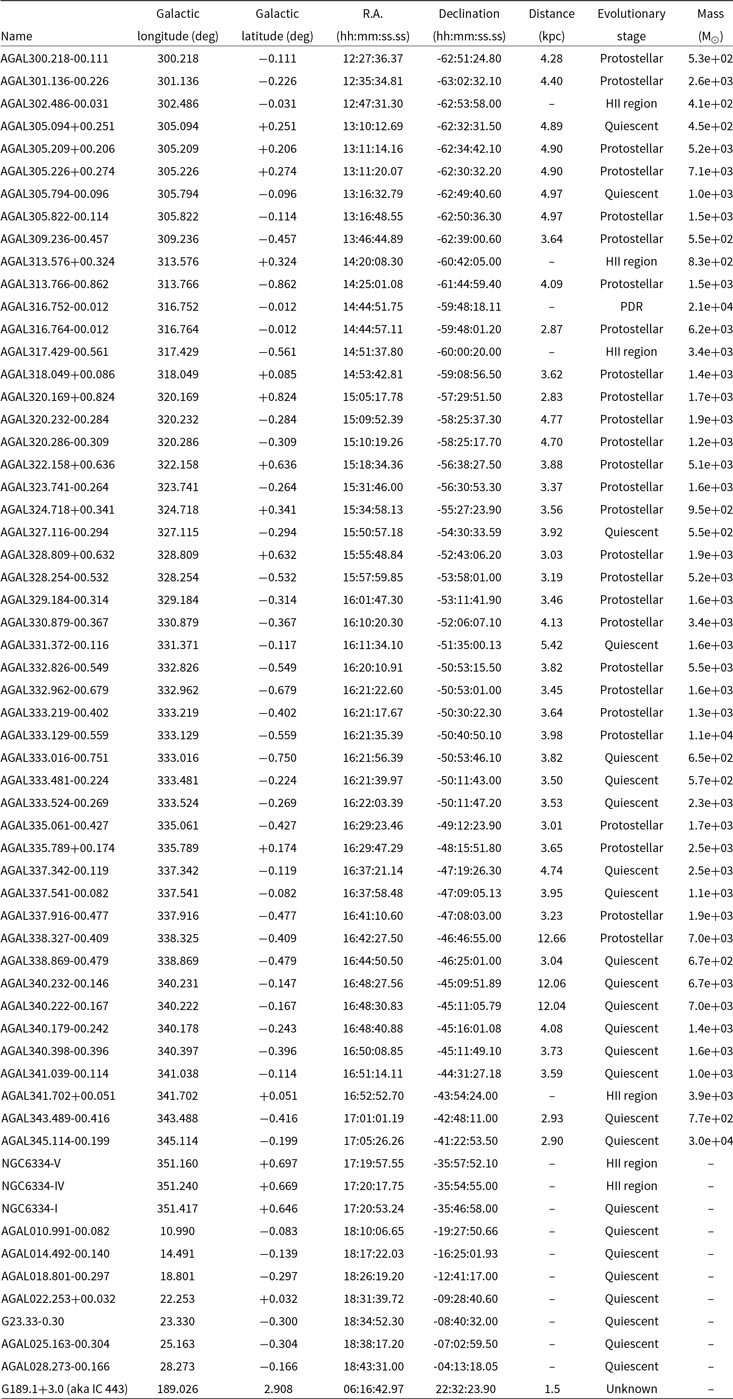
The mid-IR images from the GLIMPSE (Benjamin, Churchwell, & Babler Reference Benjamin, Churchwell and Babler2003; Churchwell et al. Reference Churchwell2009) and MIPSGAL (Carey et al. Reference Carey2009) surveys can be used to characterise the clump’s evolutionary stage (Jackson et al. Reference Jackson2013). Of the 60 targets included here, 25 are classified as ‘quiescent’ and 27 as ‘protostellar’ clumps. These young clumps are promising locations at which to observe nascent massive star formation in its earliest phases. Of the remaining sources, 6 are HII regions and one (AGAL316.752-00.012) is a PDR; the evolutionary stage of IC 443 is unknown. Details of the observed sources are given in Table 1.
List of observed sources and targeted coordinates. Distances, where available, are taken from Whitaker et al. (Reference Whitaker2018) except that for G189.1+3.0 (also known as IC 443), taken from McEwen et al. (Reference McEwen, Pihlström and Sjouwerman2016).
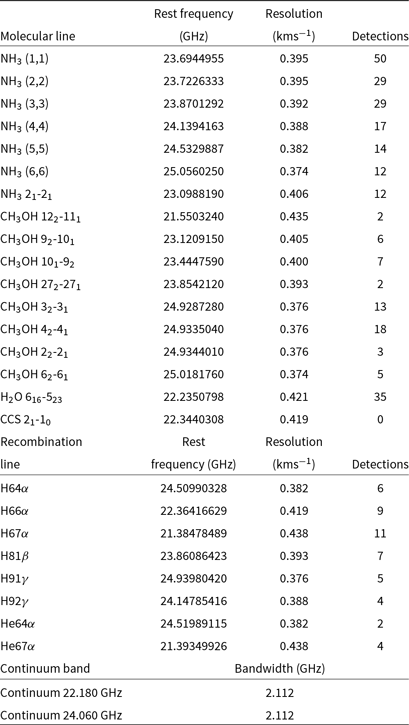
Summary of molecular and recombination lines observed, and central frequency of the 2-GHz-wide broadband continuum bands. Rest frequencies, obtained from the Splatalogue (https://splatalogue.online) are from Pickett et al. Reference Pickett1998, with the exception of the CCS $2_1$
-
$2_1$
- $1_0$
line which is from Müller et al. Reference Müller, Schlöder, Stutzki and Winnewisser2005). Detections, at the target coordinates, are based on an SNR of 5; see Section 4 for data reduction details.
$1_0$
line which is from Müller et al. Reference Müller, Schlöder, Stutzki and Winnewisser2005). Detections, at the target coordinates, are based on an SNR of 5; see Section 4 for data reduction details.
3. Observations
To carry out the survey, observations were made using the Australia Telescope Compact ArrayFootnote
a
(ATCA) in the southern winter semesters (April to September) from 2017 to 2020. A total of 84 observing sessions were completed. Observations between 21.550 and 25.057 GHz were made using the zoom-band mode of the Compact Array Broadband Backend (CABB; Wilson et al. Reference Wilson2011), with 64-MHz-wide bands and 32-kHz channels. Two 2-GHz-wide continuum bands were also observed. The zoom bands were chosen to cover the primary molecular emission lines of interest: the first six metastable inversion transitions of ammonia, a selection of methanol lines between 23 and 25 GHz, the 23.3-GHz thioxoethenylidene (CCS) transition, the masing water line at 22.2350798 GHz and the H67 $\alpha$
recombination line. The resulting spectral resolution was approximately 0.4 km/s; precise parameters for each observed line are given in Table 2.
$\alpha$
recombination line. The resulting spectral resolution was approximately 0.4 km/s; precise parameters for each observed line are given in Table 2.
In addition to the targeted lines, other spectral lines were observed serendipitously (these included additional ammonia and methanol lines as well as other recombination lines). Details of the full set of observed (and reduced) spectral lines are shown in Table 2: in total, there were 17 molecular emission lines and six hydrogen and two helium recombination lines.
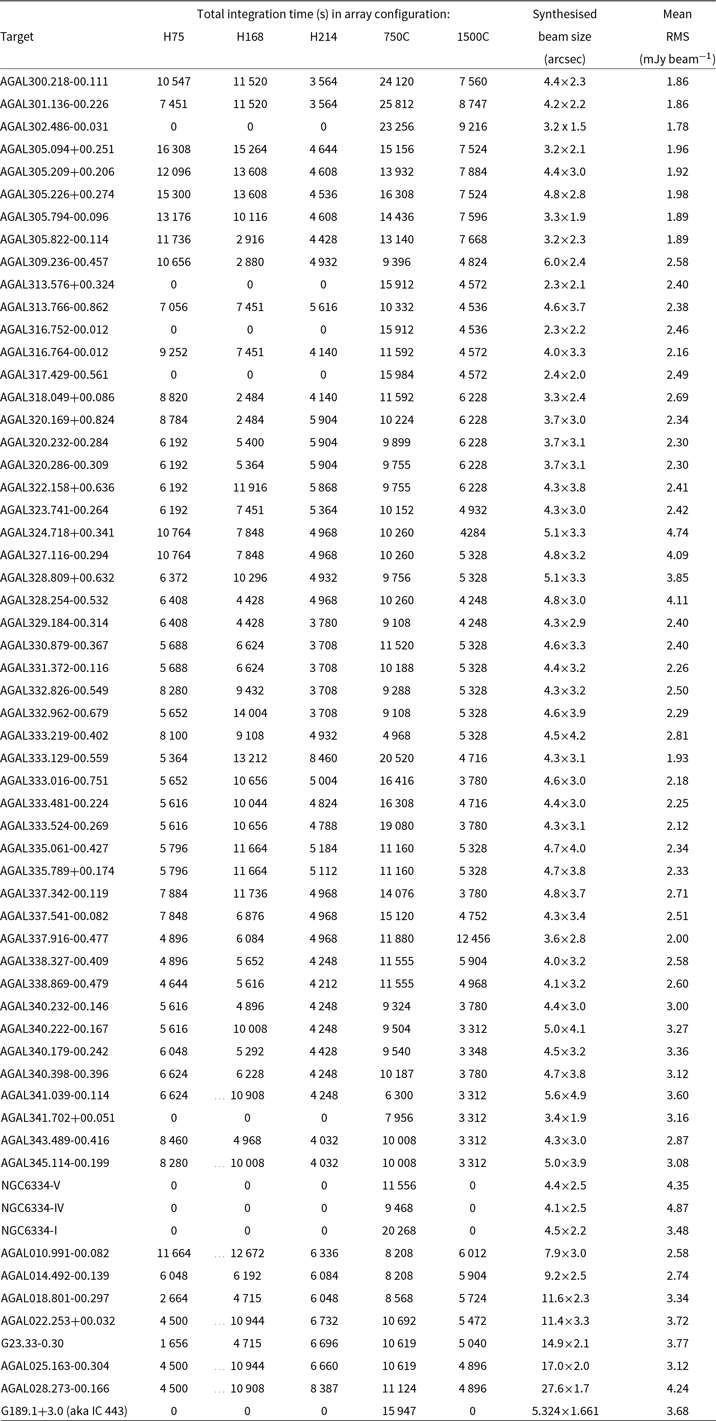
The observations were repeated using five interferometer array configurations: H75, H168, H214, 750C, and 1500C. The configuration names reflect the shortest baseline (in metres) between the array’s antennas; the long-baseline data from antenna CA06 (minimum 3 000-m baseline) was included in the data reduction. The total integration times in each array configuration for the science targets are given in Table 3, along with the synthesised beam sizes (generally approximately 4.5 by 3.0 arcsec) and the RMS noise levels (averaged over all data cubes for each target, typically around 2.5 mJy/beam).
We used standard calibration sources for bandpass, flux, and phase calibration. The quasar 1253-055 was generally used for bandpass calibration, with the BL Lac object PKS 0537-441 used for early-rising sources; the bandpass calibrator was observed once per day. Flux calibration was performed using the quasar 1934-638, also observed once per day. Phase calibrators were selected from the ATCA Calibrator Database for each science target; in most cases the calibrator was shared by multiple close targets. Phase calibrators were chosen which were bright in the 15-mm band and preferably less than 5 degrees away; compromises were resolved in favour of brightness and at the expense of distance from the target. The phase calibrators were observed every 5–15 min, depending on the prevailing atmospheric conditions and the number of targets sharing the calibrator. Overall, the weather throughout the survey was very favourable, with generally dry atmospheric conditions and low to moderate wind speeds.
4. Data reduction
The observations resulted in approximately 5 TB of raw data, which was processed using the Miriad software suite (Sault, Teuben, & Wright Reference Sault, Teuben and Wright1995), following the usual steps for radio-interferometry data reduction. The data were split into individual visibility files, each containing data from a single zoom band for a single source (whether calibrator or science target).
Flagging was performed on the visibility data, removing edge channels (first and last channel of each band) and spuriously high-amplitude visibilities (above 1 000 Jy for all zoom bands except that containing the masing $\mathrm{H}_2\mathrm{O}$
line, for which the threshold was 100 000 Jy). RFI-affected channels were removed, followed by manual inspection of the visibility time-series to remove observations made during periods of high atmospheric instability (identified by particularly noisy or rapidly varying phase measurements), guided by the observing logs.
$\mathrm{H}_2\mathrm{O}$
line, for which the threshold was 100 000 Jy). RFI-affected channels were removed, followed by manual inspection of the visibility time-series to remove observations made during periods of high atmospheric instability (identified by particularly noisy or rapidly varying phase measurements), guided by the observing logs.
Bandpass and flux solutions were calculated and applied to each calibration source, and phase correction solutions then calculated. Flux calibrator observations are not available for five observing sessions (2017-07-12, 2017-07-16, 2017-09-09, 2017-09-11, 2018-08-29): on these days the flux calibration solution from the previous day (next day for 2017-07-16) was used. The calibrator solutions were then applied to the science sources.
The calibrated data from all observing sessions was then combined, and channel frequencies converted to velocities using the rest frequencies given in Table 2. Baseline continuum emission was subtracted, and a Fourier transformation performed to produce ‘dirty’ data cubes for each science source, for each spectral line or continuum band. A 1-arcsec pixel size was chosen, in comparison with typical beam sizes of around 3 arcsec, and 512-pixel square images were produced for each spectral channel, large enough to extract a 3-arcmin square region in Galactic coordinates. The FWHM primary beam of the ATCA at these frequencies is $\sim$
2 arcmin. The channel images were then concatenated to form (
$\sim$
2 arcmin. The channel images were then concatenated to form ( $\ell$
,b,v) data cubes.
$\ell$
,b,v) data cubes.
Cleaning was carried out using Miriad’s two-threshold clean function on the central 50% of the image (linear, i.e. 50% of each spatial dimension) using 100 iterations; other settings were the phat parameter of 0.1, gain parameter of 0.1 and two cutoff thresholds of 5 and 1 times the dirty image RMS, as measured using imstat (restricted to emission-free channels). The images were then converted to Galactic coordinates, trimmed to 3-arcmin square regions, and moment 0 (integrated intensity), moment 1 (flux weighted velocity) and moment 2 (velocity dispersion) maps derived. The spectrum at the central (target) position of each cube was also extracted for reference. Finally, the maps and data cubes were converted to FITS files.
Of the 60 sources observed, 50 were detected in the ammonia (1,1) line, 12 in all ammonia lines up to (6,6), and 18 in at least 1 methanol line. Line detection counts, using a SNR threshold of 5, for the central target locations, are given in Table 2. Radio continuum emission was observed within the field of 44 targets.
5. Derived physical properties
5.1. Model of ammonia emission
A model containing five Gaussian hyperfine line components was fitted to the ammonia (1,1) and (2,2) transition spectra, for all pixels in each map, after spatial smoothing was performed by averaging the emission over square regions 5 pixels across. The model attempts to fit the nuclear quadrupole hyperfine structure of the $\mathrm{NH}_3$
lines (Ho & Townes Reference Ho and Townes1983); it does not take into account the additional, smaller, magnetic hyperfine splitting. Since the line widths are in general much larger than this smaller splitting, modelling only the five nuclear quadrupole hyperfine lines is adequate. The model contained seven parameters: the velocity of the main hyperfine component (
$\mathrm{NH}_3$
lines (Ho & Townes Reference Ho and Townes1983); it does not take into account the additional, smaller, magnetic hyperfine splitting. Since the line widths are in general much larger than this smaller splitting, modelling only the five nuclear quadrupole hyperfine lines is adequate. The model contained seven parameters: the velocity of the main hyperfine component ( $\mathrm{V}_\mathrm{LSR}$
), the full-width half-maximum amplitude line width (FWHM; common to all components) and five amplitude parameters, one for each hyperfine component, fitted independently. The satellite hyperfine component spacings are given in Table 4. Initial values of the amplitudes were 0.1 Jy/beam for the main component and 0.05 Jy/beam for the satellite components and 5 km/s for the FWHM. The initial value of the
$\mathrm{V}_\mathrm{LSR}$
), the full-width half-maximum amplitude line width (FWHM; common to all components) and five amplitude parameters, one for each hyperfine component, fitted independently. The satellite hyperfine component spacings are given in Table 4. Initial values of the amplitudes were 0.1 Jy/beam for the main component and 0.05 Jy/beam for the satellite components and 5 km/s for the FWHM. The initial value of the $\mathrm{V}_\mathrm{LSR}$
was taken from the ammonia emission as follows.
$\mathrm{V}_\mathrm{LSR}$
was taken from the ammonia emission as follows.
List of integration times, in seconds, by telescope array configuration. The array configuration names (H75, for example) reflect the length of the shortest baseline in metres. The ‘mean RMS’ is provided as representative of the noise in the data cubes, calculated as the mean of the RMS for each target, averaged over each data cube and over all spectral lines.
Velocity of ammonia hyperfine components, relative to the main component, used in the 5-component hyperfine model.

The ratio of the main component amplitude to the satellite component amplitude for the ammonia (2,2) line is intrinsically larger than for the (1,1) line, due to the components’ quantum statistical weights, and the (2,2) emission was readily detected for most sources. In comparison, some sources exhibited optically thick ammonia (1,1) emission, with the main component amplitude comparable to (or sometimes even lower than) the satellite component amplitudes. Thus, the velocity of the peak ammonia (2,2) emission was used as the initial estimate of $\mathrm{V}_\mathrm{LSR}$
, where detected; otherwise, the velocity of the peak ammonia (1,1) emission was used.
$\mathrm{V}_\mathrm{LSR}$
, where detected; otherwise, the velocity of the peak ammonia (1,1) emission was used.
Fitting was carried out by the curve_fit routine from the scipy.optimize library in Python, using the TRF (‘Trust Region Reflective’) algorithm. The fitted model parameters were then used to estimate the optical depth and rotational excitation temperature across each map. In addition, the model was fitted to the ammonia (3,3) emission in order to estimate the optical depth of this transition.
5.2. Optical depth
The rotational excitation temperature and optical depth were calculated from the fitted hyperfine parameters for the ammonia (1,1) and (2,2) transitions, following Mangum & Shirley (Reference Mangum and Shirley2015). Optical depth, $\tau$
, is estimated from the relative brightness of the satellite hyperfine transitions to the main component and cannot be calculated analytically. It was therefore estimated numerically from all four satellite hyperfine components simultaneously (using the Levenberg–Marquardt algorithm to minimise the sum-of-squares error between the data and the model); an initial value of
$\tau$
, is estimated from the relative brightness of the satellite hyperfine transitions to the main component and cannot be calculated analytically. It was therefore estimated numerically from all four satellite hyperfine components simultaneously (using the Levenberg–Marquardt algorithm to minimise the sum-of-squares error between the data and the model); an initial value of $\tau = 1.0$
was used.
$\tau = 1.0$
was used.
Positions of masers identified in the CACHMC survey. Each maser can be found in the data cube referred to in the column ‘Map name’. Galactic longitude and latitude are given in degrees, velocities in km/s and maximum intensity in mJy. These sources were identified as masers on the basis of their narrow line width, brightness, and point-source-like nature. (c) candidate maser: identification as a maser is not certain. Rest frequencies for the lines are given in Table 2.

Let $T_R(m)$
and
$T_R(m)$
and $T_R(s)$
be the measured intensity of the main and satellite hyperfine components, respectively, and
$T_R(s)$
be the measured intensity of the main and satellite hyperfine components, respectively, and $\tau_{(1,1)}$
the optical depth of the main component of the ammonia (1,1) emission. We obtained
$\tau_{(1,1)}$
the optical depth of the main component of the ammonia (1,1) emission. We obtained $\tau_{(1,1)}$
by solving
$\tau_{(1,1)}$
by solving
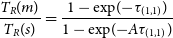 \begin{align} \frac{T_R(m)}{T_R(s)} = \frac{1-\exp\!({-}\tau_{(1,1)})}{1-\exp\!({-}A\tau_{(1,1)})} \end{align}
simultaneously for the inner ( $A = \frac{5}{18}$
) and outer (
$A = \frac{5}{18}$
) and outer ( $A = \frac{2}{9}$
) hyperfine components; the sum-of-squares error for the four components was minimised to obtain the best fit. The published data set (see Section 8) also contains estimated optical depths for ammonia (2,2) (
$A = \frac{2}{9}$
) hyperfine components; the sum-of-squares error for the four components was minimised to obtain the best fit. The published data set (see Section 8) also contains estimated optical depths for ammonia (2,2) ( $A_\mathrm{inner} = 0.0651$
,
$A_\mathrm{inner} = 0.0651$
, $A_\mathrm{outer} = 0.0628$
) and (3,3) (
$A_\mathrm{outer} = 0.0628$
) and (3,3) ( $A_\mathrm{inner} = 0.03$
,
$A_\mathrm{inner} = 0.03$
, $A_\mathrm{outer} = 0.0296$
).
$A_\mathrm{outer} = 0.0296$
).
5.3. Rotational excitation temperature
Using $\tau_{(1,1)}$
and the FWHM for the (1,1) and (2,2) transitions,
$\tau_{(1,1)}$
and the FWHM for the (1,1) and (2,2) transitions, $\Delta v_{(1,1)}$
and
$\Delta v_{(1,1)}$
and $\Delta v_{(2,2)}$
, respectively, the excitation temperature was then calculated (Mangum & Shirley Reference Mangum and Shirley2015) using the brightness temperature of the
$\Delta v_{(2,2)}$
, respectively, the excitation temperature was then calculated (Mangum & Shirley Reference Mangum and Shirley2015) using the brightness temperature of the $\mathrm{NH}_3$
(1,1) and (2,2) transitions,
$\mathrm{NH}_3$
(1,1) and (2,2) transitions, $T_{B,(1,1)}$
and
$T_{B,(1,1)}$
and $T_{B,(2,2)}$
, respectively, as
$T_{B,(2,2)}$
, respectively, as
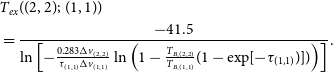 \begin{align} & T_{ex}((2,2);\ (1,1)) \nonumber \\ & = \frac{-41.5} {\ln\left[ -\frac{0.283 \Delta v_{(2,2)}}{\tau_{(1,1)}\Delta v_{(1,1)}} \ln\left( 1- \frac{T_{B,(2,2)}}{T_{B,(1,1)}} (1-\exp\!{[}{-}\tau_{(1,1)})] ) \right) \right] }. \end{align}
The statistical errors for the ammonia (1,1), (2,2), and (3,3) optical depths and for the rotational excitation temperature were computed using a bootstrapping Monte Carlo approach. For each model parameter, a random value was drawn 1 000 times from a Gaussian distribution with mean equal to the optimal parameter value and variance equal to the variance of the parameter estimates, as reported by the fitting routine. The optical depth and excitation temperature were then calculated using each set of random parameters, and the mean and variance of the resulting distributions calculated to estimate the uncertainty of these derived values. These values are included in the data release; variances for the optical depth are typically below 0.1 and below 2 for the excitation temperature.
The rotational excitation temperatures calculated from the CACHMC data at the target locations have a mean of 19.42 and range of 11.37–28.38. These values in agreement with previously reported data: for example, Urquhart et al. (Reference Urquhart2011) reports a mean of 19.3 and range of 10.2–39.0 for a large sample of similar massive star-forming regions. Line widths are also in accord to those previously reported, with a mean of 3.03 (range 0.57–10.43) in the CACHMC data, compared with 1.9 (range 0.2–7.8) (Urquhart et al. Reference Urquhart2011.)
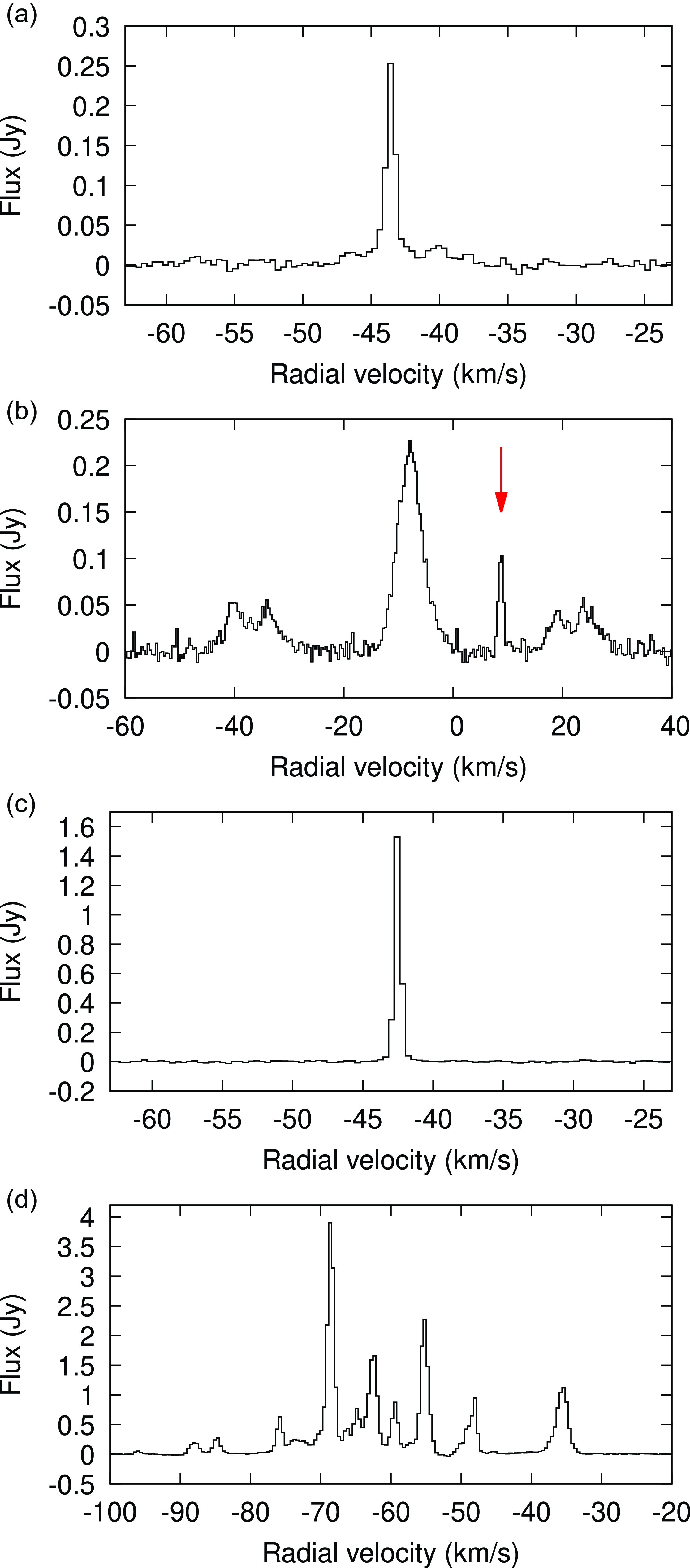
Spectra of selected masers detected during the survey. (a) AGAL337.916-00.477 (‘Nessie A’) $\mathrm{NH}_3$
(3,3) maser; (b) NGC6334-I
$\mathrm{NH}_3$
(3,3) maser; (b) NGC6334-I $\mathrm{NH}_3$
(6,6) maser, at 8.926 km/s (indicated by the red arrow: other emission is thermal); (c) AGAL305.209+00.206
$\mathrm{NH}_3$
(6,6) maser, at 8.926 km/s (indicated by the red arrow: other emission is thermal); (c) AGAL305.209+00.206 $\mathrm{CH}_3\mathrm{OH}$
10-9 maser; (d) AGAL335.789+00.174
$\mathrm{CH}_3\mathrm{OH}$
10-9 maser; (d) AGAL335.789+00.174 $\mathrm{H}_2\mathrm{O}$ $6_{16}$
-
$6_{16}$
- $5_{23}$
maser. Channel widths are approximately 0.4 ms
$5_{23}$
maser. Channel widths are approximately 0.4 ms $^{-1}$
. The masers can be found in these targets’ data cubes; coordinates of the maser sites are given in Table 5.
$^{-1}$
. The masers can be found in these targets’ data cubes; coordinates of the maser sites are given in Table 5.
5.4. Hyperfine anomalies
The fitted hyperfine component amplitudes were used to examine the so-called ‘hyperfine anomaly’ (HFA) for ammonia (1,1), wherein the left and right outer satellite hyperfine components are not equally strong, and similarly for the inner components: theory predicts that each pair should be of equal integrated intensity under LTE excitation. This effect was observed on the maps of at least 36 sources: as previous observations had shown (see, for example, Stutzki et al. Reference Stutzki, Jackson, Olberg, Barrett and Winnewisser1984; Garay & Lizano Reference Garay and Lizano1999; Longmore et al. Reference Longmore, Burton, Barnes, Wong, Purcell and Ott2007; Camarata, Jackson, & Chambers Reference Camarata, Jackson and Chambers2015), HFAs were found to be common at the peak of ammonia emissions. In this survey, however, observations of the extended, fainter, ammonia emission revealed that the HFA is also present in those regions and appears to be spatially varying.
Maps of the HFA (inner and outer ratios) are included in the data release. These were calculated using integrated intensity (spatially smoothed by averaging emission over square regions 5 pixels across) from the targets’ ammonia (1,1) data cubes. Each component was summed over velocities within 10 channels of the hyperfine component velocity, with spacings as given in Table 4 and based on the fitted radial velocity, and within 8 channels for the main (central) component (not used for the ratio calculations but provided in the data release).
6. Masers
Many of the observed spectral bands included molecular line transitions capable of masing. These include ammonia (3,3), ammonia (6,6), water $6_{16}$
-
$6_{16}$
- $5_{23}$
and multiple methanol transition lines. The lines, locations, velocities, and peak flux of detected masers and maser candidates are given in Table 5. These sources were identified as masers on the basis of their narrow line width, brightness and point-source-like nature. Examples of maser spectra observed are shown in Fig. 1.
$5_{23}$
and multiple methanol transition lines. The lines, locations, velocities, and peak flux of detected masers and maser candidates are given in Table 5. These sources were identified as masers on the basis of their narrow line width, brightness and point-source-like nature. Examples of maser spectra observed are shown in Fig. 1.
A map of the 22.180-GHz continuum emission for AGAL337.916-00.477 (‘Nessie A’); contours show the moment 0 ammonia (1,1) emission (contour values are 1, 50, 200, and 500 mJy/beam).

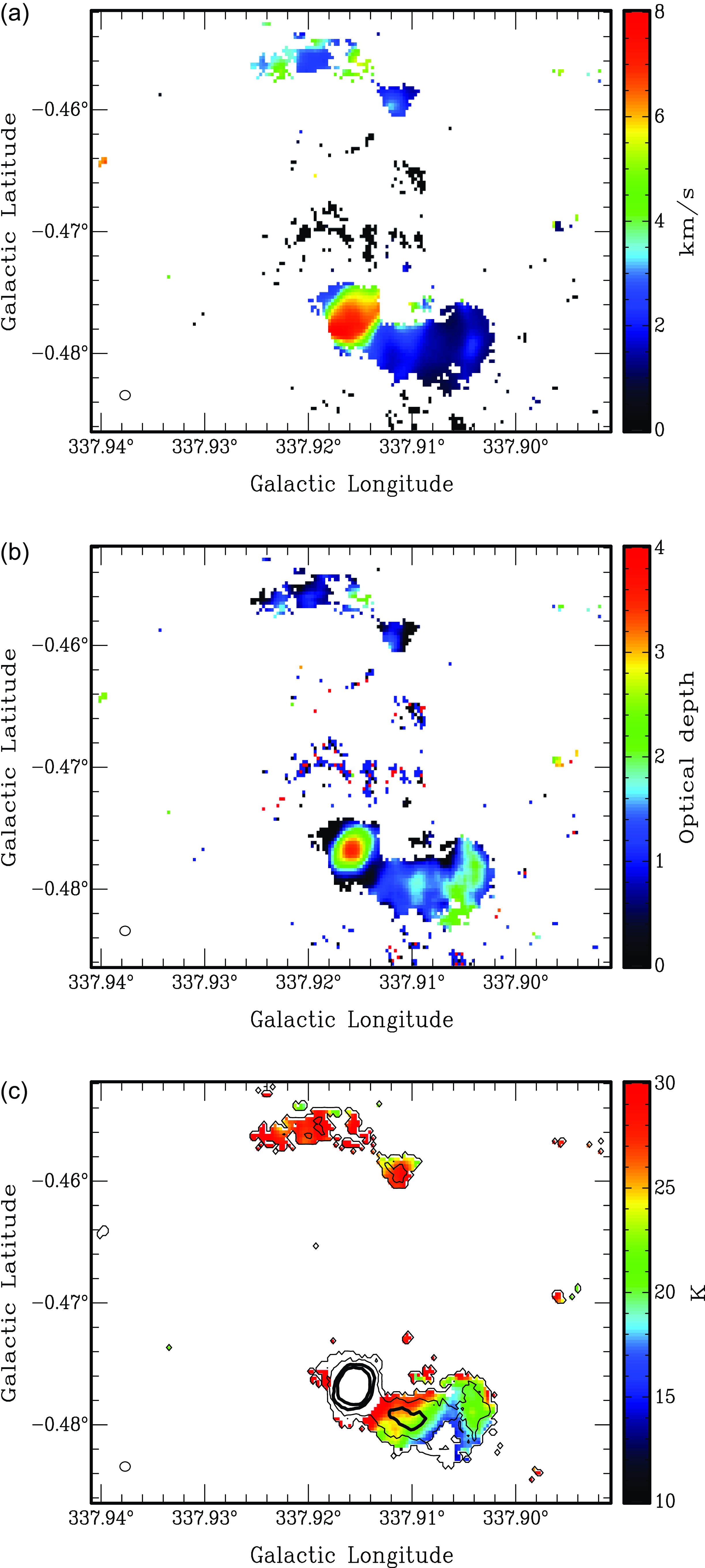
Maps showing derived physical properties of AGAL337.916-00.477 (‘Nessie A’): (a) full-width half-maximum line width, (b) optical depth, and (c) excitation temperature, $T_{ex}$
(with
$T_{ex}$
(with $\mathrm{NH}_3$
(1,1) contours as in Fig. 2 included for reference). At the peak of ammonia emission, near (337.915
$\mathrm{NH}_3$
(1,1) contours as in Fig. 2 included for reference). At the peak of ammonia emission, near (337.915 $^\mathrm{o}$
, -0.478
$^\mathrm{o}$
, -0.478 $^\mathrm{o}$
), the derived temperature becomes non-physical, since the
$^\mathrm{o}$
), the derived temperature becomes non-physical, since the $\mathrm{NH}_3$
(2,2) emission is stronger than (1,1): the assumption of LTE is broken, assuming a single gas component. The beam,
$\mathrm{NH}_3$
(2,2) emission is stronger than (1,1): the assumption of LTE is broken, assuming a single gas component. The beam, $3.6\times 2.8$
arcsec across, is shown as a small ellipse in the lower left-hand corner of each map.
$3.6\times 2.8$
arcsec across, is shown as a small ellipse in the lower left-hand corner of each map.
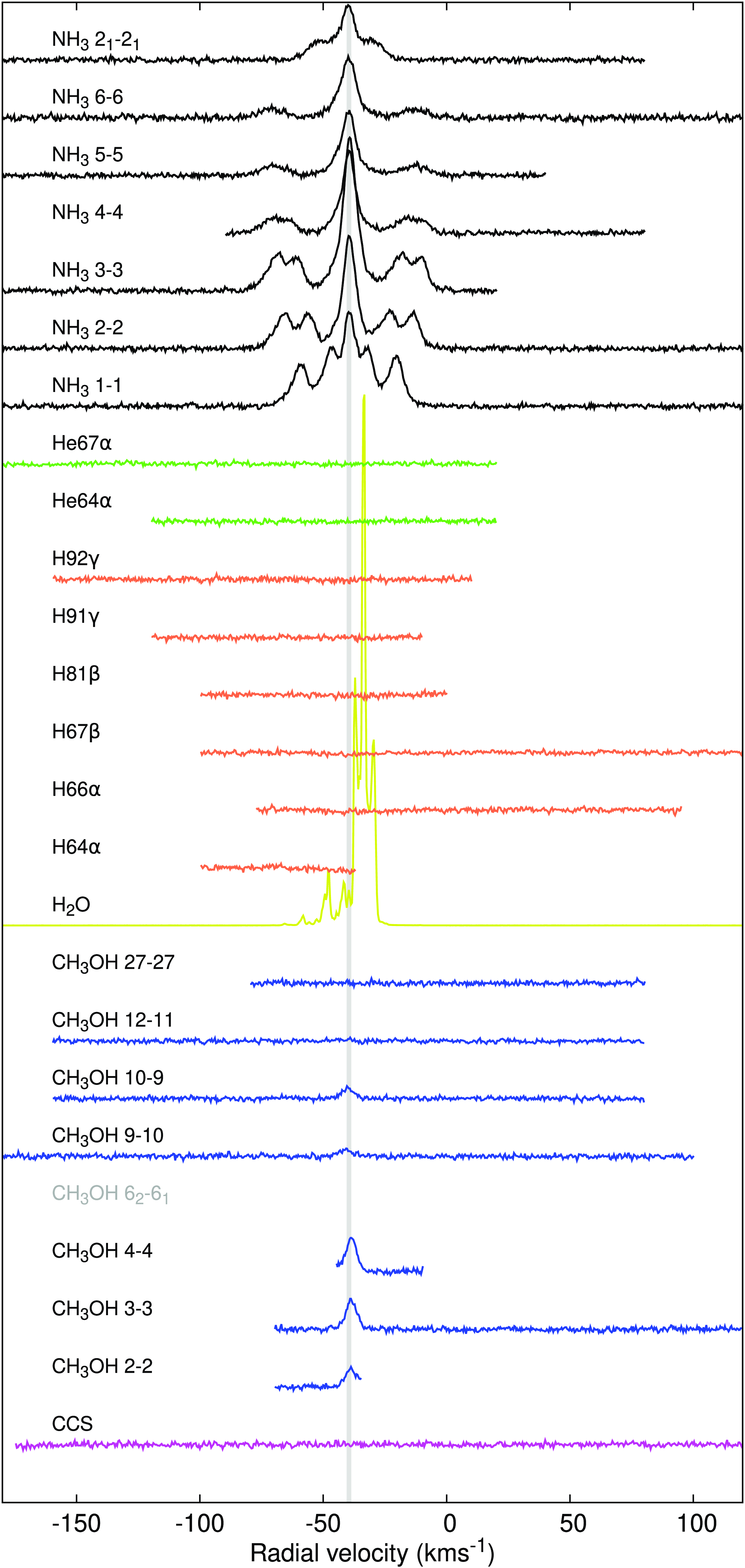
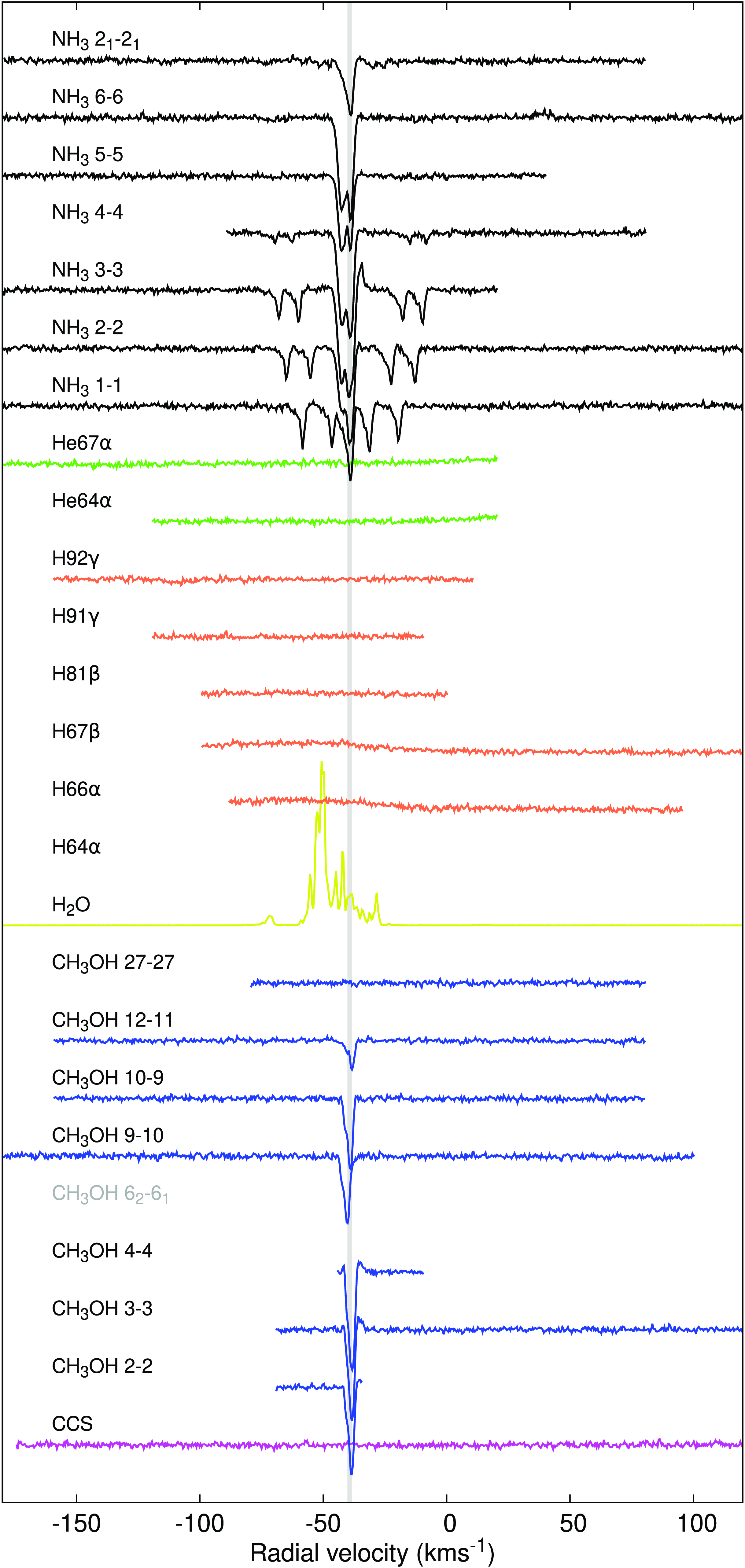
A combined plot of transition lines at the target position of AGAL337.916-00.477 (‘Nessie A’). Lines are all shown at the same scale (except for the masing $\mathrm{H}_2\mathrm{O}$
line, shown in yellow, whose emission has been down-scaled by 100X) and have been vertically offset from each other by 0.2 Jy/beam. The data is aligned to radial velocity: a vertical bar has been added at the target’s systemic velocity (
$\mathrm{H}_2\mathrm{O}$
line, shown in yellow, whose emission has been down-scaled by 100X) and have been vertically offset from each other by 0.2 Jy/beam. The data is aligned to radial velocity: a vertical bar has been added at the target’s systemic velocity ( $-39.58$
km/s) to aid visual interpretation. The plotted velocity range of the data reflects the number of channels in each transition line’s data cube, which varies. Note that there is no
$-39.58$
km/s) to aid visual interpretation. The plotted velocity range of the data reflects the number of channels in each transition line’s data cube, which varies. Note that there is no $\mathrm{CH}_3\mathrm{OH}$ $6_2$
-
$6_2$
- $6_1$
data for this target: it lies outside the velocity limits of the receiver band for this line. Line colours distinguish the different molecules and atoms.
$6_1$
data for this target: it lies outside the velocity limits of the receiver band for this line. Line colours distinguish the different molecules and atoms.
A map of the $\mathrm{NH}_3$
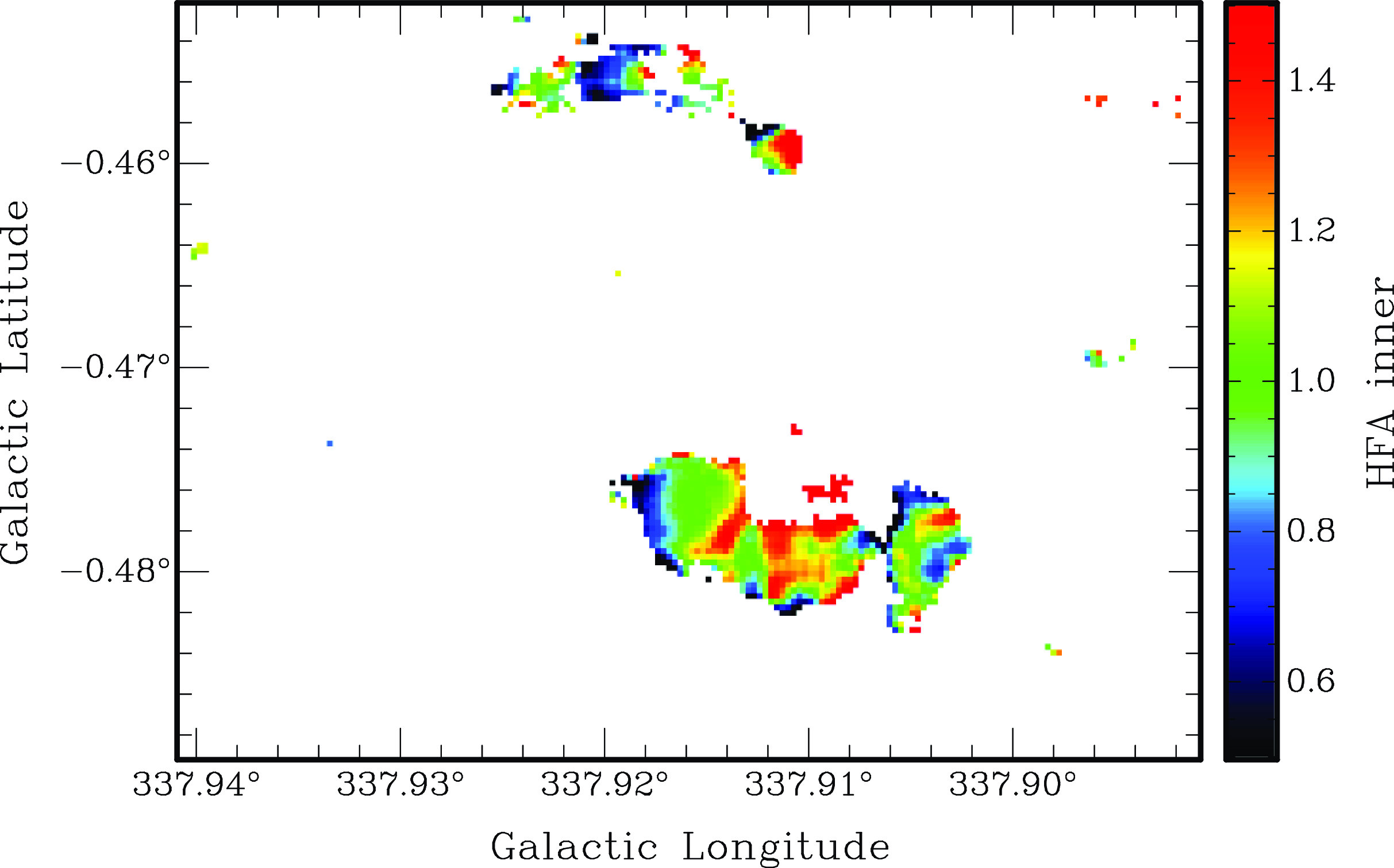
(1,1) hyperfine anomaly, showing the ratio of the left inner hyperfine component to the right inner hyperfine component, for AGAL337.916-00.477 (‘Nessie A’). The relative velocities of the components are given in Table 4.
$\mathrm{NH}_3$
(1,1) hyperfine anomaly, showing the ratio of the left inner hyperfine component to the right inner hyperfine component, for AGAL337.916-00.477 (‘Nessie A’). The relative velocities of the components are given in Table 4.
Multiple ammonia masers were observed, including two previously unknown ammonia (3,3) masers in the ‘Nessie Nebula’ (Jackson et al. Reference Jackson, Finn, Chambers, Rathborne and Simon2010), near the positions of the dense clumps AGAL337.916-00.477 (‘Nessie A’, Fig. 1(a)) and AGAL338.327-00.409 (‘Nessie C’). A previously known ammonia (6,6) maser in NGC6334-I was confirmed (Beuther et al. 2007, Fig. 1(b)).
Masers were observed in 6 methanol transition lines. The survey detected Type I methanol masers in the 2-2, 3-3, 4-4, 6-6, and 10-9 transitions and Type II methanol masers in the $9_{2}$
-
$9_{2}$
- $10_{1}$
transition.
$10_{1}$
transition.
The methanol 10-9 transition is a very rare masing line, first detected in 2011 (Voronkov et al. Reference Voronkov2011). We observed a maser at this frequency near AGAL305.209+00.206 (Fig. 1(c)), and three candidate maser sites near AGAL330.879-00.367. Type II methanol masers, in the rare $\mathrm{CH}_3\mathrm{OH}$ $9_{2}$
-
$9_{2}$
- $10_{1}$
masing line at 23.121 GHz, were detected near NGC6334-I and NGC6334-V; the former has been observed previously (Cragg et al. Reference Cragg2004).
$10_{1}$
masing line at 23.121 GHz, were detected near NGC6334-I and NGC6334-V; the former has been observed previously (Cragg et al. Reference Cragg2004).
The $\mathrm{H}_2\mathrm{O}$
22.2350798-GHz spectral line is a common maser transition that indicates shocks associated with star-forming regions. Water masers were detected towards 43 of the 60 observed clumps, often slightly displaced from the ammonia emission peaks. Almost all of these exhibited multiple velocity components: one of the sites near AGAL335.789+00.174 contains at least 12 distinct peaks at different velocities (Fig. 1(d)).
$\mathrm{H}_2\mathrm{O}$
22.2350798-GHz spectral line is a common maser transition that indicates shocks associated with star-forming regions. Water masers were detected towards 43 of the 60 observed clumps, often slightly displaced from the ammonia emission peaks. Almost all of these exhibited multiple velocity components: one of the sites near AGAL335.789+00.174 contains at least 12 distinct peaks at different velocities (Fig. 1(d)).
The data release contains the spectra of the detected masers and candidates and maps showing the position of the masers relative to the ammonia (1,1) emission for each target.
7. Data examples
7.1. Example source: AGAL337.916-00.477
This section presents data for one science target, AGAL337.916-00.477, a dense clump associated with the infrared-dark filament known as the ‘Nessie Nebula’ (Jackson et al. Reference Jackson, Finn, Chambers, Rathborne and Simon2010). This target is of great interest as a potential massive star-forming site. Ammonia emission in the Nessie Nebula has been previously studied (see, for example, Goodman et al. Reference Goodman2014; Purcell et al. Reference Purcell2012; Zucker, Battersby, & Goodman Reference Zucker, Battersby and Goodman2015). We hereafter refer to this source as ‘Nessie A’.
Nessie A is a hot protostellar source, containing a previously unknown ammonia (3,3) maser (see Fig. 1(a)). A map of its ammonia (1,1) and 22.180-GHz continuum emission is shown in Fig. 2. It is turbulent, with very high spectral line widths, hot, as all observed ammonia transition lines are strong, and has high optical depth. Maps of the measured line width for $\mathrm{NH}_3$
(1,1), estimated rotational excitation temperature (using
$\mathrm{NH}_3$
(1,1), estimated rotational excitation temperature (using $\mathrm{NH}_3$
(1,1) and (2,2)) and the optical depth of the
$\mathrm{NH}_3$
(1,1) and (2,2)) and the optical depth of the $\mathrm{NH}_3$
(1,1) main component emission are shown in Fig. 3. The line spectra at the target coordinates of Nessie A are shown in Fig. 4.
$\mathrm{NH}_3$
(1,1) main component emission are shown in Fig. 3. The line spectra at the target coordinates of Nessie A are shown in Fig. 4.
Nessie A contains many features of interest in the CACHMC data. These include extended ammonia emission from the (1,1) transition up to the (6,6) transition, a 22- and 24-GHz continuum point source and extended continuum emission. Ammonia (3,3) and water masers are present and line widths vary from very high in the central region (7–8 kms $^{-1}$
FWHM) to narrow (1–2 kms
$^{-1}$
FWHM) to narrow (1–2 kms $^{-1}$
FWHM) in the extended emission. In addition, Nessie A exhibits the ammonia HFA described in Section 5.4, for both inner and outer hyperfine components; the ratio of inner components is shown in Fig. 5.
$^{-1}$
FWHM) in the extended emission. In addition, Nessie A exhibits the ammonia HFA described in Section 5.4, for both inner and outer hyperfine components; the ratio of inner components is shown in Fig. 5.
7.2. Absorption lines
The survey revealed interesting absorption features against the free-free continuum emission from a central H II region. Such absorption was most prominent at the central positions of AGAL301.136-00.226, AGAL328.809+00.632, and AGAL332.826-00.549, with strong absorption in all ammonia lines. Absorption features were prominent at off-centre positions for AGAL320.232-00.284, AGAL322.158+00.636 and NGC6334-IV, but only for the $\mathrm{NH}_3$
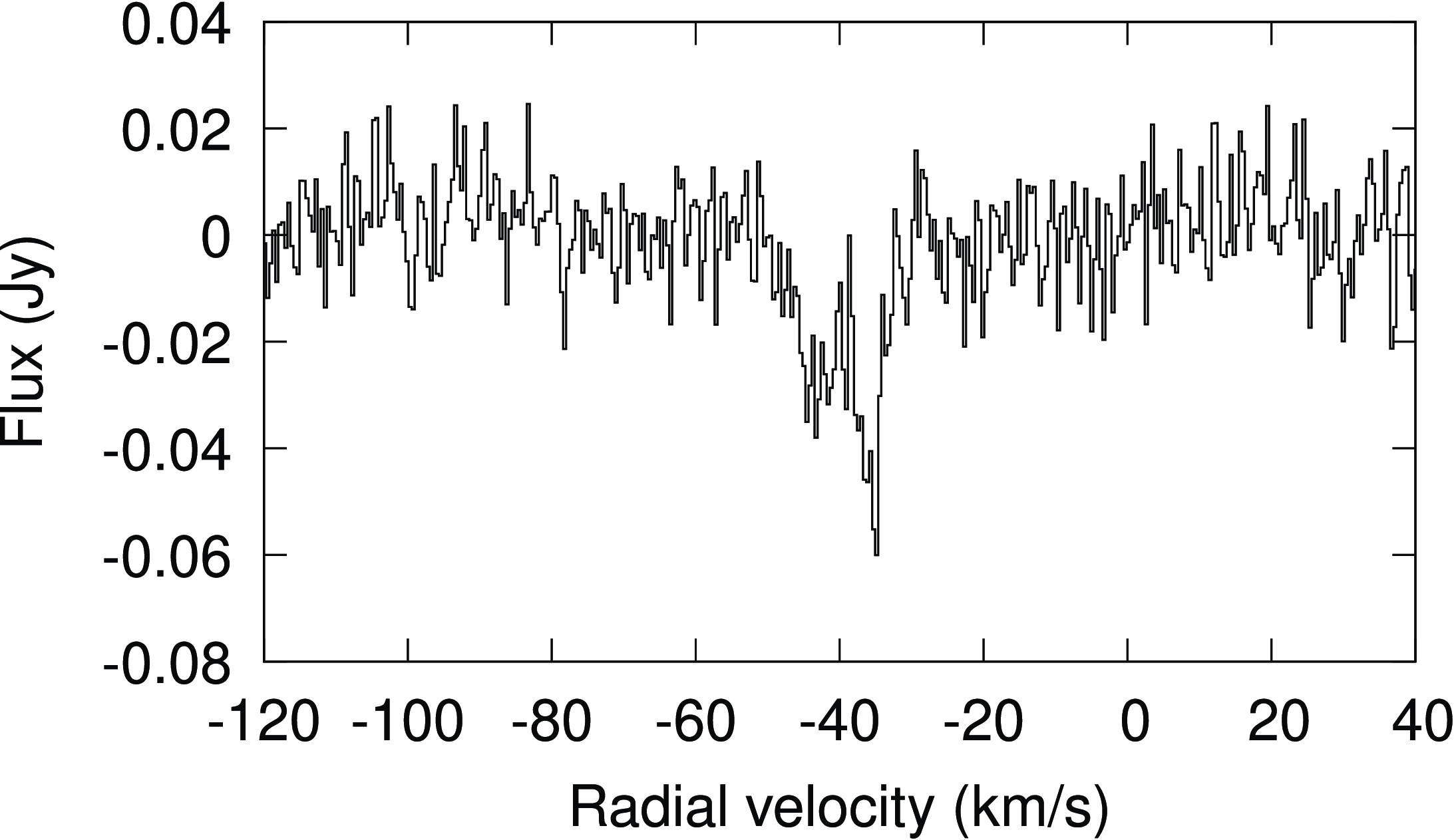
(1,1) and (2,2) lines. The central spectra for AGAL301.136-00.226 are shown in Fig. 6, where absorption in all ammonia and most methanol lines can be seen. In addition, an unexpected absorption feature in the 22.23 GHz water line was observed for AGAL328.809+00.632, at the same radial velocity as the ammonia absorption features. This feature is shown in Fig. 7.
$\mathrm{NH}_3$
(1,1) and (2,2) lines. The central spectra for AGAL301.136-00.226 are shown in Fig. 6, where absorption in all ammonia and most methanol lines can be seen. In addition, an unexpected absorption feature in the 22.23 GHz water line was observed for AGAL328.809+00.632, at the same radial velocity as the ammonia absorption features. This feature is shown in Fig. 7.
A combined plot of transition lines for AGAL301.136-00.226. Strong absorption can be seen in the ammonia and methanol spectral bands, along with evidence of emission at the edge of the $\mathrm{CH}_3\mathrm{OH}$
3-3 and 4-4 absorption features. The target exhibits ammonia emission close to the absorption velocity. Lines are all shown at the same scale (except for the masing
$\mathrm{CH}_3\mathrm{OH}$
3-3 and 4-4 absorption features. The target exhibits ammonia emission close to the absorption velocity. Lines are all shown at the same scale (except for the masing $\mathrm{H}_2\mathrm{O}$
line, whose emission has been down-scaled by 100X) and have been vertically offset from each other by 0.2 Jy/beam. The data is aligned to radial velocity: a vertical bar has been added at the target’s systemic velocity (
$\mathrm{H}_2\mathrm{O}$
line, whose emission has been down-scaled by 100X) and have been vertically offset from each other by 0.2 Jy/beam. The data is aligned to radial velocity: a vertical bar has been added at the target’s systemic velocity ( $-39.2850$
kms
$-39.2850$
kms $^{-1}$
) to aid visual interpretation. The plotted velocity range of the data reflects the number of channels in each transition line’s data cube, which varies. Note that there is no
$^{-1}$
) to aid visual interpretation. The plotted velocity range of the data reflects the number of channels in each transition line’s data cube, which varies. Note that there is no $\mathrm{CH}_3\mathrm{OH}$ $6_2$
-
$6_2$
- $6_1$
data for this target: they lie outside the velocity limits of the receiver band for this line. Line colours distinguish the different molecules and atoms.
$6_1$
data for this target: they lie outside the velocity limits of the receiver band for this line. Line colours distinguish the different molecules and atoms.
Absorption feature in the 22-GHz water spectral band for AGAL328.809+00.632; it is almost central to the map, lying 1–2 arcsec away from the position of maximum ammonia absorption, and the radial velocity of this absorption feature matches the radial velocity of emission and absorption in other spectral lines.
8. Data release
The CACHMC dataFootnote b (https://doi.org/10.25919/74nw-9r95) is available to download from the CSIRO’s Data Access Portal, at https://data.csiro.au/collection/csiro:59354. The project website at https://cachmc.space provides galleries of moment maps and central spectra.
The files included in the data release are arranged into five directories, each (except masers/) containing a subdirectory for each science target:
-
• data/: data cubes and derived moment maps, RMS maps and central spectra;
-
• hfa/: ammonia (1,1) hyperfine anomaly maps; and
-
• ircontext/: mid-infrared context images overlaid with ammonia (1,1) emission contours;
-
• masers/: catalogue and spectra of detected masers.
-
• temperature/: derived temperature and optical depth maps;
In addition to the observations detailed in Section 3, continuum data was collected at 5.5 GHz and 9.0 GHz for 15 targets exhibiting strong 22- and 24 GHz continuum emission; these observations were undertaken during weather unsuitable for the usual, higher frequency, observations. The raw data for these observations (as well as all other CACHMC raw data) are available in CSIRO’s Australia Telescope Online ArchiveFootnote c (ATOA) with the project code ‘C3152’.
Details of the directory structure and the included files in the data release are given in Appendix 9.
9. Summary
The CACHMC Legacy Survey was carried out on the ATCA over four winter observing seasons and successfully observed 60 potential sites of future high-mass star formation. High signal-to-noise ratio data for ammonia (J,K) = (1,1) through (6,6) transitions were collected, and 24 ammonia (3,3) masers identified, along with 19 spectral lines (including $\mathrm{H}_2\mathrm{O}$
and methanol masing lines). Continuum emission was measured at 22 and 24 GHz. Ammonia HFAs were observed and found to be common, as previous studies have shown, but also occurring in spatially extended molecular gas.
$\mathrm{H}_2\mathrm{O}$
and methanol masing lines). Continuum emission was measured at 22 and 24 GHz. Ammonia HFAs were observed and found to be common, as previous studies have shown, but also occurring in spatially extended molecular gas.
Data products from the survey have been prepared and include FITS data cubes for the observed spectral lines, along with central spectra and moment 0, 1, and 2 maps for the 60 targets. These observations are now available to characterise the turbulent structure within the target clumps and to measure the locations, temperatures, masses, temporal sequence and kinematics of their individual star-forming cores.
Competing interests
None.
Data availability statement
The CACHMC data (https://doi.org/10.25919/74nw-9r95) is available to download from the CSIRO’s Data Access Portal at https://data.csiro.au/collection/csiro:59354.
Appendix: Structure of published data
A. Directory: data/
The reduced observational data is contained in the data/ directory. There is a subdirectory for each science target, containing a subdirectory for each spectral band. Within the spectral band subdirectories are files with the following extensions, for each of the spectral lines (listed in Table 2):
-
• .cube.fits: data cube FITS file
-
• .mom0.fits: moment 0 FITS file
-
• .mom0.png: moment 0 map
-
• .autoscaled.mom0.png: moment 0 map
-
• .mom1.fits: moment 1 FITS file
-
• .mom1.png: moment 1 map
-
• .autoscaled.mom1.png: moment 1 map
-
• .mom2.fits: moment 2 FITS file
-
• .mom2.png: moment 2 map
-
• .autoscaled.mom2.png: moment 2 map
-
• .rms.fits: RMS map FITS file
-
• .rms.png: RMS map image
-
• .centralspectrum.png: plot of the line spectrum at the target coordinates
-
• .centralspectrum.txt: text file containing the spectrum at the target coordinates
Directories for the two continuum bands contain only the integrated intensity FITS file and map images. From the spectral line data cubes, the RMS of each cleaned cube was calculated, using channels identified as signal-free across all sources. For some targets not all channels were available (due to their systemic velocity). Moment map images have been masked at a signal-to-noise ratio of 5.
The FITS files and PNG images with spatial dimensions are 3 arcmin square, in Galactic coordinates centred on the target’s location. The autoscaled images use a colour range derived from the minimum and maximum values; non-autoscaled images use a colour range from $-0.1$
to 1 Jy to aid comparison between targets (
$-0.1$
to 1 Jy to aid comparison between targets ( $-0.005$
to 0.05 Jy for the continuum files).
$-0.005$
to 0.05 Jy for the continuum files).
B. Directory: hfa/
The hfa/ directory contains ammonia (1,1) HFA map images, along with the integrated intensity files used to produce them. The integrated intensity at each point was spatially smoothed by averaging over a square 5 $\times$
5-pixel region. The maps show the left outer to right outer and the left inner to right inner
$\times$
5-pixel region. The maps show the left outer to right outer and the left inner to right inner $\mathrm{NH}_3$
(1,1) hyperfine integrated intensity ratios, with a subdirectory for each target; the displayed range in each map is 0.2–2.0. Files with the following extensions are provided:
$\mathrm{NH}_3$
(1,1) hyperfine integrated intensity ratios, with a subdirectory for each target; the displayed range in each map is 0.2–2.0. Files with the following extensions are provided:
-
• .HFAinner.fits: inner hyperfine intensity ratio (left inner:right inner)
-
• .HFAinner.png: inner hyperfine intensity ratio map
-
• .HFAouter.fits: outer hyperfine intensity ratio (left outer:right outer)
-
• .HFAouter.png: outer hyperfine intensity ratio map
-
• .leftInnerII.fits: integrated intensity of the left inner $\mathrm{NH}_3$
(1,1) hyperfine component
$\mathrm{NH}_3$
(1,1) hyperfine component -
• .leftOuterII.fits: integrated intensity of the left outer
$\mathrm{NH}_3$
(1,1) hyperfine component -
• .mainII.fits: integrated intensity of the main
$\mathrm{NH}_3$
(1,1) hyperfine component -
• .rightInnerII.fits: integrated intensity of the right inner
$\mathrm{NH}_3$
(1,1) hyperfine component -
• .rightOuterII.fits: integrated intensity of the right outer
$\mathrm{NH}_3$
(1,1) hyperfine component


The hyperfine intensity ratio maps have been masked at a signal-to-noise ratio of 5.
C. Directory: ircontext/
Mid-infrared context images from the Spitzer Space Telescope are included for each target, using data from the GLIMPSE (Benjamin et al. Reference Benjamin, Churchwell and Babler2003; Churchwell 2009) and MIPSGAL (Carey et al. Reference Carey2009) surveys of the Galactic Plane. The red, green and blue channels show MIPS 24- $\mu$
m, IRAC 8-
$\mu$
m, IRAC 8- $\mu$
m and IRAC 3.6-
$\mu$
m and IRAC 3.6- $\mu$
m emission, respectively, and contours show the ammonia (1,1) emission, drawn between the minimum and maximum integrated intensity values.
$\mu$
m emission, respectively, and contours show the ammonia (1,1) emission, drawn between the minimum and maximum integrated intensity values.
The context images were created using DS9 (Joye & Mandel Reference Joye, Mandel, Payne, Jedrzejewski and Hook2003), with 12 contour linearly spaced contour levels drawn, using the ‘minmax’ scale, so that the lowest contour is at the minimum value of the data and the highest contour is at the maximum value of the data, with 10 evenly spaced contours in between. The contours were drawn with a spatial smoothing parameter of 3. Due to the dynamic range of the ammonia (1,1) emission, these contours do not represent the data as easily as the moment 0 maps, but the context and location of the targets in their local Galactic environment is shown.
D. Directory: masers/
The masers/ directory contains a tab-separated catalogue file listing detected masers along with the spectrum at each detected location. The spectrum is provided both as a plot of brightness versus velocity (in the maserspectra/ subdirectory) and as a text file containing the same data (in the maserspectratxt/ subdirectory).
The masermaps/ subdirectory contains a contour map of the ammonia (1,1) integrated intensity for each science target with detected masers, overlaid with markers (listed in the file legend.txt) distinguishing the various masing molecules.
File names begin with the target name (referring to the data cube in which the maser can be found), followed by a letter (a, b, c, …), if required, to distinguish multiple masers of the same line on the same map, and an abbreviation of the spectral line of the maser.
E. Directory: temperature/
Best-fit model parameters for ammonia (1,1), (2,2), and (3,3) emission spectra, along with the derived optical depths and rotational excitation temperature (using ammonia (1,1) and (2,2)), are contained in the temperature/ directory. These derived values were calculated from the data cubes, spatially smoothed by averaging over a square 5 $\times$
5-pixel region. There is a subdirectory for each science target, containing files with the following extensions for ammonia (1,1), (2,2), and (3,3):
$\times$
5-pixel region. There is a subdirectory for each science target, containing files with the following extensions for ammonia (1,1), (2,2), and (3,3):
-
• .SSE.fits: model fitting sum-of-squares error
-
• .fwhm.fits: fitted FWHM
-
• .fwhm_variance.fits: fitting variance of FWHM
-
• .tau.fits: estimated optical depth from best-fit model parameters
-
• .tau.png: estimated optical depth map image
-
• .tauMean.fits: mean value of optical depth from bootstrapped error estimates
-
• .tauVar.fits: variance of optical depth from bootstrapped error estimates
-
• .v0.fits: fitted radial velocity
-
• .v0_variance.fits: fitting variance for radial velocity
In addition to these model and derived values, the rotational excitation temperature, calculated using ammonia (1,1) and (2,2) emission, is given in files with the following extensions:
-
• .nh3.Tex.fits: estimated rotational excitation temperature
-
• .nh3.Tex.png: estimated rotational excitation temperature map
-
• .nh3.TexMean.fits: mean rotational excitation temperature from bootstrapped error estimates
-
• .nh3.TexVar.fits: variance of rotational excitation temperature from bootstrapped error estimates
The optical depth and rotational excitation temperature maps have been masked at a signal-to-noise ratio of 5.


 Open access

