





Inclusion is a teaching philosophy in which students with special educational needs (SEN) actively study, work and play together with their mainstream peers.Reference Voltz, Brazil and Ford1 Teachers’ attitudes towards inclusion have an impact on the success of implementing relevant inclusive practices. Furthermore, teachers’ self-efficacy beliefs are a crucial factor for promoting educational reform, redressing inequalities, fostering teacher reflection and promoting productive collaborationReference Wheatley2 as they set the tone of classrooms.Reference Carroll, Forlin and Jobling3
Studies have been conflicting regarding whether teachers’ attitude towards special learners is positive or not.Reference Bassey, Owan, Ikwen and Amanso4 Horrocks et alReference Horrocks, White and Roberts5 state that teachers ‘convey messages of acceptance or disapproval through their own actions or symbolic gestures which represent a powerful influence on schoolwide acceptance of differences’. Positive attitudes predict the successful education of children with special pedagogical needs, including autism spectrum disorder (ASD).Reference Rodríguez, Saldana and Moreno6 Conversely, negative attitudes create expectations of low achievement and low social status and can support inappropriate behaviour of students with disabilities.Reference Antonak and Larrivee7 Additionally, teachers’ expectations may come to serve as a self-fulfilling prophecy, the ‘Pygmalion effect’: verbal and non-verbal messages sent by teachers to their students may reflect their expectations and consequently affect the students’ self-expectations and self-esteem.Reference Rosenthal and Jacobson8 In their seminal work, Gibson & Dembo note that ‘teachers who in general expect students to learn and who have confidence in their ability to teach may communicate higher expectations by providing less criticism to students’.Reference Gibson and Dembo9
Students with autism are increasingly included in general education and at the same time teachers often feel unprepared and ill-equipped to meet their rather complex social, learning and behavioural needs.Reference Marks, Shaw-Hegwer, Schrader, Longaker, Peters and Powers10 Several studies show that teachers’ sense of self-efficacy has a powerful impact on their attitudes towards inclusion of students with ASDReference Lu, Zou, Chen, Chen, He and Pang11,Reference Vaz, Wilson, Falkmer, Sim, Scott and Cordier12
In defining teachers’ self-efficacy, Tschannen-Moran & Woolfolk HoyReference Tschannen-Moran and Woolfolk Hoy13 invoked cognitive–behavioural theory, writing: ‘a teacher's efficacy belief is a judgment of his or her capabilities to bring about desired outcomes of student engagement and learning, even among those students who may be difficult or unmotivated’. Previous experiences of task mastery – that is, experiences of success or failure on tasks identical to the current task – are the most important source of teacher self-efficacy. Physiological arousal, verbal persuasion and vicarious experiences are other sources.Reference Skaalvik and Skaalvik14 Teachers who express a strong belief in a particular philosophy also tend to show higher levels of educational self-efficacy.Reference Jennett, Harris and Mesibov15 Studies have shown a positive correlation between self-efficacy and teachers’ attitudes towards children with ASD.Reference Lu, Zou, Chen, Chen, He and Pang11,Reference Beamer and Yun16,Reference Segall and Campbell17 If educators believe that they can adequately teach students with ASD and produce positive outcomes, they will be more willing to include them.Reference Abegglen and Hessels18,Reference Russell, Scriney and Smyth19 According to Segall & Campbell,Reference Segall and Campbell17 placement decisions, a better understanding of children with ASD and a lower perception of disruptive behaviours correlated with higher teacher self-efficacy. Bandura emphasises that people with low self-efficacy tend to magnify possible problems and threats and dwell on their shortcomings.Reference Skaalvik and Skaalvik14
Given the rising prevalence of ASD,20,Reference Nevison, Blaxill and Zahorodny21 the need for psychometrically valid scales is critical, particularly in terms of predicting educators’ attitudes and measuring their sense of self-efficacy towards students with ASD in the context of inclusive education. Antonak & Larrivee'sReference Antonak and Larrivee7 Opinions Relative to Integration of Students with Disabilities (ORI) scale and Tschannen-Moran & Woolfolk Hoy'sReference Tschannen-Moran and Woolfolk Hoy13 short-form (12-item) Teachers’ Sense of Efficacy Scale (TSES) both have good psychometric properties and are of great interest to research internationallyReference Mezquita-Hoyos, Sanchez-Monroy, Morales-Martinez, Lopez-Ramirez and Reyna-Gonzalez22–Reference Tsigilis, Grammatikopoulos and Koustelios24 as they can be easily, economically and quickly administered.
The purpose of the present study is to test the validity across in-service and pre-service teachers of versions of the ORI and TSES translated into Greek and adapted for ASD (the ORI-ASD and TSES-ASD).
Inclusion of students with ASD in the Greek educational system
Over the past 50 years, the education of children with special needs and/or disabilities has evolved significantly worldwide. Segregation and exclusion have given way to integration and then inclusion. The beginnings of special education in Greece date back to the early 1900s.
The state was initially hesitant to take responsibility for the education of children with special needs and/or impairments, but this has changed over time. At the beginning of the 21st century, the inclusion policy – where children and young adults with ASD were classified as children with special educational needs for the first time – became one of the top priorities on the Greek educational agenda.Reference Mitroulaki, Samakouri and Serdari25 Students with ASD requiring support (level 1) can now attend a mainstream school full-time together with their peers with typical development, either permanently or temporarily, without any support or with individual ‘parallel support’ from one teacher (a co-teacher), preferably with a specialisation in autism.
Within a regular school, children with ASD requiring substantial support (level 2) can be admitted to a ‘resource class’. Two different educational programmes are offered in resource classes: (a) a special programme for all students (up to 15 h per week) and (b) an individualised programme with an extended schedule for children with more severe special needs.
Finally, young people with ASD requiring very substantial support (level 3) can alternatively be enrolled in special schools or in Special Vocational Education and Training Workshops (EEEEKs), which are vocational schools for teenagers and young people with disabilities.
Method
Sample and procedure
A cross-sectional study was conducted to evaluate in-service and pre-service teachers' attitudes towards inclusion of students with ASD. Classroom teachers and pre-service teachers were eligible to participate in the study. The survey was anonymous and participation was voluntary.
Participants’ opinions about inclusion of students with ASD were assessed using the Opinions Relative to Inclusion of Students with Autism Spectrum Disorder scale (ORI-ASD), adapted from Antonak & Larrivee's Opinions Relative to the Integration of Students with Disabilities scaleReference Antonak and Larrivee7 to ask specifically about students with ASD. The ORI-ASD consists of 25 items rated on a six-point Likert scale, from −3 (‘I disagree very much’) to +3 (‘I agree very much’). Scores range from 0 to 150, with a higher score representing a more favourable attitude towards the inclusion of students with ASD in general education classrooms. The original scale was divided into four subdomains: benefits of integration, integrated classroom management, perceived ability to teach students with disabilities, and special versus integrated special education. We have adapted their wording (e.g. changed integration to inclusion, and disability to autism spectrum disorder) to update the terminology and make it applicable to students diagnosed with autism spectrum disorder.
Participants’ sense of self-efficacy was measured using the Teachers’ Sense of Efficacy Scale – Autism Spectrum Disorder (TSES-ASD), a version of Tschannen-Moran & Woolfolk Hoy's short-form Teachers’ Sense of Efficacy ScaleReference Tschannen-Moran and Woolfolk Hoy13 modified to ask about students with ASD. The scale consists of 12 items rated on a 9-point Likert-type scale with anchors at 1 (‘none’), 3 (‘very little'), 5 (‘some influence’), 7 (‘quite a bit’) and 9 (‘a great deal’).Reference Tschannen-Moran and Woolfolk Hoy13 Higher scores indicate greater teacher self-efficacy. The original scale was divided into three subscales (student engagement, instructional strategies, classroom management) for in-service teachers and one for pre-service teachers.
Both scales were translated in Greek. The translation and adaptation to a different cultural environment ensured the necessary equivalences of the translated tool with the original, emphasising mainly conceptual rather than literal equivalence.Reference Bullinger, Alonso, Apolone, Leplège, Sullivan and Wood-Dauphinee26,Reference Herdman, Fox-Rushby and Badia27 The current study followed the internationally recognised methodological procedures for cultural adaptation.Reference Beaton, Bombardier, Guillemin and Ferraz28 For the needs of the current study, based on Cramer's methodology, permission was obtained from the authors of the ORI and TSES scales.
The study received ethical approval from the Democritus University of Thrace, Research Ethics Committee (Α.Π.:Δ.Π.Θ./ΕΗΔΕ/24657/25). Written informed consent was obtained from all subjects.
Statistical analysis
Exploratory factor analyses (EFA), with principal axis factoring extraction and Oblimin rotation, of the ORI-ASD and TSES-ASD were performed in IBM SPSS version 28.0 for Windows for the sample of primary school teachers (n = 388). The ORI-ASD produced three factors with the Kaiser criterion (eigenvalues >1) and a total of 20 items. Items were omitted when their loadings were lower than 0.300.Reference Field29 For the TSES-ASD the 12 initial items were retained and a single factor solution was proposed. Confirmatory factor analyses (CFAs) were performed to confirm the fit of the proposed factorial structures to the data from the samples of preschool teachers (n = 155) and students of educational sciences (n = 310). CFAs were performed with jamovi version 2.3.28 (jamovi project; see https://www.jamovi.org/download.html), and model fit was assessed by the indices of χ2/d.f., comparative fit index (CFI), Tucker–Lewis Index (TLI), root mean square error of approximation (RMSEA) and standardised root mean squared residual (SRMR).Reference West, Taylor, Wu and Hoyle30,Reference Wheaton, Muthen, Alwin, Summers and Heise31 The CFI, SRMR and RMSEA were used with good-fit thresholds of CFI > 0.90, SRMR < 0.08 and RMSEA < 0.08.Reference Browne, Cudeck, Bollen and Long32,Reference Dagnall, Denovan, Parker, Drinkwater and Walsh33 The use of modification indices was limited to values over 20, and only same-subscale items were covaried for better fit.Reference Dagnall, Denovan, Parker, Drinkwater and Walsh33,Reference Byrne34 For every scale and subscale and for different subsamples of the study, reliability of the proposed factors was assessed by Cronbach's α.
Results
Sample characteristics
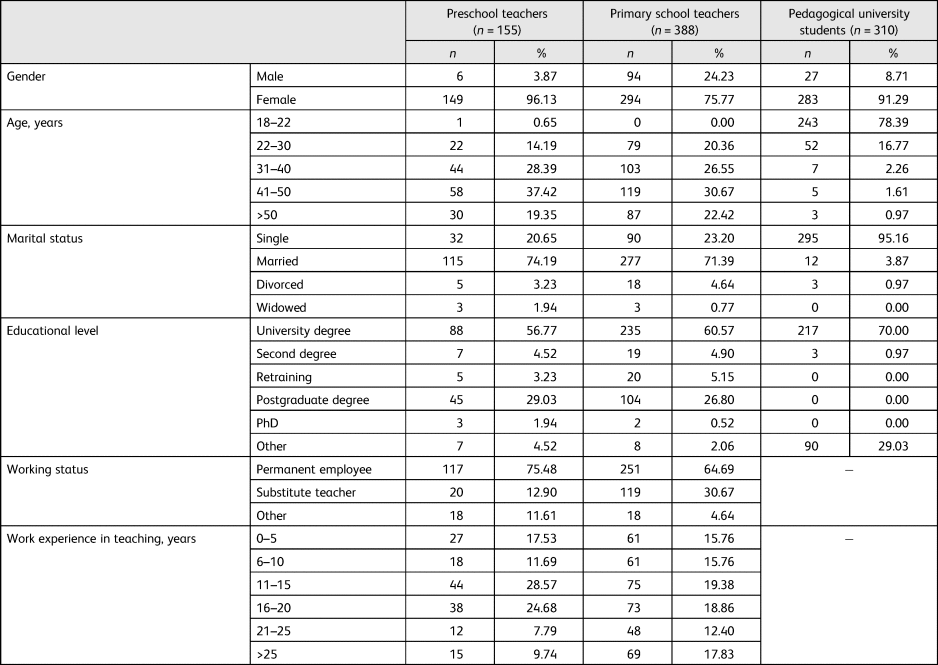
The sample consisted of 853 educators: 155 preschool teachers, 388 primary school teachers and 310 students at pedagogical university departments in Greece. Of the sample of preschool teachers 96.13% were female, 65.81% were in the age range 31–50 years, 74.19% were married and 29% had a postgraduate degree (MSc). Special education teachers accounted for 138 (16.2%) of the total sample, 25 (2.9%) of the preschool sample and 113 (13.24%) of the primary school sample. Most of the preschool (75.48%) and primary school teachers (64.69%) were permanent employees, with 53.25% of preschool teachers having 11–20 years of experience and 54% of primary school teachers having 0–15 years of experience. Detailed characteristics of the sample are presented in Table 1.
Demographic and work characteristics of survey respondents (n = 853)

Exploratory factor analysis for ORI-ASD
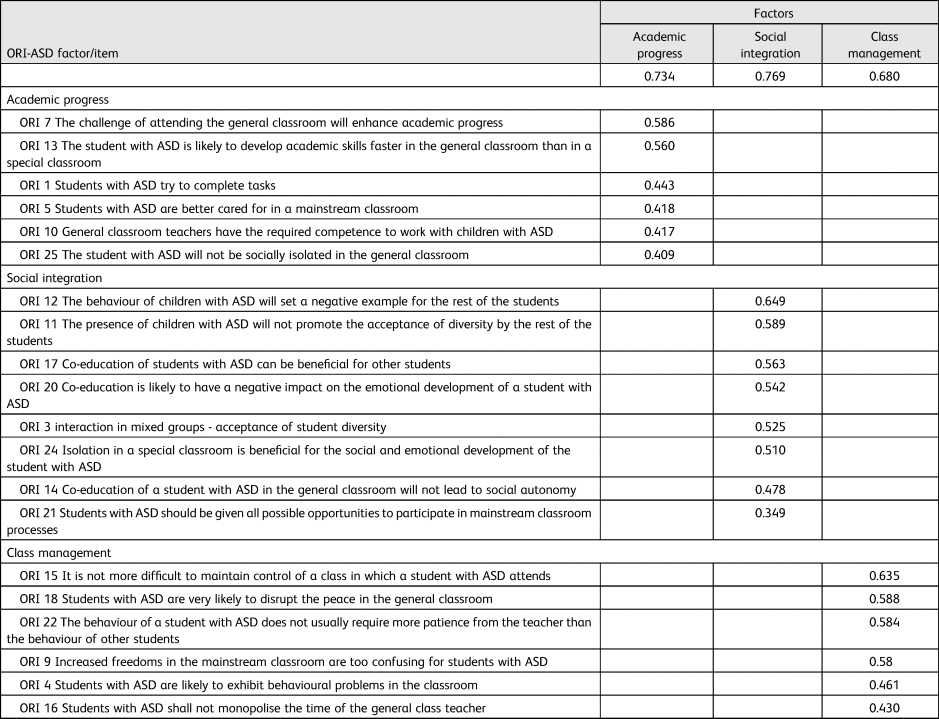
First, an exploratory factor analysis was conducted on the dimensions of the ORI-ASD questionnaire for the inclusion of students with ASD in general schools, using only the sample of primary school teachers (n = 388). The ORI-ASD produced three factors with the Kaiser criterion (eigenvalues >1) and a total of 20 items. The analysis yielded the solution of the three factors presented in Table 2. From the original 25 items of the ORI-ASD, only 20 items were preserved in the proposed solution. Items 2 (‘Extensive training of general classroom teachers’) and 23 (‘Teaching students with ASD is preferably done by special education teachers’) were removed as they did not show a correlation with any of the three factors, and items 6 (‘The extra attention required will be at the expense of other students’), 8 (‘Inclusion imposes significant changes in classroom instruction’) and 19 (‘General classroom teachers have received appropriate training to teach students with ASD’) were removed because they showed high correlations with two factors. Therefore, the final solution includes the following three factors: (a) academic progress, which includes six items with good reliability (α = 0.734) and concerns the academic benefits of inclusion for students with ASD; (b) social integration, which includes eight items with good reliability (α = 0.769) and refers to the emotional and social benefits of including students with ASD; and (c) classroom management, which includes six items with acceptable reliability (α = 0.680) and concerns perceptions of teachers regarding the ease of managing the general classroom when students with ASD are included. CFA on the sample of primary school teachers (n = 388) showed a good fit of the data to the proposed factorial structure (χ2(153) = 323, χ2/d.f. = 2.11, P < 0.001, CFI = 0.906, TLI = 0.884, RMSEA = 0.054).
Pattern matrix for the three-factor solution and item loadings on the ORI-ASD factors (primary school teachers, n = 388)

ORI-ASD, Opinions Relative to the Integration of Students with Disabilities scale modified to relate to teaching children with autism spectrum disorder.
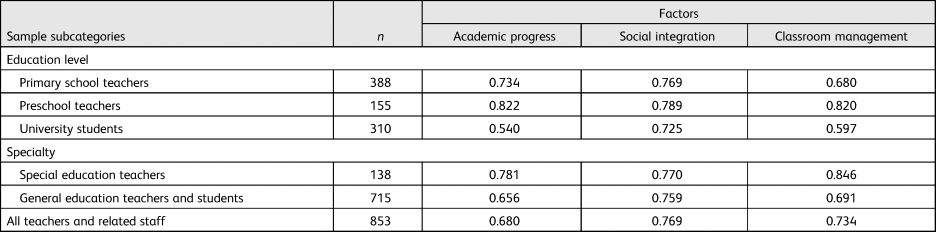
The three-factor solution obtained from the sample of teachers was examined in terms of its goodness of fit to the samples of preschool teachers (n = 155) and students (n = 310). For the sample of preschool teachers, CFA showed a good fit of the data (χ2(149) = 251, χ2/d.f. = 1.69, P < 0.001, CFI = 0.905, TLI = 0.879, RMSEA = 0.066). Also, a good fit of the data to the three-factor solution was derived for the student sample (χ2(147) = 234, χ2/d.f. = 1.59, P < 0.001, CFI = 0.903, TLI = 0.874, RMSEA = 0.044). Therefore, applying the solution of the three factors to the entire sample of teachers and students, as well as by educational level, the reliability indices presented in Table 3 are obtained.
Cronbach's α reliability indices of the ORI-ASD factors for the subcategories of the sample by grade and specialty

ORI-ASD, Opinions Relative to the Integration of Students with Disabilities scale modified to relate to teaching children with autism spectrum disorder.
Exploratory factor analysis for TSES-ASD
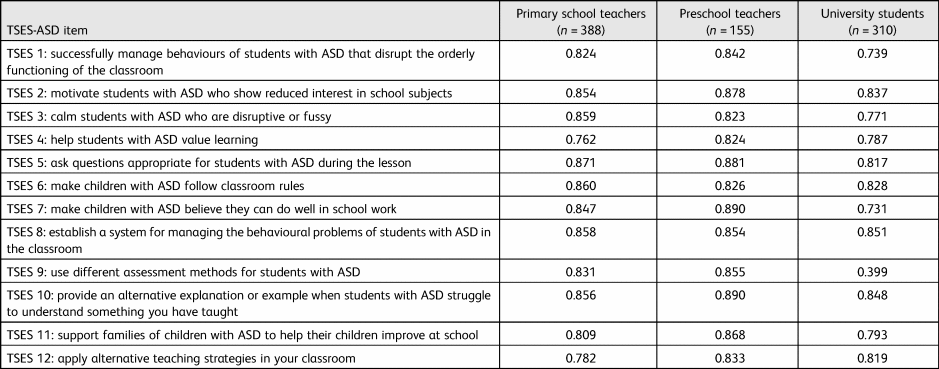
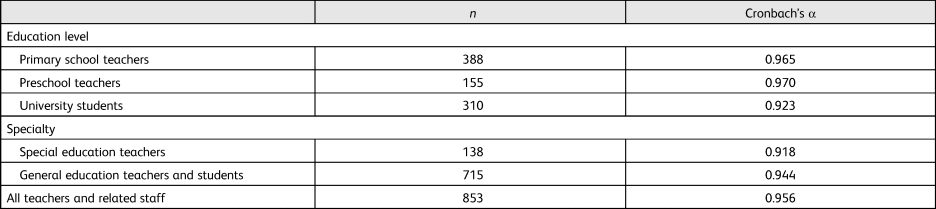
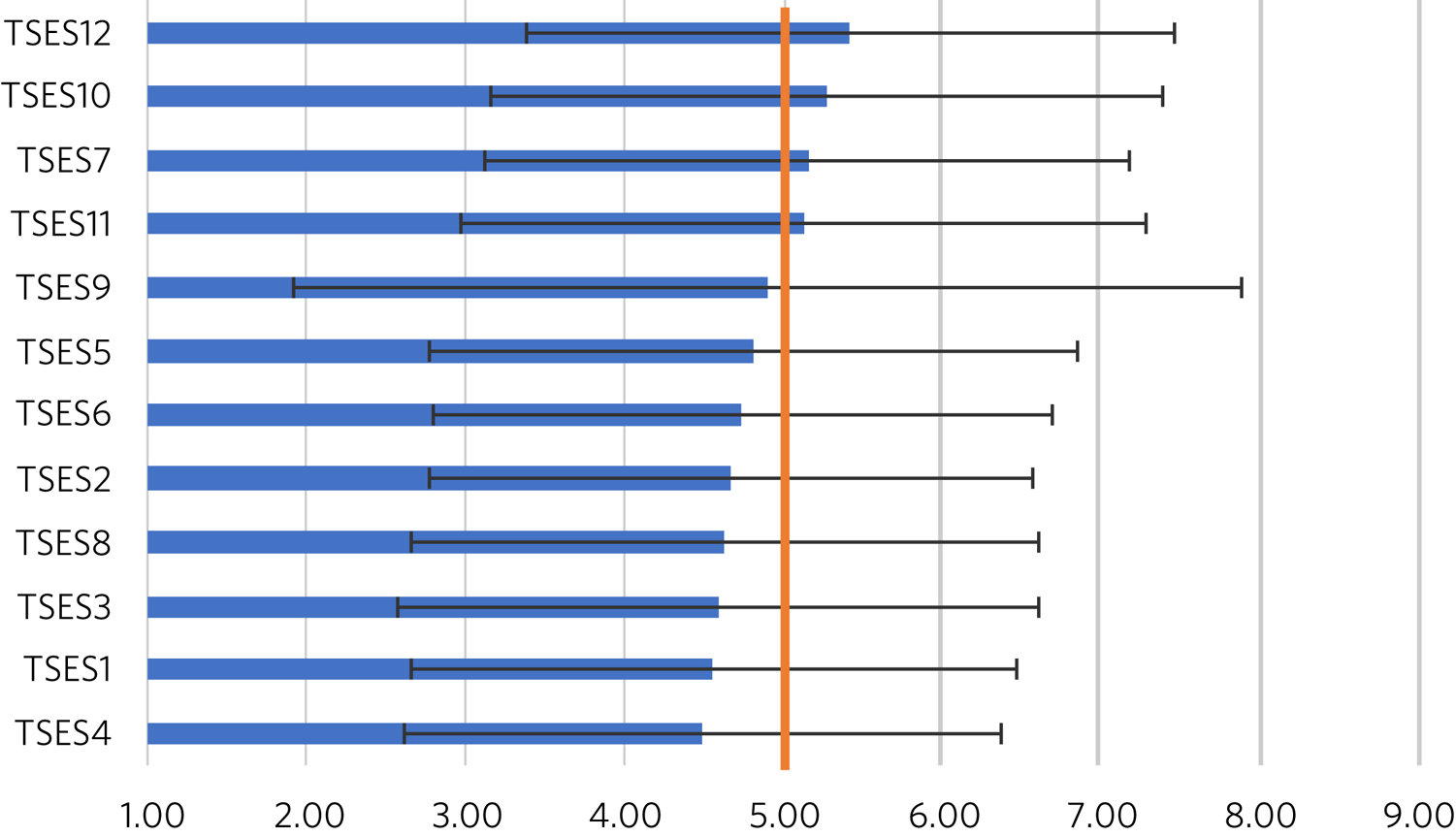
For the TSES-ASD the 12 initial items were retained and a single factor solution was proposed. Exploratory factor analysis for the TSES-ASD regarding the inclusion of students with ASD in the general classroom yielded one factor for the primary school teachers’ sample and one factor for the preschool teachers and students’ samples that included all the initial 12 scale items. The loadings of the items on the single factor by level of education do not change significantly (Table 4). The results showed a good fit of the data from the whole sample (n = 853) to the one-factor solution (χ2(45) = 234, χ2/d.f. = 5.2, P < 0.001, CFI = 0.980, TLI = 0.971, RMSEA = 0.070). Reliability indices of TSES-ASD were assessed by Cronbach's α (Table 5). Additionally, educators showed low to moderate self-efficacy beliefs (Fig. 1). High scores were reported on items such as TSES 10 ‘To what extent can you provide an alternative explanation or example when students with ASD are confused?’ and TSES 12 ‘How well can you implement alternative strategies in your classroom?’, whereas very low scores were reported on items such as TSES 1 ‘How much can you do to control disruptive behaviour in the classroom?’ and TSES 8 ‘How well can you establish a classroom management system with each group of students?’.
The one-factor solution and loadings of TSES-ASD items by level of education

TSES-ASD, Teachers’ Sense of Efficacy Scale modified to relate to teaching children with autism spectrum disorder.
Cronbach's α reliability indices of the TSES-ASD for the sample by level of education and specialty

TSES-ASD, Teachers’ Sense of Efficacy Scale modified to relate to teaching children with autism spectrum disorder.
Hierarchical display of means and standard deviations of sample responses to individual questions on the Teachers’ Sense of Efficacy Scale modified to relate to teaching children with autism spectrum disorder (TSES-ASD). TSES 12, apply alternative strategies; TSES 10, provide alternative explanation; TSES 7, believe they can do well; TSES 11, support families; TSES 9, different assessment methods; TSES 5, ask appropriate questions; TSES 6 follow classroom rules; TSES 2, motivate students; TSES 8, behaviour management system; TSES 3, calm students; TSES 1, behaviour management; TSES 4, value learning.

Discussion
Autism spectrum disorder (ASD) is an acknowledged public health issue that poses substantial challenges to educational systems all over the world. Researchers have developed scales and questionnaires to assess opinions and attitudes of educators regarding inclusion of students with special educational needs and/or disabilities in general but not specifically for ASD. However, most of these scales have been developed and validated in the English language.
The Greek version of the adapted and translated ORI, the ORI-ASD, has a different factor structure from the original version.Reference Antonak and Larrivee7 More specifically, the current analysis yielded the solution of the three factors to the entire sample of in-service and pre-service teachers, whereas a factor analysis of the original ORIReference Antonak and Larrivee7 suggested a four-factor multidimensional structure. The three factors (a) academic progress, (b) social integration and (c) classroom management may be the main components of the construct of inclusion of students with ASD into Greek educational settings. In Mexico, Mezquita-Hoyos et alReference Mezquita-Hoyos, Sanchez-Monroy, Morales-Martinez, Lopez-Ramirez and Reyna-Gonzalez22 assessed regular and special education teachers’ attitudes towards school inclusion and disability using the ORI scale and they also suggested a three- factor solution. In the USA CramerReference Cramer35 investigated pre-service teachers’ attitudes towards inclusion of students with ASD and their exploratory factor analysis of an adapted version of the ORI resulted in a two-factor structure. Rakap & KaczmarekReference Rakap and Kaczmarek23 used only the total score to evaluate teachers’ attitudes toward inclusion, as the factor analyses they conducted showed that there were several differences in the factor structure between the English version of the ORI and the translated Turkish version of the scale.
The reliability of the TSES has been demonstrated in a study by Gálvez-Nieto et al.Reference Gálvez-Nieto, Salvo-Garrido, Domínguez-Lara, Polanco-Levicán and Mieres-Chacaltana36 The TSES-12, a version of the TSES modified and translated into Greek, has a factor structure identical to the original version for pre-service teachers.Reference Tschannen-Moran and Woolfolk Hoy13 It appeared that the best solution for pre-service teachers was a single factor.Reference Tschannen-Moran and Woolfolk Hoy13 However, the solution of a single factor applied also for educators. Tschannen-Moran & Woolfolk HoyReference Tschannen-Moran and Woolfolk Hoy13 state that ‘for pre-service teachers, the total score seems to be the most appropriate gauge of efficacy as subscale scores may have little meaning for prospective teachers who have yet to assume real teaching responsibilities’. This could also apply to Greek teachers’ relative inexperience in teaching students with ASD in inclusive settings. The one-factor structure of the TSES that was revealed in Tschannen-Moran's & Woolfolk Hoy'sReference Tschannen-Moran and Woolfolk Hoy13 study with US pre-service teachers and in our study with both in-service and pre-service teachers was also replicated in a study conducted by Tsigilis et alReference Tsigilis, Grammatikopoulos and Koustelios24 involving educators teaching an innovative programme (Olympic Education Programme).
Finally, our study showed that educators did not feel competent enough to teach students with ASD, as their perceived self-efficacy ranged just below the means of the TSES scale. This is not surprising, taking into consideration that Greek pre-service and in-service teachers are not systematically prepared or trained to teach students with autism in inclusive settings. This finding is in line with the findings of Lu et al'sReference Lu, Zou, Chen, Chen, He and Pang11 study conducted with primary teachers in China as well as with a German study by Wittwer et al,Reference Wittwer, Hans and Voss37 in which teacher's self-efficacy beliefs regarding teaching children with ASD were moderate.
Thus, our results suggest that both the ORI-ASD and the TSES-ASD can be applied to pre-service and in-service educators to study their opinions regarding the inclusion of students with ASD and their overall sense of self-efficacy. Both scales demonstrate good psychometric properties in a Greek sample of teachers and university students.
Strengths and limitations
To our knowledge, there are no other relatively short measures specifically for ASD that meet the criteria for psychometric properties and utility in pre-service and in-service teachers. This study contributes to the scarce literature on pedagogical university students’ and teacher's opinions regarding inclusive education and their self-efficacy in the context of educating children with ASD. It is also noteworthy that a large sample of educators (n = 853) participated in our study. Considering both pre-service and in-service teachers’ attitudes and self-efficacy perceptions is one of the major strengths of the current study as it depicts a more comprehensive overview with important implications for university teacher training as well as professional development programmes for educators.
However, it should be noted that our study has limitations. The cross-sectional design of the study has the potential for recall bias, specifically concerning self-reported questions; thus, it restricts the probability for aetiological conclusions. Furthermore, it is well-known that adaptation of an existing scale to a different culture, ensuring the necessary equivalences of the translated tool with the original, is a challenging, arduous and continuing process.Reference Bullinger, Alonso, Apolone, Leplège, Sullivan and Wood-Dauphinee26 Although we applied a thorough approach for cultural adjustment, we recognise the possibility of additional undetermined factors. Furthermore, there might be a model complexity assumed by the TLI value, although all other model fit values are good.
Implications
Further studies should build on this work by examining the characteristics of the ORI-ASD and TSES-ASD in more detail. Furthermore, additional research should be conducted to determine the relationships between various aspects of teacher burnout, stress and depression and teacher self-efficacy for educators of children with ASD,Reference Klassen, Tze, Betts and Gordon38 as well as the potential for their abandoning of the teaching profession.Reference Skaalvik and Skaalvik14
Data availability
The data that support the findings of this study are available from the corresponding author, S.M., on reasonable request.
Author contributions
S.M.: conceptualisation and design, acquisition, analysis and data interpretation, writing the paper. E.M.: drafting the article. G.T.: reviewing of data analysis and interpretation. M.K.: drafting the article. M.S.: reviewing and editing. A.S.: design, writing, reviewing and editing the paper. The final version of the article was approved by all authors.
Funding
This research received no specific grant from any funding agency, commercial or not-for-profit sectors.
Declaration of interest
None.

 Open access


eLetters
No eLetters have been published for this article.