

Introduction
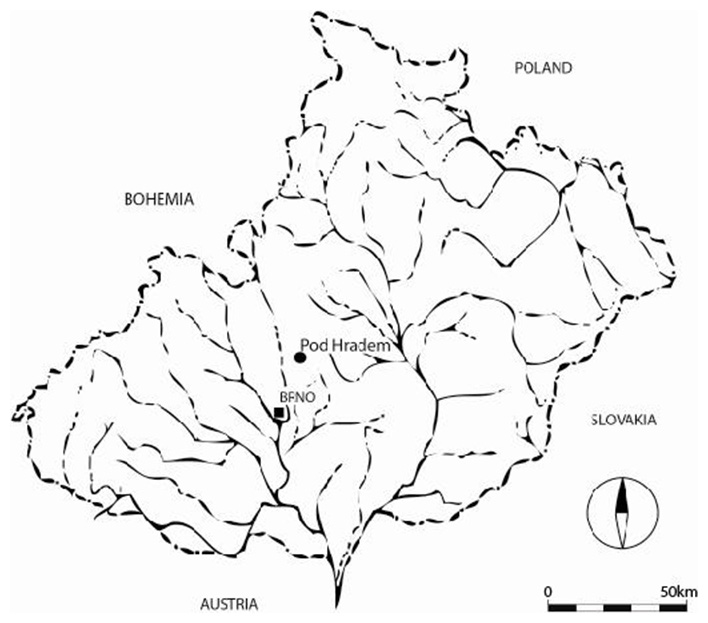
Location of Pod Hradem Cave.

Frequent, high-amplitude changes in temperature are well-documented in marine sediment and glacier cores during Marine Isotope Stage 3, however there is little information about their potentially substantial effects on environments in Central Europe. These rapid climatic and corresponding environmental changes may have had an impact on human populations in the region. This short article introduces palaeoenvironmental and archaeological results from a recent excavation at Pod Hradem Cave in Czech Republic.
Project overview
Pod Hradem cave is situated in the Moravian Karst region of southern Moravia, approximately 21km north of Brno and 4km from the well-known cave site, Kůlna (Figure 1). Pod Hradem Cave underwent limited investigations in 1890, 1896, 1897 and 1898 (Trampler 1898; Knies 1901) followed by a major excavation in 1956–58 (Musil 1965). New dates have been obtained by Neruda & Nerudová (2013) from samples from the 1950s excavations. Work to date at Pod Hradem has provided insights into cave bear and (limited) human activity during Middle and Upper Palaeolithic periods. In particular, Valoch (1965) suggested the presence of a 'Pod Hradem Interstadial' represented in the stratigraphic profile and dating to the Upper Palaeolithic.
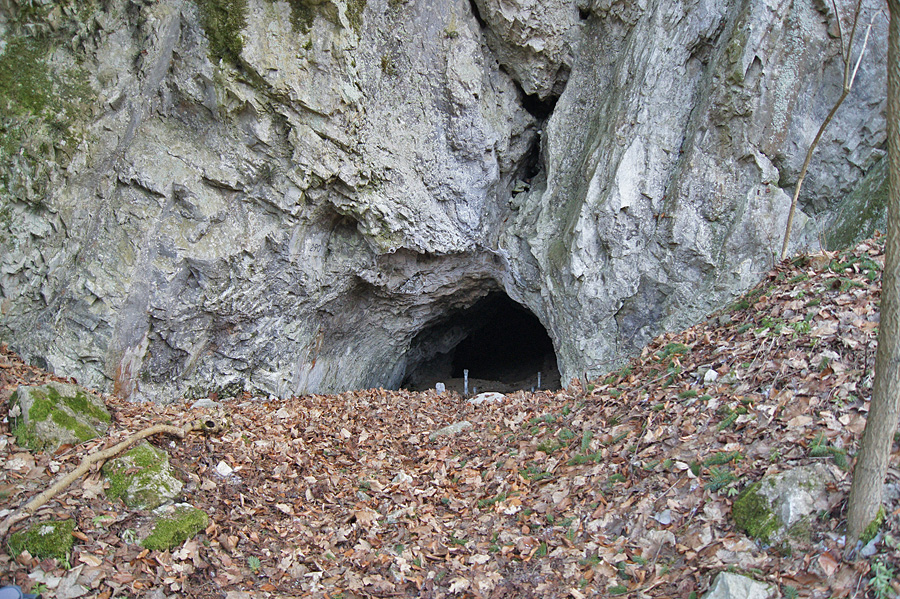
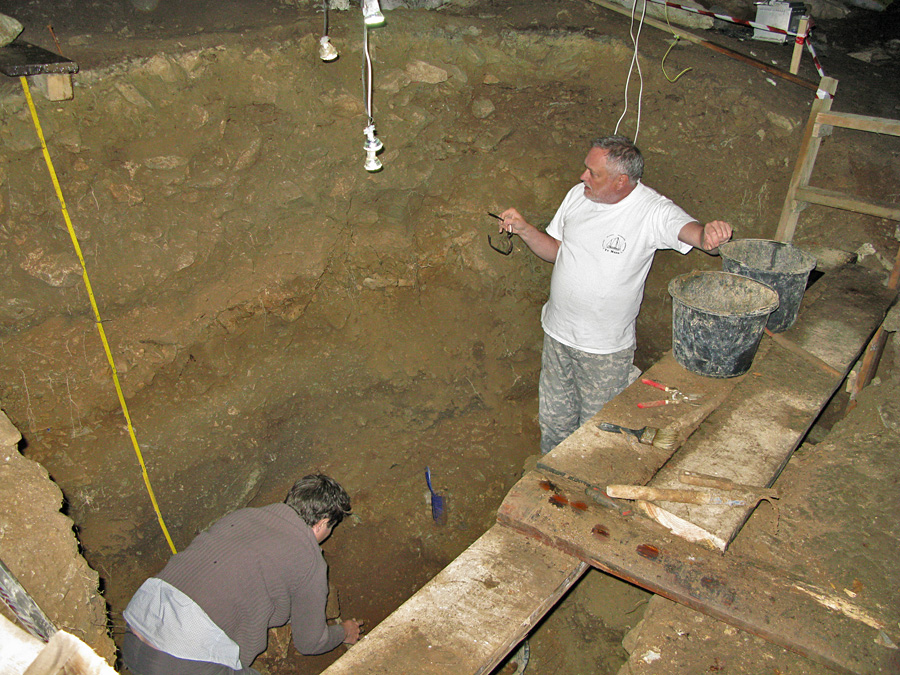
In 2011 and 2012, a 3 x 1m trench (divided into Squares A, B and C) was excavated near the entrance of Pod Hradem Cave (Figures 2 & 3). Fine-grained excavation and sampling methods were used to expedite maximum retention of evidence (cf. Wright et al. in prep.). Pollen, charcoal, stable isotopes, microfauna, large fauna, micromorphology, and sedimentological and geochemical analyses have been used to reconstruct palaeoenvironment, palaeoclimate and site formation, whilst stone and bone artefacts and manuports provide information about cultural activities.
Entrance to Pod Hradem Cave.

The excavation pit at the end of the 2012 field season.

Preliminary results
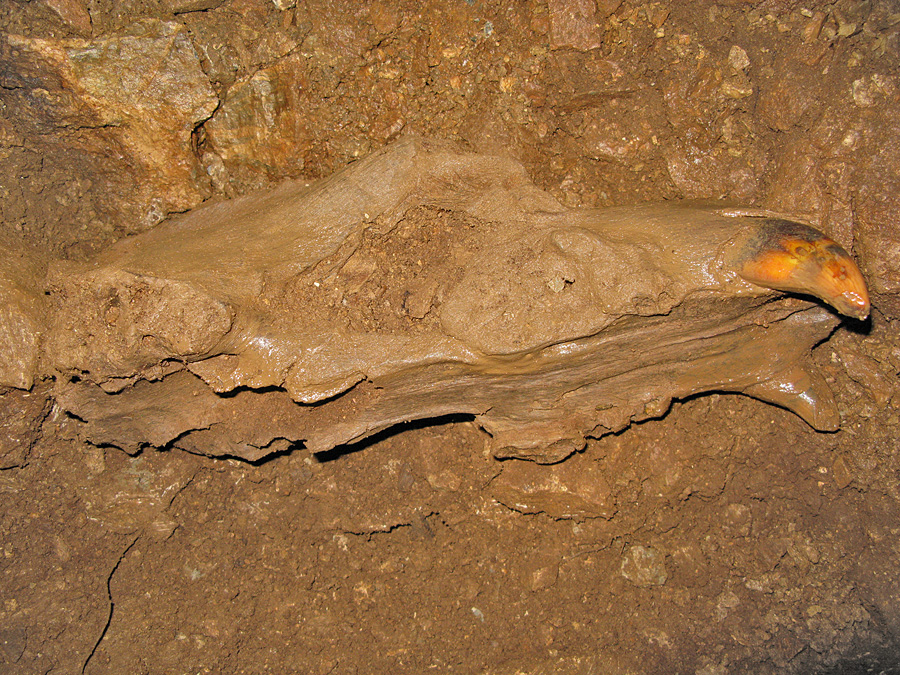
Part of a cave bear skull discovered at the base of the excavation.

Twelve AMS dates indicate that the currently exposed profile (layers 3–12) dates to between ~27 ka to ~50 ka cal BP, spanning the Middle–Upper Palaeolithic transition. A micromorphology study indicates that sediments can be generally classified as unsorted silt loams, with stratigraphic units subdivided into multiple cold and relatively warmer, more humid events. Geoarchaeological interpretations suggest most sediments entered the cave by gravity (creep or sheetwash) from the sedimentary cone at the cave entrance.
During Marine Isotope Stage 3, areas of rocky debris in the immediate vicinity were dominated by grassland and herb species, while pockets of trees and marshy or riparian habitats could be found in the wider surroundings. An increase in fern spores, arboreal palynomorphs and charcoal, and the presence of the bat Plecotus auritus in Layer 3 is consistent with classification of this layer as a warmer period.
More than 14 500 bone and tooth specimens were collected from squares A and C (excluding the wet-sieved fraction). Most are highly fragmented with only 11 per cent identifiable to taxon. Cave bear (Ursus spelaeus) dominated the assemblage, and is present in every Pleistocene layer (3–12; Figure 4). Other species include reindeer, red deer, wolf, aurochs/bison, horse, badger, hare, fox, mustelids and a mid-sized bird. The high proportion of cave bear bones, the majority of which belong to juveniles and neonates, suggests the cave was used as a bear hibernation and parturition den (see also Gargett 1996).
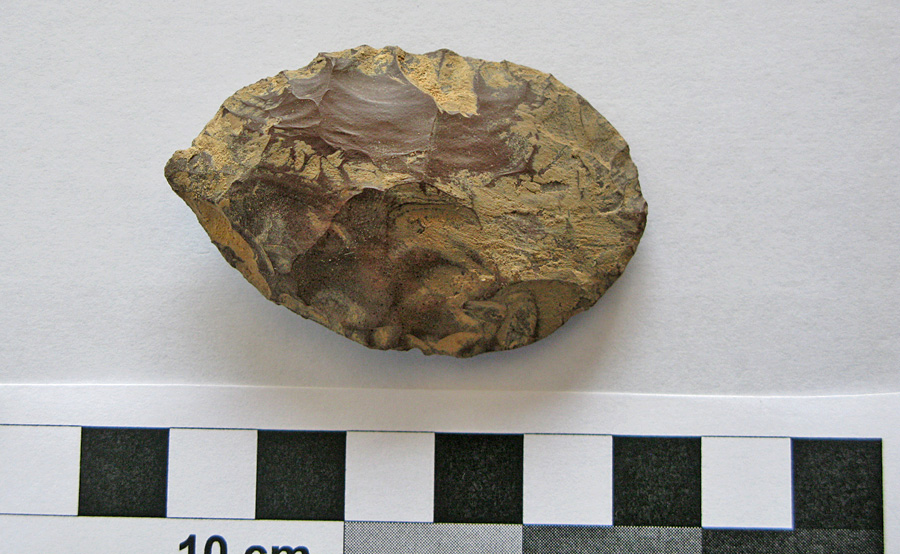
A leafpoint discovered in a layer dated to approximately 40 000 years BP.

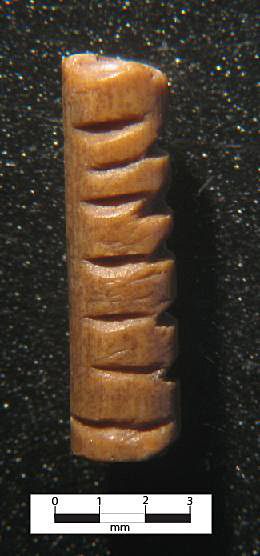
Direct evidence for human activity at Pod Hradem was restricted to small quantities of stone and bone artefacts, manuports, charcoal interpreted as a dispersed hearth, and burnt bone (cf. Nejman et al. in prep.). Most lithics were exotic, sourced to multiple locations in several directions within a 200km radius of the site (Figure 5). Some of the cultural materials have been recovered from layers 6 and 10, which seem to represent 'warmer' periods based on geoarchaeological evidence. Layer 10 contained a large amount of charcoal, burnt bone, manuports and a small number of lithics. Layer 6 contained a decorated tubular bone rod (Wright et al. in prep.; Figure 6) and a porcelanite flake. The latter is comparable to artefacts excavated at Pod Hradem in the 1950s which were sourced to Kunětická hora in Eastern Bohemia (northern Czech Republic) (Nerudová et al. 2012).
Discussion
Research at Pod Hradem confirms long-term cave bear activity, with infrequent visits by small groups of humans. Pollen, charcoal and faunal evidence consistently suggest a glacial, mosaic landscape with a range of habitats and biomes within a short distance of the cave.
Tubular bone rod discovered during the 2011 field season.

We have not found evidence for the 'Pod Hradem Interstadial' event as defined by Musil and Valoch (1966). It was originally defined on the basis of clearly stratified, brown, humic soil sediment and accepted in the international literature (e.g. Smith 1982; Churchill & Smith 2000). Over time, however, these two authors modified their definition of this event and inconsistencies have begun to appear (see e.g. Musil 2001; Valoch 2012). Current research in Pod Hradem has not confirmed the presence of this sedimentary unit, and this division is now considered redundant (Nerudová et al. in prep).
A dispersed hearth, burnt bone, and other cultural remains in the securely dated Layer 10 have implications for hominid occupation of the Moravian Karst during the late Middle/Early Upper Palaeolithic period and can potentially add to debate concerning the coexistence of Neanderthals and anatomically modern humans in this part of Europe. Although evidence remains circumstantial, several different threads support this hypothesis. These include raw material similarities between artefacts from Pod Hradem and the Neanderthal occupation of nearby Kůlna Cave, the apparent absence of early anatomically modern humans in the Moravian Karst (Svoboda 2009: 81), and overlapping radiocarbon ages between Pod Hradem Layer 10 and Neanderthal sites in this region. This question will be explored in future publications.
The discovery of a decorated tubular bone rod (unprecedented in Central Europe but strikingly similar to those known from Western and Eastern Europe; Figure 6) and multiple exotic lithics suggest wide-ranging movements of modern humans throughout much of the site's history. Complex socio-political inter-relationships are expected to have existed between resident and visiting communities, negotiated through differential site selection and importation of portable art objects (Nejman et al. in prep; Wright et al. in prep.).
Acknowledgements
We would like to thank Professor Jiří Svoboda for his support and guidance in this project. We would also like to thank the staff of CHKO, especially RNDr. Antonín Tůma and RNDr. Leoš Štefka for their generosity and support of this project. Special thanks to Mr David Sojka for technical support during fieldwork, Mgr. Vlasta Dadejová for professional photography and Assoc. Prof. Miroslav Králík for a photograph of the bone rod. Many thanks to all the people who participated in this research, in particular all the collaborators and excavation volunteers. This project was funded from the SoMoPro program. Research leading to these results has received a financial contribution from the European Community within the Seventh Framework Program (FP/2007-2013) under Grant Agreement No. 229603. The research was also co-financed by the South Moravian Region and the Department of Anthropology, Masaryk University.