


The special issue of Twin Research and Human Genetics on ‘Twin Registries Worldwide: An Important Resource for Scientific Research’ was published in 2013. The current special issue is a follow-up to update the scientific community about twin registries around the globe. This article builds upon our previous Registry updates (Afari et al., Reference Afari, Noonan, Goldberg, Edwards, Gadepalli, Osterman and Buchwald2006; Strachan et al., Reference Strachan, Hunt, Afari, Duncan, Noonan, Schur and Buchwald2013) and summarizes current information on the Washington State Twin Registry (WSTR), including history and construction methods, member characteristics, available data, and major research goals. We also provide a section with brief summaries of recently completed studies and discuss the future research directions of the WSTR.
Registry History and Construction
The WSTR (formerly the University of Washington Twin Registry) began recruiting twin pairs in 2002. The WSTR is a collaboration between Washington State University (WSU) and the University of Washington (UW), representing a unique research resource for the state and nation. Twins are identified by the Washington State Department of Licensing (DOL). We receive a list of potential twins from the DOL on a weekly basis, governed by a data sharing agreement between state agencies in Washington. Until September 2018, driver license and identification card numbers were assigned by using an individual’s name and date of birth. Because twins often have the same initials and same date of birth, the DOL asked all applicants if they were a twin to avoid issuing duplicate license numbers. In September 2018, the DOL changed the process for assigning numbers so that it is no longer based on name and date of birth, but the twin question is still asked to prevent identity fraud.
To date, there are 9,145 complete adult twin pairs enrolled in the WSTR. The WSTR sends potential participants an enrollment survey, and twins are enrolled when surveys have been received from both members. A longer in-depth survey is sent every 2 to 3 years to collect follow-up data. Twin pairs are periodically contacted to participate in new primary data collection studies.
Approximately 18% of the names that we receive from the DOL are for twins between the ages of 15 and 18. These adolescent twins are in the DOL database because in Washington State, persons are eligible to apply for a driver learning permit at age 15, and a driver license at 16. About 1% of the names that we receive from the DOL are for twins younger than 15, and these younger twins are in the DOL database because a parent or guardian requested a state-issued identification card. After seeing that we had a sizeable number of juvenile twins in the DOL database, we updated our procedures in 2013 to begin recruiting twins under the age of 18. We created two age groups for the recruitment of juvenile twins based on discussions with the local Institutional Review Board, 0–12 and 13–17, with different procedures for each. For twins 12 years old and younger, a survey for both twins is sent to the parent or guardian. Individuals are assumed to be twin pairs if they share the same birthday, last name, and address. The survey asks about twin similarity and demographics as reported by the parent, basic demographic information about the parent completing the form, and contact information. For twins between the ages of 13 and 17, a heads-up letter is sent to the parent introducing the WSTR and providing information for opting out if they do not want to give permission for their children to join (the consent process). This is followed by an invitation to the twins with a brief survey that asks about twin similarity, demographics, and contact information. To date, there are 523 juvenile twin pairs in the WSTR. When juvenile twins turn 18, we send them an enrollment survey to join as an adult member of the WSTR, as described previously.
The names that we receive each week from the DOL are stored in a secure database, and on a quarterly basis we assemble a mailing list of approximately 500 individual adults (index twins) to invite to join the Registry. We have found that a mailing list of approximately 500 twins is a feasible number based on financial and logistical constraints. Since 2015, we have worked with the Washington State University Social and Economic Sciences Research Center (SESRC) to conduct recruitment mailings, which includes printing all materials, assembly of invitation packets, mailing of packets, and entering data from returned surveys. Once the mailing to the index twin has been completed, a second mailing is sent to the co-twins of index twins if the co-twin was not in the DOL mailing list. Once we receive surveys from both twins, they are enrolled as a pair in the WSTR.
Most of the Registry consists of individuals identified by the DOL. However, since launching our website and Facebook page in 2013, we have been contacted more regularly by individuals (e.g., twins who heard or read about us, parents of twins who were interested in having their children participate) who are interested in joining the Registry but have not been identified as a twin by the DOL. We modified our procedures in 2013 to allow volunteers to enroll in the registry. Volunteers are sent an invitation to enroll via email and complete the online version of our enrollment survey. Adult volunteers represent 1% of all adult twins enrolled, and compared to twins identified by the DOL, these twins are older and more likely to be identical. Juvenile twins (and their parents) who volunteer to join the WSTR represent 87% of all pairs under the age of 18 that have enrolled in the Registry.
Registry Characteristics
Selected demographic characteristics of WSTR members are summarized in Table 1 for adults and Table 2 for juveniles. Generally, adult members are middle-aged (39.3 ± 18.4 yrs.), non-Hispanic White (90.6%), and well-educated (42% have a bachelor’s degree or higher). One limitation of the WSTR is the low percentage of racially or ethnically diverse twin pairs; however, this is a well-documented concern in genetic-based research more generally (Hindorff et al., Reference Hindorff, Bonham, Brody, Ginoza, Hutter, Manolio and Green2018; Sirugo et al., Reference Sirugo, Williams and Tishkoff2019). We examined historical birth records for Washington State (National Center for Health Statistics, 2018; United States Department of Health & Human Services et al., 2018) to compare the race and ethnicity of our members to twins born in the state between 1971 and 2017. We found that up to ~1985, roughly 90% of twin births in Washington were classified as White. Since then, the percentage of twin births classified as White has been steadily decreasing, with increases in other ethnic and racial groups, primarily Hispanic or Latino. This change can be seen in the demographics of our juvenile members; 8.7% are classified as Hispanic or Latino (compared to 3.7% for adults), and roughly 18% reported a race other than White alone.
Demographic characteristics of adult members of the Washington State Twin Registry

Note: MZ = monozygotic, DZ = dizygotic, MM = same-sex male, FF = same-sex female, MF = opposite sex.
Demographic characteristics of juvenile members of the Washington State Twin Registry
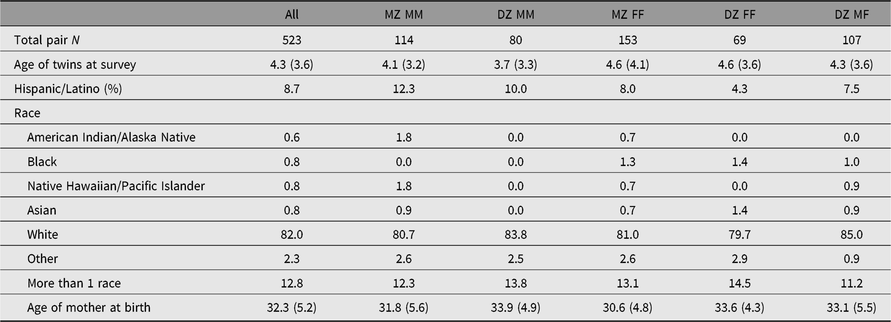
Note: MZ = monozygotic, DZ = dizygotic, MM = same-sex male, FF = same-sex female, MF = opposite sex.
Because of our construction methods (i.e., each adult member would have to have lived in WA at some point and obtained a driver’s license or renewal), the WSTR is largely Washington State based, with approximately 68% of all participants still residing in the state. However, twins live in every county throughout the state, representing a broad mix of urbanized and rural areas, in 50 U.S. states and the District of Columbia, and in 41 international countries. Thus, the Registry has diversity with respect to geographical and socio-cultural representation.
Survey Data
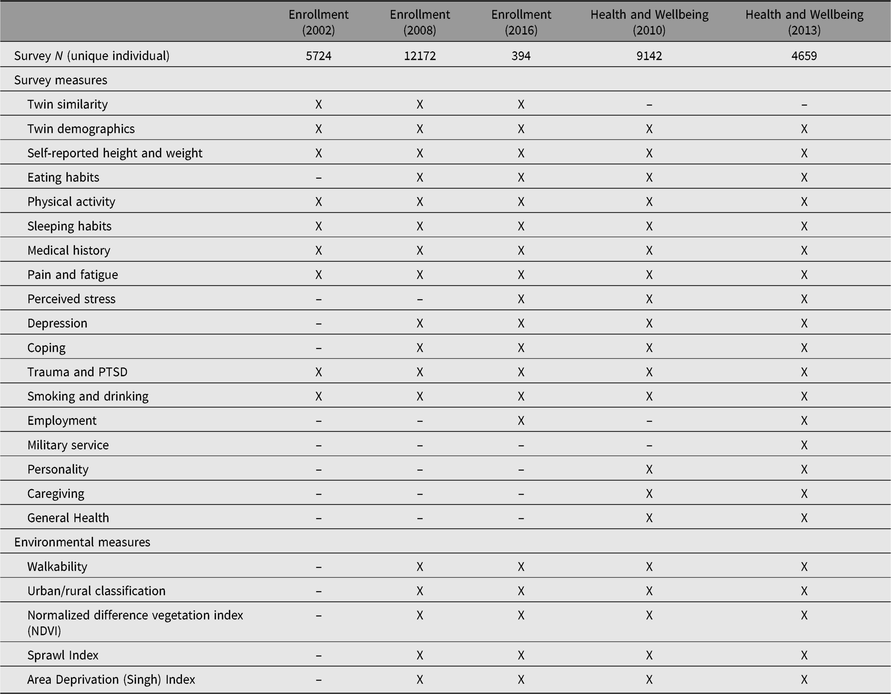
A summary of all past and current surveys, measurement domains, and total N for each is summarized in Table 3. All twins joining the WSTR complete an Enrollment Survey that collects information about health history, lifestyle behaviors, and demographics. Every 2 to 3 years, we send a follow-up Health and Wellbeing Questionnaire to collect additional in-depth information on the same topics. The surveys currently in use can be viewed on the WSTR webpage at the following url: https://wstwinregistry.org/for-researchers/available-data/.
Survey measures and environmental measures available by survey type for adult twins in the Washington State Twin Registry
Biospecimen Repository and Zygosity Determination
Twin pairs participating in additional WSTR studies (e.g., in-person or mail-out studies) may be asked to provide biological samples such as saliva, blood, and/or buccal cells, many of which can be later processed for DNA depending on the method by which they were collected (see Table 4 for a summary of the WSTR biospecimen repository).
Biological samples currently available in the Washington State Twin Registry
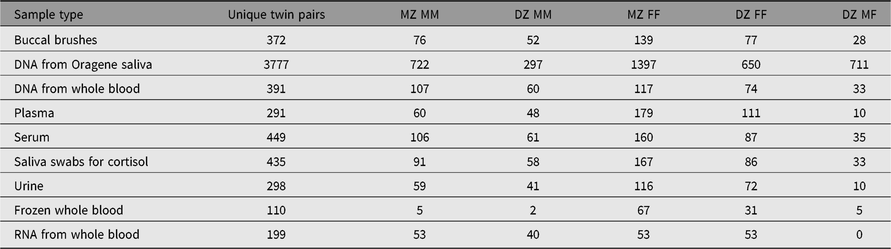
Processed DNA can be used to determine whether twin pairs are monozygotic (MZ) or dizygotic (DZ). The WSTR has used both the AmpFlSTR® Identifiler® Plus PCR Amplification Kit and the PowerPlex® 16 HS System to determine zygosity by DNA. The two methods are nearly identical (Hannelius et al., Reference Hannelius, Gherman, Mäkelä, Lindstedt, Zucchelli, Lagerberg and Lindgren2007; Yang et al., Reference Yang, Tzeng, Tseng and Huang2006). To date, 545 pairs have been classified as MZ and 209 same-sex pairs as DZ by DNA (8% of WSTR members overall have DNA-based zygosity).
Obtaining DNA-based zygosity results for the entire registry would be cost-prohibitive, thus we have used various self-report methods over the years. In 2019 we created a unit-weighted pair zygosity sum score (PZS) to classify same-sex twins as identical or fraternal based on their enrollment survey responses, using same-sex twin pairs with DNA-based zygosity as the reference. The WSTR Enrollment Survey includes five questions about childhood similarity. The PZS was computed by summing the scores of the five similarity questions for each twin. The PZS ranges from 0 to 10 if there is no missing data, and is rescaled if there is missing data. Same-sex twin pairs with a PZS less than 4.8 are classified as DZ twins, and those with a PZS greater than 4.8 are classified as MZ twins. Classification accuracy is 92% overall (when compared to the reference), with 94% for true MZ and 88% for true DZ twins. All opposite-sex twin pairs are assigned as DZ.
Environmental Exposures
Since 2008, we have geocoded each twin’s street address at the time of survey completion to create a set of environmental exposures (see bottom of Table 3) that can be linked to survey data. This work remains an important focus of our ongoing research. For example, we demonstrated that neighborhood walkability showed a quasi-causal association with neighborhood walking and moderate to vigorous physical activity, but not with BMI (Duncan et al., Reference Duncan, Cash, Horn and Turkheimer2015), and that the suppression of genetic risk for high BMI by neighborhood walkability was mediated by physical activity (Horn et al., Reference Horn, Turkheimer, Strachan and Duncan2015). We also found that objectively measured walking was related to neighborhood walkability, after controlling for sex, age, BMI, and household income (Hwang et al., Reference Hwang, Hurvitz and Duncan2016).
Recent studies using survey data and geocoded environmental exposures found that greater access to green space was associated with fewer depressive symptoms (Cohen-Cline et al., Reference Cohen-Cline, Turkheimer and Duncan2015), neighborhood deprivation was associated with shorter sleep duration (Watson et al., Reference Watson, Horn, Duncan, Buchwald, Vitiello and Turkheimer2016) and higher levels of hazardous drinking (Rhew et al., Reference Rhew, Kosterman, Duncan and Mair2018). Additional studies demonstrated that individual and neighborhood level measures of socioeconomic status (SES) moderate genetic and environmental influences on BMI (Dinescu et al., Reference Dinescu, Horn, Duncan and Turkheimer2016), increased levels of neighborhood deprivation were associated with greater genetic risk for depressive symptoms (Strachan et al., Reference Strachan, Duncan, Horn and Turkheimer2017), and neighborhood walkability moderates the association between low back pain and physical activity (Zadro et al., Reference Zadro, Shirley, Pinheiro, Bauman, Duncan and Ferreira2017). A complete list of all Registry publications can be found here: https://wstwinregistry.org/for-researchers/publications/.
Registry Goals
The Registry was initially established to attract diverse research interests. The enrollment survey contains a wide range of topics including socio-demographics, twin similarity, and a number of physical and mental health measures culled from validated scales and subscales. Although this remains an important feature of the WSTR, over the last decade a major focus of our work has been to establish a longitudinal cohort to conduct co-twin control studies that enable the detection of environmental effects on health while reducing the structural confounding and biases inherent in studying unrelated individuals who have not been randomly assigned to different environments (Moffitt, Reference Moffitt2005; Oakes, Reference Oakes2004, Reference Oakes2006), as would happen in a randomized controlled trial. In this framework, twins are used as quasi-experimental controls for shared genetic and environmental effect confounds that cannot be held constant via random assignment (Turkheimer, Reference Turkheimer2008; Turkheimer & Harden, Reference Turkheimer, Harden, Reis and Judd2014). This work is further described in a forthcoming Cohort Profile in the International Journal of Epidemiology (Duncan et al., Reference Duncan, Avery, Hurvitz, Moudon, Tsang and Turkheimerin press). In our research, we use the twin design to identify potentially causal associations among environmental exposures, lifestyle behaviors, and a broad array of physical and mental health outcomes as described by us previously (Duncan et al., Reference Duncan, Mills, Strachan, Hurvitz, Huang, Moudon and Turkheimer2014) and in our forthcoming Cohort Profile.
Summary of Recent Primary Data Collection Studies
In addition to archival survey data, biospecimens, and environmental exposures available to researchers, another important feature of the WSTR is our ability to contact twin pairs of interest to participate in new primary data collection studies on a variety of topics. Below we briefly summarize recent select studies. By nature of the size and scope of in person studies, they are typically funded by extramural grants; descriptions of grant funded studies can be found here: https://wstwinregistry.org/for-researchers/grants/).
Validation and Application of Portable Particulate Device in the UW Twin Registry
This study seeks to understand how the environment influences human health by measuring exposure to air-pollution (PM2.5) in real-time using a portable particle monitor that was built and refined using the design-feedback iterative cycle (Duncan et al., Reference Duncan, Seto, Avery, Oie, Carvlin, Austin and Novosselov2018). Identical twins living in Washington State collect data at home for two weeks after a brief in-person visit to collect vital measures (e.g., blood pressure), lung function (e.g., FEV1), and biological samples. The at-home portion involves wearing an activity monitor (accelerometer) and GPS monitor to measure location and activity, as well as the portable particle monitor to measure environmental air pollution exposures. This study is ongoing and is funded by the National Institute of Environmental Health Sciences of the National Institutes of Health (NIH).
TWIN Study of Environment, Lifestyle Behaviors, and Health
The goal of this project is to determine how the built environment in which individuals live, work, and play on a daily basis influences lifestyle behaviors and health. Identical twin pairs (N = 144) first participated in this study from 2012–2015, wearing an activity monitor (accelerometer) and a GPS monitor to measure physical activity and location for two weeks. During the follow-up phase of the study, we contacted 128 out of the original 144 pairs to collect data for one week at home, and 60% of participants agreed to participate. We very recently completed data collection on 70 repeat pairs, and data analyses for both the initial and follow-up portions of the study are ongoing. This study is funded by the National Institute of Aging of the NIH.
Epigenetic Determinants of Major Depression: A Monozygotic Discordant Twin Study
The objective of this study is to identify functional epigenetic determinants for major depressive disorder. The central hypothesis is that aberrant DNA methylation and resulting alterations in gene expression are associated with major depressive disorder. The study design and rationale was recently published (Strachan et al., Reference Strachan, Zhao, Roy-Byrne, Fowler and Bacus2018), and a manuscript representing the results of the primary aim is forthcoming. This study is funded by the National Institute of Mental Health of the NIH.
Gene Expression and the Microbiome in Twins
The goal of this study is to generate data on epigenetic and gut microbiota alterations associated with obesity in BMI discordant same-sex twin pairs. Twin pairs discordant for BMI (one twin normal weight and the other obese according to BMI standards) provided a stool sample, buccal brush sample, and completed three questionnaires. A total of 22 twin pairs were enrolled (7 MZ female, 5 DZ female, 5 MZ male, 5 DZ male) with an average within-pair BMI difference of 11.1. Data collection has been completed on all pairs and the specimens are now being analyzed. This study was supported by an institutional grant from Washington State University Office of Research (Nutritional Genomics and Smart Foods for Optimal Nutrition and Health in Diverse Populations).
Limitations and Future Research Directions
As noted previously, a major goal for the WSTR is to improve representation of diverse ethnic and racial groups, a current limitation of the Registry. Improving minority representation will likely require using different methods for different groups (Yancey et al., Reference Yancey, Ortega and Kumanyika2006), such as using birth certificates, clinics or schools, and developing surveys in Spanish, in addition to in-person outreach, phone call follow-up, and the use of incentives. These potential ways of improving minority recruitment will be explored, contingent on funding.
An emerging research direction for the Registry relates to healthy aging. The State of Washington provides a file of all deaths that occurred within the state during a given year. These files are used to update the Registry and remove individuals who are deceased. In addition to name and date of birth, records include the residence address at time of death, date of death, and primary cause of death using ICD-10 classification. We will use this information to elucidate how lifestyle behaviors and environmental exposures are associated with twin deaths, especially among twins who are discordant for age at death and cause of death. We will also adopt a life-course approach to determine trajectories of aging as we broaden our sample to include twins in early life.
A related emerging research direction is to increase the number of juvenile pairs in the Registry to conduct new primary data collections of studies in youth — for example, life-course based studies as described above — as well as studies on genetic and environmental influences on youth lifestyle behaviors, academic outcomes, and disease prevention. Since 2007, approximately 2,700 twins have been born each year in Washington State. We thus have the potential to add a substantial number of new twins each year to the Registry, both through the DOL and by contacting new parents of twins identified by birth records, a recruitment mechanism we will explore in the coming year. Use of this information requires approval from the Washington State Department of Health and the Washington State Institutional Review Board. More outreach, such as in-person events around the state and near WSU’s distributed campuses, will allow us to address this goal.
Finally, we are very interested in genotyping the entire WSTR. Not only will this allow us to have DNA-based zygosity determination on all participants, but it will also allow us to expand our current environmental based work to examine genetic and epigenetic causes of disease as well as gene-by-environment interactions.
Acknowledgements
We acknowledge Dedra Buchwald, founding director, and Jack Goldberg, senior researcher, for starting the Registry and their dedication to seeing it flourish. We also acknowledge past and present faculty and staff who have worked with the Registry. Finally, we acknowledge our twin members for whom this work is dedicated.
Financial support
The content of this paper was not supported by any specific grant from any funding agency, commercial or not-for-profit sectors. However, multiple grants over the years have been instrumental in funding operations. We acknowledge the following major sources of funding from the NIH (Principal Investigators who are not authors of this paper are spelled out, Principal Investigators who are authors of this paper are indicated by initials): (Niloofar Afari, R01AR051524; Dedra Buchwald, RC2HL103416; Ellen Schur, R01DK089036; G.D., R01AG042176 and R56AG042176; Edmund Seto and G.D., R21ES024715 and R33ES024715; Jinying Zhao and E.S., R01MH097018).
Conflict of interest
None of the authors has a conflict of interest to declare.
Ethical standards
The authors assert that all procedures contributing to this work comply with the ethical standards of the relevant national and institutional committees on human experimentation and with the Helsinki Declaration of 1975, as revised in 2008.



