South Koreans with disabilities gained legal protection from discrimination for the first time when the Disability Discrimination Prohibition Act was passed in 2007.Footnote 1 The law detailed direct and indirect forms of discrimination, as well as specific types like discrimination against disabled women and discrimination in accessing public transit or buildings. It also made it easier for discrimination victims to seek remedies by allowing both affected individuals and supporting organizations to file claims at the National Human Rights Commission of Korea (NHRCK). During the first eight months after the law went into force, the proportion of discrimination complaints received by the NHRCK that were related to disability leaped from 14% to 61% (NHRCK 2016b, 137). Whereas prior policies treated disabled people as “invisible beneficiaries” of welfare who needed medical treatment or curing if possible, the new law treated disabled persons as “rights-bearers” and formalized procedures to promote their full participation in policy processes and in society generally (Eunjung Kim Reference Kim2017; JaeWon Kim Reference Kim, Arrington and Goedde2021). One activist explained that deliberations leading to the law had “turned disabled persons into producers and leaders in policymaking – not just passive consumers – and given us a seat at the table.”Footnote 2 Indeed, disabled activists and allied lawyers played a central role in designing the law and have since monitored its implementation and pushed for revisions. For example, they filed lawsuits using the new nondiscrimination protections to challenge exemptions for certain sizes or types of facilities in new regulations regarding ramps and other accessibility features. As a result, new buildings face stricter accessibility requirements, and 95% of Seoul’s metro stations have elevators, as compared to just 30% of New York’s (Choi Reference Choi2022). The committee that checks if buildings comply with accessibility regulations is also legally required to include disabled individuals. In short, new rights, obligatory clauses, and enforcement mechanisms have transformed laws related to disabled persons and led to their systematic involvement in policy processes.
Japan passed its own Disability Discrimination Elimination Act in 2013.Footnote 3 Unlike the prior pattern of relying on nonbinding laws and “welfare and good intentions (zen’i)” toward people with disabilities (Kawauchi Reference Kawauchi2002, 36), the new law took a legalistic approach by codifying the rights of disabled persons and others’ duties toward them. It prohibited “unfair and discriminatory treatment on the basis of disabilities” and required public entities to provide reasonable accommodations for the first time. Disabled activists and allied lawyers obtained revisions in 2021 that extended that legal requirement to private businesses. However, the law specifically directed discrimination claims toward the consultation office (sōdan madoguchi) of the appropriate government agency, not the courts, as activists had hoped. To formalize more inclusive decision-making, Japan’s law started requiring that disabled persons be appointed to the national Disability Policy Commission and other policy councils. By 2018, 90% of the Regional Disability Discrimination Elimination Councils that were established by the new law had members with disabilities (Cabinet Office 2019b, 11). A disabled activist on the committee tasked with monitoring accessibility in public transportation hailed “the barrier-free assessment index that we created from the perspective of affected persons (tōjisha)” and attributed significant changes in the built environment to “added legal obligations” (gimuka) in regulations.Footnote 4 While wheelchair users previously had to wait for station attendants to carry them up and down stairs, 92% of Japanese train stations used by over 3,000 persons per day had elevators or slopes by 2020.Footnote 5 Disabled persons’ organizations actively monitor policy implementation and study remaining issues, bolstering their rights and transforming societal attitudes toward disabled people.
These examples suggest a turn toward more legalistic modes of governance. The shift affects both how decision-making and policy implementation occur and who is involved in these processes. Legalistic governance describes policymaking and dispute resolution that (1) follow more formal, detailed, written-down, and enforceable rules and (2) involve more participatory, contested, and transparent procedures, as elaborated below (Kagan Reference Kagan, Nelson, Rabin and Sugarman2001). The Japanese government summarized such a legalistic turn in its approach to regulating smoking in 2018 as moving “from manners to rules” (manā kara rūru e), which I adopt for this book’s title.Footnote 6 Instead of trusting that smokers be considerate of others or that nonsmokers show toleration, regulations added detailed rules about where one could smoke, what signage establishments must post, and who could enter smoking rooms.Footnote 7 From 2011 to 2015, Korea similarly expanded nonsmoking rules until even bars, restaurants, and Internet cafés (PC bang) had to ban smoking except in designated smoking rooms.Footnote 8 Increasingly ubiquitous nonsmoking signs made the new rules visible in both countries and often listed fine amounts or mentioned the relevant Health Promotion Law (see Fig. 1.1). Such signs manifest legalism – more law – and often reflect activists’ contributions to the legalistic turn. For example, the sign pictured from Oki Shrine in Hamamatsu, which was erected due to pressure from an activist doctor, cites Art. 25 of the Health Promotion Law when banning smoking on the shrine’s grounds, even though that law technically only assigns to facilities managers an “obligation to endeavor” (doryoku gimu) to prevent secondhand smoke exposure. And Korea’s blue sign designating a nonsmoking building was originally designed by the main tobacco control advocacy group and then officially adopted by the Ministry of Health and Welfare. In societies that historically relied on social norms and nonbinding bureaucratic guidance or government exhortations to maintain order, this growth of rules and law marks a significant change. What is driving the spread of such legalistic approaches to governance? This book argues that the answer necessitates analyzing how activists and lawyers advocate for legalistic policy solutions and creatively use them.

Figure 1.1 Nonsmoking signs, mentioning fines and/or the health promotion laws.
Figure 1.1Long description
The first sign features a crossed-out cigarette with smoke at the top left. The text, no smoking, appears below the Korean text. Further down, the text reads, No Smoking Area, a fine of 100,000 won. A hand symbol with the text, Say No!, is at the top right. The second sign illustrates a building with a no smoking symbol centered in a circle. Wavy lines suggest smoke drifting away. Text in Korean is present above and below the house. The third sign exhibits Japanese text on a wooden board. The text lists prohibitions within the shrine grounds. The fourth sign displays a rectangular poster with a circular no-smoking symbol at the top and a diagonal line across a lit cigarette. Below this symbol is the Japanese text, followed by the English text, Public Non Smoking Area, Smoking in a Public Non Smoking Area will be fined 1,000 Yen.
Two Puzzles: More Legalistic Governance and Varieties of Legalism
Legalism is unexpected in South Korea and Japan. Long known for their nonlegalistic regulatory styles, officials in both countries historically relied more on informal, flexible “soft-law” measures, such as administrative guidance via nonbinding recommendations or warning letters, and faced little judicial oversight (Upham Reference Upham1987; Ginsburg Reference Ginsburg2001; Mo and Brady Reference Mo and Brady2009). Though bureaucrats lacked the legal power to compel private actors to follow such instructions, they tended to achieve their objectives by leveraging school or regional ties and delegating implementation to private actors, as the state and businesses’ incentives generally aligned (Upham Reference Upham1996; Ha and Kang Reference Ha and Kang2011). Rather than openly contest policy decisions, opaque networks of bureaucrats, political elites, and regulated interests cooperated to design and implement policies, often via self-regulation. This approach – famously called the “developmental state” in the realm of industrial policy – underpinned rapid economic growth and was implemented with the help of authoritarianism in Korea and longtime single-party dominance in Japan (Johnson Reference Johnson1982; Amsden Reference Amsden1989; Woo-Cumings Reference Woo-Cumings1999). Such “state-centric” governance left groups like the activists and lawyers highlighted in this book with few channels of access and little information about policy (Kim Reference Kim2013).
The nonlegalistic approach extended to public policy; bureaucrats often “privatized” disputes by granting preemptive but limited concessions or mobilized societal groups from the top down to help achieve policy aims (Upham Reference Upham1987; Garon Reference Garon1997; Pharr Reference Pharr1990; Araki Reference Araki1999; Sunhyuk Kim Reference Kim2010; Taekyoon Kim et al. Reference Kim and Fox2011; Looney Reference Looney2020). Instead of having enforceable rules, statutes articulated desired principles and left bureaucrats flexibility in implementation (Upham Reference Upham1996; Löschke Reference Löschke2021, 290). Japanese authorities sought change “not through the coercive force of law, but by using law, and governmental persuasion, to change attitudes” (Foote Reference Foote and Baum1997, n. 191). Korea’s laws were used to serve Japanese colonial rulers’ and then authoritarian dictators’ coercive ends, and so they lacked legitimacy, detail, or consistency (Ginsburg Reference Ginsburg2002; Kim Reference Kim, Park and Dressel2012, 102–4). Whereas Korean political elites ruled by law enacting ad hoc laws to further their aims, the rule of law (i.e., written-down rules and established procedures) would have constrained elites.
Overall, Korea and Japan’s nonlegalistic regulatory style left few rules or state actions subject to judicial review. Similar institutional disincentives in both countries and the courts’ pro-state reputation also discouraged litigation as a means of enforcing policy or challenging state actions (Haley Reference Haley1978; Yang Reference Yang1989; West Reference West2001; Chan Reference Chan2017). Both governments capped the number of lawyers, which made legal representation expensive. Neither country permitted class actions, punitive damages, or pretrial discovery, and trial dates were often weeks or months apart. The rules on standing, the statute of limitations, and evidence were also narrow. In short, neither Japan nor Korea had a history of legalistic governance, and courts played a marginal role. The rise of legalism in these “hard cases” is the book’s first puzzle.
At the same time, the legalistic turn has taken different forms, and the pace of change varies. To analyze such variation, this book conducts paired comparisons of four recent policy changes related to disabled persons’ rights and tobacco control, which are structurally similar policy domains. Despite analogous advocacy for legalistic policy solutions, outcomes varied. Compared to Japan’s, for example, Korea’s reforms regarding disability discrimination were more detailed and enforceable via the National Human Rights Commission and the courts. Yet revised accessibility regulations in both countries became binding and formalized disabled persons’ participation in policy monitoring. Meanwhile, coalitions of doctors, consumer advocates, and women successfully pushed to strengthen nonsmoking rules in both countries, despite opposition from powerful tobacco and hospitality interests, but failed to establish producers’ legal liability regarding cigarettes. The book’s paired comparisons, including the negative cases of tobacco liability law, leverage variation in the nature and pace of legalism to identify conditions under which legalism is more likely and what its real-world consequences are. Varieties of legalism in the relatively similar contexts of Korea and Japan are the book’s second puzzle.
Legalism, in diverse forms, also exists in other policy domains. For instance, Korea’s quarantines, curfews, and contact tracing in response to the COVID-19 pandemic used more binding measures than Japan’s appeals for citizens to voluntarily stay home and exercise “self-restraint” (jishuku) (Wright Reference Wright2021; Borovoy Reference Borovoy2022; Oh Reference Oh2022). However, major reforms in 2018 to both Japanese and Korean labor law sought to address notoriously long work hours and problems with death or suicide by overwork by legally defining what counts as a workweek, mandating overtime pay, and adding fines and criminal penalties for violating these new regulations (Kwon and Field Reference Kwon and Field2018; Sala Reference Sala2024). Korea’s Serious Accidents Punishment Act in 2021 also established criminal sanctions for unsafe firms, extensive obligations of care, and the possibility of punitive damages, following a series of fatal workplace accidents, though preventative self-regulation remains a key policy instrument (Son Reference Son2022).Footnote 9 Similarly, after the March 2011 earthquake-tsunami-meltdown in Fukushima, Japan gained an independent Nuclear Regulation Authority (NRA) with its own technical staff, the power to sanction electric utilities, and the right to draft bills regarding nuclear safety. This NRA and lawsuits challenging nuclear power plant restarts have bolstered oversight of nuclear power in Japan (Koppenborg Reference Koppenborg2023). To cite another example of increasing legalism, Japan revised its criminal code in 2023 to broaden the definition of rape, raise the age of consent for the first time since 1907, specify scenarios in which it is difficult for victims to consent to sexual intercourse, and extend the statute of limitation (Asahi 2023). Although Japan’s #MeToo movement was anemic in comparison to Korea’s, these reforms fulfilled many longstanding demands of activism regarding gender-based violence (Kamata Reference Kamata2018; Hasunuma and Shin Reference Hasunuma and Shin2019). Korea, meanwhile, strengthened some laws related to sexual violence and spy cameras (molka), which clarified rules and punishments and proceduralized civil society groups’ participation in monitoring policy implementation (Chang Reference Chang2018). Although Korea stopped short of adding nonconsent to clarify the definition of rape in 2023, it has strengthened laws punishing digital sex crimes (Shin Reference Shin2021; Jung Reference Jung2023). The broader legalistic turn is important to study because it is transforming the role of law and courts in both polities and changing citizens’ options for political participation. As policy domains with key similarities but varying outcomes, disability rights and tobacco control provide ideal contexts for analyzing legalism.
Overall, I document more legalistic approaches to governance in both Japan and Korea, but the shift is more pronounced in Korea, at least on paper. In practice, the societal impact is often similar, and civil society groups are actively involved in promoting legalistic policy instruments and monitoring policy. Korean civil society groups frequently end up compensating for the incomplete enforcement of their country’s more detailed regulations with activities to raise societal awareness and encourage compliance. Japanese activists, meanwhile, supplement their country’s vaguer and less binding legal frameworks with initiatives to educate citizens and encourage voluntary and local changes. Given Korea and Japan’s similar histories of nonlegalistic, state-centric governance and parallel legal institutions, how can we explain the distinctive patterns of legalism amid the overall greater role of law and courts in policy processes? How is regulatory style changing, and what is driving the turn toward legalistic modes of governance? Why is legalism more pronounced in some issue areas than in others?
The Argument in Brief: A Bottom-Up Explanation for Legalistic Governance
The core argument of this book is that activists and lawyers are under-appreciated societal drivers behind the legalistic turn in governance. They are also key to understanding the varieties of legalism. While most studies focus on top-down or structural explanations regarding political elites’ and judges’ responses to institutional fragmentation, electoral competition, international law developments, or neoliberal reforms, my research traces how activists and lawyers are change agents (see also Evans Case Reference Evans Case2013). Though previously marginalized in policymaking in Korea and Japan, activists and lawyers are bringing issues before courts and demanding (and using) laws and regulations with more detailed definitions, enforceable legal provisions, and proceduralized dispute resolution. Legalistic policy instruments appeal to activists and allied lawyers because they elucidate rights and duties, clarify dispute resolution and enforcement mechanisms, improve transparency and accountability, and enhance societal actors’ access to policy processes. Some activist groups have long sought legalistic reforms – consider women’s fight for equal opportunity legislation and changes to the patriarchal family law (Gelb Reference Gelb2000; Shin Reference Shin2006). But activists and lawyers harnessed recent trends that proved conducive to legalism: altered incentives for political elites, broader civil society activism for governmental accountability and transparency, changes in the legal professions, and policy learning via transnational activism and international treaties. By leveraging synergies among litigation, legislative activism, and media coverage domestically, as well as international mechanisms, lawyers and activists have pushed for access to policymaking and for institutional changes, which over time cumulated to make governance more legalistic in both countries. In so doing, they also gained the knowhow and networks that facilitate future legal mobilization and policy advocacy.
Drawing on sociolegal and institutionalist perspectives, this book uncovers the creative agency of entrepreneurial actors working within and sometimes reconfiguring particular institutional landscapes. Regulatory agencies and courts both depend on citizen-initiated complaints, but institutions structure claimants’ options and expectations of success. Studies about “legal opportunity structures” likewise emphasize how existing legal frameworks and rulings (the legal stock) constrain the bases on which claims can be made, as well as who can make claims (access rules) and what the costs or potential rewards of doing so are (Hilson Reference Hilson2002; Wilson and Rodriguez Cordero Reference Wilson and Cordero2006; Evans Case and Givens Reference Evans Case and Givens2010; Vanhala Reference Vanhala2012). The openness of political institutions is also a key component of the “political opportunity structure” that social movements scholars say affects activists’ strategies by altering the perceived costs or benefits of collective action (McAdam Reference McAdam, McAdam, McCarthy and Zald1996; Tarrow Reference Tarrow2011, 163–4). For instance, raising awareness about a problem may shift elite alignments and render politicians more receptive to activists’ demands. By seeking more formal and enforceable rules, proceduralized dispute resolution, and participatory decision-making, activists and lawyers help create legal and political opportunities.
My work, therefore, builds on prior studies showing that societal groups are “not merely passive entities forced to wait for opportunities to arise; they can actively help produce them” by campaigning for legislative changes and using new legal frameworks in ways that reshape regulatory style (Andersen Reference Andersen2005, 57). Some research on European legal integration similarly draws attention to societal actors, documenting how they leverage support from EU-level courts to achieve domestic legislative and judicial changes (Cichowski Reference Cichowski2007; Evans Case and Givens Reference Evans Case and Givens2010; Vanhala Reference Vanhala2018b). Likewise, activists often cite their government’s treaty commitments to push for improved human rights practices domestically through political mobilization, litigation, and agenda-setting (Simmons Reference Simmons2009). Earlier work traced how private citizens contribute to the growth of law by demanding rights and statutes (Nonet Reference Nonet1969). In employment law, legalized policy turned private citizens into participants in governance and made policy more responsive to individual circumstances (Selznick Reference Selznick1969). Lawyers contributed to the development of the modern state by “labor[ing] to legitimate [a] rule-based social order and supply[ing] expertise to fledgling bureaucracies” (Halliday and Karpik Reference Halliday and Karpik1997; Pavone Reference Pavone2022, 7). Their lawyering impacted regulatory style. Activism and strategic litigation, meanwhile, can redefine “social perceptions of the nature of a problem and the appropriateness of the intervention of state authority” (Zemans Reference Zemans1983, 697). As societal groups use existing laws and regulations to bring claims before the courts, they educate judges about legal remedies and contribute to the social construction of what is “legally grievable” (González-Ocantos Reference González-Ocantos2016; Taylor Reference Taylor2023). Repeated litigation exposes existing laws’ shortcomings and spurs reforms that liberalize the legal opportunity structure by enhancing access to the courts or reasonably priced legal representation and ensuring effective remedies, as happened with British NGOs’ environmental lawsuits (Vanhala Reference Vanhala2012, 525). Lawyers can also convince judges to innovate, as Japanese plaintiffs’ lawyers did to obtain privacy protections that reduced the risks for potential litigants (Arrington Reference Arrington2019a). Similarly, the “Euro-lawyers” who “ghostwrote” decisions for overworked judges advanced judicialization in Europe and transformed governance (Pavone Reference Pavone2022). This book adds evidence about how activists and lawyers contribute to gradual institutional and legislative changes that are transforming regulatory style.
Change is rarely easy and usually incremental. The paired case studies point to five interconnected mechanisms through which activists and lawyers encourage a legalistic regulatory style. These mechanisms are elaborated in Chapter 2. First, by defining or framing a problem as a rights violation, they couple it with legalistic policy solutions like rights protections and legally binding obligations. Second, by expanding the range of groups that support reforms, they build credibility with numbers and external validation – which often gets them a seat at the table – and gain channels through which to propose legalistic policy solutions. Third, civil society groups shoulder the costs of researching policy options (including from abroad) and drafting proposals, thereby providing information subsidies and making it easier for decision-makers to adopt legalistic policy solutions. Fourth, activists file lawsuits that demonstrate the strengths and the weaknesses of existing legal frameworks, hold officials accountable for implementation, and reinforce rights framing. Finally, activists leverage international treaty reporting schedules and compliance monitoring procedures to activate international scrutiny and pressure their own government to enact legalistic reforms. Doing so also creates opportunities for diverse organizations to cooperate and amass credible data about a problem and policy implementation, which is helpful in domestic advocacy. These five interrelated mechanisms operate across the social, political, and legal spheres, though it is analytically useful to separate them. If sequenced well and coordinated, they work together as pathways through which activists and lawyers forge legal and political opportunities for later groups and transform regulatory styles.
Existing Explanations for the Legalistic Turn in Governance
Unlike this book’s bottom-up argument, existing explanations for legalistic governance or the broader judicialization of politics tend to be more top-down and structural. For example, interbranch conflicts, fragmented political power, and weak administrative capacity, such as in federalist systems or in the European Union during regional integration, led policymakers to create legalistic clauses that delegate policy enforcement to the judiciary (Kagan Reference Kagan, Nelson, Rabin and Sugarman2001; Farhang Reference Farhang2010; Kelemen Reference Kelemen2011). Fearing electoral losses, politicians might also seek legalistic regulations and independent courts to constrain their successors (Ginsburg Reference Ginsburg2003; Hirschl Reference Hirschl2004). More binding rules, accountability, and rights-claiming channels may accompany the empowerment of the political left, which often seeks to improve “the quality of the process” (Kitschelt Reference Kitschelt1994, 10; Huber and Stephens Reference Huber and Stephens2012; Kage Reference Kage2017). Further, risk-averse politicians may pass statutes with clauses that, in practice, delegate controversial issues to the courts (Graber Reference Graber1993; Tate and Vallinder Reference Tate and Vallinder1995; Whittington Reference Whittington2005). In addition, policymakers may use legalistic modes of governance to empower new judicial institutions, like Korea’s Constitutional Court or EU courts, or to pressure other branches of government (Wilson and Rodriguez Cordero Reference Wilson and Cordero2006; Kelemen and Vanhala Reference Kelemen and Vanhala2010; Lejeune Reference Lejeune2017). Judges might agree to hear cases to clarify the scope and meaning of existing rights or innovate at the margins in rulings to render controversial issues more mainstream (Shapiro Reference Shapiro1981, 35–7; Andersen Reference Andersen2005, 237; Ginsburg and Matsudaira Reference Ginsburg, Matsudaira and Dressel2012). Concerns about the country’s international reputation and treaty commitments, desire to emulate successful policies tried abroad, or globalization and the expectations of multinational firms with US-trained lawyers might spur officials to enact more detailed and enforceable regulations (Finnemore and Sikkink Reference Finnemore and Sikkink1998, 895; Kelemen and Sibbitt Reference Kelemen and Sibbitt2004; Dobbin, Simmons, and Garrett Reference Dobbin, Simmons and Garrett2007; Ginsburg Reference Ginsburg, Ginsburg and Chen2008).
This section reviews recent trends in Korea and Japan to show that such top-down or structural explanations are not wrong, but they undervalue the role that societal groups play in bringing cases before the courts, shifting lawmakers’ preferences and electoral prospects, or harnessing international trends. In the past three decades, Korea and Japan have experienced parallel integration into the global economy, increased political competition (however short-lived in Japan), decentralizing reforms, bureaucratic scandals and corruption, the growth of civil society, and judicial reforms. Although not identical, these parallel dynamics make Korea and Japan similar systems for comparison and help rule out some top-down explanations for legalism (Lijphart Reference Lijphart1971). They are also important background conditions that activists and lawyers capitalized on when pursuing more legalistic governance.
To begin, scholarship about democratic deepening and elected politicians’ incentives predicts that political elites would adopt legalistic reforms that constrain their successors but cannot explain reforms’ timing and specific mix of formality and participation. Korea’s democratization in 1987 and the end of single-party rule in Japan in 1993 opened policymaking processes in both countries to more voices. The chances of electoral turnover have been consistently higher in Korea. Yet electoral competition rose in Japan, too; the long-dominant Liberal Democratic Party (LDP) has had to rule in coalition since the 1990s electoral reforms and lost power from 2009 to 2012. As detailed in this book, advocates of legalistic reforms in both countries took advantage of more competitive elections to cultivate elite allies, who also faced altered incentive structures. Politicians were receptive to activists’ suggestions of legalistic reforms because new procedures that allowed politicians to claim credit spurred rising numbers of lawmaker-sponsored bills in both countries (Nemoto Reference Nemoto, Pekkanen, Reed and Scheiner2013; Lee Reference Lee, Gong, Eckhardt, Holden and Lee2017, 532).Footnote 10 After electoral reforms, Japanese politicians focused less on securing pork for their district and more on “policies for the nation” (Catalinac Reference Catalinac2016, 125). Democratizing reforms in Korea since the 1990s also pushed political parties to provide voters with policy specifics and improved accountability (Yoonkyung Lee Reference Lee2022, 105). In both countries, legalism fit with efforts to curb corruption and enhance transparency and oversight of government officials after scandals sapped public trust (Pharr Reference Pharr, Nye, Zelikow and Kang1997; Ginsburg Reference Ginsburg2001; Akio Reference Akio and Berman2010; Lee and Jung Reference Lee, Jung and Berman2010). A member of the Japan Civil Liberties Union, an activist organization, observed that “it is true that the law has been for a long time marginalized in Japan. But a major change has occurred since the late 1980s. As the bureaucracy has become more and more criticized, there has been an increasing reliance on and control by the law” (Chan Reference Chan2004, 147). “Government downsizing and deregulation” fueled a more “legalized” (hōka) society in which “rights are returned from the bureaucracy to the people” (Milhaupt and West Reference Milhaupt and West2003, 455). Democratic Korea likewise pursued the rule of law by limiting arbitrary uses of state authority and codifying citizens’ civil and political rights and later social and economic rights (Yoon Reference Yoon2010). Thus, electoral competition and democratic deepening facilitated activists and lawyers’ advocacy for legalistic governance but cannot fully explain its diverse forms.
Existing explanations linking the rise of left-leaning parties with legalistic governance also fall short in Korea and Japan. Certainly, left-leaning parties first debated the disability discrimination legislation introduced at the start of this chapter, but the conservative LDP ultimately passed the law in Japan. And conservative governments in both countries enacted stronger regulations to improve the accessibility of the built environment and to restrict indoor smoking, despite resistance from business groups. Civil society groups pressed and sometimes partnered with the government to address the needs of previously underrepresented groups, including with new legislation (Pekkanen Reference Pekkanen2004; Haddad Reference Haddad2007; Sunhyuk Kim Reference Kim2010; Kim Reference Kim2013; Arrington Reference Arrington2016). Such state-civil society cooperation flourished under left-leaning governments, but many procedures and channels remained after conservatives regained power. This book argues that we need to pay attention to the mechanisms through which societal groups’ activism encouraged politicians to promote a legalistic regulatory style.
In addition, theories linking institutional fragmentation to legalistic modes of governance predict more legalism in Japan, but the reality is more complicated. Decentralization reforms increased access points for reform advocates in both countries. Yet greater local autonomy in Japan produced subnational variation in ordinances and even competition among localities (Park Reference Park2006; Hijino Reference Hijino2017). Korean localities have less autonomy and budget, but legalism is spreading at the national level. Japanese localities can enact regulations that are stricter than national ones (uwanose) or extend beyond the scope of national ones (yokodashi). Especially in Japan, resistance to enforceable laws at the national level pushed activists toward subnational experimentation, such as with information disclosure ordinances (Repeta Reference Repeta1999; Maclachlan Reference Maclachlan and Smith2000). Proceduralized dispute resolution has likewise developed in Japan through subnational ordinances against disability-based discrimination, as elaborated in Chapter 5. Japan’s “civic legacy” of local grassroots advocacy facilitated such subnational policy innovations, whereas the ideas, networks, and strategies that constitute Korea’s civic legacy favor national and rights-based activism (Chung Reference Chung2020, 23–31). Overall, partly because of activism strategies, subnational legalism is growing in Japan, while national-level governance in Korea is more legalistic.
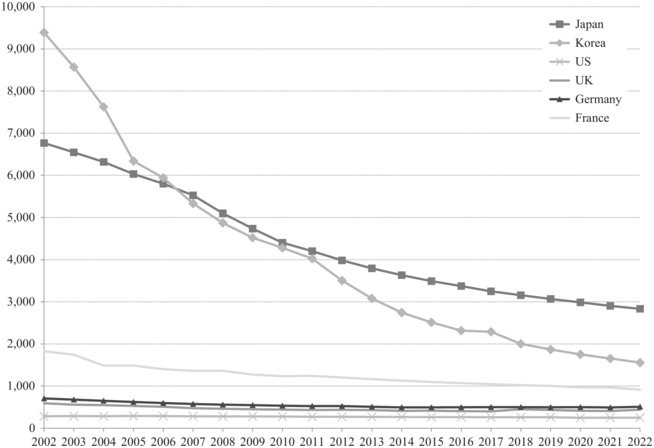
Korea and Japan also underwent analogous judicial reforms at the turn of the millennium that lead one to expect a larger role for the courts in both countries (Choi and Rokumoto Reference Choi and Rokumoto2007). Korea and Japan share legal institutions that follow the civil law tradition due to Japanese colonial rule over the peninsula from 1910 to 1945. Both were then influenced by the experiences of US occupation after World War II and US-backed economic development. Reformers around 2000 sought to make courts less marginal. The Japanese Justice System Reform Council wanted to “enable the people to easily access the justice system as users and to obtain proper, prompt, and effective remedies in response to diversified needs” (JSRC 2001). Korea likewise sought to bolster citizens’ access to and trust in the judicial system (Ginsburg Reference Ginsburg2004). At the forefront was Korea’s new Constitutional Court, which, alongside the National Human Rights Commission, provided NGOs with new channels for mobilizing the law to influence policy (Hong Reference Hong, Shin and Chang2011; Kim and Park Reference Kim, Park and Dressel2012). To a lesser degree, Japan’s Supreme Court has become more aware of the importance of judicial review, equality rights, and international human rights norms, though human rights violations between private actors are more likely to be addressed than public authorities’ human rights violations (Martin Reference Martin2010; Mihira Reference Mihira, Vanoverbeke, Maesschalck, Nelken and Parmentier2014; Hatano Reference Hatano, Higaki and Nasu2021; Repeta Reference Repeta and Hein2023). Reforms to civil procedure in both countries aimed to enhance citizen participation in the courtroom by making trials more adversarial and less document based and introducing lay juries for serious criminal offenses (Ota Reference Ota2001; Nottage Reference Nottage2005; Kwon Reference Kwon and Cho2010; Sohn Reference Sohn2016; Kage Reference Kage2017). Access to legal representation also improved as both governments raised caps on the number of people who could become lawyers each year. Between 2002 and 2022, the number of lawyers per 100,000 people rose from 15 to 35 in Japan and even more dramatically from 11 to 59 in Korea (see Fig. 1.2). Furthermore, while legalistic governance entails more than just litigation and while the number of civil suits per capita in Korea dwarf Japanese numbers, administrative lawsuits have risen in both countries (Kim and Lee Reference Kim and Lee2020, 493–6). Korean surveys also documented a “positive attitude toward the law” and “a growth of legal consciousness” (KLRI 1994, 2015). Growing numbers of large law firms and the legal profession’s globalization or “Americanization” introduced ideas about regulatory tools as well (Kelemen and Sibbitt Reference Kelemen and Sibbitt2002; Goedde Reference Goedde2014). Data indicate that one symptom of the “fundamental transfer of authority from the bureaucracy to the legal system” is that top graduates choose careers in law over the bureaucracy, which once attracted top talent (Milhaupt and West Reference Milhaupt and West2003; Kwon Reference Kwon2021). While these judicial reforms and changes in the legal profession were conducive to legalistic governance, they fail to explain the pace of change and the legalistic policy instruments adopted.

Figure 1.2 Number of citizens served by each lawyer, comparative (2002–2022).
Figure 1.2Long description
The graph plots the years from 2002 to 2022 on the horizontal axis and the number of citizens per lawyer, ranging from 0 to 10,000 on the vertical axis. The data points of the lines are as follows: Japan (2002, 6900), (2010, 4400), (2015, 3500), and (2022, 2900). Korea (2002, 9300), (2010, 4200), (2015, 2500), and (2022, 1700). U.S. (2002, 300), (2010, 300), (2015, 300), and (2022, 300). France (2002, 1900), (2010, 1300), (2015, 1100), and (2022, 900). Germany (2002, 800), (2010, 700), (2015, 700), and (2022, 700). U.K. (2002, 650), (2010, 500), (2015, 500), and (2022, 600). All values are estimated.
Overall, Koreans and Japanese are increasingly leveraging the law to influence policy and assert their rights via the courts and other channels, like the NHRCK or international human rights mechanisms (Arrington and Goedde Reference Arrington and Goedde2021). International law’s development and the influence of US lawyers and the American legal academy in promoting legalization is important context for the transformation studied in this book. But we need to analyze Korean and Japanese activists’ and lawyers’ strategic actions to understand legalism’s spread. They are actively taking advantage of new opportunities and forums. Activists and lawyers from both countries organized study trips to Berkeley or European countries to learn about legal advocacy and hosted or joined international conferences to share ideas about legalistic policy instruments (Chan Reference Chan2004; Heyer Reference Heyer2015). In the past decade, activists also traveled to Geneva to report violations of treaty principles regarding hate speech in Japan (Hatano Reference Hatano, Higaki and Nasu2021) and discrimination against LGBTQ individuals in Korea (Kim and Hong Reference Kim, Hong, Arrington and Goedde2021). Meanwhile, disability rights advocates filed lawsuits regarding involuntary institutionalization in Korea and won a historic lawsuit over voting rights for people with intellectual disabilities in Japan (Okura Reference Okura2018). And asylum seekers and NGOs in both countries, which are known for their stingy refugee policies, have engaged in domestic and transnational rights advocacy to slowly improve the processing of claims (Flowers Reference Flowers2008; Wolman Reference Wolman2013; McClean Reference McClean2024). While international human rights mechanisms’ development facilitated advocacy, activists and lawyers had to take advantage of such changed conditions. Their activism and claims-making help explain when and how new opportunities opened, as this book’s cases show.
Paired Comparisons within Korea and Japan: Case Selection and Research Design
Parallels in this book’s paired comparisons of four recent reforms in two policy domains with structural similarities – disability rights and tobacco control – help to further rule out potential explanations for legalistic governance. In both issue areas, advocates for legalistic regulations began from positions of weakness, and neither issue promised significant votes for politicians considering whether to take it up. As this book’s empirical chapters show, disabled persons had been marginalized and treated as mere recipients of welfare or medical care in both societies. They comprise less than 10% of either country’s population. Likewise, antismoking activists tackled a common practice among men in both societies and took on powerful tobacco companies that used to be state-owned monopolies and still enjoyed favorable legal protections. Furthermore, small businesses resisted regulations requiring the installation of both accessibility features like ramps or accessible toilets and designated smoking rooms with ventilation due to cost and space considerations. Yet, in both issue areas, nearly contemporaneous reform discussions were sparked by treaty commitments and upcoming mega-events that emboldened and empowered domestic activists. The international treaties – the 2006 UN Convention on the Rights of People with Disabilities and the 2003 WHO Framework Convention on Tobacco Control – and legislation and lawsuits abroad provided opportunities for policy entrepreneurs to share ideas about legal norms and legalistic enforcement mechanisms. Given the priority the International Olympic Committee places on accessibility and smoke-free games, policy debates on these issues took frontstage in preparations for the 2018 PyeongChang Winter Games and especially the 2020 Tokyo Games. The chapters illustrate how “any one locale is crosscut by, and co-constitutes, dynamics that exceed geographic boundaries” (Riofrancos Reference Riofrancos, Simmons and Smith2021, 107). These international treaties, focusing events, and policy learning alone cannot explain variations in the nature and pace of legalism in the cases. We need to examine how domestic activists and lawyers leveraged international developments, with an awareness of the multiscalar processes and structures within which they work.
This book analyzes varying degrees of legalistic governance (or lack thereof) in Korean and Japanese social policy through four paired longitudinal case studies, tracing the enactment, implementation, and revision of policies, as well as related litigation, over three decades. The case studies examine two issues in each of the two policy domains: disability rights (antidiscrimination and accessibility) and tobacco control (tobacco product liability and indoor smoking restrictions). Many studies of societal groups’ contributions to judicial expansion in Europe focus on success cases, leading to selection bias on the dependent variable (Börzel Reference Börzel2006). This book avoids such bias by including a case wherein societal groups failed to obtain legalistic policy reforms or expand legal opportunities – tobacco product liability. Secondary scholarship on these issue areas in other parts of the world also helps situate Korea and Japan in relation to trends elsewhere (e.g., Kagan and Vogel Reference Kagan and Vogel1993; Kagan and Nelson Reference Kagan, Nelson, Rabin and Sugarman2001; Derthick Reference Derthick2002; Kelemen Reference Kelemen2011, chap. 6; Vanhala Reference Vanhala2011b, Reference Vanhala2015; Jarman Reference Jarman2018; McCann and Haltom Reference McCann, Haltom, Burke and Barnes2018). My comparative research design offers insights into changes in governance and legal institutions in other democratic polities that follow the civil law tradition. In particular, the causal mechanisms through which societal actors contribute to legalism and the conditions that are favorable to such efforts may well apply to other polities and to public policy issues beyond tobacco control and disability rights.
The paired case studies draw on process tracing and analysis of primary and secondary sources in Korean, Japanese, and English. More than 120 original interviews with lawyers, judges, scholars, journalists, politicians, and activists uncover law in action and the distinctive relationships, discourses, and strategic repertoires that shaped activism in these relatively similar contexts. For more details, see the Appendix on Sources and Methods. Movements’ blogs, newsletters, and participant memoirs offer further insights into activists’ perceptions and activities. Content analyses of legislative debates, NGOs’ analyses of legal cases, and media coverage also shed light on policymaking and enforcement, as well as how they are changing. Process tracing “uncover[s] the fingerprints” that legalism’s proponents and opponents “should have left in the empirical record” (Beach and Pedersen Reference Beach and Pedersen2013, 42). Through inductive case studies, process tracing aims at theory building by specifying causal mechanisms, elaborated in Chapter 2 (Trampusch and Palier Reference Trampusch and Palier2016).
The book’s empirical chapters point to several conditions under which activists are more likely to contribute to a legalistic regulatory style, but I eschew a deterministic argument. First, demands for legalistic policy solutions are more effective when backed by “support structures” that include lawyers and organizations with rights-advocacy goals and sources of funding (Epp Reference Epp1998). As a result, the book investigates the lawyers involved in promoting legalism, asking who they are, how they organize, and what models they consider when strategizing. Second, legalism is more likely if reform opponents are diffuse or unorganized. Certainly, tobacco control advocates faced more organized and powerful opposition from the tobacco industry, aligned politicians, and the hospitality sector. Yet business groups also slow-walked antidiscrimination and accessibility reforms, and the chapters detail how disability rights advocates systematically worked around and undermined such resistance. Third, the case studies indicate that legalism is most likely when all five of the above-mentioned mechanisms are activated in a systematic and sustained way (González-Ocantos Reference González-Ocantos2016). Support structures help sustain activism over time to take advantage of the productive synergies among these mechanisms, including in the face of powerful organized resistance to reform. Thus, my research explores the agents and the politics behind the legalistic turn occurring in Japanese and Korean governance.
Besides explaining a more legalistic regulatory style and its downstream effects on claims-making, this book investigates the accompanying social changes (or lack thereof) in terms of the attitudes and behavior of stakeholders, as well as the broader populace. Triangulating among diverse surveys and media coverage, the chapters lend support to prior scholars’ findings that the implementation of rights-based policies is not always as smooth or as complete as reformers hope (Hafner‐Burton and Tsutsui Reference Hafner‐Burton and Tsutsui2005). I also draw on the legal mobilization tradition, which emphasizes what has been called constitutive, social constructivist, or sociological institutionalist modes of analysis (Taylor and Tarrow Reference Taylor and Tarrow2024). Court rulings and laws matter not only directly as authoritative and enforceable pronouncements but also indirectly through “radiating effects” that reshape individuals’ identities, sense of entitlements, perceptions of risks and opportunities, and resources for strategic action (Galanter Reference Galanter, Boyum and Mather1983; McCann and Lovell Reference McCann and Lovell2020, 357). Scholars of institutional change similarly note that “rules, even when formally codified, are never simply applied, but always interpreted, enforced, and enacted – and by actors with divergent and conflicting interests. This is why courts can be such influential (and unpredictable) actors, and why lawyers find such gainful employment (Streeck and Thelen Reference Streeck and Thelen2005, 14–15); it is also, however, why the rulings of courts are themselves rarely more than the end of the beginning of any social conflict” (Thelen and Conran Reference Thelen, Conran, Fioretos, Falleti and Sheingate2016, 65). Therefore, instead of explaining a single “snapshot” policy outcome (e.g., new legislation), each chapter uncovers a “moving picture” wherein gradual, smaller regulatory and cultural shifts cumulate to have substantive implications (Pierson Reference Pierson2000). Some effects are still emerging.
Defining Legalistic Regulatory Style
The emergence of legalism elsewhere helps us characterize and explain shifts in regulatory style in Korea and Japan. Though the trend is surprising in these hard cases, it is not unique to Korea and Japan. In the past three decades, governance in many countries has involved more detailed laws and regulations, new constitutional clauses, clearer enforcement mechanisms, more judicial checks on officials, and wider citizen participation (e.g., Stone Sweet Reference Stone Sweet2000; Hirschl Reference Hirschl2004; Cichowski Reference Cichowski2007; Gauri and Brinks Reference Gauri and Brinks2008; Dressel Reference Dressel2012; Kapiszewski, Silverstein, and Kagan Reference Kapiszewski, Silverstein and Kagan2013). Often associated with neoliberalism, globalization, the development of international law, democratization, and institutional fragmentation, such legalistic modes of governance are a key part of the broader trend that has been labeled “legalization,” “juridification,” or “judicialization” of politics and observed worldwide (Vallinder Reference Vallinder1994; Barnes and Burke Reference Barnes and Burke2015, 3–4; Hamlin and Sala Reference Hamlin, Sala and Thompson2018). During the United Kingdom’s and Japan’s deregulation of the 1980s and 1990s, for example, “freer markets” necessitated “more rules” and “juridical reregulation” (Vogel Reference Vogel1996). The label “Eurolegalism” summarized how regional integration in the European Union led to a greater emphasis on “enforcing legal norms through transparent legal rules and procedures and broad[er] access to justice, empowering private actors to assert their legal rights” (Kelemen Reference Kelemen2011, 6). European regulations on data privacy also involved a growing number of enforceable rules and more formally participatory policy processes, even as self-regulation persisted – “cooperative legalism” (Bignami Reference Bignami2011). Meanwhile, legalistic tobacco control laws diffused across Europe, and litigation emerged as a public health policy enforcement tool (Jarman Reference Jarman2018). Even China adopted “authoritarian legality” in governance, creating rights-giving legislation and encouraging workers to become familiar with and use new laws and regulations to help with enforcement (Gallagher Reference Gallagher2017).
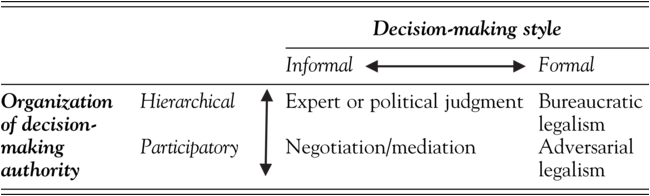
To make sense of what is changing in Korea and Japan, this book adopts Kagan’s influential conceptualization of legalism. He saw modes of governance as varying on two main dimensions, which provide greater precision and “a language for comparison” in a world where judicialization and legalization are increasingly widespread (Barnes and Burke Reference Barnes and Burke2020, 483). The who and the how of governance, sometimes also called regulatory style or policy style, vary around the world and across policy domains (Lowi Reference Lowi1964; Vogel Reference Vogel1986; Howlett and Tosun Reference Howlett and Tosun2018; Cairney Reference Cairney, Howlett and Tosun2021). Governance may rely more on legally binding clauses that constrain choice or on autonomous societal self-regulation and nudges (Thaler and Sunstein Reference Thaler and Sunstein2003; Treib, Bähr, and Falkner Reference Treib, Bähr and Falkner2007). Officials also consult societal actors to varying degrees in decision-making and involve them in policy implementation more or less (Richardson Reference Richardson1982). Likewise, rules and regulations might be elaborated in advance or in response to new social issues. Distilling the main axes of variation in other studies of regulatory style, Kagan emphasizes two dimensions.
The first dimension is the level of formality, or the degree to which policy decisions and implementation follow written-down, enforceable rules and procedures instead of more informal, flexible coordination and discretionary judgments. The common understanding of legalism as adherence to legal rules accords with the “rules” in my book’s title, but Kagan’s concept of legalism is broader. Legalistic governance also entails formalized procedures, which “erode the power of closed networks of political and business elites in shaping policy – by increasing openness and transparency, and by empowering a wider range of actors” (Kelemen and Sibbitt Reference Kelemen and Sibbitt2004, 132). Kagan’s second dimension thus focuses on the extent of participation in governance. Is decision-making authority centralized among closed groups of bureaucrats and experts or more participatory among contending interests using dispute resolution mechanisms, such as the courts? Formalizing procedures for decision-making and dispute resolution reflects a desire for greater accountability, much as how programmatic distributive policies aim to curtail officials’ discretion by making decisions “subject to rules that are formalized, transparent (in the sense of being made public), and not manipulable by incumbents” (Catalinac and Muraoka Reference Catalinac and Muraoka2023, 41). Opening policy processes to wider participation likewise aims to increase transparency.
These two dimensions lead to four “ideal types” (Table 1.1). Relative to governance elsewhere, the United States’ regulatory style – labeled “adversarial legalism” – entails more complex legal rules, legal sanctions, and formalized and adversarial enforcement procedures, which give lawyers and litigation a uniquely prominent role (Kagan Reference Kagan2001, 3). Kagan (Reference Kagan2000) often described Japan as the opposite of the US regulatory style, and Korea showed similar patterns. Yet, to deemphasize the United States as a referent, I drop “adversarial” and just use “legalism.” The two dimensions remain helpful for characterizing change, and Chapter 2 details indicators of legalism. The legalistic turn analyzed in this book is a movement toward the lower right quadrant, away from bureaucrat-led decision-making and away from informal measures. Regulatory style varies by issue area, with different mixes of policy instruments and procedures. The empirical chapters detail remnants of bureaucratic legalism or mediation, such as Japan’s informal consultations regarding disability discrimination. Overall, this book investigates how, when, and why governance in Korea and Japan is becoming more formal and participatory.

Table 1.1Long description
The decision making styles are depicted as a spectrum from informal to formal. The organisation of decision-making authority is illustrated as a spectrum from hierarchical and participatory. The organization level based on decision-making style, in order from informal to formal. Hierarchical Informal: Expert or political judgement. Hierarchical Formal: Bureaucratic legalism. Participatory Informal: Negotiation/mediation. Participatory Formal: adversarial legalism.
Contributions
This book makes several contributions to scholarship. First, it identifies, analyzes, and makes sense of a significant transformation in governance in East Asia’s main democracies, which includes a greater role for law and courts. The legalistic turn is changing how policymaking and policy implementation occur and who is involved in these processes. Indicators of the transformation include gradual changes in policy, statutes, institutions, procedures, and jurisprudence. Such changes have received less scholarly attention than both countries’ contemporaneous judicial reforms or the judicialization of politics, studies of which tend to focus on high courts and “mega-politics” (Hirschl Reference Hirschl, Whittington, Kelemen and Caldeira2008; Miyazawa, Chan, and Lee Reference Miyazawa, Chan and Lee2008; Kim and Park Reference Kim, Park and Dressel2012; Chulwoo Lee Reference Lee2016; Alter and Madsen Reference Alter and Madsen2021; but see Vanoverbeke et al. Reference Vanoverbeke, Maesschalck, Nelken and Parmentier2014). My book offers a useful corrective by studying more quotidian social policies and examining proceedings across all levels of courts, as well as their interactions with legislative bodies, the bureaucracy, and public opinion. The signs of a more legalistic regulatory style are central to the broader judicialization of politics because they constitute the legal frameworks that enable law and courts’ expanded roles in governance. This is not to say that US-style adversarial legalism is emerging in East Asia’s main democracies. As one scholar noted, “hōka” (legalization) in Japan reduces some differences between the United States and Japan but is not the same as convergence (Nelken Reference Nelken, Vanoverbeke, Maesschalck, Nelken and Parmentier2014, 2–3). Like their European counterparts, Japanese and Korean decision-makers feared creating a “lawsuit society” (soshō shakai) or “a country of litigious people” (JDDA Enactment Team 2002, 41; Seong-kon Kim Reference Kim2010). Yet, by asking if other countries should worry about the “American disease” of adversarial legalism, Kagan “triggered a vibrant debate and inspired a wealth of research” comparing regulatory styles (Bignami and Kelemen Reference Bignami, Kelemen, Burke and Barnes2018, 95). I engage with such research by utilizing Kagan’s conceptualization of governance as varying on two dimensions (formality and participation) without using the distinctive US regulatory style as a benchmark. Using these dimensions, my research challenges the conventional wisdom that law and courts play marginal roles in Korean and Japanese politics and illuminates what is changing.
Second, this book identifies bottom-up drivers behind legalism and the broader judicialization of politics, which are usually attributed to top-down forces. In so doing, it advances sociolegal scholarship by theorizing the mechanisms through which activists facilitate institutional change. Hendley (Reference Hendley1999) urged more attention to “the demand for law.” Rather than appearing “as if by magic,” cases must be brought before the courts by people in order for politics to become judicialized (Epp Reference Epp1998, 18). The extent to which citizens perceive law and courts as useful and thus use the law to pursue their policy goals is shaped by a complex array of factors, including the nature of existing laws and rights, rules about standing, constitutional rules configuring the relationships and authority of government bodies, and citizens’ understandings of them (Cichowski and Stone Sweet Reference Cichowski, Sweet, Cain, Dalton and Scarrow2003). By identifying and illustrating the specific mechanisms through which activism can creatively use and sometimes reshape regulatory rules and procedures, this book elucidates the multisited recursive microprocesses of institutional change (McAdam, Tarrow, and Tilly Reference McAdam, Tarrow and Tilly2001; Campbell Reference Campbell2002; Shipan and Volden Reference Shipan and Volden2008). It builds on new institutional analysis, which pays attention to how individuals participate in institutionalization processes through innovation and building support for new rules and organizational forms (Strang and Soule Reference Strang and Soule1998; Fligstein Reference Fligstein2001). But such studies tend to overlook the law and legal institutions (Edelman, Leachman, and McAdam Reference Edelman, Leachman and McAdam2010, 661). Similarly, studies of policy feedback, which is the reciprocal effects of a policy and the people who interact with it, generally ignore the legal sphere (Pierson Reference Pierson1993; but see Goss and Lacombe Reference Goss and Lacombe2019). At the same time, a review article bemoaned that sociolegal studies highlight how law contributes to the social construction of daily life but pay insufficient attention to its role in the politics of issue framing and policymaking (Levitsky Reference Levitsky2013). Epp (Reference Epp2016, 40) also urged sociolegal scholars to engage more with studies of public policy. This book seeks to bridge these divides by analyzing the mechanisms through which societal groups are contributing to incremental changes in the institutions, processes, and actors involved in policymaking, thereby transforming citizens’ options for political participation.
Third, to characterize what is changing about governance, I systematically bring together the frameworks of legal and political opportunities with studies of regulatory style and the broader judicialization of politics. Rather than have opportunity structures explain outcomes, I use the concepts as an “orienting device for the sorting of observations” (Tilly Reference Tilly and Wiktorowicz2004, xi). In so doing, this book adds precision to our understanding of variations in the nature, pace, and meaning of the judicialization or legalization of politics, which Hirschl characterized as “arguably one of the most significant developments in late twentieth and early twenty-first century governance” (Hirschl Reference Hirschl, Whittington, Kelemen and Caldeira2008, 69). In Asia, the role of law and courts is also growing, though it is more recent (Dressel Reference Dressel2012). Yet studies of the judicialization of politics suffer from conceptual stretching (Hamlin and Sala Reference Hamlin, Sala and Thompson2018). By building on Kagan’s conceptualization of legalism and specifying its indicators (see Chapter 2), I advance this literature to postulate observable implications of legalism – more formal rules and more contested, participatory procedures – that can be used for comparative analysis (Barnes and Burke Reference Barnes and Burke2020). Studies of legal and political opportunity structure help identify factors that constrain activists and the institutions they target for change. For example, activists and lawyers seek to expand the legal opportunity structure via justiciable rights, broaden rules about who can bring lawsuits, obtain relief from the cost of litigation, loosen rules about evidence in adjudication, clarify dispute resolution mechanisms, and gain access to policymakers (Hilson Reference Hilson2002; Andersen Reference Andersen2005; Wilson Reference Wilson2009; Evans Case and Givens Reference Evans Case and Givens2010; Vanhala Reference Vanhala2018b). To help reshape the rules and procedures, activists cultivate elite allies, which studies of political opportunity structure emphasize as access to formal institutions (Kitschelt Reference Kitschelt1986; Tarrow Reference Tarrow2011). I apply the framework of opportunity structures to paired case studies to analyze when and how activists perceive and use openings (Kay and Baker Reference Kay and Baker2015).
Fourth, this book extends the geographic scope of research about legal mobilization, cause lawyering, and legal opportunity structures to East Asia. Legal mobilization scholarship was Western-centric until recently (for recent exceptions, see Tam Reference Tam2013; Stern Reference Stern2013; Chua Reference Chua2014; Arrington Reference Arrington2019a), and the legal opportunity structure literature remains so. Taking into account differences across cultural context, this book explores law as “a living institution, subject to social interpretation, political manipulation, and judicial transformation” (Edelman, Leachman, and McAdam Reference Edelman, Leachman and McAdam2010, 661). I study “law in action” rather than just as something relatively static, written down, and exogenous from political or social processes. The institutionalist approach helps specify constraints and arenas of contention, while still foregrounding the agency of activists and lawyers. In particular, this book spotlights the lawyers who worked with movements to pursue reforms and specifies how a “support structure of rights-advocacy lawyers, rights-advocacy organizations, and sources of financing” makes it more likely that societal actors can influence decision-making rules and procedures (Epp Reference Epp1998, 18). This adds East Asian empirics to the “cause lawyering” literature, which analyzes how lawyers leverage their professional skills in activism (Sarat and Scheingold Reference Sarat and Scheingold2005, Reference Sarat and Scheingold2006). It also connects that scholarship to earlier Japanese studies of legal mobilization and lawyers (Kidder and Miyazawa Reference Kidder and Miyazawa1993) and recent research about Korea’s new public interest law firms and foundations (Goedde Reference Goedde, Arrington and Goedde2021). Through comparisons, this book enables us to see patterns and trends in cause lawyering that might be taken for granted in single-country studies (see also Liu and Halliday Reference Liu and Halliday2011; Hsu Reference Hsu2018; Arrington and Moon Reference Arrington and Moon2020). By paying attention to the support structures that help activists assess opportunity structures and the counterforces that close opportunities, this book aims to understand the necessary and permissive conditions under which societal actors can influence policymaking patterns.
Manners and Rules
Before outlining the book’s structure, let me say a few words about the phrase used in the book’s title – “from manners to rules.” Its emphasis on enforceable rules captures an important part of the transformation I detail but not all of it. Japanese policy councils debated whether to “make it legally obligatory” (gimuka/gimu dzuke) for private businesses to provide customers with reasonable accommodations, such as ramps into stores or braille signage. In Korea, activism for accessibility likewise pushed for accommodations like no-step entrances and elevators to “be made legally obligatory” (uimuhwa) because budgetary and space constraints had stymied the implementation of “voluntary clauses” (im’ui johang) (see Fig. 1.3). Legalistic reforms changed rules in undeniable ways. For instance, they codified nondiscrimination rights and, in Korea, made the rules more favorable by giving NGOs the right to file claims on behalf of disabled victims of discrimination. Such changes suggest that officials realized that manners-type approaches that relied on unenforceable social norms were not enough.

Figure 1.3 “Accessible facilities for disabled persons: make their installation mandatory”.
At the same time, more legalistic governance does not necessarily mean jettisoning manners-type measures, such as public education initiatives or unenforceable exhortations. Even legalistic measures depend on voluntary compliance to some extent because monitoring everyone is impossible. However, legalism’s increased formality, transparency, and citizen involvement in policymaking processes can increase perceptions of legal frameworks’ legitimacy and predictability. And people obey the law not because they fear punishment but because they consider it legitimate (Tyler Reference Tyler2006). Moreover, even unenforceable or aspirational laws can catalyze changes in behavior and beliefs. Laws generally do not just regulate and sanction but also “communicate information about new norms, [which are] standards of desirable and appropriate conduct” (Htun and Jensenius Reference Htun and Jensenius2022, 2). This “expressive power” of laws is not necessarily incompatible with enforcement mechanisms like sanctions or punishments. In fact, as the empirical chapters show, policymakers frequently combine legalistic clauses with more symbolic exhortations. The expressive or educative dimensions of laws also help us understand why activists care about clarifying or adding detail to definitions in laws and regulations. Manners and rules are neither the only alternatives nor mutually exclusive. Consider, for example, Fig. 1.4, which depicts the advertisement I saw on a Tokyo bus, encouraging road traffic “rules and manners” to prevent bicycle accidents. This book not only traces a general shift toward legalistic modes of governance but also documents diverse policy instruments beyond the categories of rules or manners, such as clauses shifting the burden of proof, subsidies, or the creation of new policy assessment bodies. Combined in interesting ways, they exhibit more formal and participatory modes of governance overall.

Figure 1.4 On a Tokyo bus, “Bikes can also prevent accidents through rules and manners.”
The book’s title may foreground rules and formalism at the expense of the participation dimension of legalism. However, my research reveals the importance of both dimensions in understanding changing regulatory styles. Additionally, the phrase “from manners to rules” fits better with smoking, which is a matter of individual choice, than with accessibility, which is a matter of building codes and the policies of government agencies or businesses. Yet prior policies toward disabled persons relied on manners or good intentions and welfare paternalism instead of prohibiting discrimination or requiring that trains, buses, and buildings be accessible to everyone. Both the phrase and the label of legalistic governance – which is an ideal type – capture key elements of this shift. The phrase might imply thresholds or cut points along a spectrum. In reality, governance involves multiple actors, institutions, policy instruments, and processes that combine and change in diverse ways. Hence, I specify indicators of more legalistic governance in Chapter 2 rather than thresholds. In sum, the phrase “from manners to rules” is a useful shorthand for the legalistic turn in governance documented in this book.
Roadmap
As already noted, Chapter 2 bridges Kagan’s typology of regulatory styles with scholarship about legal and political opportunity structures to detail indicators of legalistic governance, which serve as a guide for the subsequent paired case studies. It also theorizes five causal mechanisms that elucidate how activism is contributing to more legalistic governance. Finally, it discusses in a probabilistic way the conditions under which activism is more likely to contribute to legalistic modes of governance.
The empirical chapters are divided into two parts. Part I comprises three chapters focused on the history of disability rights activism and recent reforms related to accessible public transit and disability discrimination. Chapter 3 overviews historical parallels in the marginalization of people with disabilities, the development of welfare policies for them, and the emergence of independent living movements in Japan and Korea. Activism by (rather than for) Japanese and Koreans with disabilities and growing rights consciousness accelerated in the 1990s and 2000s through ties with transnational activist networks and around negotiations for the Convention on the Rights of Persons with Disabilities. As background for the next two chapters, Chapter 3 surveys recent reforms and the organizational ecology of disabled persons’ organizations and lawyers who are the actors activating the causal mechanisms that contribute to the legalistic turn in governance.
Chapter 4 focuses on a central demand of disability rights activism – accessibility. In both Korea and Japan, the built environment has grown markedly more accessible, in part through nonbinding measures. But by combining contentious and institutional tactics, disability rights advocates have pushed to make standards and regulations mandatory and to give disabled persons (the users of barrier-free features) a seat at the table in policy design, implementation, and evaluation. The national governments and localities in both Korea and Japan have gradually responded by making accessibility policy more formal and participatory, though gaps remain.
Worldwide, more than 125 countries have enacted legal provisions against disability-based discrimination; such legislation was also a core demand of Japanese and Korean disability rights activism. Despite the rapid diffusion of nondiscrimination norms, we know less about why their forms vary and how they have affected rights-claiming options. Through a paired comparison of activism surrounding statutes enacted in Korea and Japan in 2007 and 2013, respectively, Chapter 5 shows how advocacy for such legislation and related litigation transformed governance and created legal opportunities. To a greater extent in Korea than in Japan, people with disabilities gained nondiscrimination rights, mechanisms for redressing discrimination, support from NGOs and state agencies, and the legal tools with which to solidify and expand antidiscrimination protections in court and through statutory revisions.
Part II focuses on cases related to tobacco control. Law, rights talk, and litigation have become regular features of tobacco control movements and public health campaigns to reduce tobacco consumption worldwide, including in Japan and Korea. But are they enough to overcome the resource and information disadvantages tobacco control activists face when taking on the industry? Chapter 6 offers as historical background a discussion of the tobacco epidemic, the multifaceted reasons the tobacco industry remains politically influential in both countries, the Framework Convention on Tobacco Control, and recent tobacco control measures, including taxation and pricing, limits on advertising, and new responses to electronic nicotine delivery systems.
With this book’s “negative cases,” Chapter 7 unpacks why legal mobilization related to tobacco product liability and the recovery of healthcare costs of treating smokers has had so little impact on legal frameworks and jurisprudence. The chapter highlights the persistence of the Tobacco Business Law as sustaining the tobacco industry’s political power, the role of transnational networks among tobacco companies against stronger regulations, domestic Japanese and Korean judges’ narrow interpretation of standing rules and evidence of causation, and the weaknesses of support structures for sustained legal mobilization and advocacy.
Chapter 8 turns to a paired comparison of secondhand smoke prevention policies, which offer a more optimistic picture of social change. In addition to stricter nonsmoking rules, changing social norms and declining smoking rates were conducive to realizing reforms and benefited from them. This chapter details the contributions of tobacco control advocates through lobbying, educational activities, and lawsuits related to secondhand smoke, especially in workplaces and at subnational levels. Their multisited activism is a necessary part of understanding why one is much less likely to get exposed to secondhand smoke in Korea and Japan today.
The book’s conclusion takes stock of the extent of the legalistic turn in governance in Korea and Japan, including in other issue areas. Governance is overall more legalistic in Korea than in Japan, based on the comparisons in the areas of tobacco control and disability rights. But Japan has also adopted a more legalistic approach. The tobacco liability cases remind us that legalism is not emerging everywhere, though. The cases suggest that legalistic governance is more likely when there are institutionalized support structures for policy advocacy and legal mobilization, when opposition to reforms is diffuse or unorganized, and when activists activate all five mechanisms theorized in this book in a sustained way. The conclusion surveys other issue areas in which legalistic governance is taking hold or not in Japan and Korea, including gender equality, labor law, and COVID-19 countermeasures. Finally, it explores what implications the growing role of law and courts has for Japanese and Korean democracy. The book concludes, on a cautiously optimistic note, that the potential for rights realization and channels for participation have improved, especially in Korea. Although legal mobilization remains challenging and the implementation of reforms faces human and resource constraints as well as sticky social attitudes, activists and lawyers are creatively using and deepening legal frameworks in ways that produce institutional and social changes.