

Introduction
Since 2016, police data worldwide have revealed a significant and rapid increase in cocaine production in Latin America, accompanied by higher levels of purity, consumption, and seizures, particularly in Europe [EUDA 2024, UNODC 2024, OFDT 2023]. Although cocaine consumption has not increased in North America, due to its substitution by fentanyl and other drugs, cocaine seizures are also increasing significantly in Asia, Africa, and Oceania. As a globally illicit drug, cocaine is now readily available on all five continents; its supply chain has demonstrated a remarkable ability to resist attempts at control by nation-states and law enforcement agencies.
This article analyses these recent changes in the cocaine value chain by examining the barely studied expanding logistical role of a Brazilian criminal secret society called the Primeiro Comando da Capital (“First Capital Command”),Footnote 1 hereinafter referred to as the “PCC”. Empirically, I focus on the operations of the PCC governance unit responsible for regulating drug-trafficking activities, which I will refer to as the “Agência”.Footnote 2 By analysing the logistical changes introduced by the Agência, which moved the PCC towards a platform-type model [Srnicek Reference Srnicek2017],Footnote 3 the paper focuses on the mechanisms by which Latin American criminal organizations expand their regulation of global value chains. I suggest that these changes have allowed the PCC to partner with key international actors in this illicit transatlantic economy by lowering wholesale prices and improving the quality and stability of the supply of cocaine hydrochloride in Europe [OFDT 2023, EUDA 2024]. The scale of the accumulation offered to these actors, who also regulate the use of violence in various localities, makes them politically relevant and challenges the established powers.
Theoretically, my approach is consistent with the assumption that actors who regulate both violence and markets are political actors, and are even more so when they produce ideologies and a sense of belonging [Weber Reference Weber, Runciman and Matthews1978; Tilly Reference Tilly1990, Reference Tilly2003; Varese Reference Varese2023]. They are not political actors by virtue of any formal relationship with the state or official institutions, but rather because their control over both capital and the means of violence, legitimized by specific groups, enables them to exercise extra-legal governance. In this sense, I make the assumption that the PCC is organized with the aim of accumulating opportunities and concentrating power; its criminal expansion has created an emerging governscape [Steputtat 2013] in which the state is forced to coexist with alternative power regimes [Feltran Reference Feltran2020a].
Accordingly, this article engages with scholarly debates on the different ways in which political and financial goals frame the structure of criminal organizations capable of using coercion, as stated by the Production, Trade, Governance (PTG) framework [Breuer and Varese Reference Breuer and Varese2023; Campana and Varese Reference Campana and Varese2018]. While the empirical focus of this article is the PCC agency, it is important to note that the latter is designed to regulate how independent traffickers operate by means of a platform model; this governance device allows for the optimization of profits for thousands of individual and small-scale cocaine traffickers, who might be PCC members or simply their economic partners.Footnote 4 In this regard, the broader PCC structure is that of a typical governance-type criminal network [Breuer and Varese Reference Breuer and Varese2023], but one that is atypical in that it includes the Agência, which regulates a myriad of individual or collective criminal entrepreneurs. These actors are organized along the lines of a guild [Bodie Reference Bodie2018 17; Montias Reference Montias1977] and are connected by a platform-type business model. In other words, by describing the trading mechanisms introduced by the Agência, I take an analytical approach to the debate on criminal governance [Campana and Varese Reference Campana and Varese2018; Lessing Reference Lessing2021]. My aim is to contribute to: (i) the scholarship on power regimes, which predominantly focuses on state-centric analyses; (ii) research on organized violence and criminal governance, which often lacks robust empirical grounding; and (iii) the comparative discourse on global (il)licit economies, which is frequently framed by normative dichotomies such as legal/illegal and North/South.
More than 20 years ago, Peter Reuter used the metaphor of the hourglass to characterize the international cocaine market [Reuter Reference Reuter2003]. According to this model, a few intermediaries—the narrow part of the hourglass—are extremely powerful, while a vast array of producers and retailers—positioned at both ends—exercise limited dominance over sections of the value chain [Reuter Reference Reuter and Letizia2014]. Work on the structuring of illegal markets [Beckert and Dewey Reference Beckert, Dewey, Beckert and Dewey2017] has demonstrated that illegal groups use the infrastructure of legal trade to expand their value chains [Tarrius Reference TARRIUS2015; Ribeiro Reference Ribeiro2006], and that illegal businesses are protected by robust corruption structures around the world [Dewey Reference Dewey2011; Misse Reference Misse2019; Campana and Varese Reference Campana and Varese2022; Fromm Reference Fromm2023]. The normative dichotomy between legal and illegal economies has also been challenged in various sociological works [Gootenberg Reference Gootenberg, Topik, Marichal and Frank2006, Reference Gootenberg2009; Telles Reference Telles2007; Telles and Hirata Reference Telles and Hirata2010; Dewey Reference Dewey2016; Feltran Reference Feltran2019, Reference Gabriel2021]. The upscaling of international cocaine trafficking has forced us to realize how recent changes in this global flow have generated an intense degree of convergence between multiple criminal markets and actors [Boekhout van Solinge Reference Boekhout Van Solinge, Savona, Guerette and Aziani2022], and that the trade reaches territories far beyond Latin America [Arias and Grisaffi Reference Arias and Grisaffi2021; Grisaffi Reference Grisaffi2022, Reference Grisaffi, Heymann and Gonzalez2024; Boekhout van Solinge Reference Boekhout Van Solinge, Savona, Guerette and Aziani2022; Hauser Reference Hauser2022; Vigh Reference Vigh2017, Reference Vigh2022; Sergi Reference Sergi2024].
The literature clearly recognizes that the political economy of these global chains structures the heterogeneity of local criminal dynamics [Reuter Reference Reuter and Letizia2014; Feltran Reference Feltran2019; Estancona Reference Estancona2021, Reference Estancona2022; Brombacher et al. Reference Brombacher, Maihold, Müller and Vorrath2022] and causes changes in the dynamics of violence and homicide [Aziani Reference Aziani2020; Feltran et al. 2022]. The increase in the cocaine supply that is specific to Europe has been noted in several studies and reports [Russo Reference Russo2010; OFDT 2023; Conover Reference Conover2024], which have demonstrated that this increase in the trade is not limited to major hubs, ports, and airports [Sampó and Trancoso Reference Sampó and Troncoso2023; Brombacher et al. Reference Brombacher, Maihold, Müller and Vorrath2022]. Work on the coca-producing countries of Peru, Bolivia, and Colombia not only reveals a decline in the prices paid to producers and changes to the trade in recent years, but also links recent changes to long-term historical and political processes [Mazeres Gaitero Reference Mazeres Gaitero2020; Mateus Reference Mateus2021; Gutierrez and Ciro Reference Gutiérrez José, Ciro, Gutiérrez -SANIN and Gutiérrez2023]. A particularly interesting strand of the literature has discussed hybrid orders, governscapes, and criminal governance as means of analysing these markets [Arias Reference Arias2006; Stepputat Reference Stepputat, Bouziane, Harders and Hoffmann2013; Campana and Varese Reference Campana and Varese2018; Feltran Reference Feltran2020a; Cruz Reference Cruz2022; Lessing Reference Lessing2021; Blattman et al. Reference Blattman, Duncan, Lessing and Tobón2025].
The centrality of disputes over the logistics of transnational illicit markets has also received attention from some prominent scholars [Stepputat and Hagmann Reference Stepputat and Hagmann2019; Hagmann and Stepputat Reference Hagmann and Stepputat2023; Schouten, Stepputat, and Bachmann Reference Schouten, Stepputat and Bachmann2019] and has been studied in comparison to legal markets. These studies demonstrate that criminalization leads to expansion of—and greater variability within—the territories of distribution routes in illicit markets [Dávila et al. Reference Dávila, Magliocca, McSweeney and Rueda2021; Gambetta and Reuter Reference Gambetta, Reuter, Fiorentini and Peltzman1996]. The literature also shows how the material dimension of power regimes, starting with sovereignty itself, is strongly related to the politics of wealth circulation [Hirata Reference Hirata2022; Maldonado Aranda Reference Maldonada Aranda2010; Feltran Reference Feltran2019]. As I reviewed this literature and talked to my interlocutors in the field, it became clear that the cocaine market is extremely sophisticated, uses myriad digital networks to establish itself and, above all, draws together a plethora of autonomous entrepreneurs in joint operations. At the same time, it became clear that the way these structures operate reflects the traditional form of the guild, a network based on honour and reputation; however, these networks are now regulated by criminal organizations. Only after realizing this did I begin to understand the platform logic that structures these transnational value chains. These chains linked countless autonomous producers to a vast array of end consumers worldwide by establishing multimodal logistics systems, alongside networks for production, security, communications, international payments, and strategic investment.
Even though the PCC has been much discussed in terms of its various dimensions and effects for almost two decades now [Biondi Reference Biondi2009, Reference Biondi2016; Feltran Reference Feltran2010, Reference Feltran2018, Reference Feltran2020a; Willis Reference Willis2015], the emerging literature in English has not yet examined, either empirically or analytically, the key role that the PCC has come to occupy in the international cocaine value chain. The PCC offers a different kind of protection from that analysed by Gambetta [Reference Gambetta1993] or Varese [Reference Varese2001] and discussed by Chu [Reference Chu2002] in that it does not accept the practice of extortion within its ranks [Feltran Reference Feltran2018]. In the PCC, each member is an autonomous entrepreneur (trader) who at the same time occupies a position of responsibility in the management of the organization (governance). The organization provides protection and guarantees for the individual business, but in principle this protection can never be paid for with money. Mutual protection creates strong bonds between the members, who feel like brothers [Manso and Dias Reference Manso and Dias2018]. This governance structure allows us to understand the rapidity of the recent changes in the cocaine value chain that have been noted in the literature [Arias and Grisaffi Reference Arias and Grisaffi2021; Boekhout van Solinge Reference Boekhout Van Solinge, Savona, Guerette and Aziani2022; Vigh Reference Vigh2022; De Lugo Bird and Herbert Reference De Lugo Bird and Herbert2024; Sergi Reference Sergi2024; Pinho, Rodrigues, and Zambon Reference Pinho, Rodrigues and Zambon2023; Cipriani, Lien, and Santos Reference Cipriani, Lien and Santos2023].Footnote 5
The year 2016 marked a turning point in global cocaine trafficking, with Brazil emerging as a major transit country for seized cocaine; it was followed by Colombia, which was also the leading producer [OFDT 2023]. While the PCC had not replaced other established criminal groups in the cocaine trade, it had enormously amplified their operations by means of logistical coordination. Cocaine from Bolivia and Peru, which had previously supplied only the southern cone of Latin America, was now being exported via Santos and then on to many other Brazilian, Argentinian, and Uruguayan ports. The PCC’s growing role in logistics was in evidence across various points in the cocaine supply chain. Cocaine distribution increased, becoming truly global, and was now dominated by a few transnational criminal organizations. The PCC’s entry into global logistics both drove and reflected these shifts, as it capitalized on changes in the US market and introduced new platform-type logistical mechanisms. Studying the Agência offers us valuable insights into these recent transformations and their broader theoretical implications.
Methods
This article is based on mixed-methods research conducted between 2018 and 2023 in six Brazilian, Bolivian, and French cities (São Paulo, Cáceres, San Matías, Cayenne, Le Havre, and Paris). As part of my long-term ethnographic research on the PCC in Brazil, in recent years I conducted dozens of interviews with as many actors involved in the cocaine value chain as possible, including interlocutors from the cocaine trade and law enforcement.Footnote 6 I was able to speak to five former international drug traffickers (with three of them, two men and one woman, I conducted a lengthy sequence of interviews and informal conversations). In addition, I interviewed eight customs officials from different countries (two of whom were American, five French, and one Brazilian), a ship’s pilot from a major European port, two dock workers, and nine police officers who were involved in combating cocaine trafficking (five in Brazil, four in France). I also gained access to extensive police files on the trafficking of cocaine from Brazil to Europe (especially on seizure operations coordinated by the Brazilian Federal Police). In collaboration with Victor Simoni and Timothée Narring, I have also begun an ongoing work of ethnographic research on the port of Le Havre, complemented by a series of interviews with French authorities that were carried out in Paris between January 2024 and January 2025. In our Le Havre fieldwork, we have already conducted more than 60 interviews related to retail and wholesale markets and collected a significant amount of ethnographic material. In French Guiana, I recently conducted field research for 15 days to compile the life stories of drug traffickers and other criminals involved with the PCC, and with another Brazilian criminal organization known as the Comando Vermelho (CV).
The methodological procedures I use in my fieldwork are those typically used in multi-sited qualitative work such as this study, which was centred on a value chain. Following the cocaine as it transited from producers to final consumers, I focused on the role of intermediaries linked to the PCC. This involved identifying some critical points where this intermediation took place (national borders, road junctions, and ports and airports in South America and Europe, especially in Brazil and France). I conducted in-depth interviews at these critical logistical points and, in some of them, I carried out several weeks of ethnographic observation. Based on the material collected, I began the analytical process, which initially consisted of making a detailed reconstruction of one or more typical cocaine journeys [Knowles Reference Knowles2014; Tsing Reference Tsing2015; Vigh and Sausdal Reference Vigh, Sausdal, Bucerius, Haggerty and Berardi2021; Feltran Reference Gabriel2021]. I was particularly interested in analysing the forms of governance in this chain: in other words, the relationship between norms and material forms of governance [Tilly Reference Tilly2004]. I then compared the hybrid governance regimes found at each of the links in the value chain, always looking for sociological mechanisms that structure global processes that reproduce inequalities, crime, and violence.
Taking the transnational cocaine value chain as an analytical unit imposes an extensive series of methodological challenges which I have had to deal with in recent years. Firstly, there is the challenge of understanding a value chain that is designed to be secret and—in the specific case of cargo managed by the PCC—that is regulated by a secret society. This means that even long-standing members of the organization do not have full access to its workings. What’s more, this is a market that moves hundreds of billions of dollars every year, which increases the difficulty of accessing its operators, who are always wary of the risks of criminalization, police infiltration, publicizing their positions, or leaking market information. Added to these non-trivial challenges is a third, equally challenging methodological aspect: studying a value chain that is undergoing rapid transformation. Prices and governance dynamics in the cocaine value chain have changed rapidly over the last few years, and even the most general forms of regulation in this chain remain unknown to both academic researchers and the police.
I have faced all these challenges by means of three very precise methodological choices. Building on previous research, my recent work on the cocaine value chain has drawn on traditional descriptive-analytical procedures in socio-anthropology [Feltran Reference Feltran2018, Reference Gabriel2021]. Firstly, I followed the typical journeys of objects—such as stolen cars, car parts, or cocaine—and verified the ways in which their value chains were governed by state, criminal, or protection actors. Laws and codes of honour and conduct govern these markets to the same extent as more pragmatic factors, such as price and violent coercion. Secondly, it should be made clear that these value chains are highly segmented and use very specific local knowledge in each of the territories they pass through. Sometimes this local knowledge is of a highly technical nature; it ranges from port logistics to deep-sea diving; from the comparative operation of different navigation charts to cryptocurrencies; and from the skill of dismantling car bodies to hide cocaine in them to knowledge of the ways in which mafias operate on every continent. All of this technical expertise and local knowledge, and much more besides, is connected in the cocaine value chain. It would be impossible to accumulate ethnographic knowledge of all the actors at the various points in the chain, even in a long-term research project with access to a vast collaborative research network. For this reason, I am only interested in the main actors involved at each link of the value chain and how they govern the chain at that point. In each of these points, I seek to discover how trafficking works, but also to establish the prices in that value chain (product, labour, costs, etc.). This not only involves conducting a considerable amount of qualitative research (which consists of direct and participant observations as well as formal and informal interviews with users and authorities), but also makes it necessary to gain as much access to pertinent documentation as possible—be it public, official, or informal—as well as to secondary quantitative data on the specific territory or phenomenon.
Thirdly, I believe that the specific study of a few typical cases will be extremely helpful in reconstructing the complexity of these value chains. The chains consist of much more than “routes”, the term the authorities use to refer to them; instead, what I have seen are myriad paths and alternatives for the circulation of cocaine, at small, medium, and large scales, by the different types of people hired to move the drug. From countless ports and airports, in different quantities, and in different ways, the flow of drugs reaches its destination continents via multiple locations. However, while these forms vary greatly, the criminal organizations involved in wholesale intermediation are very few in number, and this makes for an excellent avenue of research. This is why I am concentrating my current field research efforts on networks brokered by the PCC, a criminal organization whose fundamental structural forms are well known to me. Although secretive, these criminal organizations and their operators (there are always corrupt law enforcement figures among them) are part of the world we live in and produce very concrete effects in that world. Based on the study of specific cases, recognizing, compiling, organizing, and analysing the different effects produced by these cocaine value chains allows us to then assess their typicality in order to form a more generalized picture of the phenomenon.
In the dozens of interviews I have conducted with PCC operators, their former partners and colleagues, I was able to outline the PCC’s expansion into these markets. All of them explicitly told me that they would not (and frequently could not) reveal the PCC’s current modus operandi in international trafficking, even if their anonymity was guaranteed. The following is a reconstruction of the operation, which was based on the systematic study of fragments of interviews and informal conversations.
The PCC’s governance structure
It would not be feasible to provide a detailed account of the origins and expansion of the PCC, a topic that has already been extensively explored in the literature [Willis Reference Willis2015; Biondi Reference Biondi2016; Feltran Reference Feltran2018; Manso and Dias Reference Manso and Dias2018]. However, it is crucial to underscore the fundamental characteristics of the governance structure of this criminal organization. A key distinction that sets the PCC apart from other mafias, be they Latin American, European, or Asian, lies in its political philosophy: it explicitly rejects any centralized, personalized power structure.
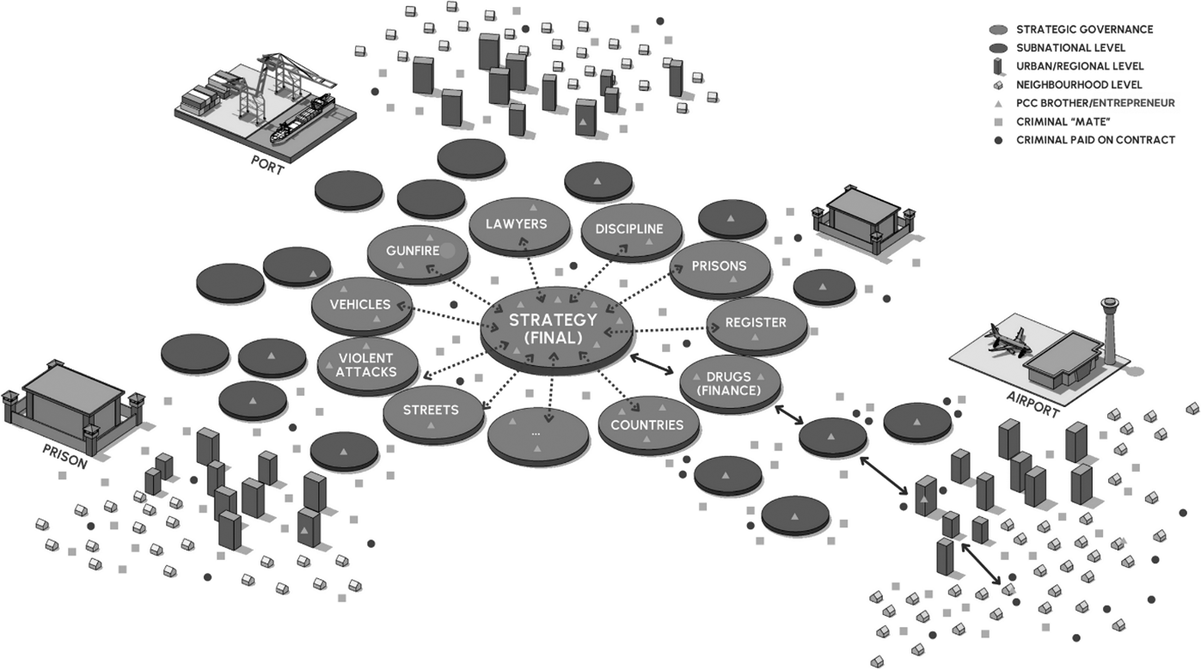
The PCC does not rely on a single, charismatic leader, like the figures of Pablo Escobar, El Chapo, Dom Berna, or the Godfather. Instead, leadership roles rotate between several individuals, and the organization is not run by powerful billionaire bosses. Instead, it is characterized by a criminal network of powerful positions across multiple hierarchical levels, with thousands of wealthy, not-so-wealthy, or even very poor members, all of whom are supposed to have equal rights. Contrary to the portrayal of figures like “Marcola”Footnote 7 or other so-called leaders, often presented by the press as the masters of the PCC’s soldiers and subordinates, this secret society is composed of tens of thousands of initiated members who occupy diverse positions of responsibility, from strategic to local, all of whom concurrently manage their own autonomous criminal enterprises (Figure 1).
PCC governance structure (from 2002 onwards)
[Source: The author, based on long-term ethnographic fieldwork (2005–2024). Design by Victoria Scussel]

The diagram illustrates the coexistence of a decentralized economic framework and a centralized strategic political decision-making process within the PCC. Economically, the organization functions as a network of individual entrepreneurs, each managing their own criminal enterprises independently. These entrepreneurs, regardless of the scale of their operations, retain all profits from their independent activities and are not required to share them with the organization. However, when they use the organization’s infrastructure—a platform that provides them with many opportunities—they automatically share their contacts so that the PCC can also use them to generate income for the fraternity. Fully initiated members of the PCC do business with many uninitiated criminals, known as “partners” (companheiros), and hire outsourced employees, who are paid through informal contracts within their illegal companies. Members enjoy access to such resources as vehicles, weapons, legal assistance, protection, and valuable contacts. Additionally, those involved in drug trafficking benefit from access to the PCC’s networks, which enables them to purchase supplies at lower prices and benefit from the organization’s logistical, financial, and communication infrastructures. In the event of disputes or challenges, they can rely on the PCC’s resources and internal justice system for resolution. Conversely, although PCC members operate autonomously in economic terms, they are required to take on responsibilities within the collective organization. Based on their skills and internal standing, they may be elected or appointed to various roles; their responsibilities range from maintaining discipline in a prison cell to contributing to the organization’s international expansion strategy.
Strategic decisions are made within centralized councils called sintonias, which function as regulatory bodies overseeing areas such as weapons, legal support, vehicles, contacts, criminal discipline, justice in both streets and prisons, planned violent action, and the PCC’s strategic expansion beyond São Paulo and into other countries. Power is therefore not concentrated in individuals but vested in the positions themselves, thereby fostering a collective and flexible leadership structure in which authority is tied to a role rather than a person. A strong ideology of political equality makes it possible for each of the PCC’s initiated members, known as “brothers”, to effectively claim the same voice, the same right of argumentative speech, in any situation of interlocution within the brotherhood. Within the organization, a richer member is subject to exactly the same codes and rules as a poorer one, and a member in a leadership position is under an even greater obligation to behave in an exemplary manner. What appears to be unique about the PCC when it is compared to other mafias in the world [see Varese Reference Varese2011, Reference Varese2023] is that the multiple trade structures operated by its members are ultimately embedded within a unified governance framework. Hierarchical positions of power are occupied by individuals who have an equal power of speech internally, although as independent entrepreneurs they occupy different and unequal positions in the market. Small, medium, or large entrepreneurs can occupy the most diverse positions in the organization’s governance structure. There have been many cases in which high-ranking members have been killed or excluded because their “brothers” considered them to have acted wrongly [Feltran Reference Feltran2018].
The PCC does not advocate for material equality but upholds the belief that everyone has the potential to achieve wealth. While the established elites are viewed as representatives of an oppressive system, economically successful PCC members are admired, even by those in prison who lack such basic possessions as a toothbrush or a towel. Their shared origins in the hardships of favelas and prisons serve as a unifying bond that symbolizes a common humanity. The success of one member inspires others to strive for social mobility, reflecting the view that the “oppressed and criminalized” are equal in essence, if not in terms of material wealth. This shared identity, often tied to a common ethno-racial background, fosters a collective understanding that to recognize one’s position in the world is to oppose the system.
That is why one of the central slogans of the PCC is “one for all and all for one”, and why it preaches for “peace among us and war against the system”. While the PCC’s members can be extremely violent towards its enemies, and although internal discipline is exceptionally strict, which leads to many expulsions and even deaths, internally, the members are not personally subject to coercion or even commands. Isolated acts of revenge, or other individually decided acts, are not permitted. Those occupying positions of power, which are almost always collegial and continually rotating, are supposed to be at the service of the criminal population, not the other way around. The PCC’s ideology speaks of the need to do “what is right, what is fair, and what is just”, and all PCC peers are constantly evaluating whether their brothers’ actions fulfil these criteria. These assessments are made as part of their daily interactions, but when conflicts arise, the “justice agency” is called upon to resolve all internal disputes. Once a decision has been made by the organization, there is no appeal.
Each sintonia functions as a virtual office, typically managed by a collegiate group whose members occupy strategic roles; its influence extends hierarchically from the national to neighbourhood levels. These offices delegate responsibilities to regional and municipal leaders, who coordinate neighbourhood operatives in securing and distributing firearms for criminal uses, either through loans, rentals, or sale. Another highly secretive sintonia oversees organized violence, managing attacks and missions while minimizing visibility and avoiding the attention of law enforcement. This discreet approach reflects the PCC’s overarching strategy: to expand quietly and avoid direct confrontation with the established authorities.
This governance structure balances economic decentralization with centralized strategic decision-making. Information can flow from the highest levels to neighbourhood operatives in just two or three phone calls, while local actors maintain access to higher, more powerful bodies. The system operates effectively due to the strong cohesion of its principles and practices, which allows the PCC’s operational philosophy to infiltrate into its members’ daily activities and to attain a remarkable reach. The PCC’s governance model, underpinned by an egalitarian ideology shared by its initiated members, eliminates the need for the armed territorial control seen in extortion-based criminal organizations.
The Agência: a governance unit to regulate trade
The most significant governance body within the PCC today is the Agência, which oversees the organization’s drug-trafficking operations. Like all sintonias, the Agência operates through a centralized strategic board of administrators, supported by a network of subnational councils. This hierarchical structure ensures both operational reach and depersonalization, facilitating the execution of three primary functions. Firstly, it streamlines the connection between producers and retailers, thus enhancing the organization’s logistical efficiency. Secondly, it oversees quality control while striving to set lower prices. Thirdly, it establishes and enforces the economic regulations that govern interactions between PCC members, their associates, subcontractors, and allied actors within this value chain.
The Agência is a very complex body, which oversees operations involving various types of drugs at both wholesale and retail levels, with a primary focus on cocaine destined for export. The subject of the Agência is still insufficiently explored by law enforcement and until relatively recently, it had largely been overlooked in academic studies. As research into the area progresses, the Agência’s intricate and often misunderstood dynamics are becoming evident. For example, the lorry drivers or other operators who have been hired to transport PCC cocaine are frequently prosecuted as if they were members of the organization and as if all the seized cocaine belonged to them or the PCC. However, this is rarely the case. The Agência is a platform used to connect a myriad of outsourced actors, ranging from IT support workers and drug mules through those working in logistics infrastructures to lawyers and accountants. Drugs often pass through intermediaries who are unaware of their origin or ownership, a mechanism that shields the PCC while helping to perpetuate the narrative that their network is significantly disrupted by large drug seizures. This pattern, common in the global drug trade, protects the organization’s dominance while reinforcing claims on the part of law enforcement and the media that such raids are impactful.
The PCC operates as a “criminal freemasonry” that unites numerous independent entrepreneurs within its framework. These individuals retain full control over their profits, without having to pay any mandatory fees or extortion payments to the organization. Instead, they collaborate by circulating drugs explicitly identified as “from the Comando”. These are narcotics that are owned by the PCC rather than by the entrepreneurs themselves, although they are often transported alongside the entrepreneurs’ private shipments. This dual distribution model generates institutional revenue without infringing on individual enterprises. PCC members must clearly separate their personal ventures from the organization’s collective activities. Moreover, the organization appropriates the business contacts cultivated by its members, leveraging these to facilitate its operations and enhance institutional profitability. In return, individual entrepreneurs benefit from the PCC’s logistical support and protective infrastructure. Notably, institutional revenue is exclusively reinvested in order to sustain and expand the organization’s operational systems, rather than being distributed for private gain. This reinvestment strengthens the organization’s capacity to support its members and maintain its dominance within the criminal economy. The Agência’s melding of individual and institutional logistics is central to its functionality and demonstrates the PCC’s ability to avoid the centralization of power in the hands of one member while balancing entrepreneurial autonomy with collective coordination. This synergy ensures the sustainability both of individual enterprises and the organization’s broader criminal and political objectives. The operational nuances of this model will now be explored further, shedding light on the Agência’s pivotal role in maintaining the PCC’s strategic cohesion and adaptability.
The following examination of the PCC’s methods of international trafficking two decades ago and of the transformations observed between 2014 and 2016 will provide valuable insights into the organization’s evolving strategies.
Background (2004–2010)
Born in 1969, the man known in the criminal world as “Smooth Operator” amassed substantial wealth by exporting cocaine through PCC networks in Santos before transitioning into the legitimate business world in 2018. His illicit gains were laundered and reinvested and eventually converted into productive capital. Today, he manages a diversified portfolio that includes hotels, restaurants, and automotive trading, and also deals in art, which is prominently displayed across his properties. I have conducted numerous in-depth interviews and informal conversations with Smooth over the years, delving into his extensive experience in crime, business, and prison life. However, he remains resolutely silent on the current strategies employed by the PCC in the international cocaine market.
Fragments from our conversations reveal that Smooth’s involvement in cocaine exportation began in 2008 at the Port of Santos, although he had been trying to set up a criminal enterprise of this type since 2004. At that time, Brazil played a minor role in the global cocaine trade, and its exports to Africa and Europe were managed by a small elite of political and economic figures from the north of the country. Colombia, as the dominant global supplier, controlled the market in both the United States and Europe, leaving Brazil to handle primarily Bolivian and Peruvian cocaine. This trade was largely managed by ranchers and politicians in border states. The CV, an older Brazilian criminal organization and a former ally of the PCC, concentrated on importing base paste and cocaine hydrochloride for the domestic market and engaged only minimally in export activities.
Smooth’s first attempt at international trafficking was marked by a significant setback. After serving an eight-month prison sentence, he was invited by a Serbian drug dealer in the same prison to collaborate with him in a large-scale operation. In 2008, the pair organized the shipment of 400 kg of cocaine directly to the Balkans. However, the profits from the venture never materialized, and his Serbian associate vanished shortly after the shipment. For over a year, Smooth had no communication with his contact. This left him burdened by a significant debt to his suppliers, which he was forced to renegotiate on a monthly basis.
Despite the financial strain this caused, Smooth, known for his distinctive style and towering presence, remained confident in the trustworthiness of his associate. Born in a favela in São Paulo’s southern region [see Maria de Jesus Reference Maria de Jesus1962 for sociological context], Smooth emphasizes that favelados possess an innate ability to discern trustworthiness. His confidence in his associate stemmed from their shared prison experience in São Paulo during the early 2000s, where they had spent two years enduring what Smooth referred to as “many trials” together. Although the shipment’s failure made his position difficult, he remained convinced that his contact had not betrayed him, attributing the failure to unforeseen circumstances rather than malice or deceit.
Sixteen months after the initial failure, in 2010, Smooth’s Serbian contact returned to Brazil and sought him out in person. First, without saying a word, the contact opened his briefcase and showed him a series of foreign-language newspaper clippings detailing “settlements of accounts” among traffickers in the Balkans. He then explained that the 400-kg shipment had been stolen upon its arrival in Serbia, but all those involved in the theft had already been eliminated. While he could not reimburse Smooth for the loss, he invited him to work with him on another shipment, this time through a more secure arrangement. This proposal was their chance to recover financially. Smooth trusted his friend completely, comparing the trust he placed in him to his trust in his own wife.
Together, they prepared an even larger operation, leveraging more established networks and support from other associates tied to the emerging PCC. Almost 500 kg of cocaine, sourced from several São Paulo drug traffickers affiliated with the organization, was transferred from a small fishing boat to a transatlantic cargo ship in the early hours of the morning, shortly after it had departed the harbour. This time, the operation proceeded flawlessly. A month later, the payment was made available to Smooth Operator in Europe. However, Smooth could not personally collect the payment due to his past convictions, which prevented him from travelling abroad. His son, who had never been involved in crime and could easily obtain a passport, was tasked with undertaking the mission in his place. After facing numerous challenges as a first-time traveller, his son eventually arrived at a luxury hotel in Hamburg, where he received a briefcase containing nearly €8 million in cash from a tall, strong-looking, blonde, blue-eyed, well-dressed man. The identity of the man remained unknown, and when Smooth’s son attempted to thank him, the phone number was no longer in service. The euphoria among Smooth’s family members was immense—the future seemed promising.
This initial euphoria was soon overshadowed by a critical challenge: determining how to transfer the proceeds back to Brazil and facilitate payments to the other stakeholders involved in the shipment. During this inaugural operation, the strategy involved Smooth’s daughter spending three days acquiring as many luxury items as possible—clothing, footwear, jewellery, watches, and handbags—all purchased in cash and worn or carried back to Brazil. This operation represented a significant turning point, not only in Smooth Operator’s trajectory within the international cocaine trade but also in the PCC’s strategic entry into this highly lucrative market, leveraging its presence in the largest port in the South Atlantic. For subsequent missions, establishing reliable payment networks would be essential. Engaging with doleiros (currency exchange dealers) was a critical step, and Smooth could count on the PCC, which had already cultivated relationships with the most dependable operators. These arrangements ensured that funds could pass through customs without complications. Additionally, transporting cash necessitated the implementation of stringent security measures, which the PCC’s extensive network in São Paulo during the 2010s was well positioned to provide. Smooth’s subsequent operations were fully coordinated with the organization’s established networks. As his team gained more experience, it became clear that agreements on pricing were necessary to take into account the costs of corruption, while it was also important to maintain a consistent quality and pricing for the product, both of which had been positively received by the buyers of the initial consignment.
In a manner reminiscent of Durkheim’s assertion that necessity creates functions, the types of challenges faced by Smooth and his family, along with their colleagues who were establishing the PCC’s dominance in the Port of Santos, prepared the PCC for the development of the Agência. Originally tasked with overseeing institutional funds generated from the members’ monthly contributions as well as from the raffles and games of chance played in prisons, the Agência underwent a significant and quick transformation. It had to scale up and professionalize in response to the growing demands associated with the PCC’s expanding role in the international cocaine market.
Developing infrastructures (2010–2016)
Between 2008 and 2014, numerous entrepreneurs, including Smooth, sought to succeed by leveraging the organization’s support. By 2014, the PCC had, by means of a subtle but significant process, succeeded in consolidating its influence and establishing hegemony over the Port of Santos.Footnote 8 In 2016, the PCC underwent a rapid transformation, simultaneously challenging the dominance of the CV in the Amazon region and disrupting the entrenched elite family enterprises that had hitherto dominated the cocaine trade in Brazil. At this point, the PCC was prepared to introduce a business model that was quite distinct from those of the European and African mafias engaged in the trade. Central to this transformation was the Agência, which provided independent dealers like Smooth with access to essential resources, such as operators whose trustworthiness was guaranteed, security and insurance, logistics for coca production, distribution logistics, communication systems, international payment channels, and money-laundering schemes. Furthermore, the Agência facilitated a two-way exchange, making Smooth’s contacts and networks available to the broader PCC network and thereby strengthening the organization’s overall reach and control within the global cocaine trade.
Having gained insight into the profitability of international trafficking, the Agência continues to evolve. Like all of the PCC’s strategic agencies, it operates as an institutional regulatory body and its resources are not appropriated for private gain. Its primary function is to facilitate the interests of individual entrepreneurs, such as Smooth Operator, by ensuring that their profits are secured. The Agência is tasked with managing the complexities of international transactions, which encompass a range of activities, from establishing trust with suppliers and buyers to providing guarantees for intermediary operators. The activities also include navigating financial mechanisms, such as obtaining credit from loan sharks and financiers to ensure remittances, as well as managing the repatriation of funds. The suborning of key figures in the logistics chain—police officers, dock workers, sailors, and customs officials—ensures the smooth transit of goods, while the conversion of illicit profits into legitimate business income is also crucial.
Each entrepreneur could, like Smooth Operator, establish such an infrastructure on an individual basis—but this would require substantial time and investment and entail significant personal risk. This was the modus operandi of the established elite families in the international cocaine trade: operating relatively autonomously on a small scale and minimizing risk thanks to their political influence and networks. Smooth lacked access to this influence and these networks; thus, the Agência’s proposal was for it to take on the responsibility for regulating infrastructure along the entirety of the value chain, thereby offering operators progressively better conditions for undertaking their individual ventures. Instead of isolated entrepreneurial efforts, what increasingly emerged was a model in which individual endeavours were combined with institutional revenue, which was then reinvested into infrastructure for future operations.Footnote 9 The Agência would function as a platform linking different nodes of the value chain in a reliable way. It was to become the secret society’s most effective tool—ensuring the trust necessary for market development and the prosperity of its members.
On becoming a global platform (2016–2025)
Through a process of trial and error, a consolidated platform-type scheme was established by the Agência that leveraged its contacts across Brazil and positioned PCC members at critical points in the cocaine value chain. This network extended from production laboratories in Bolivia and Peru to the international flow of the drug to Europe. Faced with this logistics platform, the CV lost its capacity to control its contacts in Colombia, and the PCC expanded its network to include Colombian narcos, making it increasingly profitable for them to work with the Agência. Key logistical nodes, such as border regions, road junctions, ports, and airports, were strategically occupied by PCC members or others linked to the PCC. Evidence gathered from fieldwork I have conducted in various regions—including the Bolivian border (Cáceres), a major Brazilian logistics hub (Uberlândia), the Port of Santos, and recent research in French Guiana and the Port of Le Havre—indicates that a steady increase in cocaine trafficking through Brazil took place at this time; this included Colombian cocaine, which is now also handled by the PCC in Brazil’s northern macro-region.
An intense armed conflict between the PCC and the CV escalated during this period, with violent repercussions across Brazilian prisons and borders. This also marked the end of a 23-year partnership between the PCC and CV and led to open warfare between them. By 2016, following the murder of Jorge Rafaat in Paraguay, the PCC emerged as the Braziliandominant force in the international trafficking of cocaine, marijuana, and firearms; it consolidated its power in the Port of Santos and expanded its operations to encompass all the major ports and airports in Brazil, Argentina, and Uruguay. Strategically, the PCC decided that cocaine, particularly cocaine of the highest quality, should be sold at cost price to any member, regardless of the buyer’s location in Brazil.Footnote 10 This model meant that the PCC could profit from intermediation in the wholesale market without overcharging its members, which greatly enhanced the competitiveness of its operators within the broader market. Individual business ventures profited from this system by reselling cocaine at the retail or wholesale level, either domestically or for export. The sale of base paste was consolidated for the domestic market, while cocaine hydrochloride was sold for export due to quality requirements.
The PCC brought about a significant shift in both retail and wholesale operations: individual traffickers could still sell their own drugs, but they were often required to distribute the “PCC drugs”, thereby contributing to the organization’s financial pool. To better illustrate these mechanisms, consider the case of Alpha, a fictitious entrepreneur I created based on my field data. Having purchased 25 kg of cocaine per month for a number of months, his profits are increasing and he has gained the trust of the PCC. Alpha seeks to purchase 50 kg of cocaine hydrochloride from his fellow supplier Beta, located on the Brazil–Bolivia border, who offers a price of US$2,800 per kg. However, Beta, now connected to the Agência, utilizes broader networks and supplier pressure to secure a better price of US$2,500 per kg. Through the Agência’s intervention, Alpha also acquires an additional 50 kg of cocaine at cost price, thereby further reducing the price to US$1,500 per kg. As a result, Alpha now purchases 100 kg for US$200,000, rather than the usual 50 kg for US$125,000, making his business considerably more competitive. If Alpha sells this cocaine at US$20,000 per kg at the Port of Santos, he will earn US$2 million for his share of the 100 kg in an 800-kg shipment. However, half of this, i.e., US$1 million, must be returned to the Agência as payment for the “PCC drugs” sold at cost price. Without the Agência’s intermediation, Alpha’s turnover would have been limited to US$875,000. Thus, the collective efforts of Alpha and his network, facilitated by the offices of the PCC, ensure that all the parties involved see higher profits than they would have done by working independently, thus reinforcing the organization’s economic model and its dominance in the cocaine trade.
This allowed independent entrepreneurs, such as my interlocutors Smooth, Steve, and Linda, to maintain their operations while benefiting from the competitive advantage of purchasing “PCC drugs” at cost price. The increased number of PCC members involved in trafficking further diversified cocaine distribution routes, complicating enforcement and monitoring. Price flexibility had existed within the free market, but strict regulations now applied to those buying from the PCC. Competition among members was mitigated by these regulations, which ensured market stability. Payments made in advance secured better prices, as did larger-scale deals. The PCC’s platform-type business model rapidly took control of various points along the value chain, especially logistical intermediation, without clashing with producers or other mafias.
Over the past decade, the PCC has consolidated its position along the Bolivian and Peruvian borders, while internal tensions with the CV have intensified, especially in the wake of the latter’s diminished role in dealing Colombian cocaine.Footnote 11 In 2024, two 10-tonne seizures made it clear that Brazilians, Colombians, and Venezuelans were working together.Footnote 12 In both cases, the PCC logistics platform had connected them. Our research on ports and borders reveals significant contextual specificity, the understanding of which is crucial to transporting goods with minimal risk. This explains why the global cocaine value chain is highly fragmented, with professionals specializing in distinct stages. The costs associated with crossing borders in vehicles loaded with drugs, transporting cocaine by truck, storing drugs at the port, and loading them onto ships, are largely standardized. No single entity can oversee or regulate all these activities, as each one requires years of expertise to carry out safely. The complexity of these processes makes it nearly impossible for one team to master every link in the chain, especially when considering the linguistic and cultural capital that is required to conduct international transactions. However, it is possible to facilitate connections between all of these local operators, as well as providing essential services such as security, insurance, and international payments. The platform-type collaborative efforts of numerous entrepreneurs, who each specialize in a specific stage, and their coordination by means of a platform-type governance device (the Agência), appear to be driving notable improvements in the efficiency of the value chain.
The Agência’s platform structure enables the PCC to exert significant pressure on producers in the Andean and Amazonian regions and to demand lower prices and increased production or productivity. This framework facilitates the extreme exploitation of low-level independent operators, who are often from impoverished and marginalized communities. These producers frequently endure coercion and violence, but are driven by the prospect of the earnings associated with taking part in the drug-trafficking chain, which are higher than the minimal wages paid for traditional labour. For those who manage to ascend to the position of larger supplier to PCC-affiliated entrepreneurs, their experiences often align with Peter Reuter’s [Reference Reuter2003] observation: substantial wealth accumulation within cocaine markets tends to concentrate in the middle tiers of the supply chain. Evidence collected in recent years has revealed that this systemic labour exploitation, which is embedded in the market’s business model, is a critical factor behind trends such as declining prices, improved drug purity and quality, and the more reliable supply of cocaine to its final destinations.
Conclusions: expanding a multimodal trade, challenging established powers
As it expands, the more influence the PCC gains over the multimodal infrastructure facilitating the transportation of drugs from their source to their destination, the more it can offer its international crime partners in terms of diversified business, security, communication, and financial solutions. In Europe, Africa, Asia, and Oceania, local criminal players manage local distribution. However, the platform’s logistical efficiency has attracted partnerships with criminal organizations across these continents. Maritime options available through the platform include direct shipping via sailboats or fishing vessels, the use of shell export companies, concealing drugs within legal shipments, transferring them to fishermen, dissolving cocaine into products like sugar or tar, or using divers to attach packages to ships’ hulls. On land, drugs can be transported using dedicated vehicles, by contaminating legitimate truck cargo, or by covering short distances by motorcycle, bicycle, or even on foot. Aerial transportation may involve small planes operating on clandestine airstrips, large commercial airlines with compromised employees, or private jets and helicopters that are equipped to cross the Atlantic, flying from north-eastern Brazil to West Africa or straight to Europe. Government and private postal companies are always available to dispatch urgent or smaller shipments. Potential operators can be crowdsourced in every location. By leveraging this multifaceted network and employing sophisticated logistics software to identify optimal routes and methods, the PCC and its partners ensure delivery stability, which facilitates market consolidation. This operational flexibility allows for the strategic expansion of consumer markets. The greater the number of operators that use the platform, the more complete and efficient the offered service becomes.
The PCC employs violence as a last resort while striving to monopolize the intermediation of the global cocaine trade, leveraging a platform-based business model to overcome challenges coming from law enforcement or criminal competition. Colombian criminal organizations have long dominated the export market with defined territories, but the PCC positions itself as a cooperative partner rather than a competitor, emphasizing mutual benefit and shared profits. Rather than using coercion, the PCC claims to attract collaborators through offering them strategic advantages. My research interlocutors suggest that its diplomatic stance, which masks its self-interest, has fostered cooperation between diverse criminal actors. In the words of one of my interviewees—a veteran South American drug trafficker, now living in Europe—“The PCC approaches you and offers you a partnership; when you see them, they are already in control.”
This is not so different from what happened to the independent self-employed drivers who joined Uber, or the countless sole proprietors who saw AirBnb as a real opportunity to increase their income, expand, and diversify their independent businesses. After a while, they became dependent on a powerful platform and could not make money without it. With its robust logistical and financial capacities, the PCC has absorbed not only Bolivian and Peruvian traffickers but also Colombian and Venezuelan groups, as evidenced by major drug seizures in 2024 that revealed their reliance on its networks for international transportation.Footnote 13 The Agência’s financial capacity facilitates corruption agreements, provides traffickers with financial and communication infrastructures, and reduces their reliance on violence that might draw unwanted attention. It also allows PCC operations to expand beyond drug trafficking to encompass disparate illicit economies—the platform criminal economy facilitates connections among smugglers, scammers, miners, loggers, and squatters, all of whom engage in money laundering, financial investment, and legal businesses, thereby creating multiple marketplaces.
By fostering cooperative crime growth through its own criminal platform, the PCC has made territorial control through violence less important. Value lies not in a location but in its connections. In 2023, the Brazilian Federal Police reported the presence of PCC members in multiple countries across five continents. The organization’s operations span vast regions, leveraging billions annually in the global illicit economy. Cocaine profits are reinvested in both legal and illegal businesses, in branches including agriculture, cattle ranching, gold and timber extraction, real estate, and financial schemes involving cryptocurrencies and tax havens. It’s not merely money laundering; it’s capital protection, too.
The expanding contemporary criminal organizations and their criminal governance structures are, nonetheless, difficult to integrate into established political regimes. The more the PCC and other mafias grow in power, the more they challenge the authority of existing political powers and the more they are persecuted. In fact, the elementary forms of politics they present are fuelled by an incredible accumulation of capital that challenges the very nature of modern state power [Feltran Reference Feltran2020b].
The power struggle between diverse political frameworks and global value regulation becomes particularly pronounced when criminal power regimes interact with fragile, small, postcolonial, weak, or fragmented states. An individual arriving in a small island state—especially one functioning as a tax haven—with a billion dollars, an extensive network of commercial contacts, and a significant arsenal can quickly become established as a key political actor. This phenomenon is unfolding globally, at what is probably an unprecedented rate. On the other hand, large states, even those in central economies, today face significant challenges when it comes to controlling illegal markets and the actors behind them.
These conflicts reveal an unexpected confluence of global accumulation, localized violence management, and political order-making [Tilly Reference Tilly1990; Feltran Reference Feltran2020a]. Today, funds obtained from international cocaine trafficking are becoming increasingly embedded in global finance: there is ample evidence that cryptocurrency accounts, betting sites, and numerous banking products are being used for money laundering, including in tax havens [Cassano Reference Cassano2017]. Despite the political challenges posed by these dynamics, this illegal accumulation machine, regulated by criminal secret societies from various regions, appears to be in harmony with established global economies. The recent worldwide scandals around criminals laundering money through global banks, such as HSBC, the Canadian Lebanese Bank, and Credit Suisse among others, reflect the fact that this connection is not new to contemporary capitalism [Al Sabri Halawi Reference Al Sabri Halawi2019].
This sociological study of the PCC’s Agência provides us with a better understanding of the changes that are taking place in contemporary transnational cocaine markets. As the narco-state debate resurfaces in numerous countries around the world, my study leads me to the conclusion that the hybrid governance supporting the global cocaine trade, which is facilitated through potentially violent secret societies like the PCC, enables the coexistence of official and illicit forms of accumulation, and is producing emerging forms of criminal/political power regime that pose a challenge to our usual descriptive and analytical perspectives. To seek to understand the peculiarities of contemporary criminal forms of trade and governance [Breuer and Varese Reference Breuer and Varese2023], and of how they affect given power structures, seems to me to be an excellent way of approaching a more realistic analytical framework than that of the old model, which assumes a systematic opposition between states and criminal organizations. This inevitably requires the adoption of an integrated sociological framework in order to understand the management of violence, economic accumulation through different business models, and the (re)production of political orders. In this approach, criminal governance and illicit value chains are revealed as relevant to understanding contemporary power dynamics.

 Open access

