


1. Introduction
Design practice has historically been effective at translating human wants and market opportunities into artefacts and services. However, placing the consumer at the centre of design has also produced unintended consequences for planetary health and social-ecological systems (Reference BorthwickBorthwick et al., 2022). This tension motivates a life-centred stance that balances human goals with environmental and ethical concerns (Reference LutzLutz, 2022). In parallel, it is widely recognised in the design research that early-phase decisions strongly shape downstream environmental impacts (e.g., Reference Boonkanit and KengpolBoonkanit & Kengpol, 2010). Yet, in practice, sustainability mostly remains something that is “added” after the concept direction is set, often as optimisation, mitigation, or compliance, rather than as a driver of what ought to be designed in the first place.
One way to integrate sustainability earlier is conducting a life cycle assessment (LCA) during concept development. Early LCA has shown potential compared to end-of-pipe approaches (Reference DayanandaK, Jannu and SreedharaCDayananda et al., 2019). However, in many design contexts, the time, data, and expertise needed for such calculations are limited. Moreover, it requires partial specification of the artefact (materials, processes, use scenarios), which typically presupposes that a concept direction already exists. This creates a practical gap: designers need a way to reason about environmental impact before committing to a concept, when the “right problem” and intervention space are still open.
This study addresses that gap by proposing and testing an early-phase process that begins not with a market opportunity or a user desire, but with an environmental and ecological challenge and the explicit intent to address it. The key difference to many suggested approaches is therefore not only that sustainability is brought earlier, but that the project is oriented from the outset around an ecological problem. In this paper, a “problem” is defined as a situation that hinders the well-being of ecosystems or life (human and non-human), through one or more stressors that cause harm or degradation. The design task is then to determine how that ecological problem is expressed in the world, who or what is affected, and where design action could realistically reduce harm or restore conditions given available resources and existing constraints. In this paper, we suggest a strategy of intellectual operations during the context phase (also known as discovery or scoping) that may push design in a direction it must, quoting Don Reference NormanNorman (2023, p.13), go from
“being unintentionally destructive, to intentionally constructive”.
The paper specifically covers the problem framing in the context phase of the proposed Impact Design Process (IDP), which aims to anchor the project in an explicit intent to address a defined harm to ecosystems and life.
2. Context phase of the Impact Design Process
This section describes the problem framing in the context phase as a set of iterative steps that support designers in moving from a broad ecological challenge toward a defensible choice of problem to address and a target group to do that through before committing to a concept or a problem related to market demand. Each step is described in the order it ought to be applied and specifies its purpose, required inputs, and tangible outputs. Designers are expected to revisit earlier steps as new insights, evidence, or constraints emerge. The extension of the traditional context phase is divided in four main steps, namely interpreting the environmental challenge (Section 2.1), translating the challenge to needs (2.2), and selecting the most impactful problem space to work with according to data gathered, and to project resources and constraints (2.3). Subsequently, deciding upon an intervention space (2.4) possible within the selected problem which includes selecting the target group which would then continue, per traditional customer-and user discovery approaches, be further explored, understood and empathised with and are not in the scope of this paper.
The four main steps contain substeps which will be described in each of the sections. As environmental challenges are complex, they are best addressed through transdisciplinary work that integrates academic and non-academic actors from problem framing to solution design (Reference Lang, Wiek, Bergmann, Stauffacher, Martens, Moll, Swilling and ThomasLang et al., 2012). For that reason, cross-disciplinary and cross-sectoral interaction is encouraged across all steps of the design process.
2.1. Interpret environmental challenge
The interpretation of the environmental challenge begins by analysing the starting point (2.1.1) to make constraints and intent of the project explicit, to then go on and explore the context of the challenge at hand (2.1.2) by setting up questions to which the answers will be framed in a way to understand the consequences to various stakeholders of a specific environmental and ecological challenge (Section 2.1.3). To visualise the relationship between actions leading up to negative consequences for various stakeholders, a causal reaction map is used, similar to a causal loop diagram (Section 2.1.4).
2.1.1. Analysing the starting point
Any intended action begins in a context with certain constraints, which is also true for design projects. Some parameters may already be fixed, such as scope, the ecological challenge domain, a symptom, stressor or impact of concern, a suspected source, a carrier or medium of the stressor, an affected entity, or a geographical setting. In addition, designers and teams bring prior experience, values, and assumptions into the work. These frames are inescapable and more specifically (Reference IrwinIrwin, 2015)
“profoundly influence what is identified as a problem and how it is framed”
For this reason, the first step in IDP is an explicit reflection on the starting point, meaning what is known, what is assumed, what is chosen, and what remains unknown. The aim of this step is twofold. First, it supports an informed choice about what is feasible and defensible given constraints such as time, funding, access to expertise and stakeholders, team composition, and available tools. Second, it anchors the work in a clear statement of intent, namely focus statement, so later decisions remain traceable to the purpose of the project.
The focus statement articulates the intended change or impact in a broader sense. To do this, it is suggested to consider the kind of contribution, whether the project aims to react to damage or problem that has been done and/or damage that is being done. Designers should reflect on whether their contribution will (i) minimise harm by shielding a receiver from a problem, or design for an agent to contain a problem; (ii) clean up stressors causing damage in a system; (iii) heal the system from the damage; (iv) prevent the damaging action; (v) change the procedures related to an action; attempting (vi) behavioural change or (vii) paradigm shift; and ultimately to (viii) redesign or reimagine a system to make the old one obsolete.
2.1.2. Interrogatives & understanding the context of the environmental challenge
The designer can begin the initial exploration of the environmental challenge(s) by first brainstorming questions. Based on subjective reasoning, and in relevance to the project, the questions asked should first be short and specific and be around (i) what the environmental challenge is and how is it defined, (ii) how it emerged (agent, action, source and enabler), and (iii) what impact it has on nature in terms of change. As the questions are answered, new follow-up questions emerge which can be both open-and close ended. The answers should generate an understanding of what the problem is, how it occurs, and what the consequences are. They can be recorded in a table with the fields: stressor, source, agent, action, carrier, pathway, receiver, and impact; where there is a clear separation between sourced facts from assumptions by for example noting “(A)” for assumption.
2.1.3. Understanding consequences
Consequences that have emerged from initial exploration are noted and separated into groups corresponding to the identified stakeholders, particularly those on the receiving end of a problematic action. These consequences may be considered across ecological scales, from bioregions and ecosystems to habitats (or biotopes), populations, species, and, where relevant, individual organisms. Moving toward finer levels of resolution does not replace holistic understanding but complements it by revealing how effects manifest at different levels of organisation. This includes examining how a phenomenon influences the fundamental conditions that sustain life. Depending on the context, the analysis may extend to impacts on cellular energy dynamics, for example through alterations in ATP (adenosine triphosphate), the principal intracellular energy carrier in living cells.
2.1.4. Causal reaction map
To help understand how actions, reactions and consequences emerge, it is suggested to visualise the chain of events that lead up to a particular impact. The overview aims to help identify where additional knowledge may be needed and where it is possible, and most strategic to intervene. The metaphor used is that of a “maze” of dominoes, where tipping one may cause many others to fall but only certain dominoes have the potential to trigger larger cascades. In a sense, it draws on the logic of the Pareto Principle (Reference PyzdekPyzdek, 2021), suggesting that a small number of interventions can yield a “large effect” on the overall system or situation, which has been empirically observed across domains (Reference Gittens, Kim and GodwinGittens et al., 2005; Reference ShestserauShestserau et al., 2024). The designer is encouraged to search for the earliest actionable “domino”, similar to a leverage point (Reference MeadowsMeadows, 1999) often mentioned in systems design.
2.2. Translate to needs
This step translates identified consequences into legitimate needs by distinguishing between systemic “big picture” needs and specific needs situated within them. A systemic need refers to a fundamental condition required for sustaining life or maintaining ecological integrity. Within such systemic needs, more context-bound and specific needs can be identified. For example, sustaining human fertility and healthy offspring constitutes a systemic need, while protecting pregnant and breastfeeding individuals from harmful chemical exposure represents a specific need within that broader system. A concrete design focus might therefore concern the quality of drinking water during pregnancy and breastfeeding in regions where contamination is present.
The purpose of this distinction is to ensure that specific needs are anchored in life-supporting systemic needs, thereby avoiding the design of artefacts that respond to manufactured or artificially constructed needs (Reference Victoria-Uribe and García-AlbarránVictoria-Uribe et al., 2019), a tendency prevalent in consumption-driven societies. The translation to needs is carried out through two substeps: impact assessment (2.2.1) and urgency ranking (2.2.2).
2.2.1. Impact assessment
The impact assessment characterises each identified consequence in order to understand how it affects receivers or is generated by agents. Each consequence or stressor is examined through five lenses:
-
• Magnitude captures the spread across scales (e.g., individual, local, regional, global)
-
• Severity describes the depth or nature of the damage
-
• Frequency signifies how often the problem occurs
-
• Time frame/duration captures persistence of effects e.g., short-term vs. long-term, reversible vs. irreversible
-
• Time-to-effect specifies how quickly consequences become detectable or produce visible impact, for example immediate, near-term, or delayed.
These lenses help clarify the structure and gravity of the problem across scales and over time. The designer determines how each lens is operationalised relative to the context and the available knowledge.
2.2.2. Urgency ranking
The urgency ranking builds upon the impact assessment by qualitatively scoring each consequence according to the defined lenses. The scale used for ranking is determined by the designer and should be appropriate to the context. For instance, a scale of 1–5 might represent “mild” to “severe,” or it may use more context-specific descriptors, such as “mild irritation” to “life-threatening damage.”
The ranking could be conducted separately for each affected receiver or agent of interest. Problems or stressors may be scored individually, in relation to their sources, or through a broader evaluative scale that highlights the overall gravity of the issue. This step supports prioritisation by clarifying which consequences demand immediate attention and which may be addressed at a later stage.
2.3. Select problem space
Based on the impact assessment and urgency ranking, the designer selects a problem space for continued work. This step narrows the previously mapped consequences into a bounded domain of action. It clarifies (i) where in the causal chain intervention is possible, (ii) which actors and receivers are structurally involved, and (iii) the limits within which the design project will operate. The selection remains a qualitative judgement constrained by available knowledge, organisational realities, and project scope. Because agents may also be receivers in adjacent chains of action, the causal structure is examined explicitly by separating the stressor and its systemic components. To structure the problem space, the designer defines:
-
• Problem [noun]: e.g., artefact, phenomena, behaviour is addressed
-
• Source [noun]: near origins
-
• Enabling action [verb]: e.g. how it spreads, moves, activates
-
• Pathway [preposition]: in what way it acts
-
• Carrier/Medium [noun]: the vehicle that “transmits” it
-
• Receiver [noun]: who/what suffer
-
• Impact [noun]: The consequence (health, ecological, social, etc.)
Explicitly distinguishing these elements prevents mixing up symptoms with causes and makes alternative intervention points visible. At this stage, the designer reflects on where intervention is feasible under project constraints. Meaning, whether to influence an agent, mitigate consequences for a receiver, or alter the enabling mechanism. The aim is not to eliminate systemic complexity but to define a “tractable” portion of it. The outcome of this step is a problem statement, formulated as a single bounded sentence capturing the selected stressor and its causal structure. Like refining the mesh in finite-element modelling, details are increased only where precision is needed and kept rough elsewhere. The aim is the minimum information necessary to act, clear enough to guide interventions, lean enough to move fast, as also usually done when selecting or narrowing a target group. A structured formulation may follow the template:
[problem/stressor] from [source/enabler/agent] that [action/mechanism] via [carrier/medium] along [pathway/context], affecting [receiver] and causing [impact].
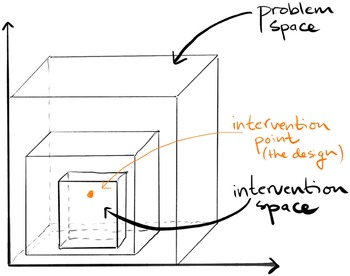
The relationship between problem space, intervention space, and the eventual intervention point (the design outcome) is illustrated in Figure 1. The intervention space specifies where, within the broader problem space, the designer will act. Once the problem space is decided, the task becomes selecting a target group through whom the intervention will be operationalised.
Intervention space within the problem space

2.4. Select intervention space
Selecting an intervention space emphasises that any problem can be addressed from multiple angles and that the impact depends on where the designer chooses to intervene. It is the design in the end, that is the intervention point, as there are an infinite number of points in space, as there are designs possible to address a single problem, as illustrated in Figure 1.
Once the problem space is bounded, the intervention space specifies where the designer will act within it. The purpose of this is to reflect upon the selection of target group, with the aim of finding one that will create the biggest impact for a specific problem, depending on one’s scope and resources, meaning that a target group is selected based on leverage in relation to the defined problem.
To support this decision, contexts are clustered using insights from the previous analysis, considering severity of impact and practical capacity to act. The context clusters should visualise where the effects of a problem are the most severe, where there is a (financial, social or otherwise) willingness to have it solved and subsequently look at those stakeholders inside a cluster with a willingness to pay to have the problem solved. Clustering may also reveal opportunities to identify several contexts that can be addressed simultaneously, otherwise referred to as “multi-solving” (Reference Sawin, Eccles, Moser and SmithSawin et al., 2023). The designer may choose to address the environmental problem by for example designing (may include but not limited to, and not mutually exclusive):
-
• For the primary user
-
• Via an intermediary (e.g., an artefact for practitioners who restore/protect an ecosystem)
-
• A system of stakeholders
The intervention space may be expressed in the following manner:
We address [problem] by intervening at the [mode] level, targeting [primary user/intermediaries] to achieve [mechanism of change], with expected effects on [ecosystem/receiver].
3. Methodology
The problem-framing components of the Impact Design Process (IDP) were implemented under two different starting conditions (i.e., what is already defined when the process begins) during the 2025/2026 academic year at the University of Antwerp. Both applications involved Product Development students and focused specifically on testing the broadened context phase prior to ideation.
The first implementation took place in a second-year bachelor sustainability course (n = 134), where the environmental challenge (waste collection) was predefined, but the specific problem space was open. In previous course iterations, students received no structured guidance during the initial sessions and selected a topic independently. In this iteration, the IDP was introduced to structure and support problem framing and problem selection during the early phase. The second implementation occurred within a master thesis project, where the overall intent and affected group (pregnant and breastfeeding individuals potentially exposed to pollutants) were predefined, while pollutant scope and contextual framing remained open. In both cases, analysis of the starting point explicitly identified the degrees of freedom in the project, clarifying which parameters were fixed and which could be reframed.
3.1. Integration in a sustainability course
The sustainability course consisted of six weekly sessions. The IDP was integrated into the first two sessions (each 4 hours) and partially into the third, with an additional 8 hours of scheduled independent work per week. The overall course structure progressed from (1) interpreting the environmental challenge to (2) translating to needs, (3) selecting problem and intervention space (target group), and subsequently to (4) ideation, (5) evaluation, and (6) development of a design brief.
In this iteration, the first two sessions were dedicated to structured problem framing prior to ideation. Short lectures introduced the theoretical rationale of each step, followed by guided exercises supported by worksheets covering interrogatives, causal mapping, impact assessment, urgency ranking, and problem statement formulation. Students were permitted to use AI tools for information retrieval under time constraints, guided by a structured prompt. The first session focused on interrogatives and causal mapping; the second on impact assessment and urgency ranking; and the third concluded with formulation of a bounded problem statement and preliminary target group selection.
At the end of the course, a survey was sent out to all students to evaluate the method and consisted of questions revolving the outputs from the activities and their perceived usefulness and clarity, gained understanding about waste collection, confidence level in problem framing, and motivation of selected problem space and target group. Additionally, a short reflective interview was conducted with the course examiner to evaluate the application of the introduced activities to the sustainability course.
3.2. Integration in a master project
The IDP was applied more extensively and iteratively within the context phase, over course of 6 weeks, although did not begin in the chronological order presented in Section 2. The master student began with a project revolving around bioinspired filtration system for pregnant and breastfeeding individuals and was guided through the process by four 2h supervision consultations. The starting point included:
-
• A predefined affected group (pregnant and breastfeeding individuals)
-
• An initial focus on microplastics
However, it was not predetermined that microplastics were the only relevant pollutant.
The analysis of the starting point was done by conducting an open literature review to understand the prevalence of microplastics in drinking water and the potential effects on mother, fetus, and breastfeeding infant. Early supervision focused on making assumptions explicit, particularly the assumption that microplastics were the primary pollutant of concern.
Using the interrogatives and causal reaction map, the student broadened the scope to include multiple pollutants and mapped them according to source, carrier, pathway, receiver, and impact. The results from the research were organised in Miro as mind-maps and structured canvases to clearly visualise the flow of the thinking process and activities performed. An impact assessment was conducted using magnitude, severity, time frame, and frequency (added iteratively), was performed per pollutant and per receiver, based mainly Belgian governmental reports, and inter-governmental reports (e.g., WHO, UN), NGO publications, and scientific literature for consequences of specific pollutants. The result informed an urgency ranking. In parallel, the student ran a short survey to understand habits, trust of tap-and bottled water, and filtration practices around drinking water.
Building on the assessment and survey, possible intervention spaces were explored. The student investigated who is affected globally by pollutants in drinking water. The analysis focused on identifying exposure contexts, meaning populations differentiated by geography, water source type (tap, well, bottled, filtered), socio-economic conditions by ideating and then clustering candidate intervention spaces (phrased in location of target group, pollutant, and impact). These exposure constellations were clustered to determine where vulnerability, pollutant prevalence, and feasibility (depending on the scope of the master thesis project) of intervention intersected.
4. Results & discussion
This section reports learnings from applying the IDP problem framing activities in two educational settings. The bachelor case provides breadth on usability and perceived learning at cohort scale, while the master case provides depth on how the process supports reframing, evidence structuring, and prioritisation under uncertainty.
4.1. Integration in a sustainability course
To evaluate the educational impact of the structured problem-framing approach, a post course survey was administered to all 134 students. The survey used Likert-scale, binary questions, and open questions to assess perceived confidence, usefulness of specific steps, and usability of the tool. Regarding identification of harmful components, 78% of students (n=123) indicated that the method helped them identify the most harmful component or substance within their selected waste stream. Concerning target group selection, 77% of the total reported that the approach was at least somewhat helpful, more specifically 48% rating it as helpful or very helpful. However, usability posed challenges. When asked how easy or difficult the tool was to use, 50% rated it as somewhat or very difficult, while 16% found it somewhat or very easy. Open responses reveal that early worksheets and the urgency ranking were often perceived as confusing, particularly before students understood their purpose. In practice, we learned that making templates for students has the effect that students mostly focus on filling in the template and forget to use the tool as an instrument. As soon as students learned to step away from just filling in the fields because they must, the impact of using the proposed problem framing activities was considered significant. Many students asked question during the free work, and longer discussions and reflections with several students was common during the first two sessions. Several students noted difficulty separating magnitude from severity and struggled with the structured sentence templates. This suggests that while the framework structured thinking, it initially increased cognitive load. Qualitative responses indicate that the impact assessment and causal mapping were particularly influential in decision making. Students reported that urgency ranking helped them select between “multiple candidate problems” and that reaction chains provided a broader understanding of the consequences identified. Regarding future adoption, 28% indicated they were likely or very likely to use the reasoning again, while 48% selected “maybe”. This suggests moderate transferability beyond the course context.
No pre-test baseline was conducted; therefore, changes in confidence cannot be interpreted as measured improvement from an initial state. However, according to the course examiner’s evaluation, student performance on the assessment criterion “problem definition and scope” was approximately 20% higher compared to previous years where no structured framework was provided. As grading was conducted by the same examiner, this comparison reflects judgment by experience, rather than controlled statistical testing.
4.2. Integration in a master project
The master project applied the IDP iteratively within the context phase of a bioinspired filtration system aimed at pregnant and breastfeeding individuals. The initial focus was microplastics in drinking water. However, the first step “interpret environmental challenge” (specifically substeps 2.1.1 & 2.1.2) revealed an implicit assumption that microplastics were the primary pollutant of concern.
Through interrogatives, understanding consequences and causal reaction mapping, the student widened the lens beyond microplastics to include additional pollutants. During this phase, the student noticed discrepancies between the limits presented by governments (especially the local) and limits of pollutants and those of NGOs and scientific publications. Here it is important to note that every impact assessment ought to have a reflection afterwards, where one analyses the results and asks if the data gathered is enough and balanced. As previously mentioned in the beginning of this paper, we strongly encourage communication with experts from various disciplines, as well as communicating across sectors. In this situation, it would be beneficial for the student to speak to experts on pollutants affecting both fetal-and child development, and with those who set the limits in order to strengthen the impact assessment and urgency ranking. The discrepancies led to further research, finding more sources providing evidence necessary according to the student and was seen as strengthening Step 1. Consequences were recorded for three receivers, namely mother (pregnant or breastfeeding), fetus, and breastfeeding infant. A causal reaction map was produced to visualise how pollutants move from source through carrier and pathway to fetus (via placenta) or infant (via breast milk). This reframed the mother as an intermediary rather than the primary receiver – the child. This meant that the design outcome will be used by the mother, but mostly designed for the fetus and infant. To structure findings, pollutants were linked to their impacts across receivers using mind maps and structured canvases. The student then conducted an impact assessment mainly based on Belgian governmental reports, but also included intergovernmental organisations (e.g., WHO, UN), environmental NGOs concerned with chemicals, and scientific literature. The student used the lenses magnitude, severity, and time frame. The interpretation of the lenses in the impact assessment required clarification. For example, ‘magnitude’ could be understood as searching for most widespread (i) pollutant, (ii) fetal defect, (iii) impact, (iv) community affected by industrial wastewater, and (v) businesses known to pollute waterways, etc. The student first interpreted “magnitude” as “frequency”, meaning how often the pollutants are prevalent in drinking water, whereas the in the Impact Assessment magnitude referred to the geographical or systemic spread of the problem. Frequency was added later, when it became clear that prevalence influenced perceived urgency, which was in the end the most contributing factor for the selected pollutants to filter. Additionally, ‘time-to-effect” was also found to be of interest and missing in such an analysis and was therefore included in the process presented in Section 2 as well. Lead, nickel, and nitrate emerged as highest-ranking pollutants, largely driven by governmental Belgian data on exposure. The student encountered difficulty prioritising among multiple high-scoring pollutants, revealing a limitation of the method, possibly related to application under time constraints as seen in the sustainability course.
Parallel to the impact assessment, the student investigated exposure contexts globally, by exploring female groups affected by pollutants in drinking water. Populations were differentiated by geography, water source type (tap, well, bottled, filtered), and socio-economic conditions. Candidate intervention spaces were ideated based on a combination of the results, and clustered according to pollutant, receiver, location, and impact to identify intersections of vulnerability, prevalence, and feasibility. Based on the urgency ranking and exposure analysis, the student selected lead, nickel, nitrate, and PFAS, in urban settlements as a problem space. The resulting mission statement was formulated as: “Design a filtration system for making drinking water safe, from perceived safe drinking water.”
Whether this is an accurate representation of what is urgent or not, is at this moment difficult to decide, because it may not always be “the poison”, but the dose. On the other hand, one could argue that pollutants such as PFAS in drinking water becoming increasingly common globally is a cause of concern itself, including the “chemical cocktail” received in urban environments through water and food, which the student did make a comment on.
4.3. Reflection
The results of introducing this to the bachelor students in the sustainability course will be visible in the coming years. Nevertheless, beginning to systematically integrate design methods that take environmental challenges and need into consideration is critical in design education. Or as Reference Faludi, Acaroglu, Gardien, Rapela, Sumter and CooperFaludi et al. (2023) argue:
“For industry to integrate sustainable design at scale, design education must integrate sustainability at scale.”
Given the time sensitivity of the nature crisis, methods for sustainable practice should be iterated in parallel with implementation rather than delayed until perfection (Reference Faludi, Acaroglu, Gardien, Rapela, Sumter and CooperFaludi et al., 2023).
Across both cases, the most significant shift was not technical but epistemic. Students and the master researcher were required to make assumptions explicit, distinguish facts from interpretations, and justify why a particular problem space deserved attention. This reframing activity exposed how easily designers gravitate towards familiar, visible, or media-salient issues, and how quickly problem selection can be driven by intuition rather than structured analysis. The problem framing activities tested in this study did not remove subjectivity, but they surfaced it and made it open to discussion.
The master thesis project further exposed tensions in early impact reasoning. Interpretation of lenses such as magnitude and frequency influenced urgency scoring, raising questions about whether prevalence, severity, or long-term systemic effects should dominate prioritisation. Selecting a problem space therefore proved not purely analytical but partly normative and subjective. The process shifts attention from “finding the right solution” to justifying why a particular harm is considered design-relevant. More broadly, this work proposes a shift in early-phase practice: systematically interpret the environmental problem space and articulate the intended ecological change before selecting an intervention space or target group. The term “interpret” is deliberate, as environmental challenges are inevitably framed through the designer’s perspective. Selecting a problem is not neutral. By surfacing assumptions, testing multiple perspectives, and prioritising robust evidence, the process seeks to reduce confirmation bias and clarify the reasoning behind problem selection within complex “wicked” situations (Reference Rittel and WebberRittel & Webber, 1973).
A limitation of this work is that both cases reflect a single use of IDP in a single project setting, rather than repeated application across teams and projects. Future work should expand testing to additional starting conditions (including fully open “blank sheet” entry) and examine IDP in multi-designer settings. In addition, the process should be adapted and evaluated for interdisciplinary and transdisciplinary use across the full design trajectory, as addressing environmental challenges undoubtedly require cross-disciplinary and cross-sectoral involvement. What is necessary for effective collaboration in such an endeavour, concerning roles, facilitation, decision-making, and evidence integration, remains to be explored in future work.
5. Concluding remarks
This paper has presented and tested the problem-framing activities of the Impact Design Process (IDP), on the expansion of the context phase to begin explicitly from environmental challenge rather than market demand or user problem. Across two different starting conditions, the findings indicate that structured interpretation, consequence mapping, and impact-based prioritisation can support more deliberate and defensible selection of problem spaces before ideation.
Rather than offering a strict formula for identifying the “correct” problem, the IDP introduces a way of reasoning about environmental challenges. It requires designers to surface assumptions, separate systemic needs from specific needs, and justify why a particular harm or need is selected as “design relevant” and in need of addressing in the first place. In doing so, the method shifts early design activity from intuitive topic selection toward explicit argumentation grounded in ecological consequence. The contribution is both practical and conceptual, in that it provides a structured procedure for early environmental problem framing while reframing problem selection as a knowledge-based act rather than an intuitive choice. It positions the context phase as one of critical interpretation, where selecting a problem is recognised as a consequential act with ecological and ethical implications. While preliminary and tested in limited settings, this work suggests that if environmental problem framing is structured from the earliest phase of the process, design practice may shift from treating sustainability as optimisation within an already defined concept toward using environmental harm as the starting condition for defining what ought to be designed.

 Open access

