


1. Introduction
Engineering design is vital for identifying and solving problems that benefit society. A design engineer’s effectiveness in addressing engineering design challenges largely depends on their knowledge. While design engineers possess core knowledge in design process tasks, including design specification, ideation, and detail design (Reference LiuLueptow, 2008), this alone is insufficient for successful engineering design activities (Reference LindemannLindemann, 2015). Engineering design practice often requires knowledge beyond the design process, including sustainability, materials, manufacturing, and consumer behaviour (Reference Desai and MitalDesai & Mital, 2021; Reference Pidaparti and PidapartiPidaparti, 2023). Historically, design engineers could maintain comprehensive knowledge in various areas necessary for effective design, including manufacturing requirements and sustainability demands. However, the expansion of the knowledge space (Reference Hatchuel, Le Masson, Reich and WeilHatchuel et al., 2011; Reference Kazakci, Hatchuel, Le Masson and WeilKazakci et al., 2010) has created a gap, making it impractical to perform design process tasks without external inputs. This gap arises because design engineers can no longer independently map design concepts to the required domain knowledge. According to the Concept-Knowledge (C-K) theory, creative design emerges when new concepts are matched with appropriate knowledge (Reference Michaeli, Hou, Hu and HouMichaeli et al., 2014). Advancements in computational technologies have shifted the paradigm from using computers as tools to collaborating with them (Reference Przegalinska and TriantoroPrzegalinska & Triantoro, 2024; Reference Song, Viros-i-Martin and SelvaSong et al., 2023). This shift necessitates reimagining engineering design practices to explore new possibilities.
This study explores how design engineers can collaborate with AI to enhance engineering design practices. The research question is: How can AI technologies bridge the knowledge space expansion gap in engineering design? Specifically, we examine large language models (LLMs), particularly multi-agent LLMs. An LLM is a deep learning AI model pre-trained on vast amounts of data to understand and process natural language (Reference Yao, Duan, Xu, Cai, Sun and ZhangYao et al., 2024). LLMs’ ability to mimic human cognitive behaviour is unprecedented, supporting complex activities across various fields. It is suggested that AI technologies can become even more powerful when they reinforce each other or other technologies (Reference Thomas and NicholasThomas & Nicholas, 2018). Many AI systems and tools are available but often segregated and not specifically adapted to support engineering design activities. Aggregating these tools to support engineering design practice specifically is explored in this study, highlighting its novelty and contribution. Trust and privacy are significant concerns when adopting LLM technology for specific applications (Reference Kibriya, Khan, Siddiqa and KhanKibriya et al., 2024; Reference Mireshghallah, Antoniak, More, Choi and FarnadiMireshghallah et al., 2024). However, this study proposes an approach that minimises privacy risks when using multi-agent LLMs as collaborators in engineering design.
The following section discusses advances in AI technologies that could support collaborative engineering design, including multi-agent LLMs and retrieval-augmented generation (RAG). Based on related studies, we explore the capabilities and applicability of these technologies in engineering design. Section 3 presents a framework of AI collaboration in engineering design (AICED) intended to assist engineers in making informed design process decisions, reducing design process time, and improving the overall quality of engineering design solutions. Section 4 delves into the implementation of the AICED framework. Section 5 discusses the AICED framework, including its industry implications. Finally, Section 6 provides the study’s conclusion.
2. Literature review
2.1. Technologies for AICED
2.1.1. Multi-agent LLM
LLMs represent a significant advancement in cloud-based AI technology, designed to comprehend human language and perform tasks with high accuracy and coherence, particularly in generating new data (Reference KumarKumar, 2024). These models are trained on extensive datasets that include text, images, audio, codes, and videos. This training enables them to differentiate between various types of data and generate new, contextually relevant data with applications in engineering design (Reference Chen, Xiao, Chen, Sun, Childs and HanChen et al., 2024; Reference González and NoriGonzález & Nori, 2024). The Multi-agent LLM is a cutting-edge development in AI systems (Reference Zou, Zhao, Bariah, Bennis and DebbahZou et al., 2023). This technology involves multiple specialised agents, each powered by an LLM, collaborating to solve complex tasks. An agent is defined as an entity capable of understanding and autonomously processing information to achieve a common goal (Reference Hauptman, Schelble, Duan, Flathmann and McNeeseHauptman et al., 2024; Reference Shu, Chen, Lu, Zhang and WangShu et al., 2024). Multi-agent LLMs are particularly beneficial in supporting early-stage engineering design, and this process is inherently challenging and involves iterative processes in defining concept requirements, conceptual design, and concept evaluation (Reference Mayda and ChoiMayda & Choi, 2017). Although early-stage design activities are initially low-cost, they significantly influence the overall cost of design projects (Reference Mirabito and Goucher-LambertMirabito & Goucher-Lambert, 2022). These activities also encompass socioeconomic, environmental, and manufacturing considerations, areas in which design engineers often have limited expertise. Researchers have noted that LLMs are underutilised and have proposed employing multi-agent LLMs to support various stages of engineering design (Reference Chiarello, Barandoni, Škec and FantoniChiarello et al., 2024). The potential uses of LLMs for collaborative support are also being explored in other fields, such as healthcare report generation and legal document drafting, highlighting their precision and capability (Reference Naveed, Khan, Qiu, Saqib, Anwar, Usman, Akhtar, Barnes and MianNaveed et al., 2023).
2.1.2. Retrieval-augmented generation (RAG)
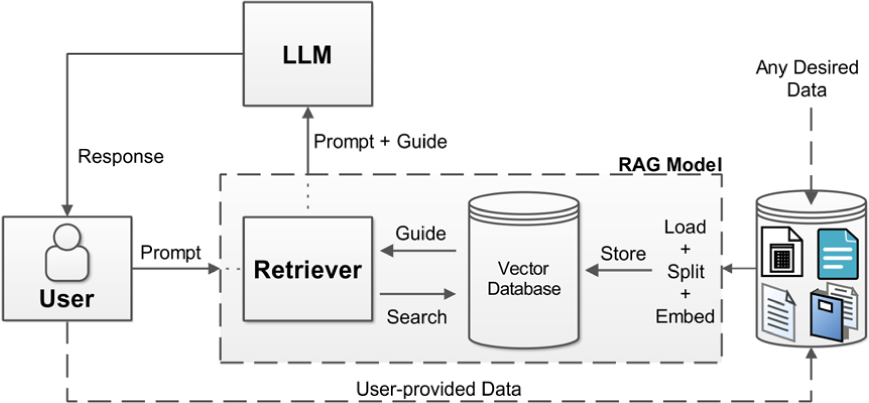
RAG is an advanced AI technique that enhances the accuracy of LLMs by integrating external knowledge sources (Reference Ibrahim, Aboulela, Ibrahim and KashefIbrahim et al., 2024). This reduces hallucination effects or the possibility of LLMs producing incorrect information (Reference Ji, Lee, Frieske, Yu, Su, Xu, Ishii, Bang, Madotto and FungJi et al., 2023). In Figure 1, the RAG model is depicted within a rectangular box with a dotted line, illustrating that users can provide the necessary external knowledge.
A representation of the RAG model

The RAG model, Figure 1, indexes or organises the external data by loading it, splitting it into chunks, embedding it (converting it into vectors), and storing it in a vector database. When a user submits a prompt, the RAG model’s “Retriever” compares the prompt against the indexed vectors in the database to retrieve the most relevant documents. These documents augment the prompt, providing context for the LLM-generated response, and can be examples based on in-house practices. RAG has been explored in engineering design for guiding LLM outputs (Reference Siddharth and LuoSiddharth & Luo, 2024).
2.2. Existing AI-supported design frameworks
The advancements in AI technology challenge the long-held belief that automating engineering design activities is difficult (Reference Eisenstein and PuertaEisenstein & Puerta, 2000). The capabilities demonstrated by AI technologies are gradually overcoming their initial resistance and fostering a more receptive attitude towards their adoption. Researchers have applied AI, particularly pre-trained LLMs, to support engineering design activities. These models help generate more efficient and cost-effective conceptual ideas compared to traditional methods, such as crowdsourcing (Reference Ma, Grandi, McComb and Goucher-LambertMa et al., 2023). Similarly, guiding LLMs with prompt templates has been explored in generative conceptual design research, resulting in more creative and reasonable ideas compared with traditional methods (Reference Wang, Zuo, Cai, Yin, Childs, Sun and ChenWang et al., 2023).
Despite these advancements and others (Reference Jiang, Hu, Wood and LuoFor example, Jiang et al., 2022), a significant gap remains between the general capabilities of AI technologies and their specific application in improving the design process workflow to achieve productivity gains in engineering design, as demonstrated in this study.
2.3. The future of human knowledge considering AI
Knowledge is both infinite and immeasurable (Reference Saad and ChakharSaad & Chakhar, 2010; Reference WoodWood, 2013). Human knowledge remains indispensable despite sophisticated advancements in AI technologies, systems, and tools (Section 2.1). The concept of knowledge space expansion (Section 1) underscores the perpetual challenge of managing knowledge’s infinite nature, even with computational advancements. For instance, the development of LLMs has introduced the necessity for prompt engineering - the process of designing and refining input prompts to elicit optimal responses from LLMs (Reference Marvin, Hellen, Jjingo and Nakatumba-NabendeMarvin et al., 2023). Skills in prompting LLMs are increasingly recognised as crucial for design engineers (Reference Thoring, Huettemann and MuellerThoring et al., 2023). Both novice and professional design engineers who lack expertise in prompt engineering will require training or simplified approaches to use LLM technology effectively. Foundational knowledge is also essential to formulate prompts that yield the desired responses from LLMs. One significant challenge in the early stages of engineering design is formulating the right questions to define and understand a design problem, establish requirements, and develop satisfactory solutions. Collaborating with LLMs would require effectively asking these questions to get a better response, particularly when using multi-agent LLMs. Additionally, early-stage design involves creating precise documentation in specific formats, which can be particularly challenging for novices. For example, producing a design specification - a critical document that can inspire creativity - is often difficult for novice engineers and students to execute accurately. A specialised computational system is necessary to enhance design engineers’ capabilities in tackling challenging engineering design tasks. However, while AI can outperform humans in specific tasks, it is unlikely to replace human knowledge completely. AI is most effective when used in conjunction with human expertise and judgment.
3. AICED framework
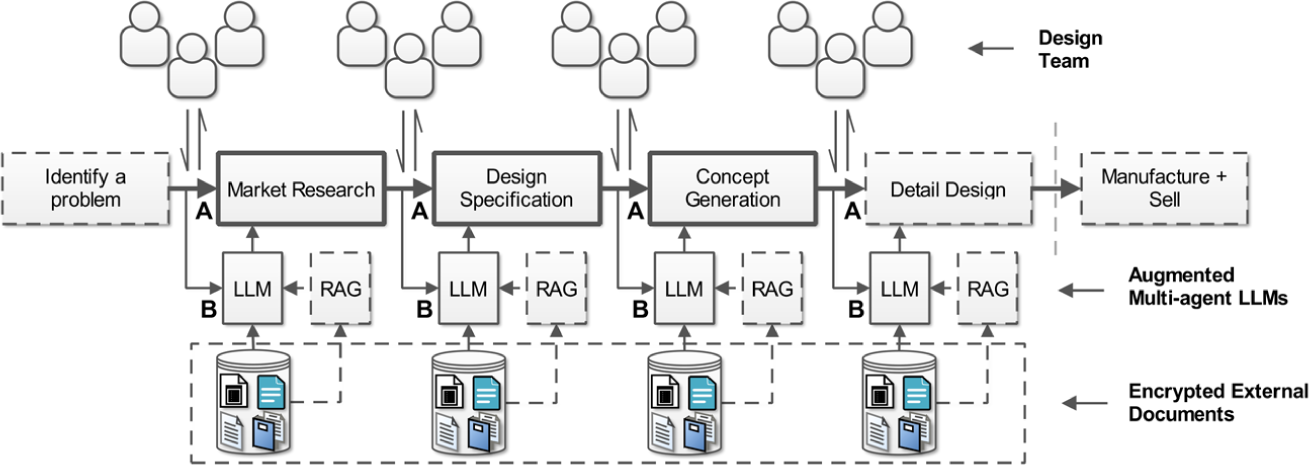
This section outlines the theoretical framework for AICED, as illustrated in Figure 2. The framework facilitates effective collaboration between designers and AI during engineering design activities, primarily focusing on early-stage design (problem definition, design specification, and concept generation) while also considering later stages. The engineering design process necessitates a continuous flow of thought across stages. When in a state of creative flow, design engineers experience total immersion and focus on the task at hand, enhancing their creativity and problem-solving abilities (Reference DoyleDoyle, 2017). Maintaining this flow is crucial, particularly during early-stage activities up to the “Concept Generation” phase depicted in Figure 2. Interruptions in flow can adversely affect performance in predominantly conceptual design tasks. The scientific basis for uninterrupted flow in cognitive activities has been extensively studied (Reference Vervaeke, Ferraro and Herrera-BennettVervaeke et al., 2018). This research indicates that flow spontaneously occurs when there is a proper balance of knowledge, skill, and challenge.
Theoretical AICED framework

Figure 2 illustrates the collaboration of the design engineer or team (human-in-the-loop) with AI systems at each stage of the design process. AI systems can potentially serve as tools and collaborators in engineering design. The AICED framework provides an integrated AI approach to maintaining creative flow in design activities, allowing design engineers to maximise their cognitive abilities. This flow can be disrupted when the required knowledge, skills, and tools are not immediately available or do not align with the design problem. The AICED framework begins with an identified design problem and provides a structured guide for solving any engineering design problem.
As illustrated in Figure 2, the design engineer or team collaborating with the AICED framework has two options at each stage of the design process. Option A involves performing the task themselves, including modifying, correcting, or rejecting the AI output. Option B allows the delegation of the task to AI agents, with the design engineer responsible for validating and taking ownership of the AI-generated output. Consequently, the AI outputs remain reversible, as indicated by the bidirectional arrows in Figure 2, which also signify the communication between the design engineer or team and the process. At each stage, the AICED framework activates relevant LLM agents, prompts, and backend examples to guide its outputs, ensuring they are specific to the process or task.
3.1. The AICED LLM agents
The AICED framework incorporates four LLM agents, each with specific settings to accomplish process-specific tasks. These agents are the “design engineer”, “manufacturer”, “sales engineer”, and “writer”. The “design engineer” agent provides the problem context, design constraints, and functional requirements. The “manufacturer” agent offers advice on manufacturing and sustainability. The “sales engineer” agent identifies users and stakeholders. The “writer” agent arranges the data in the required format. Each agent’s task background is detailed in the backstory setting, including the external reference documents utilised. The LLM agent’s temperature setting, which ranges from 0 to 1, controls the randomness of its output. Higher temperatures increase the variability and creativity of the responses. Consequently, the agents’ temperatures are set higher (0.5 - 0.7) to produce rare and insightful responses. These four agents simulate a collaborative problem-solving environment, combining diverse expertise and knowledge areas.
The AICED framework shown in Figure 2 simulates the RAG concept in Figure 1 in that external knowledge augments the multi-agent LLM. A few external examples (few-shot prompting) were used with the multi-agent LLMs to achieve a satisfactory result (Reference Schulhoff, Ilie, Balepur, Kahadze, Liu, Si, Li, Gupta, Han and SchulhoffSchulhoff et al., 2024). For this purpose, the RAG model alternative (dotted lines in Figure 2) would require more examples. A pilot consultation with design professionals was conducted to determine the knowledge used as examples to augment the multi-agent LLMs, as shown in Figure 2, ensuring appropriate responses. The examples are provided in a comma-separated-value (CSV) file, encrypted with Fernet - a class of Python cryptography module (Reference Raj, Suresh and PhridvirajRaj et al., 2023). The encryption ensures that the external reference data, which could be confidential, cannot be read without the key. Section 4 provides further discussion on data privacy. The key design process activities supported with the AICED, as indicated in Figure 2, are discussed next. These activities are performed with consideration to manufacturing and sustainability issues.
3.2. Problem definition
The design process begins with defining or understanding the problem, a crucial yet challenging aspect of a design engineer’s role (Reference NewcampNewcamp, 2016; Reference Singer, Aguirre-Jaimes, White, Vigeant and Jarvie-EggartSinger et al., 2024). It sets the direction for the subsequent market research and steers the ideation process towards viable solutions. An engineering design problem can be defined from multiple perspectives, with four key perspectives identified: 1) customer and stakeholder needs, 2) functional requirements, 3) design constraints, and 4) problem context (Reference LiuLiu, 2021). These perspectives were integral in developing a multi-agent LLM for the AICED framework.
3.3. Product design specification (PDS)
Following the problem definition, the next task involves preparing a PDS to guide the concept generation for a potential solution (Reference Mat, Hussin, Ramli, Alkahari, Jamli, Kudus and CaseMat et al., 2020). Effectively structuring a design problem within the PDS is challenging but essential for fostering creativity and innovative solutions (Reference Göhlich, Bender, Fay and GerickeGöhlich et al., 2021). The design engineer LLM agent creates the PDS elements and their requirements for the AICED framework shown in Figure 2, while the writer agent compiles and presents the data in CSV format. The design engineer agent’s backstory included examples from the 32 PDS elements proposed by Pugh Reference Pugh(1991).
3.4. Ideation
Ideation involves the conceptual activity of generating ideas to solve a given problem. This brainstorming process is most effective when guided by constraints, such as those outlined in a PDS. The ideation process typically includes multiple iterations, with creative visual images crucial in inspiring novel concepts (Reference Han, Shi, Chen and ChildsHan et al., 2018; Reference Ma, Rong, Ma and RongMa et al., 2022). GPT-4, the LLM that powers DALL-E 3, was utilised to generate conceptual imagery for the AICED model depicted in Figure 2. An engineering design problem was directly input to prompt the model to ‘conceptualise’ ideas. For each design problem, two alternative image concepts were generated: Solution Concept A and Solution Concept B (Figure 4).
This section introduces the AICED framework, which employs an external knowledge-augmented multi-agent LLM approach to support the engineering design process. The framework integrates various stages of the design process, maintaining creative flow and minimising delays associated with iterative cycles. It applies to professional engineering tasks such as problem definition, concept generation, and creating professional documentation like a PDS. The subsequent section will discuss the implementation of the AICED framework.
4. Implementing the AICED framework
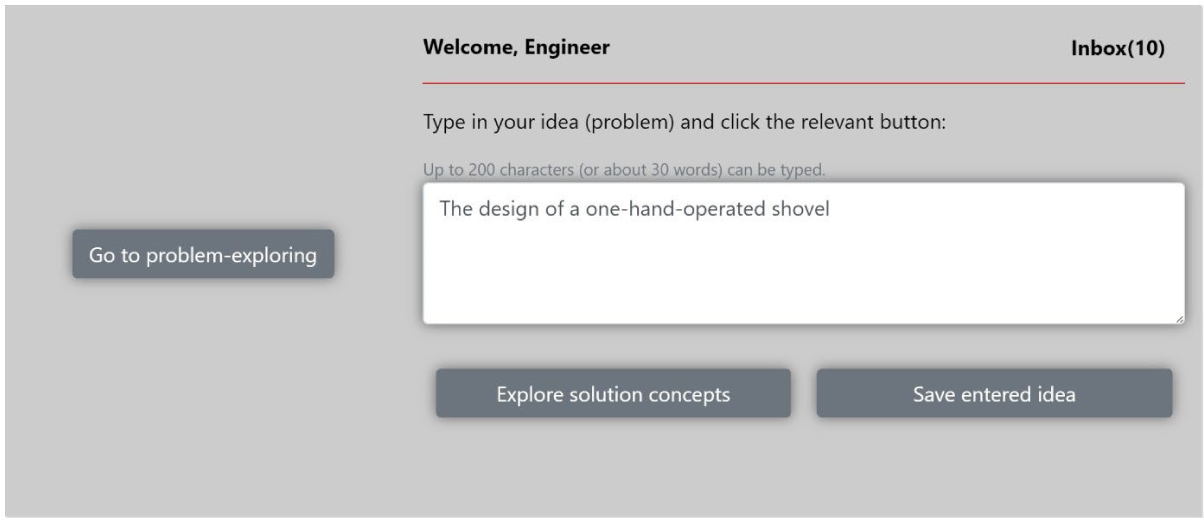
The AICED framework is implemented as a computational web tool, Pro-Explora, accessible through the graphical user interface (GUI). An interface of Pro-Explora is shown in Figure 3; users can log in to the tool at https://www.explorefoss.com. Pro-Explora is a simple yet supportive comprehensive tool for AICED. It enables design engineers to seamlessly generate new engineering design problems, explore imagery solution concepts, define problems, and create a PDS to guide further concept development. This study does not cover the aspects of the tool that generate new engineering design problems. Due to the concurrent and iterative nature of the early-stage design process, activities do not necessarily follow sequential order (Reference Obieke, Milisavljevic-Syed and HanObieke et al., 2020). Consequently, in Pro-Explora, the generation of image concepts precedes problem definition and the creation of the PDS.
Pro-explora interface for AICED

Figure 3 shows the Pro-Explora interface with a logged-in user, “Engineer,” who submitted a design problem titled “The design of a one-hand-operated shovel,” an undergraduate final-year project. The user can “Save the entered idea” to their Pro-Explora inbox or “Explore solution concepts.” Figure 4 shows a Pro-Explora-generated concept for the design problem, allowing the user to generate alternative solution concepts, define the problem, or create a PDS. Additionally, the user can return to the computational problem-exploring interface, although this aspect is not covered in the current study. Figure 5 shows the generated documents for the problem definition and PDS, which two experienced design engineers vetted as highly relevant to guide the innovative design of the shovel.
A generated concept of a design problem

Problem definition (A) and PDS (B) for shovel design

5. Discussion
5.1. Addressing the research question
The AICED framework effectively addressed the research question posed in Section 1: “How can AI technologies bridge the knowledge space expansion gap in engineering design?” This framework minimises the knowledge gap that hinders early-stage engineering design activities. The limitation of design engineers due to knowledge space expansion became evident as an over-the-wall problem when solo engineering design practice began yielding unsuccessful results (Reference UllmanUllman, 2010). Concurrent engineering design practice emerged, incorporating inputs from technical and non-technical stakeholders and becoming essential to the design process. Despite the widespread adoption of concurrent engineering design, engineers still perform design tasks individually and make decisions constrained by knowledge space expansion. These decisions are subsequently discussed with extended design team members, such as manufacturers and environmentalists. To enhance the effectiveness of these discussions, it is crucial to support or augment the design engineers’ knowledge at the design process level. The more informed the design engineers are about the subject areas of the extended team members, the more streamlined the group discussions will be.
The manufacturing involvement details in Figure 5A enable the design engineer to assess their understanding of the design’s manufacturing aspects, forming the basis for discussions with manufacturers. Similarly, the initial sustainability and environmental assessment informs the design engineer about the design’s potential sustainability and environmental implications. These elements shape the design engineer’s concept of the potential solution to the problem. The problem definition document in Figure 5A incorporates the four key perspectives in defining an engineering design problem (Section 3): problem context, customers’ and stakeholders’ needs, functional requirements, and design constraints (Reference LiuLiu, 2021). Additionally, it includes manufacturing involvement, sustainability, and environmental assessment. With the AICED framework, the first cycle of early-stage engineering design activities—defining the problem, establishing the essential and desirable PDS requirements, and creating a visual concept of a possible solution—takes less than five minutes.
5.2. Design freedom for individual practitioners or freelancers
The AICED framework effectively supports design engineers working individually and as part of a team. The importance of teamwork and individual work in engineering design is well-recognized in academia and industry (Reference LindemannLindemann, 2015). Encouraging the effective utilisation of both approaches is essential (Reference Han, Park, Hua and ChildsHan et al., 2021; Reference Zhang, Markopoulos, Bekker, Paule-Ruíz and SchüllZhang et al., 2022). In some cases, it is beneficial to have team discussions after individual members have completed specific tasks (Reference MettlerMettler, 2023). This approach is supported by the nominal group technique (NGT), where individually generated concepts are collectively evaluated to reach a decision (Reference CassoneCassone, 2024; Reference Messerschmidt, Cortes and NanayakkaraMesserschmidt et al., 2024). Working individually allows design engineers to concentrate more efficiently on their tasks, particularly when focusing on design process tasks or conceptualising new engineering design problems (Reference Obieke, Milisavljevic-Syed and HanObieke et al., 2024). However, the decisions made by a design engineer during this time are often subject to concurrent review and input from consultants, other design engineers, or extended team members such as clients, manufacturers, or legal experts (Reference Angelova, Vodenova and RaychevaAngelova et al., 2024).
Therefore, the AICED framework benefits student design engineers, freelancers, and individual practitioners. It lets them quickly expand or enrich their conceptual knowledge of an idea or design problem, facilitating more informed discussions with other professionals.
5.3. Industry implications: Open AICED framework
The AICED framework is designed as an adaptable, open framework that can be tailored to meet specific organisational needs. For instance, the PDS document can be customised to a required length and formatted according to organisational standards, including specific elements of interest. Similarly, any perspective relevant to the problem can be incorporated into the problem definition document shown in Figure 5A. Organisations can integrate external knowledge or example data to guide the AICED framework contextually. The framework includes an encryption technique to protect confidential data before transferring it to an LLM. However, it is important to note that despite this encryption, the data is decrypted during LLM processing and may be logged by the LLM service provider (Reference Yan, Li, Xu, Dong, Zhang, Ren and ChengYan et al., 2024). Data protection at the LLM service provider’s level depends on the provider’s data control and logging policies. Therefore, it is advised to contact the LLM service provider to understand their data logging policies and maintain trust, security, and privacy.
5.4. The constraint of prompt engineering knowledge
Prompt engineering has become crucial for effective interaction with LLMs (Reference MeskóMeskó, 2023). As discussed in Section 2.3, proficiency in prompt engineering is essential for crafting text inputs that guide the behaviour of LLM-powered applications (Reference AltoAlto, 2024). Without this knowledge, users may struggle to leverage LLMs’ capabilities fully. Developing specialised support tools across various fields aims to democratise access to advanced technologies, enabling individuals who might otherwise be disadvantaged to benefit from these technologies. For instance, computer-aided engineering tools empower design engineers to utilise sophisticated technologies without needing in-depth knowledge of the underlying systems. Similarly, the AICED framework addresses this need by facilitating a specialised tool that allows design engineers to harness the power of LLMs without requiring extensive knowledge of prompt engineering. The AICED framework bridges the prompt engineering knowledge gap by managing LLM design tasks on the backend. As illustrated in Figure 2, using external examples with the multi-agent LLM simplifies the prompt requirements, as the agent can interpret the example documents to generate its prompts. This approach ensures that design engineers can focus on their core tasks while benefiting from LLMs’ advanced capabilities.
5.5. Human in the loop in AICED
The level of safety required in engineering design may not allow for complete digitalisation or the removal of humans from the design process. The details generated by the Pro-Explora tool, based on the AICED framework and shown in Figure 5, are highly relevant. These documents are formatted in a specific engineering design layout to support conceptual thinking (Reference Göhlich, Bender, Fay and GerickeGöhlich et al., 2021). While the tool did not produce incorrect results, some information requires human interpretation. For instance, the “Weight” element of the PDS specifies that the shovel’s weight must not exceed 15 kg. This limit is quite high, even with some content on the shovel. Additionally, the first essential requirement in the “Durability” element of the PDS appears incomplete, and the “Cost” element does not specify the currency. However, design engineers can interpret and update this information as needed. The one-page PDS and problem definition documents facilitate the rapid conceptualisation of design solutions. Since these documents are downloadable in Word format, they can be easily expanded, edited, or used seamlessly. This significantly simplifies the work of design engineers, as illustrated in Figure 2, where the AI system handles the more challenging tasks.
6. Conclusion
While AI technologies are increasingly adopted across various sectors to support complex activities, their application in engineering design remains underexplored. This study addresses this gap by introducing the AICED framework, a novel approach for AI collaboration in engineering design. Utilising advanced multi-agent LLM technology, the AICED framework enhances design process activities with AI capabilities. Implemented as the computational tool Pro-Explora, it augments design engineers’ abilities in problem definition, product design specification (PDS), and conceptual design. These early-stage engineering design activities are often identified as challenging in practice. Pro-Explora, powered by the AICED framework, generates a professional problem definition, a PDS document, and a unique image description of a potential solution concept within five minutes. This rapid generation process accelerates the early-stage design cycle and allows design engineers to maintain an uninterrupted creative flow. The tool’s effectiveness was demonstrated in a real-life engineering design project, with outputs deemed highly relevant by two experienced design professionals. The study also discusses the industry implications of the AICED framework, particularly in addressing the growing need for prompt engineering knowledge and skills. This pioneering study uses multi-agent LLMs as collaborators to produce standard-format documents in engineering design, leading to new research directions in the specific applications of LLMs within this field.
This study has limitations, primarily due to the pilot consultation with engineering design professionals to assess the AICED framework’s outputs and the knowledge used as prompts. Future work will involve a more formal consultation, including deploying the AICED framework in real-world case studies. Further research will explore using LLMs for interpreting drawings and analysing 3D CAD models, which would be particularly useful for creating patent sketches in the required format. By augmenting LLMs with examples of patent sketches, the AICED framework could facilitate the production of patent sketches from other engineering drawings. Additionally, the framework could produce other documents to support patent applications for engineering design practitioners and freelancers, fostering innovation and invention.


 Open access

