





There is a wide body of empirical literature (e.g., Bishop, Reference Bishop1997; Conti-Ramsden & Jones, Reference Conti-Ramsden and Jones1997; Leonard, Reference Leonard2014) providing evidence of important linguistic difficulties regarding verb comprehension and production in developmental language disorder (DLD). Such difficulties in the morphological verb production in children with DLD are reported in numerous studies in various languages (Leonard, Reference Leonard2014). Among English-speaking children with DLD, the most important difficulties are reflected in the errors and omissions of verbal inflection of the third-person singular (-s) and the past tense (-ed) (Conti-Ramsden et al., Reference Conti-Ramsden, Botting and Faragher2001; Hoover et al., Reference Hoover, Storkel and Rice2012; Leonard et al., Reference Leonard, Eyer, Bedore and Grela1997). Bishop (Reference Bishop2014) summarized this kind of difficulty in the production of tense marking in children with DLD using elicitation tasks (e.g., Marshall & van der Lely, Reference Marshall and van der Lely2012; Rice et al., Reference Rice, Wexler, Marquis and Hershberger2000; van der Lely & Ullman, Reference van der Lely and Ullman2001), sentence repetition (e.g., Dalal & Loeb, Reference Dalal and Loeb2005), and its presence in written language (e.g., Windsor et al., Reference Windsor, Scott and Street2000).
Regarding Spanish and Catalan, some of the most important morphological errors made by children with DLD in terms of language production are observed in the verbal inflection of tense, number, and person, as well as in the overuse of infinitives (Bedore & Leonard, Reference Bedore and Leonard2001; Grinstead et al., Reference Grinstead, Baron, Vega-Mendoza, De la Mora, Cantú-Sánchez and Flores2013; Sanz-Torrent et al., Reference Sanz-Torrent, Serrat, Andreu and Serra2008). A longitudinal study by Sanz-Torrent et al. (Reference Sanz-Torrent, Serrat, Andreu and Serra2008) showed that bilingual children with DLD displayed a significantly higher use of infinitives compared with the control group. Additionally, the group with DLD presented a significant number of verb omission and verbal inflection errors. Specifically, regarding tense, most studies have focused on the past tense morphology in children with DLD. For example, a study of the spontaneous production of tense and temporality in French-speaking children with DLD (Paradis & Crago, Reference Paradis and Crago2001) showed that they presented significantly lower scores on past and future tenses when compared with control groups.
Furthermore, the use of telic predicates has been studied in children with DLD. Telicity is the aspectual property of a verb or verb phrase that presents an action or event as having a clear end point, for example, “fall down” is telic, because it lexically indicates that the event is completed. The verb “work,” on the other hand, is atelic, since it depicts an activity with no clear end point. Regarding the production of telic predicates by Spanish-speaking children with DLD, Grinstead et al. (Reference Grinstead, Lintz, De la Mora, Cantú-Sánchez and Flores2016) found that they produced telic verbs more often in the past than in the present. However, they were not significantly different from typically developing children in this matter. On a longitudinal basis, distinct past tense inflections were eventually used successfully to mark aspectual contrasts by Spanish-speaking children when referring to perceptually salient actions, which, due to their higher imageability, might tend to be learned before more abstract ones (Hirsh-Pasek & Golinkoff, Reference Hirsh-Pasek and Golinkoff2006; Uccelli, Reference Uccelli2009). Consistently, the Aspect Hypothesis (Shirai & Andersen Reference Shirai and Andersen1995) predicts that acquisition of tense and aspect markers is strongly influenced by lexical aspect; specifically, past perfective markers would be associated with telic verbs (achievements and accomplishments), while general imperfective markers would be associated with atelic verbs (states and activities), and progressive markers with activity verbs.
In general, as observed in the above-mentioned studies, research in language production in children with DLD is abundant, while their language comprehension has been far less studied (e.g., Bishop & Adams, Reference Bishop and Adams1992; Joffe et al., Reference Joffe, Cain and Maric2007; Montgomery, Reference Montgomery2004). In particular, there are relatively few studies dedicated to the analysis of verbal inflections in terms of language comprehension, and even fewer dedicated to verbal morphology comprehension in sentence comprehension in online tasks (e.g., Andreu et al., Reference Andreu, Sanz-Torrent, Guardia and MacWhinney2011; Andreu et al., Reference Andreu, Sanz-Torrent and Rodriguez-Ferreiro2016; Marinis & van der Lely, Reference Marinis and van der Lely2007). Bishop, in one of the first studies in this field (Reference Bishop1979), administered receptive vocabulary and grammar tests to English-speaking children with an expressive or receptive-expressive language disorder (affecting both production and comprehension) and found that all children had a significantly lower level of comprehension compared to children of the same age with typical language development. Mainela-Arnold et al. (Reference Mainela-Arnold, Evans and Coady2008) investigated the lexical access of children with DLD in a gating task (Frequency-Manipulated Gating Task) and suggested that children with DLD experience greater interference of words from previous tests, an issue that could point toward a greater vulnerability precisely because of the competition introduced by the stimuli of previous tests in the linguistic task process. This interpretation tallies with previous studies on verbal working memory, which support the view that the linguistic capacity of the DLD group is more vulnerable due to the interference of previously presented words, particularly when the difficulty of the experimental task increases (Weismer et al., Reference Weismer, Evans and Hesketh1999). For English-speaking adolescents with a history of DLD, a compensatory processing strategy that relies on the interpretation of global contextual cues has been proposed. Such strategy would allow them to consider event-probable items as quickly as a control group does (Borovsky et al., Reference Borovsky, Burns, Elman and Evans2013).
Specifically regarding verbal morphology comprehension, German language-impaired children were found to perform significantly more poorly than typically developing children at responding to a Truth Value Judgment Task that involved the use of the perfective past tense of a telic German verb. The children in this study were unable to identify as inappropriate the use of a telic verb in the past to characterize an event that was not completed (Schulz et al., Reference Schulz, Wymann and Penner2001). Similarly, Fellbaum et al. (Reference Fellbaum, Miller, Curtiss, Tallal, MacLaughlin and McEwen1995) found that children with DLD performed more poorly than a group of age controls on a picture identification task that required comprehension of grammatical morphemes of brief duration (such as regular-past-ed). To this respect, a reduced language processing capacity of children with DLD to deal with low-phonetic-substance inflections in English has been suggested (Montgomery & Leonard, Reference Montgomery and Leonard2006). An explanation to this phenomenon could also be related to the continuous nature of the speech stream, which can lead to a possible breakdown in the processing of inflected forms in children who cannot accomplish their morphological analysis in real time and are thus unable to integrate the linguistic properties of incoming words into a developing sentence meaning (Montgomery & Leonard, Reference Montgomery and Leonard1998). Such difficulties with comprehension of verbal inflections persist in subtle form into adolescence, according to Leonard et al. (Reference Leonard, Miller and Finneran2009). These authors conclude that 16-year-old adolescents with DLD might present a continued difficulty with processing of tense and agreement morphology, which mirrors an early developmental characteristic period of alternation and omission of tense/agreement inflections in DLD.
However, more recent research using eye-tracking technology (Andreu et al., Reference Andreu, Sanz-Torrent, Guardia and MacWhinney2011; Andreu et al., Reference Andreu, Sanz-Torrent and Rodriguez-Ferreiro2016; Andreu et al., Reference Andreu, Sanz-Torrent and Trueswell2013; Christou et al., Reference Christou, Guerra, Coloma, Andreu Barrachina, Araya, Rodriguez-Ferreiro, Buj Pereda and Sanz-Torrent2020; Christou et al., Reference Christou, Sanz-Torrent, Coloma, Guerra, Araya and Andreu2021) has raised the possibility that language comprehension among children with DLD is more preserved. The results of these authors indicate that, in terms of verbs in simple sentences, separated, or in narrative style, children with DLD present a semantic representation of the verb which is more typical than expected. Similarly, Montgomery (Reference Montgomery1995, Reference Montgomery2000a, b) concluded that the comprehension of children with DLD was preserved during the use of short sentences, whereas in long sentences comprehension was significantly reduced. Also, Montgomery and Evans (Reference Montgomery and Evans2009) studied the relationship between working memory and complex sentence comprehension through several experimental tasks (nonword repetition task/PSTM, competing language processing task/CLPT, and a sentence comprehension task) and concluded that the limited comprehension of complex sentences presented by children with DLD is significantly associated with a limitation in working memory. In this study, both the DLD group and the control groups showed adequate comprehension of simple sentences, although the authors of the study suggested that the children with DLD require more cognitive resources in their processing trajectory.
Most studies that address the phenomenon of language comprehension in children with DLD have been based on offline methodologies. Such offline measures provide useful information on the outcome of language processes; however, online technics allow capturing difficulties in the underlying language process (van Alphen et al., Reference van Alphen, Brouwer, Davids, Dijkstra and Fikkert2021). In this respect, Andreu et al. (Reference Andreu, Sanz-Torrent and Trueswell2013) suggested that the previous studies based on offline tools could have limitations when recording the real linguistic comprehension capacity of children with DLD. To date, there are relatively few studies which have specifically studied language comprehension in online sentence tasks (e.g., Andreu et al., Reference Andreu, Sanz-Torrent, Buil and MacWhinney2012; Andreu et al., Reference Andreu, Sanz-Torrent and Rodriguez-Ferreiro2016; Christou et al., Reference Christou, Guerra, Coloma, Andreu Barrachina, Araya, Rodriguez-Ferreiro, Buj Pereda and Sanz-Torrent2020; Christou et al., Reference Christou, Sanz-Torrent, Coloma, Guerra, Araya and Andreu2021; Marinis & van der Lely, Reference Marinis and van der Lely2007; Montgomery, Reference Montgomery1995, Reference Montgomery2000a, b). The present study is developed from the visual world paradigm (Cooper, Reference Cooper1974; Tanenhaus et al., Reference Tanenhaus, Spivey-Knowlton, Eberhard and Sedivy1995) which is based on the premise that eye fixation is an ideal independent response analogous to what a person is cognitively processing. In this sense, the amount of time in glance fixation toward the target can indicate a higher level of comprehension. With respect to research that measures language comprehension, online recordings of eye movements permit excellent experimental conditions, as more secondary variables are accounted for and controlled, and therefore fewer cognitive resources are engaged (Montgomery & Evans, Reference Montgomery and Evans2009). To sum up, the eye-tracking data can be considered as an optimal source of information in psycholinguistic research because it provides insights with respect to participant’s exact timing of processing the linguistic information, and to eventual difficulties that may arise in the underlying processes.
In the present study, we seek to evaluate the online comprehension of Spanish verbal morphology of tense in children with DLD, since inflectional morphology is probably one of the most significant difficulties of this linguistic disorder (Mendoza, Reference Mendoza2016). This question results especially interesting regarding the fact that Spanish is a language of rich morphology. Particularly, we have concentrated on the inflections of Spanish future and past tenses, since previous studies in children with DLD have shown differences in their production compared to their control peers (Paradis & Crago, Reference Paradis and Crago2001; Bradshaw et al., Reference Bradshaw, Hoffman and Norris1998), especially in Spanish past tense (Grinstead et al., Reference Grinstead, Lintz, De la Mora, Cantú-Sánchez and Flores2016). Considering these reported results on tense inflection production and the idea that processing of tense morphology mirrors the characteristic alternation and omission of tense inflections in DLD (Leonard et al., Reference Leonard, Miller and Finneran2009), we have designed an experiment to assess morphological markers of tense in the context of simple sentences. We sought to establish the perceived distinction of two forms (e.g. subió –climbed: past tense, and subirá, will climb: future tense), which are both graphically and prosodically stressed. This is not the case with the present tense “sube” (climbs), which neither graphically nor prosodically marked in Spanish. Additionally, this allowed the design of the stimuli to be graphically clearer.
If we consider that it is the morphology of the verb that guides the comprehension of the sentence, the deficits in the morphological processing will be reflected both in the execution and in the pattern of glances during the task. Thus, according this hypothesis, it would be expected that the children with DLD would perform poorly compared to their control group counterparts. Such results could suggest the possibility of a deficit in the comprehension of the morphological markers of the verb, and consequently a significantly more diminished comprehension of verbal morphology. Conversely, if the children with DLD show similar comprehension to that of their control group counterparts, this would allow suggesting that their verbal morphology comprehension is relatively preserved, at least in the experimental conditions we describe below. This could indicate the possibility of a not significantly atypical representation of the notion of the past/future, despite the errors that appear in the production of those verbal infections.
Methods
Participants
All participants were native speakers of Spanish and Catalan and reside in Catalonia, where both Spanish and Catalan are official languages. In this sense, all the children that participated in the study were simultaneous bilinguals in both languages. According to the acquired parental report, the children had been equally exposed to Spanish and Catalan since birth. As stated by Alarcón and Garzón (Reference Alarcón and Garzón2011), children in Barcelona are equally proficient in both Spanish and Catalan, although the use of Spanish is more popular. For more information on the linguistic reality of Catalonia, see Sanz-Torrent et al. (Reference Sanz-Torrent, Badia, Serra, Perez-Vidal, Juan-Garau and Bel2007) and Sanz-Torrent et al. (Reference Sanz-Torrent, Serrat, Andreu and Serra2008). The sample consists of 4 groups: 24 children with DLD (age range 4.6–12.6; average age 7.8 years), 24 children with the same age as the children with DLD as a control group (age range 4.6–12.2; average age 7.8 years), and 24 children with the same linguistic level (based on Mean Length of Utterance by words, MLU-w, with ages ranging between 4.6 and 9.4 with an average age of 6.8 years). The last sample group was composed of 24 adult university students (ages that oscillate between 18 and 30, and an average age of 22.5 years). The inclusion of the adult group as a language expert control group provides us with the opportunity to evaluate in greater depth the experimental validity of the procedure and the adequacy of the stimuli. For the selection of the DLD group, the diagnostic criterion for Specific Language Impairment (SLI) was used (Leonard, Reference Leonard2014; Stark & Tallal, Reference Stark and Tallal1981; Watkins, Reference Watkins, Watkins and Rice1994), since the present research was carried out during the years 2013–2015, when the most prominent term in use was SLI. However, we accept that children who meet these classic SLI criteria enter within the framework of DLD (Bishop et al., Reference Bishop, Snowling, Thompson and Greenhalgh2017) and, for this reason, we decided to use the DLD term throughout our work.
For the formation of the DLD group and the two control groups of children (chronological and linguistic), an extensive evaluation was conducted previously (see Materials section below) in a set of 260 children whose ages range between 3.9 and 12.6 years. The children who presented cognition and a linguistic level within the parameters of normality passed to the next stage, where spontaneous speech samples were recorded for the analysis of the MLU-w. Subsequently, the ideal candidates were selected to form control groups comparable to the DLD group in terms of age and MLU-w. Because of the amplitude of age range among the participants of the DLD group, we created two subgroups: one of younger children (DLD1: n = 12 and average age 6.0 years) and one of older children (DLD2: n = 12, average age 9.7 years). This classification was extrapolated to the rest of the control groups: Age-control group (AGE1: average age 6.3 years and AGE2: average age 9.4 years) and MLUw-control group (MLU-w1: average age 5.4 years and MLU-w2: average age 8.2 years). The parents of the children with DLD and the adult participants gave their written consent for participating in the present research and the school director authorized the conducting of the experimental tasks inside the institution. The descriptive data of the groups are summarized in Table 1.
Average individual measures per group and pairwise contrasts (Welch’s two-sample t-test, two-tailed)
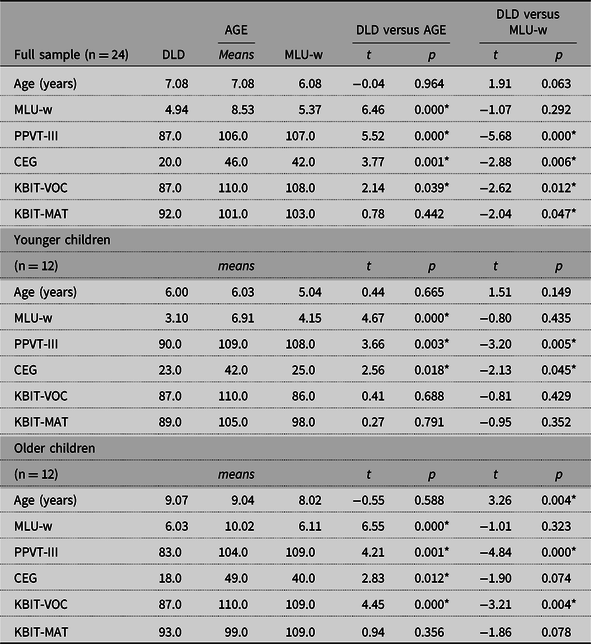
Chronological age in years; MLU-w (Mean Length of Utterance by word count); PPVT-III (Peabody Picture Vocabulary Test—Third Edition) in standard score; CEG (Comprehension Test of Grammatical Structures) in standard score; KBIT-VOC (Kaufman Brief Intelligence Test-Verbal IQ) in standard score; KBIT-MAT (Kaufman Brief Intelligence Test-Non Verbal IQ) in standard score.
Materials
An extensive evaluation based on various standardized tests was conducted for the formation of the DLD group and the two control groups of children. As seen in Table 1, the conducted tests were the Peabody Picture Vocabulary Test—Third Edition (PPVT-III; Dunn et al., Reference Dunn, Dunn and Arribas2006), the Comprehension Test of Grammatical Structures (CEG; Mendoza et al., Reference Mendoza, Carballo, Muñoz and Fresneda2006), and the Kaufman Brief Intelligence Test (KBIT-VOC and KBIT-MAT, Spanish version; Kaufman & Kaufman, Reference Kaufman and Kaufman2004). The means for all four tests were 100 and standard deviation (SD) was 15. Criteria for selection of the DLD groups were to have a score of at least a 1.25 SD below the mean on the PPVT-III, the CEG, and the KBIT-VOC. On the KBIT-MAT (Kaufman Brief Intelligence Test-Non Verbal IQ), children with DLD obtained a nonverbal IQ of 85 or more. Participants in the control groups obtained scores within the means. For the language experiments, the eye movement register system Tobii T120 with an integrated monitor TFT 17ʼʼ was used. The stimuli were presented and the eye-tracking data were collected using the Tobii Studio Software.
Stimuli
In total, 60 simple-structured sentences (subject-verb-object) were created, 30 in past form and 30 in future form. For example, see Figure 1 (SP: “La chica subió al árbol”/“La chica subirá al árbol”) (EN: “The girl climbed the tree”/“The girl will climb the tree”). Another example would be “Mi abuela encendió la chimenea”/“Mi abuela encenderá la chimenea” (“My grandmother lit the fireplace”/“My grandmother will light the fireplace”). In these examples, Spanish inflectional morphemes of future (subiRÁ - encendeRÁ) and of paste tense (subiÓ - encendiÓ) can be observed. Two experimental lists (each containing 15 past sentences and 15 future sentences) were created and used randomly. When a stimulus appeared in its past version in List A, its future version appeared in List B. This design guaranteed that a child never faced the two versions of the same stimulus. This experimental structure provides the possibility of evaluating the past and future inflections separately to detect if there are any significant differences. Visual and verbal stimuli are available online in: https://osf.io/ru62e.
Example of the visual display in a trial.
EN: “The girl climbed the tree” (Target: girl on the tree, Competitor: girl under the tree).
SP: “La chica subió al árbol.”
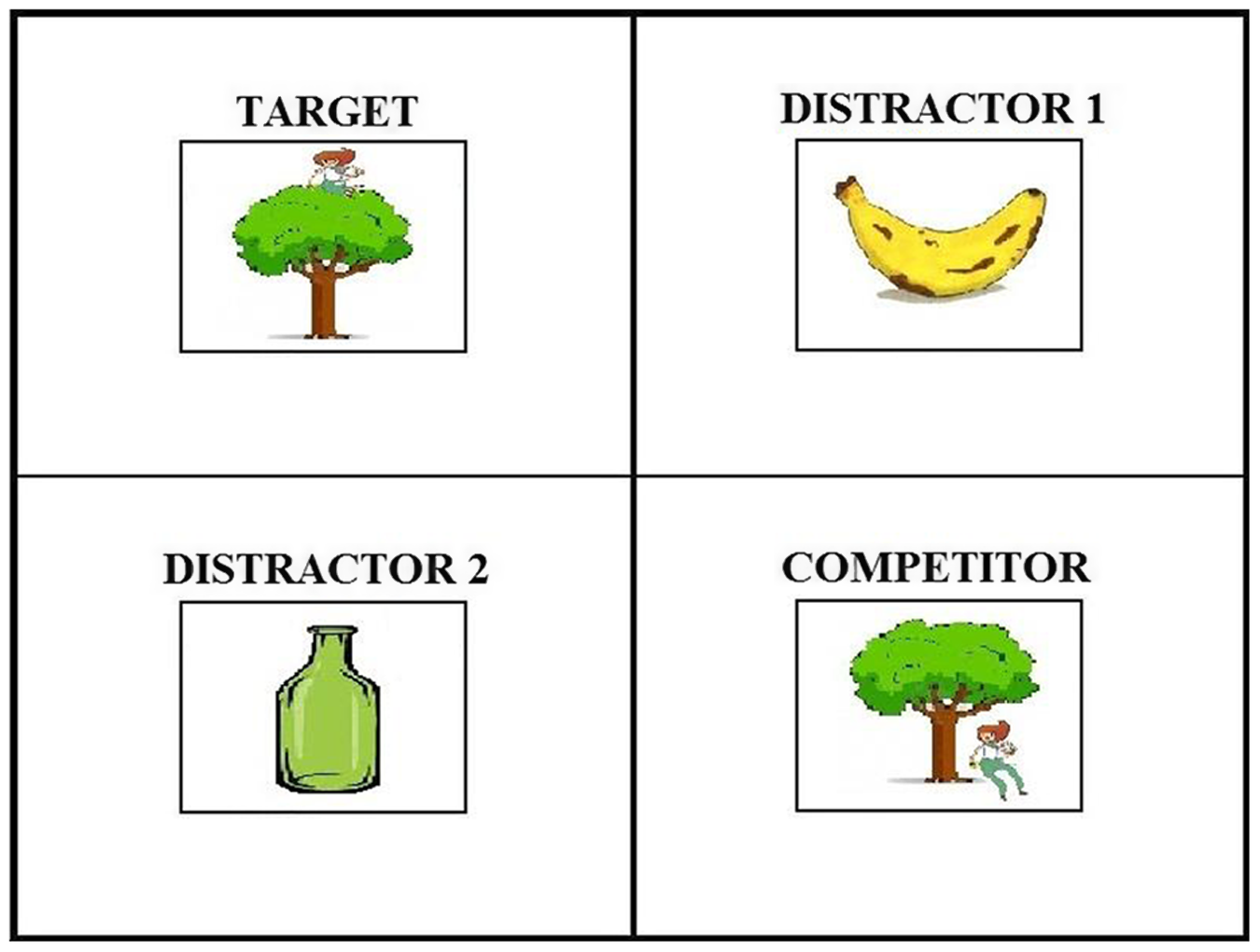
The visual stimuli were composed of images of 800 × 600 pixels and were presented on a monitor screen set to 1024 × 768 pixels. Each stimulus was composed of four squares (target, competitor, and two distractors not semantically related to the sentence). Each square had an image placed in its interior. The lines of the square were black and the background white. The sentences were recorded by a native Spanish speaker at a normal speaking rate at 44,100 Hz. The stimuli were evaluated and selected by judges (collaborators and authors of the research) with the goal of reducing the presence as much as possible of strange variables which could decrease the adequacy of the stimuli.
Procedure
The stimuli were converted to a video format of 800 × 600 pixels and appeared on the integrated monitor TFT of 17ʼʼ of Tobii T120 Eye Tracker at a horizontal distance of approximately 22ʼʼ from the participants’ eyes. Both the presentation of the stimuli and the collection of the obtained eye movement data were carried out through the Tobii Studio Software. At the beginning of the experiment, a calibration of 20s was set up in order to validate the tracking and the registration of the eye movement. Four test trials took place before the experimental task (two past and two future sentences) to familiarize the participant with the sequence of events. Each participant was given these instructions: “You will see some images and you will hear a sentence, search as quickly as possible for the correct image and continue looking at it.” The images of the test were presented in random order and the participant was exposed either to List A or List B. At the beginning of each trial, before the stimulus appeared, a purple circle was shown at the center of the screen for 1000 ms, and subsequently, the stimulus appeared for 5000 ms. Three 1000 ms critical time windows were analyzed. The time windows corresponded to the first critical window following the verb (2000 to 3000 ms from sentence onset), the critical noun window (3000 to 4000 ms from sentence onset), and the last critical window, which followed the noun window (4000 to 5000 ms from sentence onset). Previous studies have also used this experimental design (Andreu et al., Reference Andreu, Sanz-Torrent, Guardia and MacWhinney2011; Andreu et al., Reference Andreu, Sanz-Torrent and Rodriguez-Ferreiro2016; Christou et al., Reference Christou, Guerra, Coloma, Andreu Barrachina, Araya, Rodriguez-Ferreiro, Buj Pereda and Sanz-Torrent2020; Christou et al., Reference Christou, Sanz-Torrent, Coloma, Guerra, Araya and Andreu2021).
Data analysis
Four areas of interest corresponding to the location and size of the displayed pictures (i.e., the target, the competitor, and two distractor objects) were defined using the software Tobii Studio. This software provides participants gaze location at both the horizontal and vertical axes each 8,33 ms (sample rate of 120 Hrz). Consequently, it was possible to determine, for each gaze sample, whether it was located inside of any of the areas of interest at any given point during the experimental trial. Using the R Project software (R Core Team, 2021), steps of one ms were inspected per participant and trial for each of these time windows and a value of 1 was given to the area of interest that participants were fixating at time step. The proportion of fixation (number of fixation to an area of interest/total number of fixations) was calculated per participant on a trial basis for the four areas of interest (the target, the competitor, and the two distractor objects on the display).
Our statistical approach was based on a nonparametric cluster-based permutation analysis (Barr et al., Reference Barr, Jackson and Phillips2014; Kronmüller & Noveck, Reference Kronmüller and Noveck2019; Kronmüller et al., Reference Kronmüller, Noveck, Rivera, Jaume-Guazzini and Barr2017), which contrasted log-ratios between the experimental group (DLD) and the control groups (Adults, Age-control, and MLUw-control). Since log-ratio around zero expressed no object preference, we contrasted the log-ratio of the experimental group against a zero distribution (Barzy et al., Reference Barzy, Black, Williams and Ferguson2020; Guerra et al., Reference Guerra, Bernotat, Carvacho and Bohner2021; Helo et al., Reference Helo, Guerra, Coloma, Reyes and Rämä2021). Cluster-based permutation analysis offers a statistical tool that controls for familywise error rates in time series. This analysis identifies temporally adjacent effects with the same direction and cluster them together (Barr et al., Reference Barr, Jackson and Phillips2014). A cluster mass statistic is subsequently obtained by aggregating the largest absolute summed t-values on each time step within the identified cluster, resulting in a distribution of t-values. We then obtained for each significant cluster a null-effect t-distribution by scrabbling the labels of the two groups of interest (i.e., groups being contrasted, e.g., DLD vs. Age-control group) based on 2000 iterations for every 50 ms. Finally, we tested the significance of each cluster by computing the proportion of the sum of the largest t-values between the null-distribution and our data. To establish if a time bin was statistically significant, we used a mixed-effect linear regression on log-ratios with group as a fixed effect and random intercepts for participants and items. The lmerTest R package (Kuznetsova, Brockhoff & Christensen, Reference Kuznetsova, Brockhoff and Christensen2017) was used to obtain p-values. Adjacent time bins showing at least three consecutive (150 ms) reliable differences (p < .05) were grouped together to form a cluster.
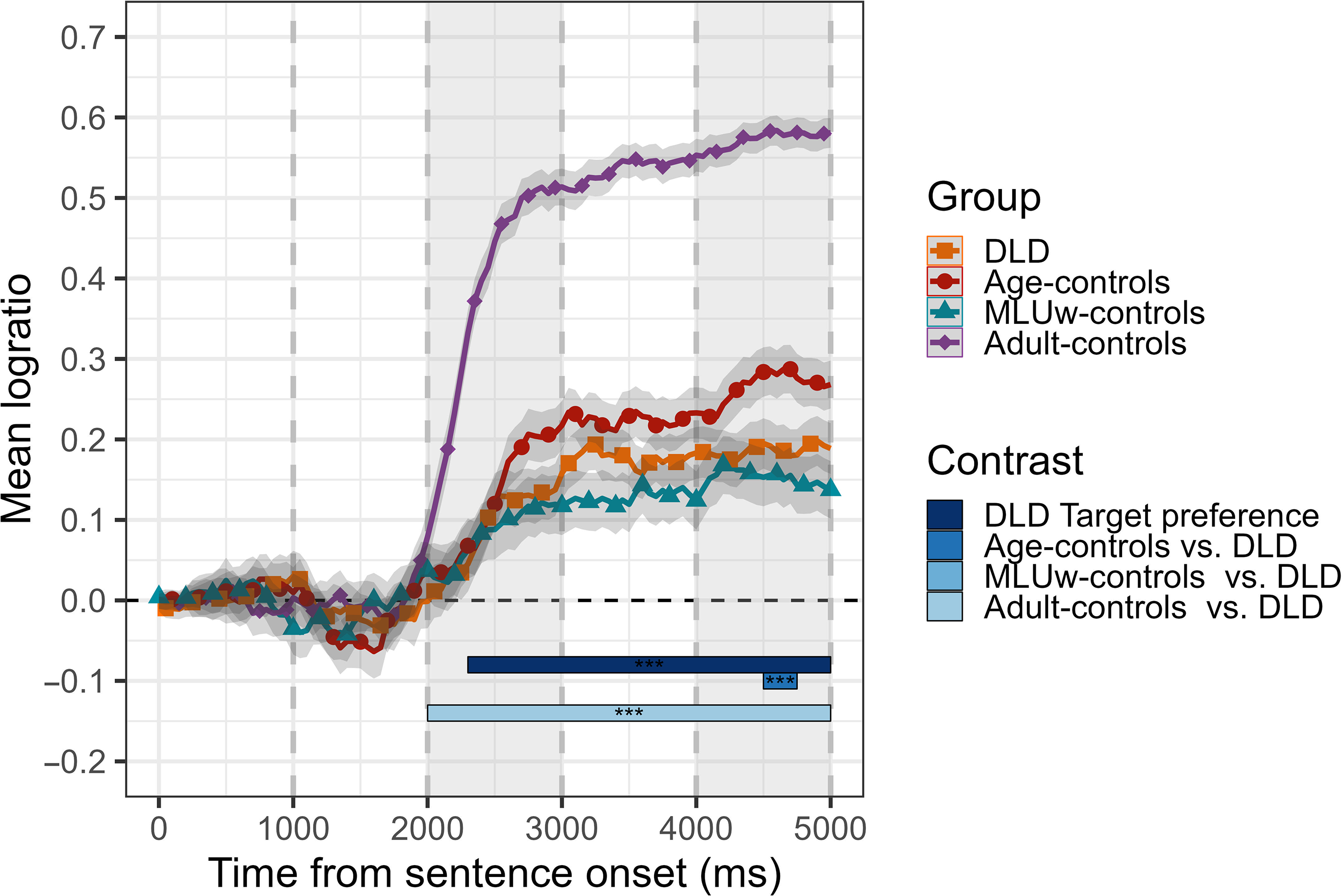
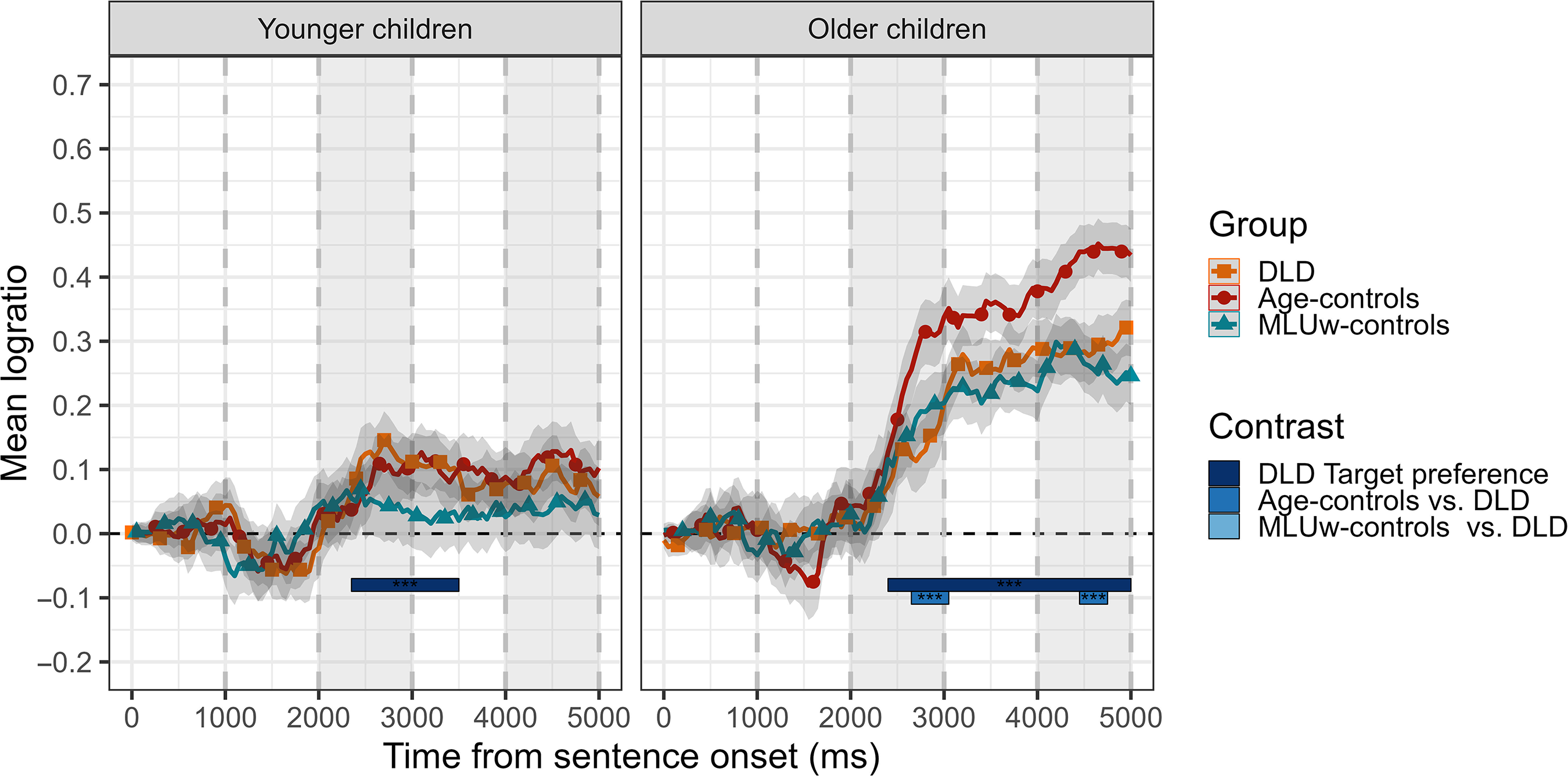
We conducted a total of 14 different contrasts via cluster analysis. First, the group of interest (i.e., the DLD group) was contrasted against each control groups (i.e., Age-control, MLUw-control, and Adults), and the zero distribution (see Figure 2; contrast 1, 2, 3, and 4). Moreover, children’s data were divided using an age-median split criterion resulting in two subgroups (i.e., younger children and older children) for each children group. Subsequently, we compared the younger DLD group against the corresponding zero distribution, the younger Age-, the younger MLUw-group (see Figure 3, panel on the left; contrast 5, 6, and 7), and we did the same with the older children subgroups (see Figure 3, panel on the right; contrast 8, 9, and 10). Finally, we contrasted within each group (i.e., DLD, Age-control, MLUw-control, and Adults) the log-ratios for trials in past tense versus trials in future tense (see Figure 4; contrasts 11, 12, 13, and 14). Following Chan et al. (Reference Chan, Yang, Chang and Kidd2018), we considered that proportions smaller than .025 can be described as significant by two-tailed test. After Bonferroni correction, our critical p-value was equal to 0.0018 (i.e., .025/14).
Mean log-transformed fixation proportion differences between target and competitors by group and time window. Shaded areas represent the within-subject adjusted 95% confidence intervals.
Mean log-transformed fixation proportion differences between target and competitors by children subgroup over time. Shaded areas around solid lines represent the within-subject adjusted 95% confidence intervals.
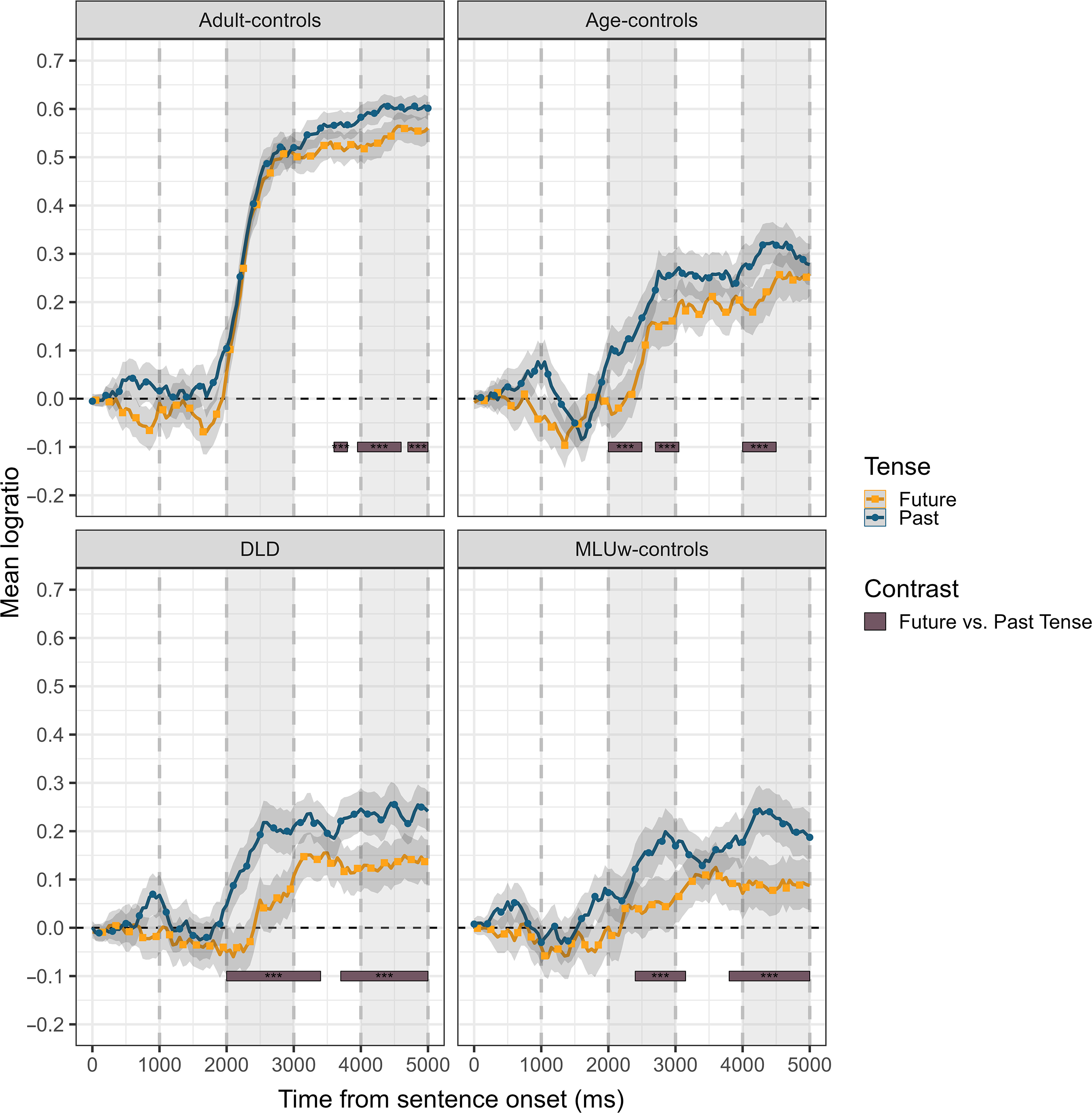
Mean log-transformed fixation proportion differences between future and past verbs by experimental group and time window. Shaded areas represent the within-subject adjusted 95% confidence intervals.
For each contrast, we created a null-hypothesis distribution of t-values; these were achieved by randomly permutating each group (i.e., Adults, Age-, and MLUw-control) and the zero-distribution label with the DLD label (for the first four contrast), by randomly permutating each children age subgroup label (i.e., Younger Age-, Younger MLUw-, Older Age-, and Older MLUw-control) and the zero-distribution label with the label of the corresponding DLD subgroup (i.e., Younger DLD, Older DLD), and by randomly permutating tense labels (i.e., Future and Past) within each group. All data and analysis scripts are available online in https://osf.io/ru62e.
Results
Figure 2 presents the average log-transformed ratio between the target and competitor object for each independent group on each time window. In these time course plots, shaded areas surrounding main lines represent the 95% confidence intervals calculated by participants and adjusted for within-subject design. Confidence intervals are a reliable source for estimating effects size in the original measure (Cumming, Reference Cumming2013, Reference Cumming2014; Cumming & Finch, Reference Cumming and Finch2005; Fidler & Cumming, Reference Fidler, Cumming, Schinka, Velicer and Weiner2013), which can be visually inferred by observing the differences between the upper and the lower boundary between two means. This is particularly useful in the context our data and analysis, since for a given cluster the effect size changes dynamically over time. Significant clusters are represented visually as horizontal bars across time (i.e., extend of the cluster) and with color shades representing each contrast. As clearly shown in Figure 2, all groups increase the proportion of fixations toward the target during the beginning of the first time window. This target preference reaches its peak in the first critical time window and it is maintained in the second and third time window for all groups, except for the Age-control group, which evidence a further increase in the last time window. As expected, the Adult-control group shows a clear advantage in terms of the speed and magnitude of preference, that is, faster and larger preference for the target compared to the DLD group (from 2000 ms after sentence onset to the end of the trial, Observed sum t = 535.13, p < .001).
Regarding children groups, we observe more subtle differences, particularly between the Age-control and the DLD group. While all three children groups evidence a preference for the target object from the first time window, the Age-control group appears to have an advantage in terms of size of this effect relative to the DLD and MLU-w groups. In more detail, children with DLD (Observed sum t = 287.61, p < .001) started preferring the target object 2300 ms after sentence onset to the end of the trial. Finally, the cluster analysis revealed a late and short significant cluster from 4500 ms to 4750 ms after sentence onset, showing a larger preference for the target in the Age-control relative to the DLD group (Observed sum t = 13.29, p < .001). Nevertheless, at the end of the experimental task (4750–5000 ms), the DLD group presents a similar level of comprehension to the children of the Age-control group.
When we compared children subgroups (Figure 3), we found that both younger and older children with DLD exhibited a preference for the target object, yet the extend of the identified clusters differed; while younger children with DLD exhibit a cluster that end 3500 ms after sentence (Observed sum t = 79.8, p < .001), older children maintained this preference until the end of the trial (Observed sum t = 307.59, p < .001). Finally, while no differences were observed between the younger children subgroups, the older Age-control group evidence a larger target preference compared to the older DLD group in two moments in time: first, between 2650 ms and 3050 ms from sentence onset (Observed sum t = 24.72, p < .001), and then between 4450 ms and 4750 ms from sentence onset (Observed sum t = 15.83, p < .001). No other significant clusters were found. Again, at the end of the experimental task, the older DLD group presents a similar level of comprehension to the older Age-control group.
In sum, the results of all analyses confirm that children with DLD and children of the control groups preferred the target object (vs. competitor) in all time windows. Nevertheless, some significant differences between the DLD and the Age-control group appeared mainly due to the differences between older children with DLD (DLD2) and older children of the chronological control group (AGE2). Finally, both the children groups and the adult group have obtained higher comprehension percentages when the sentence verbs were in the past tense (Figure 4).
Discussion
This research performed a real-time study of the aspects of verbal morphology of tense in children with DLD. The results have shown that both the children of the DLD group and the children of the control groups can comprehend the differences of past and future in simple sentences structure. Contrary to the initial hypothesis, where it was argued that children with DLD would perform poorly compared with the control group participants, results indicate that the online comprehension of the verbal morphology of tense in children with DLD is more preserved than expected. Both the first analysis (Figure 2) and the second one (Figure 3) showed that the DLD group, in general terms, did not present important different percentages of task comprehension from the chronological control group and MLU-w control group. In other words, in the vast majority of the analyzed time bins, in intergroup terms, the DLD group presents a capacity for comprehension which does not significantly differ from that of the children control groups (differences between the DLD and the other children groups did not statistically differ from zero). However, when we observe the comparison of children subgroups (Figure 3), more significant differences appear which are observed in the first and in the last time window between older children with DLD (DLD2) and older children of the chronological control group (AGE2).
The difficulties the children with DLD present in the morphological processing of verbal morphology are an issue well documented by different authors in different languages. In English-speaking children with DLD, for example, the most significant problems appear in the production of the verbal inflections of the third person singular and past and present progressive tenses (Conti-Ramsden et al., Reference Conti-Ramsden, Botting and Faragher2001; Hoover et al., Reference Hoover, Storkel and Rice2012; Leonard et al., Reference Leonard, Eyer, Bedore and Grela1997; Rice et al., Reference Rice, Wexler and Cleave1995; Rice & Wexler, Reference Rice and Wexler1996). Among Spanish- and Catalan-speaking children with DLD, the most significant difficulties appear in the verbal inflection of tense, number, and person, and in the use of infinitives (Anderson, Reference Anderson2001; Bedore & Leonard, Reference Bedore and Leonard2001; Grinstead et al., Reference Grinstead, De la Mora, Pratt, Flores and Grinstead2009; Sanz-Torrent et al., Reference Sanz-Torrent, Serrat, Andreu and Serra2008). Similar findings point to a significant problem in the production of verbal morphology in French-, German-, and Greek-speaking children with DLD (Abdalla & Crago, Reference Abdalla and Crago2008; Jakubowicz et al., Reference Jakubowicz, Nash, van der Velde, Greenhill, Littlefield and Tano1999; Paradis & Crago, Reference Paradis and Crago2001; Stavrakaki, Reference Stavrakaki2005). However, the significant limitations in the capacity of children with DLD to comprehend and to produce language remains an open question.
Results also show that all groups obtained higher comprehension percentages when verbs were in the past tense (Figure 4). These results could be explained from a cognitive and a methodological perspective. In linguistic terms, information relative to the time can be transmitted through the grammatical morphology of the verb. In this sense, verbal morphology of tense is grammatical information that allows the representation and expression of the past, present, and future (Radden & Dirven, Reference Radden and Dirven2007). According to these authors, the fundamental function of the verbal morphology of tense is locating the conceptual situation within the continuous axis of time. In other words, the emitter occupies a position in the present moment in the continuum of time, where the future extends forward and the past unfolds backward. This grammatical possibility permits distinguishing, in conceptual and in linguistic terms, known reality from projected reality. The fundamental difference that distinguishes them is the definitive dimension (definiteness) of past. Conversely, the future always contains a degree of uncertainty, since the projected reality is subjected to and inseparable from human imagination. The methodological dimension of the proposed explanation may be another cause of the found effect. In this sense, the specific character of the graphic representation of the stimuli may have an important weight in the differences found. For example, if we consider the stimulus explained above: “La niña subió al árbol”/“La niña subirá al árbol” (“The girl climbed the tree”/“The girl will climb the tree”) (see Figure 1) we can see that, in its version of the past (“The girl climbed the tree”), it is more likely for the participants to choose the target (girl on the tree) than the competitor (girl under the tree). This effect may be related to the telicity of the depicted events for the past tense in the stimuli whose end point is clear and, therefore, the pictorial representation is unequivocal (Grinstead et al., Reference Grinstead, Lintz, De la Mora, Cantú-Sánchez and Flores2016). Conversely, in the future version, the distinction between target and competitor is less likely, since both images may be coherent in conceptual terms. Projection into the future (“The girl will climb the tree”) could be mentally represented by both the target (girl under the tree) and the competitor (girl on the tree). For this reason, the choice for the future could partly be a process of discard or elimination. The found effect illustrates an interesting cognitive phenomenon, where the importance of mental representation of the concept seems to have more force than its linguistic representation. In other words, in the interaction between language (grammatical morpheme) and thought (illustrated concept), it seems that the second plays a superior role since, in grammatical terms, both morphemes (past and future) are defined with a similar clarity.
The findings of this study introduce more empirical evidence from a relatively recent perspective which indicates the possibility of a less atypical comprehension of language by Spanish-speaking children with DLD than what is generally considered (Andreu et al., Reference Andreu, Sanz-Torrent, Guardia and MacWhinney2011; Andreu et al., Reference Andreu, Sanz-Torrent and Rodriguez-Ferreiro2016; Andreu et al, Reference Andreu, Sanz-Torrent and Trueswell2013; Christou et al., Reference Christou, Guerra, Coloma, Andreu Barrachina, Araya, Rodriguez-Ferreiro, Buj Pereda and Sanz-Torrent2020; Christou et al., Reference Christou, Sanz-Torrent, Coloma, Guerra, Araya and Andreu2021). However, it is essential to emphasize the existence of a series of studies, also recent, in which opposite results are presented (Coloma et al., Reference Coloma, Maggiolo and Pavez2013; Coloma et al., Reference Coloma, Mendoza and Carballo2017; Coloma & Pavez, Reference Coloma, Pavez, Benavides and Schwartz2017). In these studies, Coloma and colleagues (Reference Coloma, Maggiolo and Pavez2013) studied the comprehension of children with DLD through a narrative discourse protocol (Pavez et al., Reference Pavez, Coloma and Maggiolo2008) that evaluates the natural role of spoken language (complex sentences in narrative style, absence of visual cues, and offline methodology). These studies indicate that the DLD group presents a lower level of comprehension, compared with the chronological control group, an issue that is extremely important when contrasting it with the present results. Several reasons may be involved in the presence of this apparent antithesis. Interestingly, studies demonstrating more preserved comprehension capacity in children with DLD (Andreu et al., Reference Andreu, Sanz-Torrent, Guardia and MacWhinney2011, Reference Andreu, Sanz-Torrent and Trueswell2013, Reference Andreu, Sanz-Torrent and Rodriguez-Ferreiro2016; Christou et al., Reference Christou, Guerra, Coloma, Andreu Barrachina, Araya, Rodriguez-Ferreiro, Buj Pereda and Sanz-Torrent2020, Reference Christou, Sanz-Torrent, Coloma, Guerra, Araya and Andreu2021) are based on simpler structures of language, on eye-tracking methodology which does not require linguistic production to indicate the level of comprehension, and language is always supported by visual scenes. However, studies that demonstrate a more atypical comprehension (Coloma et al., Reference Coloma, Maggiolo and Pavez2013; Coloma et al., Reference Coloma, Mendoza and Carballo2017; Coloma & Pavez, Reference Coloma, Pavez, Benavides and Schwartz2017) do not have visual support, the comprehension is evidenced through verbal responses of the children with DLD, and the characteristics of the studied language are much closer to the real-world circumstances of day-to-day linguistic communication.
The empirical results allow us to suggest the possibility of more preserved comprehension of the verbal morphology of tense than previously assumed. In this sense, the dysfunctional comprehension of children with DLD of the temporal dimension of verbs, in everyday verbal interaction, could result from other limitations or cognitive difficulties. In previous years, authors discussed that the continuous nature of the speech stream might lead to several possible breakdowns in information processing (Montgomery & Leonard, Reference Montgomery and Leonard1998). More recently, other authors stressed the possibility of an impaired speed of processing and/or working memory which generates the language deficits seen in DLD (Borovsky et al., Reference Borovsky, Burns, Elman and Evans2013). Perhaps, the above-mentioned difficulties are due to a nonsignificant accumulation of mental workload throughout the sentences, which in real language interaction eventually leads to a linguistic processing slowdown. In other words, problems maintaining verbal morphology in short-term memory while comprehending possibly produce the dysfunctional comprehension (Hsu & Bishop, Reference Hsu and Bishop2014). For example, in Figure 2 (2500–30000 ms), the Age-control group presents a nonsignificant advantage in terms of comprehension relative to the DLD group. However, in the following 500 ms (3000–3500 ms), the DLD group reaches a similar level of comprehension, which seems to be a result of a processing slowdown. In more detail, when we compared children subgroups (Figure 3; 2500–30000 ms), we found that older children with DLD (DLD2) present significantly poorer comprehension compared to older children of Age-control group (AGE2). Again, in the following 500 ms (3000–3500 ms), DLD2 increases substantially the preference for the target object and presents a similar level of comprehension to AGE2. Finally, at the end of the experimental task (4000–5000 ms), AGE2 shows a significantly higher level of comprehension (4450–4750 ms) in comparison to DLD2. Nevertheless, older children with DLD overcome the difficulty (4750–5000 ms) and reach a similar level of comprehension to that of their control group counterparts. Additionally, it might be important to consider the present results under the perspective of different authors (Bortolini & Leonard, Reference Bortolini and Leonard1996; Mendoza, Reference Mendoza2012) that suggest that children with DLD who speak languages rich in morphological inflections might present a higher performance and a better use of these markers compared to children with DLD who speak languages less rich in morphological terms.
A limitation in our study is that the difficulty of the linguistic, psychological, and social interaction within human communication differs substantially from the grammatical structure designed for this research. In other words, the construction of simple sentence stimuli and the adequate circumstances for psycholinguistic experimentation provided by the methodology of eye-tracking do not represent the enormous complexity faced by children with DLD in their daily verbal interaction, both in terms of language production and language comprehension. At this point, it is important to underline that traditional accounts indicate language comprehension and production as separate processes (Bock, Reference Bock, Miller and Eimas1995; Levelt, Reference Levelt, Beckmann and Heyer1993). Nevertheless, more recent work (Garrod & Pickering, Reference Garrod and Pickering2009; MacDonald, Reference MacDonald2013; Menenti et al., Reference Menenti, Gierhan, Segaert and Hagoort2011; Pickering & Garrod, Reference Pickering and Garrod2013) suggest that language comprehension and production are tightly interwoven. In a classical, yet complementary, theoretical approach, human comprehension is conceptualized both in terms of language and thought, as an interconnected process (Vygotsky, Reference Vygotsky1986). Future studies should shed more light on the above-mentioned issues, which might have an important impact on the clinical and educational reality of children with DLD. In this sense, future studies should analyze more complex linguistic structures and contrast the interaction of language production and comprehension in children with typical and atypical language development by means of psychophysiological techniques. Finally, in terms of psycholinguistic intervention, the synthesis of new and/or more complex language constructions, as well as the implementation of low processing load contexts, complemented by visual scenes, could encourage a more appropriate use of verbal grammatical morphemes and raise the possibility of a better prognosis.
Supplementary material
To view supplementary material for this article, please visit https://doi.org/10.1017/S0142716422000042
Acknowledgments
This research was supported by Grant EDU2013-44678-P from the Ministry of Economy and Competitiveness of Spain (S.C., M.S.T, L.A., J.R.F.) and the Chilean National Commission for Scientific and Technological Research (CONICYT). Funding from PIA/CONICYT Basal Funds for Centers of Excellence, Project FB0003 (C.J.C., E.G.), and FONDECYT individual grant and 11160657(C.A.) is also gratefully acknowledged. We express our sincere gratitude to all of the children and adults who participated in the study. Also, we thank UTAE (Unit of School Learning Disorders/Hospital of Sant Joan de Déu), CREDA Narcís Masó (Centre of Educational Resources for Hearing Impairments) and ATELCA (Association of Specific Language Impairment of Catalonia) for their help in setting up the group of children with DLD. Finally, we thank the school Pla de les Vinyes for hosting this research.
Appendix 1
The 30 sentences of the LIST AFootnote * used in the experimental task are
-
1. La niña pondrá la sopa en el plato [The girl will put the soup in the plate].
(TARGET: empty plate; COMPETITOR: full plate; DISTRACTORS: house, car).
-
2. El niño comió el pastel de cumpleaños [The boy ate the birthday cake].
(T: eaten cake; C: entire cake, D: battery, book).
-
3. El avión aterrizará en el aeropuerto [The plane will land at the airport].
(T: flying plane, C: landed plane; D: building, radio).
-
4. Mi abuela encendió la chimenea [My grandmother lit the fireplace].
(T: lighted fireplace; C: fireplace without fire; D: ball, shoe).
-
5. La niña subirá al árbol [The girl will climb the tree].
(T: girl in front of the tree; C: girl on the tree; D: banana, bottle).
-
6. El hombre cortó la leña [The man cut the wood].
(T: cut wood; C: uncut wood; D: telephone, heels).
-
7. El niño saltará a la piscina [The boy will jump in the swimming pool].
(T: boy outside the pool; C: boy inside the pool; D: thread).
-
8. El niño cogió la pelota [The boy caught the ball].
(T: boy with the ball; C: boy without the ball; D: sofa, tree).
-
9. El pájaro atrapará al gusano [The bird will catch the worm].
(T: worm on ground; C: worm in the mouth of the bird; D: flowerpot, key).
-
10. El niño metió un mensaje dentro de una botella [The boy put a message inside the bottle].
(T: bottle with the message; C: empty bottle; D: t-shirt, armchair).
-
11. La niña decorará el árbol de navidad [The girl will decorate the Christmas tree].
(T: undecorated tree; C: decorated tree; D: glass, apple).
-
12. La maestra mordió una manzana en el descanso [The teacher bit an apple during the break].
(T: bitten apple; C: entire apple; D: flower, bed).
-
13. Mi abuela encenderá una vela [My grandmother will light a candle].
(T: candle off; C: lighted candle; D: bicycle, plate).
-
14. Mi abuelo bebió un vaso de agua [My grandfather drank a glass of water].
(T: empty glass; C: glass with water; D: belt, chair).
-
15. El niño recogerá sus juguetes [The boy will pick up his toys].
(T: toys on the floor; C: toys in the box; D: screen, lemon).
-
16. La niña abrió su regalo [The girl opened her present].
(T: opened present; C: wrapped present; D: button, leaf).
-
17. El chico atará sus zapatos [The boy will tie his shoes].
(T: shoes untied; C: tied shoes; D: computer, fridge).
-
18. El niño rompió la ventana [The boy broke the window].
(T: broken window; C: window unbroken; D: sock, cheese).
-
19. El señor abrirá la puerta [The gentleman will open the door].
(T: closed door; C: opened door; D: guitar, cake).
-
20. El niño subió las escaleras [The boy went up the stairs].
(T: boy at the top of the stairs; C: boy at the bottom of the stairs; D: bottle, pencil).
-
21. Joan escribirá una carta [Joan will write a letter].
(T: blank paper; C: written paper; D: teddy, mandarin).
-
22. La niña comió un helado [The girl ate the ice cream].
(T: glass without ice cream; C: glass with ice cream; D: lamp, star).
-
23. El señor pintará la pared [The gentleman will paint the wall].
(T: white wall; C: painted wall; D: coin, sandwich).
-
24. El hombre bañó al perro [The man bathed the dog].
(T: bathed dog; C: unbathed dog; D: helicopter, grapes).
-
25. El niño manchará su ropa [The boy will stain his clothes].
(T: boy with clean T-shirt; C: boy with stained T-shirt; D: potato, suitcase).
-
26. El hombre construyó el muro [The man constructed the wall].
(T: constructed wall; C: wall under construction; D: coin, sandwich).
-
27. La niña dibujará en una hoja [The girl will draw on a paper].
(T: white paper; C: paper with drawings; D: melon, palm trees).
-
28. El cartero entregó un paquete [The postman delivered the package].
(T: postman without package; C: postman with the package; D: pen, strawberry).
-
29. El chico tirará la pelota [The boy will throw the ball].
(T: boy with the ball; C: boy without the ball; D: scissors, baby carriage).
-
30. La planta creció en la maceta [The plant grew in the pot].
(T: big plant; C: growing plant; D: barrel, spoon).


 Open access

