





No CrossRef data available.
Article contents
- Abstract
- Non-Technical Summary
- Technical Summary
- Social Media Summary
- Introduction
- Basins of attraction and X-curve: a resilience perspective on transformation
- Different roles of backlash and risks of derailment
- Transformative capacities for navigating backlash dynamics
- Conclusion
- Author contributions
- Funding statement
- Competing interests
- Research transparency and reproducibility
- Footnotes
- References
Facing backlash and derailment risks: building capacities for navigating transformations to sustainability and justice in turbulent times
Published online by Cambridge University Press: 10 July 2026
Article contents
- Abstract
- Non-Technical Summary
- Technical Summary
- Social Media Summary
- Introduction
- Basins of attraction and X-curve: a resilience perspective on transformation
- Different roles of backlash and risks of derailment
- Transformative capacities for navigating backlash dynamics
- Conclusion
- Author contributions
- Funding statement
- Competing interests
- Research transparency and reproducibility
- Footnotes
- References
Abstract
Non-Technical Summary
Transformations to sustainability and justice have recently encountered backlash and political polarization, violent conflict, democratic backsliding, and dehumanization. In this article, we describe three archetypes of backlash that may affect whether and how transformations unfold. We then explore the role of harnessing hope and imagination, hospicing with dignity, and enabling radical collaboration while holding paradox as three capacities that may prove helpful to navigating backlash during transformative change efforts.
Technical Summary
Recognizing backlash as a dynamic of transformations that is distinct from the forms of counter-resistance or contentious politics that have previously been documented as crucial in transformations, we focus on three backlash archetypes and the potential for derailment of transformations to sustainability and justice. Focusing on the specific transformation phase of ‘in-betweenness’ when systems are in flux and the risk of backlash and derailment is high, we suggest there is a need for capacities that help create provisional spaces to grapple with the range of emotional, relational, and political issues underpinning backlash. We explore the role of three transformative capacities for their relevance in addressing backlash and derailment based on existing evidence: harnessing hope and imagination, hospicing with dignity, and enabling radical collaboration while holding paradox.
Social Media Summary
Societal transformations involve backlash and derailment risks – three archetypes and key capacities to navigate them.
Keywords
Information
- Type
- Concepts and Perspectives
- Information
- Creative Commons

 This is an Open Access article, distributed under the terms of the Creative Commons Attribution licence (http://creativecommons.org/licenses/by/4.0), which permits unrestricted re-use, distribution and reproduction, provided the original article is properly cited.
- Copyright
- © The Author(s), 2026. Published by Cambridge University Press.
Footnotes
*
equal co-lead authorship
References
Abram, S., Atkins, E., Dietzel, A., Jenkins, K., Kiamba, L., Kirshner, J., Kreienkamp, J., Parkhill, K., Pegram, T., & Santos Ayllón, L. M. (2022). Just Transition: A whole-systems approach to decarbonisation. Climate Policy, 22(8), 1033–1049. https://doi.org/10.1080/14693062.2022.2108365Google Scholar
Aghion, P., Akcigit, U., Deaton, A., & Roulet, A. (2016). Creative destruction and subjective well-being. The American Economic Review, 106(12), 3869–3897. https://doi.org/10.1257/aer.20150338Google Scholar
Ahmad, W., Sen, A., Eesley, C., & Brynjolfsson, E. (2024). Companies inadvertently fund online misinformation despite consumer backlash. Nature, 630(8015), 123–131. https://doi.org/10.1038/s41586-024-07404-1Google Scholar
Alter, K. J., & Zürn, M. (2020a). Theorising backlash politics: Conclusion to a special issue on backlash politics in comparison. The British Journal of Politics and International Relations, 22(4), 739–752. https://doi.org/10.1177/1369148120947956Google Scholar
Alter, K. J., & Zürn, M. (2020b). Conceptualising backlash politics: Introduction to a special issue on backlash politics in comparison. The British Journal of Politics and International Relations, 22(4), 563–584. https://doi.org/10.1177/1369148120947958Google Scholar
Bächtiger, A., & Dryzek, J. S. (2024). Deliberative democracy for diabolical times. Cambridge University Press.Google Scholar
Barnes, M. J., & Karim, S. M. (2025). The Manosphere and Politics. Comparative Political Studies, 59(1), 3–43. https://doi.org/10.1177/00104140241312095Google Scholar
Béné, C. (2022). Why the Great Food Transformation may not happen–A deep-dive into our food systems’ political economy, controversies and politics of evidence. World Development, 154, 105881. https://doi.org/10.1016/j.worlddev.2022.105881Google Scholar
Benessaiah, K., & Eakin, H. (2021). Crisis, transformation, and agency: Why are people going back-to-the-land in Greece? Sustainability Science, 16(6), 1841–1858. https://doi.org/10.1007/s11625-021-01043-5Google Scholar
Bennett, N. J., Blythe, J., Cisneros-montemayor, A. M., Singh, G. G., & Sumaila, U. R. (2019). Just transformations to sustainability. Sustainability, 11(14), 3881. https://doi.org/10.3390/su11143881Google Scholar
Betasamosake Simpson, L. (2014). Land as pedagogy: Nishnaabeg intelligence and rebellious transformation. Decolonization: Indigeneity, Education & Society, 3(3), 1–25. https://ikdll.nau.edu/id/eprint/54/Google Scholar
Bird, F. (2022). The generative power of hope: Anticipating possibilities in times of crises. Springer Nature.Google Scholar
Black, R., Busby, J., Dabelko, G. D., de Coning, C., Maalim, H., McAllister, C., Ndiloseh, M., Smith, D., Alvarado, J., Barnhoorn, A., Bell, N., Bell-moran, D., Broek, E., Eberlein, A., Eklöw, K., Faller, J., Gadnert, A., Hegazi, F., Kim, K., & Staudenmann, J. (2022). Environment of peace: Security in a new era of risk. SIPRI. https://doi.org/10.55163/LCLS7037Google Scholar
Blasiak, R., Dauriach, A., Jouffray, J. B., Folke, C., Österblom, H., Bebbington, J., Bengtsson, F., Causevic, A., Geerts, B., Grønbrekk, W., Henriksson, P. J. G., Käll, S., Leadbitter, D., McBain, D., Crespo, G. O., Packer, H., Sakaguchi, I., Schultz, L., Selig, E. R., & Crona, B. (2021). Evolving perspectives of stewardship in the seafood industry. Frontiers in Marine Science, 8, 671837. https://doi.org/10.3389/fmars.2021.671837Google Scholar
Bogner, K., Kump, B., Beekman, M., & Wittmayer, J. (2024). Coping with transition pain: An emotions perspective on phase-outs in sustainability transitions. Environmental Innovation and Societal Transitions, 50, 100806. https://doi.org/10.1016/j.eist.2023.100806Google Scholar
Bolet, D., Green, F., & Gonzalez-eguino, M. (2024). How to get coal country to vote for climate policy: The effect of a “Just Transition Agreement” on Spanish election results. American Political Science Review, 118(3), 1344–1359. https://doi.org/10.1017/S0003055423001235Google Scholar
Bosetti, V., Colantone, I., De Vries, C. E., & Musto, G. (2025). Green backlash and right-wing populism. Nature Climate Change, 15(8), 822–828. https://doi.org/10.1038/s41558-025-02384-0Google Scholar
Bräuchler, B. (2022). Creative peacebuilding and resistance in Indonesia. The Asia Pacific Journal of Anthropology, 23(1), 1–19. https://doi.org/10.1080/14442213.2021.2007990Google Scholar
Brown, K., & Westaway, E. (2011). Agency, capacity, and resilience to environmental change: Lessons from human development, well-being, and disasters. Annual Review Environment and Resources, 36(1), 321–342. https://doi.org/10.1146/annurev-environ-052610-092905Google Scholar
Brundiers, K. (2018). Disasters as opportunities for sustainability: The case of Christchurch, Aotearoa New Zealand. Sustainability Science, 13(4), 1075–1091. https://doi.org/10.1007/s11625-017-0523-4Google Scholar
Buhler King, C., Sivagnanam, R. J., & De Silva, S. (2023). A participatory arts application of Playback Theatre to transitional justice in Sri Lanka. Research in Drama Education: The Journal of Applied Theatre and Performance, 28(1), 126–142. https://doi.org/10.1080/13569783.2023.2170221Google Scholar
Busher, J., Giurlando, P., & Sullivan, G. B. (2018). Introduction: The emotional dynamics of backlash politics beyond anger, hate, fear, pride, and loss. Humanity & Society, 42(4), 399–409. https://doi.org/10.1177/0160597618802503Google Scholar
Cahn, N., & Ni Aolain, F. (2009). Hirsch Lecture: Gender, Masculinities, and Transition in Conflicted Societies. New England Law Review, 44, 1. https://doi.org/10.2139/ssrn.1531725Google Scholar
Caniglia, G., Lüderitz, C., von Wirth, T., Fazey, I., Martín-lópez, B., Hondrila, K., König, A., von Wehrden, H., Schäpke, N. A., Laubichler, M. D., & Lang, D. J. (2021). A pluralistic and integrated approach to action-oriented knowledge for sustainability. Nature Sustainability, 4(2), 93–100. https://doi.org/10.1038/s41893-020-00616-zGoogle Scholar
Carpenter, S. R., Folke, C., Scheffer, M., & Westley, F. (2019). Dancing on the Volcano: Social Exploration in Times of Discontent. Ecology and Society, 24(1), 23. https://doi.org/10.5751/ES-10839-240123Google Scholar
Clark, J. N. (2021). Thinking systemically about transitional justice, legal systems, and resilience. In Ungar, M. (Ed.), Multisystemic resilience: Adaptation and transformation in contexts of change, pp. 530–550. Oxford University Press. https://doi.org/10.1093/oso/9780190095888.003.0028Google Scholar
Coen, D., Herman, K., & Pegram, T. (2022). Are corporate climate efforts genuine? An empirical analysis of the climate ‘talk–walk'hypothesis. Business Strategy and the Environment, 31(7), 3040–3059. https://doi.org/10.1002/bse.3063Google Scholar
Cole, L., & Raphael, L. (2025). Dancing and tending the spaces-in-between: On hospicing and fugitivity in transformative public sector innovation. Journal of Awareness-Based Systems Change, 5(2), 149–182. https://doi.org/10.47061/jasc.v5i2.10299Google Scholar
Collins, J. N. (2024). Precarity and Hope in Contemporary Latin America. Latin American Research Review, 1–12. https://doi.org/10.1017/lar.2024.21Google Scholar
Courville, S., & Piper, N. (2004). Harnessing hope through NGO activism. The Annals of the American Academy of Political and Social Science, 592(1), 39–61. https://doi.org/10.1177/0002716203261940Google Scholar
Cupać, J., & Ebetürk, I. (2020). The personal is global political: The antifeminist backlash in the United Nations. The British Journal of Politics and International Relations, 22(4), 702–714. https://doi.org/10.1177/1369148120948733Google Scholar
Daggett, C. (2018). Petro-masculinity: Fossil fuels and authoritarian desire. Millennium, 47(1), 25–44. https://doi.org/10.1177/0305829818775817Google Scholar
Daume, S. (2024). Online misinformation during extreme weather emergencies: Short-term information hazard or long-term influence on climate change perceptions? Environmental Research Communications, 6(2), 022001. https://doi.org/10.1088/2515-7620/ad1b67Google Scholar
Daw, T. M., West, S., Downing, A., Nasiritousi, N., Lindell, M., Hahn, T., Karlsson, M., Snäll, T., & Lindvall, D. (2026). What role for deliberative minipublics in sustainability transformations? An emerging topic for sustainability science. Sustainability Science, 1–17. https://doi.org/10.1007/s11625-025-01789-2.Google Scholar
de Freitas Netto, S. V., Sobral, M. F. F., Ribeiro, A. R. B., & Soares, G. R. D. L. (2020). Concepts and forms of greenwashing: A systematic review. Environmental Sciences Europe, 32(1), 19. https://doi.org/10.1186/s12302-020-0300-3Google Scholar
Deitelhoff, N. (2020). What's in a name? Contestation and backlash against international norms and institutions. The British Journal of Politics and International Relations, 22(4), 715–727. https://doi.org/10.1177/1369148120945906Google Scholar
Diaz Ruiz, C., & Nilsson, T. (2023). Disinformation and echo chambers: How disinformation circulates on social media through identity-driven controversies. Journal of public policy & marketing, 42(1), 18–35. https://doi.org/10.1177/07439156221103852Google Scholar
Drimie, S., Magner, C., Pereira, L., Charli-Joseph, L., Moore, M. L., Olsson, P., Siqueiros-garcia, J. M., & Zgambo, O. (2021). Facilitated dialogues. In Biggs, R., De vos, A., Preiser, R., Clements, H., Maciejewski, K. & Schlüter, M. (Eds.), The Routledge Handbook of Research Methods for Social-Ecological Systems (pp. 136–147). Routledge.Google Scholar
Dryzek, J. S., & Pickering, J. (2017). Deliberation as a catalyst for reflexive environmental governance. Ecological Economics, 131, 353–360. https://doi.org/10.1016/j.ecolecon.2016.09.011Google Scholar
Eakin, H., Shelton, R., Siqueiros-Garcia, J., Charli-Joseph, L., & Manuel-navarrete, D. (2019). Loss and social-ecological transformation: Pathways of change in Xochimilco, Mexico. Ecology and Society, 24(3), 15. https://doi.org/10.5751/ES-11030-240315Google Scholar
Ergon, J. (2026). Going green at the end of the end of history: The Swedish climate backlash through a Polanyian lens. Sustainability: Science, Practice and Policy, 22(1), 2630456. https://doi.org/10.1080/15487733.2026.2630456Google Scholar
Falla, A. M. V., Brink, E., & Boyd, E. (2024). Quiet resistance speaks: A global literature review of the politics of popular resistance to climate adaptation interventions. World Development, 177, 106530. https://doi.org/10.1016/j.worlddev.2023.106530Google Scholar
Farrell, J. (2016). Corporate funding and ideological polarization about climate change. Proceedings of the National Academy of Sciences, 113(1), 92–97. https://doi.org/10.1073/pnas.1509433112Google Scholar
Farrell, J. (2019). The growth of climate change misinformation in US philanthropy: Evidence from natural language processing. Environmental Research Letters, 14(3), 034013. https://doi.org/10.1088/1748-9326/aaf939Google Scholar
Feola, G., Vincent, O., & Moore, D. (2021). (Un)making in sustainability transformation beyond capitalism. Global Environmental Change, 69, 102290. https://doi.org/10.1016/j.gloenvcha.2021.102290Google Scholar
Fischer-Kowalski, M., & Rotmans, J. (2009). Conceptualizing, observing, and influencing social–ecological transitions. Ecology and Society, 14(2). https://doi.org/10.5751/ES-02857-140203Google Scholar
Folke, C., Colding, J., & Berkes, F. (2003). Synthesis: Building Resilience and Adaptive Capacity in Social-Ecological Systems. In Berkes, F., Colding, J. & Folke, C. (Eds.), Navigating Social-Ecological Systems: Building Resilience for Complexity and Change (pp. 352–387). Cambridge University Press.Google Scholar
Forchtner, B., Kroneder, A., & Wetzel, D. (2018). Being skeptical? Exploring far-right climate-change communication in Germany. Environmental Communications, 12(5), 589–604. https://doi.org/10.1080/17524032.2018.1470546Google Scholar
Förell, N., & Fischer, A. (2025). Climate Backlash and Policy Dismantling: How Discursive Mechanisms Legitimised Radical Shifts in Swedish Climate Policy. Environmental Policy and Governance, 35(4), 615–630. https://doi.org/10.1002/eet.2160Google Scholar
Fraune, C., & Knodt, M. (2018). Sustainable energy transformations in an age of populism, post-truth politics, and local resistance. Energy Research & Social Science, 43, 1–7. https://doi.org/10.1016/j.erss.2018.05.029Google Scholar
Galafassi, D., Tàbara, J. D., Heras, M., Iles, A., Locke, K. A., & Milkoreit, M. (2018). Restoring our senses, restoring the Earth. Fostering imaginative capacities through the arts for envisioning climate transformations. Elementa: Science of the Anthropocene, 6, 69. https://doi.org/10.1525/elementa.330Google Scholar
Galaz, V., Metzler, H., Daume, S., Olsson, A., Lindström, B., & Marklund, A. (2023). AI could create a perfect storm of climate misinformation. arXiv preprint arXiv:2306.12807.Google Scholar
Geels, F. W. (2014). Regime resistance against low-carbon transitions: Introducing politics and power into the multi-level perspective. Theory, culture & society, 31(5), 21–40. https://doi.org/10.1177/0263276414531627Google Scholar
Geiger, N., Dwyer, T., & Swim, J. K. (2023). Hopium or empowering hope? A meta-analysis of hope and climate engagement. Frontiers in Psychology, 14, 1139427. https://doi.org/10.3389/fpsyg.2023.1139427Google Scholar
Gelcich, S., Hughes, T. P., Olsson, P., Folke, C., Defeo, O., Fernández, M., Foale, S., Gunderson, L. H., Rodríguez-sickert, C., Scheffer, M., Steneck, R. S., & Castilla, J. C. (2010). Navigating transformations in governance of Chilean marine coastal resources. Proceedings of the National Academy of Sciences, 107(39), 16794–16799. https://doi.org/10.1073/pnas.1012021107Google Scholar
Gobby, J., Temper, L., Burke, M., & Von ellenrieder, N. (2022). Resistance as governance: Transformative strategies forged on the frontlines of extractivism in Canada. The Extractive Industries and Society, 9, 100919. https://doi.org/10.1016/j.exis.2021.100919Google Scholar
González-Mon, B., Cabello, V., Jiménez-aceituno, A., Mancilla garcía, M., Castro, A. J., López-rodríguez, M. D., Moore, M.-L., & Schlüter, M. (2025). Unstable bridges—exploring the possibilities for “in between” spaces amidst divergent narratives in environmental governance. Sustainability Science, 1–20. https://doi.org/10.1007/s11625-025-01772-xGoogle Scholar
Gready, P., & Robins, S. (2014). From transitional to transformative justice: A new agenda for practice. International Journal of Transitional Justice, 8(3), 339–361. https://doi.org/10.1093/ijtj/iju013Google Scholar
Gunderson, L. H., & Holling, C. S. (Eds.) (2002). Panarchy; Understanding Transformations in Human and Natural Systems. Island Press.Google Scholar
Hafner, M., & Tagliapietra, S. (2020). The geopolitics of the global energy transition. Springer Nature.Google Scholar
Halperin-Kaddari, R., & Freeman, M. A. (2016). Backlash goes global: Men's groups, patriarchal family policy, and the false promise of gender-neutral laws. Canadian Journal of Women and the Law, 28(1), 182–210. https://doi.org/10.3138/cjwl.28.1.182Google Scholar
Haraway, D. (2018). Staying with the trouble for multispecies environmental justice. Dialogues in Human Geography, 8(1), 102–105. https://doi.org/10.1177/2043820617739208Google Scholar
Hartwell, M. B. (2007). Violence in peace: Understanding increased violence in early post-conflict transitions and its implications for development. In Mavrotas, G. & Shorrocks, A. (Eds.), Advancing development (pp. 135–146). Palgrave Macmillan. https://doi.org/10.1057/9780230801462_8Google Scholar
Hebinck, A., Diercks, G., von Wirth, T., Beers, P. J., Barsties, L., Buchel, S., Greer, R., Van steenbergen, F., & Loorbach, D. (2022). An actionable understanding of societal transitions: The X-curve framework. Sustainability Science, 17(3), 1009–1021. https://doi.org/10.1007/s11625-021-01084-wGoogle Scholar
Hebinck, A., Vervoort, J. M., Hebinck, P., Rutting, L., & Galli, F. (2018). Imagining transformative futures: Participatory foresight for food systems change. Ecology & Society, 23(2). https://doi.org/10.5751/ES-10054-230216Google Scholar
Herrfahrdt-Pähle, E., Schlüter, M., Olsson, P., Folke, C., Gelcich, S., & Pahl-wostl, C. (2020). Sustainability transformations: Socio-political shocks as opportunities for governance transitions. Global Environmental Change, 63, 102097. https://doi.org/10.1016/j.gloenvcha.2020.102097Google Scholar
Hicks, D. (2013). Dignity: Its essential role in resolving conflict. Yale University Press.Google Scholar
Hill, G. M., & Kolmes, S. A. (2024). A review of the multi-stakeholder process for salmon recovery and scenario mapping onto stability landscapes. Environments, 11(6), 120. https://doi.org/10.3390/environments11060120Google Scholar
Hogg, M. A., & Gøtzsche-Astrup, O. (2021). Self-uncertainty and populism: Why we endorse populist ideologies, identify with populist groups, and support populist leaders. In Forgas, J. P., Crano, W. D. & Fiedler, K. (Eds.), The psychology of populism: The tribal challenge to liberal democracy (pp. 197–218). Routledge.Google Scholar
Homer-Dixon, T. (2024). Catastrophic Dehumanization: A Formal Model. Available at SSRN 5061588.Google Scholar
Hultman, M., Björk, A., & Viinikka, T. (2019). The far right and climate change denial: Denouncing environmental challenges via anti-establishment rhetoric, marketing of doubts, industrial/breadwinner masculinities enactments and ethno-nationalism. In Forchtner, B. (Ed.), The far right and the environment: Politics, discourse and communication (pp. 121–135). Routledge.Google Scholar
Hultman, M., & Pulé, P. M. (2018). Ecological masculinities: Theoretical foundations and practical guidance. Routledge. https://doi.org/10.4324/9781315195223Google Scholar
Iyengar, S., Lelkes, Y., Levendusky, M., Malhotra, N., & Westwood, S. J. (2019). The origins and consequences of affective polarization in the United States. Annual review of political science, 22(1), 129–146. https://doi.org/10.1146/annurev-polisci-051117-073034Google Scholar
Jamison, A. S., & Henisz, W. J. (2025). Competing demand-side explanations and populism: Cross-national variation in a recursive ideational system. Democratization, 32(3), 759–787. https://doi.org/10.1080/13510347.2024.2418457Google Scholar
Juncos, A. E., & Joseph, J. (2020). Resilient peace: Exploring the theory and practice of resilience in peacebuilding interventions. Journal of Intervention and Statebuilding, 14(3), 289–302. https://doi.org/10.1080/17502977.2020.1745445Google Scholar
Kahane, A. (2017). Collaborating with the enemy: How to work with people you don't agree with or like or trust. Berrett-Koehler Publishers.Google Scholar
Kahane, A. (2023). Radical collaboration to transform social systems: Moving forward together with love, power, and justice. Journal of Awareness-Based Systems Change, 3(2), 23–40. https://doi.org/10.47061/jasc.v3i2.6709Google Scholar
Kallis, A. (2013). Far-right “contagion” or a failing “mainstream”? How dangerous ideas cross borders and blur boundaries. Democracy and Security, 9(3), 221–246. https://doi.org/10.1080/17419166.2013.792251Google Scholar
Kish, K., & Quilley, S. (2017). Wicked dilemmas of scale and complexity in the politics of degrowth. Ecological Economics, 142, 306-317. http://dx.doi.org/10.1016/j.ecolecon.2017.08.008Google Scholar
Knutsen, C. H., Marquardt, K. L., Seim, B., Coppedge, M., Edgell, A. B., Medzihorsky, J., Pemstein, D., Teorell, J., Gerring, J., & Lindberg, S. I. (2024). Conceptual and measurement issues in assessing democratic backsliding. PS: Political Science & Politics, 57(2), 162–177. https://doi.org/10.1017/s104909652300077xGoogle Scholar
Krange, O., Kaltenborn, B. P., & Hultman, M. (2019). Cool dudes in Norway: Climate change denial among conservative Norwegian men. Environmental Sociology, 5(1), 1–11. https://doi.org/10.1080/23251042.2018.1488516Google Scholar
Krange, O., Kaltenborn, B. P., & Hultman, M. (2021). “Don't confuse me with facts”—how right-wing populism affects trust in agencies advocating anthropogenic climate change as a reality. Humanities and Social Sciences Communications, 8(1), 255. https://doi.org/10.1057/s41599-021-00930-7Google Scholar
Laybourn, L., Evans, J., & Dyke, J. (2023). Derailment risk: A systems analysis that identifies risks which could derail the sustainability transition. Earth System Dynamics, 14(6), 1171–1182. https://doi.org/10.5194/esd-14-1171-2023Google Scholar
Lazurko, A., Moore, M.-L., Haider, L. J., West, S., & McCarthy, D. D. (2025). Reflexivity as a transformative capacity for sustainability science: Introducing a critical systems approach. Global Sustainability, 8, e1. https://doi.org/10.1017/sus.2024.49Google Scholar
Letourneau, A., Davidson, D., Karsgaard, C., & Ivanova, D. (2024). Proud fathers and fossil fuels: Gendered identities and climate obstruction. Environmental Politics, 33(4), 678–698. https://doi.org/10.1080/09644016.2023.2274271Google Scholar
Leung, C. K., Ko, J., & Chen, X. (2025). Economic crises and the erosion of sustainability: A global analysis of ESG performance in 100 countries (1990–2019). Innovation and Green Development, 4(2), 100226. https://doi.org/10.1016/j.igd.2025.100226Google Scholar
Levin, S. A., Milner, H. V., & Perrings, C. (2021). The dynamics of political polarization. Proceedings of the National Academy of Sciences, 118(50), e2116950118. https://doi.org/10.1073/pnas.2116950118Google Scholar
Lewandowsky, S., Ecker, U. K. H., Cook, J., van der Linden, S., Roozenbeek, J., & Oreskes, N. (2023). Misinformation and the epistemic integrity of democracy. Current Opinion in Psychology, 54. https://doi.org/10.1016/j.copsyc.2023.101711Google Scholar
Lockwood, M. (2018). Right-wing populism and the climate change agenda: Exploring the linkages. Environmental Politics, 27(4), 712–732. https://doi.org/10.1080/09644016.2018.1458411Google Scholar
Loorbach, D. (2014). To Transition! Governance panarchy in the new transformation. https://drift.eur.nl/app/uploads/2016/12/To_Transition-Loorbach-2014.pdf. Accessed 4 May 2026.Google Scholar
Loorbach, D., Frantzeskaki, N., & Avelino, F. (2017). Sustainability transitions research: Transforming science and practice for societal change. Annual Review of Environment and Resources, 42, 599–626. https://doi.org/10.1146/annurev-environ-102014-021340Google Scholar
López, A. (2023). Gaslighting: Fake climate news and big carbon’s network of denial. In Fowler-Watt, K., & McDougall, J. (Eds.), The Palgrave handbook of media misinformation (pp. 159-177). Cham: Springer International Publishing. https://doi.org/10.1007/978-3-031-11976-7_11Google Scholar
MacArthur, J., & Matthewman, S. (2018). Populist resistance and alternative transitions: Indigenous ownership of energy infrastructure in Aotearoa New Zealand. Energy Research & Social Science, 43, 16–24. https://doi.org/10.1016/j.erss.2018.05.009Google Scholar
Machado de Oliveira, V. (2021). Hospicing modernity: Facing humanity's wrongs and the implications for social activism. North Atlantic Books.Google Scholar
Maniatakou, S., Olsson, P., & Jørgensen, P. S. (2025). The role and capacities of large-scale actor coalitions in shaping sustainability transformations. Global Sustainability, 8, e28. https://doi.org/10.1017/sus.2025.10010Google Scholar
Maryboy, N. C., Begay, D. H., & Nichol, L. (2020). Paradox and Transformation. International Journal of Applied Science and Sustainable Development, 2(1). https://doi.org/10.4324/9781351036344-9Google Scholar
McCright, A. M., Dentzman, K., Charters, M., & Dietz, T. (2013). The influence of political ideology on trust in science. Environmental Research Letters, 8(4), 044029. https://doi.org/10.1088/1748-9326/8/4/044029Google Scholar
McGregor, D., Whitaker, S., & Sritharan, M. (2020). Indigenous environmental justice and sustainability. Current Opinion in Environmental Sustainability, 43, 35–40. https://doi.org/10.1016/j.cosust.2020.01.007Google Scholar
Milkoreit, M., Lindahl, T., Moore, M.-L., Nyström, M., Olsson, P., & Schill, C. (2025). Human Cognition and the Anthropocene. Stockholm Resilience Center (Stockholm University), Beijer Institute of Ecological Economics, Report prepared for the Anthropocene Paradigm Shift Symposium, December 1 , 2025.Google Scholar
Montgomery, A. W., Lyon, T. P., & Barg, J. (2024). No end in sight? A greenwash review and research agenda. Organization & Environment, 37(2), 221–256. https://doi.org/10.1177/10860266231168905Google Scholar
Moore, M.-L., Hermanus, L., Drimie, S., Rose, L., Mbaligontsi, M., Musarurwa, H., Moses ogutu, M., Oyowe, K., & Olsson, P. (2023). Disrupting the opportunity narrative: Navigating transformation in times of uncertainty and crisis. Sustainability Science, 18(4), 1649–1665. https://doi.org/10.1007/s11625-023-01340-1Google Scholar
Moore, M.-L., & Milkoreit, M. (2020). Imagination and transformations to sustainable and just futures. Elementa: Science of the Anthropocene, 8(1), 081. https://doi.org/10.1525/elementa.2020.081Google Scholar
Moore, M.-L., Olsson, P., Nilsson, W., Rose, L., & Westley, F. R. (2018). Navigating emergence and system reflexivity as key transformative capacities. Ecology and Society, 23(2). https://doi.org/10.5751/ES-10166-230238Google Scholar
Moore, M.-L., Tjornbo, O., Enfors, E., Knapp, C., Hodbod, J., Baggio, J. A., Norström, A., Olsson, P., & Biggs, D. (2014). Studying the complexity of change: Toward an analytical framework for understanding deliberate social-ecological transformations. Ecology and Society, 19(4), 54. https://doi.org/10.5751/ES-06966-190454Google Scholar
Nesse, R. M. (1999). The evolution of hope and despair. Social Research, 429–469. https://www.jstor.org/stable/40971332Google Scholar
Nord, M., Angiolillo, F., Good god, A., & Lindberg, S. I. (2025). State of the world 2024: 25 years of autocratization–democracy trumped? Democratization, 32(4), 839–864. https://doi.org/10.1080/13510347.2025.2487825Google Scholar
Novalia, W., McGrail, S., Rogers, B. C., Raven, R., Brown, R. R., & Loorbach, D. (2022). Exploring the interplay between technological decline and deinstitutionalisation in sustainability transitions. Technological Forecasting and Social Change, 180, 121703. https://doi.org/10.1016/j.techfore.2022.121703Google Scholar
O’Brien, K. (2024). The Role of Actionless Action in Generating Quantum Social Change: Forum on Snapshots from Home. Journal of International Political Theory, 20(1), 106–111. https://doi.org/10.1177/17550882231214891Google Scholar
Öberg, M. (2025). Mapping global violence: The Uppsala Conflict Data Program. One Earth, 8(9), 101394. https://doi.org/10.1016/j.oneear.2025.101394Google Scholar
Ojala, M. (2023). Hope and climate-change engagement from a psychological perspective. Current Opinion in Psychology, 49, 101514. https://doi.org/10.1016/j.copsyc.2022.101514Google Scholar
Olsson, P., Folke, C., & Hahn, T. (2004). Social–ecological transformation for ecosystem management: The development of adaptive co-management of a wetland landscape in southern Sweden. Ecology and Society, 9(4), Article 2. https://doi.org/10.5751/ES-00683-090402Google Scholar
Olsson, P., Galaz, V., & Boonstra, W. (2014). Sustainability transformations: A resilience perspective. Ecology and Society, 19(4). https://doi.org/10.5751/ES-06799-190401Google Scholar
Olsson, P., Gunderson, L. H., Carpenter, S. R., Ryan, P., Lebel, L., Folke, C., & Holling, C. S. (2006). Shooting the rapids: Navigating transitions to adaptive governance of social-ecological systems. Ecology and Society, 11(1), Article 18. http://www.ecologyandsociety.org/vol11/iss1/art18/. https://doi.org/10.5751/ES-01595-110118Google Scholar
Olsson, P., & Moore, M.-L. (2024a). A resilience-based transformations approach to peacebuilding and transformative justice. Current Opinion in Environmental Sustainability, 66, 101392. https://doi.org/10.1016/j.cosust.2023.101392Google Scholar
Olsson, P., & Moore, M.-L. (2024b). Transformations, agency and positive tipping points: A resilience-based approach. In Tàbara, J. D., Flamos, A., Mangalagiu, D. & Michas, S. (Eds.), Positive tipping points towards sustainability: Understanding the conditions and strategies for fast decarbonization in regions (pp. 59–77). Springer International Publishing.Google Scholar
Omari, J. (2024). Political disinformation in the Anthropocene. Washington and Lee Law Review, 81, 2027. https://doi.org/10.1016/j.cosust.2020.03.006.Google Scholar
Parsons, M., & Fisher, K. (2020). Indigenous peoples and transformations in freshwater governance and management. Current Opinion in Environmental Sustainability, 44:124–139. https://doi.org/10.1016/j.cosust.2020.03.006Google Scholar
Patterson, J., Kaiser, C., Logg-Scarvell, J., & Anisimova, K. (2026). Climate policy backlash: Taming an unruly concept? Journal of Environmental Policy & Planning, 1–28. https://doi.org/10.1080/1523908X.2026.2628706.Google Scholar
Patterson, J. J. (2023). Backlash to climate policy. Global Environmental Politics, 23(1), 68–90. https://doi.org/10.1162/glep_a_00684Google Scholar
Patterson, J. J., Feola, G., & Kim, R. E. (2024). Negotiating discord in sustainability transformations. Proceedings of the National Academy of Sciences, 121(21), e2310186121. https://doi.org/10.1073/pnas.2310186121Google Scholar
Pel, B. (2021). Transition ‘backlash’: Towards explanation, governance and critical understanding. Environmental Innovation and Societal Transitions, 41, 32–34. https://doi.org/10.1016/j.eist.2021.10.016Google Scholar
Pelenc, J., Wallenborn, G., Milanesi, J., Sébastien, L., Vastenaekels, J., Lajarthe, F., Ballet, J., Cervera-marzal, M., Carimentrand, A., Merveille, N., & Frère, B. (2019). Alternative and resistance movements: The two faces of sustainability transformations? Ecological Economics, 159, 373–378. https://doi.org/10.1016/j.ecolecon.2019.01.013Google Scholar
Pereira, L., Sitas, N., Ravera, F., Jimenez-aceituno, A., & Merrie, A. (2019). Building capacities for transformative change towards sustainability: Imagination in Intergovernmental Science-Policy Scenario Processes. Elementa: Science of the Anthropocene, 7(1), 35. https://doi.org/10.1525/elementa.374Google Scholar
Pereira, L. M., Hichert, T., Hamann, M., Preiser, R., & Biggs, R. (2018). Using futures methods to create transformative spaces: Visions of a good Anthropocene in Southern Africa. Ecology and Society, 23(1). https://doi.org/10.5751/ES-09907-230119Google Scholar
Piazza, J. A. (2024). Populism and support for political violence in the United States: Assessing the role of grievances, distrust of political institutions, social change threat, and political illiberalism. Political Research Quarterly, 77(1), 152–166. https://doi.org/10.1177/10659129231198248Google Scholar
Regilme, S. S. F. Jr. (2023). Crisis politics of dehumanisation during COVID-19: A framework for mapping the social processes through which dehumanisation undermines human dignity. The British Journal of Politics and International Relations, 25(3), 555–573. https://doi.org/10.1177/13691481231178247Google Scholar
Reyers, B., Moore, M.-L., Haider, L. J., & Schlüter, M. (2022). The contributions of resilience to reshaping sustainable development. Nature Sustainability, 5(8), 657–664. https://doi.org/10.1038/s41893-022-00889-6Google Scholar
Rocha, J. C., Peterson, G., Bodin, Ö., & Levin, S. (2018). Cascading regime shifts within and across scales. Science, 362(6421), 1379–1383. https://doi.org/10.1126/science.aat7850Google Scholar
Roggeband, C., & Krizsán, A. (2020). Democratic backsliding and the backlash against women's rights: Understanding the current challenges for feminist politics. UN Women Discussion Papers.Google Scholar
Sands, S., & Ferraro, C. (2025). DEI rollbacks: Consequences and considerations for brand managers. Business Horizons, 69(2), 209–216. https://doi.org/10.1016/j.bushor.2025.02.010Google Scholar
Scoones, I., Stirling, A., Abrol, D., Atela, J., Charli-Joseph, L., Eakin, H., Ely, A., Olsson, P., Pereira, L., Priya, R., van Zwanenberg, P., & Yang, L. (2020). Transformations to sustainability: Combining structural, systemic and enabling approaches. Current Opinion in Environmental Sustainability, 42, 65–75. https://doi.org/10.1016/j.cosust.2019.12.004Google Scholar
Scott, R. R. (2010). Removing mountains: Extracting nature and identity in the appalachian coalfields. University of Minnesota Press.Google Scholar
Sharpe, B., Hodgson, A., Leicester, G., Lyon, A., & Fazey, I. (2016). Three horizons: A pathways practice for transformation. Ecology and Society, 21(2). https://doi.org/10.5751/ES-08388-210247Google Scholar
Sköld, A. (2026). Hope in the time of hopelessness. Nordic Psychology, 78(1), 18–31. https://doi.org/10.1080/19012276.2025.2481457Google Scholar
Söderlund, J., & Borg, E. (2018). Liminality in management and organization studies: Process, position and place. International Journal of Management Reviews, 20(4), 880–902. https://doi.org/10.1111/ijmr.12168Google Scholar
Sokolova, T. (2023). Co-producing ‘The Future (s) We Want’: How does political imagination translate into democratised knowledge-action models for sustainability transformations? Environmental Science & Policy, 144, 162–173. https://doi.org/10.1016/j.envsci.2023.03.018Google Scholar
Sosa, J. J. (2022). Backlash. Feminist Anthropology, 3(2), 198–205. https://doi.org/10.1002/fea2.12087Google Scholar
Stedman, S. J. (1997). Spoiler problems in peace processes. International security, 22(2), 5–53. https://doi.org/10.1162/isec.22.2.5Google Scholar
Stirling, A. (2015). Emancipating Transformations: From controlling ‘the transition'to culturing plural radical progress. In Scoones, I., Leach, M. & Newell, P. (Eds.), The politics of green transformations (pp. 54–67). Routledge.Google Scholar
Stirling, A., Cairns, R., Johnstone, P., & Onyango, J. (2023). Transforming imaginations? Multiple dimensionalities and temporalities as vital complexities in transformations to sustainability. Global Environmental Change, 82, 102741. https://doi.org/10.1016/j.gloenvcha.2023.102741Google Scholar
Supran, G., & Oreskes, N. (2017). Assessing ExxonMobil's climate change communications (1977–2014). Environmental Research Letters, 12(8), 084019. https://doi.org/10.1088/1748-9326/aa815fGoogle Scholar
Temper, L., Avila, S., Del Bene, D., Gobby, J., Kosoy, N., Le Billon, P., Martinez-alier, J., Perkins, P., Roy, B., Scheidel, A., & Walter, M. (2020). Movements shaping climate futures: A systematic mapping of protests against fossil fuel and low-carbon energy projects. Environmental Research Letters, 15(12), 123004. https://doi.org/10.1088/1748-9326/abc197Google Scholar
Temper, L., Walter, M., Rodriguez, I., Kothari, A., & Turhan, E. (2018). A perspective on radical transformations to sustainability: Resistances, movements and alternatives. Sustainability Science, 13(3), 747–764. https://doi.org/10.1007/s11625-018-0543-8Google Scholar
Tengö, M., Brondizio, E. S., Elmqvist, T., Malmer, P., & Spierenburg, M. (2014). Connecting diverse knowledge systems for enhanced ecosystem governance: The multiple evidence base approach. Ambio, 43(5), 579–591. https://doi.org/10.1007/s13280-014-0501-3Google Scholar
Tschakert, P., Barnett, J., Ellis, N., Lawrence, C., Tuana, N., New, M., Elrick‐barr, C., Pandit, R., & Pannell, D. (2017). Climate change and loss, as if people mattered: Values, places, and experiences. Wiley Interdisciplinary Reviews: Climate Change, 8(5), e476 doi:10.1002/wcc.476.Google Scholar
Turnheim, B., & Geels, F. W. (2012). Regime destabilisation as the flipside of energy transitions: Lessons from the history of the British coal industry (1913–1997). Energy Policy, 50, 35–49. https://doi.org/10.1016/j.enpol.2012.04.060Google Scholar
Useem, B., & Goldstone, J. A. (2022). The paradox of victory: Social movement fields, adverse outcomes, and social movement success. Theory and Society, 51(1), 31–60. https://doi.org/10.1007/s11186-021-09460-2Google Scholar
Utrata, A. (2024). Engineering territory: Space and colonies in Silicon Valley. American Political Science Review, 118(3), 1097–1109. https://doi.org/10.1017/S0003055423001156Google Scholar
Vallacher, R. R., & Fennell, E. (2021). Rapid social change and the emergence of populism. In Forgas, J. P., Crano, W. D. & Fiedler, K. (Eds.), The psychology of populism: The tribal challenge to liberal democracy (pp. 332–347). Routledge.Google Scholar
van der Leeuw, S., & Folke, C. (2021). The social dynamics of basins of attraction. Ecology and Society, 26(1). https://doi.org/10.5751/ES-12289-260133Google Scholar
Vaškovic, P., & Vičanová, G. (2024). Anxiety, hope and meaning in times of ecological crisis: An existential-phenomenological perspective on environmental emotions. Human Studies, 1–21. https://doi.org/10.1007/s10746-024-09728-3.Google Scholar
Walker, I., Leviston, Z., Price, J., & Devine‐wright, P. (2015). Responses to a worsening environment: Relative deprivation mediates between place attachments and behaviour. European Journal of Social Psychology, 45(7), 833–846. https://doi.org/10.1002/ejsp.2151Google Scholar
Wallensteen, P. (2015). Quality peace: Peacebuilding, victory and world order. Oxford University Press.Google Scholar
Wanvik, T. I., & Haarstad, H. (2021). Populism, instability, and rupture in sustainability transformations. Annals of the American Association of Geographers, 111(7), 2096–2111. https://doi.org/10.1080/24694452.2020.1866486.Google Scholar
Westley, F., McGowan, K., & Tjornbo, O. (Eds.) (2017). The evolution of social innovation: Building resilience through transitions. Edward Elgar Publishing.Google Scholar
Westley, F. R., Tjornbo, O., Schultz, L., Olsson, P., Folke, C., Crona, B., & Bodin, Ö. (2013). A theory of transformative agency in linked social-ecological systems. Ecology and Society, 18(3), 27. https://doi.org/10.5751/ES-05072-180327Google Scholar
Williams, L. (2024). Indigenous intergenerational resilience and lifelong learning: Critical leverage points for deep sustainability transformation in turbulent times. Sustainability, 16(11), 4494. https://doi.org/10.3390/su16114494Google Scholar
Wolfram, M., Borgström, S., & Farrelly, M. (2019). Urban transformative capacity: From concept to practice. Ambio, 48(5), 437–448. https://doi.org/10.1007/s13280-019-01169-yGoogle Scholar
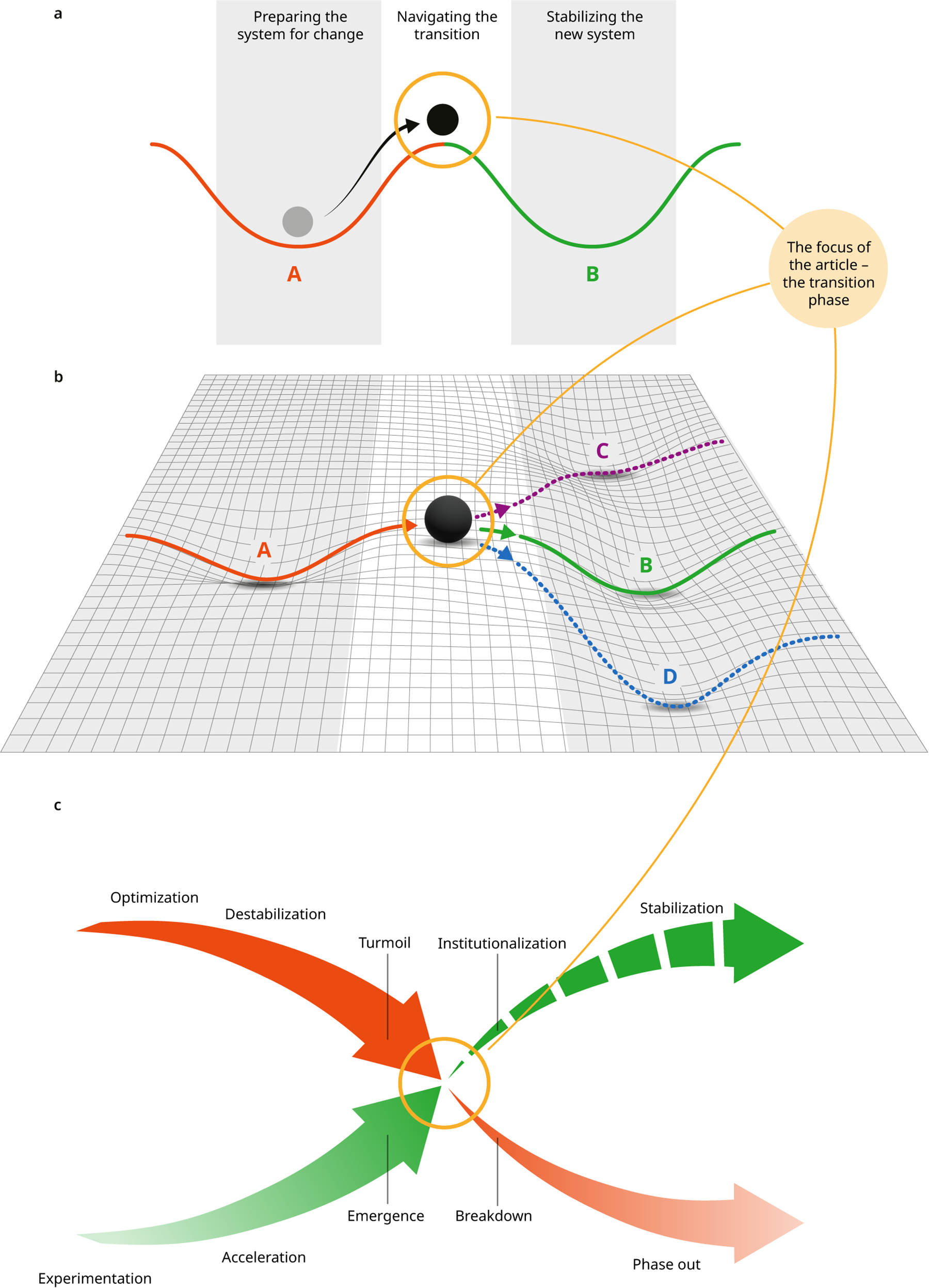
Figure 1. Shows the transition phase focus of this article as the ‘in-between’ of systems change and two models useful for analyzing and understanding backlash dynamics and transformative capacities needed in this phase. (a) The basins of attraction model highlights the multiple phases of transformations with a system that shifts from one basin of attraction to another, which involves thresholds and tipping dynamics. Panel (b) also illustrates multiple system trajectories represented by multiple basins of attraction that the ‘ball’ can roll into in the transition phase, due to many competing, latent attractors (C (purple) and D (blue). (c) The X-curve model highlights the making and unmaking dimensions of transformations and that such change requires an acceleration in both dimensions.Figure 1 long description.
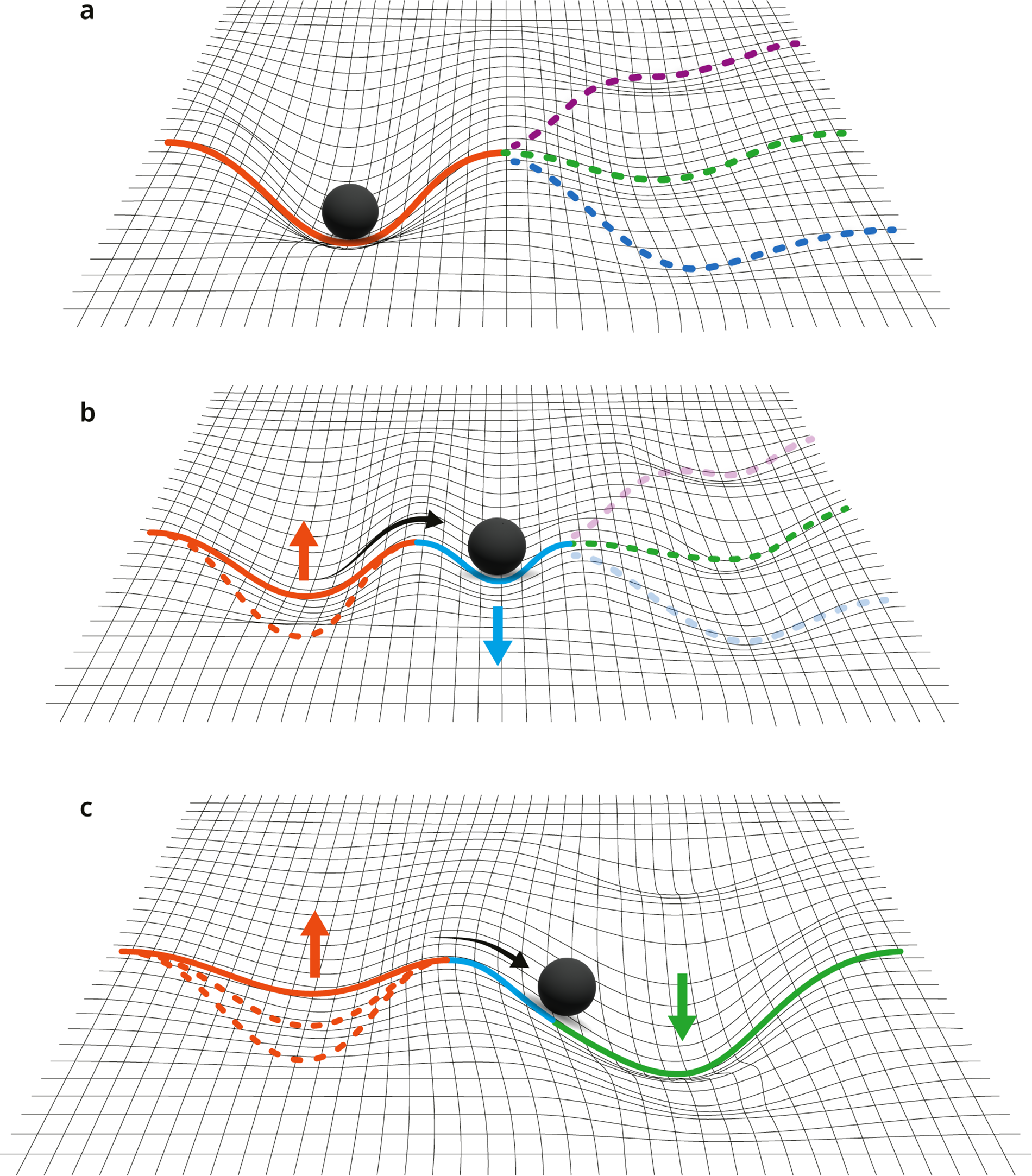
Figure 2. Panel (a) builds on the multiple basins of attraction framework introduced in Figure 1, while (b) highlights the importance of creating a temporary stabilization, or a small and provisional basin of attraction, during the ‘in-between’ phase. Developing such capacities can help sustain momentum for change while addressing the underlying concerns driving backlash dynamics, so that transformative change toward sustainability, equity, and peace can emerge and endure (c).Figure 2 long description.
 You have
Access
You have
Access
 Open access
1. Introduction
Recently, a surge of interest has emerged around backlash as a specific and distinct dynamic within societal change processes (see, e.g. Abram et al., Reference Abram, Atkins, Dietzel, Jenkins, Kiamba, Kirshner, Kreienkamp, Parkhill, Pegram and Santos Ayllón2022; Bosetti et al., Reference Bosetti, Colantone, De Vries and Musto2025; Ergon, Reference Ergon2026; Förell & Fischer, Reference Förell and Fischer2025; J. J. Patterson et al., Reference Patterson, Feola and Kim2024; J. Patterson et al., Reference Patterson, Kaiser, Logg-Scarvell and Anisimova2026; Pel, Reference Pel2021). Colloquially, the term is often used in generic ways, referring to any type of opposition or counter-response. However, scholars have developed much more complex and nuanced understandings of backlash that demonstrate and conceptualize backlash as distinct from more regular reactions or counter movements (Alter & Zürn, Reference Alter and Zürn2020a; Deitelhoff, Reference Deitelhoff2020; Sosa, Reference Sosa2022). For instance, Alter and Zürn (Reference Alter and Zürn2020a) define backlash as involving: i) a retrograde objective or imaginary, ii) a simultaneous articulation of an extraordinary challenge to existing dominant principles, procedures, practices, or development pathways, and iii) efforts surrounding this challenge have reached a certain threshold that they have become mainstream in both public discourse and public life (see also Kallis, Reference Kallis2013; MacArthur & Matthewman, Reference MacArthur and Matthewman2018). Patterson (Reference Patterson2023) adds a temporal aspect, suggesting the emergence of backlash tends to be perceived as abrupt and unanticipated by the dominant system.
Such a conceptualization of backlash raises new questions about whether and how backlash may lead to the derailment of the many ongoing efforts seeking transformative changes toward peace, sustainability, and justice. Transformations are defined as involving fundamental shifts in: how power, authority, and resources are structured and flow in a system; the practices and processes that reflect and reproduce those structures; the norms, beliefs, and values that underpin those structures and processes; and the way all of those shape human-biosphere connectivity across multiple scales (Moore & Milkoreit, Reference Moore and Milkoreit2020). Transformations of these multiple dimensions across multiple scales are also understood to go through different phases, and not necessarily in some sequential ordering (Herrfahrdt-Pähle et al., Reference Herrfahrdt-Pähle, Schlüter, Olsson, Folke, Gelcich and Pahl-wostl2020). Such fundamental re-structuring, re-ordering, re-thinking, and re-valuing will inevitably involve both the ‘making’ of new connections and new system states, and the ‘unmaking’, or the phasing out of destructive relationships in the current dominant system (Feola et al., Reference Feola, Vincent and Moore2021; Loorbach et al., Reference Loorbach, Frantzeskaki and Avelino2017; Moore et al., Reference Moore, Hermanus, Drimie, Rose, Mbaligontsi, Musarurwa, Moses ogutu, Oyowe and Olsson2023; Novalia et al., Reference Novalia, McGrail, Rogers, Raven, Brown and Loorbach2022; Olsson et al., Reference Olsson, Galaz and Boonstra2014; Turnheim & Geels, Reference Turnheim and Geels2012).
Transformations scholarship has long recognized that various forms of resistance play an important part in the making and unmaking of any transformation process (Falla et al., Reference Falla, Brink and Boyd2024; Geels, Reference Geels2014; González-Mon et al., Reference González-Mon, Cabello, Jiménez-aceituno, Mancilla garcía, Castro, López-rodríguez, Moore and Schlüter2025; Temper et al., Reference Temper, Avila, Del Bene, Gobby, Kosoy, Le Billon, Martinez-alier, Perkins, Roy, Scheidel and Walter2020). That is, the generative effects of resistance are viewed as essential for shifting, not least, the power dynamics that are part of transformative change (Falla et al., Reference Falla, Brink and Boyd2024; Pelenc et al., Reference Pelenc, Wallenborn, Milanesi, Sébastien, Vastenaekels, Lajarthe, Ballet, Cervera-marzal, Carimentrand, Merveille and Frère2019; Scoones et al., Reference Scoones, Stirling, Abrol, Atela, Charli-Joseph, Eakin, Ely, Olsson, Pereira, Priya, van Zwanenberg and Yang2020; Temper et al., Reference Temper, Avila, Del Bene, Gobby, Kosoy, Le Billon, Martinez-alier, Perkins, Roy, Scheidel and Walter2020, Reference Temper, Walter, Rodriguez, Kothari and Turhan2018). For instance, numerous studies have explored different methods and processes for engaging with plural ways of knowing, being, and doing, recognizing that this will increase potential for transformation and help in resisting the reinforcement of status quo dynamics (e.g. Caniglia et al., Reference Caniglia, Lüderitz, von Wirth, Fazey, Martín-lópez, Hondrila, König, von Wehrden, Schäpke, Laubichler and Lang2021; L. M. Pereira et al., Reference Pereira, Hichert, Hamann, Preiser and Biggs2018; Parsons & Fisher, Reference Parsons and Fisher2020). Others have examined how the mobilization of agency can support emancipatory struggles and shift the power dynamics that currently lead to epistemic, economic, linguistic, cultural, ecological injustices and violence (Betasamosake Simpson, Reference Betasamosake Simpson2014; Gobby et al., Reference Gobby, Temper, Burke and Von ellenrieder2022; McGregor et al., Reference McGregor, Whitaker and Sritharan2020; Stirling, Reference Stirling, Scoones, Leach and Newell2015; Temper et al., Reference Temper, Walter, Rodriguez, Kothari and Turhan2018; Williams, Reference Williams2024).
However, these diverse forms of resistance, distinct in their goals and their effects on system dynamics and societal transformations, are not equal to the emerging conceptualizations of backlash and its features (Alter & Zürn, Reference Alter and Zürn2020b Cupać & Ebetürk, Reference Cupać and Ebetürk2020). Moreover, questions remain about the effects of backlash on such generative forms of resistance and on broader efforts for transformative change (Laybourn et al., Reference Laybourn, Evans and Dyke2023).
In this article, we bring emerging conceptualizations of backlash together with a social-ecological systems (SES) resilience-based perspective (Folke et al., Reference Folke, Colding, Berkes, Berkes, Colding and Folke2003) on transformations to explore backlash dynamics and the potential of various capacities to navigate such dynamics. We aim to examine existing theoretical and empirical evidence about when and whether backlash may lead to derailment of transformations toward sustainability and justice. We also examine capacities to minimize backlash effects, reduce derailment risks, and support pathways of transformation that reconnect humanity to the biosphere and promote justice.
To do this, we organize the paper as follows. First, we introduce key concepts from a complex SES perspective and a resilience-based approach to transformations. We then explore how backlash may co-evolve with making and unmaking efforts in transformations, and what this implies for potential derailment of transformations to sustainability and justice. We suggest there are at least three archetypes of transformations-backlash dynamics that could occur when a system may be in-between one state and other possible states. Finally, we explore the kinds of capacities that may be important for navigating transformations in the face of backlash.
2. Basins of attraction and X-curve: a resilience perspective on transformation
From a SES resilience perspective, transformations are often depicted as involving multiple basins of attraction, sometimes referred to as the ‘cup and ball’ model (Figure 1a). The general idea is that a dominant system state represents one basin organized around an attractor (Hill & Kolmes, Reference Hill and Kolmes2024; van der Leeuw & Folke, Reference van der Leeuw and Folke2021). The resilience of that particular system state is defined by the size of the basin, its depth, its width, and how much variability and change can happen within the basin before the ‘ball’ moves up and crosses a threshold or tipping point toward an alternative attractor (Rocha et al., Reference Rocha, Peterson, Bodin and Levin2018). A system may hold multiple, competing attractors and basins or states, but different attractors may vary in their strength or weakness (Figure 1b).
Shows the transition phase focus of this article as the ‘in-between’ of systems change and two models useful for analyzing and understanding backlash dynamics and transformative capacities needed in this phase. (a) The basins of attraction model highlights the multiple phases of transformations with a system that shifts from one basin of attraction to another, which involves thresholds and tipping dynamics. Panel (b) also illustrates multiple system trajectories represented by multiple basins of attraction that the ‘ball’ can roll into in the transition phase, due to many competing, latent attractors (C (purple) and D (blue). (c) The X-curve model highlights the making and unmaking dimensions of transformations and that such change requires an acceleration in both dimensions.
1 Long description
Three diagrams depict system change phases and transition dynamics. In the first diagram, labeled ′a′, three phases are shown: ′Preparing the system for change′ (A), ′Navigating the transition′ and ′Stabilizing the new system′ (B). A ball moves from A to B, highlighting the transition phase focus. The second diagram, labeled ′b′, shows multiple trajectories on a grid with paths A, B, C and D, representing different system states. The ball′s movement indicates potential shifts between these states. The third diagram, labeled ′c′, illustrates a process with arrows labeled ′Optimization′, ′Destabilization′, ′Turmoil′, ′Institutionalization′, ′Stabilization′, ′Experimentation′, ′Acceleration′, ′Emergence′, ′Breakdown′ and ′Phase out′. These elements emphasize the dynamics of system transformation and stabilization.
Transformations of SESs are understood to involve various phases across these multiple basins, such as preparing a system for change, transitioning between two different states, and the consolidation of the alternative state (Herrfahrdt-Pähle et al., Reference Herrfahrdt-Pähle, Schlüter, Olsson, Folke, Gelcich and Pahl-wostl2020; Moore et al., Reference Moore, Tjornbo, Enfors, Knapp, Hodbod, Baggio, Norström, Olsson and Biggs2014; Olsson et al., Reference Olsson, Folke and Hahn2004, Reference Olsson, Gunderson, Carpenter, Ryan, Lebel, Folke and Holling2006). Transformations scholarship has also examined the role that crisis (Benessaiah & Eakin, Reference Benessaiah and Eakin2021; Moore et al., Reference Moore, Hermanus, Drimie, Rose, Mbaligontsi, Musarurwa, Moses ogutu, Oyowe and Olsson2023), disasters (Brundiers, Reference Brundiers2018), and political shocks (Gelcich et al., Reference Gelcich, Hughes, Olsson, Folke, Defeo, Fernández, Foale, Gunderson, Rodríguez-sickert, Scheffer, Steneck and Castilla2010; Herrfahrdt-Pähle et al., Reference Herrfahrdt-Pähle, Schlüter, Olsson, Folke, Gelcich and Pahl-wostl2020) may play in shaping transformative change efforts in different phases of transformations, and the intentional and strategic mobilization of different capacities and transformative agency across transformations processes (F. R. Westley et al., Reference Westley, Tjornbo, Schultz, Olsson, Folke, Crona and Bodin2013).
Another model commonly used to illustrate transformations is the X-curve, developed within the scholarship on socio-technical systems, transition management, and the multi-level perspective (Hebinck et al., Reference Hebinck, Diercks, von Wirth, Beers, Barsties, Buchel, Greer, Van steenbergen and Loorbach2022; Loorbach, Reference Loorbach2014). The X-curve depicts different system states along intersecting trajectories, with the dominant incumbent system potentially breaking down along one trajectory and an emerging alternative system developing along the other (Figure 1c).
Both frameworks highlight the critical phase in transformations where existing relationships or structures are phasing out and new ones are forming (Figure 1). This phase, referred to as the transition phase in the SES resilience approach (Olsson et al., Reference Olsson, Folke and Hahn2004, Reference Olsson, Gunderson, Carpenter, Ryan, Lebel, Folke and Holling2006), constitutes an opportunity space for major change (Folke et al., Reference Folke, Colding, Berkes, Berkes, Colding and Folke2003; Gunderson & Holling, Reference Gunderson and Holling2002), but since there may be several basins of attraction (Hill & Kolmes, Reference Hill and Kolmes2024; van der Leeuw & Folke, Reference van der Leeuw and Folke2021) and competing, latent attractors, there is high uncertainty about what the actual changes will be, and what the system may become (Olsson & Moore, Reference Olsson and Moore2024a) (Figure 1). Therefore, the transition phase can also be seen as a state of limbo characterized by tipping dynamics, high uncertainty, and turbulence (Carpenter et al., Reference Carpenter, Folke, Scheffer and Westley2019; Olsson & Moore, Reference Olsson, Moore, Tàbara, Flamos, Mangalagiu and Michas2024b). In this article, we focus on this critical period of ‘in-betweenness’ (Söderlund & Borg, Reference Söderlund and Borg2018) given that when systems are in flux and uncertainty is high, the risk associated with the effects of backlash and derailment may similarly be high.
3. Different roles of backlash and risks of derailment
Building on previous work using the multiple basins of attraction and the X-curve as heuristics (Figure 1), together with existing empirical evidence on backlash, we propose that at least three archetypes of backlash dynamics may emerge and play different roles in the derailment of just transformations toward sustainability:
• Archetype 1: Backlash that emerges from individuals or groups that may be increasingly marginalized or dissatisfied with the existing status quo but who simultaneously struggle and resist the phasing out or unmaking dynamics that sustainability and justice ideas imply. This reaction may be rooted in fears about immediate losses, such as livelihoods or identity attached to a specific role or specific place. If left unattended, these groups who are not ‘attracted’ to cup B may ultimately become attracted to cup C;
• Archetype 2: Backlash that emerges from efforts of some individuals or groups may effectively be making an entirely different basin (cup C) and deliberately dismantling any efforts that contribute to creating the attractor(s) for cup B;
• Archetype 3: Backlash that emerges from incumbents who want to protect the status quo and resist both phasing out and some of the ‘making’ of alternative basins, and thus resist cups B and C, but may be attracted to or pushing for a cup D as an alternative.
Evidence of each of these will be examined below. We propose these archetypes as a first conceptualization of backlash dynamics specific to the ‘in-between’ phase of transformation processes. We acknowledge that no single actor controls a complex system, and that agency is distributed across scales, including space and time, and across the human and non-human (see Benessaiah & Eakin, Reference Benessaiah and Eakin2021; Galafassi et al., Reference Galafassi, Tàbara, Heras, Iles, Locke and Milkoreit2018; Moore & Milkoreit, Reference Moore and Milkoreit2020; F. R. Westley et al., Reference Westley, Tjornbo, Schultz, Olsson, Folke, Crona and Bodin2013). Here we focus primarily on human agency in backlash dynamics, recognizing that actors do strategically mobilize and exert deliberate agency (Brown & Westaway, Reference Brown and Westaway2011; F. R. Westley et al., Reference Westley, Tjornbo, Schultz, Olsson, Folke, Crona and Bodin2013), and it remains valuable to understand what the effects of that agency may have in a particular moment in time.
Furthermore, as Wanvik and Haarstad (Reference Wanvik and Haarstad2021) state, backlash is an integral part of any transformation process, and thus it is worth understanding the range of its effects. Therefore, if for our purposes, cup B (Figure 1b) is understood to represent a basin with an attractor that centers sustainability, justice, and stewardship and weakens the attraction of status quo systems of oppression, ecological degradation, and exploitation, then it is worth considering how backlash may shape that potential or possibility. We emphasize that the basin of attraction idea is a simplified heuristic and that there is no single cup A, B, or C, given there is no single transformation or system, but many, plural versions and realities.
3.1. Archetype 1
We suggest one transformations-backlash dynamic stems from those who may be increasingly marginalized or dissatisfied with the existing status quo (cup A) but who also struggle and resist the phasing out or unmaking dynamics that sustainability and justice ideas imply and who fear immediate losses, such as jobs, identity (i.e. not ‘attracted’ to B). This in itself may just exist as resistance in a system. But if left unattended, there is evidence that some experiencing such losses may become attracted to cup C.
For example, scholarship shows that the rapid phasing out of incumbent systems can feel threatening among affected groups (Fischer-Kowalski & Rotmans, Reference Fischer-Kowalski and Rotmans2009; Vallacher & Fennell, Reference Vallacher, Fennell, Forgas, Crano and Fiedler2021; F. Westley et al., Reference Westley, McGowan and Tjornbo2017), sometimes referred to as transition pain (Bogner et al., Reference Bogner, Kump, Beekman and Wittmayer2024). If emotional reactions and grievances are ignored, they can then be mobilized and directed into emotional rage (Busher et al., Reference Busher, Giurlando and Sullivan2018; Jamison & Henisz, Reference Jamison and Henisz2025). For instance, studies have explored how workers in sectors involved in coal mining and fossil fuel industries, which have been slated to be phased out, can feel threatened not just economically but also existentially, given the erosion of identities closely tied to their work, place, and communities (Scott, Reference Scott2010). These same workers are often excluded from envisioning, innovating, and building new systems and futures, and the lack of inclusion has been documented as fueling a weakening of attraction to cup A or B (see e.g. Hogg & Gøtzsche-Astrup, Reference Hogg, Gøtzsche-Astrup, Forgas, Crano and Fiedler2021; Piazza, Reference Piazza2024; Vallacher & Fennell, Reference Vallacher, Fennell, Forgas, Crano and Fiedler2021).
However, if left unattended, studies have also shown how the effects of decisions in one area, for instance, policies about climate change, and the perceptions of injustice or grievances that these changes bring have then become linked to perceptions of injustices in other areas (Piazza, Reference Piazza2024). Scholars have studied this linking phenomenon, for instance, in the ways that xenophobia and opposition to migration have become linked with, and amplified, climate change denialism (see Hultman et al., Reference Hultman, Björk, Viinikka and Forchtner2019; Krange et al., Reference Krange, Kaltenborn and Hultman2019, Reference Krange, Kaltenborn and Hultman2021; Lockwood, Reference Lockwood2018; Walker et al., Reference Walker, Leviston, Price and Devine‐wright2015). It is this change, from having grievances about cup A or B to becoming attracted to retrograde imaginaries, challenging anyone attempting to generate cup B, and contributing to mainstreaming discourse about cup C, that makes this a backlash dynamic – one that can contribute to derailment of transformations to sustainability and justice. Conversely, in places where workers and unions have been included in processes for a just transition, there has been broader support and minimal backlash (Bolet et al., Reference Bolet, Green and Gonzalez-eguino2024; Bosetti et al., Reference Bosetti, Colantone, De Vries and Musto2025).
3.2. Archetype 2
A second backlash archetype involves some individuals or groups deliberately creating an entirely different basin (cup C) and deliberately dismantling any efforts that contribute to creating the attractor(s) for the B cup. Much scholarship has recently focused on the strategies used to create a new cup C type of attractor. For instance, a significant and growing body of research examines democratic backsliding (e.g. Knutsen et al., Reference Knutsen, Marquardt, Seim, Coppedge, Edgell, Medzihorsky, Pemstein, Teorell, Gerring and Lindberg2024) and radical populism and how this may contribute to backlash dynamics (e.g. Bosetti et al., Reference Bosetti, Colantone, De Vries and Musto2025; Hultman et al., Reference Hultman, Björk, Viinikka and Forchtner2019; Krange et al., Reference Krange, Kaltenborn and Hultman2021).
Studies have highlighted that groups combine retrograde narratives that romanticize an imaginary past (a key feature of backlash), while simultaneously developing economic innovations that never existed in the past – such as AI or cryptocurrencies – and that provide massive challenges for existing governing institutions that lack the technical expertise or legal jurisdiction to effectively regulate the consequences (Forchtner et al., Reference Forchtner, Kroneder and Wetzel2018; Galaz et al., Reference Galaz, Metzler, Daume, Olsson, Lindström and Marklund2023; Krange et al., Reference Krange, Kaltenborn and Hultman2021; McCright et al., Reference McCright, Dentzman, Charters and Dietz2013; Utrata, Reference Utrata2024). Simultaneously, these efforts have also recently mainstreamed political discourses in several countries that depict sustainability and justice as part of an elitist establishment and as the causes of existing problems, despite many wealthy elites with considerable structural and discursive power being the ones leading this narrative (Fraune & Knodt, Reference Fraune and Knodt2018; Krange et al., Reference Krange, Kaltenborn and Hultman2021; Wanvik & Haarstad, Reference Wanvik and Haarstad2021). Scholars have shown how this same wealth and power may also be, at least partially, then directed toward funding effective machines of disinformation and denialism (Ahmad et al., Reference Ahmad, Sen, Eesley and Brynjolfsson2024; Lopez, Reference López, Fowler-Watt and McDougall2023; Farrell, Reference Farrell2016, Reference Farrell2019). The deliberate spread of disinformation and what has been termed post-truth politics contributes to polarization and may include strategies that amplify, ridicule, or threaten groups that hold different views and perspectives (Diaz Ruiz & Nilsson, Reference Diaz Ruiz and Nilsson2023; Fraune & Knodt, Reference Fraune and Knodt2018; Piazza, Reference Piazza2024). These strategies have also been documented for the way they lead to dehumanization of those holding opposing views (Homer-Dixon, Reference Homer-Dixon2024; Regilme, Reference Regilme2023) and increasing social acceptance of political violence (Piazza, Reference Piazza2024).
These backlash effects may both derail transformative change efforts aiming to create a cup B attractor and contribute to dismantling cup A and the status quo. Well-studied examples include how current populist movements have attempted to delegitimize, discredit, or abruptly defund scientific bodies, educational institutions, diverse civil society organizations, and government agencies that have been responsible for creating and implementing policies that either uphold the status quo or support change policies (see e.g. Fraune & Knodt, Reference Fraune and Knodt2018; Hultman et al., Reference Hultman, Björk, Viinikka and Forchtner2019; Krange et al., Reference Krange, Kaltenborn and Hultman2021; Wanvik & Haarstad, Reference Wanvik and Haarstad2021). The implementation of these changes also may include dangerous strategies, including harassment, doxxing, trolling, and normalizing threats of violence (Barnes & Karim, Reference Barnes and Karim2025).
Despite different motivations and organizing logics, the SES resilience perspective also highlights that the ‘unmaking’ efforts of those trying to create cup C may combine or overlap with the unmaking efforts of those trying to create cup B (Kish & Quilley Reference Kish and Quilley2017). Such a combination could accelerate the unmaking of the status quo (Useem & Goldstone, Reference Useem and Goldstone2022), but given the very different aims, the conflicting visions of the future, and disagreement on change strategies, this combination and acceleration could create conditions of chaos in the transition phase (Loorbach, Reference Loorbach2014).
3.3. Archetype 3
Third, some incumbents of the dominant system may, in theory, have indicated support for cup B efforts but in practice, may actually be supporting cup A or even supporting a cup D or aspects of cup C, such as the rollback of regulations or certain policy approaches while still desiring the peace, geopolitical stability, and certain economic privileges that cup A provided them (Kish & Quilley, 2017). If the attractors of cup C or cup D begin to strengthen, the attractiveness of cup B may weaken for these individuals, organizations, or their networks. The focus may become protecting the benefits that they gained from cup A, and backlash may emerge if this moves to deliberately trying to derail phasing out efforts and the ‘making’ efforts for cup B. More critical perspectives have argued this as part of ‘the complex operations underway to constantly re-secure structural oppression in the face of sustained efforts to transform it’ (Sosa, Reference Sosa2022, p. 202). Whether deliberate or done unwittingly, this type of backlash mixes with a form of ‘remembrance’ (Gunderson & Holling, Reference Gunderson and Holling2002) such as the institutionalized memory that exists in any system.
As one example, scholars have long criticized the claims that large companies make about sustainability as mere greenwashing and their resistance to changing the status quo (Béné, Reference Béné2022; Coen et al., Reference Coen, Herman and Pegram2022; de Freitas Netto et al., Reference de Freitas Netto, Sobral, Ribeiro and Soares2020; Montgomery et al., Reference Montgomery, Lyon and Barg2024). However, amidst the greenwashing, there were some companies that appeared genuine in their attempts to move toward cup B and supported a transition from cup A (Maniatakou et al., Reference Maniatakou, Olsson and Jørgensen2025; Blasiak et al., Reference Blasiak, Dauriach, Jouffray, Folke, Österblom, Bebbington, Bengtsson, Causevic, Geerts, Grønbrekk, Henriksson, Käll, Leadbitter, McBain, Crespo, Packer, Sakaguchi, Schultz, Selig and Crona2021). Yet, with a strengthening of an alternative cup C attractor, there is now a growing number of the same actors who are not fully supporting cup C but also no longer supporting a transition from cup A. For instance, a number of companies have recently canceled their own sustainability initiatives and are withdrawing their investments in sustainability and justice (Sands & Ferraro, Reference Sands and Ferraro2025), something that has often happened during economic instability or crises (Leung et al., Reference Leung, Ko and Chen2025). This change, whether only discursive or actual material change, creates a backlash that can derail the unmaking of cup A and the making of cup B, while creating yet another attractor in a possible cup D.
Having proposed these three transformations-backlash dynamics and archetypes, rooted in existing scholarship on resilience-based transformations and on the political dynamics of backlash, we contend there is a need to consider the capacities for transformations that may help prepare for and navigate backlash during the in-between transition phase.
4. Transformative capacities for navigating backlash dynamics
Failing to address backlash dynamics during the transition phase can have severe consequences, including derailment, as well as the introduction of new risks (Laybourn et al., Reference Laybourn, Evans and Dyke2023), including risks as significant as those for international peace and security (Black et al., Reference Black, Busby, Dabelko, de Coning, Maalim, McAllister, Ndiloseh, Smith, Alvarado, Barnhoorn, Bell, Bell-moran, Broek, Eberlein, Eklöw, Faller, Gadnert, Hegazi, Kim and Staudenmann2022; Hafner & Tagliapietra, Reference Hafner and Tagliapietra2020). If backlash is understood as an expected dynamic of transformations, then developing capacities to hold tensions that pose derailment risks arising from: political and affective polarization (Iyengar et al., Reference Iyengar, Lelkes, Levendusky, Malhotra and Westwood2019; Levin et al., Reference Levin, Milner and Perrings2021), the dynamics of violent conflict (Hartwell, Reference Hartwell, Mavrotas and Shorrocks2007; Öberg, Reference Öberg2025; Stedman, Reference Stedman1997), democratic backsliding (Knutsen et al., Reference Knutsen, Marquardt, Seim, Coppedge, Edgell, Medzihorsky, Pemstein, Teorell, Gerring and Lindberg2024; Nord et al., Reference Nord, Angiolillo, Good god and Lindberg2025), processes of dehumanization (Homer-Dixon, Reference Homer-Dixon2024; Regilme, Reference Regilme2023), and mis- and disinformation (Daume, Reference Daume2024; Lewandowsky et al., Reference Lewandowsky, Ecker, Cook, van der Linden, Roozenbeek and Oreskes2023; Omari, Reference Omari2024; Supran & Oreskes, Reference Supran and Oreskes2017) becomes crucial. Capacities will also be needed to simultaneously continue any momentum for change and address the underlying concerns driving backlash dynamics, if transformative change toward sustainability, equity, and peace is to emerge and endure (Figure 2c).
Panel (a) builds on the multiple basins of attraction framework introduced in Figure 1, while (b) highlights the importance of creating a temporary stabilization, or a small and provisional basin of attraction, during the ‘in-between’ phase. Developing such capacities can help sustain momentum for change while addressing the underlying concerns driving backlash dynamics, so that transformative change toward sustainability, equity, and peace can emerge and endure (c).
Figure 2 Long description
The image A shows a grid surface with a black sphere resting in a depression. A solid red line curves downward into the depression, while three dashed lines in purple, green and blue extend from the depression, moving upward and diverging. The image B depicts a similar grid with the black sphere positioned at a peak. A solid red line and a dashed red line curve upward towards the peak, with an orange arrow pointing upward along the red lines. A solid blue line descends from the peak with a blue arrow pointing downward. The image C features the black sphere in a different depression. A solid red line and a dashed red line curve upward towards the depression with an orange arrow pointing upward. A solid green line extends from the depression, moving upward with a green arrow pointing along it.
Previous work drawing on transformations and the multiple basins of attraction framework (Figure 2a) has emphasized the importance of creating a temporary stabilization, or a small and provisional basin of attraction, during the ‘in-between’ phase (Olsson & Moore, Reference Olsson and Moore2024a) (Figure 2b). This momentary stabilization is understood to be essential to create the space, time, and conditions to genuinely address backlash dynamics. Cole and Raphael (Reference Cole and Raphael2025) suggest that this type of pause also helps to ensure actors do not keep replicating what they were already doing or become locked into certain attractors and system states. Examples of practices that support such momentary stabilization include some of the combinations of transformative and transitional justice practices that introduce temporary structures, such as mediation circles or healing spaces, that give opportunities to identify and address marginalization, identity-based grievances, connect people across polarized differences, or even interrupt harmful patterns that contribute to dismantling institutions and allow for reflection and re design (Clark, Reference Clark and Ungar2021; Gready & Robins, Reference Gready and Robins2014). Yet, this implies a need for capacities within the system to create such a provisional space to hold the system in a different, more reflexive state (Juncos & Joseph, Reference Juncos and Joseph2020; Olsson & Moore, Reference Olsson and Moore2024a).
A growing body of literature has examined the need for and role of various transformative capacities, ranging from systems reflexivity (Lazurko et al., Reference Lazurko, Moore, Haider, West and McCarthy2025; Moore et al., Reference Moore, Olsson, Nilsson, Rose and Westley2018) to capacities for participatory futuring and foresight (Hebinck et al., Reference Hebinck, Vervoort, Hebinck, Rutting and Galli2018; L. M. Pereira et al., Reference Pereira, Hichert, Hamann, Preiser and Biggs2018; Wolfram et al., Reference Wolfram, Borgström and Farrelly2019). However, much of this previous work has not specifically explored the relevance of those capacities for navigating backlash dynamics. To address this, we draw on three transformative capacities from existing scholarship to explore whether and how they may be relevant to navigating the transition phase. These three are not intended to be comprehensive, and we emphasize that having transformative capacities in a system, if not mobilized or combined with strategic, material, and collective strategies, will not alone reduce backlash. For each of the three capacities, we highlight their importance as part of overall resilience, relate them to relevant archetype(s), and analyze how they may reduce derailment risks for transformations to sustainability and justice and ensure that the outcomes of backlash are not chaos and collapse.
The transformative capacities we focus on include: harnessing hope and imagination (Moore & Milkoreit, Reference Moore and Milkoreit2020; Ojala, Reference Ojala2023; Stirling et al., Reference Stirling, Cairns, Johnstone and Onyango2023), hospicing with dignity (Cole & Raphael, Reference Cole and Raphael2025; Machado de Oliveira, Reference Machado de Oliveira2021; Moore et al., Reference Moore, Hermanus, Drimie, Rose, Mbaligontsi, Musarurwa, Moses ogutu, Oyowe and Olsson2023), and enabling radical collaboration while holding paradoxes (Drimie et al., Reference Drimie, Magner, Pereira, Charli-Joseph, Moore, Olsson, Siqueiros-garcia, Zgambo, Biggs, De vos, Preiser, Clements, Maciejewski and Schlüter2021; Kahane, Reference Kahane2023). We highlight these three as they seemed particularly relevant to the emotional, relational, and political nature of backlash. Our selection is also informed by our own work of engaging with changemakers through research and transdisciplinary education over decades. While that does not in itself translate to a method, we think continually reflecting on how these experiences inform our conceptualizations is helpful to share. In the following section, we will explore how some of these capacities may be relevant to address backlash and derailment during the transition phase.
4.1. Harnessing hope and imagination
Previous scholarship has explored the role of hope and imagination as capacities in transformative change toward sustainability and justice (Moore & Milkoreit, Reference Moore and Milkoreit2020; Ojala, Reference Ojala2023; Sharpe, Reference Sharpe2013; Sharpe et al., Reference Sharpe, Hodgson, Leicester, Lyon and Fazey2016; Stirling et al., Reference Stirling, Cairns, Johnstone and Onyango2023). We acknowledge that claims about the causal relationships of collective hope or imaginaries with transformations toward sustainability and justice need to be made cautiously, as more empirical work is still needed (Milkoreit et al., Reference Milkoreit, Lindahl, Moore, Nyström, Olsson and Schill2025). However, given the need to motivate and engage people in imagining actionable alternative futures, scholars and practitioners from diverse perspectives have been developing practices for harnessing imagination, hope, and supporting a sense of agency (see Galafassi et al., Reference Galafassi, Tàbara, Heras, Iles, Locke and Milkoreit2018; L Pereira et al., Reference Pereira, Sitas, Ravera, Jimenez-aceituno and Merrie2019; Sokolova, Reference Sokolova2023).
Bird (Reference Bird2022) conceptualizes hope as enabling an anticipation of possibilities in complex, uncertain, confusing, and even conflictual settings, separate from despair, wishful, or even fantastical thinking. Bird (Reference Bird2022) emphasizes that the foundation of hope must be grounded in an understanding of the transformations it seeks to catalyze. Without such grounding, hope risks devolving into a deceptive optimism (Bloch, Reference Bloch1986; Collins, Reference Collins2024; Geiger et al., Reference Geiger, Dwyer and Swim2023; Nesse, Reference Nesse1999; Sköld, Reference Sköld2026; Vaškovic & Vičanová, Reference Vaškovic and Vičanová2024), fostering the unrealistic belief that the same systems responsible for problems can resolve them. Drawing on this conceptualization, we suggest that capacities for hope and imagination create the conditions needed to meet the challenges of changing contexts, which are relevant for dealing with backlash, in at least two different ways. First, harnessing hope and imagination will be crucial for strengthening the attractor of cup B in ways that address the grievances that underpin the backlash dynamics of Archetype 1 while still holding accountability for (in)justices and (un)sustainability that others have also experienced in the status quo system state. Conversely, if one does not feel hope or cannot imagine cup B being able to address their concerns, then cup B is not likely to be a strong attractor for them. We suggest that (re)igniting hope for alternatives may also divert people from becoming attracted to retrograde imaginaries and thus be relevant for addressing all three backlash archetypes.
Second, we emphasize that hope is not just about imagining and anticipating a better future, but if connected to capacity and a place or provisional space to act, endure, and adapt during the turbulent process of getting there in practice, it can lead to different actions in the future. Previous scholarship has also highlighted that hope and imagination are not just individual capacities, but are often developed and strengthened in collective processes (Galafassi et al., Reference Galafassi, Tàbara, Heras, Iles, Locke and Milkoreit2018; Pereira et al., Reference Pereira, Hichert, Hamann, Preiser and Biggs2018; Moore & Milkoreit, Reference Moore and Milkoreit2020). Moreover, studies have shown that creating collective processes and places for connecting hope, imagination, and a sense of agency can create opportunities for: i) positive examples to emerge, ii) a transference of ideas among individuals or groups, and iii) creating inspiration through the sensing of hope in others (Courville & Piper, Reference Courville and Piper2004). We suggest this is relevant in the in-between phase when there may even be risks of clashing hopes. Ensuring that ongoing capacities for hope and imagination remain or are strengthened, even in the face of competing, and sometimes stronger attractors, may be crucial for navigating any of the three backlash archetypes, especially Archetypes 2 and 3.
4.2. Hospicing with dignity
The fundamental notion that certain aspects of existing dominant systems will need to be phased out, including dysfunctional or maladaptive infrastructure, institutions, values, norms, behaviors, practices, and certain system relationships or feedbacks, all while prioritizing the inclusion of individuals and communities in the process is central to transformative change (Abram et al., Reference Abram, Atkins, Dietzel, Jenkins, Kiamba, Kirshner, Kreienkamp, Parkhill, Pegram and Santos Ayllón2022; Bennett et al., Reference Bennett, Blythe, Cisneros-montemayor, Singh and Sumaila2019; Feola et al., Reference Feola, Vincent and Moore2021; Moore et al., Reference Moore, Hermanus, Drimie, Rose, Mbaligontsi, Musarurwa, Moses ogutu, Oyowe and Olsson2023; Olsson et al., Reference Olsson, Galaz and Boonstra2014; Reyers et al., Reference Reyers, Moore, Haider and Schlüter2022). Yet, resistance to this phasing out plays a crucial role in the backlash dynamics of Archetypes 1 and 3 and thus can contribute to derailment.
To grapple with the ‘letting go’ and the need to address the emotional dimensions of the unmaking, we draw on the concepts of hospicing and dignity. Machado de Oliveira (Reference Machado de Oliveira2021) introduced the healthcare concept of hospicing to recognize the capacities needed to grieve the losses associated with change and to facilitate the emergence and flourishing of the new, so that resentment over the losses does not lead to enduring harm. In this sense, hospicing could lessen the grievances that contribute to backlash Archetypes 1 and 3, and could counteract polarization, conflict, democratic backsliding, and dehumanization, which characterize Archetype 2. However, we add that hospicing must be combined with dignity, defined as the respect for and recognition of one’s identity, values, and interests (Wallensteen, Reference Wallensteen2015), or more simply as ‘the glue that holds all of our relationships together’ (Hicks, Reference Hicks2013). In peace processes, strategies such as inclusive dialogue, power-sharing, rehumanization, and reconciliation are highlighted as vital for promoting dignity (Wallensteen, Reference Wallensteen2015). In transformative change, capacities for implementing similar strategies may be crucial for creating the provisional space needed to navigate the risks of derailment and for ensuring that transitions between system states are just, equitable and peaceful (Bräuchler, Reference Bräuchler2022; Olsson & Moore, Reference Olsson and Moore2024a).
One example involves initiatives aimed at establishing or reinforcing women’s rights, which have been documented as experiencing backlash dynamics that trigger further increased violence against women (Cahn & Ni Aolain, Reference Cahn and Ni Aolain2009; Halperin-Kaddari & Freeman, Reference Halperin-Kaddari and Freeman2016; Roggeband & Krizsán, Reference Roggeband and Krizsán2020). New efforts are increasingly linking gender and climate concerns by ensuring that gender-based initiatives prioritize the transformation of cultural norms associated with different forms of masculinities, like those that connect resistance to climate action to gendered identities and power (Daggett, Reference Daggett2018; Hultman & Pulé, Reference Hultman and Pulé2018; Letourneau et al., Reference Letourneau, Davidson, Karsgaard and Ivanova2024). In this way, capacities for hospicing with dignity not only help proactively identify and navigate losses and the resistance to cup B that may emerge but also support the deep cultural shifts needed to sustain transformative change across interconnected social and environmental issues.
Every individual may risk losing something in a transformation process. Fears and grief can emerge about the risk of losing an immediate livelihood or a professional or familial identity (Eakin et al., Reference Eakin, Shelton, Siqueiros-Garcia, Charli-Joseph and Manuel-navarrete2019; Tschakert et al., Reference Tschakert, Barnett, Ellis, Lawrence, Tuana, New, Elrick‐barr, Pandit and Pannell2017). Some existing approaches to the just transition have focused on re-skilling or up-skilling employees so that they have qualifications for other forms of employment (Aghion et al., Reference Aghion, Akcigit, Deaton and Roulet2016). While such initiatives can provide support, simply offering financing and training does not fully address the grievances of Archetype 1 and the associated derailment risks, including the complexities of emotional loss, identity shifts, or loss of dignity that can arise when people must leave behind deeply ingrained roles and livelihoods. Nor does it address those who are most powerful in a system who will not need ‘upskilling’ but will need to redefine their entire purpose (see e.g. Krange et al., Reference Krange, Kaltenborn and Hultman2019) so as not to push for cup D, such as in Archetype 3. Letting go of an old system involves more than just financial stability; it requires space for grieving, for coming to terms with change and connecting to the new systems in meaningful ways, and for recognizing the effects of losing individual or collective identity and belonging.
4.3. Enabling radical collaboration while holding paradoxes
Polarizing discourses can drown out any middle ground or reduce the liminal ‘in-between’ spaces that can be crucial during the transition phase, and where agreement or reflexive forms of deliberation might have otherwise emerged (Bräuchler, Reference Bräuchler2022; Dryzek & Pickering, Reference Dryzek and Pickering2017; González-Mon et al., Reference González-Mon, Cabello, Jiménez-aceituno, Mancilla garcía, Castro, López-rodríguez, Moore and Schlüter2025; Olsson & Moore, Reference Olsson and Moore2024a). Conventional approaches to negotiating conflict and bringing multiple perspectives together on contentious sustainability-related issues often involve processes that inherently rely on ideas of reaching agreement or even consensus (Kahane, Reference Kahane2017). However, if backlash dynamics are not just an ordinary type of opposition, such approaches may not be useful, desirable, or possible. Therefore, developing capacities and methods for ‘holding the space’ (Buhler King et al., Reference Buhler King, Sivagnanam and De Silva2023) for highly contentious and triggering conversations and ‘staying with the trouble’ (Haraway, Reference Haraway2018), which focus on the abilities to hold paradoxes and endure the discomfort and uncertainty of navigating transformative changes, may be crucial for creating a provisional stability basin. In the context of Archetypes 2 and 3, such capacities and spaces could prevent elites from impeding or co-opting transformations and mis- or disinformation from spreading or gaining traction.
As one example, stretch collaboration, also referred to as radical collaboration, has been developed as a method (see Kahane, Reference Kahane2023) for contexts in which actors hold distant values, worldviews, preferences, approaches, or ideologies but need to transform the dynamics creating conflict on crucial issues. Such ‘conflict transformation’ approaches have been developed and used in the shift from apartheid to democracy in South Africa and the ongoing transition from conflict to peace in Colombia and thus is, in many ways, designed for contexts characterized by potentially high levels of backlash (Drimie et al., Reference Drimie, Magner, Pereira, Charli-Joseph, Moore, Olsson, Siqueiros-garcia, Zgambo, Biggs, De vos, Preiser, Clements, Maciejewski and Schlüter2021). Radical collaboration asserts the need for both conflict and connection, and recognizes the incommensurability of diverse perspectives (Kahane, Reference Kahane2023, see also Tengö et al., Reference Tengö, Brondizio, Elmqvist, Malmer and Spierenburg2014). Enabling such forms of collaboration tends to rely on experimentation, rather than solutions, as a means to navigate forward (Drimie et al., Reference Drimie, Magner, Pereira, Charli-Joseph, Moore, Olsson, Siqueiros-garcia, Zgambo, Biggs, De vos, Preiser, Clements, Maciejewski and Schlüter2021), and recognizes the dynamics between the micro and macro levels, treating transformations as both involving personal as well as collective and systemic change (Kahane, Reference Kahane2023; Temper et al., Reference Temper, Walter, Rodriguez, Kothari and Turhan2018).
An example includes citizen assemblies and deliberative democracy initiatives, which are often explicitly designed as spaces for constructive interaction and decision-making for polarizing challenges (Bächtiger & Dryzek, Reference Bächtiger and Dryzek2024; Daw et al., Reference Daw, West, Downing, Nasiritousi, Lindell, Hahn, Karlsson, Snäll and Lindvall2026). Such forms of radical collaboration and deliberation may create a provisional space for addressing backlash dynamics, including the grievances underlying the conflicts that lead to Archetype 1, as well as the disinformation, democratic backsliding, and dehumanization that characterize Archetype 2. Empirical evidence shows that paradoxical tensions can serve as an important source of transformative potential if the different needs underpinning those tensions can be held without forcing an immediate solution (Maryboy et al., Reference Maryboy, Begay and Nichol2020; O’Brien, Reference O’Brien2024). Therefore, we contend that mobilizing capacities for holding paradox and enabling more radical forms of collaboration may be crucial to ensuring transformative change processes are not derailed.
5. Conclusion
This article is intended to contribute to a better understanding not only of ‘what’ needs to be changed or transformed in different systems, but ‘how’ transformative change may involve specific capacities, with a particular focus on when a system may be in-between different states and backlash dynamics are shaping the transformation process. We proposed three different transformations-backlash archetypes that affect the unmaking and making processes of transformation, explicitly treating backlash as distinct from generative forms of resistance, which have long been recognized in transformations scholarship (e.g. Falla et al., Reference Falla, Brink and Boyd2024; Stirling, Reference Stirling, Scoones, Leach and Newell2015; Temper et al., Reference Temper, Walter, Rodriguez, Kothari and Turhan2018). We then use the existing literature on transformative capacities to explore the relevance of three capacities – harnessing hope and imagination, hospicing with dignity, and enabling radical collaboration while holding paradox – for navigating different aspects of backlash and avoiding derailment during the transition phase of a transformation.
Much of the existing literature on transformations focuses on transformations occurring in democratic contexts or conditions that were operating without deliberate, well-funded disinformation campaigns and counter-institution building (see also Kish & Quilley 2017). Consequently, key backlash dynamics have often been overlooked, or more narrow conceptualizations about the roles of ‘elites’ as a homogenous group have been adopted. Therefore, existing recommendations about how to support transformations risk being of limited relevance for navigating backlash. Our contribution begins to grapple with how backlash that co-evolves with polarization, dehumanization, democratic backsliding, and more will affect the transition phase of a transformation. We argue that various groups, including but not only separate and heterogeneous incumbents and elites, may engage in different kinds of backlash. If there are insufficient capacities for creating temporary, moments of stability, long enough for people to engage with ‘the other’, to move past post-truth or retrograde and challenging narratives, and to still find hope and ways to imagine something different for moving forward, attractors for sustainability, justice, and peace may be outcompeted.
Transformations are not only long and difficult, but they are also relational, political, and emotional. Existing evidence implies that the three transformative capacities explored here may play a role in addressing identity-based grievances, retrograde imaginaries, polarization, and institutional dismantling that underpin the different backlash archetypes. We suggest these capacities themselves may even generate new kinds of attractors, although future research needs to explore such a hypothesis. While we focus on capacities, we also emphasize that these capacities should not be seen as simple solutions that will magically resolve backlash. That would underestimate the struggle, time, and contentious nature of transformations. Instead, we focus on them on the basis that giving up on capacities for harnessing hope and imagination, hospicing with dignity, and for collaborating in radically new ways with ‘the other’ and navigating the innate paradoxes this involves is not going to help those on the frontlines of transformative change.
We close by reflecting on how these capacities and backlash dynamics are often addressed in fragmented ways in scholarship, yet their dynamic interrelationships must be considered collectively to fully capture the nature of transformative change. For instance, fear can evolve into anger, and when hope is crushed, it may intensify this anger, triggering further negative dynamics such as hate and dehumanization that are part of at least two backlash archetypes. These processes can perpetuate harm and trauma to people, communities, and nature. Exploring the interplay of these relationships and emotions and the actions or effects they can have within a complex SES is essential to further understanding how backlash may be addressed during transformations. Future research can build on the backlash archetypes outlined here to empirically investigate the complexity and interconnectedness of transformation–backlash–capacity relationships and find ways for advancing regenerative approaches that remain vital for reconnecting humanity to the biosphere and promoting justice. For instance, the concept of common humanity, which is not a reference to all humans being the same but instead offers a relational perspective on connecting despite our differences, could help frame responses to backlash dynamics and derailment risks, emphasizing relationships with each other, the biosphere, and our kinship with the more-than-human world.
Acknowledgements
We acknowledge the constructive comments from the editors and two anonymous reviewers.
Author contributions
P.O. and M.L.M. conceived and designed the article. P.O., M.L.M., P.S.J., and C.F. wrote the article.
Funding statement
This work was supported by Svenska Forskningsrådet Formas (M.L.M., grant number 2023-01601) and the European Research Council (M.L.M., P.O., grant number 101097891). C.F. was supported by the Beijer Foundation and the Marianne and Marcus Wallenberg Foundation.
Competing interests
Authors P.O., M.L.M., P.S.J., C.F. declare none.
Research transparency and reproducibility
N/A.