





This paper explains the conditions under which women are more likely to represent interest groups in parliamentary hearings. Research on parliamentary lobbying (Austen-Smith and Wright Reference Austen-Smith and Wright1994; Hall and Deardorff Reference Hall and Deardorff2006; Baumgartner, Berry, Hojnacki et al. Reference Baumgartner, Berry, Hojnacki, Kimball and Leech2009; Binderkrantz, Christiansen and Pedersen Reference Binderkrantz, Christiansen and Pedersen2015; Dur and Mateo Reference Dür and Mateo2016) has largely focused on the what of advocacy, highlighting how interest groups gain access to legislative venues through technical expertise, political alignment, and strategic framing; but comparatively little attention has been paid to the who: the individuals chosen to speak on behalf of these organizations. Previous studies have shown that access to parliamentary venues is shaped by an interest group’s resources, reputation, and institutional ties, with well-established groups often enjoying privileged positions in policymaking (Baumgartner, Berry, Hojnacki et al. Reference Baumgartner, Berry, Hojnacki, Kimball and Leech2009; Halpin Reference Halpin2014; Beyers Reference Beyers2004). Interest groups also invest significant effort in aligning their frames with dominant political narratives and decision-makers’ priorities (Klüver Reference Klüver2013; Beyers, De Bruycker and Baller Reference Beyers, De Bruycker and Baller2015; Klüver, Braun and Beyers Reference Klüver, Braun and Beyers2015). Yet these analyses largely overlook the identity of the spokesperson – the messenger – who conveys the message and signals symbolic legitimacy, authority, and credibility.
This paper addresses this gap by shifting the analytical focus to the gendered dimensions of representation in interest group advocacy. Specifically, it investigates whether and how gender is strategically deployed by interest groups in parliamentary settings. Rather than assuming that the gender of representatives simply reflects gender composition or leadership roles within the interest group, or policy areas, we examine whether interest groups strategically select women as spokespersons to enhance their credibility and alignment with gender-sensitive institutional norms. To do that, we build on existing literature on interest groups, gender representation, and framing and source effects, which emphasizes how the characteristics of the speaker shape the reception of political messages (Lupia and McCubbins Reference Lupia and McCubbins1998; Chong and Druckman Reference Chong and Druckman2007). We examine whether the gender composition of parliamentary committees, the presence of female leadership, the type of interest group, the policy domain, and the size of the hearing affect the likelihood that a woman represents an interest group in parliamentary deliberations.
The empirical strategy relies on a unique and comprehensive dataset covering all interest group appearances in the Spanish Parliament from 1996 to 2023. Using a hierarchical logistic regression model with Bayesian inference, we analyze how organizational, institutional, and contextual variables shape gendered representation. Our findings show that citizen groups are significantly more likely than business or economic organizations to be represented by women. The presence of women MPs on parliamentary committees also matters as the proportion of women increases, so does the likelihood of female representatives from interest groups. We find greater female representation in hearings focused on gender equality, human rights, and development, while hearings on economic and defense-related issues show notably lower female participation. Additionally, hearings with larger witness panels are associated with a 20% increase in female representation, likely due to increased visibility and reduced competition for speaking opportunities. Finally, results also highlight female representation in interest groups advocacy often serves a strategic signaling function, particularly when committees are gender-diverse or chaired by women.
This research contributes to interest groups, and gender and political representation literatures. Existing studies on women’s political representation offer a comprehensive understanding of gender dynamics within parliaments and governments (Pitkin Reference Pitkin1972; Mansbridge Reference Mansbridge1999; Childs and Krook Reference Childs and Krook2009; Wängnerud Reference Wängnerud2009; Waylen, Celis, Kantola et al. Reference Waylen, Celis, Kantola and Weldon2013; Celis and Lovenduski Reference Celis and Lovenduski2018). However, we do not know much about gender dynamics in interest groups, with only a few notable exceptions (Nownes and Freeman Reference Nownes and Freeman1998; Bath, Gayvert-Owen and Nownes Reference Bath, Gayvert-Owen and Nownes2005; Strolovitch Reference Strolovitch2006; Holli Reference Holli2012; Lucas and Hyde Reference Lucas and Hyde2012; Marchetti Reference Marchetti2014; LaPira, Marchetti and Thomas Reference LaPira, Marchetti and Thomas2019; Seibicke Reference Seibicke2020; Junk, Romeijn and Rasmussen Reference Junk, Romeijn and Rasmussen2021; Antonucci Reference Antonucci2021; Strickland and Stauffer Reference Strickland and Stauffer2022; Coen, Katsaitis and Vannoni Reference Coen, Katsaitis and Vannoni2025; Dwidar, Marchetti and Strolovitch Reference Dwidar, Marchetti and Strolovitch2025). Similarly, the literature on interest group advocacy focuses heavily on how actors shape policy preferences by emphasizing particular aspects of an issue (Baumgartner and Jones Reference Baumgartner and Jones1993), yet it gives comparatively little attention to the source of the message and how this matters (Lupia Reference Lupia and Kuklinski2000; Druckman Reference Druckman2001; Chong and Druckman Reference Chong and Druckman2007). This paper contributes to fill this gap by explaining under which conditions women are more likely to represent interest groups in parliamentary hearings. The remainder of the paper is structured as follows. The next section outlines the theoretical framework and presents the hypotheses guiding our empirical analysis. Next, the paper describes the data and methodology. In the third section, we present the main results, followed by a discussion of their implications. The final section concludes with reflections on future research and policy relevance.
Parliamentary lobbying
In most advanced democracies, the access of interest groups to the parliamentary sphere constitutes a fundamental component of representative democracy (Dahl Reference Dahl1998). Interest groups contribute to the policymaking process by providing technical expertise and specialized knowledge, as well as articulating the diverse societal interests that elected representatives are expected to consider (Austen-Smith and Wright Reference Austen-Smith and Wright1994; Baumgartner and Leech Reference Baumgartner and Leech1998; Norton Reference Norton1999; Hall and Deardorff Reference Hall and Deardorff2006). Yet, interest groups’ access to parliamentary arenas is neither evenly distributed nor automatic (Pedersen, Binderkrantz and Christiansen Reference Pedersen, Binderkrantz and Christiansen2014; Binderkrantz, Christiansen and Pedersen Reference Binderkrantz, Christiansen and Pedersen2015). It is contingent upon a combination of informational assets, organizational credibility, and alignment with prevailing political narratives (Baumgartner, Berry, Hojnacki et al. Reference Baumgartner, Berry, Hojnacki, Kimball and Leech2009; Klüver, Braun, and Beyers Reference Klüver, Braun and Beyers2015).
Beyond formal access, an interest group’s influence depends on how its information is perceived, particularly whether it aligns with policymakers’ preferences and frames issues in politically salient terms (Klüver, Braun and Beyers Reference Klüver, Braun and Beyers2015). Consequently, interest groups devote significant effort to tailoring their messages to match the political priorities of their audience. While existing literature on framing highlights how actors influence policy by emphasizing particular dimensions of an issue (Baumgartner and Jones Reference Baumgartner and Jones1993), less attention has been given to the identity of the messenger itself. Yet, who delivers the message can be as consequential as its content.
Source attributes such as expertise, trustworthiness, and shared identity shape credibility and persuasion (Lupia Reference Lupia and Kuklinski2000; Druckman Reference Druckman2001; Chong and Druckman Reference Chong and Druckman2007). Classic and contemporary experimental work demonstrates that audiences rely on cues about who speaks, as much as on what is said (Hovland and Weiss Reference Hovland and Weiss1951; Lupia and McCubbins Reference Lupia and McCubbins1998; Petty and Wegener Reference Petty and Wegener1998; Hafner, Elmes and Read Reference Hafner, Elmes and Read2019). Messenger identity also carries implications for political legitimacy. Studies show that the social characteristics of those presenting information influence the perceived fairness and acceptability of political decisions (Arnesen and Peters Reference Arnesen and Peters2018; Bochel and Berthier Reference Bochel and Berthier2020; Guerra-Heredia, Lobillo-Mora, Martín-Martín et al. Reference Guerra-Heredia, Lobillo-Mora, Martín-Martín and Espino-González2024). Parliamentary committees function as representational arenas in which witness identity shapes both whose perspectives enter the process and how they are evaluated (Bochel and Berthier Reference Bochel and Berthier2020). Interest group representatives, therefore, act not only as providers of expertise but also as symbolic actors whose identity signals inclusion, representational congruence, or legitimacy.
Despite this, research on interest groups has largely focused on the informational and material resources they deploy, paying far less attention to the representatives who deliver their messages in parliamentary settings. Recent studies (Nownes and Freeman Reference Nownes and Freeman1998; Bath, Gayvert-Owen and Nownes Reference Bath, Gayvert-Owen and Nownes2005; Strolovitch Reference Strolovitch2006; Holli Reference Holli2012; Lucas and Hyde Reference Lucas and Hyde2012; Marchetti Reference Marchetti2014; LaPira, Marchetti and Thomas Reference LaPira, Marchetti and Thomas2019; Seibicke Reference Seibicke2020; Junk, Romeijn and Rasmussen Reference Junk, Romeijn and Rasmussen2021; Antonucci Reference Antonucci2021; Strickland and Stauffer Reference Strickland and Stauffer2022; Dwidar, Marchetti and Strolovitch Reference Dwidar, Marchetti and Strolovitch2025; Coen, Katsaitis and Vannoni Reference Coen, Katsaitis and Vannoni2025) show that the identity of advocates varies systematically across organizations, policy domains, and institutional contexts, but we still lack a systematic account of how these representatives are selected and how their identity aligns with parliamentary expectations.
Messenger characteristics – gender, professional background, social status – affect message reception (Crisci and Kassinove Reference Crisci and Kassinove1973; Lupia Reference Lupia and Kuklinski2000; Druckman Reference Druckman2001; Chong and Druckman Reference Chong and Druckman2007; Hafner, Elmes and Read Reference Hafner, Elmes and Read2019). A message delivered by a trusted or identity-congruent spokesperson may enhance its framing effect, while the same message presented by an incongruent source may weaken or even reverse its impact. This insight has important implications for interest group strategies in parliamentary contexts. When selecting a spokesperson for legislative hearings, groups are not merely choosing a technically qualified representative; they are also selecting a symbolic messenger – someone who can signal shared values, political compatibility, or organizational credibility (Druckman Reference Druckman2001). In this way, identity becomes a strategic asset in political debates, shaping how interest groups are perceived in terms of legitimacy, expertise, and alignment with institutional norms.
Gender, in particular, functions as a powerful signal (Lombardo and Meier Reference Lombardo and Meier2016). Choosing a woman may convey a commitment to gender equality, project credibility on equality-related issues, or align with the representational norms of gender-balanced committees (Childs Reference Childs2004; Heath, Leslie, Schwindt-Bayer et al. Reference Heath, Leslie, Schwindt-Bayer and Taylor-Robinson2005; Holli Reference Holli2012; Celis and Lovenduski Reference Celis and Lovenduski2018). Prior studies find that groups are more likely to deploy female advocates when addressing gender-sensitive issues or when interacting with committees chaired by women or with many female MPs (Arnesen and Peters Reference Arnesen and Peters2018; Bochel and Berthier Reference Bochel and Berthier2020; Junk, Romeijn and Rasmussen Reference Junk, Romeijn and Rasmussen2021; Seibicke Reference Seibicke2020; Antonucci Reference Antonucci2021; Strickland and Stauffer Reference Strickland and Stauffer2022; Coen, Katsaitis and Vannoni Reference Coen, Katsaitis and Vannoni2025; Dwidar, Marchetti and Strolovitch Reference Dwidar, Marchetti and Strolovitch2025).
At the same time, representational choices are shaped by structural constraints. Organizations differ markedly in their internal gender composition and division of labor: women remain concentrated in specific roles or policy domains (Nownes and Freeman Reference Nownes and Freeman1998; Lucas and Hyde Reference Lucas and Hyde2012; LaPira, Marchetti and Thomas Reference LaPira, Marchetti and Thomas2019), while leadership and high-level advocacy positions continue to be male-dominated (Gottfried Reference Gottfried1992; Strolovitch Reference Strolovitch2006; Holli Reference Holli2012). These patterns structure the pool of potential spokespersons long before any strategic decision is made. Yet lobbying teams often include multiple staff members with overlapping responsibilities (Lucas and Hyde Reference Lucas and Hyde2012; LaPira and Thomas Reference LaPira and Thomas III2017), which provides organizations with some discretion over who testifies. In these situations, external considerations – such as relational proximity to policymakers, reputational benefits, or alignment with institutional norms – may influence selection (Beyers and Braun Reference Beyers and Braun2014; Binderkrantz, Christiansen and Pedersen Reference Binderkrantz, Christiansen and Pedersen2015). Because spokespersons are typically drawn from leadership cadres, senior advocates, or technical experts, and because these roles themselves reflect gendered career trajectories, men and women are not equally available or interchangeable as representatives. The gender of the individual who appears before Parliament thus reflects a selection process shaped simultaneously by organizational structures and by the symbolic value different representatives bring to political arenas.
In sum, while representational choices are bounded by internal structures, interest groups retain the capacity to strategically select spokespersons whose identity resonates with the symbolic and gendered environment of parliamentary committees (Junk, Romeijn and Rasmussen Reference Junk, Romeijn and Rasmussen2021; Strickland and Stauffer Reference Strickland and Stauffer2022; Coen, Katsaitis and Vannoni Reference Coen, Katsaitis and Vannoni2025). The next section examines when groups deploy women as representatives and how such choices vary with the gender composition and institutional norms of parliamentary committees.
-
(A) Institutional Norms and Gender Diversity Expectations
Parliaments – especially those grounded in strong gender-equality norms – serve as institutional arenas where symbolic and descriptive representation are central (Pitkin Reference Pitkin1972; Phillips Reference Phillips1995; Mansbridge Reference Mansbridge1999; Lombardo and Meier Reference Lombardo and Meier2016). Existing research shows that parliamentary settings that emphasize inclusivity, equality, and proactive measures against gender bias significantly enhance women’s access to and engagement in political discussions (Heath, Leslie, Schwindt-Bayer et al. Reference Heath, Leslie, Schwindt-Bayer and Taylor-Robinson2005; Annesley, Beckwith and Franceschet Reference Annesley, Beckwith and Franceschet2019). Gender-balanced and inclusive environments foster greater awareness of women’s underrepresentation, creating a sense of urgency to address this persistent disparity (Lombardo and Meier Reference Lombardo and Meier2016).
Changes in descriptive representation promotes legitimacy in settings where historically marginalized groups have been excluded (Mansbridge Reference Mansbridge1999). Some parliaments have worked to reduce the formal and informal norms that historically acted as barriers, hindering women’s access to active participation in political debates and decision-making processes within these institutions (Heath, Leslie, Schwindt-Bayer et al. Reference Heath, Leslie, Schwindt-Bayer and Taylor-Robinson2005; Lombardo and Meier Reference Lombardo and Meier2016; Celis and Lovenduski Reference Celis and Lovenduski2018; Annesley, Beckwith and Franceschet Reference Annesley, Beckwith and Franceschet2019). These norms include male-dominated networks and entrenched institutional cultures built around masculine patterns of bargaining, communication, and professional advancement (Franceschet and Piscopo Reference Franceschet and Piscopo2008). As these barriers weaken, the presence of women in parliamentary committees increasingly shapes expectations about inclusiveness, equality, and representational fairness.
Gender-diverse committees, in turn, operate as powerful institutional signals. They convey norms of diversity and equal participation, and they may influence how organized interests present themselves in legislative arenas. Interest groups facing such contexts may strategically select female spokespersons – not necessarily to influence gender-specific policy but to align with the committee’s representational environment and enhance their perceived legitimacy. Research on parliamentary representation and advocacy dynamics reinforces this expectation. Strickland and Stauffer (Reference Strickland and Stauffer2022) show that women’s entry into lobbying is shaped by the gender composition of legislatures, as organizations anticipate improved relational access and fewer interpersonal barriers in more feminized political settings. Similarly, Coen, Katsaitis and Vannoni (Reference Coen, Katsaitis and Vannoni2025) find that female lobbyists gain greater access to EU policymakers and that organizations are more likely to deploy women when interacting with gender-diverse directorates. These studies underscore that women’s presence in advocacy is shaped by both organizational supply and institutional demand.
Parliaments also act as gatekeepers: invitation practices, representational norms, and procedural expectations determine which actors gain access to the deliberative arena (Binderkrantz, Christiansen and Pedersen Reference Binderkrantz, Christiansen and Pedersen2015; Beswick and Elstub Reference Beswick and Elstub2019; Bochel and Berthier Reference Bochel and Berthier2020). Gender-diverse committees may implicitly or explicitly favor diverse witness panels. Consistent with this, gender-diverse legislatures generate stronger demand for female advocates (Strickland and Stauffer Reference Strickland and Stauffer2022), and female policymakers attract more engagement from women representatives (Coen, Katsaitis and Vannoni Reference Coen, Katsaitis and Vannoni2025). These dynamics create incentives for interest groups to adapt through the selection of female spokespersons, aligning their public-facing delegation with institutional expectations. Accordingly, we expect
H1 (Gender as a Strategy by Numbers): Interest groups are more likely to be represented by women in parliamentary committees with a majority of women MPs.
Beyond committee composition, the presence of female leadership – such as a woman serving as committee chair – may further shape expectations about representation. The increasing number of women in leadership positions contributes to changing dynamics within political institutions toward greater inclusivity and equity. As role models and advocates, women MPs inspire other women to engage and contribute to discussions that affect their communities (Annesley, Beckwith and Franceschet Reference Annesley, Beckwith and Franceschet2019). They trigger a ‘contagion’ effect, influencing female leadership and political involvement across different political institutions (Matland and Studlar Reference Matland and Studlar1996; Gilardi Reference Gilardi2015). Moreover, women’s access to leadership roles can break down barriers and stereotypes, inspiring more women to aspire to similar positions and increasing their representation in decision-making processes (Lombardo, Caravantes and Fernandez Reference Lombardo, Caravantes and Fernandez2025; Krook Reference Krook2010). From a strategic perspective, interest groups may respond to such cues by assigning women to speak, to align with the perceived values of the leadership. This mechanism reflects a subtle but powerful form of gendered signaling – a way for groups to demonstrate that they are responsive, and legitimate actors within a democratic polity that values diversity (Celis, Childs, Kantola et al. Reference Celis, Childs, Kantola and Krook2011):
H2 (Gender as a Strategy by Leadership): Interest groups are more likely to be represented by women in parliamentary committees chaired by women.
-
(B) Types of Groups
Interest groups vary in structure, goals, and internal norms, and approach gender representation in very different ways. Economic interest groups have historically exhibited significant gender disparities in leadership positions. Women remain underrepresented on corporate boards and in high-ranking roles within firms (Verge and Lombardo Reference Verge and Lombardo2021; Childs and Krook Reference Childs and Krook2009; Suk Reference Suk2012; Hughes, Paxton and Krook Reference Hughes, Paxton and Krook2017; Verge and Lombardo Reference Verge and Lombardo2021), while trade unions have traditionally been dominated by men, with women more often relegated to secondary roles (Strolovitch Reference Strolovitch2006; Guillaume and Pochic Reference Guillaume and Pochic2012; Ward Reference Ward2022). Because economic groups primarily pursue material benefits and policy influence, gender inclusivity has not been a structural priority. In contrast, citizen’s groups, especially in those policy areas where diversity and representation are valued, like those focused on social justice, equality, or welfare, are more likely to be internally egalitarian and gender-inclusive (Dür and Mateo Reference Dür and Mateo2016). Citizens’ groups benefit from gender diversity because it enhances their credibility as representatives of the public interest, helping them attract members and sustain support. Their broad membership base – comprising individuals from various social and professional backgrounds – creates an environment where women are more likely to hold leadership positions and play prominent roles in advocacy efforts.
However, for the purposes of parliamentary hearings, the relevant question is not only whether women are present within the organization, but whether the group chooses to put women forward as its public representatives – for example, as leaders, spokespersons, or lobbyists who testify. Citizen groups may do so both for internal normative reasons and because gender representation strengthens their claims to moral legitimacy (Rasmussen and Reher Reference Rasmussen and Reher2019). Economic groups may be less inclined or less able to do so, unless compelled by external expectations.
These structural differences produce pronounced variation in who speaks for whom. Women lobbyists are disproportionately found in citizen-based and public-interest groups, especially in policy areas linked to social welfare, gender equality, or rights, and they remain far less common among business and labor representatives (Bath, Gayvert-Owen and Nownes Reference Bath, Gayvert-Owen and Nownes2005; Lucas and Hyde Reference Lucas and Hyde2012; LaPira et al. Reference LaPira, Marchetti and Thomas2019). They also engage more often in non-contract and grassroots advocacy and less frequently in corporate or multi-client lobbying (Nownes and Freeman Reference Nownes and Freeman1998; LaPira and Thomas Reference LaPira and Thomas III2017). Complementing this pattern, Junk, Romeijn and Rasmussen (Reference Junk, Romeijn and Rasmussen2021) show that identity-and hobby-based groups have the highest proportions of female advocates, whereas firms and economic associations have the lowest. Accordingly, we expect
H3 Citizen groups are more likely than economic groups to send a female representative.
-
(C) Number of Individuals Giving Testimony
The size and visibility of a parliamentary hearing may influence representational decisions. When more groups are invited to a hearing, competition for attention and influence increases. In such settings, groups may anticipate greater media coverage or institutional scrutiny and seek to differentiate themselves through inclusive and diverse representation. By including women, interest groups may not only reflect internal diversity but alsoproject alignment with broader societal values. Hence, we expect
H4 Women are more likely to represent interest groups in parliamentary hearings with a higher number of participants, as gender inequality is more visible and there is greater pressure to address it.
-
(D) Policy Areas
Policy domains vary in how strongly they are associated with gender. Research on political representation highlights a gender divide in issue attention within political institutions (Atkinson Reference Atkinson2020; Chaqués-Bonafont and Cristancho Reference Chaqués-Bonafont and Cristancho2022). Policy areas such as health, education, human rights, and social policy are often seen as ‘feminized’, while economic or defense-related areas remain male-dominated (Annesley, Engeli and Gains Reference Annesley, Engeli and Gains2015). Women are more often selected for roles and policy discussions that align with these expectations (Childs and Krook Reference Childs and Krook2009; Celis, Childs, Kantola et al. Reference Celis, Childs, Kantola and Krook2011), reflecting long-standing norms about which issues are considered ‘appropriate’ for each gender (Lombardo and Meier Reference Lombardo and Meier2016). As a result, women tend to be linked to caregiving, family, and welfare, whereas men are associated with economic leadership and corporate affairs (Lovenduski and Norris Reference Lovenduski and Norris2003; Celis and Lovenduski Reference Celis and Lovenduski2018).
Just as governments and parliaments exhibit gendered patterns of issue attention, interest groups reflect similar trends in leadership and participation (Nownes and Freeman Reference Nownes and Freeman1998; Lucas and Hyde Reference Lucas and Hyde2012; Bath, Gayvert-Owen and Nownes Reference Bath, Gayvert-Owen and Nownes2005, Strolovitch Reference Strolovitch2006; Holli Reference Holli2012; Marchetti Reference Marchetti2014; LaPira, Marchetti and Thomas Reference LaPira, Marchetti and Thomas2019). Women face greater obstacles in male-dominated fields such as finance, technology, or corporate lobbying, where institutional cultures and leadership networks have historically excluded them. Similarly, men may encounter societal resistance when advocating for social welfare, healthcare, and family policy, areas more closely associated with women’s roles. These cultural stereotypes influence not only who participates in certain policy areas but also who is chosen to represent organizations in legislative debates.
Empirical findings confirm that gendered expectations structure representation across policy domains. Bochel and Berthier (Reference Bochel and Berthier2020) show that committees addressing health, education, social policy, and equality feature far more women witnesses, while finance, economic affairs, and defense committees remain overwhelmingly male. Junk, Romeijn and Rasmussen (Reference Junk, Romeijn and Rasmussen2021) similarly find that women’s visibility is higher in public-interest and social-policy arenas and much lower in economic or business-dominated settings. Studies of lobbying reinforce this asymmetry: women advocates are concentrated in reproductive rights, women’s health, and welfare but remain underrepresented in corporate, financial, and union lobbying (Nownes and Freeman Reference Nownes and Freeman1998; Bath, Gayvert-Owen and Nownes Reference Bath, Gayvert-Owen and Nownes2005; Lucas and Hyde Reference Lucas and Hyde2012; LaPira, Marchetti and Thomas Reference LaPira, Marchetti and Thomas2019). Taken together, this literature shows that policy domains carry strong gendered cues that shape expectations about who is seen as a credible spokesperson. According to the above, we expect
H5 (Gender as an Issue): Women are more likely to represent interest groups when the policy being discussed is traditionally associated with women’s issues.
Data and methods
This study draws on an original dataset documenting interest group appearances (comparecencias parlamentarias) before committees in the Spanish Congress of Deputies between 1996 and 2023 (Chaqués-Bonafont and Muñoz Reference Chaqués-Bonafont and Muñoz Marquez2016). Unlike countries such as Denmark – where interest groups can request direct access to parliamentary hearings – participation in Spain is invitation-only. Committees decide whom to invite through political negotiations among parliamentary groups, influenced by party ideology, issue salience, and lobbying dynamics (Pedersen, Binderkrantz and Christiansen Reference Pedersen, Binderkrantz and Christiansen2014; Binderkrantz, Christiansen and Pedersen Reference Binderkrantz, Christiansen and Pedersen2015). While all groups in Parliament can propose invitees, the majority party generally wields the most influence. Once invited, each interest group decides who will represent them at the hearing.
The dataset includes information on interest group representatives, their gender (inferred from names), position within the organization (CEO or non-CEO), policy area, hearing date, and activity type (legislative or oversight-oriented). Interest groups are classified using the EU transparency register categories: business associations, companies, trade unions, professional associations, NGOs, professional lobbies, and others. Policy areas are categorized based on the Comparative Agenda Project methodology (Baumgartner, Breunig and Grossman Reference Baumgartner, Breunig and Grossman2019). Gender-related topics covered in the dataset include women’s rights, moral deliberations on abortion and assisted reproduction, gender discrimination in the labor market, gender-based violence, and family policy.
Committee membership and chair positions among female MPs were identified using a dataset spanning the composition of the Congreso de los Diputados from 1982 to 2023 (available at www.q-dem.com). This dataset includes information on committee functions, gender and party representation, committee types (permanent or non-permanent), and the various roles deputies have held over time. These roles include chairs (or co-chairs), speakers, secretaries, and members. Vice-chairs are stipulated by Congreso de los Diputados regulations to perform chair functions in specific circumstances, often leading sub-policy areas within the commission. To measure the importance of the presence of women in parliaments, we analyzed the percentage of female MPs in each committee during each legislature from 1996 to 2023. This percentage increased gradually, especially after the implementation of party and legal quotas (2007) from approximately 15% in 1996 to nearly 50% in 2023, with significant variations across committees and parliamentary groups.
Between 1996 and 2023, the Parliament witnessed over 6,000 interest group appearances, involving approximately 3,000 organizations. These appearances fall into two primary categories: legislative and oversight. Legislative appearances, comprising roughly one-third of the total, involve interest groups presenting evidence related to forthcoming bills, directly influencing policy decisions. Oversight appearances focus on the Parliament’s oversight and political guidance function, with interest groups providing insights on specific issues, information, or evaluations of governmental activities. While these appearances are less directly tied to immediate legislative decisions, they still contribute valuable information and assessments. We control these differences in the analysis.
A central innovation of this paper lies in distinguishing between strategic and structural representation of women. We argue that the selection of women as spokespeople can stem from (1) structural representation – when women hold formal leadership roles (eg CEOs) within the interest group, and their presence reflects internal power distribution; or (2) strategic representation – when women do not hold senior positions but are selected to represent the organization in politically visible forums such as parliamentary hearings, likely to signal legitimacy, inclusiveness, or alignment with institutional expectations. This distinction allows us to explore whether women’s visibility reflects deeper organizational change or is instrumental and situational. If, for example, women appear frequently as representatives but are rarely CEOs – especially in male-dominated policy sectors (eg finance, technology, defense) – this may suggest a symbolic deployment of gender diversity for strategic advantage. Conversely, when women represent groups in traditionally feminized areas (eg health and welfare) and hold CEO positions, this supports the idea of substantive gender inclusion and leadership. This approach thus helps uncover the tactical use of gender by interest groups and its variation across policy domains, organization types, and institutional settings.
The dataset does not capture the internal gender composition of each interest group or the distribution of staff across policy files. As a consequence, we cannot directly determine whether a woman appearing in a hearing is the only staff member responsible for that issue or whether organizations had a wider pool of possible representatives. To address this constraint, our empirical strategy focuses on identifying patterns consistent with strategic selection, rather than measuring strategic choice directly. The distinction between CEOs and non-CEOs is central to this approach: when an organization sends a non-CEO to a hearing, we can reasonably infer the existence of alternative potential spokespersons, making gendered variation across institutional contexts more informative. Our analyses therefore detect systematic differences in representative gender that cannot be explained solely by staff composition, while fully acknowledging that we cannot observe internal staffing structures.
The outcome variable is a binary condition for whether a woman (1) or a man (0) represents an interest group, and the set of observations is made out of combinations of each of the interest groups present in each parliamentary hearing. We use a hierarchical logit model to analyze the factors influencing women’s representation in these hearings. Our key variables of interest correspond to the hypotheses we want to assess: the type of interest group (business groups, trade unions, and NGOs) (H1), the percentage of women on the committee (H2), the gender of the committee chair (H3), the number of individuals giving testimony in a hearing (H4), and the policy area of the hearing (H5).
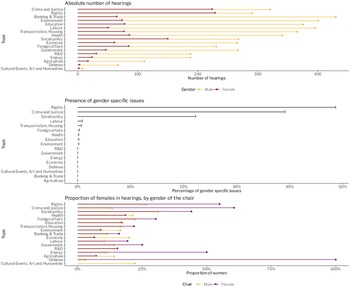
Figure 1 summarizes the distribution of parliamentary hearings across policy domains and shows how gender appears in these settings. Panel A displays the absolute number of hearing representatives invited to parliamentary hearings in each policy domain, disaggregated by the gender of the representative. The figure shows that hearings are not evenly distributed across topics. Rights, Social Policy, Crime and Justice, Health, and Education account for the largest number of invited representatives. In contrast, areas such as Agriculture, Defense, Culture, and Energy receive comparatively limited attention. Panel B shows the share of hearings addressing gender-specific issues within each policy domain, calculated as the percentage of hearings in that domain that explicitly address gender-related topics. Gender-specific issues include hearings focusing on gender equality policies or issues that disproportionately affect women or men. The figure indicates that only a small fraction of hearings, concentrated primarily in Rights and Social Policy, explicitly address gender. This pattern suggests that gender-related topics are relatively rare and clustered in specific policy areas.
Gender representation in parliamentary hearings across policy domains.

Figure 1. Long description
The image contains three graphs that analyze gender representation in parliamentary hearings across various policy domains. The first graph, a horizontal bar chart, shows the absolute number of hearings for different topics, with separate bars for male and female representation. Topics include Crime and Justice, Rights, Banking and Trade, Environment, Education, and others. The second graph, another horizontal bar chart, illustrates the presence of gender-specific issues across the same topics, indicating the percentage of hearings addressing these issues. The third graph, also a horizontal bar chart, displays the proportion of females in hearings, differentiated by the gender of the chair, with separate bars for male and female chairs. Each graph provides insights into how gender representation varies across different policy domains and under different conditions. All values are approximated.
Panel C presents the proportion of women among hearing representatives, distinguishing hearings chaired by male and female committee chairs. Across nearly all topic areas, the proportion of women representing interest groups is higher when the committee chair is a woman. In several domains, most notably Rights, Crime and Justice, Education, and Health, female-chaired committees exhibit substantially higher female representation. This pattern provides preliminary evidence consistent with our theoretical expectations regarding the role of institutional leadership in shaping gender representation in parliamentary hearings.
We also include several control variables: whether the hearing is gender-specific, its purpose (legislative or oversight), the commission type (permanent or non-permanent), the percentage of left-leaning members in the commission, and the ideology of the chair’s party. We include a flexible time specification using a Kalman filter so that time allows for contemporaneous effects without imposing a parametric form for time. The model specification is hierarchical, allowing the effects of certain topics and covariates to vary depending on the gender of the committee chair. This enables us to examine whether differential effects exist based on the chair’s gender. In other words, we allow for differential effects of the main parameters of interest depending on the gender of the chair of the committee. By using a hierarchical model, we make the assumption that the data generating process is the same in both genders, allowing for some variation. This contrasts with using interactions, which would have implied the assumption that the two effects are arbitrarily unrelated. The model specification is presented in Equation 1:

We employ Bayesian inference to estimate the parameters of the model. There are several advantages of employing Bayesian inference over frequentist approaches in our case (Gill and Witko Reference Gill and Witko2013). First, the data are not a random sample, but rather the whole set of potential observations. This allows us to avoid arbitrary thresholds based on p-values. Second, there are only two groups in the hierarchical definition (namely, the gender being either male or female for the head of the committee), which poses an estimation challenge if frequentist statistics were to be employed. By using reasonable priors, Bayesian inference allows us to overcome this limitation while at the same time helping us understand under which conditions it is plausible to assume that the gender of the head of the committee makes a differential effect on the variables of interest.
Third, we perform a comprehensive management of missing data on the ideology of the party chairing, based on assigning values resembling the distribution of the original variable. The uncertainty is then automatically passed into the parameters of interest. The iterative nature of the Markov-Chain Monte-Carlo (MCMC) estimation under the Bayesian paradigm facilitates a natural treatment of missing data. We employ weakly informative priors. All continuous variables are standardized to 2 standard deviations (Gelman Reference Gelman2008) so that we can compare the effects across all of them, continuous and binary. The reference hearing is one on the ‘Crime and Justice’ topic, of a Company or Business/Trade association, of a monitoring and permanent hearing that is not gender-specific, that has an average number of females in the committee, average chair ideology, and average percentage of left parties, average number of individuals giving testimony, and a male chair. We employ JAGS (Plummer Reference Plummer2004) for the estimation and ggmcmc (Fernández-i-Marín Reference Fernández-i-Marín2016) for convergence, diagnostics, post-processing, and visualization. Convergence diagnostics as well as all parameters of the model are reported in the Online Appendix.
To ensure the robustness of our findings, we employ two different strategies to deal with potential sources of bias. First, we consider the potential selection bias that can arise from the fact that women and men have different probabilities to chair a specific committee. In this sense, we add propensity scores to the model. Second, we re-run the analysis discarding the hearings that were planned but not executed. That is, only with parliamentary hearings that were carried on. With this, we want to ensure that there is no difference between the ideal of gender equality most likely to be planned and the reality of what is indeed done. All these models are robust to our main findings and are reported in the Online Appendix (Section C).
Determinants of female representation in interest group advocacy
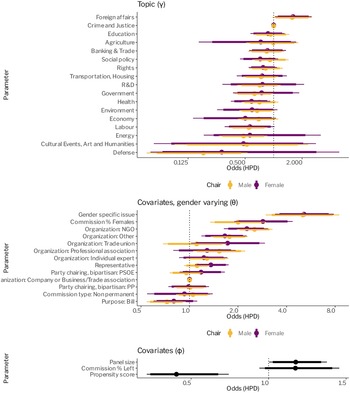
Figure 2 shows the caterpillar plots of the main parameters of interest. The dots represent the median of the posterior distribution, whereas the uncertainty bands cover the 90 and 95 percent credible intervals (the highest posterior densities, which can be understood as confidence intervals in a frequentist scenario). The figure shows the odds ratios against the reference category.
Main model results. Posterior distributions of the parameters summarized as highest posterior densities (HPDs) at 90 and 95 percent credibility.

Figure 2. Long description
The image contains three graphs showing posterior distributions of parameters summarized as highest posterior densities (HPDs) at 90 and 95 percent credibility. The first graph, labeled 'Topic (γ)', displays odds for various parameters such as foreign affairs, crime and justice, education, and more. The second graph, labeled 'Covariates, gender varying (θ)', shows odds for parameters like gender-specific issues, commission percentage of females, organization types, and party chairing. The third graph, labeled 'Covariates (φ)', presents odds for panel size, commission percentage left, and propensity score. Each graph uses different colors to represent chair, male, and female categories. The graphs illustrate how different factors influence the likelihood of women representing interest groups in parliamentary deliberations.
Hypotheses 1 and 2 examine whether the composition and leadership of parliamentary committees influence the likelihood of women representing interest groups in parliamentary hearings. The evidence for Hypothesis 1 is strong and consistent (see Figure 2): as the percentage of female MPs on a committee increases, so does the probability that women will act as representatives of interest groups in that committee’s hearings. Specifically, an increase in the proportion of women MPs equivalent to two standard deviations (roughly an interquartile range shift) is associated with a doubling of the likelihood that a woman will represent an interest group. This finding underscores the importance of gender diversity within parliamentary committees in promoting broader gender inclusion in policy deliberation processes.
In contrast, the findings for Hypothesis 2 – which assesses whether having a female chair influences the likelihood of women appearing as interest group representatives – are more ambiguous. While the presence of a female chair is associated with a modest increase in the probability of female representation, this effect diminishes once additional variables are controlled for. Figure 2 highlights some variation between male-chaired (yellow) and female-chaired (purple) committees, but the overlapping confidence intervals suggest only weak evidence of a substantial chair gender effect. These findings indicate that while gender dynamics within committees matter, the impact of leadership roles is more complex and may not exert a uniformly strong influence.
We then explore whether interest groups engage in strategic selection when choosing their representatives for parliamentary hearings. Specifically, we examine whether women are more likely to represent an organization when they are not the CEO – suggesting that their selection may be instrumental rather than structural. The data (label ‘representative’ in the figure) indicate a clear pattern: when the committee chair is male, there is no systematic difference in whether a man or woman represents the interest group. However, when the chair is female, organizations are significantly more likely to send a woman as their representative – even if she is not the organization’s CEO. This behavior suggests a strategic adaptation to perceived gender dynamics within the committee. Moreover, this strategic pattern is observable across all types of organizations. These results point to a broader tactical use of gender representation by interest groups, aimed at enhancing credibility or resonance in front of female-led or gender-diverse committees.
To dig deeper, Table 1 provides descriptive information about whether the proportion of women representing interest groups in parliamentary hearings changes based on the gender of the committee chair, specifically focusing on interest groups invited multiple times from 1996 to 2023 (Table 1). The results show that interest groups, particularly business organizations like the Confederación Española de Organizaciones Empresariales (CEOE), Confederación Española de la Pequeña y Mediana Empresa (CEPYME), and trade unions such as Comisiones Obreras (CCOO) and Unión General de Trabajadores (UGT) strategically send women representatives to hearings when the committee is chaired by a woman. In the first three cases, this differential effect is over 43 percentage points, and for UGT, it is slightly lower at 38 percentage points. However, citizen’s groups generally do not engage in this strategic selection, with a few exceptions, such as the Comité Español de Representantes de Personas con Discapacidad (CERMI). For instance, the CEOE sends a female representative only 2.4% of the time when the chair is a man, but this figure jumps dramatically to 20 times more (50%) when the chair is a woman. Similarly, CCOO follows this pattern, sending a woman 50% of the time when the chair is a woman, 10 times more likely than when the chair of the committee is a man.
The proportion of female attendees at hearings, depending on the gender of the commission chair, for selected interest groups (it includes the average percentages across the period analyzed)

Table 1. Long description
The table presents data on the proportion of female attendees at hearings for various interest groups, segmented by the gender of the commission chair. It includes six interest groups and compares the percentage of male and female attendees, highlighting the difference in percentage points. The groups listed are Confederacin Espaola de Organizaciones Empresariales, Comisiones Obreras, Confederacin Espaola de la Pequea y Mediana Empresa, Unin General de Trabajadores, and Comit Espaol de Representantes de Personas con Discapacidad. The table shows significant differences in female representation depending on the chair's gender, with notable variations across different interest groups.
The organizations included in Table 1 – CEOE, CEPYME, CCOO, UGT, and CERMI – are the five most frequently invited interest groups in the period 1996–2023, which makes them the only cases with a sufficient number of repeated hearings to examine descriptive within-organization variation. The table is therefore not intended as a systematic within-group test of strategic behavior, but as an illustrative complement to the model-based estimates. Importantly, these descriptive differences should not be interpreted independently of the multivariate results. Because the hierarchical model conditions on policy topic, committee gender composition, and organization type, the effects attributed to chair gender cannot be explained by the fact that certain committees (eg social policy or health) are more likely to be chaired by women and to attract female representatives. Table 1 simply shows that the descriptive patterns among the most frequently invited groups are consistent with the broader effects estimated by the model.
The third hypothesis posits that citizen groups are more likely than economic groups to be represented by women. This is particularly evident in citizen groups, which typically have diverse membership bases and emphasize inclusiveness to attract broader support. In contrast, economic groups, which focus primarily on advancing material interests, tend to have less diverse membership and may overlook gender balance, leading to the underrepresentation of women. The analysis reveals compelling evidence supporting this hypothesis. The middle diagram highlights the effects of ‘Organization’, indicating that, all else being equal, women are approximately twice as likely to be represented in a parliamentary hearing if the organization is a citizen’s group, compared to companies or business organizations. This finding underscores a clear trend where citizen groups prioritize gender equality representation, thereby attracting a greater number of female representatives. Conversely, companies or business/trade associations demonstrate fewer female representatives, indicating a lack of commitment to gender equality and inclusivity.
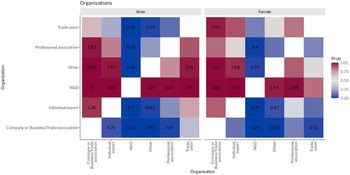
Another way to observe the differences between interest organizations is to look at the cross-organization probabilities. That is, up to which point it is more or less likely that an organization type is more represented by women than another type. Figure 3 shows such probabilities, represented by the colors. Blue and strong colors imply that the organization in the row is less likely to be represented by women than the column organization. At the same time, red implies that the row organization is more likely to be represented by women than the column organization. The numbers in the cells report the odds ratio, the average effect in multiplicative terms. In this example, when the chair of a parliamentary committee is a male, professional associations are 1.84 times more likely (ie 84 percent) than a Company or Business/Trade association to be represented by a woman. The figure also shows NGOs are always more than two times (between 2.3 and 5.2) more likely to be represented by women if the committee chair is a male. If the chair is a female, the difference is not so pronounced (around two times more).
Cross-organization evidence. Colors show the expected likelihood of the organization on the row being more likely (higher than 1) or less likely (lower than one) represented by a woman than the type of organization in the column, and the number is the median odds ratio.

Figure 3. Long description
The matrix displays the likelihood of male and female representation across various organizations, including trade unions, professional associations, NGOs, individual experts, and companies or business/trade associations. The matrix consists of six rows and six columns, with each cell containing a numerical value indicating the median odds ratio. The left section of the matrix represents male representation, while the right section represents female representation. The color gradient from blue to red indicates the probability, with blue representing lower likelihood and red representing higher likelihood. For example, the value 2.55 in the female section for trade unions indicates a higher likelihood of female representation compared to other organizations. The matrix highlights notable trends, such as NGOs having a higher likelihood of female representation with a median odds ratio of 4.4 for males and 4.4 for females. The data provides insights into gender representation across different organizational types.
Considering NGOs as the foremost proponents of organizations seeking to enhance legitimacy and attract support, the evidence strongly supports the third hypothesis. The strategic emphasis on gender equality representation within NGOs not only bolsters gender balance but also signals a broader commitment to societal values. Women serving as representatives for NGOs contribute significantly to this narrative, distinguishing the organization positively from other interest groups. Conversely, the lower representation of women in business-focused entities raises pertinent questions about their dedication to gender equality and inclusivity within their organizational frameworks.
The fourth hypothesis (H4) states that the likelihood of women appearing as representatives increases as the number of individuals giving testimony in a hearing grows, because larger witness panels make gender disparities more visible and therefore more normatively salient. In this case, as Figure 2 illustrates, the variable accounting for the number of witnesses per hearing is positive, lending support to the hypothesis. Its substantive effect is also comparable to that of increases in women’s presence on the committee: a one interquartile range increase in the number of witnesses is associated with a 1.2-fold (or 20%) increase in the likelihood that a woman represents an interest group. This finding suggests that larger political debates may create more inclusive environments for women advocates, partly because gender disparities become more visible and competition for speaking slots diminishes. As a result, women may have greater opportunities to participate and contribute to parliamentary discussions.
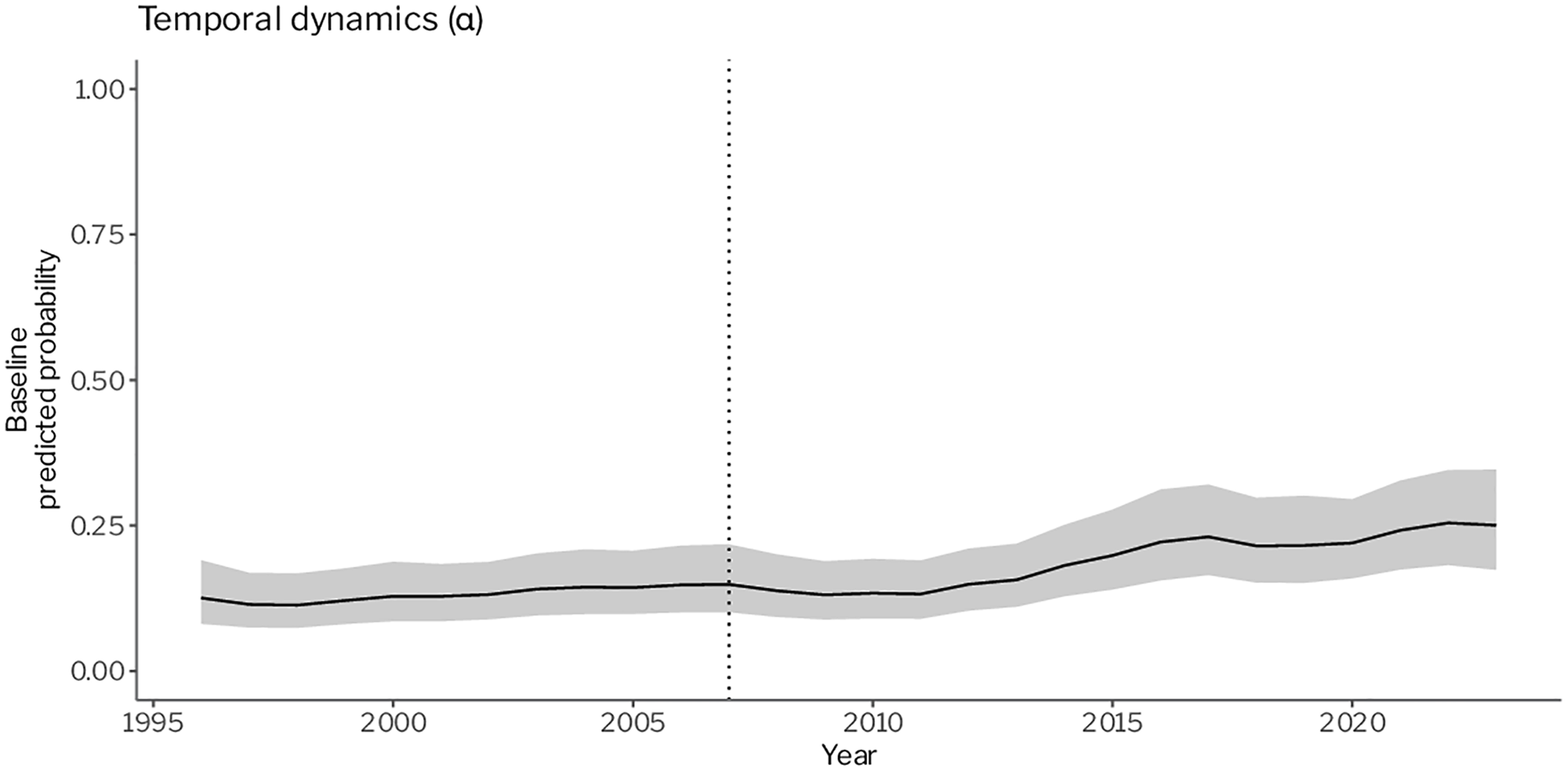
Finally, Figure 4 shows the smoothed temporal dynamic. In this case, in the form of the baseline predicted probability of women appearing in a parliamentary hearing, for the reference categories and average values. We can see that from the 1990s until the mid-2010s, the probability barely changed and was around 10–15 percent. It is only until very recently that the probability has moved to values closer to 20–25 percent. Recall that this trend is observed after accounting for other factors that might influence women’s representation of interest groups in parliamentary hearings, suggesting a genuine shift in the underlying dynamics.
Predicted probability of a woman representing an interest groups in a parliamentary hearing.

Figure 4. Long description
A line graph titled 'Temporal dynamics' displays the baseline predicted probability of a woman representing an interest group in a parliamentary hearing from 1995 to 2020. The x-axis represents the years, ranging from 1995 to 2020, while the y-axis represents the baseline predicted probability, ranging from 0.00 to 1.00. The graph features a single line with a shaded area around it, indicating the confidence interval. The line starts at a low probability around 0.10 in 1995, remains relatively stable with slight fluctuations until around 2007, and then shows a gradual increase, reaching approximately 0.25 by 2020. A vertical dotted line around 2007 marks a significant point in the timeline. All values are approximated.
The results of the fifth hypothesis shed light on the likelihood of women representing interest groups, particularly when discussing topics traditionally associated with women’s issues. The analysis, as depicted in the top diagram of Figure 2 (topic), reveals intriguing insights. While the evidence appears weaker compared to the first hypothesis, with fewer topics showing clear gender patterns, it remains significant. It is crucial to note that these differences in representation are observed after accounting for various other factors, ensuring a robust analysis. For instance, the percentage of women in the parliamentary committee and the gender specificity of the issue are considered. The findings indicate that women are approximately twice as likely to participate in representing interest groups in parliamentary hearings discussing international human rights, developmental issues, and cooperation (Foreign affairs) compared to the reference category, which is ‘Crime and Justice’. Conversely, ‘Defense’ emerges as the topic with the most pronounced gender divergence, with women being around 70 percent less likely to represent interest groups in parliamentary hearings on this subject. The most notable contrast occurs between ‘Foreign affairs’ and ‘Defense’, where the likelihood of a woman appearing in a ‘Foreign affairs’ committee is approximately 6.25 times higher than in a ‘Defense’ committee.
Although foreign policy is generally considered a male-dominated domain, the foreign affairs hearings in this dataset deal chiefly with human rights, development cooperation, and global equality – subfields strongly associated with feminized policy agendas. Research shows that women are more likely to engage in these issues, both as policymakers and as advocates (Chaqués-Bonafont and Cristancho Reference Chaqués-Bonafont and Cristancho2022). Thus, the higher representation of women in foreign affairs hearings reflects the substantive content of the hearings rather than contradicting established gendered divisions in foreign policy. These results highlight the nuanced dynamics of gender representation in parliamentary debates, emphasizing the varying degrees of female involvement across different policy domains. While certain topics exhibit stronger gender patterns, such as ‘Foreign affairs’ (human rights and cooperation) and ‘Defense’, others may not conform as distinctly to traditional gender associations.
Discussion
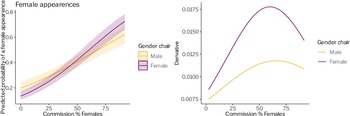
The results indicate a clear differential effect on the likelihood of women representing interest groups in parliamentary hearings, contingent on the presence of women in the parliamentary committee. The model estimates the predicted probability of female representation and identifies potential ‘tipping points’ – levels at which women’s presence most significantly increases the likelihood of female appearances. Figure 5(a) illustrates these marginal effects.
Marginal effects. Predicted probability of female appearances in parliamentary hearings.

Figure 5. Long description
The image contains two line graphs side by side. The left graph shows the predicted probability of female appearances in parliamentary hearings as a function of the percentage of females in commissions. The x-axis represents the commission percentage of females, ranging from 0 to 100 percent, while the y-axis represents the predicted probability of a female appearance, ranging from 0 to 0.8. Two lines are plotted: one for male chairs in yellow and one for female chairs in purple, each with a shaded confidence interval. The right graph displays the derivative of the predicted probability with respect to the percentage of females in commissions. The x-axis is the same as in the left graph, while the y-axis represents the derivative, ranging from 0.0075 to 0.0175. The purple line for female chairs peaks around 50 percent females, while the yellow line for male chairs shows a more gradual increase. The graphs illustrate how the likelihood of female appearances changes with the gender composition of commissions and the gender of the chair. All values are approximated.
The analysis shows that the tipping point differs depending on the gender of the committee chair. When the chair is female, the threshold is reached when women constitute 52% of the committee; when the chair is male, it rises to 68%. These findings highlight the importance of female leadership in amplifying women’s representation. Model accuracy is strong, with 70% of hearings correctly predicted. The evidence supports a multifaceted view of interest group dynamics. Gender functions as a legitimacy tool for citizen-focused groups but is less relevant for economic organizations such as business associations. This reflects broader patterns: women are more prevalent in public interest and equality groups, while business and corporate lobbying remain male-dominated (Nownes and Freeman Reference Nownes and Freeman1998; Bath, Gayvert-Owen and Nownes Reference Bath, Gayvert-Owen and Nownes2005; Lucas and Hyde Reference Lucas and Hyde2012; LaPira, Marchetti and Thomas Reference LaPira, Marchetti and Thomas2019; Junk, Romeijn and Rasmussen Reference Junk, Romeijn and Rasmussen2021).
Representation dynamics also reflect leadership and issue focus, but results point to strategic adaptation. Women are more likely to represent organizations when the committee chair is female, even though they often do not hold top leadership positions. This suggests tactical selection aligned with perceived expectations rather than internal gender empowerment.
These findings align with recent scholarship showing that interest groups use gender strategically. Organizations increase the presence of female lobbyists as political institutions become more gender-diverse, anticipating improved access (Strickland and Stauffer Reference Strickland and Stauffer2022; Coen, Katsaitis and Vannoni Reference Coen, Katsaitis and Vannoni2025). Accordingly, when the chair is male, there is no systematic difference in representative gender, but with a female chair, the likelihood of female representation increases substantially. This pattern supports the idea of strategic signaling: organizations adjust their external image to match institutional contexts and enhance credibility (Strolovitch Reference Strolovitch2006; Holli Reference Holli2012; Marchetti Reference Marchetti2014). Gender thus becomes a symbolic resource, mobilized when advantageous, but not necessarily reflecting deeper organizational change.
Further research is needed to assess whether this reflects genuine commitments to gender equality or strategic adaptation. The study shows women increasingly appear in visible roles within policymaking arenas, but we do not know whether such visibility translates into structural empowerment within the organizations they represent. This distinction between descriptive representation (presence) and substantive representation (power and decision-making authority) within interest groups is crucial. Organizations may adopt the appearance of gender diversity for legitimacy benefits while leaving underlying hierarchies unchanged. Without accompanying shifts in internal hierarchies and power distribution, the rise in female visibility in hearings risks reinforcing a performative gender sensitivity – one that satisfies surface-level expectations without challenging underlying inequalities.
Conclusion
This paper has examined the gender dynamics of interest group representation in parliamentary hearings, shedding light on how gender is strategically deployed by organizations in the political arena. The findings show that citizen groups are significantly more likely than economic or business organizations to have women representatives, highlighting how organizations that prioritize inclusivity and public legitimacy tend to amplify female voices. The composition of parliamentary committees also plays a crucial role: as the percentage of women MPs on a committee increases, the likelihood of women representing interest groups rises accordingly. A substantial increase in female representation occurs when the percentage of women MPs on a committee is raised by two standard deviations, effectively doubling the probability of female representation.
The study also highlights that topic-specific dynamics shape who speaks in parliamentary settings. Women are more frequently seen representing interest groups in hearings on issues traditionally associated with gender equality, human rights, and development, while defense-related hearings see significantly lower female representation. Additionally, hearings with larger witness panels increase the likelihood of female participation by 20%, likely because gender disparities become more visible and competition for speaking opportunities decreases. Finally, the results show a positive trend over time: women’s participation in hearings has risen from around 10–15% in the 1990s to 20–25% in recent years, indicating gradual but meaningful progress toward greater gender inclusivity.
At the same time, the findings provide evidence consistent with patterns of strategic selection in interest group representation. Women are more likely to be chosen as representatives when they do not occupy top leadership roles, suggesting that their presence may not always reflect underlying organizational power structures. This tendency appears particularly pronounced in contexts where committees are more gender-diverse or chaired by women, although the effect of leadership is more modest and context-dependent than that of overall committee composition. These patterns suggest that some organizations – especially economic groups – adapt their public-facing representation to align with the gendered expectations of the institutional environment, potentially to enhance credibility or relational access. By contrast, citizen groups appear more likely to reflect structural gender inclusion rather than purely strategic considerations.
These findings have important implications for both the study of interest groups and political representation. They call for a more nuanced understanding of how interest groups respond to institutional pressures – not just through policy framing or coalition-building but also through symbolic gestures that exploit identity markers like gender. Future research should continue to interrogate the intersection of gender, power, and strategic behavior in political advocacy, with particular attention to how institutional settings condition these dynamics. In particular, we need to better understand whether this strategic behavior contributes to reducing the structural underrepresentation of women in organizational hierarchies, and whether institutional pressures can foster more enduring forms of gender equality in political advocacy.
Supplementary material
The supplementary material for this article can be found at https://doi.org/10.1017/S1475676526101418.
Data availability statement
The data supporting the findings of this study are available on the Q-Dem website at Q-Dem.
Acknowledgments
Earlier versions of this article were presented at the Geypo research seminar at the Universidad Complutense de Madrid, the Political Science research seminar at the University of Barcelona, the Interest Groups Section of the ECPR General Conference, and the Comparative Agendas Project meeting held in Barcelona in 2024. We thank participants in these venues for their helpful comments and suggestions. We are also grateful to the anonymous reviewers for their constructive feedback, which significantly improved the manuscript.
Funding statement
This research was supported by the Spanish Ministerio de Ciencia e Innovación through the project Agenda Dynamics on Social Media (PID2021-123463NB-I00, 2022–2024), Principal Investigator: Laura Chaqués Bonafont, and by the Agència de Gestió d’Ajuts Universitaris i de Recerca (AGAUR) through the research group grant Grup de Recerca Consolidat (2021 SGR 00980, 2021–2024), Principal Investigator: Laura Chaqués Bonafont.
Competing interests
The authors declare no competing interests.
Ethical standards statement
This research complies with the ethical standards of the authors’ institution and with applicable national regulations. The study is based on publicly available parliamentary data and does not involve human subjects requiring ethical approval.



 Open access

