


INTRODUCTION
The first suspected outbreak of human trichinellosis in Greenland occurred in 1944 [1] and until 1959 around 640 clinical cases with 58 deaths occurred in 11 outbreaks [Reference Møller2]. No cases were reported between 1959 and 1971, and subsequently only sporadic cases and outbreaks have been observed [Reference Møller2]. Over the last decades outbreaks of human trichinellosis have occurred both in tourists and inhabitants of Greenland with the most recent inhabitant cases occurring in 2001 and 2002 in West Greenland [Reference Møller2]. Possible explanations of the apparent decline in trichinellosis cases include lifestyle changes with less consumption of game meat, increased public awareness of food safety, insufficient case registration, or a combination of these factors. However, in spite of this, recent studies have shown relatively high seroprevalence locally [Reference Bohm, van Knapen, Tanner, Martinez-Fernandez and Bolas-Fernandez3, Reference Henriksen4].
Walrus and polar bear meat infected with freeze-resistant Trichinella nativa are primary sources of human outbreaks in the Arctic [Reference Pozio and Darwin Murrell5], but seal meat has also been suspected as an alternative source of infection; although rarely infected, several thousand seals are caught every year for consumption.
The aims of the present study were to determine seroprevalence and risk factors for seropositivity in a typical Greenlandic hunting community.
METHODS
The study was carried out during a 2-week period in April 2004, in the town of Tasiilaq and the three settlements Kulusuk, Kuummiut, and Isortoq in the municipality of Ammassalik in East Greenland. The municipality includes the town of Tasiilaq (∼1800 inhabitants) and seven small settlements (∼1200 inhabitants), in total 5·3% of the population of Greenland (all figures for 2004) [6].
All inhabitants aged >10 years were eligible for participation. For children the investigation took place at the local schools that agreed to participate, and for adults in local meeting houses, larger workplaces, nursing stations, or if requested, at home. Schoolchildren were recruited via flyers from the schools, and adults via posters at public places, through the local radio, and flyers distributed to each household.
Children were given written information about the study, signature forms for parent's or legal guardian's informed consent, and questionnaires in Greenlandic and Danish to take home. After returning the signed forms and the completed questionnaires to the schools the children had venous blood samples drawn. Adult participants, after giving written informed consent, were interviewed by their own choice either by a Greenlandic interpreter, by one of the investigators, or they completed the questionnaire without help, followed by the drawing of a venous blood sample.
The study was ethically approved by the Commission for Scientific Research in Greenland.
Two questionnaires on lifestyle factors and dietary habits were produced; one for schoolchildren and one for adults. The adult questionnaire collected additional information about education, occupation, and hunting habits, but otherwise the questionnaires were basically identical. Questions about dietary habits were asked both as ‘present use’ without specification and as ‘ever use’. Both questionnaires were first designed in Danish and then translated into Greenlandic by a Greenlandic interpreter together with one of the investigators to avoid misunderstanding.
Venous blood samples were allowed to clot and serum was separated by centrifugation and stored initially at −20°C and subsequently at −80°C until analysis. All samples were analysed for specific IgG antibodies against Trichinella spp.
A serum sample from a patient with a confirmed diagnosis of trichinellosis from a game meat-related outbreak in West Greenland in 2001 [Reference Møller2] was used as Trichinella-positive control. Serum samples from 200 adult Danes presumed never to have been exposed to Trichinella were tested by ELISA and Western blot, and a seronegative sample was selected as negative control.
All serum samples were tested for Trichinella-specific IgG antibodies by ELISA as previously described and validated [Reference Møller2, Reference Møller7] using two antigens: an excretory/secretory (E/S) antigen [Reference Kapel and Gamble8], and a β-tyvelose antigen [Reference Bruschi9]. Cut-off values for the E/S and β-tyvelose IgG antigens were defined as the 98% percentiles of the OD distribution of test results of the 200 presumed seronegative Danish control sera resulting in cut-off values of OD 0·26 (E/S antigen) and OD 0·24 (β-tyvelose IgG antigen), respectively.
Western blot was performed on samples with OD results above the cut-off value for the E/S ELISA, while dot blot was performed on samples positive in the tyvelose ELISA. For Western blot, a crude antigen from Trichinella larvae was separated on a 5% stacking gel and a 10% sodium dodecyl sulphate–polyacrylamide gel (SDS–PAGE) and transferred to nitrocellulose sheets. For the dot blot, 2 μl tyvelose antigen (1 mg/ml) diluted 1:4 were added directly to a nitrocellulose sheet and left to dry for 1 h at room temperature. For both blots, samples were diluted 1:100, and a rabbit anti-human IgG-labelled with alkaline phosphatase (Dako, Denmark) was diluted 1:1000 and used as conjugate. The immunoblots were evaluated using a substrate of Nitro Blue tetrazolium (Sigma, Denmark) and 5-bromo-4-chloro-3-indolyl phosphate (Sigma).
A sample was considered seropositive if positive in at least one of the ELISAs and having a positive dot blot or a positive Western blot with a Trichinella-specific band of 49 kDa. If the Western blot showed unspecific bands the sample was considered negative.
The association between Trichinella seropositivity and possible risk factors was evaluated by odds ratio (OR) estimated in a logistic regression model (proc genmod, SAS version 9.1; SAS Institute Inc., USA). All variables were adjusted for age by a cubic spline with knots chosen as the 5%, 35%, 65%, and 95% quartiles in the age distribution from the survey. In additional analyses, effect modification by age was evaluated by inclusion of an interaction term between age (<40, ⩾40 years) and the risk factor.
Intake of different game meat was categorized into: every day, few times a week, once a week, few times a month, once a month, seldom, and never, and re-categorized into ‘ever’ and ‘never’ categories; if the ‘never’ category had no cases, this was categorized into ‘ever’ and ‘seldom/never’. Raw meat categories were: more than 50 times, between 20 and 50 times, between 10 and 20 times, between 1 and 10, and never.
More precise estimates of the association between food intake and Trichinella seropositivity were obtained in trend analyses by constructing continuous measures of meat intake, expressing the number of times per year of intake of each food item (e.g. ‘every day’=365 times/year, ‘few times a week’=182 times/year, ‘once a week’=52 times/year, etc.).
RESULTS
Of 2063 eligible persons 998 (48%) participated in the study; 65% of the youngest age group (10–19 years) and between 36% and 49% of the older age groups. According to the individual's own perception 946 were Greenlanders or mixed (Greenlander+other), and 52 were Danes or other (not Greenlanders). There were 481 men and 517 women with a median age of 30 years and 32 years, respectively. Six hundred and fifty-six persons (65·7%) were from Tasiilaq town, and 342 (34·3%) were from the settlements (117 from Kulusuk, 169 from Kuummiut, and 56 from Isortoq).
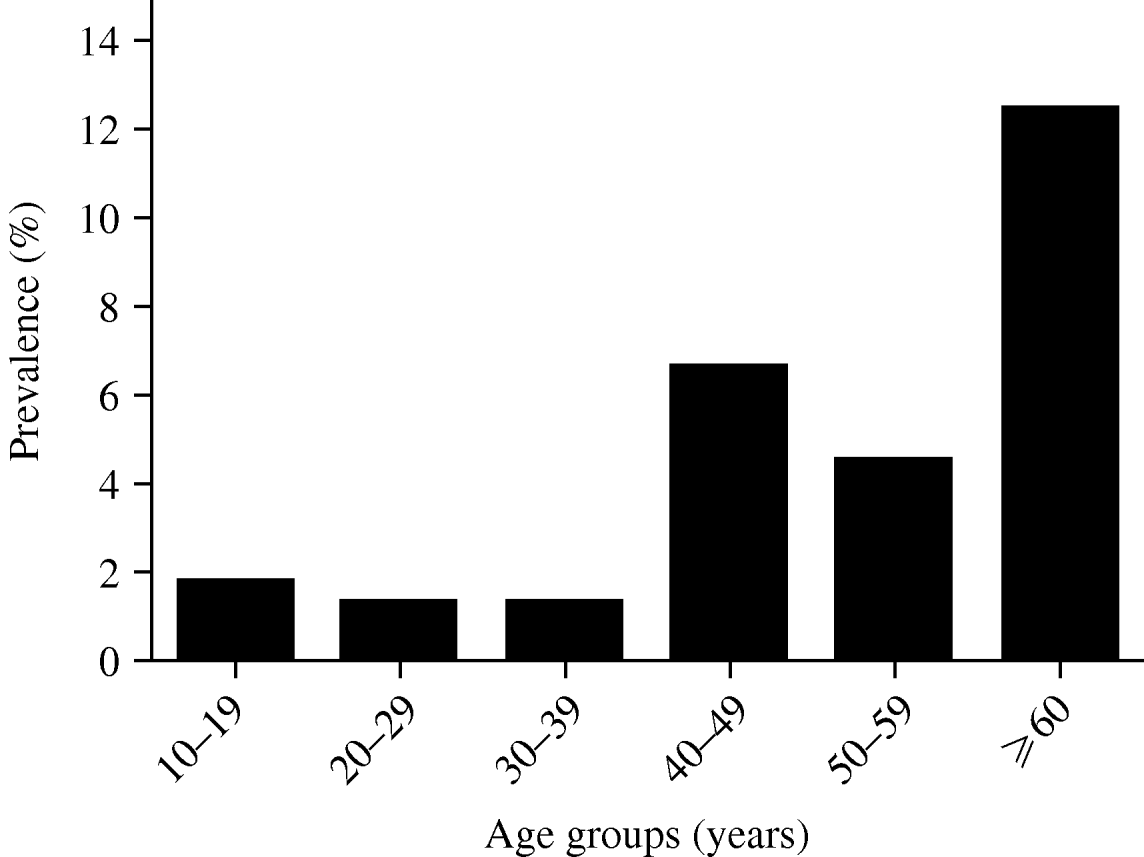
Overall, 31 persons (3·1%) were Trichinella-seropositive; in Tasiilaq 2·7%, in Kulusuk 2·6%, in Kuummiut 3·6%, and in Isortoq 7·1% (P=0·34). Seropositivity increased significantly with age from 1·4% in persons aged <40 years to 7·5% in persons aged ⩾40 years (Table 1, Fig. 1). As all 31 seropositive persons were of Greenlandic or mixed ethnicity, risk factor analyses were restricted to the 946 persons of Greenlandic or mixed ethnicity.
Prevalence of Trichinella infections in 946 persons with Greenlandic and mixed (Greenlander+other) ethnicity, in 2004 in the Ammassalik municipality; according to age. Seropositivity was determined by ELISA and immunoblot using the antigens, E/S and tyvelose.
Risk (OR) of being Trichinella-seropositive in 946 persons of Greenlandic and mixed (Greenlander and other) ethnicity living in the Ammassalik municipality 2004, according to age
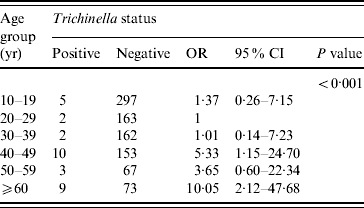
OR, Odds ratio; CI, confidence interval.
Seropositivity was determined by ELISA and immunoblot using the antigens, E/S and tyvelose.
Of the demographic and lifestyle risk factors for the 946 persons of Greenlandic and mixed (Greenlander and other) ethnicity living in Ammassalik municipality, only ‘Occupation as hunter or fisherman’ for males (OR 8·68, 95% CI 1·74–43·31, P=0·01) was significantly associated with Trichinella seropositivity. Gender, current or previous residence, level of education, occupation in females and having a hunter in the family were not significantly associated with Trichinella seropositivity in this population. Of dietary habits, only the trend for ‘Intake of polar bear meat’ (OR 1·26, 95% CI 1·01–1·57, P=0·04) was significantly associated with Trichinella seropositivity. Greenlandic diet, intake of seal, walrus or polar beat meat (ever/never) or consuming raw game meat were not significantly associated with Trichinella seropositivity.
There were no interactions with age for any of these risk factors (P>0·05).
DISCUSSION
We achieved an overall participation rate of 48%, slightly higher in schoolchildren (65%) than in adults (36–49%). In order to maximize participation rate and minimize selection bias, great effort was made to recruit participants based on advertisements (e.g. flyers, posters, local media). Moreover, during the last days of the study period home visits were made to all addresses in Tasiilaq town to ensure that persons at home, e.g. the sick, would also have the opportunity to participate. Our recruitment methodology did not allow for an evaluation in non-participants of reasons for not participating in the study. However, although selection bias between participants and non-participants cannot be ruled out, serostatus was unlikely to bias participation, as this information was not available for subjects prior to study entry. Although hunters would be absent more often from town than, e.g. school teachers, a sufficient number of hunters participated to show a statistically significant association between hunting and seropositivity.
The overall seroprevalence of 3·1%, with >12% seroprevalence in persons aged ⩾60 years, shows that Greenlanders in the Ammassalik municipality in East Greenland are at a significant risk of Trichinella infection. The seroprevalence in Isortoq was twice as high as in the other settlements in the Ammassalik municipality, which is compatible with a higher degree of game meat consumption in Isortoq. However, although comparative serological studies are scarce, these figures are lower than a seroprevalence of 22% found in persons aged >13 years in another traditional hunting community of Qaanaaq (Thule) in northwest Greenland [Reference Bohm, van Knapen, Tanner, Martinez-Fernandez and Bolas-Fernandez3], which probably reflects differences in hunting habits with less reliance on wild game meat in Ammassalik compared to Qaanaaq.
Age was statistically associated with seropositivity with a marked difference in persons aged <40 years and ⩾40 years. This may reflect higher consumption of game meat with less attention to food safety in previous times (cohort effect) and that older persons live more traditional lives dependent on game meat [Reference Pars, Osler and Bjerregaard10], while younger generations prefer ‘industrialized’ food. However, it may also reflect the fact that mandatory Trichinella inspection of polar bear and walrus meat by light microscopy was introduced in 1966 in Greenland resulting in lower seroprevalence in persons born later than the time of introduction.
Not surprisingly, males occupied as hunters or fishermen were at higher risk of being seropositive (OR 8·68) compared to persons with other occupations. The same tendency was observed for female hunters/fishermen, although insignificant. In Greenland, one fifth of the population are hunters, although there is a transition from full-time to part-time hunting [Reference Rasmussen11]. Hunted animals reflect the local game fauna and include a variety of bird species, caribou, muskoxen, seals, walrus, polar bear, and whales. Among these animals Trichinella infections have been reported in ringed seals (0·1%), bearded seals (0·8%), walruses (1–2%), and polar bears (23–53%) [Reference Madsen12–Reference Born, Clausen and Henriksen14]. The higher rate of seropositivity in hunters was not unexpected, as these persons have easier and more frequent access to meat potentially infected with Trichinella. Moreover, a higher intake of polar bear meat was also associated with an increased rate of seropositivity, consistent with the high Trichinella prevalence found in polar bears [Reference Born and Henriksen13].
Dietary questions were constructed to reflect both present and past use. Thus, as individual dietary habits may change over time, present dietary exposure may not necessarily reflect past exposure when actual Trichinella infection may have taken place.
Although Trichinella inspection of polar bear and walrus meat has been mandatory in Greenland since 1966, this is not performed in all municipalities, and many doctors and nurses on temporary assignments have not been trained in Trichinella examination. The risk of overlooking Trichinella infection is therefore considerable, which is supported by the finding of 1·4% of persons aged ⩽40 years being seropositive, a period of living when meat inspection is supposed to have taken place. Improved training of local personnel responsible for Trichinella diagnostics is needed. In Nunavik, Canada, a preventive programme based on preconsumption enzymatic testing of walrus meat at regional laboratories has been successfully implemented [Reference Proulx15], and a similar programme might be introduced in Greenland.
In conclusion, Trichinella infection in the Ammassalik municipality is prevalent but mainly in Greenlanders aged ⩾40 years. The significantly lower prevalence in younger generations probably reflects changes in dietary preferences with male hunters being at significantly higher risk of Trichinella infection than persons of other occupations, but could also reflect that meat inspection has been mandatory since 1966. Still, preventive measures against Trichinella infection should be strengthened in Greenland.
ACKNOWLEDGEMENTS
This work was supported by the Commission for Scientific Research in Greenland (KVUG). We thank laboratory worker Mette Ingvorsen (Statens Serum Institut), Chief Medical Officer Hans Christian Florian Sørensen (Tasiilaq Health Centre), and the staff at the Tasiilaq Health Centre, and the nursing stations in the settlements of Kuummiut, Kulusuk, and Isortoq, for invaluable help in connection with the field work for this study.
DECLARATION OF INTEREST
None.



