


The recollection of life threat, i.e. the belief that one's life was in danger, is consistently associated with post-traumatic stress. Reference King, King, Bolton, Knight and Vogt1,Reference Mott, Graham and Teng2 Perceived threat can be more strongly related to distress than objective danger-exposure. Reference Creamer, Burgess, Buckingham, Pattison, Wilson and Raphael3–Reference Lazarus and Folkman8 Whereas previous studies have focused on perceived threat as a predictor of post-traumatic stress in people directly exposed to trauma, no studies have provided a similar model for how people not physically present during disasters or terrorist events have developed post-traumatic stress. However, in theories of counterfactual thinking, humans tend to create possible alternatives to past life events. Reference Epstude and Roese9 Given that retrospective appraisals of life threat may be a result of thoughts about what could have happened, it is possible that even people who were not directly exposed to a traumatic episode, in retrospect, may think that their lives were threatened.
Until now, no study has compared perceived threat and post-traumatic stress disorder (PTSD) in individuals directly and indirectly exposed to a potentially traumatic event. Using data from ministerial employees who were present v. those not present during the 2011 bombing of the governmental quarters in Oslo, our aim was to examine the prevalence of perceived life threat and its association with PTSD in individuals directly or indirectly exposed to terror. Key questions were whether people would retrospectively evaluate that they had a high risk of dying, even among employees not present at the scene of the attack, and whether levels of perceived life threat would be dependent on physical and psychological proximity to the event. Another question was whether perceived life threat would be associated with PTSD in people directly as well as indirectly exposed to trauma.
Method
Participants and procedures
The present study is part of the ‘Mental health and work environment factors in the aftermath of the Oslo terrorist attack 22 July 2011’ study. Reference Hansen, Nissen and Heir10 A car bomb blast shattered government buildings, killing 8 people and injuring 209 more. Approximately 4000 ministry employees had their offices in proximity to the epicentre of the explosion. Eligible participants were the 3520 individuals employed in 14 of the 17 Norwegian ministries on 22 July 2011. All 3520 employees were invited to participate in the study, and data were collected between March and June 2012. Prior to data collection, the employees were informed about the purpose and content of the study and given the opportunity to withdraw. The study was approved by the Regional Ethics Committee in Norway.
Of the 3520 invited participants, 1970 (56%) responded. Of these, 47 (2%) were excluded from the analysis because of missing outcome variables. Hence, 1923 participants were included in the present study. For the included sample, the mean age was 45.4 years (range 19–70), 1109 (58%) were women, and 331 (17%) had leadership responsibilities. There were no significant differences in these demographic characteristics between employees who were present and not present at the governmental district at the time of the bomb explosion (Table 1). There was no significant difference in the proportion of employees who were present during the terrorist attack in the response group v. the non-response group, whereas age and the proportion of women were higher among responders. Reference Hansen, Nissen and Heir10
Demographic description of ministerial employees (n = 1923), grouped according to whether they were present in the governmental district or not during the 2011 Oslo bombing

| Present (n = 204) |
Not present (n = 1719) |
|
|---|---|---|
| Age in years, mean (s.d.) range |
44.7 (11.8) 22–70 |
45.4 (10.8) 19–69 |
| Gender, n (%) | ||
| Female | 124 (60.8) | 985 (57.3) |
| Male | 80 (39.2) | 734 (42.7) |
| Leadership responsibility, a n (%) | 33 (16.7) | 298 (17.8) |
| Neuroticisms, mean (s.d.) range |
2.24 (0.74) 1.00–4.50 |
2.10 (0.71)** 1.00–5.00 |
| Direct exposure, n (%) | ||
| Physical injury to self | 52 (25.5) | – |
| Witnessed people dead or dying | 67 (32.8) | – |
| Witnessed people seriously injured | 132 (64.7) | – |
| Proximity, n (%) | ||
| Oslo downtown | – | 168 (9.8) |
| Oslo periphery | – | 341 (19.8) |
| Norway outside Oslo | – | 854 (49.7) |
| Abroad | – | 356 (20.7) |
| Indirect exposure, n (%) | ||
| Loss of close colleague | 38 (18.6) | 220 (12.8)* |
| Close colleague injured | 108 (52.9) | 808 (47.0) |
| Damage to one's own office | 134 (65.7) | 911 (53.0)*** |
| Loss of personal property | 104 (51.0) | 616 (35.8)*** |
*P<0.05, **P<0.01, ***P<0.001, between group differences. There were no significant differences in age, gender, or leadership responsibility between the groups.
a. Totals for this variable: present n = 198; not present n = 1670.
Measures
Perceived life threat
Perceived life threat was measured by the question: ‘How great do you think the danger was that you would die?’. Reference Heir and Weisæth7,Reference Heir, Piatigorsky and Weisæth11 The participants responded on a five-point scale: 1, none; 2, small; 3, moderate; 4, great; 5, overwhelming. This measure has previously been shown to correlate highly with other items assessing life threat, indicating acceptable scale construct validity. Reference Heir, Piatigorsky and Weisæth11 A score of 4 (great) or 5 (overwhelming) was considered as high perceived life threat. This choice of cut-off was based on the dose–response relationship between the response categories and post-disaster distress in a previous study. Reference Heir and Weisæth7
The PTSD Check List – Specific (PCL-S)
The PCL is a 17-item self-administered questionnaire that assesses DSM-IV PTSD symptoms. Reference Weathers, Ford, Stamm and Lutherville12 The participants were asked to indicate on a five-point Likert scale (1, not at all; 5, extremely) the extent to which they had been bothered by the 17 symptoms in the past month. We used the PCL-S (i.e. symptoms endorsed were linked to the bomb explosion), and we considered an item-score of three or higher to indicate the presence of a particular symptom. 13 To distinguish between individuals with and without PTSD, the DSM-IV criteria 14 were applied to the PCL responses. Reference Hem, Hussain, Wentzel-Larsen and Heir15 According to the DSM-IV system, a PTSD diagnosis required one positive score in cluster B (re-experiencing symptoms), three in cluster C (avoidance symptoms), and two in cluster D (hyperarousal symptoms). The same procedure has performed well for detecting PTSD in the Norwegian population. Reference Hem, Hussain, Wentzel-Larsen and Heir15
Exposure
The participants were asked about their location at the moment when the bomb exploded, and given five answer choices: (a) in the governmental district downtown; (b) in downtown Oslo, but not in the governmental district; (c) in Oslo, but not downtown; (d) in Norway, but not in Oslo: and (e) abroad. Participants were categorised as being ‘present’ if they replied (a) they were located in the governmental district; whereas the remaining replies (b–e) were categorised as ‘not present’. Reference Hansen, Nissen and Heir10 Furthermore, they were asked three questions whether they had: (a) witnessed people who were dead or dying; (b) who were seriously injured; and (c) whether they were physically injured themselves (yes/no). Questions about indirect exposure were whether the employees had experienced: (a) loss of a close colleague; (b) a close colleague that was injured; (c) damage to one's own office; or (d) loss of personal property (yes/no)
Neuroticism
The 44-item Big Five Inventory assessing five dimensions of personality traits (extraversion, agreeableness, conscientiousness, neuroticism and openness) was applied. Reference Rammstedt and John16 Neuroticism is generally among the best predictors of post-disaster stress Reference Norris, Friedman, Watson, Byrne, Diaz and Kaniasty17 and was therefore included as a covariate in the present study. The variable consists of eight items that were rated on a five-point Likert scale (1, disagree strongly; 5, agree strongly). The mean item score was applied, ranging from 1 to 5.
Demographics
We assessed characteristics of employees using the following variables: gender, age, and leadership position by asking whether the participant had leadership responsibilities for other employees.
Statistical analyses
Employees who were present or not present during the traumatic event were compared using the chi-squared or t-test for independent samples. We analysed the associations between direct or indirect exposures and the risk of high perceived life threat, and then between perceived life threat and risk of PTSD using logistic regression. We applied the same statistical procedure in the prediction of both perceived life threat and PTSD to achieve comparable results. We used multiple logistic regression analyses to control for covariates that have been shown to predict PTSD, such as direct or indirect exposure, age, gender, leadership responsibility, and neuroticism. Reference Hansen, Nissen and Heir10,Reference Norris, Friedman, Watson, Byrne, Diaz and Kaniasty17 Missing data across all variables ranged from 0% (age, gender, proximity to the bomb explosion, physical injury to self) to 3% (leadership responsibility). Missing values were dropped through listwise deletion when adding variables to the regression models. Of 1923 responders with data on outcome variables, the number with complete data on all variables was 1833 (95%) in the regression model with high perceived life threat as outcome and 1848 (96%) in the model with PTSD as outcome. Participants with missing variables were not different from those with complete data in terms of age, gender, proximity to the bomb explosion, PTSD or perception of life threat (t-tests, chi-squared). All tests were two-tailed and differences were considered significant if P<0.05. The statistical analysis was performed with the software package SPSS version 20.0 for Windows.
Results
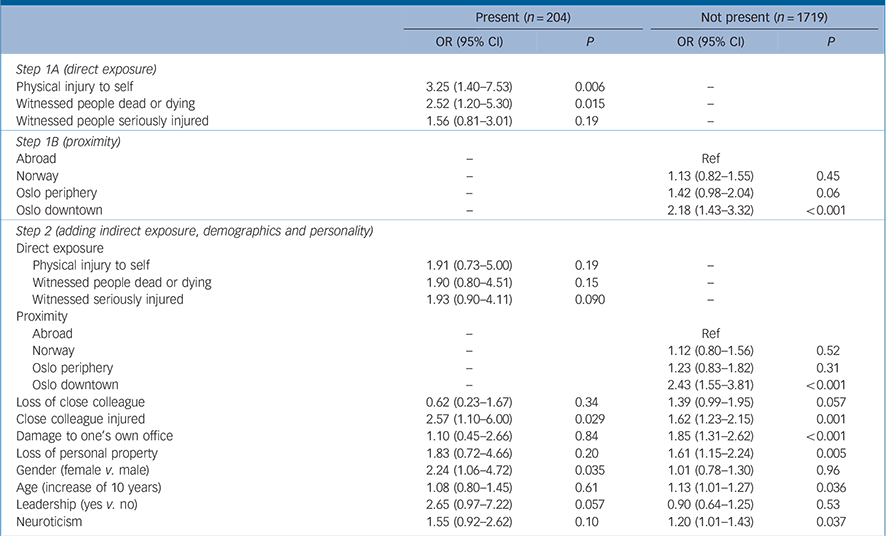
High perceived life threat, i.e. the retrospective belief that one's life was in great or overwhelming danger was reported by 22% (374) of the 1719 employees who had not been present when the bomb exploded and 65% (133) of the 204 employees who were present in the governmental district (P<0.001). Among those not present, physical proximity to the scene of the attack was associated with high perceived life threat (Table 2). More specifically, the prevalence of perceived life threat increased from 18% among employees who had been abroad, to 20% for those who were in Norway, outside Oslo; to 24% for those who were in the Oslo periphery, and to 33% for those who were in Oslo downtown (P<0.001 linear by linear association). In addition, indirect exposures, such as a close colleague injured, damage to one's own office, and the loss of personal property were independently associated with high levels of perceived life threat (Table 2). Among those who were not present, a positive association was also found for neuroticism.
Associations between direct or indirect exposures to terror and high perceived life threata among ministerial employees (n = 1923) who were present in the government district or not during the 2011 Oslo bombing: stepwise logistic regression adjusting for other variables
| Present (n = 204) | Not present (n = 1719) | |||
|---|---|---|---|---|
| OR (95% CI) | P | OR (95% CI) | P | |
| Step 1A (direct exposure) | ||||
| Physical injury to self | 3.25 (1.40–7.53) | 0.006 | – | |
| Witnessed people dead or dying | 2.52 (1.20–5.30) | 0.015 | – | |
| Witnessed people seriously injured | 1.56 (0.81–3.01) | 0.19 | – | |
| Step 1B (proximity) | ||||
| Abroad | – | Ref | ||
| Norway | – | 1.13 (0.82–1.55) | 0.45 | |
| Oslo periphery | – | 1.42 (0.98–2.04) | 0.06 | |
| Oslo downtown | – | 2.18 (1.43–3.32) | <0.001 | |
| Step 2 (adding indirect exposure, demographics and personality) | ||||
| Direct exposure | ||||
| Physical injury to self | 1.91 (0.73–5.00) | 0.19 | – | |
| Witnessed people dead or dying | 1.90 (0.80–4.51) | 0.15 | – | |
| Witnessed seriously injured | 1.93 (0.90–4.11) | 0.090 | – | |
| Proximity | ||||
| Abroad | – | Ref | ||
| Norway | – | 1.12 (0.80–1.56) | 0.52 | |
| Oslo periphery | – | 1.23 (0.83–1.82) | 0.31 | |
| Oslo downtown | – | 2.43 (1.55–3.81) | <0.001 | |
| Loss of close colleague | 0.62 (0.23–1.67) | 0.34 | 1.39 (0.99–1.95) | 0.057 |
| Close colleague injured | 2.57 (1.10–6.00) | 0.029 | 1.62 (1.23–2.15) | 0.001 |
| Damage to one's own office | 1.10 (0.45–2.66) | 0.84 | 1.85 (1.31–2.62) | <0.001 |
| Loss of personal property | 1.83 (0.72–4.66) | 0.20 | 1.61 (1.15–2.24) | 0.005 |
| Gender (female v. male) | 2.24 (1.06–4.72) | 0.035 | 1.01 (0.78–1.30) | 0.96 |
| Age (increase of 10 years) | 1.08 (0.80–1.45) | 0.61 | 1.13 (1.01–1.27) | 0.036 |
| Leadership (yes v. no) | 2.65 (0.97–7.22) | 0.057 | 0.90 (0.64–1.25) | 0.53 |
| Neuroticism | 1.55 (0.92–2.62) | 0.10 | 1.20 (1.01–1.43) | 0.037 |
a. High perceived life threat was defined as responding 4 (great) or 5 (overwhelming) to the question: ‘How great do you think the danger was that you would die?’, measured on a five-point scale ranging from 1, none to 5, overwhelming.
Among employees who had been present, physical injury to self and witnessing people dead or dying were independently associated with a high level of perceived life threat when taking only direct exposure into consideration (Table 2). However, when adjusting for indirect exposure, as well as for demographics and personality, our measures of direct exposure were not significantly related to perceived life threat. On the other hand, female gender and indirect exposure in terms of having a close colleague injured were associated with a high level of perceived life threat.
The symptom criteria for PTSD were met by 4% (64) of the 1719 employees who had not been present at the time of the incident and 24% (49) of the 204 employees who had been present (P<0.001). There was a strong association between perceived life threat and the prevalence of PTSD regardless of whether employees had been present during the bomb explosion or not (Table 3). Adjusting for measures of objective exposure, demographics and neuroticism had a low impact on the associations between perceived life threat and PTSD.
Associations between perceived life threat and post-traumatic stress disorder (PTSD) among ministerial employees (n = 1923) who were present in the government district or not during the 2011 Oslo bombing: stepwise logistic regression adjusting for other variables

| Present (n = 204) | Not present (n = 1719) | |||
|---|---|---|---|---|
| OR (95% CI) | P | OR (95% CI) | P | |
| Step 1 | ||||
| High perceived life threat a | 6.53 (2.45–17.36) | <0.001 | 5.36 (3.22–8.93) | <0.001 |
| Step 2 (Adding direct exposure) | ||||
| High perceived life threat | 5.87 (2.15–16.03) | 0.001 | ||
| Physical injury to self | 1.27 (0.60–2.67) | 0.54 | ||
| Witnessed people dead or dying | 0.93 (0.45–1.96) | 0.86 | ||
| Witnessed people seriously injured | 1.63 (0.72–3.69) | 0.24 | ||
| Step 3 (Adding demographics and personality) | ||||
| High perceived life threat | 5.65 (1.89–16.86) | 0.002 | 5.15 (2.96–8.96) | <0.001 |
| Physical injury to self | 1.03 (0.44–2.42) | 0.95 | ||
| Witnessed people dead or dying | 0.90 (0.39–2.09) | 0.80 | ||
| Witnessed people seriously injured | 2.16 (0.84–5.55) | 0.11 | ||
| Gender (female v. male) | 2.50 (1.04–6.03) | 0.041 | 1.19 (0.66–2.14) | 0.57 |
| Age (increase of 10 years) | 0.89 (0.64–1.25) | 0.51 | 1.19 (0.93–1.53) | 0.17 |
| Leadership (yes v. no) | 0.63 (0.20–1.95) | 0.42 | 0.52 (0.18–1.51) | 0.23 |
| Neuroticism | 2.98 (1.73–5.14) | <0.001 | 3.54 (2.50–5.02) | <0.001 |
a. High perceived life threat was defined as responding 4 (great) or 5 (overwhelming) to the question: ‘How great do you think the danger was that you would die?’, measured on a five-point scale ranging from 1, none to 5, overwhelming.
Discussion
Main findings
The present study examined perceived threat and PTSD in ministerial employees who were present v. not present at the scene of the 2011 Oslo bombing. Not surprisingly, the results showed that a higher proportion of employees who were present at the time of the attack experienced a high life threat. Still, a considerable proportion of individuals who had not been present perceived that their life had been in danger. For those who were not present, physical proximity to the scene of terror increased the probability of believing that one's life had been in danger. In addition, psychological proximity, such as having close colleagues that were injured, material damages to one's office and the loss of personal property increased the probability of a retrospective perception of high life threat. Regardless of whether individuals were present at the scene of the attack or not, perceived life threat was associated with PTSD, even when adjusting for other well-known predictors of PTSD such as gender, age, neuroticism and measures of objective exposure.
Interpretation of our findings
The present findings demonstrated that even individuals who were not present at the scene of a terrorist attack may, in retrospect, appraise the situation as if their life had been in danger. This is consistent with theories of counterfactual thinking, explaining that humans tend to create possible alternatives to life events that already occurred, and often contrary to what really happened. Reference Epstude and Roese9 Thus, retrospective evaluation of danger may be a result of thoughts of what could have happened. Whether they had been close to the terror scene or not, employees might have been preoccupied by thoughts like ‘what if … ’ or ‘if not … ’
The finding that high perceived life threat was associated with both physical and psychological proximity to the event also corresponds with theories of counterfactual thinking, in which perceived closeness to an alternative outcome makes appraisals of what could have happened more likely. Reference Roese and Olson18 Thus, our findings can be understood in terms of proximity heuristics and the role of closeness as an indicator of probability. Reference Teigen19–Reference Teigen21 Our findings suggest that neuroticism may affect the tendency to think that one's life was in danger. Rumination and worry often accompany neuroticism, and may include thoughts of adverse outcomes of what could have happened.
The high levels of perceived life threat suggest an upward estimation of the risk of dying. Although 65% of the employees who were present at the time of the explosion believed that their life had been in great or overwhelming danger, the true mortality rate for this group was 2%. On the other hand, the prevalence of high life threat was 22% among employees not present, despite that the mortality rate was 0.2% for all employees included. In fact, 99.8% of all the ministerial employees survived the terrorist attack, making odds for survival for a random employee quite high. The discrepancies are in accordance with experimental studies showing that subjective risks of dying are generally severely overestimated. Reference Teigen19,Reference Teigen21 Additionally, the catastrophic potential of a terrorist attack may influence people's probability judgments. Reference Verplanken22
The strong association between perceived life threat and PTSD is in agreement with previous research. Reference King, King, Bolton, Knight and Vogt1,Reference Mott, Graham and Teng2,Reference Vogt and Tanner6,Reference Gil and Caspi23–Reference Mayou, Ehlers and Bryant26 The present study extends these findings by demonstrating an equally strong association between perceived life threat and PTSD in individuals who were not directly exposed to trauma. Our findings support the notion that thoughts of what could have been continuously affect people's emotions, Reference Markman, Klein and Suhr27 and that ruminations on alterative outcomes can influence processes essential to PTSD development and recovery. Reference Dunmore, Clark and Ehlers28,Reference Ehlers and Clark29
Limitations
The present study has some limitations. First, the cross-sectional design of the present study does not allow conclusions about causality. Future longitudinal studies are needed to explore the directionality of the association between perceived life threat and PTSD. Second, exposure variables were collected 10 months after the event, and only assessed by self-reported measures. Third, the diagnosis of PTSD was determined by a self-reported instrument (PCL-S), and not by clinical diagnosis. However, the Norwegian version of the PCL-S performs nearly as well as the Structural Clinical Interview for DSM-IV (SCID-I) in its ability to detect PTSD in epidemiological research. Reference Hem, Hussain, Wentzel-Larsen and Heir15 Finally, we have not considered fulfilment of the PTSD A criterion, but only taken into account the burden of symptoms.
Implications
Our findings may have implications for public health strategies and the prevention and treatment of PTSD. Although a higher proportion of those who had been present at the scene of the terror attack reported that their life had been in great or overwhelming danger, the absolute number of employees that reported high life threat was higher among those who were not present. The same was true for PTSD, i.e. the total number of employees that met the symptom criteria of PTSD was higher among employees who had not been present than among those who were present. This may illustrate the outcome of many disasters, as well as stressful events of lesser magnitude. A low risk of severe stress reactions in more peripheral circuits may result in a very high number of affected individuals, as stated by Geoffrey Rose's fundamental axiom in preventive medicine: ‘a large number of people exposed to a small risk may generate many more cases than a small number exposed to a high risk’. Reference Rose30 Hence, a high-risk prevention strategy focusing solely on the individuals who are judged most likely to develop stress reactions may deal with only part of the problem. Our findings illustrate that post-disaster healthcare should be planned for large groups and not only for the group with the highest prevalence of a risk factor or a mental illness. One option might be a low-threshold service for mental health and psychosocial support that is available for anyone who is adversely affected by a disaster event.
A population strategy of prevention is necessary whenever risk is widely diffused through a larger population. Reference Rose31 According to general principles in situations where many people are exposed to some risk, Reference Rose30,Reference Rose31 a small shift in the distribution of perceived threat may have a large effect on the number of people with PTSD. Thus, moderating perceptions of having been in serious danger may be an appropriate approach to the prevention of PTSD. Attention to the event and its possible adverse effects may cause unintended appraisals and perceptions that people have been exposed to serious danger. In that respect, more research is necessary to determine how various aspects of disasters, such as media coverage, early intervention programmes, and various compensatory mechanisms affect people's perception of having been in serious danger. It has been well demonstrated that recalled threat intensity may increase with time, and that such recall amplification may hinder recovery from post-traumatic stress. Reference Heir, Piatigorsky and Weisæth11 Thus, health professionals, disaster workers and authorities should be aware of possible harmful effects of promoting perceptions of serious danger.
Moderation of retrospective threat appraisals may be an appropriate approach in cognitive therapy. It is well accepted that thoughts about what could have been can interfere with processes essential to recovery. Reference Ehlers and Clark29 Overestimations of the risk of dying suggest that therapeutic approaches that promote objective threat evaluation would be beneficial. An active reconstruction and cognition of the factual course of events may be a useful tool in this process. Reference Heir and Weisæth32
Previous studies have not provided an explanation of how people not physically present have developed post-traumatic stress after disasters or terrorist events. Reference Dixon, Rehling and Shiwach33–Reference Stein, Elliott, Jaycox, Collins, Berry and Klein36 Based on the present findings, counterfactual thoughts about serious threats to one's life may be the clue needed to fill in this gap. This underlines the importance of understanding cognitive processes and, more specifically, counterfactual evaluations in the aftermath of trauma. Reference Dalgleish37,Reference El Leithy, Brown and Robbins38 It may well be that the same processes are essential, regardless of physical proximity to a catastrophic event.
Funding
This work was supported by The Norwegian Directorate of Health.




eLetters
No eLetters have been published for this article.