

INTRODUCTION
Dr Tom Armstrong Bowes FSA (1869–1954) spent all his working life as a GP in Herne Bay, east Kent (just like his father and elder brother Charles), where he established himself as a noted local historian and antiquarian. In 1932 he was instrumental in the formation of the original Herne Bay Museum by the Herne Bay Records Society (HBRS), to which he bequeathed his collection of palaeoliths from gravel pits in the Stour valley at Fordwich, Sturry, Canterbury and Reculver (fig 1).
Palaeolithic sites located along the Kentish Stour in relation to the major rivers and other Lower Palaeolithic sites of south-east England. Map: first author.

Bowes’s collection was without doubt the largest and most significant collection of Palaeolithic flint artefacts from the Stour valley, but, other than the Fordwich specimens stored in the British Museum, it has played no part in recent reassessments of the British Lower Palaeolithic record.Footnote 1 The reasons for this are manifold. Bowes published almost nothing about his collection, just three short articles,Footnote 2 was wealthy enough to purchase what he wanted rather than scramble around dirty pits and employed a cryptic labelling system that involved using the second letter of the site name, only some of which could be worked out in the absence of his destroyed notebooks.Footnote 3 Worse, when the original Herne Bay Museum was flooded by a North Sea surge in 1953, many of the gummed labels were soaked off, removing any evidence of their provenance at all. The whole sorry mess was subsequently stored in a chicken shed, before being widely dispersed. Of the original 3,793 objects, housed in seventeen cases, less than half remain: 1,479 in the British Museum and 185 in Herne Bay Museum. As Derek Roe so elegantly put it:
The truth is that such information as does survive [about Bowes’s collection] has done so by tenuous chance, and we are left to wish that he had expended the energy he devoted to his private recording system on proper publication instead.Footnote 4
During a search of the Herne Bay Historical Records Office archives in 2020, one of us (first author) discovered a large archive belonging to Tom Bowes, which included nine scrapbooks containing some 3,550 pages of newspaper cuttings, offprints, tickets, menus, leaflets, postcards, photographs, paintings and letters, ephemera collated over a period of some thirty years from 1921–51. This archive provided the key to Bowes’s wider interests and his private recording/notation system and were housed together with a photograph album showing all the specimens from Fordwich with their original numbering, plus a large collection of flint implements from various localities.
Most of our recent insights into the Early and Middle Palaeolithic have come from modern excavations, which sample relatively small areas in great detail but often find few, if any, handaxes or other implements. There is, however, a vast body of material collected from expansive exposures in manually-dug pits from the 1860s through to the 1920s, when widescale mechanical excavation became normal.Footnote 5 Such early collections have been shown to be useful in broadscale studies of the movements of early humans.Footnote 6 Many of these collections are poorly contextualised and lack the detailed stratigraphic recording so important in modern analysis, but recent work has shown the continual reappraisal of old museum collections can contribute new understandings.Footnote 7 The integrity of these collections and any associated archival material is paramount to unlocking the lost provenance of artefacts so that their full potential can be realised and they can continue to contribute to, and even transform, current understandings of the early human societies.
This paper summarises what we have learnt about Bowes and his collection and explores how this rediscovered resource might be made valuable to modern research once again.
TOM BOWES (1869–1954), COLLECTOR
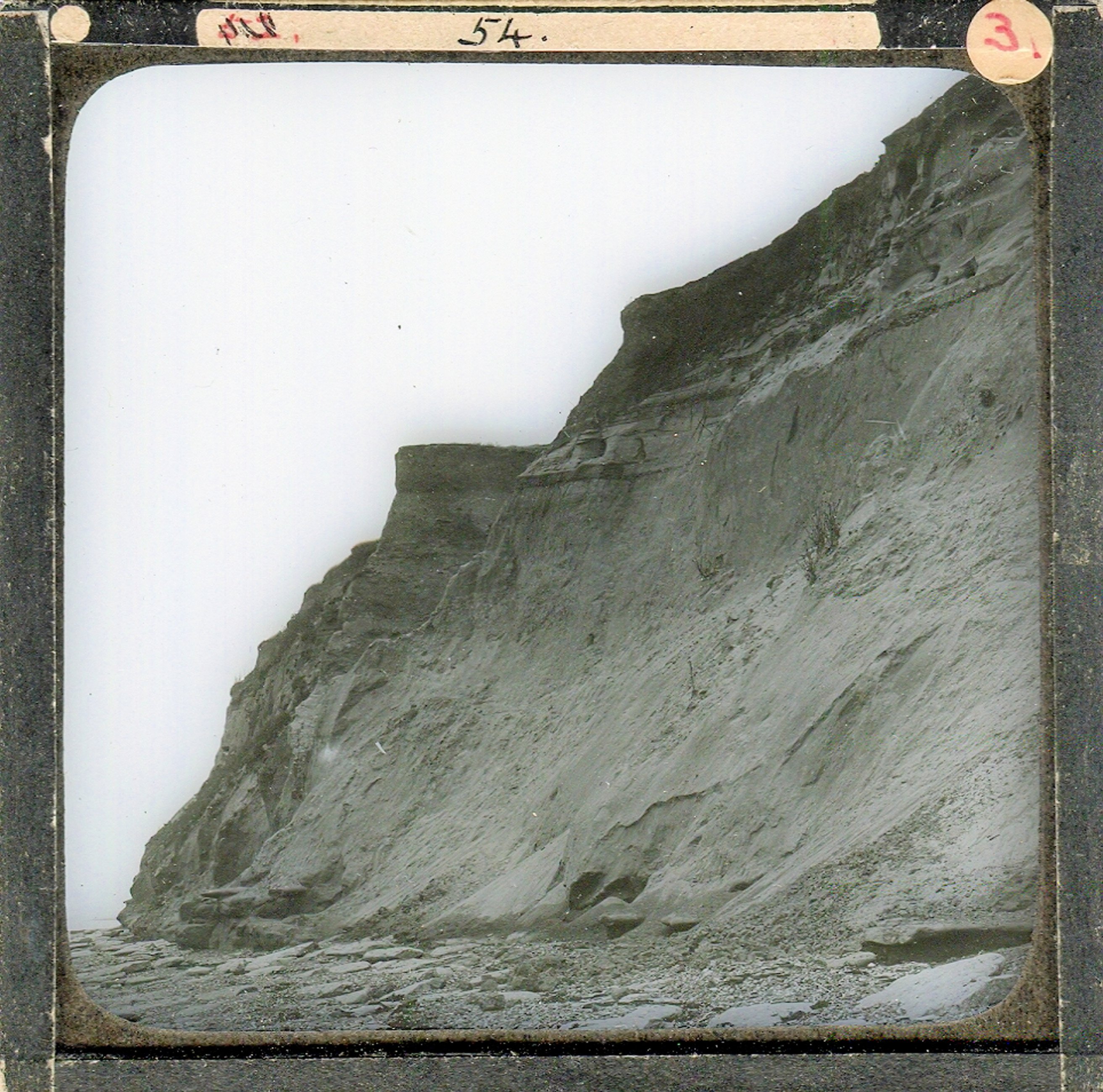
Tom Armstrong Bowes (fig 2) was born in Herne Bay on 30 November 1869, the youngest of seven children born to Hannah Bowes (nee Kitchen) and her husband Doctor John Bowes, a local GP and surgeon. The family was well known and highly respected among the gentlefolk of Herne Bay, a seaside town that had sought, since the first advertisements for bathing machines appeared in the eighteenth century, to distinguish itself as the ‘genteel’ alternative to Margate.Footnote 8 The family appears, in many respects, to have been the epitome of the Victorian upper middle-classes and at the time of Tom’s birth employed a cook, a nursemaid, a ladies’ maid, a general domestic and a governess. The young Tom Bowes received his early education at home before attending Epsom College, where he was head prefect and won the Watts Engledue and Martin Science Prizes; in his lecture ‘Sixty Years of Herne Bay’ he recounts boyhood tales of forays to Bishopstone Glen, which from his home he would have been able to see in the distant cliffs halfway between Herne Bay and Reculver. It was from the gravels capping these cliffs (fig 3) that some of the country’s earliest recorded collections of prehistoric flint implements were made, as far back as 1860.Footnote 9 In 1888, Bowes went up to study medicine at Gonville and Caius College, Cambridge, receiving his MD in 1897. Upon qualifying he returned to the family home at 7 Marine Terrace, Herne Bay, and set up in medical practice. For the rest of his life Dr Tom, as he was affectionately known, was a leading figure in Herne Bay, a member of the local Bible Society, the Cricket Club, the local Conservative Party Branch and the Fortnightly Club, among others, but unlike his kinsmen he resisted assuming any formal civic roles, preferring to spend his spare time on his hobbies.
Caricature of Tom Bowes. Bowes Scrapbook 4, p 114. Image: courtesy of HBHRS ©.

Bowes’s magic lantern slide from his lecture ‘Herne Bay in the past: cliffs at Reculver’. Image: courtesy of HBHRS ©.
Bowes was already collecting antiquities before the First World War, when he wrote to Sir Hercules Read FSA at the British Museum requesting information about Samian ware; possibly the Roman ceramic vessel ‘caught’ off Pudding Pan Rock and offered to him by the fisherman for not less than £22 6s (more than two months wages for a skilled tradesman in 1914). Throughout the remainder of the 1920s and 1930s, Bowes amassed a substantial collection of Palaeolithic artefacts from local sites in the Stour valley. Almost all of these he acquired through Valentine Sinclair, an antique dealer and proprietor of The Old Northgate Curiosity Shop, Canterbury.Footnote 10 Sinclair had extensive trade networks and contracts with several Kent quarrymen. He was always keen to remind Bowes of the stiff competition faced from other gentlemen ‘visiting the pits’, most notably Major Percy Powell-Cotton of Birchington, who had already heavily invested in Sinclair.Footnote 11 At Fordwich, Bowes set up an exclusive contract with the operators, Brett, who would supply him, via Sinclair, with the best finds from the new High Gravel Pit, ‘Fordwich Hill Quarry’.Footnote 12 There is, though, little evidence that Bowes regularly, if ever, visited the gravel pits from where the artefacts originated,Footnote 13 that any were collected personally or that he ever bothered to record the geology. Sinclair sometimes provided rudimentary details of the pit from which the ‘stones’ originated, their rough position in the gravels and which specimens the quarrymen considered oldest, but beyond that few contextual details were recorded by Bowes or his associates.
One of the guiding principles behind Bowes’s collection was his desire to have examples from every stage of human cultural development. From his scrapbooks (fig 4), lecture notes and magic lantern slides, it is evident that Bowes was up-to-date on the latest Palaeolithic frameworks. The first page of the first scrapbook can be taken as a microcosm of his interests and beliefs, an eclectic mix of cuttings relating to science and religion that includes literary quotations, verses from the bible, newspaper cuttings on archaeological discoveries, the obituary of a geologist, an article on bathing machines and a list of volumes in Charles Igglesden’s A Saunter Through Kent with Pen and Pencil. In the centre of the page is a quote from Alexander Pope’s An Essay on Man: ‘The proper study of mankind is man’.Footnote 14 His libraryFootnote 15 contained the 1897 second edition of Sir John Evans’ Ancient Stone Implements, Weapons and Ornaments of Great Britain, then and today the most authoritative account of the Reculver discoveries from 1861 onwards, although he would have found little concerning the archaeological succession from Evans, who was notoriously reticent on such matters.
Illustrations of Palaeolithic handaxes from Bowes’s collection, Scrapbook 1, pp 119–20. Image: courtesy of HBHRS.

Bowes’s library also contained several copies of the British Museum Guidebook to the Stone Age, and it is most likely from these and through correspondence with its author, Reginald Smith FSA, that Bowes kept up with the latest ideas on the Palaeolithic. Smith had been an early adopter of Victor Commont’s scheme for the Somme,Footnote 16 which established an evolutionary succession of handaxe industries ranging from crude Chellean forms to highly refined Upper Acheulean types. Smith’s pre-First World War work with the geologist Henry Dewey at Swanscombe and other localities in the Thames valley had resulted in a similarly definitive sequence for Britain.Footnote 17 During the 1920s, the pair had extended their research to the Kentish Stour, with papers on SturryFootnote 18 and FordwichFootnote 19 both drawing on Bowes’s collection, alongside the better documented discoveries of other local collectors Drs Ince and Willock. Smith saw parallels between the Thames and Stour. In Bowes’s collection from Fordwich Smith identified Clactonian (five cores, three scrapers, numerous large flakes), St Acheul type handaxes (n = 67) and ‘pear-shaped handaxes of the peculiar Fordwich facies’ (n = 288, 267 unrolled).Footnote 20 The gravels at Sturry, on the other hand, had yielded St Acheul handaxes beneath a Levalloisian Mousterian industry, topped by rolled Chellean artefacts, the last considered an older industry that had been redistributed from a higher and consequently older terrace. From these interactions Bowes would have understood that the rough handaxes from the high-level gravels at Fordwich were older than the better made types from Sturry, Reculver and Maypole, all of which sat at lower levels in the Stour terrace staircase, and this no doubt shaped his collecting habits.
Bowes’s completist collecting ethos also drove him into the world of eoliths (dawn stones), geofacts with naturally chipped edges and dark-brown staining found in abundance on the ancient gravels of the Kent plateau, but which for a period during the 1880s–90s were regarded as genuine artefacts by no less an authority than Sir Joseph Prestwich,Footnote 21 professor of geology at Oxford and one of the pioneers of Palaeolithic archaeology. Bowes personally visited the places where the eoliths had first been discovered in the 1880s by the Kent grocer Benjamin Harrison,Footnote 22 and would have received no discouragement from Reginald Smith, himself a quiet eolith sympathiser who for completeness had dedicated half a case to them when the British Museum’s display was reorganised in the 1910s.Footnote 23 Bowes also communicated with James Reid Moir (1879–1944), a tailor from Ipswich who had been making claims of humanly-made artefacts in the marine (Crag) and pre-Crag Tertiary beds in Suffolk and Norfolk since 1909. He had met with strong opposition from his contemporaries, such as the father of the Clactonian Samuel Hazzledine Warren (1873–1958), and had been disappointed not to have convinced Abbé Henri Breuil (1877–1961), the celebrated doyen of French archaeology.Footnote 24 Undeterred, the 1920s saw a spate of activity from Moir, who had by now convinced himself that he had discovered an unbroken sequence of human industry from eoliths, through pre-Palaeolithic rostro-carinate (keel-shaped) implements to proto-handaxes and handaxes. Articles about Moir’s sensational claims appeared in the national press – ‘Weapons of ancient Norfolk giants. Forest of elephants and tigers. Cromer research’ (The Evening News: 23 Dec 1924), ‘Man in glacial period, discoveries at Cromer, age of the Palaeoliths’ (The Times: 22 Aug 1924) and ‘Prehistoric Cromer, flint hunting on the Norfolk coast’ (The Daily Mail: 24 Jan 1925) – and clearly caught Bowes’s attention, as all were pasted into the first scrapbook. Bowes personally visited Cromer on several occasions,but was still reliant on Sinclair for his best specimens, who sent Bowes an encouraging letter concerning his forays: ‘I hope you will see the Norfolk flint with the carving on it while you are in town see if you can find one like mine there.’Footnote 25
Bowes’s own discovery in 1927 of a flint ‘handaxe’ from the Cromer Forest Bed at East Runton led to further correspondence with Moir and the production of a technical illustration by Bowes’s brother, Harold McGowan Bowes (fig 5). Moir, though, rather thin-skinned and having been wounded by rejection on many occasions, urged caution:
I think your brother is to be congratulated on his drawings & which I can see are in every way accurate. But this does not appear to be to the best advantage, although admirable illustrations, I can imagine some of the archaeological underworld claiming it as of natural origin! It is wise to be cautious on these matters, I am wondering if you would not be wise to refrain from publishing this until you have others of a similar type to show with it.Footnote 26
Lithograph of pre-Palaeolith from the Cromer Forest Bed. Image: courtesy of the Seaside Museum.
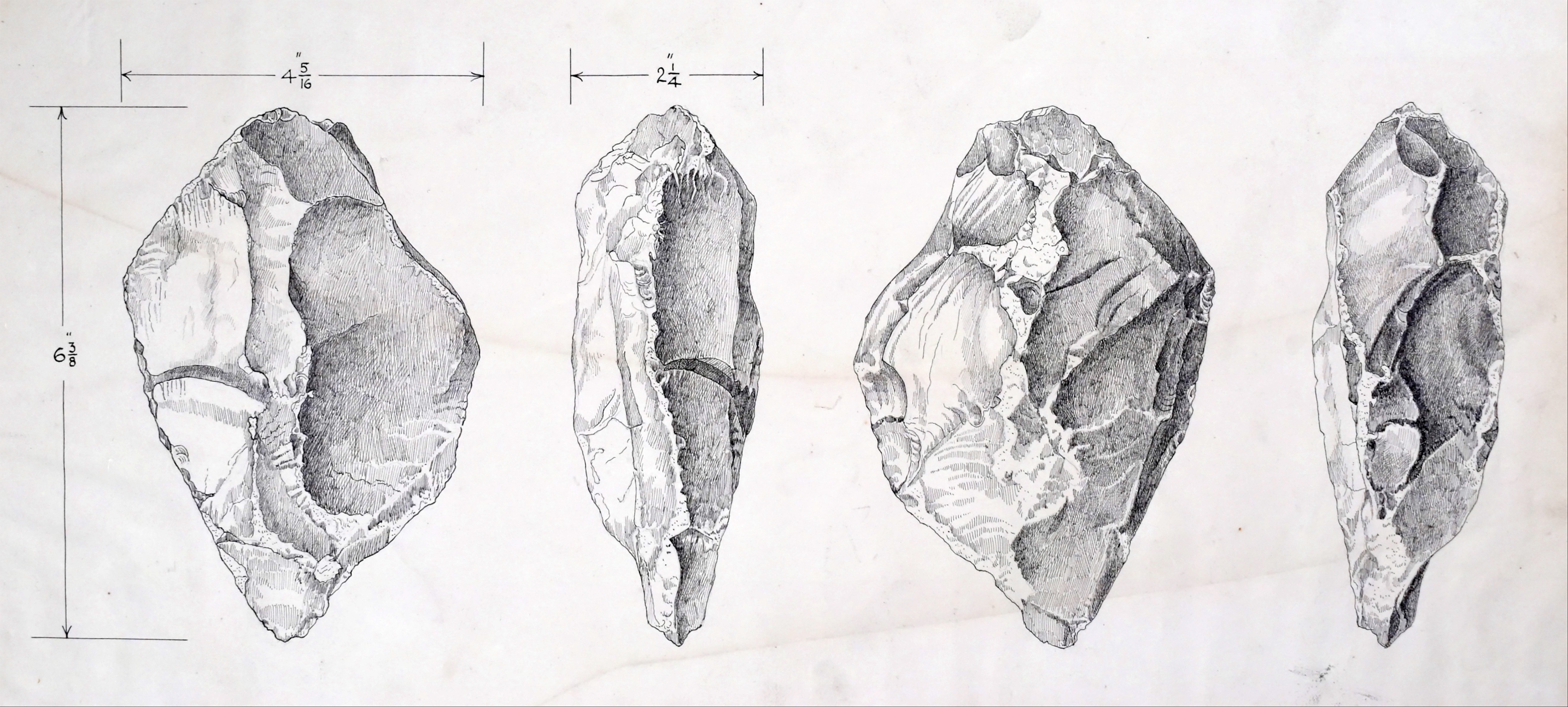
Bowes went ahead and published his find in The Antiquaries Journal,Footnote 27 although ironically the illustrations were too finely detailed to be rendered for publication and Reginald Smith asked Bowes for permission for them to be traced so as to make them suitable.
The scrapbooks are full of evidence for dubious artefacts Bowes had attempted to get authenticated, only to receive letters from experts saying they were not what he hoped for. Perhaps the most disappointing of these incidents was recorded in Scrapbook 3. In 1932 Bowes wrote to Reginald Smith at the British Museum about a flint nodule with the outline of a horse scratched into the cortex. Bowes had picked this up at Cissbury, near to the well-known Neolithic flint mine. After experts, including Henri Breuil and James Reid Moir, sent Bowes encouraging letters, Reginald Smith, who had previously written about and exhibited Bowes’s (genuine) Palaeolithic artefacts, got so far as drafting a short article announcing the carving to the world. Before Smith could do so, however, Bowes received a crushing letter from Leslie Armstrong: the scratches cut through not just the surface patina, but even the lichen on the stone, and must have been ‘drawn very recently indeed’. Five years later Bowes’s second find of a Cissbury stone with abstract carvings got short shrift from Smith. However, Bowes continued to contact museum authorities to research both his personal collection and that of Herne Bay Museum.
Bowes was a disciple of Charles Darwin and a keen follower of Sir Arthur Keith, the renowned anatomist, Fellow of the Royal Society and Conservator of the Hunterian Museum of the Royal College of Surgeons. Bowes’s scrapbooks contain a letter from Darwin to the Gardeners’ Chronicle written c 1871–2 and purchased by Bowes in the 1920s (DCP-LETT-7919F). His collection also contained a stuffed Argus pheasant (fig 6), a species that featured prominently in Darwin’s theory of sexual selection. The first articles of any length in Scrapbook 1 are Arthur Keith’s ‘Certain phases in the evolution of man’,Footnote 28 followed by the announcement of the Piltdown discoveries, which Keith considered confirmed his theories, and with which he would become strongly associated after his reconstruction of the Piltdown skull. Bowes’s affinity for Keith’s science was likely because both were medics who worked (briefly, in Keith’s case) as GPs. Keith’s writings often appeared in the British Medical Journal and other medical publications. Bowes’s own medical thesis had analysed complications of ear infections, for which he studied skull morphology, a methodology Keith used extensively. Like Keith, Bowes, at a more local level, advised archaeologists, police and others in his community on the identification and conservation of human and animal bones. Bowes accumulated press cuttings and offprints about evolution and items by and about Keith throughout his collecting life.
Display featuring the Argus pheasant in the first Herne Bay Museum run by the Herne Bay Records Society at the Odd Fellows Hall, Mortimer Street, c 1932. Image: Mike Bundock with permission of HBHRS.

FROM THE FORTNIGHTLY CLUB TO HERNE BAY MUSEUM
On the evening of 30 November 1928, a selection of eoliths and palaeoliths from Bowes’s collection was shown to the Herne Bay Fortnightly ClubFootnote 29 as an accompaniment to a lecture by William Henry Steadman, retired headmaster of Northfleet Boys School and fellow archaeologist. Steadman’s talk on that night was about ‘Some remains of Primeval Man’ and contained details of a ‘second’ Galley Hill man. The ‘first’ Galley Hill man had been found in the autumn of 1888, lying at a depth of 8ft in gravel of the 100ft terrace of the Thames near Northfleet, a known source of palaeoliths. The original finder, a quarryman called Jack Allsop, had safeguarded the discovery until local antiquarian Robert Elliott could investigate it. Elliott and his son examined the section carefully but could find no evidence that the gravel had been disturbed, a conclusion ‘confirmed’ seven years later by British Survey geologists William Topley and Clement Reid, by which time the section had long since vanished. Examining the human material (1895), the anatomist E T Newton saw a mixture of Homo sapiens and Neanderthal characteristics, unlike any known race past or present, from which he concluded that the find was a Palaeolithic ancestor of the Neolithic people of Britain.
The second Galley Hill specimen had in fact been found four years earlier than the first, by boys from Galley Hill School who had been illicitly playing in the adjacent gravel pits. Their finds had come from a depth of 5ft in another exposure of the 100ft terrace gravel and consisted of a partial skull and several other bones. They brought them to the attention of one of the school masters, Steadman, who placed them in the school collection. Here they remained until around 1910, when Steadman happened to come across reports about the first Galley Hill man and realised that his specimen might be of the same type. When the skull was examined by Sir Arthur Keith, he pronounced it was indeed of the same type as the first Galley Hill skeleton but noted that the bones were thinner and whiter. He concluded that the evidence was, on the whole, ‘against the probability of the second Galley Hill man being of the age of the 100ft terrace’.Footnote 30 Subsequent scientific analyses unequivocally demonstrated that the first Galley Hill skeleton was of more recent origin,Footnote 31 probably Neolithic to Bronze Age, but what became of the second Galley Hill man is unclear. Oakley and Montague stated that ‘at the present time no skull answering precisely to Sir Arthur Keith’s description can be traced’,Footnote 32 but during a recent revaluation of the Quaternary fossil and lithics collection within the Seaside Museum,Footnote 33 Herne Bay, undertaken as part of a conservation award by the Quaternary Research Association,Footnote 34 a human lower jaw mandible labelled ‘Northfleet’ was identified. The exact provenance is unknown, but due to Steadman’s association with the founding of the museum there is a possibility that this is part of the missing remains from Galley Hill.
Bowes eventually joined the Fortnightly Club and became one of its longest lasting members (twenty-five years). He was president from 1943 to 1951, leading the society through the tumultuous years of the Second World War, and throughout his long association gave a total of nineteen lectures. The election of Bowes at this juncture was the catalyst that spurred the formation of the Herne Bay Records Society,Footnote 35 probably through a combination of his exhibition of stone implements and his presence in discussions; things certainly gained momentum after Bowes joined the club, and in 1932 the HBRS Museum was opened in the former Plymouth Brethren chapel, the Oddfellows Hall at 53 Mortimer Street, Bowes became the chairman and William Steadman the honorary curator.Footnote 36
TOM BOWES’S COLLECTION
By the time a Herne Bay Museum was mooted, Tom Bowes’s collection was so large that he had to house it in a room of the old Herne Bay College, probably by arrangement with the headmaster, his lifelong friend Captain Eustace Turner. It filled seventeen cases and contained nearly 4,000 objects. It was probably with some relief to the school that the flint implement collection became a founding component of the Herne Bay Museum’s collection. Two ledgers provide details of Bowes’s original collection from the Stour, along with extant totals and the key to Bowes’s cryptic labelling system (table 1).
Assessment of Bowes’s collection from two original museum catalogues (blue and maroon books) with totals of Palaeoliths from sites in east Kent, in the original collection, and remaining collection in the Seaside Museum, Herne Bay, and the British Museum.
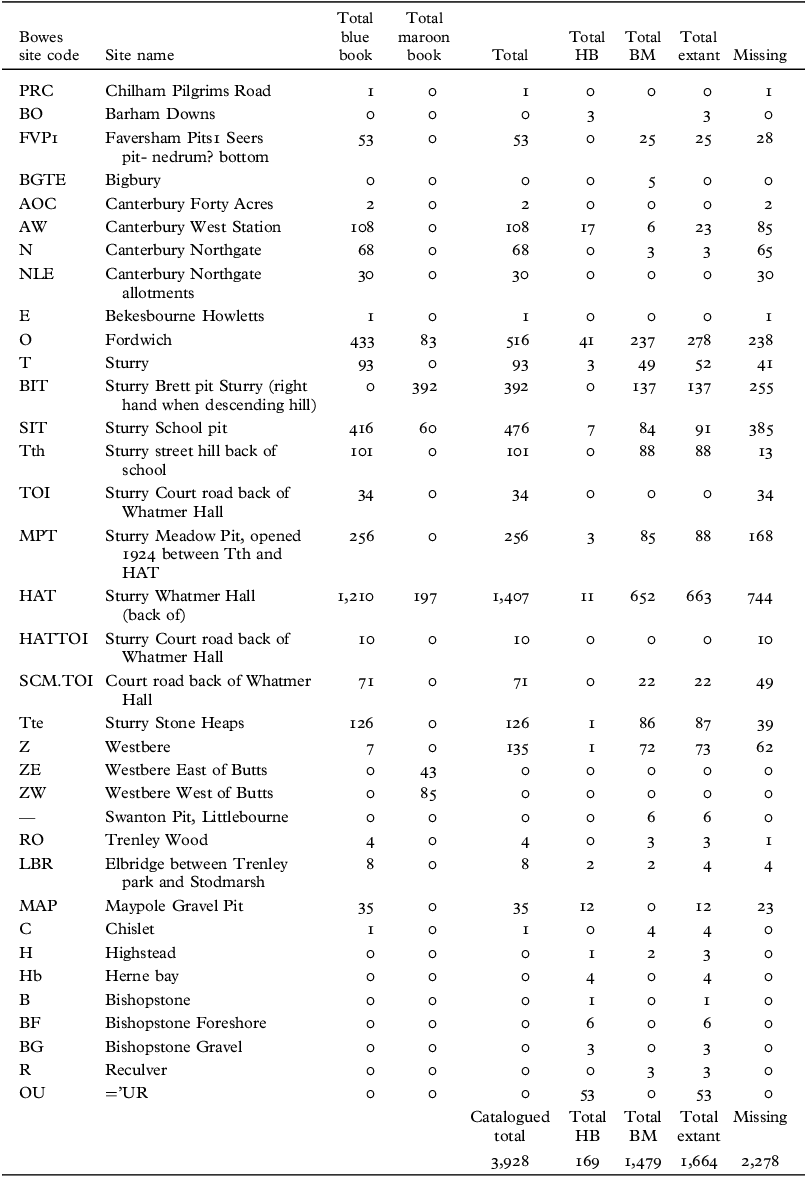
The known extant collection (n = 1,664) is less than half the size of the original acquisition (3,928), 1,479 of which are in the British Museum (BM), although 185 of the more spectacular items remain in the Seaside Museum, Herne Bay. The whereabouts of and what happened to the rest of the material is unknown, but after the Second World War the collection had a troubled history, including flood damage that removed the vital gummed labels and an ignominious stay in a chicken shed. Successive curators either did not recognise the collection’s significance or, without the contextual detail, were unable to interpret them in any meaningful way. This likely lay behind the decision in 1963 to offer the collection to the British Museum, which was accepted.Footnote 37
The collection is like most of this vintage, assemblages dominated by formal tools, handaxes, scrapers and flake tools, but does contain several cores, flakes and diverse objects. It is unlikely that there is a significant bias towards any particular forms in the entire collection, as Bowes took everything offered to him; during boom periods he received regular deliveries of artefacts ‘by the crate load’, although the material held by the Seaside Museum does seem to contain mostly large or elegant forms. It is currently under detailed study as part of the PhD thesis of the first author, from which some preliminary observations to demonstrate the value of re-combining the sample can be made within the context of current research. This is showing that the Middle Pleistocene fluvial archive of the major English rivers contain a hitherto unknown temporal pattern in artefact assemblages,Footnote 38 suggesting that artefact assemblages do carry chronological significance and might relate to the cultural preferences of different human groups over time, an interpretation previously abandoned. This has been made possible using a new expanded chronostratigraphic framework based on the marine oxygen isotope record and a scaffold of biostratigraphical and geochronological dating for glacial cycles, but has so far only been adequately demonstrated in the Thames valley.
The collection contains material from at least three different terraces of the River Stour, the most easterly former tributary of the Thames. A staircase of terraces descending in an easterly direction to the modern alluvial floodplain near to sea level was mapped by Alice Coleman in the 1950s.Footnote 39 These were formed in successive erosional cycles, a product of falling and rising sea levels due to the climatic oscillations of the glacial cycles and crustal uplift. There is still much ambiguity in the dating of the Stour and how the Palaeolithic archaeology from the terrace sediments correlate with the marine oxygen isotope record, but if one terrace can be accurately dated then in theory other terraces can be dated upwards or downwards from this known marker. The terraces containing Palaeolithic archaeology may span as many as nine different glacial/interglacial phases correlating with the marine isotope stages (MIS), stretching from MIS–15 to MIS–7 (c 620 000 to 200 000 years bp).
It includes at least three sites of national importance on distinct terraces: Fordwich, Sturry and Canterbury West. The first, at Fordwich, contains a high proportion of crude Acheulean handaxes of possible MIS–15 age,Footnote 40 which may make them the oldest in Britain and, other than Moulin Quignon in the Somme (with which they have great affinity),Footnote 41 the oldest in northern Europe. The Fordwich assemblage also contains very fine scrapers akin to those from High Lodge and a number of well-made ovate handaxes of Boxgrove type.Footnote 42 There are also several large multiple platform cores, bi-pyramidal in form and worked in a roughly discoidal fashion, identical to those previously called Clactonian but now known not to be exclusive to that industry but to occur alongside handaxes in Acheulean contexts. Recent work in deposits of comparable age, at Mildenhall in Suffolk,Footnote 43 have suggested the presence of three different assemblage types: an early and crude Acheulean in rolled condition and probably relating to MIS–14 or 15 as seen at Warren Hill; a refined, earlier MIS–13 scraper assemblage without handaxes (best known from High Lodge); and a refined ovate Acheulean assemblage dating to late MIS–13, as found at both sites mentioned above as well as at Boxgrove in Sussex.
The material from the many pits at Sturry is yet to be studied in detail, but it does contain a number of very well made twisted ovate handaxes, which appear to be marker fossils for MIS–11a south of the Thames.Footnote 44 Intriguingly, Bowes’s catalogue makes no mention of Homersham’s West Pit at Sturry, a site where Dr Ince collected artefacts and made careful records of their position in the geological sequence. This was later published by Smith and Dewey, who identified an Acheulean assemblage from the basal gravel, followed by an early phase of the Mousterian containing Levallois with crude rolled (‘Chellean’) handaxes at the top.Footnote 45 The material in the Bowes collection (fig 7), although not as well contextualised as the collection of Ince, is still useful in statistical analysis of the Acheulean handaxe forms across pre and post Anglian sites and may corroborate Ince’s observations. It contains some elegant twisted handaxes, but in rolled condition and most likely displaced from the higher terrace. The School Pit assemblage, furthermore, has a section drawing and interpretation by Breuil,Footnote 46 providing another key tie point for comparison with other sites and other workers. This site sits at a lower elevation and yielded Levallois material.
Examples of handaxes in the Bowes collection. Top row all from Fordwich. Bottom row from left: a quartz crystal tipped elongated ovate from Sturry; then from St Stephens Canterbury (West): cleaver, ficron and large pointed. Photographs: first author, courtesy of the Seaside Museum.
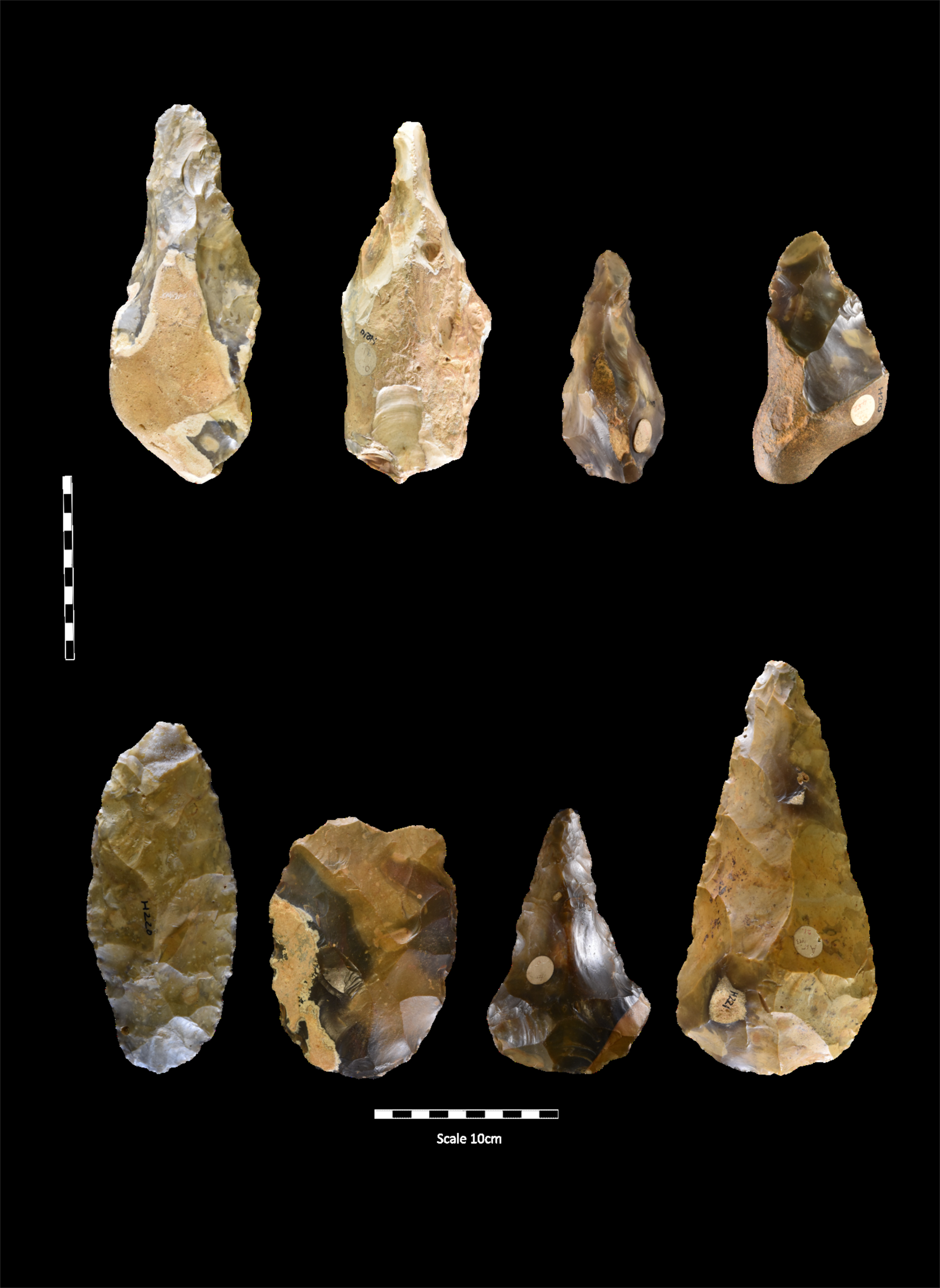
The most significant finding to date has been the small collection of handaxes (n = 17) labelled from Canterbury West, on a lower terrace and upstream of the Sturry sites.Footnote 47 This contains ficrons and cleavers, which have been shown to co-occur in significant numbers only in sites belonging to the MIS–9 interglacial cycle,Footnote 48 most notably at Cuxton,Footnote 49 in the Medway valley, and the recent discovery of an exceptionally large ficron handaxe at Frinsbury,Footnote 50 a site on a tributary of the Medway, but also a comparable assemblage from Howletts,Footnote 51 a site in the Little Stour valley, a tributary of the Great Stour. The occurrence of so many assemblages containing ficrons and cleavers within the fluvial systems of rivers in south-east Britain may suggest that they are all cultural comparators.
CONCLUSION
The Bowes collection provides a valuable large sample of artefacts from the terraces of the Stour from which to understand the Palaeolithic settlement of southern Britain. Given Bowes’s complete lack of attention to contextual niceties, however, on its own it can tell us very little. Understanding the Bowes collection relies on the work of others, both people in the past such as Ince, Smith and Dewey, who took greater care to understand the geology and sequence in the Stour, and workers in the present who have returned to these sites to provide up-to-date analyses of the sediments and context of the artefacts.Footnote 52 Typically, though, modern investigations cut only small sections and find far fewer artefacts than were uncovered in the days of manual and steam-shovel gravel extraction, and it is here, used with due diligence, that the Bowes collection will come into its own.
SUPPLEMENTARY MATERIAL
To view supplementary material for this article, please visit https://doi.org/10.1017/S0003581524000015
ABBREVIATIONS AND BIBLIOGRAPHY
Abbreviations
- BM
-
British Museum
- MIS
-
marine isotope stage
- HBRS
-
Herne Bay Records Society
- HBHRS
-
Herne Bay Historical Records Society


 Open access

