

1. Introduction
Global challenges demand collective solutions, and global governance is frequently hypothesized as an essential mechanism to achieve effective, internationally coordinated policy and action. Global governance is made up of international efforts to generate knowledge and develop rules, procedures, norms, and foreign policy instruments that regulate the international order (Dingwerth & Pattberg, Reference Dingwerth and Pattberg2006; Ruffini, Reference Ruffini2017; Thomas, Reference Thomas2011; Weiss, Reference Weiss2016). One increasingly recognized tool of global governance is science diplomacy (hereafter SD) efforts aimed at recruiting and integrating scientific expertise into international problem-solving.
A primary function of SD is to facilitate the formation of effective epistemic communities (hereafter EC): a network of domain-specific professionals, in this case scientists, who generate authoritative knowledge to inform the policymaking process. These communities also develop epistemic discourses that play a fundamental role in defining the international space (Adler & Haas, Reference Adler and Haas1992; Bueger, Reference Bueger, Mayer, Carpes and Knoblich2014; Haas, Reference Haas1992, Reference Haas2015). The participation and active engagement of a global network of scientists within these ECs is crucial, as they provide independent analysis and scientific evidence (Kaltofen & Acuto, Reference Kaltofen and Acuto2018). By fostering collaboration between diplomats and scientists, SD serves as an instrumental dimension of global governance – supporting the creation of new scientific knowledge that informs foreign policy, promotes international scientific collaborations, and strengthens international cooperation on global challenges (AAAS, & The Royal Society, 2010; Kaltofen & Acuto, Reference Kaltofen and Acuto2018; Ruffini, Reference Ruffini2017; Rungius & Flink, Reference Rungius and Flink2020).
The process by which SD fosters an effective scientific EC is complex, and there has not been a systematic analysis of the main components or their effectiveness. Analyzed here is the selected case of over a decade (2011–2022) campaign of SD initiatives aimed at forming an EC for new knowledge to assist in meeting the global challenge of the Water–Energy–Food Nexus Framework (hereafter, WEF Nexus). This case is particularly instructive, as the WEF Nexus has gained prominence as a multifaceted and integrated approach to addressing climate change challenges in agricultural production, water resource management, and energy production (Albrecht et al., Reference Albrecht, Crootof and Scott2018; Daher & Mohtar, Reference Daher and Mohtar2015; Mohtar, Reference Mohtar2022; Scott et al., Reference Scott, Kurian, Wescoat, Kurian and Ardakanian2015). More broadly, the analysis of the WEF Nexus case evaluates the extent to which the combination of initial nudges and catalyst seed funding—here, in the form of an international SD campaign—could create self-sustaining research and innovation in critical policy domains.
Prior to the introduction of the WEF Nexus concept, the autonomous subfields of water, energy, and food largely operated in isolation, with their own networks of scientists, journals, and conceptual frameworks, alongside the routine career investments tied to identification with a specific subfield. The limitations of these siloed fields, particularly considering the complexity of climate change and the interdependencies of resource management, spurred the interest of global governance actors in promoting a systems-thinking approach. This momentum evolved into an SD campaign led primarily by policymakers in the Global North (Caballero & Londoño, Reference Caballero and Londoño2022), who supported the WEF Nexus through a classic pump-priming strategy, aiming to generate solutions to major policy challenges under the resource constraints commonly faced by nation-states and international organizations (Borrás & Edquist, Reference Borrás and Edquist2013; Flanagan et al., Reference Flanagan, Uyarra and Laranja2011; Mazzucato, Reference Mazzucato2014; Nichols & Roskam, Reference Nichols and Roskam1939). It also represents a case of temporary intervention intended to stimulate the emergence of a self-sustaining innovation ecosystem (John, Reference John2018; Thaler & Sunstein, Reference Thaler and Sunstein2008).
This perspective raises central questions about global governance regarding policy and sustainability efforts in the face of climate change and natural resource management: Was there a substantial and intensifying SD campaign for the WEF Nexus in concept and practice? If so, did this campaign foster the emergence of a mature and resilient scientific EC around the WEF Nexus Framework? And if so, did the resulting EC generate significant scientific knowledge contributions, and was it self-sustaining after SD efforts subsided?
To address these questions, this study combines analyses of unique data on global governance efforts directed at the concept of WEF Nexus from 2011 through 2022 with bibliometric data on resulting scientific publications. This enables, for the first time, the tracking of the volume and timing of an SD campaign aimed at a new scientific EC for new policy-relevant research. Additionally tracked are concurrent scientific recruiting activities known to attract scientists to emerging topics and stimulate research and knowledge production (Milojević, Reference Milojević2025). Then four dimensions of a resulting EC over the period are assessed: (1) attracting scientists and formation of a core group of researchers; (2) the establishment of a legitimizing core of topical scientific outlets and bridging to outlets on related topics; (3) the maturation of the collaborators’ network of publishing scientists; and (4) achieving sustainability through a resilient network. Finally, as a measure of authoritative scientific response to an emerging international challenge, the volume and growth rate of the EC's output in scientific publications are evaluated in relation to the SD campaign and recruiting events.
2. SD and formation of ECs
It is known that the likelihood of influencing international policymaking increases with the establishment of an effective EC providing interdisciplinary, credible, and transparent expertise that addresses a clearly defined problem with direct policy implications (Antoniades, Reference Antoniades2003; Bueger, Reference Bueger, Mayer, Carpes and Knoblich2014; Haas, Reference Haas1992, Reference Haas2015; Palladino, Reference Palladino2021). ECs share common normative beliefs, offer causal explanations for the problem at stake, and share common mechanisms to validate relevant knowledge that contributes to the understanding of the problem (Adler & Haas, Reference Adler and Haas1992). Amongst effective ECs, scientists often play crucial roles in generating new knowledge, serving as policy advisors, advocates of pressing issues, and facilitators of cross-border scientific collaborations (Haas, Reference Haas2015; Jasanoff, Reference Jasanoff2012).
SD mechanisms facilitate the formation of ECs by providing platforms for scientific advice, fostering international scientific collaborations, and promoting scientific cooperation to ease diplomatic tensions (Polejack et al., Reference Polejack and Coelho2021; Prieto & Scott, Reference Prieto and Scott2022). In turn, ECs can shape future SD mechanisms by influencing their design and implementation through expert-driven policy engagement (Tanczer et al., Reference Tanczer, Brass and Carr2018). This dynamic relationship has been documented in knowledge production processes that contribute to international agenda-setting and consensus-building in areas such as transnational activism, security, cybersecurity, trade, and environmental policy (Adler, Reference Adler2008; Cross, Reference Cross2011; Drake & Nicolaidis, Reference Drake and Nicolaidis1992; Keck & Sikkink, Reference Keck and Sikkink1998; Ollivier-Mrejen et al., Reference Ollivier-Mrejen, Michel and Pham2018; Peterson, Reference Peterson1992; Ruffini, Reference Ruffini2018; Whitesides, Reference Whitesides2020). Similarly, SD mechanisms have facilitated international partnerships that drive cutting-edge scientific advancements requiring significant investment, such as the Large Hadron Collider at CERN (Höne & Kurbalija, Reference Höne and Kurbalija2018) and transnational collaborations between leading scientific ecosystems (Ruffini, Reference Ruffini2020; Suttmeier & Simon, Reference Suttmeier, Simon, Mayer, Carpes and Knoblich2014; Wagner & Simon, Reference Wagner and Simon2023).
Yet this widely circulated, cooperation-oriented vision of SD has been critiqued as somewhat naïve for overlooking the asymmetrical power dynamics embedded in diplomatic and scientific engagements. Critical scholarship argues that the AAAS framing tends to obscure the political interests, motivations, and strategic goals behind SD initiatives, reflecting an idealized practitioner-driven model rather than the complexity observed in practice (Fägersten, Reference Fägersten2022). Others similarly highlight that SD is inseparable from geopolitics and global economic competition, emphasizing that scientific collaboration is often intertwined with national interest, strategic positioning, and unequal capacities between the Global North and Global South (Flink & Schreiterer, Reference Flink and Schreiterer2010; Gluckman et al., Reference Gluckman, Turekian, Grimes and Kishi2017). Recent critiques further argue that SD must be understood not as a harmonizing force but as a practice of navigating political and economic complexity (Adamson et al., Reference Adamson, Robinson, Barrett and Jacobsen2025). Taken together, these critiques call for a ‘post-naïve’ approach that situates SD within broader competitive and geo-economic dynamics rather than viewing it solely as a harmonizing or cooperative enterprise (Olšáková, Reference Olšáková2023).
Recent policy reflections underscore this broader role for SD not only in fostering cooperation but also in navigating competition, building inclusive knowledge infrastructures, and supporting long-term systems governance (AAAS, & The Royal Society, 2025). This broader view of SD as a strategic, mission-driven, and system-oriented tool is echoed in recent European frameworks that highlight the importance of cultivating institutional SD ecosystems and evaluating their impact on sustainability-oriented governance (European Commission. Directorate General for Research and Innovation, 2025).
It is widely recognized that SD lacks a single agreed definition, with conceptualizations ranging from foreign policy tools to transnational knowledge diplomacy (Kaltofen & Acuto, Reference Kaltofen and Acuto2018). This study adopts a pragmatic definition focused on purposive interventions aimed at mobilizing and coordinating scientific communities. In this analysis, SD refers to concrete interventions by specific organizations, rather than an abstract process, that mobilized resources and venues for WEF Nexus research. These included multilateral research programs (e.g., IAI CRN3, Belmont Forum SUGI-FWE, CGIAR Nexus Gains), supranational EU initiatives (Horizon funding and the PRIMA WEFE agenda), development finance–backed schemes (World Bank, regional development banks, WE4F), bilateral science partnerships (Newton Fund, Merian Fund, US–China INFEWS), and nationally funded programs with an explicit international scope (e.g., NexusAsia, NSF INFEWS). Notably, many of these initiatives were designed and financed by institutions based in the Global North, reflecting the region's central role in shaping the international policy agendas that promoted the WEF Nexus. These actors also supported the production of WEF-themed books and journal special issues, using publication venues as additional SD instruments that helped consolidate and broaden the emerging Nexus EC.
3. Addressing the research gap in the WEF Nexus
Climate change is arguably the most pressing global environmental challenge confronting humanity (Climate Change 2021: The Physical Science Basis, 2021; Abbass et al., Reference Abbass, Qasim, Song, Murshed, Mahmood and Younis2022; Mora et al., Reference Mora, Dousset, Caldwell, Powell, Geronimo, Bielecki, Counsell, Dietrich, Johnston, Louis, Lucas, McKenzie, Shea, Tseng, Giambelluca, Leon, Hawkins and Trauernicht2017; Tebaldi et al., Reference Tebaldi, Hayhoe, Arblaster and Meehl2006). Scientific research has shown that the accelerated growth triggered by industrialization and globalization has significantly degraded natural ecosystems, leading to abrupt and far-reaching climate changes (e.g., Miles et al., Reference Miles, Underdal, Andresen, Wettestad, Skjærseth and Carlin2002; Rockström et al., Reference Rockström, Steffen, Noone, Persson, Chapin, Lambin, Lenton, Scheffer, Folke, Schellnhuber, Nykvist, de Wit, Hughes, van der Leeuw, Rodhe, Sörlin, Snyder, Costanza, Svedin and Foley2009). Recognition of planetary boundaries and the anthropogenic origins of climate change has spurred a global call to action, prompting extensive efforts at national, international, and multilateral levels (Özkaragöz Doğan et al., Reference Özkaragöz Doğan, Uygun and Akçomak2021; Ruffini, Reference Ruffini2018; Thompson, Reference Thompson2018). Notably, scientific input has shaped diplomatic negotiations around a variety of environmental issues. It has informed the adoption of international regulatory frameworks concerning biodiversity, marine pollution, acid rain, stratospheric ozone depletion, wetland conservation, the protection of migratory species and polar bears, and the governance of Antarctica (Harden-Davies, Reference Harden-Davies2018; Johnston, Reference Johnston, Rajamani and Peel2021; Prieto et al., Reference Prieto, Ocampo-Peñuela, Zapata and Medina2025). Therefore, fostering the production of such policy-relevant knowledge about climate change and its consequences has become a central goal of global governance (Bäckstrand, Reference Bäckstrand2003; Castells, Reference Castells2008; Gluckman et al., Reference Gluckman, Bardsley and Kaiser2021; Johnston, Reference Johnston, Rajamani and Peel2021; Legrand & Stone, Reference Legrand and Stone2018).
Among the integrative frameworks gaining momentum in response to these multifaceted challenges is the WEF Nexus. However, integrative and systemic approaches to resource management have circulated in academic and policy circles since at least the 1990s. Importantly, frameworks such as Integrated Water Resources Management (IWRM) and related approaches in sustainability science and coupled socio-ecological systems, which recognized cross-sectoral interlinkages well before the ‘nexus’ terminology was formalized (Leck et al., Reference Leck, Conway, Bradshaw and Rees2015). The WEF Nexus conceptualizes the interdependencies among these essential resources. Earlier discussions focused on dyadic relationships—such as food–energy, water–food, or water–energy linkages—but the tripartite WEF Nexus emerged prominently in global discourse in 2008, when the World Economic Forum began addressing water security, building on earlier work on resource interlinkages (Scott & Shah, Reference Scott and Shah2004). Several years later, these conversations culminated in the publication of an initial WEF Nexus volume, which identified population growth, economic development, and urbanization as key drivers of rising demand for water, energy, and food (Waughray, Reference Waughray2011).
Building on these developments, the German government, in collaboration with the World Wildlife Fund, the International Food Policy Research Institute, and other international actors, convened the 2011 Bonn Nexus Conference. At this event, the Stockholm Environment Institute formally introduced the WEF Nexus Framework as an essential component of green economy and growth strategies (Hoff, Reference Hoff2011). The framework highlighted its value for decision-making in contexts requiring the evaluation of trade-offs and interdependencies among natural resources. For instance, energy production choices can affect water usage and, in the case of biofuels, compete with food production for land. Similarly, water extraction, treatment, pricing, and distribution have implications for energy consumption. Dietary and agricultural choices also influence both water and energy demands.
As an outcome of the Bonn conference, a set of policy recommendations was issued. National governments were encouraged to invest in learning and knowledge management systems to strengthen the capacity of leaders, policymakers, and researchers. International organizations were urged to support evidence generation for the WEF Nexus through funding, partnerships, and transboundary cooperation. Research institutions and universities were invited to help close knowledge gaps by developing context-specific technologies, promoting cross-sectoral coordination, designing decision-support tools and indicators, enhancing science-policy communication, and conducting applied research to improve sustainability, resilience, and policy coherence across interconnected systems (BonnNexus2011, 2012).
In 2012, the United Nations Secretary-General presented the report Resilient People, Resilient Planet, which emphasized the need to develop an integrated understanding of the WEF Nexus and proposed the creation of a periodic global outlook report to assess progress in this area (Halonen & Zuma, Reference Halonen and Zuma2012).
However, due to its top-down and closed-door approach, the proposed global nexus outlook report failed to gain traction. In parallel, international attention increasingly turned toward the Sustainable Development Goals (SDGs), a proposal championed by the government of Colombia that offered a more inclusive and goal-oriented framework for global development (Caballero & Londoño, Reference Caballero and Londoño2022).
Despite this setback, governments and scientific institutions—particularly from the Global North—continued to promote the WEF Nexus, presenting it in various international fora and establishing conceptual and policy linkages with the emerging SDG agenda. Subsequently, the WEF Nexus featured in numerous multilateral forums, including the 2012 Rio + 20 United Nations Conference on Sustainable Development, COP18 on Climate Change, meetings of the World Meteorological Organization, the 2015 G20 Summit, and discussions leading to the adoption of the SDGs (Allan et al., Reference Allan, Keulertz and Woertz2015; Daher & Mohtar, Reference Daher and Mohtar2015).
Influencing the direction of scientific research is a formidable challenge. This is particularly the case of the WEF Nexus Framework, where the impetus did not arise from the usual drivers of scientific change, such as theoretical crisis or disruptive empirical findings (Marques et al., Reference Marques, Macasaet, Powell, Dusdal and Baker2025). At the outset, it was unclear whether global governance interest in promoting the integrative framework of the WEF Nexus would catalyze the formation of a supportive and resilient EC capable of producing actionable, cross-disciplinary knowledge even after the SD campaign began to decline.
4. Methods
4.1. Data collection
First, from 2011 through 2022, SD mechanisms and scientific recruiting activities were extracted and coded from the comprehensive online listing of events, dates, and reports: WEF Nexus Resource Platform (https://www.water-energy-food.org/). Second, to generate data to assess both the emergence of a scientific EC and its generation of research, WEF Nexus scientific publications were searched for using the Scopus Application Programming Interface between 2011 and 2022 using the terms ‘WEF Nexus’, ‘FEW Nexus’, ‘EFW Nexus’, ‘Water AND energy AND food AND Nexus’, in titles, keywords, and abstracts. After eliminating false hits, a total of 1,634 publications were included, mostly peer-reviewed journal research articles (hereafter papers), and a smaller set of monographs and chapters, and papers in special journal issues on WEF Nexus were also included. Although Nexus research has expanded to include ecosystem (WEFE) and health dimensions, this study limits analysis to the WEF triad to ensure comparability across the full 2011–2022 period, during which the tripartite WEF framing remained the dominant reference in SD agendas and recruitment efforts. Data taken from these publications included authors, date of publication, collaborations, and citation history. Despite the known limitations and biases documented when using the Scopus bibliometric database, the resulting dataset aligns with those used in other bibliometric studies of the WEF Nexus (e.g. Chen et al, Reference Chen, Zhang, Luo, Zhang, Bi and Cao2019; Fan et al., Reference Fan, Wang and Zhang2021; Lv et al., Reference Lv, Yuan, Zhou, Wang and Qu2023; Mongeon & Paul-Hus, Reference Mongeon and Paul-Hus2016; Opejin et al., Reference Opejin, Aggarwal, White, Jones, Maciejewski, Mascaro and Sarjoughian2020).
4.2. Indicators
SD Mechanisms:Footnote 1
1. global governance conferences – uni-and multi-lateral sponsored conferences and meetings on the WEF Nexus concept, environmental conservation, and climate change with international invitees.
2. institutional reports – agenda setting open-access reports prepared before or after global governance conferences and reports of multilateral agencies.
3. international research funding programs – funding of WEF Nexus research open to all scientists in the world.
Scientific Recruitment Activities:
1. academic conferences – scientific research on WEF Nexus is reported and discussed by researchers.
2. monographs and special issue of journals – invited planned publications to introduce the WEF Nexus potential for research.
Dimensions of an EC and Its Maturity:
1a. repeating researchers – core of repeating authors of WEF Nexus papers (at least two papers).
1b. new researchers – first-time WEF Nexus authors.
2a. repeating journals – core journals with repeating WEF Nexus papers (at least two are published).
2b. new journals – topical areas and journals publishing first WEF Nexus paper.
3a. collaborators network maturation – number of collaborations (edges); mean collaborative papers per researcher (average node degree); core of highly interconnected researchers (largest connected component [LCC]); connectivity among researchers (isolates and connected components of two or more researchers collaborating); sub-networks (clustering coefficient); more diverse collaborations across the network (assortativity coefficient); sub-networks of communities setoff from the overall network (number of communities and modularity coefficient).
3b. collaborators network resiliency – sensitivity to volume of when researchers with the highest number of direct connections and to volume of core researchers.
EC's Scientific Response:
1. WEF Nexus scientific production – peer-reviewed journal papers, including the few monographs and papers in special journal issues because beyond recruitment these also convey knowledge.
4.3. Analysis plan
To track the prevalence and timing of global governance efforts to form a WEF Nexus scientific EC, a timeline is constructed of the SD mechanisms and scientific recruitment activities over the period. To assess the emergence and maturation of the EC, the bibliometric data are analyzed annually over the period as to accumulation of scientific personnel – recruitment of repeating and new authors of WEF Nexus paper – and to the establishment and spread of topical space within climate change science – journals repeatedly and newly publishing WEF Nexus paper. To assess the collaborative maturity of the EC, the bibliometric data are used to derive standard metrics of the cumulative collaborators network of WEF Nexus authors as of 2011, 2015, 2019, and 2022. In addition to growth in direct collaboration, this network reveals the emergence of a core group of researchers who, while not all directly collaborating with each other, remain interconnected through chains of collaborative ties. And six simulations assess resiliency in terms of connectivity among largest number of researchers (maintained LCC) and cohesiveness among total population of researchers (less clustering into isolated separate communities) – of the 2022 collaborators network of the EC (Burt, Reference Burt2004).
Three simulations assess resiliency by comparing degradation of the network after removing the top 1%, 5%, and 10% of researchers with the highest direct connections to other researchers (nodes with highest direct connections). Then, three simulations assess resiliency by comparing degradation of the network after removing the top 1%, 5%, and 10% of the researchers with the highest betweenness centrality in the network – those who serve as strategic bridges between otherwise disconnected parts of the network. The EC's scientific response is assessed by the total scientific publications, their annual growth rate, and annual volume plotted against annual frequencies of SD mechanisms and scientific recruitment activities.
5. Results
5.1. Timeline of WEF Nexus SD mechanisms and scientific recruitment activities
Shown in the left column of Figure 1 is the timeline of 143 SD mechanisms including: 42 global governance conferences, 79 institutional reports, and 22 international research funding programs. In the right column by date are 107 recruiting scientific events: 21 edited monographs, 23 special journal issues, plus 63 academic conferences/invited workshops introducing and signaling the WEF Nexus concept and research possibilities for a diverse array of scientific sub-fields: chemistry, meteorology, computational sciences, engineering, mathematics, physics, sustainability, environmental studies, geography, and education, among others. Several temporal trends are evident. As would be expected, the 36 SD mechanisms, occurring from 2011 to 2014, preceded the 8 recruiting scientific events in 2015 and 31 such events over the next 2 years. And, after the highpoint of 2018 in which 29 SD mechanisms and 23 recruiting events occurred, in 2019 activities of the WEF Nexus campaign dropped to an earlier level and remained there through the rest of the period.
Timeline of SD mechanisms and recruiting scientific events, 2011–2022.

For example, 2012 saw a notable rise in reports produced for the Rio + 20 conference in Brazil and the Climate Change COP18 in Qatar, as well as the influential SD report Resilient People, Resilient Planet, which explicitly endorsed adopting a Nexus approach. These were complemented by various reports from the United Nations Food and Agriculture Organization (FAO), more publications from the World Economic Forum and reports and policy briefs from other international organizations. In 2013 an important journal special issue signaling and demonstrating the WEF Nexus approach to research on the Mekong Delta in Vietnam was published and there was a second recruiting invited scientific workshop. Also in 2013, the United Nations Economic Commission for Europe established a Task Force for Water–Food–Energy–Ecosystems Nexus with annual meetings to address the lack of integration between sectoral policies resulting in negative impacts on shared waters, and the first report by a multilateral development bank was published in Asia.
Subsequently, the WEF Nexus was included in several multilateral meetings and conferences in different regions of the world. In 2014, a conference and report on drylands was hosted in Morocco, in 2015, a forum on the Greater Mekong River was organized, and initiating in 2016 a program of regional dialogues in Asia, Africa, and Latin America was implemented with the support of the Deutsche Gesellschaft für Internationale Zusammenarbeit (German Agency for International Cooperation) and the European Union. At the same time, in 2015 alone, one academic conference occurred, and seven recruiting journal special issues/monographs were published, including the first journal special issues targeting the dissemination of WEF Nexus research appeared in Water International and the International Journal of Water Resources Development. At the 2018 World Water Forum in Brasilia, several panels, workshops, and events presented a variety of institutional reports showcasing the adoption of the WEF Nexus Framework to scientific investigation.
This process was paired with research funding programs constituting a direct SD mechanism also displayed in the left column of the timeline. The first multilateral agency to include explicitly the WEF Nexus framework within the terms of references of a research funding call was the Inter-American Institute for Global Change Research in 2012 (IAI – Inter-American Institute for Global Change Research, n.d.). Afterward, governments developed diverse funding programs such as NexusAsia, funded by Finland, NexusNet, NewtonFund-FAPESP by the United Kingdom, the InFEWS US-China program, funded by the NSF, and the Merian Fund, supported by the Netherlands and South Africa. Similarly, supranational institutions like the European Union created specific research programs promoting interdisciplinary research addressing the interdependencies of natural resources and socioeconomic systems linked to water, food, and energy resources. Additionally, the Belmont Forum launched a Collaborative Research Action on the WEF Nexus in 2016 with commitments from 22 national funding agencies (Belmont Forum, 2016).
5.2. Formation of a scientific EC
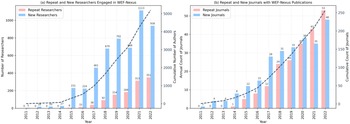
Figure 2 shows two dimensions of an emerging EC over the period. Panel A displays the recruiting of scientists, indicated as an author of at least one WEF Nexus paper, from 70 researchers cumulatively by 2014 to a 1000 3 years later and on to over 5000 authoring scientists from 109 countries (not shown in graph) researching the topic over the period. Although most of these scientists were involved in a single paper, a core of repeatedly publishing scientists grew modestly, even in the later years of less SD mechanisms and recruitment events, 15 authors published at least two papers in 2016 and 351 published multiple papers in 2022. Over the period, there was a culmination of 547 repeating researchers with over a third of those publishing three or more WEF Nexus papers. But repeat research falls off significantly at larger volume of papers as just under 3% of repeating researchers published 10 papers over the 12 years.
Growth in repeating and new scientists and journals publishing on WEF Nexus, annual and cumulative frequencies 2011–2022.

As indication of establishing scientific topical outlets, Panel B illustrates the development of scientific outlets on the topic, showing both a growing core of journals that repeatedly publish WEF Nexus research and journals that are newly beginning to publish related papers. From a single journal in 2011, there is a growing set of journals with multiple papers on the topic, expanding to a total of 195 journals publishing at least two WEF Nexus papers by 2022. Not surprisingly, initial papers were concentrated in disciplinary journals on water, energy, environment, and sustainability. Starting in from 2016, the EC also had the capability of expanding beyond the core set of journals with a steady flow of papers initiating the WEF Nexus topic in other journals. The epistemic reach broadened and attracted contributions from diverse fields such as public health, computational sciences, data science, and urban and development studies. Cumulatively over the period, 250 journals published at least one paper on some aspect of the WEF Nexus.
As the third dimension of the EC, Table 1 reports metrics of the cumulative network of collaborations showing a linear development of the network over the period. Growing from just 5 connected researchers in 2011 to 5,494 by 2022, this expansion is accompanied by marked increase interconnections (edges) from 10 in 2011 to 19,324 in 2022, reflecting a growing intensity of joint research among WEF Nexus researchers.
WEF Nexus Cumulative Co-authorship Collaboration Network Metrics at Four Selected Years

The other metrics indicate a forming, but not fully developed, network of researchers. As to formation, the mean node degree – representing the mean number of collaborators and ties to their collaborators per researcher – also increased from 4.0 to 6.9, indicating more connections per researcher over time. The size of the LCC grew from 1 to 1,540, signaling the formation of a group of interconnected researchers. The relatively low number of isolates, despite the rapid increase in researchers, implies that most newcomers are joining the field through collaboration with already active members. The assortativity coefficient decreased to 0.63 by 2022, indicating a shift toward more heterogeneous collaboration patterns, with researchers increasingly connecting across different levels of connectivity.
As to less maturity, the presence of 777 connected components – each comprising two or more researchers – indicates the parallel emergence of many distinct sub-networks or some fragmentation. Similarly, the clustering coefficient remained high, declining slightly from 1.00 to 0.86, which demonstrates persistent strong local clustering and the continued formation collaborative groups even amid network expansion.
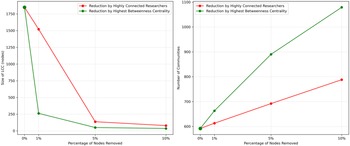
Figure 3 presents the simulated results on network resiliency, the fourth dimension of the emerging EC. By 2022, the connectivity of the collaborator network appeared relatively robust when researchers with the highest number of direct connections to other researchers were removed (Panel A, red line labeled Reduction by Highly Connected Researchers). The removal of the top 1 led to a modest reduction in the LCC, decreasing its size by about 19%. However, with the top 5% removed, the LCC size dropped dramatically – by over 90% – and further declined to just 4% of its original size after the top 10% are removed. A similar trend is observed in network cohesiveness (Panel B, red line), where the number of communities rises gradually from around 600 to nearly 790 across the three levels of node removal.
Simulations of WEF Nexus EC collaborator network resiliency.

In contrast, the network was far more sensitive to the removal of researchers with the highest betweenness centrality – those who serve as strategic bridges between otherwise disconnected parts of the network (green lines labeled Reduction by Strategic Bridge Researchers). The LCC plummeted by more than 85% after removing just 1% of these individuals and continued to degrade to near-fragmentation by 5% and 10% removal levels. The number of communities increased sharply in parallel, from approximately 590 to 1,080. These findings suggest that while the EC had achieved a certain level of redundancy in direct connections by 2022, it remained structurally dependent on a small set of strategically positioned researchers who maintained the overall cohesion of the network.
5.3. The EC's scientific response
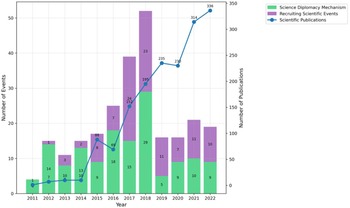
The resulting EC – modestly developed but resilient – produced 1,634 WEF Nexus publications over the 12-year span. Figure 4 juxtaposes the EC's annual response against the annual frequency of SD mechanisms and recruiting events documented in the timeline. The timing of both trends indicates a pattern of introduction of the WEF Nexus concept and buildup of a campaign of SD events from 2011 to 2014 with publications taking off in the inflection year of 2014. Annual publications continue to grow through the most intense SD period from 2016 to 2018. Although SD efforts began to decline after 2018, there appears to have been enough stimulating inertia created for the EC to add more science about the WEF Nexus approach. From 2014, publications grew at a mean annual rate of 72.8% through the rest of the period reaching 336 new publications in 2022.
Annual frequency of SD mechanisms, scientific recruiting events, and WEF Nexus publications.

6. Discussion
This case answers the questions laid out above regarding global governance, SD, ECs, and their impact. For the first time, a campaign of SD is mapped in its full complexity alongside the corresponding scientific recruitment dynamics. Using data on global governance, SD activities, and bibliometric analysis, the results indicate that between 2011 and 2022, interactions among the three SD mechanisms and two scientific recruitment events, supported by multilateral and international geopolitical agendas, created a global effort to establish a scientific EC around the WEF Nexus concept. As reflected in the timing and accumulation of these governance actions, a WEF Nexus EC began to form and expand, producing scientific knowledge on the concept. Even so, the results indicate that the WEF Nexus campaign cultivated an EC characterized by both continuity and transience.
Regarding continuity, a steady stream of researchers shifted from siloed disciplinary work to engage with the tripartite WEF Nexus concept. Serving as a critical condition for spreading the concept in response to climate change challenges, their publications repeatedly appeared in a core set of journals with cross-disciplinary influence. Further evidence of the success of these SD actions is seen in a developing collaboration network. The significant rise in the number of nodes and edges within the international researcher network reflects expanding participation and collaboration in WEF Nexus research. Moreover, the network evolved to become sufficiently robust and efficient to withstand random reductions in researcher participation. Finally, the EC contributed a substantial and growing body of new knowledge, with continued increases in research output even after the primary SD mechanisms subsided.
As to transience, the scientific EC and its response were not as mature as it might have been. Although the SD and recruiting activities drew in researchers to this new perspective, many of their contributions were ephemeral – just one paper. Only a modest core of consistently repeating researchers resulted and although publications did find a core set of journals, equal numbers of WEF Nexus publications were one-offs in journals. And by 2022 the connectiveness and cohesion of the network was still substantially dependent on a small group of highly connected researchers – even a loss of several dozen top researchers would likely have adverse consequences for the EC moving forward.
The mixed results about EC formation are not surprising. Of the events that most frequently stimulate new scientific responses – disruptive findings, newly rejected theory, innovative instruments, and access to new sources of data – SD is more removed from the usual scientific process. Of course, climate change ranks as a major existential challenge and these kinds of events have always been a potent stimulant of research. But the WEF Nexus was a conceptual refinement on an already established scientific response to the impact of climate change in three fields. It is a course adjustment, crucial of course, but not revolutionary. Nevertheless, from the perspective of a more realistic expectation, the global government SD actions were successful in planting the WEF Nexus concept into climate change research, with signs of a lasting shift in scientific orientation. One indication of this lasting shift is the continued evolution of the WEF Nexus itself, which increasingly integrates adjacent knowledge domains – including ecosystems (WEFE), health (OneHealth), and biodiversity – reflecting the field's movement toward broader systems-based framings.
7. Conclusion
This case challenges a common policy assumption: the creation of international research funding programs alone may not suffice to mobilize global scientific communities. Funding is necessary but not sufficient. The results suggest that funding alone is insufficient. Instead, it must be combined strategic agenda-setting mechanisms – including high-level conferences, policy reports, and institutional signaling – that effectively stimulates engagement. Moreover, this case highlights the need to support shared platforms for scientific interaction. Conferences, workshops, and the sponsorship of edited volumes and journal special issues not only provide intellectual space for emerging ideas but also open publication opportunities – especially for early-career researchers and those from underrepresented regions. For future SD efforts, this study suggests that holistic strategies – blending financial support with deliberate agenda-setting and inclusive knowledge-sharing infrastructures – are key to cultivating resilient and impactful ECs.
In terms of policy relevance, this case also raises critical questions about the timing and influence of scientific knowledge fostered by SD. While the WEF Nexus was actively promoted through conferences and policy reports – peaking around 2018 and continuing through 2022 – the most intense wave of scientific output occurred in the latter half of this period, even as SD activity itself had begun to decline after 2018. This suggests a lag between agenda-setting efforts and scientific response. It also raises a broader issue: can scientific knowledge produced years after the height of diplomatic attention still shape policy agendas that may have moved on? For example, by the time the WEF EC had gained critical mass, policy focus had already begun to shift toward new frames such as the energy transition and integration of climate change and biodiversity conservation agendas. This underscores the need for future research on the alignment (or misalignment) between science and policy cycles in SD campaigns. It also reinforces the idea that SD can play a foundational role in building sustainability knowledge infrastructures – networks, practices, and platforms that endure beyond short-term policy windows to support integrated responses to complex global challenges.
Although the results from two sources of extensive data not usually combined are revealing, they ultimately represent just one case of SD and EC formation and impact to generate scientifically informed knowledge. For comparison, additional cases should be examined in a similar fashion here. The same is true for predicting the sustainability of research on a concept such as the WEF Nexus. How long will the EC and its response in this case continue? And broadly, additional research is needed on the degree to which global governance and its SD mechanisms can establish lasting shifts in scientific response to large-scale problems.
Supplementary material
The supplementary material for this article can be found at https://doi.org/10.1017/sus.2026.10047.
Acknowledgements
The lead author acknowledges the support of the Fulbright Program and the Ministry of Science, Technology, and Innovation of Colombia (MinCiencias), whose partnership enabled the doctoral research that informed this work. The lead author also acknowledges the support of the program Landscape-U (U.S. National Science Foundation Research Traineeship (NRT) Award #1828822) to participate and present at the 11th Conference of the European Society for the History of Science in 2024. Authors 1 and 3 acknowledge the support of the SustainFood program (U.S. National Science Foundation AccelNEt Award #2201446) to participate in networking events and summer schools from the WEF Nexus community in the United States, Africa, and Europe. Author 3 acknowledges additional support from the Maurice K. Goddard Chair Endowment and the USDA National Institute of Food and Agriculture (Project PEN0 4816, #7003839).
Author contributions
Authors 1, 2, and 4 equally contributed to this work. Authors 3 and 4 jointly supervised this work. Authors 1, 2, and 4 developed the conceptualization of the article. Author 1 led the Timeline's documentation, created the bibliometric data set and coded the science diplomacy programs, contributed to conceptualizing the network analysis part, and led compiling and writing all sections. Author 3 guided and supervised the process of building the Timeline by providing expert input and contributing with comments and edits to the manuscript. Author 4 led the conceptualization of the paper, supervised results analysis, and edited the final version of the manuscript unifying the voice in all sections.
Funding statement
The lead author received support from a Fulbright scholarship in partnership with the Ministry of Science, Technology, and Innovation of Colombia (MinCiencias). Also funding from the Landscape-U NSF grant No. 1828822 and SustainFood NSF grant No. 2201446.
Competing interests
The author(s) declare no competing interests.
Data availability statement
All data and code supporting this study are available in Zenodo at https://doi.org/10.5281/zenodo.18224913.




 Open access

