


Introduction
The goal of National Institutes of Health’s (NIH) Clinical and Translational Science Award (CTSA) program is to facilitate and accelerate the translation of discoveries from the bench to the bedside and into communities. In order to accomplish this, clinical and translational researchers must be supported and developed [Reference Reis1]. As a result, training and career development have been core components of the CTSA program since its launch in 2006. NIH and CTSA hubs all stress the importance of developing the next generation of clinical and translational researchers. There has been a considerable investment in training and career development programs, as evidenced by time, funds, and the growing scope and number of such programs. However, there is a lack of evaluations of CTSA training and career development programs aimed at understanding the impact such programs have on research productivity and ultimately on career success.
The pilot evaluation project discussed in this paper focuses on one such career development program, specifically the KL2 program. The KL2 is a multi-year career development program that provides salary support and funds for protected training and research time for early-career scholars (M.D., M.D./Ph.D., or Ph.D.), allowing them to conduct research while being mentored by experienced investigators [Reference Schneider2]. This article looks at the publication patterns, scholarly productivity, and research impact of the KL2 scholars’ published work at one CTSA hub—the Institute for Clinical and Translational Research (ICTR) at the University of Wisconsin-Madison (UW)—using bibliometric data, data on research translational stage, and program-level data detailing scholar characteristics. Within the scope of this paper, we discuss the innovative methods we undertook for analyzing the data and the outcomes, as well as the challenges associated with this type of analysis.
Although complex models of career success have been put forward, such as the comprehensive career-success model for physician-scientists in Rubio et al. [Reference Rubio3] crafted by the Research on Careers Workgroup at the University of Pittsburgh, the scope of this pilot study is more limited. We focus on aspects of extrinsic career success, specifically on concrete outcomes and markers such as publications [Reference Rubio3]. Within the scope of this pilot study, we were also able to explore some personal contextual factors/determinants of career success, specifically demographic characteristics such as gender [Reference Rubio3, Reference Lee4].
Current Challenges
The challenges inherent in evaluating training and career development programs even at the single institutional level are daunting. These multiply when the focus is expanded across CTSA hubs which is likely a major reason for the lack of this type of evaluation.
The lack of nationally coordinated/consortium-level evaluative efforts and a dearth of standardized methods or shared definitions are reoccurring problems that have hindered such efforts. For instance, all CTSA hubs are required to report on publications by scholars who received hub funding for career development such as KL2 and TL1 awards, as well as other publications that are the product of research that used CTSA resources and services. Yet despite having access to the necessary publication data (via required reporting) and the tools needed to undertake bibliometric analyses via their iCite tool, the NIH does not analyze and produce reports using bibliometrics. A consortium-level analysis of KL2 scholars would be valuable and could be used to provide insights into trends in workforce development and provide a useful benchmark that CTSA hubs could use to help evaluate their programs. However, the lack of a nationally coordinated plan that utilizes shared definitions and a standardized methodology means that, in general, CTSA hubs have been left to create their own tracking processes and determine what to include and measure in order to determine the impact of their programs [Reference Surkis5].
Other instances where a lack of guidance and shared definitions can pose challenges include issues touched upon in the Institute of Medicine (IOM) report from the 2013 assessment of the CTSA program which recommends CTSA hubs should support research across the translational spectrum [Reference Leshner6]. This recommendation, while important and well-intentioned, first requires that a CTSA hub have a means of determining exactly the types of research they are supporting before they can begin to weigh their relative success in supporting the full spectrum of translational research. The 2013 IOM report acknowledges that greater standardization is needed and that metrics need to go further than simply counting publications, yet the report did not offer specific guidance on what other metrics should be used [Reference Surkis5, Reference Leshner6]. Recently attempts have been made to address some of the issues discussed above through the phased development and rollout of a Common Metrics Initiative which may ultimately provide more guidance on shared methods and definitions across the CTSA hubs.
Examination of a hub’s publications and associated citation network, as well as the publications associated with its specific services and programs (such as the KL2 program), has the potential to contribute to a richer understanding of the quantity, impact and types of research a CTSA hub supports. However, moving beyond publication analysis to citation analysis is challenging. Citation analysis typically requires not only that hubs have access to citation databases, but also that publication and citation data be compiled or acquired in a format that allows for manipulation—a tall order [Reference Coryn7].
An additional compounding factor is the issue of normalization, as indicators should be normalized in order to make comparisons between publications that are published in different fields, years, and journals. However, normalized citation impact indicators, specifically field-normalized indicators, are not typically offered for free or in an easy-to-use exportable format by traditional providers such as Thomson Reuters and Elsevier, putting the burden of calculating such indicators on the user. Calculating normalized citation impact indicators can be both time-consuming and complex, depending on the ease of access to the additional data needed for the calculation and the complexity of calculation itself. Because of the challenges associated with conducting citation analysis, many turn to paid services offered by Thomson Reuters and Elsevier to gather and analyze their publication and citation data. However, such service providers interfaces, in the past, have tended to be inflexible. The inflexible nature of these interfaces can limit their usefulness when one desires to drill down into the data, focus on smaller subsets of data such as those associated with individual programs, or merge in additional data.
This pilot represents one CTSA hub’s first efforts to contribute to an evaluation of a career development program by addressing many of the challenges mentioned above. We combined multiple data sources, and used KL2 scholars’ publications as the basis of an evaluation that utilizes internal data on scholars’ demographics, translational research category codes, and bibliometrics. Using this approach, we were able to take a preliminary look at the types of research the KL2 program supports and assess the initial productivity of its scholars and the impact of their published research.
Methods
This pilot study provides an overview of the early scholarly contributions/productivity of ICTR KL2 scholars at the UW-Madison using publication data. In doing so, we illustrate the feasibility of 3 different approaches to bibliometrics: utilizing paid services (specifically custom reports through providers such as Thomson Reuters or Elsevier), using the basic free downloadable reports or data file options provided by Thomson Reuters or Elsevier, or using the free services of newer options such as iCite. In addition, to illustrating the feasibility of conducting bibliometric analysis using 3 different data sources/approaches, we also illustrate how bibliometrics can be used to conduct analyses at both the publication level and author level. Furthermore, we demonstrate how an institution’s internal data or program-level data can be combined into the analysis in order to further drill down into the data and make additional comparisons if desired (such as those we conducted by gender). This pilot also illustrates one viable method for determining the types of research (translational level (T-codes)) a program or hub supports and demonstrates how these data can be further combined with bibliometrics and internal data records to evaluate scholars’ early outcomes.
Step 1: Using Thomson Reuters to Access Bibliometric Information on All ICTR Publications
An Excel file of publications that cited ICTR (and thus used ICTR resources) from 2008 to 2015 was sent to Thomson Reuters so that bibliometric data on ICTR publications could be compiled and linked to each publication. Of the list of 2153 publications sent to Thomson Reuters, bibliometric data were available for 1917 publications (89%) from Web of Science (519 of which were KL2 publications). Thomson Reuters supplied the results in the form of both an Excel spreadsheet of publication-level data and a Microsoft Access database file that contained tables of authors, publications, and citing and cited publications. The Access database was intended to be used with the supplied Xite software for creating reports and database manipulation, however we discovered that the Xite software did not enable us to drill down into the data and make the sort of comparisons we desired. As a result, tables from the Access database supplied by Thomson Reuters were individually exported into Excel and subsequently imported into SPSS and merged together using a combination of PMID, Author and ISI LOC (which is a unique article identifier that is assigned to an article when it enters Thomson Reuter’s database).
Step 2: Merging in Author-Level Data
In order to account for the numerous authors associated with each publication, the publication-level data for the 1917 ICTR publications were merged together with the author-level bibliometric data tied to the 7051 unique authors listed on the ICTR publications. The resulting data file of 14,030 cases links both publication and author-level bibliometric data together by creating a separate record for each author by each publication. This means that each publication or unique PMID is listed multiple times (once for each individual author listed on the publication). This format was used to account for the multiple authors who contributed to a publication and preserve the data on author citation order and the author-level bibliometric data associated with each individual author.
Merging in author-level data poses its own unique set of complex issues, sometimes referred to as the “author name disambiguation” problem. This refers to the ambiguity that plagues linking together author information because author names are ultimately not unique enough to avoid duplication and because of the inconsistent manner in which author names are reported [Reference Milojevic8]. Author name ambiguity is a commonly acknowledged issue, one that has been the subject of multiple publications and disambiguation methods of varying complexities. The problem has given rise to alternatives for tracking author publishing activity such as the use of ORCID which utilizes an author ID system [Reference Milojevic8]. Considering these author name disambiguation issues, we manually inspected bibliometric records using data files containing KL2 scholars’ demographic and academic profile traits. We used these data to aid in disambiguation of KL2 scholars’ author-level bibliometric data and to merge demographic information on the KL2 scholars into the SPSS database. Merging internal data records containing data on scholars’ demographic and academic profile traits with bibliometric data allows us to examine the potential influence of gender on scholars’ productivity and the impact of their research. Gender as a variable of interest was included in this study in part because previous studies have reported significant gender disparities in traditional measures of career success such as publication productivity [Reference Dehdarirad, Villarroya and Barrios9].
Two different sources provided information on KL2 scholars’ demographic and academic profile traits. Demographic data exported from our local tracking system, WEBCAMP, were used in conjunction with internal ICTR KL2 Excel sheets containing verified data on scholar background and careers. Using these two different sources, we crafted a demographic datafile on KL2 scholars that contained information on KL2 scholars’ gender, race/ethnicity, department and division, career outcomes (specifically, career position/titles), continued involvement in research, and retention at UW-Madison. We used the information from the demographic datafile to review the bibliometric SPSS datafile case by case and identify the exact author name iterations that match the KL2 scholars’ bibliometric data obtained from Thomson Reuters. We next merged the KL2 scholars’ demographic and academic profile data with the Thomson Reuter’s bibliometric file using author name to link and merge the 2 data sets. Using the data from the newly merged SPSS datafile, we identified 519 KL2 publications. For the purposes of this pilot, KL2 publications are defined as any ICTR publication on which at least 1 KL2 scholar is listed as an author (either as a result of their KL2 participation or their use of other ICTR services). We used this list of 519 KL2 publications and their associated PMIDs to begin the process of identifying the types of research produced by the KL2 scholars.
Step 3: T-Coding and Classifying Publications Along the Translational Spectrum
To examine the types of research the KL2 program supports, we first needed to code or classify each scholar’s publications along the translational spectrum. To accomplish this, we used a checklist to manually classify publications into translational research categories. The checklist used is described in Surkis et al. [Reference Surkis5]. It uses categories from the 2013 IOM report as a starting point on which agreed-upon definitions across 5 CTSA institutions were developed. This conceptualization of the translational spectrum is made up of 5 categories that were further simplified into 3 categories of publications. These are T0 (basic science research), T1–T2 (clinical research), and T3–T4 (post-clinical translational research). An additional category called “TX” was used for publications deemed to be outside the translational spectrum.
The coding process involved 3 different coders, each of whom individually reviewed the abstracts and MESH terms of the 519 publications and assigned each publication to a category along the translational spectrum accompanied by the checklist number that led them to choose that specific translational category [Reference Surkis5]. Discrepant codes were then discussed by the coding group to arrive at a final consensus code. Publications where coders’ individual category assignments differed and no final consensus coding could be reached after discussion were sent to a coder outside the CTSA institution (one of the authors on the original article from which this checklist was crafted, Surkis et al. [Reference Surkis5]) for final coding input. An Excel file containing the final hand-coded T-codes for the 519 KL2 publications was then merged into the SPSS data set using PMIDs as the key field.
Step 4: Construction of Key Analytic Variables: Calculating Normalized Citation Indicators or Comparative Citation Ratios (CCR)
In addition to the bibliometric data supplied by Thomson Reuters, we also included data from other sources such as iCite and the Essential Science Indicators (ESI) in order to craft normalized citation impact indicators for comparison purposes. These are what Schneider et al. [Reference Schneider10] have called CCR. CCR indicators compare the observable citation rates for a set of publications with the citation rates of another “comparable” set of publications, so that publications from different fields and years can be compared with one another [Reference Schneider10]. CCR indicators are ultimately a simple ratio created by taking the observed citation rate divided by the expected citation rate. Different CCR indicators vary in how the expected citation rate is calculated and therefore what is chosen as a suitable “comparable” set of similar publications [Reference Schneider10]. An additional benefit of these CCR indicators is that as a result of taking the form of a ratio the results are easy to interpret, where 1.00 equals a publication (or group of publications) that have received the exact number of citations that would be expected. A score above 1.00 indicates a performance better than expected, and a score below 1.00 represents performance lower than expected.
Two such CCR indicators were created using data exported from the ESI database provided by Thomson Reuters. ESI assigns papers to 1 of 22 different fields, providing field baseline data in the form of annual expected citation rates that can be used to assess the impact of papers against a field-appropriate benchmark. An article’s assigned field is determined by the journal in which an article appears [Reference Van Veller11]. Using the master journal list provided by Thomson Reuters, it is possible to link Web of Science publication data with ESI baseline data by matching articles based on the year and journal in which they were published with the appropriate ESI field [12].
Combining these different data sources allows for normalized CCRs to be calculated in which the number of citations a publication has received is benchmarked against a world average obtained for articles belonging to the same field and published in the same year. Using the matched and merged ESI baseline data, 2 different indicators were created by using 2 different methods of normalization. The first indicator, Citation Impact, is derived when normalization is done at the group level and is calculated by taking the sum of citations for the group of articles under consideration divided by the sum of the ESI baselines/annual expected citation rates for these articles [Reference Van Veller11]. The second indicator, Relative Impact, is calculated when normalization is conducted at the individual article level, where an individual citation impact ratio is calculated separately for each article, and normalization is ultimately achieved by calculating the mean of the group’s individual citation impact ratios [Reference Van Veller11].
Step 5: Merging in iCite Data
Additionally, after entering the write-up phase of this pilot, we became aware of the CCR variable called the relative citation ratio (RCR) developed by researchers at NIH and available for free through iCite (https://icite.od.nih.gov/) [Reference Hutchins13]. iCite’s RCR variable differs from similar field-normalized CCR variables in that, unlike with Thomson Reuters’ approach using their CCR variable ratio, an article’s field is not determined by the journal in which an article is published, but rather by creating a field based on an article’s co-citation network [Reference Hutchins13]. The expected citation rate for iCite variables is not taken from a global average but instead is only related to publications produced with NIH funding, making it of particular interest for CTSA hubs.
By uploading into iCite the same publication list of 1917 publications on which we had received bibliometric data from Thomson Reuters, we were able to download the bibliometric analyses done through iCite into Excel. We again used PMIDs to merge the iCite data into our SPSS database. The bibliometric results from iCite services are not directly comparable with those from Thomson Reuters since the bibliometric analysis through iCite was done over a year later and therefore had more time to gain citations. However, we decided to include the metrics from iCite in our analysis (using the same 2008–2013 timeframe we used for the Thomson Reuters bibliometrics) because the RCR has been mentioned as a possible variable in future CTSA common metrics. The full list of bibliometric variables we chose to report on after reviewing the various metrics we crafted and/or pulled using the data from Thomson Reuters, iCite and the ESI database are listed in Table 1 along with metrics descriptions/definitions.
Metric descriptions

ESI, Essential Science Indicators; CCR, comparative citation ratios; NIH, National Institutes of Health.
Analysis
The compiled data were analyzed to examine:
(1) Overall frequencies for publication and author-level metrics for KL2 publications.
(2) Demographic and academic profile of KL2 scholars including diversity in terms of gender and types of research.
(3) Degree to which KL2 scholars’ demographic and academic profile traits relate to variation in metrics measuring scholarly impact and research productivity.
(a)Using within-group KL2 comparisons by gender.
(4) T0–T4 codes that indicate where on the translational spectrum KL2 scholars’ publications fall.
Shapiro-Wilk tests revealed that the data were not normally distributed; as a result, non-parametric tests were used (Mann-Whitney U test). All analyses were performed using SPSS version 23. For analyses that utilized bibliometric data, findings are briefly summarized in the text with more detailed information located in the tables (including means, medians, standard deviations, test statistics, and statistical significance/p values). For all analyses, statistical significance of α of 0.05 was used; in the tables significant results are indicated by an asterisk *.
Results
Demographics of KL2 Scholars Active Between 2008 and 2013
Of the 58 KL2 scholars and their associated publications for which Thomson Reuters supplied bibliometric data, only publications published between the years 2008 and 2013 were included in the citation analyses (in order to allow publications at least 2 y to gain citations). The 50 KL2 scholars that published between 2008 and 2013 and their associated publications are thus the primary focus of this pilot study. Analyses using T-codes that indicate the types of research being produced by classifying where a publication falls along the translation spectrum, used the full set of KL2 publications from 2008 to 2015.
The gender distribution of the 50 KL2 scholars whose publications were used in citation analyses was nearly even, with 24 scholars (48% of the sample) identifying as female and another 26 scholars identifying as male (52%). The majority of KL2 scholars (n=37) identify as non-Hispanic white (74%). The vast majority of KL2 scholars (94%) were still active in research and 82% still worked at UW-Madison in some capacity as of December 2015. KL2 scholars have a wide variety of areas of expertise and come from many different departments. Most KL2 scholars (for which data were available) come from UW-Madison’s School of Medicine and Public Health (n=32) which has the largest pool of potential scholars of all the health sciences schools/colleges.
KL2 Within-Group Analysis: Author-Level Bibliometrics—By Gender
Within-group analysis on KL2 scholars’ demographic and academic profile traits was conducted to examine if KL2 author-level bibliometric values differ significantly depending on scholars’ traits. We chose to use gender to compare and contrast the performance of our KL2 scholars since many past studies have found that males’ and females’ publication productivity is significantly different, with females on average publishing less than their male counterparts [Reference Dehdarirad, Villarroya and Barrios9]. Additionally, scholars receiving K awards from NIH have in the past been referred to as “an ideal population within which to study issues of gender and academic success” [Reference Jagsi16].
Analysis by gender using the Mann-Whitney U test indicated that no statistically significant differences in author-level bibliometrics exist by gender (Table 2). Despite the lack of significant differences at the author level, the overall results suggest that the KL2 scholars appear quite productive with the average KL2 scholar publishing in the double digits (median=10) at ICTR during the 5-year timeframe that was the focus of our bibliometric analysis (2008–2013). Additionally, the Crown index (C-index) which can be used to measure the performance of an author’s body of work (by comparing it to the norms of the journals in which they publish) illustrates that KL2 scholars perform above 1.00 and therefore their body of work performs slightly better than expected (median=1.07). The average percentile that at the author level reflects the relative performance of the author’s work normalized to their respective field(s) is also encouraging. Percentile metrics supplied by Thomson Reuters are normalized indicators where lower values indicate better performance; KL2 scholars appear to be performing better than many of their peers who are publishing within the same field and timeframe.
Author-level bibliometrics by gender

KL2 Within-Group Analysis: Publication-Level Bibliometrics—By Gender
When analysis by gender at the publication level was conducted, author citation order emerged as the sole significant gender difference. Author citation order refers to where an author falls in a publication’s list of authors, with results indicating that female scholars (median=2) rank significantly higher in their publications citation order than their male counterparts (median=3), U=12,117, p<0.001. Full results comparing male and female KL2 scholars’ publication-level bibliometrics appear in Table 3. Overall results regarding KL2 scholars’ publications regardless of gender are encouraging. Thomson Reuter’s CCR variable ratio shows that KL2 scholars’ papers are performing as expected. The percentile values supplied by Thomson Reuters are also favorable, keeping in mind that percentiles from Thomson Reuter’s range from 0 to 100, where lower values indicate better performance. Percentile essentially indicates the percentage of papers (from the same field, year, and document type) that are cited more often than a specific paper or set of paper(s) [14]. Therefore, the low percentiles received by KL2 scholars, regardless of gender, shows that their papers are performing better—that is, cited more often—than the majority of papers published within the same field, year and of the same document type.
Publication-level bibliometrics by gender
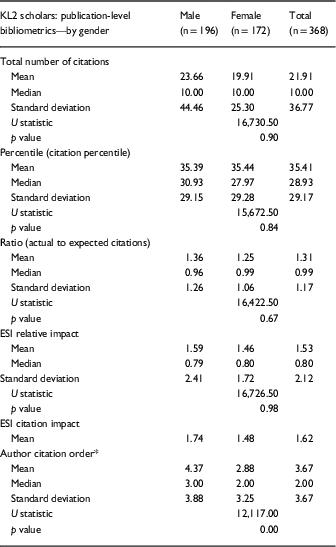
Significant results at p<0.05 are marked with an *.
iCite Data: KL2 Within-Group Analysis—By Gender
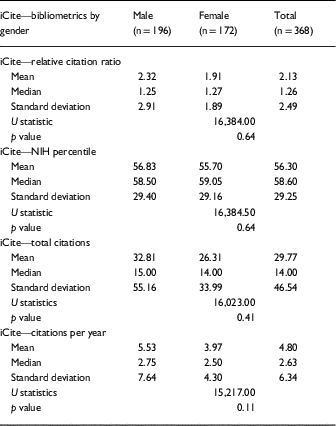
Bibliometrics downloaded through the free NIH iCite service were also analyzed to see if significant differences existed by gender. Shapiro-Wilk tests revealed that the data were not normally distributed, as a result, analysis by gender was done using Mann-Whitney U tests. No significant differences by gender emerged but results are summarized briefly below as well as in Table 4. While no significant differences in the RCR exist by gender, it is important to note that both male (median=1.25) and female KL2 scholars’ (median=1.27) RCR is above 1.00 indicating that both genders’ publications are cited more often than the norm for NIH publications. NIH percentile data also suggests that KL2 scholars’ publications are cited slightly more often than the norm for NIH publications.
iCite data: KL2 publication-level bibliometrics by gender
KL2 Hand-Coded T-Codes
Hand-coded T-codes indicating where a publication falls along the translational spectrum (T0, T1–T2, or T3–T4) provide another avenue of analysis. Since this area of analysis did not involve citation analysis, it was not necessary to limit the analysis to publications published between 2008 and 2013. All 519 publications authored by the 58 KL2 scholars who published between 2008 and 2015 were coded. The inclusion of the works of the 8 additional scholars and publications from the years 2014 and 2015 did not significantly alter the demographics of the groups (which experienced fluctuations ≤2%).
After removing the 46 KL2 publications that were coded as TX and deemed to be outside of the translational spectrum, we analyzed the remaining 473 KL2 publications. Overall, KL2 publications are primarily concentrated in either the T0 or T3–T4 categories on opposite sides of the translational spectrum, with the largest category being T0 (basic research) and with very few publications falling into the T1–T2 (clinical research) category.
KL2 Within-Group Analysis: Publication-Level T-codes—By Gender
When looking at T-codes by KL2 scholars’ demographic traits, a significant association emerged between T-codes (where research falls along the translational spectrum) and gender (χ2=101.9, p<0.001). Intriguingly, the results indicate that male and female scholars tend to publish articles on different ends of the translational spectrum (see Table 5).
KL2 publication-level—translational level (T-codes) by gender

The majority (67.6%) of male-authored KL2 publications were classified as T0 (basic science publications) compared with their female counterparts for whom T0 publications made up a minority (27.2%) of their publications. KL2 scholars authored few T1–T2 publications; for both genders the smallest percentage of their publications fell within the T1–T2 category. Overall however, a larger percentage of male KL2 scholars’ publications fell within the T1–T2 category (13.4%) compared with their female counterparts (8.5%). However, female scholars published far more T3–T4 publications than their male counterparts. The majority (64.3%) of female KL2 scholars’ publications were T3–T4 publications compared with male scholars for whom only 18.9% of their publications fell within the T3–T4 category. The distribution of each gender’s publications along the translational spectrum illustrates that male scholars’ research is heavily concentrated towards the early/basic science research end of the spectrum, while female scholars research tends towards the T3/T4 translational end of the spectrum.
The observable differences in publication T-codes between the KL2 scholars are likely at least in part due to other factors. For instance, changes over time may be a factor. An analysis of T-codes by year seen in Table 6 illustrates an overall trend towards a greater proportion of KL2 scholars’ research falling within the realm of T3/T4 research over time.
Translational level (T-codes) by year

Discussion
Early outcomes suggest that KL2 scholars are achieving extrinsic career success in terms of research and publications. Our results show that KL2 scholars’ publications are cited more often than the norm for NIH publications. In this study, we used several sources of bibliometric data providing several normalized citation impact indicators or CCR to compare across fields and time. Despite the different databases used to produce these indicators, differences in how these CCR indicators are calculated, and the different points in time when these data were pulled, the results were similar and illustrated that the KL2 scholars’ publications are generally performing either as expected or better than expected. We also observed favorable results and returns from investing in the next generation of researchers in the number of scholars that have continued to work for the institution (82%) and stayed engaged in research (94%). This level of research engagement matches the productivity reported by Schneider et al. [Reference Schneider2] and is similar to that reported by Amory et al. [Reference Amory17] on other K scholars at another large public institution (in the top 10). Additionally, we found outcomes that suggest some success in developing independent researchers, for instance, 84% of our KL2 scholars published at least one publication as a first author which is higher than the 72% reported in a previous study by Schneider et al. [Reference Schneider2]. Overall, several of our findings support those of previous studies on K scholars, further adding to the evidence of positive early outcomes from scholars supported by the KL2 program.
The distribution of publications across the translational spectrum is of considerable interest and importance. The CTSA program—“clinical and translational science awards”—was originally intended to speed the translation of basic research (already being conducted in abundance with existing NIH funding) to clinical and practice applications. However, our data (Table 5) indicate that 47.6% of the research conducted by scholars in the KL2 program is at the basic science research level, and only 11% is at the clinical level (with 41.4% at the T3/T4 level). This raises the intriguing question of whether the clinical research infrastructure is adequately supported by the CTSA program. After all, according to the most recent funding announcements, the CTSA program is no longer supporting clinical research infrastructure as it did in its earliest years. While we do not know with certainty what the distribution of T0–T4 research is at other CTSA hubs, anecdotal evidence suggests our institute’s experience may not be unique. To the extent that is the case, the large number of publications we observed at the basic science research level (T0), and the relatively small number at the T1–T2 level, raises questions as to whether CTSA funding is in fact fulfilling the mission of enhancing clinical and translational research by supporting research across the entire translational spectrum.
In addition to evidence of positive outcomes from scholars supported by the KL2 program, our analyses also produced interesting findings regarding gender and T-codes. For instance, the KL2 program has experienced a shift over time in the distribution of publications across the translational spectrum. This shift towards more T3/T4 work in recent years suggests that concentrated efforts (by the institution and program staff) to support more T3/T4 work have been successful, and also underscores the value of tracking the type of research produced by a program, and by extension a CTSA hub. Understanding the type of research that is being supported and produced is an important first step that allows for the opportunity to make impactful changes with concentrated efforts. For instance, by admitting more scholars whose background and research interests are concentrated in the portion of the translational spectrum that a program or institution may want to prioritize, this small change and shift in priorities can potentially have measurable and significant effects on the stage and type of research that not only the KL2 program produces but by extension the CTSA hub as well. Due to the sheer number of publications KL2 scholars produce that represent roughly 25% of ICTR’s publications, shifting the type/stage of research generated by some of ICTR’s most productive researchers allows for major shifts to be made in the type of research supported by a CTSA hub as a whole.
Another interesting finding was the limited number of significant differences by gender observed in this study. The lack of significant gender differences in research productivity and impact in this article is somewhat surprising considering the amount of past literature reporting significant gender disparities between men and women in citation behavior and research productivity, and the significant gender differences also reported in the past even among K award recipients [Reference Jagsi16]. Our analyses found only small non-significant differences between male and female scholars’ publication impact and productivity, with the only significant gender differences being observed in author citation order and T-codes.
The significance (if any) behind the gender differences observed between male and female scholars in author citation order and their tendency to publish articles on different ends of the translational spectrum could be the result of a host of factors. Potential explanations include changes over time (such as the institution’s increased emphasis on more T3/T4 work in recent years), differences in citation behavior in and across fields, or differences in collaborative practices. Another possible explanation for these gender differences is the different areas of study/expertise that KL2 women and KL2 men chose to study and research. For instance, past research has found that men and women specialize in different areas of research [Reference Grant and Ward18], and while most KL2 scholars came from UW-Madison’s School of Medicine and Public Health, the KL2 women represent a wider variety of disciplines and areas of expertise than the men.
Overall, further research is needed to better interpret the results observed in our study to see if these findings are generalizable to the KL2 program as a whole or are simply characteristic of the one unique CTSA hub that was the focus of our analysis. Additional work is also needed to discern if the lack of observed gender differences between male and female KL2 scholars in regard to research productivity and the impact of their respective publications reflects identifiable individual, program or institutional level factors that narrow productivity and career trajectory disparities.
Overall, NIH-supported early-career development programs could benefit immensely from more systematic evaluation aimed at understanding the impacts of these programs on the early-career success of scholars. A greater understanding of the multiple factors affecting career success could help career development programs to better allocate resources and make effective data-driven decisions regarding program changes and improvements.
Using bibliometric data to evaluate CTSA research productivity offers a promising contribution to a broader evaluation of the KL2 program. CTSA evaluators have recommended informally to NCATS that a consortium-level analysis of the KL2 scholars, their programs, and their research productivity would be valuable to the roughly 60 institutions participating in the CTSA consortium. A focus on publications, bibliometrics and translational level for scholars’ productivity, across the entire CTSA consortium, could provide consistent in-depth insight into trends related to workforce development objectives in biomedical research in this country.
Two limitations of this study, including limited data and lack of an appropriate comparison group, could be addressed (at least in part) by a consortium-level analysis of the KL2 scholars or by facilitating evaluator access to existing NIH data. For instance, within the scope of this study, we did not include data on current and former KL2 scholars’ grant applications and funding history which could have been a useful additional outcome to consider in examining scholars’ early career outcomes. Additionally, due to limited data, a suitable comparison group for the KL2 scholars comprised of other early-career researchers from similar fields was not available. Comparisons were instead limited to within-group comparisons and comparisons using various normalized citation impact indicators or CCR. These were useful to compare KL2 scholars’ publications to NIH publications via iCite data or to norms calculated using ESI data (wherein publications are assigned to a particular field by journal). If more data were available, a comparison group could potentially have been created and additional analyses undertaken. A consortium-level analysis of the KL2 scholars, in addition to providing interesting insights, would provide a benchmark against which we and other CTSA hubs could gauge the success of our KL2 scholars and evaluate our individual KL2 programs. In addition, we agree with comments made by Schneider et al. [Reference Schneider2] about the evaluative benefits of having greater access to existing NIH data such as the NIH Information for Management, Planning, Analysis and Coordination database which houses data about career development award applicants, including NIH grant applications and demographic information.
Ultimately our study points to the feasibility of using program-level data and publication data, including bibliometrics and data categorizing publications along the translational spectrum, to evaluate early outcomes including the productivity of scholars and the influence of their published research. Our pilot has illustrated the feasibility of 3 different approaches to bibliometrics: utilizing paid services or the free downloadable reports/datafile options through providers such as Thomson Reuters or Elsevier, or using the free services offered by iCite. Each has advantages and disadvantages (depending on one’s needs, goals, and resources) but all are viable options for evaluative purposes. Our study also illustrates the evaluative benefits of categorizing publications along the translational spectrum to identify the types of research produced by a program and its scholars and how these data can be further combined with internal data records and bibliometrics to gain richer insights.
Future Directions
This pilot study illustrates that linking bibliometric data and data categorizing publications along the translational spectrum, with a CTSA hubs’ internal program data records is feasible, and offers several innovative possibilities for the evaluation of a CTSA as a whole as well as a targeted evaluation of its programs and investigators. Future directions include building on the existing bibliometric data sets and including the publications of KL2 scholars from other CTSA hubs to provide more context for how our CTSA and KL2 scholars are performing. Another option includes expanding our focus and gathering our KL2 scholars’ full publication records to compare how scholars’ publications before, during and after the KL2 program fare. Other avenues of interest include going beyond examining one single aspect of extrinsic career success (publications) and instead combining the quantitative data analyzed within the scope of this study, with KL2 grant/funding data, survey data and qualitative interview data. Efforts are already underway to pursue a study focused on outcomes from KL2 scholars using a mixed-methods approach that builds on the work done by Rubio et al. [Reference Rubio3] and Lee et al. [Reference Lee4] regarding evaluating comprehensive career success by combining our existing data with survey data and data from interviews with KL2 scholars. Utilizing a mixed-methods approach integrating qualitative and quantitative data (e.g., Hogle and Moberg [Reference Hogle and Moberg19]) will allow us to gain a more in depth understanding of career success, and explore the influence that various factors and barriers can have on career direction, research productivity, and even the types of research scholars undertake.
Acknowledgments
The authors thank Linda Scholl for her help in translational spectrum coding and her feedback in reviewing this manuscript. The authors also thank Alisa Surkis for her help in providing translational spectrum coding input on KL2 publications. This work was funded in part, by NIH NCCATS grant UL1TR000427. The content is solely the responsibility of the authors and does not necessarily represent the official views of the National Institutes of Health.
Disclosures
The authors have no conflicts of interest to declare.


 Open access

