







1 Introduction
This article concerns the model theory of Zermelo–Fraenkel ( $\mathsf {ZF}$
) set theory. More specifically, it is about various types of extensions of arbitrary models of
$\mathsf {ZF}$
) set theory. More specifically, it is about various types of extensions of arbitrary models of $\mathsf {ZF}$
, as opposed to countable or well-founded ones. This is a topic that I have worked on intermittently for over four decades. Indeed, Theorem C of the abstract answers the following question that was initially posed in my 1984 doctoral dissertation [Reference Enayat9, Question 1.1.12]:
$\mathsf {ZF}$
, as opposed to countable or well-founded ones. This is a topic that I have worked on intermittently for over four decades. Indeed, Theorem C of the abstract answers the following question that was initially posed in my 1984 doctoral dissertation [Reference Enayat9, Question 1.1.12]:
Question $\heartsuit $
.
$\heartsuit $
.

Can every model of $ \mathsf {ZF}$
be properly end extended to a model of
$ \mathsf {ZF}$
be properly end extended to a model of $ \mathsf {ZF}$
?Footnote
1
$ \mathsf {ZF}$
?Footnote
1
Note that if there is a proper class of strongly inaccessible cardinals, then every well-founded model of $\mathsf {ZF}$
can be properly end extended to a model of
$\mathsf {ZF}$
can be properly end extended to a model of $\mathsf {ZF}$
. Furthermore, by a well-known result due to Keisler and Morley [Reference Keisler and Morley30], every model of
$\mathsf {ZF}$
. Furthermore, by a well-known result due to Keisler and Morley [Reference Keisler and Morley30], every model of $\mathsf {ZF}$
whose class of ordinals has countable cofinality has a proper elementary end extension. The motivation for the above question emerges from the comparative study of the model theory of
$\mathsf {ZF}$
whose class of ordinals has countable cofinality has a proper elementary end extension. The motivation for the above question emerges from the comparative study of the model theory of $ \mathsf {ZF}$
and Peano Arithmetic (
$ \mathsf {ZF}$
and Peano Arithmetic ( $\mathsf {PA}$
). Prima facie,
$\mathsf {PA}$
). Prima facie, $ \mathsf {ZF}$
and
$ \mathsf {ZF}$
and $\mathsf {PA}$
are unrelated; after all
$\mathsf {PA}$
are unrelated; after all $\mathsf {PA}$
axiomatizes basic intuitions concerning the familiar arithmetical structure of natural numbers, whereas
$\mathsf {PA}$
axiomatizes basic intuitions concerning the familiar arithmetical structure of natural numbers, whereas $\mathsf {ZF}$
codifies the laws governing Cantor’s mysterious universe of sets, a vastly more complex structure. However, thanks to a clever coding idea, introduced first by Ackermann [Reference Ackermann1],
$\mathsf {ZF}$
codifies the laws governing Cantor’s mysterious universe of sets, a vastly more complex structure. However, thanks to a clever coding idea, introduced first by Ackermann [Reference Ackermann1], $\mathsf {ZF}$
and
$\mathsf {ZF}$
and $\mathsf {PA}$
turn out to be intimately connected at a formal level:
$\mathsf {PA}$
turn out to be intimately connected at a formal level: $\mathsf {PA}$
is bi-interpretable with the theory
$\mathsf {PA}$
is bi-interpretable with the theory $\mathsf {ZF}_{\mathrm {fin}}+\mathsf {TC}$
, where
$\mathsf {ZF}_{\mathrm {fin}}+\mathsf {TC}$
, where $\mathsf {ZF}_{\mathrm {fin}}$
is obtained from
$\mathsf {ZF}_{\mathrm {fin}}$
is obtained from $\mathsf {ZF}$
by replacing the axiom of infinity by its negation, and
$\mathsf {ZF}$
by replacing the axiom of infinity by its negation, and $\mathsf {TC}$
expresses “the transitive closure of every set exists.”Footnote
2
In this light it is natural to compare and contrast the model theoretic behavior of models of
$\mathsf {TC}$
expresses “the transitive closure of every set exists.”Footnote
2
In this light it is natural to compare and contrast the model theoretic behavior of models of $\mathsf {ZF}$
and
$\mathsf {ZF}$
and $\mathsf {PA}$
in order to elucidate the role of the axiom of infinity in
$\mathsf {PA}$
in order to elucidate the role of the axiom of infinity in $\mathsf {ZF}$
set theory. A central result in the model theory of
$\mathsf {ZF}$
set theory. A central result in the model theory of $\mathsf {PA}$
is the MacDowell–Specker Theorem [Reference Mac Dowell and Specker33], and its refinement (independently) by Phillips [Reference Phillips, Hurd and Loeb39] and Gaifman [Reference Gaifman21], that states that every model of PA (of any cardinality) has a proper conservative elementary end extension. Using the aforementioned bi-interpretation between
$\mathsf {PA}$
is the MacDowell–Specker Theorem [Reference Mac Dowell and Specker33], and its refinement (independently) by Phillips [Reference Phillips, Hurd and Loeb39] and Gaifman [Reference Gaifman21], that states that every model of PA (of any cardinality) has a proper conservative elementary end extension. Using the aforementioned bi-interpretation between $\mathsf {PA}$
and
$\mathsf {PA}$
and $\mathsf {ZF}$
, the refinement of the MacDowell–Specker Theorem is equivalent to the following theorem.
$\mathsf {ZF}$
, the refinement of the MacDowell–Specker Theorem is equivalent to the following theorem.
Theorem
$\triangledown $
.

Every model of $ \mathsf {ZF}_{\mathrm {fin}}+\mathsf {TC}$
(of any cardinality) has a proper conservative elementary end extension.
$ \mathsf {ZF}_{\mathrm {fin}}+\mathsf {TC}$
(of any cardinality) has a proper conservative elementary end extension.
In the above, ${\mathcal {N}}$
is said to be a conservative elementary extension of
${\mathcal {N}}$
is said to be a conservative elementary extension of $\mathcal {M}$
if
$\mathcal {M}$
if ${\mathcal {N}}$
elementarily extends
${\mathcal {N}}$
elementarily extends $ \mathcal {M}$
, and the intersection of every
$ \mathcal {M}$
, and the intersection of every ${\mathcal {N}}$
-definable set with M is
${\mathcal {N}}$
-definable set with M is $\mathcal {M}$
-definable (parameters allowed). It is known that Theorem
$\mathcal {M}$
-definable (parameters allowed). It is known that Theorem $\triangledown $
becomes false if
$\triangledown $
becomes false if $\mathsf {ZF}_{\mathrm {fin}}+ \mathsf {TC}$
is replaced by
$\mathsf {ZF}_{\mathrm {fin}}+ \mathsf {TC}$
is replaced by $\mathsf {ZF}$
, but the answer to Question
$\mathsf {ZF}$
, but the answer to Question $ \heartsuit $
(Theorem 5.18) remained open until now.Footnote
3
$ \heartsuit $
(Theorem 5.18) remained open until now.Footnote
3
The foremost motivation in writing this article was to present the rather intricate details of the solution to the above 40-year old question to my younger self. Another motivation was to publicize what can be described as a long overdue ‘Additions and Corrections’ to my 1987 paper [Reference Enayat11], namely, Theorems A and B of the abstract (Theorem 3.1 and Corollary 4.2 of the article, respectively).
Section 2 is devoted to preliminaries needed for Sections 3–5 in which the main results are presented. Section 3 contains the proof of Theorem A of the abstract (and closely related material). Section 4 contains results on faithful extensions (a generalization of conservative extensions), including Theorem 4.1 that yields Theorem B of the abstract (as Corollary 4.2). A key result in Section 4 is Theorem 4.4 which is used in Section 5 in conjunction with other machinery to establish Theorem C of the abstract. Section 6 is an Addendum and Corrigendum to my aforementioned 1987 paper [Reference Enayat11]. The Appendix presents the proof of a theorem due to the collective effort of Rubin, Shelah, and Schmerl that plays a key role in the proof of Theorem C of the abstract.
2 Preliminaries
Here we collect the basic definitions, notations, conventions, and results that are relevant for the subsequent sections.
2.1 Definitions and basic facts. (Languages and theories of sets)
-
(a)
$\mathcal {L}_{\mathrm {set}}=\{=,\in \}$
is the language of
$\mathsf {ZF}$
-set theory. We treat
$\mathsf {ZF}$
as being axiomatized as usual, except that instead of including the scheme of replacement among the axioms of
$\mathsf {ZF}$
, we include the schemes of separation and collection, as in [Reference Chang and Keisler5, Appendix A]. Thus, in our setup the axioms of Zermelo set theory
$\mathsf {Z}$
are obtained by removing the scheme of collection from the axioms of
$\mathsf {ZF}$
. More generally, for
$ \mathcal {L}\supseteq \mathcal {L}_{\mathrm {set}}$
we construe
$\mathsf {ZF}( \mathcal {L})$
to be the natural extension of
$\mathsf {ZF}$
in which the schemes of separation and collection are extended to
$\mathcal {L}$
-formulae; similarly we will use
$\mathsf {Z}(\mathcal {L})$
to denote Zermelo set theory over
$\mathcal {L}$
, i.e., as the result of extending
$\mathsf {Z}$
with the
$ \mathcal {L}$
-separation scheme
$\mathsf {Sep}(\mathcal {L})$
. Officially speaking,
$\mathsf {Sep}(\mathcal {L})$
consists of the universal closures of
$ \mathcal {L}$
-formulae of the form Thus
$$ \begin{align*} \forall v\exists w\forall x(x\in w\longleftrightarrow x\in v\wedge \varphi (x,\vec{y})). \end{align*} $$
$\mathsf {ZF}(\mathcal {L})$
is the result of augmenting
$ \mathsf {Z}(\mathcal {L})$
with the
$\mathcal {L}$
-collection scheme
$\mathsf { Coll}(\mathcal {L})$
, which consists of the universal closures of
$\mathcal {L} $
-formulae of the form: When X is a new predicate, we write
$$ \begin{align*} \left( \forall x\in v\text{ }\exists y\text{ }\varphi (x,y,\vec{z})\right) \rightarrow \left( \exists w\text{ }\forall x\in v\text{ }\exists y\in w \text{ }\varphi (x,y,\vec{z})\right). \end{align*} $$
$\mathcal {L}_{\mathrm {set}}( \mathrm {X})$
instead of
$\mathcal {L}_{\mathrm {set}}\cup \{\mathrm {X\}}$
, and similarly we write
$\mathsf {ZF}(\mathrm {X})$
,
$\mathsf {Sep}(\mathrm {X})$
,
$ \mathsf {Coll}(\mathrm {X})$
, etc. instead of
$\mathsf {ZF}(\mathcal {L})$
,
$ \mathsf {Sep}(\mathcal {L})$
,
$\mathsf {Coll}(\mathcal {L})$
, etc. (respectively) when
$\mathcal {L}=\mathcal {L}_{\mathrm {set}}(\mathrm {X})$
.
-
(b) For
$n\in \omega $
, we employ the common notation (
$ \Sigma _{n}, \Pi _{n}, \Delta _{n}$
) for the Levy hierarchy of
$\mathcal { L}_{\mathrm {set}}$
-formulae, as in the standard references in modern set theory by Kunen [Reference Kunen32], Jech [Reference Jech24], and Kanamori [Reference Kanamori25]. In particular,
$\Delta _{0}=\Sigma _{0}=\Pi _{0}$
corresponds to the collections of
$\mathcal {L}_{\mathrm {set}}$
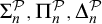
-formulae all of whose quantifiers are bounded. In addition, we will also consider the Takahashi hierarchy of formulae (
$\Sigma _{n}^{\mathcal {P}}, \Pi _{n}^{ \mathcal {P}}, \Delta _{n}^{\mathcal {P}}$
) (introduced in [Reference Takahashi46], and further studied by Mathias’ [Reference Mathias35]), where
$\Delta _{0}^{ \mathcal {P}}$
is the smallest class of
$\mathcal {L}_{\mathrm {set}}$
-formulae that contains all atomic formulae, and is closed both under Boolean connectives and under quantification in the form
$Qx\in y$
and
$Qx\subseteq y $
where x and y are distinct variables, and Q is
$\exists $
or
$ \forall $
. The classes
$\Sigma _{1}^{\mathcal {P}},\Pi _{1}^{\mathcal {P}}$
, etc. are defined inductively from the class
$\Delta _{0}^{\mathcal {P}}$
in the same way that the formula-classes
$\Sigma _{1},\Pi _{1}$
, etc. are defined from
$\Delta _{0}$
-formulae. -
(c) For
$n\in \omega $
and
$\mathcal {L}\supseteq \mathcal {L} _{\mathrm {set}},$
the Levy hierarchy can be naturally extended to
$\mathcal {L }$
-formulae (
$\Sigma _{n}(\mathcal {L}), \Pi _{n}(\mathcal {L}), \Delta _{n}(\mathcal {L})$
), where
$\Delta _{0}(\mathcal {L})$
is the smallest family of
$\mathcal {L}$
-formulae that contains all atomic
$\mathcal {L}$
-formulae and is closed under Boolean operations and bounded quantification. -
(d)
$\mathsf {KPR}$
(Kripke–Platek with ranks) is the subtheory of
$\mathsf {ZF}$
whose axioms consist of
$\mathsf {KP}$
plus an axiom that asserts that for all ordinals
$\alpha , \{x:\mathrm {rank} (x)<\alpha \}$
exists (where
$\mathrm {rank}(x)$
is the usual rank function on sets). Following recent practice (initiated by Mathias [Reference Mathias35]), the foundation scheme of
$\mathsf {KP}$
is only limited to
$\Pi _{1}$
-formulae; thus in this formulation
$\mathsf {KP}$
can prove the scheme of
$\in $
-induction for
$\Sigma _{1}$
-formulae. In contrast to Barwise’s
$\mathsf {KP}$
in [Reference Barwise2], which includes the full scheme of foundation, our version of
$\mathsf {KP}$
is finitely axiomatizable. Thus
$ \mathsf {KPR}$
is finitely axiomatizable. -
(e)
$\mathsf {ZBQC}$
is the subtheory of
$\mathsf {Z}$
, obtained by augmenting
$\mathsf {M}_{0}$
with
$\mathsf {Foundation}$
(as a single axiom),
$\mathsf {AC}$
(the axiom of choice), and the axiom of infinity, where
$\mathsf {M}_{0}$
is axiomatized by
$\mathsf {Extensionality}$
,
$\mathsf {Pairing}$
,
$\mathsf {Union}$
,
$\mathsf {Powerset}$
, and
$\Delta _{0} $
-
$\mathsf {Separation}$
.Footnote
4
Two distinguished strengthenings of
$\mathsf {ZBQC}$
are
$\mathsf {Mac}:= \mathsf {ZBQC+TC}$
(recall that
$\mathsf {TC}$
asserts that every set has a transitive closure) , and
$\mathsf {Most}:=\mathsf {ZBQC}+\mathsf {KP}+\Sigma _{1}$
-
$ \mathsf {Separation}$
.
$\mathsf {ZBQC,} \mathsf {Mac}$
, and
$\mathsf {Most}$
are finitely axiomatizable.Footnote
5
-
(f) For
$\mathcal {L}\supseteq \mathcal {L}_{\mathrm {set}}$
, the dependent choice scheme, denoted
$\Pi _{\infty }^{1}$
-
$\mathsf {DC}(\mathcal {L})$
, consists of the universal closure of
$ \mathcal {L}$
-formulae of the following form: In the presence of
$$ \begin{align*} \forall x\exists y\ \varphi (x,y,\vec{z})\longrightarrow \forall x\exists f\ \left[ f:\omega \rightarrow \mathrm{V},\ f(0)=x,\mathrm{and}\ \forall n\in \omega \ \varphi (f(n),f(n+1),\vec{z})\right]. \end{align*} $$
$\mathsf {ZF}(\mathrm {\mathcal {L}})\mathrm {,}$
thanks to the Reflection Theorem (Theorem 2.10),
$\Pi _{\infty }^{1}$
-
$ \mathsf {DC}\mathrm {(\mathcal {L})}$
is equivalent to the single sentence
$ \mathsf {DC}$
below: Note that
$$ \begin{align*} \forall r\ \forall a\ \left[ \begin{array}{c} \left( \forall x\in a\ \exists y\in a\ \left\langle x,y\right\rangle \in r\right) \longrightarrow \\ \left( \forall x\in a\ \exists f\ \left( f:\omega \rightarrow \mathrm{V},\ f(0)=x,\mathrm{and}\ \forall n\in \omega \ \left\langle f(n),f(n+1)\right\rangle \in r\right) \right) \end{array} \right]. \end{align*} $$
$\mathsf {DC}$
is provable in
$\mathsf {ZFC}$
.













2.2 Definitions and basic facts. (Model theoretic concepts)
In what follows we make the blanket assumption that $ \mathcal {M}$
,
$ \mathcal {M}$
, ${\mathcal {N}}$
, etc. are
${\mathcal {N}}$
, etc. are $\mathcal {L}$
-structures, where
$\mathcal {L}$
-structures, where $ \mathcal {L}\supseteq \mathcal {L}_{\mathrm {set}}$
.
$ \mathcal {L}\supseteq \mathcal {L}_{\mathrm {set}}$
.
-
(a) We follow the convention of using M,
$M^{\ast }, M_{0}$
, etc. to denote (respectively) the universes of structures
$\mathcal {M }$
,
$\mathcal {M}^{\ast }, \mathcal {M}_{0},$
etc. We denote the membership relation of
$\mathcal {M}$
by
$\in ^{\mathcal {M}}$
; thus an
$\mathcal {L}_{ \mathrm {set}}$
-structure
$\mathcal {M}$
is of the form
$(M,\in ^{\mathcal {M} }) $
. -
(b)
$\mathrm {Ord}^{\mathcal {M}}$
is the class of ordinals in the sense of
$\mathcal {M}$
, i.e., where
$$ \begin{align*} \mathrm{Ord}^{\mathcal{M}}:=\left\{ m\in M:\mathcal{M}\models \mathrm{Ord} (m)\right\} , \end{align*} $$
$\mathrm {Ord}(x)$
expresses “x is transitive and is well-ordered by
$\in $
.” More generally, for a formula
$ \varphi (\vec {x})$
with parameters from M, where
$\vec {m}=\left ( x_{1},\cdot \cdot \cdot ,x_{k}\right ) $
, we write
$\varphi ^{\mathcal {M}}$
for A subset D of
$$ \begin{align*} \left\{ \vec{m}\in M^{k}:\mathcal{M\models \varphi }\left( m_{1},\cdot \cdot \cdot ,m_{k}\right) \right\}. \end{align*} $$
$M^{k}$
is
$\mathcal {M}$
-definable if it is of the form
$ \varphi ^{\mathcal {M}}$
for some choice of
$\varphi .$
We write
$\mathbb { \omega }^{\mathcal {M}}$
for the set of finite ordinals (i.e., natural numbers) of
$\mathcal {M}$
, and
$\mathbb {\omega }$
for the set of finite ordinals in the real world, whose members we refer to as metatheoretic natural numbers.
$\mathcal {M}$
is said to be
$ \omega $
-standard if
$\left ( \mathbb {\omega },\mathbb {\in }\right ) ^{\mathcal {M}}\cong \left ( \mathbb {\omega },\mathbb {\in }\right ) .$
For
$ \alpha \in \mathrm {Ord}^{\mathcal {M}}$
we often use
$\mathcal {M}_{\alpha }$
to denote the substructure of
$\mathcal {M}$
whose universe is where
$$ \begin{align*} M_{\alpha }:=\left\{ m\in M:\mathcal{M}\models m\in \mathrm{V}_{\alpha }\right\} , \end{align*} $$
$\mathrm {V}_{\alpha }$
is defined as usual as
$\{x:\mathrm {rank} (x)<\alpha \}$
, where
$\mathrm {rank}(x)=\sup \{\mathrm {rank}(y)+1:y\in x\}.$
-
(c) For
$c\in M$
,
$\mathrm {Ext}_{\mathcal {M}}(c)$
is the
$ \mathcal {M}$
-extension of c, i.e.,
$\mathrm {Ext}_{\mathcal {M}}(c):=\{m\in M:m\in ^{\mathcal {M}}c\}.$
-
(d) We say that
$X\subseteq M$
is coded (in
$\mathcal {M)}$
if there is some
$c\in M$
such that
$\mathrm {Ext}_{ \mathcal {M}}(c)=X.$
-
(e) Suppose
$\mathcal {M}\models \mathsf {ZF}$
. We say that
$X\subseteq M$
is
$\mathcal {M}$
-amenable if
$(\mathcal {M },X)\models \mathsf {ZF}(\mathrm {X})$
; here X is the interpretation of
$\mathrm {X}$
.










2.3 Definitions. (‘Geometric shapes’ of extensions)
Suppose $\mathcal {L}\supseteq \mathcal {L}_{\mathrm {set}}$
,
$\mathcal {L}\supseteq \mathcal {L}_{\mathrm {set}}$
, $ \mathcal {M}$
and
$ \mathcal {M}$
and ${\mathcal {N}}$
are
${\mathcal {N}}$
are $\mathcal {L}$
-structures, and
$\mathcal {L}$
-structures, and $\mathcal {M} $
a submodel
Footnote
6
of
$\mathcal {M} $
a submodel
Footnote
6
of ${\mathcal {N}}$
(written
${\mathcal {N}}$
(written $ \mathcal {M}\subseteq \mathcal {N)}.$
-
(a)
$\mathcal {M}^{\ast }$
is the convex hull of
$\mathcal {M}$
in
${\mathcal {N}}$
if
$M^{\ast }=\bigcup \limits _{a\in M}\mathrm {Ext}_{{\mathcal {N}}}(a).$
-
(b) Suppose
$a\in M. {\mathcal {N}}$
fixes a if
$ \mathrm {Ext}_{\mathcal {M}}(a)=\mathrm {Ext}_{{\mathcal {N}}}(a)$
, and
$\mathcal {N }$
enlarges a if
$\mathrm {Ext}_{\mathcal {M}}(a)\subsetneq \mathrm { Ext}_{{\mathcal {N}}}(a). $
-
(c)
${\mathcal {N}}$
end extends
$\mathcal {M}$
(written
$\mathcal {M}\subseteq _{\mathrm {end}}{\mathcal {N}}$
)
$,$
if
$\mathcal {N }$
fixes every
$a\in M$
. End extensions are also referred to in the literature as transitive extensions, and in the old days as outer extensions. -
(d)
${\mathcal {N}}$
is a powerset-preserving end extension of
$\mathcal {M}$
(written
$\mathcal {M}\subseteq _{\mathrm {end}}^{ \mathcal {P}}{\mathcal {N}}$
) if
$(i) \mathcal {M}\subseteq _{\mathrm {end}} {\mathcal {N}}$
and
$(ii)$
for if
$a\in M$
,
$b\in N$
, and
${\mathcal {N}}\models (b\subseteq a)$
, then
$b\in M$
. -
(e)
${\mathcal {N}}$
is a rank extension of
$\mathcal {N }$
(written
$\mathcal {M}\subseteq _{\mathrm {rank}}{\mathcal {N}}$
) if
$\mathcal { N}$
is an end extension of
$\mathcal {M}$
, and for all
$a\in M$
and all
$b\in N\backslash M$
,
${\mathcal {N}}\models \mathrm {rank}(a)\in \mathrm {rank}(b)$
. Here we assume that
$\mathcal {M}$
and
${\mathcal {N}}$
are models of a sufficient fragment of
$\mathsf {ZF}$
(such as
$\mathsf {KP}$
) in which the rank function is well-defined.
${\mathcal {N}}$
is a topped rank extension of
$\mathcal {M}$
if
$\mathrm {Ord}^{{\mathcal {N}}}\backslash \mathrm { Ord}^{\mathcal {M}}$
has a least element.Footnote
7
-
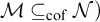
(f)
${\mathcal {N}}$
is a cofinal extension of
$ \mathcal {M}$
(written
$\mathcal {M}\subseteq _{\mathrm {cof}}\mathcal {N)}$
if for every
$b\in N$
there is some
$a\in M$
such that
$b\in \mathrm {Ext}_{ {\mathcal {N}}}(a)$
, i.e.,
${\mathcal {N}}$
is the convex hull of
$\mathcal {M}$
in
${\mathcal {N}}$
. -
(g)
${\mathcal {N}}$
is taller than
$\mathcal {M}$
(written
$\mathcal {M}\subseteq _{\mathrm {taller}}\mathcal {N)}$
if there is some
$b\in M$
such that
$M\subseteq \mathrm {Ext}_{{\mathcal {N}}}(b).$
























2.4 Definitions (‘Logical shapes’ of extensions)
Suppose $\mathcal {L}\supseteq \mathcal {L}_{\mathrm {set}}$
, and
$\mathcal {L}\supseteq \mathcal {L}_{\mathrm {set}}$
, and $ \mathcal {M}$
and
$ \mathcal {M}$
and ${\mathcal {N}}$
are
${\mathcal {N}}$
are $\mathcal {L}$
-structures such that
$\mathcal {L}$
-structures such that $ \mathcal {M}$
is a submodel of
$ \mathcal {M}$
is a submodel of ${\mathcal {N}}$
.
${\mathcal {N}}$
.
-
(a) For a subset
$\Gamma $
of
$\mathcal {L}$
-formulae,
$ \mathcal {M}$
is a
$\Gamma $
-elementary submodel of
${\mathcal {N}}$
(written
$\mathcal {M}\preceq _{\Gamma }{\mathcal {N}}$
) if for all n-ary formulae
$\gamma \in \Gamma $
and for all
$a_{1},\cdot \cdot \cdot ,a_{n}$
in M,
$\mathcal {M}\models \gamma (a_{1},\cdot \cdot \cdot ,a_{n})$
iff
$ {\mathcal {N}}\models \gamma (a_{1},\cdot \cdot \cdot ,a_{n}). \mathcal {M}$
is an elementary submodel of
${\mathcal {N}}$
(written
$\mathcal {M} \preceq {\mathcal {N}}$
) if
$\mathcal {M}\preceq _{\Gamma }{\mathcal {N}}$
for
$ \Gamma = \mathcal {L}$
-formulae. We say that
$\mathcal {M}$
is an elementary submodel of
${\mathcal {N}}$
if
$\mathcal {M}\preceq _{\Gamma } {\mathcal {N}}$
for the set
$\Gamma $
of all
$\mathcal {L}$
-formulae (written
$ \mathcal {M}\preceq {\mathcal {N}}$
). For a given
$\gamma \in \Gamma $
we say that
$\gamma $
is absolute between
$\mathcal {M}$
and
$ {\mathcal {N}}$
if
$\mathcal {M}\preceq _{\{\gamma \}}{\mathcal {N}}$
. As usual, we write
$\mathcal {M}\prec _{\Gamma }{\mathcal {N}}$
if
$\mathcal {M}\preceq _{\Gamma }{\mathcal {N}}$
and
$\mathcal {M}\subsetneq {\mathcal {N}}$
(similarly for
$\mathcal {M}\prec {\mathcal {N}}$
) -
(b)
${\mathcal {N}}$
is a self-extension of
$\mathcal {M }$
(written
$\mathcal {M}\subseteq _{\mathrm {self}}{\mathcal {N}}$
) if
$\mathcal { N}$
is interpretable in
$\mathcal {M}$
(i.e.,
${\mathcal {N}}$
is isomorphic to a model
${\mathcal {N}}^{\ast }$
whose universe
$N^{\ast }$
and the interpretation
$R^{{\mathcal {N}}^{\ast }}$
of each
$R\in \mathcal {L}$
are all
$\mathcal {M}$
-definable), and additionally, there is an
$\mathcal {M}$
-definable embedding j of
$\mathcal {M}$
into
${\mathcal {N}}^{\ast }$
. In this context,
${\mathcal {N}}$
is an elementary self-extension of
$ \mathcal {M}$
if the map j is an elementary embedding. -
(c)
${\mathcal {N}}$
is a conservative extension of
$ \mathcal {M}$
(written
$\mathcal {M}\subseteq _{\mathrm {cons}}{\mathcal {N}}$
) if for every
${\mathcal {N}}$
-definable D,
$M\cap D$
is
$\mathcal {M}$
-definable. -
(d) For
$\mathcal {M}\models \mathsf {ZF}$
,
$ {\mathcal {N}}$
is a faithful extension of
$\mathcal {M}$
(written
$ \mathcal {M}\subseteq _{\mathrm {faith}}\mathcal {N)}$
, if for every
$\mathcal {N }$
-definable D,
$M\cap D$
is
$\mathcal {M}$
-amenable (as in Definition 2.2(e)).Footnote
8









2.5 Remark
The following are readily verifiable:
-
(a) If
$\left \langle {\mathcal {N}}_{k}:k\in \omega \right \rangle $
is a chain of models extending
$\mathcal {M}$
whose union is
$ {\mathcal {N}}$
, and
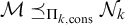
$\mathcal {M}\preceq _{\Pi _{k,\mathrm {cons}}}{\mathcal {N}} _{k}\preceq _{\Pi _{k}}{\mathcal {N}}_{k+1}$
for each
$k\in \omega ,$
then
$ \mathcal {M}\preceq _{\mathrm {cons}}{\mathcal {N}}$
.Footnote
9
Here
$\mathcal {M}\preceq _{\Pi _{k,\mathrm {cons}}} {\mathcal {N}}_{k}$
is shorthand for:
$\mathcal {M}\preceq _{\Pi _{k}}{\mathcal {N}} _{k}$
and
$\mathcal {M}\preceq _{_{\mathrm {cons}}}{\mathcal {N}}_{k}$
. -
(b)
$\left ( \mathcal {M}\subseteq _{\mathrm {self}}{\mathcal {N}} \right ) \Rightarrow \left ( \mathcal {M}\subseteq _{\mathrm {cons}}{\mathcal {N}} \right ). $
-
(c) Assuming
$\mathcal {M}\models \mathsf {ZF}$
,
$\left ( \mathcal {M}\subseteq _{\mathrm {cons}}{\mathcal {N}}\right ) \Rightarrow \left ( \mathcal {M}\subseteq _{\mathrm {faith}}{\mathcal {N}}\right ) .$








The implications in (b) and (c) are not reversible. More specifically, (b) is not reversible since, e.g., if ${\mathcal {N}}$
is a self-extension of
${\mathcal {N}}$
is a self-extension of $\mathcal {M},$
then
$\mathcal {M},$
then $\left \vert M\right \vert =\left \vert N\right \vert ,$
but it is possible to build a conservative elementary extension
$\left \vert M\right \vert =\left \vert N\right \vert ,$
but it is possible to build a conservative elementary extension ${\mathcal {N}}$
of a model
${\mathcal {N}}$
of a model $\mathcal {M}$
with
$\mathcal {M}$
with $\left \vert M\right \vert <\left \vert N\right \vert ,$
e.g., if
$\left \vert M\right \vert <\left \vert N\right \vert ,$
e.g., if $\mathcal {U}$
is an
$\mathcal {U}$
is an $ \mathcal {M}$
-ultrafilter, then the ultrapower formation modulo
$ \mathcal {M}$
-ultrafilter, then the ultrapower formation modulo $\mathcal {U}$
can be iterated along any linear order (of arbitrary cardinality) and results in a conservative elementary extension of
$\mathcal {U}$
can be iterated along any linear order (of arbitrary cardinality) and results in a conservative elementary extension of $\mathcal {M}$
. In particular, it is possible to arrange
$\mathcal {M}$
. In particular, it is possible to arrange $\mathcal {M}\subseteq _{\mathrm {cons}} {\mathcal {N}}$
such that M is countable but N is uncountable. Another way to see that
$\mathcal {M}\subseteq _{\mathrm {cons}} {\mathcal {N}}$
such that M is countable but N is uncountable. Another way to see that $(i)$
is not reversible is to note that by a theorem of Gaifman [Reference Gaifman20] every elementary self-extension of a model
$(i)$
is not reversible is to note that by a theorem of Gaifman [Reference Gaifman20] every elementary self-extension of a model $ \mathcal {M}$
of the
$ \mathcal {M}$
of the $\mathsf {ZF}$
is a cofinal extension.Footnote
10
However, by Theorem 3.1 there are models of
$\mathsf {ZF}$
is a cofinal extension.Footnote
10
However, by Theorem 3.1 there are models of $\mathsf {ZF}$
that have taller conservative elementary extensions. To see that (c) is not reversible, note that if
$\mathsf {ZF}$
that have taller conservative elementary extensions. To see that (c) is not reversible, note that if $ \kappa $
and
$ \kappa $
and $\lambda $
are strongly inaccessible cardinals with
$\lambda $
are strongly inaccessible cardinals with $\kappa <\lambda $
, then
$\kappa <\lambda $
, then $\left ( \mathrm {V}_{\kappa },\in \right ) $
is faithfully extended by
$\left ( \mathrm {V}_{\kappa },\in \right ) $
is faithfully extended by $\left ( \mathrm {V}_{\lambda },\in \right ) $
, but since the truth predicate for
$\left ( \mathrm {V}_{\lambda },\in \right ) $
, but since the truth predicate for $\left ( \mathrm {V}_{\kappa },\in \right ) $
is parametrically definable in
$\left ( \mathrm {V}_{\kappa },\in \right ) $
is parametrically definable in $\left ( \mathrm {V}_{\lambda },\in \right ) $
, by Tarski’s undefinability of truth
$\left ( \mathrm {V}_{\lambda },\in \right ) $
, by Tarski’s undefinability of truth $\left ( \mathrm {V}_{\lambda },\in \right ) $
is not a conservative extension of
$\left ( \mathrm {V}_{\lambda },\in \right ) $
is not a conservative extension of $\left ( \mathrm {V}_{\kappa },\in \right ) $
.
$\left ( \mathrm {V}_{\kappa },\in \right ) $
.
It is also noteworthy that the most common examples of definable extensions in the context of models of set theory are elementary extensions. However, the Boolean-valued approach to forcing provides a wealth of definable extensions that are not elementary. More specifically, if $ \mathcal {M}$
is a model of
$ \mathcal {M}$
is a model of $\mathsf {ZFC}$
,
$\mathsf {ZFC}$
, $\mathbb {B}$
is an element of
$\mathbb {B}$
is an element of $ \mathcal {M}$
that is a complete Boolean algebra from the point of view of
$ \mathcal {M}$
that is a complete Boolean algebra from the point of view of $ \mathcal {M}$
, and
$ \mathcal {M}$
, and $\mathcal {U}$
is an ultrafilter on
$\mathcal {U}$
is an ultrafilter on $\mathbb {B}$
that is in
$\mathbb {B}$
that is in $\mathcal {M}$
, then there is an
$\mathcal {M}$
, then there is an $\mathcal {M}$
-definable embedding j of
$\mathcal {M}$
-definable embedding j of $ \mathcal {M}$
into the model
$ \mathcal {M}$
into the model $\mathcal {M}^{\mathbb {B}}/\mathcal {U}$
(where
$\mathcal {M}^{\mathbb {B}}/\mathcal {U}$
(where $ \mathcal {M}^{\mathbb {B}}$
is the
$ \mathcal {M}^{\mathbb {B}}$
is the $\mathbb {B}$
-valued forcing extension of the universe, as calculated in
$\mathbb {B}$
-valued forcing extension of the universe, as calculated in $\mathcal {M}$
). However, in typical cases
$\mathcal {M}$
). However, in typical cases $ \mathcal {M}$
and
$ \mathcal {M}$
and $\mathcal {M}^{\mathbb {B}}/\mathcal {U}$
are not elementarily equivalent, e.g., we can always arrange
$\mathcal {M}^{\mathbb {B}}/\mathcal {U}$
are not elementarily equivalent, e.g., we can always arrange $\mathbb {B}$
so that the truth-value of the continuum hypothesis changes in the transition between the
$\mathbb {B}$
so that the truth-value of the continuum hypothesis changes in the transition between the $\mathcal {M }$
and
$\mathcal {M }$
and $\mathcal {M}^{\mathbb {B}}/\mathcal {U}$
. Furthermore, even though
$\mathcal {M}^{\mathbb {B}}/\mathcal {U}$
. Furthermore, even though $ \mathcal {M}$
and
$ \mathcal {M}$
and $\mathcal {M}^{\mathbb {B}}/\mathcal {U}$
might be elementarily equivalent in some cases, in general the embedding j is not elementary if
$\mathcal {M}^{\mathbb {B}}/\mathcal {U}$
might be elementarily equivalent in some cases, in general the embedding j is not elementary if $\mathbb {B}$
is a nontrivial notion of forcing, since the statement “there is a filter over
$\mathbb {B}$
is a nontrivial notion of forcing, since the statement “there is a filter over $\mathbb {B}$
that meets all the dense subsets of
$\mathbb {B}$
that meets all the dense subsets of $\mathbb {B}$
” holds in
$\mathbb {B}$
” holds in $\mathcal {M }^{\mathbb {B}}/\mathcal {U}$
, but not in
$\mathcal {M }^{\mathbb {B}}/\mathcal {U}$
, but not in $\mathcal {M}$
(assuming
$\mathcal {M}$
(assuming $\mathbb {B}$
is a nontrivial notion of forcing).
$\mathbb {B}$
is a nontrivial notion of forcing).
2.6 Remark
Suppose $\mathcal {M}$
and
$\mathcal {M}$
and $\mathcal { N}$
are
$\mathcal { N}$
are $\mathcal {L}_{\mathrm {set}}$
-structures with
$\mathcal {L}_{\mathrm {set}}$
-structures with $\mathcal {M}\subseteq {\mathcal {N}}\mathrm {.}$
The following are readily verifiable from the definitions involved:
$\mathcal {M}\subseteq {\mathcal {N}}\mathrm {.}$
The following are readily verifiable from the definitions involved:
-
(a) For each
$n\in \omega , \mathcal {M}\preceq _{\Sigma _{n}}{\mathcal {N}}$
iff
$\mathcal {M}\preceq _{\Pi _{n}}{\mathcal {N}}. $
-
(b)
$\mathcal {M}\subseteq _{\mathrm {end}}{\mathcal {N}}$
, implies
$\mathcal {M}\preceq _{\Delta _{0}}{\mathcal {N}}$
; and
$\mathcal {M} \preceq _{\Delta _{0}}{\mathcal {N}}$
implies
$\mathcal {M}\preceq _{\Delta _{1}} {\mathcal {N}}$
. -
(c) Suppose
$\mathcal {M}\preceq _{\Delta _{0}}{\mathcal {N}}$
,
$ {\mathcal {N}}$
fixes
$a\in M$
, and there is bijection f in
$\mathcal {M}$
between a and some
$b\in M$
. Then
${\mathcal {N}}$
fixes b as well (by
$ \Delta _{0}$
-elementarity, f remains a bijection between a and b as viewed from
${\mathcal {N}}$
) -
(d) Suppose
$\mathcal {M}$
and
${\mathcal {N}}$
are models of
$ \mathsf {KPR}$
,
$\mathcal {M}\preceq _{\Delta _{0}^{\mathcal {P}}}{\mathcal {N}}$
, and
$\alpha \in \mathrm {Ord}^{M}$
. Then
$\mathrm {V}_{\alpha }^{\mathcal {M}}= \mathrm {V}_{\alpha }^{{\mathcal {N}}}$
; this follows from the fact that the formula expressing that x is an ordinal and
$y=\mathrm {V}_{x}$
as a
$ \Sigma _{1}^{\mathcal {P}}$
-formula in
$\mathsf {KPR}$
(using the usual recursive definition of the
$\mathrm {V}_{\alpha }$
-hierarchy). -
(e) If
$\mathcal {M}\subseteq _{\mathrm {end}}^{\mathcal {P}} {\mathcal {N}}$
, then
$\mathcal {M}\preceq _{\Delta _{0}^{\mathcal {P}}}\mathcal {N }$
. On the other hand, since the formula expressing “x is an ordinal and
$y=\mathrm {V}_{x}$
” can be written as a
$ \Sigma _{1}^{\mathcal {P}}$
-formula, it is absolute between models
$\mathcal {M }$
and
${\mathcal {N}}$
such that
$\mathcal {M}\subseteq _{\mathrm {end}}^{ \mathcal {P}}{\mathcal {N}}$
. Thus for models
$\mathcal {M}$
and
${\mathcal {N}}$
of
$\mathsf {KPR}$
:
$$ \begin{align*} \mathcal{M}\subseteq _{\mathrm{end}}^{\mathcal{P}}{\mathcal{N}}\Rightarrow \mathcal{M}\subseteq _{\mathrm{rank}}{\mathcal{N}}. \end{align*} $$
As pointed out by the referee, by [Reference Mathias35, Proposition 6.17], the converse of the above implication also holds provided
$\mathcal {M} \models \mathsf {Most}$
and
${\mathcal {N}}\models \mathsf {Mac}$
. -
(f) If
$\mathcal {M}\preceq _{\Delta _{0}}{\mathcal {N}}$
, and
$ \mathcal {M}^{\ast }$
is the convex hull of
$\mathcal {M}$
in
$ {\mathcal {N}}$
, then
$\mathcal {M}\subseteq _{\mathrm {cof}}\mathcal {M}^{\ast }\subseteq _{\mathrm {end}}{\mathcal {N}}$
. If
$\mathcal {M}$
and
${\mathcal {N}}$
are furthermore assumed to be models of
$\mathsf {KPR}$
, and
$\mathcal {M} \preceq _{\Delta _{0}^{\mathcal {P}}}{\mathcal {N}}$
, then (e) above implies that
$\mathcal {M}\subseteq _{\mathrm {cof}}\mathcal {M}^{\ast }\subseteq _{ \mathrm {rank}}{\mathcal {N}}$
. -
(g) If both
$\mathcal {M}$
and
${\mathcal {N}}$
are models of
$ \mathsf {KPR}$
, and
$\mathcal {M}\preceq _{\Delta _{0}}{\mathcal {N}}$
, then the statement “
${\mathcal {N}}$
is taller than
$\mathcal {M}$
” is equivalent to “there is some
$\gamma \in \mathrm {Ord}^{{\mathcal {N}}}$
that exceeds each
$\alpha \in \mathrm {Ord}^{ \mathcal {M}}$
.” -
(h) Generic extensions of models of
$\mathsf {ZF}$
are end extensions but not rank extensions since they have the same ordinals. However, by (f) above, powerset preserving end extensions of models of
$ \mathsf {KPR}$
are rank extensions, thus for models
$\mathcal {M}$
and
$ {\mathcal {N}}$
of
$\mathsf {KPR}$
we have
$$ \begin{align*} \mathcal{M}\subseteq _{\mathrm{end}}^{\mathcal{P}}\mathcal{N\Longrightarrow M }\subseteq _{\mathrm{rank}}{\mathcal{N}}. \end{align*} $$
On the other hand, since
$\mathcal {P}(x)=y$
is
$\Pi _{1}$
-statement, we have
$$ \begin{align*} \mathcal{M}\preceq _{\Sigma _{1},\mathrm{end}}{\mathcal{N}}\Longrightarrow \mathcal{M}\subseteq _{\mathrm{end}}^{\mathcal{P}}{\mathcal{N}}. \end{align*} $$
The converse of the above implication need not be true for arbitrary models
$ \mathcal {M}$
and
${\mathcal {N}}$
of
$\mathsf {KPR}$
. The referee has offered the following counterexample: let
${\mathcal {N}}$
be a model of
$\mathsf {ZFC}$
that is
$\omega $
-standard but whose
$\omega _{1}$
is nonstandard, and let
$ \mathcal {M}$
be the well-founded part of
${\mathcal {N}}$
. Then
$\mathcal {M} \models \mathsf {KPR}$
, and the property of being equinumerous to a von Neumann ordinal is a
$\Sigma _{1}$
-property of
$\mathcal {P}^{{\mathcal {N}} }(\omega )$
that holds in
${\mathcal {N}}$
but fails in
$\mathcal {M}$
. However, if
$\mathcal {M}\models \mathsf {Most}$
and
${\mathcal {N}}\models \mathsf {Mac}$
, then by [Reference Mathias35, Proposition 6.17] the converse of the above implication holds. -
(i) As we shall see in Lemma 4.3, faithful end extensions of models of
$\mathsf {ZF}$
are rank extensions. -
(j) Thanks to the provability of the induction scheme (over natural numbers) in
$\mathsf {ZF}$
, if
${\mathcal {N}}$
is a faithful extension of a model
${\mathcal {N}}$
(where
$\mathcal {M}$
is a model of
$\mathsf {ZF}$
), then
${\mathcal {N}}$
fixes each element of
$\omega ^{\mathcal {M}}$
(but
$ {\mathcal {N}}$
need not fix
$\omega ^{\mathcal {M}}$
, e.g., consider the case when
${\mathcal {N}}$
is an internal ultrapower of
$\mathcal {M}$
modulo a nonprincipal ultrafilter over
$\omega ^{\mathcal {M}}$
).



2.7 Definition
Reasoning within $\mathsf {KP}$
, for each object a in the universe of sets, let
$\mathsf {KP}$
, for each object a in the universe of sets, let $\dot {a}$
be a constant symbol denoting a (where the map
$\dot {a}$
be a constant symbol denoting a (where the map $a\mapsto \dot {a}$
is
$a\mapsto \dot {a}$
is $\Delta _{1}$
, e.g.,
$\Delta _{1}$
, e.g., $\dot { a}=\left \langle 3,a\right \rangle $
as in Devlin’s monograph [Reference Devlin7])
$\dot { a}=\left \langle 3,a\right \rangle $
as in Devlin’s monograph [Reference Devlin7]) $.$
Let
$.$
Let $\mathrm {Sent}_{\mathcal {L}_{\mathrm {set}}}(x)$
be the
$\mathrm {Sent}_{\mathcal {L}_{\mathrm {set}}}(x)$
be the $\mathcal {L}_{\mathrm {set}}$
-formula that defines the proper class
$\mathcal {L}_{\mathrm {set}}$
-formula that defines the proper class $ \mathrm {Sent}_{\mathcal {L}_{\mathrm {set}}}$
of sentences in the language
$ \mathrm {Sent}_{\mathcal {L}_{\mathrm {set}}}$
of sentences in the language
 $$ \begin{align*} \mathcal{L}^{+}= \mathcal{L}\cup \{\dot{a}:a\in \mathrm{V}\}, \end{align*} $$
and let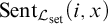 $\mathrm {Sent}_{\mathcal {L}_{\mathrm {set}}}(i,x)$
be the
$\mathrm {Sent}_{\mathcal {L}_{\mathrm {set}}}(i,x)$
be the $ \mathcal {L}_{\mathrm {set}}$
-formula that expresses “
$ \mathcal {L}_{\mathrm {set}}$
-formula that expresses “ $i\in \omega , x\in \mathrm {Sent}_{\mathcal {L}_{\mathrm {set}}},$
and x is a
$i\in \omega , x\in \mathrm {Sent}_{\mathcal {L}_{\mathrm {set}}},$
and x is a $ \Sigma _{i}$
-sentence.” In (a) and (b) below,
$ \Sigma _{i}$
-sentence.” In (a) and (b) below, $\mathcal {M} \models \mathsf {KP}$
,
$\mathcal {M} \models \mathsf {KP}$
, $S\subseteq M$
, and
$S\subseteq M$
, and $k\in \omega ^{\mathcal {M}}$
.Footnote
11
$k\in \omega ^{\mathcal {M}}$
.Footnote
11
-
(a) Given
$k\in \omega $
, S is a
$\Sigma _{k}$
-satisfaction class for
$\mathcal {M}$
if
$\left ( \mathcal {M},S\right ) \models \mathrm {Sat}(k,\mathrm {S})$
, where
$\mathrm {Sat}(k,\mathrm {S})$
is the universal generalization of the conjunction of the axioms
$(i)$
through
$ (iv)$
below. We assume that first order logic is formulated using only the logical constants
$\left \{ \lnot ,\vee ,\exists \right \} .$
-
(i)
$\left [ \left ( \mathrm {S}\left ( \dot {x}=\dot {y}\right ) \leftrightarrow x=y\right ) \wedge \left ( \mathrm {S}\left ( \dot {x}\in \dot {y} \right ) \leftrightarrow x\in y\right ) \right ] .$
-
(ii)
$\left [ \mathrm {Sent}_{\mathcal {L}_{\mathrm {set}}}(k,\varphi )\wedge \left ( \varphi =\lnot \psi \right ) \right ] \rightarrow \left [ \mathrm {S}(\varphi )\leftrightarrow \lnot \mathrm {S}\mathsf {(}\psi \mathsf {)} \right ] \mathsf {.}$
-
(iii)
$\left [ \mathrm {Sent}_{\mathcal {L}_{\mathrm {set}}}(k,\varphi )\wedge \left ( \varphi =\psi _{1}\vee \psi _{2}\right ) \right ] \rightarrow \left [ \mathrm {S}(\varphi )\leftrightarrow \left ( \mathrm {S}(\psi _{1})\vee \mathrm {S}(\psi _{2})\right ) \right ] \mathsf {.}$
-
(iv)
$\left [ \mathrm {Sent}_{\mathcal {L}_{\mathrm {set}}}(k,\varphi )\wedge \left ( \varphi =\exists v\ \psi (v)\right ) \right ] \rightarrow \left [ \mathrm {S}(\varphi )\leftrightarrow \exists x\ \mathrm {S}\mathsf {(}\psi \mathsf {(}\dot {x}\mathsf {))}\right ] .$
-
-
(b) S is a full satisfaction class for
$ \mathcal {M}$
if
$\left ( \mathcal {M},S\right ) \models \mathrm {Sat}(k,\mathrm {S })$
for every
$k\in \omega $
.











2.8 Tarski’s definability and undefinability of truth theorems
Suppose $\mathcal {M}$
is an
$\mathcal {M}$
is an $\mathcal {L}_{ \mathrm {set}}$
-structure.
$\mathcal {L}_{ \mathrm {set}}$
-structure.
-
(a) (Definability/codability of truth). If
$\mathcal { M}$
is a structure coded as an element m of a model
$ {\mathcal {N}}$
of a sufficiently strong
Footnote
12
fragment of
$\mathsf {ZF}$
, then there is
$s\in N$
such that
${\mathcal {N}}$
views s as the Tarskian satisfaction relation on m, written
$ {\mathcal {N}}\models \mathrm {sat}(s,m).$
Footnote
13
Moreover,
$\mathrm {sat}(x,y)$
is
$ \Delta _{1}$
in
${\mathcal {N}}.$
-
(b) (Undefinability of truth). If S is a full satisfaction class for
$\mathcal {M}$
, then S is not
$\mathcal {M}$
-definable.


It is a well-known result of Levy that if $\mathcal {M}\models \mathsf {ZF} \mathrm {,}$
then there is a
$\mathcal {M}\models \mathsf {ZF} \mathrm {,}$
then there is a $\Delta _{0}$
-satisfaction class for
$\Delta _{0}$
-satisfaction class for $ \mathcal {M}$
that is definable in
$ \mathcal {M}$
that is definable in $\mathcal {M}$
both by a
$\mathcal {M}$
both by a $\Sigma _{1}$
-formula and a
$\Sigma _{1}$
-formula and a $\Pi _{1}$
-formula (see ([Reference Jech24], p. 186) for a proof). This makes it clear that for each
$\Pi _{1}$
-formula (see ([Reference Jech24], p. 186) for a proof). This makes it clear that for each $n\geq 1,$
there is a
$n\geq 1,$
there is a $\Sigma _{n}$
-satisfaction class for
$\Sigma _{n}$
-satisfaction class for $\mathcal {M}$
that is definable in
$\mathcal {M}$
that is definable in $\mathcal {M}$
by a
$\mathcal {M}$
by a $\Sigma _{n}$
-formula. Levy’s result extends to models of
$\Sigma _{n}$
-formula. Levy’s result extends to models of $\mathsf {ZF}\mathrm {(}\mathcal {L }\mathrm {)}$
if
$\mathsf {ZF}\mathrm {(}\mathcal {L }\mathrm {)}$
if $\mathcal {L}$
is finite as follows.
$\mathcal {L}$
is finite as follows.
2.9 Levy’s partial definability of truth theorem
Let $\mathcal {L}$
be a finite extension of
$\mathcal {L}$
be a finite extension of $\mathcal {L}_{ \mathrm {set}}$
. For each
$\mathcal {L}_{ \mathrm {set}}$
. For each $n\in \omega $
there is an
$n\in \omega $
there is an $ \mathcal {L}$
-formula
$ \mathcal {L}$
-formula $\mathrm {Sat}_{\Sigma _{n}(\mathcal {L})}$
such that for all models
$\mathrm {Sat}_{\Sigma _{n}(\mathcal {L})}$
such that for all models $\mathcal {M}$
of a sufficiently strong
Footnote
14
$\mathcal {M}$
of a sufficiently strong
Footnote
14 $\mathsf {ZF}\mathrm {(}\mathcal {L}\mathrm {)}$
, Sat
$\mathsf {ZF}\mathrm {(}\mathcal {L}\mathrm {)}$
, Sat $_{\Sigma _{n}(\mathcal {L})}^{\mathcal {M}}$
is a
$_{\Sigma _{n}(\mathcal {L})}^{\mathcal {M}}$
is a $\Sigma _{n}( \mathcal {L})$
-satisfaction class for
$\Sigma _{n}( \mathcal {L})$
-satisfaction class for $\mathcal {M}$
. Furthermore, for
$\mathcal {M}$
. Furthermore, for $n\geq 1$
,
$n\geq 1$
, $\mathrm {Sat}_{\Sigma _{n}(\mathcal {L})}$
is equivalent to a
$\mathrm {Sat}_{\Sigma _{n}(\mathcal {L})}$
is equivalent to a $\Sigma _{n}(\mathcal {L})$
-formula ( provably in
$\Sigma _{n}(\mathcal {L})$
-formula ( provably in $\mathsf {ZF}(\mathcal {L})$
)
$\mathsf {ZF}(\mathcal {L})$
) $\mathrm {.}$
The Reflection Theorem is often formulated as a theorem scheme of $\mathsf {ZF }$
(e.g., as in [Reference Jech24]), the proof strategy of the Reflection Theorem applies equally well to
$\mathsf {ZF }$
(e.g., as in [Reference Jech24]), the proof strategy of the Reflection Theorem applies equally well to $\mathsf {ZF}(\mathcal {L})$
for finite extensions
$\mathsf {ZF}(\mathcal {L})$
for finite extensions $\mathcal {L}$
of
$\mathcal {L}$
of $\mathcal {L}_{\mathrm {set}}$
.
$\mathcal {L}_{\mathrm {set}}$
.
2.10 Montague–Vaught–Levy reflection theorem
Let $\mathcal {L}$
be a finite extension of
$\mathcal {L}$
be a finite extension of $\mathcal {L}_{\mathrm {set} }.$
For each
$\mathcal {L}_{\mathrm {set} }.$
For each $n\in \omega $
,
$n\in \omega $
, $\mathsf {ZF}(\mathcal {L})$
proves that there are arbitrarily large ordinals
$\mathsf {ZF}(\mathcal {L})$
proves that there are arbitrarily large ordinals $\gamma $
such that the submodel of the universe determined byV
$\gamma $
such that the submodel of the universe determined byV $_{\gamma } $
is a
$_{\gamma } $
is a $\Sigma _{n}(\mathcal {L})$
-elementary submodel of the universe.Footnote
15
$\Sigma _{n}(\mathcal {L})$
-elementary submodel of the universe.Footnote
15
2.11
$\boldsymbol {\Sigma }_{\mathbf {n}}$
-elementary chains theorem

Suppose $n\in \omega , \mathcal {L}\supseteq \mathcal {L}_{\mathrm {set}}$
,
$n\in \omega , \mathcal {L}\supseteq \mathcal {L}_{\mathrm {set}}$
, $(I,<_{I})$
is a linear order, and
$(I,<_{I})$
is a linear order, and $ \left \{ \mathcal {M}_{i}:i\in I\right \} $
is a collection of
$ \left \{ \mathcal {M}_{i}:i\in I\right \} $
is a collection of $ \mathcal {L}$
-structures such that
$ \mathcal {L}$
-structures such that $\mathcal {M}_{i}\ \mathcal { \preceq }_{\Sigma _{n}(\mathcal {L})}\ \mathcal {M}_{i^{\prime }}$
whenever
$\mathcal {M}_{i}\ \mathcal { \preceq }_{\Sigma _{n}(\mathcal {L})}\ \mathcal {M}_{i^{\prime }}$
whenever $i<_{I}i^{\prime }.$
Then we have
$i<_{I}i^{\prime }.$
Then we have
 $$ \begin{align*} \mathcal{M}_{i}\ \mathcal{\preceq }_{\Sigma _{n}(\mathcal{L})}\ \bigcup\limits_{i\in I}\mathcal{M}_{i}. \end{align*} $$
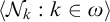
The following is a special case of a result of Gaifman ([Reference Gaifman20], Theorem 1, p.54). In the statement and the proof,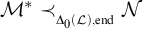 $\mathcal {M}^{\ast }\prec _{_{\Delta _{0}(\mathcal {L}),\mathrm {end}}}{\mathcal {N}}$
is shorthand for the conjunction of
$\mathcal {M}^{\ast }\prec _{_{\Delta _{0}(\mathcal {L}),\mathrm {end}}}{\mathcal {N}}$
is shorthand for the conjunction of $\mathcal {M}^{\ast }\prec _{\Delta _{0}(\mathcal {L)}} {\mathcal {N}}$
and
$\mathcal {M}^{\ast }\prec _{\Delta _{0}(\mathcal {L)}} {\mathcal {N}}$
and $\mathcal {M}^{\ast }\prec _{\mathrm {end}}{\mathcal {N}}$
.
$\mathcal {M}^{\ast }\prec _{\mathrm {end}}{\mathcal {N}}$
.
2.12 Gaifman splitting theorem
Let $ \mathcal {L}\supseteq \mathcal {L}_{\mathrm {set}}.$
Suppose
$ \mathcal {L}\supseteq \mathcal {L}_{\mathrm {set}}.$
Suppose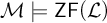 $\mathcal { M}\models \mathsf {ZF}(\mathcal {L})$
,
$\mathcal { M}\models \mathsf {ZF}(\mathcal {L})$
, ${\mathcal {N}}$
is an
${\mathcal {N}}$
is an $\mathcal {L }$
-structure with
$\mathcal {L }$
-structure with $\mathcal {M}\prec _{\Delta _{0}(\mathcal {L})} {\mathcal {N}}$
, and
$\mathcal {M}\prec _{\Delta _{0}(\mathcal {L})} {\mathcal {N}}$
, and $\mathcal {M}^{\ast }$
is the convex hull of
$\mathcal {M}^{\ast }$
is the convex hull of $\mathcal {M}$
in
$\mathcal {M}$
in ${\mathcal {N}}$
. Then the following hold:
${\mathcal {N}}$
. Then the following hold:
-
(a)
$\mathcal {M}\preceq _{\mathrm {cof}}\mathcal {M}^{\ast }\preceq _{\Delta _{0}(\mathcal {L}),\mathrm {end}}{\mathcal {N}}$
. -
(b)
$\mathcal {M\prec N}\Rightarrow \mathcal {M}\preceq _{ \mathrm {cof}}\mathcal {M}^{\ast }\preceq _{\mathrm {end}}{\mathcal {N}}$
.


Proof. To simplify the notation, we present the proof for $\mathcal {L}=\mathcal {L}_{\mathrm {set}}$
since the same reasoning handles the general case. In our proof we use the notation
$\mathcal {L}=\mathcal {L}_{\mathrm {set}}$
since the same reasoning handles the general case. In our proof we use the notation $\varphi ^{v}$
, where
$\varphi ^{v}$
, where $ \varphi $
is an
$ \varphi $
is an $\mathcal {L}_{\mathrm {set}}$
-formula and v is a parameter, to refer to the
$\mathcal {L}_{\mathrm {set}}$
-formula and v is a parameter, to refer to the $\Delta _{0}$
-formula obtained by restricting all the quantifiers of
$\Delta _{0}$
-formula obtained by restricting all the quantifiers of $\varphi $
to the elements of v. A straightforward induction on the complexity of formulae shows that:
$\varphi $
to the elements of v. A straightforward induction on the complexity of formulae shows that:
(1) If $\mathcal {K}$
is an
$\mathcal {K}$
is an $\mathcal {L}_{\mathrm {set}}$
-structure, and
$\mathcal {L}_{\mathrm {set}}$
-structure, and $m\in K$
, then
$m\in K$
, then $\mathcal {K}\models \varphi ^{m}$
iff
$\mathcal {K}\models \varphi ^{m}$
iff $(m,\in )^{\mathcal { K}}\models \varphi $
.
$(m,\in )^{\mathcal { K}}\models \varphi $
.
Note that in the above, $\varphi $
is allowed to contain parameters in
$\varphi $
is allowed to contain parameters in $\mathrm {Ext}_{\mathcal {K}}(m).$
Suppose
$\mathrm {Ext}_{\mathcal {K}}(m).$
Suppose $\mathcal {M}\prec _{\Delta _{0}}{\mathcal {N}},$
where
$\mathcal {M}\prec _{\Delta _{0}}{\mathcal {N}},$
where $\mathcal {M}\models \mathsf {ZF.}$
Note that we are not assuming that
$\mathcal {M}\models \mathsf {ZF.}$
Note that we are not assuming that ${\mathcal {N}}\models \mathsf {ZF}$
. Putting (1) together with
${\mathcal {N}}\models \mathsf {ZF}$
. Putting (1) together with $\mathcal {M}\prec _{\Delta _{0}}{\mathcal {N}}$
implies that
$\mathcal {M}\prec _{\Delta _{0}}{\mathcal {N}}$
implies that $(m,\in )^{\mathcal {M}}\preceq (m,\in )^{\mathcal {M}^{\ast }}$
for all
$(m,\in )^{\mathcal {M}}\preceq (m,\in )^{\mathcal {M}^{\ast }}$
for all $m\in M.$
On the other hand, the definition of
$m\in M.$
On the other hand, the definition of $\mathcal {M}^{\ast }$
makes it clear that
$\mathcal {M}^{\ast }$
makes it clear that $(m,\in )^{{\mathcal {N}}}=(m,\in )^{\mathcal {M}^{\ast }}$
if
$(m,\in )^{{\mathcal {N}}}=(m,\in )^{\mathcal {M}^{\ast }}$
if $m\in M.$
Putting all this together, we have:
$m\in M.$
Putting all this together, we have:
(2) For all $m\in M$
,
$m\in M$
, $(m,\in )^{\mathcal {M}}\preceq (m,\in )^{ \mathcal {M}^{\ast }}=(m,\in )^{{\mathcal {N}}}$
.
$(m,\in )^{\mathcal {M}}\preceq (m,\in )^{ \mathcal {M}^{\ast }}=(m,\in )^{{\mathcal {N}}}$
.
It is easy to see, using the definition of $\mathcal {M}^{\ast }$
, that
$\mathcal {M}^{\ast }$
, that $\mathcal {M}\subseteq _{\mathrm {cof}}\mathcal {M}^{\ast }\subseteq _{ \mathrm {end}}{\mathcal {N}}$
, and in particular
$\mathcal {M}\subseteq _{\mathrm {cof}}\mathcal {M}^{\ast }\subseteq _{ \mathrm {end}}{\mathcal {N}}$
, and in particular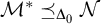 $\mathcal {M}^{\ast }\preceq _{\Delta _{0}}{\mathcal {N}}$
by Remark 2.6(b). Thus the proof of (a) is complete once we show that
$\mathcal {M}^{\ast }\preceq _{\Delta _{0}}{\mathcal {N}}$
by Remark 2.6(b). Thus the proof of (a) is complete once we show that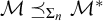 $\mathcal {M}\preceq _{\Sigma _{n}}\mathcal {M} ^{\ast }$
for each
$\mathcal {M}\preceq _{\Sigma _{n}}\mathcal {M} ^{\ast }$
for each $n\in \omega .$
Towards this aim, given
$n\in \omega .$
Towards this aim, given $n\in \omega $
, we can invoke the Reflection Theorem in
$n\in \omega $
, we can invoke the Reflection Theorem in $\mathcal {M}$
to get hold of some
$\mathcal {M}$
to get hold of some $ U\subseteq \mathrm {Ord}^{\mathcal {M}}$
such that:
$ U\subseteq \mathrm {Ord}^{\mathcal {M}}$
such that:
(3) $(\mathcal {M},U)$
satisfies “U is unbounded in
$(\mathcal {M},U)$
satisfies “U is unbounded in $\mathrm {Ord},$
and
$\mathrm {Ord},$
and $\left [ \left ( \mathrm {V}_{\alpha },\in \right ) \prec _{\Sigma _{n}}\left ( \mathrm {V},\in \right ) \right ] $
for every
$\left [ \left ( \mathrm {V}_{\alpha },\in \right ) \prec _{\Sigma _{n}}\left ( \mathrm {V},\in \right ) \right ] $
for every $\alpha \in U$
.”
$\alpha \in U$
.”
For each $\alpha \in U$
let
$\alpha \in U$
let $m_{\alpha }\in M$
such that
$m_{\alpha }\in M$
such that $ m_{\alpha }=\mathrm {V}_{\alpha }^{\mathcal {M}}.$
By (3), we have:
$ m_{\alpha }=\mathrm {V}_{\alpha }^{\mathcal {M}}.$
By (3), we have:
(4) If $\alpha ,\beta \in U$
with
$\alpha ,\beta \in U$
with $\alpha <\beta $
, then
$\alpha <\beta $
, then $ (m_{\alpha },\in )^{\mathcal {M}}\prec _{\Sigma _{n}}(m_{\beta },\in )^{ \mathcal {M}}.$
Next, we observe that if $a,b$
are in M with
$a,b$
are in M with $(a,\in )^{\mathcal { M}}\prec _{\Sigma _{n}}(b,\in )^{\mathcal {M}}$
, then for each k-ary
$(a,\in )^{\mathcal { M}}\prec _{\Sigma _{n}}(b,\in )^{\mathcal {M}}$
, then for each k-ary $ \Sigma _{n}$
-formula
$ \Sigma _{n}$
-formula $\sigma (\vec {x})$
,
$\sigma (\vec {x})$
, $\mathcal {M}$
satisfies the
$\mathcal {M}$
satisfies the $\Delta _{0}$
-statement
$\Delta _{0}$
-statement $\delta _{\sigma }(a,b),$
where:
$\delta _{\sigma }(a,b),$
where:
 $$ \begin{align*} \delta _{\sigma }(a,b):=\forall \vec{x}\in a\ \left[ \sigma ^{a}(\vec{x} )\leftrightarrow \sigma ^{b}(\vec{x})\right], \end{align*} $$
where the prefix $\forall \vec {x}\in a$
is shorthand for
$\forall \vec {x}\in a$
is shorthand for $\forall x_{0}\in a\cdot \cdot \cdot \forall x_{k-1}\in a.$
Therefore, by putting (4) and (2) together with the assumption
$\forall x_{0}\in a\cdot \cdot \cdot \forall x_{k-1}\in a.$
Therefore, by putting (4) and (2) together with the assumption $\mathcal {M}\prec _{\Delta _{0}} {\mathcal {N}}$
we can conclude:
$\mathcal {M}\prec _{\Delta _{0}} {\mathcal {N}}$
we can conclude:
(5) If $\alpha ,\beta \in U$
with
$\alpha ,\beta \in U$
with $\alpha <\beta $
, then
$\alpha <\beta $
, then $ (m_{\alpha },\in )^{\mathcal {M}^{\ast }}\prec _{\Sigma _{n}}(m_{\beta },\in )^{\mathcal {M}^{\ast }}.$
On the other hand, since U is unbounded in $\mathrm {Ord}^{ \mathcal {M}}$
, the definition of
$\mathrm {Ord}^{ \mathcal {M}}$
, the definition of $m_{\alpha }$
, together with the fact that
$m_{\alpha }$
, together with the fact that $ \mathcal {M}\subseteq _{\mathrm {cof}}\mathcal {M}^{\ast }$
, imply:
$ \mathcal {M}\subseteq _{\mathrm {cof}}\mathcal {M}^{\ast }$
, imply:
(6)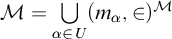 $\ \ \mathcal {M}=\bigcup \limits _{\alpha \in U}(m_{\alpha },\in )^{\mathcal {M}}$
and
$\ \ \mathcal {M}=\bigcup \limits _{\alpha \in U}(m_{\alpha },\in )^{\mathcal {M}}$
and $\mathcal {M}^{\ast }=\bigcup \limits _{\alpha \in U}(m_{\alpha },\in )^{\mathcal {M}^{\ast }}.$
Thanks to (2), (5), (6), and Theorem 2.11 ( $\Sigma _{n}$
-Elementary Chains Theorem) we can conclude:
$\Sigma _{n}$
-Elementary Chains Theorem) we can conclude:
(7) If $\alpha \in U$
, then
$\alpha \in U$
, then $(m_{\alpha },\in )^{\mathcal {M} }\preceq (m_{\alpha },\in )^{\mathcal {M}^{\ast }}\preceq _{\Sigma _{n}} \mathcal {M}^{\ast }\mathrm {.}$
We can conclude that $\mathcal {M}\preceq _{\Sigma _{n}}\mathcal {M} ^{\ast }$
by (4), (7), and Theorem 2.11. This concludes the proof of (a).
$\mathcal {M}\preceq _{\Sigma _{n}}\mathcal {M} ^{\ast }$
by (4), (7), and Theorem 2.11. This concludes the proof of (a).
To prove (b), suppose $\mathcal {M}\prec {\mathcal {N}}.$
With (a) at hand, we only need to show that
$\mathcal {M}\prec {\mathcal {N}}.$
With (a) at hand, we only need to show that $\mathcal {M}^{\ast }\preceq _{\Sigma _{n}}{\mathcal {N}}$
for each
$\mathcal {M}^{\ast }\preceq _{\Sigma _{n}}{\mathcal {N}}$
for each $n\in \omega $
. We observe that if
$n\in \omega $
. We observe that if $\alpha \in U,$
then by (5)
$\alpha \in U,$
then by (5) $ (m_{\alpha },\in )^{\mathcal {M}^{\ast }}\prec _{\Sigma _{n}}\mathcal {M} ^{\ast },$
and by (2),
$ (m_{\alpha },\in )^{\mathcal {M}^{\ast }}\prec _{\Sigma _{n}}\mathcal {M} ^{\ast },$
and by (2), $(m_{\alpha },\in )^{\mathcal {M}^{\ast }}=(m_{\alpha },\in )^{{\mathcal {N}}}.$
On the other hand, the assumption
$(m_{\alpha },\in )^{\mathcal {M}^{\ast }}=(m_{\alpha },\in )^{{\mathcal {N}}}.$
On the other hand, the assumption $\mathcal {M}\prec {\mathcal {N}}$
together with (3) makes it clear that if
$\mathcal {M}\prec {\mathcal {N}}$
together with (3) makes it clear that if $\alpha \in U, (m_{\alpha },\in )^{{\mathcal {N}}}\prec _{\Sigma _{n}}{\mathcal {N}}$
. Thus
$\alpha \in U, (m_{\alpha },\in )^{{\mathcal {N}}}\prec _{\Sigma _{n}}{\mathcal {N}}$
. Thus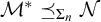 $ \mathcal {M}^{\ast }\preceq _{\Sigma _{n}}{\mathcal {N}}$
by Theorem 2.11.
$ \mathcal {M}^{\ast }\preceq _{\Sigma _{n}}{\mathcal {N}}$
by Theorem 2.11.
2.13 Remark
In general, if $\mathcal {M}\subseteq {\mathcal {N}}$
, where
$\mathcal {M}\subseteq {\mathcal {N}}$
, where $\mathcal {M}$
and
$\mathcal {M}$
and ${\mathcal {N}}$
are both models of
${\mathcal {N}}$
are both models of $ \mathsf {ZF}$
, the condition “
$ \mathsf {ZF}$
, the condition “ $\mathrm {Ord}^{\mathcal {M}}$
is cofinal in
$\mathrm {Ord}^{\mathcal {M}}$
is cofinal in $\mathrm {Ord}^{{\mathcal {N}}}$
” does not imply that
$\mathrm {Ord}^{{\mathcal {N}}}$
” does not imply that $\mathcal {M}$
is cofinal in
$\mathcal {M}$
is cofinal in ${\mathcal {N}}$
(e.g., consider
${\mathcal {N}}$
(e.g., consider $ \mathcal {M}$
and
$ \mathcal {M}$
and ${\mathcal {N}}$
where
${\mathcal {N}}$
where ${\mathcal {N}}$
is a set-generic extension of
${\mathcal {N}}$
is a set-generic extension of $\mathcal {M}$
). However, the conjunction of
$\mathcal {M}$
). However, the conjunction of $\Sigma _{1}$
-elementarity and “
$\Sigma _{1}$
-elementarity and “ $\mathrm {Ord}^{\mathcal {M}}$
is cofinal in
$\mathrm {Ord}^{\mathcal {M}}$
is cofinal in $\mathrm {Ord}^{{\mathcal {N}}}$
,” where
$\mathrm {Ord}^{{\mathcal {N}}}$
,” where $\mathcal {M} \models \mathsf {ZF}$
(or even
$\mathcal {M} \models \mathsf {ZF}$
(or even $\mathsf {KPR}$
) and
$\mathsf {KPR}$
) and ${\mathcal {N}}$
is an
${\mathcal {N}}$
is an $ \mathcal {L}_{\mathrm {set}}$
-structure implies that
$ \mathcal {L}_{\mathrm {set}}$
-structure implies that $\mathcal {M}$
is cofinal in
$\mathcal {M}$
is cofinal in ${\mathcal {N}}$
, since the statement
${\mathcal {N}}$
, since the statement $(y\in \mathrm {Ord}\wedge x=\mathrm {V} _{y})$
can be written as a
$(y\in \mathrm {Ord}\wedge x=\mathrm {V} _{y})$
can be written as a $\Pi _{1}$
-statement within
$\Pi _{1}$
-statement within $\mathsf {KPR}$
, and therefore it is absolute between
$\mathsf {KPR}$
, and therefore it is absolute between $\mathcal {M}$
and
$\mathcal {M}$
and ${\mathcal {N}}$
if
${\mathcal {N}}$
if $ \mathcal {M}\prec _{\Sigma _{1}}{\mathcal {N}}.$
Footnote
16
This is how elementary embeddings between inner models are usually formalized within
$ \mathcal {M}\prec _{\Sigma _{1}}{\mathcal {N}}.$
Footnote
16
This is how elementary embeddings between inner models are usually formalized within $\mathsf {ZF}$
, as in Kanamori’s monograph [Reference Kanamori25, Proposition 5.1].
$\mathsf {ZF}$
, as in Kanamori’s monograph [Reference Kanamori25, Proposition 5.1].
Recall that for models of $\mathsf {ZF}$
, the
$\mathsf {ZF}$
, the $\mathcal {L}_{\mathrm { set}}$
-sentence
$\mathcal {L}_{\mathrm { set}}$
-sentence $\exists p\left ( \mathrm {V}=\mathrm {HOD}(p)\right ) $
expresses: “there is some p such that every set is first order definable in some structure of the form
$\exists p\left ( \mathrm {V}=\mathrm {HOD}(p)\right ) $
expresses: “there is some p such that every set is first order definable in some structure of the form $\left ( \mathrm {V}_{\alpha },\in ,p,\beta \right ) _{\beta <\alpha }$
with
$\left ( \mathrm {V}_{\alpha },\in ,p,\beta \right ) _{\beta <\alpha }$
with $p\in \mathrm {V}_{\alpha }$
.” The following result is classical.
$p\in \mathrm {V}_{\alpha }$
.” The following result is classical.
2.14 Myhill–Scott theorem [Reference Myhill, Scott and Scott38]
The following statements are equivalent for $\mathcal {M}\models \mathsf {ZF}$
:
$\mathcal {M}\models \mathsf {ZF}$
:
-
(a)
$\mathcal {M}\models \exists p\left ( \mathrm {V}=\mathrm { HOD}(p)\right ).$
-
(b)
$\mathcal {M}$
carries a definable global well-ordering, i.e., for some
$p\in M$
and some set-theoretic formula
$\varphi (x,y,z)$
,
$\mathcal {M}$
satisfies “
$\varphi (x,y,p)$
well-orders the universe.” -
(c)
$\mathcal {M}$
carries a definable global choice function, i.e., for some
$p\in M$
and some set-theoretic formula
$\psi (x,y,z)$
,
$\mathcal {M}$
satisfies “
$\psi (x,y,p)$
is the graph of a global choice function.”


3 Taller conservative elementary extensions
Theorem 3.1. Every model $\mathcal {M}$
of
$\mathcal {M}$
of $\mathsf {ZF}+\exists p\left ( \mathrm {V}=\mathrm {HOD}(p)\right ) $
(of any cardinality) has a conservative elementary extension
$\mathsf {ZF}+\exists p\left ( \mathrm {V}=\mathrm {HOD}(p)\right ) $
(of any cardinality) has a conservative elementary extension ${\mathcal {N}}$
such that
${\mathcal {N}}$
such that ${\mathcal {N}}$
is taller than
${\mathcal {N}}$
is taller than $ \mathcal {M}$
.
$ \mathcal {M}$
.
We shall present two proofs of Theorem 3.1, the first one is based on a class-sized syntactic construction taking place within a model of set theory; it was inspired by Kaufmann’s proof of the MacDowell–Specker theorem using the Arithmetized Completeness Theorem, as described by Schmerl [Reference Schmerl41].Footnote 17 The second one is based on a model-theoretic construction that is reminiscent of the original ultrapower proofFootnote 18 of the MacDowell–Specker theorem [Reference Mac Dowell and Specker33]. The first proof is short and devilish; the second proof is a bit longer but is more transparent due to its combinatorial flavor; it also lends itself to a refinement, as indicated in Remark 3.3 and Theorem 3.4.
First proof of Theorem 3.1.
We need the following two Facts 1 and 2.
Fact 1. Suppose $\mathcal {M}$
is a model of
$\mathcal {M}$
is a model of $ \mathsf {ZF}$
that carries an
$ \mathsf {ZF}$
that carries an $\mathcal {M}$
-definable global well-ordering, and T is an
$\mathcal {M}$
-definable global well-ordering, and T is an $\mathcal {M}$
-definable class of first order sentences such that
$\mathcal {M}$
-definable class of first order sentences such that $\mathcal {M}$
satisfies “T is a consistent first order theory.” Then there is a model
$\mathcal {M}$
satisfies “T is a consistent first order theory.” Then there is a model ${\mathcal {N}} \models T^{\mathrm {st}}$
such that the elementary diagram of
${\mathcal {N}} \models T^{\mathrm {st}}$
such that the elementary diagram of $ {\mathcal {N}}$
is
$ {\mathcal {N}}$
is $\mathcal {M}$
-definable, where
$\mathcal {M}$
-definable, where $T^{\mathrm { st}}$
is the collection of sentences in T with standard shape.
Footnote
19
$T^{\mathrm { st}}$
is the collection of sentences in T with standard shape.
Footnote
19
Proof of Fact 1.
Since $\mathcal {M}$
has a definable global well-ordering, the Henkin proof of the completeness theorem of first order logic can be applied within
$\mathcal {M}$
has a definable global well-ordering, the Henkin proof of the completeness theorem of first order logic can be applied within $\mathcal {M}$
to construct a Henkinized complete extension
$\mathcal {M}$
to construct a Henkinized complete extension $T^{\mathrm {Henkin}}$
of T (in a language extending the language of T by class-many new constant symbols) such that T is definable in
$T^{\mathrm {Henkin}}$
of T (in a language extending the language of T by class-many new constant symbols) such that T is definable in $ \mathcal {M}$
. This in turn allows
$ \mathcal {M}$
. This in turn allows $\mathcal {M}$
to define
$\mathcal {M}$
to define ${\mathcal {N}}$
by reading it off
${\mathcal {N}}$
by reading it off $T^{\mathrm {Henkin}},$
as in the usual Henkin proof of the completeness theorem.
$T^{\mathrm {Henkin}},$
as in the usual Henkin proof of the completeness theorem.
Fact 2. If $\mathcal {M}\models \mathsf {ZF}$
, then for each
$\mathcal {M}\models \mathsf {ZF}$
, then for each $n\in \omega \mathcal {M}\models \mathrm {Con}(\mathrm {Th} _{\Pi _{n}}($
V
$n\in \omega \mathcal {M}\models \mathrm {Con}(\mathrm {Th} _{\Pi _{n}}($
V $,\in ,\dot {a})_{a\in \mathrm {V}}$
); here
$,\in ,\dot {a})_{a\in \mathrm {V}}$
); here $ \mathrm {Con}(\mathrm {X})$
expresses the formal consistency of
$ \mathrm {Con}(\mathrm {X})$
expresses the formal consistency of $ \mathrm {X}$
, and
$ \mathrm {X}$
, and $\mathrm {Th}_{\Pi _{n}}($
V
$\mathrm {Th}_{\Pi _{n}}($
V $,\in ,\dot {a} )_{a\in \mathrm {V}}$
is the
$,\in ,\dot {a} )_{a\in \mathrm {V}}$
is the $\Pi _{n}$
-fragment of the elementary diagram of the universe(which is a definable class, using
$\Pi _{n}$
-fragment of the elementary diagram of the universe(which is a definable class, using $\lnot \mathrm {Sat}_{\Sigma _{n}}$
, where
$\lnot \mathrm {Sat}_{\Sigma _{n}}$
, where $ \mathrm {Sat}_{\Sigma _{n}}$
is as in Theorem 2.9).
$ \mathrm {Sat}_{\Sigma _{n}}$
is as in Theorem 2.9).
Proof of Fact 2.
This is an immediate consequence of the Reflection Theorem 2.10.
Starting with a model $\mathcal {M}$
of
$\mathcal {M}$
of $\mathsf {ZF}+\exists p\left ( \mathrm {V}=\mathrm {HOD}(p)\right ) ,$
by Theorem 2.14,
$\mathsf {ZF}+\exists p\left ( \mathrm {V}=\mathrm {HOD}(p)\right ) ,$
by Theorem 2.14, $\mathcal {M}$
carries a global definable well-ordering. We will construct an increasing sequence of
$\mathcal {M}$
carries a global definable well-ordering. We will construct an increasing sequence of $\mathcal {L}_{\mathrm {set}}$
-structures
$\mathcal {L}_{\mathrm {set}}$
-structures $\left \langle {\mathcal {N}} _{k}:k\in \omega \right \rangle $
that satisfies the following properties for each
$\left \langle {\mathcal {N}} _{k}:k\in \omega \right \rangle $
that satisfies the following properties for each $k\in \omega $
:
$k\in \omega $
:
-
(1)
${\mathcal {N}}_{0}=\mathcal {M},$
-
(2)
$\mathcal {M}\preceq _{\Pi _{k+2}}{\mathcal {N}}_{k}\preceq _{\Pi _{k+1}}{\mathcal {N}}_{k+1}$
. -
(3) There is some
$\alpha \in \mathrm {Ord}^{{\mathcal {N}}_{1}}$
that is above each
$\beta \in \mathrm {Ord}^{\mathcal {M}}$
, thus
$\mathcal {M}\preceq _{\mathrm {taller}}{\mathcal {N}}_{k}$
for all
$k\geq 1$
. -
(4)
${\mathcal {N}}_{k}$
is a self-extension of
$\mathcal {M}$
, and in particular
$\mathcal {M}\preceq _{\mathrm {cons}}{\mathcal {N}}_{k}$
.Footnote
20



In other words:
 $$ \begin{align*} & \mathcal{M=N}_{0}\preceq _{\Pi _{3},\mathrm{taller}}{\mathcal{N}}_{1}\preceq _{\Pi _{2}}{\mathcal{N}}_{2}\preceq _{\Pi _{3}}{\mathcal{N}}_{3}\ \ldots,\\ & \text{and for each } k\in \omega, \mathcal{M}\preceq _{\Pi _{k+2},\mathrm{ cons,taller}}{\mathcal{N}}_{k}. \end{align*} $$
In light of part (a) of Remark 2.5, this shows that $\mathcal {M} \prec _{\mathrm {cons,taller}}{\mathcal {N}}$
, where
$\mathcal {M} \prec _{\mathrm {cons,taller}}{\mathcal {N}}$
, where ${\mathcal {N}} :=\bigcup \limits _{k\in \omega }{\mathcal {N}}_{k}$
. So the proof will be complete once we explain how to recursively build the desired chain
${\mathcal {N}} :=\bigcup \limits _{k\in \omega }{\mathcal {N}}_{k}$
. So the proof will be complete once we explain how to recursively build the desired chain $ \left \langle {\mathcal {N}}_{k}:k\in \omega \right \rangle .$
Using the notation of Definition 2.7, let $\mathcal {L}_{\mathrm {set }}^{+}= \mathcal {L}_{\mathrm {set}}\cup \{\dot {a}:a\in \mathrm {V}\}$
be the language
$\mathcal {L}_{\mathrm {set }}^{+}= \mathcal {L}_{\mathrm {set}}\cup \{\dot {a}:a\in \mathrm {V}\}$
be the language $\mathcal {L}_{\mathrm {set}}$
of set theory with a constant
$\mathcal {L}_{\mathrm {set}}$
of set theory with a constant $\dot {a}$
for each
$\dot {a}$
for each $a\in \mathrm {V}$
. To build
$a\in \mathrm {V}$
. To build ${\mathcal {N}}_{1}$
we argue within
${\mathcal {N}}_{1}$
we argue within $ \mathcal {M}$
: add a new constant c to
$ \mathcal {M}$
: add a new constant c to $\mathcal {L}_{\mathrm {set}}^{+}$
and consider the theory
$\mathcal {L}_{\mathrm {set}}^{+}$
and consider the theory $T_{1}$
defined as follows:
$T_{1}$
defined as follows:
 $$ \begin{align*} T_{1}=\left\{ \mathrm{Ord}(c)\right\} \cup \{\dot{\alpha }\in c:\mathrm{Ord} (\alpha )\}\cup \mathrm{Th}_{\Pi _{3}}(\textrm{V},\in ,\dot{a})_{a\in \mathrm{V}}. \end{align*} $$
Thus $T_{1}$
is a proper class within
$T_{1}$
is a proper class within $\mathcal {M}$
. Arguing within
$\mathcal {M}$
. Arguing within $\mathcal {M}$
, and using Fact 2, it is easy to see that
$\mathcal {M}$
, and using Fact 2, it is easy to see that $\mathrm {Con} (T_{1})$
holds, and therefore by Fact 1 we can get hold of a proper class model
$\mathrm {Con} (T_{1})$
holds, and therefore by Fact 1 we can get hold of a proper class model ${\mathcal {N}}_{1}$
of
${\mathcal {N}}_{1}$
of $T_{1}$
such that
$T_{1}$
such that ${\mathcal {N}}_{1}$
is a self-extension of
${\mathcal {N}}_{1}$
is a self-extension of $\mathcal {M}$
. Thus
$\mathcal {M}$
. Thus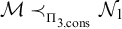 $\mathcal {M}\prec _{_{\Pi _{3,\mathrm { cons}}}}{\mathcal {N}}_{1}$
, and there is an ordinal in
$\mathcal {M}\prec _{_{\Pi _{3,\mathrm { cons}}}}{\mathcal {N}}_{1}$
, and there is an ordinal in ${\mathcal {N}}_{1}$
that is above all of the ordinals of
${\mathcal {N}}_{1}$
that is above all of the ordinals of $\mathcal {M}$
.
$\mathcal {M}$
.
Next suppose we have built $\left \langle {\mathcal {N}}_{i}:1\leq i\leq k\right \rangle $
for some
$\left \langle {\mathcal {N}}_{i}:1\leq i\leq k\right \rangle $
for some $k\in \omega $
while complying with (1)–(4). Consider the theory
$k\in \omega $
while complying with (1)–(4). Consider the theory $T_{k}$
defined in
$T_{k}$
defined in $\mathcal {M}$
as follows:
$\mathcal {M}$
as follows:
 $$ \begin{align*} T_{k+1}=\mathrm{Th}_{\Pi _{k+1}}({\mathcal{N}}_{k},b)_{b\in N_{k}}\cup \mathrm{Th}_{\Pi _{k+2}}(\textrm{V},\in ,a)_{a\in \mathrm{V}}. \end{align*} $$
Fact 2 together with the inductive assumption that $\mathcal {M} \prec _{\Pi _{k+1}}{\mathcal {N}}_{k}$
makes it evident that
$\mathcal {M} \prec _{\Pi _{k+1}}{\mathcal {N}}_{k}$
makes it evident that $\mathrm {Con} (T_{k+1})$
holds in
$\mathrm {Con} (T_{k+1})$
holds in $\mathcal {M}$
. Hence by Fact 1 we can get hold of a model
$\mathcal {M}$
. Hence by Fact 1 we can get hold of a model ${\mathcal {N}}_{k+1}$
of T such that
${\mathcal {N}}_{k+1}$
of T such that ${\mathcal {N}}_{k+1}$
is a self-extension of
${\mathcal {N}}_{k+1}$
is a self-extension of $\mathcal {M}$
. This makes it clear that
$\mathcal {M}$
. This makes it clear that $\left \langle {\mathcal {N}}_{i}:1\leq i\leq k+1\right \rangle $
meets (1)–(4).
$\left \langle {\mathcal {N}}_{i}:1\leq i\leq k+1\right \rangle $
meets (1)–(4).
Second proof of Theorem 3.1 .
Given $\mathcal {M}\models \mathsf {ZF}+\exists p\left ( \mathrm {V}=\mathrm {HOD}(p)\right )$
, let
$\mathcal {M}\models \mathsf {ZF}+\exists p\left ( \mathrm {V}=\mathrm {HOD}(p)\right )$
, let $ \mathbb {B}$
be the Boolean algebra consisting of
$ \mathbb {B}$
be the Boolean algebra consisting of $\mathcal {M}$
-definable subsets of
$\mathcal {M}$
-definable subsets of $\mathrm {Ord}^{\mathcal {M}}$
(ordered by
$\mathrm {Ord}^{\mathcal {M}}$
(ordered by $\subseteq $
). In Stage 1 of the proof we will build an appropriate ultrafilter
$\subseteq $
). In Stage 1 of the proof we will build an appropriate ultrafilter $\mathcal {U}$
on
$\mathcal {U}$
on $ \mathbb {B},$
and in Stage 2 we will verify that the definable ultrapower of
$ \mathbb {B},$
and in Stage 2 we will verify that the definable ultrapower of $ \mathcal {M}$
modulo
$ \mathcal {M}$
modulo $\mathcal {U}$
, denoted
$\mathcal {U}$
, denoted $\mathcal {M}^{\mathrm {Ord}^{ \mathcal {M}}}/\ \mathcal {U}$
, is a conservative elementary extension of
$\mathcal {M}^{\mathrm {Ord}^{ \mathcal {M}}}/\ \mathcal {U}$
, is a conservative elementary extension of $ \mathcal {M}$
that is taller than
$ \mathcal {M}$
that is taller than $\mathcal {M}$
.
$\mathcal {M}$
.
Stage 1: The following facts come handy in this stage:
Fact 1. By Theorem 2.9, for each $n\in \omega $
there is a definable satisfaction predicate for
$n\in \omega $
there is a definable satisfaction predicate for $\Sigma _{n}$
-formulae.
$\Sigma _{n}$
-formulae.
Fact 2. By Theorem 2.14, $\mathcal {M}$
has a parametrically definable global well-ordering.
$\mathcal {M}$
has a parametrically definable global well-ordering.
To facilitate the construction of $\mathcal {U}$
, let us introduce some conventions:
$\mathcal {U}$
, let us introduce some conventions:
-
(i) Given
$\mathfrak {X}\subseteq \mathcal {P}(M)$
, we say that
$ \mathfrak {X}$
is
$\mathcal {M}$
-listable, if that there is a parametric formula
$\psi (\alpha ,\beta )$
such that for all
$X\subseteq M$
we have:


 $$ \begin{align*} X\in \mathfrak{X} \text{ iff } \exists \alpha \in \mathrm{Ord}^{\mathcal{M}} X=\{m\in M:\mathcal{M}\models \psi (\alpha ,m)\}. \end{align*} $$
-
In the above context, if
$\psi $
is a
$\Sigma _{n}$
-formula,
$ \mathfrak {X}$
is said to be
$\Sigma _{n}$
-listable in
$ \mathcal {M}$
. Moreover, we say that
$\left \langle X_{\alpha }:\alpha \in \mathrm {Ord}^{\mathcal {M}}\right \rangle $
is an
$\mathcal {M}$
-list of
$\mathfrak {X}$
if
$X_{\alpha }=\{m\in M:\mathcal {M}\models \psi (\alpha ,m)\}$
for all
$\alpha \in \mathrm {Ord}^{\mathcal {M}}.$
-
(ii) Given an
$\mathcal {M}$
-listable
$\mathfrak {X}\subseteq \mathbb { B}$
, we say that
$\mathfrak {X}$
is
$\mathcal {M}$
-thick if every
$ \mathcal {M}$
-finite intersection of elements of
$\mathfrak {X}$
is nonempty. More precisely,
$\mathfrak {X}$
is
$\mathcal {M}$
-thick if
$\mathcal {M}$
satisfies the following, where
$\psi $
is a listing formula for
$\mathfrak {X}$
:


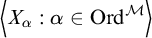





 $$ \begin{align*} \forall k\in \omega \forall \left\langle \alpha _{i}:i<k\right\rangle \in \mathrm{Ord}^{k}\ \exists \gamma \in \mathrm{Ord}\ \forall i<k\ \psi (\alpha _{i},\gamma ). \end{align*} $$
-
(iii) For each
$n\in \omega $
, let
$\mathbb {B}_{n}$
be the collection of
$X\in \mathbb {B}$
such that X is
$\Sigma _{n}$
-definable in
$\mathcal {M}$
(parameters allowed). Note that by Facts 1 and 2,
$\mathbb {B }_{n}$
is
$\mathcal {M}$
-listable for each
$n\in \omega $
. -
(iv)
$\mathcal {F}$
is the collection of all
$X\in \mathbb {B}$
of the form
$\mathrm {Ord}^{\mathcal {M}}\backslash \mathrm {Ext}_{\mathcal {M} }(\alpha )$
, where
$\alpha \in \mathrm {Ord}^{\mathcal {M}}. \mathcal {F}$
is clearly
$\mathcal {M}$
-listable and
$\mathcal {M}$
-thick.






We wish to construct an ultrafilter $\mathcal {U} \subseteq \mathbb {B}$
that satisfies the following properties:
$\mathcal {U} \subseteq \mathbb {B}$
that satisfies the following properties:
-
(1)
$\mathcal {U}$
is an ultrafilter on
$\mathbb {B}$
. -
(2)
$\mathcal {F\subseteq U}$
. -
(3) Given any
$\mathcal {M}$
-definable
$f:\mathrm {Ord}^{\mathcal {M} }\rightarrow \mathcal {M}$
, there is some
$P\in \mathcal {U}$
such that either
$f\upharpoonright P$
is one-to-one, or the range of
$f\upharpoonright P$
is a set (as opposed to a class). -
(4) Given any
$n\in \mathbb {\omega }$
,
$\mathcal {U}\cap \mathbb {B} _{n}$
is
$\mathcal {M}$
-listable. This condition is equivalent to: for any
$ \mathcal {M}$
-list
$\left \langle X_{\alpha }:\alpha \in \mathrm {Ord}^{ \mathcal {M}}\right \rangle $
,
$\left \{ \alpha \in \mathrm {Ord}^{\mathcal {M} }:X_{\alpha }\in \mathcal {U}\right \} \in \mathbb {B}.$





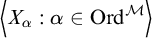

The desired ultrafilter $\mathcal {U}$
will be defined as
$\mathcal {U}$
will be defined as $ \bigcup \limits _{n\in \omega }\mathcal {U}_{n}$
, where
$ \bigcup \limits _{n\in \omega }\mathcal {U}_{n}$
, where $\mathcal {U}_{n+1}$
will be defined from
$\mathcal {U}_{n+1}$
will be defined from $\mathcal {U}_{n}$
using an internal recursion within
$\mathcal {U}_{n}$
using an internal recursion within $ \mathcal {M}$
of length
$ \mathcal {M}$
of length $\mathrm {Ord}^{\mathcal {M}}$
. Thus, intuitively speaking,
$\mathrm {Ord}^{\mathcal {M}}$
. Thus, intuitively speaking, $\mathcal {U}$
will be constructed in
$\mathcal {U}$
will be constructed in $\omega \times \mathrm {Ord}^{ \mathcal {M}}$
-stages.
$\omega \times \mathrm {Ord}^{ \mathcal {M}}$
-stages.
-
• In what follows, for
$n\in \omega $
, we fix an
$\mathcal {M}$
-list
$ \left \langle f_{n,\alpha }:\alpha \in \mathrm {Ord}^{\mathcal {M} }\right \rangle $
of all parametrically definable
$\Sigma _{n}$
-functionsFootnote
21
of
$\mathcal {M}$
with domain
$\mathrm {Ord}^{ \mathcal {M}}$
, and an
$\mathcal {M}$
-list
$\left \langle S_{n,\alpha }:\alpha \in \mathrm {Ord}^{\mathcal {M}}\right \rangle $
of all elements of
$\mathbb {B} _{n}$
. Such
$\mathcal {M}$
-lists exist by Facts 1 and 2 listed at the beginning of Stage 1.


Let $\mathcal {U}_{0} :=\mathcal {F}.$
Thus
$\mathcal {U}_{0} :=\mathcal {F}.$
Thus $\mathcal {U}_{0}$
is
$\mathcal {U}_{0}$
is $ \mathcal {M}$
-listable and
$ \mathcal {M}$
-listable and $\mathcal {M}$
-thick. We now describe the inductive construction of
$\mathcal {M}$
-thick. We now describe the inductive construction of $\mathcal {U}_{n+1}$
from
$\mathcal {U}_{n+1}$
from $\mathcal {U}_{n}$
. So suppose
$\mathcal {U}_{n}$
. So suppose $n\in \omega $
, and we have
$n\in \omega $
, and we have $\mathcal {U}_{n}\subseteq \mathbb {B}$
that satisfies the clauses
$\mathcal {U}_{n}\subseteq \mathbb {B}$
that satisfies the clauses $\mathbb {C}_{1}(n)$
through
$\mathbb {C}_{1}(n)$
through $\mathbb {C}_{3}(n)$
below. Note that conditions
$\mathbb {C}_{3}(n)$
below. Note that conditions $\mathbb {C}_{2}(n)$
and
$\mathbb {C}_{2}(n)$
and $\mathbb {C}_{3}(n)$
only kick in for
$\mathbb {C}_{3}(n)$
only kick in for $ n\geq 1$
and ensure that
$ n\geq 1$
and ensure that $\mathcal {U}_{n}$
abides by certain
$\mathcal {U}_{n}$
abides by certain $\Sigma _{n-1}$
-obligations for
$\Sigma _{n-1}$
-obligations for $n\geq 1$
.
$n\geq 1$
.
-
ℂ1 (n) :
$\mathcal {U}_{n}$
is
$\mathcal {M}$
-listable and
$ \mathcal {M}$
-thick. -
ℂ2 (n) : If
$n\geq 1$
, then
$\forall \alpha \in \mathrm { Ord}^{\mathcal {M}}\ \exists X\in \mathcal {U}_{n}$
(
$f_{n-1,\alpha }\upharpoonright X$
is one-to-one, or the range of
$f_{n-1,\alpha }\upharpoonright X$
is a set). -
ℂ3 (n) : If
$n\geq 1,$
then
$\ \forall \alpha \in \mathrm { Ord}^{\mathcal {M}}$
(
$S_{n-1,\alpha }\in \mathcal {U}_{n+1}$
or
$\mathrm {Ord} ^{\mathcal {M}}\backslash S_{n-1,\alpha }\in \mathcal {U}_{n}).$





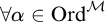


The following lemma is crucial for the construction of $\mathcal {U} _{n+1}\supseteq \mathcal {U}_{n}$
such that
$\mathcal {U} _{n+1}\supseteq \mathcal {U}_{n}$
such that $\mathcal {U}_{n+1}$
satisfies
$\mathcal {U}_{n+1}$
satisfies $ \mathbb {C}_{1}(n+1)$
through
$ \mathbb {C}_{1}(n+1)$
through $\mathbb {C}_{3}(n+1).$
Lemma 3.1.1. Suppose $n\in \omega $
,
$n\in \omega $
, $\mathcal {F }\subseteq \mathfrak {X}\subseteq \mathbb {B}, \mathfrak {X}$
is
$\mathcal {F }\subseteq \mathfrak {X}\subseteq \mathbb {B}, \mathfrak {X}$
is $ \Sigma _{n}$
-listable in
$ \Sigma _{n}$
-listable in $\mathcal {M}$
, and
$\mathcal {M}$
, and $\mathfrak {X}$
is
$\mathfrak {X}$
is $\mathcal {M}$
-thick. Then there is a large enough
$\mathcal {M}$
-thick. Then there is a large enough $k\in \omega $
that satisfies the following two conditions:
$k\in \omega $
that satisfies the following two conditions:
-
(a) Given any
$A\subseteq \mathrm {Ord}^{\mathcal {M} } $
that is
$\Sigma _{m}$
-definable in
$\mathcal {M }$
, let
$\widehat {A}\in \mathbb {B}$
be defined by:
$ \widehat {A}=A$
if
$\mathfrak {X\cup \{}A\}$
is
$\mathcal {M} $
-thick, and otherwise
$\widehat {A}:=\mathrm {Ord}^{\mathcal {M} }\backslash A$
. Then
$\mathfrak {X\cup \{}\widehat {A}\}$
is
$\mathcal {M}$
-thick, and
$\widehat {A}$
is
$\Sigma _{p}$
-definable in
$\mathcal {M}$
for
$p=\max \{m,n\}+k$
. -
(b) Given any
$f:\mathrm {Ord}^{\mathcal {M} }\rightarrow M$
that is
$\Sigma _{m}$
-definable in
$\mathcal {M}$
, there is some
$P\in \mathbb {B}$
that is
$ \Sigma _{p}$
-definable in
$\mathcal {M}$
for
$p=\max \{m,n\}+k$
such that
$\mathfrak {X\cup \{}P\}$
is
$\mathcal { M}$
-thick, and
$f\upharpoonright P$
is either one-to-one, or the range of
$f\upharpoonright P$
is coded as an element of
$\mathcal {M}$
.


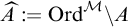








Proof. (a) is easy to see, so we leave the proof to the reader. Our proof of (b) will not explicitly specify the bound k, instead we focus on the combinatorics, which is uniform enough to yield the existence of such a bound. Given an $\mathcal {M}$
-definable
$\mathcal {M}$
-definable $f:\mathrm {Ord}^{ \mathcal {M}}\rightarrow M$
, we distinguish two cases:
$f:\mathrm {Ord}^{ \mathcal {M}}\rightarrow M$
, we distinguish two cases:
Case 1: There is some $\gamma \in \mathrm {Ord}^{\mathcal {M }}$
such that
$\gamma \in \mathrm {Ord}^{\mathcal {M }}$
such that $\mathfrak {X}\cup \{Y_{\gamma }\}$
is
$\mathfrak {X}\cup \{Y_{\gamma }\}$
is $\mathcal {M}$
-thick, where
$\mathcal {M}$
-thick, where
 $$ \begin{align*} Y_{\gamma }=\{\alpha \in \mathrm{Ord}^{\mathcal{M}}:\mathcal{M}\models f(\alpha )<\gamma \}. \end{align*} $$
Case 2: Not case 1.
If case 1 holds, then we let $P:=Y_{\gamma _{0}}$
, where
$P:=Y_{\gamma _{0}}$
, where $\gamma _{0}$
is the first ordinal in
$\gamma _{0}$
is the first ordinal in $\mathrm {Ord}^{\mathcal {M}}$
witnessing the veracity of case 1. Clearly the range of
$\mathrm {Ord}^{\mathcal {M}}$
witnessing the veracity of case 1. Clearly the range of $f\upharpoonright P$
is coded as an element of
$f\upharpoonright P$
is coded as an element of $\mathcal {M}$
.
$\mathcal {M}$
.
If case 2 holds, then let $\mathfrak {X}^{\ast }:=$
the set of all
$\mathfrak {X}^{\ast }:=$
the set of all $ \mathcal {M}$
-finite intersections of
$ \mathcal {M}$
-finite intersections of $\mathfrak {X}$
. Note that
$\mathfrak {X}$
. Note that $\mathfrak {X} ^{\ast }$
is
$\mathfrak {X} ^{\ast }$
is $\mathcal {M}$
-listable, so we can let
$\mathcal {M}$
-listable, so we can let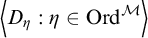 $\left \langle D_{\eta }:\eta \in \mathrm {Ord}^{\mathcal {M}}\right \rangle $
be an
$\left \langle D_{\eta }:\eta \in \mathrm {Ord}^{\mathcal {M}}\right \rangle $
be an $\mathcal {M}$
-list of
$\mathcal {M}$
-list of $\mathfrak {X}^{\ast }$
. It is also clear that the
$\mathfrak {X}^{\ast }$
. It is also clear that the $\mathcal {M}$
-thickness of
$\mathcal {M}$
-thickness of $\mathfrak {X}$
is inherited by
$\mathfrak {X}$
is inherited by $\mathfrak {X}^{\ast }$
. We will construct an
$\mathfrak {X}^{\ast }$
. We will construct an $\mathcal {M}$
-definable set
$\mathcal {M}$
-definable set $P=\{p_{\eta }:\eta \in \mathrm {Ord} ^{\mathcal {M}}\}$
by recursion (within
$P=\{p_{\eta }:\eta \in \mathrm {Ord} ^{\mathcal {M}}\}$
by recursion (within $\mathcal {M}$
) such that the restriction of f to P is one-to-one, and such that
$\mathcal {M}$
) such that the restriction of f to P is one-to-one, and such that $\mathfrak {X}\cup \{P\}$
is
$\mathfrak {X}\cup \{P\}$
is $\mathcal {M}$
-thick
$\mathcal {M}$
-thick $.$
Suppose we have already built P up to some
$.$
Suppose we have already built P up to some $\gamma \in \mathrm {Ord}^{\mathcal {M}}$
as
$\gamma \in \mathrm {Ord}^{\mathcal {M}}$
as $\{p_{\eta }:\eta <\gamma \}$
such that the following two conditions hold in
$\{p_{\eta }:\eta <\gamma \}$
such that the following two conditions hold in $\mathcal {M}$
:
$\mathcal {M}$
: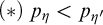 $(\ast ) \ p_{\eta }<p_{\eta ^{\prime }}$
and
$(\ast ) \ p_{\eta }<p_{\eta ^{\prime }}$
and $f(p_{\eta })<f(p_{\eta ^{\prime }})$
whenever
$f(p_{\eta })<f(p_{\eta ^{\prime }})$
whenever $\eta <\eta ^{\prime }<\gamma $
.
$\eta <\eta ^{\prime }<\gamma $
. $(\ast \ast ) \ p_{\eta }\in D_{\eta }$
for all
$(\ast \ast ) \ p_{\eta }\in D_{\eta }$
for all $\eta <\gamma .$
Within $\mathcal {M}$
, let
$\mathcal {M}$
, let $\theta =\sup \{f(p_{\eta }):\eta <\gamma \}.$
Note that
$\theta =\sup \{f(p_{\eta }):\eta <\gamma \}.$
Note that $\theta $
is well-defined because
$\theta $
is well-defined because $\mathcal {M}$
satisfies the replacement scheme. Since we know that case 2 holds, there must exist some
$\mathcal {M}$
satisfies the replacement scheme. Since we know that case 2 holds, there must exist some $D_{\delta }\in \mathfrak {X}^{\ast }$
such that:
$D_{\delta }\in \mathfrak {X}^{\ast }$
such that:
 $$ \begin{align*} D_{\delta }\cap Y_{\theta +1}=\varnothing, \text{ where } Y_{\theta +1}:=\{\alpha \in \mathrm{Ord}^{\mathcal{M}}:\mathcal{M}\models f(\alpha )<\theta +1\}. \end{align*} $$
Therefore within $\mathcal {M}$
can choose
$\mathcal {M}$
can choose $p_{\gamma }$
to be the first member of
$p_{\gamma }$
to be the first member of $D_{\delta }\cap D_{\gamma \text { }}$
that is above
$D_{\delta }\cap D_{\gamma \text { }}$
that is above $ \{s_{\eta }:\eta <\gamma \}$
. Since
$ \{s_{\eta }:\eta <\gamma \}$
. Since $\mathfrak {X}$
is
$\mathfrak {X}$
is $\mathcal {M}$
-thick and
$\mathcal {M}$
-thick and $\mathcal {F}\subseteq \mathfrak {X}$
,
$\mathcal {F}\subseteq \mathfrak {X}$
, $D_{\delta }\cap D_{\gamma \text { } } $
is unbounded in
$D_{\delta }\cap D_{\gamma \text { } } $
is unbounded in $\mathrm {Ord}^{\mathcal {M}},$
hence
$\mathrm {Ord}^{\mathcal {M}},$
hence $s_{\gamma }$
is well-defined. Thus we have constructed an
$s_{\gamma }$
is well-defined. Thus we have constructed an $\mathcal {M}$
-definable set
$\mathcal {M}$
-definable set $ P=\{p_{\eta }:\eta \in \mathrm {Ord}^{\mathcal {M}}\}$
such that
$ P=\{p_{\eta }:\eta \in \mathrm {Ord}^{\mathcal {M}}\}$
such that $p_{\eta }\in D_{\eta }$
for all
$p_{\eta }\in D_{\eta }$
for all $\eta \in \mathrm {Ord}^{\mathcal {M}}$
(so
$\eta \in \mathrm {Ord}^{\mathcal {M}}$
(so $\mathfrak {X} \cup \{P\}$
is
$\mathfrak {X} \cup \{P\}$
is $\mathcal {M}$
-thick), and f is strictly monotone increasing on P. This concludes the proof of part (b) of Lemma 3.1.1.
$\mathcal {M}$
-thick), and f is strictly monotone increasing on P. This concludes the proof of part (b) of Lemma 3.1.1.
Using Lemma 3.1.1, it is now straightforward to use transfinite recursion within $\mathcal {M}$
of length
$\mathcal {M}$
of length $\mathrm {Ord}^{\mathcal {M}}$
to construct a family
$\mathrm {Ord}^{\mathcal {M}}$
to construct a family $\mathcal {U}_{n+1}\subseteq \mathbb {B}$
that extends
$\mathcal {U}_{n+1}\subseteq \mathbb {B}$
that extends $ \mathcal {U}_{n}$
and which satisfies clauses
$ \mathcal {U}_{n}$
and which satisfies clauses $\mathbb {C}_{1}(n+1)$
through
$\mathbb {C}_{1}(n+1)$
through $ \mathbb {C}_{3}(n+1)$
.
$ \mathbb {C}_{3}(n+1)$
. $\mathcal {U}_{n+1}$
will be of the form:
$\mathcal {U}_{n+1}$
will be of the form:
 $$ \begin{align*} \mathcal{U}_{n}\ \cup \bigcup\limits_{\alpha \in \mathrm{Ord}^{\mathcal{M} }}\{A_{\alpha },P_{\alpha }\}, \end{align*} $$
where $A_{\alpha }$
and
$A_{\alpha }$
and $P_{\alpha }$
are defined within
$P_{\alpha }$
are defined within $\mathcal { M}$
by transfinite recursion on
$\mathcal { M}$
by transfinite recursion on $\alpha $
. Suppose for some
$\alpha $
. Suppose for some $\alpha \in \mathrm {Ord}^{\mathcal {M}}$
we have built subsets
$\alpha \in \mathrm {Ord}^{\mathcal {M}}$
we have built subsets $A_{\beta }$
and
$A_{\beta }$
and $P_{\beta }$
of
$P_{\beta }$
of $\mathbb {B}$
for each
$\mathbb {B}$
for each $\beta <\alpha ,$
and
$\beta <\alpha ,$
and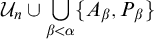 $\mathcal {U}_{n}\cup \bigcup \limits _{\beta <\alpha }\{A_{\beta },P_{\beta }\}$
is
$\mathcal {U}_{n}\cup \bigcup \limits _{\beta <\alpha }\{A_{\beta },P_{\beta }\}$
is $\mathcal {M}$
-thick. Now we can use part (a) of Lemma 3.1.1 to construct
$\mathcal {M}$
-thick. Now we can use part (a) of Lemma 3.1.1 to construct $A_{\alpha }\in \mathbb {B}$
such that
$A_{\alpha }\in \mathbb {B}$
such that $\mathcal {U}_{n}\cup \bigcup \limits _{\beta <\alpha }\{A_{\beta },P_{\beta }\}\cup \{A_{\alpha }\}$
is
$\mathcal {U}_{n}\cup \bigcup \limits _{\beta <\alpha }\{A_{\beta },P_{\beta }\}\cup \{A_{\alpha }\}$
is $\mathcal {M}$
-thick and
$\mathcal {M}$
-thick and $ A_{\alpha }=S_{n,\alpha }$
or
$ A_{\alpha }=S_{n,\alpha }$
or $A_{\alpha }=\mathrm {Ord}^{\mathcal {M} }\backslash S_{n,\alpha }.$
In the next step, using part (b) of Lemma 3.1.1, we can construct
$A_{\alpha }=\mathrm {Ord}^{\mathcal {M} }\backslash S_{n,\alpha }.$
In the next step, using part (b) of Lemma 3.1.1, we can construct $P_{\alpha }\in \mathbb {B}$
which ‘takes care of’
$P_{\alpha }\in \mathbb {B}$
which ‘takes care of’ $ f_{n,\alpha }$
(i.e., the restriction of
$ f_{n,\alpha }$
(i.e., the restriction of $f_{n,\alpha }$
to
$f_{n,\alpha }$
to $P_{\alpha }$
is either one-to-one, or its range is a set) and which has the property that
$P_{\alpha }$
is either one-to-one, or its range is a set) and which has the property that $ \mathcal {U}_{n}\cup \bigcup \limits _{\beta <\alpha }\{A_{\beta },P_{\beta }\}\cup \{A_{\alpha },P_{\alpha }\}$
is
$ \mathcal {U}_{n}\cup \bigcup \limits _{\beta <\alpha }\{A_{\beta },P_{\beta }\}\cup \{A_{\alpha },P_{\alpha }\}$
is $\mathcal {M}$
-thick. This concludes the recursive construction of
$\mathcal {M}$
-thick. This concludes the recursive construction of $A_{\alpha }$
and
$A_{\alpha }$
and $P_{\alpha }$
for
$P_{\alpha }$
for $\alpha \in \mathrm {Ord}^{\mathcal {M}}$
, thus we can define
$\alpha \in \mathrm {Ord}^{\mathcal {M}}$
, thus we can define
 $$ \begin{align*} \mathcal{U}_{n+1}:=\mathcal{U}_{n}\ \cup \bigcup\limits_{\alpha \in \mathrm{ Ord}^{\mathcal{M}}}\{A_{\alpha },P_{\alpha }\}. \end{align*} $$
The construction makes it clear that $\mathcal {U}_{n+1}$
satisfies
$\mathcal {U}_{n+1}$
satisfies $\mathbb {C}_{1}(n+1)$
through
$\mathbb {C}_{1}(n+1)$
through $\mathbb {C}_{3}(n+1)$
. This, in turn, makes evident that for
$\mathbb {C}_{3}(n+1)$
. This, in turn, makes evident that for
 $$ \begin{align*} \mathcal{U}:=\bigcup\limits_{n\in \omega }\mathcal{U}_{n}, \end{align*} $$ $\mathcal {U}$
has properties (1)–(4) promised at the beginning of Stage 1. Note that
$\mathcal {U}$
has properties (1)–(4) promised at the beginning of Stage 1. Note that $\mathcal {U}$
satisfies condition (4) since
$\mathcal {U}$
satisfies condition (4) since $ \mathcal {U}_{n+1}$
and
$ \mathcal {U}_{n+1}$
and $\mathbb {B}_{n}$
are both
$\mathbb {B}_{n}$
are both $\mathcal {M}$
-listable, and by clause
$\mathcal {M}$
-listable, and by clause $\mathbb {C}_{3}(n+1)$
,
$\mathbb {C}_{3}(n+1)$
, $\mathcal {U}\cap \mathbb {B}_{n}\subseteq \mathcal {U}_{n+1}.$
This concludes Stage 1.
$\mathcal {U}\cap \mathbb {B}_{n}\subseteq \mathcal {U}_{n+1}.$
This concludes Stage 1.
Stage 2: Let ${\mathcal {N}}:=\mathcal {M}^{\mathrm {Ord}^{\mathcal {M} }}/\ \mathcal {U}$
be the definable ultrapower of
${\mathcal {N}}:=\mathcal {M}^{\mathrm {Ord}^{\mathcal {M} }}/\ \mathcal {U}$
be the definable ultrapower of $\mathcal {M}$
modulo
$\mathcal {M}$
modulo $ \mathcal {U}$
whose universe consists of
$ \mathcal {U}$
whose universe consists of $\mathcal {U}$
-equivalence classes
$\mathcal {U}$
-equivalence classes $ [f]_{\mathcal {U}}$
of
$ [f]_{\mathcal {U}}$
of $\mathcal {M}$
-definable functions
$\mathcal {M}$
-definable functions $f:\mathrm {Ord}^{ \mathcal {M}}\rightarrow M$
. Thanks to the availability of an
$f:\mathrm {Ord}^{ \mathcal {M}}\rightarrow M$
. Thanks to the availability of an $\mathcal {M}$
-definable global well-ordering, the following Łoś-style result can be readily verified.
$\mathcal {M}$
-definable global well-ordering, the following Łoś-style result can be readily verified.
Theorem 3.1.2.
For all k-ary formulae $\varphi (x_{0},\cdot \cdot \cdot ,x_{k-1})$
of
$\varphi (x_{0},\cdot \cdot \cdot ,x_{k-1})$
of $\mathcal {L}_{ \mathrm {set}}$
and all k-tuples of
$\mathcal {L}_{ \mathrm {set}}$
and all k-tuples of $\mathcal {M}$
-definable functions
$\mathcal {M}$
-definable functions $\left \langle f_{i}:i<k\right \rangle $
from
$\left \langle f_{i}:i<k\right \rangle $
from $ \mathrm {Ord}^{\mathcal {M}}$
to M, we have
$ \mathrm {Ord}^{\mathcal {M}}$
to M, we have
 $$ \begin{align*} {\mathcal{N}}\models \varphi ([f_{0}]_{\mathcal{U}},\cdot \cdot \cdot ,[f_{k-1}]_{\mathcal{U}}) \text{ iff } \left\{ \alpha \in \mathrm{Ord}^{\mathcal{M} }:\mathcal{M}\models \varphi \left( f_{0}(\alpha ),\cdot \cdot \cdot ,f_{k-1}(\alpha )\right) \right\} \in \mathcal{U}. \end{align*} $$
For each $m\in M$
let
$m\in M$
let $\widetilde {m}: \mathrm {Ord}^{\mathcal {M} }\rightarrow \{m\}$
. Theorem 3.1.2 assures us that the map
$\widetilde {m}: \mathrm {Ord}^{\mathcal {M} }\rightarrow \{m\}$
. Theorem 3.1.2 assures us that the map $j:\mathcal {M} \rightarrow {\mathcal {N}}$
given by
$j:\mathcal {M} \rightarrow {\mathcal {N}}$
given by $j(m)=[\widetilde {m}]_{\mathcal {U}}$
is an elementary embedding, thus by identifying
$j(m)=[\widetilde {m}]_{\mathcal {U}}$
is an elementary embedding, thus by identifying $\mathcal {M}$
with the image of
$\mathcal {M}$
with the image of $ j $
, we can construe
$ j $
, we can construe ${\mathcal {N}}$
as an elementary extension of
${\mathcal {N}}$
as an elementary extension of $\mathcal {M} $
. Let
$\mathcal {M} $
. Let $\mathrm {id}:\mathrm {Ord}^{\mathcal {M}}\rightarrow \mathrm {Ord}^{ \mathcal {M}}$
be the identity map. By property (2) of
$\mathrm {id}:\mathrm {Ord}^{\mathcal {M}}\rightarrow \mathrm {Ord}^{ \mathcal {M}}$
be the identity map. By property (2) of $\mathcal {U}$
specified in Stage 1, every element of
$\mathcal {U}$
specified in Stage 1, every element of $\mathcal {U}$
is unbounded in
$\mathcal {U}$
is unbounded in $ \mathrm {Ord}^{\mathcal {M}}.$
So by Theorem 3.1.2,
$ \mathrm {Ord}^{\mathcal {M}}.$
So by Theorem 3.1.2, ${\mathcal {N}}$
is taller than
${\mathcal {N}}$
is taller than $\mathcal {M}$
since
$\mathcal {M}$
since $[\mathrm {id}]_{\mathcal {U}}$
exceeds all ordinals of
$[\mathrm {id}]_{\mathcal {U}}$
exceeds all ordinals of $\mathcal {M}$
.
$\mathcal {M}$
.
It remains to verify that ${\mathcal {N}}$
is a conservative extension of
${\mathcal {N}}$
is a conservative extension of $\mathcal {M}$
. Given a formula
$\mathcal {M}$
. Given a formula $\psi (x,y_{0},\cdot \cdot \cdot ,y_{k-1})$
and parameters
$\psi (x,y_{0},\cdot \cdot \cdot ,y_{k-1})$
and parameters $s_{0},\cdot \cdot \cdot ,s_{k-1}$
in N, let
$s_{0},\cdot \cdot \cdot ,s_{k-1}$
in N, let
 $$ \begin{align*} Y=\left\{ m\in M:{\mathcal{N}}\models \varphi ([\widetilde{m}]_{\mathcal{U} },s_{0},\cdot \cdot \cdot ,s_{k-1})\right\}. \end{align*} $$
We wish to show that Y is $\mathcal {M}$
-definable
$\mathcal {M}$
-definable $\mathfrak {.}$
Choose
$\mathfrak {.}$
Choose $f_{0},\cdot \cdot \cdot ,f_{k-1}$
so that
$f_{0},\cdot \cdot \cdot ,f_{k-1}$
so that $s_{i}=[f_{i}]_{\mathcal {U} }$
for all
$s_{i}=[f_{i}]_{\mathcal {U} }$
for all $i<p$
and consider the formula
$i<p$
and consider the formula $\theta (x,\alpha )$
defined below:
$\theta (x,\alpha )$
defined below:
 $$ \begin{align*} \theta (x,\alpha ):=\alpha \in \mathrm{Ord}\wedge \varphi (x,f_{0}(\alpha ),\cdot \cdot \cdot ,f_{k-1}(\alpha )). \end{align*} $$
Pick $n\in \omega $
large enough so that
$n\in \omega $
large enough so that $\theta (x,\alpha )$
is a
$\theta (x,\alpha )$
is a $\Sigma _{n}$
-formula. For each
$\Sigma _{n}$
-formula. For each $m\in M,$
let
$m\in M,$
let
 $$ \begin{align*} S_{m}:=\{\alpha \in \mathrm{Ord}^{\mathcal{M}}:\mathcal{M}\models \theta (m,\alpha )\}. \end{align*} $$
Note that the choice of n, $S_{m}\in \mathbb {B}_{n}$
for each
$S_{m}\in \mathbb {B}_{n}$
for each $ m\in M$
, so
$ m\in M$
, so $S_{m}\in \mathcal {U}$
iff
$S_{m}\in \mathcal {U}$
iff $S_{m}\in \mathcal {U}\cap \mathbb {B} _{n}$
for each
$S_{m}\in \mathcal {U}\cap \mathbb {B} _{n}$
for each $m\in M$
. On the other hand, by Theorem 3.1.2 we have
$m\in M$
. On the other hand, by Theorem 3.1.2 we have
 $$ \begin{align*} m\in Y \text{ iff } S_{m}\in \mathcal{U} \text{ for each } m\in M. \end{align*} $$
So we can conclude that $m\in Y$
iff
$m\in Y$
iff $S_{m}\in \mathcal {U}\cap \mathbb {B}_{n}$
for each
$S_{m}\in \mathcal {U}\cap \mathbb {B}_{n}$
for each $m\in M.$
Since
$m\in M.$
Since $\mathcal {U}\cap \mathbb {B}_{n}$
is
$\mathcal {U}\cap \mathbb {B}_{n}$
is $\mathcal {M}$
-listable by property (4) of
$\mathcal {M}$
-listable by property (4) of $\mathcal {U}$
specified in Stage 1, we can write
$\mathcal {U}$
specified in Stage 1, we can write $\mathcal {U}\cap \mathbb {B}_{n}$
as an
$\mathcal {U}\cap \mathbb {B}_{n}$
as an $\mathcal {M}$
-list
$\mathcal {M}$
-list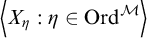 $ \left \langle X_{\eta }:\eta \in \mathrm {Ord}^{\mathcal {M}}\right \rangle $
given by some formula
$ \left \langle X_{\eta }:\eta \in \mathrm {Ord}^{\mathcal {M}}\right \rangle $
given by some formula $\psi (x,y).$
Thus the following holds for all
$\psi (x,y).$
Thus the following holds for all $m\in M$
, which shows that Y is
$m\in M$
, which shows that Y is $\mathcal {M}$
-definable:
$\mathcal {M}$
-definable:
 $$ \begin{align*} m\in Y \text{ iff } \exists \eta \left( S_{m}=X_{\eta }\right) \text{ iff } \mathcal{M} \models \exists \eta \ \forall \alpha \left( \theta (m,\alpha )\leftrightarrow \psi (\eta ,m)\right). \end{align*} $$
Corollary 3.2. Work in $\mathsf {ZF}+\exists p\left ( \mathrm {V}=\mathrm {HOD}(p)\right ) $
in the metatheory, and let
$\mathsf {ZF}+\exists p\left ( \mathrm {V}=\mathrm {HOD}(p)\right ) $
in the metatheory, and let $\mathcal {M}$
be an arbitrary model of
$\mathcal {M}$
be an arbitrary model of $\mathsf {ZF} +\exists p\left ( \mathrm {V}=\mathrm {HOD}(p)\right ).$
-
(a) For every regular cardinal
$\kappa $
there is a conservative elementary extension
${\mathcal {N}}_{\kappa }$
of
$\mathcal {M}$
that is taller than
$\mathcal {M}$
and
$\mathrm {cf}(\mathrm {Ord}^{{\mathcal {N}}})=\kappa $
.Footnote
22
-
(b) There is a proper class model
${\mathcal {N}}_{ \mathrm {Ord}}$
whose elementary diagram is a definable class such that
$(1)\ \mathcal {M\prec }_{\mathrm {cons,taller}}{\mathcal {N}}_{ \mathrm {Ord}}$
and
$(2)$
$\mathrm {Ord}^{{\mathcal {N}}_{ \mathrm {Ord}}}$
contains a cofinal class of order-type
$\mathrm {Ord} $
.


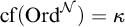


Proof. To establish (a), we observe that given a regular cardinal $\kappa $
, Theorem 3.1 allows us to build an elementary chain of models
$\kappa $
, Theorem 3.1 allows us to build an elementary chain of models $\left \langle \mathcal {M}_{\alpha }:\alpha \in \kappa \right \rangle $
with the following properties:
$\left \langle \mathcal {M}_{\alpha }:\alpha \in \kappa \right \rangle $
with the following properties:
(1) $\ \ \mathcal {M}_{0}=\mathcal {M}.$
(2)\ For each $\alpha \in \kappa \mathcal {M}_{\alpha +1}$
is a conservative elementary extension of
$\alpha \in \kappa \mathcal {M}_{\alpha +1}$
is a conservative elementary extension of $\mathcal {M}$
that is taller than
$\mathcal {M}$
that is taller than $ \mathcal {M}.$
(3) For limit $\alpha \in \kappa $
,
$\alpha \in \kappa $
,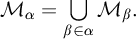 $\mathcal {M}_{\alpha }=\bigcup \limits _{\beta \in \alpha }\mathcal {M}_{\beta }.$
The desired model ${\mathcal {N}}$
is clearly
${\mathcal {N}}$
is clearly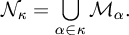 ${\mathcal {N}}_{\kappa }=\bigcup \limits _{\alpha \in \kappa }\mathcal {M}_{\alpha }.$
This concludes the proof of part (a).
${\mathcal {N}}_{\kappa }=\bigcup \limits _{\alpha \in \kappa }\mathcal {M}_{\alpha }.$
This concludes the proof of part (a).
With part (a) at hand, it is evident that in the presence of a global definable well-ordering (available thanks to the veracity of $\exists p\left ( \mathrm {V}=\mathrm {HOD}(p)\right ) $
in the metatheory), we can construct the desired model
$\exists p\left ( \mathrm {V}=\mathrm {HOD}(p)\right ) $
in the metatheory), we can construct the desired model ${\mathcal {N}}_{\mathrm {Ord}}$
as the union of an elementary chain of models
${\mathcal {N}}_{\mathrm {Ord}}$
as the union of an elementary chain of models $\left \langle \mathcal {M}_{\alpha }:\alpha \in \mathrm {Ord}\right \rangle $
that satisfies (1) and it also satisfies the result of replacing
$\left \langle \mathcal {M}_{\alpha }:\alpha \in \mathrm {Ord}\right \rangle $
that satisfies (1) and it also satisfies the result of replacing $\kappa $
with
$\kappa $
with $\mathrm {Ord}$
in (2) and (3).
$\mathrm {Ord}$
in (2) and (3).
Remark 3.3. We should point out that condition (3) of the proof of Theorem 3.1 was inserted so as to obtain the following corollary which is of interest in light of a result of [Reference Enayat12] that states that every model of $\mathsf {ZFC}$
has a cofinal conservative extension that possesses a minimal cofinal elementary extension.Footnote
23
$\mathsf {ZFC}$
has a cofinal conservative extension that possesses a minimal cofinal elementary extension.Footnote
23
Theorem 3.4. Every model of $\mathsf {ZF} +\exists p\left ( \mathrm {V}=\mathrm {HOD}(p)\right )$
has a cofinal conservative elementary extension that possesses a minimal elementary end extension.
$\mathsf {ZF} +\exists p\left ( \mathrm {V}=\mathrm {HOD}(p)\right )$
has a cofinal conservative elementary extension that possesses a minimal elementary end extension.
Proof. Let $\mathcal {M}$
be a model of
$\mathcal {M}$
be a model of $\mathsf {ZF} +\exists p\left ( \mathrm {V}=\mathrm {HOD}(p)\right ) $
,
$\mathsf {ZF} +\exists p\left ( \mathrm {V}=\mathrm {HOD}(p)\right ) $
, ${\mathcal {N}}$
be the model constructed in the second proof of Theorem 3.1, and let
${\mathcal {N}}$
be the model constructed in the second proof of Theorem 3.1, and let $\mathcal {M}^{\ast }$
be the convex hull of
$\mathcal {M}^{\ast }$
be the convex hull of $\mathcal {M}$
in
$\mathcal {M}$
in $ {\mathcal {N}}$
. Note that by Gaifman Splitting Theorem we have
$ {\mathcal {N}}$
. Note that by Gaifman Splitting Theorem we have
 $$ \begin{align*} \mathcal{M}\preceq _{\mathrm{cof}}\mathcal{M}^{\ast }\prec _{\mathrm{end}} {\mathcal{N}}. \end{align*} $$
The above together with the fact that ${\mathcal {N}}$
is conservative extension of
${\mathcal {N}}$
is conservative extension of $\mathcal {M}$
makes it clear that
$\mathcal {M}$
makes it clear that $\mathcal {M} ^{\ast }$
is a conservative extension of
$\mathcal {M} ^{\ast }$
is a conservative extension of $\mathcal {M}$
.Footnote
24
We claim that
$\mathcal {M}$
.Footnote
24
We claim that ${\mathcal {N}}$
is a minimal elementary end extension of
${\mathcal {N}}$
is a minimal elementary end extension of $\mathcal {M}^{\ast }$
. First note that
$\mathcal {M}^{\ast }$
. First note that ${\mathcal {N}}$
is generated by members of
${\mathcal {N}}$
is generated by members of $\mathcal {M}$
and the
$\mathcal {M}$
and the $\mathcal {U}$
-equivalence class of the identity function
$\mathcal {U}$
-equivalence class of the identity function $[\mathrm {id}]_{\mathcal {U}}$
via the definable terms of
$[\mathrm {id}]_{\mathcal {U}}$
via the definable terms of $\mathcal {M}$
, i.e., the following holds:
$\mathcal {M}$
, i.e., the following holds:
 $$ \begin{align*} \text{For any } a\in N, \text{ there exists some } \mathcal{M}\text{-definable function } f \text{ such that } {\mathcal{N}}\models f([\mathrm{id}]_{\mathcal{U}})=a. \end{align*} $$
To verify that ${\mathcal {N}}$
is a minimal elementary end extension of
${\mathcal {N}}$
is a minimal elementary end extension of $\mathcal {M}^{\ast }$
it is sufficient to show that if
$\mathcal {M}^{\ast }$
it is sufficient to show that if $s\in N\backslash M^{\ast }$
then
$s\in N\backslash M^{\ast }$
then $[\mathrm {id}]_{\mathcal {U}}$
is definable in
$[\mathrm {id}]_{\mathcal {U}}$
is definable in ${\mathcal {N}}$
using parameters from
${\mathcal {N}}$
using parameters from $M\cup \{s\}.$
Choose h such that
$M\cup \{s\}.$
Choose h such that $s=[h]_{\mathcal {U} }$
and recall that by our construction of
$s=[h]_{\mathcal {U} }$
and recall that by our construction of $\mathcal {U}$
we know that there exists
$\mathcal {U}$
we know that there exists $X\subseteq \mathrm {Ord}^{\mathcal {M}}$
with
$X\subseteq \mathrm {Ord}^{\mathcal {M}}$
with $X\in \mathcal {U}$
such that either
$X\in \mathcal {U}$
such that either $h\upharpoonright X$
is one-to-one, or the image of X under h is a set (and thus of bounded
$h\upharpoonright X$
is one-to-one, or the image of X under h is a set (and thus of bounded $\mathcal {M}$
-rank). However, since s was chosen to be in
$\mathcal {M}$
-rank). However, since s was chosen to be in $N\backslash M^{\ast }$
we can rule out the latter possibility. Note that since
$N\backslash M^{\ast }$
we can rule out the latter possibility. Note that since $X\in \mathcal {U}$
the extension of X in
$X\in \mathcal {U}$
the extension of X in $ {\mathcal {N}}$
will contain
$ {\mathcal {N}}$
will contain $[\mathrm {id}]_{\mathcal {U}}$
, i.e., if X is defined in
$[\mathrm {id}]_{\mathcal {U}}$
, i.e., if X is defined in $\mathcal {M}$
by
$\mathcal {M}$
by $\varphi (x)$
, then
$\varphi (x)$
, then ${\mathcal {N}}\models \varphi ([\mathrm {id}]_{\mathcal {U}})$
. Moreover, by elementarity, since h is one-to-one on X in
${\mathcal {N}}\models \varphi ([\mathrm {id}]_{\mathcal {U}})$
. Moreover, by elementarity, since h is one-to-one on X in $\mathcal {M}$
, it must remain so in
$\mathcal {M}$
, it must remain so in ${\mathcal {N}}$
. Hence, in light of the fact that
${\mathcal {N}}$
. Hence, in light of the fact that ${\mathcal {N}}\models h([\mathrm {id}]_{ \mathcal {U}})=s$
, we can define
${\mathcal {N}}\models h([\mathrm {id}]_{ \mathcal {U}})=s$
, we can define $[\mathrm {id}]_{\mathcal {U}}$
within
$[\mathrm {id}]_{\mathcal {U}}$
within $ {\mathcal {N}}$
to be the unique element of
$ {\mathcal {N}}$
to be the unique element of $h^{-1}(s)\cap X.$
This completes the proof.
$h^{-1}(s)\cap X.$
This completes the proof.
Remark 3.5. As Theorem 4.1 of the next section shows, in Theorem 3.1 the model ${\mathcal {N}}$
cannot be required to fix
${\mathcal {N}}$
cannot be required to fix $\omega ^{ \mathcal {M}}$
and in particular
$\omega ^{ \mathcal {M}}$
and in particular ${\mathcal {N}}$
cannot be arranged to end extend
${\mathcal {N}}$
cannot be arranged to end extend $\mathcal {M}$
. By putting this observation together with Remark 2.6(j) we can conclude that in the proof of Corollary 3.2,
$\mathcal {M}$
. By putting this observation together with Remark 2.6(j) we can conclude that in the proof of Corollary 3.2, $\omega ^{ {\mathcal {N}}_{\kappa }}$
is
$\omega ^{ {\mathcal {N}}_{\kappa }}$
is $\kappa $
-like (i.e., its cardinality is
$\kappa $
-like (i.e., its cardinality is $\kappa $
but each proper initial segment of it is of cardinality less than
$\kappa $
but each proper initial segment of it is of cardinality less than $\kappa $
), and
$\kappa $
), and $\omega ^{{\mathcal {N}}_{\mathrm {Ord}}}$
is
$\omega ^{{\mathcal {N}}_{\mathrm {Ord}}}$
is $\mathrm {Ord}$
-like (i.e., it is a proper class every proper initial segment of which forms a set).
$\mathrm {Ord}$
-like (i.e., it is a proper class every proper initial segment of which forms a set).
We next address the question of the extent to which the hypothesis in Theorem 3.1 that $\mathcal {M}$
is a model of
$\mathcal {M}$
is a model of $\exists p\left ( \mathrm {V}= \mathrm {HOD}(p)\right ) $
can be weakened. In what follows
$\exists p\left ( \mathrm {V}= \mathrm {HOD}(p)\right ) $
can be weakened. In what follows $\mathrm {AC}$
stands for the axiom of choice, and
$\mathrm {AC}$
stands for the axiom of choice, and $\mathsf {DC}$
stands for the axiom of dependent choice.
$\mathsf {DC}$
stands for the axiom of dependent choice.
Proposition 3.6. Suppose $\mathcal {M}$
and
$\mathcal {M}$
and ${\mathcal {N}}$
are models of
${\mathcal {N}}$
are models of $\mathsf {ZF}$
,
$\mathsf {ZF}$
, $\mathcal {M}\prec _{ \mathrm {cons}}{\mathcal {N}}$
, and
$\mathcal {M}\prec _{ \mathrm {cons}}{\mathcal {N}}$
, and ${\mathcal {N}}$
is taller than
${\mathcal {N}}$
is taller than $\mathcal {M}$
. If every set can be linearly ordered in
$\mathcal {M}$
. If every set can be linearly ordered in ${\mathcal {N}}$
, then there is an
${\mathcal {N}}$
, then there is an $\mathcal {M}$
- definable global linear ordering.
$\mathcal {M}$
- definable global linear ordering.
Proof. Suppose $\mathcal {M}$
and
$\mathcal {M}$
and ${\mathcal {N}}$
are as in the assumptions of the proposition. Fix
${\mathcal {N}}$
are as in the assumptions of the proposition. Fix $\alpha \in \mathrm {Ord}^{{\mathcal {N}} }$
such that
$\alpha \in \mathrm {Ord}^{{\mathcal {N}} }$
such that $\alpha $
is above all the ordinals of
$\alpha $
is above all the ordinals of $\mathcal {M}$
and let R denote a linear ordering of
$\mathcal {M}$
and let R denote a linear ordering of $\mathrm {V}_{\alpha }^{{\mathcal {N}}}$
in
$\mathrm {V}_{\alpha }^{{\mathcal {N}}}$
in $ {\mathcal {N}}$
. By conservativity, there is a formula
$ {\mathcal {N}}$
. By conservativity, there is a formula $r(x,y)$
(possibly with parameters from M) such that
$r(x,y)$
(possibly with parameters from M) such that $r(x,y)$
that defines
$r(x,y)$
that defines $R\cap M^{2}$
in
$R\cap M^{2}$
in $ \mathcal {M}$
. It is clear that
$ \mathcal {M}$
. It is clear that $r(x,y)$
defines a global linear ordering in
$r(x,y)$
defines a global linear ordering in $\mathcal {M}$
.
$\mathcal {M}$
.
Corollary 3.7. There are models of $\mathsf {ZFC} $
that have no taller conservative elementary extensions to a model of
$\mathsf {ZFC} $
that have no taller conservative elementary extensions to a model of $\mathsf {ZFC}$
.
$\mathsf {ZFC}$
.
Proof. This follows from Proposition 3.6, and the well-known fact that there are models of $\mathsf {ZFC}$
in which the universe is not definably linearly ordered.Footnote
25
$\mathsf {ZFC}$
in which the universe is not definably linearly ordered.Footnote
25
Question 3.8.
Can the conclusion of Proposition 3.6 be improved to $\mathcal {M}\models \exists p\left ( \mathrm {V}= \mathrm {HOD}(p)\right ) $
?
$\mathcal {M}\models \exists p\left ( \mathrm {V}= \mathrm {HOD}(p)\right ) $
?
Remark 3.9. If $\mathcal {M}\models \mathsf {ZF}$
and
$\mathcal {M}\models \mathsf {ZF}$
and $ \mathcal {M}\prec _{\Delta _{0},\ \mathrm {cons}}{\mathcal {N}}$
, then each
$ \mathcal {M}\prec _{\Delta _{0},\ \mathrm {cons}}{\mathcal {N}}$
, then each $k\in \omega ^{\mathcal {M}}$
is fixed. To see this, suppose to the contrary that
$k\in \omega ^{\mathcal {M}}$
is fixed. To see this, suppose to the contrary that $ r\in \mathrm {Ext}_{{\mathcal {N}}}(k)\backslash \mathrm {Ext}_{\mathcal {M}}(k)$
. Consider the set
$ r\in \mathrm {Ext}_{{\mathcal {N}}}(k)\backslash \mathrm {Ext}_{\mathcal {M}}(k)$
. Consider the set $S=\left \{ x\in \mathrm {Ext}_{\mathcal {M}}(k):{\mathcal {N}} \models x<r\right \} .$
It is easy to see that S has no last element. On the other hand, by the assumption
$S=\left \{ x\in \mathrm {Ext}_{\mathcal {M}}(k):{\mathcal {N}} \models x<r\right \} .$
It is easy to see that S has no last element. On the other hand, by the assumption $\mathcal {M}\prec _{\mathrm {cons}}\mathcal { N}$
, the set
$\mathcal {M}\prec _{\mathrm {cons}}\mathcal { N}$
, the set $S= \{x\in \mathrm {Ext}_{\mathcal {M}}(k):{\mathcal {N}}\models x<r\}$
is a definable subset of the predecessors of r and thus by the veracity of the separation scheme in
$S= \{x\in \mathrm {Ext}_{\mathcal {M}}(k):{\mathcal {N}}\models x<r\}$
is a definable subset of the predecessors of r and thus by the veracity of the separation scheme in $\mathcal {M}$
, S is coded in
$\mathcal {M}$
, S is coded in $ \mathcal {M}$
by some element, which makes it clear that S must have a last element, contradiction. This shows that in Theorem 4.1,
$ \mathcal {M}$
by some element, which makes it clear that S must have a last element, contradiction. This shows that in Theorem 4.1, ${\mathcal {N}}$
fixes each
${\mathcal {N}}$
fixes each $k\in \omega ^{M}.$
A natural question is whether a taller conservative elementary extension of
$k\in \omega ^{M}.$
A natural question is whether a taller conservative elementary extension of $\mathcal {M}$
can be arranged to fix
$\mathcal {M}$
can be arranged to fix $\omega ^{ \mathcal {M}}$
. As we shall see in the next section, this question has a negative answer for models of
$\omega ^{ \mathcal {M}}$
. As we shall see in the next section, this question has a negative answer for models of $\mathsf {ZFC}$
(see Corollary 4.2).
$\mathsf {ZFC}$
(see Corollary 4.2).
Remark 3.10. Theorem 4.1 should also be contrasted with Gaifman’s theorem mentioned in Remark 2.5 which bars taller elementary self-extensions of models of (a fragment of) $\mathsf {ZF}$
. Thus in Gaifman’s theorem, (a) the condition “
$\mathsf {ZF}$
. Thus in Gaifman’s theorem, (a) the condition “ ${\mathcal {N}}$
is an elementary self extension of
${\mathcal {N}}$
is an elementary self extension of $\mathcal {M}$
” cannot be weakened to “
$\mathcal {M}$
” cannot be weakened to “ ${\mathcal {N}}$
is an elementary conservative extension of
${\mathcal {N}}$
is an elementary conservative extension of $\mathcal {M}$
.” Also note that in the first proof of Theorem 3.1, each
$\mathcal {M}$
.” Also note that in the first proof of Theorem 3.1, each ${\mathcal {N}}_{k}$
is a self-extension of
${\mathcal {N}}_{k}$
is a self-extension of $ \mathcal {M}$
whose associated embedding j is a
$ \mathcal {M}$
whose associated embedding j is a $\Sigma _{k+2}$
-elementary embedding whose image is not cofinal in
$\Sigma _{k+2}$
-elementary embedding whose image is not cofinal in $\mathcal {M}$
.
$\mathcal {M}$
.
4 Faithful extensions
This section contains the proof of Theorem B of the abstract (see Corollary 4.2). Recall from Definition 2.4 and Remark 2.5 that the notion of a faithful extension is a generalization of the notion of a conservative extension. The notion of a full satisfaction class was defined in Definition 2.7(b).
Theorem 4.1. Suppose $\mathcal {M}$
and
$\mathcal {M}$
and ${\mathcal {N}}$
are both models of
${\mathcal {N}}$
are both models of $\mathsf {ZFC}$
such that
$\mathsf {ZFC}$
such that $\mathcal {M}\prec _{\Delta _{0}^{\mathcal {P}},\mathrm {faith}}{\mathcal {N}}$
,
$\mathcal {M}\prec _{\Delta _{0}^{\mathcal {P}},\mathrm {faith}}{\mathcal {N}}$
, ${\mathcal {N}}$
fixes
${\mathcal {N}}$
fixes $\omega ^{\mathcal {M}},$
and
$\omega ^{\mathcal {M}},$
and $ {\mathcal {N}}$
is taller than
$ {\mathcal {N}}$
is taller than $\mathcal {M}$
. Then:
$\mathcal {M}$
. Then:
-
(a) There is some
$\gamma \in \mathrm {Ord}^{ {\mathcal {N}}}$
such that
$\mathcal {M}\preceq {\mathcal {N}}_{\gamma }.$
Thus either
$\mathcal {M=N}_{\gamma }$
, in which case
${\mathcal {N}}$
is a topped rank extension of
$\mathcal {M}$
, or
$\mathcal {M}\prec {\mathcal {N}}_{\gamma }$
.Footnote
26
-
(b) In particular, there is a full satisfaction class S for
$\mathcal {M}$
such that S can be written as
$D\cap M$
, where D is
${\mathcal {N}}$
-definable.


Proof. FixFootnote
27
some ${\mathcal {N}}$
-ordinal
${\mathcal {N}}$
-ordinal $\lambda \in \mathrm {Ord}^{{\mathcal {N}}}$
that dominates each
$\lambda \in \mathrm {Ord}^{{\mathcal {N}}}$
that dominates each $\mathcal {M}$
-ordinal, and some
$\mathcal {M}$
-ordinal, and some ${\mathcal {N}}$
-ordinal
${\mathcal {N}}$
-ordinal $\beta>\lambda $
. Note that:
$\beta>\lambda $
. Note that:
(1)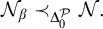 ${\mathcal {N}}_{\beta }\prec _{\Delta _{0}^{\mathcal {P}}} {\mathcal {N}}.$
Thanks to the availability of $\mathrm {AC}$
in
$\mathrm {AC}$
in ${\mathcal {N}}$
, we can choose an ordering
${\mathcal {N}}$
, we can choose an ordering $\vartriangleleft $
in
$\vartriangleleft $
in ${\mathcal {N}}$
such that
${\mathcal {N}}$
such that $ {\mathcal {N}}$
satisfies “
$ {\mathcal {N}}$
satisfies “ $\vartriangleleft $
is a well-ordering of
$\vartriangleleft $
is a well-ordering of $\mathrm {V}_{\beta }$
.” Then for each
$\mathrm {V}_{\beta }$
.” Then for each $ m\in M$
, we define the following set
$ m\in M$
, we define the following set $K_{m}$
(again within
$K_{m}$
(again within ${\mathcal {N}}$
) as:
${\mathcal {N}}$
) as:
 $$ \begin{align*} K_{m}:=\{a\in \mathrm{V}:{\mathcal{N}}\models a\in \mathrm{Def}(\mathrm{V} _{\beta },\in ,\vartriangleleft ,\lambda ,m)\}, \end{align*} $$
where $x\in \mathrm {Def}(\mathrm {V}_{\beta },\in ,\vartriangleleft ,\lambda ,m)$
is shorthand for the formula of set theory that expresses:
$x\in \mathrm {Def}(\mathrm {V}_{\beta },\in ,\vartriangleleft ,\lambda ,m)$
is shorthand for the formula of set theory that expresses:
 $$ \begin{align*} x \text{ is definable in the structure } (\mathrm{V}_{\beta },\in ,\vartriangleleft ,\lambda ,m). \end{align*} $$
Note that the only allowable parameters used in a definition of x are $\lambda $
and m. Thus, intuitively speaking, within
$\lambda $
and m. Thus, intuitively speaking, within ${\mathcal {N}}$
the set
${\mathcal {N}}$
the set $K_{m}$
consists of elements a of
$K_{m}$
consists of elements a of $\mathrm {V}_{\beta }$
such that a is first order definable in
$\mathrm {V}_{\beta }$
such that a is first order definable in $\left ( \mathrm {V}_{\beta },\in ,\vartriangleleft ,\lambda ,m\right ) $
. Also note that since we are not assuming that
$\left ( \mathrm {V}_{\beta },\in ,\vartriangleleft ,\lambda ,m\right ) $
. Also note that since we are not assuming that $\mathcal {M}$
is
$\mathcal {M}$
is $\omega $
-standard, an element
$\omega $
-standard, an element $a\in K_{m}$
need not be definable in the structure
$a\in K_{m}$
need not be definable in the structure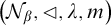 $\left ( {\mathcal {N}}_{\beta },\vartriangleleft ,\lambda ,m\right ) $
in the real world. Next we move outside of
$\left ( {\mathcal {N}}_{\beta },\vartriangleleft ,\lambda ,m\right ) $
in the real world. Next we move outside of ${\mathcal {N}}$
and define K as follows:
${\mathcal {N}}$
and define K as follows:
 $$ \begin{align*} K:=\bigcup\limits_{m\in M}K_{m}. \end{align*} $$
We observe that for each $m\in M$
,
$m\in M$
, $K_{m}$
is coded in
$K_{m}$
is coded in ${\mathcal {N}} $
, but there is no reason to expect that K is coded in
${\mathcal {N}} $
, but there is no reason to expect that K is coded in ${\mathcal {N}}$
. Thus every element of K is definable, in the sense of
${\mathcal {N}}$
. Thus every element of K is definable, in the sense of ${\mathcal {N}}$
, in
${\mathcal {N}}$
, in $( \mathrm {V}_{\beta },\in ,\vartriangleleft )$
with some appropriate choice of parameters in
$( \mathrm {V}_{\beta },\in ,\vartriangleleft )$
with some appropriate choice of parameters in $\{\lambda \}\cup M.$
Let
$\{\lambda \}\cup M.$
Let $\mathcal {K}$
be the submodel of
$\mathcal {K}$
be the submodel of $ {\mathcal {N}}$
whose universe is K. Using the Tarski test for elementarity and the fact that, as viewed from
$ {\mathcal {N}}$
whose universe is K. Using the Tarski test for elementarity and the fact that, as viewed from ${\mathcal {N}}$
,
${\mathcal {N}}$
, $\vartriangleleft $
well-orders
$\vartriangleleft $
well-orders $\mathrm {V}_{\beta }\mathcal {\ }$
we have
$\mathrm {V}_{\beta }\mathcal {\ }$
we have
(2) $\ \ \mathcal {M}\subsetneq \mathcal {K}\preceq {\mathcal {N}} _{\beta }$
.
$\ \ \mathcal {M}\subsetneq \mathcal {K}\preceq {\mathcal {N}} _{\beta }$
.
By putting (1) and (2) together we conclude
(3) $\ \ \mathcal {M}\prec _{\Delta _{0}^{\mathcal {P}}}\mathcal {K} \preceq {\mathcal {N}}_{\beta }\prec _{\Delta _{0}^{\mathcal {P}}}{\mathcal {N}}$
.
$\ \ \mathcal {M}\prec _{\Delta _{0}^{\mathcal {P}}}\mathcal {K} \preceq {\mathcal {N}}_{\beta }\prec _{\Delta _{0}^{\mathcal {P}}}{\mathcal {N}}$
.
Let $O^{\ast }$
be the collection of ‘ordinals’ of
$O^{\ast }$
be the collection of ‘ordinals’ of $\mathcal {K}$
that are above the ‘ordinals’ of
$\mathcal {K}$
that are above the ‘ordinals’ of $\mathcal {M}$
, i.e.,
$\mathcal {M}$
, i.e.,
 $$ \begin{align*} O^{\ast }=\left\{ \gamma \in \mathrm{Ord}^{\mathcal{K}}:\forall \alpha \in \mathrm{Ord}^{\mathcal{M}}\ {\mathcal{N}}\models \alpha \in \gamma \right\}. \end{align*} $$
Clearly $O^{\ast }$
is nonempty since
$O^{\ast }$
is nonempty since $\lambda \in O.$
We now consider the following two cases. As we shall see, Case I leads to the conclusion of the theorem, and Case II is impossible.
$\lambda \in O.$
We now consider the following two cases. As we shall see, Case I leads to the conclusion of the theorem, and Case II is impossible.
Case I. $O^{\ast }$
has a least ordinal (under
$O^{\ast }$
has a least ordinal (under $\in ^{\mathcal {K} }).$
Case II. $O^{\ast }$
has no least ordinal.
$O^{\ast }$
has no least ordinal.
Suppose Case I holds and let $\gamma _{0}=\min (O^{\ast })$
. Clearly
$\gamma _{0}=\min (O^{\ast })$
. Clearly $\gamma _{0}$
is a limit ordinal of
$\gamma _{0}$
is a limit ordinal of ${\mathcal {N}}$
. By the choice of
${\mathcal {N}}$
. By the choice of $\gamma _{0}, \mathrm {Ord}^{\mathcal {M}}$
is cofinal in
$\gamma _{0}, \mathrm {Ord}^{\mathcal {M}}$
is cofinal in $\mathrm {Ord}^{ \mathcal {K}_{\gamma _{0}}}.$
Since by (3) and part (d) of Remark 2.6,
$\mathrm {Ord}^{ \mathcal {K}_{\gamma _{0}}}.$
Since by (3) and part (d) of Remark 2.6, $ \mathrm {V}_{\alpha }^{\mathcal {M}}=\mathrm {V}_{\alpha }^{\mathcal {K}}$
for each
$ \mathrm {V}_{\alpha }^{\mathcal {M}}=\mathrm {V}_{\alpha }^{\mathcal {K}}$
for each $\alpha \in \mathrm {Ord}^{\mathcal {M}}$
, this makes it clear that:
$\alpha \in \mathrm {Ord}^{\mathcal {M}}$
, this makes it clear that:
(4)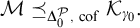 $\ \ \mathcal {M}\preceq _{\Delta _{0}^{\mathcal {P}},\ \mathrm { cof}}\mathcal {K}_{\gamma _{0}}.$
Since $\mathcal {K}_{\gamma _{0}}$
is the convex hull of
$\mathcal {K}_{\gamma _{0}}$
is the convex hull of $\mathcal {M }$
in
$\mathcal {M }$
in $\mathcal {K}$
, by Gaifman Splitting Theorem, (4) shows:
$\mathcal {K}$
, by Gaifman Splitting Theorem, (4) shows:
(5) $\ \ \mathcal {M}\preceq \mathcal {K}_{\gamma _{0}}$
.
$\ \ \mathcal {M}\preceq \mathcal {K}_{\gamma _{0}}$
.
On the other hand since by (3) $\mathcal {K}\preceq {\mathcal {N}} _{\beta }$
, we have
$\mathcal {K}\preceq {\mathcal {N}} _{\beta }$
, we have
(6) $\mathcal {K}_{\gamma _{0}}=\mathrm {V}_{\gamma _{0}}^{\mathcal {K }}\preceq \mathrm {V}_{\gamma _{0}}^{{\mathcal {N}}_{\beta }}=\mathrm {V}_{\gamma _{0}}^{{\mathcal {N}}}={\mathcal {N}}_{\gamma _{0}}.$
By (5) and (6), $\mathcal {M}\preceq {\mathcal {N}}_{\gamma _{0}}$
. Thus the proof of the theorem will be complete once we show that Case II leads to a contradiction. Within
$\mathcal {M}\preceq {\mathcal {N}}_{\gamma _{0}}$
. Thus the proof of the theorem will be complete once we show that Case II leads to a contradiction. Within ${\mathcal {N}}$
let
${\mathcal {N}}$
let $s_{\beta }$
be the elementary diagram of
$s_{\beta }$
be the elementary diagram of $\left ( \mathrm {V}_{\beta },\in \right ) $
, i.e.,
$\left ( \mathrm {V}_{\beta },\in \right ) $
, i.e., $ {\mathcal {N}}$
views
$ {\mathcal {N}}$
views $s_{\beta }$
is the Tarskian satisfaction class for
$s_{\beta }$
is the Tarskian satisfaction class for $ \left ( \mathrm {V}_{\beta },\in \right ) $
, and let
$ \left ( \mathrm {V}_{\beta },\in \right ) $
, and let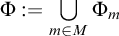 $\Phi :=\bigcup \limits _{m\in M}\Phi _{m}$
, where:
$\Phi :=\bigcup \limits _{m\in M}\Phi _{m}$
, where:
 $$ \begin{align*} \Phi _{m}:=\{x\in M:{\mathcal{N}}\models x \text{ is (the code of) a formula } \varphi (c,\dot{m}) \text{ such that } \varphi (\dot{\lambda},\dot{m})\in s_{\beta }\}. \end{align*} $$
So intuitively speaking, $\Phi $
is the result of replacing
$\Phi $
is the result of replacing $\dot { \lambda }$
by c (where c is a fresh constant) in the sentences in the elementary diagram of
$\dot { \lambda }$
by c (where c is a fresh constant) in the sentences in the elementary diagram of ${\mathcal {N}}_{\beta }$
(as computed in
${\mathcal {N}}_{\beta }$
(as computed in ${\mathcal {N}}$
) whose constants are in
${\mathcal {N}}$
) whose constants are in $\{\dot {\lambda }\}\cup \{\dot {m}:m\in M\}.$
Since
$\{\dot {\lambda }\}\cup \{\dot {m}:m\in M\}.$
Since $ {\mathcal {N}}$
need not be
$ {\mathcal {N}}$
need not be $\omega $
-standard, the elements of
$\omega $
-standard, the elements of $\Phi $
might be nonstandard formulae.
$\Phi $
might be nonstandard formulae.
By the assumption that ${\mathcal {N}}$
is a faithful extension of
${\mathcal {N}}$
is a faithful extension of $ \mathcal {M}$
,
$ \mathcal {M}$
, $\Phi $
is
$\Phi $
is $\mathcal {M}$
-amenable. Next let
$\mathcal {M}$
-amenable. Next let
 $$ \begin{align*} \Gamma :=\left\{ \begin{array}{c} t(c,\dot{m})\in M:t(c,\dot{m})\in \Phi ,\ \mathrm{and}\ \forall \theta \in \mathrm{Ord\ }\left( t(c,\dot{m})>\dot{\theta}\right) \in \Phi ,\ \mathrm{and }\ \\ t\ \mathrm{is\ a\ definable\ term\ in\ the\ language}\ \mathcal{L}_{\mathrm{ set}}\cup \{c\}\cup \{\dot{m}:m\in M\} \end{array} \right\}. \end{align*} $$
Officially speaking, $\Gamma $
consists of syntactic objects
$\Gamma $
consists of syntactic objects $\varphi (c,\dot {m},x)$
in
$\varphi (c,\dot {m},x)$
in $\mathcal {M}$
that satisfy the following three conditions in
$\mathcal {M}$
that satisfy the following three conditions in $(\mathcal {M},\Phi )$
:
$(\mathcal {M},\Phi )$
:
-
(i)
$\left [ \exists ! x \varphi (c,\dot {m},x)\right ] \in \Phi .$
-
(ii)
$\left [ \forall x\left ( \varphi (c,\dot {m},x)\rightarrow x\in \mathrm {Ord}\right ) \right ] \in \Phi .$
-
(iii)
$\forall \theta \in \mathrm {Ord}\ \left [ \forall x\left ( \varphi (c,\dot {m},x)\rightarrow \dot {\theta }\in x\right ) \right ] \in \Phi .$



Note that $\Gamma $
is definable in
$\Gamma $
is definable in $\left ( \mathcal {M},\Phi \right ) $
. Since we are considering Case II,
$\left ( \mathcal {M},\Phi \right ) $
. Since we are considering Case II,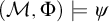 $\left ( \mathcal {M},\Phi \right ) \models \psi $
, where:
$\left ( \mathcal {M},\Phi \right ) \models \psi $
, where:
 $$ \begin{align*} \psi :=\forall t\left[ t\in \Gamma \longrightarrow \exists t^{\prime }\in \Gamma \ (t^{\prime }\in t)\in \Phi \right]. \end{align*} $$
The veracity of the dependent choice scheme in $\mathcal {M}$
(see part (f) of Definition 2.1), together with the facts that
$\mathcal {M}$
(see part (f) of Definition 2.1), together with the facts that $\Phi $
is
$\Phi $
is $ \mathcal {M}$
-amenable and
$ \mathcal {M}$
-amenable and $\Gamma $
is definable in
$\Gamma $
is definable in $\left ( \mathcal {M},\Phi \right ) $
make it clear that there is a sequence
$\left ( \mathcal {M},\Phi \right ) $
make it clear that there is a sequence $s=\left \langle t_{n}:n\in \omega ^{\mathcal {M}}\right \rangle $
in
$s=\left \langle t_{n}:n\in \omega ^{\mathcal {M}}\right \rangle $
in $\mathcal {M}$
such that:
$\mathcal {M}$
such that:
 $$ \begin{align*} \left( \mathcal{M},\Phi \right) \models \forall n\in \omega \ \left[ t_{n}\in \Gamma \wedge \left( \left( t_{n+1}\in t_{n}\right) \in \Phi \right) \right]. \end{align*} $$
Since s is a countable object in $\mathcal {M}$
, and
$\mathcal {M}$
, and $ {\mathcal {N}}$
fixes
$ {\mathcal {N}}$
fixes $\omega ^{M}$
by assumption, s is fixed in the passage from
$\omega ^{M}$
by assumption, s is fixed in the passage from $\mathcal {M}$
to
$\mathcal {M}$
to ${\mathcal {N}}$
by Remark 2.6(c). On the other hand, since
${\mathcal {N}}$
by Remark 2.6(c). On the other hand, since ${\mathcal {N}}$
has a satisfaction predicate
${\mathcal {N}}$
has a satisfaction predicate $ s_{\beta }$
for
$ s_{\beta }$
for ${\mathcal {N}}_{\beta }$
, this leads to a contradiction because we have
${\mathcal {N}}_{\beta }$
, this leads to a contradiction because we have
 $$ \begin{align*} {\mathcal{N}}\models \left\langle t_{n}^{(\mathrm{V}_{\beta },\in )}(\dot{ \lambda}):n\in \omega \right\rangle \text{ is an infinite decreasing sequence of ordinals.} \end{align*} $$
In the above $t_{n}(\dot {\lambda })$
is the term obtained by replacing c with
$t_{n}(\dot {\lambda })$
is the term obtained by replacing c with $\dot {\lambda }$
in
$\dot {\lambda }$
in $t_{n},$
and
$t_{n},$
and $t_{n}^{(\mathrm {V} _{\beta },\in )}(\dot {\lambda })$
is the interpretation of
$t_{n}^{(\mathrm {V} _{\beta },\in )}(\dot {\lambda })$
is the interpretation of $t_{n}(\dot {\lambda })$
in
$t_{n}(\dot {\lambda })$
in $(\mathrm {V},\in )$
using the Tarskian satisfaction class for
$(\mathrm {V},\in )$
using the Tarskian satisfaction class for $( \mathrm {V}_{\beta },\in )$
.
$( \mathrm {V}_{\beta },\in )$
.
Corollary 4.2. If $\mathcal {M}\models \mathsf { ZFC}$
,
$\mathcal {M}\models \mathsf { ZFC}$
,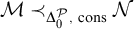 $\mathcal {M}\prec _{\Delta _{0}^{\mathcal {P}},\ \mathrm {cons}} {\mathcal {N}}$
, and
$\mathcal {M}\prec _{\Delta _{0}^{\mathcal {P}},\ \mathrm {cons}} {\mathcal {N}}$
, and $\mathcal {M}$
fixes
$\mathcal {M}$
fixes $\omega ^{\mathcal {M} },$
then
$\omega ^{\mathcal {M} },$
then $\mathcal {M}$
is cofinal in
$\mathcal {M}$
is cofinal in ${\mathcal {N}}$
. Thus a conservative elementary extension of
${\mathcal {N}}$
. Thus a conservative elementary extension of $\mathcal {M}$
that fixes
$\mathcal {M}$
that fixes $\omega ^{\mathcal {M}}$
is a cofinal extension.
$\omega ^{\mathcal {M}}$
is a cofinal extension.
Proof. If $\mathcal {M}\models \mathsf {ZFC}$
,
$\mathcal {M}\models \mathsf {ZFC}$
, $\mathcal {M} \prec _{\mathrm {cons}}{\mathcal {N}}$
, and
$\mathcal {M} \prec _{\mathrm {cons}}{\mathcal {N}}$
, and $\mathcal {M}$
is not cofinal in
$\mathcal {M}$
is not cofinal in $ {\mathcal {N}}$
, then
$ {\mathcal {N}}$
, then ${\mathcal {N}}$
is taller than
${\mathcal {N}}$
is taller than $\mathcal {M}$
. But then by part (b) of Theorem 4.1, there is an
$\mathcal {M}$
. But then by part (b) of Theorem 4.1, there is an $\mathcal {M}$
-definable full satisfaction class over
$\mathcal {M}$
-definable full satisfaction class over $\mathcal {M}$
, which contradicts Tarski’s Undefinability of Truth Theorem.
$\mathcal {M}$
, which contradicts Tarski’s Undefinability of Truth Theorem.
In Theorem 4.4 below we show that the conclusion of Theorem 4.1 holds if $ \mathsf {ZFC}$
is weakened to
$ \mathsf {ZFC}$
is weakened to $\mathsf {ZF}\mathrm {,}$
but the assumption that
$\mathsf {ZF}\mathrm {,}$
but the assumption that ${\mathcal {N}}$
fixes
${\mathcal {N}}$
fixes $\omega ^{\mathcal {M}}$
is strengthened to
$\omega ^{\mathcal {M}}$
is strengthened to $\mathcal {M} \subsetneq _{\mathrm {end}}{\mathcal {N}}$
. We first establish a lemma that will come handy in the proof of Theorem 4.4.
$\mathcal {M} \subsetneq _{\mathrm {end}}{\mathcal {N}}$
. We first establish a lemma that will come handy in the proof of Theorem 4.4.
Lemma 4.3. Suppose $\mathcal {M}$
and
$\mathcal {M}$
and $ {\mathcal {N}}$
are models of
$ {\mathcal {N}}$
are models of $\mathsf {ZF}$
, and
$\mathsf {ZF}$
, and $\mathcal {M} \subsetneq _{\mathrm {end,faithful}}{\mathcal {N}}$
. Then
$\mathcal {M} \subsetneq _{\mathrm {end,faithful}}{\mathcal {N}}$
. Then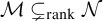 $\mathcal {M} \subsetneq _{\mathrm {rank}}{\mathcal {N}}$
.
$\mathcal {M} \subsetneq _{\mathrm {rank}}{\mathcal {N}}$
.
Proof. Suppose $\mathcal {M}$
and
$\mathcal {M}$
and ${\mathcal {N}}$
are as in the assumptions of the lemma. Since
${\mathcal {N}}$
are as in the assumptions of the lemma. Since ${\mathcal {N}}$
end extends
${\mathcal {N}}$
end extends $\mathcal {M}$
, in order to show that
$\mathcal {M}$
, in order to show that ${\mathcal {N}}$
rank extends
${\mathcal {N}}$
rank extends $\mathcal {M}$
it is sufficient that if
$\mathcal {M}$
it is sufficient that if $\alpha \in \mathrm {Ord}^{\mathcal {M}}$
and
$\alpha \in \mathrm {Ord}^{\mathcal {M}}$
and $m\in M$
with
$m\in M$
with $\mathcal {M}\models m=\mathrm {V}_{\alpha }$
, then
$\mathcal {M}\models m=\mathrm {V}_{\alpha }$
, then ${\mathcal {N}}\models m= \mathrm {V}_{\alpha }.$
For this purpose, it is sufficient to verify that
${\mathcal {N}}\models m= \mathrm {V}_{\alpha }.$
For this purpose, it is sufficient to verify that $ {\mathcal {N}}$
is a powerset-preserving end extension of
$ {\mathcal {N}}$
is a powerset-preserving end extension of $\mathcal {M}$
, since the formula expressing
$\mathcal {M}$
, since the formula expressing $x=\mathrm {V}_{\alpha }$
is
$x=\mathrm {V}_{\alpha }$
is $\Sigma _{1}^{\mathcal {P} } $
and is therefore absolute for powerset-preserving end extensions (as noted in Remark 2.6(e)). Towards this goal, let
$\Sigma _{1}^{\mathcal {P} } $
and is therefore absolute for powerset-preserving end extensions (as noted in Remark 2.6(e)). Towards this goal, let $a\in M$
and suppose
$a\in M$
and suppose $b\in N$
such that:
$b\in N$
such that:
(1)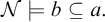 $\ \ {\mathcal {N}}\models b\subseteq a.$
Let $X_{b}=\mathrm {Ext}_{{\mathcal {N}}}(b)\cap \mathrm {Ext}_{ \mathcal {M}}(a)=\mathrm {Ext}_{{\mathcal {N}}}(b).$
Thanks to the assumption that
$X_{b}=\mathrm {Ext}_{{\mathcal {N}}}(b)\cap \mathrm {Ext}_{ \mathcal {M}}(a)=\mathrm {Ext}_{{\mathcal {N}}}(b).$
Thanks to the assumption that ${\mathcal {N}}$
is a faithful extension of
${\mathcal {N}}$
is a faithful extension of $\mathcal {M}$
, the expansion
$\mathcal {M}$
, the expansion $( \mathcal {M},X_{b})$
satisfies Separation in the extended language and therefore there is an element
$( \mathcal {M},X_{b})$
satisfies Separation in the extended language and therefore there is an element $b^{\prime }\in M$
that codes
$b^{\prime }\in M$
that codes $X_{b}.$
Thus
$X_{b}.$
Thus
(2) $\ \ \mathrm {Ext}_{\mathcal {M}}(b^{\prime })=\mathrm {Ext}_{ {\mathcal {N}}}(b)\cap \mathrm {Ext}_{\mathcal {M}}(a),$
and
$\ \ \mathrm {Ext}_{\mathcal {M}}(b^{\prime })=\mathrm {Ext}_{ {\mathcal {N}}}(b)\cap \mathrm {Ext}_{\mathcal {M}}(a),$
and
Since ${\mathcal {N}}$
end extends
${\mathcal {N}}$
end extends $\mathcal {M}$
, we have
$\mathcal {M}$
, we have
(3) $\mathrm {Ext}_{\mathcal {M}}(a)=\mathrm {Ext}_{{\mathcal {N}} }(a)$
and
$\mathrm {Ext}_{\mathcal {M}}(a)=\mathrm {Ext}_{{\mathcal {N}} }(a)$
and $\mathrm {Ext}_{\mathcal {M}}(b^{\prime })=\mathrm {Ext}_{{\mathcal {N}} }(b^{\prime }).$
So by (1) and (2),
(4) $\mathrm {Ext}_{{\mathcal {N}}}(b^{\prime })=\mathrm {Ext}_{ {\mathcal {N}}}(b)\cap \mathrm {Ext}_{{\mathcal {N}}}(a).$
By (1), $\mathrm {Ext}_{{\mathcal {N}}}(b)\subseteq \mathrm {Ext}_{ {\mathcal {N}}}(a),$
so combined with (4) this yields:
$\mathrm {Ext}_{{\mathcal {N}}}(b)\subseteq \mathrm {Ext}_{ {\mathcal {N}}}(a),$
so combined with (4) this yields:
(5) $\ \ \mathrm {Ext}_{{\mathcal {N}}}(b^{\prime })=\mathrm {Ext}_{ {\mathcal {N}}}(b)$
,
$\ \ \mathrm {Ext}_{{\mathcal {N}}}(b^{\prime })=\mathrm {Ext}_{ {\mathcal {N}}}(b)$
,
which by Extensionality makes it clear that $b^{\prime }=b.$
-
• The proof of Theorem 4.4 below is a variant of the proof of Theorem 4.1, and will strike the reader who has worked through the proof of Theorem 4.1 as repetitious, but the proof is a bit more involved here since we do not have access to the axiom of choice in
$\mathcal {M}$
or in
${\mathcal {N}}$
. Note that in Theorem 4.4
${\mathcal {N}}$
is assumed to end extend
$\mathcal {M}$
, whereas in Theorem 4.1
${\mathcal {N}}$
is only assumed to fix
$\omega ^{ \mathcal {M}}.$
Of course Theorem 4.4 follows from Theorem 4.1 if
$\mathcal {M} $
and
${\mathcal {N}}$
are models of
$\mathsf {ZFC}$
.


Theorem 4.4. Suppose $\mathcal {M}$
and
$\mathcal {M}$
and ${\mathcal {N}}$
are models of
${\mathcal {N}}$
are models of $\mathsf {ZF}$
, and
$\mathsf {ZF}$
, and $\mathcal {M} \subsetneq _{\mathrm {end,faithful}}{\mathcal {N}}$
. Then:
$\mathcal {M} \subsetneq _{\mathrm {end,faithful}}{\mathcal {N}}$
. Then:
-
(a) There is some
$\gamma \in \mathrm {Ord}^{ {\mathcal {N}}}\backslash \mathrm {Ord}^{\mathcal {M}}$
such that
$ \mathcal {M}\preceq {\mathcal {N}}_{\gamma }.$
Thus either
$ \mathcal {M}={\mathcal {N}}_{\gamma }$
, in which case
${\mathcal {N}}$
is a topped rank extension of
$\mathcal {M}$
, or
$\mathcal {M }\prec {\mathcal {N}}_{\gamma }$
. -
(b) In particular, there is a full satisfaction class S for
$\mathcal {M}$
such that S can be written as
$D\cap M$
, where D is
${\mathcal {N}}$
-definable.


Proof. Assume $\mathcal {M}$
and
$\mathcal {M}$
and ${\mathcal {N}}$
are as in the assumptions of the theorem. By Lemma 4.3 we can assume that
${\mathcal {N}}$
are as in the assumptions of the theorem. By Lemma 4.3 we can assume that ${\mathcal {N}}$
rank extends
${\mathcal {N}}$
rank extends $\mathcal {M}$
. Fix some
$\mathcal {M}$
. Fix some $\lambda \in \mathrm {Ord}^{{\mathcal {N}} }\backslash \mathrm {Ord}^{\mathcal {M}}$
and some ordinal
$\lambda \in \mathrm {Ord}^{{\mathcal {N}} }\backslash \mathrm {Ord}^{\mathcal {M}}$
and some ordinal $\beta>\lambda $
. For each
$\beta>\lambda $
. For each $m\in M$
, we can define the following set within
$m\in M$
, we can define the following set within ${\mathcal {N}}$
:
${\mathcal {N}}$
:
 $$ \begin{align*} O_{m}:=\left\{ \gamma \in \beta :{\mathcal{N}}\models \gamma \in \mathrm{Def}( \mathrm{V}_{\beta },\in ,\lambda ,m)\right\}, \end{align*} $$
where $x\in \mathrm {Def}(\mathrm {V}_{\beta },\in ,\lambda ,m)$
is shorthand for the formula of set theory that expresses:
$x\in \mathrm {Def}(\mathrm {V}_{\beta },\in ,\lambda ,m)$
is shorthand for the formula of set theory that expresses:
 $$ \begin{align*} x \text{ is definable in } (\mathrm{V}_{\beta },\in) \text{ using at most the parameters } \lambda \text{ and } m. \end{align*} $$
Clearly $\lambda \in O_{m}$
and
$\lambda \in O_{m}$
and $O_{m}$
is coded in
$O_{m}$
is coded in ${\mathcal {N}}$
. Next let
${\mathcal {N}}$
. Next let
 $$ \begin{align*} O:=\bigcup\limits_{m\in M}O_{m}. \end{align*} $$
Let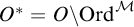 $O^{\ast }=O\backslash \mathrm {Ord}^{\mathcal {M}}$
. Clearly
$O^{\ast }=O\backslash \mathrm {Ord}^{\mathcal {M}}$
. Clearly $ O^{\ast }$
is nonempty since
$ O^{\ast }$
is nonempty since $\lambda \in O^{\ast }.$
We now consider two cases:
$\lambda \in O^{\ast }.$
We now consider two cases:
-
(I)
$O^{\ast }$
has a least element (under
$\in ^{{\mathcal {N}}}).$
-
(II)
$O^{\ast }$
has no least element.


Case I. Let $\gamma _{0}$
be the least element of
$\gamma _{0}$
be the least element of $O^{\ast }.$
It is easy to see that
$O^{\ast }.$
It is easy to see that $\gamma _{0}$
is a limit ordinal in
$\gamma _{0}$
is a limit ordinal in ${\mathcal {N}}$
. We claim that:
${\mathcal {N}}$
. We claim that:
 $$ \begin{align*} \mathcal{M}\preceq {\mathcal{N}}_{\gamma _{0}}. \end{align*} $$
To verify the claim, by the Tarski criterion of elementarity, it suffices to show that if ${\mathcal {N}}_{\gamma _{0}}\models \exists y\varphi (y,m)$
for some
${\mathcal {N}}_{\gamma _{0}}\models \exists y\varphi (y,m)$
for some $m\in M$
, then there is some
$m\in M$
, then there is some $m_{0}\in M$
such that
$m_{0}\in M$
such that ${\mathcal {N}}_{\gamma _{0}}\models \varphi (m_{0},m).$
Let
${\mathcal {N}}_{\gamma _{0}}\models \varphi (m_{0},m).$
Let $\gamma _{m}$
be the first ordinal below
$\gamma _{m}$
be the first ordinal below $\gamma _{0}$
such that:
$\gamma _{0}$
such that:
 $$ \begin{align*} {\mathcal{N}}_{\gamma _{0}}\models \exists y\in \mathrm{V}_{\gamma _{m}}\ \varphi (y,m). \end{align*} $$
So $\gamma _{m}$
is definable in
$\gamma _{m}$
is definable in ${\mathcal {N}}_{\beta }$
with parameters
${\mathcal {N}}_{\beta }$
with parameters $\gamma _{0}$
and m, and since
$\gamma _{0}$
and m, and since $\gamma _{0}\in O$
by assumption, this shows that
$\gamma _{0}\in O$
by assumption, this shows that $\gamma _{m}$
is definable in
$\gamma _{m}$
is definable in ${\mathcal {N}} _{\beta }$
with parameter
${\mathcal {N}} _{\beta }$
with parameter $m.$
So
$m.$
So $\gamma _{m}\in O.$
By the fact that
$\gamma _{m}\in O.$
By the fact that $ \gamma _{0}$
was chosen to be the least element of
$ \gamma _{0}$
was chosen to be the least element of $O^{\ast }$
, this shows that
$O^{\ast }$
, this shows that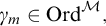 $\gamma _{m}\in \mathrm {Ord}^{\mathcal {M}},$
which makes it clear that there is some
$\gamma _{m}\in \mathrm {Ord}^{\mathcal {M}},$
which makes it clear that there is some $m_{0}\in M$
such that:
$m_{0}\in M$
such that:
 $$ \begin{align*} {\mathcal{N}}_{\gamma _{0}}\models \varphi (m_{0},m). \end{align*} $$
This concludes the verification of $\mathcal {M}\preceq {\mathcal {N}} _{\gamma _{0}}$
. To finish the proof of Theorem 4.4 it suffices to show that Case II is impossible. Suppose to the contrary that
$\mathcal {M}\preceq {\mathcal {N}} _{\gamma _{0}}$
. To finish the proof of Theorem 4.4 it suffices to show that Case II is impossible. Suppose to the contrary that $O^{\ast }$
has no least element. Within
$O^{\ast }$
has no least element. Within ${\mathcal {N}}$
let
${\mathcal {N}}$
let $s_{\beta }$
be the Tarskian satisfaction class for
$s_{\beta }$
be the Tarskian satisfaction class for $\left ( \mathrm {V}_{\beta },\in \right ) $
. For each
$\left ( \mathrm {V}_{\beta },\in \right ) $
. For each $ m\in M$
we define
$ m\in M$
we define
 $$ \begin{align*} \Phi _{m}:=\{\varphi (c,\dot{m})\in M:{\mathcal{N}}\models \varphi (\dot{ \lambda},\dot{m})\in s_{\beta }\}. \end{align*} $$
Note the constant c is interpreted as $\lambda $
in the right-hand side of the above definition of
$\lambda $
in the right-hand side of the above definition of $\Phi _{m}.$
Next we define
$\Phi _{m}.$
Next we define
 $$ \begin{align*} \Phi :=\bigcup\limits_{m\in M}\Phi _{m}. \end{align*} $$
Observe that $\Phi \subseteq M$
and
$\Phi \subseteq M$
and $\Phi $
is
$\Phi $
is $\mathcal {M}$
-amenable since
$\mathcal {M}$
-amenable since ${\mathcal {N}}$
is a faithful rank extension of
${\mathcal {N}}$
is a faithful rank extension of $\mathcal {M}$
. So intuitively speaking,
$\mathcal {M}$
. So intuitively speaking, $\Phi $
is the subset of the elementary diagram of
$\Phi $
is the subset of the elementary diagram of $ {\mathcal {N}}_{\beta }$
(as computed in
$ {\mathcal {N}}_{\beta }$
(as computed in ${\mathcal {N}}$
) that consists of sentences whose constants are in
${\mathcal {N}}$
) that consists of sentences whose constants are in $\{c\}\cup \{\dot {m}:m\in M\}.$
Since
$\{c\}\cup \{\dot {m}:m\in M\}.$
Since $ {\mathcal {N}}$
need not be
$ {\mathcal {N}}$
need not be $\omega $
-standard, the elements of
$\omega $
-standard, the elements of $\Phi $
need not be standard formulae. Also note that the constant c is interpreted as
$\Phi $
need not be standard formulae. Also note that the constant c is interpreted as $ \lambda $
in the right-hand side of the above definition of
$ \lambda $
in the right-hand side of the above definition of $\Phi _{m}.$
Now let
$\Phi _{m}.$
Now let
 $$ \begin{align*} \Gamma :=\left\{ \begin{array}{c} t(c,\dot{m})\in M:t(c,\dot{m})\in \Phi ,\ \mathrm{and}\ \forall \theta \in \mathrm{Ord\ }\left( t(c,\dot{m})>\dot{\theta}\right) \in \Phi ,\ \mathrm{and }\ \\ t\ \mathrm{is\ a\ definable\ term\ in\ the\ language}\ \mathcal{L}_{\mathrm{ set}}\cup \{c\}\cup \{\dot{m}:m\in M\} \end{array} \right\}, \end{align*} $$
So, officially speaking, $\Gamma $
consists of syntactic objects
$\Gamma $
consists of syntactic objects $\varphi (c,\dot {m},x)$
in
$\varphi (c,\dot {m},x)$
in $\mathcal {M}$
that satisfy the following three conditions in
$\mathcal {M}$
that satisfy the following three conditions in $(\mathcal {M},\Phi )$
:
$(\mathcal {M},\Phi )$
:
-
(i)
$\left [ \exists !\!x\ \varphi (c,\dot {m},x)\right ] \in \Phi .$
-
(ii)
$\left [ \forall x\left ( \varphi (c,\dot {m},x)\rightarrow x\in \mathrm {Ord}\right ) \right ] \in \Phi .$
-
(iii)
$\forall \theta \in \mathrm {Ord}\ \left [ \forall x\left ( \varphi (c,\dot {m},x)\rightarrow \dot {\theta }\in x\right ) \right ] \in \Phi .$


Clearly $\Gamma $
is definable in
$\Gamma $
is definable in $\left ( \mathcal {M},\Phi \right ) $
. Since we are in Case II,
$\left ( \mathcal {M},\Phi \right ) $
. Since we are in Case II, $\left ( \mathcal {M},\Phi \right ) \models \psi $
, where
$\left ( \mathcal {M},\Phi \right ) \models \psi $
, where $\psi $
is the sentence that expresses:
$\psi $
is the sentence that expresses:
 $$ \begin{align*} \Gamma \neq \varnothing \wedge \forall t\left[ t\in \Gamma \longrightarrow \exists t^{\prime }\in \Gamma \ (t^{\prime }\in t)\in \Phi \right]. \end{align*} $$
In contrast to the proof of Theorem 4.1 we cannot at this point conclude that there is a countable descending chain $\left \langle t_{n}:n\in \omega \right \rangle $
in
$\left \langle t_{n}:n\in \omega \right \rangle $
in $\mathcal {M}$
since
$\mathcal {M}$
since $\mathsf {DC}$
need not hold in
$\mathsf {DC}$
need not hold in $\mathcal {M}$
. Instead, we will use the following argument that takes advantage of the Reflection Theorem. Choose
$\mathcal {M}$
. Instead, we will use the following argument that takes advantage of the Reflection Theorem. Choose $k\in \omega $
such that
$k\in \omega $
such that $\psi $
is a
$\psi $
is a $\Sigma _{k}(\Phi )$
-statement
$\Sigma _{k}(\Phi )$
-statement $,$
and use the Reflection Theorem in
$,$
and use the Reflection Theorem in $ \left ( \mathcal {M},\Phi \right ) $
to pick
$ \left ( \mathcal {M},\Phi \right ) $
to pick $\mu \in \mathrm {Ord}^{\mathcal {M} } $
such that:
$\mu \in \mathrm {Ord}^{\mathcal {M} } $
such that:
 $$ \begin{align*} \left( \mathcal{M}_{\mu },\Phi \cap M_{\mu }\right) \prec _{\Sigma _{k}( \mathrm{X})}\left( \mathcal{M},\Phi \right)\hspace{-1pt}. \end{align*} $$
Then $\psi $
holdsFootnote
28
in
$\psi $
holdsFootnote
28
in $\left ( \mathcal {M}_{\mu },\Phi \cap M_{\mu }\right ) $
. Within
$\left ( \mathcal {M}_{\mu },\Phi \cap M_{\mu }\right ) $
. Within $\mathcal {M}$
, let
$\mathcal {M}$
, let
 $$ \begin{align*} w=\{v\in \mathrm{V}_{\mu }:v\in \Gamma \}. \end{align*} $$
Thus $\left ( \mathcal {M},\Phi \right ) \models w\neq \varnothing \wedge \exists t^{\prime }\in \Gamma \ (t^{\prime }\in t)\in \Phi .$
Observe that since
$\left ( \mathcal {M},\Phi \right ) \models w\neq \varnothing \wedge \exists t^{\prime }\in \Gamma \ (t^{\prime }\in t)\in \Phi .$
Observe that since ${\mathcal {N}}$
has access to the Tarskian satisfaction class for
${\mathcal {N}}$
has access to the Tarskian satisfaction class for $ {\mathcal {N}}_{\beta }$
,
$ {\mathcal {N}}_{\beta }$
, ${\mathcal {N}}$
can evaluate each term
${\mathcal {N}}$
can evaluate each term $t(c)$
in w as an ordinal
$t(c)$
in w as an ordinal $\delta <\beta $
, where
$\delta <\beta $
, where ${\mathcal {N}}_{\beta }\models t(\dot { \lambda })=\delta $
, where
${\mathcal {N}}_{\beta }\models t(\dot { \lambda })=\delta $
, where $t(\dot {\lambda })$
is the term obtained by replacing all occurrences of the constant c with
$t(\dot {\lambda })$
is the term obtained by replacing all occurrences of the constant c with $\dot {\lambda }$
in
$\dot {\lambda }$
in $t(c).$
So we can consider
$t(c).$
So we can consider $s\in N$
, where:
$s\in N$
, where:
 $$ \begin{align*} \mathcal{N}\models s=\left\{ \delta :\exists t(c)\in w\ (\mathrm{V}_{\beta },\in )\models \delta =t(\dot{\lambda})\right\}. \end{align*} $$
Within ${\mathcal {N}}$
, s is a nonempty set of ordinals that has no least element, which of course is a contradiction. This shows that Case II is impossible, thus concluding the proof.
${\mathcal {N}}$
, s is a nonempty set of ordinals that has no least element, which of course is a contradiction. This shows that Case II is impossible, thus concluding the proof.
Remark 4.5. Arguing in $\mathsf {ZFC}$
, suppose
$\mathsf {ZFC}$
, suppose $\kappa $
is the first strongly inaccessible cardinal,
$\kappa $
is the first strongly inaccessible cardinal, $\lambda $
is the second strongly inaccessible cardinal,
$\lambda $
is the second strongly inaccessible cardinal, $\mathcal {M}=(\mathrm {V}_{\kappa },\in )$
and
$\mathcal {M}=(\mathrm {V}_{\kappa },\in )$
and ${\mathcal {N}}=(\mathrm {V}_{\lambda },\in )$
. Then
${\mathcal {N}}=(\mathrm {V}_{\lambda },\in )$
. Then ${\mathcal {N}}$
is a proper faithful rank extension of
${\mathcal {N}}$
is a proper faithful rank extension of $\mathcal {M}$
in which the first clause of the dichotomy of the conclusion of part (a) of Theorem 4.1 (and 4.4) holds, but not the second one. On the other hand, if
$\mathcal {M}$
in which the first clause of the dichotomy of the conclusion of part (a) of Theorem 4.1 (and 4.4) holds, but not the second one. On the other hand, if $\kappa $
is a weakly compact cardinal, then as noted by Kaufmann [Reference Kaufmann26, Proposition 2.3],
$\kappa $
is a weakly compact cardinal, then as noted by Kaufmann [Reference Kaufmann26, Proposition 2.3], $( \mathrm {V}_{\kappa },\in )$
has a faithful topless elementary end extension
$( \mathrm {V}_{\kappa },\in )$
has a faithful topless elementary end extension $ {\mathcal {N}}$
; in this scenario the second clause of the dichotomy of the conclusion of part (a) of Theorem 4.1 (and 4.4) holds, but not the first one.
$ {\mathcal {N}}$
; in this scenario the second clause of the dichotomy of the conclusion of part (a) of Theorem 4.1 (and 4.4) holds, but not the first one.
Remark 4.6. If the assumptions of Theorem 4.4 are strengthened by adding the assumption that $\mathcal {M}\prec {\mathcal {N}}$
, then as in the proof of Theorem 3.3 of [Reference Enayat11] we can use ‘Kaufmann’s trick’ to conclude that there is some
$\mathcal {M}\prec {\mathcal {N}}$
, then as in the proof of Theorem 3.3 of [Reference Enayat11] we can use ‘Kaufmann’s trick’ to conclude that there is some $\mathcal {K}$
such that
$\mathcal {K}$
such that $ \mathcal {M}\prec \mathcal {K}\preceq {\mathcal {N}}$
and
$ \mathcal {M}\prec \mathcal {K}\preceq {\mathcal {N}}$
and $\mathcal {K}$
is a topped rank extension of
$\mathcal {K}$
is a topped rank extension of $\mathcal {M}$
. This yields a strengthening of Theorem 3.3 of [Reference Enayat11] by eliminating the assumption that the axiom of choice holds in
$\mathcal {M}$
. This yields a strengthening of Theorem 3.3 of [Reference Enayat11] by eliminating the assumption that the axiom of choice holds in $\mathcal {M}$
and
$\mathcal {M}$
and ${\mathcal {N}}$
.
${\mathcal {N}}$
.
Remark 4.7. An inspection of the proof of Theorem 4.1 makes it clear that the assumption that $\mathcal {M}\models \mathsf {ZFC}$
can be reduced to
$\mathcal {M}\models \mathsf {ZFC}$
can be reduced to $\mathcal {M}\models \mathsf {ZF}+\mathsf {DC}$
, and the assumption that
$\mathcal {M}\models \mathsf {ZF}+\mathsf {DC}$
, and the assumption that ${\mathcal {N}}\models \mathsf {ZFC}$
can be reduced to
${\mathcal {N}}\models \mathsf {ZFC}$
can be reduced to $ {\mathcal {N}}\models \mathsf {KPR}$
+ “every set can be well-ordered.” Here
$ {\mathcal {N}}\models \mathsf {KPR}$
+ “every set can be well-ordered.” Here $\mathsf {KPR}$
is as in part (d) of Definition 2.1. Similarly, an inspection of the proof of Theorem 4.4 shows that the assumption that
$\mathsf {KPR}$
is as in part (d) of Definition 2.1. Similarly, an inspection of the proof of Theorem 4.4 shows that the assumption that ${\mathcal {N}}\models \mathsf {ZF}$
can be reduced to
${\mathcal {N}}\models \mathsf {ZF}$
can be reduced to $ {\mathcal {N}}\models \mathsf {KPR}$
.
$ {\mathcal {N}}\models \mathsf {KPR}$
.


5 Dead-end models
In this section we will establish Theorem C of the abstract, the proof uses many ingredients, including the following one that refines a result obtained independently by Kaufmann and the author who demonstrated Theorem 5.1 for models of $\mathsf {ZF}$
in which the Axiom of Choice holds (see “Added in Proof” of [Reference Kaufmann26] and Remark 1.6 of [Reference Enayat10]).
$\mathsf {ZF}$
in which the Axiom of Choice holds (see “Added in Proof” of [Reference Kaufmann26] and Remark 1.6 of [Reference Enayat10]).
Theorem 5.1. No model of $\mathsf {ZF}$
has a conservative proper end extension satisfying
$\mathsf {ZF}$
has a conservative proper end extension satisfying $\mathsf {ZF}$
.
$\mathsf {ZF}$
.
Proof. This follows from putting part (b) of Theorem 4.4 together with Tarski’s Undefinability of Truth Theorem (as in Theorem 2.8).
The rest of the section is devoted to presenting results that in conjunction with Theorem 5.1 will allow us to establish Theorem C of the abstract (as Theorem 5.18).
Definition 5.2. Suppose $\mathcal {M}$
is an
$\mathcal {M}$
is an $\mathcal {L}_{\mathrm {set}}$
-structure.
$\mathcal {L}_{\mathrm {set}}$
-structure.
-
(a)
$X\subseteq M$
is a class
Footnote
29
in
$\mathcal {M}$
if
$\forall a\in M\ \exists b\in M\ X\cap \mathrm {Ext}_{\mathcal {M}}(a)=\mathrm {Ext}_{\mathcal {M}}(b).$
-
(b)
$\mathcal {M}$
is rather classless if every class of M is
$\mathcal {M}$
-definable. -
(c)
$\mathcal {M}$
is
$\aleph _{1}$
-like if
$\left \vert M\right \vert =\aleph _{1}$
but
$\left \vert \mathrm {Ext}_{\mathcal {M} }(a)\right \vert \leq \aleph _{0}$
for each
$a\in M.$







Theorem 5.3 (Keisler–Kunen [Reference Keisler29] and Shelah [Reference Shelah44]).
Every countable model of $\mathsf {ZF}$
has an elementary end extension to an
$\mathsf {ZF}$
has an elementary end extension to an $\aleph _{1}$
-like rather classless model.
$\aleph _{1}$
-like rather classless model.
Proposition 5.4. No rather classless model of $ \mathsf {ZF}$
has a proper rank extension to a model of
$ \mathsf {ZF}$
has a proper rank extension to a model of $\mathsf {ZF} $
.
$\mathsf {ZF} $
.
Proof. This follows from putting Theorem 4.4 together with the observation that a rank extension of a rather classless model of $ \mathsf {ZF}$
is a conservative extension, and therefore a faithful extension.
$ \mathsf {ZF}$
is a conservative extension, and therefore a faithful extension.
Remark 5.5. As pointed out in Remark 1.6 of [Reference Enayat11] it is possible for a rather classless model to have a proper end extension satisfying $\mathsf {ZF}$
, since
$\mathsf {ZF}$
, since $\aleph _{1}$
-like rather classless models exist by Theorem 5.3, and one can use the Boolean-valued approach to forcing to construct set generic extensions of such models.
$\aleph _{1}$
-like rather classless models exist by Theorem 5.3, and one can use the Boolean-valued approach to forcing to construct set generic extensions of such models.
Definition 5.6. A ranked tree $\tau $
is a two-sorted structure
$\tau $
is a two-sorted structure $\tau =(\mathbb {T},\ \leq _{\mathbb {T}},\ \mathbb {L},\ \leq _{\mathbb {L}},\ \rho )$
satisfying the following three properties:
$\tau =(\mathbb {T},\ \leq _{\mathbb {T}},\ \mathbb {L},\ \leq _{\mathbb {L}},\ \rho )$
satisfying the following three properties:
-
(1)
$(\mathbb {T},\ \leq _{\mathbb {T}})$
is a tree, i.e., a partial order such that any two elements below a given element are comparable. -
(2)
$(\mathbb {L},\ \leq _{\mathbb {L}})$
is a linear order with no last element. -
(3)
$\rho $
is an order preserving map from
$(\mathbb {T},\ \leq _{ \mathbb {T}})$
onto
$(\mathbb {L},\ \leq _{\mathbb {L}})$
with the property that for each
$t\in \mathbb {T}, \rho $
maps the set of predecessors of t onto the initial segment of
$(\mathbb {L},\ \leq _{\mathbb {L}})$
consisting of elements of L less than
$\rho (t).$


Definition 5.7. Suppose $\tau =(\mathbb {T},\ \leq _{ \mathbb {T}},\ \mathbb {L},\ \leq _{\mathbb {L}},\ \rho )$
is a ranked tree. A linearly ordered subset B of
$\tau =(\mathbb {T},\ \leq _{ \mathbb {T}},\ \mathbb {L},\ \leq _{\mathbb {L}},\ \rho )$
is a ranked tree. A linearly ordered subset B of $\mathbb {T}$
is said to be a branch of
$\mathbb {T}$
is said to be a branch of $\tau $
if the image of B under
$\tau $
if the image of B under $\rho $
is
$\rho $
is $\mathbb {L}$
. The cofinality of
$\mathbb {L}$
. The cofinality of $\tau $
is the cofinality of
$\tau $
is the cofinality of $(\mathbb {L},\ \leq _{\mathbb {L} }).$
Definition 5.8. Given a structure $\mathcal {M}$
in a language
$\mathcal {M}$
in a language $\mathcal {L}$
, we say that a ranked tree
$\mathcal {L}$
, we say that a ranked tree $\tau $
is
$\tau $
is $\mathcal {M}$
-definable if
$\mathcal {M}$
-definable if $\tau =\mathbf {t}^{\mathcal {M}}$
, where
$\tau =\mathbf {t}^{\mathcal {M}}$
, where $\mathbf {t}$
is an appropriate sequence of
$\mathbf {t}$
is an appropriate sequence of $\mathcal {L}$
-formulae whose components define the corresponding components of
$\mathcal {L}$
-formulae whose components define the corresponding components of $\tau $
in
$\tau $
in $\mathcal {M}. \mathcal {M}$
is rather branchless if for each
$\mathcal {M}. \mathcal {M}$
is rather branchless if for each $\mathcal {M}$
-definable ranked tree
$\mathcal {M}$
-definable ranked tree $ \tau $
, all branches of
$ \tau $
, all branches of $\tau $
(if any) are
$\tau $
(if any) are $\mathcal {M}$
-definable.
$\mathcal {M}$
-definable.
Theorem 5.9. Suppose $\mathcal {M}$
is a countable structure in a countable language.
$\mathcal {M}$
is a countable structure in a countable language.
-
(a) (Keisler–Kunen [Reference Keisler29], essentially). It is a theorem of
$\mathsf {ZFC}+\Diamond _{\omega _{1}}$
that
$ \mathcal {M}$
can be elementarily extended to a rather branchless model. -
(b) (Shelah [Reference Shelah44]). It is a theorem of
$ \mathsf {ZFC}$
that
$\mathcal {M}$
can be elementarily extended to a rather branchless model.


Definition 5.10. Suppose $(\mathbb {P},\leq _{\mathbb {P} }) $
is a poset (partially ordered set).
$(\mathbb {P},\leq _{\mathbb {P} }) $
is a poset (partially ordered set).
-
(a)
$(\mathbb {P},\leq _{\mathbb {P}})$
is directed if any given pair of elements of
$\mathbb {P}$
has an upper bound. -
(b) A subset F of
$\mathbb {P}$
is a filter over
$( \mathbb {P},\leq _{\mathbb {P}})$
if the sub-poset
$(F,\leq _{\mathbb {P}})$
is directed. -
(c) A filter over
$(\mathbb {P},\leq _{\mathbb {P}})$
is maximal if it cannot be properly extended to a filter over
$( \mathbb {P},\leq _{\mathbb {P}})$
.Footnote
30
-
(d) A subset C of
$\mathbb {P}$
is cofinal in
$( \mathbb {P},\leq _{\mathbb {P}})$
if
$\forall x\in \mathbb {P}\ \exists y\in C\ x\leq _{\mathbb {P}}y.$


Definition 5.11. Suppose s is an infinite set.
-
(a)
$[s]^{<\omega }$
is the directed poset of finite subsets of
$s,$
ordered by containment. Note that
$[s]^{<\omega }$
is a directed set with no maximum element. -
(b)
$\mathrm {Fin}(s,2)$
is the poset of finite functions from s into
$\{0,1\}$
, ordered by containment (where a function is viewed as a set of ordered pairs).


Example 5.12. Given an infinite set a, and $s\subseteq a,$
let
$s\subseteq a,$
let $\chi _{s}:s\rightarrow 2$
be the characteristic function of
$\chi _{s}:s\rightarrow 2$
be the characteristic function of $s,$
i.e.,
$s,$
i.e., $\chi _{s}(x)=1$
iff
$\chi _{s}(x)=1$
iff $x\in s.$
Clearly
$x\in s.$
Clearly $[\chi _{s}]^{<\omega }$
is a maximal filter of
$[\chi _{s}]^{<\omega }$
is a maximal filter of $\mathrm {Fin}(a,2).$
More generally, if
$\mathrm {Fin}(a,2).$
More generally, if ${\mathcal {N}} \models \mathsf {ZF}$
, and
${\mathcal {N}} \models \mathsf {ZF}$
, and ${\mathcal {N}}\models $
“
${\mathcal {N}}\models $
“ $ s\subseteq a$
and a is infinite,” consider
$ s\subseteq a$
and a is infinite,” consider $(\mathbb {P} ,\leq _{\mathbb {P}})$
, where:
$(\mathbb {P} ,\leq _{\mathbb {P}})$
, where:
 $$ \begin{align*} \mathbb{P}:=\mathrm{Ext}_{{\mathcal{N}}}(\mathrm{Fin}^{{\mathcal{N}}}(a,2)), \end{align*} $$
and $\leq _{\mathbb {P}}$
is set-inclusion (among members of
$\leq _{\mathbb {P}}$
is set-inclusion (among members of $ \mathbb {P}$
) in the sense of
$ \mathbb {P}$
) in the sense of ${\mathcal {N}}$
. Then
${\mathcal {N}}$
. Then $F_{s}$
is a maximal filter over
$F_{s}$
is a maximal filter over $(\mathbb {P},\leq _{\mathbb {P}})$
, where:
$(\mathbb {P},\leq _{\mathbb {P}})$
, where:
 $$ \begin{align*} F_{s}:= \mathrm{Ext}_{{\mathcal{N}}}\left( [\chi _{s}]^{<\omega }\right) ^{ {\mathcal{N}}}. \end{align*} $$
Definition 5.13. A structure $\mathcal {M}$
is a Rubin model if it has the following two properties:
$\mathcal {M}$
is a Rubin model if it has the following two properties:
-
(a) Every
$\mathcal {M}$
-definable directed poset
$(\mathbb {D} ,\leq _{\mathbb {D}})$
with no maximum element has a cofinal chain of length
$\omega _{1}.$
-
(b) Given any
$\mathcal {M}$
-definable poset
$\mathbb {P}$
, and any maximal filter F of
$\mathbb {P}$
, if F has a cofinal chain of length
$\omega _{1}$
, then F is coded in
$\mathcal {M}$
.


Remark 5.14. If $\tau =(\mathbb {T},\ \leq _{\mathbb {T} },\ \mathbb {L},\ \leq _{\mathbb {L}},\ \rho )$
is a ranked tree, then each branch of
$\tau =(\mathbb {T},\ \leq _{\mathbb {T} },\ \mathbb {L},\ \leq _{\mathbb {L}},\ \rho )$
is a ranked tree, then each branch of $\tau $
is a maximal filter over
$\tau $
is a maximal filter over $(\mathbb {T},\ \leq _{\mathbb {T} }).$
This makes it clear that every Rubin model is rather branchless. Also, a rather branchless model of
$(\mathbb {T},\ \leq _{\mathbb {T} }).$
This makes it clear that every Rubin model is rather branchless. Also, a rather branchless model of $\mathsf {ZF}$
is rather classless. To see this consider the ranked tree
$\mathsf {ZF}$
is rather classless. To see this consider the ranked tree $\tau _{\mathrm {class}}$
defined within a model
$\tau _{\mathrm {class}}$
defined within a model $ \mathcal {M}$
of
$ \mathcal {M}$
of $\mathsf {ZF}$
as follows: The nodes of
$\mathsf {ZF}$
as follows: The nodes of $\tau _{\mathrm {class} }$
are ordered pairs
$\tau _{\mathrm {class} }$
are ordered pairs $(s,\alpha )$
, where
$(s,\alpha )$
, where $s\subseteq \mathrm {V}_{\alpha }$
, the rank of
$s\subseteq \mathrm {V}_{\alpha }$
, the rank of $(s,\alpha )$
is
$(s,\alpha )$
is $\alpha $
and
$\alpha $
and $(s,\alpha )<(t,\beta )$
if
$(s,\alpha )<(t,\beta )$
if $ \alpha \in \beta $
and
$ \alpha \in \beta $
and $s=t\cap \mathrm {V}_{\alpha }$
. It is easy to see that
$s=t\cap \mathrm {V}_{\alpha }$
. It is easy to see that $\mathcal {M}$
is rather classless iff every branch of
$\mathcal {M}$
is rather classless iff every branch of $\tau _{\mathrm { class}}^{\mathcal {M}}$
is
$\tau _{\mathrm { class}}^{\mathcal {M}}$
is $\mathcal {M}$
-definable.Footnote
31
Hence we have the following chain of implications:
$\mathcal {M}$
-definable.Footnote
31
Hence we have the following chain of implications:
 $$ \begin{align*} \text{Rubin } \Rightarrow \text{ rather branchless } \Rightarrow \text{ rather classless.} \end{align*} $$
Theorem 5.15 (RubinFootnote 32 [Reference Rubin and Shelah40, Corollary 2.4]).
It is a theorem of $\mathsf {ZFC}+\Diamond _{\omega _{1}}$
that if
$\mathsf {ZFC}+\Diamond _{\omega _{1}}$
that if $\mathcal {M}$
is a countable structure in a countable language, then
$\mathcal {M}$
is a countable structure in a countable language, then $\mathcal {M}$
has an elementary extension of cardinality
$\mathcal {M}$
has an elementary extension of cardinality $\aleph _{1}$
that is a Rubin model.Footnote
33
$\aleph _{1}$
that is a Rubin model.Footnote
33
Definition 5.16. Suppose $\mathcal {M}$
is a model of
$\mathcal {M}$
is a model of $ \mathsf {ZF}$
.
$ \mathsf {ZF}$
. $\mathcal {M}$
is weakly Rubin if (a) and (b) below hold:
$\mathcal {M}$
is weakly Rubin if (a) and (b) below hold:
-
(a)
$\mathcal {M}$
is rather classless (this is the asymptotic case of
$(ii)$
below, if one could use
$a=\mathrm {V}$
). -
(b) For every element a of
$\mathcal {M}$
that is infinite in the sense of
$\mathcal {M}$
the following two statements hold:-
(1)
$\left ( [a]^{<\omega }\right ) ^{\mathcal {M}}$
has a cofinal chain of length
$\omega _{1}.$
-
(2) If F is a maximal filter of
$\mathrm {Fin}^{\mathcal {M}}(a,2)$
and F has a cofinal chain of length
$\omega _{1}$
, then F is coded in
$ \mathcal {M}$
.
-


As demonstrated in the Appendix, Schmerl’s strategy of $\Diamond _{\omega _{1}}$
-elimination in [Reference Schmerl42] (which is based on an absoluteness argument first presented by Shelah [Reference Shelah44]) can be employed to build weakly Rubin models within
$\Diamond _{\omega _{1}}$
-elimination in [Reference Schmerl42] (which is based on an absoluteness argument first presented by Shelah [Reference Shelah44]) can be employed to build weakly Rubin models within $\mathsf {ZFC}$
. Thus we have the following theorem.
$\mathsf {ZFC}$
. Thus we have the following theorem.
Theorem 5.17 (Rubin–Shelah–Schmerl).
It is a theorem of $\mathsf {ZFC}$
that every countable model of
$\mathsf {ZFC}$
that every countable model of $\mathsf { ZF}$
has an elementary extension to a weakly Rubin model of cardinality
$\mathsf { ZF}$
has an elementary extension to a weakly Rubin model of cardinality $\aleph _{1}$
.
$\aleph _{1}$
.
We are finally ready to establish the main result of this section on the existence of ‘dead-end’ models. Note that since every generic extension is an end extension (even for ill-founded models), the model $ \mathcal {M}$
in Theorem 5.18 has no proper generic extension.
$ \mathcal {M}$
in Theorem 5.18 has no proper generic extension.
Theorem 5.18. Every countable model $\mathcal {M} _{0}\models \mathsf {ZF}$
has an elementary extension
$\mathcal {M} _{0}\models \mathsf {ZF}$
has an elementary extension $\mathcal {M}$
of power
$\mathcal {M}$
of power $\aleph _{1}$
that has no proper end extension to a model
$\aleph _{1}$
that has no proper end extension to a model ${\mathcal {N}}\models \mathsf {ZF}$
. Thus every consistent extension of
${\mathcal {N}}\models \mathsf {ZF}$
. Thus every consistent extension of $\mathsf {ZF}$
has a model of power
$\mathsf {ZF}$
has a model of power $\aleph _{1}$
that has no proper end extension to a model of
$\aleph _{1}$
that has no proper end extension to a model of $\mathsf {ZF}$
.
$\mathsf {ZF}$
.
Proof. We beginFootnote 34 with a basic fact that will be called upon in the proof.
Fact
$\left ( \nabla \right ).$

Suppose $\mathcal { M}\models \mathsf {ZF}$
and
$\mathcal { M}\models \mathsf {ZF}$
and ${\mathcal {N}}\models \mathsf {ZF}$
with
${\mathcal {N}}\models \mathsf {ZF}$
with $\mathcal {M}\subseteq _{\mathrm {end}}{\mathcal {N}}$
, and
$\mathcal {M}\subseteq _{\mathrm {end}}{\mathcal {N}}$
, and $ a\in M$
. If
$ a\in M$
. If $s\in N$
, s is finite as viewed in
$s\in N$
, s is finite as viewed in $\mathcal { N}$
, and
$\mathcal { N}$
, and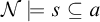 ${\mathcal {N}}\models s\subseteq a$
, then
${\mathcal {N}}\models s\subseteq a$
, then $s\in M.$
Thus for all
$s\in M.$
Thus for all $a\in M$
, we have
$a\in M$
, we have
 $$ \begin{align*} \left( \left[ a\right] ^{<\omega }\right) ^{\mathcal{M}}=\left( \left[ a \right] ^{<\omega }\right) ^{{\mathcal{N}}}. \end{align*} $$
Proof. The assumptions on $\mathcal {M}$
and
$\mathcal {M}$
and ${\mathcal {N}}$
readily imply:
${\mathcal {N}}$
readily imply:
(1) $\omega ^{\mathcal {M}}=\omega ^{{\mathcal {N}}}$
, and
$\omega ^{\mathcal {M}}=\omega ^{{\mathcal {N}}}$
, and
(2) $\mathcal {M}\preceq _{\Delta _{1}}{\mathcal {N}}$
.
$\mathcal {M}\preceq _{\Delta _{1}}{\mathcal {N}}$
.
Let $x=\mathrm {Fn}(y,a)$
be the usual formula expressing “x is the set of all functions
$x=\mathrm {Fn}(y,a)$
be the usual formula expressing “x is the set of all functions $f:y\rightarrow a$
.” It is easy to see that:
$f:y\rightarrow a$
.” It is easy to see that:
(3) The predicate $\left ( x=\mathrm {Fn}(y,a)\wedge y\in \omega \right ) $
is
$\left ( x=\mathrm {Fn}(y,a)\wedge y\in \omega \right ) $
is $\Delta _{1}$
within
$\Delta _{1}$
within $\mathsf {ZF.}$
Observe that $x=\mathrm {Fn}(y,a)$
is clearly expressible by a
$x=\mathrm {Fn}(y,a)$
is clearly expressible by a $\Pi _{1}$
-formula within
$\Pi _{1}$
-formula within $\mathsf {ZF}$
(with no restriction on y). With the added condition that
$\mathsf {ZF}$
(with no restriction on y). With the added condition that $y\in \omega $
, we can take advantage of recursion to express
$y\in \omega $
, we can take advantage of recursion to express $x=\mathrm {Fn}(y,a)$
by the following
$x=\mathrm {Fn}(y,a)$
by the following $\Sigma _{1}$
-formula:
$\Sigma _{1}$
-formula:
 $$ \begin{align*} \exists \left\langle s_{0},\cdot \cdot \cdot ,s_{y}\right\rangle \left[ s_{y}=x\wedge s_{0}=\{\varnothing \}\wedge \forall z<y\ (s_{z+1}=\left\{ f\cup \{(z,v)\}:f\in s_{z}\wedge v\in a\right\} )\right] . \end{align*} $$
Now assume $s\in N$
,
$s\in N$
,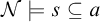 ${\mathcal {N}}\models s\subseteq a$
, and for some
${\mathcal {N}}\models s\subseteq a$
, and for some $k\in N, \mathcal {N\models } k\in \omega \wedge \left \vert s\right \vert =k$
. Thanks to (1) and the assumption
$k\in N, \mathcal {N\models } k\in \omega \wedge \left \vert s\right \vert =k$
. Thanks to (1) and the assumption $\mathcal {M}\subseteq _{ \mathrm {end}}{\mathcal {N}}$
,
$\mathcal {M}\subseteq _{ \mathrm {end}}{\mathcal {N}}$
, $k\in M.$
Therefore by (2) and (3), if
$k\in M.$
Therefore by (2) and (3), if $b\in M$
such that
$b\in M$
such that $\mathcal {M}\models b=\mathrm {Fn}(k,a)$
, then
$\mathcal {M}\models b=\mathrm {Fn}(k,a)$
, then ${\mathcal {N}}\models b=\mathrm {Fn}(k,a)$
. Thus if
${\mathcal {N}}\models b=\mathrm {Fn}(k,a)$
. Thus if $f\in N$
such that
$f\in N$
such that $f:k\rightarrow a$
is an injective function such that
$f:k\rightarrow a$
is an injective function such that $\mathrm {range}(f)=s$
, then
$\mathrm {range}(f)=s$
, then $f\in b$
, and since
$f\in b$
, and since ${\mathcal {N}}$
is an end extension of
${\mathcal {N}}$
is an end extension of $\mathcal {M}$
,
$\mathcal {M}$
, $f\in M.$
Hence
$f\in M.$
Hence $\mathrm { range}(f)=s\in M.$ $\square $
Fact
$\square $
Fact $\left ( \nabla \right ) $
)
$\left ( \nabla \right ) $
)
Given a countable model $\mathcal {M}_{0}$
of
$\mathcal {M}_{0}$
of $\mathsf {ZF}$
, by Theorem 5.17 there is a weakly Rubin model
$\mathsf {ZF}$
, by Theorem 5.17 there is a weakly Rubin model $\mathcal {M}$
that elementarily extends
$\mathcal {M}$
that elementarily extends $ \mathcal {M}_{0}$
. By Theorem 5.1, to prove Theorem 5.18 it is sufficient to verify that every end extension
$ \mathcal {M}_{0}$
. By Theorem 5.1, to prove Theorem 5.18 it is sufficient to verify that every end extension ${\mathcal {N}}$
of
${\mathcal {N}}$
of $\mathcal {M}$
that satisfies
$\mathcal {M}$
that satisfies $\mathsf {ZF}$
is a conservative extension. Towards this goal, suppose
$\mathsf {ZF}$
is a conservative extension. Towards this goal, suppose $\mathcal {M}\subsetneq _{\mathrm {end}}{\mathcal {N}}\models \mathsf {ZF}$
. In light of Remark 2.6(e), it suffices to show that
$\mathcal {M}\subsetneq _{\mathrm {end}}{\mathcal {N}}\models \mathsf {ZF}$
. In light of Remark 2.6(e), it suffices to show that $\mathcal {M}\subsetneq _{\mathrm {end}}^{\mathcal {P}}{\mathcal {N}}$
.
$\mathcal {M}\subsetneq _{\mathrm {end}}^{\mathcal {P}}{\mathcal {N}}$
.
To show $\mathcal {M}\subsetneq _{\mathrm {end}}^{\mathcal {P}}{\mathcal {N}}$
, suppose that for
$\mathcal {M}\subsetneq _{\mathrm {end}}^{\mathcal {P}}{\mathcal {N}}$
, suppose that for $a\in M$
and
$a\in M$
and $s\in N$
,
$s\in N$
, ${\mathcal {N}}\models s\subseteq a.$
We will show that
${\mathcal {N}}\models s\subseteq a.$
We will show that $s\in M.$
By Fact
$s\in M.$
By Fact $(\nabla )$
we may assume that a is infinite as viewed from
$(\nabla )$
we may assume that a is infinite as viewed from $\mathcal {M}$
. Note that this implies that
$\mathcal {M}$
. Note that this implies that $\mathcal { M}$
views
$\mathcal { M}$
views $[a]^{<\omega }$
as a directed set with no maximum element. Fact
$[a]^{<\omega }$
as a directed set with no maximum element. Fact $ (\nabla )$
assures us that:
$ (\nabla )$
assures us that: $(\ast ) \ \forall m\in M \left ( [m]^{<\omega }\right ) ^{ \mathcal {M}}=\left ( [m]^{<\omega }\right ) ^{{\mathcal {N}}},$
and
$(\ast ) \ \forall m\in M \left ( [m]^{<\omega }\right ) ^{ \mathcal {M}}=\left ( [m]^{<\omega }\right ) ^{{\mathcal {N}}},$
and
Since $\mathrm {Fin}(m,2)\subseteq \lbrack m\times \{0,1\}]^{<\omega }$
,
$\mathrm {Fin}(m,2)\subseteq \lbrack m\times \{0,1\}]^{<\omega }$
, $(\ast )$
implies:
$(\ast )$
implies: $(\ast \ast ) \ \forall m\in M \mathrm {Fin}^{{\mathcal {N}}}(m,2)= \mathrm {Fin}^{\mathcal {M}}(m,2)$
.
$(\ast \ast ) \ \forall m\in M \mathrm {Fin}^{{\mathcal {N}}}(m,2)= \mathrm {Fin}^{\mathcal {M}}(m,2)$
.
Let $\chi _{s}\in N$
be the characteristic function of s in
$\chi _{s}\in N$
be the characteristic function of s in $ {\mathcal {N}}$
, i.e., as viewed from
$ {\mathcal {N}}$
, i.e., as viewed from ${\mathcal {N}}$
,
${\mathcal {N}}$
, $\chi _{s}:a\rightarrow \{0,1\}$
and
$\chi _{s}:a\rightarrow \{0,1\}$
and $\forall x\in a(x\in s\leftrightarrow \chi _{s}(x)=1)$
. Let
$\forall x\in a(x\in s\leftrightarrow \chi _{s}(x)=1)$
. Let
 $$ \begin{align*} F_{s}:= \mathrm{Ext}_{{\mathcal{N}}}\left( [\chi _{s}]^{<\omega }\right) ^{ {\mathcal{N}}}. \end{align*} $$
As noted in Example 5.12, $F_{s}$
is a maximal filter over
$F_{s}$
is a maximal filter over $ \mathrm {Ext}_{{\mathcal {N}}}(\mathrm {Fin}^{{\mathcal {N}}}(a,2))$
, so by
$ \mathrm {Ext}_{{\mathcal {N}}}(\mathrm {Fin}^{{\mathcal {N}}}(a,2))$
, so by $(\ast \ast )$
and the assumption that
$(\ast \ast )$
and the assumption that ${\mathcal {N}}$
end extends
${\mathcal {N}}$
end extends $\mathcal {M}$
,
$\mathcal {M}$
, $ F_{s}$
is a maximal filter over
$ F_{s}$
is a maximal filter over $\mathrm {Ext}_{\mathcal {M}}(\mathrm {Fin}^{ \mathcal {M}}(a,2))$
. Note that directed set
$\mathrm {Ext}_{\mathcal {M}}(\mathrm {Fin}^{ \mathcal {M}}(a,2))$
. Note that directed set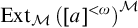 $\mathrm {Ext}_{\mathcal {M} }\left ( [a]^{<\omega }\right ) ^{\mathcal {M}}$
has a cofinal chain
$\mathrm {Ext}_{\mathcal {M} }\left ( [a]^{<\omega }\right ) ^{\mathcal {M}}$
has a cofinal chain $ \left \langle p_{\alpha }:\alpha \in \omega _{1}\right \rangle $
thanks to the assumption that
$ \left \langle p_{\alpha }:\alpha \in \omega _{1}\right \rangle $
thanks to the assumption that $\mathcal {M}$
is weakly Rubin. Together with
$\mathcal {M}$
is weakly Rubin. Together with $(\ast )$
, this readily implies that
$(\ast )$
, this readily implies that $F_{s}$
has a cofinal chain
$F_{s}$
has a cofinal chain $\left \langle q_{\alpha }:\alpha \in \omega _{1}\right \rangle ,$
where:
$\left \langle q_{\alpha }:\alpha \in \omega _{1}\right \rangle ,$
where:
 $$ \begin{align*} q_{\alpha }:=(\chi _{s}\upharpoonright p_{\alpha })^{{\mathcal{N}}}=(\chi _{s}\upharpoonright p_{\alpha })^{\mathcal{M}}. \end{align*} $$
Therefore, by the assumption that $\mathcal {M}$
is weakly Rubin,
$\mathcal {M}$
is weakly Rubin, $ F_{s}$
is
$ F_{s}$
is $\mathcal {M}$
-definable and thus coded in
$\mathcal {M}$
-definable and thus coded in $\mathcal {M}$
by some
$\mathcal {M}$
by some $ m\in M$
. This makes it clear that
$ m\in M$
. This makes it clear that $\mathcal {M}\models \chi _{s}=\cup m$
, and thus
$\mathcal {M}\models \chi _{s}=\cup m$
, and thus $s\in M$
since s is
$s\in M$
since s is $\Delta _{0}$
-definable from
$\Delta _{0}$
-definable from $\chi _{s}$
. This concludes the verification that
$\chi _{s}$
. This concludes the verification that $\mathcal {M}\subsetneq _{\mathrm {end}}^{ \mathcal {P}}{\mathcal {N}}$
, which as explained earlier, is sufficient to establish Theorem 5.18.
$\mathcal {M}\subsetneq _{\mathrm {end}}^{ \mathcal {P}}{\mathcal {N}}$
, which as explained earlier, is sufficient to establish Theorem 5.18.
An examination of the proof of Theorem 5.1, together with Remark 4.7, makes it clear that Theorem 5.1 can be refined as follows.
Theorem 5.19. No model of $\mathsf {KPR+\Pi } _{\infty }^{1}$
-
$\mathsf {KPR+\Pi } _{\infty }^{1}$
- $\mathsf {DC}$
has a conservative proper end extension to a model of
$\mathsf {DC}$
has a conservative proper end extension to a model of $\mathsf {KPR}$
.
$\mathsf {KPR}$
.
The proof of Theorem 5.18, together with Theorem 5.19 allows us to refine Theorem 5.18 as follows.
Theorem 5.20. Every countable model $\mathcal {M} _{0}\models \mathsf {KPR}+\Pi _{\infty }^{1}$
-
$\mathcal {M} _{0}\models \mathsf {KPR}+\Pi _{\infty }^{1}$
- $\mathsf {DC}$
has an elementary extension
$\mathsf {DC}$
has an elementary extension $\mathcal {M}$
of power
$\mathcal {M}$
of power $\aleph _{1}$
that has no proper end extension to a model
$\aleph _{1}$
that has no proper end extension to a model ${\mathcal {N}}\models \mathsf {KPR} \mathrm {.}$
Thus every consistent extension of
${\mathcal {N}}\models \mathsf {KPR} \mathrm {.}$
Thus every consistent extension of $\mathsf {KPR}+\Pi _{\infty }^{1}$
-
$\mathsf {KPR}+\Pi _{\infty }^{1}$
- $\mathsf {DC}$
has a model of power
$\mathsf {DC}$
has a model of power $\aleph _{1}$
that has no proper end extension to model of
$\aleph _{1}$
that has no proper end extension to model of $\mathsf {KPR}. $
Question 5.21.
Is there an $\omega $
-standard model of
$\omega $
-standard model of $\mathsf {ZF(C)}$
that has no proper end extension to a model of
$\mathsf {ZF(C)}$
that has no proper end extension to a model of $\mathsf {ZF(C)}$
?
$\mathsf {ZF(C)}$
?
Remark 5.22. Weakly Rubin models are never $\omega $
-standard (even though
$\omega $
-standard (even though $\omega $
-standard rather classless models exist in abundance). However, a slight variation of the existence proof of Rubin models shows that a Rubin model
$\omega $
-standard rather classless models exist in abundance). However, a slight variation of the existence proof of Rubin models shows that a Rubin model $\mathcal {M}$
can be arranged to have an
$\mathcal {M}$
can be arranged to have an $ \aleph _{1}$
-like
$ \aleph _{1}$
-like $\omega ^{\mathcal {M}}.$
Note, however, that the answer to Question 5.21 is known to be in the negative if “end extension” is strengthened to “rank extension”; this follows from ([Reference Enayat10], Theorem 1.5(b)), which asserts that no
$\omega ^{\mathcal {M}}.$
Note, however, that the answer to Question 5.21 is known to be in the negative if “end extension” is strengthened to “rank extension”; this follows from ([Reference Enayat10], Theorem 1.5(b)), which asserts that no $\aleph _{1}$
-like model of
$\aleph _{1}$
-like model of $\mathsf {ZFC}$
that elementarily end extends a model all of whose ordinals are pointwise definable has a proper rank extension to a model of
$\mathsf {ZFC}$
that elementarily end extends a model all of whose ordinals are pointwise definable has a proper rank extension to a model of $\mathsf {ZFC}$
. The proof of [Reference Enayat10, Theorem 1.5(b)] together with part (b) of Theorem 4.4 makes it clear that the same goes for
$\mathsf {ZFC}$
. The proof of [Reference Enayat10, Theorem 1.5(b)] together with part (b) of Theorem 4.4 makes it clear that the same goes for $\mathsf {ZF}$
, i.e., there are
$\mathsf {ZF}$
, i.e., there are $ \omega $
-standard models of
$ \omega $
-standard models of $\mathsf {ZF}$
that have no proper rank extension to a model of
$\mathsf {ZF}$
that have no proper rank extension to a model of $\mathsf {ZF}$
.
$\mathsf {ZF}$
.
6 Addendum and corrigendum to [Reference Enayat11]
Theorem 2.2 of [Reference Enayat11] incorrectly stated (in the notation of the same paper, where Gothic letters are used for denoting structures) that if $\mathfrak {A}\models \mathsf {ZF}$
,
$\mathfrak {A}\models \mathsf {ZF}$
, $\mathfrak {A}\prec _{ \mathrm {cons}}\mathfrak {B}$
and
$\mathfrak {A}\prec _{ \mathrm {cons}}\mathfrak {B}$
and $\mathfrak {B}$
fixes each
$\mathfrak {B}$
fixes each $a\in \omega ^{ \mathfrak {A}},$
then
$a\in \omega ^{ \mathfrak {A}},$
then $\mathfrak {A}$
is cofinal in
$\mathfrak {A}$
is cofinal in $\mathfrak {B}$
. As shown in Theorem 3.1 of this article, it is possible to arrange taller conservative elementary extensions of models of
$\mathfrak {B}$
. As shown in Theorem 3.1 of this article, it is possible to arrange taller conservative elementary extensions of models of $\mathsf {ZFC}$
, thus Theorem 2.2 of [Reference Enayat11] is false as stated. However, by assuming that ‘slightly’ strengthening the conditions:
$\mathsf {ZFC}$
, thus Theorem 2.2 of [Reference Enayat11] is false as stated. However, by assuming that ‘slightly’ strengthening the conditions:
 $$ \begin{align*} \mathfrak{A}\models \mathsf{ZF}, \text{ and } \mathfrak{B} \text{ fixes each } a\in \omega ^{\mathfrak{A}}, \end{align*} $$
to:
 $$ \begin{align*} \mathfrak{A}\models \mathsf{ZFC}, \text{ and } \mathfrak{B} \text{ fixes } \omega ^{ \mathfrak{A}}, \end{align*} $$
one obtains a true statement, as indicated in Corollary 4.2 of this article.Footnote
35
As pointed out in Remark 3.9, $\mathfrak {B}$
fixes each
$\mathfrak {B}$
fixes each $a\in \omega ^{\mathfrak {A}}$
whenever
$a\in \omega ^{\mathfrak {A}}$
whenever $\mathfrak {A}\prec _{\mathrm {cons}} \mathfrak {B}\models \mathsf {ZF}$
.
$\mathfrak {A}\prec _{\mathrm {cons}} \mathfrak {B}\models \mathsf {ZF}$
.
Several corollaries were drawn from Theorem 2.2 of [Reference Enayat11]; what follows are the modifications in them, necessitated by the above correction. We assume that the reader has [Reference Enayat11] handy for ready reference.
-
• In Corollary 2.3(a) of [Reference Enayat11], the assumption that
$ \mathfrak {B}$
fixes every integer of
$\mathfrak {A}$
should be strengthened to:
$\mathfrak {B}$
fixes
$\omega ^{\mathfrak {A}}$
. -
• Part (b) of Corollary 2.3 of [Reference Enayat11] is correct as stated in [Reference Enayat11]: if
$\mathfrak {A}$
is a Rubin model of
$\mathsf {ZFC}$
and
$ \mathfrak {A}\prec \mathfrak {B}$
that fixes every
$a\in \omega ^{\mathfrak {A} } $
, then
$\mathfrak {B}$
is a conservative extension of
$\mathfrak {A}$
. This is really what the proof of part (a) of Corollary 2.3 of [Reference Enayat11] shows. However, the following correction is needed: towards the end of the proof of part (a) of Corollary 2.3 of [Reference Enayat11], after defining the set X, it must simply be stated as follows: But
$X=Y\cap A,$
where Y is the collection of members
$a\in A$
satisfying
$[\varphi (b,a)\wedge a\in R_{\alpha }]$
. Since
$\mathfrak {B}$
is an end extension of
$ \mathfrak {C}$
,
$Y\in C,$
so by claim
$(\ast )$
, X is definable in
$ \mathfrak {A}$
. -
• Corollary 2.4 of [Reference Enayat11] is correct as stated since it does not rely on the full force of Theorem 2.2 of [Reference Enayat11] and only relies on the fact that no elementary conservative extension of a model of
$ \mathsf {ZF}$
is an end extension. The latter follows from Corollary 4.2 of this article. -
• The condition stipulating that
$\mathfrak {B}$
fixes
$\omega ^{ \mathfrak {A}}$
must be added to condition
$(i)$
of Corollary 2.5 of [Reference Enayat11].







Appendix: Proofs of Theorems 5.15 and 5.17
Theorem A.1 (Rubin–Shelah–Schmerl).
It is a theorem of $\mathsf {ZFC}$
that every countable model of
$\mathsf {ZFC}$
that every countable model of $ \mathsf {ZF}$
has an elementary extension to a weakly Rubin model of cardinality
$ \mathsf {ZF}$
has an elementary extension to a weakly Rubin model of cardinality $\aleph _{1}$
.
$\aleph _{1}$
.
The proof of Theorem A.1 has two distinct stages: in the first stage we prove within $\mathsf {ZFC}+\Diamond _{\omega _{1}}$
that every countably infinite structure in a countable language has an elementary extension to a Rubin model of cardinality
$\mathsf {ZFC}+\Diamond _{\omega _{1}}$
that every countably infinite structure in a countable language has an elementary extension to a Rubin model of cardinality $\aleph _{1}$
(Theorem 5.15), and then in the second stage we use the result of the first stage together with a forcing-and-absoluteness argument to establish the theorem.Footnote
36
$\aleph _{1}$
(Theorem 5.15), and then in the second stage we use the result of the first stage together with a forcing-and-absoluteness argument to establish the theorem.Footnote
36
Stage 1 of the proof of Theorem A.1
Fix a $\Diamond _{\omega _{1}}$
sequence
$\Diamond _{\omega _{1}}$
sequence $\left \langle S_{\alpha }:\alpha <\omega _{1}\right \rangle $
. Given a countable language
$\left \langle S_{\alpha }:\alpha <\omega _{1}\right \rangle $
. Given a countable language $ \mathcal {L}$
, and countably infinite
$ \mathcal {L}$
, and countably infinite $\mathcal {L}$
-structure model
$\mathcal {L}$
-structure model $\mathcal { M}_{0}$
, assume without loss of generality that
$\mathcal { M}_{0}$
, assume without loss of generality that $M_{0}=\omega .$
We plan to inductively build two sequences
$M_{0}=\omega .$
We plan to inductively build two sequences $\left \langle \mathcal {M}_{\alpha }:\alpha <\omega _{1}\right \rangle $
, and
$\left \langle \mathcal {M}_{\alpha }:\alpha <\omega _{1}\right \rangle $
, and $\left \langle \mathcal {O}_{\alpha }:\alpha <\omega _{1}\right \rangle .$
The first is a sequence of approximations to our final model
$\left \langle \mathcal {O}_{\alpha }:\alpha <\omega _{1}\right \rangle .$
The first is a sequence of approximations to our final model $\mathcal {M}.$
The second sequence, on the other hand, keeps track of the increasing list of ‘obligations’ we need to abide by throughout the construction of the first sequence. More specifically, each
$\mathcal {M}.$
The second sequence, on the other hand, keeps track of the increasing list of ‘obligations’ we need to abide by throughout the construction of the first sequence. More specifically, each $\mathcal {O}_{\alpha }$
will be of the form
$\mathcal {O}_{\alpha }$
will be of the form $ \{\{V_{n}^{\alpha },\ W_{n}^{\alpha }\}:n\in \mathbb {\omega }\}$
, where
$ \{\{V_{n}^{\alpha },\ W_{n}^{\alpha }\}:n\in \mathbb {\omega }\}$
, where $ \{V_{n}^{\alpha },\ W_{n}^{\alpha }\}$
is pair of disjoint subsets of
$ \{V_{n}^{\alpha },\ W_{n}^{\alpha }\}$
is pair of disjoint subsets of $ M_{\alpha }$
that are inseparable in
$ M_{\alpha }$
that are inseparable in $\mathcal {M}_{\alpha }$
and should be kept inseparable in each
$\mathcal {M}_{\alpha }$
and should be kept inseparable in each $\mathcal {M}_{\beta }$
, for all
$\mathcal {M}_{\beta }$
, for all $\beta>\alpha .$
Here we say that two disjoint subsets V and W of a model
$\beta>\alpha .$
Here we say that two disjoint subsets V and W of a model ${\mathcal {N}}$
are inseparable in
${\mathcal {N}}$
are inseparable in ${\mathcal {N}}$
if there is no
${\mathcal {N}}$
if there is no ${\mathcal {N}}$
-definable
${\mathcal {N}}$
-definable $X\subseteq N$
such that
$X\subseteq N$
such that $V\subseteq X,$
and
$V\subseteq X,$
and $W\cap X=\varnothing .$
We only need to describe the construction of these two sequences for stages $ \alpha +1$
for limit ordinals
$ \alpha +1$
for limit ordinals $\alpha $
since:
$\alpha $
since:
-
•
$\mathcal {O}_{0}:=\varnothing $
. -
• For limit
$\alpha $
,
$\mathcal {M}_{\alpha }:=\bigcup \limits _{\beta <\alpha }\mathcal {M}_{\beta }$
and
$\mathcal {O}_{\alpha }:=\bigcup \limits _{\beta <\alpha }\mathcal {O}_{\beta }$
. -
• For nonlimit
$\alpha $
,
$\mathcal {M}_{\alpha +1}:=\mathcal {M}_{\alpha }$
and
$\mathcal {O}_{\alpha +1}:=\mathcal {O}_{\alpha }$
.


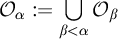



At stage $\alpha +1,$
where
$\alpha +1,$
where $\alpha $
is a limit ordinal, we have access to a model
$\alpha $
is a limit ordinal, we have access to a model $\mathcal {M}_{\alpha }$
(where
$\mathcal {M}_{\alpha }$
(where $M_{\alpha }\in \omega _{1}$
), and a collection
$M_{\alpha }\in \omega _{1}$
), and a collection $\mathcal {O}_{\alpha }$
of inseparable pairs of subsets of
$\mathcal {O}_{\alpha }$
of inseparable pairs of subsets of $M_{\alpha }$
. We now look at
$M_{\alpha }$
. We now look at $S_{\alpha }$
, and consider two cases: either
$S_{\alpha }$
, and consider two cases: either $S_{\alpha }$
is parametrically undefinable in
$S_{\alpha }$
is parametrically undefinable in $\mathcal {M}_{\alpha }, $
or not
$\mathcal {M}_{\alpha }, $
or not $.$
In the latter case we ‘do nothing’, and define
$.$
In the latter case we ‘do nothing’, and define $\mathcal {M} _{\alpha +1}:=\mathcal {M}_{\alpha }$
and
$\mathcal {M} _{\alpha +1}:=\mathcal {M}_{\alpha }$
and $\mathcal {O}_{\alpha +1}:=\mathcal {O }_{\alpha }.$
But if the former is true, we augment our list of obligations via:
$\mathcal {O}_{\alpha +1}:=\mathcal {O }_{\alpha }.$
But if the former is true, we augment our list of obligations via:
 $$ \begin{align*} \mathcal{O}_{\alpha +1}:=\mathcal{O}_{\alpha }\cup \{\left\{ S_{\alpha },\ M_{\alpha }\backslash S_{\alpha }\right\} \}. \end{align*} $$
Notice that if $S_{\alpha }$
is parametrically undefinable in
$S_{\alpha }$
is parametrically undefinable in $ \mathcal {M}_{\alpha },$
then
$ \mathcal {M}_{\alpha },$
then $\{S_{\alpha },\ M_{\alpha }\backslash S_{\alpha }\}$
is inseparable in
$\{S_{\alpha },\ M_{\alpha }\backslash S_{\alpha }\}$
is inseparable in $\mathcal {M}_{\alpha }.$
Then we use Lemma A.2 below to build an elementary extension
$\mathcal {M}_{\alpha }.$
Then we use Lemma A.2 below to build an elementary extension $\mathcal {M}_{\alpha +1}$
of
$\mathcal {M}_{\alpha +1}$
of $ \mathcal {M}_{\alpha }$
that satisfies the following three conditions:
$ \mathcal {M}_{\alpha }$
that satisfies the following three conditions:
(1) For each $\{V,\ W\}\in \mathcal {O}_{\alpha +1}$
, V and W are inseparable in
$\{V,\ W\}\in \mathcal {O}_{\alpha +1}$
, V and W are inseparable in $\mathcal {M}_{\alpha +1}$
.
$\mathcal {M}_{\alpha +1}$
.
(2) For every $\mathcal {M}_{\alpha }$
-definable directed set
$\mathcal {M}_{\alpha }$
-definable directed set $\mathbb {D}$
with no last element, there is some
$\mathbb {D}$
with no last element, there is some $ d^{\ast }\in \mathbb {D}^{\mathcal {M}_{\alpha +1}}$
such that for each
$ d^{\ast }\in \mathbb {D}^{\mathcal {M}_{\alpha +1}}$
such that for each $d\in \mathbb {D}^{\mathcal {M}_{\alpha }}, \mathcal {M}_{\alpha +1}\models \left ( d<_{\mathbb {D}}d^{\ast }\right ) .$
(3) $M_{\alpha +1}=M_{\alpha }+\omega $
(ordinal addition).
$M_{\alpha +1}=M_{\alpha }+\omega $
(ordinal addition).
This concludes the description of the sequences $\left \langle \mathcal {M}_{\alpha +1}:\alpha <\omega _{1}\right \rangle $
, and
$\left \langle \mathcal {M}_{\alpha +1}:\alpha <\omega _{1}\right \rangle $
, and $ \left \langle \mathcal {O}_{\alpha }:\alpha <\omega _{1}\right \rangle .$
Let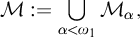 $\mathcal {M}:=\bigcup \limits _{\alpha <\omega _{1}}\mathcal {M} _{\alpha },$
and
$\mathcal {M}:=\bigcup \limits _{\alpha <\omega _{1}}\mathcal {M} _{\alpha },$
and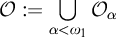 $\mathcal {O}:=\bigcup \limits _{\alpha <\omega _{1}}\mathcal {O }_{\alpha }$
; note that:
$\mathcal {O}:=\bigcup \limits _{\alpha <\omega _{1}}\mathcal {O }_{\alpha }$
; note that: $(4)$
For each
$(4)$
For each $\{V,\ W\}\in \mathcal {O}$
, V and W are inseparable in
$\{V,\ W\}\in \mathcal {O}$
, V and W are inseparable in $\mathcal {M}$
.
$\mathcal {M}$
.
We now verify that $\mathcal {M}$
is a Rubin model. Suppose, on the contrary, that for some
$\mathcal {M}$
is a Rubin model. Suppose, on the contrary, that for some $\mathcal {M}$
-definable partial order
$\mathcal {M}$
-definable partial order $\mathbb {P}$
, there is a maximal filter
$\mathbb {P}$
, there is a maximal filter $F\subseteq \mathbb {P}$
that is not
$F\subseteq \mathbb {P}$
that is not $\mathcal {M}$
-definable, and F contains a cofinal
$\mathcal {M}$
-definable, and F contains a cofinal $\omega _{1}$
-chain E. By a standard Löwenheim–Skolem argument there is some limit
$\omega _{1}$
-chain E. By a standard Löwenheim–Skolem argument there is some limit $\alpha <\omega _{1}$
such that:
$\alpha <\omega _{1}$
such that: $(5) \ \ (\mathcal {M}_{\alpha },S_{\alpha })\prec (\mathcal {M} ,F),$
where
$(5) \ \ (\mathcal {M}_{\alpha },S_{\alpha })\prec (\mathcal {M} ,F),$
where $S_{\alpha }=F\cap \alpha .$
In particular,
(6) $S_{\alpha }$
is an undefinable subset of
$S_{\alpha }$
is an undefinable subset of $\mathcal {M}_{\alpha }.$
Since $S_{\alpha }$
is a countable subset of some
$S_{\alpha }$
is a countable subset of some $\mathcal {M}$
-definable partial order
$\mathcal {M}$
-definable partial order $\mathbb {P}$
, and E is chain of length
$\mathbb {P}$
, and E is chain of length $\omega _{1}$
that is cofinal in
$\omega _{1}$
that is cofinal in $\mathbb {P}$
, there is some
$\mathbb {P}$
, there is some $e\in \mathbb {P}$
such that
$e\in \mathbb {P}$
such that $p<_{\mathbb {P}}e$
for each
$p<_{\mathbb {P}}e$
for each $p\in S_{\alpha }.$
Fix some
$p\in S_{\alpha }.$
Fix some $\beta <\omega _{1}$
such that
$\beta <\omega _{1}$
such that $e\in M_{\beta }.$
We claim that the formula
$e\in M_{\beta }.$
We claim that the formula $\varphi (x)=(x\in \mathbb {P})\rightarrow (x<_{\mathbb {P}}e)$
separates
$\varphi (x)=(x\in \mathbb {P})\rightarrow (x<_{\mathbb {P}}e)$
separates $S_{\alpha }$
and
$S_{\alpha }$
and $\mathbb {P}^{M_{\alpha }}\backslash S_{\alpha }$
in
$\mathbb {P}^{M_{\alpha }}\backslash S_{\alpha }$
in $\mathcal {M}.$
This is easy to see since if
$\mathcal {M}.$
This is easy to see since if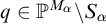 $q\in \mathbb {P}^{M_{\alpha }}\backslash S_{\alpha }$
, then by (5),
$q\in \mathbb {P}^{M_{\alpha }}\backslash S_{\alpha }$
, then by (5), $S_{\alpha }$
is a maximal filter on
$S_{\alpha }$
is a maximal filter on $\mathbb {P}^{M_{\alpha }} $
, and therefore there is some
$\mathbb {P}^{M_{\alpha }} $
, and therefore there is some $p\in S_{\alpha }$
such that
$p\in S_{\alpha }$
such that $\mathcal {M} _{\alpha }\models $
“p and q have no common upper bound,” which by (5) implies the same to be true in
$\mathcal {M} _{\alpha }\models $
“p and q have no common upper bound,” which by (5) implies the same to be true in $ \mathcal {M}$
, in turn implying that
$ \mathcal {M}$
, in turn implying that $\lnot (q<_{\mathbb {P}}e),$
as desired. We have arrived at a contradiction since on the one hand, based on (2) and (6), the formula
$\lnot (q<_{\mathbb {P}}e),$
as desired. We have arrived at a contradiction since on the one hand, based on (2) and (6), the formula $\varphi (x)$
witnesses the separability of
$\varphi (x)$
witnesses the separability of $S_{\alpha }$
and
$S_{\alpha }$
and $ M_{\alpha }\backslash S_{\alpha }$
within
$ M_{\alpha }\backslash S_{\alpha }$
within $\mathcal {M},$
and on the other hand
$\mathcal {M},$
and on the other hand $\{S_{\alpha },\ M_{\alpha }\backslash S_{\alpha }\}\in \mathcal {O}$
by (5), and therefore (4) dictates that
$\{S_{\alpha },\ M_{\alpha }\backslash S_{\alpha }\}\in \mathcal {O}$
by (5), and therefore (4) dictates that $S_{\alpha }$
and
$S_{\alpha }$
and $M_{\alpha }\backslash S_{\alpha }$
are inseparable in
$M_{\alpha }\backslash S_{\alpha }$
are inseparable in $\mathcal {M}.$
Thus the proof of Theorem A.1 will be complete once we establish Lemma A.2 below.
$\mathcal {M}.$
Thus the proof of Theorem A.1 will be complete once we establish Lemma A.2 below.
Lemma A.2. Suppose $\mathcal {M}$
is a countable
$\mathcal {M}$
is a countable $\mathcal {L}$
-structure, where
$\mathcal {L}$
-structure, where $\mathcal {L}$
is countable. Let
$\mathcal {L}$
is countable. Let $\{\{V_{n},W_{n}\}:n\in \mathbb {\omega } \}$
is a countable list of
$\{\{V_{n},W_{n}\}:n\in \mathbb {\omega } \}$
is a countable list of $\mathcal {M}$
-inseparable pairs of subsets of M, and
$\mathcal {M}$
-inseparable pairs of subsets of M, and $\left \{ \left ( \mathbb {D}_{n},\leq _{ \mathbb {D}_{n}}\right ) :n\in \mathbb {\omega }\right \} $
be an enumeration of
$\left \{ \left ( \mathbb {D}_{n},\leq _{ \mathbb {D}_{n}}\right ) :n\in \mathbb {\omega }\right \} $
be an enumeration of $\mathcal {M}$
-definable directed sets with no last element. Then there exists an elementary extension
$\mathcal {M}$
-definable directed sets with no last element. Then there exists an elementary extension ${\mathcal {N}}$
of
${\mathcal {N}}$
of $\mathcal {M}$
that satisfies the following two properties:
$\mathcal {M}$
that satisfies the following two properties:
-
(a)
$V_{n}$
and
$W_{n}$
remain inseparable in
${\mathcal {N}}$
for all
$n\in \mathbb {\omega }$
. -
(b) For each
$n\in \mathbb {\omega }$
there is some
$d_{n}\in N$
such that
${\mathcal {N}}\models d_{n}\in \mathbb {D}_{n}$
(i.e.,
$d_{n}$
satisfies the formula that defines
$\mathbb {D}_{n}$
in
$\mathcal {M}$
), and for each
$ m\in \mathbb {D}_{n}, {\mathcal {N}}\models \left ( m<_{\mathbb {D} _{n}}d_{n}\right ) .$





Let $\mathcal {L}^{+}$
be the language
$\mathcal {L}^{+}$
be the language $\mathcal {L}$
augmented with constants from
$\mathcal {L}$
augmented with constants from $C_{1}=\{\dot {m}:m\in M\}$
and
$C_{1}=\{\dot {m}:m\in M\}$
and $C_{2}=\left \{ d_{n}:n\in \mathbb {\omega }\right \} $
(where
$C_{2}=\left \{ d_{n}:n\in \mathbb {\omega }\right \} $
(where $C_{1}$
and
$C_{1}$
and $C_{2}$
are disjoint), and consider the
$C_{2}$
are disjoint), and consider the $\mathcal {L}^{+}$
-theory T below:
$\mathcal {L}^{+}$
-theory T below:
 $$ \begin{align*} T:=\mathrm{Th}(\mathcal{M},m)_{m\in M}+\left\{ d_{n}\in \mathbb{D}_{n}:n\in \mathbb{\omega }\right\} \cup \left\{ \dot{m}<_{\mathbb{D}_{n}}d_{n}: {\mathcal{N}}\models \left( m\in \mathbb{D}_{n}\right) ,n\in \mathbb{\omega } \right\}. \end{align*} $$
T is readily seen to be consistent since it is finitely satisfiable in $\mathcal {M}\mathfrak {.}$
Moreover, it is clear that if
$\mathcal {M}\mathfrak {.}$
Moreover, it is clear that if $ {\mathcal {N}}\models T$
, then
$ {\mathcal {N}}\models T$
, then $\mathcal {M}\prec {\mathcal {N}}$
and
$\mathcal {M}\prec {\mathcal {N}}$
and ${\mathcal {N}}$
satisfies condition (b) of the theorem. To arrange a model of T in which condition (a) also holds requires a delicate omitting types argument. First, we need a pair of preliminary lemmas. The proofs of Lemma A.3 and A.4 are routine and left to the reader. Note that they are each other’s contrapositive, so it is sufficient to only verify one of them.
${\mathcal {N}}$
satisfies condition (b) of the theorem. To arrange a model of T in which condition (a) also holds requires a delicate omitting types argument. First, we need a pair of preliminary lemmas. The proofs of Lemma A.3 and A.4 are routine and left to the reader. Note that they are each other’s contrapositive, so it is sufficient to only verify one of them.
Lemma A.3. The following two conditions are equivalent for a sentence $\varphi (d_{k_{1}},\cdot \cdot \cdot , d_{k_{p}})$
of
$\varphi (d_{k_{1}},\cdot \cdot \cdot , d_{k_{p}})$
of $\mathcal {L}^{+}$
:
$\mathcal {L}^{+}$
:
-
(i)
$T\vdash \varphi (d_{k_{1}},\cdot \cdot \cdot ,d_{k_{p}})$
. -
(ii)
$\mathcal {M}\models \exists r_{1}\in \mathbb {D}_{k_{1}}\forall s_{1}\in \mathbb {D}_{k_{1}}\cdot \cdot \cdot \exists r_{p}\in \mathbb {D} _{k_{p}}\forall s_{p}\in \mathbb {D}_{k_{p}}\left [ \left ( \bigwedge \limits _{1\leq i\leq p}r_{i}<_{\mathbb {D}_{k_{i}}}s_{i}\right ) \rightarrow\right.\left. \varphi (s_{1},\cdot \cdot \cdot ,s_{p})\right ] .$


Lemma A.4. The following two conditions are equivalent for a sentence $\varphi (d_{k_{1}},\cdot \cdot \cdot , d_{k_{p}})$
of
$\varphi (d_{k_{1}},\cdot \cdot \cdot , d_{k_{p}})$
of $\mathcal {L}^{+}$
:
$\mathcal {L}^{+}$
:
-
(i)
$T+\varphi (d_{k_{1}},\cdot \cdot \cdot ,d_{k_{p}})$
is consistent. -
(ii)
$\mathcal {M}\models \forall r_{1}\in \mathbb {D}_{k_{1}}\exists s_{1}\in \mathbb {D}_{k_{1}}\cdot \cdot \cdot \forall r_{p}\in \mathbb {D} _{k_{p}}\exists s_{p}\in \mathbb {D}_{k_{p}}\left [ \left ( \bigwedge \limits _{1\leq i\leq p}r_{i}<_{\mathbb {D}_{k_{i}}}s_{i}\right ) \wedge\right.\left. \varphi (s_{1},\cdot \cdot \cdot ,s_{p})\right ] .$


We are now ready to carry out an omitting types argument to complete the proof of Lemma A.2. For each formula $\psi (y,\vec {x})$
of
$\psi (y,\vec {x})$
of $ \mathcal {L}^{+}$
, and each
$ \mathcal {L}^{+}$
, and each $n\in \omega $
, consider the following q-type formulated in the language
$n\in \omega $
, consider the following q-type formulated in the language $\mathcal {L}^{+}$
, where
$\mathcal {L}^{+}$
, where $\vec {x}=\left \langle x_{1},\cdot \cdot \cdot ,x_{q}\right \rangle $
is a q-tuple of variables:
$\vec {x}=\left \langle x_{1},\cdot \cdot \cdot ,x_{q}\right \rangle $
is a q-tuple of variables:
 $$ \begin{align*} \Sigma _{n}^{\psi }(\vec{x}):=\{\psi (\dot{a},\vec{x}):a\in V_{n}\}\cup \{\lnot \psi (\dot{b},\vec{x}):b\in W_{n}\}. \end{align*} $$
Note that $\Sigma _{n}^{\psi }$
expresses that
$\Sigma _{n}^{\psi }$
expresses that $\psi (y,\vec {x})$
separates
$\psi (y,\vec {x})$
separates $V_{n}$
and
$V_{n}$
and $W_{n}.$
Lemma A.5. $\Sigma _{n}^{\psi }$
is locally omitted by T for each formula
$\Sigma _{n}^{\psi }$
is locally omitted by T for each formula $\psi (y,\vec {x})$
, and each
$\psi (y,\vec {x})$
, and each $n\in \mathbb {\omega }$
.
$n\in \mathbb {\omega }$
.
Proof. Suppose to the contrary that there is a formula $ \theta (\vec {x},d_{k_{1}},\cdot \cdot \cdot ,d_{k_{p}})$
of
$ \theta (\vec {x},d_{k_{1}},\cdot \cdot \cdot ,d_{k_{p}})$
of $\mathcal {L}^{+}$
and some
$\mathcal {L}^{+}$
and some $n\in \omega $
such that (1)–(3) below hold:
$n\in \omega $
such that (1)–(3) below hold:
-
(1)
$T+\exists \vec {x}\ \theta (\vec {x},d_{k_{1}},\cdot \cdot \cdot ,d_{k_{p}})$
is consistent. -
(2) For all
$a\in V_{n}, T\vdash \forall \vec {x}\left [ \theta ( \vec {x},d_{k_{1}},\cdot \cdot \cdot ,d_{k_{p}})\rightarrow \psi (\dot {a}, \vec {x})\right ] .$
-
(3) For all
$b\in W_{n}, T\vdash \forall \vec {x}\left [ \theta ( \vec {x},d_{k_{1}},\cdot \cdot \cdot ,d_{k_{p}})\rightarrow \lnot \psi (\dot {b },\vec {x})\right ] .$



Invoking Lemmas A.3 and A.4, (1)–(3) translate to $ (1^{\prime })$
–
$ (1^{\prime })$
– $(3^{\prime })$
below:
$(3^{\prime })$
below:
-
(1′)
$\mathcal {M}\models \forall r_{1}\in \mathbb {D} _{k_{1}}\exists s_{1}\in \mathbb {D}_{k_{1}}\cdot \cdot \cdot \forall r_{p}\in \mathbb {D}_{k_{p}}\exists s_{p}\in \mathbb {D}_{k_{p}}\left [ \left ( \bigwedge \limits _{1\leq i\leq p}r_{i}<_{\mathbb {D}_{k_{i}}}s_{i}\right ) \wedge\right.\left. \exists \vec {x}\ \theta (\vec {x},\vec {s})\right ] ,$
where
$\vec {s} =\left \langle s_{1},\cdot \cdot \cdot ,s_{p}\right \rangle .$
-
(2′) For all
$a\in V_{n}$
,
$\mathcal {M}\models \lambda (a), $
where:
$$ \begin{align*} \lambda (\mathbf{v})&:=\forall \vec{x}\ \exists r_{1}\in \mathbb{D} _{k_{1}}\forall s_{1}\in \mathbb{D}_{k_{1}}\cdot \cdot \cdot \exists r_{p}\in \mathbb{D}_{k_{p}}\forall s_{p}\in \mathbb{D}_{k_{p}}\\ &\quad \left[ \left( \bigwedge\limits_{1\leq i\leq p}r_{i}<_{\mathbb{D}_{k_{i}}}s_{i}\right) \rightarrow \left( \theta (\vec{x},\vec{s})\rightarrow \psi (\mathbf{v},\vec{ x}\ )\right) \right]. \end{align*} $$
-
(3′) For all
$b\in W_{n},\ \mathcal {M}\models \gamma (b)$
, where:
$$ \begin{align*} \gamma (\mathbf{w})&:=\forall \vec{x}\ \exists r_{1}\in \mathbb{D} _{k_{1}}\forall s_{1}\in \mathbb{D}_{k_{1}}\cdot \cdot \cdot \exists r_{n}\in \mathbb{D}_{k_{p}}\forall s_{p}\in \mathbb{D}_{k_{p}}\\ &\quad \left[ \left( \bigwedge\limits_{1\leq i\leq p}r_{i}<_{\mathbb{D}_{k_{i}}}s_{i}\right) \rightarrow \left( \theta (\vec{x},\vec{s})\rightarrow \lnot \psi (\mathbf{w} ,\vec{x})\right) \right]. \end{align*} $$





Let $\Lambda :=\{m\in M:\mathcal {M}\models \lambda (m)\}$
, and
$\Lambda :=\{m\in M:\mathcal {M}\models \lambda (m)\}$
, and $ \Gamma :=\{m\in M:\mathcal {M}\models \gamma (m)\}$
, and observe that
$ \Gamma :=\{m\in M:\mathcal {M}\models \gamma (m)\}$
, and observe that $ V_{n}\subseteq \Lambda $
by
$ V_{n}\subseteq \Lambda $
by $(2^{\prime })$
and
$(2^{\prime })$
and $W_{n}\subseteq \Gamma $
by
$W_{n}\subseteq \Gamma $
by $ (3^{\prime })$
. To arrive at a contradiction, we will show that
$ (3^{\prime })$
. To arrive at a contradiction, we will show that $\Lambda \cap \Gamma =\emptyset $
, which implies that
$\Lambda \cap \Gamma =\emptyset $
, which implies that $V_{n}$
and
$V_{n}$
and $W_{n}$
are separable in
$W_{n}$
are separable in $\mathcal {M}$
. To this end, suppose to the contrary that for some
$\mathcal {M}$
. To this end, suppose to the contrary that for some $m\in M,$
-
(4)
$\mathcal {M}\models \lambda (m)\wedge \gamma (m).$

Since each $\left ( \mathbb {D}_{n},\leq _{\mathbb {D}_{n}}\right ) $
is a directed set, (4) implies:
$\left ( \mathbb {D}_{n},\leq _{\mathbb {D}_{n}}\right ) $
is a directed set, (4) implies:
-
(5)
$\mathcal {M}\models \forall \vec {x}\ \exists r_{1}\in \mathbb {D} _{k_{1}}\forall s_{1}\in \mathbb {D}_{k_{1}}\cdot \cdot \cdot \exists r_{p}\in \mathbb {D}_{k_{p}}\forall s_{p}\in \mathbb {D}_{k_{p}}\left [ \left ( \bigwedge \limits _{1\leq i\leq p}r_{i}<_{\mathbb {D}_{k_{i}}}s_{i}\right ) \rightarrow\right.\left. \left ( \psi (m,\vec {x})\wedge \lnot \psi (m,\vec {x})\right ) \right ] .$

Recall that no $\left ( \mathbb {D}_{n},\leq _{\mathbb {D} _{n}}\right ) $
has a last element. This shows that (5) yields a contradiction, so the proof is complete. (Lemma A.5)
$\left ( \mathbb {D}_{n},\leq _{\mathbb {D} _{n}}\right ) $
has a last element. This shows that (5) yields a contradiction, so the proof is complete. (Lemma A.5)
Proof of Lemma A.2.
Put Lemma A.5 together with the Henkin–Orey omitting types theorem [Reference Chang and Keisler5, Theorem 2.2.9] to conclude that there exists a model ${\mathcal {N}}$
of T that satisfies properties (a) and (b).
${\mathcal {N}}$
of T that satisfies properties (a) and (b).
Stage 2 of the proof of Theorem A.1
In this stage we employ the result of the first stage together with some set-theoretical considerations to establish the Rubin–Shelah–Schmerl Theorem. The main idea here is a variant of the one used by Schmerl [Reference Schmerl42], which itself based on a method of $ \diamondsuit _{\omega _{1}}$
-elimination introduced by Shelah [Reference Shelah44]. This stage has three steps.
$ \diamondsuit _{\omega _{1}}$
-elimination introduced by Shelah [Reference Shelah44]. This stage has three steps.
Step 1 of Stage 2. It is well-known that there is an $ \omega _{1}$
-closed notion
$ \omega _{1}$
-closed notion $\mathbb {Q}_{1}$
in the universe
$\mathbb {Q}_{1}$
in the universe $\mathrm {V}$
of
$\mathrm {V}$
of $ \mathsf {ZFC}$
such that the
$ \mathsf {ZFC}$
such that the $\mathbb {Q}_{1}$
-generic extension
$\mathbb {Q}_{1}$
-generic extension $\mathrm {V}^{ \mathbb {Q}_{1}}$
of
$\mathrm {V}^{ \mathbb {Q}_{1}}$
of $\mathrm {V}$
satisfies
$\mathrm {V}$
satisfies $\mathsf {ZFC}+\diamondsuit _{ \mathbb {\omega }_{1}}$
[Reference Kunen32, Theorem 8.3] (note that
$\mathsf {ZFC}+\diamondsuit _{ \mathbb {\omega }_{1}}$
[Reference Kunen32, Theorem 8.3] (note that $\aleph _{1} $
is absolute between
$\aleph _{1} $
is absolute between $\mathrm {V}$
and
$\mathrm {V}$
and $\mathrm {V}^{\mathbb {Q}_{1}}$
since
$\mathrm {V}^{\mathbb {Q}_{1}}$
since $\mathbb {Q}_{1}$
is
$\mathbb {Q}_{1}$
is $\omega _{1}$
-closed). Thus by Step 1, given a model
$\omega _{1}$
-closed). Thus by Step 1, given a model $\mathcal {M}$
in the universe
$\mathcal {M}$
in the universe $\mathrm {V}$
of
$\mathrm {V}$
of $\mathsf {ZF}$
, the forcing extension
$\mathsf {ZF}$
, the forcing extension $\mathrm {V}^{\mathbb {Q}_{1}}$
satisfies “there is an elementary extension
$\mathrm {V}^{\mathbb {Q}_{1}}$
satisfies “there is an elementary extension ${\mathcal {N}}$
of
${\mathcal {N}}$
of $\mathcal {M}$
such that
$\mathcal {M}$
such that $ {\mathcal {N}} $
is a Rubin model.” In
$ {\mathcal {N}} $
is a Rubin model.” In $\mathrm {V}^{\mathbb {Q} _{1}}$
, since
$\mathrm {V}^{\mathbb {Q} _{1}}$
, since ${\mathcal {N}}$
is a Rubin model, for each
${\mathcal {N}}$
is a Rubin model, for each $s\in N$
that is infinite in the sense of
$s\in N$
that is infinite in the sense of ${\mathcal {N}}$
, there is a subset
${\mathcal {N}}$
, there is a subset $C_{s}=\left \{ c_{\alpha }^{s}:\alpha \in \omega _{1}\right \} $
of
$C_{s}=\left \{ c_{\alpha }^{s}:\alpha \in \omega _{1}\right \} $
of ${\mathcal {N}}$
such that
${\mathcal {N}}$
such that $ \left \langle c_{\alpha }^{s}:\alpha \in \omega _{1}\right \rangle $
is an
$ \left \langle c_{\alpha }^{s}:\alpha \in \omega _{1}\right \rangle $
is an $ \omega _{1}$
-chain that is cofinal in the directed set
$ \omega _{1}$
-chain that is cofinal in the directed set $\left ( [s]^{<\omega }\right ) ^{\mathcal {M}}.$
-
• Let
$\mathbb {P}_{s}$
be the suborder of
$\left ( \mathrm {Fin} (s,2)\right ) ^{\mathcal {M}}$
consisting of partial
$\mathcal {M}$
-finite functions f from s into
$2$
such that
$\mathrm {dom}(f)\in C_{s}$
. Note that
$\mathbb {P}_{s}$
is a tree-order (the predecessors of any given element are comparable). -
•
$\mathbb {P}_{s}$
can be turned into a ranked-tree
$\tau _{s}$
by defining
$\rho (f)=\alpha $
if
$\mathrm {dom}(f)=c_{\alpha }$
. The ranked tree
$\tau _{s}$
has the key property that each maximal filter of
$\left ( \mathrm {Fin}(s,2)\right ) ^{\mathcal {M}}$
is uniquely determined by a branch of
$\tau _{s}.$
-
• Let C be the binary predicate on
${\mathcal {N}}$
defined by
$C(s,x)$
iff
$x\in C_{s}$
, and let

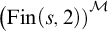








 $$ \begin{align*} {\mathcal{N}}^{+}=\left( {\mathcal{N}},C\right). \end{align*} $$
Note that the ${\mathcal {N}}^{+}$
-definable ranked trees include trees of the form
${\mathcal {N}}^{+}$
-definable ranked trees include trees of the form $\tau _{s}$
, as well as the ranked tree
$\tau _{s}$
, as well as the ranked tree $\tau _{\mathrm { class}}^{{\mathcal {N}}}$
(whose branches uniquely determine classes of
$\tau _{\mathrm { class}}^{{\mathcal {N}}}$
(whose branches uniquely determine classes of $ {\mathcal {N}}$
, as noted in Remark 5.14).
$ {\mathcal {N}}$
, as noted in Remark 5.14).
-
• This gives us
$\aleph _{1}$
-many ranked trees ‘of interest’ in
$ \mathrm {V}^{\mathbb {Q}_{1}},$
namely,
$\tau _{\mathrm {class}}^{{\mathcal {N}}}$
together with
$\tau _{s}$
for each infinite set s of
${\mathcal {N}}$
.


Step 2 of Stage 2.The concept of a weakly specializing function plays a key role in this step. Given a ranked tree $(\mathbb {T},\ \leq _{\mathbb {T}},\ \mathbb {L},\ \leq _{\mathbb {L}},\ \rho )$
, we say that
$(\mathbb {T},\ \leq _{\mathbb {T}},\ \mathbb {L},\ \leq _{\mathbb {L}},\ \rho )$
, we say that $ f:\mathbb {T\rightarrow \omega }$
weakly specializes
$ f:\mathbb {T\rightarrow \omega }$
weakly specializes $(\mathbb {T},\ \leq _{\mathbb {T}})$
if f has the following property:
$(\mathbb {T},\ \leq _{\mathbb {T}})$
if f has the following property:
 $$ \begin{align*} \text{If } x\leq _{\mathbb{T}}y \text{ and } x\leq _{\mathbb{T}}z \text{ and } f(x)=f(y)=f(z), \text{ then } y \text{ and } z \text{ are } \leq _{\mathbb{T}}\text{-comparable.} \end{align*} $$
The following lemma captures the essence of a weakly specializing function for our purposes.
Lemma A.6. Suppose $\tau =(\mathbb {T},\ \leq _{ \mathbb {T}},\ \mathbb {L},\ \leq _{\mathbb {L}},\ \rho )$
is a ranked tree, where
$\tau =(\mathbb {T},\ \leq _{ \mathbb {T}},\ \mathbb {L},\ \leq _{\mathbb {L}},\ \rho )$
is a ranked tree, where $(\mathbb {L},\ \leq _{\mathbb {L}})$
has cofinality
$(\mathbb {L},\ \leq _{\mathbb {L}})$
has cofinality $ \omega _{1}$
, and f weakly specializes
$ \omega _{1}$
, and f weakly specializes $(\mathbb {T},\ \leq _{\mathbb {T}})$
. Then every branch of
$(\mathbb {T},\ \leq _{\mathbb {T}})$
. Then every branch of $\tau $
is parametrically definable in the expansion
$\tau $
is parametrically definable in the expansion $\left ( \tau ,f\right ) $
of
$\left ( \tau ,f\right ) $
of $\tau .$
Proof. Suppose B is a branch of $\tau $
. Then since (
$\tau $
. Then since ( $ \mathbb {L},\ \leq _{\mathbb {L}})$
has cofinality
$ \mathbb {L},\ \leq _{\mathbb {L}})$
has cofinality $\omega _{1},$
there is a subset S of B of order type
$\omega _{1},$
there is a subset S of B of order type $\omega _{1}$
that is unbounded in B. Therefore there is some subset
$\omega _{1}$
that is unbounded in B. Therefore there is some subset $B_{0}$
of B that is unbounded in B such that f is constant on
$B_{0}$
of B that is unbounded in B such that f is constant on $B_{0}.$
Fix some element
$B_{0}.$
Fix some element $b_{0}\in B_{0}$
and consider subset X of
$b_{0}\in B_{0}$
and consider subset X of $\mathbb {T}$
that is defined in
$\mathbb {T}$
that is defined in $\left ( \tau ,f\right ) $
by the formula:
$\left ( \tau ,f\right ) $
by the formula:
 $$ \begin{align*} \varphi (x,b_{0}):=[x\leq _{\mathbb{T}}b_{0}\vee (b_{0}\leq _{\mathbb{T} }x\wedge f(b_{0})=f(x))]. \end{align*} $$
By the defining property of weakly specializing functions, X is linearly ordered and is unbounded in B. This makes it clear that B is definable in $\left ( \tau ,f\right ) $
as the downward closure of X, i.e., by the formula
$\left ( \tau ,f\right ) $
as the downward closure of X, i.e., by the formula $\psi (x,b_{0}):=\exists y\left [ \varphi (y,b_{0})\wedge x\leq _{\mathbb {T}}y\right ] .$
By a remarkable theorem, due independently to Baumgartner [Reference Baumgartner3] and Shelah [Reference Shelah44], given any ranked tree $\tau $
of cardinality
$\tau $
of cardinality $\aleph _{1}$
and of cofinality
$\aleph _{1}$
and of cofinality $\omega _{1}$
, there is a c.c.c. notion of forcing
$\omega _{1}$
, there is a c.c.c. notion of forcing $\mathbb {Q}_{\tau }$
such that
$\mathbb {Q}_{\tau }$
such that $\mathrm {V}^{\mathbb {Q} _{1}\ast \mathbb {Q}_{\tau }}:=\left ( \mathrm {V}^{\mathbb {Q}_{1}}\right ) ^{ \mathbb {Q}_{\tau }}$
contains a function
$\mathrm {V}^{\mathbb {Q} _{1}\ast \mathbb {Q}_{\tau }}:=\left ( \mathrm {V}^{\mathbb {Q}_{1}}\right ) ^{ \mathbb {Q}_{\tau }}$
contains a function $f_{\tau }$
such that weakly specializes
$f_{\tau }$
such that weakly specializes $\tau .$
Footnote
37
Here
$\tau .$
Footnote
37
Here $\mathbb {Q}_{\tau }$
consists of all finite attempts for building a function that weakly specializes
$\mathbb {Q}_{\tau }$
consists of all finite attempts for building a function that weakly specializes $\tau $
(ordered by inclusion). Moreover, given any collection
$\tau $
(ordered by inclusion). Moreover, given any collection $\{\tau _{\alpha }:\alpha \in \kappa \}$
of ranked trees of cofinality
$\{\tau _{\alpha }:\alpha \in \kappa \}$
of ranked trees of cofinality $\omega _{1}$
, the finite support product
$\omega _{1}$
, the finite support product $\mathbb {Q}$
of
$\mathbb {Q}$
of $\left \{ \mathbb {Q}_{\tau _{\alpha }}:\alpha \in \kappa \right \} $
is also known to have the c.c.c. property,Footnote
38
as indicated in [Reference Chodounský and Zapletal6, Corollary 3.3].Footnote
39
Note that for each
$\left \{ \mathbb {Q}_{\tau _{\alpha }}:\alpha \in \kappa \right \} $
is also known to have the c.c.c. property,Footnote
38
as indicated in [Reference Chodounský and Zapletal6, Corollary 3.3].Footnote
39
Note that for each $\alpha \in \kappa $
,
$\alpha \in \kappa $
, $\mathbb {Q}$
forces the existence of a function
$\mathbb {Q}$
forces the existence of a function $f_{\tau _{\alpha }}$
that weakly specializes
$f_{\tau _{\alpha }}$
that weakly specializes $\tau _{\alpha }.$
-
• Thus by choosing
$\{\tau _{\alpha }:\alpha \in \omega _{1}\}$
to be the collection of ranked trees that are parametrically definable in
$ {\mathcal {N}}^{+}$
, there is a function
$g(s,x)$
in
$\mathrm {V}^{\mathbb {Q} _{1}\ast \mathbb {Q}}:=\left ( \mathrm {V}^{\mathbb {Q}_{1}}\right ) ^{\mathbb {Q} } $
such that for each infinite set s of
${\mathcal {N}}$
,
$g(s,x)$
weakly specializes
$\tau _{s}$
(
$\tau _{s}$
was defined in Step 1 of Stage 2), and a function f that weakly specializes
$\tau _{\mathrm {class}}^{{\mathcal {N}} }. $


The next lemma shows that forcing with $\mathbb {Q}$
does not add new branches to ranked trees in the ground model that have cofinality
$\mathbb {Q}$
does not add new branches to ranked trees in the ground model that have cofinality $\omega _{1}$
. Note that when the lemma below is applied to the case when V is replaced by
$\omega _{1}$
. Note that when the lemma below is applied to the case when V is replaced by $\mathrm {V}^{\mathbb {Q}_{1}}$
, it shows that the ample supply of rather branchless models in
$\mathrm {V}^{\mathbb {Q}_{1}}$
, it shows that the ample supply of rather branchless models in $\mathrm {V}^{\mathbb {Q}_{1}}$
remain rather branchless after forcing with
$\mathrm {V}^{\mathbb {Q}_{1}}$
remain rather branchless after forcing with $\mathbb {Q}$
, i.e., in
$\mathbb {Q}$
, i.e., in $\mathrm {V }^{\mathbb {Q}_{1}\ast \mathbb {Q}}.$
Lemma A.7. Suppose $\tau =(\mathbb {T},\ \leq _{ \mathbb {T}},\ \mathbb {L},\ \leq _{\mathbb {L}},\ \rho )$
is a ranked tree, where
$\tau =(\mathbb {T},\ \leq _{ \mathbb {T}},\ \mathbb {L},\ \leq _{\mathbb {L}},\ \rho )$
is a ranked tree, where $(\mathbb {L},\ \leq _{\mathbb {L}})$
has cofinality
$(\mathbb {L},\ \leq _{\mathbb {L}})$
has cofinality $ \omega _{1}.$
If B is a branch of
$ \omega _{1}.$
If B is a branch of $\tau $
in
$\tau $
in $ \mathrm {V}^{\mathbb {Q}}$
, then
$ \mathrm {V}^{\mathbb {Q}}$
, then $B\in \mathrm {V}$
.
$B\in \mathrm {V}$
.
Proof. Suppose B is a branch of $\tau $
in
$\tau $
in $ \mathrm {V}^{\mathbb {Q}}$
, and let f be the
$ \mathrm {V}^{\mathbb {Q}}$
, and let f be the $\mathbb {Q}$
-generic function in
$\mathbb {Q}$
-generic function in $\mathrm {V}^{\mathbb {Q}}$
that specializes
$\mathrm {V}^{\mathbb {Q}}$
that specializes $\tau .$
Since
$\tau .$
Since $\mathbb {Q}$
does not collapse
$\mathbb {Q}$
does not collapse $\omega _{1}$
and the rank order of
$\omega _{1}$
and the rank order of $\tau $
is assumed to have cofinality
$\tau $
is assumed to have cofinality $\omega _{1}$
in
$\omega _{1}$
in $\mathrm {V}$
, there is for some
$\mathrm {V}$
, there is for some $k\in \omega $
such that:
$k\in \omega $
such that:
(1) $\ \ \mathrm {V}^{\mathbb {Q}}\models $
“
$\ \ \mathrm {V}^{\mathbb {Q}}\models $
“ $ f^{-1}\{k\}\cap B$
is unbounded in B.”
$ f^{-1}\{k\}\cap B$
is unbounded in B.”
In $\mathrm {V}^{\mathbb {Q}},$
let
$\mathrm {V}^{\mathbb {Q}},$
let $x_{0}\in B$
with
$x_{0}\in B$
with $f(x_{0})=k.$
Coupled with (1) this shows that there is some
$f(x_{0})=k.$
Coupled with (1) this shows that there is some $q_{0}\in \mathbb {Q}$
such that:
$q_{0}\in \mathbb {Q}$
such that:
(2) $\ \ \ q_{0}\Vdash \left [ f(x_{0})=k\wedge \exists y>_{ \mathbb {T}}x_{0}(y\in B\wedge f(y)=k)\right ] $
.
$\ \ \ q_{0}\Vdash \left [ f(x_{0})=k\wedge \exists y>_{ \mathbb {T}}x_{0}(y\in B\wedge f(y)=k)\right ] $
.
Let $B_{0}$
be the subset of
$B_{0}$
be the subset of $\mathbb {T}$
defined in
$\mathbb {T}$
defined in $\mathrm {V}$
as:
$\mathrm {V}$
as:
 $$ \begin{align*} B_{0}=\left\{ y\in \mathbb{T}:\exists q\in \mathbb{Q\ }(q\supseteq q_{0}\wedge q\Vdash \left[ y>_{\mathbb{T}}x_{0}\wedge y\in B\wedge f(y)=k \right] \right\}. \end{align*} $$
We wish to show: $(\ast )\ \ \mathrm {V}^{\mathbb {Q}}\models B_{0}$
is a cofinal subset of B.
$(\ast )\ \ \mathrm {V}^{\mathbb {Q}}\models B_{0}$
is a cofinal subset of B.
To verify $(\ast )$
, suppose
$(\ast )$
, suppose $b_{0}\in B$
. By (1), for some
$b_{0}\in B$
. By (1), for some $y\in \mathbb {T}$
,
$y\in \mathbb {T}$
, $\mathrm {V}^{\mathbb {Q}}$
satisfies “
$\mathrm {V}^{\mathbb {Q}}$
satisfies “ $y>_{ \mathbb {T}}b_{0}$
,
$y>_{ \mathbb {T}}b_{0}$
, $y\in B$
, and
$y\in B$
, and $f(y)=k$
.” Therefore there is some
$f(y)=k$
.” Therefore there is some $\mathbb {Q}$
-condition
$\mathbb {Q}$
-condition $q\supseteq q_{0}$
such that:
$q\supseteq q_{0}$
such that: $q\Vdash \left [ y>_{\mathbb {T}}x_{0}\wedge y\in B\wedge f(y)=k\right ] . $
Since $B_{0}\in \mathrm {V}$
,
$B_{0}\in \mathrm {V}$
, $(\ast )$
makes it clear that
$(\ast )$
makes it clear that $B\in \mathrm {V}$
as well, since B can be defined in
$B\in \mathrm {V}$
as well, since B can be defined in $\mathrm {V}$
as the downward closure of
$\mathrm {V}$
as the downward closure of $B_{0}.$ $ \dashv $
-
• Let
$\Omega $
be the collection consisting of the ranked tree
$\tau _{ \mathrm {class}}^{{\mathcal {N}}}$
together with the family of ranked trees
$ \left \{ \tau _{s}^{{\mathcal {N}}}:{\mathcal {N}}\models \left \vert s\right \vert \geq \aleph _{0}\right \} .$
Since
${\mathcal {N}}$
is a Rubin model in
$\mathrm { V}$
, each of the trees in
$\Omega $
are rather branchless in
$\mathrm {V}$
, and Lemma A.7 assures us the ranked trees in
$\Omega $
remain rather branchless in
$\mathrm {V}^{\mathbb {Q}}$
. Lemma A.6, on the other hand, assures us that each branch of the ranked trees in
$\Omega $
has a simple definition in
$\mathrm {V}^{\mathbb {Q}}.$
-
• Let
$\mathcal {L}_{\mathrm {set}}^{+}$
be the finite language obtained by augmenting the usual language
$\mathcal {L}_{\mathrm {set}}$
of set theory with extra symbols for denoting the binary relation C, the binary function
$g,$
and the unary function f. Then let
$\mathcal {L}$
be the countable language that is the result of augmenting
$\mathcal {L}_{\mathrm {set}}^{+}$
with constants for each element of
$\mathcal {M}$
. The content of the above bullet item allows us to write a single sentence
$\psi $
in
$\mathcal {L}_{ \mathsf {\omega }_{\mathsf {1}}\mathsf {,\omega }}(\mathsf {Q})$
(where
$\mathsf { Q}$
is the quantifier “there exist uncountably many”) that captures the following salient features of the structure
$\left ( {\mathcal {N}}^{+},C,g,f\right ) $
that hold in
$\mathrm {V}^{ \mathbb {Q}}$
:





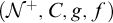

-
(1) The
$\mathcal {L}_{\mathrm {set}}$
-reduct of
$\left ( {\mathcal {N}} ^{+},C,g,f\right ) $
elementarily extends
$\mathcal {M}$
. -
(2) For each infinite s,
$\tau _{s}^{{\mathcal {N}}}$
has uncountable cofinality, is rather branchless, and
$g(s,x)$
weakly specializes
$\tau _{s}^{{\mathcal {N}}}$
. -
(3)
$\tau _{\mathrm {class}}^{{\mathcal {N}}}$
has uncountable cofinality, is rather branchless, and f weakly specializes
$\tau _{\mathrm { class}}^{{\mathcal {N}}}$
.

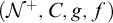


More specifically, $\psi $
is the conjunction of the following sentences:
$\psi $
is the conjunction of the following sentences:
-
•
$\psi _{1}=$
the conjunction of the countably many sentences in the elementary diagram of
$\mathcal {M}.$
-
•
$\psi _{2}=$
the sentence expressing (2) above. -
•
$\psi _{3}=$
the sentence expressing (3) above.


We elaborate on how to write $\psi _{2}$
, a similar idea is used to write
$\psi _{2}$
, a similar idea is used to write $\psi _{3}.$
The quantifier Q allows us to express that
$\psi _{3}.$
The quantifier Q allows us to express that $ \tau _{s}$
has uncountable cofinality, and the range of the specializing function
$ \tau _{s}$
has uncountable cofinality, and the range of the specializing function $g(s,x)$
is countable. To express the rather branchless feature of
$g(s,x)$
is countable. To express the rather branchless feature of $\tau _{s}$
, let
$\tau _{s}$
, let $\psi (x,y)$
be as in the proof of Lemma A.6. Note that in the notation of Lemma A.6, for any
$\psi (x,y)$
be as in the proof of Lemma A.6. Note that in the notation of Lemma A.6, for any $b\in \mathbb {T} \{x\in \mathbb {T} _{s}:\psi (x,b)\}$
is linearly ordered by
$b\in \mathbb {T} \{x\in \mathbb {T} _{s}:\psi (x,b)\}$
is linearly ordered by $\leq _{\mathbb {T}}.$
By Lemma A.6, in
$\leq _{\mathbb {T}}.$
By Lemma A.6, in $\mathrm {V}^{\mathbb {Q}},$
if s is infinite and B is a branch of
$\mathrm {V}^{\mathbb {Q}},$
if s is infinite and B is a branch of $\tau _{s}$
, then there is some
$\tau _{s}$
, then there is some $b_{0}\in B$
such that
$b_{0}\in B$
such that $\psi (x,b_{0})$
defines B. Together with the fact that
$\psi (x,b_{0})$
defines B. Together with the fact that $\tau _{s}$
is rather branchless in
$\tau _{s}$
is rather branchless in $\mathrm {V}^{\mathbb {Q}}$
(thanks to Lemma A.7) the
$\mathrm {V}^{\mathbb {Q}}$
(thanks to Lemma A.7) the $\mathcal {L}_{\mathsf { \omega }_{\mathsf {1}}\mathsf {,\omega }}$
-formula below (no need for the quantifier
$\mathcal {L}_{\mathsf { \omega }_{\mathsf {1}}\mathsf {,\omega }}$
-formula below (no need for the quantifier $\mathsf {Q}$
here) expresses the rather branchless feature of
$\mathsf {Q}$
here) expresses the rather branchless feature of $ \tau _{s}$
. In the formula below
$ \tau _{s}$
. In the formula below $\mathbb {T}_{s}$
is the set of the nodes of the ranked tree
$\mathbb {T}_{s}$
is the set of the nodes of the ranked tree $\tau _{s}$
, and “unbounded rank” is short for “unbounded
$\tau _{s}$
, and “unbounded rank” is short for “unbounded $\tau _{s}$
-rank”:
$\tau _{s}$
-rank”:
 $$ \begin{align*} \forall b\in \mathbb{T}_{s}\left[ \{x\in \mathbb{T}_{s}:\psi (x,b)\}\ \mathrm{has\ unbounded\ rank\ }\rightarrow \bigvee\limits_{\theta (x,y)\in \mathcal{L}_{\mathrm{set}}^{+}}\exists y\ \forall x\ \left( \psi (x,b)\leftrightarrow \theta (x,y)\right) \right]. \end{align*} $$
Step 3 of Stage 2. Let $\psi $
be the sentence described above. Since
$\psi $
be the sentence described above. Since $\psi $
has a model in
$\psi $
has a model in $\mathrm {V}^{\mathbb {Q}_{1}\ast \mathbb {Q }}$
, and by Keisler’s completeness theorem for
$\mathrm {V}^{\mathbb {Q}_{1}\ast \mathbb {Q }}$
, and by Keisler’s completeness theorem for $\mathcal {L} _{\omega _{1},\omega }(\mathsf {Q})$
[Reference Keisler28], the consistency of sentences in
$\mathcal {L} _{\omega _{1},\omega }(\mathsf {Q})$
[Reference Keisler28], the consistency of sentences in $\mathcal {L}_{\omega _{1},\omega }(\mathsf {Q})$
is absolute for extensions of
$\mathcal {L}_{\omega _{1},\omega }(\mathsf {Q})$
is absolute for extensions of $\mathrm {V}$
that do not collapse
$\mathrm {V}$
that do not collapse $\aleph _{1}, $
we can conclude that
$\aleph _{1}, $
we can conclude that $\psi $
has a model in
$\psi $
has a model in $\mathrm {V}$
since
$\mathrm {V}$
since $ \aleph _{1} $
is absolute between
$ \aleph _{1} $
is absolute between $\mathrm {V}$
and
$\mathrm {V}$
and $\mathrm {V}^{\mathbb {Q} _{1}\ast \mathbb {Q}}$
(recall that
$\mathrm {V}^{\mathbb {Q} _{1}\ast \mathbb {Q}}$
(recall that $\mathbb {Q}_{1}$
is
$\mathbb {Q}_{1}$
is $\omega _{1}$
-closed and
$\omega _{1}$
-closed and $\mathbb {Q}$
is c.c.c.
$\mathbb {Q}$
is c.c.c. $).$
Thanks to Lemmas A.6 and A.7, the
$).$
Thanks to Lemmas A.6 and A.7, the $\mathcal {L} _{\mathrm {set}}$
-reduct of any model of
$\mathcal {L} _{\mathrm {set}}$
-reduct of any model of $\psi $
is a weakly Rubin model that elementarily extends
$\psi $
is a weakly Rubin model that elementarily extends $\mathcal {M}$
(and the cardinality of the model can be arranged to be
$\mathcal {M}$
(and the cardinality of the model can be arranged to be $\aleph _{1}$
by a Löwenheim–Skolem argument). This concludes the proof of Theorem A.1.
$\aleph _{1}$
by a Löwenheim–Skolem argument). This concludes the proof of Theorem A.1.
Remark A.7. Schmerl [Reference Schmerl42] used a similar argument as the one used in the proof of Theorem A.1 to show that every countable model $\mathcal {M}$
of
$\mathcal {M}$
of $\mathsf {ZFC}$
has an elementary extension
$\mathsf {ZFC}$
has an elementary extension $ {\mathcal {N}}$
of cardinality
$ {\mathcal {N}}$
of cardinality $\aleph _{1}$
such that every
$\aleph _{1}$
such that every $\omega ^{\mathcal { N}}$
-complete ultrafilter over
$\omega ^{\mathcal { N}}$
-complete ultrafilter over ${\mathcal {N}}$
is
${\mathcal {N}}$
is ${\mathcal {N}}$
-definable (and thus coded in
${\mathcal {N}}$
-definable (and thus coded in ${\mathcal {N}}$
). The proof of Theorem A.1 can be dovetailed with Schmerl’s proof so as to show that every countable model
${\mathcal {N}}$
). The proof of Theorem A.1 can be dovetailed with Schmerl’s proof so as to show that every countable model $\mathcal {M}$
of
$\mathcal {M}$
of $\mathsf {ZFC}$
has an elementary extension
$\mathsf {ZFC}$
has an elementary extension ${\mathcal {N}}$
of cardinality
${\mathcal {N}}$
of cardinality $ \aleph _{1}$
that is weakly Rubin and also has the additional property that every
$ \aleph _{1}$
that is weakly Rubin and also has the additional property that every $\omega ^{{\mathcal {N}}}$
-complete ultrafilter over
$\omega ^{{\mathcal {N}}}$
-complete ultrafilter over ${\mathcal {N}}$
is
${\mathcal {N}}$
is $ {\mathcal {N}}$
-definable.
$ {\mathcal {N}}$
-definable.
Acknowledgments
The main results of the article were presented online in February 2025 at the CUNY set theory seminar. I am grateful to Vika Gitman and Gunter Fuchs and other participants of the seminar for helpful feedback. Thanks also to Corey Switzer for illuminating discussions about the forcing argument used in the proof of Theorem A.1 (in the Appendix), and to Junhong Chen for catching notational inconsistencies of a previous draft. I am especially indebted to the anonymous referee for meticulous and extensive feedback that was instrumental in shaping the article in its current form.

















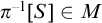






 Open access

