


What does queer mean? And how does identifying as queer affect one’s day-to-day life in the arena of materials science and engineering (MSE)? Although when I was growing up, “queer” was treated as an offensive term, queer has been adopted by a growing number of folks who do not conform to traditional societal conventions.Reference Dilley1 This encompasses lesbian, gay, bisexual and transgender, non-binary, intersex, asexual or other broadly related groups (LGBTQ+), and any similarly aligned subpopulations of humanity that can be broadly defined as gender and sexual minorities (GSM).Reference McGee and Johnson2–Reference Atherton, Barthelemy, Deconinck, Falk, Garmon, Long, Plisch, Simmons and Reeves4 Identity is an important attribute that has been tied to the effectiveness of efforts to broaden participation in scienceReference Merolla and Serpe5 and engineering.Reference Pawley and Tonso6,Reference Tonso, Johri and Olds7 Identity is important because our sense of self is derived from others, as are the social constructs that establish hierarchies on what is desirable or normal.Reference Gunckel8 If we associate success in a particular career path with a particular identity (e.g., heterosexual, cis-gender, white male), and our identity is other than that, we may carry an extra burden in achieving success in that career path.Reference Scott9 And, as we all have multiple identities (race, ethnicity, gender, religion) based upon various aspects of our backgrounds, it is evident that personal identities that coincide with the norms of a particular professional role are the easiest. The impacts of identity on self-efficacy are inherent to both imposter syndromeReference Weir10 and stereotype threat.Reference Steele11
Sexual identity is framed primarily by the hegemony of heterosexual, binary gender people who set a heteronormative context and social rules for the workplace, even absent hostility or intentional discrimination.Reference Yoder and Mattheis12 Without ill intent, the assumption often is that everyone is heterosexual. Heteronormativity, which establishes that heterosexuality is normal and privileged, and associated heterosexism can cause LGBTQ+ folks to “downplay the importance of gender and sexual orientation in their personal lives or to hide their queer identities altogether.”Reference Yoder and Mattheis12 This hiding of ourselves can include no family picture on a desk and no companion at social events connected to work. It means hiding who we are and distancing ourselves from most of our colleagues. It may also lead one’s closest colleagues and friends to be less likely to share your personal information to others out of discomfort or discomfort with possible responses. This can increase the burden on LGBTQ+ to share their personal context, particularly when confronted with questions that are commonplace if not always legal (e.g., when a gay married man is asked, “what does your wife do?” in a job interview or when a lesbian mom is presumed to not have children). Human resources (HR) personnel may question and ask you to explain your beneficiary and even challenge if s/he is a suitable recipient. Time and emotional energy are snatched away due to the most basic things.
Several years ago, my domestic partnership status was leading to a rather consistent deduction error on medical benefits for my partner. When I inquired as to why I was being asked to write checks back to the state of California to cover the error rather than someone fixing the origin of the error, an HR staff member replied, “Oh, it is not a big problem, as there are not that many of you.” I wondered just how many colleagues who were not in leadership roles had simply accepted this as the status quo. I worked diligently to get a fix in place that would at least reduce the hassle.
Recently, my partner and I were asked when applying for a joint gym membership if we could prove that we are from the same household. We had just purchased a home, so this was rather difficult due to a lack of documentation. Fortunately, they accepted the digital copy of our marriage certificate that I could send via text from my phone. Relevant or not, we wondered whether we would have had this extra hurdle if we were a straight couple, and how many straight couples could readily produce digital documentation “just in case.” With full US recognition of same-sex marriage less than three years old, we are still adapting to this reality. Within LGBTQ+ communities, gay men may have become privileged by explicit recognition of rights and a broader sharing of stories, as more of us have discussed our identities. However, struggles continue to exist. Donna Riley, head of the School of Engineering Education, Purdue University, said, “I have to be who I am, and I have to work so others can be who they are. This is risky, and it comes at a cost, but I believe the costs of being closeted are much greater, both personally and politically.”Reference Underhill13 Riley is an openly bisexual woman and a scholar on the intersection between social justice and engineering and its impact in the context of engineering education.Reference Riley, Slaton, Pawley, Johri and Olds14
The spectrum of folks who comprise the identities within LGBTQ+ in some ways redefines the concept of inclusion to be focused more on respecting and acknowledging the individual and worrying less about the percentages or fractions of people from a certain group within a population. Progress in inclusion for folks with disabilities also suffers from a history of having diversity discussions focus on the number of individuals and inadequate inclusion of their voices in policy and accommodations. Catherine Kudlick, director of San Francisco State University’s Paul K. Longmore Institute on Disability, has helped define, as well as anyone, how those seen as “others” define what it means to be mainstream and normal.Reference Kudlick15 “Once freed from prejudice and shame, they can teach the largest class of all—society—to imagine people with disabilities as innovators, problem-solvers, and true agents for change.”Reference Kudlick16 In the context of a research community, Kirkham et al. (2015)Reference Kirkham, Vines and Olivier17 outlined some issues associated with expanding beyond accessibility toward inclusion for research communities in the context of conferences and publishing.
Transgender individuals during times of transition or following transition may routinely be asked to explain discrepancies in personnel records, official identification, or prior publications. The effects of some forms of discrimination (e.g., implicit bias)Reference Greenwald, Banaji, Rudman, Farnham, Nosek and Mellott18 may only come with knowledge of someone’s LGBTQ+ status. Stereotype threats,Reference Steele11 which can be manifested as poor performance and diminished confidence about fulfilling negative performance expectations and suffering discrimination, may be exacerbated by fear of being outed about one’s LGBTQ+ status for closeted individuals. Although only the impacts of a single part of one’s identity have been discussed, the intersection, or intersectionality, between different identities (e.g., race, country of origin, sexuality, and gender) is expected to intensify impacts when more than one of the intersecting identities is also marginalized.Reference Sterzing, Gartner, Woodford and Fisher19
Materials science and engineering
Although the relatively young and interdisciplinary character of the field of MSE compared to other science, technology, engineering, and math (STEM) disciplinesReference Bowman20 may have led to somewhat greater success in gender diversity compared to the larger engineering disciplines of mechanical engineering and electrical engineering, MSE has not provided leadership to overall diversity in the context of underrepresented minorities (specifically in the United States), usually designated as African Americans, Hispanic Americans, and Native Americans.Reference Boerner21 A number of initiatives in recent years have raised awareness and led to efforts to be more successful, but the efforts are young, and written commitments from employers of all types are relatively fresh.

Recognition and acceptance of LGBT+ individuals varies considerably across communities and areas within most countries, with urban areas generally being more accepting and supportive. The International Lesbian, Gay, Bisexual, Trans and Intersex Association (ILGA) survey on attitudes toward rights and protections related to sexual orientation and gender identity shows that support for either varies by region.
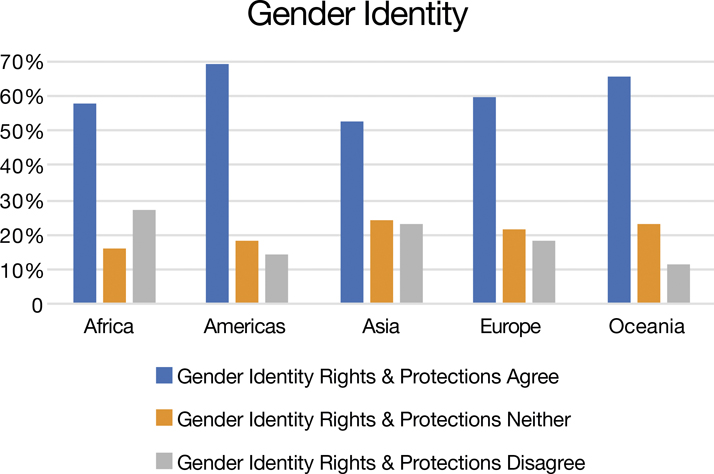
Figure 1 shows that African and Asian countries overall are less supportive of rights and protections for lesbian and gay people, with just under half of all respondents agreeing with rights and protections. Figure 2 shows that a majority of all respondents for each global region agrees with rights and protections on the basis of gender identity.
Responses to the International Lesbian, Gay, Bisexual, Trans and Intersex Association global attitudes survey by region indicating agreement, disagreement, or neither agreement or disagreement with rights and protections on the basis of sexual orientation.31

Responses to the International Lesbian, Gay, Bisexual, Trans and Intersex Association global attitudes survey by region indicating agreement, disagreement, or neither agreement or disagreement with rights and protections on the basis of gender identity.31
For additional survey information, visit http://ilga.org/ilga-riwi-global-attitudes-survey.
Recent studies provide context relevant to LGBTQ+ job roles typical to MSE disciplines. A study by Yoder and MattheisReference Yoder and Mattheis12 asked how queer-identified individuals in STEM fields experience their professional environments. They used multiple methods to establish their findings, with 1400 responses to an online survey, 150 open-response questionnaires distributed via email, and 60 one-on-one interviews. They found that graduate students, postdoctoral associates, and faculty were much more likely to describe their workplaces as welcoming and safe if they were open to colleagues about their LGBTQ+ status. Despite this fairly positive result, 38% of study participants “did not know” whether their employers provided support specific to LGBTQ+ individuals, and 27% reported “limited or no support.”
Cech and PhamReference Cech and Pham22 conducted a study of 30,000 workers in six US federal agencies, including four that commonly employ MSE disciplines (e.g., the US Department of Energy, NASA, the US Nuclear Regulatory Commission, and the National Science Foundation). More than 1000 of the survey participants identified as LGBT. Compared to their non-LGBT colleagues, LGBT employees reported systematically more negative workplace experiences. Although optimistic, LGBT employees who hold supervisory roles did not experience improved situations despite their advancement. Early career employees, who expected to have more positive experiences due to changing times, experienced only modest improvements compared to their more senior colleagues. LGBT employees reported lower satisfaction with their jobs, employee empowerment, organizational procedures, and workplace conditions than non-LGBT employees. In assessing the workplace, Cech and Pham stated, “. . . federal agencies have expansive non-discrimination policies and bureaucratized accountability structures that formally protect LGBT employees. Nevertheless, workplace inequalities for LGBT persons persist in these agencies.”23 They also suggested that because the sociopolitical ties of the particular agency appear to intersect with the experiences of LGBT employees, this may carry over to nongovernmental organizations such that, “politicization of the work of other nongovernmental STEM-related organizations (e.g., defense contractors or companies that use stem cells for biomedical research) may, by the nature of their central work tasks, attract employees that tend to be more or less supportive of LGBT equality and inclusion.”
Downey et al.Reference Downey, Werff, Thomas and Plaut24 have investigated the correlation of diversity practices with the engagement of all employees. Engagement, “a vital ingredient in overall workplace well-being,” was enhanced for all employees. Their study strongly suggests that promoting inclusion in organizations increases employee trust and engagement. At the same time, evidence shows that what applicants disclose in job applications regarding their queer identities may still compromise their likelihood of being chosen for a particular job.
Across science and engineering professional societies
Two years ago, the American Physical Society (APS) published an extensive report, LGBT Climate in Physics: Building an Inclusive Community,Reference Atherton, Barthelemy, Deconinck, Falk, Garmon, Long, Plisch, Simmons and Reeves4 from the APS Ad Hoc Committee on LGBT issues. The committee chair is Michael Falk, an MSE professor and vice dean at Johns Hopkins University. Falk is openly gay and has previously been involved in efforts to support LGBTQ+ folks.Reference Nelson25 The APS report came about following a climate survey, focus groups at APS meetings, and in-depth interviews of folks who identified as GSM. Of the estimated 1000 people anticipated to have received the survey, 324 participated, with the responses showing considerable variability by nationality, gender, and age. Nearly 15% of LGBT men, 25% of LGBT women, and 30% of gender-nonconforming individuals in this survey chose “uncomfortable” or “very uncomfortable” when asked about their comfort level in their department or division. The APS survey also tackled the topic of “outness,” or the extent to which survey participants have shared their LGBT status. Approximately 50% of respondents indicated they are out to only some, few, or none of their co-workers. The extent to which folks were out correlated strongly with their comfort level within their department or division, with more than 80% indicating they were very comfortable or comfortable. Of those indicating they were completely closeted, 64% indicated they were very uncomfortable or uncomfortable in their department or division. Falk noted that, “After participating in that study, I now feel that addressing the needs of queer women, gender non-conformers, and trans-people should be the driving issues.”
The American Chemical Society (ACS) recently completed an informal poll of its readers that was published in Chemical & Engineering News.Reference Wang26 Of the 270 respondents, 70% reported that they are open about their LGBT status at work, and 44% reported that they have experienced exclusion, intimidation, or harassment at work, with 13% reporting incidents in the past year. Transgender chemists discussed their comfort in sharing their status with colleagues and fears associated with seeking jobs using a publication record with gendered-identifying names from before their transition. The publication of the Chemical & Engineering News article led to a subsequent email comment, “ACS should not be taking sides on LGBT issues.” Freedom of speech is important, but it has landed other professional societies into unintended dramas.
In 2013, The American Society for Engineering Education (ASEE) published a similar, albeit less polite, email commentReference Ford27 in response to an article discussing LGBT engineers from years earlier.Reference Schock28 After some expressions of outrage, ASEE shared that the email comment transgressed its values regarding diversity and published a series of letters responding to the email. The outcome led ASEE to recommit to diversity and inclusion by naming 2014–2015 as a Year of Action in Diversity. ASEE’s annual meetings have become quite fascinating, with nearly end-to-end LGBTQ+ allies training taking place. ASEE meetings have continued in this vein with as many as six Safe Zone (http://thesafezoneproject.com) sessions at recent annual conferences.
Progress in affirming broad considerations of diversity can be assessed by noting the addition of diversity and inclusion statements within the written records of professional societies. One of the first places wherein broadly inclusive statements are likely to appear are in “Codes of Conduct” for professional meetings. As an example, consider the Code of Conduct for IEEE (Institute of Electrical and Electronics Engineers)29 adopted in June 2014, which states, “We will not discriminate against any person because of characteristics protected by law (e.g., age, ancestry, color, disability or handicap, national origin, race, religion, gender, sexual or affectional orientation, gender identity, gender expression, appearance, matriculation, political affiliation, marital status, veteran status).” Steadily, statements that specifically call out a long list of characteristics have been replacing more generally worded statements that enable individuals to interpret what is included. When individuals can decide what is included, that allows folks to imagine or hold fast to perspectives that deny the existence of the groups that are unmentioned. Although considerable progress has been made, Baumgart et al.Reference Baumgart, Bass and Gerber30 showed that highly ranked universities had commitments to diversity that were more broadly inclusive than those at lower-ranked institutions.
Another attribute of broad inclusion of LBTQ+ folks is to ensure that work and meeting spaces accommodate the full range of individual needs. This can be coupled with broader considerations of inclusion, as shown by services available for attendees at the 2018 American Association for the Advancement of Science annual meeting: “Restrooms are available for use by all persons, regardless of gender identity. These restrooms may also function as a family restroom or as a restroom for disabled persons traveling with a companion. A sign on the doors reading ‘Inclusive Facilities—for all to use’ will be posted. Location of inclusive facilities will be provided closer to the Annual Meeting.”
Diversity commitments and activities in MSE
In 2017, Lynnette Madsen led the creation of the Multi-Society Diversity Council with five professional societies as the founding members: The American Ceramic Society (ACerS), the Association for Iron & Steel Technology (AIST), ASM International, the American Vacuum Society (AVS), and the Materials Research Society (MRS). In 2018, The Minerals, Metals and Materials Society (TMS) joined as the sixth member. Goals for this fledgling group include approaches to foster synergy, expansion to include additional organizations, leadership, and supporting allies.
MRS has modified its statement on diversity and inclusion twice since first establishing a broadly inclusive statement in 2009 that tied innovation and excellence to diversity. The original statement was modified in 2013 to address the challenge behind achieving diversity and inclusion, and then in 2014, MRS adopted a quite direct and succinct statement that connects well with the MRS mission and values and the Code of Conduct for MRS meetings: “The Materials Research Society recognizes that diversity drives innovation, excellence, and new discoveries. We charge our membership and leadership to engage all demographic groups worldwide in advancing science and technology to improve the quality of life” (www.mrs.org/diversity-resources).
TMS has a current statement on diversity and inclusion that was adopted following development of an anti-harassment policy (Code of Conduct) in 2014 that is shared in meeting programs. That anti-harassment policy is broadly inclusive of demographic groups and has been added to meeting programs (www.tms.org/TMS2018/downloads/finalProgram/Meeting-Information_AM18FinalProgram.pdf): “TMS policy prohibits conduct that is disrespectful, unprofessional, or harassing as related to any number of factors including, but not limited to, religion, ethnicity, gender, national origin or ancestry, physical or mental disability, physical appearance, medical condition, partner status, age, sexual orientation, military and veteran status, or any other characteristic protected by relevant federal, state, or local law or ordinance or regulation . . .” A diversity statement was adopted in Summer 2016 (www.tms.org/AboutTMS). Having held two Diversity Summits in the past three years, TMS has provided leadership across all of MSE, including the development of two awards targeted toward diversity and inclusion, the Ellen Swallow Richards Diversity Award and the Frank Crossley Diversity Award, and numerous articles showcasing diverse perspectives and individuals from the MSE community. The two TMS diversity summits also had quite visible participation of individuals who identified themselves as having LGBTQ+ backgrounds.
ACerS adopted its current broadly inclusive diversity statement in 2014: “The American Ceramic Society (ACerS) values and seeks diverse and inclusive participation within the field of ceramic science and engineering. ACerS strives to promote involvement and access to leadership opportunity regardless of race, ethnicity, gender, religion, age, sexual orientation, nationality, disability, appearance, geographic location, career path or academic level.” ACerS recently established a permanent subcommittee dedicated to diversity and inclusion.
Going forward
No matter where readers of this article work in the broad, international spectrum of MSE-related careers, they work among individuals from LGBTQ+ backgrounds. The likelihood that your colleagues will or can safely share their LGBTQ+ status depends on many factors, often beyond our control.
It is important that in a context of heteronormativity, coming out is a process that never completely ends. For me, the best and most cherished response I had in sharing that I was gay to a colleague was demonstrated by Alex King, 2002 MRS President and then head of the School of Materials Engineering at Purdue University. When I shared my news with Alex, he said immediately and without a moment’s pause, “I am honored that you have shared this with me.” My hope is that as members of our MSE communities continue to share their truth, they will similarly have thoughtful colleagues who affirm and celebrate that truth.
Congratulations to Michael Falk, who has received the 2018 MRS Impact Award, “for broadened participation in STEM education in Baltimore elementary schools; for bringing attention to professional and educational climate issues faced by LGBTQ students and researchers; and for pioneered research-based methodologies for integrating computation into the Materials Science and Engineering curriculum.”
Visit www.mrs.org/mrs-impact-award for more information.
Acknowledgments
Thanks to Donna Riley, Lynnette Madsen, Michael Falk, and Alex King for comments on the manuscript and all of the LGBTQ+ folks and their allies who help keep it all moving forward.



