




Introduction
Participatory research in rural development contexts places farmers at the centre of research projects with the aim of creating an innovative collaboration process among local communities, key stakeholders and research scientists to develop and adapt technologies and innovations to local socio-environmental conditions (Barrios et al., Reference Barrios, Gemmill-Herren, Bicksler, Siliprandi, Brathwaite, Moller, Batello and Tittonell2020; Bezner Kerr et al., Reference Bezner Kerr, Kangmennaang, Dakishoni, Nyantakyi-Frimpong, Lupafya, Shumba, Msachi, Boateng, Snapp, Chitaya, Maona, Gondwe, Nkhonjera and Luginaah2019; Hauser et al., Reference Hauser, Lindtner, Prehsler and Probst2016). An important learning aspect of this process has been evaluating the utilization of these innovations and the relationship of utilization to various aspects of farmers’ livelihood capitals, inclination and experience in the collaborative research. Assessing these relationships has important implications to assess ‘what works for whom and where’ and can also reveal ways to improve information flow and access of diverse types of farming households to more efficient and productive soil management strategies.
For example, a number of studies have found that land and animal tenure as well as labour supply are important economic predictors of whether farmers experiment with and adapt practices to their own farm contexts (Adimassu et al., Reference Adimassu, Kessler and Hengsdijk2012; Chikowo et al., Reference Chikowo, Zingore, Snapp and Johnston2014). At the same time, livestock ownership may incentivize forage production and lead to greater interest in livestock-related innovations, but may discourage participation in practices that propose other uses for land or resources (e.g. crop residues for soil cover vs. forage) (Corbeels et al., Reference Corbeels, de Graaff, Ndah, Penot, Baudron, Naudin, Andrieu, Chirat, Schuler, Nyagumbo, Rusinamhodzi, Traore, Mzoba and Adolwa2014). Furthermore, land, livestock and labour can serve as proxies for overall wealth, resource endowment and social capital of a farm, which may enable greater participation in networks of farmer innovators and connections to extension and development projects that are also a key determinant of utilization of new practices (Caulfield et al., Reference Caulfield, Hammond, Fonte and van Wijk2020a; Nahayo et al., Reference Nahayo, Omondi, Zhang, Li, Pan and Joseph2017; Tenge et al., Reference Tenge, De Graaff and Hella2004).
While assets may be an important determinant for experimentation and eventual utilization of some practices, other studies have found that drivers of adaptation can be quite specific, such that there are likely key practice-user pairings, where particular strategies may appeal to different gender, age, or livelihood groups (Olarinde et al., Reference Olarinde, Binam, Fatunbi, Diagne, Adekunle and Ayanwale2017; Suvedi et al., Reference Suvedi, Ghimire and Kaplowitz2017). For example, gender is cited as a determinant of interest in new practices by many studies (de Graaff et al., Reference de Graaff, Amsalu, Bodnár, Kessler, Posthumus and Tenge2008; Nahayo et al., Reference Nahayo, Omondi, Zhang, Li, Pan and Joseph2017). Gender differentiation in utilization of practices can sometimes be traced to different roles of women and men in crop vs. livestock production or field-based practices vs. harvest, seed keeping and food storage practices (Valdivia et al., Reference Valdivia, Gilles and Turin2013). Regarding land ownership, a meta-analysis from West Africa found that while stable land tenure was important in predicting fallow and tree planting by farmers, it was much less predictive of other innovations such as manure and fertilizer application practices (Fenske, Reference Fenske2011).
The strategy of implementing innovation and dissemination of practices with farmers also can make a difference. Posthumus (Reference Posthumus2005) found that a top-down strategy of terrace construction with farmers resulted in farmers implementing terracing on degraded land where grazing occurred, while those in more participatory programmes terraced their less degraded fields to increase agricultural output there. In addition, studies such as Caulfield et al. (Reference Caulfield, Fonte, Tittonell, Vanek, Sherwood, Oyarzun, Borja, Dumble and Groot2020b); Tittonell et al. (Reference Tittonell, van Wijk, Rufino, Vrugt and Giller2007), (Reference Tittonell, Vanlauwe, Leffelaar, Rowe and Giller2005) and Vanlauwe et al. (Reference Vanlauwe, Tittonell and Mukalama2006) probed the on-farm gradients (e.g. in soil fertility) that are likely to determine where innovations are targeted within farms. There is broad agreement that understanding predictive factors of utilization could be used to foster more tailored approaches for different farmer groupings, livelihood strategies and locations within agroecosystems, as well as improved coordination with farmer information networks through which innovations flow (Nahayo et al., Reference Nahayo, Omondi, Zhang, Li, Pan and Joseph2017). Nevertheless, more attention needs to be focused on the factors influencing farmer involvement (and non-involvement) in participatory research given the critical role participants play in both adapting innovations to local needs and sharing results with the broader community (Hauser et al., Reference Hauser, Lindtner, Prehsler and Probst2016).
In view of this gap in the literature, the work described here aims to examine farmer participation and non-participation in a research project focusing on the co-development of improved forage-based fallow systems in the Peruvian Andes (Vanek et al., Reference Vanek, Meza, Ccanto, Olivera, Scurrah and Fonte2020). By better understanding the reasons for farmer research participation and non-participation in this project, we hoped to generate insights that will allow us to be more inclusive and actively engage a variety of community members moving forward as well as informing future participatory research methodologies. Specifically, we wished to understand the predictors of participation in the research trials. We hypothesized that resource endowment level influences farmers’ ability to participate and experiment with new practices. Furthermore, we sought to understand whether different stages of a household’s ‘farm life cycle’ (Barnes et al., Reference Barnes, Thomson and Ferreira2020; de Sherbinin et al., Reference de Sherbinin, VanWey, McSweeney, Aggarwal, Barbieri, Henry, Hunter, Twine and Walker2008; Perz and Walker, Reference Perz and Walker2002; Walker et al., Reference Walker, Perz, Caldas and Silva2002) could explain differences in participation. The concept of a ‘farm life cycle’ argues that over time, as members of a farming households age, farming strategies change, adapting to the new realities of the households changing access to different resources (human, financial and social) (Caulfield et al., Reference Caulfield, Bouniol, Fonte and Kessler2019). It was expected that households in an intermediate position (midway through the household’s life cycle) would be best positioned to participate in the research, that is neither the youngest farmers (with young children and unconsolidated farm enterprises) nor the oldest farmers (with few children to assist in labour and fewer animals to incentivize forage production).
Materials and methods
Study area
This research took place within the context of a broader investigation regarding improved forage and fallow options across environmental gradients in the Central Peruvian Andes. Specifically, the research aimed to assess the potential biomass production of forage-based fallows using grass-legume mixtures with different combinations of annual and perennial grasses and legumes (e.g. Vicia Sativa (vetch), Avena sativa (oats), Lupinus mutabilis (Andean lupine), Trifolium pratense (red clover), Medicago sativa (alfalfa), Lolium multiflorum (ryegrass)) and their effect on soil fertility and subsequent potato yields (Meza et al., Reference Meza, Vanek, Sueldo, Olivera, Ccanto, Scurrah and Fonte2022; Vanek et al., Reference Vanek, Meza, Ccanto, Olivera, Scurrah and Fonte2020). In each community, a meeting was first held in September of 2017 to introduce the aims and objectives of the research and to solicit interest from community members. Further meetings then took place to design the different improved fallow treatments to test in each community and discuss the experimental procedures and logistics to be implemented. Participating farmers agreed to plant between six and eight treatment plots (5 x 5 m each) in one of their fields with seed provided by the local non-governmental organization (NGO) and to work with local technicians in maintaining the plots and evaluating treatment performance over a 3–4 year period. In total, more than 100 trials were installed in farmers’ fields in October and November of 2017.
The study sites were eight rural Andean communities located in the provinces of Huamanga (Ayacucho region), Acobamba (Huancavelica region) and Huancayo (Junín region). These communities ranged in elevation from 2700 to 4500 masl and have different agroclimatic zones that are referred to locally as the ‘low’ (below 3100 masl), ‘middle’ (3100–3700 masl) and ‘high’ (above 3700 masl) zones, with distinct crops and fallow management for each. The climate in this region has cool average annual temperatures between 9–15°C and annual average precipitation between 700–1200 mm year-1. There is a dry period between May and September and a wet period (typical growing season), between October and April. Temperatures regularly fall below freezing at higher elevations. Farming is predominantly small-scale, characterized by mixed livestock-cropping systems, although a variety of livelihood strategies exist among farming households (Caulfield et al., Reference Caulfield, Hammond, Fonte, Florido, Fuentes, Meza, Navarette, Vanek and van Wijk2021). Potato (Solanum tuberosum), corn (Zea mays) barley (Hordeum vulgare), oats (Avena sativa), faba beans (Vicia faba), quinoa (Chenopodium quinoa) and a variety of Andean tubers (Oca (Oxalis tuberosa), Olluco (Ullucus tuberosus) and Mashua (Tropaeolum tuberosum)) are the dominant crops, which are rotated annually or biannually. Agricultural inputs are usually concentrated in the potato phase of the rotation. Traditional fallow practices are still employed by many farming households in the region and are especially prominent at higher elevations. Fallow periods to renew soils between cropping cycles tend to last around 2–3 years but can last for up to 10 years at higher elevations. Most households own at least some large livestock such as cattle, sheep, pigs and llamas. Chickens and, increasingly, guinea pigs are also raised by many households. Meat and wool production are either consumed by the households or sold to local traders or at local farmer markets. Cattle are also used for draught power in some households, though mechanical tillage is becoming increasingly common in some areas. Significant areas of the high zone are managed communally both for crop production and for grazing. Access to irrigation is limited to around 30% of rural households according to the survey data. Access to markets is complicated by poor road infrastructure and irregular transport services, as regional agricultural markets are located up to 125 km from some of the communities.
Rural household survey
The Rural Household Multi-Indicator Survey (RHoMIS), a standardized farm household survey used in rural development contexts, was administered in the study sites between February and March 2018. Consent for participation in the survey and use of data was requested prior to administering each survey. The surveys addressed topics such as household characteristics, farm management and production, livelihoods, food security and decision making (Tavenner et al., Reference Tavenner, van Wijk, Fraval, Hammond, Baltenweck, Teufel, Kihoro, de Haan, van Etten, Steinke, Baines, Carpena, Skirrow, Rosenstock, Lamanna, Ng’endo, Chesterman, Namoi and Manda2019; van Wijk et al., Reference van Wijk, Hammond, Gorman, Adams, Ayantunde, Baines, Bolliger, Bosire, Carpena, Chesterman, Chinyophiro, Daudi, Dontsop, Douxchamps, Emera, Fraval, Fonte, Hok, Kiara, Kihoro, Korir, Lamanna, Long, Manyawu, Mehrabi, Mengistu, Mercado, Meza, Mora, Mutemi, Ng’endo, Njingulula, Okafor, Pagella, Phengsavanh, Rao, Ritzema, Rosenstock, Skirrow, Steinke, Stirling, Gabriel Suchini, Teufel, Thorne, Vanek, van Etten, Vanlauwe, Wichern and Yameogo2020). The survey was adapted to the local context and additional details were included to evaluate aspects of forage and fallow management. In total, 171 household surveys were collected from the eight communities where the forage-based fallows research was taking place. Households surveyed were randomly selected from each of the communities and then later categorized into four groups: 1) Full Participants (P) – those that participated in the research through the establishment of experimental plots in at least one of their fields; 2) Dropped Out (D) – farming households that had initially planted the set of experimental plots in one of their fields, but later dropped out of the study; 3) Only Meetings (A) – farming households that regularly attended community meetings about the research, but never established the experimental plots; and 4) Non-Participants (N) – households that had neither established the experimental plots nor attended meetings about the experimental research (Table 1).
Absolute number and proportion (in parenthesis) of rural households (HHs) surveyed by community and participation group. Participation groups included four groups: 1) Full Participants (P) – those that participated in the research through the establishment of experimental plots in at least one of their fields; 2) Dropped Out (D) – farming households that had initially planted the set of experimental plots in one of their fields, but later dropped out of the study; 3) Only Meetings (O) – farming households that regularly attended community meetings about the research, but never established the experimental plots; and 4) Non-Participant (N) – households that had neither established the experimental plots nor attended meetings about the experimental research

Statistical analysis of survey data
Individual mixed error component models including nested random effects for ‘province’ and ‘community’ were used to evaluate the relationship between belonging to a particular participation group and different variables assessed in the rural household surveys (including human, social, financial and farm capital, farm economics and farm management variables). Fisher’s least significant difference tests (p < 0.05) were then applied to those variables that displayed an overall significant difference among participation groups at the 10% level of probability. To further characterize the participation groups, a between-class principal component analysis (PCA) was applied to a subset of the survey variables including age of household heads, household size, education level, aid received, food security, dietary diversity, total income, farm income, value farm produce, livestock holdings and land cultivated. A Monte Carlo between-class PCA test was used to test for multivariate differences among participation groups. Assumptions of homoscedasticity and normality were tested for all continuous variables and data transformed as needed for the mixed error component models and PCA using the log function. Estimated marginal means and standard errors presented were calculated using untransformed data. All analyses were carried out within the RStudio environment version 1.2.1335 for R (version 3.6.1) using the ade4, agricolae, lmerTest and emmeans packages.
Household participation interviews
In order to confirm our interpretations of the survey data of the survey data and to generate a more nuanced understanding of the differences among participation groups, a short qualitative interview was developed. The interview addressed four main topics of discussion: 1) household stages in the farm ‘life cycle’ and their influence on research participation, 2) reasons for project engagement (or not), 3) livestock and forage management, and 4) land and fertility management. While the first two topics were designed to help interpret differences observed among groups and strategies of engagement with external research actors, the latter two topics were designed to help understand the relevance of the farming techniques being tested in the participatory research to a household’s existing farming practices. Interviews were conducted in Quechua or Spanish with two households in each participation group from each community – one male and one female, to account for gender-based perspectives on the interview topics. In the community of Tizo, only participants in the research group were interviewed, as the community was very small and nearly all inhabitants were participating in the experimental trials. In total, 46 interviews were conducted, either at the rural households or by cell phone. Interviews were recorded and later transcribed electronically. Interviews were transcribed into Spanish and were analysed using a grounded theory approach (Tie et al., Reference Tie, Birks and Francis2019) with the quantitative data analysis from the RHoMIS surveys providing the basis for exploration of relationships between rural households and their participation in the improved fallows participatory research. To achieve this, the interviews were first coded and annotated by the lead author. The annotated interviews were then further reviewed, and common key concepts, which were raised frequently by interviewees, were identified in discussion with the full research team including those who conducted the interviews. These commonly identified patterns and generalizations were used to provide context and more nuanced interpretation of the survey data results. The summarized findings were then tabulated.
Results
Rural household surveys
When comparing across the different participation groups, Full Participants in the experimental trials tended to be larger and younger on average than households in the Non-Participant group. It is noteworthy, however, that the proportion of younger household heads (25–35 years), and the proportion of older household heads (65–75 years) was higher in the Non-Participant group, while the proportion of middle-aged household heads (45–55 years) was higher for the Full Participants group (Figure 1). While not significantly different at the 10% level of probability, there was also a notable difference among participation groups in education attainment with Full Participants tending to be better educated than households from the Non-Participant group (Table 2). No significant differences were observed for household head composition (single vs. couple) or gender control. Non-Participant households reported that they received less aid (from non-family organizations such as NGOs) and had a less diverse diet during good seasons (parts of the year with plentiful production) compared to Full Participants’ households. However, it is notable that Non-Participant households experienced the fewest months of food insecurity (Table 2).
Age profile of Top) Full Participants and Bottom) Non-Participants.

Estimated marginal means of parameters assessing household characteristics for four participation groups in farmer-oriented research trials on improved forage-based fallows in eight communities in the central Peruvian Andes. P-values of the mixed-effect models are presented with province and community included as nested random effects. Standard errors are presented to the right of each mean in parentheses by participation groups. In the case that p-values indicate differences at the 10% level of probability, Fisher’s least significant difference test was applied with different letters to the right of the standard errors denoting differences at the 5% level of significance

Full Participant households owned on average nearly five tropical livestock units (4.8 TLUs), more than half a TLU greater than Non-Participant households (4.2 TLUs). Full Participants consistently owned more livestock of each livestock species than Non-Participant households with the exception of llamas. No significant differences were observed for the amount of land cultivated or access to irrigation (Table 3).
Estimated marginal means of parameters assessing land & livestock assets, farm value production, and outcome variables for four participation groups in the forage and fallow trials in eight communities of the central Peruvian Andes. P-values of the mixed-effect models are presented with province and community included as nested random effects. Standard errors are presented to the right of each mean in parentheses by participation groups. In the case that p-values indicate differences at the 10% level of probability, Fisher’s least significant difference test was applied with different letters to the right of the standard errors denoting differences at the 5% level of significance

*Means calculated excluding households without land in these zones. **Mean calculated excluding households reporting no income
Non-Participant households generated around 30–35% less farm income, value of farm produce and total income, compared to Full Participants’ households (Table 3). Off-farm income accounted for around 25% of total income in the two groups. While not significantly different, Non-Participant households also tended to exhibit among the lowest levels of livestock production value, crop production value, livestock product sales, crop market orientation and crop production sales compared to Full Participant and Dropped Out groups. However, in spite of these lower overall value and earnings measurements for Non-Participant households it is worth noting that no significant differences were observed among groups for scores on the household progress out of poverty index (Table 3).
When looking at differences in management practices between groups, no significant differences were observed for agroecological farming techniques, although it was notable that the majority of farming households used these techniques (Table 4). Although not significant at the 10% level of probability, households that dropped out of the experimental trials reported greater crop diversity than Non-Participant households. A smaller proportion of Non-Participant households used chemical fertilizers (51%) compared to Full Participant households (83%) and those from the Only Meetings group (80%; Table 4). Use of pesticides and mechanized tillage displayed significant amounts of variability, but their use did not differ significantly among participation groups.
Estimated marginal means of parameters describing farm management techniques for four participation groups in the forage and fallow trials in eight communities of the central Peruvian Andes. P-values of the mixed-effect models are presented with province and community included as nested random effects. Standard errors are presented to the right of each mean in parentheses by participation groups. In the case that p-values indicate differences at the 10% level of probability, Fisher’s least significant difference test was applied with different letters to the right of the standard errors denoting differences at the 5% level of significance

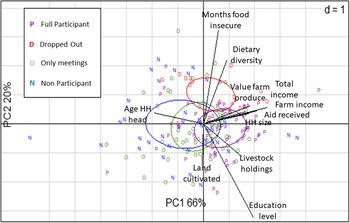
Exploring the ordination and associations among variables describing farm household types, the between-class PCA indicated significant differences among participation groups (Monte Carlo test based on 999 replicates, p = 0.002). Principal component 1 (PC1) accounted for 66% of variance and was associated with variables describing the farm value of production, while principal component 2 (PC2) accounted for 20% of variance and was associated with food security, dietary diversity and education level (Figure 2). Full Participant households and Dropped Out households appeared to diverge in the PCA from Non-Participant households along PC1. Farm value production variables (value farm produce and farm income), total income, aid received and household size were positively associated with Full Participants and Dropped Out households. Age of household head pulled in the opposite direction along PC1, confirming that age was positively associated with Non-Participants and negatively associated with Full Participant and Dropped Out households (Figure 2).
Between-class principal component analysis assessing associations among human, social, farm and financial capital, farm economics, for forage and fallow trial participation groups. Monte Carlo simulated p-value = 0.002, based on 999 replicates for overall difference among groups (at least one group different from the others) (HH = household).

Full Participants and Dropped Out households diverged along PC2. In particular, Dropped Out households appeared to be associated with lower levels of food insecurity and higher levels of dietary diversity in the good season. Full Participants, on the other hand, were associated with a greater number of livestock holdings, higher education levels and more cultivated land. Meetings Only households did not differ greatly from Non-Participant households with the majority of the Only Meetings ellipse on the PCA biplot falling within the Non-Participant ellipse (Figure 2).
Qualitative interviews
An important theme emerging from the qualitative interviews was the way that participation in the research project was related to differences in household and livelihood characteristics (supplemental material Table S1). Those interviewed often identified household size (an indicator of household labour access), as a significant factor associated with a household’s ability to participate in the research. Informants also often noted that younger households with significant off-farm livelihood activities and young children were less likely to become involved in participatory research. Similarly, older households, whose children had often migrated to urban centres, were perceived to be less likely to participate in the trials because of a lack of access to labour and generally less energy and strength to participate in the field activities. Households with lower resource endowment or that were generally more ‘vulnerable’ were also seen as less likely to participate in the experimental trials.
Individual personal characteristics were another theme that was raised as an important influence on household participation in the research. General interest or disinterest in exploring new farming techniques or knowledge was nearly always raised by interviewees as reasons for households’ participating (or not) in the experimental fallow trials. This openness for learning and experimenting with new farming techniques, or a more closed attitude focusing on what already works well, was not perceived as being a specific attitude towards just the current experimental trial, but rather as a personality trait that differed among heads of households. It was also noted by interviewees that certain households might not participate in experimental trials unless they receive material ‘gifts’ or similar incentives. Many interviewees were critical that some households would only participate in research projects where the work was done for them or where they were paid. There seemed to be a sense of concern among many interviewees regarding paternalism by past intervention projects that may have generated a sense of entitlement to donations.
Many interviewees reported that access to resources influenced a household’s ability to participate in the research. Land (access and area owned) was often raised as an important factor influencing participation, with those households owning less land being less able to participate. Access to irrigation water was also mentioned as influencing participation. Counter-intuitively, interviewees explained that access to irrigation water decreased a household’s likelihood for participation. It was explained that irrigation water tended to drive increased cropping frequency and intensity, crowding out the opportunities for fallow management, and therefore decreased the household’s interest in improved fallow techniques. However, other interviewees contradicted this notion by suggesting that access to irrigation would be necessary to increase improved fallow biomass production and make it worthwhile.
The relative importance of cropping versus livestock livelihood strategies was raised by many interviewees. Specifically, it was often noted that households with integrated crop-livestock production systems were more likely to participate in the research project, while households with a greater focus on cropping systems were less likely to participate, as they had a smaller need for forage production. At the same time, some households with a greater focus on (grazing) livestock production already had access to, and relied heavily on, permanent pastures to meet their forage requirements and therefore saw less of a need for forage produced through improved fallow techniques. Therefore, many interviewees noted that those with a medium level of livestock-oriented livelihoods and mixed systems might be most interested in forage-based fallows. At base, a household’s ability to overcome the challenge of producing sufficient quantities of forage material throughout the year was seen as a determining factor for household participation. In a number of cases, households that were able to purchase forage material off-farm or were already producing forage using dedicated (and typically irrigated) forage plots explained that they were less engaged in the research as their forage needs were already met.
Furthermore, interviewees showed a substantial awareness of agroecological practices as distinct from more industrial or chemical-intensive methods, and the way that this might influence participation in the trials. Households already practising agroecological methods were perceived to be more likely to engage in the research project due to their affinity to more sustainable agroecological practices. With regard to more industrialized farming methods such as the use of chemical fertilizers, pesticides and mechanized tillage, their opinion was split as to how this would influence participation. Some farmers argued that the use of such techniques could lead to a greater participation in research due to the soil degradation that is often associated with these practices and therefore a greater perceived need to address soil fertility concerns. On the other hand, other interviewees argued that households using these more industrialized inputs were potentially less interested in exploring agroecological techniques. Elevation zones were also noted to play an important role. The low and the middle zones were noted to be used more intensively, have easier access, receive greater inputs and thus employed much shorter fallow periods (if at all), while the high zone fields were seen as more difficult to access, received fewer inputs and employed relatively long fallow periods. Differences in the proportion of land ownership/access in the different management zones for each household were therefore mentioned as influencing a household’s likelihood of participation. The more land a household had in the high zone (and middle zone to an extent), for example, the more likely the household would be to participate in the research project.
Several other factors that influence farmer participation also came up during farmer interviews. For example, it was suggested that households already employing traditional fallow techniques were more likely to participate in the research project. Also, households with greater numbers of livestock were seen as more likely to participate due to their increased forage needs. Keeping guinea pigs is an increasingly popular means of on-farm livelihood diversification, and it was often noted in interviews that the improved fallows tested in the trials would be quite suitable in producing the nutrient-dense cut forage that is especially important for guinea pig production.
Finally, three other main issues were raised by interviewees. Several farmers articulated that some households may be adopting a ‘wait-and-see’ strategy, such that households would only start trialling the new techniques on their own fields once they observed successful implementation of this technique elsewhere in the community. Another two issues that were suggested to influence a household’s continued engagement in the project were unexpected household shocks of circumstance and experimental trial performance. For example, an unexpected household event during the experimental trials such as a household member falling ill might make it impossible to continue the trials. In addition, a poor performance of the trial during the first year (for a variety of reasons) might translate to a household dropping out if they did not see much production in the trial plot.
Discussion
Resource endowment determines participation in research
One of the most striking findings emerging from the analysis of the rural household survey data was that household characteristics closely related to human capital (household size, age of household heads and education level of household heads) were strongly associated with household participation in the improved fallows research (Table 2 and Figure 2). Overall, the households that participated were larger, younger and better educated that the households that did not participate. Full Participants were also more likely to have ‘received aid’ in the past, a variable that may indicate social capital, based on the assumption that those households that have the greatest social networks and are able to engage more easily with rural development agencies are most likely to benefit from the projects in their communities. Moreover, Full Participants owned the most livestock and generated greater value of farm produce, farm income and total income annually than Non-Participant households (Table 3 and Figure 2). The qualitative interviews with farmers from each of the study sites echoed these findings that better resource-endowed households were more likely to participate in the participatory research than less resource-endowed households. Many interviewees asserted that older and smaller households with fewer resources were less likely to participate in the research due to lack of time, access to land and fewer livestock (supplementary material Appendix 1). Indeed, as one participating farmer explained, ‘in the case [where the household is comprised] of an old couple, and that don’t have any children in the community, participation is more difficult’.
These influences on involvement in participatory research are reflected in other studies in the literature (Hauser et al., Reference Hauser, Lindtner, Prehsler and Probst2016; Olarinde et al., Reference Olarinde, Binam, Fatunbi, Diagne, Adekunle and Ayanwale2017). For example, in a recent study in the Northwestern uplands of Cambodia, the capacity of households to trial new techniques and innovate was strongly linked with their approach to risks and their capacity to manage them, which was determined by overall resource endowment (Kong and Castella, Reference Kong and Castella2021). In another study from China, land capital was positively correlated and age of households negatively correlated with farming households’ participation in a FAO-led project aimed at encouraging more sustainable natural resource management, strengthening resilience and improving food and nutrition security (Moucheng et al., Reference Moucheng, Lun, Yanying and Qingwen2018).
On the face of it, these findings are somewhat concerning. If it is the case that households with greater resources benefit by participating in research projects such as the current one, a virtuous cycle of increased resource generation may occur only for these better-endowed households. By contrast, more vulnerable households may face the opposite prospect so that their lack of participation reinforces existing disparities in resource levels. However, our findings regarding farming household resource endowment and involvement in participatory research may reveal a more complex reality. While participation may be undertaken by better resource-endowed households, this might not mean that less resource-endowed households are not engaged with the project. Instead, these less resource-endowed households may be opting for a ‘wait-and-see’ strategy, whereby they let the higher resource-endowed household trial the proposed innovations before deciding whether to employ the practice themselves. Indeed, this possibility was alluded to a number of times in the qualitative interviews (Appendix 1). For example, one farmer explained that while her less resource-endowed neighbours ‘were not participating in the research, they were closely following the progress of the [experimental] plots’. Another claimed that while he did not have enough time to participate directly in the research, he was ‘waiting with interest to understand the results of the project and the final evaluations… I want to see the productivity of these [improved] fallows’.
Underpinning these patterns of association between household resource endowment and participation in the research may be the phenomenon of rural household life cycles, where farming practices change along the course of a household life cycle due to the changing needs, motivations and resources of the rural household (de Sherbinin et al., Reference de Sherbinin, VanWey, McSweeney, Aggarwal, Barbieri, Henry, Hunter, Twine and Walker2008; Perz and Walker, Reference Perz and Walker2002). While it is true that on average the household heads of the non-participation group were significantly older than the participating group (Table 2), the age profile of the household heads of these groups was also different (Figure 1). For the Full Participants group, the households head age profile peaked at between 45 and 55 years, while the age profile of the household heads for the Non-Participants was relatively flat, with therefore proportionally more households with older household heads (65–75 years) and also proportionally slightly more younger household heads (25–35 years). The qualitative interviews provided further evidence for this interpretation based on a household’s life cycle. As one interviewee explained ‘The fact of having small children at home requires more work… however, children over 10 years old are more independent which allows not only the husband to attend community meetings [about the participatory research], but the wife too. For households [comprised of] an older couple, active participation in the project and communal activities becomes difficult’.
These findings support our hypothesis that participation in participatory research is not simply a binary decision influenced by variables associated with resource endowment but reflects more a strategic decision for these households about how best to engage with the project given the current household needs and constraints. In this respect, Kong and Castella (Reference Kong and Castella2021) suggest that the stage at which a rural household finds itself within the overall rural household life cycle strongly influences the judgement whether to participate actively or to opt for a more risk-averse strategy allowing better-placed neighbours to engage more actively and ‘waiting to see’ the results before deciding to make any change to their farming systems.
From a practical perspective, these results are important as they indicate that non-participation is necessarily not due to lack of interest. Instead, the lack of participation may be a result of the current circumstances in which the household finds itself, but which prevent them for participating due to lack of resources. This has two important implications for participatory research. First, it suggests that it is imperative to find methods of engagement that will enable Non-Participants, to input and even help shape research design providing greater insight into the opportunities and limitations of the least resource-endowed households in a community. Moreover, it will be particularly important to recognize that the group of Non-Participants will probably represent an even greater diversity of households than the participating group given that they will often be comprised of proportionally both the younger and older households of the community. A failure to recognize this heterogeneity of Non-Participants may mean that research design continues to be skewed toward exploring solutions for the more resource-endowed and possibly more homogenous group of households of a community. Secondly, special attention must be paid to continual engagement with Non-Participants throughout the research as well as ex-post dissemination of research results with the broader community, or even neighbouring communities, and not just with participating households as argued by Hauser et al. (Reference Hauser, Lindtner, Prehsler and Probst2016). Without such engagement and dissemination strategies, households with greater resources will continue to benefit disproportionately, leaving lower resource-endowed households in the role of ‘outsiders looking in’ without the ability to influence or benefit fully from the development of participatory research.
Suitability of improved fallow techniques and rural household heterogeneity
Clearly, the decision to participate in the research is not solely driven by resource endowment and the stage at which a rural household finds itself in its household life cycle. Suitability of the farming technique for the farming households will also play an important role in whether a household decides to allocate precious resources into participating in the research. This understanding can also provide deeper insight into how improved fallow techniques, in this case, may or may not fit into the current farming systems in the research sites or other similar contexts. A striking common theme arising in the qualitative interviews was that access to irrigation water was negatively associated with participation in the research project (Appendix 1). As one farmer explained ‘many families that have fields with access to irrigation nearly fully dedicate themselves to agricultural production in these spaces, and [as a result] rarely use fallowing techniques [such as those trialled in the project] in their fields’. Another echoed this reasoning ‘having access to irrigation water [means that farmers] produce more and therefore don’t use fallows’. This reflects previous studies in the area that have found a close relationship between access to irrigation and agricultural management (Bentley et al., Reference Bentley, Velasco, Rodríguez, Oros, Botello, Webb, Devaux and Thiele2007; de Valença et al., Reference de Valença, Vanek, Meza, Ccanto, Olivera, Scurrah, Lantinga and Fonte2017). However, it is important to note that these differences were not observed in the household survey data where no significant differences were observed in access to irrigation between Full Participants and Non-Participants (Table 2). Part of the reason why we may see this dichotomy in the results is that while farmers that have access to irrigation tend to increase land-use intensity and therefore have fewer options for fallow; on the other hand, many farmers also believed that in order to cultivate forage crops under improved fallows there was an increased need for irrigation. As an interviewee explained ‘in order to rear cattle, you need fields with access to irrigation [to cultivate perennial forages]’.
In addition to access to irrigation water and land-use intensity, the issue of accessibility to fields was also raised in the qualitative interviews as an important determinant of participation in the improved fallows research project (Appendix 1). With many homesteads located in the middle zone of the communities and walking times to fields in the upper zone being sometimes more than an hour, it is understandable that farmers may not be as motivated to begin an experimental trial that they must visit regularly in locations farm from their homes. This corroborates the findings of Olarinde et al. (Reference Olarinde, Binam, Fatunbi, Diagne, Adekunle and Ayanwale2017), who also found that shorter distances to the experimental plots increased participation in their participatory research project.
The important role of access to irrigation, land-use intensity and overall accessibility demonstrates the importance of management by context, whereby farmers manage their fields which are spread out across a particular landscape depending on the location of the fields. As shown in a number of studies now, both biophysical landscape patterns such as variations in soil fertility and human factors such as distance from homestead drive important differences in agricultural management (Caulfield et al., Reference Caulfield, Fonte, Groot, Vanek, Sherwood, Oyarzun, Borja, Dumble and Tittonell2020c; Caulfield et al., Reference Caulfield, Groot, Fonte, Sherwood, Oyarzun, Borja, Dumble and Tittonell2020d; Van Apeldoorn et al., Reference Van Apeldoorn, Kempen, Sonneveld and Kok2013). Coupled with a number of socio-ecological trends in the Andes such as enhanced transport infrastructure, migration, land-use change and climate change among others (Curatola Fernández et al., Reference Curatola Fernández, Obermeier, Gerique, López Sandoval, Lehnert, Thies and Bendix2015; de Valença et al., Reference de Valença, Vanek, Meza, Ccanto, Olivera, Scurrah, Lantinga and Fonte2017; Fonte et al., Reference Fonte, Vanek, Oyarzun, Parsa, Quintero, Rao and Lavelle2012), this raises a number of important questions regarding the potential role of these improved fallow techniques in the rural Andes in the future. From one perspective, their role in highland systems, where land at higher elevations is becoming increasingly more accessible due to improved transport infrastructure, and potentially more productive due to rising temperatures (though with greater exposure to climate risk in future climate scenarios for high elevations) (Urrutia and Vuille, Reference Urrutia and Vuille2009), techniques such as improved fallows could become ever more important. On the other hand, improved access to irrigation in the future may also bring about greater land-use intensity and therefore a decrease in the use of fallow techniques as described in the qualitative interviews. However, it is also important to acknowledge that interviewees also noted the importance of irrigation for the cultivation of perennial forages and managed fallow strategies. Further research to explore the potential evolving role of improved fallows in the future considering these factors could therefore prove particularly useful as a complement to this broader research project
Another revealing finding from the qualitative interviews was that households employing integrated crop-livestock systems were more likely to participate in the improved fallow trials than those households focusing either on livestock or crop production (Appendix 1). This provides a more nuanced insight to the potentially simplistic assumption that farmers with more animals will always be more interested in the forage provided by a forage-based fallow. This observation is also consistent with the association between managed fallows and guinea pig rearing in both the RHoMIS and qualitative interviews (Tables 2 and Appendix 1), suggesting it may be an important strategy for livelihood diversification that pays agroecological dividends for soils in the rural households in the Peruvian Andes. These findings reinforce the socio-ecological niche concept that argues that the agroecological, socio-cultural, economic and institutional context across multiple levels of granularity must be considered when assessing the suitability of a farming technique innovation. This approach of ‘options by context’ may help to reduce risk and increase chances of successful participatory research (Coe et al., Reference Coe, Njoloma and Sinclair2019; Descheemaeker et al., Reference Descheemaeker, Ronner, Ollenburger, Franke, Klapwijk, Falconnier, Wichern and Giller2016; Ojiem et al., Reference Ojiem, de Ridder, Vanlauwe and Giller2006). These findings, the influence of resource endowment and socio-ecological context, may also help explain why participation in some communities was greater than in others (Table 1). While we were unable to explore this question in detail in this paper, we recommend that further research be conducted in this regard.
Conclusion
The insights provided by linking the rural household survey dataset with focused qualitative interviews enabled us to develop a deeper understanding of the motivations and underlying factors that influenced a households’ decision to participate in a research project assessing the potential benefits of improved fallow techniques. Overall, the better resource-endowed households (in terms of human and social capital, more livestock, higher levels of farm value production and income, and farm inputs) tended to be more likely to participate compared to households with lower levels of these variables. This pattern appeared to have important links to a households’ life cycle, where a household’s access to resources changes over time as the household demography changes. Nevertheless, this might not mean that less resource-endowed households are not engaged with the research project. On the contrary, we found evidence to suggest that non-participating households may be opting for a ‘wait-and-see’ strategy, whereby they let the higher resource-endowed households trial the proposed innovations before deciding whether to employ the practice themselves. We also found evidence to suggest that a number of different contextual factors will influence the suitability of improved fallows for a particular household or agricultural field and therefore a household’s willingness to participate in the research project, such as access to irrigation, location of fields, livestock ownership and farming system approach. These findings underlined some critical learnings. Fundamentally, participatory research should not aim to ensure that as many potential ‘Non-Participants’ participate, as formal ‘enrolment’ in participatory trials may not be the most appropriate use of their resources. Instead, more should be done to consider these ‘Non-Participants’ via indirect means, including lower-investment knowledge-sharing activities and through existing informal information networks within communities. More should also be done to ensure that their specific set of opportunities and challenges are also reflected in the experimental design and that they have a strong voice in the iterative development of the project itself. Moreover, greater consideration should be placed on understanding management by context issues in order to better target potential improved farming techniques such as improved fallows, at multiple levels, from the field to the household and to the community and beyond. The co-development of this enhanced understanding of management by context in partnership with the farming households will increase the likelihood of more successful participatory research projects.
Supplementary material
For supplementary material for this article, please visit https://doi.org/10.1017/S0014479722000357
Acknowledgements
We greatly appreciate the time and participation of the farmers and all community members that contributed their time and energy to this research. We would also like to thank Alejandra Arce for her insightful analytical work at the beginning of the data exploration phase of this study. Funding was provided by the McKnight Foundation Collaborative Crop Research Program (grant 16-095).
Conflict of interests
The authors declare none.




 Open access

