

Where diplomats have failed, where the spirit of Christianity itself failed … these games have wrought a most happy and auspicious accomplishment.Footnote 1
The people of the Far East will be bound together not by diplomatic ties and international treaties but by the cord of mutual understanding which, if you please, I shall call it the placenta of sportsmanship.Footnote 2
Introduction
A few days before the start of the Fifth Far Eastern Championship Games on May 30, 1921, Filipino athletes found themselves stranded midstream in the always-crowded Huangpu River, which dissects the metropolis of Shanghai. Not literally stranded, mind you, as people could technically disembark from the chartered coast guard vessel that would serve as their home for the next several weeks, the Bustamante. However, it would still be two days before officials in Shanghai cleared space for them at the China Merchant’s Lower Wharf and contracted trucks to transport athletes to and from the practice facilities.Footnote 3 Some on board the vessel might have interpreted this delay as an ominous portent of things to come, but then again, not all athletes are so superstitious. In Shanghai, after finally docking, these Filipino athletes and coaches, along with the many delegates, spectators, and sportswriters who make a memorable Olympics possible, prepared to join their peers from Japan and China in what would prove to be a key moment of coalescence.
Historian Paul A. Cohen describes how the “coalescence” of individual lives combine into the collective actions that we refer to as “events.”Footnote 4 The Far Eastern Championship Games, a monumental event that brought people together and dominated the news cycle for two weeks over the summer of 1921, reveals the depth and durability of Sino–Philippine interactions that we have slowly documented over the course of this book. Sports arenas, lecture halls, and business boardrooms blended together as athletes acted as cultural ambassadors, educators served as politicians, businesspeople became lobbyists, and pundits turned into soothsayers. Sport transformed into a nexus for nationalism and a conduit for transnationalism, connecting people and their divergent social and political agendas.
However, whereas the 1921 Games acted as a moment of coalescence, the 1934 Games encapsulated an era of disintegration. In 1934, the intense conversations in the boardrooms in Manila that would eventually lead to the dissolution of the Far Eastern Athletic Association and the end to the Games sidelined the action on the courts. But it did not have to end this way. The years in between the Fifth and Tenth Far Eastern Championship Games represented a period of possibilities when physical education specialists from China, the Philippines, and Japan, many of whom were veterans of the Games, journeyed to Springfield College to study sports and health in the United States before returning to Asia to carry the baton of sports leadership. This period of overlapping trajectories and missions no doubt brought these Asian students together, but any good will they might have built during this time came to naught as war approached, the Games unraveled, and destinies diverged in 1934.
The chapters that follow complete our tour of the Sino–Philippine link by journeying through the arenas, classrooms, boardrooms, and stadiums that brought everyone together and eventually tore everyone apart. They argue that, while contact between China and the Philippines remained robust, bilateral, and multifaceted throughout the early twentieth century, 1921 marked a highpoint of cooperation and possibilities, and 1934 marked a turn toward disillusionment and disengagement.
Sports, Events, and Area Studies
Famous sports historian J. A. Mangan once described how Victorians viewed sports as the “imperial umbilical cord” of the British Empire that linked together a “white imperial fraternity.”Footnote 5 Felipe Laguatan, who served as the physical director of the Far Eastern University in the Philippines, were he a contemporary of Mangan, might have responded with the equally gendered metaphor that starts this section, emphasizing instead regional and trans-imperial connections. Curious metaphors aside, sports historians have shown how athletics connected people through lofty ideals of sportspersonship, a sense of shared struggle, and flawed notions of superiority and destiny, and the chapters in this part draw from and extend these interventions.
Sports brought a stadium of cheering fans from different walks of life together to join in a shared mission and passion. Yet sports historians are torn when addressing the location of sports in life and society in Asia. Some scholars, such as Fan Hong, portray sports as a fundamentally liberating force, especially for Asian women, whereas others, such as Andrew Morris, focus more on the role of sports in national awakenings.Footnote 6 More broadly, when theorizing sports, scholars tend to privilege “the ‘Western civilizing mission’ and Asian resistance” to that mission in their research.Footnote 7 Nonetheless, sports historians have carried critical race and gender studies, and inquiries into nation and empire, to new theoretical lengths, and this part takes advantage of the good field position they have established. Furthermore, by focusing on the Japan–China–Philippines sports triangle, this part pivots across not just imperial boundaries, but what has become another ingrained but controversial geographical and disciplinary division separating the Philippines from its “East Asian” peers: area studies.
Scholars of Southeast Asia from Japan, the United States, and Australia have defended the coherence of Southeast Asia as a region in a push for funding and relevance, but many recognize the inherent contradictions and limitations of this formulation.Footnote 8 The original impetus behind area studies lies in the creation of specialized knowledge and interdisciplinary programs to support geopolitical objectives.Footnote 9 Most scholars will point to Cold War political considerations when identifying the entrenchment of “Southeast Asia,” and sometimes “East Asia,” in academia, but others, especially from China and Japan, point to the much longer history of Nanyang (南洋), or South Seas, research.Footnote 10 Either way, the artificial constructs of “Southeast Asia” or “Nanyang,” which lack the same political momentum and imperatives that nations possess and empires possessed, have produced influential and foundational transnational research.Footnote 11 The objective of the chapters that follow is not to reject this research, but to build on and incorporate it into a revamped and boundary-flexing playbook.
Curiously, despite their many contributions, area studies specialists and sports historians have devoted considerable space to second-guessing their own relevance.Footnote 12 Nonetheless, they have largely agreed on the necessity of fostering links with related subdisciplines, latching their research to the literary turn, cultural turn, affective turn, and transnational turn.Footnote 13 This section follows this interdisciplinary path by tying the rope of sports history to the carabiner of area studies and latching it to the three key events along the pitch. It follows other area studies scholars who have explored and imagined new regions, such as highland Asia, or Zomia, littoral or maritime Asia, the Asia-Pacific, and inter-Asia.Footnote 14 It also draws inspiration from Willem van Schendel, a critic of area studies who argues that “one practical way of strengthening cross-area intellectual engagement is to ‘follow the Southeast Asians’ to the non-West.”Footnote 15 This part likewise ascends to new heights by following athletes and their entourages across and beyond the East–Southeast Asia divide.
Events and event history are the bolts that allow for the safe execution of this methodological maneuver. Event historians key in on points of inflection, often narrowing the temporal scope to a single year, if not a single day, to slowly climb the mountain of history.Footnote 16 Ray Huang, for instance, in his detailed account of day-to-day activities in the Wanli court, outlines subtle signs of disarray and corruption during what otherwise might have been considered a “year of no significance,” 1587.Footnote 17 Heather Streets-Salter similarly focuses on a relatively understudied and brief Indian mutiny in Singapore in 1915 to write a compelling narrative of World War I in a global frame.Footnote 18 Perhaps the most extreme example of this chronological squeezing comes in James Carter’s Champions Day, which grabs onto a single day in 1941 to tell the story of a rapidly changing city during World War II.Footnote 19 This temporal narrowing allows for a more careful and precise climb through seemingly mundane events, transforming them into symbols of broader changes.
As Paul A. Cohen observes, events “acquire lives of their own, partly as symbols and metaphors, partly as organizing concepts that enable historians and other scrutinizers of the past to describe and analyze ‘what happened.’”Footnote 20 If we leverage the interventions of sports historians and area studies scholars to focus on the Far Eastern Championship Games of 1921 and 1934, as well as the Springfield interlude that fell in between, as events, we can better appreciate their historical locations and implications. This part attempts to bring us to the mountaintop, offering a panoramic view of the Sino–Philippine link and the vast oceans of history and historiography that surround it.
Establishing Goalposts in Shanghai
Let us return to Shanghai in 1921. After the Filipino athletes finally alighted from the Bustamante, which had been waiting in the Huangpu River, they found their way to the courts in the Hongkou district of the thriving metropolis. On May 30, although “bad weather prevailed,” the Filipino athletes joined others to march in the opening parade in front of a “vast crowd,” which, by some estimates, totaled 150,000 by the Games’ end.Footnote 1 Dr. Chengting Thomas Wang (Wang Zhengting 王正廷), the famous politician and president of the Far Eastern Championship Games, and director J. H. Gray, head of the YMCA in China, welcomed all to the fields of competition. For eager onlookers, this iteration of the Games brought extra drama as some media talking heads, for the first time, identified the visiting team from the Philippines as the “best all-around.”Footnote 2
While talented Japanese, Filipino, and Chinese athletes took to the fields, spectators, commentators, and analysts dissected, pontificated on, and, on some occasions, torched performers and performances. At the same time, politicians and businesspeople used the occasion to deliver speeches among high company in boardrooms and lecture halls. Military leaders and educators, meanwhile, linked their industries to the competitions, looking to both recruit and legitimize their objectives through sport. And individual spectators themselves, as James H. Mills notes, carried the stories of the competition back “with them into the community, not simply as a tale to be told but as an experience to be related and relived.”Footnote 3 In other words, as is the case today, the action on the playing field ricocheted well beyond the field’s boundary like a foul ball, impacting various facets of society.Footnote 4
Although news of the 1921 Far Eastern Championship Games might have had a shorter shelf life than contemporaneous political events, like the Wood–Forbes Mission in the Philippines, and although sports news likely had less of a tangible impact on daily life for most people, coverage of the Games plastered the pages of nearly every periodical in China and the Philippines, easily garnering more attention and interest than tired political issues. Sports were simply more interesting. Historian Lang Jing (郎净), noting how sports had “became part of everyday life,” tallied sixty sport-related articles in the premier Shanghai newspaper Shenbao during a single month in 1921.Footnote 5
The Far Eastern Championship Games, the precursor to the postwar Asian Games, rotated between China, Japan, and the Philippines. American YMCA officials from China and the Philippines got the ball rolling for the competitions by organizing the first Games in 1913, but the leadership of the organization gradually shifted hands to regional professionals.Footnote 6 Japanese representatives joined the Far Eastern Athletic Association, the organization that administered the Games, soon after its creation, but no other permanent members joined until 1934 when the Dutch East Indies became a member and sent a delegation.Footnote 7 The Games thus formed a sportive triangle between China, Japan, and the Philippines during its heyday.
At the Games, athletes competed in team sports, such as volleyball, soccer, baseball, and basketball; individual sports, such as tennis and swimming; as well as track and field events. For the most part, China performed well in team sports, like soccer and volleyball, Japan excelled in the swimming events, and Filipinos shined in track and field. Each event carried with it a certain number of points that, when tallied up at the end of the Games, revealed an overall champion country for the tournament, much like the medal count at today’s Olympics. In 1921, breaking with past patterns, the Philippine team carried away the overall championship with ninety-nine points, while Japan came in second with eighty-two, and China brought up the rear with a disappointing thirty-two points.Footnote 8 It was the first time that the home team, which had logistical advantages in the competitions, failed to secure the overall victory.
For Chinese pundits, most events disappointed, but the men’s swimming events of 1921 proved particularly scandalous. Japanese and Filipino athletes carried off the medals in every single men’s swimming competition, and in the 100-meter backstroke, Chinese swimmers failed to even qualify for the championship round.Footnote 9 This setback led Chinese commentators to grasp for answers, especially with the weight of global orientalist tropes that portrayed Chinese men as “feeble, effeminate, and devious” on their shoulders.Footnote 10 The astute physical educator Hoh Gunsun (Hao Gengsheng 郝更生), reflecting on the poor performance in his monograph five years later, attributed the defeat to the turmoil surrounding the May Fourth movement. He lamented, “Had it not been for … the disturbed student life of 1919 and 1920 … China would undoubtedly have acquitted herself much better than she did.”Footnote 11
Some Chinese pundits, on the other hand, dismissed the impact of political upheaval on China’s poor performance, instead attributing the losses to what they perceived as racial differences. One Chinese commentator, for example, credited Japanese and Filipino success at swimming competitions to their being “island people.”Footnote 12 Though a far cry from Herbert Spencer’s articulation of race in Principles of Biology, this description of Filipinos and Japanese as “island people” contained its own deterministic, racialized logic.Footnote 13 Furthermore, the commentator overlooked the lakes, river systems, and 9,000-mile coast of China in his analysis, instead highlighting circumstances that gave Japanese and Filipinos a competitive advantage.
Commentators from the Philippines, for their part, also used race to diagnose athletes and dissect performances. Adopting a more optimistic and ameliorative tone, American colonial officials and Filipino and American educators touted sports as a means of racial “improvement.” For example, a representative of the Philippine Amateur Athletic Federation stated, “It is our belief that the Filipino can be made to grow taller and bigger; that the stock of the race can be improved considerably, despite many handicaps.”Footnote 14 In other words, some Filipinos used perceived racial qualities as a means to discuss growth and potential, and sports became a measuring stick for that growth.
Racially informed gossip percolated through the print media, but these commentaries, which steered readers through the endless recesses of hypotheticals and hyperbole, theoretically drew from the competitions themselves, which mostly produced a clear winner and loser. Losing can be difficult, especially when many people are watching and some of those people draft commentaries about said losing, but, if one could lose gracefully, it would send a powerful message. As historian David G. McComb points out, “it is a common cliché that sports reveal the values of a society.”Footnote 15 For nationalistic commentators, a properly executed humble loss could demonstrate civilizational quality and values.
Powerful people had already set the stage for Filipino commentators to execute such civilizational flexing. An influential American in the Philippine Department of Education, for instance, praised how young Filipinos knew how to lose.Footnote 16 Meanwhile, a Filipino commentator said, the “ability to acknowledge defeat gracefully and generously” – or, in other words, to adhere to the nebulous rules and procedures of sportspersonship – weighed on athletes at the Games.Footnote 17 So, when elite Filipino ballers succumbed to the upstart Chinese basketball team in Shanghai, their sportspersonship, and therefore their civilizational status, was put to the test.
Digesting Defeat
Shanghai commentators hyped the men’s basketball match between China and the Philippines by unleashing a timeless sports metaphor, labeling the game a “war (戰),” as opposed to a “competition (賽).”Footnote 18 This language was not unusual considering the close connection between military training and physical education in China, but the weight of the word still made it stand out in the sports section.Footnote 19 Leading the Chinese team into “battle” was the “Flying General (飞将军)” himself, Sun Li-jen (Sun Liren 孫立人), who would later become one of Nationalist China’s most esteemed military generals, leading actual Chinese armies into actual battles.Footnote 20 To cut to the chase, China won the “war,” but not without controversy.
One Philippine newspaper recorded the final score as thirty to twenty-seven in favor of China, while several papers from China reported thirty-two to twenty-seven.Footnote 21 This disagreement over the score reflected the controversy on the court where both sides demonstrated gritty determination. Keep in mind that the match took place before the invention of the twenty-four-second clock, so most games took the form of low-scoring grudge matches. Effort aside, the unexpected loss embarrassed the star-studded team from the Philippines. One Filipino athlete, when questioned about the game upon his return home, implied that his team had lost due to poor refereeing, noting to deaf ears that he “wants to forget the unpleasant past, and he asked that nothing of it be mentioned in this story.”Footnote 22 In other words, this athlete lost both the game and the opportunity to spin the loss into amorphous civilizational points.
On the other side of the court, the basketball victory carried extra significance for China. After all, the Philippine national team, which would later be christened the “Islanders” by fans at the Berlin Olympics in 1936, had earned a dream team-esque reputation for greatness.Footnote 23 Long before Stephen Curry and other NBA stars wowed viewers with their elite handles, these Filipino pioneers would “dribble the spheroid behind their backs.”Footnote 24 Out of a total of ten Far Eastern Championship Games from 1913 to 1934, the Philippine team won every basketball tournament with the glaring exception of 1921’s, when they succumbed to China and the “Flying General.”Footnote 25 In other words, the Chinese victory while “playing with the big boys,” to turn a metaphor by historian Lou Antolihao on its head, was a big deal.Footnote 26
In fact, any Chinese victory against a Philippine basketball team led to celebrations in China. Eight years later, when Nankai University defeated the University of the Philippines in an exhibition match in Tianjin, one delighted Chinese editor gushed, “Nankai triumphed 37 to 33, sending the awe-inspiring Filipino team fleeing with their arms over their heads.”Footnote 27 Basketball, which grew in popularity in China and the Philippines around the same time that it took off in the United States, provided a new channel of interaction for Chinese and Filipino competitors. In both countries, colleges and universities promoted international friendlies, sports federations organized tournaments, and media heads crafted new meanings and sponsored new rivalries.Footnote 28
Soccer, which provided another such avenue for interaction, somewhat balanced the playing field for China and the Philippines. In front of rowdy crowd, the highly favored men’s team from Hong Kong added yet another trophy in 1921.Footnote 29 Whereas Filipinos dominated the basketball competitions, Chinese athletes often triumphed in soccer at the Far Eastern Championship Games, leading Filipinos to invite Chinese teams to the islands to help Filipino players improve, but these invitations seem to have provided little benefit to the Filipino hosts.Footnote 30 Not mincing words, one Chinese commentator celebrated a Chinese team’s “sweep of the foreign island (夷島),” noting that the victories would “make enemies not dare look down upon Chinese of the Celestial Kingdom.”Footnote 31 Soccer provided some comfort for China at the Far Eastern Championship Games and some balance in the sports triangle, but it never reached the level of cultural significance as basketball.
Basketball to this day is wildly popular in the Philippines and China. Even during the early years of the communist revolution in China, when leaders regularly denounced anything tangentially American, revered Marshals Zhu De (朱德) and He Long (贺龙) promoted basketball competitions.Footnote 32 The compilers of the commemorative Legends and Heroes of Philippine Basketball, meanwhile, describe the sport as the “favorite pastime” of Filipinos.Footnote 33 In more candid terms, Pedro D. Villanueva, long-time editor of the sports section in The Philippines Herald, wrote right before the 1934 Games, “We almost regard the Far Eastern Olympic basketball title as the private property of the Philippines.”Footnote 34
Long before the Blue Eagles–Green Archers rivalry shaped the Philippine sports world, the Islander–Dragon rivalry captured the hearts and minds of spectators in Asia, linking Chinese and Filipinos through the bonds of sports.Footnote 35 Basketball might have provided “another means for China to engage with, respond to, and potentially, proclaim superiority over the West,” as historian Judy Polumbaum establishes.Footnote 36 And sports more broadly might have resulted in a “happy wedding of American and Philippine practices,” as Janice Beran observes.Footnote 37 But basketball also linked athletes and observers from China and the Philippines, creating yet another pitch on which to exchange ideas, build partnerships, and settle disputes.
Historian Lou Antolihao encourages scholars to examine sports using “a post-binary analysis that transcends the colonial fixation on disentangling the complex empire–colony relations.”Footnote 38 Or, to put it differently, he challenges us to recognize that sports were more than simply the “promise of the foreign” – a phrase historian Vicente Rafael applies to Filipino elites’ use of Castilian in the late nineteenth century.Footnote 39 Researchers should follow the lead of Zhu De and He Long and treat Asian athletes and physical educators as autonomous agents who engaged with and created unique and unexpected meaning in sports. James Naismith, a Canadian studying at Springfield College in the United States, invented basketball in this small city in western Massachusetts, meaning that basketball was as “foreign” to Rucker Park in New York City, which was constructed in 1950, as it was to the courts that used to grace Rizal Park in Manila.Footnote 40 It is time for our histories to reflect this multidimensional reality.
Ogling Athletes and Carnival Queens
Women athletes participated in the Far Eastern Championship Games for the first time in 1921, though only in a dance demonstration.Footnote 41 Women would not join in on team sports at the Games until the 1923 iteration in Osaka, and even then their participation – without medals – was limited to volleyball and tennis.Footnote 42 Commentators had thus not yet arrived at some of the more sophisticated and onerous reporting that “paid close attention” to and “published individual criticism” of not just women’s performances, but also their posture and technique.Footnote 43 Nonetheless, gendered commentary flowed through the sports pages and regular columns.
In 1921, when few women appeared on the fields themselves, some commentators leveraged their absence to score political points. The head of the Philippine delegation, calling for the participation of women in the Games upon his return to the Philippines in 1921, for instance, added unprompted, “This will result in a great boost of athletics for girls and women in the Far East, and relatively China and Japan need this boost more than the Philippines.”Footnote 44 By highlighting the deficiencies of China and Japan, this commentator turned women’s sports into a rhetorical tool to give the Philippines a slap on the back. This commentator thereby followed a common imperial discursive strategy that linked “progress” to women’s “improvement.”Footnote 45
In many subtle ways, gender, like an expertly curled stone, slid its way into Games-related coverage. As is the case today, pundits followed athletes around in their daily lives, ready to drop “bombshell” reports at a moment’s notice.Footnote 46 Filipino journalists, for example, proudly touted how “Filipinos were the first ones to stand up and offer their seats” to a group of Chinese women while riding the tram car in Shanghai.Footnote 47 This “praiseworthy” behavior supposedly contrasted with that of Chinese athletes who “didn’t seem to be very enthusiastic about giving up their seats to the ladies.”Footnote 48 As performers on and off the field, athletes felt the obligation to fulfill gendered societal expectations.Footnote 49
One columnist from the Philippines Free Press, in a special issue on the Games, related a story about how a Filipino woman in Shanghai had abandoned her traditional clothing to become a “flapper.”Footnote 50 The columnist, contrasting her with “pretty Japanese and Chinese girls,” complained that Filipinas in Hong Kong and Shanghai would rather die than wear their “own beloved costume.”Footnote 51 In this regard, this columnist foreshadowed similar anxiety-ridden male criticisms, which Andrew Morris describes as “ogling for the nation,” that would haunt female athletes in the 1930s.Footnote 52 But while commentators were only beginning to experiment with sports-related gender tropes in 1921, they, like nimble fencers, landed gendered jabs on other topics.
Whereas Filipino observers used the condition of women in China as a rhetorical punching bag, Chinese observers viewed Filipino women as models to emulate. Chinese traveler and hopeless romantic Wu Hanfang (鄔翰芳) confided in his 1929 travel memoir that Chinese men who might “look down upon Filipinas” when they first arrive at the archipelago later ended up wanting to marry them. He wrote, “The first year [Filipino women] look like devils (鬼), the second year they look half-devil, half human, and the third year [Chinese men] become engrossed by the devils.”Footnote 53 Apparently, Wu drew from personal experience in his “expert” analysis because he continued with a story about falling head over heels for the mestiza daughter of the head of the Cebu Chinese Chamber of Commerce.Footnote 54
Wu Hanfang and others from China devoted countless pages to the lives of women in the Philippines inside and outside of sports in the early twentieth century.Footnote 55 Earlier in his book, Wu described how young Filipinas frequented movie theaters, partook in social dancing, and worked in factories.Footnote 56 Other commentators, channeling the liberationist mentality of the May Fourth era in China, which nominally began right before the 1921 Games, described to readers back in China how young women and men in the Philippines interacted with one another freely at picnics, camps, and dances, and how they could choose their own marriage partners.Footnote 57 One writer admired everyday displays of affection by couples, citing how young men and women held each other’s hands while walking down the street, which is ironic considering the Philippine commentary mentioned earlier.Footnote 58
For Chinese readers, women in the Philippines served a similar discursive function as Burmese women for Indians. In her article on a prominent Indian social worker’s ethnographic accounts of Burmese women in the early twentieth century, Shobna Nijhawan describes how Indians saw in Burma a model for Indian women to be “progressive and traditional rather than overtly Westernized.”Footnote 59 Nijhawan stresses how this “South–South encounter” provided “a medium to think in new idioms of feminism and nationalism.”Footnote 60 Chinese viewers, likewise, saw in the Philippines a safe harbor to discuss what historian Louise Edwards calls the “hotly contested image” of the modern (and traditional) Asian woman.Footnote 61
Perhaps nothing captures the complexities of Chinese ogling of Filipino women better than the extensive discussions of Philippine beauty pageants. The Manila Carnival and its attached Carnival Queen contests, which contained its own type of performative competition, grew with the global exposition craze of the era, capturing the imagination of Manila’s residents.Footnote 62 The Carnival also helped inspire the Far Eastern Championship Games as some of the earliest celebrations featured Asian friendlies.Footnote 63 According to The Manila Times, the Carnival Queen was essentially a “popularity contest” where the “lady receiving the highest number of votes, be she American, Filipina, or European” would become Queen.Footnote 64 But popularity contests, just like sports competitions, mean nothing without an audience, and, as seen in the images of winners that appeared in the popular Chinese journal The Young Companion in successive years, China hosted one of those attentive audiences.Footnote 65
Nearly every Chinese visitor to the Carnival over the years commented on and created meaning in the event. This is unsurprising as Filipinos themselves used the beauty pageant to achieve various goals. Historian Genevieve Clutario argues that elite Filipino mestizos “regarded constructions of Filipina beauty as a means to solidify their privileged status,” and they used the beauty competition to define those standards.Footnote 66 Perhaps Chinese observers saw an opportunity to borrow from Filipino discourses that linked beauty, nation, and modernity, especially when the Philippine pageant winners were Chinese mestizos or fully Chinese. The editors of The Young Companion, for instance, shared with obvious glee that the Carnival Queen in 1929 had Chinese heritage.Footnote 67
Reading into conversations about the Carnival Queen contest and women in the Philippines more broadly, we see that Chinese held complicated and sometimes contradictory definitions of beauty. Wu Hanfang, as mentioned earlier, described Filipinas as possessing a concealed but profound beauty. Kiang Kang-hu (Jiang Kanghu 江亢虎), on the other hand, said of the beauty pageant, “In the eyes of Westerners, Spanish mestizos are the most beautiful, while in the eyes of Easterners, Chinese mestizos are the standard-bearers.”Footnote 68 Regardless of standard-bearers, modernity and beauty flowed together at the Carnival just like modernity and sports at the Games.
Historian Cho Kyo argues that “a people whose civilization is regarded as highly developed is likely to be viewed as physically appealing, whereas an ethnic group deemed ‘backward’ is considered ugly.”Footnote 69 Perhaps Chinese fascination with the annual beauty contest in the Philippines reflected their growing tendency to connect the archipelago with modernity, as outlined in Part II. After all, images of the Carnival Queen often appeared next to images of muscular athletes from exhibition games and cutting-edge products that glowed under “electric lights that illuminated [the Carnival] like the light of day.”Footnote 70 Beauty, sports victories, and modernity became one, and, for many Chinese and Filipino observers, they found a comfortable home in the Philippines.
The Greater Coalescence of 1921
The Far Eastern Championship Games augmented the many linkages that we have explored throughout this monograph. For example, in Chapter 3 we briefly followed renowned Philippine liberal educator Camilo Osias to Nanjing and Shanghai where he delivered speeches on vocational education. During that trip he met with his Chinese counterpart Huang Yanpei (黃炎培) and toasted friends at several banquets.Footnote 71 However, although educational meetings dominated his itinerary, Osias had actually trekked to China as the Philippine representative to the Far Eastern Championship Games.Footnote 72 In other words, his critical speech about education was merely a by-product of his attendance at a regional sports meeting. Sports, education, and diplomacy merged like the events of the decathlon, linking Osias, and the Filipino athletes, journalists, and coaches he led, to China.
During one speech in Shanghai, veering from sports and education to address politics, Osias predicted the imminent demise of the discriminatory Bookkeeping Act, which we explored in Chapter 2.Footnote 73 Only one month before, when the organizers of the Games remained in preparation mode, businessman and lawyer Albino Z. Sycip (Xue Minlao 薛民老), one of the Founders from Chapter 6, had made his way to Shanghai to rally opposition to the Bookkeeping Act.Footnote 74 At several meetings with high company, Sycip described the resistance to the discriminatory legislation to receptive ears.Footnote 75 With the friendly competitions of the Far Eastern Championship Games in the foreground, Chinese from the Philippines seized the moment to keep political issues alive and relevant in the metaphorical luxury boxes.
Meanwhile, 1921 also marked the year that scholar Liu Shimu (劉士木) traveled from Shanghai to Nanjing to deliver a speech warning of Japanese encroachment into Southeast Asia, thereby presaging common anxieties we will return in Chapter 9.Footnote 76 With the Games, which boasted large athletic delegations from Japan and the Philippines, as a backdrop, Liu Shimu implored Chinese to learn about, invest in, and travel to Southeast Asia.Footnote 77 In addition, 1921 also coincided with the Wood–Forbes Mission in the Philippines when independence became a real possibility and liberal Chinese commentators grasped onto every independence-related news story coming from the archipelago.Footnote 78 In other words, the summer of 1921 was a time of coalescence, when sports, politics, and society blended together like the colors on a well-designed jersey. It was a time of optimism despite the ample uncertainty of the era.
But, alas, all good things must come to an end. On June 6, 1921, the coast guard ship Bustamante, commanded by Captain Juan M. Panopio, labored back to Manila carrying the triumphant Filipino athletes on board.Footnote 79 While Filipinos had lost the basketball and soccer tournaments, they had succeeded elsewhere, bringing home the overarching victory. When the athlete-laden vessel arrived in Manila Bay five days later, siren blasts sounded from boats “flagged and decorated for the occasion,” welcoming them home.Footnote 80 After the ship docked, Filipino athletes alighted to join a parade that took them across the city from the Aduana to Taft Avenue to the Normal School.Footnote 81 At the Normal School, the athletes enjoyed a regal homecoming colored by speeches from prominent officials.
Before we move onto the next chapter, let’s take a moment to listen in on those speeches. With political objectives in mind, parade organizers had invited Leonard Wood and W. Cameron Forbes, who were then leading the Wood–Forbes Mission to determine whether the Philippines was ready to gain independence, along with Senate President Manuel Quezon and Manila Mayor Ramon Fernandez, to serenade the coaches and athletes.Footnote 82 Forbes was coy in his speech, opting for rote commentary on developing strong bodies, but Wood connected Philippine performance with civilizational development.Footnote 83 Quezon, meanwhile, whom we will hear more from below, leaning on the trope of the stoic athlete who “shuts up and dribbles,” stressed the importance of sportspersonship and comportment.Footnote 84 Though the parade theoretically celebrated returning Filipino athletes, politics loomed large in the ceremonial performance.
News columnists, feeling less pressure to rein in hyperbolic reflexes with trophies already secured, poured praise on the athletes. Borrowing from the famous statement of Roman dictator Julius Caesar, the Philippines Free Press described how Filipinos “came and saw and conquered.”Footnote 85 The editors of La Nación wrote, “The superiority in physical culture is one of the manifestations of the superiority of a people.”Footnote 86 The editors of La Vanguardia employed the language of race, writing, “The laurels won in Shanghai proclaim the perfection of our race.”Footnote 87 These editors implied that Filipino triumph on the sports field reflected a racial maturity that warranted parallel rewards off the field, or in other words, the granting of independence after the Wood–Forbes Mission.
The Games became a rhetorical shuttlecock in an overcrowded gymnasium. While sports could serve as a unifying force that brought together not just the athletes and coaches but also pundits and spectators, they also revealed the destabilizing potential of politics. In 1921, political debates remained relatively tame. However, by the 1934 competition in Manila, events in the boardroom, which echoed growing geopolitical anxieties outside it, led to the end of the Far Eastern Championship Games. Politicians would confiscate the shuttlecock, completely ending the game, to continue the metaphor from earlier. Between those two pivotal meets in 1921 and 1934, a select group of Filipino and Chinese educators and athletes, many of them veterans of the Games, traveled to the neutral grounds of the International YMCA College in Springfield, Massachusetts, to explore an ultimately abandoned pathway toward closer collaboration.
The Springfield Connection
Thomas H. Suvoong (Shu Hong 舒鴻) arrived with little fanfare at the International YMCA College in Springfield, Massachusetts, on February 17, 1920, in “search of happiness.”Footnote 1 On his hastily filled out application, he jotted down his address as “East of Szechuan Guild, Shanghai, China” – the vagueness of his home address suggesting that he might have been ready to sever ties with the past.Footnote 2 This makes sense considering that his father had recently passed, and he had recently served as a laborer in France during the Great War. So, following in the footsteps of his two older brothers, he had come to the United States to study.
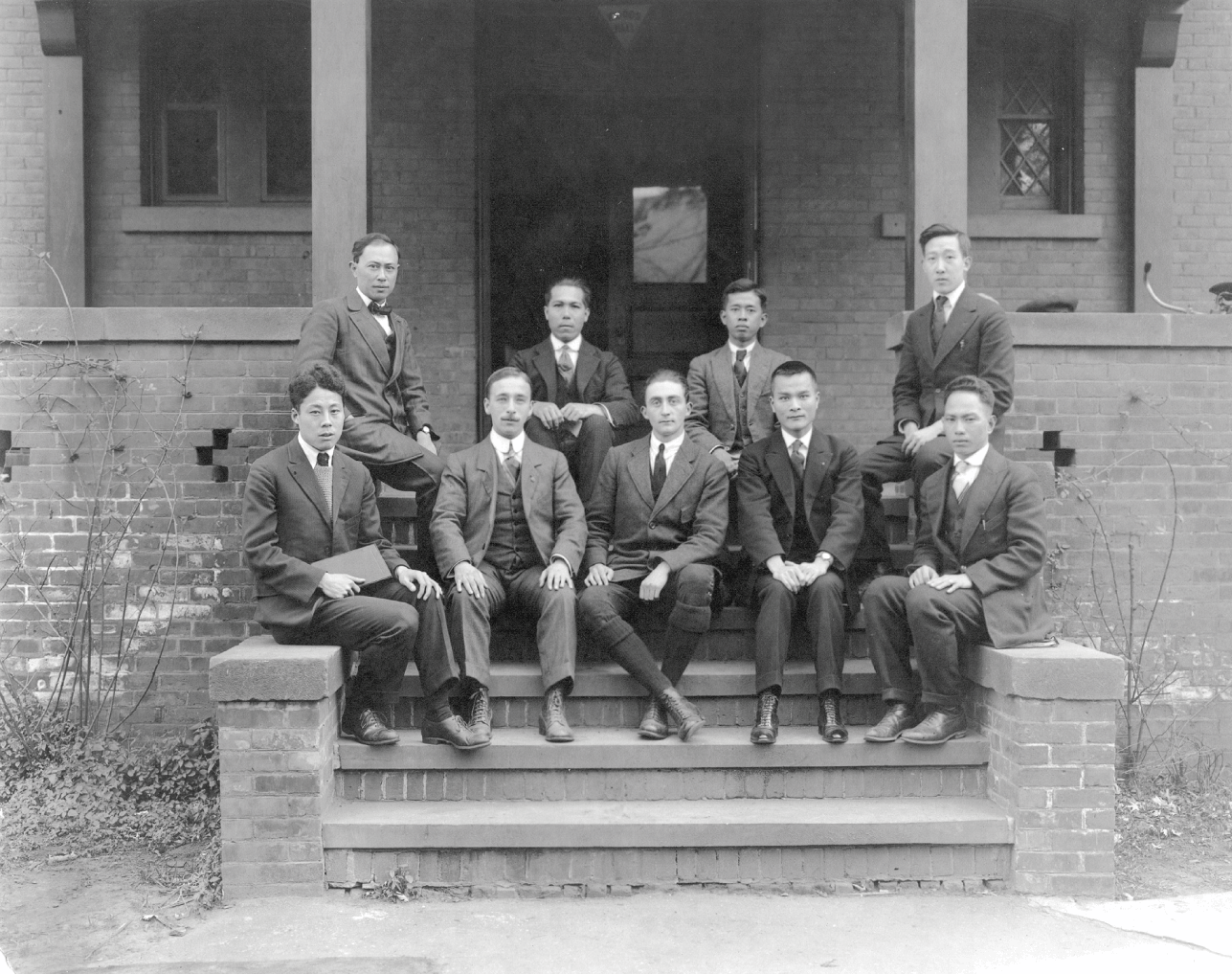
The director of the YMCA in China had sent a letter three days prior, introducing Suvoong to the president of Springfield College.Footnote 3 The director in China suggested to the president, half-heartedly, “you probably will have facilities for his securing such instruction as he may need. If you do not have [them] please feel free to recommend his entering high school.”Footnote 4 This candid introduction is how Suvoong entered the vocation of physical education. This vocation, in turn, led to a rather successful career, with Suvoong serving as the first Chinese referee at the Olympic Games and teaching at Hangzhou Zhijiang University, Nanking National University, and Shanghai Jiaotong University. At Springfield, he joined a contingent of students from China, the Philippines, and other places around the world whose fates would become intertwined (Figure 8.1).Footnote 5
Foreign student group, Springfield College, 1920. Courtesy of the Springfield College Archives and Special Collections.
From 1915 to 1932, at least fourteen students from China and five from the Philippines studied in Springfield, and by 1925, seven of them had already taken up leadership positions in physical education programs in their home countries.Footnote 6 Serafin Aquino served as the Director of Physical Education of Public Schools in Manila, Sing-Fu Chang worked as the Director of Physical Education at Southeastern University in Nanjing, John Mo (Ma Yuehan 馬約翰) continued as Director of Physical Education at Tsing Hua College in Beijing, and Regino R. Ylanan served as Director of Physical Education at the University of the Philippines in Manila.Footnote 7
These former Springfield College classmates molded physical education in China and the Philippines respectively, and this chapter traces their intellectual foundations and trajectories through Paul Cohen’s “coalescence-dispersion process.”Footnote 8 In the neutral turf of the United States, these Chinese and Filipino student-scholars, along with their Japanese peers, navigated similar questions about athletics, race, and nation, thereby extending sportive entanglements beyond the boundaries of East and Southeast Asia.Footnote 9 The period between the 1921 and 1934 Far Eastern Championship Games represented an era of possibilities when shared challenges and objectives brought Chinese, Japanese, and Filipinos together, and the mirage of an Asia unified through sports shimmered briefly on the horizon.
Springfield College, or the International YMCA Training School, as it used to be called, became a leading school for sports training, medicine, and research, but its success was far from preordained. Founders chartered the school in 1885 to train physical educators and YMCA secretaries, but from its inception, the school struggled for legitimacy, as it competed directly with George Williams College near Chicago, which also called itself the YMCA Training School.Footnote 10 The Young Men’s Christian Association, or YMCA, a British evangelical organization, had gained many adherents in the United States by the late nineteenth century, and Springfield College positioned itself as one of the first institutions to capture the energy and vigor of sportive evangelicalism through professionalization and academic training.
Under the leadership of the American Luther Gulick, the International YMCA Training School in Springfield transformed from a vocational school designed to produce YMCA secretaries into one of the foremost research centers on sports science and physical therapy in the world. Gulick gave Springfield College “its first philosophy, invented the triangle as its symbol, raised the physical director’s status to that of a profession, and built at Springfield an internationally famous curriculum.”Footnote 11 With this new mission and new international orientation, which set it apart from George Williams College, it attracted the likes of Canadian James Naismith, who invented basketball, and American William G. Morgan, who invented volleyball.Footnote 12 By the 1910s and 1920s, Springfield had already gained international acclaim as a sports college, drawing talent from around the world.
The International YMCA College at Springfield’s location in a progressive and evangelized New England no doubt influenced the Chinese and Filipino students who made their way there to study, but the “international” element of the college also steered students to take a global approach to athletics and sports in their research and later careers. “International” became a mindset of the school. One alum captured this cosmopolitan spirit in an article in the College at Springfield Bulletin, sharing his aim to make “world brotherhood customary,” which would thereby allow “a peaceful international order” to emerge.Footnote 13 While Thomas Suvoong searched for happiness, others searched for world brotherhood, but perhaps, in the end, they were searching for the same thing.
Sporting Nations
In his 1921 Springfield College thesis, Filipino graduate Geronimo Suva, who had played for the Philippine basketball team in the first Far Eastern Championship Games, broadened his research on anthropometry by engaging with the German and Swedish “systems” of gymnastics and corrective exercise.Footnote 14 Extending his international reach, Suva subtly, and perhaps unknowingly, weaved back-and-forth, like a talented point guard, between identifying with Philippine and American audiences in his narrative.Footnote 15 Chinese graduate John Mo similarly located his research on Chinese athletics in the international arena by appealing for foreign assistance to China in his 1920 thesis. He added a lengthy appendix to the end of his work, which answered common questions people had regarding Chinese schools and living and working conditions in his country.Footnote 16 Regino R. Ylanan, a fellow 1920 graduate, likewise noted that his thesis research touched on a topic “which is of paramount significance to physical education not only in this country but also abroad.”Footnote 17
Filipino Regino Ylanan and Chinese John Mo lived parallel lives as physical education trailblazers. From their humble beginnings in Cebu in the central Philippines and Gulangyu in southeastern China respectively, Ylanan and Mo rose to fame as athletes, transformed into scholars in Springfield, and returned to the capital cities of their respective countries to take up the mantles of leadership in athletics. Both had early connections to the Far Eastern Championship Games, Mo having served as a committee member at the 1915 Games and Ylanan having participated in several events at multiple meets from 1913 to 1917.Footnote 18 Both then studied at Springfield College from 1918 to 1920 before returning to their home countries to teach at Tsing Hua University and the University of the Philippines respectively. In other words, Ylanan and Mo not only channeled international influences into their research, but they lived border-crossing lives themselves, setting a precedent for their compatriots.
In the ensuing decades, John Mo and Regino Ylanan became towering figures in physical education. Regino Ylanan helped organize the NCAA of the Philippines, served as the national physical director of the country, edited a sports magazine known as the Filipino Athlete, and published several articles and books on athletics.Footnote 19 John Mo led the Chinese delegation to the Berlin Games in 1936, became the president of Tsing Hua University, served as the chairman of the All China Athletic Federation, and published several book and articles on athletics.Footnote 20 And they both represented their countries at the controversial 1934 Far Eastern Championship Games, which we will return to in the next chapter. They were the Larry Bird and Magic Johnson to the next generation of eager basketballers who followed in their footsteps.
Thomas H. Suvoong, who joined the college the same year that Ylanan and Mo graduated, could be considered one such successor. He didn’t bring many luxuries with him when he came to Springfield, but, like many of his peers from China and the Philippines, he carried a youthful optimism reminiscent of the athletes at the Far Eastern Championship Games. The fact that many of the Chinese and Filipino students in Springfield, like Mo and Ylanan, were themselves alums of the Games probably aided in producing this optimism. Gunsun Hoh, who was known by his Springfield comrades as “H2O,” wrote in a logbook, “Know each other 知人” and “Love each other 愛人.”Footnote 21 Geronimo Suva, meanwhile, wrote that it was his ambition to “do my best in helping my people + give all that I have for a noble cause.”Footnote 22 And Thomas Suvoong wrote that it was his humble goal to be “the light of the earth.”Footnote 23
The students channeled their youthful passion into their research projects, turning Springfield into a laboratory not just to study but to create national histories of sports and sporting culture. Serafin Aquino, who submitted his thesis in June 1922, like John Mo before him, created a compendium of Filipino sports and games purportedly with the dual aim of advising American colonizers and fostering renewed interest in those sports and games among Filipino children.Footnote 24 Gunsun Hoh took a similar approach in 1923 with his Springfield College thesis, “The Past and Future of Physical Education in China.” He started with a long history of physical activity in Chinese history before diving into specific Chinese games and exercises.Footnote 25
These historical theses, as well as the articles and books they inspired, like sports documentaries, tended to follow similar narrative arcs. They started by outlining an early golden age when the victories came easy. Then they described an era of decline under colonialism or a conservative regime. They concluded with a heartfelt comeback story of revival spearheaded by energetic rookies like themselves. For instance, after describing a sportive golden era in the Philippines before colonial occupation, Geronimo Suva proceeded to the period of decline, torching Spanish colonizers for turning Filipinos into “pale looking, humped back, emaciated young with spectacles, ready to die.”Footnote 26 Gunsun Hoh similarly traced the “most contrary age for the development of physical education” to the “Essay system,” which led China to the “lowest point on her down-hill journey.”Footnote 27 Hoh and Suva set the stage for a comeback, and, like good sports writers who squeeze emotions out of underdog stories, they provided them.
These scholars offset the era of decline by researching, recovering, and compiling “traditional” games, and by building a bridge between those games and twentieth-century national revivals.Footnote 28 They pivoted from past to present, stepping over the dark age in between, to draw continuities and craft new narratives for the nation. In other words, Chinese and Filipino scholars incorporated “premodern imperial forms of physical culture into a linear progressive history,” as historian Andrew Morris puts it.Footnote 29 After all, a new sports dynasty doesn’t have the same emotional vigor as a team reviving the glory days of the past, and what was nationalism if not a creative manipulation of emotions that draws from so-called historical traditions to build unity and achieve political objectives?
This formulaic Springfield research had a long-lasting impact in the region and beyond. Gunsun Hoh later converted his Springfield thesis into a highly cited monograph, which we encountered earlier in this chapter. Serafin Aquino channeled some of his thesis for a monograph on Philippine folk dances written by the “Mother of Philippine Dancing,” Francisca Reyes Aquino.Footnote 30 Candido C. Bartolome, another Filipino Springfield alumnus, published several books on physical education through his long career at the University of the Philippines.Footnote 31 And, of course, Regino Ylanan and John Mo also penned well-received sports histories and physical education research.Footnote 32 In other words, these Springfield alumni helped establish long-lasting paradigms in the histories of sports in China and the Philippines.
As leading theorists and advocates of physical education in the Philippines and China, it was only natural for Springfield graduates, upon their return home, to not only take a leading role in research but also to don the mantle of leadership in the premier athletic meet in the region, the Far Eastern Championship Games. As mentioned previously, John Mo and Regino Ylanan both participated in the Games before and after Springfield. George G. Tan (Chen Zhang’e 陈掌谔), another Springfield alumnus, likewise, competed in the decathlon at the fourth Games in Manila in 1919 before studying at the college.Footnote 33 He also served as a Chinese delegate to the 1934 Games and eventually moved permanently to the Philippines.Footnote 34 Two other Filipino alumni, Serafin Aquino and Pedro “Pete” Ablan, served as head and assistant coach of the Philippine track and field team at the 1934 Far Eastern Championship Games.Footnote 35
Chinese and Filipino students at Springfield College also viewed sports, if not as a transnational “placenta of sportsmanship,” then at least as a means to build and enhance cooperation and congeniality in the region. Pedro Ablan, who graduated from Springfield in 1922, for instance, argued in his thesis that the Far Eastern Championship Games and sports more broadly could strengthen relationships within Asia.Footnote 36 Ablan situated the three founding countries of the Games together, writing, “The writer feels sure that another two or three years will see the Philippines, China and Japan competing successfully in the athletic arena with the best athletes of the Western World.”Footnote 37 Instead of portraying the Games as a wedge to separate Filipinos from their Asian peers, he used the Games as a tool to highlight Asian solidarity. Ablan’s juxtaposition reveals the power of sport to also create a common language and experience beyond national boundaries.
A Different Sports Triangle
The Far Eastern Championship Games, enhanced by the Springfield College connection, helped form the Japan–China–Philippines sports triangle.Footnote 38 Cutting across area studies boundaries that typically separate East and Southeast Asia, the Philippines–China–Japan sports triangle challenges us to look beyond those habitual boundaries and appreciate this alternative region as a cohesive and closely connected unit. Historian Roy Bin Wong defines a region as “more than individual countries but far less than the entire globe,” and Anssi Paasi identifies “social institutions such as culture, media and administration” – a list that intersects directly with sports and its connected industries – as key ingredients for forming the “complicated constellation” that is a region.Footnote 39 This definition aligns perfectly with the China–Japan–Philippines sports triangle.
The YMCA uses a red “mind–body–spirit” triangle as its symbol, and Chinese, Japanese, and Filipino Springfield College graduates mapped that triangle onto Asia. In 1927, the young director of the Chinese YMCA in Manila, Lim Chu Cong (Lin Zhuguang 林珠光), whom we encountered in Chapters 3 and 5, led Manila’s Chinese basketball team on a well-publicized “barnstorming tour” of China and Japan.Footnote 40 Springfield alum Regino Ylanan, who by this time had returned to the Philippines to serve as national physical director, noted how tours like this allowed athletes to “serve as ambassadors of friendship and international good-will.”Footnote 41 After all, Ylanan, as a former Far Eastern Championship Games competitor, had served as such an ambassador many times in the past. Channeling good will after his return to Manila at the conclusion of the 1927 tour, a team captain connected all the dots, citing the inspiration of the “famous Y.M.C.A. triangle” of Luther Gulick, which represented “mind–body–spirit,” in yielding a successful trip through the Philippines–China–Japan triangle.Footnote 42
But it was Springfield College itself that served as the training camp for Asian educators, making events like the 1927 tour possible. The classrooms and sports fields in Springfield created ample opportunities for interactions and collaborations among members of the triangle. For instance, the Japanese student Denichi Takeuchi, who would later take Japanese sports teams on tours in the Americas, served as Filipino student Geronimo Suva’s test subject for his thesis, posing for muscle and stature measurements.Footnote 43 Shared classes, playing fields, and research brought these Asian students together, and student clubs and organizations fostered a sense of team spirit and shared mission. The Masonic Club and Cosmopolitan Club in particular brought foreign students together.
The Cosmopolitan Club set out to “unite students of all nationalities in the College for their mutual benefit, socially, intellectually, morally, and spiritually.”Footnote 44 In 1920, Pedro Ablan served as vice-president of the club, Serafin Aquino served as social chairman, and Gunsun Hoh and Geronimo Suva were members.Footnote 45 The next year, Gunsun Hoh became treasurer and Chin F. Song, Tomas Suvoong, Pedro Ablan, and Serafin Aquino were members.Footnote 46 In fact, nearly every student from China and the Philippines at one point participated in the club. If Regino Ylanan and John Mo were the Larry Bird and Magic Johnson of Springfield College, and they were worried about their legacies after retiring from the game, then they could rest assured knowing that Michael Jordan, Charles Barkley, Kobe Bryant, Isaiah Thomas, and others would continue their legacies after they stepped away.
The Cosmopolitan Club, which became the International Student Organization in the 1990s, sponsored school outings to help international students become better acquainted with one another and America. In November of 1922, for instance, members of the club took a trip to the local Indian Motorcycle Plant to learn about American industry.Footnote 47 At a farewell banquet the semester before, over “Philippine steak,” “Shanghai celery,” “Spanish olives,” and other global delicacies, Sing-Fu Chang, Chin F. Song, Serafin Aquino, Gunsun Hoh, and others celebrated the year’s graduates.Footnote 48 Student clubs and the extracurricular events they hosted fostered a sense of camaraderie, setting the stage for future gatherings and reunions at athletic events in Asia.
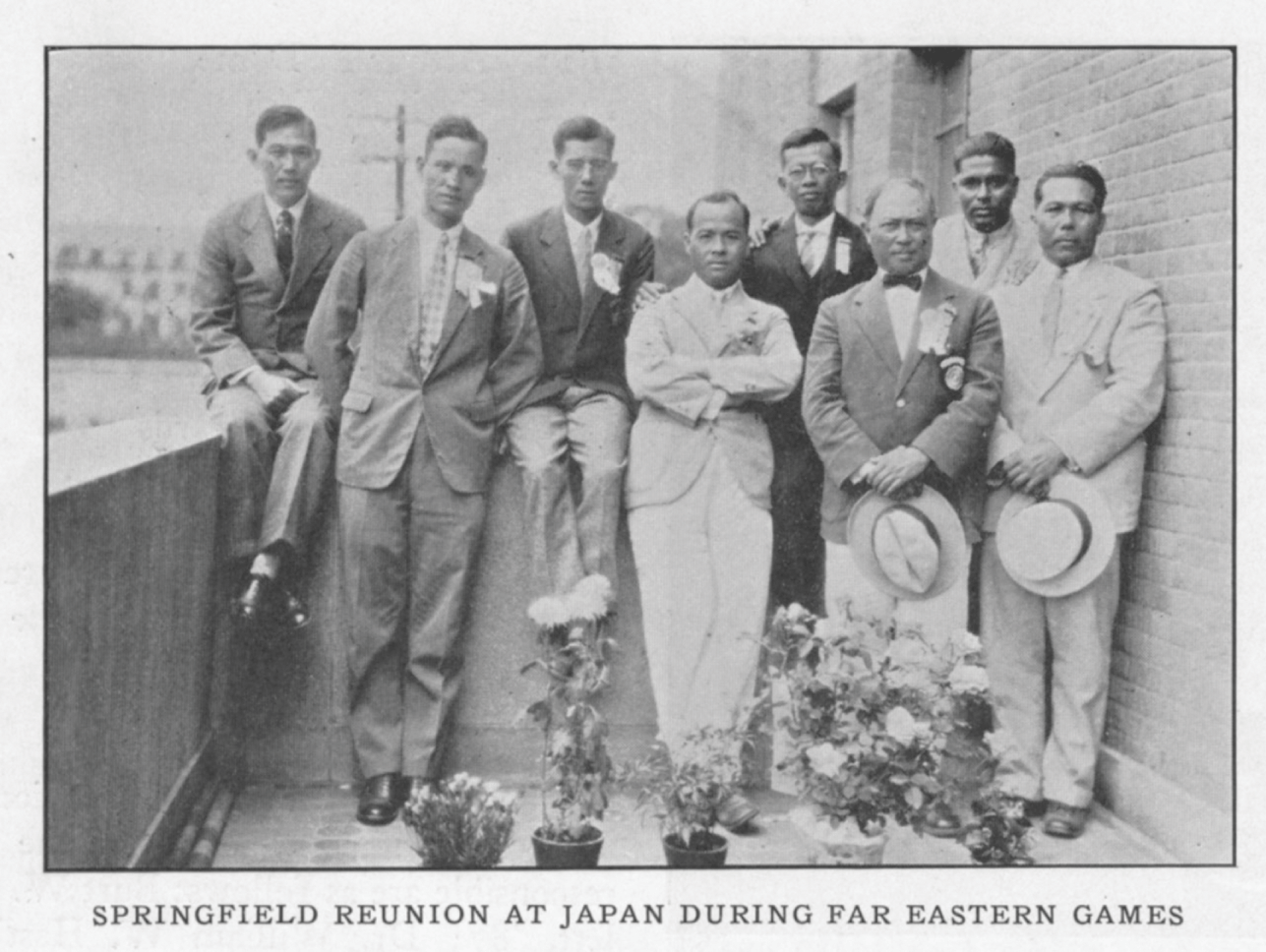
Because the Far Eastern Championship Games attracted so many Springfield graduates, the cities that hosted the Olympiads acted as sites for reunions. One alum, during a trip to China, noted how he ran into many “Springfield graduates here in Shanghai.”Footnote 49 An image in that same bulletin showed a “Springfield Reunion at Japan During Far Eastern Games” with John Mo and Regino Ylanan appearing smug and confident.Footnote 50 Writing about Chinese and Filipino medical students in a different context, one professor from the University of the Philippines shared that “many a personal friendship has no doubt been made between the two groups in their stay abroad. After their return to their respective countries these friendship[s] could not be forgotten but renewed.”Footnote 51
However, these anecdotes of interaction don’t leave us with much to measure the degree of direct contact between Japanese, Filipino, and Chinese scholar-athletes after graduation outside of a public clash in 1934 that we will explore in the following chapter, which is why this part focuses primarily on parallels. Staff in the alumni office at Springfield College no doubt saw the advantages of reunion publicity, which is why they included the Far Eastern Championship Game image in their bulletin. So, while the image hints at some of the connections that might have existed within the sportive triangle, without personal correspondence, it is impossible to address the depth or persistence of this contact.
Nonetheless, by following the athletes and educators of the China–Japan–Philippines sports triangle to a third space in the United States and to various reunions afterward, this chapter adopts a “trans-area studies” approach that examines Wong’s “geographies of connections that emerge in the spaces beyond national states that are far less than global.”Footnote 52 It is easy for watershed moments, like the 1934 kerfuffle that we will explore in the next chapter, to obscure historical contingencies, like the possibilities at Springfield’s fields. However, by exploring such contingencies, we gain a better appreciation of lost opportunities when things fell apart. We have pivoted from the local to the global, and now it is time to return once more to the local to see how many of the characters introduced in this part came together one last time to struggle over the existence of the Games and the future of Asia.Footnote 53
Parallel Circuits
In an intense battle with the “Japanese military,” the Chinese army “trampled all over enemy territory.”Footnote 1 The year? 1934. This alternate reality where China triumphed and Japan failed, which is a perfect inflection of the 1930s, did not come from the imagination of a science fiction author. It came from the pen of a sportswriter who was describing, in rather colorful terms, the Chinese victory over Japan at the final soccer game of the Tenth Far Eastern Championship Games. The author, as well as his Chinese compatriots who read his column, likely knew that the triumph on the field was only an illusion and that the true battles for the very existence of the Games and for the very existence of China were set to take place in the boardrooms the next day and on actual battlefields in years to come, but that didn’t detract from this moment of blind jubilation when the sports field served as the salve that reality could not to provide.
In the Asian sporting world, 1934 was a year of some significance. The matches of the Far Eastern Championship Games were intense, but the boardroom bouts put those matches to shame.Footnote 2 Before athletes took to the fields at the final Far Eastern Championship Games in Manila in May, Japanese Amateur Athletic Association representatives made barnstorming boardroom tours through Manila and Shanghai. In fact, the Japanese delegates landed in Shanghai at the same moment that athletes from across China had gathered for the trials for the Games.Footnote 3 Negotiators above, athletes below. The narrative in this section bounces back-and-forth between these groups. In some ways, the Tenth and final Far Eastern Championship Games initially unfolded like a repeat of the coalescence of 1921, but unlike the earlier iteration, politics ended up overwhelming sportive good will.
The Japanese barnstorming boardroom tour began when a representative of the Japan Amateur Athletic Federation arrived in Manila in January 1934 to lobby for the admission of the puppet state of Manchukuo, which Japan had created after invading northeastern China in 1931, to the Far Eastern Athletic Association.Footnote 4 The acceptance of Manchukuo into the organization would have provided some semblance of international recognition for the new state, which Japan desperately needed after its failure to achieve any such recognition from the League of Nations in the preceding years. The Manchurian Incident, as Japan’s invasion is often called, would eventually precipitate Japan’s withdrawal from the League of Nations and the Far Eastern Athletic Association, but we are getting ahead of ourselves.
In Manila, Yamamoto Tadaoki (山本忠興), the Japanese Far Eastern Athletic Association representative, met with Springfield alum Regino R. Ylanan, the secretary treasurer of the Philippine Amateur Athletic Federation, and Jorge B. Vargas, the vice-president of the same organization. Later, in March, Yamamoto laid out the stakes of their meetings in stark terms, saying, “Manchukuo must be admitted; otherwise no Japanese athlete [will] be sent to Manila next May.”Footnote 5 The first round of the heavyweight boardroom bout had set the stage for the ensuing rounds. However, in Shanghai on April 9, in the highly anticipated second round of the barnstorming boardroom tour, Japan’s lead negotiator Hiranuma Ryōzō (平沼亮三) unexpectedly clinched his opponent, ending the round prematurely. Was he throwing the match?
Enter player three. Chinese negotiators refused to sit idly by while Japan attempted to legitimize their landgrab. In fact, Chinese representatives threatened a boycott of their own if Manchukuo joined into the Far Eastern Athletic Association, applying pressure on the Philippines to ignore Japanese overtures. And their pressure worked, at least momentarily, as Japan temporarily abandoned their boycott threat. Defending the Philippine decision to side with China in refusing to allow Manchukuo to join the organization, Vargas reported, “In view of the existing rules … the Philippines had to take the action taken in Shanghai.”Footnote 6 Meanwhile, according to Chinese reports, while the Japanese “galloped quickly, and their strength can’t be ridiculed,” China eventually triumphed over the “enemy’s rampant strength.”Footnote 7 Oops, we accidentally slipped back to the soccer match, which took place a month after the Shanghai negotiations. Let us linger there for a moment before returning to the boardrooms.
After torching the Philippines 2 to 0 earlier in the tournament, China defeated Japan 4 to 3 in a grueling match, resulting in yet another trophy in their soccer war chest.Footnote 8 Of the Chinese teams that took to the fields in Manila for the Far Eastern Championship Games in May, perhaps none carried more swagger than the group of famous footballers from Hong Kong. The Philippines, despite sustained efforts to improve their national soccer team, including inviting several elite Chinese soccer squads to the archipelago in 1932 and 1933, was clearly out of its league.Footnote 9 The soccer field favored China, as did the early boardroom negotiations. Jumping back to the negotiating table in Shanghai a month prior, it appeared that Filipino negotiators had occupied an equally tenuous position.
The Philippines was caught between a rock and a hard place in the Manchukuo negotiations because the government had already raised and allocated vast sums for the Games, and if either Japan or China had followed through with their threats to withdraw, they would have absorbed huge fiscal and reputational losses.Footnote 10 So, the fact that the Philippines stuck to its guns in siding with China during the Shanghai meeting appeared like a noble and potentially costly gesture. But perhaps, as pundits would later speculate, this audacity was merely theater, as Japan and the Philippines had already struck a secret deal on Manchukuo.Footnote 11
According to newspaper reports after the Games, in exchange for Japan’s attendance in Manila, Filipino negotiators had agreed to stand with Japan on the issue of Manchukuo at the final round of the boardroom bout, which was scheduled to coincide with the conclusion of the competitions.Footnote 12 Before that boardroom finale took place, however, thanks to Japan’s acquiescence in Shanghai, the athletes finally took to the fields for the competitions, while the negotiators took a break from the boardroom to tour the banquet halls and implement their charm offensives.
The Charm Offensives
Instead of borrowing a coast guard ship like the Philippine team had done in 1921, Chinese athletes and coaches disembarked for the Philippines on the President McKinley – one of the Dollar Steamships that we encountered in Chapter 2.Footnote 13 After arriving in Manila six days later but still before the start of the Games, Chinese coaches, athletes, and delegates prepared for the critical pre-competition ceremony circuit, which required charisma, tact, and subtlety. The vice-president of the Philippine Amateur Athletic Federation Jorge Vargas laid out the stakes of the banquets, declaring, “We do not lose sight of the fact that complete success shall not be attained if [the Games] fail to foster friendly feeling with the other nations participating in the meet.”Footnote 14 Fortunately for China, seasoned diplomat Chengting Thomas Wang, who headed the Chinese delegation, and famous swimmer Yeung Sau-king (Yang Xiuqiong 楊秀瓊), who headed the Chinese swim team, led the charge.
With champagne glasses clinking and laughter reverberating through elegant halls, everything seemed to be falling into place for China. According to reports, when the shining star of China’s athletic world, Yeung Sau-king, entered the Great Harmony Club, “it felt like the entire party increased in vigor.”Footnote 15 Although the Bank of China director and head of the Chinese Chamber of Commerce in the Philippines, Alfonso Sycip (Xue Fenshi 薛芬士), whom we encountered briefly in the previous chapter, gave a gracious toast, and Chengting Thomas Wang followed with a honed diplomatic speech, the “Chinese Mermaid,” as Yeung became known, stole the show, wowing the over 600 athletes, journalists, and well-to-do politicians and businesspeople in attendance on the sixth floor of the China Banking Corporation building.Footnote 16
Several days later, on May 16, 1934, at 5:15 PM, Yeung Sau-king slipped into the waters of the newly constructed Philippine aquatic center to compete in the fifty-meter freestyle final.Footnote 17 According to reports, the “competition between Chinese and Filipino athletes was extremely fierce.”Footnote 18 Dispelling any potential anxieties of readers back home, one Chinese reporter described how the “expeditionary women’s force (遠征之娘子軍),” or the Chinese swim team, left the “local Filipino women’s team in their wakes.”Footnote 19 But for Yeung Sau-king and her fellow swimmers, victory in the pool was the easy part, and her new Chinese record of 36.93 seconds almost seemed like an afterthought.Footnote 20 As observed in Chapter 7, female athletes carried an extra burden as both competitors and symbols of femininity, and they felt it necessary to develop “numerous and often competing strategies to cope with the dissonance between masculine sport and feminine womanhood,” as sports historian Susan Cahn explains.Footnote 21
A strong physical performance in the pool, which set athletes apart from their Carnival Queen sisters, necessitated an exaggerated performance of femininity in the banquet circuit to assuage fickle male reporters and onlookers. Back at the opening ceremony four days before, Yeung Sau-king and her compatriots had weathered unabashed male ogling.Footnote 22 Gan Bun Cho (Yan Wenchu 顏文初), one such ogler who appears elsewhere in this book, directed his gaze at the Chinese women athletes who followed the flag bearers in the procession at the opening ceremony, writing, “For our healthy, strong, and beautiful female athletes, their facial features, skin, and muscles were all exceedingly exemplary.”Footnote 23
Male Filipino pundits, for their part, shared Gan’s obsession, especially when discussing Filipina swimmers. One commentator, for instance, described how the “tanksplashers who are educated enough not to be ashamed to appear before the public” were a “novelty to see.”Footnote 24 Meanwhile, Filipino lawmakers infused the ceremony with the pomp of a country on the verge of independence, raising the performative responsibilities of female and male athletes alike. The opening ceremony featured school children singing the national anthem in a brand-new stadium with flags flying and crowds cheering.Footnote 25 On this international stage, the “proper” gendered performance was paramount. With this in mind, Gan assured his readers in China that Filipino and American spectators allocated appropriate applause to Chinese representatives.Footnote 26
Back at the pool, the Filipino athlete some called the “king of the pool,” male swimmer Teófilo Yldefonso, who was the first Filipino to win an Olympic medal, anchored the Filipino men’s swimming team.Footnote 27 As in years past, he secured the gold in the 200-meter breaststroke at the Games. Yldefonso no doubt garnered the respect of the home audience, but the Japanese men carried away the hardware for most of the men’s aquatic events, “breaking all existing records of the Far East except the 200-meter breaststroke.”Footnote 28 Filipino women didn’t fare much better than their male compatriots. Although they came in a close second in the 50-meter and 100-meter freestyle competitions, they simply couldn’t keep up with Chinese stars Liu Guizhen (劉桂珍) and Yeung Sau-king.
Before the Filipino “king of the pool” added another medal to his collection at the Games, back during the banquet circuit several days earlier, the Filipino “king of the banquet,” Senate President and soon-to-be Commonwealth President Manuel L. Quezon had stepped up to the podium to impress all with his elocution.Footnote 29 At yet another banquet at the Pan-Pacific Association of China on Calle Herran, Quezon no doubt earned the respect of attendees, but the chair of the Japanese Amateur Athletic Federation, Hiranuma Ryōzō, left his own indelible mark by delivering his speech entirely in Japanese to a confused audience.Footnote 30 However, it was Chengting Thomas Wang – who had been outclassed by Yeung Sau-king at the previous banquet but settled into his element in this more formal evening banquet – who blew everyone away, stating, “after the Philippines gains independence and you [Quezon] are elected the first president, we will have the opportunity to all meet together again in the Malacañang” – the presidential palace of the Philippines.Footnote 31 Charm accomplished.
The pool and the party flowed together. The ceremony and the competition became one. Wang, or the social “merman,” as one might call him, swam through the ceremony circuit with the grace of a fish, charming his hosts and capturing hearts. Meanwhile, Yeung outclassed her Filipino competitors in the pool and even put Wang to shame in the banquet circuit, charming her hosts and satisfying oglers. While the Filipino old hats Quezon and Yldefonso still demanded respect with their long and storied careers, it became clear to attendees that the Chinese visitors were the stars of this show. Unfortunately for the “Chinese mermaid” and the “Chinese merman,” however, the basketball court and the boardroom, which would decide the fate of the Far Eastern Games and Far Eastern Athletic Association respectively, were the turf of the “Filipino Islanders,” and the visitors became fish out of water.
The Triangle Offense
Chapter 7 began with a stunning Chinese basketball triumph in 1921, so it is only fitting that Chapter 9 ends with a controversial Philippine victory that mirrored a far more controversial Philippine boardroom betrayal in 1934. The new Philippine basketball team featured breakout stars, including Jacinto Ciria Cruz, who would also lead the team in Berlin two years later; Bibiano Ouano, the “foremost basketball center in the Islands”; and old timers, like Mariano Filomeno, who had competed for the Islanders in every Far Eastern Championship Games since 1923.Footnote 32 But China had its own bevy of stars with Wang Yuzeng (王玉增), Tang Baokun (唐寳堃), and team captain Chen Shikun (陳實坤) leading the way.Footnote 33 These superstars led China and the Philippines to separate victories over Japan to start the competition, setting the stage for their first head to head match.Footnote 34
According to a Filipino reporter, the first game between China and the Philippines took place in front of the “biggest crowd known in the history of the sport in the Far East.”Footnote 35 A Chinese reporter explained that an extra seven to eight hundred ticketless spectators squeezed into the overflowing stadium, causing police to lose control of the crowd.Footnote 36 Needless to say, spectators and journalists were psyched for this heavyweight matchup. But while the metaphysical stage was set for the competition between the Philippines and China, the physical stage was not. Delayed construction funds, which poured out only four months before the start of the Games, prevented the builders from pouring out the concrete for the basketball stadium.Footnote 37 As a result, Chinese and Filipino players met on a temporary wooden court setup on the open-air tennis court, which had just hosted a tennis match a few hours before.Footnote 38
Meanwhile, after the board meetings of the Far Eastern Athletic Association in Shanghai in April, and after the ceremony circuit at the start of the Games in Manila, the stage was also set for the final boardroom bash in Manila, but the question of Manchukuo continued to hang over the deliberations like a storm cloud over an uncovered basketball court. The Chinese and Philippine diplomatic delegations, just like their star-studded basketball teams, carried a plethora of diplomatic all-stars. Chengting Thomas Wang of banquet-circuit fame and William Z. L. Sung (Shen Siliang 沈嗣良), Secretary of the China National Amateur Athletic Federation, led the charge for China. On the other side, Senate President Manuel L. Quezon, also from the prestigious banquet circuit, and Jorge B. Vargas, Vice-President of the Philippine Amateur Athletic Federation, headed up the Philippine delegation. Springfield College alumni and fellow boardroom delegates Regino Ylanan, Hoh Gunsun, and John Mo played critical, hands-on roles in the negotiations as well (Figure 9.1).Footnote 39
Springfield Reunion at the Japan Far Eastern Championship Games, 1931
Three days earlier, on the basketball/tennis court, uncooperative weather interrupted the Chinese and Filipino basketball stars. At halftime, with the Philippines up 26 to 12, the weather gods intervened, ordering a monsoon storm over the uncovered wooden court.Footnote 40 The head coach of the Philippine team, Alfredo del Rosario, swayed by the halftime score, lobbied to finish the game, waterlogged court be damned, while Chinese delegate William Z. L. Sung called for postponement given the unsafe conditions.Footnote 41 The referees initially awarded victory to the Islanders in the abbreviated match before Far Eastern Athletic Association officials intervened to overturn their decision and reschedule the game. The frustrated coaches and players then returned to their drawing boards to draft new game plans that accounted for key missing players. China had lost star Wang Yuzeng and the Philippines had lost Bibiano Ouano to injury during the game.Footnote 42
Back at the meetings, China and the Philippines also proceeded without star diplomats Chengting Thomas Wang and Manuel L. Quezon, who both called in sick.Footnote 43 Perhaps this was no coincidence, as the first board meeting ended in an impasse and the second meeting, which reportedly had an “exceedingly intense atmosphere,” dragged on for four hours, only ending when the Chinese delegation walked out in frustration.Footnote 44 After failing to reach a decision on Manchukuo, with China refusing to recognize the new member for obvious reasons, the Japanese delegation began to broach the possibility of disbanding the Far Eastern Athletic Federation altogether and replacing it with a new organization to circumvent China’s protests.Footnote 45 To this proposal, William Z. L. Sung vented his frustration, complaining that Japan “wanted to seduce the Philippines into recognizing the false organization.”Footnote 46 The temperature of the room increased, as it is wont to do on a summer day in Manila.
Back at the basketball court, after the actual storm had passed, the Islanders continued their winning streak with a less controversial defeat of China in the second round on May 18. Addressing the defeat, one Chinese commentator, in a column rife with racialized imagery, wrote, “in the second half the Philippine offense increased in speed and intensity, [with players] advancing in all directions like monkeys.”Footnote 47 With more poise and introspection, Springfield alum Thomas H. Suvoong, who served as the assistant coach of the Chinese athletic delegation, explained that inexperience playing in the tropics hampered the otherwise gallant Chinese performance.Footnote 48 After this routine Philippine victory, however, something shocking happened on the basketball courts. The Islanders fell to the Japanese team that they had soundly defeated days before, stunning the crowds in Manila.Footnote 49
An even more shocking event in the boardroom stunned newspaper readers in Manila and around the world a few days later. The Philippines also succumbed to Japan at the negotiation table. Hiranuma Ryōzō and the Japanese delegation, on May 21, their planned day of departure, scheduled a last-minute board meeting to decide the fate of the Far Eastern Athletic Association. According to conflicting reports, representatives from Japan and the Philippines tried and failed to reach a member of the Chinese delegation to inform them of the meeting.Footnote 50 With no Chinese representative present, Japan and the Philippines proceeded as a committee of two. Together, they agreed to disband the Far Eastern Athletic Association and replace it with a brand-new organization, the Amateur Athletic Association of the Orient, with Manchukuo as a member. They also scheduled a new athletic competition for Tokyo in 1938.Footnote 51 Fresh off the boat back in China, William Z. L. Sung reportedly called this “nothing less than a farce.”Footnote 52
The final basketball match between China and the Philippines had likewise been rescheduled to May 20, but unlike the last-minute board meeting, Chinese players actually received the memo and took to the court. The result for China was similar, however, as the Philippines pulled away with the victory, forty-four to thirty-three. Chinese observers cried foul, complaining that the four early fouls on star Tang Baokun, which sidelined him just like his boardroom compatriots, reflected a larger pattern of unfair officiating by the refs.Footnote 53 On the court and in the boardroom, things began to fall apart for China, but boardroom negotiators still held out hope for a last-minute intervention from the boardroom referee, Manuel Quezon. Was it possible that, as with the overturning of the referee’s decision in the first rain-shortened Sino–Philippine basketball match, the powers above would intervene and reestablish order and fairness in the final round of the boardroom bout?
The absent Manuel Quezon became the man of the hour, and his silence on the negotiations allowed Chinese and Japanese representatives, just like sports talking heads interpreting the silence of an athlete on a social media purge today, to play the speculation game. William Z. L. Sung reported that he had sent an appeal to Quezon, noting that the senate president was the “only person who clearly understood the situation.”Footnote 54 Japanese representatives of the Japanese Amateur Athletic Federation, on the other hand, apparently believed that Quezon was on their side because they sent a congratulatory telegram to the recovering statesman, writing “most hearty thanks” for “your supreme decision” on admitting Manchukuo.Footnote 55
In the end, the silence remained unbroken. Manuel Quezon and the government of the Philippines, which had informally recognized Chiang Kai-shek’s Nationalist regime in 1927 before almost any other country with a semi-official visit, as outlined in Chapter 6, ended up providing a similar recognition to Manchukuo in 1934, thereby becoming “the first government, outside of Japan, to recognize that Manchukuo was not a part of China.”Footnote 56 In other words, unlike the first basketball match when officials intervened at the eleventh hour to restore some semblance of fairness for Chinese athletes, Quezon offered no such intervention for Chinese delegates in their boardroom bout.
Reflecting back on the Games as a whole, one Filipino pundit lamented, “Years ago, we could beat the Japanese in almost any game and at any time … but today, for the Filipinos to win over the Japanese in any sport is for an hippopotamus to pass through the eye of a needle.”Footnote 57 Despite their continued supremacy in basketball and a surprise victory over Japan in baseball, Filipino athletes on the whole underperformed. In the track and field events, for instance, which the Philippines had previously dominated, Japan left with an overwhelming victory, fifty-one points to nineteen points.Footnote 58 For the Philippines, the decision to side with Japan in boardroom negotiations was not a proud one, but it was a practical one. And pundits naturally disagreed.
Commentators from the Philippines and China skewered members of the Philippine Amateur Athletic Federation for their perceived capitulation to Japan. The influential editor of the Philippine Magazine, for instance, called the action “a piece of unmatchable stupidity.”Footnote 59 Springfield alum Hoh Gunsun, who knew several of his Filipino counterparts from the Philippine Amateur Athletic Federation from their Springfield days, similarly pulled no punches, uppercutting the Philippine delegation by condescendingly inquiring how they could sell out their autonomy to Japan if their goal was to prove that they could defend their independence from Japan.Footnote 60 Hoh, showing familiarity with the political situation in the archipelago, located a weak spot for the Philippines because, just like in 1921, Filipinos had independence on their minds due to the recent passage of the Tydings-McDuffie Act, which established a framework for Philippine independence. With Japan waiting in the wings, however, many were questioning the wisdom of cutting ties with the United States.
Lead negotiator for the Philippines, Jorge Vargas, who had stood firm on the Manchukuo question in Shanghai, attempted to deflect some of the criticism with discursive gymnastics, writing, “we have nothing but the highest esteem and respect for our Chinese friends and we wish to assure them that our position has been dictated only by an impartial desire to adhere strictly to the language of the Constitution.”Footnote 61 Unfortunately for Vargas, gymnastics was not one of the recognized sports of the Far Eastern Championship Games. One Filipino commentator, who went by the name Putakte, or wasp, quipped, “Wouldn’t it be a good idea to send our athletes to Shanghai and Secretary Vargas to Tokyo to represent the Philippines in 1938?”Footnote 62
On the other hand, back in China, Springfield alumnus John Mo, who had served as the head coach of the Chinese athletic delegation, struck a diplomatic tone by avoiding the controversy of the boardroom altogether, instead highlighting the accomplishments and failures of athletes on the field.Footnote 63 When sports become inexorably tied up in politics, the wise coach knows how to channel their inner Houdini. Diplomat Chengting Thomas Wang, meanwhile, also sounded a positive note upon his return to China, saying, “Our country and the Philippines maintain extremely friendly relations, and though the Philippines has been duped by Japan, they will soon realize and regret this decision.”Footnote 64 When negotiations appear unreconcilable, the wise diplomat likewise knows how to leave open a side door.
Two sweltering weeks under the Manila summer sun were merely the trailer for the calamities of the next decade. Though the events of the weeks faded into the pages of history, the lessons echoed through the ages like the reverberations of a well-struck baseball in a hushed stadium. It would be impossible for the Philippines to remain neutral in the conflict between China and Japan in sports disputes and in war. The athletes themselves would learn that lesson, of course, as most of them ended up serving during the war, trading jerseys for a different kind of uniform, meeting their old foes on a different type of battlefield.Footnote 65 It also provided a lesson that perhaps all of us should heed: beware when using war metaphors in sports because those metaphors might come back to haunt you.
Part IV Conclusion, Game Over
Before the 1934 Games took place, a commentator in an obscure Chinese journal, perhaps with the early boardroom bouts in mind, wondered aloud whether the Far Eastern Championship Games would die of natural causes before the 1938 meeting in Tokyo.Footnote 66 History ended up confirming the author’s suspicions as the controversial Games never took place due to the Second Sino–Japanese War. It was an inglorious end to an organization that had brought together athletes, coaches, and organizers from the Japan–China–Philippines sports triangle multiple times over the course of two decades.
After the war, however, the Springfield crew were at it again. Regino Ylanan, Candido Bartolome, and Gunsun Hoh met in Manila in June of 1948 to reestablish the Far Eastern Athletic Association.Footnote 67 They agreed to formalize the arrangement at the London Olympics later that year, but when the Olympics came around, they adjusted their plans, agreeing instead to join the new Asian Games Federation, trading the sports triangle for a broader regional conglomeration. The Games would be reborn as the Asian Games in 1951 under the patronage of a new shining star in the Asian banquet circuit, Indian president Jawaharlal Nehru.Footnote 68 At the new Games, some things remained the same, like Filipino domination in basketball, but the larger more decentralized event had a different feel than the intimate triangle of old.Footnote 69
Sports bridged many divides in Asia. It linked athletes, coaches, and educators from China, the Philippine, and Japan, making visible the intense world of contact that crossed over area studies boundaries. Sports also linked together two critical sporting events in 1921 and 1934, which represented a peak and a nadir, though by no means the totality, of the broader Sino–Philippine link. The Springfield College interregnum offered a captivating contingency that enhanced the connections established during the Far Eastern Championship Games and the drama of its dissolution. Sports exposed the extensive entanglements between politics and society, as boardroom antics spilled into the arenas below, and as former athletes moved to the boardrooms above.
In the end, it is important to recognize the awesome power of sports. In a 1930 article about Filipino national hero José Rizal that appeared in a Chinese research journal, the writer noted that, if readers “just take a look at their [Filipinos’] record from the previous Far Eastern Championship Games, those who don’t know much about the character of Filipinos, can surmise that they are arduously working to improve their circumstances.”Footnote 70 In other words, this Chinese author, in an article designed to teach about Philippine history and society, used sports as the common language to engage the reader. You might not know about this fellow called Bill Clinton, but you must have heard about the legend that is Michael Jordan?
Chinese and Filipinos, China and the Philippines, though racially and geographically close to one another, can really have no vital relations, no worth-while cooperation between them unless there is vital exchange.Footnote 1
Why did he choose to plunge into nothingness, into the void of faceless faces, of soundless voices, lying outside history? I tried to step away and look at it from a distance of words read in books, half-remembered. For history records the patterns of men’s lives … . All things, it is said, are duly recorded – all things of importance, that is. But not quite, for actually it is only the known, the seen, the heard and only those events that the recorder regards as important that are put down, those lies his keepers keep their power by.Footnote 2
American novelist Ralph Ellison, in the epigraph that appears above, articulates how historians play critical roles in sustaining systems of power and privilege. In his novel, Invisible Man, he pulls down the magician’s curtains, exposing how the “keepers” of records shape and mold memory. Although many historians have attempted to recover and restore voices lost to time and archives, many others have intentionally or unknowingly sped past the graves of those who didn’t fit into their narratives. After all, selection is a key task of historians and other channelers of the past, and the act of selection by its very nature necessitates omission. Selecting one testimony or story means leaving out many others. This act of censure is one that we all take part in, but it takes different forms, channels different agendas, and holds different consequences.
Ignoring is perhaps the most stinging form of omission. Overlooking or ignoring comes not from an active effort to undermine, deplatform, or distort some disputed reality, but from a lazy privilege and carefree obliviousness. Contrast ignoring with a more active form of erasure, such as efforts by some in Japan to obfuscate or downplay the scale of the Nanjing Massacre of 1937 in school curricula.Footnote 3 As Tomoko Hamada notes, “a written national history is a powerful ideological tool that can be used for the mobilization of citizens for the service of the collective (imagined) community.”Footnote 4 Some textbook authors in Japan, like textbook authors everywhere, molded history to fulfill a specific and practicable purpose: creating a palatable imagined community from a shared, albeit distorted, past. Even though many outsiders would denounce the result of the narratives the authors conjured, those detractors can at least derive some righteous frustration knowing that the authors acted with intent and purpose.
The nefariousness of ignoring lies in its indifference, brazenness, and complete dissociation from costs. Geoff Eley describes how the past can become “both therapy and distraction, a source of familiarity and predictability, even as the actual ground of the present ceases to be reliable.”Footnote 5 Yet the history of the ignored doesn’t even have the chance to distract from or invoke nostalgias of real or imagined pasts. It is obscured with little thought but serious consequence. The history of the Sino–Philippine link, although enjoying thoughtful treatment in some scholarly circles, largely fits into this category.
China and the Philippines have had a rocky relationship over the past decade despite growing more and more economically integrated. Aside from brief honeymoon periods when President Rodrigo Duterte temporarily pivoted toward China early in his administration, and when President Ferdinand Marcos Jr. briefly offered an olive branch, the Philippines and China have appeared to be “sleepwalking into old-new nightmares,” as Dan Steinbock recently observed.Footnote 6 The strange thing about these nightmares, however, and Steinbock captures it well with his “old-new” phrasing, are their confused chronology. Normally ghosts of the past haunt the present, as seen in the case of the Nanjing Massacre and textbooks mentioned previously, but with China and the Philippines, it would perhaps be more accurate to say that the ghosts of the present haunt the past, which in turn unsettles and confuses the anxieties of the present and future.
Rocky relations between China and the Philippines over the past decade and during the height of the Cold War, coupled with the many ingrained research blinders highlighted in the introduction, have led people to overlook a complex and integrated past in the early twentieth century. The rich history of Sino–Philippine interaction that we have explored in this book, as well as the many colorful characters who spearheaded those interactions, have, for the most part, disappeared from popular knowledge. Present anxieties haunt past memories. Turning back to Eley’s quote, for China and the Philippines, the present is indeed distorted, not by the therapy and distraction of the past, but by its absence. When former senator Panfilo “Ping” Lacson recently traveled to Pag-asa (Thitu) Island in the West Philippine/South China Sea to condemn Chinese incursions in the area and boldly plant the Philippine flag, he did not invoke a warlord trope, communist trope, or any historical episode for that matter. He talked about fishing and national security.Footnote 7
While anti-Chinese discrimination and anti-China sentiments have persisted and realigned for many decades in the Philippines, they also don’t feel very rooted in any past – at least not the pasts that appear in the pages of this monograph.Footnote 8 They appear more like an old reflex than anything connected to history. In fact, the Sino–Philippine relationship today feels very fleeting and superficial despite geographical proximity and deep historical ties. Politicians on both sides of the strait seem to enjoy the emptiness because it allows them to conjure their own convenient demons and xenophobias.
In 1930, Filipino Senator Jose A. Clarin wrote, “it is hoped that, when China attains the height of her power, she will use it for the benefit of weak peoples and for the abolishment of those barriers established through racial prejudice.”Footnote 9 Like Dean Francisco Benitez, whose epigraph begins this chapter, the senator saw promise in China and reason for the Philippines to pursue a policy of engagement with that country. If elected leaders in the Philippines today had as much curiosity about China and the Philippines in the past as Senator Jose A. Clarin did about China and the Philippines in the future, and if Chinese leaders and global scholars shared a similar curiosity, perhaps we all could have a more productive and peaceful present.
This book set out to get lost in an interdisciplinary, decolonial, connected history of the Philippines and China in the early twentieth century. It engaged with, challenged, and redesigned inspiring transnational, world, and global history approaches, and it followed equally inspiring and innovative historical agents. It navigated the dual oceans of history and historiography to uncover a world of intimate contact and mutual influence. It is my hope that the characters who appeared in these pages, who carried so much optimism and dedication, and who demonstrated the ability to survive and thrive despite the odds stacked against them, can inspire you as much as they inspired me. Thank you for reading my book.
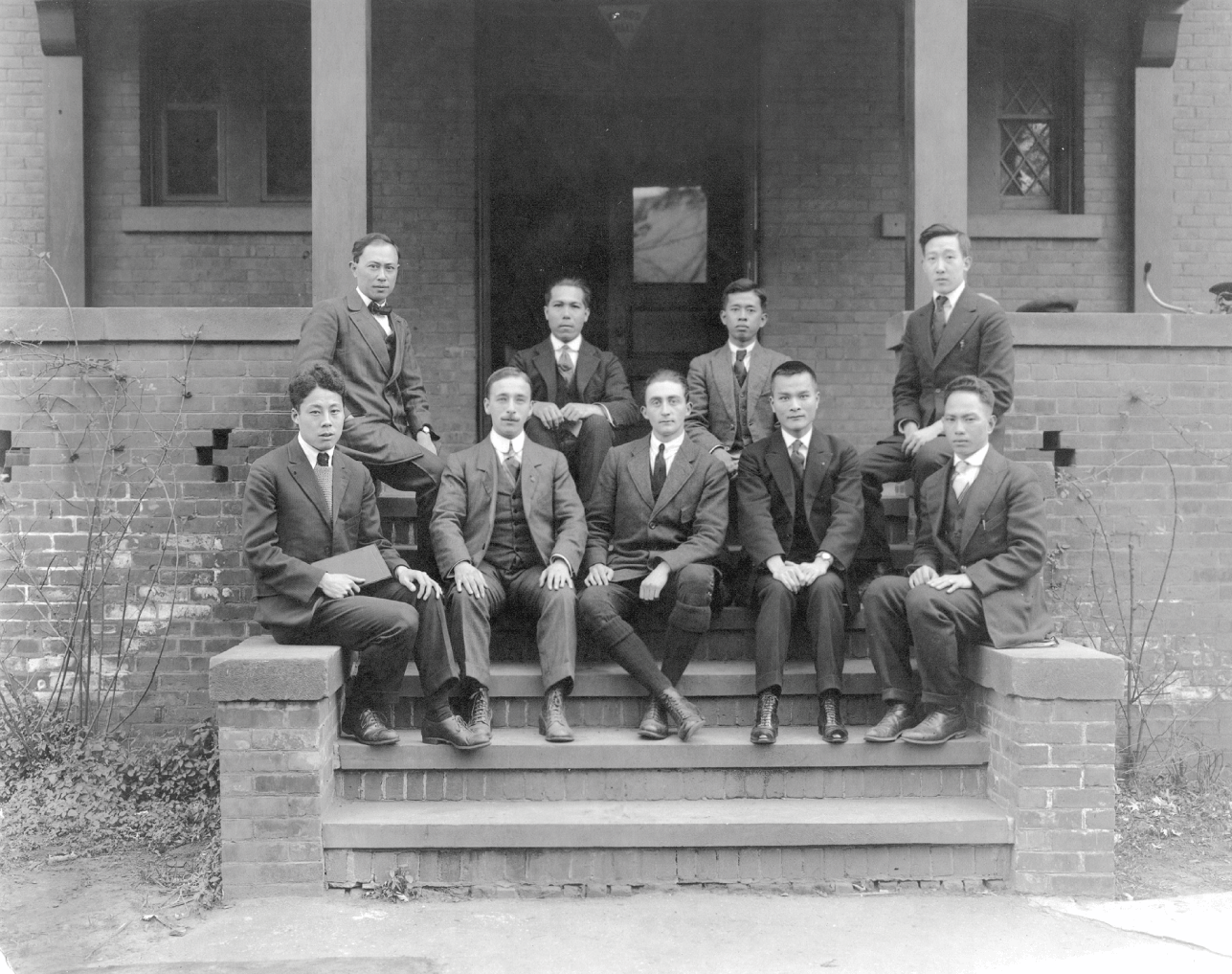
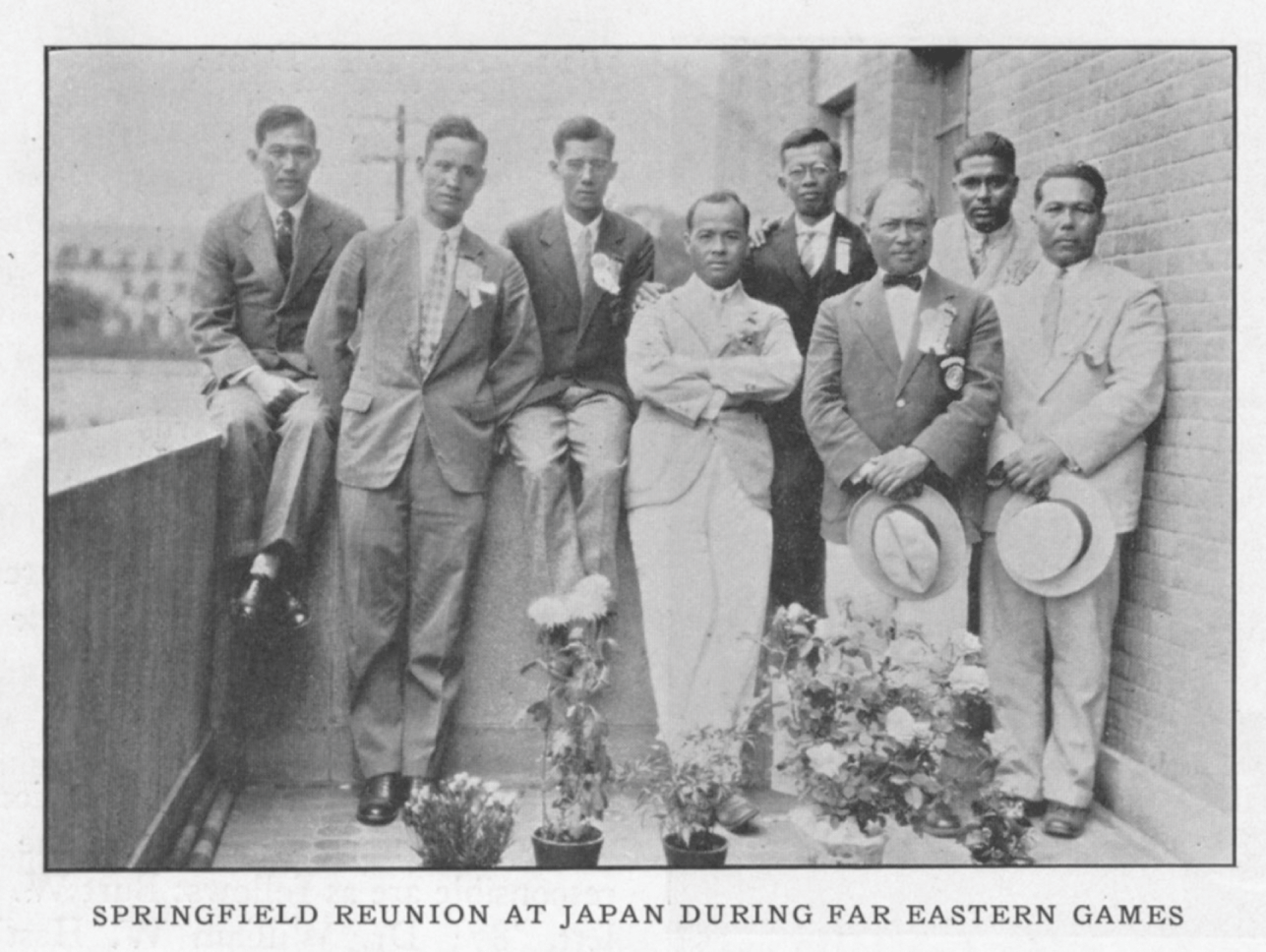

 Open access