





Key results
-
• The zoonotic potential of G. duodenalis remains uncertain, with few documented cases.
-
• We present a strongly supported case of probable wildlife-associated transmission of G. duodenalis assemblage AI to a person.
-
• Gene sequences from Giardia in the reindeer samples and from the infected fieldworker were identical, supporting a likely transmission event.
During a project assessing gastrointestinal parasite diversity in wild reindeer, faecal samples were collected. One project member, a 45-year-old man, active and in good health, became ill after sample collection, presenting with epigastric pain, diarrhoea, and reduced general condition.
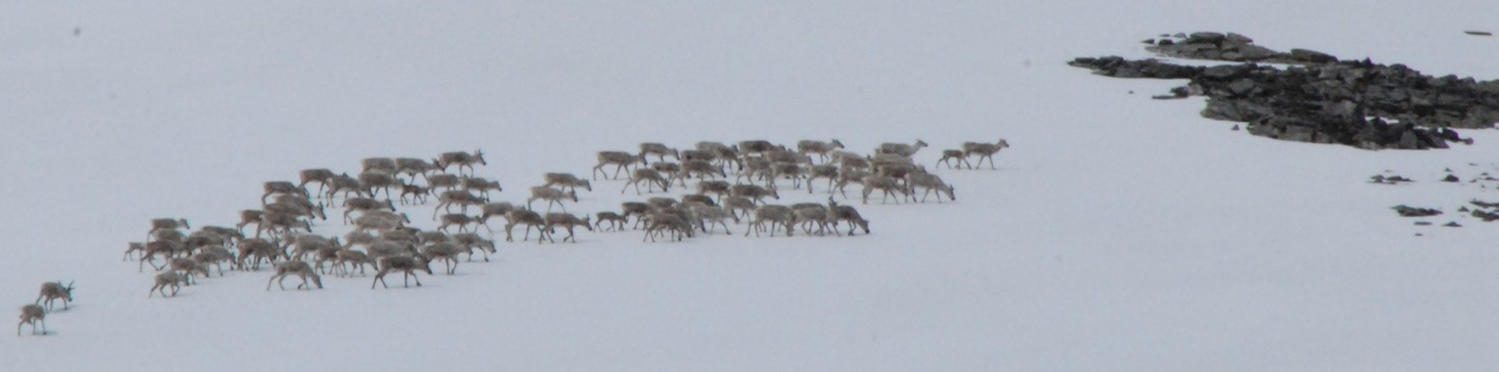
On 2 July 2021, the fieldworker went to the Knutshø mountains, about 120 km south of Trondheim in central Norway, to collect faecal samples from a herd of wild reindeer (Figure 1) observed on a snowdrift the preceding day by researchers from the Norwegian Institute for Nature Research during an aerial reindeer calf survey. He wore disposable gloves to collect the faeces into sample containers. Some samples were almost liquid in the snow and difficult to collect. After running out of gloves, he improvised and continued collecting samples using already-used disposable gloves turned inside out to shuffle the samples into containers. During this process, he did not notice getting faeces on his hands. When sampling was completed, the fieldworker ate his packed lunch.
Wild reindeer herd on snowdrift. Field worker not shown. The wild reindeer are only for illustrative purposes and are not the same individuals as those mentioned in this article. Photo: Bjørnar Ytrehus

Some three weeks later (24 July), the fieldworker was busy gardening when he suddenly felt unwell and had to go inside to rest. Later the same day, he was called out on a work assignment, but still felt quite ill, with intermittent bloating, diarrhoea, and epigastric pain.
He stayed off work on 27 July and 3 August. On his first visit to the doctor on 2 August, he was advised to return if the symptoms did not subside. He was provided with a stool sample collection kit on 4 August, and his sample was sent to St. Olav’s Hospital, Trondheim, where it was found to be Giardia-positive by multiplex quantitative polymerase chain reaction (qPCR), and he was given a diagnosis of giardiosis. The fieldworker was prescribed 400 mg of metronidazole (Flagyl®) tablets, three times daily, for seven days. He had already started to feel better and had no symptoms by the end of the medication course. Since then, the fieldworker has not had similar symptoms, but admits experiencing episodes of fatigue and exhaustion without any obvious explanation. Other potential plausible exposure routes to infective Giardia cysts (travel, contact with animals, untreated drinking water) were not identified.
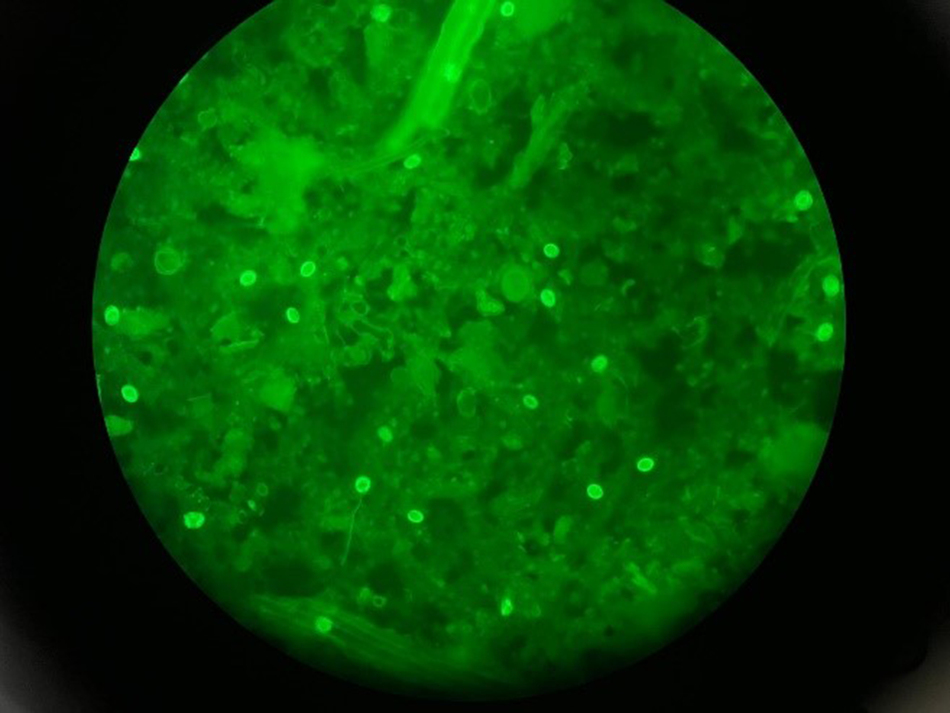
The samples from wild reindeer were sent to Nord University, where they were analysed for gastrointestinal parasites, including Giardia cysts. Smears (one smear per sample) of concentrated faeces from 41 wild reindeer samples were stained with fluorescein isothiocyanate (FITC)-labelled monoclonal antibodies (Aqua-Glo; Waterborne Inc., NO, USA) against Giardia cyst walls and examined under a fluorescence microscope.
Among these 41 samples, 18 were positive for Giardia cysts (Figure 2). Fourteen samples had high numbers of cysts (51 to >100 in 5–20 μL smears), and four had moderate numbers of cysts (10–50 cysts in 5–20 μL smears). The results of the Giardia analyses from all wild reindeer included in this study have been published [Reference Utaaker1].
Giardia cysts in faecal smear stained with monoclonal antibodies. Photo: Kjersti Selstad Utaaker

Given these findings and the fieldworker’s diagnosis, the hospital where the giardiosis diagnosis had been made was contacted and agreed to send the deoxyribonucleic acid (DNA) eluate from this sample to the Norwegian University of Life Sciences (NMBU) for further molecular analysis, together with the wild reindeer samples.
Using endpoint polymerase chain reaction (PCR) targeting the glutamate dehydrogenase (gdh) gene [Reference Cacciò2], it was confirmed that both wild reindeer and humans were infected with G. duodenalis assemblage AI. Most (14 of 15) sequences at the amplified Giardia gdh gene obtained from the Giardia isolates from wild reindeer (GenBank ID ON314835–ON314846, PQ015120–PQ015121) and the fieldworker (ON314834.1) were identical. As gdh has limited discriminatory power for epidemiological investigation and source tracking, the DNA eluates from the human sample and four of the reindeer samples with high cyst numbers were amplified at the DNA repair and recombination gene (RHP26) [Reference Ankarklev3]. No amplification was found from the fieldworker’s eluate, but amplicons from the reindeer Giardia were sequenced. One sequence (OR683783) from RHP26 was identical to a sequence in GenBank from a Giardia isolate from a moose (MG520260.1). Additionally, three sequences (OR683784–OR683786) were identical to a Giardia isolate from a hunter (MG520255.1) who had participated in slaughtering a deer one week prior to infection symptoms and for which a high similarity between the sequence from the hunter and a sequence from a fallow deer had been noted [Reference Ankarklev3]. As amplification of the Giardia DNA from the human sample at this gene was unsuccessful, additional RHP26 analyses were not performed. Due to the small volume of DNA eluate available from the hospital, further genetic characterization of the Giardia isolate from the fieldworker was not possible.
G. duodenalis is divided into eight genetic groups, known as assemblages, classified from A to H. In short, assemblages A and B are considered zoonotic, while assemblages C to H are host specific. Assemblage B is most commonly found in infected humans. New species names have been proposed for each assemblage due to their genetic and host-specific differences [Reference Wielinga4].
The potentially zoonotic assemblage AI was found in a high number of wild reindeer during a single sampling event. The fieldworker who collected the samples was diagnosed with Giardia infection around three weeks after collection, and the sequencing results indicate that the infection was probably acquired by ingestion of cysts originating from the reindeer faeces.
There are only a few cases where direct transmission of Giardia between animals and humans has been confirmed [Reference Cai5], and in this case, the parasite was most likely transmitted from a wild animal to a human, either directly from faeces that the fieldworker was handling or potentially indirectly from the environment (snow, water, etc.).
Based on available literature, the first well-documented case of probable direct zoonotic transmission was reported in 2018, when a toddler was infected after ingesting faeces from a chinchilla containing G. duodenalis assemblage B cysts [Reference Tůmová6]. Human giardiosis is not uncommon in Norway: from February 2022 to January 2024, 154 Giardia-positive samples from people in Norway were analysed to determine their genotype. Among these, only seven belonged to assemblage AI (<5%), whereas 36% were AII, and 58% were assemblage B (both BIII and BIV) [Reference Tipu7].
G. duodenalis is a parasite that came into the limelight in Norway in 2004 when a large outbreak occurred in Bergen, the second-largest city in the country. Up to 5000 people were infected in a waterborne outbreak that still stands as one of the most significant documented giardiosis outbreaks in Europe [Reference Nygård8, Reference Robertson, Hermansen and Gjerde9].
In Norway, giardiosis has been a notifiable disease in humans since 1977. The number of confirmed cases has risen with the improvement of diagnostic methods, especially after the implementation of multiplex PCR, where multiple pathogens, including Giardia, are assessed simultaneously [Reference Campbell10]. The number of cases has risen regularly, except for the years 2020 and 2021, during which there was a decline in cases, likely due to fewer patients being infected abroad, probably due to COVID-19 travel restrictions. Globally, giardiosis is one of the most prevalent and common parasitic diseases in humans, with an estimated prevalence of 200 million [Reference Certad11]. Giardia infection is more common in developing countries than in developed countries [Reference Feng and Xiao12]. For most people, an infection entails transient stomach upsets, although long-term issues have been documented [Reference Naess13].
Conclusions
This case report shows that Giardia infections can be acquired from wild animals in the Norwegian wilderness and underscores the importance of taking precautions when handling faeces from animals. The infective dose of Giardia is only a few cysts, and the quantity of cysts shed by an infected host can be high, so the possible spread of the parasite into open water sources should be considered. In general practice, giardiosis may be included on the list of differential diagnoses when patients with diarrhoea are in close contact with wild animals, use water sources from surface or well water, and people receiving their water from waterworks with pipes in poor condition, which may lead to contamination of the water after it has been treated.
Data availability statement
The data used during the current study are available from the corresponding author on reasonable request. The sequences obtained have been deposited in the National Centre for Biotechnology Information (NCBI) GenBank database.
Acknowledgements
First and foremost, our thanks go to our devoted, faithful, and persistent fieldworker. We can truly say that this paper would never have been realized without his commitment.
Author contribution
K.S.U. carried out the main bulk of the analysis of the wild reindeer samples and contributed to all analyses. B.Y. and L.J.R. contributed to the analysis of the results and the writing process. T.K. carried out the molecular analysis. All authors contributed to drafting the manuscript. All authors have read and approved the final version of the manuscript.
Funding statement
This research was partly funded by the Norwegian Environmental Agency (Project No. 20047048) and Nord University.
Ethical standard
This study did not require official or institutional ethical approval.
Consent for publication
The manuscript and results of this study have been presented to the fieldworker, and he has consented to its publication.
Prior publication
The results from this study have also been presented as a poster at the 8th International Giardia & Cryptosporidium Conference (IGCC), Melbourne, Australia. 2025.

 Open access

