

1. Introduction
I am a French visual artist based in the Centre-Val de Loire region. My work focuses on plant otherness and the complex and specific interactions that link humans and plants. In my installations, we are immersed into a sphere of organic and fictional forms. Here, the hybrids between art and science sometimes mischievously divert technology, and instead offer us aesthetic work with its roots deep in hand-made and vernacular knowledge. Since 2014, I am working in partnership with different labs in ecophysiology, pedology and bioacoustic.
Artists and scientists, together, we invent new protocols, which may sometimes use some of the tools of science, but not really in the way they are used by laboratories. My ideas can give ideas for scientific research, which is always a hope in collaboration, but my work does not directly give scientific results. Dendromacy, in intimacy with a tree; and Listening to the soil are two instances of artistic installations born from my collaborations with various scientists.
As a visual artist, my collaborations with scientists are motivated first by working with them and their team on artistic projects, meaning that the results of our specific collaborations take the form of artistic installations shown in art centers, contemporary art festivals, etc. The protocols I invented to do those pieces are derived from some scientific protocols, but they are not directly scientific protocols. These experiments are done to give a larger audience a bodily and sensitive feeling on specific topics. Sometimes it gives the scientists some new research ideas, but as a non-mandatory consequence.
2. Dendromacy
In 2012, I met the Canadian philosopher and poet Karen Houle (now Professor at the University of Guelph, https://www.uoguelph.ca/arts/philosophy/people/karen-houle) at a conference where we were both invited, and our long discussions about the perceptions of plants and their astonishing capacities made me want to dare to push the door of laboratories in plant ecophysiology.
In France at that time, collaborations between artists and scientists were still in their beginnings, but Claire Damesin (an ecophysiologist and specialist in the carbon behaviour of trees at the Ecology, Systematics and Evolution Laboratory of the University of Paris-Orsay) was curious about this type of duo. The first thing she told me was: ‘Look at that tree, it’s now breathing, like you do: trees not only reject oxygen, but they exhale through all their physiology CO2 too, as humans do’.
In my artistic quest, I look for tools to show what we have in common, as humans, with plants. We quickly agreed that we could define in an art and science piece the contours of a new intimacy with trees. She showed me first the IRGA (https://lter.kbs.msu.edu/protocols/195). This electronic device allows to measure the CO2 level emitted by a portion of the tree held in a Plexiglass ‘chamber’—meaning a PPMA box fixed to the bark with a modelling paste in order to stay hermetic—attached to the tree. The lab team, from that measure, can make an average of the amount of CO2 produced by the trunk of a specific tree. But this measurement tool was too disappointing for a visual artist: it does not allow us to ‘see’ that we breathe with trees, only to measure its rate. What interested me in that protocol was the name ‘chamber’: the concept of finding a new intimacy with a tree, through breathing, was born.
Regular thermal imaging cameras are used in the Ecology, Systematics and Evolution Laboratory to analyse the canopy different temperatures, in a range of black/to blue/to orange/to yellow/to white colours. They donot record the CO2 flow.
After some web researches, I found a cooled lens thermal camera designed to see the champagne bubbles. Champagne bubbles are CO2, so we contact the FLIR Company, manufacturer of this type of tool. After some mail exchanges with FLIR, and knowing the kind of project it was for, they proposed us to lend for 2 days the FLIR GR340 thermal imaging camera, with a cooled lens designed to detect CO2. In 2015, this camera was used in industries to detect gas leaks (now FLIR GR346, https://www.flir.eu/products/gf346/). This specific camera is not used at all in tree ecophysiology: a technician injects CO2 into the pipes and films, in order to see where there is a leak. In that specific position, the movie is in black and white, with a flattening effect on the image.
I divert a geodesic greenhouse dome done for leisure from its purpose. This 3 × 3 m dome, surrounding the trunk of one tree became our ‘chamber’ (Figure 1). This architecture became the set of the Dendromacy movie, used first as an aesthetic prop, and to isolate from the wind and the possibly disturbing flows of CO2 present in the forest too. ‘Chamber’ is the word used for the PPMA transparent boxes -fixed with a specific plastic modelling material following the bark shape and staying hermetic—designed to measure the CO2 emission. I found this term revealing to start our project to breathe with a tree. Instead of the rectangular ecophysiologic ‘chambers’, I fixed on the trunk some salad bells (used to raise salads) in soft plastic. The hole at the bottom of the chamber was closed hermetically, and the chamber stayed 24 hours on the tree. Then the scientist opened the small hole and pressed the plastic surface in order to let the bark CO2 emission going out. Indeed, the FLIR GR340 is only able to catch the CO2 in movement. Glued to the bark with the same lab method, these soft chambers can thus be pressed to exhale the CO2 concentration from this container. Knowing the minimum rate the camera was able to record, and before having, Claire Damesin did some measurements with the IRGA in her research field in Barbeau Forest near Paris. It appeared that after 24 hours, the rate of CO2 in the soft trunk ‘chamber’ could be enough to be detected.
Set for the Dendromacy movie, Claire Damesin and the FLIR camera, Barbeau, 2016.
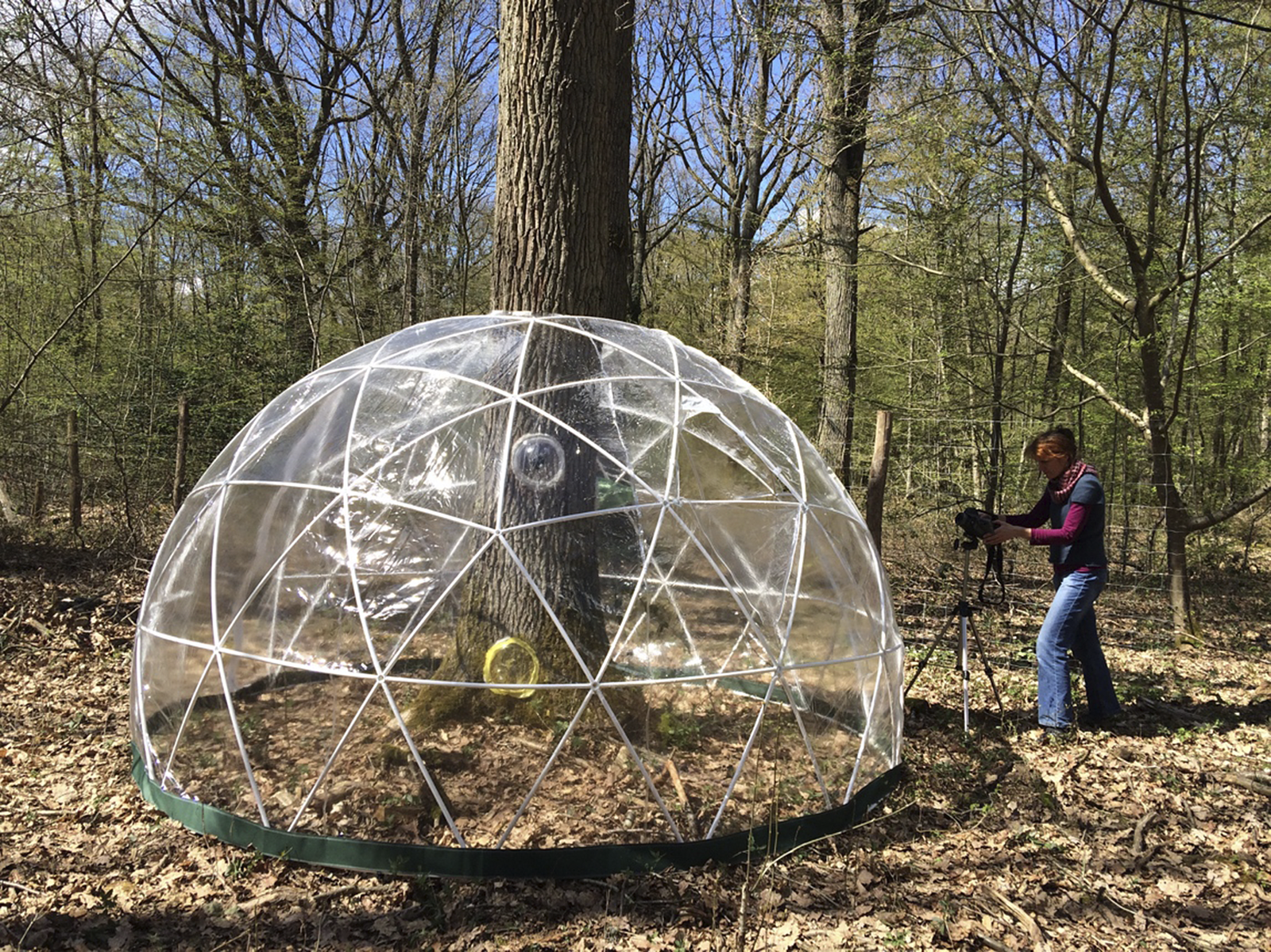
We choose an oak in that forest to be the main character of our movie, and built the geodesic dome around its trunk.
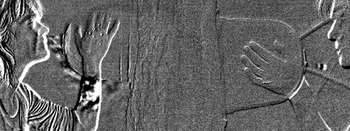
With this tool, we were able to make an experimental film, showing a ritual of a common breath with a tree: Dendromacy, in intimacy with one tree. Using three different positions of the camera, it is a 10′23″ movie achieved in 2017. To date, it is the only film in which we can see the ‘cloud’ of CO2 produced by a portion of the tree trunk, showing for a brief and fragile moment the ‘breath’ of the tree (Figure 2).
Stills from Dendromacy, 2017. Breathing of a human/concentration of CO2 from a portion of tree.

Actually, in the Dendromacy project, both human and tree CO2 emissions can be seen. But because the CO2 emission of the bark is so small, compared to the human’s one, Claire Damesin has to hold her breath while opening the plastic chamber. Both emissions are showed, but alternatively, so it can be compared.
For me, this was an opportunity to discover that one could use certain technological tools from industry or laboratory, while remaining within an artistic shape and conceptual demand. Dendromacy is a film that is showed in art centers or as part of larger experimental film programs (https://lightcone.org/fr/catalogue).
3. Listening to the soil
As part of the body of plants unfolds under our feet, in the soil, this vitality escapes our perception. The idea was born in the Rillig lab of the Freie Universität in Berlin (https://rilliglab.org/), the year before. An interesting exchange with Matthias Rillig gave rise to the idea to find ways to share with a larger audience the soil is an environment full of life and exchanges. My first idea was to be able to record the sound of the roots or mycelium growth. Back to France, and in Orsay University, I got in touch with Fanny Rybak, a bioacoustician from Isabelle Charrier’s team, at the NeuroPsi institute of the Paris-Saclay University. Aquatic ecosystems and their evolution in time through acoustic recording is studied there (for instance: Linke et al., Reference Linke, Gifford, Desjonquères, Tonolla, Aubin, Barclay, Karaconstantis, Kennard, Rybak and Sueur2018). These scientists are studying, through field recorded sounds, the quality of the biodiversity in specific fresh waters locations in time. From the recording, they are tracking the different species using bioacoustics programs such as Raven (https://ravensoundsoftware.com/) (used in Cornell U. for instance) in order to track the different frequencies of each species.
Fanny Rybak told me very quickly it could be possible to record roots, but very deceptive for an audience: waiting, maybe 2 days, for a tiny sound resulting from the movement in the soil produced by the growth of a root. When we started to work in 2017, She couldn't find any article related to ecosystem monitoring for soil, while tracking specific invertebrates has reported in different studies. (Bilski et al., Reference Bilski, Bobiński, Krajewski and Witomski2017). She was really interested in sound recordings as a non-intrusive system of soil monitoring. The second thing that seemed interesting to her was that this method could be used with a wider audience to listen to what is happening under our feet, directly on the ground.
Because she studied communication between ants previously, she had developed with a technician a tool for listening to those very faint sounds. It was a sensor made from an electronic component used to record the vibrations of industrial machines (Knowles BU-23173-000, Mouser electronics). She agreed on spending some time to try this sensor on samples of soils.
We were pleased to realise that her hunch was right: by placing soil samples in a mobile anechoic chamber (https://www.comsol.fr/model/anechoic-chamber-absorbing-electromagnetic-waves-38681)—originally intended to isolate young partridges for an experiment in her laboratory, we heard our first earthworms. The anechoic chamber was here to prevent electrical signals that could come from the lab operating from the recording device, since you have to push the volume of the Marantz PMD661 MKIII recorder, traditionally used in this lab on the field, in order to have human audible sounds. F. Rybak interest in that new experiment was to see if it could be possible to start recording some soil biotopes in order to determine the quality of its biodiversity. In her lab, those field recordings are done on aquatic biotopes through years in order to measure the biodiversity level. The live experience to listen to invertebrates’ activity with the sensor developed from the electronic component named accelerometer, is rich in empiric information. The sounds come in different ranges of qualities. To better check what was going on live, I used the anechoic chamber from F. Rybak’s lab in order to isolate different species and to listen to their different ways of moving: the intuition was that a crawling worm makes different sounds while moving in the soil than a jumping collembolans. This experiment proved me that I could be able to identify the main species from direct listening.
The first accelerometer was built with an external electric source: a battery connected to the accelerometer. But this electrical signal was very loud in the recordings. Today, with the sound artist Quentin Aurat (https://quentinaurat.com/), we improved the lab sensor in a way it is protected from electrical waves and can be used directly on the field, outdoor. He was able to plug the sensor directly into the Phantom alimentation of the recorder, a Marantz, and improved therefore the quality of the sound by suppressing one electric source.
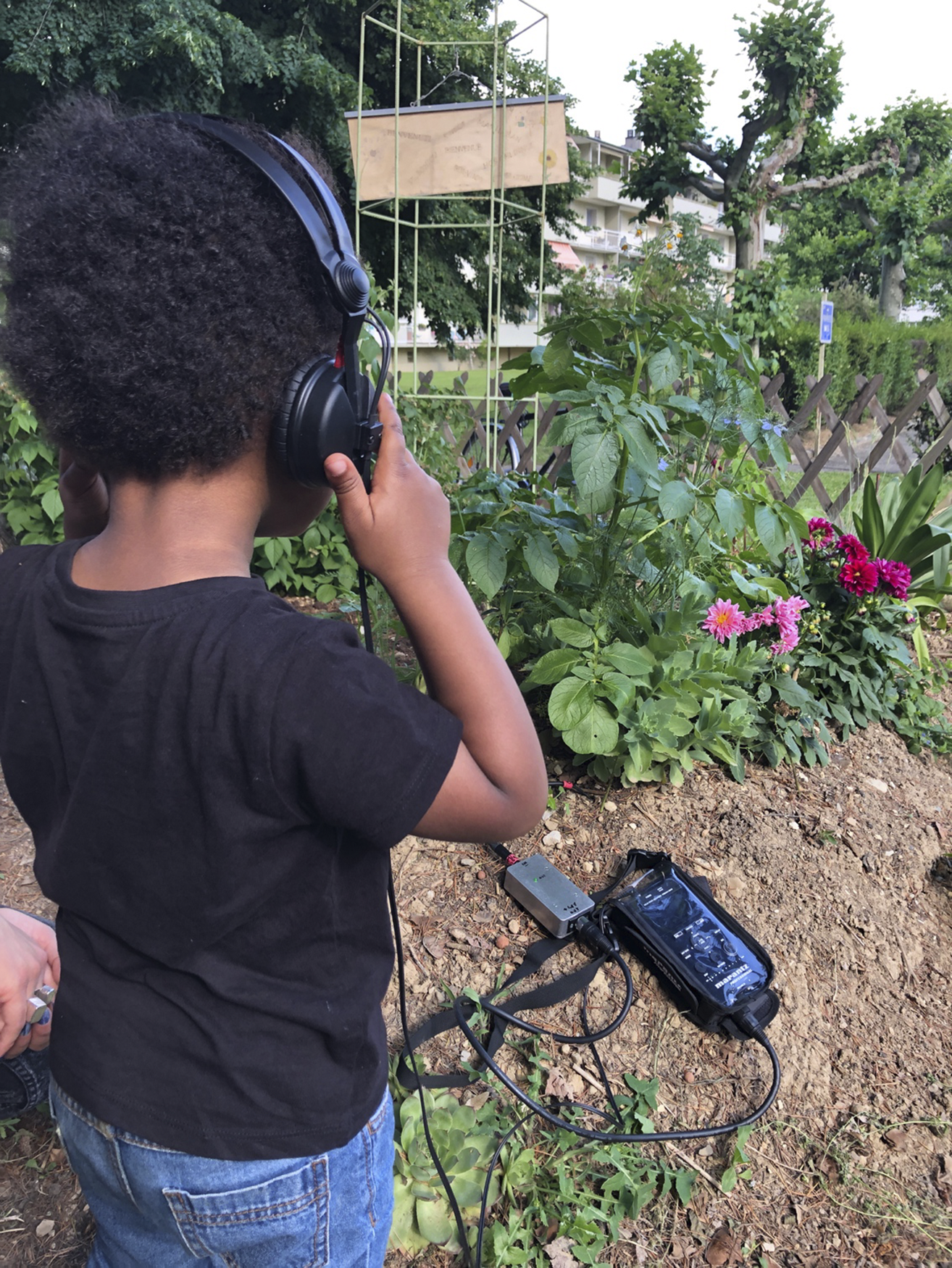
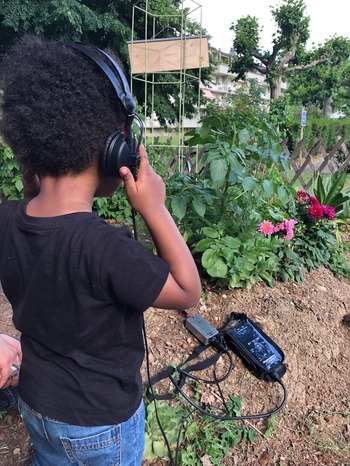
Back to my artistic practice, it allows me to propose public workshops wherein small groups we can listen to the sound of soil, live (Figure 3). In vivo, I simply put the sensor on the soil, approximately 1 cm away from the surface. The sound is produced by the evolution of different types of scavengers, making different types of sounds on jumping, walking or crawling. The smallest soil invertebrate that can be recorded with this sensor is collembolan. Sometimes it is very clear that I can record live human activities: vibrations of cars, and even radio music can be heard in the soil. Of course, it is only empiric, recognising it by ear.
Workshop in community gardens, Annecy, 2021.
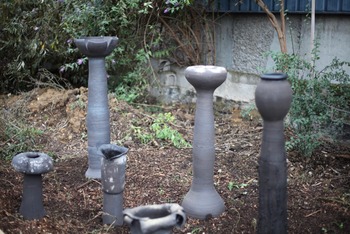
Ceramic is of course clay first, and because of its inherent properties of being an inert speaker, it was the perfect material to create a sound installation for the soil sounds. I had in mind the boats ‘écoutilles’ (hatches, but in French the word comes from ‘écouter’ meaning listen to): sculptures emerging from soil surfaces, and enlarging their shapes in order to invite to come closer to listen. And because I stayed a month in the Rillig lab for an art and science residency, I started to draw fungi-shaped forms. Then the idea became clearer to offer first a microscopic landscape that has become large. A visual proposal for the audience, in order to invite them in a second time to get closer, as the sounds of the soils are becoming more perceptible (Figure 4).
Listen to the soil, Nuit Blanche, Paris, Vive les Groues community garden, 2020.

A soil in good shape is noisy. The recordings of different soil samples are played back through small nomadic speakers in a series of twelve ceramic pieces reminiscent of fungi corollas. The sound pieces are placed on the ground outdoors, or on a surface of soil indoors. The recordings the public can listen to are previously made in situ when the territory allows it.
This installation (https://www.karinebonneval.com/eng/projets/ecouter-la-terre-10), carried out in collaboration with two laboratories (Rillig Lab and NeuroPsi) has given rise to publications (Rillig & Bonneval, Reference Rillig and Bonneval2020; Rillig et al., Reference Rillig, Bonneval and Lehmann2019). I met Johannes Lehmann while I was in residency at the Rillig lab, working on ‘Listen to the soil’ (https://news.cornell.edu/stories/2019/10/art-and-science-provide-fertile-ground-research-teaching#), and 6 months later he built the 2 years research project named after my project ‘Sounds of Soil—tracking soil health for targeted pest control’. This project, co-supervised by Kyle Wickings (CALS/Geneva Entomology), aimed at developing sensor technology to improve the early detection of insect pests, and lead to more judicious pesticide use in agricultural and horticultural systems, and enhanced agricultural sustainability and food security. ‘Sounds of soil’ received a Venture Fund grant from the Cornell Atkinson Center for Sustainability in June 2018. Louise Roberts, post-doctorate associate from Cornell AgriTech Department of Entomology, started to work on it in 2019. It is an ongoing project.
Using soil sensors to characterise the presence and distribution of such pests could therefore help to reduce pesticide inputs to soil and improve agricultural sustainability.
This is also what makes my lab residencies so exciting: sometimes my artistic research can provide ideas for new scientific research.
4. Conclusion
These unconventional projects are tending to be more frequent in science labs, because the questioning and the partnerships between art and science can sometime give birth to new questioning in science, and enlarge the audience on specific scientific topics in a new way (Rillig et al., Reference Rillig, Bonneval, de Lutz, Lehmann, Mansour, Rapp, Spačal and Meyer2021).
Acknowledgements
These artistic projects would not have been possible without the collaboration of the scientists, and their labs. I would like to thank: Claire Damesin, Professor in Plant Ecophysiology, Ecology, Systematics, Evolution Laboratory, Paris-Saclay University; Fanny Rybak, Lecturer at the University of Paris-Saclay Acoustic Communications at NeuroPsi; Matthias Rillig, Professor and Director of the Rillig Lab, Ecology of Plants, Institute of Biology, Freie Universität Berlin and Liberty Hyde Bailey, Professor, School of Integrative Plant Science Soil and Crop Sciences Section, and Department of Global Development, Cornell University. I thank the reviewers and editors for their constructive comments on the manuscript.
Financial support
Dendromacy was supported by the Diagonale Paris-Saclay Grant. Listening to the soil was supported by the Diagonale Paris-Saclay Grant, Micro Onde Art Center, DRAC Centre Val de Loire.
Conflict of interest
The author declares none.
Authorship contributions
K.B. conceived the projects and wrote the article.
Data availability statement
Neither data nor code are associated with this article.
Author biography
Karine Bonneval graduated from the European School of Image in Angoulème and the School of Decorative Arts in Strasbourg. Karine Bonneval works in collaboration with different teams of scientists in plant ecophysiology, pedology, bioacoustics and physics: Institut Diversité, Ecologie et Evolution du Vivant and NeuroPsi, Orsay University, Paris-Saclay/Rillig Lab, Freïe Universität Berlin/INRAE PIAF, Clermont-Ferrand/Soil and crops science section, Cornell University, USA/Lasire, Lille. After graduating from the Ecole Nationale Supérieure des Beaux-Arts d’Angoulème and the Ecole Supérieure des Arts Décoratifs de Strasbourg, Karine Bonneval has exhibited in France (Nuit Blanche/Domaine de Chaumont sur Loire/Micro-Onde/la Maréchalerie/la Graineterie/le Transpalette) Germany (Bourse Perspektive/Botanical museum Berlin), Latvia (Un/Green Exhibition), Denmark (AroS contemporary art museum, Haarus), USA (Cornell experimental gallery), Argentina (Centro Cultural Recoleta, Buenos Aires) and Sri Lanka (Cinnamon Colomboscope). With scientist Eric Badel (INRAE PIAF) and Studio Décalé, she won the Carasso Foundation grant ‘Composer les savoirs’ in 2019.

 Open access


Comments
I received an invitation to write a paper from Daphné Autran.As a visual artist working in collaboration with different teams of scientists, I really think it's worth to share some of my expreriences on twisting some technicals tools in order to do art installations.