




Introduction
In the mid-nineteenth century, which here refers to the 25 years or so between the early 1830s and the mid-1850s, a growing number of Siam's artists and writers endeavoured to represent the peoples of the world in a systematic fashion.Footnote 1 In compositional forms ranging from paintings and sculptures to poetry and reference works, they depicted, described, and defined a panoply of peoples as discrete social types. Unlike the scattered representations of foreigners in earlier texts and art, these new compositions subjected categories of peoples—including the Thai themselves—to organized frameworks of presentation.Footnote 2 They devoted equal attention to each representative figure, facilitating comparisons of cultural and physical alterity. Not unlike early reference works on comparative religion in Europe—which subordinated Christian beliefs to an objective structure of presentation that encouraged critics to compare and contrast religious practices across the globe—the systematic formatting of Siam's mid-century compositions made categories of peoples seem essentially equivalent.Footnote 3 The literati of Bangkok had begun to imagine that the peoples of the world could be fitted into a ‘totalizing classificatory grid’.Footnote 4 In Siam, the modern understanding of the fundamental comparability of peoples can be traced to this moment.
Historians often associate nineteenth-century attempts to order knowledge about the world's peoples with Europeans and Americans. Few Westerners resided long-term in Siam in the first half of the nineteenth century, however, and they had little direct influence on the kingdom's artists and writers.Footnote 5 But avid creators of ethnographic-like knowledge also resided in China, Japan, the Ottoman empire, and elsewhere. As early as the sixteenth century, artists in China, Japan, Europe, and the Philippines were producing and reproducing visual typologies depicting dozens of peoples, side by side.Footnote 6 By the early nineteenth century, systematic visual representations of the peoples of the world were bought and sold at major ports across the globe. Some of these trickled into Bangkok. At the same time, thousands of Chinese arrived every year. As a result, influences on Siam's artistic compositions were multiple and complex. Chinese reproductions of Western illustrations, for example, were common sights in Bangkok.Footnote 7 Even as the city's artists and writers drew selectively from newly arrived books, prints, and interlocutors, their works still teemed with tropes, vocabulary, and markers of identification long found locally.
Three exemplary compositions illustrate the ways in which Bangkok's artists and writers combined innovation and convention: a set of portraits of about 20 peoples painted on the window shutters of a Buddhist monastery, verse inscriptions describing sculptures of 32 peoples elsewhere at the same monastery, and the entries for the names of peoples in a monolingual dictionary produced by native Thai-speakers under the supervision of the American missionary, Dan Beach Bradley. The monastery, Wat Phra Chetuphon, is a major Buddhist temple known colloquially as Wat Pho. Located just south of the Grand Palace in the heart of old Bangkok, it has enjoyed royal support since shortly after the capital was established in 1782. In the 1830s and 1840s, a major renovation filled the temple grounds and its public buildings with sculptures, murals, and inscriptions of an encyclopaedic nature. The renovations were conducted on the orders of King Rama III (r. 1824–51, the ‘Third Reign’) and under the watchful eye of the temple's abbot-prince. However, the artistic details were left to a broad assortment of anonymous artists and the textual details were composed by monks, scribes, and officials of all stations. Likewise, the definitions in Bradley's famous dictionary were not written by Bradley himself, but by a pair of local scholars assigned to do the work in the early 1850s. These paintings, statues, and definitions of peoples were not the only ones produced in Siam during the mid-nineteenth century, but they are the most detailed and best documented. By taking a close look at their content, the circumstances of their production, and the sources they drew on, we can identify a meaningful shift toward the categorical representation of peoples in Siam.
These findings prompt a reconsideration of the conventional historiography of nineteenth-century intellectual change in two ways. First, while most research has focused on fields such as science, technology, geography, and medicine, where ‘Western’ and ‘indigenous’ forms may have been more easily distinguishable, knowledge about the peoples of the world was diffuse and more difficult to separate into endogenous and exogenous traditions. Unlike the scientific and technical knowledge that Bangkok intellectuals in this period associated with Europeans and Americans, knowledge about the peoples of the world was considered universal. The intellectual transition of the mid-nineteenth century was therefore one of quiet innovation as much as ‘violent’ displacement.Footnote 8 Second, by attending to the creative and scholarly works of anonymous artists, mid-ranking officials, language teachers, and conservative princes, this article identifies a neglected set of historical figures as significant agents of intellectual change. In so doing, it diverts attention from the conventional historiographical heroes: the missionaries and their princely and monastic interlocutors—especially Prince/King Mongkut (r. 1851–68). As seen from Bangkok, innovation in the production of knowledge about the world's peoples was incremental and dispersed.
Wat Pho and the agents of intellectual change
The mid-nineteenth century is often described as a transitional period in the intellectual history of Siam. In narratives of this transition, the chief protagonists are usually Prince Mongkut—a monk throughout the reign of his elder half-brother, King Rama III—and a fractious cast of Protestant missionaries who began arriving in 1828. Conversations between the missionaries, Prince Mongkut, and other Bangkok intellectuals, it is said, prompted a conceptual reorientation towards ‘rational’ modes of thinking current in the West.Footnote 9 If this were the whole story, our account of Siam's mid-century transformation should begin with Mongkut's ordination and the missionaries’ arrival in the 1820s. But Mongkut would not have found textual orthodoxy so attractive, and the missionaries would not have found such ready conversation partners, if they were not building on local intellectual trends that date, at least, to the late eighteenth century.Footnote 10
These older trends, in short, favoured reading over listening, the cosmopolitan over the insular, and the canonical over the mystical. Writers of the late eighteenth and early nineteenth centuries produced a vast new corpus of literature and reference works with readers in mind. They searched foreign and popular sources for storylines to invigorate court literature, their compositions featured realistic scenarios and cosmopolitan settings to appeal to a broader audience, and they wrote histories, treatises, and reference works designed for a growing cross-section of readers.Footnote 11 Their emphasis on the written word was shared by Buddhist reformers, chief among them Mongkut's grandfather, King Rama I (r. 1782–1809). The king is perhaps best known for convening a rare council of senior monks to purify the Pali canon through careful editing. But he also ordered scholars to translate and compose new works on Buddhist history and philosophy, and he issued a series of royal orders to discipline the monkhood by attacking supernaturalism and other pursuits unbecoming of monks. Few of the king's Ayutthaya-era predecessors had taken such steps.Footnote 12 The king also made it a habit to put the moral and practical reasoning behind his decisions in writing; treatises and royal orders alike began to include explicit justifications.Footnote 13 These long-term trends toward providing explanations, promoting textual authority, and looking outward for inspiration laid the groundwork for Siam's intellectual transformations of the mid-nineteenth century.Footnote 14
Mongkut rushed to ordain just before his father, King Rama II, died in 1824. Wisely, he kept the robes as his older half-brother took the crown. He quickly developed a reputation for his mastery of Pali texts. Around 1826, Mongkut began to see the Mon order as a model of canonical purity, and he redoubled his efforts to reform his own practice when he shifted monastic residences in 1829. It was not until around 1833, however, that Mongkut made a public break with mainstream tradition in Siam by organizing his own reordination. This event was later seen as the symbolic beginning of his Thammayut movement. In the next few years, Mongkut's handful of followers grew to a couple of dozens.Footnote 15 As early as 1830, Mongkut was exchanging knowledge with Jean-Baptiste Pallegoix, the priest of the church next door, and, throughout the 1830s, he appears time and again in the journals and letters of Protestant missionaries.Footnote 16 But even the missionaries declined to take credit for Mongkut's reforms, believing that they were made at the behest of Rama III, or at least with his approval.Footnote 17 That approval was officially conferred in 1837, when the king awarded Mongkut an elevated title and made him abbot of Wat Bowonniwet, a royal monastery in central Bangkok.
With royal support, an institutional centre, and a growing number of lay and robed followers, Mongkut was no longer afraid of stepping on toes. He embarked on a dogmatic campaign, in Craig Reynolds's words, against ‘blind faith and lax discipline’.Footnote 18 Until he softened in the waning days of the Third Reign, Mongkut was uncompromising about matters such as the proper pronunciation of Pali and the appropriate method of wearing the robes. He rejected narratives that he believed to be apocryphal, such as the popular stories of the Buddha's previous lives and the Traiphum cosmology. Instead, he sent to Lanka for manuscripts to compile a purer Pali canon and had his students study it intensely. He also corresponded actively with counterparts in Lanka, inquiring about colonial rule and defending his interpretation of canonical texts. So that lay followers would better understand the Dharma, the prince urged monks to preach more often, to use vernacular speech rather than Pali, and to avoid reading their sermons. He also printed religious pamphlets for distribution.Footnote 19 With his emphasis on monastic discipline, rational explanation, and textual authority, Mongkut followed in his grandfather's footsteps.
At the same time, the outward-looking orientation of the royal court in the late eighteenth and early nineteenth centuries primed the next generation of intellectuals to seek knowledge from foreigners. The missionaries did not disappoint. They arrived in Siam not just with a zeal for proselytization and an eagerness to converse in Thai, but also with the training and expertise to expound on astronomy, medicine, mechanics, and, of course, European languages—knowledge they hoped would persuade listeners to accept a Christian metaphysics. They reported countless visits, dinner parties, and freewheeling conversations with some of Bangkok's most illustrious figures.Footnote 20 The missionaries also supplied themselves with maps, charts, gadgets, manuals, and astronomical equipment intended to force their interlocutors to question their cosmological (and, thus, their religious) beliefs. Bradley's Thai translation of his colleague's manual on astronomy had a major impact on Bangkok's elite, even if no one converted.Footnote 21 Conversations with the missionaries often became the talk of the town.Footnote 22 They produced, in Thongchai's view, a ‘seismic shift in the intellectual milieu’.Footnote 23
On closer examination, however, this shift appears less dramatic. Scholarly accounts of Siam's mid-nineteenth-century intellectual transition tend to focus narrowly on Mongkut's orthodox movement or on fields such as science, geography, astronomy, and medicine.Footnote 24 In addition, while the effect of ‘Western knowledge’ on the general worldview of the Third-Reign elite is difficult to pin down, its effect on the masses of monks, artisans, and commoners of the period remains all but unexamined.Footnote 25 Even among the elite, the missionaries’ most frequent conversation partners were Mongkut and his associates. Aside from the prince himself, these included his full brother, Prince Chuthamani, as well as the Phra Khlang minister (the official responsible for overseas foreigners) and his sons, his deputy, and the abbot of his monastery. The powerful Bunnag family, of which the Phra Khlang and his sons were members, were avid patrons of the Thammayut movement and were instrumental in putting Mongkut on the throne in 1851.Footnote 26 Historians have therefore viewed the intellectual history of the mid-nineteenth century through the lens of factional politics. Mongkut and his supporters, open to the secular knowledge of the missionaries, represent the vanguard of intellectual transition. Princes and officials close to Rama III, in contrast, are portrayed as the conservative old guard, dismissive of the missionaries’ expertise and resistant to change. It was only after Mongkut became king that the tide turned and Western approaches to scientific knowledge were accepted with halting consensus.Footnote 27
If Siam's intellectual transition was born of engagements between Mongkut, his followers, and the missionaries, and was primarily observable in the fields of science, mechanics, and medicine, then how do scholars account for the most significant elaboration of knowledge in mid-century Siam? Beginning in 1834, an enormous collection of textual and visual compositions was installed at Wat Pho as the temple underwent a comprehensive overhaul. By the time renovations were complete in 1848, inscriptions and murals covered the interior walls of almost every public building and hundreds of small statues dotted the galleries and grounds. The scope, number, and didactic purpose of the works have led scholars to see Wat Pho as a veritable ‘encyclopedia’ and a ‘university in stone’.Footnote 28 The works cover a vast array of sacred and secular subjects, including cosmography, astrology, omens, medicine, childbirth, massage, yogic positions, folktales, versification, provincial towns, the proper behaviour of women, the treatment of small-pox, the past lives of the Buddha, and the subject of this article: the diversity of the world's peoples. Even botanical gardens of medicinal plants were laid to supplement inscriptions on treating ailments.Footnote 29 Knowledge once transmitted through manuscripts and oral instruction was now displayed for public consumption.Footnote 30 In this regard, Wat Pho's makeover was unquestionably innovative, but neither Mongkut, nor the missionaries, nor any of their confidants had any direct hand in it. On the contrary, it was Rama III who announced the renovations (as early as 1831), a prince later known as Paramanuchit Chinorot who presided over the monastery as abbot, and three officials close to the palace who oversaw the labour. How could the old guard be responsible for such an ambitious intellectual project? The conventional explanation views the renovations through the lens of Siam's political factions: Rama III ordered the production of artwork and texts to preserve ‘traditional’ knowledge in the face of a flood of ‘foreign’ ideas that threatened to swamp the kingdom in the Third Reign.Footnote 31
But when we broaden our focus beyond the factionalism of the court, and beyond Mongkut and the missionaries, and beyond even the exemplary compositions produced at Wat Pho, the intellectual transition of the mid-nineteenth century appears more gradual, and its agents more diffuse. To begin with, the didactic compositions installed at Wat Pho in the mid-nineteenth century were not entirely unprecedented. The monastery already displayed knowledge about medicine and yogic positions as early as the First Reign and at least a handful of the temple's window shutters featured paintings of archetypal peoples no later than the Second. Even before the Third-Reign renovations, the monastery was known for its public orientation and instructive murals.Footnote 32 In addition, Wat Pho held no monopoly on public displays of knowledge. Shortly before his death, Rama III had statues of rishis in yogic positions and inscriptions of medical inscriptions installed at Wat Bowonniwet, while painted portraits and statues of archetypal peoples, much like the ones on display at Wat Pho, were observed at other locations as well.Footnote 33 Even the impact of displaying knowledge publicly may be overstated, as manuscript knowledge was more commonly accessed in the past.Footnote 34
Furthermore, intellectual change was not the sole province of Mongkut and his associates. In fact, communication across class and factional lines was commonplace. For instance, some of the princes involved in the composition of inscriptions at Wat Pho, including Prince Paramanuchit and Prince Dechadison, were close to Mongkut as well as Rama III. Dechadison was also a frequent visitor of Bradley's.Footnote 35 More importantly, anonymous artists and low-level monks, officials, and commoners played crucial roles in the production of knowledge. Their roles are especially clear in the creation of textual and visual knowledge about non-scientific matters such as the diversity of the world's peoples. Such actors can be identified with the creation of all three works discussed in this article: the mural paintings on the temple shutters, the poems and the statues they described, and the definitions in Bradley's dictionary. Though courtly, monastic, and missionary figures probably determined the comparative formatting of each of these works, it was a broad cross-section of artists and writers that domesticated the foreign by reviving old tropes, interpreting new information, and adapting traditional forms of expression. By investigating the form, the content, and the creators of Bangkok's mid-century efforts to depict, describe, and define the peoples of the world, it becomes clear that Siam's intellectual transition had deep historical roots and its agents spanned the social spectrum.
Portraits of peoples on the shutters of Wat Pho
The most vivid of the mid-century works are the figures painted on the window shutters of the assembly halls (viharas) at Wat Pho. Approximately 20 pairs of life-sized, full-body portraits survive on the inner surfaces of shutters in the temple's north, south, and west viharas (Figure 1).Footnote 36 The figures occupy the positions of temple guardians, which may explain why all the figures are male and many carry weapons.Footnote 37 But the portraits do not depict particular individuals. Rather, they depict conventional types—archetypal categories that today might be considered ‘ethnic’ or ‘national’. Viewed altogether, the shutter portraits form a typology—a series of discrete, stereotyped models of various peoples for visual perusal.Footnote 38 The figures on the shutters are not labelled, and perhaps never were, so it is not always possible to identify with certainty the peoples depicted. However, each pair is given distinctive markers of identification—clothing, accessories, props, hairstyles, and facial features—many of which were well-established tropes in the artwork of Siam. By repeating them again and again in visual media, artists revived and reconfirmed locally specific conventions for differentiating peoples. This was not unusual: the frequent repetition of such markers with little concern for accuracy was consistent with typologies of peoples produced throughout Asia and Europe in the eighteenth and nineteenth centuries.
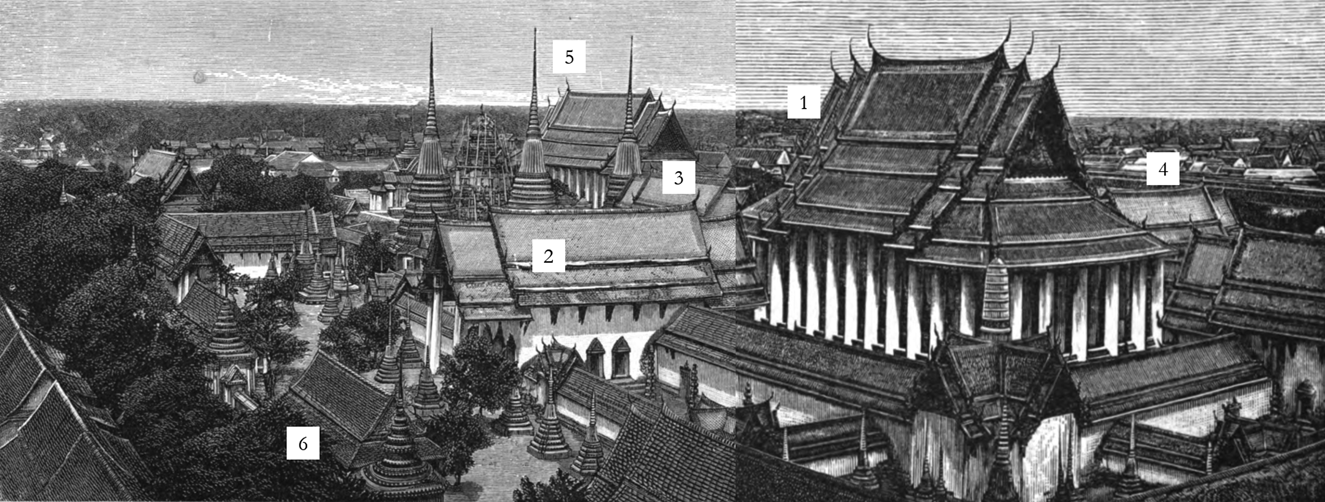
Composite view of Wat Phra Chetuphon (Wat Pho) from the south-east. The large building on the right (1) is the ordination hall (ubosot). Four viharas (assembly halls) radiate from the ordination hall in cardinal directions. Clockwise from the left, they are the south (2), west (3), north (4), and east viharas. Behind the south and west viharas are funerary stupas for Kings Rama I, II, and III. In this illustration, the stupa for King Mongkut, just beyond, is still under construction. The large building behind the funerary stupas contains Wat Pho's reclining Buddha (5). Sixteen pavilions lined the outer walls of the monastery's public grounds; one is marked (6). This image is a composite of two line drawings based on a panoramic set of photographs. Sources: The photographs have been attributed to Francis Chit and dated to 1864 by Pipat Pongrapeeporn, Phap mum kwang khong Krung Thep Maha Nakhon nai samai ratchakan thi si: kankhonphop mai / Panorama of Bangkok in the Reign of King Rama IV: A New Discovery (Bangkok: Muang Boran, 2001). The line drawings were published in Frank Vincent, The Land of the White Elephant: Sights and Scenes in South-Eastern Asia (New York: Harper & Brothers, 1874), aft. 124, 128.

The north, south, and west viharas were built during the reconstruction of the temple ordered by King Rama I (r. 1782–1809) in 1788. According to an inscription commemorating the First-Reign construction work, the interior walls of the north vihara already featured a depiction of the Traiphum cosmography—a traditional conceptualization of the worldly and divine spaces of the universe.Footnote 39 Around that time, it is possible that portraits of some peoples were painted on the shutters of that vihara, as well. Visiting in 1822, the British envoy John Crawfurd observed the Traiphum mural. He reported that the walls of the north vihara ‘contain representations of the Hindoo creation, and full-sized figures of the natives of Lao, Pegue, China, Tartary, Hindustan, and Persia’.Footnote 40 Although this is not certain, Prince Dhani Nivat and others have taken Crawfurd's ‘full-sized figures’ to be a reference to the shutter paintings.Footnote 41 As art historian K. I. Matics points out, ‘the depiction of people from all corners of the world is appropriate for the Traiphum theme which includes all forms of existence’.Footnote 42 David Abeel, one of the earliest Protestant missionaries in Bangkok, may have observed the same room in 1832. He wrote that the walls were ‘completely covered with representations of heaven, earth, hell, and one of the stars of which their books speak’, but he also noticed ‘foreigners, or caricatures of white men, and dignified natives’, alongside other figures and scenes.Footnote 43
Unlike the Traiphum murals, the figures on the shutters survive, but they are not necessarily in their original form. The portraits seen by Crawfurd were retouched, if not repainted completely, during the renovations of Rama III in the 1830s and 1840s. At around the same time, additional portraits were painted on other shutters in the north, south, and west viharas. The pair of Europeans visible today in the north vihara must have been among the new figures added in the mid-nineteenth century because, as Dhani observes, Crawfurd would certainly have mentioned them if they were present in 1822. In addition, Crawfurd says nothing about the portraits that now decorate the shutters of the south and west viharas, even though he also visited those rooms. So, they too were probably painted later—in the 1830s or 1840s. Finally, we know that additional rooms were added to the three viharas in the reign of Rama III, so the shutters in those rooms cannot date earlier than the 1830s.Footnote 44 Since then, the shutters have been restored at least twice. So, while Crawfurd's observations suggest that some of the portraits were painted before 1822—possibly in the reign of Rama I—most of today's extant portraits must be touched-up versions of originals painted in the 1830s or 1840s.
We cannot analyse the form and content of the shutter portraits without first considering the global circulation of visual typologies of the world's diverse peoples, the appearance of foreign-made portraits in Siam, and the local practice of depicting foreigners as guardian deities in local temples. Although there is no clear evidence that systematic visual typologies of peoples were produced in the kingdom before the Third Reign, examples of such works had been circulating in Asia since at least the end of the sixteenth century. Many were originally commissioned by imperial authorities, both Asian and European. As early as the 1590s, for example, the Spanish governor of Manila hired Chinese artists to paint approximately 75 pictures of various peoples and professions in a book-length manuscript later called the Boxer Codex. The Dutch East India Company merchant, Johan Nieuhof, included nearly a dozen pictures of diverse figures—singly or in pairs—in his 1682 account of the East Indies. Crawfurd's account of his mission to Siam included portraits of supposedly typical Malay, Thai, and ‘Cochinchinese’ couples, as well as profile illustrations of eight ‘national’ types.Footnote 45
The late Ming and Qing imperial courts were also interested in depicting the variety of peoples they encountered. Scholar-officials in frontier districts created so-called Miao albums, which not only portrayed Miao (Hmong) groups, but also included dozens of other peoples living on the empire's southern and south-western frontiers. Based on these and other sources, the Qianlong emperor commissioned a more formal album in 1751 in which the full variety of ‘tributary peoples’, including Europeans, were depicted side by side in male–female pairs for comparison. The production of Miao albums peaked in the late eighteenth and early nineteenth centuries.Footnote 46
Illustrations of generic peoples may have originally been based on real-life observations, but they were easily carried, copied, recoloured, adapted, and exaggerated by artists and publishers who had never met their subjects. European publishers sacrificed up-to-date accuracy for profit and expedience, continually reproducing the same illustrations in new publications. Nieuhof's prints, for example, were repeatedly copied and republished, in some cases more than a century after they were first made. Pictures highlighting ‘native savagery’ were especially popular; Nieuhof's print, ‘A Soldier of Amboina’, was reproduced again and again because, behind the soldier, two children are shown scalping a severed head.Footnote 47 Imagery circulated from Asia to Europe and then back again. The European publisher, Willem Blaeu, for instance, collected illustrations of peoples from various sources and reproduced them, in dozens of male–female pairs, in a rough civilizational order around his maps of the world. As early as the beginning of the seventeenth century, Japanese artists saw such typologies and began producing their own versions on painted screens. At first, Japanese artists faithfully reproduced the European illustrations, even copying the distorted figures of the Japanese themselves. By the mid-seventeenth century, however, they were painting all the figures in a Japanese style. They also rearranged the order, leading off with a complimentary portrait of a dignified Japanese couple and finishing with faraway peoples with darker skin, less clothing, and an abundance of hair.Footnote 48 In China, too, workshops began churning out lower-quality Miao albums for local consumers. The artists might have used stencils to facilitate mass production, as the outlines of the illustrations in different albums were identical, even as the painted details differed. Many of the details, in turn, were adjusted to appeal to the market. Some artists, for example, exaggerated hairstyles to match consumer tastes for the exotic and the skirts of some Miao women receded scandalously as prurience eclipsed accuracy.Footnote 49
By the early nineteenth century, the global market for albums, illustrated books, paintings, and prints featuring arrays of ‘exotic’ peoples was livelier than ever. Artists in Asian port cities—including Canton and Manila—created paintings of figures representing a variety of peoples and professions to sell locally and to export for buyers around the world. Workshop artists relied on subtle printed outlines, or they traced figures through glass or thin paper, to facilitate mass production. Chinese artists became well known for copying prints and paintings from both Asian and European sources. Among these were albums depicting, in tabular formats, the costumes of peoples from around the world.Footnote 50 By the mid-nineteenth century, the constant duplication of tropes, and their association with various peoples, had become a global phenomenon. In the popular imagination of viewers, wherever they lived, the repetition of certain identifying markers contributed to the formation of static stereotyped images of peoples.Footnote 51 Illustrated typologies such as these likely found their way to Siam, although there is little direct evidence until the 1830s, when books such as Crawfurd's appeared in the personal libraries of princes and high officials.Footnote 52
Though not necessarily in tabular formats, portraits of foreigners had long been brought to Siam from a variety of sources. A Persian visitor reported in 1686 that King Narai (r. 1656–88) was ‘eager to learn about the other kings of the inhabited world, their behaviour, customs and principles. He made a great effort to enlighten himself and sent everywhere for pictures depicting the mode of living and the courts of foreign kings’.Footnote 53 According to the visitor, Narai was so struck by a portrait of the Safavid emperor that he decided to adopt Persianate dress himself. King Louis XIV of France sent a large portrait of himself to Narai as a gift and pictures of the Sun King and his family could also be viewed, at the time, in the residences of the Phra Khlang and Narai's Greek minister, Phaulkon.Footnote 54 By the early nineteenth century, foreign-made prints were hung in monasteries all over Bangkok. At Wat Pho, Crawfurd observed ‘several Chinese copies of French and English prints’ decorating the walls of the north vihara. One of them, he added, was ‘the portrait of an English lady—“la pensive Anglaise!”’.Footnote 55 The surgeon George Finlayson, who accompanied Crawfurd, remarked that they ‘were amused to find suspended in a very handsome temple, two coarse paintings of French ladies, in rural costume’.Footnote 56 Although it is not clear whether Siam's temple artists would have seen visual typologies of peoples before the early to mid-nineteenth century, they were certainly exposed to imported portraits of foreigners.
While the portraits of almost two-dozen pairs of archetypal figures at Wat Pho exemplify the mid-nineteenth century trend toward comparative depiction, the decision to position them on the window shutters built on an old, local practice. As early as the seventeenth century, foreigners were sometimes depicted as temple guardians around doors and windows. Although guardians were more commonly given the form of ogres (yak), celestial deities, animals, and Chinese gods, there is some evidence that portraits of individual foreigners served as guardian figures towards the end of the Ayutthaya period (1351–1767). According to a travel account from 1690, a temple patronized by the Phra Khlang of the time featured, on the front doors, ‘two Savages with the heads of Devils, and at the back door were painted two Portugueze as big as the Life’.Footnote 57 Some of the king's royal guard were of Portuguese descent and so it might have seemed appropriate to depict them as temple guards even though they were Christians. Elsewhere, at Wat Tapon Noi in Chanthaburi, painted figures of a European—possibly Portuguese—and one or two others stand guard next to the windows.Footnote 58 Then, around the turn of the eighteenth century, portraits of a Chinese, a European, and two Muslims were painted lurking above the windows at Wat Yai Suwannaram, Petchaburi. Murals dated 1734 at the nearby Wat Ko Kaew Suttharam include a series of figures, wearing diverse costumes, floating under the eaves.Footnote 59 Though the Phra Khlang's temple does not survive, the figures at the other monasteries seem to display the idiosyncratic features and sartorial details of specific individuals, not generic types. The features of the European at Wat Yai Suwannaram can even be traced, plausibly if not certainly, to a portrait of Britain's King James I, a copy of which may have made its way to Siam via the Mughal empire.Footnote 60 Unlike the figures at Wat Pho, however, only foreigners with fearsome reputations were selected to guard Ayutthaya-era temples. They were not archetypal portraits displayed for public instruction and comparison.
If the painters responsible for Wat Pho's shutter portraits were the same as those assigned to the mural paintings on the surrounding walls, they were members of the royal artist corps.Footnote 61 While they were exposed to foreign-made portraits, they did not, it seems, use those illustrations as models for their shutter paintings. Neither did they rely on their own observations of the cosmopolitan residents around them. Instead, they drew on locally familiar tropes and stock images of foreigners. Indeed, some markers of identification changed little from the late seventeenth century to the mid-nineteenth. It is possible, as Matics suggests, that ‘eclectic artisans were following Ayutthaya [period] models from iconographical sketchbooks’.Footnote 62 The artists also surely observed examples of stock characters on temple walls throughout the city. One of the clearest examples is the figure of a particular variety of European, usually identified by later scholars as French or Dutch. In murals of the eighteenth and early nineteenth centuries, this sort of European generally wears a wig with long curls, a black hat with an upturned brim, a frilly cravat and cuffs, and a long colourful coat.Footnote 63 Popular among European gentlemen from the late seventeenth to the mid-eighteenth centuries, this attire was decidedly old-fashioned by the end of the eighteenth and was comically outdated by the mid-nineteenth. Yet these markers were still used to depict the figure of the Dutch or French European at Wat Pho and elsewhere in Siam.
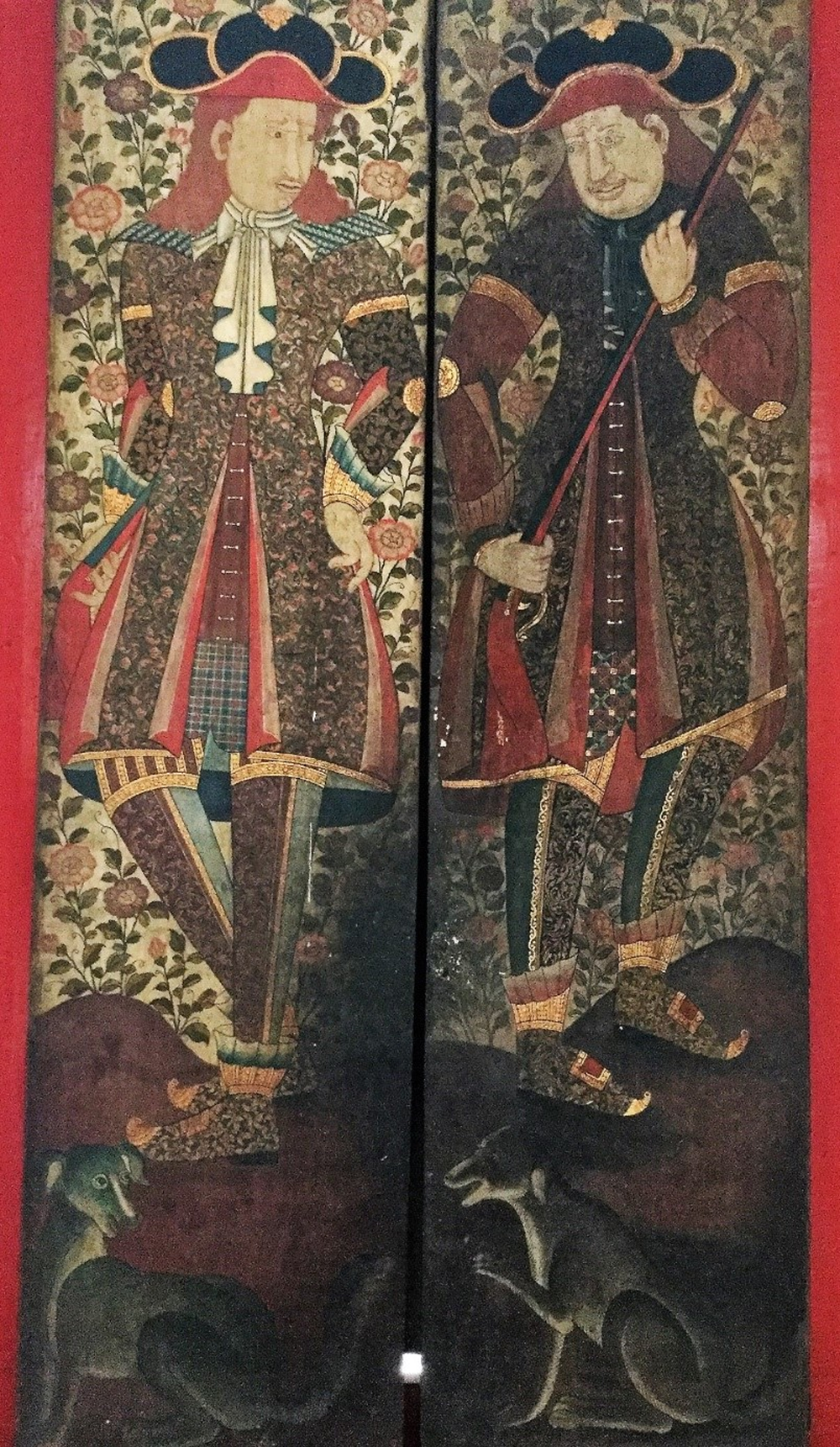
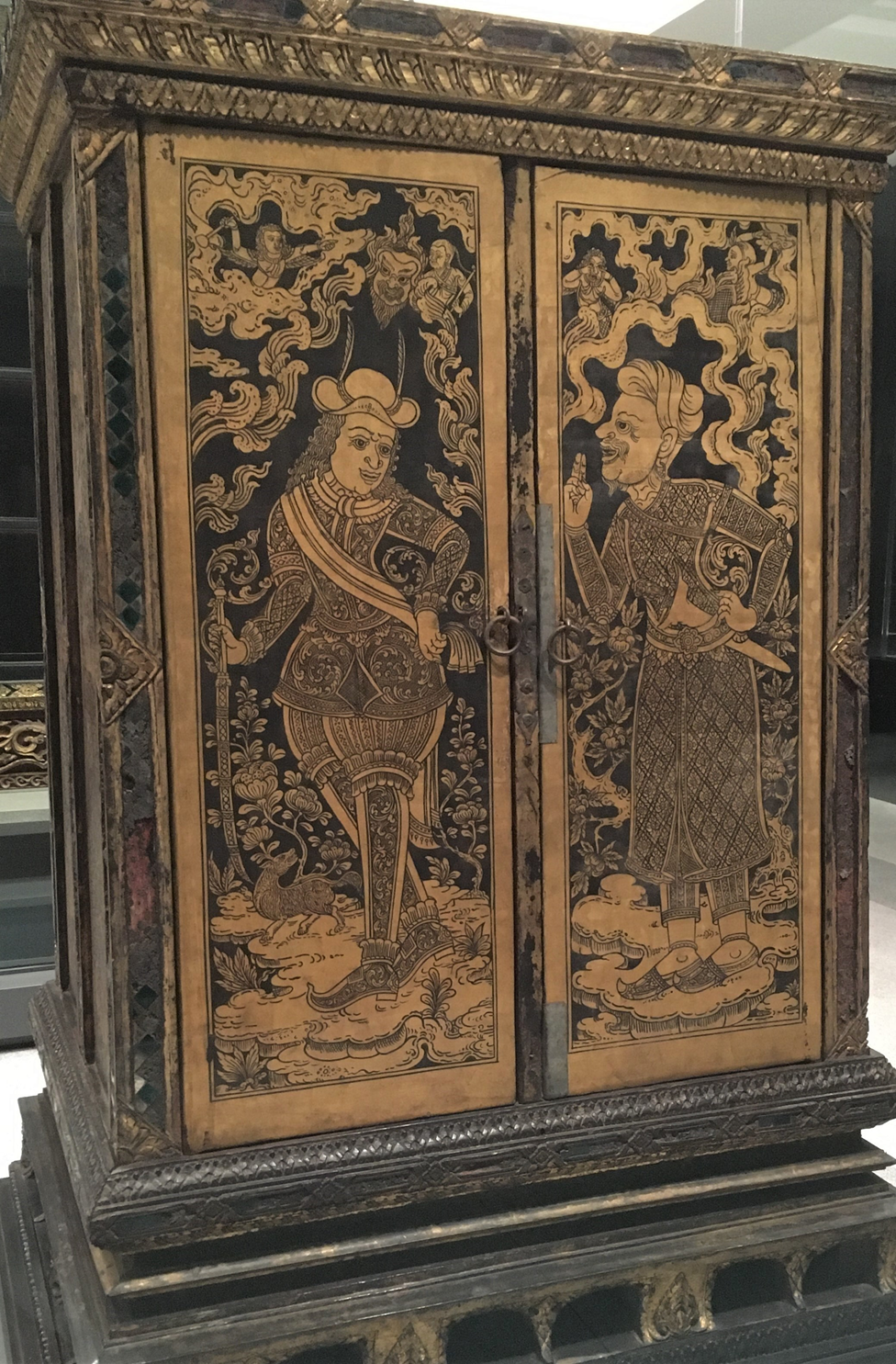
A pair of Europeans on the Wat Pho shutters (Figure 2) includes all these markers. They closely resemble Europeans depicted a century prior on the walls of Wat Ko Kaew Suttharam, Phetchaburi, and in a late Ayutthaya-era pavilion now located at the Suan Pakkat Palace in Bangkok. Even though a Jesuit priest in the Wat Ko Kaew mural has dressed himself as a Buddhist monk (Figure 3, at far right), he is nevertheless rendered identifiably European by his hat and wig—clues that ensure his correct identification.Footnote 64 In addition, the left-hand figure in the pair of Europeans on Wat Pho's shutters strongly resembles a European depicted on a famous lacquer cabinet of uncertain date housed in the Bangkok National Museum (Figure 4). Both figures adopt a stance popular in late seventeenth-century French royal portraiture: each figure's weight rests on his forward left foot, while the right foot is tucked behind. His left hand rests on his hip while his right holds a weapon. Art historians have argued that the prototype for these two figures, and for the representation of this type of European in Siam generally, may have been the portrait of Louis XIV given to Narai.Footnote 65
Portraits of Europeans—perhaps French or Dutch—painted on the shutters of one of the directional viharas, Wat Pho. Source: Arthit Jiamrattanyoo.
Detail of Europeans, including one dressed like a Buddhist monk, in a mural dated 1734, Wat Ko Kaew Suttharam, Petchaburi, Thailand. Source: Matthew Reeder.

Lacquer manuscript cabinet featuring a European (left) and a Persian or Indo-Persian (right), National Museum, Bangkok. Source: Matthew Reeder.
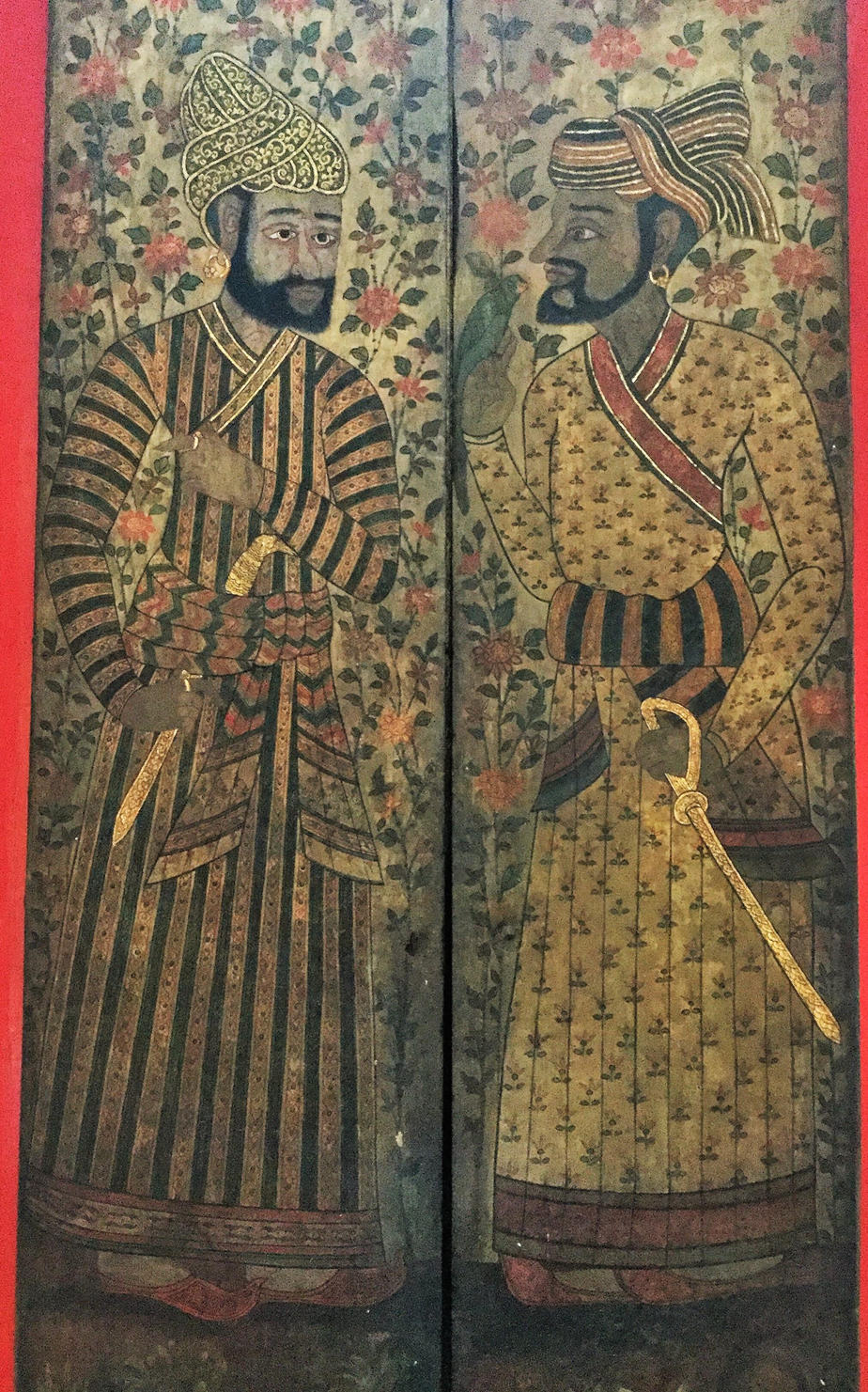
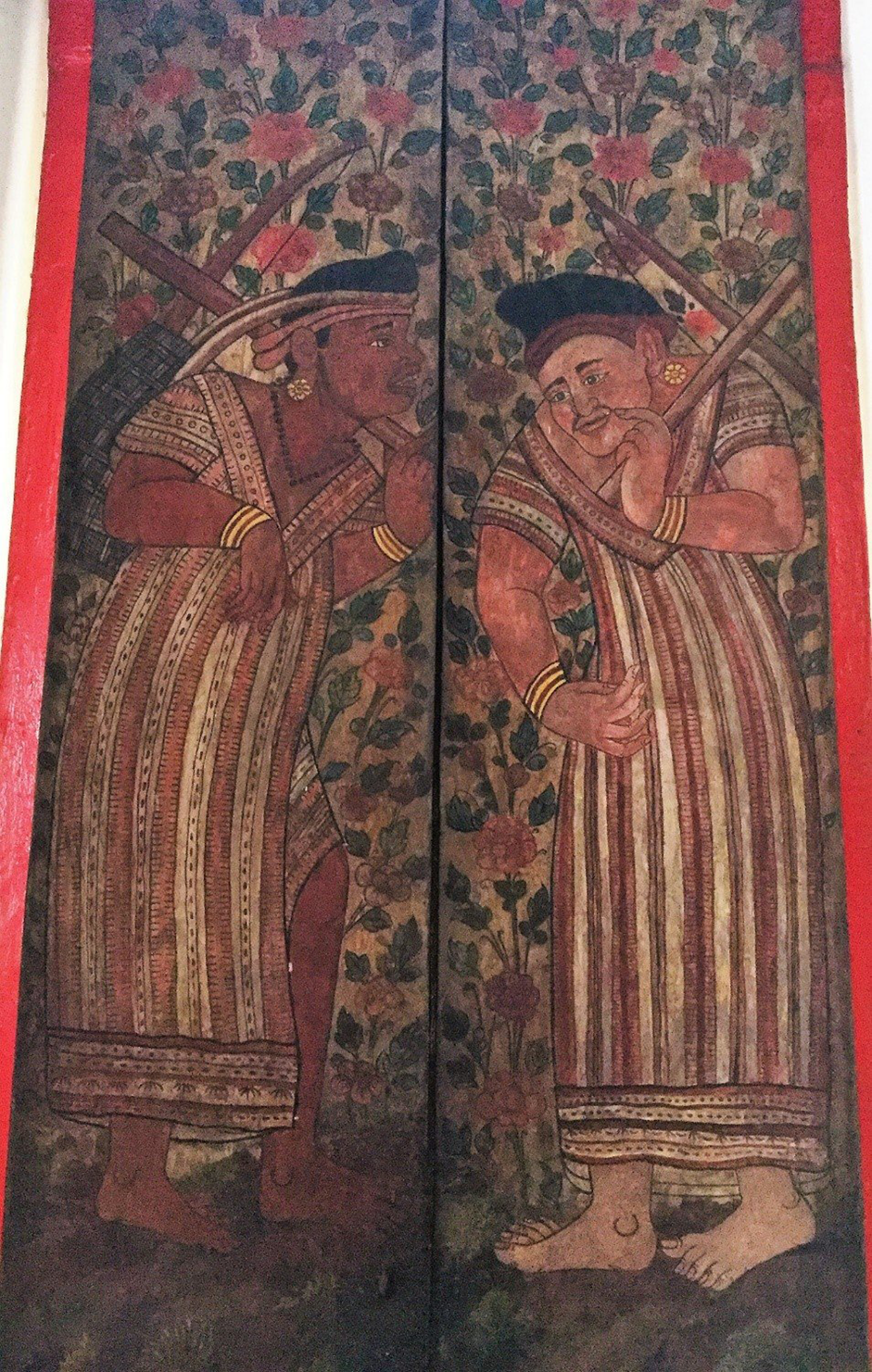
The stock figure of a Muslim in Persianate dress also appears frequently in eighteenth- and early nineteenth-century murals. Wearing a turban, slippers, and a colourful robe, he may represent Persians, Indo-Persians, or another sort of Muslim from Southern Asia. Next to the Louis-like European on the doors of the lacquer cabinet is a Muslim figure of this type (Figure 4). His pose, like his partner's, resembles one of the portraits at Wat Pho, but other props differ (Figure 5). The shutter figure's sword and sash appear to match the Indo-Persian style more closely than the cabinet figure's kris and belt.Footnote 66 Persianate Muslims with sashes and swords also appear in other eighteenth- and early nineteenth-century murals such as those at Wat Chaiyathit, Wat Suwannaram, and Wat Saket.Footnote 67 Even some hill peoples such as the Karen—probably unfamiliar to the artists of the Ayutthaya period and virtually unknown outside the region before the 1820s—were, in the early nineteenth century, already associated with certain archetypal markers of identification.Footnote 68 A long off-white tunic with vertical stripes, a crossbow, and a woven basket distinguish Karen figures not only on the shutters at Wat Pho (Figure 6), but also in murals at Wat Bangkhae Yai and Wat Bang Yi Khan.Footnote 69
Portraits of Persians or Indo-Persians painted on the shutters of one of the directional viharas, Wat Pho. Source: Arthit Jiamrattanyoo.
Portraits of Karens painted on the shutters of one of the directional viharas, Wat Pho. Source: Arthit Jiamrattanyoo.
The set of portraits at Wat Pho was not the only typology of peoples painted on the doors, shutters, and walls of important buildings in this period.Footnote 70 In 1834, a British envoy exploring trade opportunities, David Richardson, noticed a similar set of portraits at the palace of the king of Chiang Mai. He wrote:
The hall I was received in is a brick building about 100 feet by 50, the walls painted with an extraordinary jumble of clouds, trees, temples, and on the window shutters natives of different countries in the act of salutation. Among others I observed two Europeans in the costume of the time of George II.Footnote 71
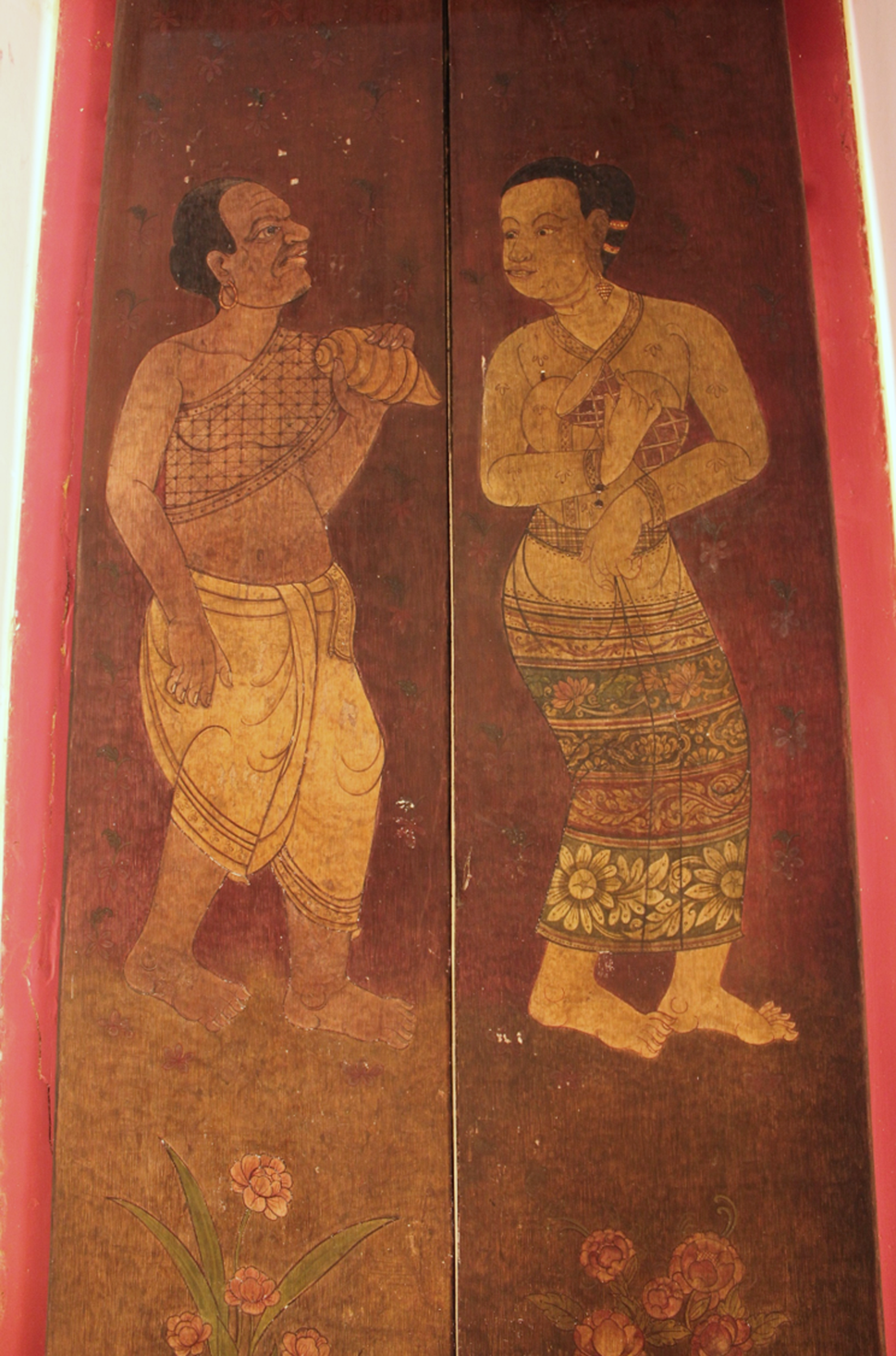
Three decades later, a German doctor noticed portraits of various ‘races’ of Brahmins on the walls of Bangkok's Wat Suthat, which were probably painted in the Third Reign.Footnote 72 In addition, the shutters of the ordination hall at Wat Bang Khun Thian Nok in Thonburi, which were also probably painted in the Third Reign, feature portraits of 22 different peoples in male–female pairs (Figure 7). As at Wat Pho, the portraits are not labelled, but the markers are familiar enough that all but one of them have been tentatively identified.Footnote 73
Recently restored portraits of a Brahmin man (left) and an unidentified woman (right), Wat Bang Khun Thian Nok, Thonburi, Thailand. Source: John S. F. Smith.
Although the practice of posing foreigners as temple guardians dates to the Ayutthaya period, the nineteenth-century typologies at Wat Pho and Wat Bang Khun Thian Nok feature a larger selection of figures. By the 1830s or 1840s, full-length portraits of 20 different peoples or more graced the window shutters at both locations. Despite the availability of foreign illustrations and even the presence of actual foreigners, the artists eschewed empirical observation. Realistic likenesses were not the goal. Rather, by repeating the same tropes over and over, Bangkok's mid-century artists disseminated local conventions for categorizing the world's peoples.Footnote 74 This was not unusual—in Europe, illustrations of the world's ‘native’ peoples also relied on the constant repetition of dated markers that rendered Europe's ‘others’ fixed in time.Footnote 75 Artists in Siam likewise revived hoary tropes but, in the first half of the nineteenth century, they did so for a new purpose: to transform traditional depictions of foreigners as guardians into painted typologies offered up to facilitate comparison.
The statues and the stanzas
Representations of alterity took a different form in the string of 16 rectangular pavilions erected alongside Wat Pho's outer walls. At both ends of each pavilion, a small sculpture—approximately a metre high—represented one of the world's peoples.Footnote 76 On the walls behind the statues, mural scenes represented their characteristic ‘fortresses or homelands’.Footnote 77 Although no trace of the murals remains, a handful of the original 32 sculptures survive.Footnote 78 In addition, each sculpture was accompanied by a two-stanza descriptive poem inscribed in stone on a nearby wall. Most of these inscriptions have likewise been effaced, but the poems themselves were recorded for posterity and have been published many times.Footnote 79
Prince Paramanuchit Chinorot, the abbot of the monastery during the renovations, was heavily involved in the textual side of the project, compiling sources and composing inscriptions. In 1845, he wrote a poem to celebrate the progress of the work. The poem includes a few lines about the statues of peoples and the inscriptions describing them:
The statues and their poetic captions date to sometime between 1834, when the encyclopaedic phase of the renovations began, and 1845, the date of this commemorative poem.Footnote 81
While the statues and verses, like the shutter paintings, cover an impressive number of peoples, they are not comprehensive. Some peoples who were known in mid-nineteenth-century Bangkok, such as the Portuguese, English, and Americans, were left out.Footnote 82 At the same time, obscure peoples like Yipset-an and Sarakachuan were included.Footnote 83 As with the social identification of peoples everywhere, the process was hardly scientific; Africans were lumped together as one, for example, while Russians were divided into the ‘Petersburg Russians’ and the ‘Russians living near Chinese territory’. Likewise, separate statues and verses differentiated the figure of the ‘Hindu’, the ‘Brahmin Hindu’, and the ‘Rammahet Brahmin’.Footnote 84 Without exception, the stanzas and surviving statues use men as representatives of their peoples.
While each category of people is accorded equal attention—an identically sized statue and two stanzas—the poetic descriptions reveal the subjective, unsubtle judgements of the authors about the bodies and cultures of the peoples described.Footnote 85 I will offer three examples: the contemptuous treatment of the African, the mockery of the Russian, and the glorification of the Thai. Each set of verses is signed by its author. I begin with the description of the African because it is the only one that can be linked with confidence to a surviving statue:
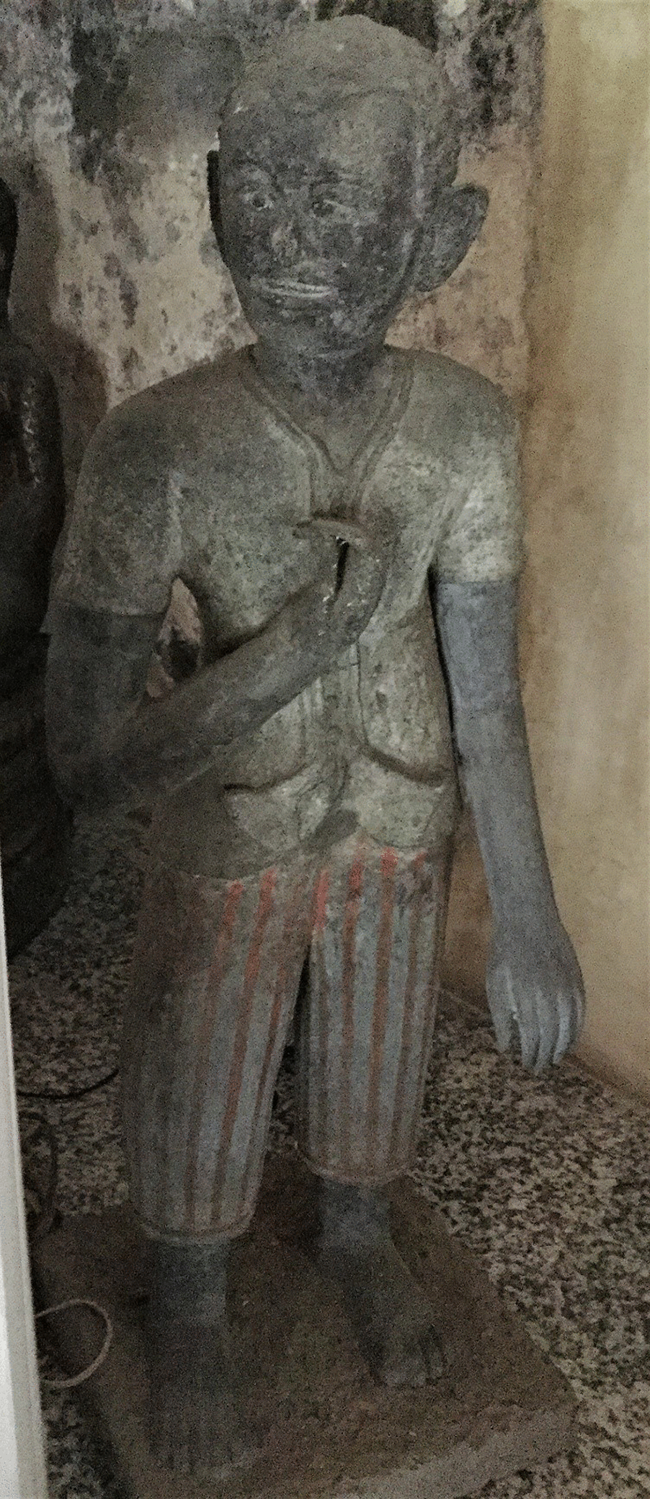
Turning to the statue of the African (Figure 8), we can clearly see the curly hair and bared white teeth—markers of ugliness in mid-century Bangkok. The figure's trousers feature bold stripes that predate its recent restoration. No sign of the original floral pattern remains.Footnote 87 The statue also appears to be lacking the cloth that, according to the poem, served as a belt. Nevertheless, the statue's hair, teeth, and striped trousers suggest that the African's sculptor and his poet attempted to call attention to the same tropes.
Sculpture of an African, Wat Pho. Source: Arthit Jiamrattanyoo.
The poetic description of the Rut Pita-sabak combines the author's negative judgement of the Russians of St Petersburg with information that must have been adduced from a foreign interlocutor or gazetteer:
In these lines, markers of identification include the geographical location of the Russian homeland, its extreme weather, a vague second-hand notion of Russia's large population, a description of the hearths and coats of its rural people, and a derisive comment on their odour. The scholar Barend Jan Terwiel has argued that entertainment was more important than accuracy in these verse descriptions of peoples, but it was not unusual for early ethnographic descriptions worldwide to focus on the unusual, the comic, and the disgusting.Footnote 89 After all, memorable features aided differentiation. I have not been able to trace the source of this information on the Russians, but the details and the qualitative judgements were characteristic of both English and Chinese gazetteers of the period.Footnote 90
Other figures are described with admiration, but the most flattering verses were reserved for the statue of the ‘Siam[ese]’.Footnote 91 Along with the Sinhalese people, who were the highly respected inhabitants of the great Buddhist ‘continent’ of Lanka, the stanzas on the ‘Siamese’ were composed by the temple's abbot, Prince Paramanuchit, himself. The prince was considered old-fashioned in both his beliefs and his writing style.Footnote 92 He joined his teacher, Phra Phonnarat, and his nephew, King Mongkut, in preferring ‘Siam’ over the colloquial ‘Thai’ to label his own language, kingdom, and people. In fact, throughout his life, the prince remained unusually reluctant to use colloquial labels for peoples in his verse compositions, preserving the style of a bygone era in which such labels had little role in formal expression. Of the ‘Siamese’, he writes:
The decision to include a figure representing the ‘selves’ of the Bangkok elite—or, at least, most of them—marks a shift in classificatory thinking. The term ‘Thai’ was rarely used as an ethnic label before the late eighteenth century and ‘Siam[ese]’ was even rarer. And, in contrast with the African, the Petersburg Russian, and most of the other figures, the Siamese was represented by a nobleman, not a commoner. The inclusion among the statues of a ‘Siamese’ nobleman suggests that, by the mid-nineteenth century, Bangkok's writers believed that they constituted a people, too; ethnic labels were not just for ‘others’.Footnote 94
The verses shift easily between references and referents. The verses are associated with the statue, the statue with the nobility, the nobility with the ‘Siamese’, and the Siamese with the royal city. The name of the old capital, Ayutthaya, is also applied to Bangkok, suggesting the continuity of Siam's ruling classes over time. The verses helped readers to make the association between the statue in front of them, the officials of the state, and the representation of the Siamese. Most Thai commoners, however, would have seen little of themselves in either the stanzas or the statue.
As the historian Davisakd Puaksom has observed, the markers of identification used in the verses vary substantially. Descriptions of all but two of the sculptures call attention to the people's dress. Most of the poems allude to the people's homeland or associate them (usually vaguely) with a kingdom or polity. About half make some mention of the people's beliefs or religious practices and about a third refer to their typical occupations or skills. Nine of the descriptions mention skin colour, facial features, or beards.Footnote 95 As with the shutter paintings, the sculptors and poets often highlighted the characteristics that marked difference most memorably. Many of these markers were exaggerated or dated. Few of Bangkok's diverse foreign residents looked much like their representatives in sculpture and verse. It would be misleading to conclude that any one kind of marker was used to define peoples in mid-nineteenth-century Bangkok, as the verses use so many. It might appear from the use of the word phasa (lit. ‘language’) to label categories of peoples—as in the commemorative poem by Paramanuchit quoted above—that native language was the deciding factor. In the verses, however, language characteristics were largely ignored.
Responsibility for the composition of the 32 poems was parcelled out to 18 different writers. They ranged from princes to lower-ranked monks and officials about whom we have only fragmentary information. It was appropriate that Paramanuchit, an abbot and future patriarch, wrote about the Sinhalese people of the celebrated Buddhist land of Lanka and that Luang Likhitpricha, who had led a corps of scribes to Battambang with Bangkok's army, wrote about the Khom (Khmer).Footnote 96 Otherwise, it appears that writers were not chosen for their familiarity with the peoples they described, but because of their skills at verse composition. In fact, most of these authors worked on multiple texts for Wat Pho. In addition to describing the statues of peoples, four of them also composed verse captions for murals of Ramayana scenes, ten of them also contributed stanzas describing the exercises of ascetics, and five also supplied stanzas for a set of verses exemplifying prosody.Footnote 97 It has been assumed that the authors were partisans of the king, but this was not strictly the case.Footnote 98 Many of the authors were too lowly to have left us much evidence about their connections, while two of the more exalted authors—Paramanuchit and Dechadison—are known to have been close to Mongkut, as well.
Dechadison, the head of the palace scribal corps, also appears in the diary of the American missionary, Dan Beach Bradley. In 1840, according to Bradley, news of the outbreak of the Opium War prompted the royal court to question the relative power of China, Britain, and other states. Dechadison first sought the advice of the Catholic bishop, Jean-Baptiste Pallegoix, who naturally identified Rome, along with England and Russia, as the ‘greatest kingdoms on the earth’. The prince then invited Bradley to comment, in the American's words, on ‘the different races of men now living on the face of the earth, their manners and customs, and the extent of their territories’. With several missionary colleagues, Bradley took some time to compile a table that ranked 15 European nations and included statistics about their populations, territories, and military forces. Rome was ranked last. The prince did not accept the information uncritically—he was sceptical that the missionaries could get reliable statistical information and he rightly suspected that Protestants and Catholics were biased in favour of their own coreligionists.Footnote 99 Indeed, it is likely that he knew more than he let on.Footnote 100 Despite Dechadison's interest in ranking nations, comparing statistics, and seeking knowledge from foreigners, there is no evidence that this information informed any of his verse descriptions of peoples. Dechadison himself did not write about Europeans at all, but about the Chinese, Japanese, Koreans, and Sarakachuan.
However, some sources of information can be inferred. The names of almost two-thirds of the peoples described in the poems at Wat Pho can be found in a list of 62 peoples embedded in Nang Nopphamat—a multi-author treatise from the late 1820s or early 1830s. Even the names of a few obscure peoples like the Rammahet Brahmins are found in both compositions, so the list in Nang Nopphamat may have been one of the sources consulted.Footnote 101 Evidence in the stanzas themselves suggests that local knowledge about peoples was supplemented with foreign sources of information. Even the names of some of the peoples were probably unknown before the nineteenth century. In all other pre-modern sources, the Thai-language term for the Dutch was Wilanda, probably derived from the Portuguese and Malay term for Holland. Yet, one of the poems describes a statue of a Dotchi, who is said to hail from a land adjacent to Wilanda. Scholars usually assume that Dotchi is the Thai version of the English word for the Dutch, but it seems more likely that it comes from the Dutch or German word for Germans.Footnote 102 In any case, the word was new to Siam. The verses on the French and the Sarakachuan claimed that each used Sepoy soldiers. Sepoys were probably not well known in Siam before Crawfurd's contingent of Sepoy guards caught the attention of the royal court.Footnote 103 One set of stanzas associates the Qing with Tartars (Tat), explicitly positioning the imperial family as outsiders who compelled the ‘Chinese’ to start wearing queues. The persistent differentiation of the Manchus from the Chinese was common in accounts from East Asia.Footnote 104 Finally, the poem on the Muslim Hui people of China admits that no one knew what they looked like and that the sculptor had to base the statue on hearsay.
The inclusion of vocabulary and information from a variety of foreign sources—both Chinese, it seems, and European—shows that the statues and stanzas did not simply reproduce ‘traditional’ knowledge. At the same time, like the shutter portraits, they revived many well-worn tropes. In other words, Wat Pho's portraits, statues, and poems represent something quietly innovative: an effort to reconcile new sources of information and new comparative formats with old social categories and markers of identification. The poets juxtaposed the intimately known Siamese with the unfamiliar Russians, and the well-worn tropes of European hats and wigs with hearsay about the Hui. The knowledge about the peoples of the world produced for display at Wat Pho was not intended to represent Siam's ‘traditional’ knowledge. Rather, it was part of a grand project to demonstrate local command of a universal body of knowledge. As such, it combined information and forms of expression from both foreign and local sources, copying neither wholesale.
Defining peoples for Bradley's dictionary
Dictionary definitions, like the artistic depictions and poetic descriptions of peoples, relied on tropes and archetypes. Nowhere were these definitions so expressive as in the monolingual Thai–Thai dictionary produced under the direction of the Protestant missionary, Dan Beach Bradley, in the early 1850s.Footnote 105 The dictionary provides entries for at least 20 different peoples, or more than 40 if subentries are counted separately. Because the dictionary is associated so closely with its American originator, it has not been considered in the context of local knowledge production. It is true that Bradley dictated the format of the dictionary in at least two respects: even the simplest words were given definitions and entries were arranged alphabetically.Footnote 106 It appears that he also compiled the list of words to be defined. The definitions, however, were composed by Bradley's ‘language teachers’—native speakers educated in the Buddhist tradition—and they reflect a local perspective. In format, early missionary dictionaries such as Bradley's increasingly resembled the user-friendly lexicons that local scholars had begun producing in response to a late eighteenth- and early nineteenth-century trend towards reading for pleasure. So, to the Bangkok literati of the time, the monolingual dictionary produced by Bradley's teachers appeared innovative, both in form and in content, but not alien. I make this case in the pages that follow before examining the dictionary definitions themselves.
Compared to other dictionaries compiled in the mid-nineteenth century, Bradley's was an impressive feat. It contains five times as many entries as its only monolingual precursor—a dictionary manuscript also compiled by ‘native assistants’ under the direction of the missionary Jesse Caswell—and its definitions are longer and more expressive. As such, it offers the richest evidence of local efforts to identify and define the peoples of the world. Although Bradley began collecting words for a monolingual dictionary in 1838, the work lapsed at some point before he embarked on a three-year trip to America in 1847.Footnote 107 In 1851, shortly after Bradley's return, Mongkut succeeded Rama III and Bradley's old teacher, Ajan That, offered to restart his work. Bradley wrote of visiting ‘the monastery of Teacher That’, so it seems that Ajan That was closely associated with a monastery—perhaps as a lay leader or a former monk.Footnote 108
In a September 1854 diary entry, Bradley notes his dissatisfaction with his previous efforts to produce a monolingual dictionary and explains how he restarted the project in 1851:
I judged it best to have a new more perfect arrangement made comprising if possible nearly if not quite all Siamese words in the language. Hence I set my Siamese teacher, a fine scholar, at the work, overseeing and directing him in it. He has now had that work in hand nearly four years defining all the words himself alone. Within the last year I have called in my old teacher Nai Muang to take a part in the work in order that it may be the sooner brought to a close.Footnote 109
Definitions were finally completed in May 1855. The dictionary, Bradley wrote, was ‘wholly Siamese and the words have been defined wholly by Siamese scholars under my own particular supervision’.Footnote 110 Although his second teacher, Nai Muang, evidently assisted, a note printed on the first page of the dictionary credits Ajan That with the definitions. At 40,000 words, it was the most comprehensive Thai dictionary to date. Although it is possible that Bradley made some modifications here and there, there is no evidence of major revisions or additions.Footnote 111 On the contrary, many definitions reflect a distinctly local perspective. In manuscript form, Bradley's dictionary had few readers, but the composition nevertheless reveals the kind of knowledge circulating in mid-century Bangkok.Footnote 112
The form of the dictionary—comprehensive and practical—corresponded with trends in Thai readership in the late eighteenth and early nineteenth centuries. In the old kingdom of Ayutthaya, literature was usually recited and heard, not read. Treatises on Thai prosody, such as the series of related texts called Jindamani, were designed to assist composition, not consumption. Older versions of Jindamani included a lexicon of difficult words arranged homophonically to help writers to distinguish words that sounded alike and to spell them correctly. Many of the words in these lexicons were not, however, defined or provided with synonyms.Footnote 113 In the early nineteenth century, as Nidhi Eoseewong has argued, a trend among elites toward reading for pleasure was well underway. Primers for teaching basic reading skills proliferated. A new edition of Jindamani featured a lexicon in which the words were rearranged topically (although still in a rather stream-of-consciousness fashion) and assigned brief glosses.Footnote 114
Another lexicon, the Kham Ritsadi, was probably written in the early 1850s. Dechadison was its author, likely in collaboration with Paramanuchit and another prince.Footnote 115 This new work improved on earlier lexicons by expanding the number of entries considerably, to around 1,300, although they were still limited to difficult words with obscure roots. The work's topical organization was a bit more intuitive than previous lexicons and, in addition to assigning synonyms or brief definitions for every entry, examples from literary or colloquial sources were provided for some words as well. One topical cluster in the Kham Ritsadi defines nine rarely used labels for peoples. Meng, for example, is defined as Mon. The word Man, defined as Phama (Burmese), is supplemented by what seems to be an obscure saying: ‘Man trade crows; Khula trade chickens.’Footnote 116 It is tempting to wonder whether Dechadison was inspired to embark on this project after having a conversation with Bradley in 1840. The missionary, who had already envisioned writing dictionaries himself, proposed to the prince that ‘some efforts’ be made to ‘settle the language upon some standard, as [with] dictionaries and grammars’. In reply, according to Bradley, ‘the prince very modestly confessed that the Siamese grammar was a confused thing and quite beyond his depth’.Footnote 117
In the end, just like the missionary dictionaries, the Kham Ritsadi was designed as a reference work for learners and readers. According to the colophon on one surviving manuscript, its purpose was ‘to enable women and men who love learning about works of kap, khlong, lilit, and chan [verse forms] to understand and remember … [it is] much like an aphithansap’.Footnote 118 The reference to an aphithansap would have brought to mind, at least for locals with a monastic education, the expansive twelfth-century Pali lexicon called the Abhidhānappadīpikā, known throughout the Theravada world.Footnote 119 Bradley's dictionary sported a similar title, Akkharaphithansap, which was likewise a deliberate attempt to situate the work into a locally recognizable genre.Footnote 120 To well-read locals, Bradley's dictionary would have appeared innovative, but not completely foreign. Like the Kham Ritsadi and the other new user-friendly lexicons, its format addressed the needs of an increasing number of Thai readers.
In Caswell's dictionary, the definitions of the names of peoples are generally limited to stating, vaguely, that they refer to a people. Sometimes, the direction of the people's homeland from the vantage point of Bangkok is also mentioned.Footnote 121 Fortunately, most of the definitions in Bradley's dictionary are more expansive. The authors, Ajan That and Nai Muang, were rarely content to say that a word was merely the name of a category of people. They usually added other details, such as synonymic labels, geographical origins, and markers that, they implied, distinguished one people from another. The sort of markers invoked in these definitions varied considerably, but clothing and hairstyle were most common. In addition, the definitions indicate that labels for peoples were, by the mid-nineteenth century, conceived of as referring to bounded, coherent groups and that the abstract term for such groups was still in flux. The words phasa, chat, and phuak—each word carrying its own connotations—were used interchangeably to refer to what today we might call an ‘ethnic group’.Footnote 122
Four example definitions illustrate the variety of markers and abstract terms used by Ajan That and Nai Muang:
Lawa, are the people of one phasa called Lawa. People of this phasa have no mueang [town, state]; they have only villages. They wander and reside in the mueang of a king.
Kaew, are the people of one chat; [they are] as if from a Lao mother and a Vietnamese father.
Phama [Burmese], is the name of people in Ava. People of that mueang generally keep their hair long, and put it up high on their heads.
Jek [Chinese], [are] Jin [Chinese]; [they] are a phuak of people who keep their hair long in braids [queues], wear shirts and pants, and come from China.Footnote 123
Types of markers mentioned in these four definitions include clothing, hairstyles, origins, locations of residence, forms of settlement, and comparisons to other groups. Identifying markers found in other entries also include tattooing practices, skin colour, and body size.
The markers in the definition for Jek—a colloquial term for Chinese that later become derogatory—are particularly revealing in two ways. First, they remind us that some of these markers could be manipulated, both by the state and by individuals. In nineteenth-century Bangkok, the queue (or pigtail) was one of the state's primary means of identifying its male Chinese subjects. As Chinese and Thai subjects were treated very differently by law—regarding taxation, corvée, conscription, marriage, mobility, and so on—it was not uncommon for Chinese subjects to cut off their queues and join another category. Similarly, when opium was legalized for Chinese in 1851, the state permitted non-Chinese to continue their habit, but only if they re-registered as Chinese and grew queues.Footnote 124 Second, the definition reflects the subjective perspective of the people who wrote it. Shirts and pants only make effective markers of difference in a context in which most people—like Ajan That and Nai Muang—did not wear such clothing. It is unlikely that Bradley, who invariably dressed in shirts and pants, would have crafted such a definition.
Like the shutter paintings, the statues, and the verses, Bradley's dictionary formatted knowledge in an unprecedentedly systematic fashion. Although it drew on Western prototypes, its format complemented recent advances in lexicons compiled by local literati, which were also becoming more comprehensive and reader-oriented. In contrast to the Kham Ritsadi and the lexicons in the Jindamani texts, however, it included even the most common words familiar to every Thai speaker. The names of each people, from small hill tribes to the ‘Thai’ themselves, occupied an entry just like every other, arranged objectively in alphabetical order. The list of words defined in the dictionary were collected from Thai-language texts, not foreign ones, so there were no entries for the distant or obscure peoples featured at Wat Pho like the Sarakachuan and the Petersburg Russians. Bradley's dictionary was written by local scholars whose definitions reflected local understandings of what distinguished peoples from one another. The markers of difference cited in the definitions—such as clothing, hair, and homeland—were subjective in that they defined peoples, in one way or another, as others. Only the Thai were spared an association with such markers. Bradley's dictionary relates simply that they are the people of Bangkok; Caswell's says that they are from ‘here’.Footnote 125 As a resource for knowledge about the peoples of the world, Bradley's monolingual dictionary integrated local markers, perspectives, and labels into a new, more systematic organization.
Conclusion: constituting and comparing peoples
Two generations after the renovation of Wat Pho and the composition of Bradley's dictionary, Siam's intellectuals joined their peers elsewhere in Asia in embracing a new global trend in the organization of knowledge about the world's peoples. European Orientalists had begun to evaluate peoples on a temporal yardstick of civilization as early as the eighteenth century, positioning ‘primitive’ tribes on one end and ‘advanced’ civilizations on the other. Not only were peoples assessed qualitatively as before, but they were mapped onto a timeline of progress and, despite their contemporaneous coexistence, associated with different eras of development.Footnote 126 This trend spread steadily. By the middle of the nineteenth century, Ottoman elites were internalizing these lessons, adapting them, and incorporating them into descriptions of peoples in their own empire.Footnote 127 Officials in China, long used to assessing peoples’ civilizational attainment, were moved by Darwinian theories of race and, by the turn of the twentieth century, used them to reframe their own imperial self-representations and historical narratives.Footnote 128 Siam's officials were not immune to this global shift in classifying peoples. Officials under King Chulalongkorn (r. 1868–1910) and his successors began to identify peoples inside and outside their kingdom and assign them places on a temporal scale of progress as well.Footnote 129
While Siam's turn of the twentieth-century intellectuals were inspired by global intellectual trends, they built on the conceptual innovations of the mid-nineteenth century. These innovations are reflected in the systematic and comparative formatting of the visual and textual studies of alterity discussed in this article. In multiple forms of expression—from the paintings and sculptures to the verses and definitions—archetypal representations of dozens of peoples were offered up on equal terms. The statues, just like the shutter portraits, were all the same size. Precisely two stanzas of verse described each statue. Each dictionary entry was sorted alphabetically. Unlike most prior visual or textual representations of peoples, these mid-century works showed peoples out of context. They were not ensconced in market or battle scenes. Instead, they were each presented as an ideal manifestation of a social category, suggesting that the world of peoples could be classified into discrete types and represented in a sorted or tabular format. This reflected an emerging ethno-categorical consciousness. Like contemporaneous artists and writers in the European colonies and major port cities of Asia, Siam's literati had begun to envision social categories as fixed, bounded, and mutually exclusive.
Despite the newly comparative formatting, however, the factors used to categorize peoples—visually or descriptively—were hardly systematic. The results of these mid-nineteenth-century efforts to depict, describe, and define peoples show us just how messy the process of differentiation was in practice.Footnote 130 Sometimes Bangkok's artists and writers represented difference by depicting a distinctive physical appearance or style of clothing. Sometimes they identified a people as having in common a single political affiliation or geographical origin. Or they asserted that a people could be distinguished by their religious and ceremonial practices, their typical occupations and behaviour, or their language. Countless permutations of markers were deployed in these mid-century works, but no one kind of marker alone sufficed to differentiate all peoples into distinct and bounded groups. In this sense, representations of alterity were malleable and contradictory. The markers selected to represent peoples varied considerably, even as particular markers were tenaciously applied to certain peoples again and again. The stability of the caricatures over time served an important function. Social categories were reified by the constant repetition of memorable markers of differentiation.
It was not just the markers that hearkened back to older representations of alterity in Siam. Despite their exposure to foreign compositions and interlocuters, Bangkok's mid-nineteenth-century artists and authors also built on conventional forms of expression imbued with familiar meanings. The practice of painting portraits of archetypal peoples on the shutters at Wat Pho, for example, grew out of an older tradition of depicting foreigners as temple guardians. The stanzas and statues expanded on pre-existing efforts to display knowledge for public consumption. Even Bradley's dictionary, written by two ‘Siamese scholars’, resembled other works of reference produced locally to respond to the growing population of readers.
By distinguishing peoples with traditional markers and by representing alterity in familiar ways, Bangkok's artists and writers domesticated their comparative repackaging of the diversity of the world's peoples. ‘The new survives when tamed by normalcy’, as Mary Elizabeth Berry puts it.Footnote 131 As a result, the peoples of the world offered up for comparison in mid-century Bangkok retained a distinctly local hue. At the same time, however, by adopting comparative formats to assert intellectual control over the world's peoples, everyday agents of intellectual change participated in a conceptual trend that was spreading across the globe. By representing the peoples of the world as constituting fixed, comparable, and knowable categories, Bangkok's artists and writers foreshadowed forms of ethnic identification now associated with the modern world.


 Open access

