

Introduction
In this chapter, we examine the electoral repercussions of the refugee crisis. At a first level, we study in depth the effects of the refugee crisis on political conflict across our selected countries, namely the ways in which the salience of the immigration issue has increased and restructured European politics. Moreover, we wish to gain further insight into the drivers of changing patterns of politicization. If, as we assume, immigration became a more salient topic electorally after the refugee crisis, we aim to identify the parties that spearheaded this change in our set of countries.
Finally, we want to qualitatively examine the possible associations between the trends we observe in salience and polarization, of immigration on the supply side with the corresponding trends in electoral terms. We would like to check, at least qualitatively, whether there is a relationship between the electoral performance of parties and their changing positions and prioritization of immigration during the electoral campaigns following the refugee crisis. While we understand that the latter is a much more multifaceted phenomenon, which requires further analysis, we shall show that there are some interesting patterns, particularly on the right of the political spectrum, linking the politicization of immigration and electoral outcomes.
Party-System Dynamics after the Refugee Crisis
Our main questions are related to the previous chapters but focusing on a different temporal and spatial dimension. In this chapter, we aim to understand who politicizes immigration during election campaigns, rather than at the time of policymaking, and shed some light on who avoids the issue and what the political dynamics in each country are. We already concluded in Chapter 4 that the policy politicization dynamics vary per country and party-system, and here we want to analyze whether and to what degree this also applies to election campaigns. We expect that in such campaigns, too, existing party-system configurations and the parties’ strategies in each country should be crucial for the electoral repercussions of the refugee crisis.
Our first focus is on issue salience as an indicator of how much parties focus on immigration compared to other issues and how big a part of the electoral “space” this issue occupies. This is linked to theories of issue ownership (Bélanger and Meguid Reference Baumgartner and Jones2008; van der Brug Reference van der Brug2004; Budge and Farlie Reference Budge and Farlie1983; Green and Hobolt Reference Green-Pedersen2008; Petrocik Reference Pierson1996), which stress that parties strategically emphasize issues on which they possess either a credible reputation or a record of competence and past alignment with voter preferences. Each party in each election must decide whether to further stress a given issue, maintain its issue-specific discourse from the last election, or avoid the issue altogether (Green‐Pedersen and Mortensen Reference Green-Pedersen and Otjes2015; Sigelman and Buell Reference Simon2004). We expect the party’s strategy to generally depend on patterns of issue ownership and past record. On the issue of immigration, conservatives and even more so radical right parties tend to be more engaged and recognized as competent and aligned with public preferences (Dennison and Goodwin Reference Dennison and Goodwin2015; Pardos-Prado, Lancee, and Sagarzazu Reference Pérez2014); hence, we expect them to be the parties emphasizing this issue. By contrast, social-democratic and leftist parties are expected to generally avoid the issue, as it is not one of their core strengths with the electorate. Finally, we have no expectations for green and liberal parties: On the one hand, their typically cosmopolitan outlook might lure them to the issue, while on the other hand, like more traditional left-wing parties, they might be inclined to avoid taking potentially unpopular positions.
Additionally, we expect that the refugee crisis has not affected only the salience of immigration on an electoral and partisan level, but also the positioning of parties on the issue. Immigration rose to prominence in recent decades in European political discourse (Kriesi et al. Reference Kriesi2012), and there is an ongoing question as to what the response to “issue entrepreneurs” (De Vries and Hobolt Reference De Vries and Hobolt2020), that is, parties of the radical right that rose on the back of this and other cultural issues, should be from the side of mainstream parties. Meguid (Reference Mérand2005b) notes that mainstream parties are faced with a choice to either adopt an “adversarial” stance, that is, increase their distance on the issue relative to the radical right’s position, or an “accommodative” stance, that is, decrease that distance and potentially also co-opt radical right parties in government. Bale (Reference Angelescu and Trauner2003) suggests the accommodative tactic is far more frequent for conservative parties. It is convenient for them, even if they may lose votes, since it allows the size of a government coalition that is more favorable for their agenda to expand. Empirically, Alfonso and Fonseca (Reference Alfonso and Fonseca2012) indeed find that conservative parties tend to converge toward an anti-immigration stance, irrespective of the existence or pressure of radical right parties, as the issue has potential electoral yields for them, a finding corroborated by Green-Pedersen and Krogstrup (Reference Green‐Pedersen and Mortensen2008) and Pardos-Prado et al. (Reference Pardos-Prado2015). Abou-Chadi (Reference Abou-Chadi2016) provides a more nuanced picture, showing that conservative parties tend to adopt more radical positions under pressure from the radical right, as they both compete for attracting disenchanted voters of the left with a more culturally conservative stance on immigration.
Our study expands the current literature by zooming in on a period during which some of the assumptions held by contemporary scholars have been challenged. First, assumptions that the radical right parties could be contained as a junior coalition partner with a few policy concessions have been put into question. Indeed, in a number of key European countries, such as France, Italy, Austria, and Sweden, radical right parties have mushroomed to such a degree that they are directly threatening or have already outflanked the conservative parties. Secondarily, with immigration increasingly coming under the spotlight in the aftermath of the refugee crisis and, as shown in Chapter 4, having become the core concern of a majority of European voters at least temporarily, the potential losses to the far right might multiply and threaten substantially the mainstream parties not only on the left but also on the right. We posit therefore that mainstream parties, and particularly conservative ones, are likely to converge toward an anti-immigration consensus, moving their positions on the issue toward more radical stances, especially in cases where the radical right had already had a significant presence before the refugee crisis.
Operationalization of Key Measures
For the study of the shifts in the parties’ issue salience and positioning and their electoral repercussions, we utilize our core-sentence dataset, which was introduced in Chapter 3 (Hadj Abdou, Bale, and Geddes Reference Hadj-Abdou, Bale and Geddes2022; Hutter, Kriesi, and Hutter Reference Ignazi2019; Kleinnijenhuis, de Ridder, and Rietberg Reference Kolb1997), which records the claims and discourses of parties as depicted in the written press during electoral campaigns. Regarding the type of metrics we produce from the database, we propose to study shifts in salience by three key measures: party-system or systemic salience of immigration, interparty salience in immigration discourse, and intraparty salience of immigration.
To clarify, the first metric, that is, the systemic indicator, measures the total number of sentences dedicated to immigration, for or against, in one national electoral campaign as a share of the total number of sentences in the respective campaign. Simply put, the systemic indicator measures how salient the issue of immigration was during a campaign, providing us with a raw metric to compare demand-side salience, which was already examined in Chapter 4, and supply-side salience in the elections before and after the refugee crisis.
The second metric, interparty salience, is one component of issue ownership. While we typically use the share of a party’s sentences on a given issue over the total number of its sentences addressing various issues, we also want to examine salience and issue ownership from a relative perspective. Thus, the interparty metric measures the share of all the sentences addressed to the issue of immigration by a given party, compared to the corresponding shares of the other parties or party families. Rather straightforwardly, we assume that the higher a party’s share of the sentences revolving around immigration, the higher the probability that it is attempting to “own” the issue and/or render it salient.
However, this relative share does not capture all aspects of the salience of immigration for a given party. Especially due to the fact that we use the written press as a source, which tends to prioritize mainstream parties, this measure might distort how voters perceive parties and electoral campaigns, particularly now that social media have become an important source of accessing news. Therefore, we also use the standard metric of salience and issue ownership, that is, a metric that detects how the parties frame themselves, by measuring the sentences involving immigration within a party’s discourse, a measure we call the intraparty salience of immigration. That is, in this case, we ask how much of their electoral campaign parties spend on the issue of immigration compared to other issues, hopefully providing us with an indication of how closely parties are associated with this issue in a given campaign. We think the two measures of inter- and intraparty salience are complementary; the former provides a snapshot of the relative weight of each party in the campaign for a given issue, while the latter takes into account the various means that might be used to acquire an image of a party’s priorities and focuses more closely on the salience of an issue for the party itself.
With regard to positioning, the operationalization is more straightforward. We measure each party or party family’s position as the average position they have on the issue, aggregating the positions for all sentences to result in an average value ranging from –1 to 1. We also weigh the aggregated positions by each party’s overall salience in the campaign, to avoid skewing the results too much in favor of extreme, but fringe parties that do not appear frequently in the public sphere. We then represent this visually as a diagram, placing the parties on an anti-/pro-immigration axis.
In terms of positioning, we also differentiate party families based on their shift in position. We have already noted that we mostly distinguish between “accommodative” and “adversarial” stances, but overall, the change in a party’s positioning before and after the refugee crisis can be characterized in four ways. Accommodation refers to the assumption of an anti-immigration stance, moving further toward the radical right’s opposition to immigration. An adversarial stance, to the contrary, is attributed to a party that becomes more pro-immigration during and after the refugee crisis. In addition to those two basic types, there is also the possibility of no discernible movement, that is a fixed pro- or anti-immigration position for a party that hardly budged during the crisis. The final possibility is one of avoidance of the issue, and this is assigned to parties that barely talk about it. While avoiding the issue before and after the crisis is formally equivalent to “no movement,” we keep those two outcomes separate, as we feel that maintaining a distinct positive or negative attitude toward migration is different from not having a position on migration at all.
Furthermore, we also briefly differentiate between the systemic outcomes for each party-system, depending on the relative and absolute movement of the parties’ positions on the issue of immigration. Here, there are four main outcomes: convergence, in which the parties abandon extreme positions and converge in their relative positions towards each other; divergence, in which the parties’ relative positions grow more distant; stability, when their relative and absolute positions remain the same; and, finally, drift, when their relative positions do not change, but their absolute positions do, but move in the same direction.
We proceed by splitting parties into party families. For the categorization of parties into party families, we rely on the Parlgov database (Döring and Manow Reference Döring and Manow2021) but merge Christian-democrat and conservative parties into a unified “conservative” category. In the countries we study, there are six main party families present, namely the radical right, the conservatives, the liberals, the greens, the social democrats, and the radical left. Additionally, there is a leftover “others” category, which includes the Movimento 5 Stelle and some fringe parties in Austria and Hungary. We should also note here that we limit our study to seven of the eight countries included in most of our chapters, as we unfortunately have no electoral campaign data for Sweden.
Salience and Party-System Dynamics of Immigration in Electoral Campaigns
Before we delve into the supply side on the issue of immigration, we would like to remind the reader that the parties that raised the issue were responding to a surge in demand as well. As we have already mentioned in the previous chapters, the refugee crisis was an event that caught the attention of the European public. Immigration was perceived as one of the most important problems for European voters as the refugee crisis deepened, but its salience varied between the types of countries. As presented in Figure 4.5, in the open destination and transit countries – Germany, Sweden, Hungary, and Austria – the issue rose sharply in salience in the minds of the public. By contrast, in the other four countries, our frontline and closed destination countries – Italy, Greece, the UK, and France – the public salience of the issue presented some different patterns, with either less steep increases or even no increases at all, as in the case of France.
A main question we want to address is whether these demand-side patterns are aligned with supply-side changes. More specifically, we examine three aspects of the supply side: first, whether the salience of immigration rose in electoral campaigns in line with demand-side patterns; second, how this relationship was affected by the timing of the elections, that is, by how close to the actual refugee crisis they were held; and third, whether this was any different for the frontline and closed destination countries that did not exhibit the same kind of rise in salience of immigration.
A first way to approach these questions is to measure the systemic salience of immigration in electoral campaigns. In line with previous research on the topic, we notice in all countries upward trends in the overall electoral salience of immigration after the refugee crisis, which is broadly in line with what we witnessed on the demand side, as shown in Figure 14.1.
The salience of immigration, measured as a share of immigration issues over total issues
Note: The dotted lines are the mean electoral campaign salience of immigration for the seven countries, and the upper line is the second standard deviation. For Sweden, we have no core-sentence data. The vertical line signifies the time of the peak of the refugee crisis (August 2015).

In Germany in particular and in Austria and Hungary to a lesser degree, the election immediately after the refugee crisis was characterized by an increasing party focus on the issue of immigration. In Hungary and Austria, the share of issues that concerned immigration jumped from a precrisis average of approximately 5 percent to, respectively, 9 and 12 percent of all campaign issues, while in Germany, the effect was even greater, with immigration rising from 3 percent precrisis to 18 percent in the election that immediately followed, in October 2017.Footnote 1 Overall, this trend is in line with the demand-side surge in concerns about immigration that was witnessed in those countries around that time.
The other country presenting a noticeable rise was Italy. The gradual climb of immigration as an important concern of Italians between the elections of 2013 and 2018 was matched with a rise in supply-side salience. By contrast, in the UK, a rise in the salience of immigration is barely noticeable, but any movement is complicated due to the way this issue was embedded in the wider Brexit discourse in any case.
There are two countries in which migration does not rise in salience at all. In Greece, in the aftermath of the refugee crisis, despite the country being at the forefront of the refugee exodus, the salience of the issue remained low, below the EU average, as people were still not ranking immigration as one of their top concerns, and parties did not prioritize the issue in the campaign discourse. Additionally, while the first election occurred exactly one month after the most massive refugee wave, in September 2015, the electorate and parties were too preoccupied with the economic state of affairs, while the next election was held four years later, in 2019, quite far timewise from the peak of the refugee crisis. Finally, France is the country that defies the general trend, with the salience of the issue diminishing in the election right after the refugee crisis. Temporal distance cannot explain the trend here, as it was the first country, apart from Greece, to actually hold elections after the crisis. Instead, we should probably perceive this as being in accordance with the relative stability of the French demand side, as the issue gained traction with neither parties nor voters postcrisis. As we shall see, even the Front National, the party one would expect to raise the banner of anti-immigration, did not allocate the bulk of its time to the issue.
While salience is one key metric of a possible increase in the interest in immigration, due to the refugee crisis, we cannot solely rely on it. It could be the case that salience has remained the same, but the average position of parties has shifted or polarization, that is, the distance between the parties’ positions on the issue, has increased, as immigration became a more conflictual issue due to the refugee crisis. In any given election, the number of issues parties are called to opine on are plentiful, and their salience in the press might not be entirely indicative of political conflict; thus, positions need to be taken into account. In Figure 14.2, we present the average position of each party-system over time, for each election, on the issue of immigration.
Average weighted position of each party-system across time
Note: The weights correspond to our salience metric presented above, as each party was weighed by its presence in the public sphere to avoid depicting an average position skewed by smaller fringe parties. Average position can vary from –1 to 1, with negative values signifying more consistent anti-immigration stances. Again, the dotted lines represent the mean, zero, and the values at 2 standard deviations away from the mean.

The results in Figure 14.2 provide a mixed image of the relationship between salience and average position. The average weighted position varies considerably from country to country and from election to election. The observations occupy almost the entire range of possible values, even if there is a strong cluster of cases with slightly negative values. Thus, the overall average is negative, at –0.31, with 75 percent of the observations being negative. With regard to its trend, there are again contradictory tendencies. In Greece and France, the average position tilted very slightly toward a favorable view on immigration after the refugee crisis, albeit in an environment of very low salience. The same was true in Hungary for the most recent election but starting from an already very negative value, for an issue that was additionally almost nonexistent in previous campaigns. In Germany and Italy, where the issue was more salient, the trend is in reverse, with the average position returning closer to the mean after it had drifted upward before the refugee crisis. It should also be noted from the figure that certain countries tend to oscillate more, like Germany and Greece, while for others, the average position tends to be more stable over time, fixed at low negative values, forming an established anti-immigration consensus in the party-system, as is the case for Austria, Hungary, and Italy.
While there is this impression of relative stability on average position for most countries, we should not be entirely certain that this meant the status quo was maintained after the refugee crisis. Instead, we should perceive the results of Figure 14.2 as a bridge, in order to discuss the different pathways of individual parties that can produce an outcome of relative aggregate stability. These indicators are strongly subject to composition effects: Stable average positions can be a product of parties not changing their position, but, as we noted, they could also be a product of convergence, that is, left-wing parties moving slightly toward anti-immigration positions (an “accommodative stance”), with right-wing parties concurrently moving toward more pro-immigration positions. The same may apply to the value of the average position itself, which in most country gravitates toward zero and mostly lies in the low negative values. This could be a product of either parties assuming juxtaposed positions or of a party-system convergence toward a median position. Studying the patterns of behavior of particular party families and parties more closely will help us differentiate between these cases.
We should note, however, before concluding this section that the variables we use that might explain policy are not really associated with phenomena on the supply side of politics. The proximity to the refugee crisis, which we theorized as a potential driver of politicization, seems to merely have a loose relationship with salience. There are some cases where proximity seems to correlate well with immigration salience (high salience, close proximity in Germany 2017 – low salience, lack of proximity in Greece 2019), but in general, there are several important cases (Greece 2015, France 2017, and Italy or Hungary 2018) that are not in line with expectations. Our other variables, such as country type and problem pressure, do not show much association with supply-side patterns either. The two frontline states (Italy and Greece) exhibit completely diverse behaviors, while closed destination states like France and the UK also differ greatly from one another.
Decomposing Interparty Salience
We therefore turn toward the core of what we want to examine in this chapter, that is, the political supply of individual parties in each system, another version of political pressure, and how that might have affected the reconfiguration of party-systems. We already saw that political pressure, in terms of public salience and radical right polling percentages, differed a lot depending on the context of each country (Chapter 4) and that different types of policies were politicized to varying degrees (Chapter 5). But did any of these policy debates reverberate in the electoral campaigns that mostly occurred a few years after the refugee crisis had reached its peak? Was there a shift of existing parties on the issue of immigration, or did smaller parties that focused on immigration, positively or negatively, mushroom compared to their past trajectory? Which parties tried to “own” the issue? We already saw that in certain countries, the issue gained salience and the average position moved, albeit slightly. We now aim to understand who the drivers of those shifts were, their characteristics, and how they differed from one country to another.
Perhaps the most surprising lack of legacy of the refugee crisis is that it did not lead to the creation of new parties that focus specifically on immigration, even in countries where the radical right was weak or absent. The closest example to such a new party would be the Alternative for Germany (AfD), which pivoted hard toward immigration issues in the 2017 German elections. However, while the party was a new addition to Germany’s parliament, it was not a new addition to its political system, as it had narrowly missed the electoral threshold of 5 percent in the previous elections, albeit with a completely different agenda, focusing on Euroscepticism (Bremer and Schulte-Cloos Reference Bremer, Schulte-Cloos, Kriesi and Hutter2019b). In substantive terms, the AfD had pivoted so hard toward anti-immigration in the wake of the refugee crisis that the party’s public image had changed considerably since the previous election. Apart from that, the only additions to the party-systems of our seven-country sample are either fringe parties in central and eastern Europe (Hungary and Austria) or the newly emerging La République en Marche (ReM) in France, the party of President Macron, which was, however, the product of a politician who had already served in the upper echelons of the French Republic as a minister of the economy and industry. Despite the lack of new parties, it is worth examining where the rise in salience in five out of seven countries came from. As we saw (Figure 14.1), apart from Greece and France, immigration became clearly more salient in electoral campaigns after the crisis in four of our countries, and marginally in the UK.
We can take a first glimpse of who politicized immigration in Figure 14.3, which presents what we call the interparty salience on the issue of immigration, that is, the shares of core sentences that correspond to each party family in each country per election on the issue of immigration. Figure 14.3 should be read in conjunction with Figure 14.1, showing the overall electoral salience of immigration as an issue. From the combination of the two graphs, some interesting patterns emerge, indicating both the past path of immigration politicization and developments after the refugee crisis.
Interparty salience for each party family on immigration issues per election, 2002–2020

In general, in all of the countries, there are three party families involved in the discussion around immigration, the outcomes being different permutations of interactions between them – the social democrats (or the radical left in Greece, which has effectively replaced them), the conservatives, and the radical right. Given that the conservatives are highly present in electoral campaigns in all countries, as shown in Figure 14.3, there are three different combinations that emerge: a first scenario where the conservatives are the sole party engaged in the issue, as in Hungary (see also Chapter 4); a second scenario where conflict occurs mainly between two party families, usually the two mainstream right and left ones; and finally, a triparty engagement scenario, which pits all three families against each other. As we see in Figure 14.3, the presence of the other party families is sporadic in the immigration discourse and virtually inexistent for all countries after the refugee crisis. Liberals and greens do not frequently raise the issue in the public sphere, either because they do not prioritize the issue or the media do not cover them extensively with regard to immigration.
The first type of configuration occurs only in Hungary. The immigration issue, especially after the refugee crisis, was dominated by Fidesz, Orbán’s party. The privileged access of Orbán’s party to the media and his prioritization of immigration as a flagship issue are starkly portrayed in Figure 14.3 and also discussed in Chapter 4, as Orbán’s party captured approximately 80 percent of all immigration-related themes. The duality evidenced in previous elections, as the issue was shared between Jobbik and Fidesz, completely vanished in the 2018 elections, as Fidesz became the sole owner of the issue of immigration.
In Greece and Germany, two parties engaged in conflict around immigration: the CDU-CSU coalition, that is, the conservatives and the social democrats in Germany, and Syriza, a radical left/social democrat hybrid, and New Democracy in Greece. In both countries, the radical right was boycotted by the press. In Germany, there is a taboo on talking about the radical right, and the relatively new AfD was shunned by the press. In Greece, meanwhile, there was a blanket ban on Golden Dawn coverage after 2013 and the party’s involvement in the murder of a Greek antifascist singer, as the party’s leadership was under trial. As the radical right disappeared from the spotlight, the conservatives could afford to abandon their accommodative strategy and focus less on the matter, resulting in the very low salience of the issue in Greece. This is a common puzzle for our book, that is, how there was so little salience for the issue in the epicenter of the crisis, but now we have enough evidence to understand the reasons: Apart from the focus on economic issues under the bailout, the party-system dynamics changed due to the disappearance of the radical right from the public spotlight.Footnote 2
In the other countries, after the refugee crisis, all three party families competed on the issue to a certain extent. On the one end, we find Austria and the UK, where the issue is almost entirely owned by the right bloc and the main actors are the mainstream and radical right, while on the other end there are France and Italy, where the conflict is mainly between the social democrats and the radical right, with the conservatives receding from the spotlight, at the time that the latter’s electoral fortunes waned considerably.
Decomposing Intraparty Salience of Immigration
Apart from the interparty salience, we also measure how emblematic the issue of immigration was for parties, as an indication of how much the voters identified them with the issue, that is, as another component of issue ownership. Figure 14.4 presents the intraparty (family) salience of immigration, that is, the share of core sentences of each party family on the issue of immigration.
Share of core sentences of each party that refer to immigration, 2002–2019
Note: We have included only party families with at least ten actions in this graph so as to now present parties whose results might have been based on a very low and possibly nonrepresentative sample of sentences. Thus, some party families are missing in each country, and in Hungary, two elections are missing because no party family passed the threshold in 2010 and 2014.

The Hungarian and Austrian cases stick out, as in both countries, in the elections after the refugee crisis, the conservatives dramatically increased their preoccupation with immigration during the electoral campaign and, coupled with the share of sentences they produced on the issue, can be reliably identified as the issue owners. By contrast, there are three cases in which the conservatives appear to provide scant attention to the issue of immigration, namely the UK, Greece, and France. As noted already, this outcome is, however, due to the different contextual characteristics and party strategies available to each party in those countries. Whereas in Greece, as we noted, the accommodation of the radical right ended because there was a blanket ban on Golden Dawn coverage, in the case of the UK, it should be remembered that immigration could not be entirely separated from the Brexit issue, which was what dominated the attention of media and the Conservatives’ headquarters. While the party did not spend much of its time stressing its immigration position, it did spend most of its time on delivering Brexit, an issue that was closely linked to immigration control, at least in the minds of many right-wing voters that the party needed to regain from UKIP. In France, finally, the issue simply did not feature in the campaign, which revolved mostly around Europe and economic issues, leaving no space left for the issue to Marine Le Pen’s party. Thus, we could say that in Greece and the UK, the conservatives continued to be the issue owners, while in France, the radical right owned immigration. But in all cases, it should be remembered that the issue was not salient.
In Italy, a similar trend occurred, and even if the conservatives did not disappear, Figures 14.3 and 14.4 paint a clear picture of the issue as a battlefield mainly between the nationalists of the radical right, consisting of the Lega and Fratelli d’Italia, and the social democrats and social liberals of the Partito Democratico. Those two parties therefore constituted the main poles and issue owners of each position in Italy, outflanking Berlusconi’s declining party.
Finally, the most striking case is Germany, where Figure 14.4 somewhat corrects Figure 14.3. Whereas the AfD occupied a very small part of the discourse on immigration, as shown in Figure 14.3, given that the party did not feature prominently in the public sphere, it nevertheless barely spoke of anything else, as almost 60 percent of its core sentences contained references to immigration (see Figure 14.4). As such, intraparty salience indicates that voters in Germany, who also have recourse to social media and sources of information other than the mainstream written press, sense that the AfD actually is the issue owner.
Beyond the type of competition on the issue, we wanted to examine the drivers of the rise in salience, wherever they existed, after the refugee crisis. It is now evident that there are differing patterns in this matter, too. However, in most cases where we witnessed a rise in the electoral salience of immigration, the social democrats and left parties clearly avoided immigration issues, apart from maybe Italy and the UK. Even in the latter countries, though, the share of sentences of those parties compared to other parties decreased (see Figure 14.3). The same is true for Greece, albeit from a much higher level. Only in France was this countered, as the PS greatly increased the salience of immigration in its discourse,Footnote 3 even if the electoral results afterward might have vindicated the more silent stance of its peer parties elsewhere.
In all the countries included in the study, the combined share of the conservatives and radical right increased to a certain extent. But this is where trends diverge: In Hungary, Austria, and the UK, we witnessed the displacement of the radical right by the conservatives in the public discourse about immigration after the refugee crisis. In these cases, the share of immigration-related utterances was reduced for the radical right, with the center right dominating the discourse to varying degrees in each of these countries. Hungary was the most extreme, in line with the estimates provided by Bíró-Nagy (Reference Bíró-Nagy2022), but the trend was similar in all three countries. The same applied to Greece, even if marginally, with the caveat that the radical right was not present in the press there and that the salience of the issue, as well as the share of the conservatives, was low to begin with. Meanwhile, in France and Italy, the opposite happened: Both metrics point to the radical right as the main standard-bearer of immigration issues and in fact, in both countries, the relative gap between the radical right and conservatives in interparty salience increased in favor of the radical right.
Decomposing Issue Position
Apart from salience, parties also compete on positioning on the issue of immigration. Whereas issue ownership can give us an indication of the potential winners and losers of the issue’s uneven emergence, parties also need to occupy a distinct position on the issue to effectively convert their issue ownership into electoral gains (Abou-Chadi Reference Abou-Chadi2016). In Figure 14.5, we see the average position of each of the party families on the immigration issue for each election. Figure 14.5 demonstrates some overall expected results. In general, the parties are aligned according to our theoretical expectations, that is, the right and radical right are positioned toward the anti-immigration side, while greens, liberals, social democrats, and the radical left are leaning toward the pro-immigration side, with Italy, Germany, and FranceFootnote 4 being the most characteristic cases.
Average party family positions on immigration per election, 2002–2019
Note: Again, we have included only party families with at least ten actions for this graph, as to now show positions that might have been erroneous due to a low sample of sentences. Positions toward the left of the figure lean more toward an anti-immigration direction, while positions toward the right are more pro-immigration.

Some conclusions can still be drawn, however, even if most parties’ behavior is as expected. While our previous discussion highlighted the reasons immigration did not become a very salient issue in Greece, Figure 14.5 indicates its latent structuring potential, as the mainstream party families are completely polarized on the issue, a configuration remaining stable throughout the years, with the conservatives adopting an extreme anti-immigration stance and the radical left (Syriza) an extreme pro-immigration position.
For Hungary, which we have also marked as a case of political reshuffle after the refugee crisis, we note again that Fidesz not only raised the attention it paid to immigration but effectively outflanked the radical right Jobbik’s position on the issue, taking the most extreme anti-immigration stance toward an issue that became much more salient in that election compared to the one before the refugee crisis. Hungary’s high polarization occurs mainly because of Orbán’s juxtaposition to a host of centrist and leftist parties, which take him on with a distinct pro-immigration stance. As such, much like Greece’s setting, Hungary’s distinct juxtaposition of party families is a product of two mainstream party families, maintaining almost opposite positions on the issue, at a much higher level of salience, however.
The same applies for Austria and the UK. In the former, conservative prime minister Kurz also adopted a position equivalent to the one of the FPÖ, in a country where all the competitors of the radical right turned more anti-immigration (a case of drift), compared to the previous election, which explains the large drop in average position for Austria seen in Figure 14.2. By essentially standing still in a shifting landscape, the Austrian radical right may have lost its luster as the main anti-immigration pole. In the UK, too, the Conservatives, who anyway always held a distinctly extreme anti-immigration position, competed closely with the radical right party on the issue, during a time when the Labour party had become, under the Corbyn leadership after 2015, more liberal on immigration. As we saw, the conservatives did not dedicate a significant amount of their campaign to the issue, only enough so that they would make their position distinct and equally salient to UKIP’s. The British pattern of party-system dynamics, therefore, unlike Austria’s, is one in which the parties started diverging from each other after Corbyn was elected, as the Conservatives moved further to the right, and Labour moved further to the left. Rather than a pattern of drift that would result in a lower average position, as in the case of Austria, the pattern in the UK was one of divergence, resulting in a similar average position due to diverging relative positions.
Overall, Figures 14.3–14.5, even though they point to different party-system equilibria, indicate the existence of three countries, namely Austria, Hungary, and the UK,Footnote 5 all with a distinct legacy of closure, where the common theme is that of the conservatives prioritizing the immigration issue after the refugee crisis; adopting or maintaining extreme positions on the issue; and effectively competing with the radical right, depriving it of breathing air.
Unlike those countries, the French and German political landscapes were highly polarized by the radical right’s extreme position, forcefully assuming the mantle of the anti-immigration party owning the issue, with the conservatives diverging from their radical right counterparts. While in France the systemic polarization remained stable during the refugee crisis, in Germany, the addition of the AfD led to a pattern of divergence. Finally, Italy was a case of relative systemic stability, as the average position of each party family hardly moved in the 2018 elections, right after the refugee crisis, as, similarly to Greece, polarization along the left–right axis continued after the crisis.
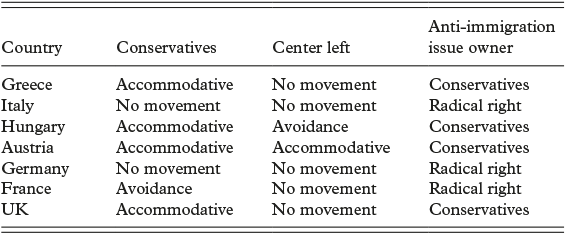
Following the theoretical framework we introduced previously, inspired by Meguid (Reference Mérand2005b), Table 14.1 summarizes the patterns of positional movement and issue ownership we have explored so far. Each party essentially has three choices: (1) accommodate the radical right’s position, moving closer to it; (2) oppose it by moving further away from it; or (3) stay put or, as noted, altogether avoid the issue. Some of the cases are ambivalent, as the Greek conservatives and all UK mainstream parties can be categorized as cases of avoidance rather than accommodation, but due to those parties’ monopolization of the anti-immigration position, we label their tactics as accommodative, even if at a very low level of salience. Additionally, we note in the last column the owner of the anti-immigration position in each country. While there were parties that arguably might have owned the issue from a pro-immigration or moderate position, such as Syriza in Greece or the CDU in Germany, due to their much higher interparty salience compared to other parties, we mainly focus on who owns the anti-immigration position because this is likely the most effective electoral strategy in this context.
Electoral Outcomes and Party Dynamics
Table 14.2 summarizes the electoral fortunes of each party family in the election immediately after the refugee crisis. While we cannot draw any rigorous conclusions from the association between the electoral trends and the patterns we noted above, it is worth commenting on the possible links between those strategies and the electoral fortunes of parties.
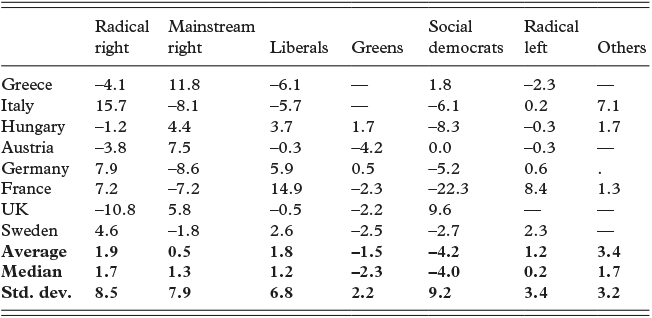
Who are the winners and losers of the elections after the refugee crisis? We see that this depends heavily on the context: In Italy, Germany, France, and Sweden, the radical right made noticeable electoral inroads, whereas the conservatives suffered. By contrast, in Greece, Hungary, Austria, and the UK, the conservatives increased their vote share, whereas the radical right performed poorly. What is common in all the countries, apart from the UK, is that the mainstream left-wing party, no matter its strategy, fared poorly compared to the previous election.Footnote 6 Only the radicalized Labour party under Corbyn improved its electoral performance, albeit not by a wide enough margin to allow it to win first place and form a government.
In general, the mainstream left and the greens to a lesser extent were the consistent electoral losers during the refugee crisis, almost irrespective of the stance they held. Their losses ranged from 2 to 22 percent. While it is evidently simplistic to attribute those losses to their stance on the immigration position, given the long-term trend of the center left’s decline and the internal turmoil in the extreme case of France, it is clear that the refugee crisis at least did not help them at all with improving their electoral performance.
For the right block, we can see that a zero-sum gain game occurred: Wherever the conservatives were reinforced, the radical right lost and vice versa. We can speculate that there is a tighter association between positioning and ownership of the issue and their electoral performance for this political block. In all four cases where the conservatives emphasized the issue and adopted an accommodative strategy toward the radical right, they were rewarded. A consistent winning strategy of the conservatives emerges particularly from AustriaFootnote 7 and Hungary, where the respective parties chose to compete and engage with the issue (Figure 14.3), render it salient and make it an identifying feature of their campaign (Figure 14.4), and assume a distinct and clear position (Figure 14.5) that ended with a clear electoral victory. This is in contrast to the recent work or Abou-Chadi et al. (Reference Abou-Chadi2022), which posits that a rise in the salience of immigration, even when accompanied by accommodative tactics by conservative parties, could not be expected to lead to improved electoral performances for the radical right. This does not seem to be the case when we look at the aggregate fortunes of parties in our sample. More in line with Bíró-Nagy (Reference Bíró-Nagy2022), we find that conservative parties that emphasized immigration did well, even if several confounding factors – such as press boycotts in Greece, suppressed press freedom in Hungary, and radical right scandals in Austria – might have also contributed to this outcome.
There are two more cases in which the conservatives improved their electoral performance: Greece in 2019 and the UK in 2017, where both parties adopted part of their peers’ strategy in Austria and Hungary. As is evident in Figures 14.3 and 14.5, while the UK and Greek conservative parties held a distinct position and increased their relative share in the immigration discourse, neither of them raised the issue to their main preoccupation, but in fact stressed it very little compared to other issues, as shown in Figure 14.4. Additionally, both parties did not really pursue an accommodative strategy, as they already held a fairly extreme position in past elections. However, in both countries, there are mitigating circumstances, as the specificities of the arrest and trial of Golden Dawn in Greece and the Brexit debate in the UK led to a particularistic political competition in which the radical right was absent in the former and superseded in the latter.
Therefore, those conservative parties that had the most consistent anti-immigration profile, prioritized the issue, and did not waver on their position gained the most, while mainstream parties of the right that followed an adversarial, avoidance, or no-movement strategy did not fare equally well, with France and Italy being the most catastrophic examples for the conservatives.
The Italian case is a paradigmatic one in which the electoral result did not bode well for the conservatives, as they saw their vote percentages plummet and those of the radical right increase. In both France and Italy, the radical right parties essentially supplanted their mainstream counterparts as the main right-wing parties. Again, though, these are only loose associations, given that there are many more factors at work, such as the internal issues among the Italian conservatives and their unique quality of being tied up so closely with the personality of Berlusconi and their decline in association with the evolution of Berlusconi’s judicial and other problems.
Still, the Italian case remains instructive, as perhaps the most straightforward one: Immigration was an issue that rose in importance consistently in recent years, both on the demand side (Figure 4.5) and the supply side (Figure 14.1), and after the refugee crisis, an anti-immigration consensus emerged (Figure 14.2). The radical right became the party family that acquired the lion’s share of attention on the issue (Figure 14.3), dedicated more time to this issue than any other party family (Figure 14.4) and expressed the most distinct anti-immigration position, even if still close to the centre of the Italian party-system on the issue (Figure 14.5). Its electoral rise (Table 14.2), and especially its continuing ascent in the polls, after the elections of 2018 can be construed as being associated with all these trends, given the evidence provided here about its stance regarding immigration. In essence, the Lega and FdI followed a strategy similar to their “mainstream” right-wing peers in Hungary and Austria and reaped the benefits accordingly.
France almost resembled this case, but it lacked the critical element of the FN becoming identified more closely with the migration issue. Unlike the conservatives in Hungary and Austria and the Italian Lega, the FN, either by choice or because it was forced to follow the other parties’ agenda, spent much more of its time with questions on the economy and Europe, which proved to be a less advantageous issue domain for the party than immigration. As can be seen in Figures 14.1, France was the only country where the issue of immigration declined in significance after the refugee crisis. This was because the mainstream and centrist parties did not refer to itFootnote 8 but also because the FN did not do so either (Figure 14.3). Instead, it waged a rear-guard war on the merits of the Euro currency, which pitted it against its main competitor, Emmanuel Macron. Perhaps this was a deliberate choice because the party felt that immigration was not gaining as much traction with the French public (Figure 4.5), but it was nevertheless a unique choice when compared to most of its peers elsewhere in Europe.
Finally, the German case also shows the perils of the rising salience of immigration for ambivalent center right parties. While the German CDU did make an effort to speak more about migration (Figure 14.3), it did so while being much more on the defensive about it compared to its Austrian peers, for example. Whereas Kurz had provided his credentials to the Austrian audience, initiating continuous efforts to shut down immigration routes and talking incessantly about the issue, the German CDU, under Merkel, had to bear with the legacy of “we can do it,” as well as a much more permissive immigration policy than part of its electorate was apparently willing to put up with. As shown in Figures 14.4 and 14.5, the German CDU was not only much closer to centrist/leftist parties on immigration than the AfD, but, unlike its Austrian peers, it also failed or simply could not credibly make this its flagship issue. Moreover, the AfD essentially became identified as the immigration party, despite its low relative salience on the issue, as more than 60 percent of its total discourse concerned immigration. While its presence in the media was not extensive, whoever detected the party’s presence anywhere probably saw it in association with immigration. As with the other parties that succeeded on this issue, the three crucial factors of adopting a distinct position, remaining on message, and stressing it as much as possible were present and accomplished.
The Legacy of the Refugee Crisis
As the refugee crisis fades from memory, it has left some important and lasting marks on the European political landscape. The impact of this crisis was not a wholesale transformation of party-systems in some countries, as happened during the Eurozone crisis (Kriesi and Hutter Reference Kriesi, Hutter and Bojar2019), but it is in line with our characterization of this crisis as one that was cumulative and expected, much like an avalanche: Unlike the Eurozone crisis, which caught several actors by surprise or forced them to adopt untenable and unpopular positions, the refugee crisis allowed much more room for strategic choices by parties, who could see the potential political impact of the issue and either shield against it or try to exploit it, more or less successfully, depending on the case.
The refugee crisis, especially compared to the Eurozone crisis, had different effects. Mainstream actors in most countries could not only weather the storm but also profit from it. Unlike the Eurozone crisis, which essentially doomed the mainstream parties of the afflicted countries, the refugee crisis had an effect that varied according to the electoral and political strategies each party adopted. It is also noteworthy that the political developments in each country were obviously affected by the respective policies (e.g., the “we can do it” policy or the hardliner stance of Orbán), but overall, they do not present any pattern regarding the type of countries we have identified so far in terms of destination, frontline, and so on. Nor do they correlate too closely with problem pressure or temporal proximity of the elections to the crisis. Whereas in the Eurozone crisis the degree of party-system transformation tended to follow the economic impact of the situation, in this case, the relationship between outcomes and causes was much looser. As we saw, party-systems followed completely different patterns of politicization of the refugee crisis, with some going through a homogeneous drift of positions, while others witnessed convergence or divergence of positions. What this renders salient is the strategic element of the refugee crisis, as party leadership during the time of the crisis and existing party-system conflict constellations and paths were much more crucial for the eventual outcomes.
As such, it was not necessarily a crisis of profound transformation, but a crisis of opportunity, as various actors mobilized to profit from the increased salience attributed to the immigration issue by the mainstream media and European electorates. The most salient pattern is one of drift: first, a drift of the attention paid to immigration, as more parties, particularly on the right-wing part of the political spectrum, rushed to capitalize on the issue and prioritized it in their campaign discourse and second, a drift toward the right, as shown in Table 14.2. Unmistakeably, after the refugee crisis in all of the seven countries examined here but one (the UK), the first election after the refugee crisis was accompanied by a noticeable increase in the combined percentages of conservative and radical right parties, as well as a simultaneous drop in the combined left and liberal/centrist vote.Footnote 9
As we saw, however, the drivers of the politicization and those who reaped benefits from this drift were not necessarily the same in every country but were instead the parties that were ready and able to seize the opportunity. Table 14.2 almost presents a picture of stability, notwithstanding the continuing decline of the social democratic parties, but this conceals differing patterns depending on the set of countries. More specifically, we identified a group of countries, particularly Hungary and Austria, but also Greece and the UK, where the conservative parties displaced the radical right, both in terms of politicizing the issue, in the sense of rendering it salient and assuming a distinct position and in the first two cases, in terms both of identifying with it and of electoral gains.
On the other hand, there were other countries, like Italy and Germany (and, we might add, Sweden), where the radical right made advances at the expense of the conservatives, capitalizing on the latter’s diluted position and record on immigration and, especially in the cases of Italy and France, also on the overall decline and turmoil in the ranks of the conservative parties. Overall, the discourse shifted toward the right as, where they were successful, mainstream parties adopted positions toward the extreme end of the anti-immigration spectrum, and in cases in which they were not successful, they were hit hard by the radical right’s advances. However, in the end, notwithstanding the family that they belonged to, there was a commonality among all countries: Right-wing actors that were persistent on their anti-immigration message and “owned” the issue enjoyed electoral gains at the expense of their proximate party families and the left.


 Open access