


1. Introduction
What are the origins of legislators’ policy positions? Canonical wisdom tells us that the quest for re-election is the central driving force behind members’ legislative decisions (e.g., Fiorina, Reference Fiorina1974; Mayhew, Reference Mayhew1974; Shepsle and Weingast, Reference Shepsle and Weingast1981; Weingast and Marshall, Reference Weingast and Marshall1988; Cox and McCubbins, Reference Cox and McCubbins1993). Electorally minded theories prioritize constituency service and policy optimization (e.g., Fenno, Reference Fenno1978; Kingdon, Reference Kingdon1989; Arnold, Reference Arnold1990), with comparatively less attention given to members’ privately held preferences. In fact, it is often assumed that legislators possess the (near unlimited) resources necessary to consolidate complete information about constituent preferences, which they subsequently seek to reflect in a mirrored fashion (e.g., Baron and Ferejohn, Reference Baron and Ferejohn1989; Fearon, Reference Fearon1999; Axelrod, Reference Axelrod2015).
Such assumptions suggest that members of Congress are essentially interchangeable insofar as their preferred clientele. In the modern, polarized era, this could lead to the conclusion that a Democrat is a Democrat and a Republican is a Republican. Yet not every legislative action has electoral implications or maps cleanly onto partisan cleavages. Members of Congress routinely cast votes on diffuse and low-salience bills with little traceability, on which party is an imperfect predictor (e.g., Miller and Stokes, Reference Miller and Stokes1963; Arnold, Reference Arnold1990). While constituency preferences are undoubtedly meaningful to the representational relationship, they are not the sole driver of legislative behavior (Burden, Reference Burden2007; Grimmer, Reference Grimmer2013; Bernhard et al., Reference Bernhard, Sewell and Sulkin2017). Even if members wanted to act strictly in accordance with the preferences of their constituents, they often lack the information necessary to do so (Butler and Nickerson, Reference Butler and Nickerson2011; Broockman and Skovron, Reference Broockman and Skovron2018). In the absence of clear directives, members are likely to draw upon their own experiences to guide their legislative decision-making. Furthermore, it is conceivable that members’ personal experiences shape their decisions regarding which subconstituencies to prioritize (Fenno, Reference Fenno1977; Grose, Reference Grose2011).
The extent to which legislators are guided by their personal views and preferences in office has important implications for representative democracy. Being able to parse out personal motivations via observed behavior has long interested scholars of American legislative politics. Of the studies that acknowledge the important role that members’ personal experiences play in their legislative decision-making (e.g., Washington, Reference Washington2008; Francis and Bramlett, Reference Francis and Bramlett2017), empirical evidence has proven scarce given the difficulties associated with capturing legislators’ privately held preferences.
We suggest that a member of Congress’s birthplace can be leveraged to ascertain valuable information regarding her/his personal experiences. One’s surroundings in their developmental years are critical to shaping the way they evaluate and respond to the world around them (Quintelier, Reference Quintelier2015). For this paper, places of birth provide plausibly exogenous variation in members’ experiences that can be distinguished from constituency-specific motivations. In line with the developing birthplace favoritism literature, we suggest that members born outside of the geographic area they represent have little electoral reason to act dissimilarly to other members who were born in and represent that geographic area, beyond the indelible imprint of birthplace (e.g., Do et al., Reference DO, Nguyen and Tran2017; Dickens, Reference Dickens2018; Baskaran and da Fonseca, Reference Baskaran and da Fonseca2021; Mattos et al., Reference Mattos, Politi and Morata2021). That is, we contend that finding evidence of convergence in members’ behavior associated with geographic similarities in their places of birth, apart from their places of representation and other key determinants of decision-making (e.g., partisanship), suggests that legislative behavior is, at least in part, shaped by members’ surroundings during formative years in their lives.
We examine the effects of birthplace on US House members serving in the 107th–115th Congresses (2001–2018), exploiting the significant variation in member birthplaces. In fact, on average, well over half of the membership is born outside of the district, one-third outside of the state, and one-quarter outside of the region that they represent. Cumulatively, our results demonstrate systematic variation in the decision-making of members of Congress based on the geographic location of their birth. First, legislators from similar geographic areas are more likely to agree on legislation. This effect is moderated by legislators’ age, whereby the commonalities of birthplace are less meaningful when there is a large age disparity between members. Furthermore, we demonstrate in a secondary analysis that members’ support for agricultural protection is shaped in a meaningful way by the agricultural makeup of the county in which they were born. These relationships are robust to various model specifications and unobserved confounders. Cumulatively, our findings suggest that members’ personal history shapes the representational relationship they have with their constituents and that members, even if they desire to reflect the wishes of the voters they represent, are subject to constraints caused by their personal experiences.
2. Why place of birth matters
Research demonstrates that there is systematic variation in attributes across individuals living in different geographic areas of the US. Individuals living in close proximity to one another have repeated social interactions and are subject to the same features of and changes to their environment (Rentfrow et al., Reference Rentfrow, Jost, Gosling and Potter2009). Selection and socialization drive and reinforce the development of different political opinions and partisan adherence in different settings (Gimpel et al., Reference Gimpel, Lovin, Moy and Reeves2020). Consequently, similar personalities cluster in regions and vary across borders (Rentfrow et al., Reference Rentfrow, Gosling and Potter2008). These regional differences lead to geographic variation in politically relevant characteristics such as ideology and partisanship (Krug and Kulhavy, Reference Krug and Kulhavy1973; Carney et al., Reference Carney, Jost, Gosling and Potter2008; Rentfrow, Reference Rentfrow2010). Therefore, the geographic location within which people live has the potential to meaningfully influence the way they view the world around them. Importantly, for our purposes, geographic variation in individual-level attributes has implications for the behaviors of not only voters but legislators as well (Ramey et al., Reference Ramey, Klingler and Hollibaugh2017; Arceneaux et al., Reference Arceneaux, Dunaway and Soroka2018).
Moreover, childhood experiences and social environments are vital for the formation of political behaviors and attitudes (e.g., Erikson, Reference Erikson1968; Caspi et al., Reference Caspi, McClay, Moffitt, Mill, Martin, Craig, Taylor and Poulton2002; Moran et al., Reference Moran, Coffey, Chanen, Mann, Carlin and Patton2011; De Neve, Reference De Neve2015). Meaningful childhood events linger throughout developmental years, commonly persisting for a lifetime (Quintelier, Reference Quintelier2015), and the opinions derived from these circumstances influence responses to political events (Sears and Valentino, Reference Sears and Valentino1997; Valentino and Sears, Reference Valentino and Sears1998). For instance, childhood interventions have been shown to affect political participation in adulthood (Holbein et al., Reference Holbein, Bradshow, Kal Munis, Rabinowitz and Lalongo2021). Furthermore, one’s childhood geographic location influences the formative experiences that shape identities into adulthood (Scourfield et al., Reference Scourfield, Dicks, Drakeford and Davies2006), and studies of public resource allocation demonstrate that politicians’ identities play an important role in elite decision-making (e.g., Pande, Reference Pande2003; Franck and Rainer, Reference Franck and Rainer2012). Succinctly, politicians often favor members of their own group identity, with birthplace logically contributing to the development of such identities.
Relatedly, the budding birthplace favoritism literature asserts a hometown bias, whereby politicians often prioritize their birthplace in the distribution of resources, independent of electoral support. This phenomenon has been observed in several contexts, including Europe (Carozzi and Repetto, Reference Carozzi and Repetto2016; Fiva and Halse, Reference Fiva and Halse2016; Baskaran and da Fonseca, Reference Baskaran and da Fonseca2021), Latin America (Mattos et al., Reference Mattos, Politi and Morata2021), Africa (Burgess et al., Reference Burgess, Jedwab, Miguel, Morjaria and Padró i Miquel2015; Dickens, Reference Dickens2018), and Asia (Do et al., Reference DO, Nguyen and Tran2017), although this work has focused primarily on the effects of birthplace bias on distributive politics. On a base level, these forces ought to exist for members of Congress and may be measurable in members’ observed legislative decisions (i.e., roll call votes).
Recent work examining the effects of legislators’ ties to their district is consistent with our basic supposition — representation is shaped in important ways by the depth of members’ experiences in their district. For instance, studies find that House members’ history in their district has considerable implications for how they approach constituent communication (Hunt, Reference Hunt2022) and the extent to which they invest in constituent services (Crosson and Kaslovsky, Reference Crosson and KaslovskyN.d.). Taking this logic a step farther, legislators with roots in the same geographic area should possess more similar legislative proclivities than those with roots in different geographic areas, all else equal. We explore this logic below.Footnote 1 While much of the “local roots” literature to date focuses on the effects of a shared geographic identity (between voters and their representatives) on various aspects of the dyadic relationship (e.g., legislative styles, communication, resource allocation, etc.), our extension of this logic explores the effects of birthplace correspondence between legislators on convergence/divergence in legislative decision-making. Importantly, this extension provides insights into how legislators’ places of birth shape their policy decisions, which have received limited consideration in the local roots literature (for an exception, see Crosson and Kaslovsky, Reference Crosson and KaslovskyN.d.). Furthermore, our framework allows us to evaluate the extent to which legislative decisions are informed by birthplace independent of members’ district of representation, contributing to our understanding of whether members’ behaviors are influenced (consciously or subconsciously) by considerations outside of electoral motivations.
The increasingly nationalized agenda and rising strength of national parties suggest that birthplace effects, which are geographically centered and produce local political cleavages that are distinctive from national ones, are almost certainly less central to legislative decision-making than they once were (Hopkins, Reference Hopkins2018; Lin and Lunz Trujillo, Reference Lin and Lunz Trujillo2023). Nevertheless, even in the highly nationalized and polarized environment that characterizes the modern Congress, there remain conditional demands for legislators to pursue parochial interests and bipartisan compromise that are reflected in observed legislative behavior (Harbridge and Malhotra, Reference Harbridge and Malhotra2011; Moore et al., Reference Moore, Neff Powell and Reeves2013; Feigenbaum and Hall, Reference Feigenbaum and Hall2015; De Benedictis-Kessner and Warshaw, Reference De Benedictis-Kessner and Warshaw2020; Harbridge-Yong et al., Reference Harbridge-Yong, Volden and Wiseman2023).Footnote 2 Numerous studies find evidence of contemporary localized interests (e.g., spatial, financial, etc.) that supersede partisanship and ideology within certain policy domains that have disparate costs and benefits across geographic areas (Hankinson, Reference Hankinson2018; De Benedictis-Kessner and Hankinson, Reference De Benedictis-Kessner and Hankinson2019; Marble and Nall, Reference Marble and Nall2021).Footnote 3 After all, if local considerations were entirely subverted by national ones, we might expect members to be in (near) perfect lockstep with their party without electoral consequence; however, this appears not to be the case (Canes-Wrone et al., Reference Canes-Wrone, Brady and Cogan2002; Carson et al., Reference Carson, Koger, Lebo and Young2010). Moreover, the varied legislative agenda of the US House with respect to vote types and issue areas provides members with isolated opportunities to express birthplace-informed positions at odds with their party while maintaining overall high rates of party loyalty. For instance, partisan pressures vary markedly across types of votes, with members having considerably more leeway on final passage votes than on some other classes of votes (Ansolabehere et al., Reference Ansolabehere, Snyder and Stewart2001; Sinclair, Reference Sinclair, Brady and McCubbins2002; Crespin et al., Reference Crespin, Rohde and Vander Wielen2013).Footnote 4 Therefore, the local forces that underpin birthplace effects, while perhaps weaker than they once were, are nevertheless present in the modern era. While members may be influenced by birthplace effects on even the most divisive partisan votes (perhaps subconsciously), we expect the effects of birthplace to be more evident when national partisan considerations are less central to the decision. We return to this later when we offer a series of robustness checks that isolate vote types, issues domains, and member electoral contexts that involve less partisan influence.
In sum, some existing research suggests that members of Congress’ life experiences affect their legislative behavior (Swers, Reference Swers2002; Grose, Reference Grose2011; Lawless, Reference Lawless2012), although this connection has proven to be difficult to empirically demonstrate, especially for the membership at large (as opposed to subsets of the membership on the basis of descriptive characteristics). Given that childhood experiences and connections can be particularly formative to human behaviors and attitudes, it stands to reason that a member’s birthplace plays an influential role in shaping her/his legislative decisions. Given the systematic geographic variation in politically relevant attributes in the US, it follows that members who are born in the same geographic location will exhibit convergence in legislative behavior, independent of other political factors (e.g., partisanship). Members’ place of birth plausibly informs a number of considerations that precede, but meaningfully affect, their legislative decisions, including party affiliation, committee assignment requests, and the like. These antecedent considerations notwithstanding, we expect birthplace effects to be most pronounced on legislative decisions that have disparate costs and benefits across geographic areas and on which members are afforded the leeway to vote in accordance with parochial interests. We add the important proviso that other features of individuals’ birthplace (e.g., racial composition, economic circumstances, population density, etc.) and their communication networks surely unify their experiences beyond geographic proximity (Baybeck and Huckfeldt, Reference Baybeck and Huckfeldt2002; Moore and Reeves, Reference Moore, Reeves, Ginsberg, Wagner and Bachner2017). For instance, those raised in large metropolitan areas share experiences that are unique to urban living. Therefore, we might consider geographic location to be just one factor that leaves an imprint on members, and so it might be considered a conservative estimate of life experience on legislative behavior.
We think that there are several plausible mechanisms through which birthplace can affect legislative behavior and by extension the convergence of legislative behavior among members. For instance, childhood experiences in a geographic area might socialize/condition future legislators to assume a set of attitudes or values that accompany them into their legislative careers. These experiences might also impart knowledge about issues that are particularly important to their birthplace communities. Another possibility is that legislators forge and maintain close connections with family and friends in/near their birthplaces whose perspectives inform their decisions. Yet another is that members possess deep emotional ties to their places of birth, leading them to be mindful of the interests of those who live there. There are undoubtedly other possibilities as well.
Provided that there is indeed systematic variation in the psychological attributes (Rentfrow et al., Reference Rentfrow, Jost, Gosling and Potter2009) and/or socialization (Gimpel et al., Reference Gimpel, Lovin, Moy and Reeves2020) of individuals living in different geographic areas in the US and that birthplaces create meaningful experiences and/or connections, then drawing upon Tobler’s (1970, 236) First Law of Geography, whereby “near things are more related than distant things,” Tobler’s (Reference Tobler1970, 236) it stands to reason that members born near (far from) one another should exhibit similarities (dissimilarities) in their legislative behavior, all else equal. We do not wish to suggest that all geographically proximal locations in the US bear marked resemblances, but rather that, on average, individuals with geographic connections (in state, region, and/or proximity) are more likely to share experiences and ties than those who do not. The powerful effects of these geographic connections have been demonstrated elsewhere (e.g., Rentfrow, Reference Rentfrow2010; Gerber et al., Reference Gerber, Douglas Henry and Lubell2013) and have been attributed to such factors as historical migration patterns, social interactions, environmental influences (e.g., climate and natural resources), and the like (Rentfrow et al., Reference Rentfrow, Gosling and Potter2008). To use a simple example, individuals raised in densely agricultural areas are likely to have a deeper understanding of the issues confronting farmers as well as stronger affective and relational ties to the farming community. The knowledge and attachments forged during formative years are likely to follow these individuals even if they go on to represent districts that have little agricultural presence. Thus, members born in close proximity to one another into places with similar agricultural compositions are likely to converge in their agriculturally related voting behavior, especially on decisions that afford them comparatively greater autonomy.
It is also important to note that members range widely in age and therefore may have very vastly relationships with their places of birth even when born and raised in the same geographic location. Numerous forces can lead to dramatic changes in the culture and physical environment of a particular area over time. For instance, the Baltimore, MD, that Nancy Pelosi (D-CA) was born into in 1940 was substantially different in various ways (e.g., economics, demographics, population size, etc.) from the one her colleague Scott Taylor (R-VA) was born into some 39 years later in 1979 (Crenson, Reference Crenson2017), and therefore we might expect these differences in their surroundings to lessen their shared experiences and likelihood of agreeing. Furthermore, it is conceivable that there exists some level of decay in birthplace effects with age, such that older members may have weaker ties (e.g., psychological attachments, personal connections, etc.) to their places of birth than their younger counterparts.Footnote 5 These possibilities suggest that birthplace effects may be quite different for members with sizable age disparities. Therefore, we arrive at the following proposition and corollary:
Birthplace Agreement Proposition: Members of Congress who are born in close geographic proximity to one another are more likely to exhibit similarities in their roll call voting patterns relative to members of Congress who are born a greater distance from one another, all else equal.
Age Corollary: The effect of birthplace proximity should diminish when members have greater age disparities.
3. What do legislators who move look like?
Fully capturing the effect that place of birth has on a member of Congress is no trivial task, in large part because each individual experiences her/his birthplace in different ways. Some members were raised in wealthy neighborhoods, while others were not. Some members live in their place of birth for a long period of time, while others do not. Some members come from families with deep local roots in those communities, while others do not. The list goes on. In order to fully encapsulate the effects of birthplace, one would need to account for the specific, and myriad, circumstances that each member experienced. Instead, we use a relatively coarse measure as a first cut at exploring the effects of birthplace. In particular, we record the location of each member’s birthplace and examine whether members who come from similar locations are more likely to converge in their policy positions.Footnote 6 We suggest that this rather blunt approach is likely to disadvantage finding a birthplace effect, and therefore our findings might be considered a lower bound of this effect.
We examine birthplace effects for members serving in the 107th–115th US House of Representatives (2001–2018). Table 1 presents the number of members who were born outside of the district they represent, as well as the count of members who were born outside of their district’s state and region.Footnote 7 This table also presents the number of members born outside of the 50 states, including Washington, DC. As Table 1 notes, a sizable number of members were born outside of the geographic areas containing their district. In fact, well over a third of the membership was born outside their district’s state during the period of analysis. Therefore, there is considerable variation across members in terms of their personal history with the geographic areas they represent.
House members’ places of birth, 2001–2018

Of course, a natural concern with an analysis of this sort is the possibility of non-random migration, particularly electorally motivated, strategic movement (i.e., carpetbagging). For instance, potential candidates could relocate to vicinages that provide them with a greater likelihood of winning office. From a theoretical standpoint, if we assume that dyadic congruence is an important condition for winning office, such migration should conceal rather than exacerbate birthplace effects (i.e., members moving to congenial districts). From an empirical standpoint, many members move from their place of birth when they are quite young, likely well before they ever considered running for elective office. In fact, 64.7% of members who were born outside of their district’s state did not attend high school in their state of birth, meaning that they left their place of birth at a comparatively young age. We revisit this observation in a later robustness check.
Figure 1a shows the patterns of movement from members’ city of birth to the geographic center of the district they represent, and Figure 1b presents a density plot of the destination states for members who moved from their birthplace.Footnote 8 Importantly, migration is fairly widespread, and so the movement is neither to select states nor to neighboring states. Rather, most states prove to be destinations for future members, and the distances of travel are noteworthy.Footnote 9 We find that the average distance of movement from a US-born member’s place of birth to her/his district of representation is over 860 miles or roughly the driving distance from New York, NY, to Milwaukee, WI.
Member relocation from the place of birth with the 50 states.

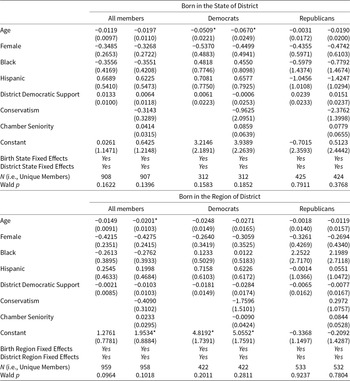
Given that many members move from their place of birth at a relatively young age, migration strikes us as plausibly orthogonal to electoral considerations. We conduct a balance test to examine whether members who are born outside of the state or region they represent possess observable characteristics that are meaningfully different from those who were born in the state or region they represent. We do so by estimating a series of logistic regression models with a dependent variable measuring whether the member was born in the state or region containing the district that she/he represents.Footnote 10 We look at a selection of traits and behaviors that have important implications for representation (e.g., Stratmann, Reference Stratmann2000; Gerrity et al., Reference Gerrity, Osborn and Morehouse Mendez2007; Grose, Reference Grose2011), including age, gender, race, district-level democratic support, conservatism, and chamber seniority.Footnote 11 The purpose of including measures of conservatism and chamber seniority is to capture members’ stable ideological predispositions and electoral security. Since these measures are the outgrowth of observed legislative decisions—the phenomenon of interest in this study—we also estimate the models without these measures. Furthermore, we include state (region) fixed effects for birth states (region) as well as the states (regions) containing the district of representation.
The results of the balance test are presented in Table 2. In general, we find that members who were born outside of their district’s state (region) are not statistically different from those who were born in their district’s state (region) in terms of the covariates included in the test. The one exception is the age variable, which proves to be negative and statistically significant for democratic members when using state as the geographic area of interest and for all members when using region and including the complete list of covariates. This would imply that, for these subsets of members, those representing districts in their birth state (region) are, on average, slightly younger than those representing districts outside of their birth state (region). We struggle to concoct a story in which voter receptivity to older candidates is a motivating force for strategic migration. Furthermore, we include in Table 2 an omnibus test for each model to examine whether the coefficients on the covariates (other than the fixed effects) are jointly equal to zero [see Wald p-values] (e.g., Arceneaux et al., Reference Arceneaux, Gerber and Green2006; Kumar, Reference Kumar2022), and we find no evidence of imbalance at the α = 0.05 level.Footnote 12
Balance test across members born inside and outside the state/region of representation

Notes: Standard errors are given in parentheses. * denotes  $p \leq 0.05$.
Therefore, we contend that the balance tests provide at least some empirical support for the exogeneity of birthplace, although we also appreciate that we cannot speak to correlations with other unobserved, but politically relevant, variables. This is not to say that members never relocate strategically, just that, on average, members born outside of the state or region that they represent look substantially similar to those born in their district’s state or region. While we are hesitant to go so far as to assume “as-if” randomness in this study, the logical and statistical underpinnings are present (Dunning, Reference Dunning2008). Nevertheless, in an effort to better establish the relationship between birthplace and legislative behavior, we take the additional step in the analyses below of controlling for various factors that influence legislative decisions, as well as performing numerous robustness checks and sensitivity analyses.
4. Birthplace agreement
We begin by examining the effect that birthplace has on the likelihood that House members adopt identical positions on recorded votes during the period of analysis. Since geographically concentrated interests are varied and often quite difficult to identify and quantify, this approach allows for the myriad birthplace issues that could motivate legislative behavior by tapping into the basic spatial logic that members born near one another are more likely to exhibit similar proclivities with respect to the issues that affect their places of birth.Footnote 13 In a sense, this approach allows us to consider all geographically specific policy considerations without needing to measure them directly. We generate agreement scores for all pairwise combinations of unique members in a given Congress across all roll call votes.Footnote 14 Therefore, the resulting score for an individual pair of members documents the proportion of all roll calls in a given Congress on which these members cast the same recorded vote.Footnote 15 For each Congress, we arrive at a vector of  $(n \times [n-1])/2$ agreement scores for all pairwise combinations of members, where n denotes the number of members casting votes in a given Congress.Footnote 16
To explore the Birthplace Agreement Proposition, we then determine, for each pairwise combination of members, the geographic correspondences in their places of birth and representation by recording whether they were born in or represent districts in the same state and region. We also measure the distance (in miles) between the epicenters of the members’ cities of birth as well as the distance between their districts of representation.Footnote 17 We provide different measures of geographic correspondence—state, region, and distance—to allow for the possibility that different units are independently or jointly relevant. To examine the Age Corollary, we also record the difference in age between each pairwise combination of members.
We estimate the fractional logistic regression model shown in Equation (1). Since the outcome is bound to the unit interval, this estimation strategy yields consistent estimators and ensures that predictions are likewise bound to the unit interval (Papke and Wooldridge, Reference Papke and Wooldridge1996).Footnote 18
 \begin{eqnarray}
\text{Agree} & = & \beta_0 + \sum_{i=1}^{k} \beta_i \text{BirthGeo}_g + \beta_{k+1} \text{Age} + \sum_{p=k+2}^{2k+1} \beta_p \text{BirthGeo}_g \times Age + \nonumber \\
& & \sum_{r=2k+2}^{3k+1} \beta_r \text{RepGeo}_g + \boldsymbol \beta' \mathbf{x} + \boldsymbol \gamma' \mathbf{z} + \epsilon.\\
\nonumber
\end{eqnarray}
\begin{eqnarray}
\text{Agree} & = & \beta_0 + \sum_{i=1}^{k} \beta_i \text{BirthGeo}_g + \beta_{k+1} \text{Age} + \sum_{p=k+2}^{2k+1} \beta_p \text{BirthGeo}_g \times Age + \nonumber \\
& & \sum_{r=2k+2}^{3k+1} \beta_r \text{RepGeo}_g + \boldsymbol \beta' \mathbf{x} + \boldsymbol \gamma' \mathbf{z} + \epsilon.\\
\nonumber
\end{eqnarray} Agree  $\in [0, 1]$ denotes the agreement score between pairwise members. BirthGeo accounts for the geographic correspondence in birthplace between members, and RepGeo accounts for the geographic correspondence in district of representation between members, where $g \in \{\text{state}, \text{region}, \text{distance}\}$ measures the correspondence in terms of state, region, and distance (in miles) between the epicenters of the vicinages, respectively.Footnote 19, Footnote 20 $k \in \{1, 2, 3\}$ provides for all combinations of geographic measures of birthplace. To maintain consistency within a model, we require only that the same measure(s) of geographic units be used for both birthplace and representation correspondences (e.g., when including the state of birth in the model, we likewise include the state of representation). Age denotes the difference in age, using integers, between the pairwise combination of members. We include the interaction between BirthGeo and Age to account for the possibility that members experience the same place of birth in different ways depending on when they were born, as articulated in the corollary. All combinations of measures of birthplace correspondence are, therefore, interacted with age.
In addition to the key independent variables, we also include a variety of covariates, denoted x (with corresponding vector of coefficients, β), that measure correspondences between pairwise combinations of members in terms of important characteristics that influence their likelihood of adopting identical positions on roll call votes. In particular, we include indicator variables measuring whether pairwise members identify as belonging to the same party, gender, and race, as well as continuous measures of the difference in Democratic support between the pairwise members’ districts and the difference between the pairwise members’ chamber seniority.Footnote 21 We also include Congress fixed effects to account for baseline differences in the propensity for members to agree with one another, denoted z (with the corresponding vector of coefficients, γ). All models are estimated with robust standard errors.Footnote 22
Furthermore, separately accounting for pairwise correspondences in Democrats and Republicans, to control for possible baseline imbalances across parties, yields virtually symmetrical party effects, and doing so does not substantively alter our results (see Section G of the Supplemental Appendix). We do not include a measure of members’ pairwise ideological distance to avoid using a roll call-based measure (e.g., DW-Nominate) of voting disparities to predict the propensity for members to adopt the same positions on roll call votes (i.e., agreement scores). We note that when using the ideological scores developed by Bonica Reference Bonica(2018), which are not derived from roll call votes, our central findings are substantively unchanged. However, doing so requires us to drop two Congresses from our analysis (i.e., 114th–115th Congresses [2015–2018]), and so we do not include this measure in the models reported below in effort to retain all available data.Footnote 23
We restrict our analysis to members born in and representing districts in the 48 continental US states because of (1) complications relating to categorizing the states and regions of those born outside of the US and (2) concerns relating to the outliers (in terms of distance) introduced when including those born in or representing districts outside of the continental US. To the latter point, the maximum distance between the birthplaces of pairwise members without this restriction is 12,247.3 miles, which is certainly problematic.Footnote 24 We note, however, that imposing these restrictions, which is important for properly measuring the effect of distance, eliminates only 52 unique members during the entire period of analysis. Furthermore, estimating the following models over all members yields substantively similar results to those reported below.Footnote 25
Given our inability to know the precise timing of when members moved from their place of birth, one could have concerns about the plausibility of birthplace effects. After all, many of these members could have moved from their place of birth before developing cognitive awareness of it and/or deep personal ties. While we think this should disadvantage a statistically discernible birthplace finding, it is nevertheless a reasonable concern. Therefore, we perform a robustness check by separately restricting our analysis to those members who attended high school in the county of their birth. Since length of residency is generally thought to strengthen geographic attachments (Kasarda and Janowitz, Reference Kasarda and Janowitz1974; Anton and Lawrence, Reference Anton and Lawrence2014), we might deduce that these members lived in their place of birth a sufficient duration for it to leave an imprint on them.Footnote 26 We opted to use high school attendance in counties of birth for this robustness check since many individuals, especially in rural regions, attend high school in adjacent towns, making the requirement of high school attendance in one’s city of birth particularly restrictive. Nevertheless, using high school attendance in city of birth as a requirement for inclusion does not substantively alter the results, nor does using the more relaxed assumption of high school attendance in the member’s state of birth.
4.1. Birthplace agreement results
Table 3 presents the results of the models shown in Equation 1. We find evidence of birthplace effects regardless of the geographic measures (or combination thereof) used. In the models that include only a single geographic measure of birthplace correspondence (i.e., Models 1–3), the birthplace correspondence variables across the models, as well as their interaction with age, are statistically significant and in the expected direction. Among these models, the distance measure (i.e., Model 3) provides the best fit, having the the lowest bias-corrected Akaike Information Criterion (AICc), whereas the indicator for birth state correspondence (i.e., Model 1) fares the worst. We find strong evidence that the best model fit among the various combinations of these variables can be found in Model 6, which accounts for both birth region correspondence and the distance between members’ birthplaces. In fact, the probability that Model 6 is the best approximating model among the alternatives exceeds 93 percent, with the next nearest competitor being Model 7 at a mere 5 percent.Footnote 27
Using Model 6, we find that the correspondence in region of birth and the distance between birthplaces independently affect the likelihood that members agree on roll call votes. Sharing a birth region is positively related to agreement, and distance is negatively related to agreement, as expected, with both being statistically significant at the α = 0.05 level. This implies that members who were born in the same region and those born within close proximity to one another are more likely to agree, all else equal. Furthermore, their interaction with age behaves as expected, with increasing age disparity moderating downward the effect of the constitutive birthplace terms. In sum, we find evidence that place of birth has a measurable effect on aggregate legislative behavior, as predicted by the Birthplace Agreement Proposition, with differences in age diminishing these effects, as predicted by the Age Corollary.
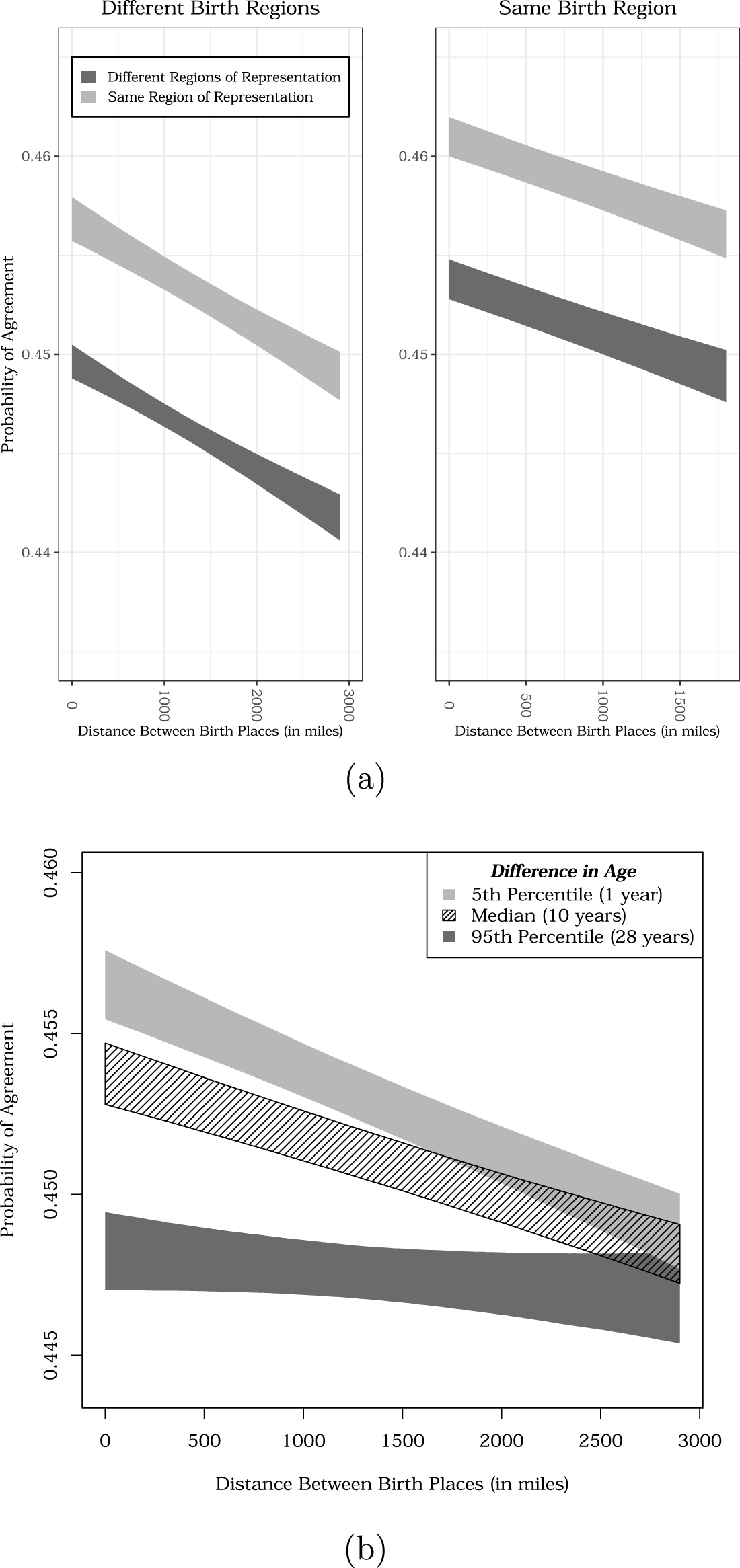
Figure 2 shows the 83.5 percent confidence intervals for predicted agreement scores as a function of distance (in miles) between pairwise members’ birthplaces, generated by the best fitting model (i.e., Model 6).Footnote 28 We use 83.5 percent confidence intervals since we are interested in assessing statistical significance at α = 0.05 on the basis of confidence interval overlap (Goldstein and Healy, Reference Goldstein and Healy1995; Maghsoodloo and Huang, Reference Maghsoodloo and Huang2010). In addition to distance, Figure 2a varies combinations of correspondences between members’ birthplace regions and regions of representation, and Figure 2b varies differences in members’ age. Other variables are set to amplify differences across pairwise members by setting party, gender, and race to be equal to zero, indicating that members differ across these terms and setting all other comparison measures to their mean. Therefore, we should naturally expect the agreement predictions generated for such pairwise members to be quite low, and this approach gives us insights regarding the force of birthplace among members who are predisposed to disagree.Footnote 29
Regional, birth distance, and age effects on predicted probability of agreement.

Unsurprisingly, we find in Figure 2a that members who share both birthplace and representation regions have the highest baseline likelihood of agreement, and those who differ in both have the lowest. Importantly, birth region—seen in the intercept shift across panels of Figure 2a among members with the same correspondence in representation region—exerts a statistically meaningful effect on agreement scores across all values of birthplace distance. In addition, among all regional combinations, increasing distance between birthplaces leads to a statistically meaningful decrease in the likelihood of agreement. On average, members born in close proximity to one another in the same birth region are roughly 1.2 percentage points more likely to agree with one another than those born in different birth regions and a great distance from one another. Considering that this effect accounts for roughly 9 percent of the standard deviation of agreement rates for members belonging to different parties during the period of analysis, this finding suggests that birthplace explains a non-trivial amount of the variation in opposing party members’ propensity to agree. In fact, this effect size implies that for members who bare considerable differences and are therefore highly unlikely to agree on roll call votes, those born in close proximity to one another in the same birth region are expected to agree on 16.4 more votes per Congress than members born a great distance from one another in different birth regions, using the mean number of roll call votes per Congress during the period of analysis.
As a reminder, this portion of the analysis examines all roll call votes, irrespective of vote and issue types, and so naturally it includes many votes on which we should expect birthplace effects to be quite limited, in particular votes involving minimal localized implications and considerable party pressure. Therefore, we take the additional step of estimating the models in Table 3 after restricting the roll call votes to those dealing with a particularly prominent parochial issue area: agriculture (Browne, Reference Browne1995; Adler, Reference Adler2000; Paarlberg, Reference Paarlberg2011).Footnote 30 We find that the effects of birth place are substantially larger than they are when including all roll call votes (see Section J of the Supplemental Appendix), as evidenced by the constitutive birthplace coefficients being almost universally larger in absolute value. In fact, we find that the birthplace effect nearly triples (to 3.3 percentage points) compared to the effect identified in the unrestricted analysis above (of 1.2 percentage points).Footnote 31
Member agreement scores as a function of place of birth—members born in and representing the continental US

Notes: Robust standard errors are given in parentheses. All “same” variables are indicators of whether the paired members have identical values on the given measure. All “difference” variables measure the absolute difference between the paired members on the given measure. The Distance Between Places of Birth variable measures the distance between the paired coordinates of member birth cities in miles using the Haversine method (i.e., shortest distance between two points). * denotes  $p \leq 0.05$, and $^\dagger$ denotes conditional $p \leq 0.05$ for non-linear interaction terms.
We also estimate the models after restricting the roll call votes to include only non-party votes and/or votes on final passage, both of which are recognized as vote types that afford members greater independence from their party (Sinclair, Reference Sinclair, Brady and McCubbins2002; Young and Wilkins, Reference Young and Wilkins2007; Crespin et al., Reference Crespin, Rohde and Vander Wielen2013). Again, birth place effects are considerably larger when making each of these restrictions (see Section J of the Supplemental Appendix).Footnote 32 In addition, we estimate the models after restricting the membership to include only those members who represent tenuous districts that favored the out-party presidential nominee in the current (for presidential years) or previous (in midterms) presidential election, as these members are most likely to exhibit partisan independence (Carson et al., Reference Carson, Koger, Lebo and Young2010), and we find a striking increase in the birthplace effect yet again (see Section J of the Supplemental Appendix).Footnote 33 Therefore, these robustness checks make clear that the effects identified in Table 3 are persistent and quite conservative.
Figure 2b shows the influence of age on the birthplace distance effects for members born in different regions but representing the same region and otherwise possessing the dissimilar attributes described above. We set the birthplace region correspondence to zero to more realistically evaluate the range of birthplace distance, although doing otherwise generates similar results. For illustrative purposes, we select the 5th, 50th, and 95th percentiles of the difference in age variable. As can be seen, the negative constitutive age term shifts the likelihood of agreement downward for all values of distance between birthplaces. Importantly, the effect of birthplace distance is attenuated with increasing differences in age, as expected. While there is a statistically significant negative effect of birthplace distance for the lowest two categories of age difference (i.e., the 5th percentile and median), the effect of distance is no longer statistically meaningful for the highest category of age difference. In sum, we find evidence that with increasing age differences between members, the distance between their places of birth plays a much less pronounced role in predicting their likelihood of agreement. This squares with our understanding that members who were born in the same place but are of significantly different ages may have experienced their birthplace in vastly different ways and/or may have considerably different attachments to their place of birth.
We further explore the above models by restricting our analysis to only those members who attended high school in the county in which they were born. As a reminder, this is done in effort to better identify members who resided in their place of birth a sufficient amount of time for their birthplace to leave a cognitive imprint and/or for members to develop deep ties. The results of this analysis can be found in Table 4. These results are substantively similar to those without the high school attendance restriction (Table 3). Notably, the additional restriction on high school attendance yields even stronger birthplace effects. The key constitutive terms on birth state, region, and distance are considerably larger in absolute value in each of the model specifications, which is broadly consistent with the notion that birthplace effects should be stronger among those who experience their place of birth for longer durations.
Member agreement scores as a function of place of birth—members born in and representing the continental us & attended high school in the county of their birth

Notes: Robust standard errors are given in parentheses. All “same” variables are indicators of whether the paired members have identical values on the given measure. All “difference” variables measure the absolute difference between the paired members on the given measure. The Distance Between Places of Birth variable measures the distance between the paired coordinates of member birth cities in miles using the Haversine method (i.e., shortest distance between two points). * denotes  $p \leq 0.05$, and $^\dagger$ denotes conditional $p \leq 0.05$ for non-linear interaction terms.
Section K of the Supplemental Appendix provides the predicted agreement scores, with 83.5 percent confidence intervals, for pairwise members who attended high school in their county of birth, using the best fitting model from Table 4 (i.e., Model 3). We also include the predictions for pairwise members who did not attend high school in their county of birth, to further explore the logic that these members should have comparatively weaker birthplace effects due to moving from their place of birth at an earlier age. We find that when members attended high school in their county of birth, they have a statistically higher likelihood of agreeing when born in close proximity to one another (by 1 percentage point) and three times the overall birthplace effect when compared to the unrestricted analysis (see Figure 2b). Conversely, when members did not attend high school in their county of birth, we find a markedly lower baseline level of agreement and no statistically discernible birthplace effect, as we might expect.
We note that there is considerable variation across cities within the US in terms of their range of distances to other locations within the US. In particular, the distance between a city and its most distant counterpart within the US (i.e., maximum distance) will be smaller for more centrally located cities than those located on the coasts. Since cities have different maximum distances, we wish to eliminate the possibility that our results are being driven by cities with extreme maximum distances. Therefore, we identify the smallest maximum distance for a city within the continental US and restrict our data to include pairwise distances no greater than this value. Specifically, the contiguous geographic center of the US is Lebanon, KS, with a maximum distance (to Hamlin, ME) of approximately 1600 miles. Section L of the Supplemental Appendix presents the results of the analysis using these restricted data, and our findings are substantively unchanged. If anything, the effect of birthplace distance is more pronounced. In addition, Section L of the Supplemental Appendix includes the predicted agreement scores, with 83.5 percent confidence intervals, as a function of distance (in miles) between members’ birthplaces, using the best fitting model (i.e., Model 3). Even with the restricted range, we find a birthplace effect that is slightly larger than that reported in Figure 2b. In fact, for members of a similar age, the birthplace effect is roughly 50 percent larger when restricting the data in this fashion. This suggests that extreme maximum distances (exceeding 1600 miles) are making negligible contributions to the results when using the unrestricted data.
To address any concerns that there might be partisan dependencies in the movement of members from their place of birth to the location they would eventually represent (i.e., geographic partisan sorting), we compare the partisan composition of the county in which members were born, using the percentage of the two-party vote received by the Democratic presidential nominee in members’ county of birth in the presidential election immediately preceding their birth year (Amlani and Algara, Reference Amlani and Algara2021), to the partisan composition of members’ district during their first term in office. To begin, the correlation in Democratic support across these locations is quite weak (r = 0.09). However, we estimate the models in Table 3 after restricting the membership to include only those members who experienced a significant shift in partisan composition from their place of birth to their place of representation—including members in the lowest and highest deciles of raw change in Democratic support (i.e., district Democratic support less birth county Democratic support).Footnote 34 For these members, we can eliminate spatial partisan sorting as an explanation for the birthplace effects identified above. The results of this analysis can be found in Section M of the Supplemental Appendix, and we find that the results are robust to this restriction.
Section N of the Supplemental Appendix provides sensitivity analyses of the key independent variables in Model 6 — the birthplace region and distance variables. We are particularly interested in understanding how robust these findings are to unobserved confounders (Cinelli and Hazlett, Reference Cinelli and Hazlett2020).Footnote 35 To perform this sensitivity analysis, we use the Difference in District Democratic Support variable as a benchmark for assessing the strength of the confounder(s) needed to undo the statistically significant effects observed. We use this benchmark because of the enormous role that district partisanship plays in shaping members’ legislative behavior (Carson et al., Reference Carson, Koger, Lebo and Young2010), which is also apparent in our model results. In short, the confounder(s) would have to be larger than three times the size of the Difference in District Democratic Support variable to negate the effect of the distance variable and more than twice the size to negate the effect of the region variable. This finding, in concert with the plausible independence of birthplace, gives us some confidence that birthplace is causally related to the pairwise agreement of members.
Section O of the Supplemental Appendix provides an additional robustness check in which we restrict our analysis to include only those pairwise combinations of members representing the same state (region) but born in different states (regions). We do this to minimize the possibility that the statistically significant effect of birthplace distance found above is being driven exclusively by members who were born in and represent the same state (region), for whom we would expect the strongest correspondence in behavior, a priori. Therefore, this restriction creates a more demanding test of the birthplace thesis, as it requires the birthplace distance effect to operate among those pairwise members who represent similar geographic areas and thus experience broadly comparable electoral constraints, but were born in different geographic circumstances. Importantly, the results of this analysis show that our distance measure is unperturbed, remaining statistically significant, and in the expected direction for both the constitutive and interaction terms. Therefore, even among members who were born in different states (regions), those born in closer proximity to one another are more likely to converge in their voting behavior.
We conclude this section with a brief exploration of a single, yet important, possible mechanism driving birthplace effects—identity. It would be exceedingly difficult to ascertain the precise mix of mechanisms responsible for members’ birthplace effects, not the least because the set of mechanisms at play may well depend on complex spatiotemporal circumstances (Machamer et al., Reference Machamer, Darden and Craver2000). Nonetheless, we believe that identity is a particularly viable mechanism given the extensive research linking individuals’ place of birth to their self identities (e.g.,Hernandez et al., Reference Hernandez, Carmen, Salazar-Laplace and Hess2007; Stanley, Reference Stanley2022). To do so, we revisit the models in Table 3 by separating out those states that rank highly (i.e., in the top 10) in terms of (1) residents’ state pride and (2) smallest total area (in square miles). With respect to the former, it has been shown elsewhere that group pride is an important element in the expression of strong group identity (de Figueiredo, Jr. and Elkins, Reference de Figueiredo and Elkins2003; Huddy and Ponte, Reference Huddy, Del Ponte, GG and Miller2019; Gustavsson and Stendahl, Reference Gustavsson and Stendahl2020). To the latter, cohesiveness and homogeneity are central features of group self-categorization and strong group identities (Turner et al., Reference Turner, Hogg, Oakes, Reicher and Wetherell1987; Huddy, Reference Huddy2001), with smaller geographic areas lending themselves to these conditions. We find that the state-level birthplace effects are statistically significant and sizable for the states associated with strong group identities across all model specifications, as shown in Section P of the Supplemental Appendix. In fact, for these states, the birthplace effect not only surpasses all other states, but becomes larger in magnitude than the birthplace effect associated with region.Footnote 36
5. A policy-specific application: Support for agricultural protection
To this point, we have examined pairwise correspondences in members’ voting behavior, under the supposition that members born in close proximity to one another will have a greater propensity to agree. However, this approach does not tap into the specific policy demands of a member’s birthplace. In effort to address this, we turn to examining the determinants of member support for agricultural protection, a policy domain that is both complex and has long been recognized as prioritizing parochial interests in legislative decision-making (Browne, Reference Browne1995; Adler, Reference Adler2000; Paarlberg, Reference Paarlberg2011). In particular, we draw upon the excellent work of Bellemare and Carnes Reference Bellemare and Carnes(2015), which is one of the most comprehensive studies on this topic to date. Bellemare and Carnes’ work examines the effects of a member’s electoral demands for agricultural protection (via constituents), along with her/his past career experience in agriculture and contributions received from agricultural political action committees (PACs), on the member’s likelihood of being designated a “Friend of the Farm Bureau” in the 106th–110th Congresses (1999–2008). The authors suggest that the “Friend” measure is “arguably [their] best overall measure of legislative action on agricultural issues: it covers a wide range of actions, both at the floor voting stage and behind the scenes” (Bellemare and Carnes, Reference Bellemare and Carnes2015, p. 24).
We contribute to this research by considering the agricultural composition of a member’s place of birth (around the time of her/his birth), in effort to explore whether member decision-making is informed by the parochial interests of their birthplace. To do this, we add to the Bellemare and Carnes Reference Bellemare and Carnes(2015) models a measure of the number of acres of harvested cropland located in the member’s birthplace county around the time of her/his birth, normalized to the unit interval for ease of interpretation.Footnote 37 This measure captures the scale of agricultural production in a county and so does well to tap demand for agricultural protection (Whatley, Reference Whatley1985; O’Donoghue and Whitaker, Reference O’Donoghue and Whitaker2010). We use county-level data since it is the smallest geographic unit available to us, and therefore it is the area most likely to inform a member’s experience. We note that using alternative measures, including the county-level number of farms (with and without harvested cropland), yields substantively similar results to those reported below.Footnote 38 Importantly, the demands for agricultural protection between members’ birthplace and the district they represent exhibit important differences, with a correlation of 0.34.Footnote 39
We build upon the Bellemare and Carnes Reference Bellemare and Carnes(2015) models by also examining the determinants of members’ positions on all agriculture votes during the period of analysis. To do this, we use a Bayesian Item Response Theory model to estimate dynamic ideal points for each member serving during the period of analysis over the votes identified by the Political Institutions and Public Choice (PIPC) database as having an agricultural focus (see Section R of the Supplemental Appendix for a table of votes).Footnote 40 We provide for members to have different ideal points before and after redistricting (1999–2002 and 2003–2008), to allow for the possibility that members experience different electoral forces in the two periods.Footnote 41 The scale is bound to the unit interval, with increasing values representing greater support for agricultural protection. We otherwise use the identical set of covariates used in the above “Friend” models.
The results of this analysis can be found in Table 5, using OLS with standard errors clustered on unique members throughout.Footnote 42 The key independent variables in Bellemare and Carnes’ models are presented in italics. Column 1 replicates the Bellemare and Carnes Reference Bellemare and Carnes(2015) model for House members only, since our study does not include senators, and we find that their results hold when subsetting the data in this fashion. Column 2 simply introduces our measure of birth county acres of cropland harvested to the model in Column 1, and the resulting coefficient on this variable is both positive and statistically significant, suggesting that increasing the number of acres of cropland harvested in the member’s county of birth over the range of observed values (i.e., the unit interval for the normalized measure) increases the likelihood of being a “Friend” of the Farm Bureau by nearly 21 percentage points. In fact, when looking at the standardized coefficients, shown in Column 3, we find that this birthplace variable has a larger marginal effect on “Friend” status than a member’s career in agriculture, and even the proportion of farm constituents in the member’s district—two of the three key independent variables in Bellemare and Carnes’ (2015) models.Footnote 43
Member support for agricultural protection

Notes: Standard errors are clustered on unique members. * denotes  $p \leq 0.05$.
Columns 4–7 present the results of the models with member ideal points as the dependent variable. These models introduce the birthplace variable to the collection of covariates used by Bellemare and Carnes Reference Bellemare and Carnes(2015), including their key independent variables both individually and collectively. The results of these models closely resemble those from the “Friend” analysis. In each of these models, the birthplace variable is positive and statistically significant. Increasing the number of acres of cropland harvested over the observed range increases a member’s agricultural protection ideal point by roughly one-eighth or more of the scale. To put this into perspective, the difference in median ideal points of the parties during this period is 0.18, and so the size of this birthplace effect is just shy of the distance between the parties on the agricultural protection dimension.Footnote 44
6. Discussion
For decades, studies of legislative behavior have been steeped in the logic that legislators are single-minded seekers of re-election (Mayhew, Reference Mayhew1974). This tradition is well-founded and generally unobjectionable to us. However, we suggest that members’ pursuit of electoral goals is constrained to some extent by their personal experiences. There are a number of reasons why we should expect members to have some personal constraints. For one, members are humans with formative life experiences that, consciously or subconsciously, inform their decision-making. Moreover, even if members were willing to act according to any whim of their constituency, members operate with incomplete information regarding those preferences and must rely to some extent on their personal experiences and connections when making such inferences (Butler and Nickerson, Reference Butler and Nickerson2011; Broockman and Skovron, Reference Broockman and Skovron2018).
While we are not alone in positing that personal experiences and privately held preferences shape legislative decision-making, there are challenges to empirically evaluating these claims. When relying on observed legislative behavior, it is difficult to ascertain the extent to which it is motivated by personal versus constituency preferences, especially when considering that elections are a marketplace for enforcing policy congruence between the representative and her/his constituents (Lott and Bronars, Reference Lott and Bronars1993). Changes in a member’s electoral circumstances, such as the decision to retire, redistricting, and the like, only go so far in adjudicating this matter (e.g., Rothenberg and Sanders, Reference Rothenberg and Sanders2000). Except for isolated, and unusual, circumstances that make a member’s personal motivations germane and measurable (e.g., Baumann et al., Reference Baumann, Debus and Muller2015), this has been an exceedingly difficult question with which to analytically grapple.
We do so in this project by leveraging variation in member birthplaces. A sizable portion of the membership was born a considerable distance from the district that they represent. For these members, there is little to be gained electorally by adopting positions that are informed by their place of birth. Furthermore, there are a variety of reasons to believe that birthplace can impact legislative behavior. For instance, studies make clear that an individual’s place of birth plays a formative role in shaping her/his psychological composition (Rentfrow et al., Reference Rentfrow, Gosling and Potter2008) as well as personal and emotional ties (Oxfeld and Long, Reference Oxfeld, Long, Lynellyn and Oxfeld2004). Therefore, we predict that members who are born in close proximity to one another will exhibit similarities in their voting records, even if they represent very dissimilar locations. Our findings support this supposition. We also demonstrate the importance of birthplace in an examination of members’ support for agricultural protection, a policy domain characterized by parochial considerations. We find that the agricultural makeup of members’ county of birth informs their legislative behavior in powerful ways.
This study demonstrates that representation, while largely motivated by members’ (controlled) appeals to their constituents, exhibits evidence of members’ internal workings. To this extent, representational congruence between members and their constituents is constrained, at least in part, by members’ personal attributes. These findings comport with some of the extant literature on descriptive representation (e.g., Gamble, Reference Gamble2007; Grose, Reference Grose2011) and “local roots” (Hunt, Reference Hunt2022; Crosson and Kaslovsky, Reference Crosson and KaslovskyN.d.) in concluding that members’ experiences and shared histories matter. In short, we find that the way that members internalize policy questions is shaped by the world they entered into.
We think that there are several interesting avenues for future research in this vein. For instance, we believe that there is value in extending this study to other elective bodies (e.g., US Senate), as well as examining whether birthplace informs other important legislative behaviors, like co-sponsorship. Furthermore, we think that there is room for useful refinements and elaborations to our measures of the myriad factors that shape members’ developmental experiences (e.g., race), to more fully account for how birthplace affects legislative decision-making. Moreover, this work raises larger questions about the normative implications of personal experiences for quality of representation. We leave these, and other, matters for future studies.
Supplementary material
The supplementary material for this article can be found at https://doi.org/10.1017/psrm.2025.20. To obtain replication material for this article, https://doi.org/10.7910/DVN/BX399B.




 Open access

