
Skip to main content Accessibility help
×
  • Cited by 10
    • Show more authors
    • You may already have access via personal or institutional login
    • Select format
    • Publisher:
      Cambridge University Press
      Publication date:
      30 July 2009
      16 April 2007
      ISBN:
      9780511510823
      9780521870221
      9781107411517
      Dimensions:
      (228 x 152 mm)
      Weight & Pages:
      0.71kg, 424 Pages
      Dimensions:
      (229 x 152 mm)
      Weight & Pages:
      0.62kg, 424 Pages
    You may already have access via personal or institutional login
  • Selected: Digital
    Add to cart View cart Buy from Cambridge.org

    Book description

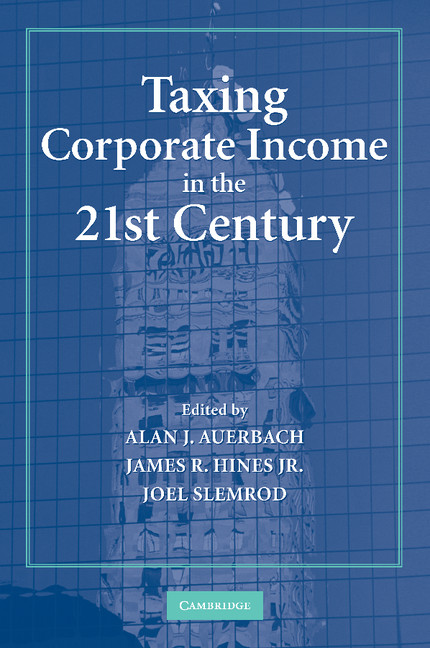
    This book was first published in 2007. Most countries levy taxes on corporations, but the impact - and therefore the wisdom - of such taxes is highly controversial among economists. Does the burden of these taxes fall on wealthy shareowners, or is it passed along to those who work for, or buy the products of, corporations? Can a country with high corporate taxes remain competitive in the global economy? This book features research by leading economists and accountants that sheds light on these and related questions, including how taxes affect corporate dividend policy, stock market value, avoidance, and evasion. The studies promise to inform both future tax policy and regulatory policy, especially in light of the Sarbanes-Oxley Act and other actions by the Securities and Exchange Commission that are having profound effects on the market for tax planning and auditing in the wake of the well-publicized accounting scandals in Enron and WorldCom.

    Reviews

    “In this book most of the top stars of public finance economics grapple with a series of issues surrounding the taxation of corporate income. These include, among others, the reactions of corporations to changes in the corporate tax rate, tha reactions of the market to changes in the tax on dividends, and the efforts of corporations ( by choosing their location, by their debt-finance decisions, and by other means) to reduce their tax liabilities. The authors do not reach a clear consensus, but expose the reader to the many facets (of theory, of hypothesis framing and testing, and of data analysis) that turn out to be important as one delves into this topic. These matters are profound, rich and challenging to professionals interested in public finance and corporate behavior.” -- Arnold C. Harberger, University of California, Los Angeles

    “The corporate income tax has a long history of analysis and consideration by economists, going back to Harberger's pathbreaking work in the 1960's. Yet questions of its efficiency costs and incidence remain controversial today – and crucial to U.S. policy discussions of capital formation, competitiveness, and wages and income distribution. This volume collects important new papers on the consequences of the double taxation of dividends, corporate taxation of multinational firms, and links between corporate taxation and corporate governance. The book should be read both by economists interested in capital income taxation and by policy analysts piecing together the role of corporate taxation in tax reform.” -- R. Glenn Hubbard, Dean, Columbia Business School

    “Understanding the effects of the corporate tax is one of the central and most difficult elements of tax policy. This book provides a comprehensive analysis of the issue. Auerbach, Hines, and Slemrod have brought together the leading researchers in the field, many of them using new or unique data sets to understand the effects of taxing corporations. The analyses will help further the debate on corporate tax compliance, international competition, the effects of dividend taxation, and many other issues of central importance to tax reform and to our economy.” -- David Weisbach, The University of Chicago

    “Anyone interested in the issues related to taxing corporate income will find this book well worth their time to read. As highlighted in many of the discussant comments, as many if not more questions are raised than answered in many of the papers and I believe the book will prove to be fertile ground for graduate students and others searching for important and timely research questions.” -- Terry Shevlin, University of Washington

    Refine List

    Actions for selected content:

    Select all | Deselect all
    • View selected items
    • Export citations
    • Download PDF (zip)
    • Save to Kindle
    • Save to Dropbox
    • Save to Google Drive

    Save Search

    You can save your searches here and later view and run them again in "My saved searches".

    Please provide a title, maximum of 40 characters.
    ×

    Contents


    Page 1 of 2


    • Preface
      pp xi-xiv
      • By Alan J. Auerbach, Robert D. Burch Professor of Economics and Law, Director of the Burch Center for Tax Policy and Public Finance, and former Chair of the Economics Department University of California, Berkeley, James R. Hines, Richard A. Musgrave Collegiate Professor of Economics in the department of economics and Professor of Law in the law School University of Michigan, Joel Slemrod, Paul W. McCracken Collegiate Professor of Business Economics and Public Policy Stephen M. Ross School of Business at the University of Michigan; Director of the Office of Tax Policy Research, an interdisciplinary research center housed Ross School

    Page 1 of 2


    Metrics

    Altmetric attention score

    Full text views

    Total number of HTML views: 0
    Total number of PDF views: 0 *
    Loading metrics...

    Book summary page views

    Total views: 0 *
    Loading metrics...

    * Views captured on Cambridge Core between #date#. This data will be updated every 24 hours.

    Usage data cannot currently be displayed.

    Accessibility standard: Unknown

    Why this information is here

    This section outlines the accessibility features of this content - including support for screen readers, full keyboard navigation and high-contrast display options. This may not be relevant for you.

    Accessibility Information

    Accessibility compliance for the PDF of this book is currently unknown and may be updated in the future.
