





Introduction
Countries around the world are facing serious problems due to aging and failing public infrastructure (e.g., roads, bridges, and water systems), which are further exacerbated by growing damages from climate change (Gössling et al., Reference Gössling, Neger, Steiger and Bell2023). While the public sector may be primarily responsible for fixing these problems, governments in this “new Governance” era (Evers & Schmid, Reference Evers and Schmid2025, p. 2) increasingly need support from other sectors as well as from individual citizens to collaboratively manage risks and protect infrastructure systems (Dvir et al., Reference Dvir, Liu and Vedlitz2024; Kvartiuk, Reference Kvartiuk2016; McLennan, Reference McLennan2020). Case in point, a promising and yet little studied way for citizens to help, especially considering widespread budget shortfalls and spending cuts facing governments, is donating to their government (Li et al., Reference Li, Eckel, Grossman and Brown2011, Reference Li, Eckel, Grossman and Brown2015; López-Pérez et al., Reference López-Pérez, Ramirez-Zamudio and Cruz-Martínez2024; Slemrod & Kuchumova, Reference Slemrod and Kuchumova2023). Though not a well-known form of public revenue raising, opportunities for citizens’ voluntary monetary donations to their local government do exist, with wide-ranging examples such as “check-off” programs in many states in the United States (Tax Project, 2025), dedicated municipal funds for urban forestry like the tree fund in the city of Guelph, Canada (City of Guelph, 2026), “solidarity accounts” in response to natural disasters like the 2024 flash floods in Valencia, Spain (Generalitat Valenciana, 2024), or––in the particular setting that this study zeroes in on––local authorities asking citizens to donate resources to build and repair roads and bridges in pursuit of infrastructure upgrades and economic development goals in the developing country of Vietnam (Thanh & Pham, Reference Thanh and Pham2019).
A seminal article by Smith and Huntsman (Reference Smith and Huntsman1997), which builds on the citizen-customer model and the citizen-owner model to propose a citizen-investor model that highlights the value of government as perceived by citizens, defines co-investment broadly as citizens voluntarily investing their time or money in the government from which they expect to receive value. However, the vast majority of research on citizen participation has paid more attention to time investment (sometimes referred to using related terms like co-production or direct participation) than to monetary investment (which Nabatchi and Leighninger (Reference Nabatchi and Leighninger2015) consider an indirect form of public participation) in the government (Dvir et al., Reference Dvir, Liu and Vedlitz2024; Zhang et al., Reference Zhang, Liu and Vedlitz2020a). Furthermore, the research line that does emphasize citizens’ monetary investment has often probed their willingness to engage in debt-financing (e.g., purchasing interest-bearing municipal bonds) or to accept a permanent financial surcharge (e.g., on their recurring taxes or utility bills), as opposed to a one-time voluntary monetary donation to the government. The science of donations, meanwhile, has concentrated almost exclusively on voluntary giving to private charitable organizations.
To advance the nascent literature on government donations, this study asks: To what extent do some established drivers of charitable giving explain the willingness of Vietnamese citizens to donate to their local government for road improvements? For our theoretical framework, we draw upon Bekkers and Wiepking’s (Reference Bekkers and Wiepking2011) prominent framework of mechanisms that drive charitable giving. Specifically, we focus on five mechanisms that we can directly test with our empirical data: awareness of need (measured by perceived issue importance), solicitation (the government’s ask), costs (the requested donation amount), altruism (the desire to support fellow citizens), and efficacy (trust in government). It is also worth acknowledging the remaining drivers from Bekkers and Wiepking’s (Reference Bekkers and Wiepking2011) framework that our data cannot directly capture, namely material benefits, reputational consequences, psychological outcomes, and values, which we discuss as a future research opportunity at the end of this article.
In terms of contributions to the budding line of research on citizens’ voluntary monetary donations to local governments, our present article aims to extend this literature in three ways. Firstly, we attempt to replicate in the understudied, Southeast-Asian, single-party, and developing-country context of Vietnam three known drivers of government donations: awareness of need, costs, and efficacy. Secondly, we shed light on two potential drivers that have remained untested in the government donations literature, namely citizens’ altruism and government’s solicitation. Thirdly, we make a number of methodological contributions such as by using a large-N nationally representative sample of Vietnamese citizens, benchmarking the drivers’ effect sizes, and estimating as well as comparing citizens’ stated donation willingness with their actual recent donation behaviors.
The following sections will proceed as follows: Section “Theoretical background and hypotheses” theoretically reviews and hypothesizes some probable drivers of citizens’ willingness to donate to local governments; Section “Research design” explains our empirical research design; Section “Main results” shows the results from our main analyses (while also listing in the Appendix some supplemental analyses that support and extend the main results); Sections “Discussion” and “Conclusion” conclude with a discussion of the theoretical and practical implications as well as the current limitations and future research directions of this study.
Theoretical background and hypotheses
To build our hypotheses, we draw upon the influential theoretical framework developed by Bekkers and Wiepking (Reference Bekkers and Wiepking2011), who synthesize the massive literature on charitable giving into core mechanisms that drive giving. Not merely a list of motivations, these drivers represent a multidimensional system of factors that includes external triggers, the donor’s internal calculations, and the interactions between actors and targets in the philanthropic process. More specifically, Bekkers and Wiepking (Reference Bekkers and Wiepking2011) argue that these drivers differ along four key dimensions: their form (tangible or intangible), their location (within, outside, or between people), the actors involved (donors, fundraisers, beneficiaries, and/or alters), and the targets of their effects (donors and/or beneficiaries). Further, the mechanisms often follow a logical order corresponding to the typical act of donation, where prerequisites like an awareness of need and solicitation must be met before a donor’s own calculations come into play.
With this nuanced understanding, as aforementioned, our study tests hypotheses derived from five drivers that our empirical data can directly measure: awareness of need (measured by perceived issue importance), solicitation (the government’s ask), costs (the requested donation amount), altruism (the desire to support fellow citizens), and efficacy (trust in government). Crucially, while three of these drivers (awareness of need, costs, and efficacy) have been inspected by previous government donations research, which our study aims to replicate, the other two (altruism and solicitation) have not been tested by the existing studies on giving to government. This is a serious knowledge gap that our study tries to fill, given that these two drivers are especially critical as they speak to the core debate about whether donating is driven by internal altruistic motivations or external social pressure (DellaVigna et al., Reference DellaVigna, List and Malmendier2012)––a distinction well noted in the charitable sector but overlooked in studies of giving to government. As DellaVigna et al. (Reference DellaVigna, List and Malmendier2012) make clear about these two types of motivation for charitable giving, some people simply enjoy donating, while other people would rather not donate but dislike saying no under the solicitor’s pressure. In other words, the former type of motivation (i.e., altruism) is largely supply-driven, while the latter type (i.e., solicitation) is mostly demand-driven, thus affecting the utility of the prospective donor differently (DellaVigna et al., Reference DellaVigna, List and Malmendier2012).
Following Bekkers and Wiepking’s (Reference Bekkers and Wiepking2011, p. 929) framework, the order of the drivers and resultant hypotheses we discuss below does not indicate their relative importance but instead “corresponds to the chronological order in which they affect giving in the typical act of donation” and reflects “related literatures in which prosocial behavior and helping others are conceptualized as a series of consecutive decisions.”
Awareness of need (perceived issue importance)
The first prerequisite for philanthropy is an awareness of need. In the charitable giving literature, to cite just a few examples, the perceived need for support has been linked with donations to homeless people (Lee & Farrell, Reference Lee and Farrell2003), international relief nonprofits (Cheung & Chan, Reference Cheung and Chan2000), and online charitable crowdfunding projects (Salido-Andres et al., Reference Salido-Andres, Rey-Garcia, Alvarez-Gonzalez and Vazquez-Casielles2021). This driver is unique in that needs may be tangible or intangible; needs may reside within, between, and outside people; needs originate from beneficiaries and fundraisers; and needs target potential donors to trigger the giving process (Bekkers & Wiepking, Reference Bekkers and Wiepking2011).
Relatedly, the awareness of an important public issue is a well-accepted driver of an individual citizen’s public policy attitudes and engagement. Such engagement can manifest in various forms such as voicing policy support or opposition (Zhang et al., Reference Zhang, Liu and Vedlitz2020b), electoral voting (Fournier et al., Reference Fournier, Blais, Nadeau, Gidengil and Nevitte2003), co-production (McLennan, Reference McLennan2020), or––as a few recent studies have documented––giving money to the government. For instance, Davidovic et al. (Reference Davidovic, Harring and Jagers2020) find that citizens holding stronger pro-environmental values are more willing to accept higher taxes to protect the environment; Zhang et al. (Reference Zhang, Liu and Vedlitz2020a) find that citizens priorly affected by flooding are more willing to accept higher water bills to help with local flood control; and Dvir et al. (Reference Dvir, Liu and Vedlitz2024) find that citizens more concerned with the state of local infrastructure are more willing to accept higher utility bills to support the construction of local infrastructure facilities. Meanwhile, particularly relevant to our study, Li et al. (Reference Li, Eckel, Grossman and Brown2011, Reference Li, Eckel, Grossman and Brown2015) learn through a lab experiment that people are more likely to make a one-time donation to a government agency if they believe that the agency serves an important cause.
Informed by and replicating the above knowledge, our first hypothesis is as follows:
H1: Citizens who consider a public issue important are more willing to donate to their local government to address that issue.
Solicitation (government’s ask)
The second key external trigger is solicitation, which Bekkers and Wiepking (Reference Bekkers and Wiepking2011) frame as a tangible (e.g., a fundraising letter) or intangible (e.g., a verbal ask) interaction between people that originates from a beneficiary or fundraiser and targets a potential donor. In the charitable giving literature, it is generally agreed that “the most proximate cause of charitable gift is being asked to give” (Paxton, Reference Paxton2020, p. 547) and that “a large majority of all donation acts occurs in response to a solicitation” (Bekkers & Wiepking, Reference Bekkers and Wiepking2011, p. 931).
Of course, donation asks are not equally effective. In fact, there is clear evidence that many people try to avoid or reject solicitors (Andreoni et al., Reference Andreoni, Rao and Trachtman2017; DellaVigna et al., Reference DellaVigna, List and Malmendier2012; Exley & Petrie, Reference Exley and Petrie2018). What makes a donation ask successful, then? As Andreoni et al. (Reference Andreoni, Rao and Trachtman2017, p. 629) conclude, “the power of the ask derives from the emotional reaction it induces in a potential giver.” As a consequence, a donation ask tends to be more effective if it is in person and from a solicitor who has a good connection with the prospective donor (Gee & Meer, Reference Gee and Meer2020). Although this idea has been tested only in the nonprofit sector and not the public sector, there is room for us to conjecture that:
H2: Citizens who are personally asked by a government leader, especially one whom they have a close connection with, are more willing to donate to their local government.
Material costs (requested donation amount)
Once a donation has been solicited, the material costs become salient. This driver is tangible, resides outside the donor, originates from the fundraiser, and affects the donor (Bekkers & Wiepking, Reference Bekkers and Wiepking2011). Indeed, “it is clear that giving money costs money” and thus “when the costs of a donation are lowered giving increases” (Bekkers & Wiepking, Reference Bekkers and Wiepking2011, p. 932). This idea has been tried out extensively in the charitable sector and corroborated by findings such as how a potential donor’s giving can be influenced by the tax deductibility level (Peloza & Steel, Reference Peloza and Steel2005), the donation matching rate (Karlan & List, Reference Karlan and List2007), and, perhaps most directly, the requested donation amount (Desmet & Feinberg, Reference Desmet and Feinberg2003). Hung et al.’s recent (Reference Hung, Lu and Hung2025) meta-analysis of this literature also confirms that donors are sensitive to the price of giving.
In the public sector, the cost sensitivity of citizens regarding monetary co-investment has been analyzed mostly by hypothetical willingness-to-pay experiments that appraise people’s willingness to accept a permanent tax increase or utility bill surcharge that would help fund government efforts to improve flood control (Zhang et al., Reference Zhang, Liu and Vedlitz2020a), clean energy (Jin et al., Reference Jin, Wan, Lin, Kuang and Ning2019; Mueller, Reference Mueller2013), overall infrastructure (Kotchen et al., Reference Kotchen, Turk and Leiserowitz2017), and so on. Unsurprisingly, these studies tend to find a negative effect of costs (i.e., the amount of tax or bill surcharge) on the probability of acceptance. As a result, our third hypothesis is as follows:
H3: Citizens who are requested to give a smaller amount are more willing to donate to their local government.
Altruism
Next, altruism is a mechanism that originates from a donor’s care for the tangible consequences of their gift for the beneficiaries (Bekkers & Wiepking, Reference Bekkers and Wiepking2011). Paxton (Reference Paxton2020, p. 547) defines altruism as “a desire to increase others’ well-being or the public good.” It is worth noting that altruism does not necessarily mean pure selflessness, as altruistic donors gain at least a “warm glow” feeling––a sense of satisfaction just from doing good (Andreoni et al., Reference Andreoni, Rao and Trachtman2017; Bekkers & Wiepking, Reference Bekkers and Wiepking2011; DellaVigna et al., Reference DellaVigna, List and Malmendier2012; Paxton, Reference Paxton2020; Slemrod & Kuchumova, Reference Slemrod and Kuchumova2023). Even as “impure altruists” (Bekkers & Wiepking, Reference Bekkers and Wiepking2011, p. 936), though, it is beyond debate that many people are willing to help total strangers even in anonymous settings (Andreoni et al., Reference Andreoni, Rao and Trachtman2017; Gee & Meer, Reference Gee and Meer2020).
The notion of altruism is more commonly studied in the nonprofit sector (e.g., Nowakowska, Reference Nowakowska2024), but it has also been grappled with in the public sector chiefly in conjunction with intertwined concepts like public service motivation (Piatak & Holt, Reference Piatak and Holt2020). A recent paper by Slemrod and Kuchumova (Reference Slemrod and Kuchumova2023) represents one of a few scholarly efforts so far to theorize about the effect of altruism (or at least the “warm glow” motivation) on citizens’ donations to their government. Although these scholars cannot directly measure individual citizens’ altruism, their theory is backed up by the indirect and suggestive fact that “in periods of popular wars the warm glow from gifts to government could be naturally elevated because of rise in patriotism and pride” (Slemrod & Kuchumova, Reference Slemrod and Kuchumova2023, p. 463). Thus, there is room for us to hypothesize that:
H4: Citizens who are more altruistic are more willing to donate to their local government.
Efficacy (trust in government)
Lastly, the efficacy mechanism is an intangible driver located within the donor—a perception, generated by the fundraiser, that the donation will make a difference to the supported cause (Bekkers & Wiepking, Reference Bekkers and Wiepking2011). This perception is essential because donors may know about and have to choose among many worthy causes that need monetary support (Neumayr & Handy, Reference Neumayr and Handy2019). Accordingly, people tend to donate to organizations that they can trust to use the donated money well (Neumayr & Handy, Reference Neumayr and Handy2019).
Although this idea has been tested mostly in the nonprofit sector (e.g., Alhidari et al., Reference Alhidari, Veludo-de-Oliveira, Yousafzai and Yani-de-Soriano2018), it appears to also apply to trust in government––which Dvir et al. (Reference Dvir, Liu and Vedlitz2024, p. 2759) define as “individuals’ views of government ability to correctly and fairly execute its responsibilities.” Specifically, a few studies (Dvir et al., Reference Dvir, Liu and Vedlitz2024; Li et al., Reference Li, Eckel, Grossman and Brown2011; López-Pérez et al., Reference López-Pérez, Ramirez-Zamudio and Cruz-Martínez2024) have associated citizens’ trust in their government with their willingness to give to the government. It is worth noting how these studies operationalize trust differently, with Dvir et al. (Reference Dvir, Liu and Vedlitz2024) measuring a general level of trust in government, Li et al. (Reference Li, Eckel, Grossman and Brown2011) focusing on perceptions of the government’s quality of work, and López-Pérez et al. (Reference López-Pérez, Ramirez-Zamudio and Cruz-Martínez2024) considering perceptions of the government’s corruption. These differences reflect the emerging consensus in the literature on trust about the multidimensional nature of this concept (e.g., AbouAssi et al., Reference AbouAssi, Tran, Bowman and Johnston2024; Alhidari et al., Reference Alhidari, Veludo-de-Oliveira, Yousafzai and Yani-de-Soriano2018; Zhong et al., Reference Zhong, Su, Peng and Yang2017). Zhong et al.’s (Reference Zhong, Su, Peng and Yang2017) meta-analysis of management research on trust labels two main dimensions of trust: competence-based trust (the trustor’s beliefs about the trustee’s ability) versus goodwill-based trust (the trustor’s beliefs about the trustee’s integrity and benevolence). Correspondingly, it makes sense that citizens need to trust both the quality of work (Li et al., Reference Li, Eckel, Grossman and Brown2011) and the lack of corruption (López-Pérez et al., Reference López-Pérez, Ramirez-Zamudio and Cruz-Martínez2024) of their government in order to confidently entrust their donations to the government.
Hence, our last two hypotheses are as follows:
H5a: Citizens who trust their local government’s quality of work are more willing to donate to their local government.
H5b: Citizens who trust their local government’s lack of corruption are more willing to donate to their local government.
Research design
Research setting and data source
While most research on citizen co-investment has been based in Western, democratic, and developed countries, the present article examines citizen co-investment in Vietnam––a little-studied, Southeast-Asian, single-party, and developing country. Besides the well-recognized benefits of replication––a key tenet of the scientific method that has often been inadequate in public and nonprofit management research (Helmig et al., Reference Helmig, Spraul and Tremp2012; Pedersen & Stritch, Reference Pedersen and Stritch2018), Vietnam provides a valuable setting for our investigation of citizens’ donations to local governments to improve local infrastructure owing to the critical public infrastructure needs in the country. This is not only because Vietnam’s developing economy has been hindered by poor infrastructure capacity (Dang & Pheng, Reference Dang and Pheng2015), but also because Vietnam’s infrastructure is geographically vulnerable to some of the most dangerous climate-change threats (e.g., sea-level rise) in the world (Balboni, Reference Balboni2025). Facing such serious problems, Vietnamese local authorities in the last decade have been requesting citizens to donate resources to help build and repair roads and bridges in pursuit of infrastructure upgrades and economic development goals (Thanh & Pham, Reference Thanh and Pham2019). Moreover, in a single-party state, the government and its affiliated organizations are the primary channels for civic action, making donations to the government a more common and substantial form of participation than in nations with large, independent nonprofit sectors (Nguyen & Doan, Reference Nguyen, Doan, Wiepking and Handy2015). Additionally, while philanthropy and mutual assistance are deeply embedded in Vietnamese culture and tradition with a high rate of domestic giving, the monetary sums are often small and suggesting significant untapped potential (Nguyen & Doan, Reference Nguyen, Doan, Wiepking and Handy2015).
To study this phenomenon, our article relies on the 2023 data of the Vietnam Provincial Governance and Public Administration Performance Index (PAPI) project. PAPI is a citizen-participatory, public-policy-monitoring project funded and implemented every year mainly by the United Nations Development Programme (UNDP) and the Centre for Community Support and Development Studies (CECODES)––a local nongovernmental research organization “working in promoting civil society, strengthening its voice and its engagement with the state” (CECODES, 2024). As one of the largest citizen feedback collection projects in Vietnam, PAPI plays “an instrumental role in shifting central and local governments’ mindsets towards an openness to external reviews and citizens’ candid feedback on governance and public administration performance” and “assists central and local governments in identifying governance challenges and anticipating where central and local governments should focus their energy and resources” (CECODES et al., 2024, p. 1).
After two pilot rounds to validate and fine-tune survey methods, first in three provinces in 2009 and then in 30 provinces in 2010, since 2011 PAPI has been conducted every year in all 63 provinces in Vietnam, randomly sampling and surveying thousands of citizens annually via a rigorous sampling method to ensure they are representative of the Vietnamese population (CECODES et al., 2024). Specifically, PAPI uses a multistage, clustered-sampling strategy each year that randomly picks a couple of districts within each of the 63 provinces, a couple of communes within each of the selected districts, a couple of villages within each of the selected communes, and lastly about 20 adult citizens within each of the selected villages––the smallest public administrative tier in Vietnam (although communes are the smallest tier with a People’s Committee––the official local administrative authority). Despite PAPI’s nationally representative sampling and high response rate, we cannot completely rule out a non-response bias where non-respondents may differ somehow from respondents (e.g., non-respondents may be less civically engaged or harder to reach).
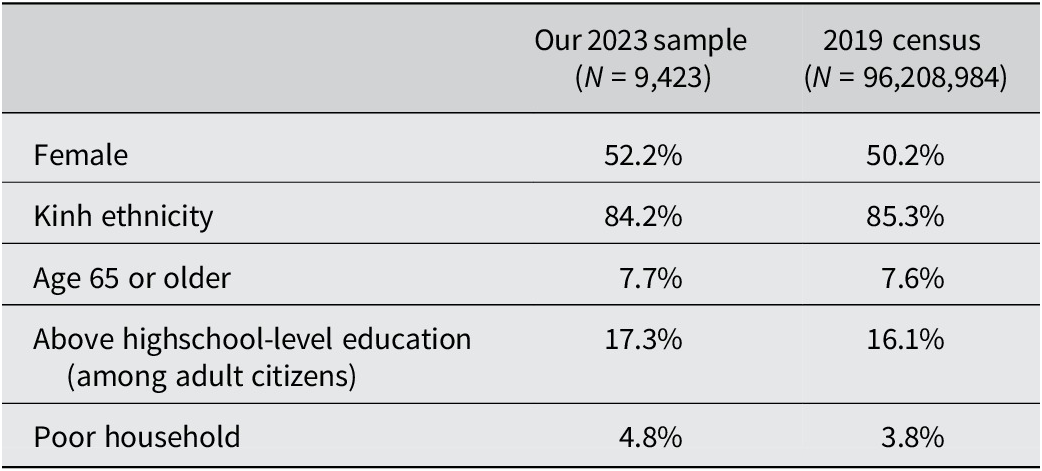
Our study relies on data from the 2023 PAPI project, which had an approximately 81% response rate and, besides many other public affairs topics, surveyed a random subset of about 9,000 Vietnamese citizens about their perceptions of and willingness to help improve local roads. Table 1 highlights the representativeness of this sample by comparing some demographic variables between our sample data and the latest Vietnamese census data, showing the closeness of the sample to the actual demographic characteristics of the Vietnamese population.
National representativeness of some demographic characteristics

Table 1. Long description
The table consists of three columns. The first column lists demographic characteristics. The second column contains data for Our 2023 sample where N equals 9,423. The third column contains data for the 2019 census where N equals 96,208,984.
* Female: 52.2 percent in the 2023 sample versus 50.2 percent in the 2019 census.
* Kinh ethnicity: 84.2 percent in the 2023 sample versus 85.3 percent in the 2019 census.
* Age 65 or older: 7.7 percent in the 2023 sample versus 7.6 percent in the 2019 census.
* Above highschool-level education among adult citizens: 17.3 percent in the 2023 sample versus 16.1 percent in the 2019 census.
* Poor household: 4.8 percent in the 2023 sample versus 3.8 percent in the 2019 census.
Variables
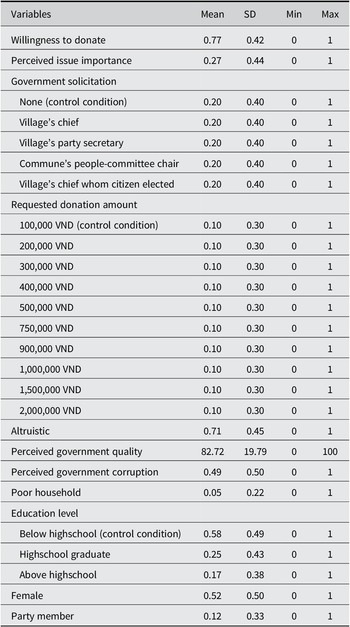
Table 2 provides the descriptive statistics of this study’s variables. Our only dependent variable is Willingness to Donate, a binary variable that equals 1 if a citizen answered “yes” (or 0 otherwise) to this question: “In the next year, if there is a decision to invest in building or repairing public roads in your locality, would you be willing to donate [randomly assigned amount of money] to your local government to help fund the project?” It is noteworthy that 77% of the surveyees answered “yes” to this question.
Descriptive statistics (N = 9,423)

Table 2. Long description
The table contains five columns: Variables, Mean, S D, Min, and Max. Key data points include:
* Willingness to donate: Mean 0.77, S D 0.42, Min 0, Max 1.
* Perceived issue importance: Mean 0.27, S D 0.44, Min 0, Max 1.
* Government solicitation categories (None, Village chief, Village party secretary, Commune committee chair, Elected village chief) all show a Mean of 0.20 and S D of 0.40.
* Requested donation amounts range from 100,000 V N D to 2,000,000 V N D, each with a Mean of 0.10 and S D of 0.30.
* Altruistic: Mean 0.71, S D 0.45.
* Perceived government quality: Mean 82.72, S D 19.79, Min 0, Max 100.
* Perceived government corruption: Mean 0.49, S D 0.50.
* Poor household: Mean 0.05, S D 0.22.
* Education level: Below highschool (Mean 0.58), Highschool graduate (Mean 0.25), Above highschool (Mean 0.17).
* Female: Mean 0.52, S D 0.50.
* Party member: Mean 0.12, S D 0.33.
To test our first hypothesis, our first independent variable is Perceived Issue Importance, a binary variable that equals 1 if a citizen answered “roads” (or 0 otherwise) to this open-ended question (which, importantly, was asked before the above question): “In the next year, if there is a decision to invest in building or repairing a type of public infrastructure in your locality, what do you think should be prioritized?” “Roads” was the most common answer to this question, followed by community centers, playgrounds, water systems, and so on. We acknowledge that capturing the first-to-mind response from an open-ended question may not be identical to asking about the importance of roads directly, which poses a measurement limitation.
To test our second hypothesis, our next set of independent variables include five binary variables that correspond to different conceivable sources (or lack) of local government pressure: personally requested by None (the control condition and reference category) to donate, by the Village’s Chief, by the Village’s Party Secretary, by the Commune’s People-Committee Chair, or by the Village’s Chief whom Citizen Elected. Among these options, the last category is the type of local government leader that an average Vietnamese citizen should have the closest connection with (compared with a generic village’s chief whom the citizen may not have chosen to elect, a village’s party secretary––who can be elected only by members of the Communist Party of Vietnam (CPV), or a commune’s People-Committee chair––who can be elected only by the local People’s Council (i.e., the local government’s legislative branch)). These five hypothetical conditions, which citizens were asked to imagine, were randomly assigned to the citizens to strengthen internal validity by ensuring that results would not be confounded by selection biases.
To test our third hypothesis, our next set of independent variables includes ten binary variables that correspond to ten different requested donation amounts ranging from 100,000 VND (the reference category) to 2,000,000 VND. These amounts were also randomly assigned to the citizens to bolster internal validity. Similar to previous willingness-to-pay experiments in the public sector (e.g., Jin et al., Reference Jin, Wan, Lin, Kuang and Ning2019; Kotchen et al., Reference Kotchen, Turk and Leiserowitz2017; Mueller, Reference Mueller2013; Zhang et al., Reference Zhang, Liu and Vedlitz2020a), each citizen was asked whether he/she would be willing to give the randomly assigned amount to support the proposed public good/service improvement (i.e., local public roads in this case).
To test our fourth hypothesis, our next independent variable is Altruistic, a binary variable that equals 1 if a citizen answered “yes” (or 0 otherwise) to this question: “To help alleviate poverty, the government sometimes transfers funds from richer provinces to poorer provinces. Would you be willing to pay more in taxes to pay for transfers to a poor province outside of your own?” This measure was adapted for our research context based on more common general measures of altruism such as “I have sympathy for people who are less fortunate than I am” or “I try to give generously to those in need” (Piatak & Holt, Reference Piatak and Holt2020). It is interesting that 71% of the surveyees showed an altruistic tendency here.
To test our last two hypotheses, our next two independent variables are Perceived Government Quality and Perceived Government Corruption. Perceived Government Quality is a continuous variable ranging from 0 to 100 and corresponding with each citizen’s rating of the quality of work by their commune’s People’s Committee––the official governmental body in charge of implementing local public administrative functions in Vietnam. As Table 2 indicates, the average rating is 82.72 out of 100. Meanwhile, Perceived Government Corruption is a binary variable that equals 1 if a citizen agreed (or 0 otherwise) that local government employees sometimes engaged in bribery or embezzlement. It is striking that 49% of the surveyees reported knowing about local government corruption, which aligns with longstanding concerns about severe corruption in Vietnam (e.g., see Tromme, Reference Tromme2016).
Finally, following prior research in both the nonprofit and public sectors, we include several individual demographic characteristics as control variables. To start with, income is obviously an imperative factor as it allows a donor to afford donating (Paxton, Reference Paxton2020). We control for income using the binary variable Poor Household, which equals 1 if a citizen’s household income met (or 0 otherwise) the poverty standard (i.e., about 1,500,000 VND or below per person per month in 2023) (Kim, Reference Kim2024). Next, the level of education is also an influential predictor of donations because education may boost prosocial motivation, awareness of need, and income itself (Paxton, Reference Paxton2020). We measure formal education with three binary variables: Below Highschool (the reference category), Highschool Graduate, and Above Highschool. Another factor is gender differences in giving, with most studies noticing that women are more likely to donate probably due to their stronger prosocial values (De Wit & Bekkers, Reference De Wit and Bekkers2016). We control for gender with the binary variable Female. Lastly, political affiliation and ideology, especially regarding the appropriate size and roles of the public sector, may also shape charitable contributions (Dvir et al., Reference Dvir, Liu and Vedlitz2024; Paarlberg et al., Reference Paarlberg, Nesbit, Clerkin and Christensen2019). We control for political affiliation using the binary variable Party Member, which equals 1 for CPV members (or 0 otherwise)––the only legal and, therefore, monopolistic political party in this one-party state.
Analytical methods
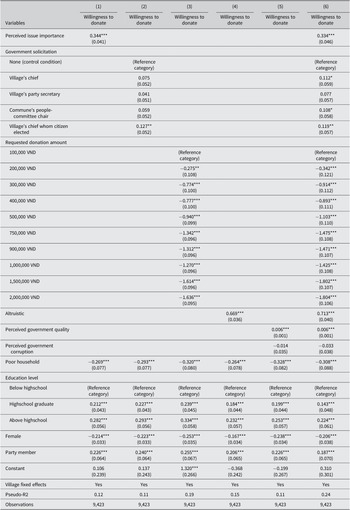
We use probit regression, a maximum-likelihood method of estimation suitable for binary outcome variables, to examine the above variables in six regression models as reported in Table 3. The first five models examine our five types of drivers separately, while the last model includes all of the variables in order to test all of the hypotheses together. We also control for village fixed effects in all of the models so that we can compare citizens living in the same village and thereby increase comparability and internal validity, as different localities in Vietnam may have different public infrastructure conditions, construction costs, cultures, and other potentially confounding characteristics (Balboni, Reference Balboni2025). As reported in the Appendix, we also conduct a series of supplemental analyses to bolster confidence in and add nuances to the findings from our main regression models. These include using cluster-robust standard errors to account for the clustered sampling design, a linear probability model for easier interpretation, an analysis to mitigate common source bias, and a comparison of stated donation willingness versus actual recent donation behaviors to assess the extent of hypothetical bias.
Main results

Table 3. Long description
A table titled Main results presenting Probit model coefficients for Willingness to donate across six numbered columns from 1 to 6.
Variables and key findings include:
* Perceived issue importance: Shows a positive significant effect in model 1 (0.344) and model 6 (0.334).
* Government solicitation: Using None as a reference category, Village's chief whom citizen elected shows a significant positive effect in model 2 (0.127) and model 6 (0.119).
* Requested donation amount: Using 100,000 V N D as a reference category, all higher amounts from 200,000 to 2,000,000 V N D show increasingly negative significant coefficients, reaching -1.804 for 2,000,000 V N D in model 6.
* Altruistic: Shows a strong positive significant effect in model 4 (0.669) and model 6 (0.713).
* Perceived government quality: Shows a small but significant positive effect (0.006) in models 5 and 6.
* Demographic controls: Poor household and Female variables consistently show negative significant effects across all models. Education level (Highschool and Above) and Party member status consistently show positive significant effects.
Bottom rows indicate Village fixed effects are included for all models. Pseudo-R2 values range from 0.11 to 0.24, with model 6 having the highest at 0.24. Total observations for all models are 9,423. Standard errors are provided in parentheses below coefficients. Significance levels are marked with asterisks: three for p less than 0.01, two for p less than 0.05, and one for p less than 0.1.
Notes: Probit models. Standard errors in parentheses.
*** p < 0.01, ** p < 0.05, * p < 0.1.
Main results
Table 3 presents the results of our main regression models. Model 6, which includes all of the variables in order to test all of the hypotheses together, robustly shows highly similar results to the first five models, which examine the five mechanisms separately, so we can focus on discussing this full model. As Model 6 displays: (1) citizens who considered public roads the most important issue to prioritize were significantly more willing to donate to their local government to address that issue, which supports Hypothesis 1; (2) citizens who were asked to imagine being requested by the village’s chief whom they elected were significantly more willing to donate, which supports Hypothesis 2 (while the Village’s Party Secretary condition is not statistically significant, the statistical significance of two other conditions (the Commune’s People-Committee Chair condition and the generic Village’s Chief condition) is only marginal (p < 0.1) yet possibly meaningful as it suggests that Vietnamese citizens might be more responsive to an administrative authority than to a political authority when considering supporting local roads––perhaps because the Village’s Chief and the Commune’s People-Committee Chair are the local administrative officials directly in charge of public administration project implementation, while the Party Secretary’s primary role is ideological leadership and not day-to-day administrative functions); (3) citizens who were requested to give a larger amount were significantly less willing to donate, which supports Hypothesis 3 (it is also essential to remark how the estimated negative coefficients here increase in magnitude as the requested donation amount goes up, which implies that the citizens were sensitive to the requested amount); (4) citizens who showed an altruistic orientation were significantly more willing to donate, which supports Hypothesis 4; and (5) citizens who expressed trust in the government’s quality of work (but, surprisingly, not the lack of corruption) were significantly more willing to donate, which supports Hypothesis 5a but not Hypothesis 5b. As for the control variables, citizens who were female, poor, less educated, and not a CPV member were significantly less willing to donate.
Discussion
This study tested five mechanisms from Bekkers and Wiepking’s (Reference Bekkers and Wiepking2011) theoretical framework to understand citizen donations to local governments. Our findings largely corroborate the extant government donations research on the importance of awareness of need, costs, and efficacy, while also revealing the roles of citizen altruism and government solicitation in this context. Further, the findings not just signal the applicability of Bekkers and Wiepking’s (Reference Bekkers and Wiepking2011) charitable giving mechanisms to the novel context of donations to local governments in Vietnam but also unveil multiple nuances regarding how these mechanisms operate.
To begin with, our results provide a more nuanced understanding of the efficacy mechanism. While the theory suggests trust in efficacy is crucial, our findings distinguish between competence-based trust (perceived quality of work) and goodwill-based trust (perceived corruption). The fact that only the former was a significant driver suggests that in the Vietnamese context citizens may prioritize the government’s capacity to deliver a tangible project (i.e., “can they build the road?”) over concerns about corruption, which may be viewed as a fact of life (substantiated by the fact that nearly half of the surveyees reported knowing about a case of local corruption). This underlines how different components of efficacy can have different weights depending on the socio-political context.
Next, our study sheds light on how the solicitation mechanism functions in a single-party state. The most statistically significant experimental condition (being asked by an elected village chief—the local government leader whom citizens should have the closest connection with) underscores the interplay of personal connections and the state’s administrative authority in mobilizing citizen contributions. This form of solicitation may be uniquely effective in a context where the lines between community leadership and state administration are blurred, a finding that extends Bekkers and Wiepking’s (Reference Bekkers and Wiepking2011) framework beyond the typical nonprofit context.
Relatedly, the large substantive effect of the altruism mechanism indicates a stronger predictor of donation willingness than the solicitation mechanism (also see Table A1’s Model 2 in the Appendix). This suggests that while external pressure from the state does play a role, citizens’ internal motivations to help fellow citizens may be a more powerful driver. This finding points to the plausibly dominant role of supply-side altruistic motivations in this context. The fact that citizens’ donation willingness appears to be shaped more by supply-side (altruism) than demand-side (solicitation pressure) motivations here also means giving may increase the utility of the potential donors in this case (DellaVigna et al., Reference DellaVigna, List and Malmendier2012).
In terms of the control variables, our surprising finding that female citizens were less willing to donate might have something to do with structural gender inequality in Vietnam, which has long hampered Vietnamese women’s participation in public affairs (Nguyen, Reference Nguyen2022). This adds some nuances about the generalizability of previous findings and lends credence to the values of replication––a tenet of the scientific method that has often been deficient in public and nonprofit management research (Helmig et al., Reference Helmig, Spraul and Tremp2012; Pedersen & Stritch, Reference Pedersen and Stritch2018).
As for practical implications, our study’s findings may offer local governments in Vietnam (and potentially elsewhere, given the decently high level of generalizability that we find) many useful insights about how to better attract voluntary donations from citizens. For instance, local governments should pay careful attention to the requested donation amount given this driver’s big effect size. To illustrate, looking at Table A1’s Model 2 in the Appendix, we can spot some hefty declines in the likelihood of giving when the requested donation amount reaches certain thresholds like 300,000 VND, 750,000 VND, and 1,500,000 VND. As another example, given the substantial effect size of perceived issue importance, local governments may benefit from more effective fundraising by focusing on prospective donors who care about a certain cause––i.e., similar to the market segmentation research that nonprofits have long utilized. At the same time, our findings about the low willingness to donate of female, low-income, low-education, and non-CPV-member citizens should warn governments to be mindful of various inequality dimensions that may create barriers to citizen participation (also see Clark, Reference Clark2018).
Notwithstanding such scholarly and policy implications, our current article certainly has some remaining limitations that future research should address. Empirically, for example, it is necessary to return to measurement issues like how our awareness-of-need driver is based on a top-of-mind question and binary measure. Our top-of-mind question (what type of public infrastructure should be prioritized?) likely established a high threshold for perceived issue importance since a citizen had to explicitly name “roads” as their absolute priority to be coded as a “1,” while the “0” category might include citizens who, despite prioritizing other public infrastructure projects, might still recognize the need for road improvements. Consequently, as our reference category might include people who actually did recognize the need for better roads and thus might be willing to donate––thereby artificially narrowing the contrast between the “1” group and the “0” group, our finding for the awareness-of-need driver likely represents a conservative, lower-bound estimate of this driver’s true effect. A stronger future approach, then, may be using a direct and scaled question about the intensity of a citizen’s perceived importance of roads. Future endeavors should also try to tackle the probable hypothetical measurement bias that our study and most previous studies in this research line have not overcome. Creative revealed-preference, as opposed to stated-preference, designs may be a promising approach to transcend this limitation (De Corte et al., Reference De Corte, Cairns and Grieve2021). It is worth emphasizing, though, that hypothetical willingness-to-pay designs like the one used herein are still frequently employed in public opinion or policy impact evaluations (Kotchen et al., Reference Kotchen, Turk and Leiserowitz2017). Also, while hypothetical bias might have artificially inflated the overall intercept of our models (i.e., the baseline willingness to give), the directional relationships and relative roles of the independent variables (i.e., their slopes) should remain theoretically sound. Next, while some of our findings rely on experimental variations, the rest depend on observational variations that are limited in proving causality, necessitating future causal inference efforts. Lastly, to further replicate this literature’s knowledge, it would also be enriching to see more empirical evidence from related contexts such as China (e.g., Bies & Kennedy, Reference Bies and Kennedy2019) or other underexplored contexts such as Muslim communities (e.g., Siddiqui & Campbell, Reference Siddiqui and Campbell2023).
Additionally, future studies should pursue further theoretical development. There is definitely room to test more potential drivers (e.g., material benefits, reputational consequences, psychological outcomes, or personal values) and potential outcomes (e.g., ranging from positive ones like public good/service improvement to negative ones like reduced donations to nongovernmental organizations with implications for democracy building––see Herrold & AbouAssi, Reference Herrold and AbouAssi2023) of citizens’ donations to the government. Also crucially, future research should investigate whether the type of good being funded changes the predictive power of the drivers. The relevant drivers for local roads, where the donor and their family may also be direct beneficiaries, may differ from those for goods that require more pure altruism (e.g., charitable giving to help poor strangers). Comparing different types of goods therefore would further refine boundary conditions. It would also be interesting to consider the roles of government types (e.g., general versus special purpose governments––see Park & Shi, Reference Park and Shi2021), donation methods (e.g., giving directly to the public sector versus indirectly via intermediary nonprofits––see Gazley et al., Reference Gazley, Cheng and LaFontant2019), and public service/good delivery methods (e.g., in-house versus contracting to private firms––see Lavertu & Tran, Reference Lavertu and Tran2025). Finally, it would be fruitful to ponder how Bekkers and Wiepking’s drivers (e.g., supply-side versus demand-side motivations) may interlink.
Conclusion
In conclusion, voluntary giving to local governments represents a promising and yet understudied form of citizen engagement. Applying Bekkers and Wiepking’s (Reference Bekkers and Wiepking2011) framework to the context of giving to local governments in Vietnam, this present study has expanded our nascent understanding of this engagement form.
To concisely answer the broader “so what?” question, our findings offer critical takeaways for both research and practice. For research, this study essentially demonstrates the robust generalizability of Bekkers and Wiepking’s (Reference Bekkers and Wiepking2011) charitable giving framework by extending it beyond the traditional nonprofit sector and into the realm of local government co-investment. Besides establishing that core philanthropic drivers effectively explain citizens’ willingness to donate to the state, our results refine the boundary conditions of this framework by revealing contextual nuances. For instance, we show that, in this specific governance setting, the efficacy mechanism appears driven primarily by competence-based trust (the government’s quality of work) rather than goodwill-based trust (perceptions of corruption).
For management practice, the key takeaway is that local governments facing infrastructure deficits and budget shortfalls may successfully attract voluntary co-investment by adopting nonprofit-style fundraising strategies. For example, public administrators must be sensitive to the requested donation amount as citizens exhibit clear price sensitivity. Also, solicitation efforts may be most effective when channeled through elected local leaders who bridge the gap between state administrative authority and grassroots community ties. Ultimately, as governments increasingly turn to citizens for support, unpacking these complex behavioral drivers is not just a rewarding academic pursuit but also a necessity for the future of resilient public finance and participatory governance.
Supplementary material
The supplementary material for this article can be found at http://doi.org/10.1017/S0957876526000239.
Acknowledgements
The author would like to thank the editors and anonymous reviewers for their helpful feedback. Thanks also go to PAPI Vietnam for creating and sharing valuable data.
Funding statement
The author received no funding for this study.
Competing interests
The author has no conflict of interest to disclose.
Declarations
The author has no relevant financial or non-financial interests to disclose.


 Open access

