
Skip to main content Accessibility help
×
  • Cited by 1
    • You may already have access via personal or institutional login
    • Select format
    • Publisher:
      Intersentia
      Publication date:
      22 December 2020
      13 September 2019
      ISBN:
      9781780689180
      9781780686981
      Dimensions:
      Weight & Pages:
      Dimensions:
      Weight & Pages:
    You may already have access via personal or institutional login
  • Selected: Digital
    Add to cart View cart Buy from Cambridge.org

    Book description

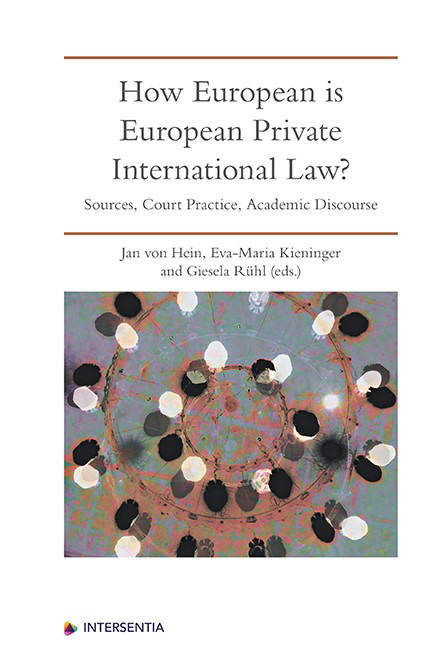
    Over the course of the last few decades, the European legislature has adopted a total of 18 Regulations in the area of private international law, including civil procedure. The resulting substantial legislative unification has been described as the first true 'Europeanisation' of private international law, and even as a kind of 'European Choice of Law Revolution'. However, it remains largely unclear whether the far-reaching unification of the 'law on the books' has turned private international law into a truly European 'law in action': To what extent is European private international law actually based on uniform European rules common to all Member States, rather than on state treaties or instruments of enhanced cooperation? Is the manner in which academics and practitioners analyse and interpret European private international law really different from previously existing domestic approaches to private international law? Or, rather, is the actual application and interpretation of European private international law still influenced, or even dominated, by national legal traditions, leading to a re-fragmentation of a supposedly uniform body of law? In bringing together academics from all over Europe, How European is European Private International Law? sets out to answer - for the first time - these crucial and interrelated questions. It sheds light on the conspicuous lack of 'Europeanness' currently symptomatic of European private international law and discusses how this body of law can become truly European in character in the future. With contributions by Jürgen Basedow (Max Planck Institute for Comparative and International Private Law), Paul Beaumont (University of Sterling), Sabine Corneloup (University Paris II, Panthéon-Assas), Gilles Cuniberti (University of Luxembourg), Agnieska Frackowiak-Adamska (University of Wroclaw), Stéphanie Francq (University of Louvain), Pietro Franzina (University of Ferrara), Jan von Hein (University of Freiburg), Michael Hellner (Stockholm University), Eva-Maria Kieninger (University of Würzburg), Thomas Kadner Graziano (University of Geneva), Xandra Kramer (Erasmus University Rotterdam), Johan Meeusen (University of Antwerp), Pedro A. de Miguel Asensio (Complutense University Madrid), Dário Moura Vicente (University of Lisbon), Marta Requejo Isidro (Max Planck Institute for Procedural Law Luxembourg), Giesela Rühl (University of Jena), Alix Schulz (Heidelberg University) and Marc-Philippe Weller (Heidelberg University).

    Refine List

    Actions for selected content:

    Select all | Deselect all
    • View selected items
    • Export citations
    • Download PDF (zip)
    • Save to Kindle
    • Save to Dropbox
    • Save to Google Drive

    Save Search

    You can save your searches here and later view and run them again in "My saved searches".

    Please provide a title, maximum of 40 characters.
    ×

    Contents

    Metrics

    Full text views

    Total number of HTML views: 0
    Total number of PDF views: 0 *
    Loading metrics...

    Book summary page views

    Total views: 0 *
    Loading metrics...

    * Views captured on Cambridge Core between #date#. This data will be updated every 24 hours.

    Usage data cannot currently be displayed.

    Accessibility standard: Unknown

    Why this information is here

    This section outlines the accessibility features of this content - including support for screen readers, full keyboard navigation and high-contrast display options. This may not be relevant for you.

    Accessibility Information

    Accessibility compliance for the PDF of this book is currently unknown and may be updated in the future.
