


1. Introduction
The design automation goal is to offload design tasks to a machine to support the designer or engineer. As Cederfeldt and Elgh (Reference Cederfeldt, Mikael and Fredrik2005) define it, design automation refers to “Engineering support by implementation of information and knowledge in solutions, tools, or systems, that are pre-planned for reuse and support the progress of the design process”. But despite its focus on reusability, once automation is implemented in a machine-readable format, its flexibility often comes at the cost of usability. For instance, rigid parameterization can limit adaptability (Rad et al. Reference Rad, Kent, Mirza, Henrik, Dag and Roland2022).
Developing a design automation support system presents a dilemma for developers. On one hand, creating a system that can adapt to any design scenario demands a level of effort and expertise that not all designers may have the time or ability to achieve (Heikkinen Reference Heikkinen2021). Moreover, such systems assume that users possess sufficient knowledge of the design system to configure the automation. On the other hand, a turn-key design automation system, while easy to use, often lacks the adaptability required to address the specific needs of a product under development, leading to a “black box” effect (Verhagen et al. Reference Verhagen, Bermell-Garcia, Van Dijk and Curran2012). This poses a trade-off between user-friendliness and the flexibility of automation.
Within the broader scope of Generative AI (GenAI), Large Language Models (LLMs) have appeared recently as a technology that offers potential in the trade-off between design flexibility and automation. The way these models can support the designer in design automation is by providing an assistance layer between the engineer and conventional methods. LLMs are not only able to independently generate outputs according to specific tasks demands (Generation), but also possess the capability to assist in connecting and integrating conventional engineering methods through interpreting inputs and outputs in accordance with given guidelines (Orchestration)
This duality represents an extension of previous technological possibilities. It also highlights their evolving but underexplored role within the technological agency utilized by engineers in the modern design process. As Leonardi (Reference Leonardi2011) explains, the imbrication of human and technological agency leads to the formation of new routines in organizational and industrial contexts; in our case, this interplay specifically applies to engineering design, necessitating an analysis to ensure LLM-based systems afford rather than constrain the goals of the engineer. We believe this analysis is of particular importance when considering the integration of non-deterministic models as active participants and therefore partial owners in the design process. The model proposed in this paper is a response to this analysis need.
We define complex products as components that are usually part of complex systems that are difficult to describe, understand, predict, manage, design or change (Sellgren Reference Sellgren2005), that additionally require the use of physical simulation models for the validation of the concepts before manufacturing. Their design typically relies on models such as Finite Element Modelling (FEM) and Computational Fluid Dynamics (CFD) to predict performance in relation to neighbouring system components. Examples of such components are jet engine structural parts or truck chassis members which integrate with other subsystems and must perform reliably under dynamic load cases and varying configurations. We envision that LLM-based systems could provide support via Design Automation to orchestrate these activities, providing time savings and improved quality throughout repeated analysis loops.
Other authors have explored the potential of GenAI in Engineering Design (ED) (Chiarello et al. Reference Chiarello, Filippo, Simone, Marija and Gualtiero2024). Their evaluation of the ED literature classified the potential of GenAI (LLMs in particular) to support designers with the generation, evaluation and description of engineering activities. They also highlighted the need for further research in LLMs supporting the ED activities of evaluating and describing. This paper intends to fill the research gap on the support that LLMs can provide to designers on design automation task during the development and evaluation of complex systems, such as structural components of vehicles.
The research reported in this paper aims to answer the following Research Questions (RQs):
RQ1. How can designers - and design automation developers - structure and visualize the contribution of Generative AI, specifically LLMs, within design automation systems?
RQ2. How have LLMs been integrated into design processes within the engineering design community.
RQ3. What are the research gaps in the application of LLMs for engineering design support?
2. Method
To answer RQ1, the experience from developing LLM-based automation applications (Pradas Gómez, Krus, et al.Reference Pradas, Alejandro, Krus, Panarotto and Isaksson2024; Pradas Gómez, Panarotto, et al. Reference Pradas, Alejandro, Massimo and Ola2024) has been used to propose a conceptual model, where the contribution of LLM can be easily identified. Additional feedback has been received from academic and industrial practitioners. Moreover, a formal survey has been created to validate the conceptual understanding of the model in industry. Furthermore, the literature survey used to answer RQ2 has been used to further validate the model coherence.
To answer RQ2, a literature review was carried out to retrieve documented examples of the application of LLMs within the engineering design community. After the identification of relevant papers, these were analysed to position each contribution within the triangle model, assessing the responsibility attributed to each member. RQ3 was answered from the combination of the literature review and the insights of the survey in industry.
2.1. Survey methodology
The method was presented to industrial participants in two companies: GKN Aerospace (4 different sites and countries) and MAN Truck & Bus SE. For both companies the same format was employed to ensure consistency and facilitate comparative analysis between the two companies. The model was presented for 15 minutes in an online meeting, followed by a digital survey and further 15 minute discussion on the model and the feasibility of GenAI impacting engineering practices.
The survey was designed as a quick and anonymous feedback (2 minutes average) aimed at maximizing responses. Questions 1 to 5 are available in the results section, Figure 2. An additional question asked the participants to provide any comments on the proposed model or the application of GenAI to their engineering tasks, complementing the post-survey group discussion.
2.2. Literature review methodology
The literature review used the PRISMA method (Page et al. Reference Page, McKenzie, Bossuyt, Isabelle, Hoffmann, Mulrow and Larissa2021) to present and describe the methodology and structure the content of the results and discussion sections. To maintain a focused and contextually relevant scope, we specifically targeted journals and conference papers endorsed by the Design Society (DS) plus an additional journal - JCSIE - due to the relevance of the topic. The search string, repositories used, and selection criteria are available in Figure 1. RQ2 guided the creation of a targeted search string for data collection.
Adapted PRISMA flowchart showing how the 40 papers assessed were selected

Following retrieval of the 112 papers identified, a screening process was performed in which titles and abstracts were analysed for relevance to the research question. The inclusion criteria focused on papers with potential for design automation use. The two main authors acted as the reviewers and evaluated independently a set of 10 papers to test the paper inclusion criteria and scoring logic to position each proposed LLM support on the triangle model. The updated scoring criteria, as presented in Figure 2, was used to evaluate 10 more papers (sampled 5 from conferences and 5 from journals) to confirm the criteria and reduce inter-reviewer bias. The remaining papers (92) were divided evenly and ranked by one reviewer only.
The evaluation criteria focused on three questions, whose purpose was to:
-
Question 1: Quantify the split of design responsibility between the designer and the computational support (consisting of LLMs, traditional tools or both)
-
Question 2: Quantify the freedom (agency) of the LLM in selecting the steps to achieve the design automation support, vs the static material agency of traditional tools and
-
Question 3: Quantify the use of the LLM in their generative vs orchestration capacity.

The table above presents the list of questions along with suggested score examples; Below, a calculation example shows how to position a score within the triangular coordinates

3. Results
This section proposes a model to quantify and visualize the contribution of LLMs in engineering design tasks, followed by the results of the industrial feedback and literature mapping.
3.1. The triangle of design responsibility model definition
The triangle of design responsibility addresses challenges in balancing human and technological agency in achieving design automation goals, particularly with the integration of LLMs. Drawing on Leonardi's affordance model (Leonardi Reference Leonardi2011), it conceptualizes how the interplay between human designers, traditional design tools and LLMs influence the engineering design process. Responsibility hereby refers to the accountability and control over decision-making and task execution outcome ownership, which is shared among the designer, traditional tools and LLMs.
In essence the design automation goal dictates the required actions to be taken which in turn rely on the interplay between designer and technological agency. Together these agencies create an infrastructure in which the technological agency can either afford or constrain the potential to achieve the desired goal. The technological agency in this context consists of methods, whereby digital engineering tools such as CAD-software, simulation-software and coded solutions are embodiments of these methods. The use of LLMs in the design process introduces a new and dynamic form of technological agency. Unlike traditional methods which are limited to the static execution of pre-defined tasks, LLMs possess the ability to orchestrate . They can act as collaborative entities, dynamically interpreting inputs, generating outputs and potentially reshaping workflows by not only executing specific tasks but also interacting with other methods. By distinguishing LLMs as a third player in the triangle model, it aims to more accurately capture the evolving and complex interplay between designers, traditional methods and LLMs. In the context of this ICED conference theme - “Design is a team sport” - the design owners will be referred from now on as the players in the design activity. Figure 3 introduces the model and positions the different types of LLM support frameworks.
Conceptual model of the triangle of design responsibility, with an example in orange of an execution of a design activity where the responsibility is equally shared by the three players

The vertices of the ternary diagram symbolize the three players. The designer embodies human agency, responsible for setting objectives, able to make decisions and guiding the overall design process. Tools represent traditional methods, able to execute predefined, hardcoded tasks with narrowly defined parameters. The language model emerges as the novel player capable of orchestrating workflows and collaborating with both designers and tools to enhance automation. The diagram illustrates the distribution of responsibility, with ownership percentages totalling 100% and varying based on the design task and product. For example, a chat interaction between a designer and a LLM-based system - with knowledge of design practices - suggesting next activities could be positioned between the designer and the LLM around (50, 50, 0). Likewise, a LLM system embedded in a workflow with the purpose of routing inputs to the appropriate traditional tool would be positioned in the surrounding of (0, 50, 50) if they have a balanced contribution.
3.2. Survey
The results from the 54 respondents (34 from GKN, 20 from MAN) from 5 independent offices are presented in Figure 4. In addition to the questions presented, participants were encouraged to make use of a 6th free-text field to share further insights, which were used to supplement and contextualize the survey findings.
Survey results

3.3. Literature review
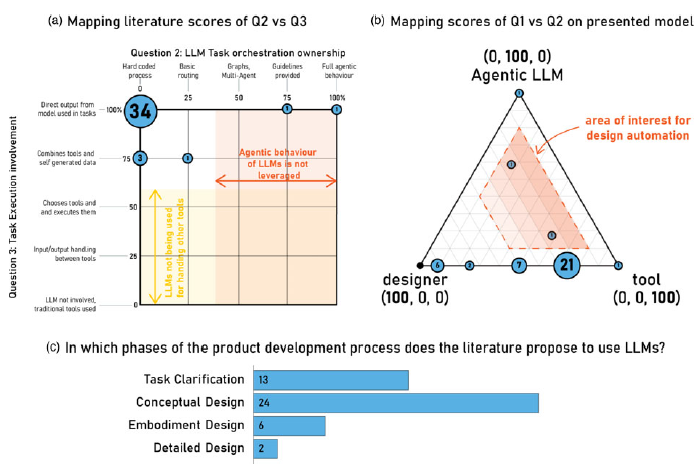
The scores of the 40 papers assessed against the 3 questions and criteria described in Figure 2 returns 3 different dimensions ranging from 0 to 100%. Q2 and Q3 dimension scores were combined for visualization purposes acting as coordinates. Papers were then grouped based on those coordinates and represented as blue bubbles in the chart, with the diameter representing the quantity of papers at that coordinate. In addition, each proposition of LLM design support was mapped against one or more development phases of the engineering design process (Pahl and Beitz Reference Pahl and Beitz2007).
Top-left (a) shows a count of papers positioned against Q2 and Q3; Top-right (b) shows the reviewed papers positioned on the triangle of design responsibility; Bottom (c) maps the activities against the design development phases

4. Discussion
4.1. Survey results interpretation
The Q1 results show a varied participant role distribution, covering all stakeholders involved in design automation activities, with those most directly affected by the integration of GenAI into engineering tasks making up the largest groups of respondents. The survey results showed that most participants were to some extent familiar with GenAI language models, with only 3.5% reporting no familiarity at all. While most have some kind of experience with GenAI language models, there is a considerable variation in familiarity which may also represent a challenge in adopting GenAI technology.
A 91% understanding rate is considered sufficient by the authors to conclude that the model is simple to understand in industry. Participants largely agreed on the usefulness of the triangle model, with 83% expressing a positive sentiment. This suggests that the model provides a practical and effective way to frame and leverage the interaction between designers, traditional methods as well as language models for solving engineering problems in their agentic capabilities. One Respondent (ID#36) noted, “This is exactly what we need to implement the GenAI ideas which can increase the efficiency of users […]” underscoring the model’s potential to guide the integration of GenAI into engineering workflows. However, the same respondent also acknowledged that “[…] there are a lot of challenges to get GEN AI implementation 100% as we can't replace sometimes conventional way of working […]”. This perspective, although stemming from an individual automation/software developer, captures a recurring theme in the survey: despite the positive reception, many participants highlighted the challenges of implementation, particularly in environments with numerous traditional methods and workflows. The GenAI examples that industry practitioners have experienced (e.g. ChatGPT) were not connected at all with the tools that must be used in real product development activities.
As a Design Engineer (ID#38) stated, “[…] it is going to be very difficult to integrate generative AI models into our processes as one complete system because we use so many different design tools at different stages.” This highlights the perceived complexity of utilizing GenAI's orchestration capabilities within complex engineering workflows. Echoing the need for practical solutions, a team lead (ID#48) suggested, “[…] to come up with very specific and simple use cases that could be demonstrated”, highlighting the importance of concrete examples to build confidence in the technology in industry. The literature review reveals a lack of papers investigating let alone demonstrating the potential of integrating GenAI within engineering processes while combining the use of traditional methods.
Regarding the general usefulness of GenAI frameworks that combine human, traditional methods and GenAI LLMs, the survey revealed an overall positive and optimistic view, with 82% expressing a favourable sentiment and only 11% who slightly oppose. However, comments revealed a more nuanced perspective, with recurring concerns about reliability and risks. For example, a Design Engineer (ID#39) remarked, “We need measures to make sure GenAI is more robust and reliable for engineering if it is to be used at all” reflecting a recurring theme of scepticism about reliability. Another participant with a software development background (ID#34) added “This shares my vision of how generative AI can be useful as well, but I'm concerned about the risk of the AI misinterpreting or hallucinating with regards to the instructions given, and don't see how that risk is mitigated.”
These mixed responses highlight two key aspects: strong enthusiasm for GenAI's potential to transform engineering workflows as well as persistent concerns about reliability, integration challenges, and ensuring the technology affords rather than constrains the goals of the engineer. Addressing these issues is crucial for the successful adoption of GenAI as mirrored in previous ED research by Kretzschmar et al. (Reference Kretzschmar, Maximilian, Maximilian, Sebastian, Elias, Bernhard and Kristin2024a, Reference Kretzschmar, Maximilian, Maximilian, Sebastian, Felix, Bernhard and Kristin2024b). The triangle model seeks to contribute to this by providing a way to conceptualize and balance the contributions of human expertise, traditional methods, and GenAI language models in engineering design, to determine their successful interplay in the design process.
4.2. Literature review interpretation
The results in Figure 5 (c) show that only 8/40 papers (20%) cover the later phases of the design (embodiment and detailed). These phases are precisely the most time consuming and most complex to perform and automate for the type of products that this paper focuses on (complex products, physical models). Therefore, we identify a research gap that could be further researched.
The combination of the literature Q2 and Q3 presented in Figure 5 (a) highlights two gaps. First, most studies (38/40) use LLMs or GenAI models as tools, leveraging only their material agency and not using their dynamic capabilities (Leonardi Reference Leonardi2011). An example from other fields where LLMs are explored to behave in human agency is Voyager (Wang et al. Reference Wang, Yuqi, Yunfan, Ajay, Chaowei, Yuke, Linxi and Anima2023). Second, none of the papers allowed the LLMs the freedom to use the tools needed to execute the design task. Only 4 of them combined the generation of the LLM output and some external, hard-coded rationale or support. This is important, as the results of the survey and discussion with industry show the importance of keeping traditional tools in any future GenAI framework. Other literature outside the ED research area that would fill the bottom right area of Figure 5 (a) are MechAgents (Ni and Buehler Reference Ni and Buehler2024) a framework that leverages a multi-agent structure to solve mechanical problems via FEM coding, or the use of RAG and simulation files to evaluate heat treatments effects on 3D parts (Sun et al. Reference Sun, Xusheng, Chao, Xiaohu, Wenyu, Jiangang, Zeyu, Tengyang, Tianyu and Dongying2024).
Finally, Figure 5 (b) shows that since LLMs are being used as traditional tools, and prevented from executing their agentic properties, they lie on the bottom line on the design responsibility triangle, with the rest of traditional tools. Only two papers give LLMs, designers and tools a shared responsibility on design activities (Pradas Gómez, Panarotto, et al. Reference Pradas, Alejandro, Massimo and Ola2024; Li et al. Reference Li, Zuoxu, Zhijie, Xinxin and Jihong2024). Only one paper, at the top of the triangle, fully delegated design responsibility to the LLM. This paper best exemplifies this corner of the model, where during a hackathon competition researchers delegated all the design decisions to ChatGPT and acted as physical executors of the LLM's decisions in a workshop environment (Ege et al. Reference Ege, Øvrebø, Vegar, Martin, Martin and Håvard2024). An example in the “gap zone” of Figure 5 (a) and (b) from outside the ED community combining agentic behaviour and external tool usage is HuggingGPT (Shen et al. Reference Shen, Kaitao, Xu, Dongsheng, Weiming and Yueting2023). This implementation uses a LLM to process top level tasks request from the human and answers them using a generic 4 step process: task planning where it decides what to do and in what order, model (tool) selection, execution of the task and finally response generation; gathering all results of the workflow and presenting them to the user.
4.3. Limitations
The survey was subject to response biases (acquiescence and courtesy), mitigated by providing the survey to be anonymous and framing it as a constructive feedback exercise. Another limitation is the short and shallow exposure of the participants to the model (15 minute explanation). Though they grasped the concept, more time could have been spent to give higher quality feedback. This activity is planned as part of future research, when participants will interact with the model via their example cases to score and position them themselves in the triangle model. The feedback will used to improve the definition of the questions and provide score example guidance, increasing model interpretability.
The literature review focused on a limited subset of databases and research areas, meaning the conclusions apply primarily to the Design Society’s scope. This limitation arose from time constraints and the number of reviewers. An initial query search on Scopus, unrestricted by specific journals and including terms like “product development” or “complex products”, yielded thousands of results, many being false positives. Refining the search using filters still left over 300 documents, leading to a narrower scope aligned with the Design Society’s focus and the conference theme. The ArXiv repository was excluded as a primary search database to balance content quality and a manageable paper count, though relevant papers may exist there. Finally, while the scoring criteria for the papers were explicitly defined, we acknowledge that an element of subjectivity remains inherent in the scoring process.
4.4. Answer to research questions
To answer RQ1 (How can designers and design automation developers structure and visualize the contribution of Generative AI, specifically LLMs, within design automation systems?) a model was developed and validated through an industry survey, with relevant ED literature positioned against it. The literature review for RQ2 (How have LLMs been integrated into design processes within the engineering design community?) also answers RQ3 (What are the research gaps in the application of LLMs for engineering design support?). Observing Figure 5, it shows that LLMs have primarily been used as traditional tools, with varying levels of design delegation, generally without support from additional tools. Their implementations have not leveraged agentic capabilities, show different levels of design delegation between human designers and these tools, and primarily focus on early design phases.
Combined with the industrial feedback, we identify a research gap for the design automation of complex products, such as the structural components of vehicle systems throughout every phase of the design process, but with a higher interest in the later phases of the design, due to the amount of engineering hours available to automate. There is a lack of research on frameworks that combine traditional tools to ensure the accuracy and performance of the tasks with LLMs providing flexibility on the execution of the task and adapting to designer instructions. The designer, as unanimously described by industry practitioners, shall remain in the driver's seat. Finally, industry is eager for a practical implementation of such a framework, ensuring research is not only theoretical but also executable and testable. This will help assess whether the technology meets societal expectations and measure its effectiveness in practice.
5. Conclusion
A model for positioning the support of Generative AI in design automation has been presented. It highlights the different nature of design responsibility ownership of each contributor: Designers, traditional tools and LLMs in their agentic role. The proposed model, together with the ranking criteria, is simple to understand and can be used in industry to clarify the expectation of each player in design automation activities. As a result, each of the three team members will be played using their strengths, resulting in more effective automation systems. This combination can support designers in a novel way and allow them to increase the flexibility of the design automation. Also, they can use the benefits of highly hard-coded tools without the need for the system users to be experts on the system itself. Therefore, we see a research opportunity to leverage LLMs agentic capabilities to automate some of the tasks that are difficult to do with traditional automation techniques, due to complexity and development effort. Future research must also address the challenge of ensuring reliability and reproducibility in LLM-driven automation, as designers and engineers must be able to trust that results are both consistent and dependable, a critical requirement for design automation solutions.



 Open access

