

Introduction
Consanguinity is a characteristic feature of kinship systems in many societies in the developing world, particularly Islamic countries where consanguineous unions account for 25–55% of total marriages (Bittles, Reference Bittles, Speicher, Antonarakis and Motulsky2010). Consanguineous unions remain socially and culturally favoured in countries like Pakistan, Iran, Turkey and Saudi Arabia and correlate with an increased rate of recessively transmitted hereditary/congenital malformations and child morbidity. Among the major populations in these countries, high consanguinity has been found to be associated with illiteracy, low socioeconomic status, rural residence and extended household type, and to be more prevalent in families with high fertility and overlapping generations (Hussain & Bittles, Reference Hussain and Bittles1998; Hussain, Reference Hussain1999). Furthermore, the types of consanguineous unions vary quite widely between and within different cultures, with religious, ethnic and local or tribal traditions. The pattern of consanguineous unions gives clues to the socio-biological structure of populations and the morbidity/mortality variables therein.
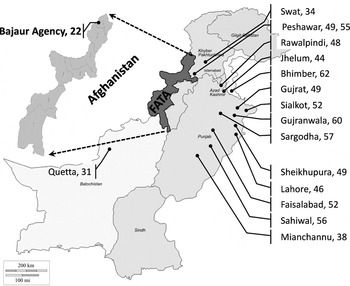
In Pakistan, several studies on consanguinity have been carried out in the populations of Punjab province and cosmopolitan cities like Rawalpindi, Lahore, Quetta and Karachi (Fig. 1). These studies have demonstrated that consanguineous unions account for 31–62% of the total marriages (Shami & Minhas, Reference Shami and Minhas1984; Bittles et al., Reference Bittles, Grant and Shami1993; Shami et al., Reference Shami, Grant and Bittles1994). Furthermore, first cousin marriages have been shown to be the most popular type. These data have led to a generalization that the preference for close marriages is very high in Pakistani society and that consanguinity is widespread in all sub-populations (Shami et al., Reference Shami, Grant and Bittles1994; Hussain & Bittles, Reference Hussain and Bittles1998). However, recent epidemiological studies carried out in relatively small, isolated and less admixed populations of Pakistan have found that this generalization may not be the actual state of affairs, and that consanguinity is not the ‘cultural norm’ in all sub-populations (Rehman, Reference Rehman2010; Ullah, Reference Ullah2013).
Map of Pakistan with zoom-in map of FATA. Bajaur Agency (1) is shown as the northern-most in the series of seven agencies of FATA (from north to south: 1, Bajaur; 2, Mohmand; 3, Khyber; 4, Orakzai; 5, Kurram; 6, North Waziristan; 7, South Waziristan). The distribution of consanguinity (%) in various regions of Pakistan is depicted.
Due to certain geo-political developments, the north-western populations of Pakistan adjoining the Afghanistan border are undergoing demographic transition. These populations are an amalgamation of native Pashtun tribes and the migrated Afghan Pashtuns. Extensive cross-border migrations were witnessed after the Soviet invasion of Afghanistan in 1979. Bajaur Agency has the second largest Afghan refugee population after Kurram Agency in the Federally Administered Tribal Areas (FATA). Afghan refugees have originated from the Kunar, Laghman, Parwan, Kundoz and Kabul provinces of Afghanistan (Government of NWFP, 1992). Furthermore, the military operations by the army and the ‘war against terrorism’ over the last decade have caused several regional population displacements that have drastically affected the distribution of Pashtun tribes inhabiting FATA (Kerr, Reference Kerr2010; Rahmanullah, 2010). A large number of families have fled to adjoining areas of Khyber Pakhtunkhwa (KPK) or other provinces of Pakistan, and even Afghanistan for the better off. This situation has severely marred the socioeconomic situation and damaged the education and health infrastructure. Most of the people currently residing in the war-affected areas are poor, with no means of migration, or are traditionally linked to their lands for protection and agriculture.
FATA in the north-western extreme of Pakistan has a unique administrative and political status dating from the British time since 1849. After the independence of Pakistan in 1947, FATA inherited a system by which the area was controlled through a combination of political agents and tribal elders or maliks, leaving the people with their local traditions and internal independence. This system of governance continues even today (Kerr, Reference Kerr2010; FATA, 2014). In FATA, seven tribal units called ‘Agencies’ lie in a north-to-south strip in the order: Bajaur, Mohmand, Khyber, Orakzai, Kurram, North Waziristan and South Waziristan. The population of FATA is characterized by a conservative tribal set-up, with a scattered and low population density (117 persons/km2), extended households (9.3 persons/family) and very low literacy rate (33.8% and 7.5% for males and females, respectively; Rehman, Reference Rehman2010; FATA, 2014). The annual population growth rate is higher in FATA due to various factors. These include the immense urge for greater manpower in tribal Pashtuns, a symbol of status and strength among the tribesmen, which in turn leads to early marriages. In addition, there is a lack of education and awareness, especially among women, about family planning and the scarcity of family planning services (Government of NWFP, 1994). The majority of the people are involved in primary-level activities such as agriculture, livestock rearing, arms manufacturing and trade, drug-trafficking, cross-border trade and manual jobs. Most often a single person's income supports the entire household (Rahmanullah, 2010). A rather rigid patriarchal household system prevails and key family decisions, including marital unions of sibs, are made by the elder males.
Epidemiological and bio-anthropological data on these populations are scarce for various reasons, such as the war conditions, remote terrain and inaccessibility, and unique socio-cultural norms of the Pashtuns (Rehman, Reference Rehman2010; Perveen, Reference Perveen2012; Rehman et al., Reference Rehman, Wahab, Khattak and Malik2014). On the other hand, information on these populations is highly valuable owing to their cultural, social and biological affinities with other Pashtun populations of Pakistan, as well as Afghanistan. In order to glean information about the socio-biological population structure of representative tribal Pashtuns of FATA a cross-sectional study was carried out in Bajaur Agency, and the dynamics of consanguinity and the inbreeding coefficient were explored.
Methods
Study population
Bajaur Agency lies at the northern extreme of FATA (Fig. 1). Geographically, it is a strategically located area in the east of the Kunar Valley in Afghanistan and shares boundaries with the Malakand Agency to the south-east, Dir district to the north-east and Mohmand Agency to the south (co-ordinates: 34° 41′ 0″ N, 71° 30′ 0″ E) (FATA, 2014). It has an area of 1290 km2. Roughly 40% of the agency area is covered by barren mountains and 60% by wide valleys (Government of NWFP, 1994). Bajaur Agency has seven tehsils, its administrative headquarters is Khar and its estimated population is 760,000 individuals. The major tribes are Tarkalani and Utman Khel, while the minor tribes are Mohmand, Shinwari and Safi. Pashtu is the predominant language. Agricultural farming, small-scale business and manual jobs are the major employment types. Many people migrate to the south-eastern districts of KPK and Punjab provinces for subsistence (Rehman, Reference Rehman2010).
Sample selection and data collection
Field sampling was carried out in four tehsils of Bajaur Agency. Due to the deteriorating law-and-order situation sampling in remote towns and villages was only possible with the permission of tribal elders/maliks. A local resource person always accompanied the field-survey team. Married male subjects from Bajaur Agency were randomly recruited from public places like markets and hujras between March and August 2012. Due to the specific socio-cultural norms of the area, the interviewing of female subjects was not possible. Formal verbal consent was obtained from each subject prior to data collection. This study was approved by the ethical committees of Quaid-i-Azam University, Islamabad, and Hazara University, Mansehra. Recruited subjects were requested to provide information on socioeconomic variables and marital union types in face-to-face interviews. Subjects providing incomplete information were excluded. Data from individuals without permanent residence in Bajaur Agency were not included in the analyses. Only one individual from each household was interviewed.
Definition of variables
The subject's tehsil of origin and rural–urban status were taken from union council records. Family/household types were defined as either ‘nuclear’, ‘more than one couple’ or ‘extended’. ‘Nuclear’ families had only a couple and their children living in the house. ‘More than one couple’ families had two brothers with their wives and children living in the same dwelling. Three or more overlapping generations living in the same household were defined as an ‘extended’ family (Hina & Malik, Reference Hina and Malik2014). A subject's literacy was recorded as the number of years they had attended school/college. The subject's tribal/sub-tribal affiliation, occupation and socioeconomic status were based on self-identified categories.
There were seven marriage types, which were coalesced into consanguineous unions and non-consanguineous unions (Wahab & Ahmad, Reference Wahab and Ahmad1996; Bittles, Reference Bittles, Speicher, Antonarakis and Motulsky2010). Four consanguineous unions types were recorded, i.e. ‘double first cousin’, ‘first cousin’, ‘first cousin once removed’ and ‘second cousin’. Non-consanguineous unions comprised three types, i.e. ‘second cousin once removed’, ‘distantly related/biradari’ and ‘non-related’. Marital union types were further assorted into cross-cousin or parallel-cousin, and patrilineal or matrilineal types. First cousin marriages were resolved into four sub-types: father's brother's daughter (FBD), father's sister's daughter (FSD), mother's brother's daughter (MBD) and mother's sister's daughter (MSD) (Bittles, 2010). Standard descriptive statistical analyses were performed using Excel and GraphPad-Prism software. The distribution of consanguineous unions was determined with respect to the demographic variables of the subjects. The inbreeding coefficient (F) was estimated from the weighted proportions of consanguineous union types (Bittles, Reference Bittles, Speicher, Antonarakis and Motulsky2010).
Results
Sample characteristics
Data were collected for 967 married males from 29 different towns in four tehsils of Bajaur Agency. The subjects' ages ranged from 14 to 82 years (mean±SD: 34.02±12.13). Among the four tehsils, there were 126 subjects from Nawagai, 536 from Khar, 160 from Mamund and 145 from Salarzai tehsil (Table 1).
Distribution of marital union types (n (%)) in four tehsils of Bajaur Agency, Pakistan (n=967)

Consanguinity and inbreeding coefficient
Collectively, the rate of consanguineous unions was 22.34% (n=216), while the rate of non-consanguineous unions was 77.66% (n=751) (Table 1). The overall inbreeding coefficient was estimated to be 0.0134. Marriages up to distantly related/biradari constituted 42.5% (n=411). Among the individual union types, marriages among ‘non-related’ had the highest representation (57.5%), followed by distantly related/biradari marriages (20.06%) and first cousin unions (19.96%).
By tehsil, the consanguineous union rate ranged from 14.48% in Salarzai to 24.60% in Nawagai, and the corresponding inbreeding coefficients (F) were 0.0088 and 0.0139, respectively (Table 2; Fig. 2). The highest estimate of F was observed in Khar tehsil (i.e. 0.0145), which was due to the high proportion of first cousin unions. The differences in the distribution of consanguineous and non-consanguineous unions in the four tehsils were statistically non-significant (p=0.091). There were 74.56% rural and 25.44% urban representatives in the sample; however, the estimates of consanguineous unions and F were nearly the same in both categories (p=0.852). With respect to family structure/household categories, consanguineous unions were observed to be highest in subjects belonging to extended families (27.43%; F=0.0307). When distributed by their education, 63.08% of subjects were found to be illiterate, and these showed a significantly higher prevalence of consanguineous unions (24.92%) compared with the literate group (18.21%) (p=0.016). With respect to their occupational status, consanguinity was higher in subjects with unskilled jobs (23.46%; F=0.0142). There were five self-identified economic strata with a high representation in the ‘poor’ and ‘low’ economic groups. Consanguineous union rates were observed to be higher in subjects belonging to ‘low’ and ‘middle-low’ categories (Table 2).
Distribution of consanguineous unions, total marriages and inbreeding coefficient (F) by various socio-demographic variables, Bajaur Agency, Pakistan

* Statistically significant (Sig.=significant; ns=not-significant).
Consanguinity and non-consanguinity rates (left y-axis) and inbreeding coefficient F (black dots; right y-axis) in four tehsils of Bajaur Agency.

The Pashtuns residing in Bajaur Agency exhibited substantial tribal diversity and at least 136 major and minor tribal systems were observed in the sample. Of the major tribes, Tarkalani had the highest representation in the sample (83.35%), followed by Uthman Khel and Mohmand. Tarkalanis had a higher prevalence of consanguineous unions (23.08%; F=0.0138) (Table 2). Among the prominent sub-tribes of Tarkalanis (i.e. sample size ≥24), the proportions of consanguineous unions were observed to be highly variable. The highest F was observed in Barosi (0.0179), followed by Sadaat (0.0178).
Distribution of marriage types by age, marriage year and age at marriage
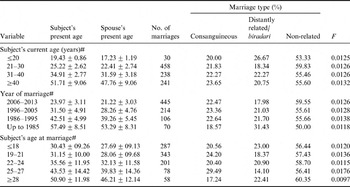
The distribution of consanguineous union rates and F was explored by the subject's age, year of marriage and age at marriage. The proportion of consanguineous unions gradually declined with decreasing age-range categories (Table 3; Fig. 3). Furthermore, there was a transition in the marriage pattern and level of F before and after 1985. Consanguinity was in gradual decline after 1986–1995. The ratio of ‘distantly related/biradari’ marriages was also declining across the ‘year of marriage’ intervals. Most of the marriages (i.e. 65%) commenced up to the age of 21 years. Consanguinity was generally higher for subjects with early age at marriage, while increasing age at marriage was usually associated with a low F (Fig. 3). It was also observed that differences in the spousal ages have declined over the years.
Distribution of marriage types by subject's age, year of marriage and age at marriage, Bajaur Agency, Pakistan

# χ 2 statistics not significant.
Temporal variations in consanguinity rate (bar graph, left y-axis) and inbreeding coefficient F (black dots; right y-axis) by current age, year of marriage and age at marriage.

Effect of parental marriage type on subject's marriage type
Among parental marriages, consanguineous unions only amounted to 5.2% (n=50), and ‘distantly related/biradari marriages’ made up 32.4% (n=314), while ‘non-related’ types were markedly higher (62.4%; n=603) (Table 4). Furthermore, whether parental marriage type was a predictor of subject's marital union type was assessed. Cross-tabulation of subject's marital union against parental marriage type demonstrated that consanguineous unions were significantly higher in subjects with parental consanguineous unions. Likewise, the proportion of ‘non-related’ marriages was far higher in subjects whose parental marriage type was ‘non-related’ (p<0.0001) (Table 4).
Comparison of paternal and subject's consanguinity by cross-tabulation of marriage types, Bajaur Agency, Pakistan

* χ 2=84.67; df 4; p<0.0001; Sig.
Pattern of first cousin unions
A total of 193 marriages were between first cousins. Of these, parallel-cousin marriages were in the majority (n=113; 58.55%), as compared with cross-cousin marriages (n=80; 41.46%) (Table 5). Additionally, patrilineal unions were customary (n=142; 73.58%), while matrilineal unions were less frequent (n=51; 26.42%) (significant at p<0.0001). Among the four first cousin union types, father's brother's daughter marriages (FBD) were the most prevalent (n=95; 49.22%), while mother's sister's daughter (MSD) marriages were the least common (n=18; 9.33%) (p<0.0001). The distribution of first cousin unions by tehsil was statistically significant (Table 5).
Distribution of types of first cousin unions by key demographic variables, Bajaur Agency, Pakistan

* Distribution statistically significant.
Discussion
Only a few studies on consanguinity have been carried out in the Pashtun populations of KPK, Pakistan. Wahab and Ahmad (Reference Wahab and Ahmad1996) reported consanguineous union rates in Swat, KPK. Wahab et al. (Reference Wahab, Ahmad and Akram2006) also reported marital union types in the local and migrant Afghans inhabiting Peshawar, KPK. Sthanadar et al. (Reference Sthanadar, Bittles and Zahid2014) have recently reported that consanguinity was 66% in the Malakand district of KPK. However, this estimate is based on the marriages observed among the parents of children with hearing impairments, and hence may not be representative of the actual inbreeding coefficient in Malakand. The present study is the first comprehensive account of consanguinity and inbreeding coefficient in the representative tribal Pashtun populations.
Each agency in FATA is a distinct assemblage of tribes and sub-tribes of Pashtuns, most of which are off-shoots of the Yousafzai clan. The study sample from Bajaur Agency appears to be highly heterogeneous in terms of tribal diversity, and the estimates of consanguinity and F were highly variable across these tribes. Heterogeneity in the sample was further found in the demographic categories such as economic status and employment group. Despite substantial heterogeneity in the sample, consanguineous unions were observed to be associated with various socio-demographic variables.
Certain peculiarities observed in the marital union types suggest a distinct nature of kinship system in Bajaur Agency. For example, in contrast to other populations of Pakistan, marital unions types were less diversified in Bajaur Agency and of the seven well-established marriage types only three categories were conspicuous, i.e. ‘first cousin’, ‘distantly related’ and ‘non-related’. On the other hand, marriage types like ‘double first cousin’, ‘first cousin once removed’, ‘second cousin’ and ‘second cousin once removed’ were in negligible proportions. These data established that consanguineous unions are not customary in Bajaur Agency. Only 22% of marriages were observed to be consanguineous and a further 20% were between distantly related/biradari individuals. This is contrary to a general perception about the prevalence of consanguineous unions in Pakistan. In a previous study in Peshawar, the consanguineous union rate was observed to be 50% among the Afghani Pashtuns (Wahab et al., Reference Wahab, Ahmad and Akram2006). Another study in Swat showed that the consanguineous union rate was 34% (Wahab & Ahmad, Reference Wahab and Ahmad1996). Interestingly, Saify & Saadat (Reference Saify and Saadat2012) showed that consanguineous unions were 46% in the overall Afghanistan population, ranging from 38% in Kabul province to 51% in Bamyan. Another study in the west and south of Afghanistan revealed the consanguineous union rate to be 52% (Saadat & Tajbakhsh, Reference Saadat and Tajbakhsh2013).
Likewise, first cousin unions were not the preferred type of marriage in Bajaur Agency. Previous studies in Pakistan have shown that first cousin marriages are the most popular types of consanguineous unions, as well as in total marriages contracted (Shami & Minhas, Reference Shami and Minhas1984; Hussain, Reference Hussain1999; Jabeen & Malik, Reference Jabeen and Malik2014). First cousin unions were 49% among the Afghanis sampled in Peshawar, KPK (Wahab et al., Reference Wahab, Ahmad and Akram2006). Lower estimates of first cousin marriages were witnessed in the Pashtuns of Swat (22%) and Quetta, Balochistan (16%) (Mian & Mushtaq, Reference Mian and Mushtaq1994; Wahab & Ahmad, Reference Wahab and Ahmad1996). In the present sample from Bajaur Agency the most common type of marriage was between ‘non-related’ (58%). It has been noticed in some parts of Bajaur Agency, especially in Mamond tehsil, that huge bride-prices are paid by the groom's family to the father of the bride. The custom of bride-price is common in certain tribal Pashtuns, particularly those of Afghan origin and those belonging to economically impoverished households. This custom may also partially account for the non-consanguineous unions occurring between couples originating from distantly related geographies and/or ethnicities. On the other hand, the high prevalence of consanguineous unions among the Pashtuns settled in large cities has been argued to be the result of a decline in marriage payments (Kamalai, Reference Kamalai1985). Badaruddoza & Afzal (Reference Badaruddoza and Afzal1995) also suggested that marriage payment was less common in consanguineous compared with non-consanguineous unions among the Muslims of Aligarh, north India.
The pattern of first cousin unions in Bajaur Agency revealed that there was a strong preference for parallel-cousin marriages, FBD marriages being the most common type with MSD the least frequent. Previous studies on first cousin unions carried out in the Pakistani population have also shown that parallel-cousin marriages are more frequent than cross-cousin marriages (Wahab & Ahmad, Reference Wahab and Ahmad1996). In the populations of Rawalpindi and Jhelum, parallel-cousin unions were the most common type (Shami & Siddique, Reference Shami and Siddiqui1984; Shami & Minhas, Reference Shami and Minhas1984). Another study in Peshawar showed that parallel-cousin and cross-cousin marriages were almost equally prevalent (Wahab et al., Reference Wahab, Ahmad and Akram2006). Furthermore, patrilineal marriages have been shown to be more common in Pakistan than matrilineal types (Shami & Minhas, Reference Shami and Minhas1984; Shami & Siddiqui, Reference Shami and Siddiqui1984; Donnan, 1988). In the Swat population and in Afghan refugees residing in Peshawar, the FBD marriages were found to be the most prevalent (Wahab & Ahmad, Reference Wahab and Ahmad1996; Wahab et al., Reference Wahab, Ahmad and Akram2006). It has been argued that patrilineal unions are preferred because they strengthen the brotherly bonds and keep property and land intact. Likewise, when brothers become in-laws they support each other more in business and family disputes (Zaman, Reference Zaman2008). It may also be added that patrilineal unions could be the most plausible scenario for the parents in the present context of deteriorating law-and-order in the region.
The estimates of rates of consanguineous union and F were nearly the same in the rural and urban samples of Bajaur Agency. This observation is in agreement with Wahab & Ahmad (Reference Wahab and Ahmad1996), who conducted studies on consanguinity in Swat, Pakistan. It was argued that this similarity could be due to a continuous trend of migration from rural to urban settlements. In most of the FATA, there is not much difference in the socioeconomics of rural and urban union councils. In the present sample, the most common household type was ‘more than one couple’, where two or more brothers were living in the same house. The ‘extended household’ type accounted for 23% of the sample. Consanguinity was observed to be higher in ‘extended’ families, and the differences were statistically significant. Extended households are common in rural areas of Pakistan. Extended families with large sibships and overlapping generations make consanguineous unions the most likely scenario (Hussain & Bittles, Reference Hussain and Bittles1998).
With a few exceptions, consanguinity has been shown to be negatively associated with literacy (Wahab & Ahmad, Reference Wahab and Ahmad1996; Bittles, Reference Bittles, Speicher, Antonarakis and Motulsky2010). These data also support this notion, with rates of consanguineous union and F being significantly higher in the illiterate sample. Among the literate sample, consanguineous unions were observed to be relatively higher in ‘graduates’. Higher literacy increases the chances of securing better jobs in the government sector, which might have increased the chances of inter-familial marriages. It is worthwhile mentioning that a literacy rate of 37% was observed in the male subjects of Bajaur Agency included in this study. There could be an over-representation of the literate subjects in this sample because the consent approval rate from illiterate individuals was rather low. An overall literacy rate of 17% has been estimated for Bajaur Agency, and in particular women's education is very low (<5%) (FATA, 2013). In FATA generally, and in Bajaur Agency specifically, educational institutes have been the target of militancy. A large number of schools, madarasas and colleges have been damaged or demolished in the armed conflicts during the last decade. Unfortunately, girls' schools have been severely affected and girls/women have been discouraged from getting a formal education. This situation is clearly reflected in the literacy estimates of Bajaur Agency.
The distribution of subjects by their occupational status shows that unskilled workers were in the majority in the present sample (47%). The unskilled workers were involved in manual jobs, cattle-rearing and basic-level activities. Most of these were illiterate and a higher prevalence of consanguineous unions was observed in these subjects. Furthermore, a large number of interviewed subjects (15%) had no jobs.
The inbreeding coefficient was lower among the ‘poor’ group and the ‘unemployed’. It is quite likely that both these variables increased the ‘age at marriage’ and hence, indirectly decreased the chances of inter-familial marriage. In another study in Pakistan, Hussain & Bittles (Reference Hussain and Bittles1999) observed that women in consanguineous unions married at younger ages, while those in non-consanguineous unions had a higher age at marriage. Furthermore, ethnic affiliation appeared to influence age at marriage. It has been argued that in the case of consanguineous unions, the marriage negotiations and decision-making process between the prospective in-laws start early on, which explains the lower age at marriage (Donnan, Reference Donnan1995). Caldwell et al. (Reference Caldwell, Reddy and Caldwell1983) argued that the continued rise in women's age at marriage may result in difficulty in finding suitable grooms within the family, which may increase the chances of out-marriage.
It appears that historically consanguineous unions were not customary in the Pashtun tribes of Bajaur Agency. Firstly, this is evident when marriages are observed with respect to subject's current age, year of marriage and age at marriage (Table 3). A drastic shift in the marriage pattern (i.e. increase in consanguinity level) was observed after 1985, the period coinciding with the Soviet invasion of Afghanistan and the geo-political turmoil in FATA. It has been hypothesized that in times of civil conflict intra-familial marriage is an advantageous strategy to optimize the security of couples, families and their communities (Bittles, Reference Bittles2012). However, after 1986–1995 there was a gradual decline in the prevalence of consanguineous unions. Secondly, marriages among ‘non-related’ exhibited a general rise over the time (Table 3). The distribution of marriages by subject's current age also showed that consanguineous unions were declining in the younger age intervals. This situation could be partially attributed to the fact that a large number of families were forced to migrate from Bajaur Agency due to military operations in the region, hence decreasing the kinship choices for marriages. Thirdly, this study shows that consanguineous unions among the subjects' parents were only 5.2%, while marriages of the ‘non-related’ type had the highest representation (62%). Nonetheless, parental marriage type was a predictor of subject's marriage type. Taken together, these data suggest that consanguineous unions have not been the preferred type of marital union in Bajaur Agency and the rate of consanguinity is in gradual decline.
Study limitations
This study has several limitations. For instance, the sample is only representative of the male population from public places and hujras. Ideally, a more representative sample would had been obtained through door-to-door surveys in major towns of seven tehsils of Bajaur Agency. The war situation in FATA has severely affected transport. Hence, travelling was very tedious for researchers in certain sampling sites. The selection of subjects was through convenience sampling, i.e. relatively safe and accessible areas of Bajaur Agency were visited and only with the permission of tribal elders/maliks. Moreover, the response rate was low in many areas as the subjects were reluctant to interact with the researchers coming from outside. Consent approval was low, particularly in towns with very low literacy rates. Thus, only four tehsils out of seven could be surveyed. It is pertinent to add that door-to-door visits were not possible because men are absent from home during the day/working hours and women could not be interviewed by the male enumerators.
In conclusion, this study reports on the consanguinity rates and inbreeding coefficients in the turbulent and war-affected population of Bajaur Agency, Pakistan, and provides insights into the structure of Pashtun tribes living there. The research found that consanguineous unions are not common in Bajaur Agency and that first cousin marriages are not common. These observations suggest that there will be a significantly lower burden of consanguinity-associated morbidity/mortality in Bajaur Agency compared with other highly inbred populations of Pakistan. As a prospective study it would be interesting to observe consanguinity in other agencies of FATA and to witness regional variation in the inbreeding coefficient.
Acknowledgments
The authors are highly indebted to the subjects for their participation in this study. This study could not have been accomplished without the help of the resource personnel Mr Saboor Khan, Mr Sallah-Uddin and Mr Israr-Uddin. The study was partially supported by research grants from PSF-Islamabad and HEC-Pakistan.