




Introduction
Early research on environment and violence relied on Malthusian concepts of population overshoot and carrying capacity. When demand for resources exceeds supply, the result would be increase in societal tensions and possibly violence. Newer research in environmental security depicts environmental crises as amplifying the impact of other destabilizing social factors. Ecological crises are most likely to precipitate violence in countries with deep ethnic divisions, low state capacity, and poor economic performance. More effective and inclusive states, though, can buffer ecological shocks and maintain stability (Homer-Dixon Reference Homer-Dixon1994; Goodman and Baudu Reference Goodman and Baudu2023; Kahl Reference Kahl2006; Busby Reference Busby2022). The literature on environmental peacebuilding proceeds from similar premises, but goes in the opposite direction. Environmental stresses can also catalyze innovation and induce collaboration among otherwise antagonistic groups (Ide et al. Reference Ide, Bruch, Carius, Conca, Dabelko, Matthew and Weinthal2021; Krampe, Hegazi, and VanDeveer Reference Krampe, Hegazi and VanDeveer2021; Ogden Reference Ogden2018; Conca and Wallace Reference Conca and Wallace2009).
Political ecology stands apart from these largely materialistic and mechanistic theories about environmental ‘triggers’ to violence. Political ecology examines how political, economic, and social forces shape environmental issues and resource use through power dynamics, inequality, and historical context. Claims about the abundance, accessibility, and ownership of natural resources justify and motivate assertions over resource-rich spaces (Bridge, McCarthy, and Perreault Reference Bridge, McCarthy and Perreault2015; Robbins Reference Robbins2019; Watts Reference Watts, Floyd and Matthew2013; Peluso and Watts Reference Peluso and Watts2001; Watts and Peluso Reference Watts, Peluso and Death2013). Securing territory enables resource extraction, while resource extraction reinforces territorialization. Political ecology pays special attention to frontier zones, areas of disputed and unsettled jurisdictions and sovereignty. These frontiers are where conflicts over resource extraction and territorialization are most acute and visible. Consequently, the management of environmental insecurity at the frontier closely aligns with pre-existing territorial and nationalist agendas (Rasmussen and Lund Reference Rasmussen and Lund2018; Selby, Daoust, and Hoffmann Reference Selby, Daoust and Hoffmann2022; Watts Reference Watts2017).
This article examines the relationship between water scarcity and ethnic conflict in Kirkuk. It focuses on how inhabitants of this disputed territory understand the connection between societal instability and ecological change, especially shortages in water. Kirkuk is claimed by the Iraqi state and by Kurdish nationalists. Kirkuk contains some of Iraq’s largest oil fields and most productive agricultural lands, fed both by rainfall and by the Tigris tributaries. The province suffered repeated bouts of ethnic violence through the twentieth century. In the last twenty years, Kirkuk (like much of Iraq and the wider Middle East) has faced temperature increases and water shortfalls due to global climate change (Zittis et al. Reference Zittis, Almazroui, Alpert, Ciais, Wolfgang Cramer, Fnais, Francis, Hadjinicolaou and Howari2022; Barlow et al. Reference Barlow, Zaitchik, Paz, Black, Evans and Hoell2016). The onset of these ecological challenges is often cited as contributing to regional political instability and intercommunal violence (Norman, Martin Gil, and Barron Reference Norman, Gil and Barron2024; Swain and Jägerskog Reference Swain and Jägerskog2016; King Reference King2021; Daoudy, Sowers, and Weinthal Reference Daoudy, Sowers and Weinthal2022; Sowers, Vengosh, and Weinthal Reference Sowers, Vengosh and Weinthal2011; Akbarzadeh and Cimini Reference Akbarzadeh and Cimini2023).
The article finds that convictions about Iraq’s territorial integrity and commitment to ethnonationalist projects inflect the framing of water insecurity. Arabic and Kurdish-speaking inhabitants of the frontier are divided in their views about water insecurity. Claims about drought and scarcity serve competing agendas of territorial acquisition, making and unmaking Kirkuk’s frontier status. In a larger scope, these findings show how agendas of ethnopolitics and territorial sovereignty set the parameters for environmental thinking. Territorialization projects deploy ecological discourses as part of their maneuvers for resource exploitation.
The article proceeds in five sections. The first theorizes linkages between political ecology’s focus on the construction of meaning around human-environmental interaction and the framing of different forms of ecological risk, especially related to water and the hydrosocial landscape. The second section explains how contested frontier spaces became subject to competition about the framing of ecological scarcity or abundances, creating conditions which are often rife with violence. The third section examines the hydrosocial competition in Kirkuk qualitatively, focusing on the history of conflict in Kirkuk and the way nationalist movements have claimed resources in this territory. The fourth section presents results of a public opinion survey of Kirkuk residents, showing how commitments to different programs of ethno-territorial control inflect the framing of environmental risks, particularly water insecurity. The fifth and concluding section assesses the implications of these findings for environmental peacebuilding in Iraq and larger questions of how political ecology prioritizes political reconciliation before any technical measures for ecological remediation are feasible.
Political Ecology at the Water Frontier
Political ecology has emerged as the main alternative to the materialistic bent of environmental security and peacebuilding. Both environmental security and environmental peacebuilding concentrate on ecological disequilibrium, tipping points, and feedback loops that spur or dampen political competition. Political ecology, in contrast, puts politics first, attempting to explain the social consequences of human-environment interactions. The key mechanisms of political ecology occur in the construction of shared meaning around ecological conditions and environmental change. Attitudes on environmental issues, Agrawal argues, “emerge as a result of struggles over resources and in relation to new institutions and changing calculations of self-interest and notions of the self” (Agrawal Reference Agrawal2005). In this sense, beliefs about natural resources and other ecological features are as important as their physical or material disposition. Such beliefs assign meaning and value to human engagement with the environment. Ecological ideas are not neutral; they are socially encoded and often politically contentious. They reinforce or challenge rights to access resources (Bryant Reference Bryant1998: 87; Robbins Reference Robbins2019: 114-26).
Water figures prominently in political ecology literature, both as a biological necessity and a bearer of symbolic value. As urbanization and industrialization necessitate more diverse and complex forms of water management, contestation becomes more variegated (Agnew Reference Agnew2011; Karpouzoglou and Vij Reference Karpouzoglou and Vij2017; Flaminio, Rouillé-Kielo, and Le Visage Reference Flaminio, Rouillé-Kielo and Le Visage2022). Boelens et al. deploy the term “hydrosocial” to incorporate the contested imaginary and socio-environmental materialization of humans’ interaction with water. The hydrosocial encompasses the physical distribution of water, plus attendant infrastructure, legal-administrative arrangements, political hierarchies, cultural institutions, and practices (Boelens et al. Reference Boelens, Hoogesteger, Swyngedouw, Vos and Wester2016: 2).
Framing is key to constructing the hydrosocial landscapes. Frames are cognitive and discursive schema that interpret, explain, and give meaning to the world. Frames take multiple forms. Diagnostic frames evaluate a circumstance and assign it problem status: whether the situation is a problem, as opposed to an immutable or irresolvable condition. Prescriptive frames point to measures that address the diagnosed problem and assign responsibility for action (Snow and Benford Reference Snow and Benford1988; Entman Reference Entman1993: 52; Rein and Schön Reference Rein and Schön1996; Bromley-Trujillo and Poe Reference Bromley-Trujillo and Poe2020). Framing constrains public policy and the implementation of collective action because the lack of a common frame hinders agreement about what measures need to be taken (van Hulst and Yanow Reference van Hulst and Yanow2016; Dodge and Metze Reference Dodge and Metze2024; Druckman Reference Druckman2004; Majone Reference Majone, Goodin, Moran and Rein2008).
Framing environmental resources as scarce (versus abundant), private (versus public), dangerous (versus benign), reflects preexisting political and social commitments and motivations. Framing predisposes individuals to see or emphasize certain aspects of the situation in ways that parallel prior values or worldviews (Vaughan Reference Vaughan1995: 172). Ethnic identities constrain which phenomenon people believe warrant attention and how they believe those issues should be addressed (Lieberman and McClendon Reference Lieberman and G.H.2013). Views about the environment are often polarized in this way. Some groups are more likely to see environmental issues as salient; they would adopt frames that link environmental and political conditions. Others downplay the severity of these same issues or reject political interventions (Kerr, Hughey, and Cullen Reference Kerr, Kenneth and Cullen2016; Lazri and Konisky Reference Lazri and Konisky2019; Song et al. Reference Song, Lewis, Ballew, Bravo, Julie Davydova, Garcia, Hiltner, Naiman, Pearson, Romero-Canyas and Schuldt2020). Still, alternative scenarios are possible. Several studies detail ethnically divided societies becoming more cohesive in response to environmental hazards and natural disasters, helping to avert potentially violent escalation (Johnson, Rodríguez, and Quijano Hoyos Reference Johnson, Rodríguez and Hoyos2021; De Juan and Hänze Reference De Juan and Hänze2021; Taher et al. Reference Taher, Bruns, Bamaga, Al-Weshali and Van Steenbergen2012; Adano et al. Reference Adano, Dietz, Witsenburg and Zaal2012). Environment challenges can precipitate new and inclusive notions of identities and associated common framing of environmental challenges (Figueredo and Dean Reference Figueredo, Dean and Senehi2023; Swain and Öjendal Reference Swain and Öjendal2018).
Ethnic and Ecological Competition at the Frontier
The competition of ecological ideas is especially acute in places where sovereign authority is most fiercely disputed. Theories of resource wars (Le Billon Reference Le Billon2012) and violent environments (Peluso and Watts Reference Peluso and Watts2001) often focus on frontier spaces, areas where legitimacy, authority, and sovereignty are most unsettled. Across the developing world, state authorities share powers and responsibilities for governance with a range of nonstate actors. The entire matrix of state, private, customary, and religious authorities comes into question at the frontier (Watts Reference Watts2017). Rebel groups or other nonstate actors have assumed control over dams and other types of hydrological infrastructure in the wake of state failures or collapse (Gilmore et al. Reference Gilmore, Cunningham, Gentil-Fernandes, Huang, Jung and Loyle2025; Baldwin et al. Reference Baldwin, McCord, Dell’Angelo and Evans2018; Schillinger and Özerol Reference Schillinger and Özerol2023; Allouche Reference Allouche, Wegerich and Warner2010). Rulemaking at the frontier is polycentric, with different forms of authority tending to conjoin, ally, and intermingle (Ostrom Reference Ostrom2017; Migdal Reference Migdal2001; Lust Reference Lust2022). At the same time, though, frontier authority can be unequal and disorganized, prone to uncertainty.
The response to the uncertainty of the frontier is the drive to territorialization, asserting exclusive control over discrete space (Rasmussen and Lund Reference Rasmussen and Lund2018). Territorialization is a spatial twin of state-building. It defines the territorial extent over which the state can purport to hold the monopoly over legitimate violence. Territorialization, thus, asserts exclusive control over discrete space and singular rights to ecological resources therein. Territorializing practices seek to categorize, regulate, and refashion terrain and ecosystems, replacing fuzzy demarcations with firm and clear borders. These practices have a similar approach to human habitation, sorting people into citizens and noncitizens, civilized and uncivilized, local and foreign, etc (Storey Reference Storey2025; Elden Reference Elden2009; Sassen Reference Sassen2000). Ecological narratives undergird territorialization at the frontier. On one hand, frontiers are deemed undeveloped and underpopulated. On the other hand, these same spaces are seen as teeming with potential natural wealth, such as water, land, and minerals. This juxtaposition of scarcity and abundance impels territorial control at the frontier (Selby, Daoust, and Hoffmann Reference Selby, Daoust and Hoffmann2022). Yet these efforts inevitably generate resistance. Rival states pursue their own territorialization strategies in the same space (Sahlins Reference Sahlins2023). Internal frontiers arise where states maintain a kind of special jurisdiction, often to manage conflictive relationships between transplanted settlers and so-called sons of the soil. Such internally defined composite areas can generate intense violence, with no power able to assert total autonomy (Scott Reference Scott2009; Ron Reference Ron2003; Fearon and Laitin Reference Fearon and Laitin2011; Nordås Reference Nordås, Côté, Mitchell and Toft2018).
The resulting friction further unsettles authority at the frontier. Selby, Daoust, and Hoffmann, examining Sudan, Syria, and Palestine, casts doubt on conventional accounts that depict drought or other ecological collapses as violence triggers. Instead, they find that the fundamental invitation to conflict is “real or imagined abundance of land and associated water resources.” Darfur, Hasaka, and Gaza became targets for territorialization and state expansion because of the belief that they harbored unrealized but exploitable ecological bounties. State agents, migrants and settlers, domestic and foreign investors, and resident indigenous populations each brought to bear their authority claims over these resources. Ecological subjectivities transform resources and territory into points of violent contention (Selby, Daoust, and Hoffmann Reference Selby, Daoust and Hoffmann2022: 206). Ecological framing and ideas appear in other forms during frontier conflicts as well. States cite the need for environmental conservation to curb wasteful local practices or to establish national parks and nature preserves. Such measures render ecological problems like water scarcity into “politically neutral, technical and/or managerial issues which can be ‘objectively’ solved according to technical knowledge, ‘rational water use’ and good governance” (Boelens et al. Reference Boelens, Hoogesteger, Swyngedouw, Vos and Wester2016: 2). Put in practice, though, they often seem little more than land grabs that marginalize indigenous peoples and pave the way for the state’s preferred forms of resource extraction (Luke Reference Luke1995; Kelly and Ybarra Reference Kelly and Ybarra2016; Lunstrum Reference Lunstrum2014). Indigenous actors deploy their own ecological imaginaries in resistance to states. On one hand, they tout their ethnic homeland as a kind of pristine ecological zone that must be defended from foreign intrusion. On the other hand, they see the purported abundance as something which could sustain their own alternative political projects (Nakai Reference Nakai2025; Le Billon Reference Le Billon, Menton and Le Billon2021; Dawson Reference Dawson2000).
The framing of frontier ecologies serves competing political projects. “The ideas of what constitutes the nature of resources, as well as the rules that govern their use and control, are reworked,” in the resource frontier, according to Rasmussen and Lund. “The institutional debris of obsolete and recovered fragments of rules, institutions, forms of organization, and artifacts combine to shape and territorialize space” (Rasmussen and Lund Reference Rasmussen and Lund2018: 389). These ecological imaginaries are the result of power relationships and reflect the divergent priorities of the actors vying for frontier control. This is true of water as much as for any other type of resource. As Hommes et al. note
struggles over territories need to be understood as struggles over imaginaries and associated identities, subjectivities and meanings that concern the wished-for hydrosocial territorial order and the ways of life that are regarded as ‘good’ and desirable (and those that are not) (Hommes, Hoogesteger, and Boelens Reference Hommes, Hoogesteger and Boelens2022).
Devising new rules about resource use, then, deepens and extends power projection at the frontier in ways that intensify conflicts over the rules governing water (Boelens et al. Reference Boelens, Hoogesteger, Swyngedouw, Vos and Wester2016: 6-7).
Ethnic Violence and Hydrosocial Contention in Kirkuk
The Iraqi province of Kirkuk bears the hallmarks of frontier space: contested and violent territorialization, resource competition, and population shifts (Natali Reference Natali, Haklai and Loizides2015). After World War I, Kurdish, Turkish, and Arab Iraqi nationalists claimed Kirkuk, then part of the ex-Ottoman governorate of Mosul. A League of Nations inquest found Turkish and Arabic speakers dominated the city of Kirkuk, while Kurdish speakers were the majority in outlying rural areas. Incorporating Mosul into Iraq was considered vital because the northern mountains were the only part of Iraq with sufficient rainfall for dry farming. The Tigris River and its tributaries flow from Turkey and Iran through the Zagros highlands to central Iraq. The discovery of oil in Kirkuk 1926 further heightened the area’s importance. The oil industry attracted economic migrants from across Iraq and other parts of the region and changed the area’s demographics. It brought Kirkuk in the circuit of global capitalism (Bet-Shlimon Reference Bet-Shlimon2019). The Iraqi government and Kurdish nationalists engaged in repeated rounds of violence and negotiation. Saddam Hussein’s Arab Ba’ath party unilaterally announced an autonomy plan for the north, but pointedly excluded Kirkuk from the autonomous administrative zone. Kurdish factions rejected the plan as politically and territorially insufficient and fighting continued (Anderson and Stansfield Reference Anderson and Stansfield2009).
Competition over northern Iraq’s hydrosocial landscape intensified. The Iraqi government dammed the Tigris tributaries to harness water and supply electricity to the oil industry. Kurdish insurgents targeted both dams and oil installations through the 1970s and into the Iran-Iraq War (1980-1988) (Ahram Reference Ahram2023). The government’s response became more lethal, culminating in the ethnic cleansing of Kurds known as the Anfal, razing thousands of Kurdish villages and killing 50,000 to 100,000. Destruction concentrated along Turkish and Iranian borders and Kirkuk, suggesting an intent to shift the demographic balance to nullify Kurdish territorial claims. The government encouraged Arabic-speaking Iraqis to migrate to Kirkuk and pressured Turkmen and other groups to adopt Arabic and declare themselves Arab in official documentation (Hiltermann Reference Hiltermann2007). In 1991, after the first Gulf War, Kurdish rebels seized control of Erbil, Dohuk, and Sulaymaniyah provinces. In 1992, they held elections to establish the Kurdistan Regional Government (KRG), claiming it resumed the abortive 1970 autonomy plan. Baghdad viewed it as a rebel enclave and imposed a blockade, cutting off Kurdish access to Kirkuk.
The overthrow of Saddam in 2003 marked a key transition for Kirkuk. The 2005 constitution introduced federal consociational power-sharing between Arab and Kurdish elites and recognizing the Kurdistan Regional Government (KRG) as a regional authority. The constitution set out vague provisions for shared administration over oil and water resources. Article 140 pledged a referendum in Kirkuk to decide if residents wanted to join the Kurdistan Region or remain under the central government. However, Iraq’s interethnic bargain was uneasy. Ascendent Arab Shi’i parties saw their leadership in Iraq as unassailable due to their demographic majority. Kurds, who comprised roughly 15 percent of Iraq’s population, continued to push to maximize autonomy, even to the point of secession.
The downfall of Saddam brought the return of Kurdish refugees and KRG troops to Kirkuk. Arab and Turkoman communities mobilized militias to resist Kurdish encroachment. No referendum occurred, leaving Kirkuk under central government jurisdiction, disappointing Kurdish leaders. Disagreements over the disposition and control of oil and water in Kirkuk continued. In 2014, the Islamic State insurgency seized Mosul, gaining support in Sunni Arab areas facing water shortages. KRG forces seized Kirkuk and moved forward with a plebiscite on independence in 2017. The Iraqi government declared this unconstitutional and moved to retake the disputed territory. Thousands of Kurdish residents fled Kirkuk for the KRG. Since the reentry of federal forces to Kirkuk, Kurdish residents distrust the central government, citing encroachment by Arab militias and judicial corruption (Hasan Hama and Hassan Abdulla Reference Hasan Hama and Abdulla2019). Statements from political elite in Kirkuk underscore how current contestation over land was placed within narratives of continued ethnic conflict. The Kurdish mayor of Qara Hanjir, a subdistrict east of Kirkuk city, related that after the Kurdish withdrawal of 2017, “Arabs have been attempting to reclaim these lands, presenting the renewed Ba’ath-era contracts to assert ownership over Kurdish farmers’ lands” (Ali Reference Ali2019).
Overlaying these political tensions are worsening environmental conditions, especially concerning water. The combination of a region-wide drought and increased upstream impounding of water by Turkey and Iran created severe water shortages. In 2003-4, according to hydrological studies, Kirkukis had nearly 24,000 cubic meters per capita for drinking, agriculture, and industrial usage. By 2020-21, Kirkukis had access to only 758 cubic meters per capita (Yaseen and Faris Reference Yaseen and Faris2024). Industrial waste, especially from the oil sector, polluted waterways and aquafers (Qasim Reference Qasim2021). These conditions have increased competition for water and especially heightened competition between agriculturalists for access to irrigation and between the agricultural sector and the oil industry. At the same time, competition for water resources is part of the imaginaries of ongoing ethnic conflict. For Kurds, ecological exclusion was perceived as an extension of the Iraqi government’s history of political exclusion and Arab domination. Mohammed Ameen, a Kurdish farmer in Sargaran north of Kirkuk city related that
the Ba’ath regime moved Arab farmers to Kirkuk for demographic alteration, yet we also know that the peasants stay because they want access to the land and water resources especially in Dibs and Sargaran areas which have abundant water from the Little Zab River… the area provides such advantages that no one would choose to leave it voluntarily, especially when they [Arabs] receive government backing and contracts to access the land (Mamshai Reference Mamshai2025a: 181).
On the other hand, local Arab leaders in Kirkuk blamed the KRG for diverting waters upstream, harming the province’s agriculture in a “deliberate strategy” to put pressure on the federal government (Mamshai Reference Mamshai2025a: 74). These competing images of Kirkuk’s bygone water bounty mirror each other. Each attribute the spoilation of the frontier to the ethnic rival. Both agree, though, that Kirkuk’s ecological bounty is not so much naturally declining as intentionally degraded.
Even amidst these overlapping crises, though, forms of peace are visible in Kirkuk. Contrary to popular concerns that water access in Kirkuk is weaponized for the benefit of different ethnic factions, Mamshai finds that committees of technicians from the KRG and federal authorities meet regularly to coordinated water flow. Although these negotiations can be contentious, especially with less water arriving from Iran, they generally seek technical solutions to difficult ecological problems (Mamshai Reference Mamshai2025a: 280). More granularly, O’Driscoll and collaborators, using surveys and participant observation, underscore that Kirkukis usually avoid overt measures that might lead to conflict or tensions with neighbors. In a polyglot community such as Kirkuk, one important way to avoid conflict is by switching languages to accommodate an interlocuter in their native tongue (O’Driscoll and Bourhrous Reference O’Driscoll and Bourhrous2024; O’Driscoll Reference O’Driscoll2021). With neither the federal government of Iraq nor the KRG able to ensure ecological and political protection for their citizens and residents, people in Kirkuk (as in much of northern Iraq) often rely on locally-embedded tribal and religious leaders or even militias to arbitrate disputes and assert rights to water (Norwegian Refugee Council 2023; Berghof Foundation 2023). In a frontier zone riven by ethnolinguistic cleavage, polyglottism and code-switching contribute to sustainability. This ability to live together and maintain a semblance of peace suggests that cooperation on environmental remediation is still possible.
Popular Perceptions of Water Insecurity in Kirkuk
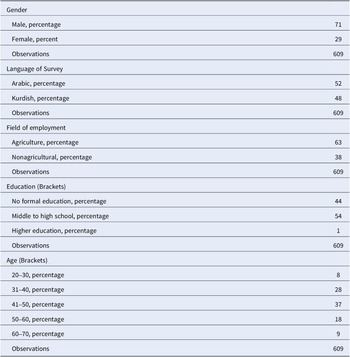
A public opinion survey helps elucidate popular conceptions of political ecology and understandings about the connection between environmental change, security, and governance (Blommaert and van de Vijver Reference Blommaert and van de Vijver2013; Csutora, Zsoka, and Harangozo Reference Csutora, Zsoka and Harangozo2021; Doolittle Reference Doolittle2015; Ybarra Reference Ybarra2018). We conducted the survey in the summer of 2023, selecting both urban and rural settings in the districts of Shwan, Kirkuk city, Laylan, and Daquq. These eastern areas of the Kirkuk province are the most ethnically diverse and also the hardest hit by water scarcity. Enumerators hired by a local survey firm carried hand-held laptops and cell phones, visiting the local market (bazaar/ suq ) over several days. Respondents were told that responses were kept anonymously and subject to the ethics review standard. The questionnaire usually took 20 minutes to complete. There was no renumeration offered. The basic demographic breakdown is provided below in Table 1.
Demographic Breakdown of Respondents

Table 1. Long description
Starting at the top, the gender section lists male percentage as 71 and female percentage as 29, with 609 observations. The next section, language of survey, records Arabic percentage as 52 and Kurdish percentage as 48, again with 609 observations. The employment field section shows agriculture percentage at 63 and nonagricultural percentage at 38, with 609 observations. The education brackets section details no formal education at 44 percent, middle to high school at 54 percent, higher education at 1 percent, and 609 observations. The age brackets section lists 20 to 30 years at 8 percent, 31 to 40 years at 28 percent, 41 to 50 years at 37 percent, 50 to 60 years at 18 percent, 60 to 70 years at 9 percent, and 609 observations.
Special care is devoted in the polling to assure safety and security. In a frontier space like Kirkuk, the threat of violence endangers both researchers and research participants (Haer and Becher Reference Haer and Becher2012; Bell-Martin and Marston Jr Reference Bell-Martin and Marston2021; Brück et al. Reference Brück, Justino, Verwimp, Avdeenko and Tedesco2016; Wood Reference Wood2006; Krause Reference Krause2021; Driscoll and Schuster Reference Driscoll and Schuster2018). The survey instrument is designed to avoid asking questions that might elicit self-censors or reveal potentially damaging information. The battery addresses basic demographics, broad questions on political outlook, and questions regarding attitudes toward environmental risk and overall political orientation. Some questions were considered too pointed to be included. For instance, the survey avoided asking questions specifically related to specific political parties, which could be a source of security concerns for respondents.
By design, enumerators also did not ask respondents about ethnolinguistic identity directly in order to avoid biasing responses or eliciting self-censorship. Instead, respondents could indicate a preferred language on the tablet and proceed to take the survey in either Arabic or Kurdish. This language choice is a strong proxy for ethnolinguistic affiliation, but was kept confidential in face-to-face interactions.
Measuring the Attitudes on Water Scarcity
We asked respondents about two distinct aspects in their framing of the diagnostic and the prescriptive. The former involves evaluation of circumstances and assignment of problem status; the latter involves identifying potential solutions or responses to the defined problem. To measure the diagnostic framing, the survey measures levels of agreement with the following proposition about water scarcity and ethnic conflict, measured on an ordinal scale, where 1= strongly disagree; 2= somewhat disagree; 3= no conviction; 4= somewhat agree; 5=strongly agree.
Water scarcity and drought contribute to tensions between Kurds, Arabs, Turkmen, and other ethnicities and sects in Iraq in general.
To measure prescriptive framing, we ask respondents which governing authority they would enlist for dealing with water insecurity. The question was posed as follows:
If you or a member of your family or relatives encountered problems related to water shortage and irrigation, or problems associated with climate change (drought), who is the authority you would seek to solve such problems?
Respondents had a non-exclusive menu of authority figures they could select. Options were a) the federal government of Iraq (GoI); b) the KRG; c) party politicians and officials; and d) nonstate actors (i.e. tribal chieftains, religious leaders, militias, etc.). This proposition is meant to measure what individuals see as potential solutions to water management issues at a personal level.
Measuring Territorialization
We measure attitudes to territorialization through the two questions. First, we ask a question related to Iraqi nationalism and Iraq’s territorial integrity
Kurdish rule in Kirkuk and other disputed territories was a sign of the division of Iraq. These areas should be subject to the Baghdad central government.
This is ranked ordinally from strongly disagree (=1) to strongly agree (=5).
Secondly, we ask the respondent about their preferred security arrangement for Kirkuk
What is the best way to ensure security in Kirkuk and other disputed territories?
Respondents were given a categorical choice of the following exclusive options: a) management by the federal government of Iraq (GoI) (i.e the status quo since 2017); b) management by the KRG; c) joint management by the KRG and the federal government; and d) do not know.
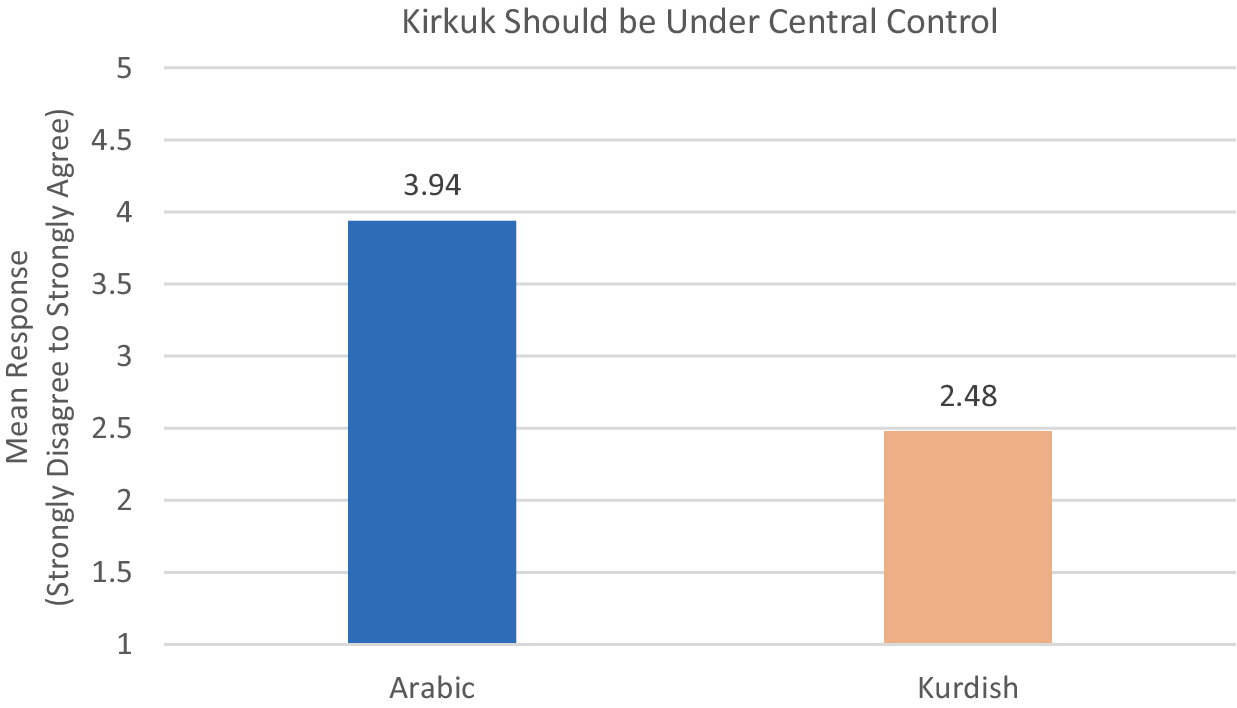
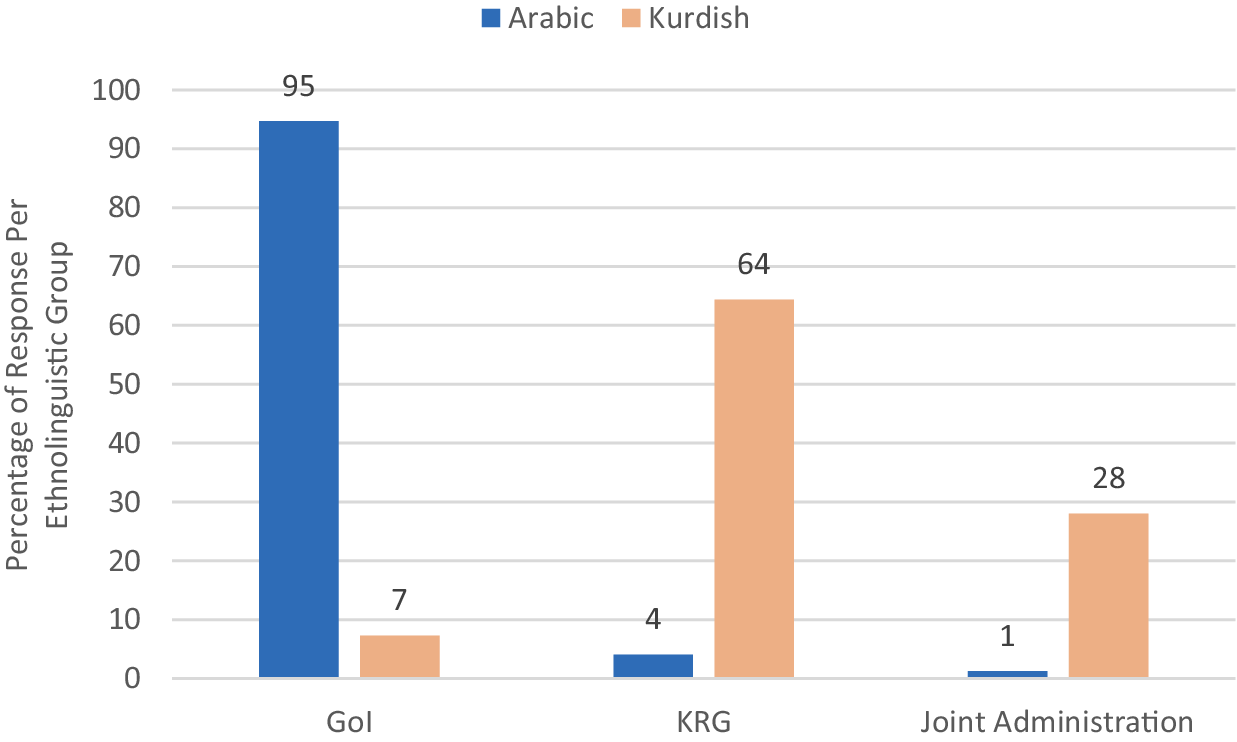
It is important to note that responses on territorialization are partially correlated with ethnolinguistic status, as shown below in Figure 1 and 2 below. Members of Kirkuk’s ethnolinguistic communities harbor diverse views about the Iraq’s territorial integrity and about how Kirkuk should be governed. Arabic-speakers largely favor the status quo: direct federal control over Kirkuk. Kurdish-speakers are more divided, but mostly favor placing Kirkuk under KRG control or creating a joint administration with special territorial status.
Commitment to Iraqi Nationalism, by Ethnolinguistic Group.

Preferred Territorial Solution for Kirkuk, by Ethnolinguistic Group.
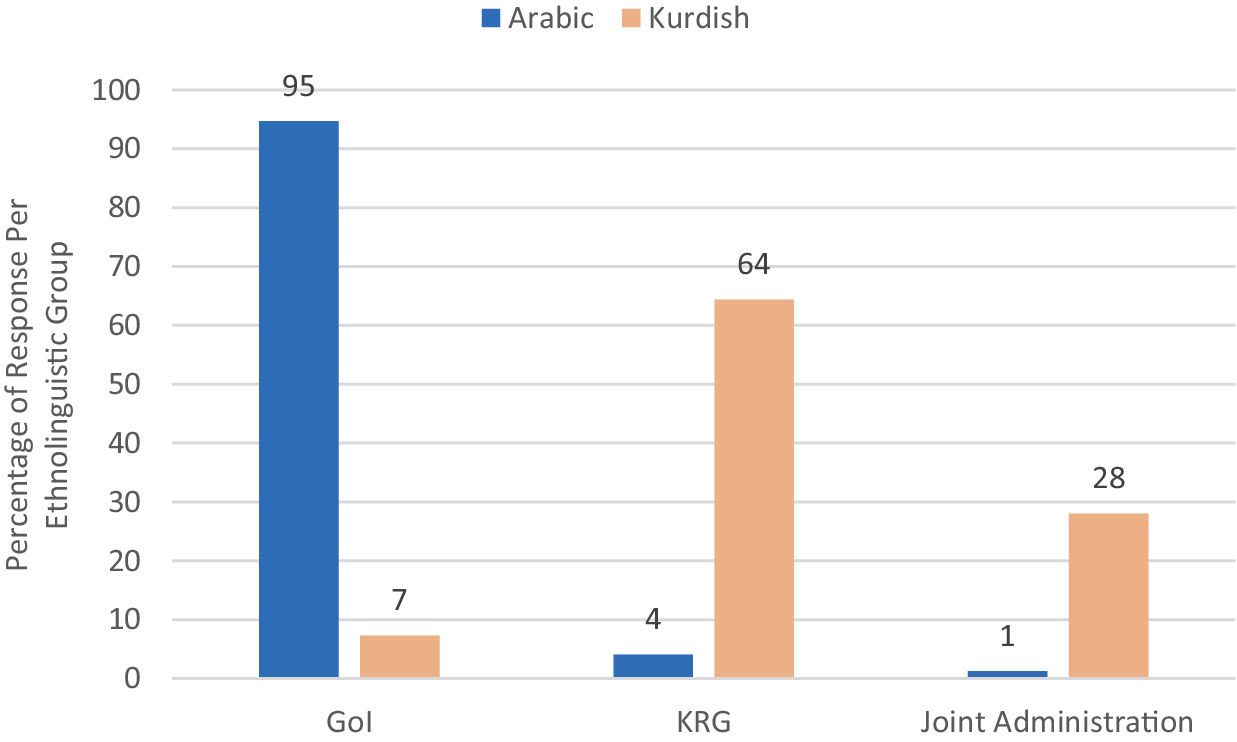
Figure 2. Long description
The x-axis lists GoI, K R G, and Joint Administration from left to right. The y-axis shows percentage of response per ethnolinguistic group from 0 to 100. For GoI, Arabic is 95 percent and Kurdish is 7 percent. For K R G, Kurdish is 64 percent and Arabic is 4 percent. For Joint Administration, Kurdish is 28 percent and Arabic is 1 percent. Arabic responses are highest for GoI, Kurdish responses are highest for K R G, and Kurdish responses are also notable for Joint Administration.
Results and Findings
Analyzing Diagnostic Frames
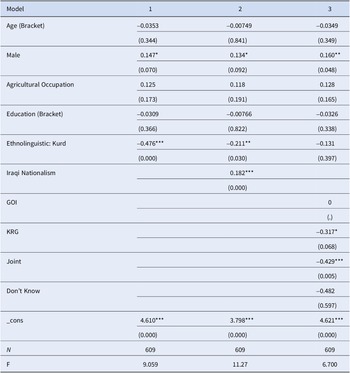
To analyze diagnostic framing, we begin with OLS regression using STATA v. 18.5. We include independent variables for age, gender, education, and a dummy variable for ethnolinguistic affiliations (Kurdish language=1). Results are shown in Table 2 below. Two variables are strongly and consistently associated with water insecurity framing. The first is ethnolinguistic affiliation. There are significant differences between Arabic and Kurdish-speakers in all aspects of diagnostic framing of water insecurity. Arabic-speakers are more likely to believe that water shortages contribute to ethnic conflict, to rural tensions, and to economic problems. Kurdish-speakers in contrast, are collectively less likely to accept such framing of water shortages. Put another way, Kurdish-speakers are more dubious of frames that attribute political problems to environmental factors. A second variable that stands out as strongly and positively correlated with the water insecurity frame is gender. Men tend to agree with these propositions more often than women within the sample.
OLS Regression Results
Diagnostic Framing About Water Security
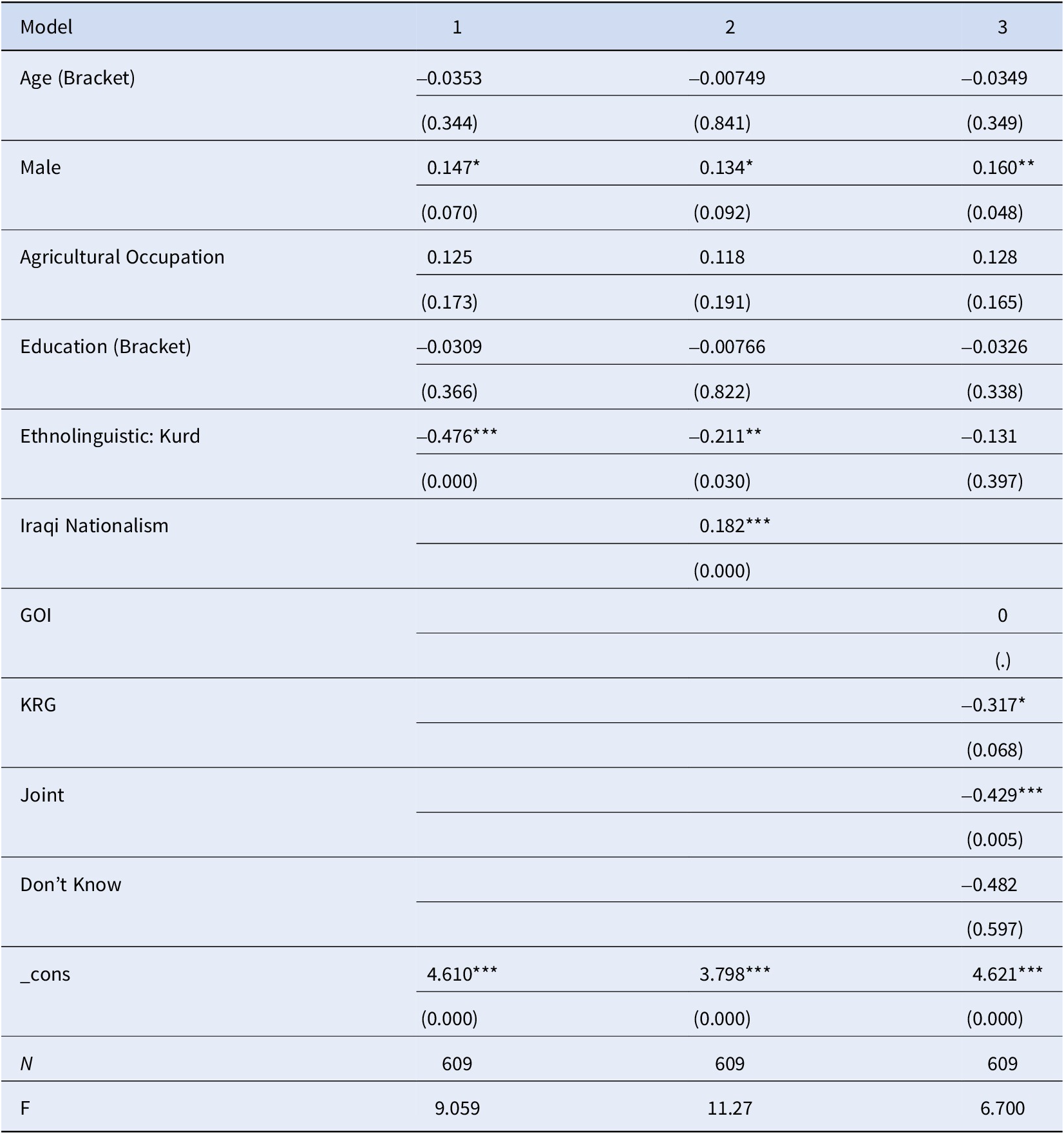
Table 2. Long description
Beginning at the top left, the table lists variables vertically: Age (Bracket), Male, Agricultural Occupation, Education (Bracket), Ethnolinguistic: Kurd, Iraqi Nationalism, G O I, K R G, Joint, Don’t Know, and _cons. Each variable’s coefficients are shown for Models 1, 2, and 3, with standard errors in parentheses directly beneath. For Age (Bracket), coefficients are negative and non-significant across all models: minus 0.0353 (0.344), minus 0.00749 (0.841), minus 0.0349 (0.349). Male is positive and significant: 0.147* (0.070), 0.134* (0.092), 0.160** (0.048). Agricultural Occupation is positive but non-significant: 0.125 (0.173), 0.118 (0.191), 0.128 (0.165). Education (Bracket) is negative and non-significant: minus 0.0309 (0.366), minus 0.00766 (0.822), minus 0.0326 (0.338). Ethnolinguistic: Kurd is negative and highly significant in Model 1: minus 0.476*** (0.000), Model 2: minus 0.211** (0.030), Model 3: minus 0.131 (0.397). Iraqi Nationalism is only present in Model 2: 0.182*** (0.000). G O I is only present in Model 3: coefficient 0, standard error (.). K R G is only present in Model 3: minus 0.317* (0.068). Joint is only present in Model 3: minus 0.429*** (0.005). Don’t Know is only present in Model 3: minus 0.482 (0.597). The constant (_cons) is positive and highly significant in all models: 4.610*** (0.000), 3.798*** (0.000), 4.621*** (0.000). At the bottom, sample size N is 609 for all models. F-statistics are 9.059, 11.27, and 6.700 for Models 1, 2, and 3 respectively. Significance levels are denoted by asterisks: * p less than 0.10, ** p less than 0.05, *** p less than 0.01.
p-values in parentheses; * p < 0.10, ** p < 0.05, *** p < 0.01
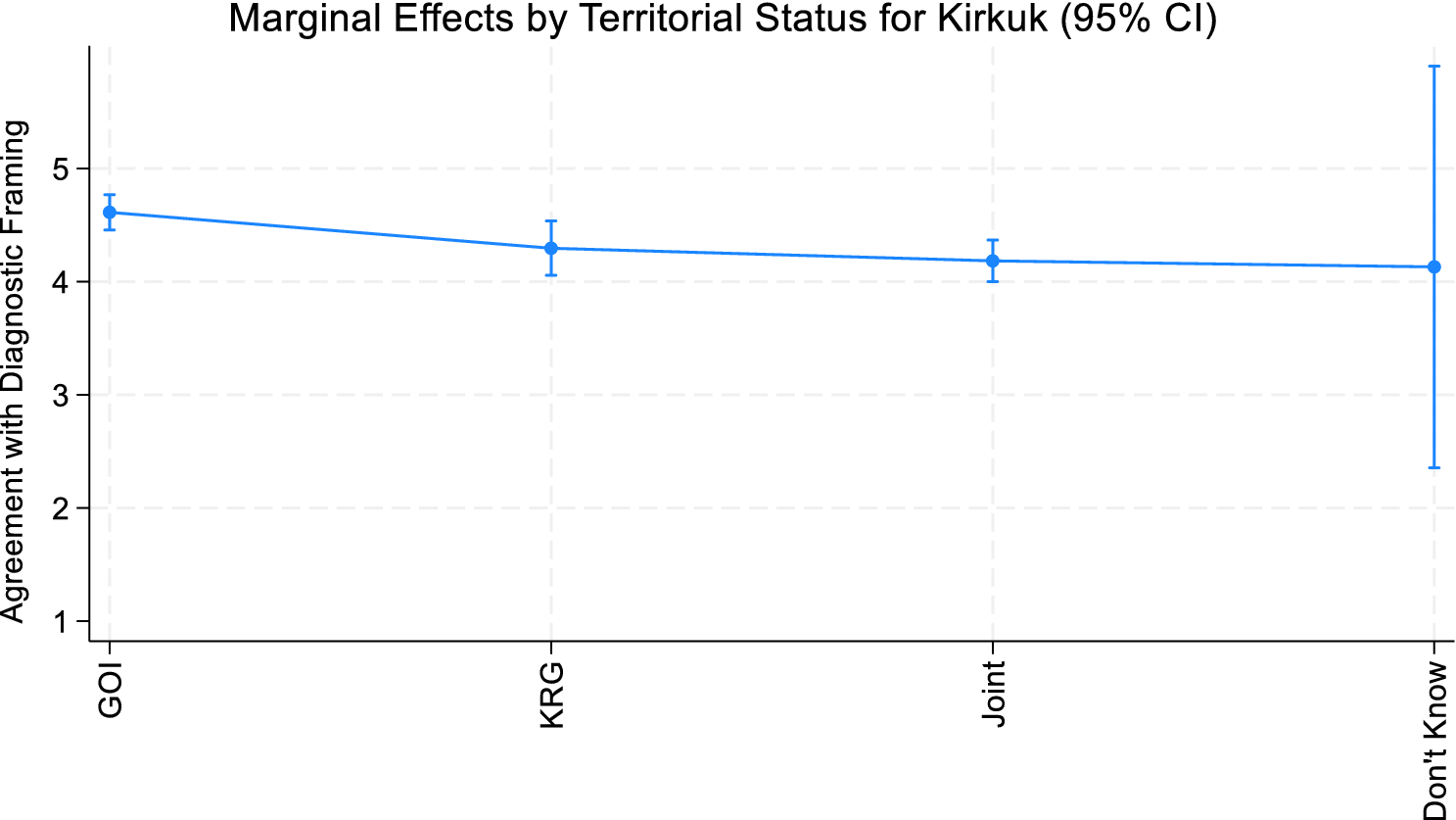
Models 2 and 3 in Table 2 expand on this basic model by adding variables for territorialization. Figure 3 presents the marginal effects of the territorial preferences variable (Table 2, Model 3) with all other variables held at their mean. This represents how much territorial preferences impact framing of water scarcity as a cause of instability. The models and figures show which supporters of the current status quo in which the federal government of Iraq controls Kirkuk directly are most likely to adopt in the water insecurity framing. Those favoring revising Kirkuk’s territorial status, whether by attaching Kirkuk to the KRG or joint rule, are somewhat less likely to frame water shortages as a cause of conflict. While the difference is fairly small at a substantive level (perhaps between a “strong agree” and “somewhat agree” on the 1-5 scale), it is important to note that this gap persists even while controlling for Kurdish ethnolinguistic affiliation. As there is reason to believe that ethnolinguistic affiliation and territorial preferences are strongly connected in Kirkuk, this disparity in framing water security requires is an important substantive finding.
from Table 2, Model 3.

Figure 3. Long description
The x-axis lists four categories from left to right: GOI, KRG, Joint, and Don’t Know. The y-axis ranges from 1 to 5 and is labeled Agreement with Diagnostic Framing. Each category has a blue point connected by a line, with vertical error bars representing 95 percent confidence intervals. GOI is near 4.7, KRG near 4.3, Joint near 4.2, and Don’t Know at 4.1. The error bar for Don’t Know is much larger than for the other categories, spanning from about 2.5 to 5.2. The trend shows a slight decline in agreement from GOI to Don’t Know, with the greatest uncertainty in the Don’t Know group.
Analyzing Prescriptive Framing
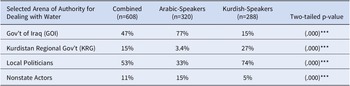
To examine prescriptive framing regarding which arena of authority is appropriate for dealing with water insecurity, we begin with descriptive statistics. Respondents had a non-exclusive menu of authority figures they could select to deal with water insecurity: the federal government of Iraq (GoI), the KRG, local party politicians, or nonstate actors. Table 3 shows total responses and responses broken down by Kurdish versus Arabic-language selection. Percentage totals surpass 100 percent because individuals can select more than one option. The results show scant interest in nonstate solutions. Few residents in Kirkuk see nonstate arenas of authority as responsible for water management. There is instead pronounced focus on formal institutions, both the state (GoI or KRG) and politicians and political parties that can influence the state.
Percentage of Respondents Selecting Different Arenas of Authority with T-Test for Differences Between Ethnolinguistic Groups (Note: Responses are not exclusive)
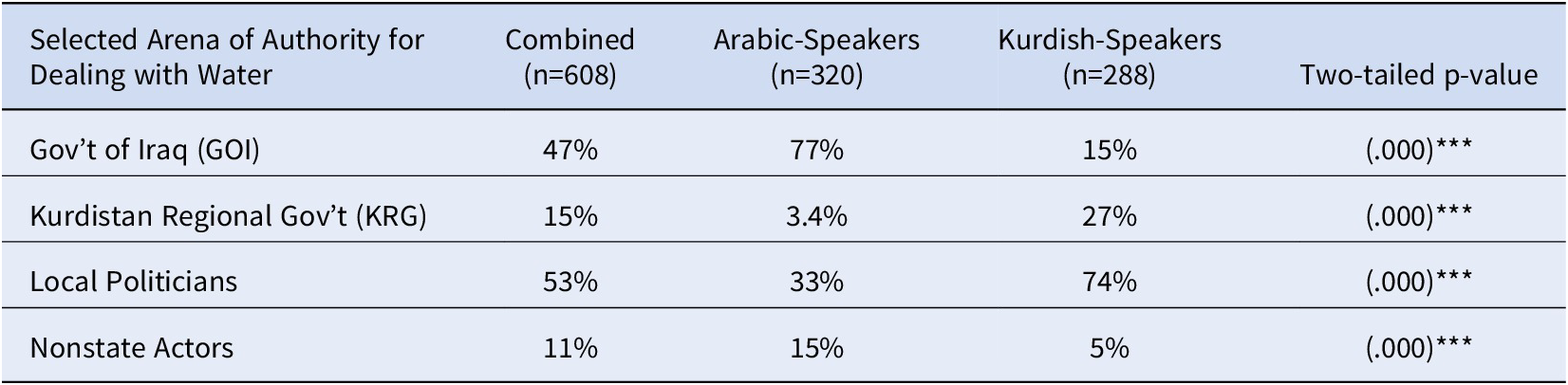
Table 3. Long description
Starting from the top row, the table lists four arenas of authority for water management: Gov apostrophe t of Iraq (G O I), Kurdistan Regional Gov apostrophe t (K R G), Local Politicians, and Nonstate Actors. For G O I, 47 percent of all respondents selected this authority, with 77 percent among Arabic-speakers and 15 percent among Kurdish-speakers. For K R G, 15 percent overall, 3.4 percent Arabic-speakers, and 27 percent Kurdish-speakers. Local Politicians were chosen by 53 percent overall, 33 percent Arabic-speakers, and 74 percent Kurdish-speakers. Nonstate Actors were selected by 11 percent overall, 15 percent Arabic-speakers, and 5 percent Kurdish-speakers. Each row ends with a two-tailed p-value of open parenthesis dot zero zero zero close parenthesis, marked with three asterisks, indicating statistically significant differences between groups. The table notes that responses are not exclusive and provides p-value thresholds in the footnote.
p-values in parentheses; * p < 0.10, ** p < 0.05, *** p < 0.01
But views of the state itself are highly fractured. Arabic-speakers see water management as something the federal government should handle. Hardly any Kurdish-speakers in Kirkuk agree. In contrast, they frame water management as something that should be handled by the KRG primarily (despite the KRG’s expulsion since 2017) or by local party politicians. T-tests confirms that differences between Arabic and Kurdish-speakers are statistically significant (see table 3).
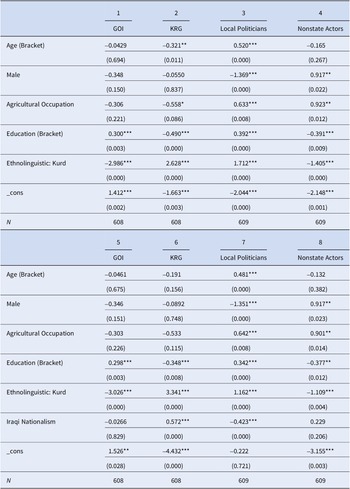
For more intensive testing, we run separate binary logistical regression evaluating the odds of selecting each of these arenas of authority, shown in Table 4 below. The basic models (numbers 1-4) present the odds of selecting each arena of authority accounting for age, gender, whether they have an agricultural occupation, education level, and the ethnolinguistic dummy (where Kurdish language is coded as 1). Again, we see evidence of disparities between the Arab and Kurdish ethnolinguistic groups in selecting arenas of authority. We include the interval variable measuring commitment to Iraqi nationalism and retaining Kirkuk under federal authority in models 5 through 8 in Table 4.
Binary Logistical Regression Results: Prescriptive Framing of Water Insecurity
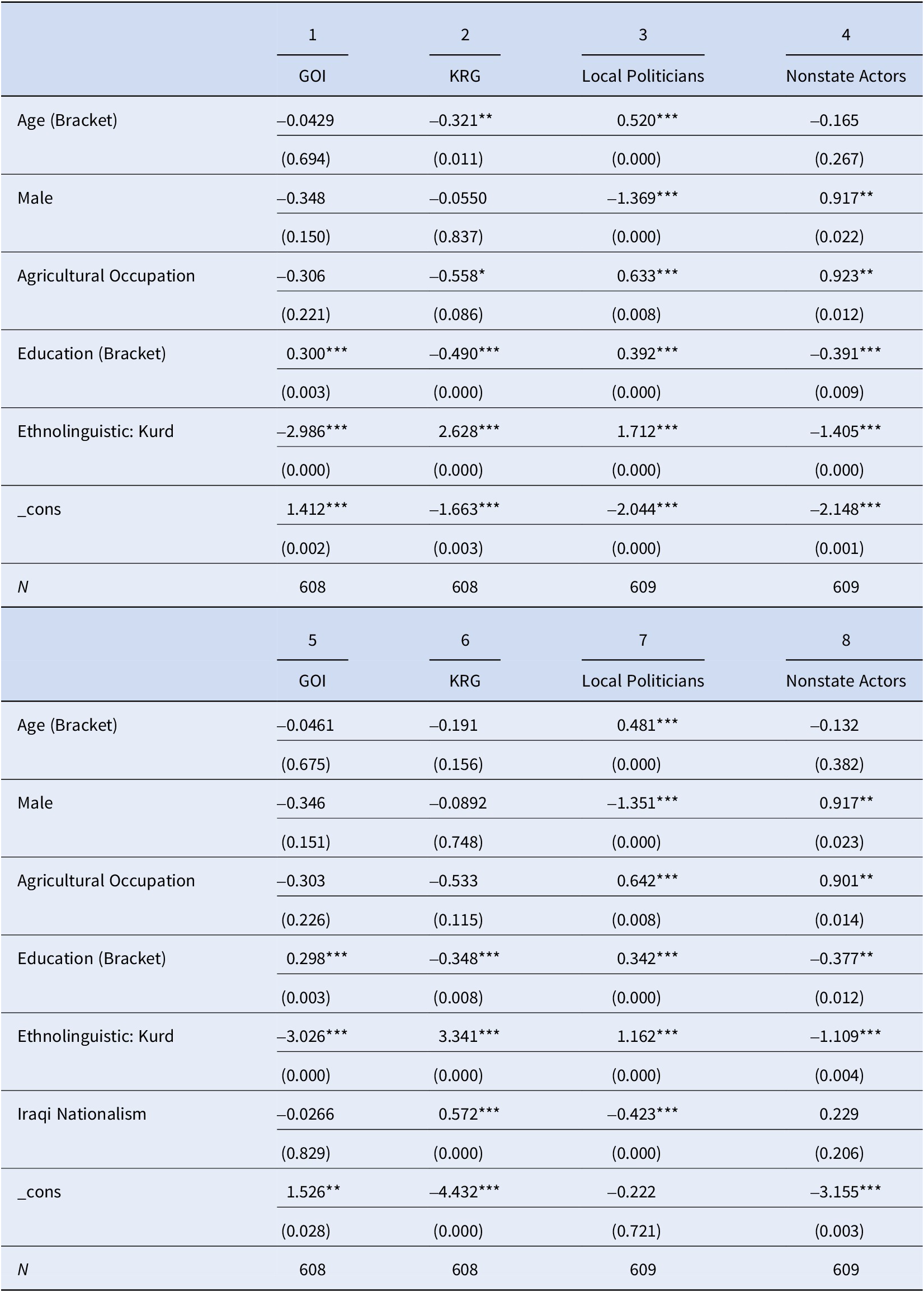
Table 4. Long description
The table consists of two panels, each with four columns labeled GOI, KRG, Local Politicians, and Nonstate Actors, representing eight models in total. From top to bottom, each row lists a predictor variable: Age (Bracket), Male, Agricultural Occupation, Education (Bracket), Ethnolinguistic Kurd, Iraqi Nationalism (second panel only), and _cons. For each variable, the first row displays the regression coefficient, with asterisks indicating significance levels (one for p less than 0.10, two for p less than 0.05, three for p less than 0.01). The second row shows the p-value in parentheses. For example, in Model 3 (Local Politicians, first panel), Age (Bracket) has a coefficient of 0.520 with three asterisks and a p-value of 0.000. Ethnolinguistic Kurd shows strong negative and positive associations across models, with coefficients ranging from minus 2.986 to 3.341, all highly significant. The bottom row in each panel lists sample sizes (N), with values of 608 or 609. The table footnote explains the asterisk coding for significance thresholds.
p-values in parentheses: * p < 0.10, ** p < 0.05, *** p < 0.01
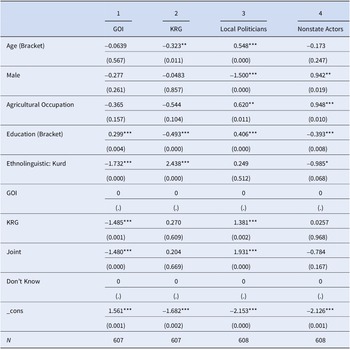
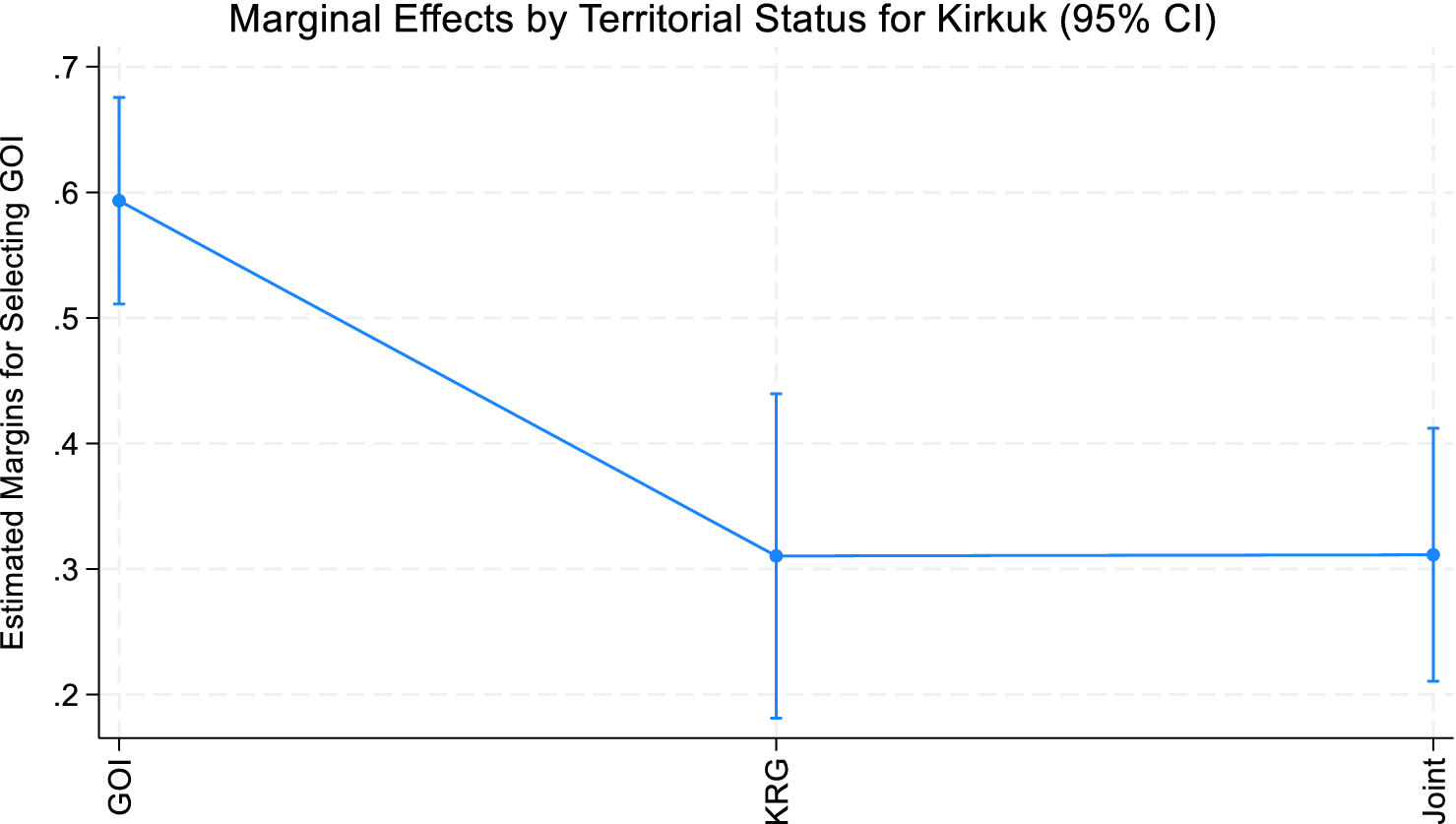
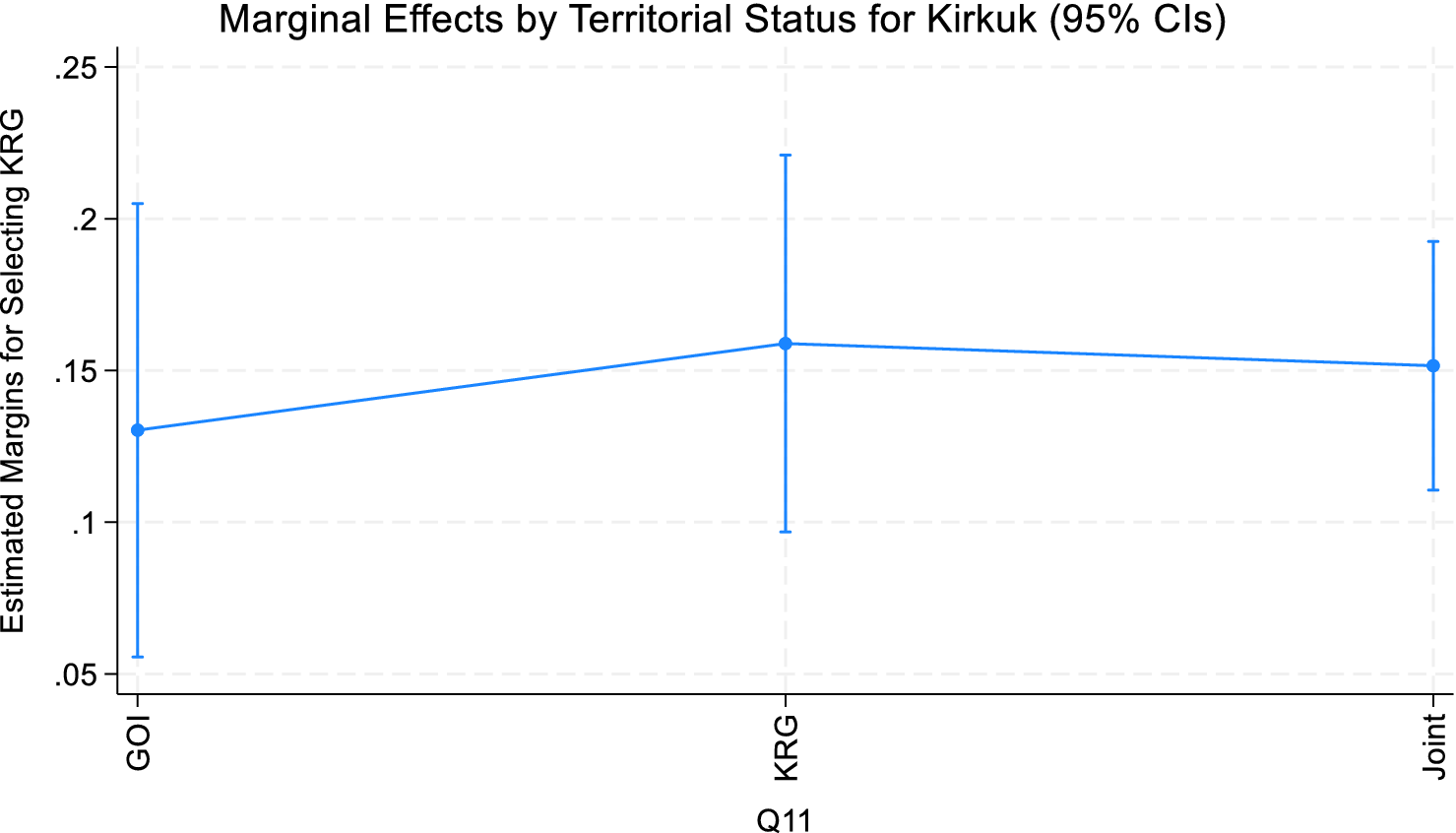
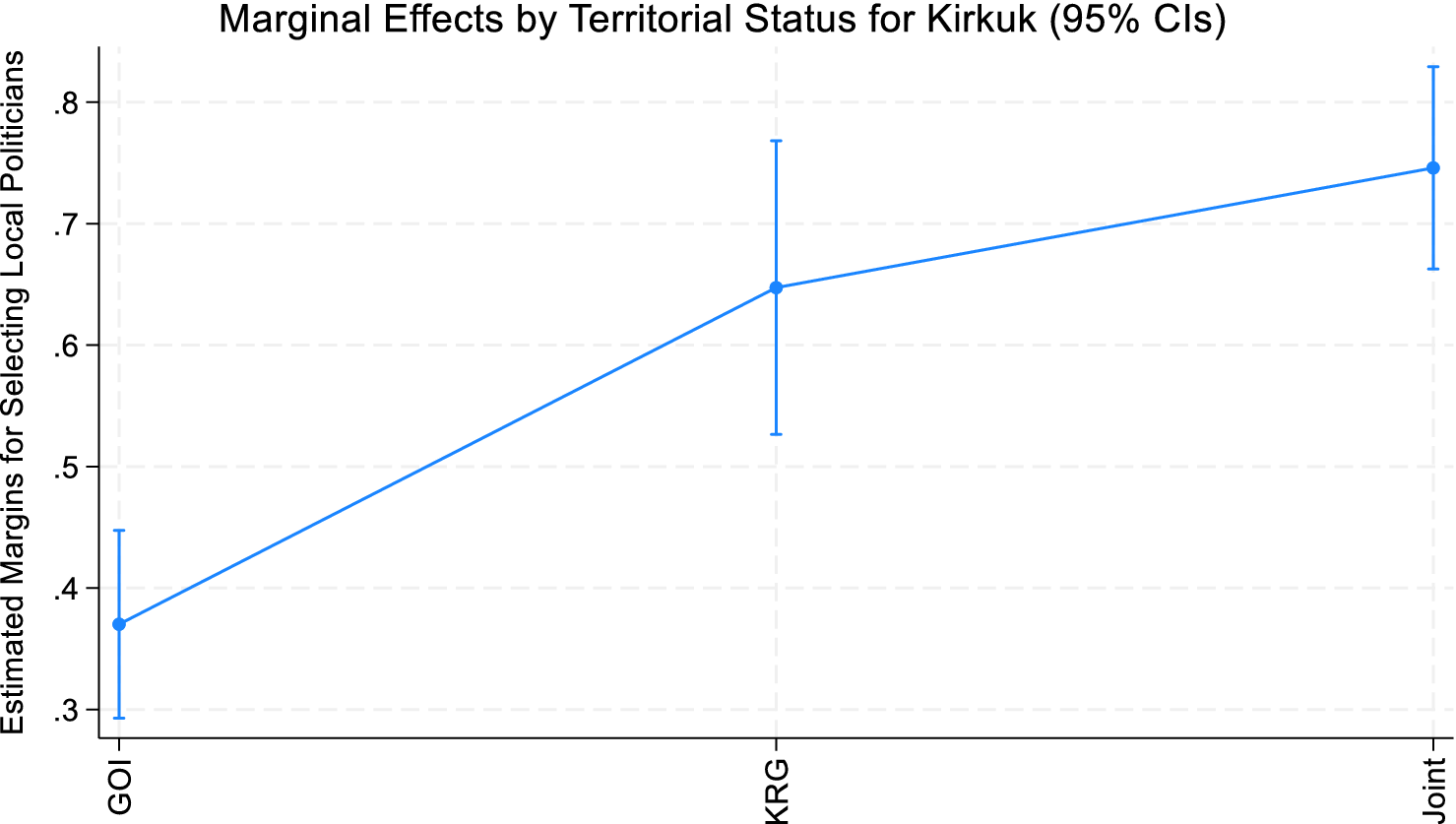
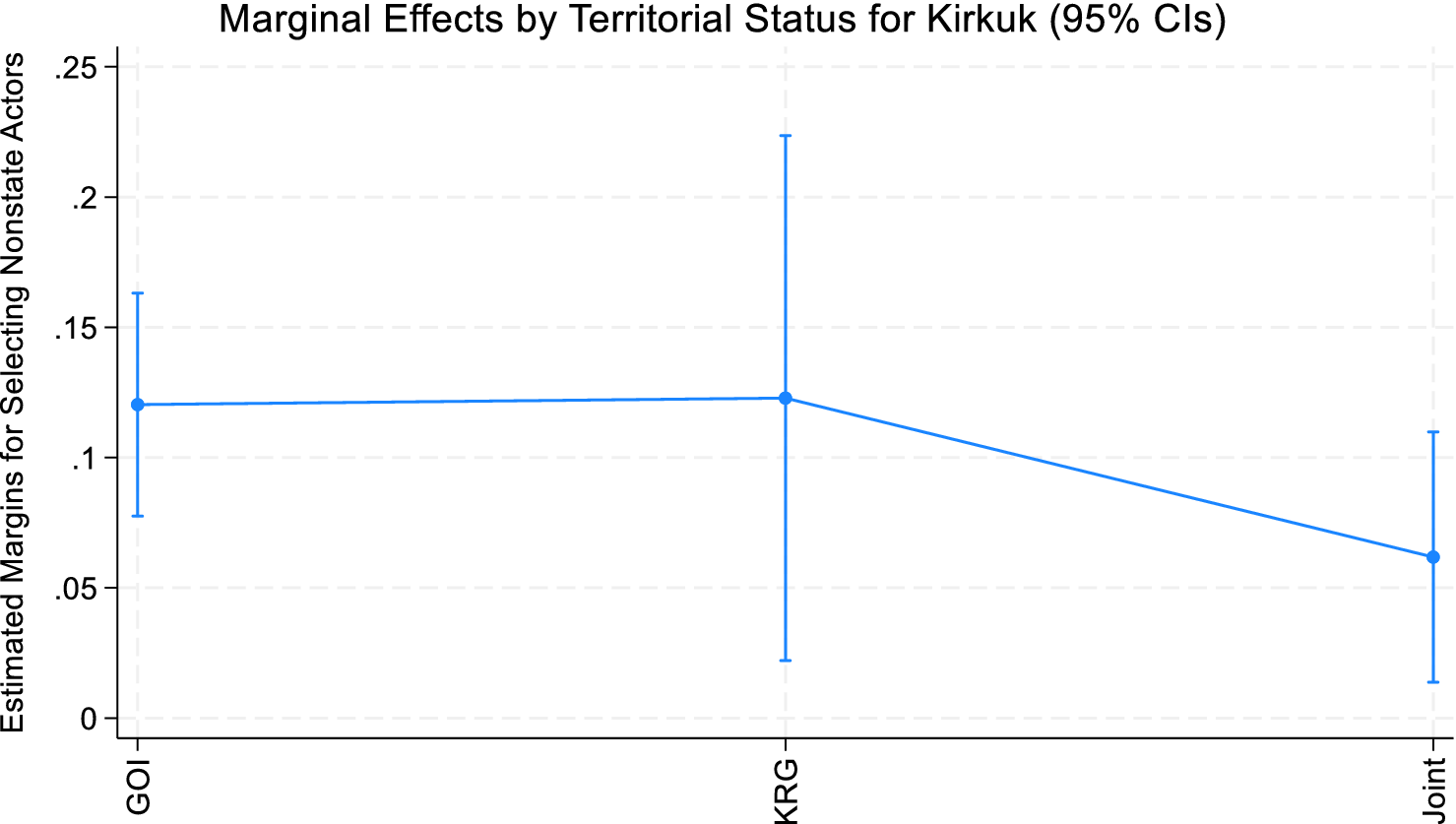
We further explore territorialization running the regression with identical controls but replacing the ordinal variable measuring Iraqi nationalism with a series of nominal variables reflecting whether respondents preferred federal authority, KRG authority, or joint authority in Kirkuk. Results appear in Table 5. Figures 4–7 derive from the models in Table 5, depicting the marginal effect of the nominal territorialization variables. This graphically illustrates how commitments to different territorial schema for Kirkuk influence the likelihood of selecting different arenas of authority for dealing with water insecurity. Again, we see that ethnolinguistic affiliation and territorialization consistently affect prescriptive framing of water scarcity. Those who favor Kirkuk’s integration under Iraq’s central authority – largely Arabic-speakers – are the most likely to enlist the federal government for help dealing with water shortages and reject involvement by the KRG, party politicians, or nonstate actors. By comparison, those favoring revising Kirkuk’s territorial status – largely Kurdish-speakers – are more willing to involve multiple arenas of authority in day-to-day water management.
Binary Logistical Regression Results: Prescriptive Framing Using Nominal Variables
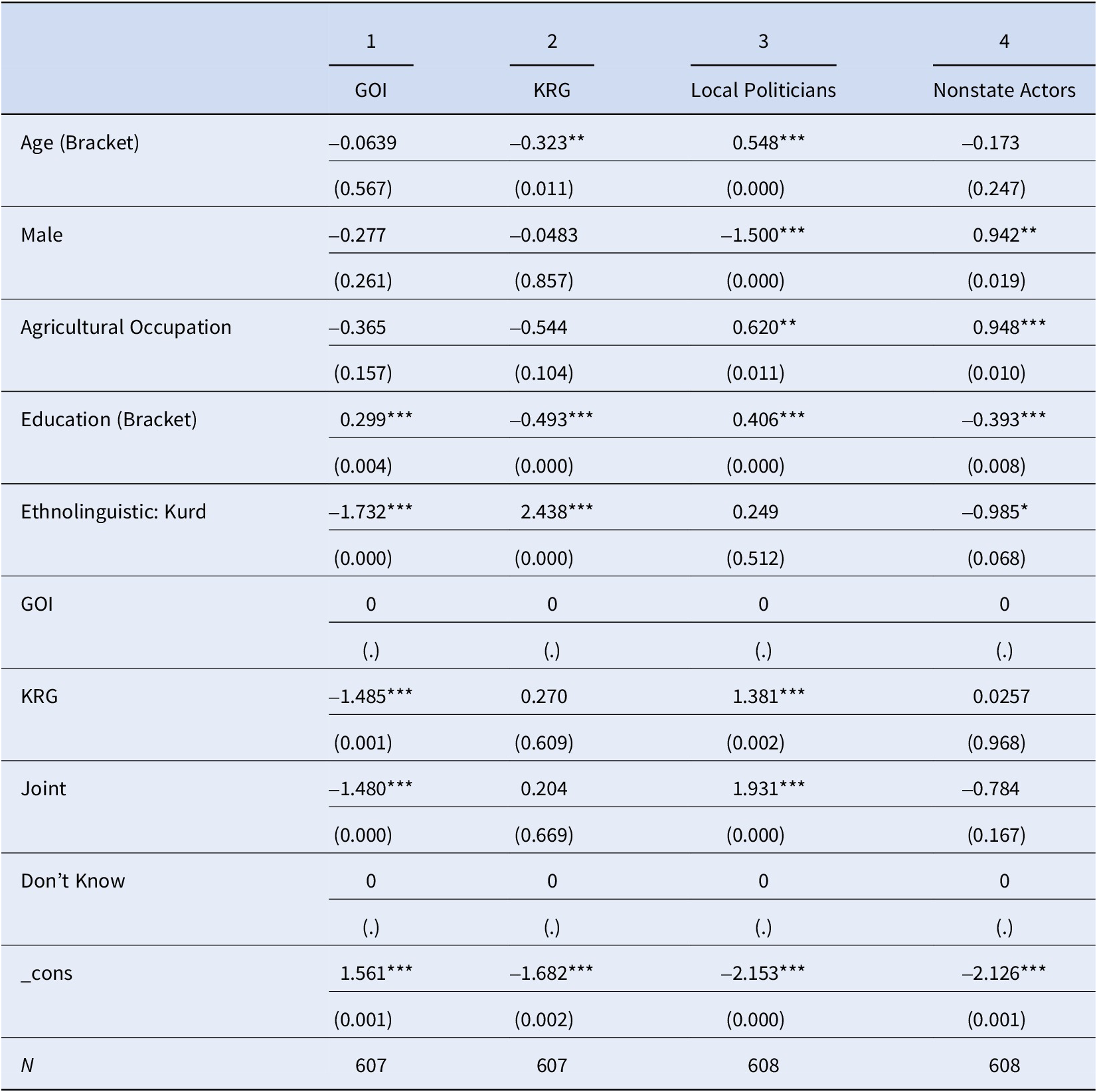
Table 5. Long description
Beginning at the top, the leftmost column lists variables: Age (Bracket), Male, Agricultural Occupation, Education (Bracket), Ethnolinguistic Kurd, G O I, K R G, Joint, Don’t Know, _cons, and N. Each variable spans two rows: the first row displays regression coefficients for G O I, K R G, Local Politicians, and Nonstate Actors, while the second row shows p-values in parentheses. For Age (Bracket), coefficients are minus 0.0639 for G O I (p 0.567), minus 0.323 for K R G (p 0.011, double asterisk), 0.548 for Local Politicians (p 0.000, triple asterisk), and minus 0.173 for Nonstate Actors (p 0.247). For Male, coefficients are minus 0.277 for G O I (p 0.261), minus 0.0483 for K R G (p 0.857), minus 1.500 for Local Politicians (p 0.000, triple asterisk), and 0.942 for Nonstate Actors (p 0.019, double asterisk). Agricultural Occupation coefficients are minus 0.365 for G O I (p 0.157), minus 0.544 for K R G (p 0.104), 0.620 for Local Politicians (p 0.011, double asterisk), and 0.948 for Nonstate Actors (p 0.010, triple asterisk). Education (Bracket) coefficients are 0.299 for G O I (p 0.004, triple asterisk), minus 0.493 for K R G (p 0.000, triple asterisk), 0.406 for Local Politicians (p 0.000, triple asterisk), and minus 0.393 for Nonstate Actors (p 0.008, triple asterisk). Ethnolinguistic Kurd coefficients are minus 1.732 for G O I (p 0.000, triple asterisk), 2.438 for K R G (p 0.000, triple asterisk), 0.249 for Local Politicians (p 0.512), and minus 0.985 for Nonstate Actors (p 0.068, single asterisk). G O I and Don’t Know rows have coefficients of 0 and p-values as dot for all columns. K R G coefficients are minus 1.485 for G O I (p 0.001, triple asterisk), 0.270 for K R G (p 0.609), 1.381 for Local Politicians (p 0.002, triple asterisk), and 0.0257 for Nonstate Actors (p 0.968). Joint coefficients are minus 1.480 for G O I (p 0.000, triple asterisk), 0.204 for K R G (p 0.669), 1.931 for Local Politicians (p 0.000, triple asterisk), and minus 0.784 for Nonstate Actors (p 0.167). _cons coefficients are 1.561 for G O I (p 0.001, triple asterisk), minus 1.682 for K R G (p 0.002, triple asterisk), minus 2.153 for Local Politicians (p 0.000, triple asterisk), and minus 2.126 for Nonstate Actors (p 0.001, triple asterisk). N values are 607 for G O I and K R G, 608 for Local Politicians and Nonstate Actors. Significance is denoted by asterisks: single for p less than 0.10, double for p less than 0.05, triple for p less than 0.01.
p-values in parentheses * p < 0.10, ** p < 0.05, *** p < 0.01
Marginal Effects from Table 5, Model 1.

Figure 4. Long description
The x-axis lists three categories from left to right: G O I, K R G, and Joint. The y-axis is labeled Estimated Margins for Selecting G O I, ranging from 0.2 to 0.7. At G O I, the estimated margin is about 0.6 with a large error bar. At K R G, the margin drops to about 0.3 with a similar error bar. At Joint, the margin remains at about 0.3, also with a large error bar. The line connecting the points slopes downward from G O I to K R G, then remains flat from K R G to Joint. All points display 95 percent confidence intervals as vertical error bars.
Marginal Effects from Table 5, Model 2.

Figure 5. Long description
The x-axis lists three categories from left to right: G O I, K R G, and Joint. The y-axis is labeled Estimated Margins for Selecting K R G, ranging from 0.05 to 0.25. Each category has a blue point connected by lines, with vertical error bars representing 95 percent confidence intervals. The G O I point is near 0.14, K R G is slightly higher near 0.16, and Joint is near 0.15. The error bars for all three points are wide and overlap, indicating no statistically significant differences between the categories. The graph title is Marginal Effects by Territorial Status for Kirkuk (95 percent C Is).
Marginal Effects from Table 5, Model 3.

Marginal Effects from Table 5, Model 4.

Figure 7. Long description
The x-axis lists three territorial statuses from left to right: G O I, K R G, and Joint. The y-axis is labeled estimated margins for selecting nonstate actors, ranging from 0 to 0.25. Each status has a blue point with a vertical error bar representing the 95 percent confidence interval. G O I and K R G have similar estimated margins near 0.12, but K R G has the widest confidence interval, spanning from about 0.02 to 0.22. G O I’s interval ranges from about 0.07 to 0.17. The Joint status has the lowest estimated margin, near 0.06, with a narrower confidence interval from about 0.02 to 0.10. The line connecting the points shows a flat trend from G O I to K R G, then a decline to Joint.
Overall, the results show that those most committed to the Iraqi state’s territorial agenda in Kirkuk are the most likely to diagnose water insecurity as endangering stability. They are also the most likely to prescribe enlisting the government of Iraq to manage day-to-day water scarcity problems. Only the Iraqi state can – or should – rescue Kirkuk from water insecurity. In this way, ecological ideas about scarcity foster Iraqi Arab penetration at the internal frontier. In contrast, those opposing Iraqi state’s designs on Kirkuk are less likely to accept the water insecurity frame as a diagnosis. They see the roots of Kirkuk’s problems elsewhere. Moving to prescriptive framing, they are reluctant to enlist the Iraq government for help with water scarcity. They prefer to rely on the KRG as well as politicians to handle these challenges. Even though these politicians may eventually have to petition Baghdad, this intermediation is preferable to inviting the federal government to consolidate control in disputed Kirkuk. These ecological subjectivities, their understanding of the stakes in Iraq’s environmental crisis and what might solve it, align with alternatives to the state’s integrationist plans. The hydrosocial space becomes a front of nationalist contestation.
Conclusions
Iraq is high on any watchlists of ecologically-vulnerable countries (Al-Obaidi et al. Reference Al-Obaidi, Allawi, Al-Taie, Alobaidi, Al-Khayri, Abdullah and Ahmad-Kamil2022; Jaff Reference Jaff2023; Varis, Keskinen, and Kummu Reference Varis, Keskinen and Kummu2017). Indeed, the entire Middle East faces rising temperature and water depletion, coinciding with grave social and political upheaval. Studies in Iraq depict multiple forms of hydrosocial contestation. The exact shape depends both on local ecological and political conditions (Rizzi and Mollinga Reference Rizzi and Mollinga2024; Mason Reference Mason2022; Al-Rubaie, Mason, and Mehdi Reference Al-Rubaie, Mason and Mehdi2021; Jongerden et al. Reference Jongerden, Wolters, Dijkxhoorn, Gür and Öztürk2019; Hassaniyan Reference Hassaniyan2021; Al Kli, Miller, and de Waal Reference Al Kli, Miller and de Waal2024). The ubiquity of water insecurity across Iraq, some suggest, could spur momentum toward environmental and political remediation (von Lossow, Schwartzstein, and Partow Reference von Lossow, Schwartzstein and Partow2022). A report by the Century Foundation, for instance, expresses guarded optimism about an emerging consensus among Iraqis about climate change as a real danger. Such a “clear definition of the problem,” the report avers, might invite “viable responses, which also focus on human agency – remediations, adaptation, sometimes even reversals and solutions” (Shuker Reference Shuker2023). Diagnostically framing the severity of ecological crisis can lead to new kinds of inter-ethnic collaboration and problem solving.
This article places the ecological and political challenges of Iraqi in a broader setting. Shifts in material ecological conditions connect to the ideas and practices which actors deploy to understand and address environmental challenges (Daoudy Reference Daoudy2021). The struggle over resources in Kirkuk began decades before the current water crisis manifested. This enables residents of Kirkuk to imagine (or remember) an ecological golden age of frontier abundance. Ecological imaginaries in Kirkuk intertwine with rival projects for ethnonational territorialization. Each of these projects frame the territory’s water scarcity in different ways. Those favoring Iraq’s state-building project, mostly Arabic-speaking Kirkukis, are also the most likely to accept the traditional environmental security framing. They believe that water scarcity is a trigger of social and political tensions. They also insist that the Iraqi state alone manage water scarcity. In contrast, those favoring alternative state-building projects, namely the Kurdish counter-state, dispute this framing. They are more likely to see Kirkuk’s problems as fundamentally political, not ecological, and they also prefer that other authorities step in to manage the ecological risk.
These findings have considerably pessimistic implications for the role of water in environmental security and peacebuilding (Weinthal, Troell, and Nakayama Reference Weinthal, Troell and Nakayama2011; Weinthal and Johnson Reference Weinthal and Johnson2018). The environmental security and peacebuilding literatures share the assumption that material environmental change induces and precedes political and social change. Ensuing policy prescriptions accordingly tend to focus on technical solutions to mitigate shortage or ameliorate allocative disputes that could spur to violence (Krampe, Hegazi, and VanDeveer Reference Krampe, Hegazi and VanDeveer2021; Ide Reference Ide2020). The political ecology approach does not deny the impact of drought and ecological scarcity on human survival. But it offers a more nuanced view of human-ecological interactions. Scarcity or lack of a technical ingenuity do not spur people to adopt strident political stances. Political agency and ideas are the primary determinants of war, peace, and ecological sustainability. Disparate environmental frames are embedded in commitments to antagonistic projects for territorialization, nationalism, and state-building.
Kirkuk is hardly exceptional as an internal frontier, subject to unsettled sovereignty claims and rival ethnoterritorial ambitions. Indeed, the Kurdish drive for self-determination has contributed to the formation of multiple internal frontiers across Turkey, Syria, Iran, and Iraq. In each of these, conflicts over water and other resources are prominent (Yıldırım Reference Yıldırım2024; Mamshai Reference Mamshai2025b; Daoudy Reference Daoudy2020; Bilgen Reference Bilgen2018; Hommes, Boelens, and Maat Reference Hommes, Boelens and Maat2016). We might expand the scope further. In Asia alone we might mention Palestine (Haddad Reference Haddad2011), Aceh (Green IV Reference Green2013), Russian sub-federal regions such as Tatarstan (Tulaeva, A., and and Snarski Reference Tulaeva and Henry Laura2024), and Kashmir (Bhan and Trisal Reference Bhan and Trisal2017). In all such spaces, environmental governance must navigate competing claims of ethnopolitical control and ownership. Rival ecological and political imaginaries of territorial status loom over the pursuit of environmental security. These dynamics illustrate a larger trend. As great powers like United States, Russia, and China appropriate and manipulate environmentalist framing to serve their larger strategic ends, they ultimately undermine efforts to foster international collaboration on climate change (Toal Reference Toal2024). Frame polarization, driven by ethnonationalist projects, undercuts the bases for intercommunal collaboration in ecological governance. Even seemingly benign and technical governance approaches are controversial when viewed through polarized frames. Peace requires political reconciliation and the construction of shared ecological imaginaries before technical solutions become feasible.
Acknowledgments
Biographical notes. Ahram is a professor at the Virginia Tech School of Public & International Affairs. Mamshai is associate researcher at Virginia Tech, having recently completed his doctorate in Planning, Globalization, and Governance. Portions of this research were conducted for the doctorate.
Financial support
The author acknowledges support from Virginia Tech and the Governance and Local Development Program, Gothenburg University.
Disclosure
None.
Appendix
Summary of Key Variables
Territorialization Variable
Q: Kurdish rule in Kirkuk and other disputed territories was a sign of the division of Iraq. These areas should be subject to the Baghdad central government (Question 10)
Ranked ordinally from strongly disagree (=1) to strongly agree (=5).
Diagnostic Framing Variable
Q: Water scarcity and drought contribute to tensions between Kurds, Arabs, Turkmen, and other ethnicities and sects in Iraq in general (Question 19)
Ranked ordinally from strongly disagree (=1) to strongly agree (=5).

Table A1 Long description
The table has six columns: Variable Name, N, Mean, Standard Deviation, Min, and Max. The first row lists Q10_R with N as 609, mean 3.253, standard deviation 1.174, minimum 1, and maximum 5. The second row lists Q19 with N as 609, mean 4.427, standard deviation 0.9292, minimum 1, and maximum 5. All values are aligned by variable and statistic, with Q10_R and Q19 as the only variables shown.


 Open access

