





People with intellectual disabilities are considerably more likely to experience depression and anxiety than the general population. Reference Cooper, McLean, Guthrie, McConnachie, Mercer and Sullivan1 For example, one study estimated that 15.8% of people with intellectual disabilities experienced depression in a given year and 8.1% experienced anxiety, compared with rates of 10.1% for depression and 3.9% for anxiety in the general population. Reference Cooper, McLean, Guthrie, McConnachie, Mercer and Sullivan1 When diagnosed with depression, anxiety or both, adults with intellectual disabilities report difficulties in accessing appropriate mental healthcare, whether in the form of pharmacological treatment or psychological therapy. Reference Branford, Gerrard, Saleem, Shaw and Webster2,Reference Whittle, Fisher, Reppermund, Lenroot and Trollor3 It has been reported that psychotropic medications are overprescribed for people with intellectual disabilities, whether they experience a mental health condition or not, and that prescribing of psychotropic medication may be misaligned with people’s presenting problems. Reference Bertelli4 Initiatives have been developed in recent years to address these issues. Reference Branford, Gerrard, Saleem, Shaw and Webster2 People with intellectual disabilities may benefit from appropriately adapted psychological interventions, Reference Tapp, Vereenooghe, Hewitt, Scripps, Gray and Langdon5 potentially with small to moderate effect sizes. However, adults with intellectual disabilities experience stigma in relation to their disability, as well as a lack of availability of services offering appropriate treatment, despite the potential effectiveness of interventions. Reference Whittle, Fisher, Reppermund, Lenroot and Trollor3 Consequently, this population high needs for mental health support but face significant barriers to accessing that support. Reference Tapp, Vereenooghe, Hewitt, Scripps, Gray and Langdon5–Reference Burke, Dagnan and Taylor7
Evidence-based psychological therapies
Evidence-based psychological therapies such as cognitive–behavioural therapy (CBT) and graded exposure are recommended by national bodies (e.g. the National Institute for Health and Care Excellence in the UK) for people with intellectual disabilities who experience depression, anxiety or both. 8 National guidelines recommend that psychological interventions for people with intellectual disabilities should first be considered within primary care psychological therapy services that are available for the population as a whole. 9 Despite this, to our knowledge, no cohort study has evaluated therapy outcomes for people with intellectual disabilities in such settings. Aggregated service data have been reported to indicate that therapy outcomes may be poorer for people with intellectual disabilities relative to the general population, Reference Wang, Aguilar-Gaxiola, Alonso, Angermeyer, Borges and Bromet10 but person-level data were not available for the study in question, meaning that the authors were unable to examine the influence of sociodemographic factors on therapy outcomes. The study also relied on poor-quality self-report codes for learning disabilities that may have encompassed a wider range of specific cognitive difficulties not considered to be intellectual disabilities per diagnostic criteria, for example, dyslexia. Therefore, understanding the effectiveness of psychological therapies provided in primary care psychological services is of crucial importance to inform future treatment recommendations for this population.
In line with guidance for evaluating complex interventions from the Medical Research Council, Reference Dagnan, Rodhouse, Thwaites and Hatton11 the present study used a naturalistic design to evaluate psychological therapy outcomes for people with intellectual disabilities receiving a primary care psychological therapy programme (NHS Talking Therapies for anxiety and depression [TTad]), using individual electronic healthcare record databases covering all services nationwide in England. The aims of this study were to:
-
(a) examine the effectiveness of routinely delivered psychological therapy in NHS TTad for reducing symptoms of depression and anxiety in a large cohort of adults with intellectual disabilities;
-
(b) investigate how therapy outcomes differ for adults with intellectual disabilities compared with adults without intellectual disabilities;
-
(c) evaluate whether therapy outcomes differ according to sociodemographic factors routinely collected and known to be associated with NHS TTad therapy outcomes in prior studies in the general population (age, gender, ethnicity, index of multiple deprivation, employment, psychotropic medication intake and self-reported health status).
Method
This study followed the Enhancing the Quality and Transparency of Health Research (EQUATOR) reporting guidelines: REporting of studies Conducted using Observational Routinely-collected health Data (RECORD) Reference Skivington, Matthews, Craig, Simpson and Moore12 (see Supplementary Material available at https://doi.org/10.1192/bjp.2025.127).
Study design and data sources
This was a retrospective, matched, observational cohort study. The MODIFY data-set Reference Benchimol, Smeeth, Guttmann, Harron, Moher and Petersen13,Reference Bell, El Baou, Saunders, Buckman, Charlesworth and Richards14 includes patient-level electronic healthcare records from every NHS TTad service (formerly known as Improving Access to Psychological Therapies) across England between 2012 and 2019 Reference El Baou, Bell, Saunders, Buckman, Mandy and Dagnan15 (Supplementary Material 1). To enable identification of individuals with intellectual disabilities in the NHS TTad database, records were linked with three databases in which this information is available: the Hospital Episode Statistics (HES) database, the Mental Health Services Data Set, and HES-Office for National Statistics (ONS) mortality data using a linkage key provided by NHS Digital. Reference El Baou, Bell, Saunders, Buckman, Mandy and Dagnan15–18 The MODIFY data-set includes information on demographic characteristics, therapy and service-level factors, as well as other healthcare variables for individual patients across England (Supplementary Material 2 and 3).
Non-identifiable information was provided by NHS Digital with a legal basis for the anonymisation, meaning that this research did not required informed consent or research ethics committee review, as per the Governance Arrangements of Research Ethics Committees.
Study participants
All adults who completed a course of psychological therapy (defined as attending at least two sessions) in NHS TTad between 2012 and 2019 per evaluation criteria established by the National Health Service 19 and previous research 20–Reference Saunders, Cape, Leibowitz, Aguirre, Jena and Cirkovic22 were included in the study cohort. A standard set of exclusion criteria used in studies of NHS TTad cohorts were applied (see Supplementary Material 2 for a study flow chart). The final study cohort included people who met threshold diagnostic criteria for depression (based on a nine-item Patient Health Questionnaire [PHQ-9] score ≥10) or anxiety (Generalized Anxiety Disorder-7 [GAD-7]) score ≥8) but did not meet diagnostic criteria for conditions for which there is no evidence-based psychological therapy offered in NHS TTad (for example, schizophrenia, bipolar disorder or personality disorder).
Procedures
Intellectual disabilities were ascertained using diagnostic codes entered in the HES database and the Mental Health Services Data Set, according to the ICD-10, Reference Clark23 using codes F70–79 and F81.9. This method of ascertainment has been shown to provide good person-level sensitivity for identification of intellectual disabilities in the HES 24 (see Supplementary Material 4 for details of the frequency of occurrence of each code in our study).
Therapy within NHS TTad includes evidence-based psychological therapies as recommended by national guidelines and follows a stepped-care model in which the intensity of interventions depends on the patient’s clinical presentation Reference El Baou, Bell, Saunders, Buckman, Mandy and Dagnan15 (Supplementary Material 1). National guidelines for NHS TTad therapists recommend that psychological interventions are tailored to the specific needs and preferences of each individual with intellectual disabilities, in terms of mode of delivery (online versus face to face); personal privacy concerns; and cognitive, sensory or communication preferences and needs. 8 A positive practice guide outlining recommended adjustments to therapy when working with people with intellectual disabilities in NHS TTad was published in 2015, Reference Sheehan, Mansour, Broadbent, Hassiotis, Mueller and Stewart25 but it was not possible to identify the extent of its use in the present study. Potential recommendations included use of more accessible materials (e.g using ‘easy-read’ communication), more emphasis on behavioural as opposed to cognitive elements of interventions, adapting communication style to include more repetition, adjusting the length of sessions, and involving supporters or carers in agreement with the person with an intellectual disability.
The final study cohort of 2 048 462 individuals eligible for analysis included 6870 (0.33%) adults with a diagnosis code of intellectual disability at any point in their record (see the Supplementary Material for a study flow chart).
Outcome measures
Depression and anxiety symptoms were evaluated before and after therapy by means of measures routinely used in NHS TTad services. Individuals meeting ‘caseness’, a level of symptoms likely to be sufficient to meet diagnostic criteria for either measured condition, were included in the study. Depression was assessed using the PHQ-9 Reference Dagnan, Burke, Davies and Chinn26 with a caseness threshold score of 10. Generalised anxiety was assessed using the GAD-7, Reference Kroenke and Spitzer Robert27 with a caseness threshold score of ≥8. Reference Kroenke and Spitzer Robert27 The use of anxiety-disorder-specific measures in a smaller subset of individuals was evaluated in sensitivity analyses. Both depression and anxiety scores were collected before and after therapy, regardless of whether the primary presenting problem was classified as depression or an anxiety disorder, as interventions targeting depression as a primary presenting problem may also affect anxiety symptoms, and vice versa.
Nationally defined outcome metrics for NHS TTad were derived from the symptom measures above, Reference El Baou, Bell, Saunders, Buckman, Mandy and Dagnan15 which have been used in national evaluations of these services and in previous research. Reference El Baou, Bell, Saunders, Buckman, Mandy and Dagnan15,Reference Spitzer, Kroenke, Williams and Löwe28 Reliable improvement was defined as a clinically meaningful reduction in either depression or anxiety symptoms from the first to last attended treatment session (≥6 points on the PHQ-9, ≥4 points on the GAD-7). Reliable recovery was defined as meeting the reliable improvement criterion as well as ending therapy below clinical thresholds for both depression and anxiety. Reliable deterioration was defined as a clinically meaningful increase (≥6 points on the PHQ-9, ≥4 points on the GAD-7) in depression or anxiety symptoms from the first to last attended treatment session.
Covariates
A range of sociodemographic covariates known to be associated with therapy outcomes 20,Reference Saunders, Buckman, Stott, Leibowitz, Aguirre and John21,Reference Wakefield, Kellett, Simmonds-Buckley, Stockton, Bradbury and Delgadillo29–Reference Buckman, Saunders, Stott, Cohen, Arundell and Eley31 were included in the analyses (Supplementary Material 3): age, gender, ethnicity, employment status, self-reported health status and psychotropic medication intake at the start of therapy. A range of therapy-related covariates were also included in some of the analyses (waiting times, number, intensity and frequency of treatment sessions, and baseline measures of depression and anxiety).
Statistical analysis
First, descriptive statistics were used to summarise demographic characteristics and therapy factors for people with intellectual disabilities (the intellectual disability group) and people without intellectual disabilities (the no intellectual disabilities group).
Next, differences in symptoms pre- and post-treatment were evaluated in the intellectual disability group, using paired-samples t-tests as well as Cohen’s d av adapted for within-subject designs. In the absence of a comparison group of people with intellectual disabilities who did not receive psychological therapy, we used existing systematic reviews to gather effect sizes from randomised controlled trials of psychological therapies conducted in similar populations. Reference Tapp, Vereenooghe, Hewitt, Scripps, Gray and Langdon5,Reference Buckman, Stott, Main, Antonie, Singh and Naqvi32–Reference Unwin, Tsimopoulou, Kroese and Azmi35
To examine whether having intellectual disabilities was associated with better or worse therapy outcomes, we fitted logistic regressions for each outcome in the following sequence: model 1, including group (intellectual disability versus no intellectual disability); model 2, additionally adjusting for clinical and sociodemographic covariates; model 3, additionally adjusting for therapy factors; and model 4, rerun using a propensity-score-matched sample. Reference Koslowski, Klein, Arnold, Koesters, Schuetzwohl and Salize36 In this last analysis, adults with intellectual disabilities were matched 1:2 with comparison individuals without a diagnosis code for intellectual disability in their records using psmatch2. 37 Given the vast pool of potential controls available (∼2 million), efforts were made to seek exact matching for categorical covariates when possible, to achieve balance across characteristics also investigated in subgroup analyses. A propensity score was used to find the most appropriate control on the basis of the remaining covariates when exact matching was not used. The propensity score was estimated using logistic regression by modelling the probability of belonging to the intellectual disability group. The model included all factors thought to be associated with the outcomes (Supplementary Material 5). Model 4, fully adjusted after matching, was considered to be the primary model. We also tested for the presence of an interaction between having an intellectual disability and each demographic or clinical factor in the fully adjusted models in both the matched (model 4) and full (model 3) cohorts and in comparing outcomes between subgroups.
To obtain a deeper understanding of our findings and determine the effect of model specification on the outcomes, we ran post hoc analyses in which we sequentially removed each covariate from model 3. This analysis revealed that the employment variable strongly influenced the odds ratio estimation for the intellectual disability group variable in the adjusted models, which led us to additionally present results for the adjusted models excluding the employment variable (model 5). We also conducted sensitivity analyses, in which we reran the main analyses including (a) an alternate code list for intellectual disabilities ascertainment (F70–79); 24 (b) anxiety-disorder-specific measures, when these were provided, instead of or alongside the GAD-7; and (c) random intercepts to enable us to consider the potential clustering effects of NHS service groups in the analyses.
In all analyses, missing data were accounted for by including a dummy ‘Missing’ category for categorical covariates, as imputing data for protected characteristics such as ethnicity may be nonsensical. For continuous covariates, N = 75 178 records with missing data were excluded from the study cohort; this represented 3.7% of the overall study cohort and was thus unlikely to affect the statistical analyses. Analyses were conducted using Stata 17 for Windows (StataCorp LLC, College Station, Texas USA; see https://www.stata.com/). The analysis plan was not preregistered.
Results
The study cohort comprised N = 2 048 542 people, including N = 6870 people with an identified intellectual disability and N = 2 041 672 people without an identified intellectual disability. People with an intellectual disability had an average age of 35.3 years at referral (s.d. = 13.5); 82.7% were of White ethnicity and 62.5% were female; and 88.0% and 94.3% met clinical caseness thresholds for depression and anxiety, respectively. People without an intellectual disability had an average age of 40.1 years (s.d. = 14.8); 81.9% were of White ethnicity and 65.5% were female; and 87.1% and 93.7% met clinical caseness thresholds for depression and anxiety, respectively.
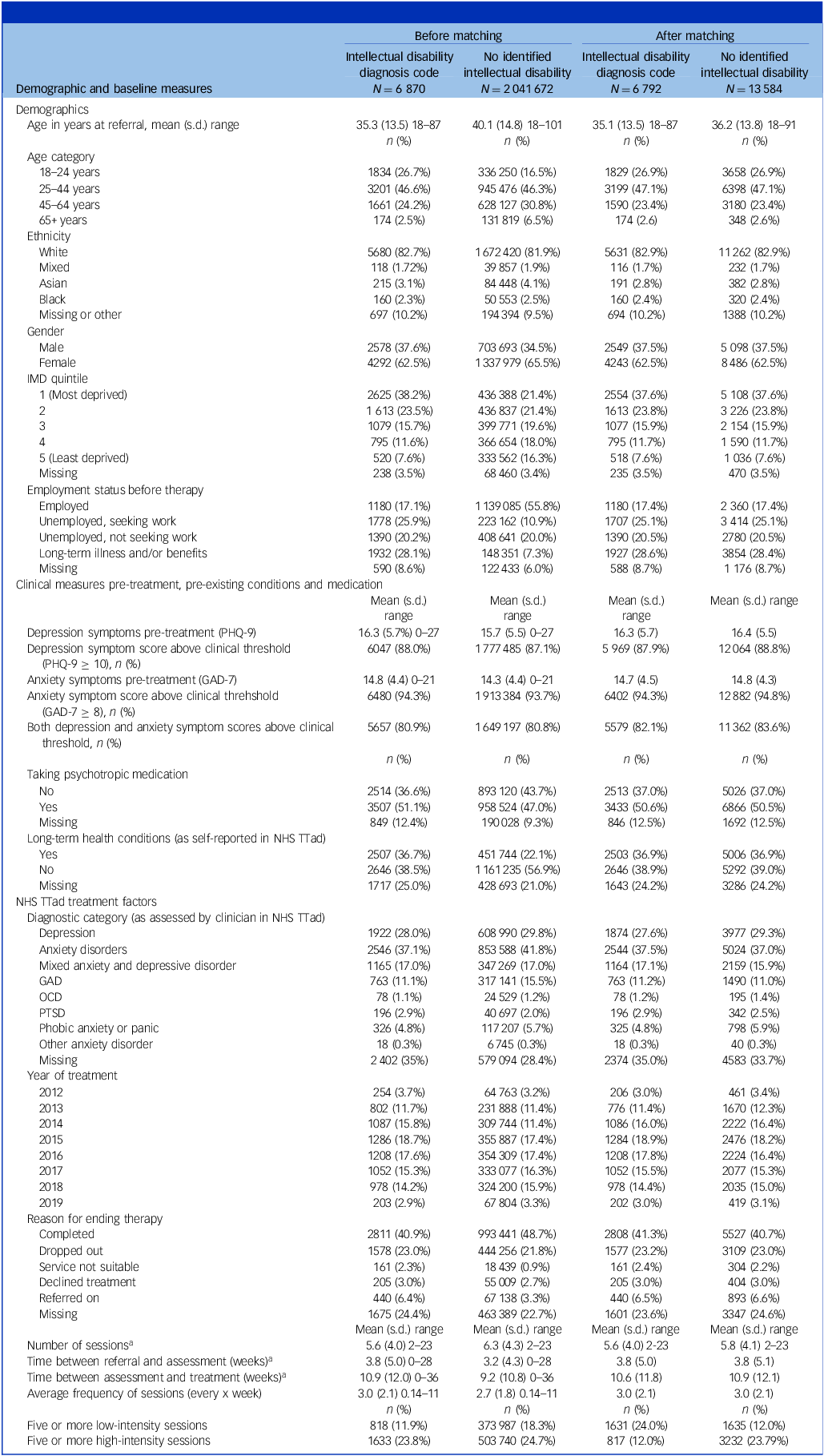
Comprehensive descriptive statistics are presented in Table 1. Compared with people without an intellectual disability, people with intellectual disabilities were more likely to be aged 18–24 years old and to live in more deprived areas and were less likely to be employed. They were more likely to take psychotropic medications and to report long-term health conditions. In terms of therapy factors, they were less likely to have completed a course of therapy and were more likely to have been discharged from NHS TTad services by either being referred on to other services or owing to NHS TTad care being deemed ‘not suitable’ for them. They also had slightly longer waiting times between assessment and treatment and received slightly fewer sessions than people without intellectual disabilities (Table 1).
Demographics and baseline characteristics

Table 1 Long description
The table presents demographic and baseline characteristics of individuals with and without intellectual disabilities before and after matching. It includes data on age, ethnicity, gender, employment status, clinical measures, and therapy factors. The table has 67 rows and 12 columns. Column headers include 'Demographic and baseline measures', 'Before matching', 'Intellectual disability diagnosis code N = 6870', 'No identified intellectual disability N = 2041672', 'After matching', 'Intellectual disability diagnosis code N = 6792', and 'No identified intellectual disability N = 13584'. Row labels include categories such as 'Age in years at referral', 'Age category', 'Ethnicity', 'Gender', 'IMD quintile', 'Employment status before therapy', 'Clinical measures pre-treatment', 'Taking psychotropic medication', 'NHS TTad long-term health conditions as self-reported in NHS TTad', 'NHS TTad treatment factors', 'Year of treatment', and 'Reason for ending therapy'. Each row provides specific data points for each category before and after matching. Notable trends include differences in age distribution, employment status, clinical measures, and therapy outcomes between individuals with and without intellectual disabilities.
IMD, index of multiple deprivation; GAD, Generalised Anxiety Disorder; OCD, obsessive–compulsive disorder; PTSD, post-traumatic stress disorder; PHQ, Patient Health Questionnaire.
a To reduce the influence of extreme values, variables were winsorised at the top 99th percentile.
After propensity score matching, 6792 of 6870 individuals with intellectual disabilities were each matched to two individuals with similar characteristics without an identified intellectual disability. This sample size was adequate for logistic regressions. 38 Demographic, baseline characteristics and treatment factors such as number of sessions were similar in the two groups after matching (Table 1).
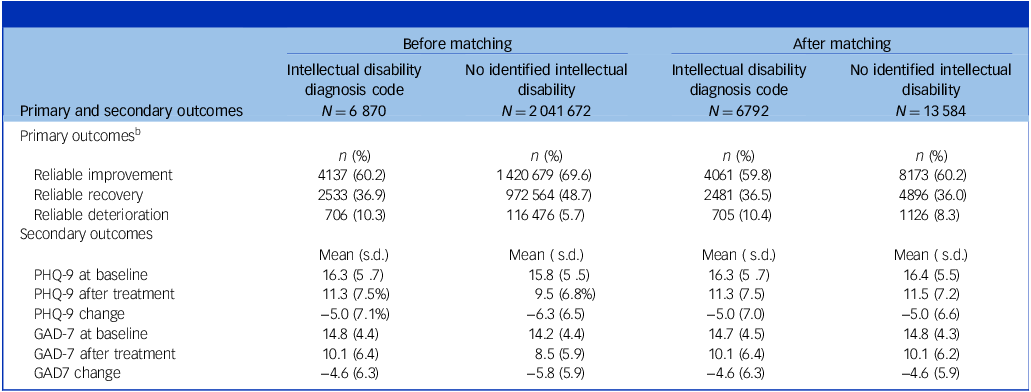
On average, people with intellectual disabilities experienced a reduction in their symptoms of depression and anxiety (Table 2) over the course of therapy. Pre–post effect sizes were moderate for both depression (Cohen’s d av = −0.64, 95% CI −0.67 to −0.60) and anxiety (Cohen’s d av = −0.86, 95% CI −0.89 to −0.82). For context, effect sizes observed in randomised controlled trials evaluating psychological therapy aimed at alleviating mental health symptoms in individuals with mild to moderate intellectual disabilities have varied (see Supplementary Material 6 for a full list). For depression, these effect sizes ranged from d av = −0.08 (95% CI −0.78 to 0.61) after manualised individual CBT Reference Bujang, Sa’at, Sidik and Joo39 to d av = −1.96 (95% CI −2.53 to −1.37) after a cognitive–behavioural group intervention. Reference Hassiotis, Serfaty, Azam, Strydom, Blizard and Romeo40 For anxiety, these effect sizes ranged from d av = −0.24 (95% CI −0.54 to 0.06) after behavioural activation Reference McCabe, McGillivray and Newton41 to d av = −1.10 (95% CI −1.70 to −0.49) following computerised CBT. Reference Jahoda, Hastings, Hatton, Cooper, Dagnan and Zhang42
Clinical measures and outcomesa

PHQ, Patient Health Questionnaire; GAD, Generalised Anxiety Disorder.
a. Both depression and anxiety scores were collected before and after therapy, regardless of whether the primary presenting problem was classified as depression or an anxiety disorder, as interventions targeting depression as a primary presenting problem may also affect anxiety symptoms, and vice versa.
b. n indicates data available.
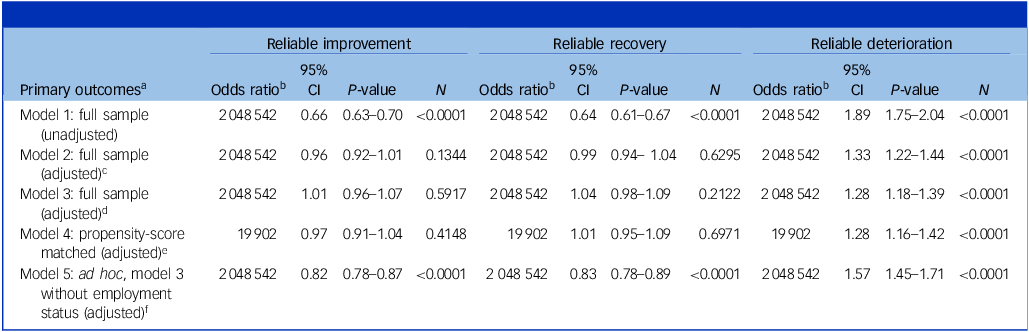
Compared with people without intellectual disabilities, the group of people with intellectual disabilities had therapy outcomes that were similar (for reliable improvement and recovery) or poorer (for reliable deterioration). In the primary model (model 4), people with intellectual disabilities were as likely to meet reliable improvement (adjusted odds ratio 0.97, 95% CI 0.96−1.04) and reliable recovery (adjusted odds ratio 1.01, 95% CI 0.95−1.09) criteria as people without. People with intellectual disability were more likely to meet reliable deterioration (adjusted odds ratio 1.28, 95% CI 1.16−1.42). These differences were attenuated in comparison with the results of the unadjusted model (model 1), which consistently showed poorer outcomes for people with intellectual disabilities (Table 3).
Study outcomes: logistic regression

Table 3 Long description
The table presents data on therapy outcomes for people with intellectual disabilities compared to those without, across five different models. It includes columns for reliable improvement, reliable recovery, and reliable deterioration, each with odds ratios, 95% confidence intervals (CI), P-values, and sample sizes (N). The rows represent different models: Model 1 (full sample, unadjusted), Model 2 (full sample, adjusted), Model 3 (full sample, adjusted), Model 4 (propensity-score matched, adjusted), and Model 5 (model 3 without employment status, adjusted). Each row provides specific values for odds ratios, CIs, P-values, and N for reliable improvement, reliable recovery, and reliable deterioration. Notable trends include the consistent poorer outcomes for people with intellectual disabilities in the unadjusted model (Model 1) and the attenuated differences in the adjusted models.
PHQ, Patient Health Questionnaire; GAD, General Anxiety Disorder.
a. Missing data for categorical covariates were imputed using a ‘missing’ category. There were no missing data for continuous covariates.
b. Example of odds ratio interpretation: an odds ratio of 0.66 in model 1 indicates that the odds of achieving reliable improvement are 34% lower for people with intellectual disabilities than for people without.
c. Adjusted for gender, ethnicity, employment status, self-reported health status, psychotropic medication, diagnosis category, index of multiple deprivation (IMD) quintile, year of first appointment, age at referral, baseline PHQ-9, baseline GAD-7.
d. Adjusted for gender, ethnicity, employment status, long-term condition (LTC) case, psychotropic medication, diagnosis category, IMD quintile, year of first appointment, age at referral, baseline PHQ-9, baseline GAD-7, waiting time from referral to assessment, waiting time from assessment to treatment, year of appointment, number of low-intensity sessions, number of high-intensity sessions, reason for ending treatment, frequency of sessions.
e. The propensity score was estimated using logistic regression with age group, gender, ethnicity, employment status, LTC case, psychotropic medication and IMD quintile as categorical covariates and year of first appointment, baseline PHQ-9, baseline GAD-7, waiting time from referral to assessment and waiting time from assessment to treatment as continuous covariates. Exact matching was used for all categorical covariates.
f. Model 3, without the employment status variable.
To obtain a deeper understanding of how model specification contributed to the attenuation of differences observed between the unadjusted and adjusted models, we performed post hoc analyses. These involved systematically removing each covariate individually from the adjusted model (model 3). The results revealed that the employment variable largely explained the attenuation of the differences between people with and without identified intellectual disabilities (Supplementary Material 7). In the adjusted model excluding the employment variable, outcomes were consistently poorer for people with intellectual disabilities (reliable improvement adjusted odds ratio 0.82, 95% CI 0.78–0.87; reliable recovery adjusted odds ratio 0.83, 95% CI 0.78–0.89; reliable deterioration adjusted odds ratio 1.57, 95% CI 1.45–1.71) (Table 3, model 5). To contextualise these results, adjusted outcomes are presented in Fig. 1 by employment status; these showed that being employed was associated with better therapy outcomes, regardless of intellectual disability status.
Outcomes by employment status and age group. E, employed; Un-S, unemployed and seeking employment; U-NS, unemployed, not seeking employment; LTI, long-term sickness or income support.

We found an interaction between age group and having an intellectual disability: being over the age of 65 years was generally associated with better outcomes for people without an intellectual disability but poorer outcomes for people with intellectual disabilities (Fig. 1). This was particularly notable for reliable deterioration: in the group of people aged 65 years or over, the odds of reliable deterioration were more than three times higher for people with intellectual disabilities than for people without (adjusted odds ratio 3.36, 95% CI 1.31–5.42). By comparison, in the 18- to 24-year-old group, people with intellectual disabilities had only slightly higher odds of experiencing reliable deterioration than those without an intellectual disability (adjusted odds ratio 1.35, 95% CI 1.10–1.61) (see Supplementary Material 8 for all subgroup analyses). All sensitivity analyses yielded similar results (Supplementary Material 9–11).
Discussion
This study evaluated services provided in mainstream (i.e non-specialised intellectual disability) services nationwide using a large cohort of adults with intellectual disability. The findings showed that people with intellectual disabilities may benefit from interventions provided in such services but that their outcomes are poorer than those of people without intellectual disabilities. After propensity score matching, differences were attenuated and outcomes were similar (for reliable improvement and reliable recovery) or poorer (for reliable deterioration) for people with intellectual disabilities. The observed differences before matching seemed to be attributable to sociodemographic factors, particularly employment, and age (over 65 years) could moderate the relationship between intellectual disability and therapy outcomes. Thus, we both present new findings and extend previous knowledge using person-level data with national coverage.
Our finding that adults with intellectual disabilities experienced poorer outcomes in older age was particularly notable, as adults without intellectual disabilities experience better outcomes in older age. 20 Our finding may be explained by the specific transitions that adults with intellectual disabilities experience in older age, such as that from the parental home to community care settings. Reference Cooney, Coyle and Jackman43 This transition into older age may be accompanied by more physical health problems that affect independence and support needs, with a subsequent impact on mental health and therapy outcomes.
We also found that therapy outcomes were more similar between people with and without intellectual disability when employment status was adjusted for in the analyses, and being employed was associated with better therapy outcomes. Research has generally found a positive influence of employment on the health and quality of life of people with intellectual disabilities, although the nature of this relationship is yet to be fully defined. Reference Strnadová44 A potential explanation for this finding could also be that being employed is a marker of a milder intellectual disability, suggesting that therapy may be more effective for people with milder intellectual disabilities; this explanation should be considered in the context of the generalisability of the study findings.
People with intellectual disabilities constituted 0.33% of the total study cohort but have been estimated to represent up to 2.16% of the adult population in England Reference Dean, Shogren, Hagiwara and Wehmeyer45 (i.e. a higher rate than is reported globally), indicating potential underrepresentation of adults with intellectual disabilities in our cohort. Consequently, the findings may not be generalisable to the full population of people with intellectual disabilities. Moreover, in our study, the employment rate of 17% for people with intellectual disabilities exceeded the 9% reported in national statistics, 46 which could suggest overrepresentation of people with milder intellectual disabilities and fewer support needs. Such overrepresentation may also explain the attenuation of odds ratios after the introduction of employment as a covariate in the analyses and suggests that people in our study cohort may benefit from higher levels of social support 47 than the general population of people with intellectual disabilities. Therefore, the findings may not be generalisable to a population of people who have higher support needs or benefit from less social support. Nevertheless, the strengths of this study included our use of a data-set of national coverage. This means that the findings are representative of a population of people with intellectual disabilities who access mainstream psychological therapy services, provided that their intellectual disability status is accurately documented in their healthcare record.
Limitations
This study had several limitations, including the use of an observational design, which did not allow us to infer causality regarding any of the associations identified here. This also meant that despite our efforts to reduce bias by using propensity score matching, some residual confounding may have affected the accuracy of our estimation of the effects observed. Moreover, the underrepresentation of people with intellectual disabilities discussed above indicates the presence of selection bias, which could be attributed to both underidentification of intellectual disabilities in medical records and a general lack of access to services for people with intellectual disabilities. Moreover, despite being symptom measures routinely used in services, the PHQ-9 and the GAD-7 have not, to our knowledge, been validated in populations of people with intellectual disability, and such measures may be difficult to use for some people with intellectual disability. The subgroup analyses were also exploratory, and the results should be confirmed in future research.
Finally, we had no information about the type or extent of adaptations to therapies and service structures that services have implemented to meet the needs of people with intellectual disabilities. Similarly, the sparsity of information available about the severity of intellectual disabilities limited the generalisability of the findings to the whole population of people with intellectual disabilities. As mentioned previously, the higher than expected employment rates may indicate that people with mild intellectual disabilities were overrepresented in our cohort.
Research and clinical implications
In this study, we have presented evidence that receiving a course of psychological therapy in a primary care service may alleviate symptoms of depression and anxiety for people with intellectual disabilities. Reliable deterioration rates were poorer for people with intellectual disabilities, regardless of their sociodemographic characteristics. Some key implications of these findings are that people with intellectual disabilities should be referred to generic primary care talking therapy services, but that deterioration of their symptoms should perhaps be specifically monitored so that more support may be offered to those individuals whose symptoms deteriorate. Understanding the drivers of deterioration of symptoms during a course of therapy may be an important area for future research and could provide insights into how to tailor treatment adaptations
Future research could also focus on understanding representation and accessibility of services for people with intellectual disabilities, and studies could consider both individual and systemic factors that may influence the relationships among employment participation, social inclusion and mental health in this population. In addition, future work could investigate how transitioning into older age affects mental health outcomes and how therapies could be tailored to consider the specific challenges that this transition may bring for people with intellectual disabilities.
Regarding clinical implications, the underrepresentation of people with intellectual disabilities in this study’s cohort implies that similar inequities may exist in terms of accessing mental healthcare. Such inequities should be addressed by making services more accessible for this population and by tailoring therapy to their needs. Generalising the use of adaptation frameworks7 could provide a route to improving psychological therapy outcomes for this population.
Supplementary material
The supplementary material is available online at https://doi.org/10.1192/bjp.2025.127
Data availability
All data used for this study are available upon successful application to NHS Digital via the Data Access Request Service: https://digital.nhs.uk/services/data-access-request-service-dars. Data fields can be accessed via NHS Digital data dictionary: https://www.datadictionary.nhs.uk/.
Acknowledgements
We thank our colleagues at the ADAPT Lab for their support (https://www.adptlab.net/).
Author contributions
All authors were involved in the conceptualisation and design of the study. C.E.B., A.J., J.S., R.S., J.E.J.B. and D.D. contributed to the methodology and formal analysis. C.E.B., A.J. and J.S. assessed and verified the underlying data reported in the manuscript. C.E.B. drafted the first version of the manuscript. All authors contributed to the review and writing of subsequent versions of the manuscript and approved the final version. All authors had full access to all data in the study and accept responsibility for the decision to submit for publication.
Funding
Data acquisition for this work was supported by the Alzheimer’s Society (AS-PG-18-013). J.E.J.B. is supported by the Wellcome Trust (201292/Z/16/Z), M.R. is supported by Medical Research Council grants MC_UU_00019/1 and 3, and J.S. and S.P. are supported by the UCLH NIHR Biomedical Research Centre. The funders of the study had no role in study design, data analysis, data interpretation, writing of the report or the decision to submit this article for publication.
Declaration of interest
J.S. and A.J. are supported by the Alzheimer’s Society (AS-PG-18-013). J.E.J.B. and R.S are supported by the Royal College of Psychiatrists. R.S. has held an unrelated honorary position with NHS England, and their time was compensated through financial support to the employing institution. R.S. is on the editorial board of the British Journal of Psychiatry. J.S. has been a consultant to NHS Wales Shared Services Partnership and is involved in unrelated research projects funded by the National Institute for Health and Care Research (NIHR) Public Health Research, Dunhill Medical Trust and the Economic and Social Research Council/NIHR. W.M. is involved in unrelated research projects funded by the NIHR, MRC, Dunhill Medical Trust, Economic Research Council, Autistica and Jessica Kingsley Publishing. D.D. is involved in unrelated research projects funded by the NIHR.


 Open access


eLetters
No eLetters have been published for this article.