




INTRODUCTION
The ancient city of Teotihuacan, located in the central highlands of Mexico (Figure 1), was a political and economic powerhouse that dominated the region during the first half-millennium AD (Millon Reference Millon, Yoffee and Cowgill1988; Cowgill Reference Cowgill2015). By AD 200, an estimated 85,000 to 125,000 people lived in the city, making it the largest urban center in the Americas at the time (Cowgill Reference Cowgill2015; Smith et al. Reference Smith, Chatterjee, Huster and Stewart2019). At its height, the city was divided into neighborhood that consisted of multi-family domestic units referred to as apartment compounds (Millon Reference Millon1973; Manzanilla Reference Manzanilla1996; Carballo Reference Carballo2011). Teotihuacan persisted as a densely populated city and the capital of a regional state until the AD 500s, when its political institutions broke down and the population decreased by at least half (Cowgill Reference Cowgill2013:133).
Teotihuacan within the Basin of Mexico. Outset: The map of the Teotihuacan city with the district of La Ventilla highlighted. Adapted from Millon (Reference Millon1973).

Researchers have studied and refined the relative ceramic chronology at Teotihuacan for more than half a century, making it one of the most precise in Mesoamerica (Sanders Reference Sanders1986; Millon Reference Millon, Yoffee and Cowgill1988; Rattray Reference Rattray2001; Cowgill Reference Cowgill2015). Recently, archaeomagnetic and radiocarbon dating techniques have been employed to build high-resolution absolute chronologies of the ancient city (Hueda-Tanabe et al. Reference Hueda-Tanabe, Soler-Arechalde, Urrutia-Fucugauchi, Barba, Manzanilla, Rebolledo-Vieyra and Goguitchaichvili2004; Soler-Arechalde et al. Reference Soler-Arechalde, Sánchez, Rodriguez, Caballero-Miranda, Goguitchaishvili, Urrutia-Fucugauchi, Manzanilla and Tarling2006; Beramendi-Orosco et al. Reference Beramendi-Orosco, Gonzalez-Hernandez, Urrutia-Fucugauchi, Manzanilla, Soler Arechalde, Goguitchaishvili and Jarboe2009, Reference Beramendi-Orosco, Gonzalez-Hernandez, Soler-Arechalde and Manzanilla2020; Gómez Chavez et al. Reference Gómez-Chávez, Solís, Gazzola, Chávez-Lomelí, Mondragón, Rodríguez-Ceja and Martínez-Carrillo2017; Solís et al. Reference Solís, Rodríguez-Ceja, Chávez-Lomelí, Alcántara, Gazzola, Balcells, Jimenez, de la Rosa and Martínez-Carrillo2021; Goguitchaichvili et al. Reference Goguitchaichvili, Ortega, Torres, Archer, Cejudo, Kravchinsky, Romero and Morales2022). However, many of these studies have relied on the dating of wood-charcoal and lime plaster samples, which is a less accurate method than directly radiocarbon dating skeletal remains (Schiffer Reference Schiffer1986). A great deal of research involving absolute dating is still needed to build a high-resolution chronology for Teotihuacan (Nichols Reference Nichols2015:4–6).
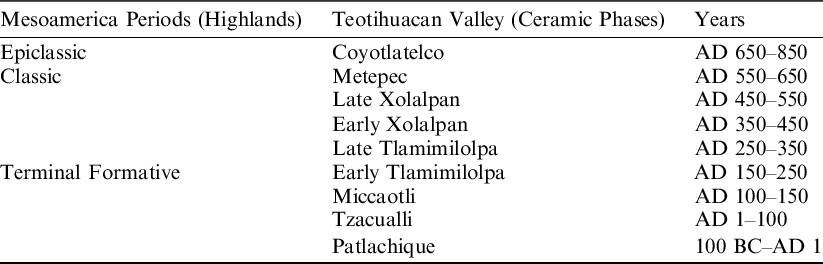
In this study, we apply high-precision accelerated mass spectrometry (AMS) radiocarbon (14C) dating to human remains recovered from La Ventilla, Teotihuacan (N =78), a centrally located neighborhood within the city (Gómez Chávez and Núñez Hernández Reference Gómez Chávez and Núñez Hernández1999; Gómez Reference Gómez Chávez2000; Figure 1). We have two objectives. The first is to develop a ceramic-phase chronology for the La Ventilla apartment complex using a Bayesian statistical model informed by 14C dates and the analysis of temporally-diagnostic ceramics from mortuary contexts. The second is to explore the abandonment of La Ventilla during the Metepec phase (Classic period) and its reoccupation by groups using distinct ceramics associated with the Coyotlatelco phase (Epiclassic period) (Table 1). From these results, we discuss the potential implications for the city’s ceramic chronology more broadly.
Established periods and ceramic phases for the region of study. From Cowgill (Reference Cowgill2015) and Nichols (Reference Nichols2015).
The deterioration of the Teotihuacan state at the end of the Classic period is linked with significant demographic change, but there are unresolved questions about the social dimensions of this upheaval and its impact on city residents. One of the most persistent questions is whether the city was continuously inhabited during the Classic to Epiclassic transition or mostly abandoned after political collapse, to be reoccupied later by groups that introduced new practices and material culture (e.g., Manzanilla Reference Manzanilla2003; Sanders Reference Sanders2003). Resolving this question requires research at the scale of specific neighborhoods, as it is highly likely that these processes did not occur in a uniform way throughout the city. In the specific context of La Ventilla, there is evidence that structures were abandoned for a number of years in association with the state’s decline, but estimating the timing of the resettlement of this area by new residents has been challenging.
TEOTIHUACAN CHRONOLOGY
Extensive archeological surveys (Millon Reference Millon1973; Sanders et al. Reference Sanders, Parsons and Santley1979) indicate that Teotihuacan was first settled during the Patlachique phase (100 BC–AD 1), in the Terminal Formative period (Table 1), as people arrived from surrounding areas into the Teotihuacan Valley. Within a century, Teotihuacan grew from a sparsely settled area to a burgeoning population of 20,000 (Cowgill Reference Cowgill2015:53). The Tzacualli, Miccoatli, and Early Tlamimilolpa phases followed the initial settlement of the city, respectively, and represent a time of major civic-ceremonial development with the construction and expansion of large, monumental structures in the central city.
In the Late Tlamimilolpa phase, the city’s civic-ceremonial center reached its peak development, and the urban population was at its height (Cowgill Reference Cowgill2015:141). Domestic life at this time was situated within the multi-family apartment compounds (Millon Reference Millon1973; Manzanilla Reference Manzanilla1996). The Early and Late Xolalpan phases were regarded by Millon (Reference Millon1973) as a time of “urban renewal,” when expansive construction projects were realized across the city. Subsequently, in the AD 500s, city population began to decline, corresponding with increasing socioeconomic inequality among city residents (Gómez Chávez and Gazzola Reference Gómez-Chávez and Gazzola2004; Robertson Reference Robertson2005; Cowgill Reference Cowgill2015:235), possibly exacerbated by issues related to climate instability (Kennett and Marwan Reference Kennett and Marwan2015; but see McClung de Tapia Reference McClung de Tapia2009, Reference McClung de Tapia2012).
Around AD 550 ± 25, as estimated from a sample of archaeomagnetic dates, an event known as the “Great Fire” took place that appears to correspond with the end of the Late Xolalpan phase (Beramendi-Orosco et al. Reference Beramendi-Orosco, Gonzalez-Hernandez, Urrutia-Fucugauchi, Manzanilla, Soler Arechalde, Goguitchaishvili and Jarboe2009). At this time, dozens of sculptures were smashed and structures in the civic-ceremonial core of the city were burned. These destructive acts mark what scholars believe was the political collapse of Teotihuacan, although the AD 550 date differs from previous estimates that place these events in the AD 600s (Cowgill Reference Cowgill2015:233). During the final century of Teotihuacan’s dominance, the population decreased dramatically (Cowgill Reference Cowgill2013:233). However, demographic decline did not result in the full or permanent abandonment of the city, and it is estimated that 40,000 people lived at Teotihuacan after the collapse of its governing institutions (Sanders et al. Reference Sanders, Parsons and Santley1979:130).
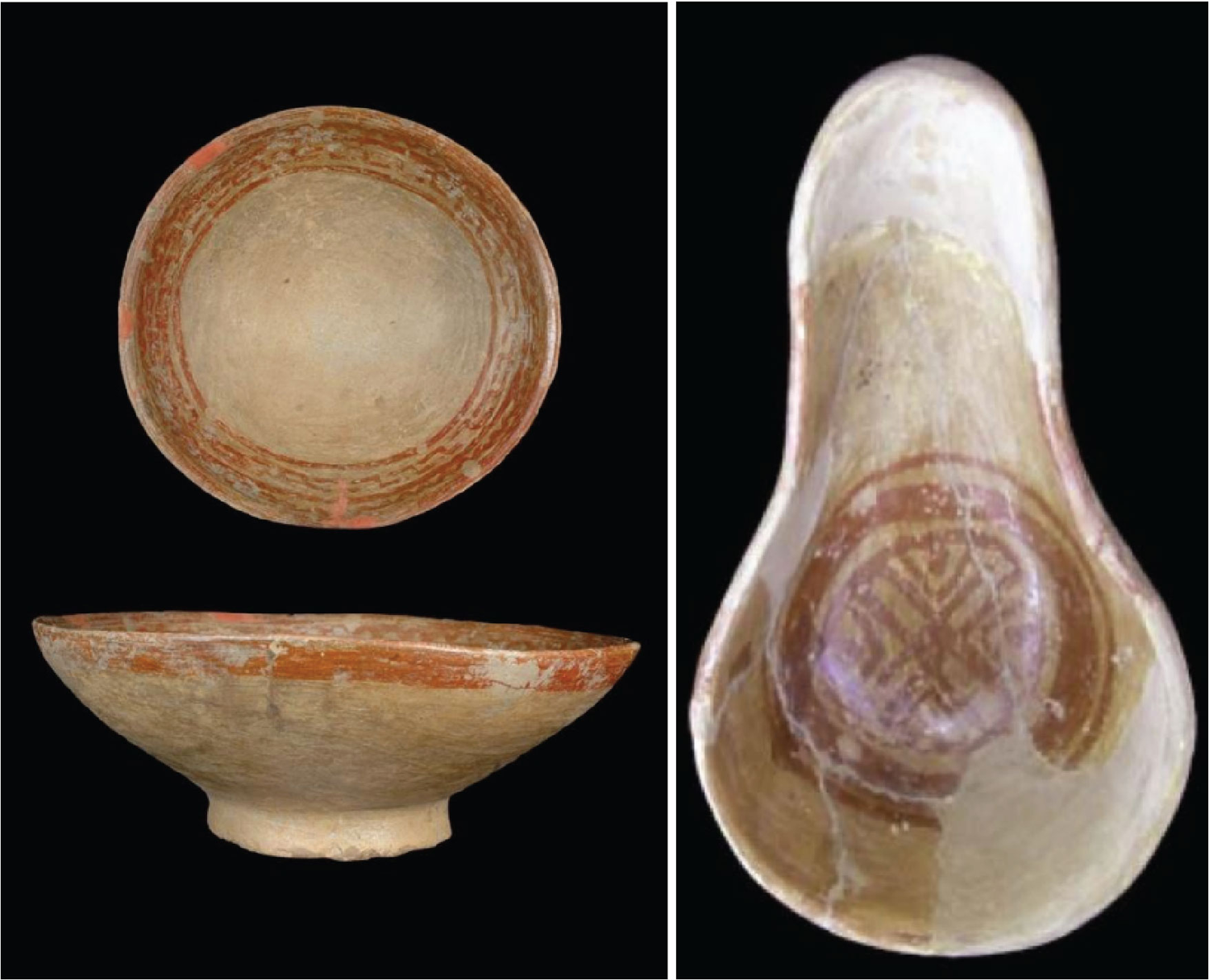
The political dissolution of Teotihuacan ushered in the Epiclassic period, and with it, significant changes in settlement patterns and material culture across the basin (Crider et al. Reference Crider, Neff and Glascock2007; Cowgill Reference Cowgill2013; Hernández and Healan Reference Hernández and Healan2019; Clayton Reference Clayton2020). One of the more apparent changes is the introduction of Coyotlatelco pottery, a distinctive serving ware with red designs painted on a natural buff or brown background (Rattray Reference Rattray1966; Cobean Reference Cobean1990; Gaxiola González Reference Gaxiola Gonzalez2006; Hernández and Healan Reference Hernández and Healan2019; Figure 2). The origin of this ceramic style has interested scholars for many years (Sugiura Reference Sugiura2006; Healan Reference Healan2012; Beekman Reference Beekman2019; Hernández and Healan Reference Hernández and Healan2019). Some archaeologists hypothesize that Coyotlatelco ceramics are of local origin, derived from earlier traditions in the Basin of Mexico (Bennyhoff Reference Bennyhoff1966; Dumond and Muller Reference Dumond and Muller1972; Sanders Reference Sanders1986:190). Others suggest that Coyotlatelco pottery was introduced into central Mexico by migrants, likely from the western portion of the Bajío region (Rattray Reference Rattray1966; Braniff Cornejo Reference Braniff Cornejo1972; Mastache and Cobean Reference Mastache and Cobean1989:65). Others see it as a hybridization of non-local and central Mexican ceramic traditions (Beekman and Christensen Reference Beekman and Christiansen2003; Manzanilla Reference Manzanilla2005:269; Lopez Pérez et al. Reference López Perez, Careta, Manzanilla Naim and Solar Valverde2006; Sugiura Reference Sugiura2006; Hernández and Healan Reference Hernández and Healan2019).
Coyotlatelco-style decorated pottery that accompanied Burial 26 (left) and one of the Coyotlatelco cucharones (serving spoons) associated with Burial 173B. Photos by Sergio Gómez Chávez (left) and Miguel Morales (right).
One of the biggest chronological challenges at Teotihuacan is to identify a more precise timing for the appearance of Coyotlatelco ceramics and how this relates temporally with the depopulation of the city and the dissolution of Teotihuacan’s governing institutions. Some scholars suggest that Coyotlatelco was in use at Teotihuacan well before the city’s demographic decline (Beekman and Christiansen Reference Beekman and Christiansen2003:144–145). Others argue that Coyotlatelco pottery was introduced by migrant groups who reoccupied the city after it was abandoned (Rattray Reference Rattray1966). In this study, we do not examine the origins of Coyotlatelco ceramics; rather, we investigate the earliest use of these materials in burial contexts within one residential neighborhood and consider the broader implications of their appearance for the timing of Teotihuacan’s decline.
La Ventilla
Located in the center of the city is the neighborhood of La Ventilla (Gómez Chávez Reference Gómez Chávez2000; Cabrera Castro Reference Cabrera Castro2017:108; see Figure 1). Samples for this study come from the La Ventilla 1992–1994 Project, from which over 350 burials across four areas of investigation (operations), or “frentes,” were excavated (Gómez Chávez and Núñez Hernández Reference Gómez Chávez and Núñez Hernández1999; Cabrera Castro Reference Cabrera Castro2000; Serrano Sánchez Reference Serrano Sánchez2003). In this study, the primary author analyzed human remains from three of these areas, La Ventilla 1, 2, and 3, which are referred to here as LV1, LV2, and LV3 (Figure 3).
The La Ventilla 1992–1994 site map. All features illustrated here represent the ancient structure of the La Ventilla neighborhood. Stars indicate dated burials in this study associated with Coyotlatelco ceramic offerings. Adapted from Gómez Chávez and Núñez (Reference Gómez Chávez and Núñez Hernández1999).

LV1 is thought to have operated as a “neighborhood temple” due to the discovery of a group of religious structures (Cabrera Castro Reference Cabrera Castro2003:1920). Here, community-scale ritual functions were paramount. Our sample from LV1 comprises three adult individuals, each of which were associated with Coyotlatelco-style ceramics. LV2 has been interpreted as a center for administrative and institutional purposes that likely accommodated high-ranking officials and priests (Cabrera Castro Reference Cabrero Castro1995; Gómez Chávez Reference Gómez Chávez2000). This compound is often referred to as the “Compound of the Glyphs” as it includes spaces decorated with red-painted glyphs arranged in a grid-like pattern (Cabrera Castro Reference Cabrera Castro2017). Eighteen individuals in this study were from burial contexts in LV2. The largest sample, 57 individuals, is from LV3, a residential area referred to as the “Artisans’ Compound” (Cabrera Castro Reference Cabrera Castro2017:109). Here, lapidary specialists worked with a variety of materials, including obsidian and shells (Gómez Chávez Reference Gómez Chávez2000; Gazzola Reference Gazzola2007). Samples from both LV2 and LV3 are associated with mortuary offerings spanning the Tlamimilolpa through the Coyotlatelco phases.
Coyotlatelco ceramics were recovered from all three of the areas included in this study (LV1, LV2, and LV3). Gómez Chávez and Cabrera Castro (Reference Gómez Chávez and Cabrera Castro2008:219), the principal investigators of the La Ventilla project, found stratigraphic evidence that the Coyotlatelco-phase materials represent a reoccupation of the area after its abandonment. They observed the presence of small, insubstantial structures associated with Coyotlatelco ceramics built atop earlier, deteriorated buildings, suggesting that these new residents had insufficient materials to undertake major construction work and reused spaces where structures had collapsed (see also Millon 1988). Additionally, Coyotlatelco ceramics were not associated with domestic and mortuary contexts containing Teotihuacan-style pottery. Similar findings are also reflected in the Pyramid of the Sun complex, where the construction of several structures used as temazcales were built after the Teotihuacan-era floors were covered by the collapse of the great pyramid (Gómez Chávez and Cabrera Castro Reference Gómez Chávez and Cabrera Castro2008).
MATERIALS AND METHODS
Sample Collection and Preparation
All samples in this study were originally recovered during the La Ventilla 1992−1994 excavations. Only adult individuals (>15 years of age) were sampled in this study to obtain adequate bone collagen yields for 14C measurements. Bone collagen samples from 78 individuals from LV1 (N = 3), LV2 (N = 18) and LV3 (N = 57) were processed for AMS 14C dating at the Human Paleoecology and Isotope Geochemistry Laboratory at The Pennsylvania State University. The surfaces of all bone samples were first manually cleaned with an X-ACTO® blade. Approximately 1000 mg of bone were demineralized for 48−72 hr in 0.5 N HCl at 5°C, then neutralized through multiple rinses of Nanopure (>18.2 MΩ) water. Following the revised Longin method (Brown et al. Reference Brown, Nelson, Vogel and Southon1988), the remaining collagen was gelatinized in ∼2 mL 0.01 N HCl at 60°C for 10 hr and lyophilized for 24–48 hr. Samples were weighed, and based on the total yield, were purified through the ultrafiltration process (Brown et al. Reference Brown, Nelson, Vogel and Southon1988, >3% yield) or through XAD-2 resin (styrene-divinylbenzene) chromatography (Stafford et al. Reference Stafford, Klaus and Duhamel1988, Reference Stafford, Edgar Hare, Currie, Jull and Donahue1991; Loshe et al. Reference Lohse, Madsen, Culleton and Kennett2014, < 3% yield). Bone collagen sample quality was evaluated by % crude gelatin yield, carbon (%C) and nitrogen (%N) yields from the combusted collagen, and the carbon-to-nitrogen (C:N) atomic percent ratios (DeNiro Reference DeNiro1985; van Klinken Reference van Klinken1999). All samples have C:N ratios ranging between 3.2 and 3.4, indicating good preservation (see Table S1).
Bone collagen samples were entered onto a vacuum line for cryogenic purification and sealed in quartz tubes with CuO powder and Ag wire. Samples were combusted for 3 hr at 900°C to remove sulfides and produce sample CO2. CO2 samples generated from bone collagen were then converted to graphite by hydrogen reduction onto an Fe catalyst at 550°C for 3 hr (Vogel et al. Reference Vogel, Southon, Nelson and Brown1984) and reaction water was drawn off with Mg(ClO4)2 (Santos et al. Reference Santos, Southon, Druffel-Rodriguez, Griffin and Mazon2004). Graphite was pressed into A1 targets with standards and backgrounds and measured for AMS analysis in the Penn State Radiocarbon Laboratory. Radiocarbon dates for bone collagen were corrected for mass fractionation with measured δ13C following Stuiver and Polach (Reference Stuiver and Polach1977). Dates were calibrated with OxCal v.4.4.4 (Bronk Ramsey Reference Bronk Ramsey2020) using the IntCal20 Northern Hemisphere curve (Reimer et al. Reference Reimer, Austin, Bard, Bayliss, Blackwell and Bronk Ramsey2020) and are presented in supplemental Table S1 and Figure S1.
Trapezoidal Modeling
This study implements a trapezoidal framework to produce a Bayesian model for ceramic-phase refinement using OxCal v.4.4.4 software (Bronk Ramsey Reference Bronk Ramsey2020; see Data File S1). The standard Bayesian model in radiocarbon dating uses boundaries and phases to assign relationships to grouped events, and it runs on the assumption that the phases placed between boundaries will have a uniform distribution of materials (Buck et al. Reference Buck, Litton and Smith1992). Phases lie within boundaries and contain unordered groups of dates that represent a common stratigraphic marker such as a floor or sterile sediment layer. This standard model is an excellent tool for depositional modeling of samples that have a clear beginning and end phase, such as those dated between construction events within a housing unit.
In this study we rely on the distribution of temporally diagnostic ceramics associated with each burial as well as stratigraphic information from the original excavations. Although a standard uniform prior model is appropriate here, a trapezoidal model will theoretically better simulate the transitional changes generally seen with typological seriations (Lee and Bronk Ramsey Reference Lee and Bronk Ramsey2012). Ceramic assemblages do not tend to start and end abruptly during the occupational history of a site but rather transition in and out of use over a gradual period of time; that is, the use of different ceramic assemblages by a population may overlap, resulting in periods of contemporaneous use. The trapezoidal model provides flexibility for overlapping assemblages by inserting three boundaries (Start, Transition, End) at the beginning and end of each phase group. In this model, the trapezoidal phase prior is used in a contiguous framework. In other words, phases separated by boundaries within a sequence are considered to be sequential (for a comprehensive example, see Lee and Bronk Ramsey Reference Lee, Bronk Ramsey and Mazar2013).
For LV3, many of the burials were assigned to a temporal range including two ceramic phases (e.g., Late Xolalpan and Metepec). This is because some wares and forms exhibit stylistic continuities across more than one phase, making it appropriate to assign these objects and the contexts that they represent to a phase-range. For this reason, we created a model with multiple sequences, each representing a major ceramic phase (e.g., Late Xolalpan, Metepec, etc.). Individuals with a two-ceramic phase designation were placed in both sequences to measure all possible outcomes for the start and end date estimations for each ceramic phase. This approach resulted in less constriction between phases. Some of these individuals were designated as outliers in one of the two sequences, which explains the discrepancy in the number of repeated samples between sequences in the model.
Table 2 describes the complete trapezoidal model rendered for this study (see also Figure S1). Unmodeled 14C dates for all samples analyzed are reported in Table S1, including those that could not be incorporated into the model due to a lack of association with temporally diagnostic ceramics or because of poor agreement with the model (i.e., outliers). Here, we have chosen to omit outliers. This decision was made because some of the burials dated in this study, particularly those from LV2, are from secondary contexts; that is, the interments had been either intentionally or unintentionally disturbed or reburied. These disturbances are evident for a few individuals who date to a phase that is extremely unlikely to coincide with the associated ceramic material recovered at the time of excavation.
Summary of the results of the trapezoidal model of 14C dates from human remains.
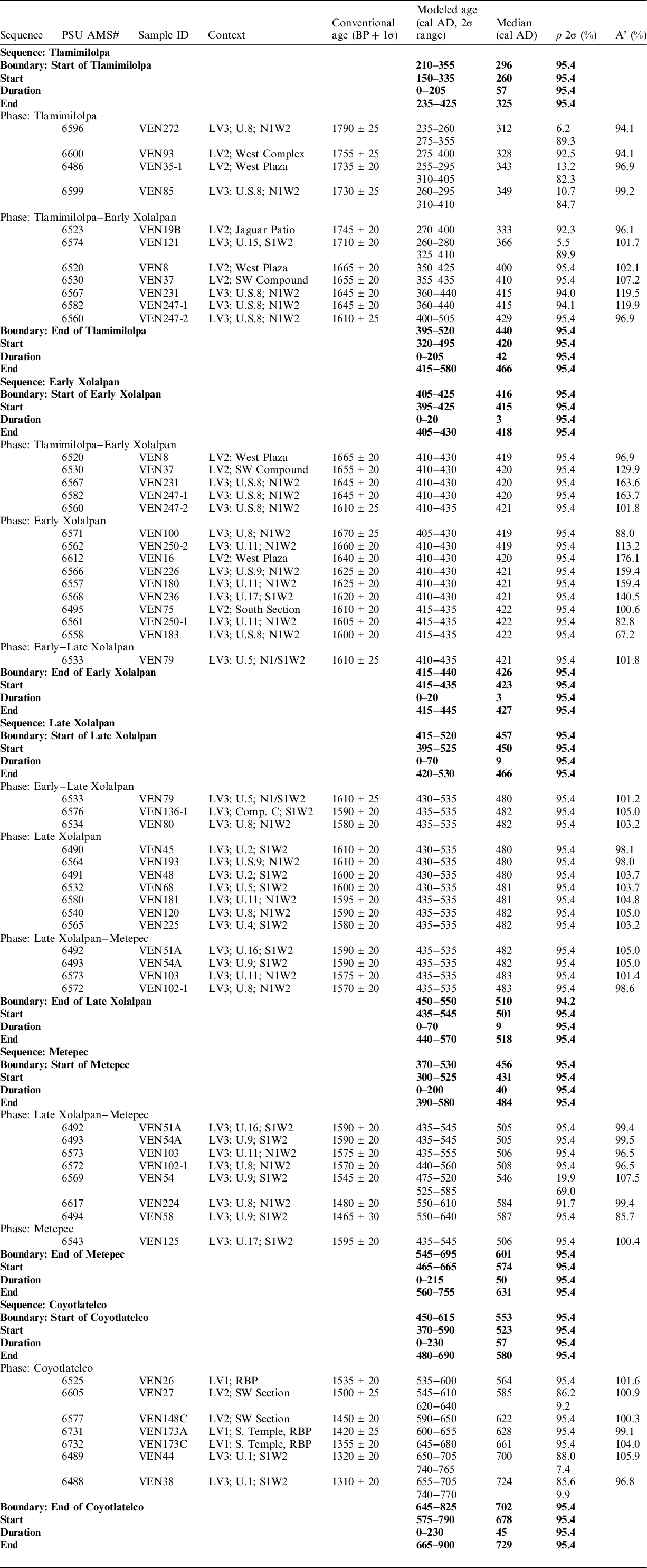
Note: RBP = Red Borders Plaza.
A previous 14C study at Teotihuacan that also used ceramic phases to build a Bayesian model (Beramendi-Orosco et al. Reference Beramendi-Orosco, Gonzalez-Hernandez, Urrutia-Fucugauchi, Manzanilla, Soler Arechalde, Goguitchaishvili and Jarboe2009), found that the removal of outliers resulted in more distinct intervals between phases and was more consistent with the intervals obtained from prior archaeomagnetic dates (Soler-Arechalde et al. Reference Soler-Arechalde, Sánchez, Rodriguez, Caballero-Miranda, Goguitchaishvili, Urrutia-Fucugauchi, Manzanilla and Tarling2006). For transparency, the La Ventilla model that includes outliers is compared to the model with outliers removed in the supplemental materials (Figure S5).
Finally, due to the large number of secondary burials within this population, we have combined all measured 14C dates across the three compounds to reconstruct the occupational history of the La Ventilla neighborhood as a whole. The ceramic phases for each burial analyzed in this study were assigned by Serrano Sánchez (Reference Serrano Sánchez2003) for LV1 and LV2 and by Gómez Chávez (Reference Gómez Chávez2000) and Clayton (Reference Clayton2009) for LV3.
RESULTS
Table 2 presents the two-sigma (2σ) calibrated 14C dates and modeled results. The burials from La Ventilla yielded individual modeled 14C dates from cal AD 235–770, which correlates to the Tlamimilolpa through the Coyotlatelco phases (Table 1), as estimated in recent ceramic chronologies (Cowgill Reference Cowgill2015; Nichols Reference Nichols2015). Unmodeled dates are nearly identical, ranging from cal AD 215–775 (Table S1). These data provide confidence that the model reflects the overall sample, even though not every individual could be included in the model.
The modeled start and end estimations for each ceramic phase are displayed in Figure 4. These estimations refer to the earliest possible start date of a given ceramic phase and the latest possible end date as projected by the model. The earliest temporally-diagnostic ceramics associated with the La Ventilla burials are from the Tlamimilolpa phase. Here, we combine the Early and Late Tlamimilolpa phases because the total sample size for these collective phases is only four. The earliest start of the transition into the Tlamimilolpa phase ranges from cal AD 150–335 (2σ), with a possible duration of 0–205 years. This modeled 14C date estimate fits well with the generally accepted dates projected for the Early Tlamimilolpa (AD 150–250) and the Late Tlamimilolpa (AD 250–350) phases (Nichols Reference Nichols2015). However, the latest end date ranges from cal AD 415–580 (2σ), which is much later than expected and is discussed further below.
Ceramic phases with trapezoidal probability distributions from AMS 14C dates. The bottom table presents the current ceramic chronology based on Cowgill (Reference Cowgill2015) and Nichols (Reference Nichols2015). Dashed, black lines represent the 2σ range of the individual calibrated dates.

The modeled dates for the Early Xolalpan phase are succinct. The model simulates the earliest start of this phase to a date of cal AD 395–425 (2σ) and the latest end date to cal AD 415–445 (2σ), both with a duration of up to only 20 years. Recently published ceramic chronologies (Cowgill Reference Cowgill2015; Nichols Reference Nichols2015) place the Early Xolalpan phase between AD 350–450. The modeled 14C dates, therefore, suggest a start to this ceramic phase up to 50 years later at La Ventilla than currently estimated, but ending at the same time, around AD 450.
For the Late Xolalpan phase, the model projects the earliest start at cal AD 395–525 (2σ) and the latest end at cal AD 440–570 (2σ), both with a duration of 70 years. These transitions suggest a start date at La Ventilla that is up to 50 years earlier and an end of up to 20 years later than estimated in recent chronologies, which place this phase at approximately AD 450–550 (e.g., Cowgill Reference Cowgill2015). However, modeled 14C dates for individual samples associated with the Late Xolalpan phase are similar to published chronologies, ranging between cal AD 430–535.
The earliest start of the Metepec phase is modeled at cal AD 300–525 (2σ) and the latest end at cal AD 560–755 (2σ). Combined, the individual samples in this sequence range in date from cal AD 435 to 640, suggesting a potentially earlier beginning for the Metepec phase than has previously been estimated (e.g., AD 550–650 in Cowgill Reference Cowgill2015 and in Nichols Reference Nichols2015).
The final phase, Coyotlatelco, is simulated in the model to an earliest start date of cal AD 370–590 (2σ) with a duration up to 230 years, and a latest end date of cal AD 665–900 (2σ) with a duration up to 230 years. These projected transitional timespans are broad and not very informative for estimating the timing of Coyotlatelco ceramic use at La Ventilla. However, the earliest modeled individual, Burial 26, dates to cal AD 535–600 (2σ), suggesting that Coyotlatelco pottery was introduced in this neighborhood in the sixth century AD (Table 2). Figure 5 lists all individuals in this study originally identified with Coyotlatelco ceramic offerings or from Epiclassic domestic contexts and their unmodeled 14C dates. Of these 11 samples, four were from secondary burial contexts, and, therefore, not included in the simulated model. Seven individuals came from primary contexts, and each had high agreement indices within the model (> 96%). Similar to the modeled dates, the earliest sample associated with Coyotlatelco ceramics, Burial 26, has an unmodeled 14C date of cal AD 530–600 (2σ, 78.7%). The latest sample, Burial 38, has an unmodeled 14C date of cal AD 660–710 (2σ, 48.0%) and cal AD 735–775 (2σ, 47.5%).
Unmodeled AMS 14C dates for all individuals in this study associated with Coyotlatelco ceramics. Calibrated dates highlighted in the gray box were included in the model.

DISCUSSION
Classic Period Chronology at Teotihuacan
Refinements to the Teotihuacan chronology within La Ventilla, as suggested by this study, are shown in Figure 6, and point to temporal overlap between the Late Xolalpan, Metepec, and Coyotlatelco phases. Recent chronological estimates place the Tlamimilolpa phase from approximately AD 150 to 350 (e.g., Nichols Reference Nichols2015). In this Bayesian model, the possible start and end transitions stretch this ceramic phase to cal AD 150–580 (Table 2). It is possible that the material culture associated with this phase was in use for the extent of the Classic period at Teotihuacan, at least within the La Ventilla neighborhood. It is also possible that Tlamimilolpa ceramics were manufactured from the AD 100s to 300s, in alignment with previous chronologies, but were sometimes buried with individuals during later phases as heirlooms (see Joyce Reference Joyce2000).
Ceramic chronology of the Mexican Highlands and Teotihuacan based on Cowgill (Reference Cowgill2015) and Nichols (Reference Nichols2015) compared to refinements for the La Ventilla neighborhood as suggested by this study. Dashed lines within the table represent “soft” endings for the ceramic phases to convey that overlap between ceramic phases was likely. Possible abandonment periods for the LV2 and LV3 compounds are based on the 2-sigma calibrated 14C date ranges.

Although the scenarios described above are certainly plausible, the most likely explanation for this result relates to sample size. In this study, only four individuals were associated exclusively with Tlamimilolpa ceramics. The Tlamimilolpa sequence within the model is dominated by samples from burials that contained ceramics assigned to an overlapping Late Tlamimilolpa–Early Xolalpan phase range, which may skew the modeled dates for Tlamimilolpa to a later century than is likely. The Bayesian model implemented by Beramendi-Orosco et al. (Reference Beramendi-Orosco, Gonzalez-Hernandez, Urrutia-Fucugauchi, Manzanilla, Soler Arechalde, Goguitchaishvili and Jarboe2009:105) for the Teopancazco neighborhood of Teotihuacan indicates that the Tlamimilolpa phase started between cal AD 50–240 and ended between cal AD 235–340, based on more than twice the number of samples associated with the Tlamimilolpa phase than were analyzed here. However, the same model places the transition from the Tlamimilolpa to the Early Xolalpan phase as occurring between cal AD 290 and 410. Furthermore, the more recent Bayesian model put forth by Beramendi-Orosco et al. (Reference Beramendi-Orosco, Gonzalez-Hernandez, Soler-Arechalde and Manzanilla2020:Table 2) for the Xalla palatial compound at Teotihuacan places the start of the Xolalpan phase between cal AD 280 and 410. In our model for La Ventilla, the four individuals associated with the Tlamimilolpa phase have combined modeled 14C dates ranging from cal AD 275 to 410, which is nearly identical to the Teopancazco and Xalla models.
It must be noted that there are several challenges present in comparing prior Teotihuacan Bayesian models to the model for La Ventilla. One issue is that about half of the Teopancazco and Xalla dates were measured by liquid scintillation counting (LSC), which is a less precise method of dating than AMS. Therefore, these previous studies have dates with standard errors ranging from ± 20 to ± 110, whereas the La Ventilla dates have standard errors ranging from ± 20 to ± 30. Additionally, the accuracy of 14C dates from Beramendi-Orosco et al. (Reference Beramendi-Orosco, Gonzalez-Hernandez, Urrutia-Fucugauchi, Manzanilla, Soler Arechalde, Goguitchaishvili and Jarboe2009, Reference Beramendi-Orosco, Gonzalez-Hernandez, Soler-Arechalde and Manzanilla2020), which come from charcoal, lime plasters, and wood beams, may be affected by the “old wood problem” (Palincaș Reference Palincaș2017). Dates from the La Ventilla samples, which come from human skeletal remains, are likely to be more accurate. Finally, the Teopancazco and Xalla models are structured differently than the La Ventilla model presented here, containing fewer transitional phases between ceramic assemblages. For these reasons, and because the objective of this study is to better identify the chronology of the La Ventilla neighborhood, it is beyond the scope of this article to combine the data from all three models into one, larger model. However, more inclusive modeling is encouraged and will be conducted in the future.
The Early Xolalpan sequence in this model is more precise than the Tlamimilolpa sequence and assists in explaining why the end date for the Tlamimilolpa phase is closer to AD 400. The modeled 14C dates from La Ventilla indicate that Early Xolalpan was a relatively short ceramic phase lasting from approximately cal AD 400 to 450. Recent chronologies place the beginning of this ceramic phase earlier, at AD 350 (e.g., Cowgill Reference Cowgill2015). As stated above, in the Teopancazco, Xalla, and La Ventilla models, the Tlamimilolpa phase may have lasted until AD 410, which is consistent with a transition to the Early Xolalpan phase towards the beginning of the fifth century.
Most of the individuals in the La Ventilla sample were associated with Late Xolalpan ceramic offerings or with ceramics assigned to the Late Xolalpan–Metepec phase range. The dual phasing for these contexts is due to stylistic continuity in many ceramic wares across these phases, in addition to the tendency for Late Xolalpan and Metepec ceramics to stratigraphically co-occur. Rattray (Reference Rattray2001:237) noted that in her analysis of ceramics from 26 stratigraphic excavations by the Teotihuacan Mapping Project (see Millon Reference Millon1973; Millon and Bennyhoff Reference Millon and Bennyhoff1961), there were no unmixed Late Xolalpan phase deposits. Metepec ceramics were consistently present with Late Xolalpan materials in small amounts. Based on the existing stratigraphic data, a high degree of temporal overlap seems likely, and it is reasonable to question whether these ceramic phases may be reliably distinguished. Late Xolalpan and Metepec phase ceramics also exhibit stylistic similarities; for example, design patterns such as cross motifs became popular in bowls, and Rattray (Reference Rattray2001) observed a general decline in the quality of ceramics during these later phases.
The model indicates that the Late Xolalpan phase may have begun in the early-mid AD 400s and ended in the late 500s, a slightly longer phase than is suggested in previous chronologies. For the Metepec phase, the model places its beginning as early as the late 300s (before Late Xolalpan) and ending as late as the mid-700s. This result can be attributed to the fact that only one individual in this dataset was associated solely with Metepec-phase ceramics. The Metepec sequence in this model relies heavily on samples that are associated with both the Late Xolalpan and the Metepec phases, thereby reflecting similar start and end transitions as the Late Xolalpan sequence. Additionally, many of the dates in the Late Xolalpan and Metepec phases fall along a plateau within the calibration curve between 1560 and 1590 14C yr BP (AD 440–535), making it difficult to distinguish between these phases (Figure S3).
One crucial piece of evidence helps us begin to frame the Metepec phase in relation to the Late Xolalpan phase. Primary Burial 125, the singular sample associated exclusively with Metepec ceramics, has a modeled date of cal AD 435–545 (2σ), which is earlier than expected based on previously published ceramic chronologies. The unmodeled date for this individual is cal AD 425–540 (2σ), ruling out the possibility that the Bayesian model is simply pulling this sample to its earliest possible point on the calibration curve. Combining these data, it is plausible that the transition into Late Xolalpan began slightly before AD 450 and that Late Xolalpan pottery fell out of use by AD 550. Dates from Burial 125 suggest that the beginning of the Metepec phase overlapped with Late Xolalpan, perhaps around AD 500 (see median value, Table 2), and Burial 58 indicates that the modeled Late Xolalpan-Metepec phase lasted until perhaps AD 640. Therefore, it is possible that Metepec ceramics were in use for more than a century. Unfortunately, no Metepec samples were included in the Teopancazco or Xalla models so we cannot compare these data across city neighborhoods.
Archaeologists have long debated the timing of the “Great Fire” and the related dissolution of Teotihuacan’s governing institutions. Some argue that the fires occurred around AD 550, corresponding to the end of the Late Xolalpan phase based on archaeomagnetic dates from burnt and unburnt lime plasters from the floors of the Teopancazco and Xalla palatial compounds (Soler-Arechalde et al. Reference Soler-Arechalde, Sánchez, Rodriguez, Caballero-Miranda, Goguitchaishvili, Urrutia-Fucugauchi, Manzanilla and Tarling2006; Beramendi-Orosco et al. Reference Beramendi-Orosco, Gonzalez-Hernandez, Urrutia-Fucugauchi, Manzanilla, Soler Arechalde, Goguitchaishvili and Jarboe2009). At La Ventilla, there is no evidence of destructive fire in any area of the neighborhood. However, Cowgill (Reference Cowgill2015:233) observed that Metepec composite censers were among Late Xolalpan ceramics smashed in the destructive events that transpired at the Feathered Serpent Pyramid. The present model indicates an overlap between the Late Xolalpan and Metepec phases. This result aligns with Cowgill’s (Reference Cowgill2015) observation that Metepec ceramics were in use when Teotihuacan’s monuments were burned, and also poses no conflict with an approximate date of AD 550 for these events.
It is important to recognize that the decline of the state was a complex and protracted process, and that changes in material culture that mark the divisions between ceramic phases do not simplistically map onto sociopolitical transformations. Rather, modeling the timing of these changes aids in establishing a chronological framework within which social developments, such as state decline, can be broadly situated. In this model, the likely end of the Metepec phase was between AD 600 and 650 (Table 2). This transition is associated with significant discontinuities in the ceramic assemblage (Cowgill Reference Cowgill2013) and concomitant shifts in a wide range of social, economic, and ritual practices. There is also evidence that climate volatility in central Mexico had reached peak severity at this time (Kennett and Marwan Reference Kennett and Marwan2015), and it is possible that a combination of mounting sociopolitical and environmental challenges contributed to the depopulation of the city and the dysfunction of its governing institutions.
Coyotlatelco and the Epiclassic Period at Teotihuacan
Gómez Chávez and Cabrera Castro (Reference Gómez Chávez and Cabrera Castro2008) have suggested, based on detailed stratigraphic excavations at La Ventilla, that the city’s population gradually declined between AD 600–650 and that 50 to 100 years later a new group entered the Teotihuacan Valley and introduced Coyotlatelco ceramics. However, at La Ventilla, radiocarbon dates from primary burials associated with Coyotlatelco offerings point to an earlier time frame for the adoption of these ceramics, beginning closer to cal AD 550 (Figure 5). A closer examination of the small number of burials recovered on top of collapsed structures at La Ventilla and their median 2σ calibrated 14C dates (Table 2) point to several scenarios that may explain these divergent results.
Burial 26, located in the Red Borders plaza of LV1 and associated with a Coyotlatelco red-on-natural ring-based bowl, is the earliest-dating Coyotlatelco primary burial, with a median 14C date of cal AD 565 (Table 2). Burial 27, with a median 14C date of cal AD 585, is the earliest-dating primary burial representing this phase in LV2 and was associated with an array of Coyotlatelco-style potsherds near the interment. During excavations, it was clear that Burials 26 and 27 were deposited into pits dug from a higher level, intruding into the walls and floors of the previous occupational phase within these compounds.
Burial 148C was located in the same architectural unit as Burial 27, the southwestern section of LV2 that had similar, distinct red borders painted across the walls as the Red Borders Plaza in LV1. This individual has a later median date of cal AD 620. In the southwest section of LV1, four individuals were deposited into a group burial and were designated as Burial 173. These individuals were placed into pits dug into a trench that was excavated in prehispanic times in the center of a temple-altar. Two large cucharones—large ceramic scoops that were common throughout the basin during the Epiclassic period—were recovered near individual 173B, which could not be dated due to poor preservation. However, two other individuals deposited in the group burial, 173A and 173C, have median 14C dates of cal AD 630 and 660, respectively.
Finally, in LV3, Burials 38 and 44 were recovered from pits again dug from a higher level and intruding into the last construction phases of the Teotihuacan-era buildings. Burial 44 was unique in that the interment was covered by stones that were decorated in geometric patterns (Gómez Chávez Reference Gómez Chávez2000). These burials have median 14C dates that are notably later than the others—cal AD 700 and 724, respectively.
Radiocarbon dates from the earliest burials associated with Coyotlatelco ceramics in La Ventilla shed light on the specific changes that occurred within a residential neighborhood around the time of Teotihuacan’s political collapse. Here, we summarize our observations and discuss the broader implications of these data for understanding processes of abandonment, resettlement, and shifting material culture throughout the city.
First, the archaeological evidence indicates that the La Ventilla neighborhood was abandoned for a time. The burials discussed above were located atop building collapse, which indicates that enough time had passed since neighborhood abandonment for structures to fall into disrepair. These burials were associated with Coyotlatelco-style ceramics, marking a significant shift in material culture that occurred during the AD 500s, based on the 14C dates in this study. Teotihuacan was an ethnically diverse city, and it is quite possible that Coyotlatelco ceramics were introduced by migrant groups before the political collapse of the state. Within La Ventilla, however, it is clear that Coyotlatelco ceramics were present in this neighborhood only after it was resettled. Therefore, the earlier 14C dates suggest that the abandonment of La Ventilla was not gradual, as originally assumed, but instead happened rapidly, perhaps around AD 550 when the destruction of the ceremonial core is estimated to have occurred.
Based on the available dates, the abandonment and resettlement of LV2 may have taken place earlier than at LV3. In LV2, Burials 75 and 154 are the latest dating to the Classic period, with unmodeled 14C date ranges of cal AD 415–550 (2σ). The earliest burial dating to the Epiclassic period, Burial 27, has an unmodeled date range of cal AD 540–610 (2σ, 88.5%). These data may indicate that LV2 was abandoned by the early AD 500s and resettled by newcomers in the late 500s. Although we do not have any 14C dates from the Teotihuacan period occupation of LV1, Epiclassic Burials 26, 173A, and 173C from this compound have similar dates to Burial 27. Therefore, it is possible that the abandonment and reoccupation periods were similar for both compounds, although the sample size is too small to draw this conclusion.
Conversely, Burials 58 and 224, the latest dating Classic period individuals in LV3, have later unmodeled 14C date ranges of cal AD 560–650 (2σ) compared to LV2. The two Coyotlatelco-phase burials in LV3, 38 and 44, also have much later unmodeled 2σ ranges of cal AD 655–775. These results suggest that the abandonment of the LV3 lapidary worker’s compound may have occurred later than that of the LV2 elite-administrative compound, with Epiclassic reoccupation also occurring several decades later than in LV2. The abandonments of sites by elite groups prior to lower-status groups has been observed elsewhere in Mesoamerica, including the Maya site of La Blanca where the palaces of the Acropolis were reoccupied by commoners after desertion by the elites (Vidal Lorenzo and Muñoz Cosme Reference Vidal Lorenzo and Muñoz Cosme2013). Higher status groups, characterized by greater wealth and wider social networks may have had more opportunities for rapid relocation than lower-status groups, especially in times of turmoil.
Alternatively, the occupation of LV3 may have simply been longer than that of LV2 with Burials 38 and 44 from LV3 representing the latest period of occupation at this compound. The small sample size of Coyotlatelco-associated individuals, particularly from LV3, necessitates further investigation to test the staggered abandonment and reoccupation hypothesis presented above.
CONCLUSIONS
New AMS 14C dating of human remains associated with ceramic offerings from La Ventilla permit refinements to the chronology of Teotihuacan within this neighborhood. Results of Bayesian modeling indicate that the ceramic phases in the latter half of Teotihuacan’s history in the Classic and Epiclassic periods may have begun earlier than previously estimated. In the Classic period, the Metepec phase appears to overlap with Late Xolalpan and begins as early as cal AD 500. Metepec phase material culture is widely considered to correspond to the final years of Teotihuacan’s regional dominance as a state. Therefore, the timing of the Metepec phase in this model is consistent with previous arguments (Beramendi-Orosco et al. Reference Beramendi-Orosco, Gonzalez-Hernandez, Urrutia-Fucugauchi, Manzanilla, Soler Arechalde, Goguitchaishvili and Jarboe2009; also see Cowgill Reference Cowgill2015:233) that Teotihuacan’s political decline occurred during the AD 500s. However, the sample size of interments associated exclusively with Metepec ceramics is small and additional dating is needed to support this hypothesis.
AMS 14C dates for Coyotlatelco-phase burials suggest that the abandonment of La Ventilla was either much more rapid than originally estimated or began between AD 500 and 550, and that groups using Coyotlatelco pottery settled in this part of the city by AD 600. The appearance of Coyotlatelco ceramics in a Teotihuacan neighborhood at this time is consistent with data from other areas of the Basin of Mexico. For example, Parsons and colleagues (Reference Parsons, Brumfiel and Hodge1996) argued that Coyotlatelco material culture was present among settlements in the southern Basin while Metepec-phase pottery was still in use at Teotihuacan. Recent 14C dates from domestic contexts in this area confirm that Coyotlatelco ceramics were introduced by the early 600s and occurred in association with ceramics that were stylistically similar to earlier, local wares (Clayton Reference Clayton2020).
In addition to permitting a chronological model for the La Ventilla neighborhood in general, results of this analysis suggest that the timing of abandonment and resettlement may have varied among compounds. For example, LV1 and LV2, the religious and administrative compounds, may have been reoccupied earlier than LV3, the artisanal worker’s compound. However, the sample size is small for burials associated with Coyotlatelco ceramics, and further dating must be done to support these hypotheses.
AMS 14C dating in this study showcases the extensive past efforts to estimate the ceramic chronology of Teotihuacan and offers refinements that relative dating cannot achieve. However, the data presented here are not faultless representations of the Teotihuacan chronology, and accuracy likely lies somewhere between these absolute 14C dates and the relative phasing. Studies of social change cannot rely solely on absolute dating. As with any scientific process, pulling from multiple lines of evidence is imperative in the development of more accurate representations of events and processes in the past.
SUPPLEMENTARY MATERIAL
To view supplementary material for this article, please visit https://doi.org/10.1017/RDC.2023.21
ACKNOWLEDGMENTS
Permission for destructive analysis and exportation of human remains was provided by the Instituto Nacional de Antropología e Historia (INAH) in Mexico City (Oficios 401.1S.3-2017/2240 and 401.3S.16-2018/450). We thank Rubén Cabrera Castro, Sergio Gómez Chávez, Alejandro Sarabia, and Nelly Zoe Núñez Rendón for providing access to the La Ventilla 1992–1994 skeletal collection and their guidance during this study. This work was primarily supported by the U.S. National Science Foundation (NSF) Dissertation Improvement Grant (BCS-1927690). Any opinions, findings, and conclusions or recommendations expressed in this material are those of the authors and do not necessarily reflect those of the National Science Foundation. This project was also supported by a Junior Fellowship granted by the Dumbarton Oaks Research Library and Collection. Buckley, with the assistance of Eccles, prepared all human skeletal remains for 14C analysis in the Human Paleoecology & Isotope Geochemistry Laboratory at Penn State run by Kennett. Culleton measured the samples for 14C on the AMS at Penn State. Cabrera Castro and Gómez Chávez are the original excavators of the La Ventilla 1992–1994 project, and Gómez Chávez and Clayton conducted part of the ceramic analysis. We thank the anonymous reviewers for their thoughtful and constructive comments.
DECLARATION
Competing interests: The authors declare none.


 Open access

