




Introduction
The recent rise of far-right nationalism has driven a surge in anti-immigration discourse, particularly across digital platforms where extremist ideas circulate rapidly and with minimal moderation (Holt, Freilich, & Chermak Reference Holt, Freilich and Chermak2022; Törnberg & Törnberg Reference Törnberg and Törnberg2024), a process fuelled by user anonymity, which reduces accountability (Cammaerts Reference Cammaerts2009), and by algorithmic echo chambers that intensify ideological bias (Pariser Reference Pariser2011; KhosraviNik Reference KhosraviNik2017). Platforms such as Telegram, known for minimal content moderation and pseudonymous user participation, have emerged as key sites for the dissemination of hate speech and radical views (Holt & Rizzuto Reference Holt and Rizzuto2021; Wildon & Argentino Reference Argentino2021). Among the groups exploiting these affordances is QAnon, a decentralised conspiracy movement, rooted in white nationalist and anti-multiculturalist beliefs. Its discursive core centres on the anonymous figure of ‘Q’, whose cryptic ‘drops’ invite followers to ‘do the research’ and ‘connect the dots’, turning passive readers into active participants (Moskalenko & McCauley Reference Moskalenko and McCauley2021). Immigration, in this context, is reframed as an existential threat to national identity, sovereignty, and security (Cruz Reference Cruz2022; Hardy Reference Hardy2023). Such rhetoric has not only galvanised support among adherents but also begun to permeate mainstream political discourse, normalising once-marginal views, such as the great replacement (Cosentino Reference Cosentino2020:ch. 3; Ekman Reference Ekman2022) and accelerationism (Hardy & Henschke Reference Hardy and Henschke2024). These patterns call for closer examination of how anti-immigration is constructed and amplified in far-right digital spaces, creating altogether new dynamics and expressions of radicalisation (Binder & Kenyon Reference Binder and Kenyon2022; Whittaker Reference Whittaker2022). This entails unpacking the communicative (linguistic and semiotic) mechanisms that enable anti-immigration hostility to function not merely as interpersonal stance but as a means of ideological alignment.
Previous studies have extensively explored far-right (including anti-immigration) discursive patterns (Gabrielatos & Baker Reference Gabrielatos and Baker2008; KhosraviNik Reference KhosraviNik2010; Wodak Reference Wodak2015; Musolff Reference Musolff and Kopytowska2017; Ekman Reference Ekman2018; van Dijk Reference van Dijk, Zapata-Barrero and Yalaz2018; Krzyżanowski Reference Krzyżanowski2020; Brown, Mondon, & Winter Reference Brown, Mondon and Winter2021; Törnberg & Törnberg Reference Törnberg and Törnberg2024) and the role of visual and multimodal resources such as memes, emojis, and imagery (Doerr Reference Doerr2017; DeCook Reference DeCook2018; Matamoros-Fernández Reference Matamoros-Fernández2018; Breazu & Machin Reference Breazu and Machin2019; Hakoköngäs, Halmesvaara, & Sakki Reference Hakoköngäs and Halmesvaara2020; Baider & Constantinou Reference Baider2024). Prominent scholarship on stance itself (e.g. Kärkkäinen Reference Kärkkäinen2003; Hyland Reference Hyland2005; Du Bois Reference Du Bois and Englebretson2007) has addressed its interpersonal and interactional dimensions, with affect and evaluation often treated as locally situated and negotiated, without moving to macro-ideological processes of stance-taking. Although some scholars have begun to connect stance to issues of identity and ideology (Jaffe Reference Jaffe2009; Kiesling Reference Kiesling2022), this line of inquiry remains underdeveloped, particularly in relation to larger communicative formations such as highly radicalised online groups—what sociolinguists term ‘communities of practice’ (Eckert & McConnell-Ginet Reference Eckert, McConnell-Ginet, Hall, Bucholtz and Moonwomon1992; Holmes & Meyerhoff Reference Holmes and Meyerhoff1999). This study addresses this gap by reconceptualising stance as a performative, multimodal practice—co-constructed through patterned linguistic and paralinguistic strategies—that creates ideological alignment central to the operational logic of far-right digital discourse. Here, performativity is understood as iterative discursive acts that do ideological work within a community of practice (Lempert Reference Lempert2008). Recognising these dynamics is crucial for understanding how such discourse environments intensify polarisation, undermine democratic debate, and encourage collective extremism.
Drawing on Hyland’s (Reference Hyland2005) model of stance and the Discourse-Historical Approach (DHA) within Critical Discourse Analysis (Reisigl & Wodak Reference Reisigl and Wodak2001, Reference Reisigl, Wodak, Wodak and Meyer2015) and Zappavigna & Logi’s (Reference Zappavigna and Logi2024) metafunctional model of emoji–text relations, we argue that stance-taking in QAnon anti-immigration discourse on Telegram is not simply propositional, but a multimodal performance, in which linguistic markers and visual resources co-construct and amplify ideological alignment and minimise discursive space for deliberation or reflexivity within their imagined digital community. We specifically ask:
(i) What linguistic stance markers are employed to construct and legitimise exclusionary positions in QAnon anti-immigration discourse?
(ii) How do emojis, as social media paralanguage, coordinate with linguistic co-text to shape group affiliation in these interactions?
(iii) In what ways does multimodal stance-taking drive collective ideological alignment within this online community?
In addressing these questions, this study makes two key contributions. Theoretically, it reconceptualises stance as a mechanism of ideological alignment in far-right discourse, moving beyond its conventional role in propositional, interpersonal, or interactional positioning. Methodologically, it introduces a multimodal discourse analytic framework to the study of stance that accounts for how affect and alignment are performed across modes in radical digital discourse.
The article begins with a review of key studies on stance and anti-immigration far-right discourse and their context of use. It is followed by a description of the data and the theoretical and analytical models used for both linguistic and non-linguistic data. The analysis section presents an overview of the quantitative patterns observed in the data, as well as an in-depth examination of the linguistic construction of stance and the multimodal orchestration of stance and affiliation through emoji–text relations, with illustrative examples drawn from the corpus. Finally, the article concludes with a synthesis of the main findings and discusses them in relation to the broader dynamics of far-right and anti-immigration online discourse.
Stance, evaluation, and alignment
Stance is broadly defined as a speaker’s communicative positioning in relation to the propositions or objects of talk and has long been theorised in pragmatics, sociolinguistics, and discourse studies. Stance-taking is a core element of social interaction, through which individuals position themselves epistemically (concerning knowledge or certainty) and affectively (concerning emotions or attitudes). A widely cited model is Hyland’s (Reference Hyland2005) framework, developed in applied linguistics, which conceptualises stance through the dimensions of hedges, boosters, attitude markers, and self-mentions. Hyland emphasises how authors use stance to construct credibility, authority, and engagement with readers at an interpersonal level. Beyond individual agency, Du Bois’s (Reference Du Bois and Englebretson2007) stance triangle further highlights stance as a dialogic and relational process that simultaneously involves evaluation of objects, positioning of selves, and alignment with others. This approach shifts the focus from isolated utterances to the sequential and interactional unfolding of stance in social contexts (Kärkkäinen Reference Kärkkäinen2003; Jaffe Reference Jaffe2009; Kiesling Reference Kiesling2022).
However, theorising stance is not without complexities. Scholars pointed to the limitations of traditional stance models that privilege spoken or monologic written texts. Most significantly, dominant approaches often localise stance within immediate interactions, overlooking how stance can function in broader ideological discourse, such as the reproduction of collective identities, that shape and are shaped by these stance-taking acts (Jaffe Reference Jaffe2009). Lempert (Reference Lempert2008), for example, cautions about these analytical complexities of stance. Drawing on data from storytelling and ritual poetic performance, he argues that while epistemic or propositional stance is often signalled by conventional linguistic forms, its social and ideological force emerges when these forms are patterned into metrically organised, repetitive, or parallel textual structures. In these cases, stance expressions, amplified through rhythm, repetition, and typography, produce what Lempert (Reference Lempert2008:570) terms denotationally implicit reflexivity. That is, they move beyond the lexico-grammatical expression of individual opinion to reflexively perform or index social action and communal alignment, even in the absence of direct dialogue. This is especially relevant in online extremist discourse, where posts may be monologic in form, yet the recurring use of stance templates, evaluative formulae, and slogan-like phrasing could function as rallying devices, transforming individual utterances into enactments of collective positioning. Equally important are new platform affordances (e.g. threading, likes, hashtags, emojis, and image macros) that shape how stance is taken and interpreted across modes. Emerging research highlights how emojis, memes, and typographic stylisations are semiotic resources for stance-taking that blur the boundaries between affective expression, alignment, and ideological signalling (Andries, Meissl, de Vries, Feyaerts, Oben, Sambre, Vermeerbergen, & Brône Reference Andries, Meissl, de Vries, Feyaerts, Oben, Sambre, Vermeerbergen and Brône2023; Zappavigna & Logi Reference Zappavigna and Logi2024)—for instance, emoji use in negotiating social bonds (Zappavigna & Logi Reference Zappavigna and Logi2024), the formation of online hate culture through ‘memetic alliances’ (Khosravi Ooryad Reference Khosravi Ooryad2023), the repurposing of memes to construct communal spaces (Pelletier-Gagnon & Pérez Trujillo Diniz Reference Pelletier-Gagnon2018), and ‘othering’ though typographic mimicry (Meletis Reference Meletis2021). The narrow focus of traditional stance models on localised interactional contexts becomes urgent, particularly in the context of far-right digital environments, where stance and affect are not isolated micro-moves, but key multimodal resources that perform ideological alignment and collective construction of identity. Addressing this gap, our multimodal critical discourse-analytic perspective extends current research on stance analysis by foregrounding the ideological and semiotic richness of radical right anti-immigration discourse in online spaces.
Far-right and anti-immigration discourse online
Online channels, including mainstream (Facebook, Twitter) or minimally moderated (Telegram, Gab, 4chan), have served as spaces not only for civic engagement but also for the spread of undemocratic, radical, and exclusionary narratives (Bennett & Segerberg Reference Bennett and Segerberg2013; Papacharissi Reference Papacharissi2015; Alvares & Dahlgren Reference Alvares and Dahlgren2016; Törnberg & Törnberg Reference Törnberg and Törnberg2024), with well-documented offline consequences, ranging from hate crimes to episodes of mass violence (Buyse Reference Buyse2014; Costello & Hawdon Reference Costello2018; Tuters & Hagen Reference Tuters and Hagen2019; Marcks & Pawelz Reference Marcks and Pawelz2022; Müller & Schwarz Reference Müller and Schwarz2023). The prominent role of QAnon supporters in the January 6 United States Capitol Insurrection illustrates the capacity for far-right digital discourse to incite collective action on an unprecedented scale (Argentino Reference Argentino2021). Within this context, social media platforms function not simply as channels for information dissemination but as dynamic participatory environments in which group values are formed, negotiated, and sustained (Braun Reference Braun2015). This ongoing interaction helps give rise to what Sandboe & Obaidi (Reference Sandboe and Obaidi2023) describe as ‘imagined extremist communities’ or digital collectives whose shared discourses and rituals bind members together across geographies and experiences. In these ‘networked public spheres’ as described by Benkler, Roberts, Faris, Solow-Niederman, & Etling (Reference Benkler, Roberts, Faris, Solow-Niederman and Etling2015), far-right groups, including QAnon adherents, have been actively exploiting digital affordances to channel grievances and mobilise hate (Perry & Scrivens Reference Perry, Scrivens, Schweppe and Walters2016). Research on far-right and anti-immigration discourse has grown substantially over the past two decades, particularly in light of global populist shifts and increasing concern with online radicalisation. Researchers identified recurrent themes of threat, burden, and moral panic, articulated through a range of discursive strategies, including nomination or labelling (e.g. illegals or aliens), predication by assigning attributes (e.g. criminal or violent), fallacious argumentations (e.g. immigration as economic burden), metaphors (e.g. flood, infection, or parasite), or general alarmist language (van Dijk Reference van Dijk1992; Gabrielatos & Baker Reference Gabrielatos and Baker2008; KhosraviNik Reference KhosraviNik2010; Wodak Reference Wodak2015; Musolff Reference Musolff and Kopytowska2017; van Dijk Reference van Dijk, Zapata-Barrero and Yalaz2018). Studies on right-wing xenophobic discourse show how exclusionary stances are normalised by embedding them in ‘common-sense’ narratives, which recast radical nativist and extremist ideologies as rational and legitimate (Wodak Reference Wodak2015; Krzyżanowski Reference Krzyżanowski2020). The pandemic context intensified this trend, with narrative frames casting immigrants as carriers of disease and societal degeneration (Lucchesi & Romania Reference Lucchesi and Romania2023). Such strategies manifest not only in linguistic choices but also through multimodal forms such as memes and emojis, which play a crucial role in amplifying the affective and collective impact of far-right discourse. Empirical studies have shown the strategic use of emojis to express extreme racism (Breazu & Machin Reference Breazu and Machin2019), nationalistic rhetoric (Baider & Constantinou Reference Baider2024), anger (Matamoros-Fernández Reference Matamoros-Fernández2018), nationalist symbols and cartoons to bond against immigrants (Doerr Reference Doerr2017), and memes to construct collective identity and symbolic violence (DeCook Reference DeCook2018) or to encode anti-immigration sentiment through ‘bitter humour’ (Hakoköngäs, Halmesvaara, & Sakki Reference Hakoköngäs and Halmesvaara2020). Platform-specific multimodal affordances, therefore, not only intensify emotional resonance but also enable users to strategically circumvent moderation and mainstream hate (Schmid, Schulze, & Drexel Reference Schmid, Schulze and Drexel2025).
While previous research mapped the discursive and multimodal strategies of the far right, little is known about how stance-taking is performed intermodally to generate collective affect and ideological closure in radical digital environments. This study addresses this gap by analysing the mechanisms of multimodal stance-taking and alignment in QAnon+ anti-immigration discourse on Telegram.
Methodology
The data for this study were sourced from Telegram, an encrypted instant messaging platform widely adopted within fringe, conspiratorial, and extremist networks (Holt & Rizzuto Reference Holt and Rizzuto2021; Wildon & Argentino Reference Argentino2021), due to its weak moderation policies and features that support anonymity and mass broadcasting. During the deplatforming of QAnon from mainstream networks after January 2021, Telegram emerged as a critical refuge for this movement, hosting over 3,500 QAnon-related channels and groups (Wildon & Argentino Reference Argentino2021). This context makes Telegram particularly salient for studying QAnon’s radical discourse and ideological amplification online. For this study, we selected the QAnon+ Telegram channel, one of the largest and most active English-language QAnon communities, which had 45,511 members at the time of data collection. The dataset comprises 5,800 posts and comments (from January 2021 to October 2022), encompassing both main posts and user-generated comments. Data were collected using Telegram’s built-in export function, which allowed the full content of the channel, including posts, comments, and emojis, to be downloaded as HTML files. The exported files were then systematically parsed and converted into a structured dataset suitable for qualitative analysis in NVivo. To focus the analysis on anti-immigration discourse, only English-language posts directly related to immigration within the US context were retained for analysis. A total of 1,204 relevant posts and comments were identified via word frequency queries using keywords such as immigrant, immigration, alien, illegal, entry, invasion, along with their variations. The refined data were then prepared for subsequent analysis using predetermined codes configured as nodes in NVivo, which allowed for a detailed quantitative and qualitative examination of our multimodal data (texts and emojis). It should be noted that in our dataset, posts are typically made by the admin and broadcast to the group, with comments responding primarily to these posts rather than engaging in extended one-to-one interaction or conversational threading. In this context, interactivity is understood more as what Zappavigna & Logi (Reference Zappavigna and Logi2024) describe as ‘communing affiliation’, where participants resonate affectively around a shared communicative event and align ideologically with the wider in-group community. This interactional structure is central to our analysis, as it allows us to demonstrate how collective stance and alignment are multimodally enacted in QAnon+ anti-immigration discourse.
The study adopts a multimodal critical discourse analysis approach, integrating Hyland’s (Reference Hyland2005) model of stance, the Discourse-Historical Approach (DHA) by Reisigl & Wodak (Reference Reisigl and Wodak2001, Reference Reisigl, Wodak, Wodak and Meyer2015), and the social semiotic theory of emoji–text relations (Zappavigna & Logi Reference Zappavigna and Logi2024). Hyland’s (Reference Hyland2005) stance model provides the primary framework for examining how authorial positioning is linguistically constructed. In his model, stance is defined as the interactional metadiscursive expression of the author’s attitudes, judgments, and commitments, and is realised through four main strategies: hedges (e.g. perhaps, possible), which mitigate commitment and open dialogic space; boosters (e.g. obviously, clearly), which amplify certainty and close down alternatives; attitude markers (e.g. unfortunately, disgusting, love), which signal affective or evaluative stance; and self-mentions (e.g. I, my), which project authorial voice (Hyland Reference Hyland2005:177–81). However, to capture the complex interplay between individual (propositional) stance-taking and collective ideological alignment within extremist digital communities, we incorporate the Discourse-Historical Approach (DHA), which extends the analysis beyond interpersonal stance markers to address broader discursive strategies of legitimation, exclusion, and ideological positioning. DHA, a key approach within critical discourse studies, offers analytical tools for examining how participants are nominated (named and categorised, e.g. liberal voters), how actions and attributes are predicated (attributed, e.g. cheap), which lines of reasoning (topoi) or strategies of mitigation and intensification are employed to justify claims and construct in-group/out-group boundaries, and lastly, the perspective (point of view) from which discursive (dis)alignment is expressed. Acknowledging that stance is performed not only through language but also multimodally, we follow Zappavigna & Logi’s (Reference Zappavigna and Logi2024) typology to analyse emoji–text relation in our data. Emojis and text were coded for functional convergence across Hallidayan metafunctions: ideational (concurrence), where emojis depict or embellish content either literally (e.g.  for crocodile) or metonymically (e.g.
  for America); interpersonal (resonance), where emojis either imbue the co-text by adding affect or intensity (e.g. block the border invasion +
  to add urgency), or enmesh-harmonise with the co-text by echoing (e.g. Evil
  ) or coalescing with the expressed attitude (e.g. Speechless
  ); and lastly, textual (synchronicity), where emojis function as insets for cohesion (e.g. More
  please) or as affectual punctuation (their heads are going to
  ). For emoji-only replies, we adopt Zappavigna & Logi’s (Reference Zappavigna and Logi2024) dialogic affiliation categories to show how commenters ideologically align through rallying (strong support), adjusting (repositioning), deferring (playful or passive alignment), or disaffiliate by dismissing (downplaying) or opposing (actively resisting) the value or claim in the main post (Zappavigna & Logi Reference Zappavigna and Logi2024:142). This integrated, multi-level approach allows us to capture not only the multimodal realisation of stance but also the ways in which digital actors perform in-group affiliation and collective ideological alignment in radicalised online spaces.
Overview of findings
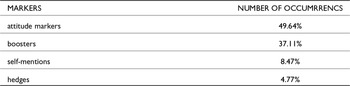
Table 1 provides an overview of the frequency of linguistic stance markers identified in the dataset. It shows that attitude markers and boosters are the most prevalent stance markers in QAnon+ anti-immigration comments, with 49.64% and 37.11% occurrences, respectively, followed by substantially fewer instances of self-mention and hedges.
Stance markers in QAnon+ anti-immigration comments.

In what follows, we build on this quantitative information by first establishing the types of stance and discursive strategies present in the textual data, before examining how these strategies are reworked, performed, and amplified through the interplay of text and emoji. This structure allows us to unpack layers of stance and communal alignment, which are performed multimodally in QAnon+ anti-immigration discourse. As a methodological note, we would like to acknowledge that all illustrative excerpts are presented exactly as they appeared in the original texts, including any grammatical or orthographic errors, to accurately reflect the communicative style of the participants and avoid inadvertently removing features that may carry analytic significance.
Linguistic construction of stance
Attitude markers and discursive othering
Linguistic stance in QAnon+ discourse is constructed through a combination of explicit attitude markers, hostile nomination, and value-laden predication, jointly performing affective escalation and in-group/out-group boundary-making, as illustrated in examples (1)–(5).
(1) They are an invasive species that is a net tax drain, commits lots of crime, and has an IQ only slightly higher than Blacks.
(2) Cheap labor and taxpayer funded living
(3) A line of morons!
(4) Dear God protect us from Biden’s sick evil minions
(5) There’s a BUS FULL OF FUTURE Liberal Voters….the Tards have to bribe the imports….freebies in America if you vote Liberal
Example (1), posted in response to a video depicting a large group of migrants described as an “invasion” at the US southern border, employs explicit negative attitude markers such as “invasive species”, “net tax drain”, and “lots of crime”. These terms function as a series of affectively charged expressions that do more than merely convey attitude. They operate through exclusionary nomination, with “they” constructing migrants as a collective faceless group, and through predication, by ascribing criminality, economic burden, and intellectual inferiority to them. This discursive pattern goes beyond the expression of personal animus to legitimise exclusionary views by framing migrants as existential threats in biological, social, and moral terms. Such strategic use of affective language is a hallmark of extreme far-right discourse, where hostile categorisation and negative attribution are weaponised to normalise racism and present radical responses as justified against a threatening ‘other’ (Faragó, Kende, & Krekó Reference Faragó, Kende and Krekó2019). Example (2) is posted in response to a video captioned as “invasion by design … send them to Canada”. It adopts a similar model of othering by labelling immigrants as “labor”, an anthroponym that identifies them only by their social role as undifferentiated economic actors. This label is further reinforced by predication in “cheap” and “taxpayer funded living”, which frames them as burdensome and parasitic. This linguistic framing activates the topos of economic burden, a classic argumentative move in populist and nationalist rhetoric (Reisigl & Wodak Reference Reisigl and Wodak2001, Reference Reisigl, Wodak, Wodak and Meyer2015), constructing immigrants as a dual threat, undermining local livelihoods and draining public resources. The comment itself is exemplary of those articulated from the perspective of the “ordinary taxpayer”, amplifying collective resentment towards both the out-group and perceived elite enablers, which, in turn, justifies exclusionary attitudes as a matter of social justice.
The comment, “A line of morons!” in example (3), is posted directly in response to a video depicting family members and sponsors waiting to pick up migrants at the border. This single phrase functions as an attitude marker and a means of dehumanising the out-group (here, the supporters and facilitators of migration and not the migrants themselves directly) by turning them into objects of ridicule. Similar patterns appear elsewhere in the dataset, such as in “They look Middle Eastern”, “They look like convicts or detainees”, and “Crawling over a wall like a bunch of rats in a sewer”. The animal metaphor, in particular, is an inflammatory labelling, predicating subhuman traits onto the out-group, a pattern also documented in the far-right discourse literature, where out-groups are likened to swarms, insects, or other vermin (Hart Reference Hart2021). Taken together, these discursive strategies assert a stance of disdainful superiority that, per Culpeper’s (Reference Culpeper2011) account of conventional impoliteness, function to provoke, maintain social distance, and reinforce group boundaries.
Examples (4) and (5) both channel affective and moral urgency through a blend of negative labelling, attitude markers, and a conspiratorial perspective on political processes. In example (4), the plea “Dear God protect us from Biden’s sick evil minions” has been made in response to a video shared on the channel, depicting immigrants in Texas being reportedly armed. It draws on explicitly negative descriptors and religious invocation to frame political opponents and their allies as fundamentally corrupt and morally threatening. The term minions frames the out-group as passive instruments of a malign agenda. Similarly, example (5), “There’s a BUS FULL OF FUTURE Liberal Voters….the Tards have to bribe the imports….freebies in America if you vote Liberal”, which is made in response to a video depicting a bus transporting immigrants from an assistance centre to destinations across the US, echoes the conspiratorial logic by claiming that migration is manipulated for electoral advantage. Here, political actors are nominated as “Tards”, while migrants are labelled as “imports” and further predicated as future voters and recipients of unearned benefits. Together, the patterned use of attitude markers, hostile nomination, and negative predication forms a broader performative script that sustains in-group solidarity and legitimises exclusion. In essence, these metrical and patterned linguistic resources (Lempert Reference Lempert2008) do social work by intensifying affect and motivating communal alignment.
Boosters and affective escalation
As shown in Table 1, boosters are the second most frequently used strategy in our dataset, accounting for 37.11% of occurrences. Employed to increase certainty, intensify emotional urgency, and escalate rhetorical force, their frequent use in QAnon+ reflects a broader pattern in right-wing populist communication, where heightened language constructs a sense of crisis and immediacy (Yerly Reference Yerly2022). Across examples (6)–(11), we observe how intensification is realised through various linguistic devices—for example, augmentatives, hyperboles, imperatives, rhetorical questions, and so on—all of which act as boosters in Hyland’s (Reference Hyland2005:129) terms, amplifying the speaker’s stance and projecting certainty. While boosters are conceptualised as lexico-grammatical resources that emphasise ‘the force of propositions’, our analysis shows that, in digital discourse, these are often intertwined with what Lempert (Reference Lempert2008) describes as performance-based and text-metrical strategies. Drawing on his notion of metrical organisation, features such as emphatic spelling, exclamation marks, and patterned escalation, originally theorised in the context of oral poetic performance, become especially salient in digital spaces, or what Zappavigna & Logi (Reference Zappavigna and Logi2024) term ‘dialogic’ or ‘communing affiliative’ spaces, where these resources shift stance from the merely propositional to the socially performative.
(6) Civil war coming soon!
(7) Look how the INVASION waves at the camera! CLOSE IT NOW!
(8) UNREAL
(9) Absolutely RIDICULOUS!!
In example (6), posted in response to a video highlighting perceived injustices against Americans compared to immigrants, the utterance is intensified by its directness and the use of hyperbole and absolute certainty, without any hedging or mitigation. It adopts an apocalyptic and mobilising stance, drawing on the topos of imminent threat/danger to situate the audience within a shared crisis narrative. In example (7), the caption accompanying the main post’s video of immigrants crossing the border employs an augmentative (“invasion” as an exaggerated representation of migration) and imperative (“CLOSE IT NOW!”) to escalate the perceived threat through intensification and performative urgency. By labelling immigrants as “the invasion” and predicating them with the human action of “waving at the camera”, the comment anthropomorphises the group and frames them as deliberately provocative. The commenter dramatises migration as a hostile incursion that can fuel fear and legitimise extreme responses, echoing classic strategies of securitisation and othering in far-right discourse (Lazaridis & Tsagkroni Reference Lazaridis, Tsagkroni, Lazaridis and Wadia2015). Example (8), “UNREAL”, posted in response to a video depicting immigrants climbing and crossing the border wall, employs capitalisation as a visual intensifier, while the strong evaluative adjective amplifies the emotional charge of the stance. This combination exemplifies how paralinguistic boosters and attitude markers in this context co-perform affect and intensify the emotional register of the stance that can animate ideological alignment within the in-group. In example (9), as part of the main post announcing New York City’s approval of voting rights for noncitizen residents, linguistic and typographic resources come together to amplify the stance. The capitalisation of “RIDICULOUS”, the adverbial booster “absolutely”, and the double exclamation marks work together to intensify emotional force and signal categorical rejection. Typography functions here as a digital proxy for prosodic emphasis, transforming the written utterance into an act of communal stimulation: the speaker both voices their outrage and models it for others in the imagined audience. Here again, boosters and attitude markers escalate affect, police the boundaries of collective identity, and co-perform the stance of outraged dismissal that is emblematic of far-right digital discourse.
(10) More like HELLLLLLLLL NOOOOOOOOOO

(11) Disgusting repulsive and truly just unbelievable I cannot imagine anybody being okay with our tax money going to people breaking the law I mean this is just beyond comprehension. Getting more than our service members this can’t stand why are people not outraged more I mean if this doesn’t wake people up what will?

Especially prominent among the boosters are those with pronounced text-metrical structures. The exaggerated letter repetition in “HELLLLLLLLLL NOOOOOOOOOO” (in example (10) in response to a poll about financial compensation for undocumented immigrants) and the repeated red exclamation marks ( ) serve as powerful boosters that enact an intensified affective and evaluative stance of refusal toward the proposition (here, the idea of letting immigrants in) by showing zero tolerance. This orthographic intensity, that is, the elongation of letters, capitalisation, and punctuation, visually mimics the intonational excess and heightened emotional pitch typical of shouting in oral performance. While a clipped “HELL NO” still communicates refusal, the elongated form dramatises the stance and marks the boundary as uncompromising in response to perceived threats. In line with Lempert’s (Reference Lempert2008) concept of metrical performance, such use of boosters not only indexes the speaker’s epistemic and deontic stance but also models the affective stance expected in the ‘imagined community’ (Anderson Reference Anderson1983) and shapes how members align themselves emotionally and rhetorically in this digital space.
A similar example is example (11), which is a response to a comment contrasting military life-insurance payouts with proposed compensation for undocumented immigrants. It layers strong adjectives such as “disgusting”, “repulsive”, and “unbelievable” to achieve a cumulative effect that intensifies the emotional register and accentuates the speaker’s stance of moral outrage. Repetition here, as Lempert (Reference Lempert2008) asserts, becomes a means of socially situated positioning, not just a lexical echo. Furthermore, as Jeffries (Reference Jeffries and Burke2023) notes, the stylistic use of a three-part list introduces rhythm by clustering similar ideas, which serves to heighten both the persuasive force and dramatic intensity of the stance. Boosters such as “truly”, “just”, and repeated phrases like “I mean” further amplify the affective force and draw attention to the speaker’s disbelief and anger. The repeated self-mention (“I cannot imagine” and “I mean”) personalises the stance, presenting the speaker as both witness and judge of the injustice described. Rhetorical questions, “why are people not outraged more”, and “if this doesn’t wake people up what will?”, invite a collective moral awakening and potentially stimulate in-group alignment. The speaker invokes the topos of injustice and moral responsibility and positions themselves as the voice of the aggrieved patriotic taxpayer defending the values of the in-group. The frequent co-occurrence of boosters (e.g. repetition and capitalisation) and attitude markers (e.g. evaluative adjectives or emotive language) in the data reflects a performative style of stance-taking that not only expresses emotion but also invites ideological alignment within the in-group by amplifying the collective affect and encouraging shared outrage.
Self-mentions and hedges
Both self-mentions and hedges were comparatively rare in the dataset, appearing far less frequently than attitude markers or boosters (8.47% and 4.77%, respectively). Self-mentions, expressed through personal pronouns or possessive adjectives, are typically a means for authors to construct subjectivity and signal a personal stake. However, in the context of QAnon anti-immigration comments, these moves function less as statements of opinion and more as strategic resources, often to prepare the ground for condemnation or punitive propositions and to perform in-group solidarity through shared grievances. Phrases like ‘I think a gun would solve that’, ‘In my opinion they come to rob and steal from America’, and ‘The only answer to stop this is I believe, the military’ are frequently situated within narratives of testimonial victimhood, eyewitness authority, or insider perspective, but pragmatically serve to preface the hateful and exclusionary propositions that follow.
(12) I’m sorry, but they should go straight to prison.
(13) I paid a lot of money for my visa. I am a US citizen who pays taxes. They are going to come in for free?- How preposterous when so many people have paid thousands of dollars and studied long hours to earn the right of citizen including my husband.
(14) Likely given with a warm place to sleep while I sit here in Texas in - 4 temps and no heat, power or water for 19 straight hours. And they don’t have to get a COVID test to just sashay in
In example (12), the polite hedge “I’m sorry” (a self-mention marker to show reluctance) precedes an unhedged punitive stance (“should go straight to prison”) in response to content discussing migrants receiving preferential treatment, such as four-star accommodations, which other commenters contrast with the neglect of veterans. The seemingly softened apologetic approach is used as a preface to ease into a radical suggestion with the modal “should” and the adverb “straight”, amplifying the speaker’s stance. CDA scholars note that such face-saving disclaimers allow speakers to preserve a positive self-image (e.g. as polite or fair-minded) even as they voice harsh or extreme sentiments. Indeed, van Dijk (Reference van Dijk1992) observed that ‘disclaimers’ such as ‘I am not racist, but…’ perform a dual positioning: they portray the speaker as reasonable and/or nonracist (part of the moral in-group) while still cueing a negative remark about an out-group. Notably, the immigrants who have gained US citizenship appear to be as hostile as the local members against the newly arrived immigrants and the perceived undue advantages granted to them. In example (13), which is posted in a thread where both legal immigrants and citizens react with frustration to posts about border crossings, the author recounts their financial hardships and status as a US citizen, positioning themselves as a legitimate member of the in-group. They broaden the argument from a personal to a collective level, citing the experiences of many who have incurred significant costs for citizenship. The phrase “how preposterous” serves as an evaluative attitude marker, intensifying their stance on the issue. In example (14), which is a comment responding to the same post mentioned in example (9), the commenter takes a testimonial perspective, “I sit here in Texas”, to foreground personal hardship and set up a direct contrast with the perceived comfort afforded to immigrants. The hedge, “likely given a warm place to sleep”, introduces speculation, while the phrase “just sashay in” employs sarcasm and an attitude marker to delegitimise the immigrants. The sequence of intensifiers, “-4 temps, no heat, power or water for 19 straight hours”, supports the speaker’s grievance and dramatises the sense of injustice. The overall effect is to elicit sympathy for the in-group while expressing exclusionary attitudes, with self-mention and hedging functioning not to moderate but to heighten personal and collective resentment.
Often framed as an opinion, hedges signal uncertainty through markers such as maybe, seem, likely, could be, and so forth (Hyland Reference Hyland2005). They allow writers to soften statements and reduce the risk of direct refutation. In QAnon+ anti-immigration discourse, hedging (despite its low occurrence) enables the presentation of inflammatory ideas, conspiracy theories, fearmongering, and hostility in a more palatable form.
(15) Maybe Mayorkas is keeping dangerous criminals here for a reason: as an army of potential terrorists and replacement enforcers
(16) Sad, all these people could be infected with COVID. Seems a very unnecessary risk for America
(17) Lol..electric fence,just saying
Example (15) appears as part of the main post, which frames immigration as a deliberate threat by the ‘Biden Regime’. It deploys a hedge (“maybe”) to introduce doubt, triggering conspiracy thinking about government motives. It positions the US Homeland Security Secretary, Alejandro Mayorkas, as deliberately retaining criminal immigrants to build an army. The comment layers attitude markers (“dangerous criminals”, “potential terrorists”, and “replacement enforcers”) and a booster (“army of”) to escalate the sense of the threat. It mobilises deep-state tropes, directly referencing the Great Replacement or White Genocide conspiracy theories, which often invoke anxieties about white identity and the perceived need to defend it against threats posed by immigration. The comment resonates with widespread far-right concerns about preserving white identity and resisting multiculturalism and demographic change (Wodak Reference Wodak2015). The comment rests on the topos of purpose, where the alleged intention behind government action is treated as evidence of its illegitimacy, thus justifying extreme suspicion and radical opposition. In response to a video depicting immigrants crossing a river, the commenter in example (16) opens with “Sad” as an affective stance marker, then deploys hedging through “could be infected with COVID” and “seems a very unnecessary risk”, layering evaluative modalisation onto the claim. The comment positions immigrants as bearers of disease and frames their presence as a public health risk, via the topos of threat. By foregrounding disappointment (“Sad”) while employing hedged language (“could” and “seems”), the comment legitimises xenophobic attitudes under the pretext of national safety. A related tactic appears in example (17), which is made in response to the same poll as in example (10), where the commenter combines humour (“lol”) and hedging (“just saying”) to introduce a violent proposal in a casual way. This discursive strategy serves to normalise an otherwise extreme stance by packaging it as a light-hearted joke. Taken together, the marked scarcity of both self-mention and hedging relative to the overwhelming use of attitude markers and boosters aligns with the literature on affective extremism in digital echo chambers (KhosraviNik Reference KhosraviNik2017). In such spaces, stance is performed primarily through collective outrage and emphatic certainty rather than through personal positioning or mitigation. This style of communication minimises the space for doubt and individual reflexivity and instead performs social work by strengthening communal alignment.
Multimodal stance: Emoji–text relation
While the foregoing analysis demonstrates how affective and intensified stance is enacted through linguistic and paralinguistic resources, the QAnon+ anti-immigration discourse is also characterised by its multimodal intensity. This section first presents a summary of emoji–text pairings, showing dominant functions of emojis and their frequencies in the dataset, to provide an empirical foundation for understanding how affect and alignment are enacted through multimodal resources.
Emoji–text convergence
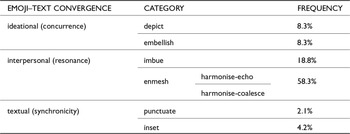
The integration of emojis with text creates powerful multimodal ensembles that amplify, inflect, or occasionally complicate the stance and affect communicated by linguistic strategies alone. In this section, we discuss how emojis coordinate with meaning made in the linguistic co-text. As shown in Table 2, emoji–text convergence is overwhelmingly interpersonal in nature in QAnon+ anti-immigration comments.
Emoji–text convergence in QAnon+ anti-immigration comments.
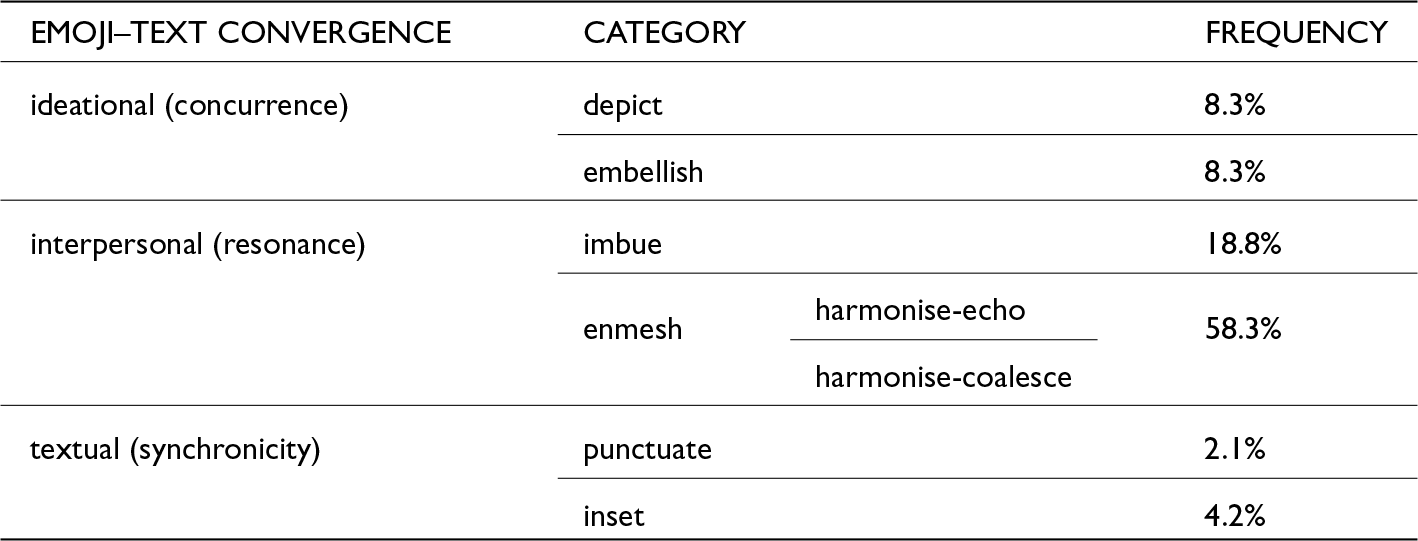
Specifically, interpersonal (via resonance) dominates the dataset, with 77.1% of multimodal comments involving emojis that directly imbue or enmesh the stance of the accompanying text. Notably, the most frequent pattern, harmonise via echo and harmonise via coalesce (together 58.3%), demonstrates that emojis often serve to echo the affective force of the text. In contrast, ideational convergence via concurrence (where emojis simply depict or embellish the text content) is much less common (8.3% each), showing that the communicative function of emojis in this discourse is primarily affiliative and less representational. Textual convergence via synchronicity, where emojis merely punctuate or synchronise with the flow of discourse, accounts for only a small fraction (2.1% punctuate, 4.2% inset). Overall, these patterns reveal that in QAnon+ anti-immigration discourse, emojis are mobilised to co-perform affect and alignment. This finding substantiates the argument that stance in digital extremism is not only multimodal but performative, with emojis functioning as key resources for affective escalation and in-group alignment around exclusionary and radical positions.
The following set of examples (18)–(21) illustrates how outrage and othering are co-performed through emoji–text convergence, amplifying affective stance and encouraging group alignment.
(18) Looks like that wall don’t work.
people have to stand up against these people walking away with keys to our kingdom. They are all thieves(19) No fucking way!!!
(20) They are not Migrants! They are not Undocumented Immigrants! They are not Asylum Seekers! They are…ILLEGAL ALIENS! Repeat after me… ILLEGAL ALIENS! They are CRIMINALS!” They gained that status the moment they crossed our Border! Every Communist Democrat that has enabled this…. is a Criminal as well!
(21) Definitely not families looking for a better life.
 people have to stand up against these people walking away with keys to our kingdom. They are all thieves


Example (18) is posted in response to the same video discussed in example (8), which shows immigrants climbing and crossing the border wall. Here, stance and affect are constructed multimodally through tightly coordinated emoji–text pairings. The opening phrase introduces epistemic hedging and a tentative evaluative stance, which the thinking face emoji ( ) immediately reinforces, enmeshing with the co-text to echo the skepticism (albeit ironically) and encourage the reader to adopt a similarly questioning position. According to Zappavigna & Logi (Reference Zappavigna and Logi2024), this is an echo relation: the emoji and text reinforce the same evaluative stance, with the emoji serving as a prosodic intensifier that marks the interpersonal mood as doubtful or reflective. The comment then escalates as the angry face emoji (
 ) precedes the imperative, visually echoing and amplifying the affective intensity of the verbal stance markers (“stand up”, “thieves”). This convergence again functions as enmesh-echo, where the emoji and text reinforce one another, with the emoji serving to visually dramatise and co-perform the collective outrage. The result is an intensified affective stance, where emoji and language operate collectively to signal and recruit shared in-group affect (Zappavigna & Logi Reference Zappavigna and Logi2024). Overall, through these enmesh-echo relations, the comment does not merely express individual emotion but performatively orchestrates affect and stance within the in-group, strengthening the emotional cohesion of the community. In example (19), which responds to the same poll as in examples (10) and (17), “No fucking way!!!
  ”, linguistic and visual stance markers are powerfully enmeshed to dramatise absolute rejection. The explicit booster (“No fucking way!!!”) is already an emphatic stance marker, deploying profanity, exclamation, and intensifiers to signal strong refusal and affective alignment. The immediate sequence of multiple
  emojis visually intensifies and coalesces with the textual stance, forming a single multimodal burst of outrage. This enmeshment does not simply echo but fuses the linguistic and visual elements that can amplify the emotional mood and transform the utterance into a performative act. Therefore, emojis here do not merely supplement the text. They saturate the commenter’s affective-evaluative stance and enact the affiliative and exclusionary dynamics typical of far-right digital discourse.
Example (20) is part of the main post in the channel and leverages a formulaic, metrically patterned structure, characterised by deliberate repetition and redefining in “They are not Migrants! They are not Undocumented Immigrants! They are not Asylum Seekers! They are…ILLEGAL ALIENS!”, which produces a rhythmic, chant-like slogan. These recurrent, conventionalised expressions act as boosters and perform social work by positioning the speaker within a collective rooted in shared values and outrage. Through this patterned textual performance, shared affect is mobilised and ideological alignment is enacted within the digital space (Lempert Reference Lempert2008). The discourse then shifts from immigrants to political adversaries (“Every Communist Democrat that has enabled this… is a Criminal as well!”). The top hat emoji ( ), placed directly after the accusation, operates ideationally through concurrence via embellish, which visually stands in symbolically for a stigmatised group (classic imagery of criminal masterminds or corrupt elites, here Democrats). Rather than referencing a literal object, the emoji here draws on cultural associations with villainy, corruption, or elitism, which amplifies the delegitimising move articulated in the text. Even when the text itself does not explicitly foreground negative evaluation, as in example (21) responding to a post presenting migration as a coordinated invasion, the immediate placement of the angry face emoji (
 ) functions through interpersonal resonance to imbue the entire utterance with affective intensity.
Examples (22)–(25) centre on sarcasm, violent humour, and patriotic mobilisation, where emoji–text convergence fuses ridicule, hostility, and solidarity into performative alignment.
(22) Bring in the crocodile
(23) Just one shot?
(24) Drop a bomb
. Problem solved!(25) I love the idea of people coming together and building it! Let’s do it! Screw it- we the people need to stand. usususus


 . Problem solved!
Example (22) is a comment posted in response to the main post featured in example (20) that emphatically labels immigrants as “illegal aliens” and “criminals”. Here, the crocodile emoji operates through ideational concurrence via depict, with the emoji placed in immediate proximity to the text, directly illustrating the referenced object. However, the ideological and dehumanising force is enacted at the discourse-pragmatic level, where the crocodile serves as a coded incitement of violence (a reference to the supposed presence of crocodiles in the Rio Grande River). In other words, beyond mere depiction, the emoji situates the comment within a repertoire of hostile in-group humour (Hakoköngäs et al. Reference Hakoköngäs and Halmesvaara2020). This pattern of pairing text with corresponding emoji recurs in the following examples, where visual cues amplify the sarcastic, exclusionary, or violent dimensions of the utterance, demonstrating how the multimodal ensemble functions as performative group alignment in the digital space. Example (23) is a response to footage of a violent altercation involving an immigrant being shot. It is a nuanced case that demonstrates how emoji–text relations are not always neatly separable. The rhetorical question, “Just one shot?” is immediately followed by the eye-roll emoji ( ), which operates through interpersonal resonance, enmeshing and harmonising with the text. While the question itself may cue sarcasm or critique, it remains potentially ambiguous in isolation. The eye-roll emoji does not simply echo a specific word or phrase; rather, it imbues the entire utterance with mocking affect, thus performatively rendering sarcasm more explicit.
Example (24), responding to the same video showing immigrants crossing a river as in example (16), illustrates ideational text-image concurrence via both depict and embellish. The bomb and explosion emojis follow the directive, visually dramatising the violent ‘solution’ and amplifying its affective force. Proximity ensures tight semantic mapping, where the  emoji directly depicts the bomb (call to violence), while the
  embellishes this act, serving as a metonymic extension, representing both the immediate result (explosion) and the escalation of violence. Together, the emojis construct a stylised, almost cartoonish narrative of anti-immigration sentiment. This multimodal stance differs from purely verbal incitement by enacting violence iconically and instantaneously. Emojis provide a vivid, shared visual cue that triggers more immediate and visceral affect than text alone (Zappavigna & Logi Reference Zappavigna and Logi2024). The stacking of
  and
and  intensifies and normalises the dehumanising stance, inviting the audience to frame violence as an acceptable solution, an effect well-documented in radicalising digital discourse (Ebner, Kavanagh, & Whitehouse Reference Ebner, Kavanagh and Whitehouse2022; Marcks & Pawelz Reference Marcks and Pawelz2022).
Example (25) appears within a discussion about citizens finishing the border wall to prevent crossings. It demonstrates the coalescence of multiple emojis to amplify and generalise the affective and communal force of the utterance. The cluster of emojis (
 ) follows a series of rallying imperatives and expressions of collective resolve (“Let’s do it! Screw it- we the people need to stand”). The emoji cluster acts as a visual and affective crescendo, enmeshing and harmonising with the text to elevate its call for solidarity. The repeated US flags anchor the message in a shared national identity, not as a direct referent but as a generalised patriotic affect. The heart exclamation is an added layer of emotional investment, while the raised hands signify collective affirmation and celebration. In this configuration, the emoji cluster does not operate as isolated stance markers; instead, it functions performatively to visually mobilise the in-group alignment and add communal purpose articulated in the verbal message.
Dialogic affiliation: Emoji-only responses
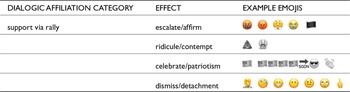
While much of the multimodal stance in the dataset involves combinations of text and emoji, there are also instances where comments consist only of emojis. Emoji-only responses function as a compressed means of affective (dis)alignment. In addressing how emojis index the affective state of commenters in the QAnon+ dialogic Telegram channel, we found that they function unanimously to rally, aligning commenters in support of the anti-immigration proposition with various effects, such as escalate/affirm, ridicule/contempt, or celebrate/patriotism and dismiss/detachment (as shown in Table 3), analysed in their context of direct response to the original post.
Dialogic affiliation categories in QAnon+ anti-immigration emoji-only comments.
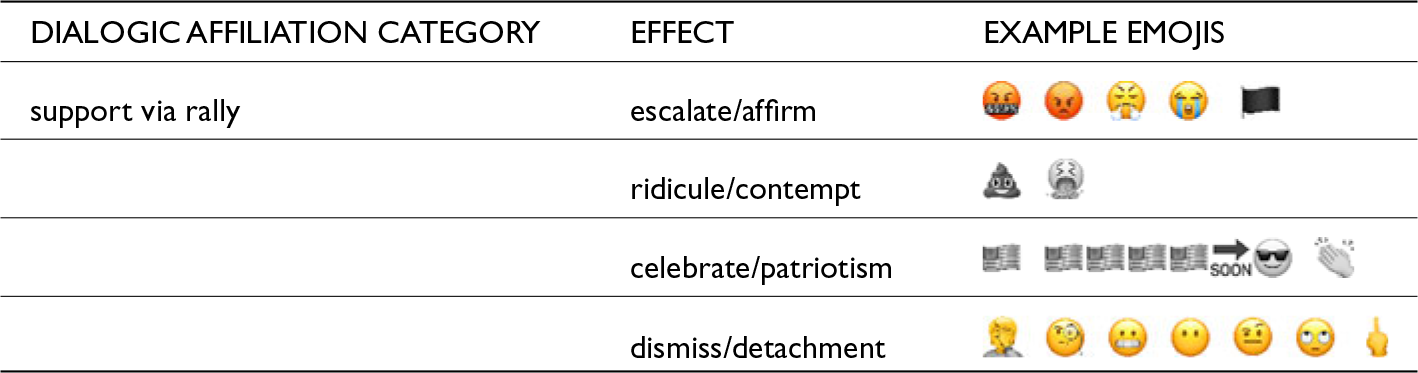
As shown in Table 3, the emoji-only responses serve to rally via escalating or affirming group sentiment, typically via repeated use of anger, outrage, call to action (for example, the black flag  associated with anarchism or a call to escalate resistance), or exasperation emojis. These forms of rallying signal not only personal affect but also collective emotional alignment.
(26) [main post] ‘The Biden admin has reversed a rule change proposed by President Trump that would prevent issuing work permits to illegal immigrants who have been ordered deported. So yes, Biden is now putting criminals ahead of citizens. Full Article [link].’
[emoji-only response]

In example (26), the combination of  (angry face) and
  (middle finger) functions as a coalescing emoji cluster, which together escalate collective outrage and visually dismiss both the policy and its proponents. This co-occurrence intensifies the emotional force of the response, transforming individual reactions into a compressed multimodal act of group alignment.
Emoji-only responses also operate through ridicule or contempt directed at the out-group (e.g. piles of poo, vomiting, mocking laughter, eye rolls), performing delegitimation through visual mockery or disgust.
(27) [main post] ‘Take your a** home!’ Heavily-armed black rights groups march through Austin chanting anti-illegal migrant slogans, demands Biden ‘close the border’ and calls for reparations to be paid NOW
[emoji-only response]

In example (27), the vomiting emoji expresses affective disgust, not solely toward immigrants, but toward the spectacle of Black rights activists appropriating far-right anti-immigrant rhetoric. This response sets boundaries within the in-group by using visuals to delegitimise both the actors and the act of message appropriation, delineating whose voices and views are considered acceptable in the anti-immigration community.
Other emoji types focus on celebration or patriotism (e.g. flags, clapping, national pride), visually affirming in-group identity and shared values.
(28) [main post] DeSantis tells it like it is. 3 out of 4 people arrested for looting have been illegal aliens in the aftermath of the hurricane: “They’re illegally in our country. Not only that, they tried to loot & ransack in the aftermath of a natural disaster. They need to be sent back to their home country. They should not be here at all.”
[emoji-only response]
usususususus

 usususususus
 In example (28), the string of  (clapping) and
  (US flag) emojis functions as a coalescing display of celebration and patriotism, visually rallying around DeSantis’s call for the removal of undocumented immigrants involved in looting and reinforcing collective identity.
The remaining emojis express dismissal or detachment (e.g. zipped lips, facepalm, neutral faces, suspicious expressions, or the middle finger), which often serve to distance the user from the out-group or from the topic, while still indexing in-group solidarity as seen in the response to the Biden administration’s policy reversal earlier. Our findings show that whether used alone or with linguistic co-text, emojis function as potent resources that intensify affect, and co-perform exclusionary sentiments and enact communal alignment in QAnon+ anti-immigration discourse.
Conclusion
Our findings reveal that QAnon+ anti-immigration discourse on Telegram is shaped by a distinctive communicative logic, wherein stance is collectively performed through patterned multimodal strategies. The marked predominance and frequent co-occurrence of attitude markers and boosters, alongside the notable scarcity of self-mention and hedging, point to a discourse style characterised by affective intensity and ideological closure, and relatively limited openness to doubt or reflective discourse. While previous research has also highlighted the affective saturation of extremists’ discourse, characterised by outrage, grievance, and collective solidarity (KhosraviNik Reference KhosraviNik2017; Breeze Reference Breeze2020), our study extends this understanding by demonstrating that stance, in participatory extremist spaces, is enacted not only by explicit linguistic markers (such as boosters, attitude markers, and strategies like nomination, predication, and perspectivisation), but also emerges through patterned co-performance with paralinguistic (typographic) features and visual resources (emojis). Building on literature highlighting the central role of visuals in extremist digital communication (Doerr Reference Doerr2017; DeCook Reference DeCook2018; Baider & Constantinou Reference Baider2024; Schmid, Schulze, & Drexel Reference Schmid, Schulze and Drexel2025), our analysis further shows that emojis serve not merely as representational choices to express racist emotions or attitudes, but as critical paralinguistic tools that amplify affect and alignment. Across the corpus, emoji–text relations recur predominantly through resonance by echoing, intensifying, and harmonising with the attitudinal force of the linguistic co-text. Similarly, emoji-only responses serve as compressed visual resources that enhance negative judgements and support in-group affiliation (Zappavigna & Logi Reference Zappavigna and Logi2024). Our study suggests that a defining characteristic of contemporary online extremism is its reliance on multimodal and performative displays of stance and group alignment, rather than rational deliberation and argumentation, a tendency that may be shaped, inter alia, by ‘the political economy’ of digital platforms (KhosraviNik Reference KhosraviNik2017). Future comparative research across various extremist groups, digital platforms, and cultural contexts could reveal how multimodal stance-taking adapts to diverse affordances and audience dynamics. More broadly, this work calls for a critical engagement with the multimodal and performative dimensions of online radicalisation, highlighting the crucial role of multimodal stance-taking in constructing and legitimising extremist views and mobilising group alignment.

 Open access

