


Introduction
Compared with a very active year on the electoral side in 2022 (Benjaballah & Sauger Reference Bendjaballah and Sauger2023), 2023 was much less decisive. Still, 2023 was rich on the social side, with riots, protests, and tensions throughout the country. Besides, 2023 was also highlighted by the management of the minority government.
Minority governments are not a very common feature of French politics because of the majority voting system and the predominance of presidential elections over domestic politics. But, for the second time in the history of the Fifth Republic, right after Emmanuel Macron's re-election as President of the Republic in 2022, his coalition fell 40 seats short of an absolute majority in the legislative elections. Thus, Macron's coalition had even fewer seats than the Socialist group in 1988, with 15 seats short of a majority (see Rozenberg Reference Rozenberg, Field and Martin2022). As a direct consequence, the minority government, led by Elisabeth Borne struggled to pass legislation in a divided Parliament and often bypassed it through the use of Article 49.3 of the Constitution allowing the government to pass a law without a vote, which the Assemblée nationale can overturn by passing a motion of no confidence.
Election report
Senate elections
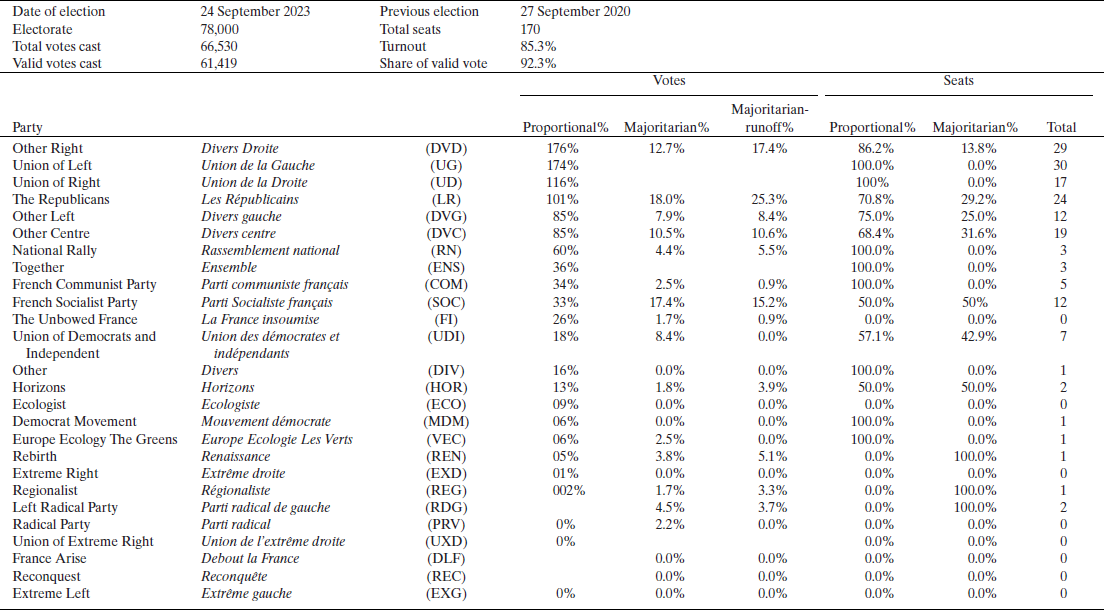
On 24 September, elected representatives in France voted to renew 170 of the 348 seats in the Sénat (the Senate). A total of 79,000 electors—95 per cent of whom are designated by municipal councils—elect senators in 42 mainland and overseas départements, including Paris, as well as the overseas territories of Saint–Pierre–and–Miquelon and New Caledonia, and six of the 12 constituencies for French nationals living abroad. Half of the Senate is renewed every six years. About 80 per cent of Senators were elected with a proportional system in this election, as most of the districts in which elections were held are among the most populated departments.
Les Républicains/The Republicans (right-wing) and their centrist allies, who have almost continually ruled over the chamber since 1958, were favorites and eventually ended up keeping their majority. And promptly after, for the fifth time, Gérard Larcher was elected president of the chamber. Rassemblement National/National Rally (RN) won three seats, which was less than expected by Marine Le Pen, but which is still a return to the Senate since 2020. Beyond this symbolic entry, the outcome of these elections was one of limited change (see Table 1). The right lost a few seats at the expense of the Republicans. The grand coalition of the left of 2022—the Nupes—failed to reach an agreement for the senatorial elections. The ecologists and communists won a few more seats thanks to an efficient coalition strategy, despite the presence of La France Insoumise (LFI) candidates in all districts.
Elections to the upper house of the Parliament (Sénat) in France in 2023

Notes:
1. Senate elections are held by half every three years. This table reports only about elections held in 2023.
2. Senate elections are indirect elections held with a form of parallel electoral system with both proportional representation in districts with a magnitude strictly superior to two and two-round runoff elections in smaller districts.
Source: Vie-publique.fr. (2024).
The only member of the French government running in the elections, Secretary of State for Citizenship Sonia Backès, was defeated in the French territory of New Caledonia. In a highly pressured context after Emmanuel Macron's trip to Noumea in July (see Institutional Change Report), Sonia Backès lost her seat to a proindependence candidate.
Cabinet report
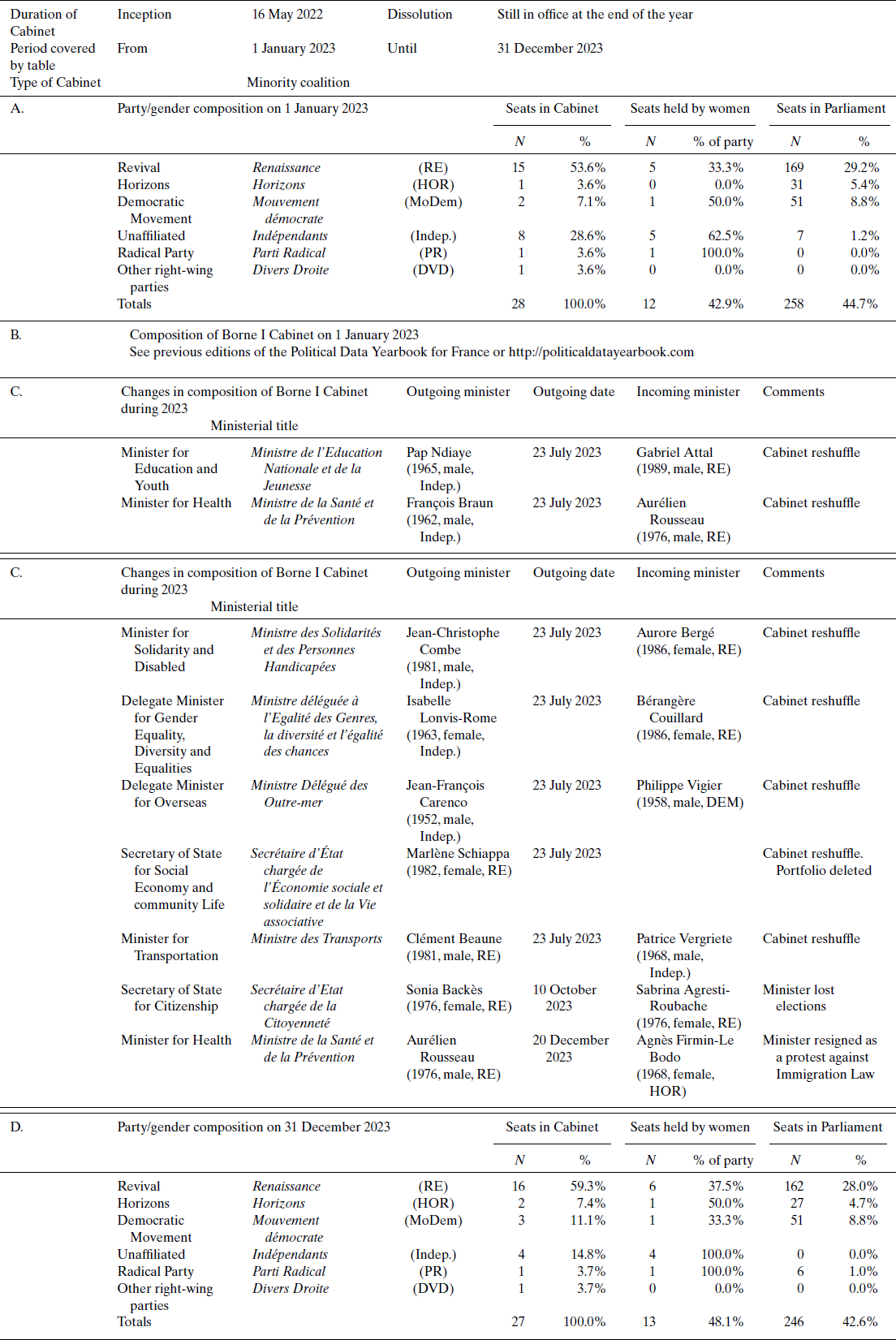
After the controversial adoption of the pensions reform in mid-March, a light reshuffle took place in the composition of the Elisabeth Borne Cabinet. In July, eight ministers left the government, including Pap Ndiaye, Minister for Education and François Braun, Minister for Health (both from the civil society), the latter being substituted by Aurélien Rousseau. Besides, three ministers also gained new portfolios, among them, Gabriel Attal, who became Minister for Education at the age of 34. Sarah El Hairy, former State Secretary for Youth, became State Secretary for Biodiversity. Finally, Bérangère Couillard, former State Secretary for Environmental Transition, stepped in as Delegate Minister for Gender Equality. This reshuffle has been considered as the recognition of the incapacity of nonprofessional politicians to “aggressively” assert their positions in a polarized context.
In October, after the Secretary of State for Citizenship, Sonia Backès, lost her seat at the Senate (see Election Report), a second reshuffle was reported. Sabrina Agresti-Roubache, State Secretary for Urban Affairs, stepped in as State Secretary for Citizenship.
Finally, in December, Aurélien Rousseau resigned as Minister for Health to signal his disagreement with the immigration reform. He was replaced by Agnès Firmin-Le Bodo.
Changes in the Cabinet are shown in Table 2.
Cabinet composition of Borne I in France in 2023

Source: Site Officiel du Gouvernement (2024) (www.info.gouv.fr/composition-du-gouvernement).
Parliament report
As mentioned, in June 2022, President Macron failed to get a parliamentary majority, leaving Parliament with four main factions. Macron's party and its allies (center and center-right) conform the largest faction. The other three factions are the Republicans, Nupes (itself divided between the socialists, the Greens, and LFI) and RN.
In 2023, Macron was not able to get any of these factions to join the government on a regular basis. The Republicans’ support was conditional and ad hoc. As for Nupes, the only consensual strategy across its component parties has been a strict opposition to the government on most issues.
When it came to a vote on the budgetary legislation in the fall, none of the opposition parties were willing to support any of the bills relating to the budget, so the government forced legislation through without submitting it to a vote in the Parliament (Article 49.3 of the French Constitution). With 13 uses of the Article 49.3 procedure in 2023, 2023 still falls short of the exceptional figure for 1989 (Article 49.3 was used 16 times in that year).Footnote 1 It still sets the use of such a procedure at an exceptional level, causing heightened debates on the legitimacy of such a procedure and about possible democratic backsliding dynamics in France.
As permitted by the Constitution, votes of no confidence accompanied the use of Article 49.3. Contrary to tradition, these votes of no-confidence have not only been systematic but also there were “double” votes three times in 2023, as both the left and the far right triggered their own votes of no-confidence for the same laws. None of these votes succeeded in censoring the government, as the left generally avoided to vote when it was called by the far right. On the contrary, RN representatives did vote several times for initiatives from the left, embarrassing the left by doing so. Yet, the Borne government almost fell in March, when a cross-party motion failed by a margin of just nine votes, with 278 deputies voting for the motion (the majority threshold was set at 287). In the end, the Borne government did survive 2023 with little positive prospects for 2024, as the term was marred with rumours of replacements on President Macron's decision. Yet, the presidential style of a majoritarian political system has not flinched despite the minority-government context.
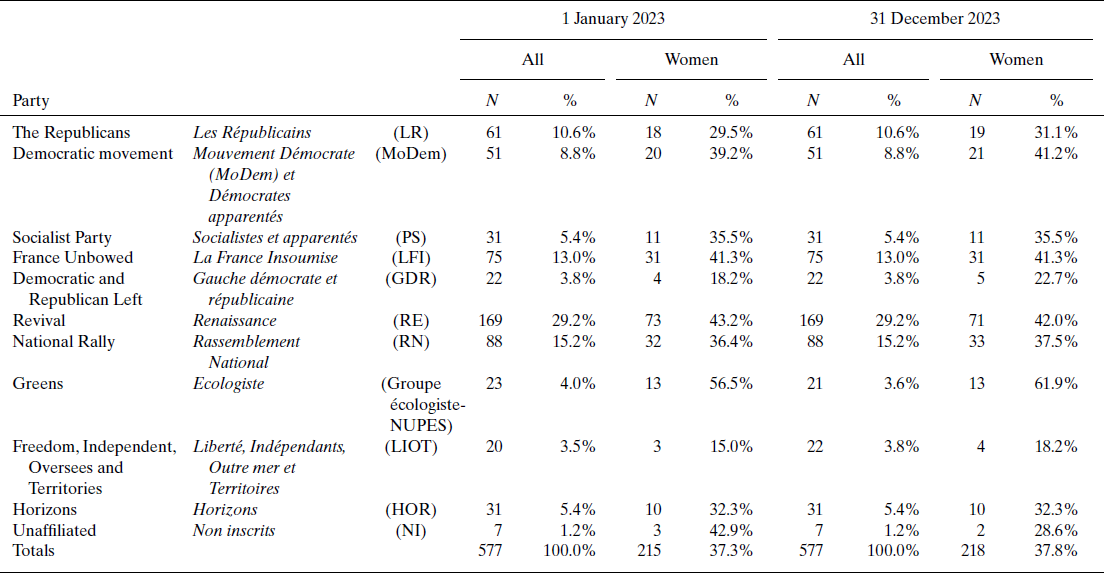
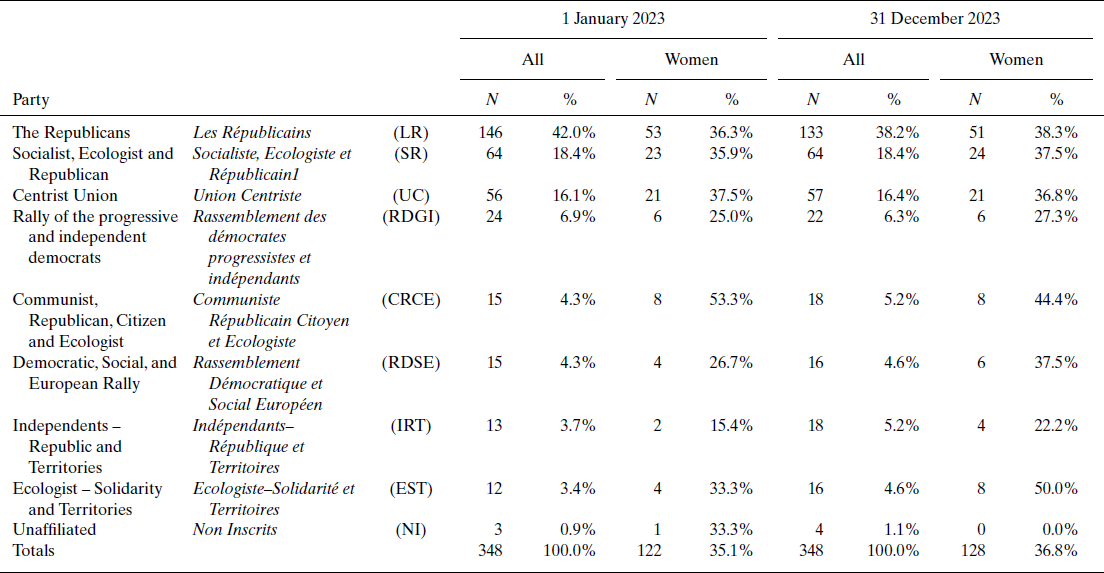
The composition of both houses of Parliament during 2023 can be found in Tables 3 and 4.
Party and gender composition of the lower house of the Parliament (Assemblée nationale) in France in 2023

Source: Assemblée Nationale website (2024).
Party and gender composition of the upper house of the Parliament (Sénat) in France in 2023

Source: Senate website (2024).
Political party report
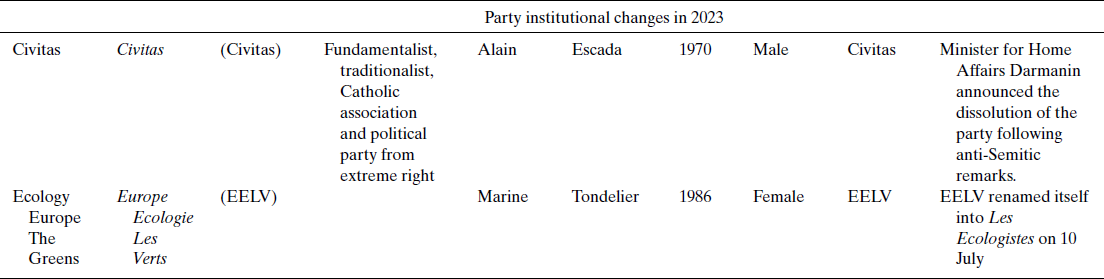
No major news is to be reported about parties (Table 5). The Green party, Europe Ecologie Les Verts, renamed itself into Les Ecologistes (The Ecologists). The decision was proposed in an internal committee on 10 December 2022 and adopted by vote on 10 July 2023. The former name is, however, also kept as a possible second name.
Changes in political parties in France in 2023

Source: Parties and Elections in Europe (2024) (www.parties-and-elections.eu/index.html).
In October, the government banned “Civitas,” a traditionalist Catholic, fundamentalist association, and political party, accusing it of inciting hatred in society against Lesbian, Gay, Bisexual, Transgender, Queer, Intersex, Asexual (LGBTQ) people, Islamophobia, and anti-Semitism.
The Nupes, the leftwing coalition, saw its dynamism wane over the period. Dissensions between LFI and its leftwing partners spread throughout the year. No electoral coalition between left-wing parties was agreed for the senatorial elections, and none was expected for the European elections of 2024. The point of rupture between the socialists and LFI was, however, reached in October, triggered by disagreements over the terrorist attacks in Israel and the following war in Palestine. The refusal to condemn the Hamas attacks as terrorists by LFI led the Socialist Party to announce a moratorium on its participation in the Nupes on 17 October. The Ecologists remain divided on the issue, with no official decision on the matter.
Institutional change report
Constitutional reform
The government attempted, for the whole year, to find a political consensus on New Caledonia, a French Territory in the Pacific Ocean. More particularly, the French government attempted to gather all of New Caledonia's local political parties to come to the table and come up with a new agreement on New Caledonia's political future after the Nouméa Accord, signed in 1998.Footnote 2 During his trip in July 2023, President Macron announced a constitutional amendment to reform New Caledonia's electoral roll. Initially, the Nouméa Accord excluded French citizens who had not resided in New Caledonia before 1998 from voting at local and territorial Parliament's elections. The Constitutional bill intended to restore the voting rights of French citizens. The amendment was scheduled to be submitted to the French Congress during the first quarter of 2024.
President Macron also attempted to reach a political consensus on Corsica, another French island in the Mediterranean Sea, where its people have long wanted more say on their own affairs, as well as an official status for their language. Gérald Darmanin presented a draft text providing for the “recognition of an autonomous status” for the island “within the Republic” in the French Constitution. The text was submitted for approval to the local Assembly.
Issues in national politics
Despite its minority status, the Borne government managed to pass some significant pieces of legislation, causing strong opposition.
Pensions reform
President Macron started off 2023 with a pensions reform, which raised the minimum retirement age from 62 to 64. The government argued it was necessary to balance the books amid shifting demographics.
A united front of unions argued the reform would disproportionately affect low-skilled workers and women especially. They also framed the pension debate as part of a wider fight for social justice. They staged multiple rounds of strikes and protests, gathering huge crowds in cities and towns throughout the country. Refinery shutdowns and transport and rubbish collectors’ strikes caused chaos in many French cities. Throughout the time of the strikes, polls consistently showed that a large majority of the French opposed the reform, putting pressure on a government already weakened in Parliament.
Violence rose in late March when Macron ordered his government to run the reform through Parliament without a vote. This decision sparked several nights of unrest and turned the social dispute into a political crisis. However, the Conseil Constitutionnel (Constitutional Court) ruled that the pensions reform was in line with the Constitution, including raising the legal retirement age from 62 to 64. This ruling helped shut down the movement. Yet, Macron came out more weakened.
Immigration reform
Gérald Darmanin, Minister of Home Affairs, spent much of the year trying to build parliamentary support for a new “immigration law.” However, opposition lawmakers banded together to shoot down the bill before it was even debated in the National Assembly.
In response, the government submitted a tougher law to win over right-wing lawmakers, introducing measures that discriminate between citizens and immigrants in terms of eligibility for benefits. The law was harsh enough for Marine Le Pen to claim it as an “ideological victory.” The support from the far right brought about a crisis within Macron's party, leading his health minister, Aurélien Rousseau, to resign in protest. Besides, a third of the French regions vowed not to comply with some of the toughest measures of the law.
Finally, the war in Gaza led to controversial debates among political parties. Jean-Luc Mélenchon, leader of LFI, quickly dispatched a statement that had been criticized widely and in which he referred to Hamas as “the Palestinian forces.” At the same time, pro-Palestine demonstrations were banned in the country.
To conclude, 2023 offered only gloomy perspectives. Despite the capacity of the government to survive its minority status and even pass legislation, the incapacity of all political actors to accommodate a situation outside of the majoritarian logic of the Fifth Republic may lead to gridlock in the short term and provide no convincing responses to citizens’ enduring dissatisfaction. The polarization of a fragmented party system keeps developing, the RN providing, in the end, the only stable anchoring point of a political landscape in turmoil.

 Open access

