




1. Introduction
This article reexamines the provenance of the imperfective aspect marker ka.Footnote 1 This marker is characteristic of the French-lexicon creoles of the Lesser Antilles (henceforth Lesser AntilleanFootnote 2 ) and French Guiana (henceforth Guyanais), setting them apart from Haitian Creole, Louisiana Creole and the French-lexicon creoles of the Indian Ocean, all of which employ a reflex of après ‘after’ as their imperfective marker.
The origin of ka is of particular interest, as it is a central element of the grammar of these creoles and, as noted, one that distinguishes them from the rest of the French-lexicon creoles. Understanding its provenance is key to reconstructing the development of and internal relationships between the French-lexicon creoles. Earlier scholarship has put forward several competing hypotheses regarding its etymology (among others Hull Reference Hull and Hancock1979; Maher Reference Maher1994; G. Hazaël-Massieux Reference Hazaël-Massieux and Hazaël-Massieux1996; Damoiseau Reference Damoiseau1998, Reference Damoiseau2008; Fattier Reference Fattier2008; M-C. Hazaël-Massieux Reference Hazaël-Massieux2008; Librova Reference Librova2019), but to date, no consensus has been reached on the exact origin of ka. Pfänder (Reference Pfänder2000:210) counts no less than fifteen different proposals. As Syea (Reference Syea2017:261) observes, “as far as ka itself is concerned, its historical source seems to be shrouded in mystery”, whereas Parkvall & Jacobs (Reference Parkvall and Jacobs2022:161) note that “the imperfective marker ka does not even have an accepted etymology”.
In this article, we aim to advance the debate by presenting typological data on the provenance of TMA markers from a wide range of creoles. These data show that such markers almost invariably (a) derive from material supplied by the lexifier rather than the substrate, and (b) originate in words or morphemes with a locative or deictic meaning. These two observations significantly narrow the range of potential sources for ka, leaving the French locative construction n’(en) être qu’à + X as the most plausible candidate. While a range of periphrases involving the string qu’à + INF have been proposed in the literature on ka, these proposals miss the point in that they have focused primarily on the formal properties of the source construction rather than its semantics. What remains lacking, and what this article provides, is an account that situates the emergence of ka in the well-documented cognitive-semantic grammaticalization pathway from locative predication to imperfective aspect.
The remainder of the article is structured as follows: Section 2 examines the geographic and synchronic distribution of ka in French Creoles and highlights its semantic and syntactic properties. In Section 3, we review existing hypotheses. Section 4, the core of this article, offers an in-depth analysis supporting the hypothesis we consider by far the most plausible.
2. The imperfective marker ka: synchronic distribution and semantic-syntactic scope
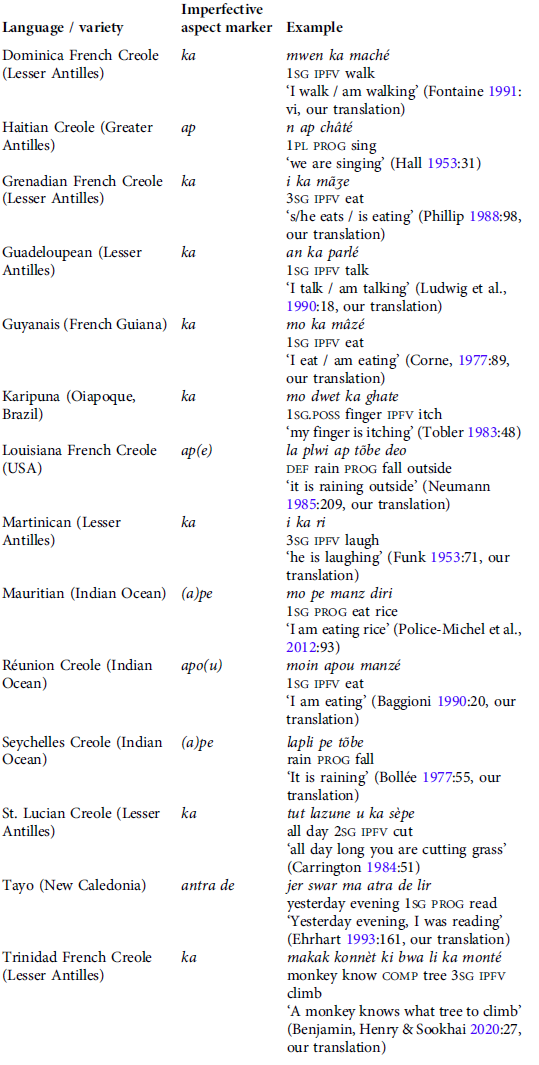
The preverbal marker ka is a hallmark of all the French-lexicon varieties of the Lesser Antilles, as well as of Guyanais and its offshoot known as Karipuna spoken across the Brazilian border in Oiapoque. In all these varieties, ka functions as a portmanteau imperfective marker, covering progressive and habitual readings as well as other meanings typically associated with imperfectivity, such as iterative and prospective aspect (e.g. Bybee et al. Reference Bybee, Perkins and Pagliuca1994).
The close similarity between Guyanais ka and Lesser Antillean ka in form, function and meaning has long been taken as evidence for a genetic link between these two creoles (e.g. Goodman Reference Goodman1964; Parkvall & Jacobs Reference Parkvall and Jacobs2022). By contrast, in Haitian Creole, Louisiana Creole, and the French-lexicon creoles of the Indian Ocean (Mauritius, Seychelles, Réunion), the corresponding function is generally expressed by a reflex of French après (e.g., ap ∼ ape ∼ pe, and other variants).Footnote 3
There has been sporadic mention in the literature of the occurrence of ka in Northern Haiti (e.g. Relouzat Reference Relouzat1994:15), but Parkvall (Reference Parkvall1995:10) rightly notes that these mentions have to be treated with caution, given that “hundreds of works have been published on Haitian, some of them by native speakers, without this ever having been previously mentioned”. Indeed, the author of the most extensive linguistic mapping project for Haitian Creole (Fattier Reference Fattier1998), for instance, has made no mention of the use of ka as an imperfective marker in Haitian Creole in either of her articles dealing specifically with ka and ap (Fattier Reference Fattier2008, Reference Fattier2010). And while her Atlas (Fattier Reference Fattier1998) contains numerous examples of preverbal /ka/ across Haiti, this /ka/ is clearly the popular allomorph – also commonly found in Louisiana French Creole (Valdman & Klingler Reference Valdman, Klingler and Valdman1997:122, 127) – of the Haitian Creole modal verb kap∼kapab ‘can, to be able’.Footnote 4
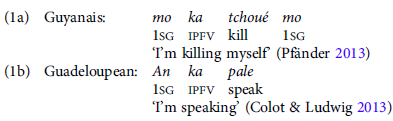
The marker ka that interests us here – the one that characterizes the verbal system of Lesser Antillean French Creole and Guyanais – is not a modal verb but a dedicated preverbal imperfective aspect marker, marking both progressive (1a, 1b)Footnote 5 and habitual aspect (2a, 2b).
(2a) Guyanais:

(2b) Martinican:

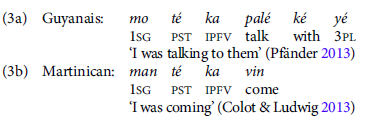
As expected, ka can be preceded by the past marker té (3a, 3b):
Both Guyanais and Lesser Antillean also feature the future marker ké, historically derived from ka + alé ‘to go’ (e.g. Syea Reference Syea2017:216). This marker can in turn be preceded by the past tense marker té to form counterfactual or conditional expressions. In both creoles the combination ké ka can furthermore be used to express progressive aspect in the future tense (‘I will be V-ing’).
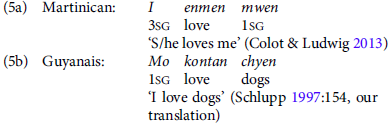
Indicative of ka being an aspect marker rather than tense marker is the fact that it is generally omitted before stative verbs (4–5) (notwithstanding some exceptions; see Parkvall & Jacobs Reference Parkvall and Jacobs2022:162–165).


In both ka-creoles, on some stative verbs, including verbal adjectives, ka serves to indicate a change-of-state (6):


In ka + V complement clauses, ka appears to represent a meaning akin to English -ing.Footnote 6


The question of when ka became productive in Lesser Antillean and Guyanais – and whether it was already present in the earliest stages of these varieties – is important, but falls outside the scope of this article. For present purposes, it suffices to note that ka was first attested in a text dated roughly to the first half of the 18th century, La Passion de Notre Seigneur selon St Jean (M-C. Hazaël-Massieux Reference Hazaël-Massieux2008:68, 69).Footnote 7 We therefore assume that ka developed into a full-fledged imperfective marker at some point between the mid-17th – the start of a plantation economy on Martinique – and mid-18th century.
Of potential relevance for determining a plausible source construction is the fact that in several early French Creole texts, ka appears written as <qu’a>. Some scholars have taken this as evidence that the source construction must have involved the French string qu’à. M-C Hazaël-Massieux (Reference Hazaël-Massieux2008:428, 429), however, urges caution, emphasizing that the spelling <qu’a> merely reflects how 18th-century scribes perceived and transcribed the sound according to French orthographic conventions and that it cannot, by itself, settle the question of its grammatical origin. We principally agree with this position; however, in this specific case, we believe that the scribes’ choice of orthography was based on genuine linguistic memory and intuition regarding the source construction (see Section 4).
3. Existing hypotheses on the origin of ka
Among the TMA markers attested in creole languages around the world, ka is most likely the one that has prompted the widest variety of etymological proposals: “The origin of this particle (…) is far from clear, unlike that of most of the Creole tense and aspect particles” (Goodman Reference Goodman1964:84). For a concise summary of the different proposals, see, for instance, Parkvall (1995:3; Reference Parkvall2000:100), Pfänder (Reference Pfänder2000:211, 212) and Librova (Reference Librova2019). Below, we review the most prominent ones.
3.1. Non-lexifier hypotheses
Several proposals have traced ka to non-lexifier sources, assuming that ka was not innovated from French input but rather inspired by (or taken wholesale from) one or the other substrate or adstrate language. Parkvall (1995:3; Reference Parkvall2000:100) notes that “no less than 13 different sources from 11 different substrate languages, ranging from Wolof to Hausa, have been suggested”.
The hypothesis that French Creole ka represents a transfer from the Portuguese-lexicon creoles of the Gulf of Guinea, where a homophonous morpheme likewise marks imperfective, was first suggested by Schuchardt (Reference Schuchardt1882:911) and later by for instance Taylor (Reference Taylor1963:812), Valkhoff (Reference Valkhoff1966:105–106) and Hull (Reference Hull and Hancock1979).
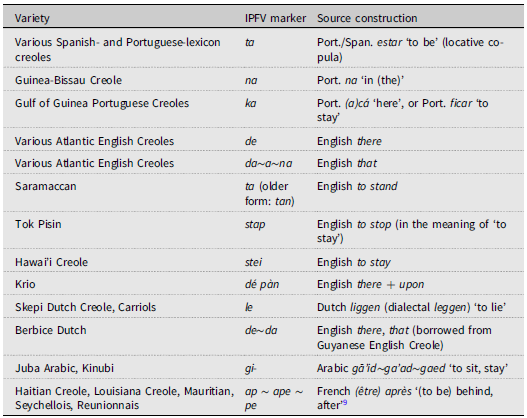
As regards substrate proposals, Goodman (Reference Goodman1964:84) tentatively pointed at Hausa kan (habitual marker), Mende kaka (iterative), Manding ka (perfective), Efik ke (progressive) and Wolof nga∼nge (continuous present), while adding that “none of these sources is completely satisfying”. Nainsouta (cited in M-C. Hazaël-Massieux Reference Hazaël-Massieux and Chancé2004:151) pointed specifically to Bambara n’gha (with the alleged allomorph ka), a suggestion later taken up by M-C. Hazaël-Massieux (Reference Hazaël-Massieux2008:428, 429). Taylor (Reference Taylor1945), Wittmann (Reference Wittmann1995) and, more recently, Pfänder (Reference Pfänder2000:225), amongst others, have instead pointed to the Arawak morpheme ka (the third-person singular of ‘to be’) as a possible source. While the form-function match with some of these languages looks attractive on the surface, such proposals face the general problem that creole TMA markers overwhelmingly derive from lexifier material rather than from other creoles or substrate languages (see Table 1 in Section 4; cf. Parkvall Reference Parkvall2000:100). One of the very few counterexamples known to us is the set of Ijo-derived TMA markers in Berbice Dutch. Crucially, however, that case involved prolonged and intense contact with the donor language: around one-third of the entire Berbice Dutch lexicon – including basic vocabulary – is of Ijo origin. If ka truly derived from a substrate source, one might expect that source language to have made a similarly disproportionate contribution to the overall lexicon of the ka-creoles, which is not the case.
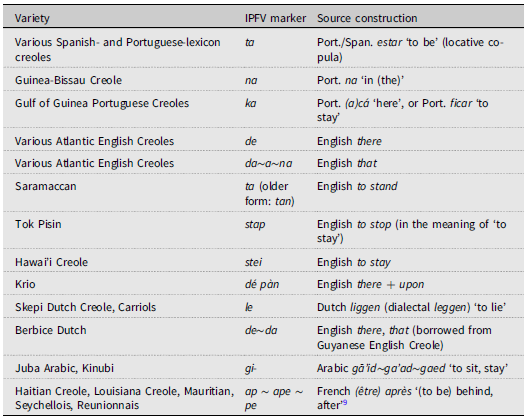
Imperfective aspect markers and their presumed source items in creole languages world-wide.Footnote 8
Rather, these non-lexifier hypotheses appear to be examples of what in the literature has been dubbed the “cafeteria principle” (Dillard Reference Dillard1970), aptly defined by Parkvall (Reference Parkvall2000:4) as the examination of as many (West) African languages as possible “until the desired feature has been detected and, once detected, this is claimed to be the origin of the Creole feature”.
3.2. Lexifier hypotheses
A range of French periphrases involving qu’à + INF have been put forward as potential etymological candidates.
Presumably because of its high frequency in spoken French and its ability to take infinitival complements, the periphrasis n’avoir qu’à + INF – roughly meaning ‘to only/just have to + INF’ – is often invoked in discussions of the origins of ka. M-C. Hazaël-Massieux (Reference Hazaël-Massieux and Chancé2004:151, our translation) does so, for example, when noting that “in colloquial French one (still) says t’as qu’à faire ça / j’ai qu’à faire ça [‘you only have to do that / I only have to do that’], etc., with a qu’à that appears to offer a (formally and semantically) plausible explanation for the Creole ka.” However, while certainly formally plausible, we disagree with Hazaël-Massieux’s claim of semantic plausibility. In fact, the proposal can be rejected precisely on semantic grounds: constructions expressing deontic modality are, to our knowledge, not typical sources of progressive or imperfective aspect markers. For similar reasons, French quand ‘when’, tentatively proposed by Van Name (Reference Van Name1869:144), also seems an unlikely source for ka.
G. Hazaël-Massieux (Reference Hazaël-Massieux and Hazaël-Massieux1996:236/656) considered three potential etymologies for ka:
-
• the French adjective capable ‘capable’, as used in the verbal periphrasis être capable de + INF ‘to be able to V’ (cf. already Funk Reference Funk1953:78);
-
• the progressive periphrasis il est qui mange,Footnote 10 with the purely hypothetical variant il (est) qu’(est) à manger ‘it is he who is eating’;
-
• the unattested restrictive periphrasis il n’est qu’à manger ‘he is only eating’.
Rather than committing to one construction, Hazaël-Massieux suggests that these constructions may have converged, collectively paving the way for the infinitival marker qu’à to be reanalysed as a preverbal progressive marker. His discussion, however, remains largely formal: it focuses on the ability of qu’à to occur with infinitival complements (which we think is beside the point; see Section 3.4), while offering little to nothing in terms of semantic argumentation. In other words, he does not trace a pathway from these source constructions to progressive or imperfective meaning.
Fattier’s (Reference Fattier2008) position is more committed. She explicitly endorses Hazaël-Massieux’s third construction, the periphrasis il n’est qu’à + INF, i.e. the emphatic, restrictive variant of the progressive être à + INF. The plain être à + INF construction is marginally attested in seventeenth- and eighteenth-century French (Jeppesen Kragh Reference Jeppesen Kragh2021:87, 88) and was still described by Gougenheim (Reference Gougenheim1929:50ff) as part of the grammar, albeit as a marginal phenomenon in competition with the en train de + INF construction (Gougenheim Reference Gougenheim1929:60).
However, like G. and M-C. Hazaël-Massieux, Fattier likewise focuses on the ability of the qu’à string to take infinitival complements, and consequently fails to present evidence for the existence of the alleged source construction in colonial French. Fattier (Reference Fattier2008:205, 206) instead points to the survival of the restrictive adverb néké (necque ∼ necq ∼ annik) ‘only, just’ in Haitian and Guyanais, which she interprets as evidence for the popularity of restrictive n’être que clauses in the colonial French input. This observation is certainly relevant: we share Fattier’s (Reference Fattier2008:207) view that restrictive n’être que constructions may have been preferred because of their phonetic salience (see Section 4).Footnote 11 However, the Haitian form néké does nothing to explain the vowel /a/ in ka, and the restrictive verbal periphrasis il n’est qu’à + INF itself remains unattested in colonial French. In short, although Fattier sharpens Hazaël-Massieux’s proposal by selecting a single source construction, her account ultimately remains tentative.
3.3. Hybrid proposals
Several scholars have explicitly argued for convergence of French and West African sources, something loosely suggested as a possibility also by Goodman (Reference Goodman1964:84) and Holm (Reference Holm1988:155). M-C. Hazaël-Massieux (Reference Hazaël-Massieux2008:428, 429) and more recently Librova (Reference Librova2019) provide cases in point, both suggesting that the phonetic and functional similarity between the Bambara predicate marker ka and colloquial French qu’à + INF periphrases may have facilitated the selection and stabilization of ka as a creole TMA marker. In a similar vein, Pfänder (Reference Pfänder2000) has argued for convergence of French être à + INF with Arawak ka.
We do not wish to discard the possibility that grammatical items with a similar sound and function in the substrate or adstrate languages may have played a reinforcing role in the development of ka. However, the reliance on substrate input typically remains conjectural, as it relies on the presence of a disproportionate number of speakers of certain substrate languages (Upper Guineans in the case of M-C. Hazaël-Massieux and Librova; Arawakans in the case of Pfänder) in the formative period of the French Creoles, something that has never been demonstrated. Furthermore, these hybrid proposals, too, offer very little semantic argumentation as to why être à + INF should have been chosen as the progressive source. Their focus instead lies on this construction’s ability to take infinitival complements, which, we argue below, is entirely beside the point. An exception is Pfänder (Reference Pfänder2000:224, 225), who does – rightly, in our view – point out the correlation between locatives and progressives. However, he does not fully pursue this insight, and his analysis, too, suffers from an overreliance on substratal (Arawak) influence and an excessive focus on infinitival complementation.
3.4. Why current proposals are missing the point
The recurring theme in the proposals by Guy and Marie-Christine Hazaël-Massieux, Pfänder, Fattier, Damoiseau and Librova is the assumption that the crucial selection criterion was the source construction’s ability to take infinitival complements.Footnote 12 In our view, this focus is misplaced. The syntactic combinability of the source construction is never the decisive selection criterion in the grammaticalization of imperfective markers or auxiliaries cross-linguistically. What matters is semantics, or, specifically, the capacity of the source construction to express a notion of being in a location (e.g. Comrie Reference Comrie1976:102, 103). Its subsequent extension from nominal complements to verbal complements is wholly unsurprising: the grammaticalization of auxiliaries and TMA markers typically starts with predications that are limited to nominal (or adverbial) complements, only to then gradually extend their usage to encode ever more dynamic situations, eventually taking full verbal complements (whether infinitival, gerundial, or participial) (e.g. Heine Reference Heine1993:55, 59).
Such an extension would have been especially natural in a creolization setting, where individuals were under pressure to innovate and regularize new grammatical patterns. The presence or absence of infinitival complements in the French input is therefore of limited diagnostic value. If the construction’s use in French was restricted to nominal complements, creolizers could readily have extended it to verbal contexts drawing on the universally familiar space = time metaphor. We will expand on this below as we present our framework for the origins of ka.
In sum, existing proposals have been primarily formal in nature and have overlooked the semantic and functional motivations that are crucial to understanding the rise of ka. Section 4 seeks to fill this gap.
4. Our proposal: n’(en) être qu’à + X and the Location Schema
4.1. Brief typology of creole imperfective markers
Before advancing, a terminological and typological clarification is in order. As noted, ka serves as a general imperfective. However, a number of other creoles world-wide in fact distinguish morphologically between progressive and habitual aspect (see, e.g., features 47 and 48 in Michaelis et al. Reference Michaelis, Maurer, Haspelmath and Huber2013).
It is tempting to assume that such differences reflect lexifier tendencies. Thus, it is likely no coincidence that English, unlike French, morphologically distinguishes between progressive and habitual aspect, and that this distinction is mirrored in the English-lexicon creoles, with habitual aspect being rendered by unmarked verbs. For the French-lexicon creoles, however, the picture is less clear-cut. More precisely, the après creoles – Haitian and Louisiana in the Caribbean, as well as the Indian Ocean varieties – pattern like the English-lexicon creoles in that après functions as a progressive marker, while habitual readings are typically expressed by unmarked verbs.
These differences, however, have no bearing on our argumentation; for reasons of space, they will not be pursued further here. What matters for our purposes is that progressive aspect constitutes a well-established subdomain of imperfectivity, and that the locative-to-progressive grammaticalization pathway is therefore fully compatible with the synchronic imperfective scope of ka. In other words, it is entirely conceivable that ka initially emerged as a progressive marker and only subsequently extended its scope to other imperfective values.
With this clarification in place, we now turn to the typological evidence relevant to the emergence of ka. The following two typological observations apply to creole imperfective aspect markers:
-
(i) As noted already by Schuchardt (Reference Schuchardt1882:911), imperfective aspect markers (whether dedicated progressives or general imperfectives) in the Atlantic Creoles are very often recruited from locative words or constructions, an observation repeated many times since (e.g. Holm Reference Holm1988:154–157; Heine & Kuteva Reference Heine and Kuteva2002:203). The same tendency can in fact be observed far beyond the Atlantic: “The semantic connection of all of these progressive constructions with position or location is striking and suggests a language universal” (Holm Reference Holm1988:155).
-
(ii) A second robust generalization is that, with very few exceptions, creole imperfective aspect markers derive from lexifier rather than from substrate source material, a claim that holds true not just for imperfective aspect markers but for creole TMA markers at large (cf. Holm Reference Holm1988:144; McWhorter Reference McWhorter2000:46; Parkvall Reference Parkvall2000:100).
Table 1 illustrates both generalizations for a range of creoles with different lexifiers and from different regions of the world, listing imperfective aspect markers (whether dedicated progressives or general imperfectives) alongside their presumed source items.
4.2. The French source construction: n’(en) être qu’à + X
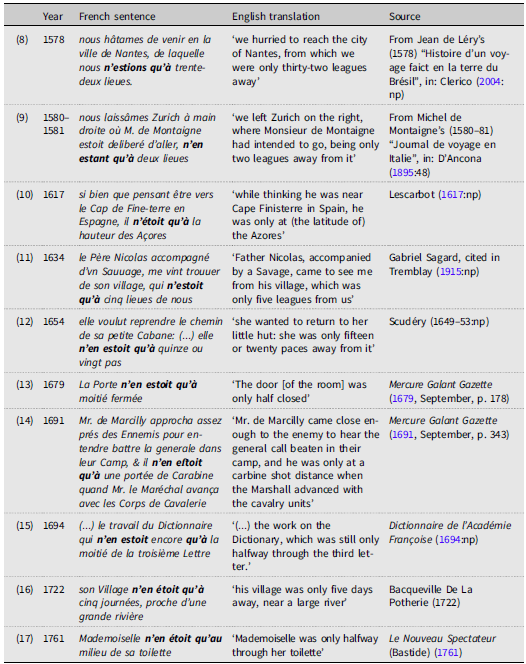
On the basis of the two creole typological facts outlined above – (i) the cognitive path from location to progressive aspect and (ii) the dominance of lexifier source material in the development of creole TMA markers – we aimed to link ka to a French locative construction, irrespective of whether the construction selects infinitives. The mainstream French locative predicate n’(en) être qu’à X ‘to be only/just at X’ emerged as the prime candidate. In that construction, en is an optional resumptive pronoun, and X typically denotes a measure of distance in space or time, such as à dix pas ‘ten steps away’, à cinq journées ‘five days away’, à la moitié ‘halfway’, and so on. It is the restrictive counterpart of the simple locative predicate (en) être à X ‘to be at X’. For obvious phonetic reasons, our focus is on the restrictive version of this construction, which has remained in use in modern French (e.g. n’(en) être qu’à ses débuts ‘to be only in its early stages’) and can be seen to occur as early as in 16th-century French (8, 9). More importantly, n’(en) être qu’à X appears to have been particularly frequent in the 17th and 18th centuries (10–17), including in colonial narratives (e.g. 10, 11, 16). Table 2 presents the relevant examples.
Some examples of the locative predicate n’(en) être qu’à X in 16th, 17th- and 18th-century French literature.Footnote 13
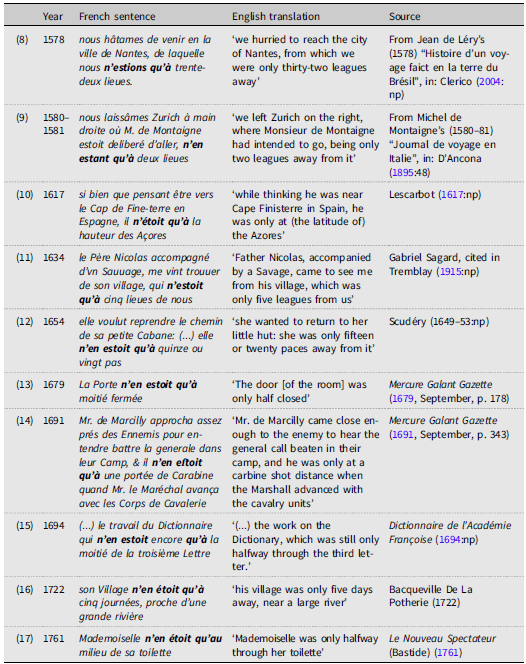
The source construction as we conceive it – n’(en) être qu’à + X, where X indicates location or distance in space or time – is a common turn of phrase in modern-day standard French and appears to have been so already in the 16th, 17th and 18th centuries. Table 2 only presents a fraction of all the examples of n’(en) être qu’à + X we found in French texts from that period.
In other words, the construction was part and parcel of popular French precisely in the period when ka began to emerge in the French-lexicon creoles of the Lesser Antilles and French Guiana. While it would be desirable to support this claim with quantitative corpus statistics, in practice this is not straightforward. Searches for the n’(en) être qu’à construction in historical corpora yield a large number of irrelevant hits, not only because of the wide orthographic variation but also because the string can occur in a number of non-locative contexts, too.Footnote 14 Establishing whether a given occurrence actually instantiates the locative predicate at issue therefore requires manual inspection of each example. Since major resources such as Gallica do not offer lemma-level search options in the first place, this would involve a substantial amount of manual work with no guarantee of a meaningful payoff in terms of interpretable frequency figures.
Rather, what matters for the present argument is not a precise token count, but the fact that the construction is a well-formed and entirely ordinary part of French, both in modern usage and (as the attestations cited above show) already in the 17th and 18th centuries. The examples we have identified are distributed across different authors, genres and decades, which strongly suggests that the construction was neither marginal nor idiosyncratic. We deem these examples sufficient for our purposes, since our argument only requires that the construction was available and familiar in the French input, not that it reached any particular frequency threshold.
It is worth emphasizing the ordinary everyday character of the construction. After all, based on G. Hazaël-Massieux’s (Reference Hazaël-Massieux and Hazaël-Massieux1996:236/656) cautious wording – “on pourrait imaginer aussi des expressions comme il [n’est] qu’à manger” – and Librova’s (Reference Librova2019:20, our translation) description of it as a “putative expressive form”, one might be tempted to treat it as rare. Pfänder (Reference Pfänder2000:220, 225) even adds an asterisk before the construction. Clearly, though, these authors all refer to the construction with infinitival complements, which indeed appears to have been rare if not altogether non-existent. As noted in Section 3.4, however, this focus is misplaced, as the ability to take infinitives is not a criterion in the selection of progressive source constructions. Rather, cross-linguistically, source constructions for progressives typically start out as plain locative constructions that, by their very nature, are restricted to nominal and adverbial complements.Footnote 15 Only later, as the construction advances along the cline of grammaticalization, does it acquire the ability to take verbal complements. In other words, when identifying the source construction of ka, what matters first and foremost is that construction’s ability to express the notion of being in a location.
4.3. Cross-linguistic popularity of the Location Schema and the space = time metaphor
As such, our suggested development of ka from n’(en) être qu’à X ‘to be only at X’ aligns perfectly with Heine’s (Reference Heine1993) Location Schema “X is at/in Y”, one of the most frequent pathways to progressive and imperfective aspect cross-linguistically: “it is most commonly used to develop progressive aspects; in fact it probably accounts for more progressive constructions in the languages of the world than all other event schemas taken together” (Heine Reference Heine1993:32). Likewise, Bybee & Dahl note: “Explicitly locative phrases seem to be the most common sources [for progressives]. These usually take the form of a copula plus a locative adposition” (1989:77, 78).
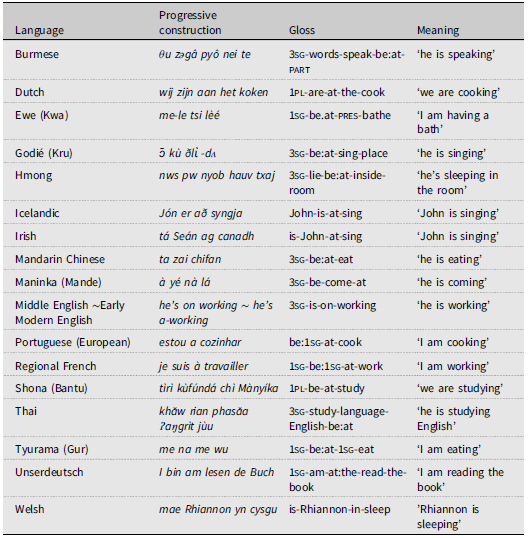
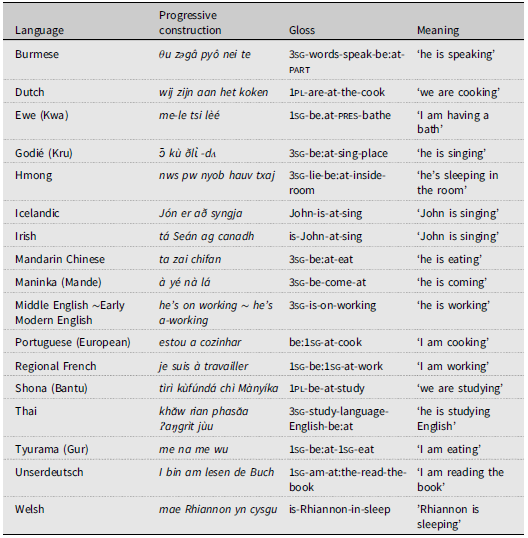
Heine & Kuteva (Reference Heine and Kuteva2002:97–99) list eight languages, including Lingala, Burmese, Thai and Chinese, as having a progressive marker derived from a word or construction with the original meaning of ‘be at’. Additional comparanda for our French periphrasis include the Dutch continuous construction zijn + aan het + V ‘to be at (the) V-ing’, and its Portuguese counterpart estar a + V ‘to be at V-ing’, both textbook examples of the Location Schema. Comrie (Reference Comrie1976:32, 102) gives further examples from Icelandic – Jón er að syngja John-is-at-sing ‘John is singing’ – and Irish – tá Seán ag canadh is-John-at-singing ‘John is singing’ – as well as from the Bantu language Shona: tìrì kùfúndá chì mànyíka we-be-at-study ‘we are studying’. Table 3 provides a non-exhaustive overview with examples from different continents. A more extensive search would no doubt turn up a host of additional examples.
Examples of progressives based on Heine’s (Reference Heine1993) Location Schema ‘to be at X’ in languages from different continents.Footnote 16
More generally, our proposed trajectory is in line with the famous space = time metaphor, whereby spatial expressions are recruited to encode temporal-aspectual relations (e.g. Comrie Reference Comrie1976:103; Hopper & Traugott Reference Hopper and Closs Traugott2003:85). As Bybee et al. (Reference Bybee, Perkins and Pagliuca1994:137) note: “to be located spatially in an activity is to be located temporally in that activity”. In the words of Comrie (Reference Comrie1976:103), “we can refer to some instance of a process by viewing the whole of the situation as if it were spatial” (cf. Pusch Reference Pusch2003 with specific regard to the French progressive periphrases être après + V and être en train de + V).Footnote 17 This metaphorical mapping is, of course, cognitive at its core: speakers conceptualize temporal progression in terms of spatial location. In our French source construction, the inherent overlap between space and time is illustrated by examples such as (10), (15) and (17), which, with the use of spatial indicators, clearly encode ongoing engagement in an activity: in (10), it is inferred that the subject, Marc Lescarbot, is traveling; in (15), the logical subject, the dictionary, is in the process of being written, and in (17), the female protagonist is in the midst of getting dressed and doing her make-up.
4.4. From complex locative predicate n’(en) être qu’à X to preverbal aspect marker ka V
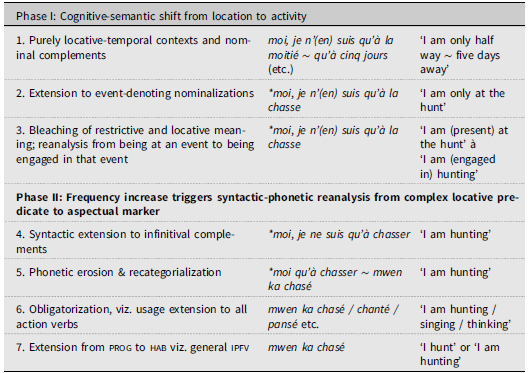
As noted, our proposal differs crucially from existing proposals in that our suggested source construction – n’(en) être qu’à X – did not originally allow verbal complements.Footnote 18 Rather, the X-slot was initially occupied by mainly nominal complements denoting location or distance in space and time. The subsequent shift in the X-slot from locative nominal complements to event-denoting verbal complements is precisely what Heine’s (Reference Heine1993) Location Schema predicts: frequent use of the construction in activity contexts would have triggered reanalysis of the X-slot as an event rather than a place. We may hypothesize that this happened first via nominalizations, then generalizing to verbal complements. As the original static, locative meanings eroded, the construction spread to increasingly more dynamic, non-locative contexts, eventually also allowing verbal complements that imply no location whatsoever (cf. Bybee et al. Reference Bybee, Perkins and Pagliuca1994:292). As a result, the construction’s frequency increased and phonetically redundant material was shed. The perceptually salient qu’à [ka] string remained and was reanalyzed as a preverbal progressive marker, ultimately developing into the portmanteau imperfective marker ka that characterizes Lesser Antillean and Guyanais. Schematically, the development can be captured in two successive phases (Table 4), a semantic shift from location to activity (with complete loss of the original locative meaning), followed by syntactic-phonetic reanalysis, the final steps entailing what Heine (Reference Heine1993) and others have dubbed (de- or) recategorialization, as well as obligatorization. An originally complex predicate has now become a preverbal aspect marker. We furthermore assume that ka would initially have emerged as a progressive marker, with later extension to habitual contexts, thus becoming the general imperfective it is today.Footnote 19
Schematic representation of the path from n’(en) être qu’à + X to ka + V
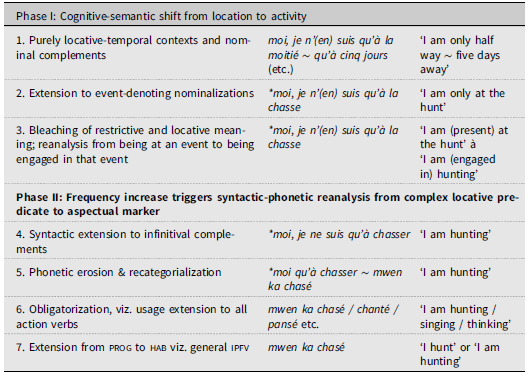
Note. Asterisks indicate constructions that are not grammatical in French and are used here merely to illustrate intermediate stages in the hypothesized grammaticalization pathway.
The fact that modern-day ka does not express physical location is entirely unsurprising. Although in some cases source constructions retain part of their original spatial meaning, the complete loss of original semantic content through the process known as bleaching is perfectly common in grammaticalization,Footnote 20 not least in the development of progressive markers from locative constructions. As Bybee et al. (Reference Bybee, Perkins and Pagliuca1994:25) note: “The change that takes place to derive a progressive meaning is the loss of the spatial meaning” (cf. e.g. Heine Reference Heine1993:54, 55; Hopper & Traugott Reference Hopper and Closs Traugott2003:94, 95).
Whether the n’(en) être qu’à construction had already begun to take infinitival complements in the colonial French variety(/ies) that lexified the ka-creoles, or whether this usage extension occurred within the creolesFootnote 21 themselves, is an interesting question in its own right, but one that is largely moot to understanding the provenance of ka.
In short, mirroring countless languages world-wide, the path from mainstream French n’(en) être qu’à X ‘to be only at X’ into ka +V ‘to be V-ing’ in Lesser Antillean and Guyanais exemplifies the well-known grammaticalization cline where originally locative material loses concrete spatial meaning and becomes a marker of progressive aspect.
4.5. On the importance of phonetic and semantic salience
As to why the creolizers selected the restrictive focus-version n’en être qu’à X as the source construction, and not the plain predicative version être à X, here we agree with the likes of Hazaël-Massieux (Reference Hazaël-Massieux2008) and Fattier (Reference Fattier2008) and others who have pointed out, or at least hinted at, the phonetic/perceptual salience of the restrictive qu’à string.
The importance of perceptual salience and the tendency towards a /CV/ syllable structure in pidginization and creolization are received wisdom (e.g. Holm Reference Holm1988:108-113; Alber & Plag Reference Alber and Plag2001). McWhorter (Reference McWhorter1998 and elsewhere), for instance, has shown that the lack of perceptual salience of certain morphological categories (especially verbal inflection) in the lexifier correlates with morphological losses in the creole. By contrast, source items for creole TMA particles are typically segmentally robust (tending towards the CV(C) or VCV type), tonic, and prosodically independent, making them perceptually attractive targets for recruitment in the formation of pidgins and creoles (see e.g. the forms in Table 1 in Section 4.1).Footnote 22 Other closed-class items give further clues: the hallmark Spanish/Portuguese preposition a ‘at, to’, for instance, did not make its way into any of the Ibero-Romance-lexified creoles, most of which instead opted for the phonetically robust /CV/ form na ‘at, to’.Footnote 23 Similar observations also hold for creole pronouns: here, too, the main criterion for the selection of source material appears to be perceptual salience. It is telling in this regard that across the French-lexicon creoles, the first-person singular pronoun always derives from the tonic form moi, not the unstressed clitic je. In short, the restrictive n’(en) être qu’à construction had major phonological advantages over être à, as the shedding of unstressed material naturally yielded the desired /CV/ syllable structure.
One might ask why, given that many Spanish- and Portuguese-lexicon creoles recruited estar as the source for their progressive markers, French-lexicon creoles did not recruit être. Here, too, the answer may lie in the Location Schema: French être – unlike Iberian estar – is not inherently locative and thus would not have been a natural candidate for reanalysis as a progressive marker. A further factor may be that the (singular) inflected present tense forms of être (/sɥi/, /ɛ/ and /ɛ/) lack what the inflected present tense forms of estar (/(ɨ)’ʃto/, /(ɨ)’ʃtaʃ/ and /(ɨ)’ʃta/) do have: a segmentally robust syllable structure as well as prominent stress.Footnote 24
We propose that the semantic salience of the restrictive construction played a role as well. Already Meillet (Reference Meillet1921:140) noted that the desire to obtain “une expression intense” is a recurrent starting point for grammaticalization cycles, a view that has found broad support in later work.Footnote 25 A textbook example, and arguably a good comparandum for our case, is the development of negation in French: to reinforce the preverbal negator ne, Early Modern French added the emphatic minimizer pas ‘step’ postverbally. As its use increased, ne became optional and pas lost its lexical meaning and emphatic force, ultimately becoming the unmarked postverbal negator in colloquial French (e.g. Haspelmath Reference Haspelmath1999:1062; Van der Auwera Reference Van der Auwera and Horn2010:75–76; Hopper & Traugott Reference Hopper and Closs Traugott2003:32).
A similar analysis can be applied to the development of ka: it helps explain why the restrictive n’(en) être qu’à X was recruited rather than the pragmatically neutral (en) être à X. Although n’(en) être qu’à X is in origin restrictive (being at X and no further), its interpretation in mainstream French is often emphatic, conveying that one is already very close to the relevant endpoint Y, as in Je ne suis qu’à quelques secondes/pas/mètres du bureau. In other words, speakers can (and historically could) use the construction not only to delimit a quantitative point in space or time, but also to underscore imminence and proximity. This emphatic use is already evident in Early Modern French: in sentences such as (8), (11), (12), (14) and (16) in Table 2, the authors could have chosen the neutral (en) être à X without loss of information, yet selected the restrictive variant precisely to foreground proximity to Y.
Together with its phonetic salience, it is precisely this expressive foregrounding potential, rather than restrictiveness per se, that would have made n’(en) être qu’à X a pragmatically attractive input for the development of ka.
5. Final remarks and conclusions
This article has argued that the preverbal imperfective marker ka in Lesser Antillean and Guyanais French Creoles can be plausibly derived from the French locative periphrasis n’(en) être qu’à X ‘to be only at X’. This hypothesis rests on three mutually reinforcing factors:
-
(a) the predominance of lexifier source material in creole TMA formation,
-
(b) the cognitive-semantic suitability and typological ubiquity of the Location Schema, and
-
(c) the phonetic/semantic salience of the source construction.
Unlike previous accounts, most of which focused on syntactic selectional properties, we foregrounded cognitive-semantic motivation as the primary driver of grammaticalization, showing that our suggested pathway fits well within the universally common Location Schema, whereby locative predications are reanalyzed as progressive markers. Phonetic and semantic salience both played a crucial role in making the restrictive version (n’(en) être qu’à X) the more likely candidate for reanalysis, as opposed to the neutral être à X construction.
On the one hand, the development of ka reflects a clear capacity for innovation on the part of the creolizers: to our knowledge, no French dialects anywhere in the world display anything similar to ka in terms of its semantic-syntactic and morpho-phonological properties. On the other hand, the trajectory from n’(en) être qu’à + X to ka + V underscores that creoles are by no means exceptional in their grammaticalization pathways. Rather, they draw on the same cognitive-semantic mechanisms – in this case the locative-to-aspectual pathway – that shape the grammars of non-creole languages. Far from being aberrant, the rise of ka thus illustrates the regularity of creole grammatical change. A parallel can be drawn with the emergence of other grammatical categories in creoles, such as the development of definite and indefinite articles: while innovative with respect to the lexifier, these too follow well-attested cognitive-semantic patterns: word for “one” à indefinite article; demonstrative pronoun à definite article (see, e.g., Velupillai Reference Velupillai2015:368, 369).
Incidentally, our findings give retrospective credit to the scribes who, in eighteenth- and nineteenth-century French Creole texts, represented the aspect marker ka orthographically as <qu’a>. Their choice seems to have reflected not superstratist sentiment, but rather linguistic memory and instinct that accurately captured the marker’s etymological roots.
Note, finally, that we do not discard the possibility that the emergence of ka was reinforced by input from substrate or adstrate languages containing morphemes of similar phonological shape and functional scope. However, while such convergence may have contributed to the stabilization of ka, we maintain that it is not a sine qua non for understanding its development.
Looking ahead, further research should explore the broader sociohistorical context that may have conditioned the divergence between ka-creoles and après-creoles. In particular, colonial demographic patterns – including the distribution of African ethnolinguistic groups, settlement histories, and the relative weight of French dialectal inputs – may help explain why some French-lexicon creoles recruited après while others innovated ka. A fuller integration of linguistic reconstruction with colonial demographic history could yield new insights into the internal ties and variation between these creoles.
Competing interests declaration
The authors declare no competing interests.
Funding information
The contribution of Bart Jacobs to this article was made possible with the help of an OPUS Grant from the National Science Centre Poland, grant number 2019/33/B/HS2/03114. The contribution of Aymeric Daval-Markussen to this article was made possible with the help of the Independent Research Foundation of Denmark, Grant 10.46540/4256-00026B.
Appendix: Imperfective aspect markers in the French-lexicon creoles, including the individual varieties of Lesser Antillean French Creole, in alphabetical order.

 Open access

