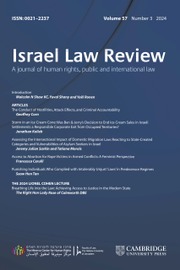


The first issue of the Israel Law Review for 2026 consists of four articles.
The opening article, David Kretzmer’s ‘The West Bank as Occupied Territory: The Irrelevance of the Mandate and the Lack of Jordanian Sovereignty’, considers two arguments raised by the Government of Israel to explain why it does not regard the West Bank as occupied territory and may therefore establish Israeli settlements there. The first is that this territory was not the sovereign territory of another state when occupied by Israel in June 1967; the second is that the trust created by the League of Nations Mandate over Palestine still applies in those parts of Mandatory Palestine that did not become the sovereign territory of another state in 1948. The article argues that in the light of the modern right to self-determination, the law of belligerent occupation may apply in territory that was not previously under sovereign jurisdiction. The article then shows that the mandate system was a compromise between the colonial aspirations of Britain and France and the principle of self-determination propagated by US President Woodrow Wilson. The Mandate did not give rights to Jews or the Jewish people, but merely obligated Britain to carry out its commitment under the Balfour Declaration to create the conditions that ‘will secure the establishment of the Jewish national home’ in Palestine. This obligation ended with the termination of the Mandate and the establishment of the State of Israel, which was the ultimate realisation of a national home for the Jewish people in the land of Israel. Kretzmer argues that even if one were to accept the argument that the trust established by the Mandate continues to apply in the West Bank, in an era in which colonial ideas have been rejected the implication is not that Jewish citizens of Israel have a right to settle there, but that the right of the Palestinian inhabitants of that area to self-determination should be respected.
The second article – ‘The Judiciary in Ukraine and Challenges of Wartime: The Protection of Human Rights in Extraordinary Conditions and Prospects of Restoring Military Courts’ by Olena Ovcharenko, Anatoliy Kozachenko, Roman Kabalskyi and Oleksandr Savchuk – discusses problems and prospects for the resumption of military justice in Ukraine. The research formulates solutions for overcoming the negative consequences for the Ukrainian judiciary of the armed aggression by Russia against Ukraine. These include, for example, the limited institutional and human resources of international tribunals such as the International Criminal Court, and placing on the Ukrainian judicial system the main burden of the investigation and trial of cases. The authors propose to restore the system of military courts in Ukraine, which was ended voluntarily in 2010. This would reduce the pressure on the courts of general jurisdiction and ensure the prompt resolution of hundreds of thousands of cases of compensation for damage caused to individuals and businesses as a result of the hostilities, as well as enabling the conduct of criminal proceedings for military and war crimes.
David Gliksberg, in ‘Converting Narratives and Alleviating Constitutional Inequality through Taxation: Lessons from Conscription Disparities’, explores the potential effect of converting a constitutional narrative into a tax narrative that might help to address constitutional controversy. The article takes as a case study the long-standing and deeply constitutional controversy in Israel about inequality in military conscription. All efforts made over the decades to resolve the conflict or reduce its scope have failed. The article sets up a novel framework by conceptualising mandatory service as a ‘tax in-kind’, proposing a mandatory army tax credit as a tool to alleviate the inequality. The proposed regime leverages a framing effect in order to bridge the tension between Israel’s ‘people’s army’ ethos and the growing inequality. The article’s insights would apply to any country with mandatory military service facing issues of inequality, and tackles the question of whether conscription controversies should be addressed solely through constitutional narratives or through tax narratives as well? In addition, the approach of the article challenges traditional tax perspectives and public policy by incorporating non-monetary obligations into the tax discourse.
The fourth and last instalment in this issue is ‘Bending the Rules: On Large Language Models and Content Moderation’ by Renana Keydar, Noa Mor, Yuval Shany and Omri Abend. This article examines the transformative impact of large language models (LLMs) on online content moderation, revealing a critical gap between platforms’ rule-based policies and their AI-driven enforcement mechanisms. Using Facebook’s hate speech moderation policies and practices as a case study, the article argues that while content policies are increasingly rule-oriented, AI-driven enforcement seems to operate in a standard-like manner. This disconnect, they argue, creates transparency, consistency and accountability challenges relating to the delineation of online freedom of expression. The authors introduce the concept of ‘rules by the millions’ to describe how AI systems actually operate through generating vast networks of micro-rules that evade traditional regulatory oversight. This phenomenon disrupts the conventional rules-versus-standards framework used in legal theory, raising urgent questions about the adequacy of current AI governance mechanisms.
We close this introduction with the happy announcement that the 2025 Israel Law Review Prize goes to Dr William Thomas Worster for his article `Assurances on the Use of Exported Arms in the Gaza Conflict’, published in issue 58(2–3). The article offers a careful and meticulous analysis of how assurances relating to arms exports have been operationalised under the Arms Trade Treaty, and applies these criteria to the specific case of the US export of arms to Israel. The editors commended the article for its originality and carefully crafted nature, critical analyses, and extensive research into different fields of international law. Congratulations, Will!
We wish all our readers an interesting and instructive read.

 Open access

