


1. Introduction
Generative AI technologies have introduced new possibilities for design, allowing designers to interact with algorithms to generate images, text, and prototypes based on human prompts (Reference Subramonyam, Thakkar, Ku, Dieber and SinhaSubramonyam et al., 2025). AI tools can facilitate ideation, divergent thinking, and visual exploration and support both novice and professional designers in overcoming creative blocks and exploring more alternatives (Reference Akverdi and BaykalAkverdi & Baykal, 2024; Reference Ho, Liu, Qiu and YangHo et al., 2024; Reference Li, Li, Yan, Yang and DingLi et al., 2024). However, this integration of AI in design processes has also raised concerns about authorship, originality, and human creativity (Reference GünayGünay, 2024). Designers’ attitudes to AI have been various from enthusiasm for efficiency to anxiety about losing the control of design processes (Reference AnyatasiaAnyatasia, 2023; Reference Mao, Rafner, Wang and ShersonMao et al., 2024). These contrasting experiences suggest that the use of AI tools in design areas depend on both AI functionality and motivations and attitudes of designers toward them. Motivation refers to the internal drive that initiates and sustains goal-directed behavior (Reference Cox and KlingerCox & Klinger, 2011). In the context of AI, motivation reflects both the curiosity to explore intelligent systems and the desire to improve efficiency or creative outcomes. When users interact with AI tools, their engagement is often driven by a mixture of intrinsic motives, such as enjoyment and interest, and extrinsic motives, such as productivity or recognition. Studies based on Self-Determination Theory (SDT) showed that motivations were related to fulfilment of autonomy and competence. When AI systems give users a sense of control and enhance their capability, motivation tends to grow, while when they limit creative agency, motivation and satisfaction decline (Reference ChiuChiu, 2024; Reference Huang and MizumotoHuang & Mizumoto, 2024). Some researchers have drawn on Uses and Gratifications Theory (U&G) to explain that people adopt Generative AI to satisfy diverse needs-seeking as it is practical and efficient and can enhance inspiration and self-expression (Reference Kang, Choi and KimKang et al., 2024). Building on these insights, Technology Continuance Theory (TCT) suggests that when motivations are met, users experience increase in satisfaction and confirmation, which in turn increases their intention to continue using the technology (Reference BhattacherjeeBhattacherjee, 2001). Therefore, motivation is a dynamic process that connects users’ perceptions of technology with their emotional responses and sustained engagement. Some recent studies have investigated detection of what is the motivation of designers in adoption and continued use of AI in design processes. Reference Li, Li, Yan, Yang and DingLi et al. (2024) conducted a quantitative survey among Generation Z designers and art students to examine how perceived usefulness, enjoyment, and trust influence intention to use AI in art and design tasks. Their results indicated that both cognitive beliefs (usefulness and trust) and affective experiences (enjoyment) can significantly predict adoption intention. However, this study focused on initial intention and did not consider designers’ post-adoption experiences such as satisfaction or continued use. The participants were also predominantly students, which limits the generalizability of the findings to professional design practice. In contrast, Reference AnyatasiaAnyatasia (2023) carried out a qualitative exploratory study with professional creatives using text-to-image AI systems (Midjourney and Stable Diffusion). Through semi-structured interviews, the study identified playfulness, inspiration, and usefulness as the dominant motivators behind AI adoption in design processes. Also, it pointed out that designers considered AI as a partner that can support experimentation and idea generation, improve efficiency, and overcoming technical barriers. However, this study relied on a small sample and self-reported perceptions, which provided rich descriptions but no quantitative evidence on these motivations. Similarly, Reference Akverdi and BaykalAkverdi and Baykal (2024) used an interview-based qualitative approach to explore designers’ perceptions on AI’s role in creative processes. Their results recognized AI’s potential to accelerate ideation and diversify visual outcomes, but also expressed concerns about originality, authorship, and creative dependency. Although this study provided insights into designers’ negative views toward AI, it lacked a systematic framework to measure motivation and did not empirically test the relationships between motivation, attitude, or behavioral intention. Based on these, Reference Mao, Rafner, Wang and ShersonMao et al. (2024) proposed the Hybrid Intelligence Technology Acceptance Model (HI-TAM) and combined a survey and interviews to examine designers’ willingness to collaborate with AI in co-design processes. Quantitative analysis showed that perceived partnership, transparency, and control positively predicted collaboration intention, while qualitative findings further explained designers’ expectations of agency and trust in hybrid design contexts. However, this study primarily focused on collaboration factors rather than the motivational structure. Reference Kim and KimKim and Kim (2025) conducted an online survey among 287 South Korean designers and combined U&G with the TPB to model designers’ decision-making process in adopting generative AI tools. Their model focused on planned-behavior constructs (attitudes, subjective norms, perceived behavioral control, intention to use, and actual usage). The results showed that attitudes and subjective norms significantly predicted intention, which in turn predicted actual usage. The study further highlighted the importance of social influence in shaping adoption and continuous engagement, particularly in professional settings. However, this work primarily conceptualized motivation at a broad level and emphasized the intention-to-behavior pathway, rather than providing a scale-based, multidimensional motivational structure and testing how distinct motivation dimensions jointly relate to post-use evaluations such as satisfaction and continuance intention. In summary, existing studies have helped explain designers’ motivations to adopt and continue to use AI tools from both positive (usefulness, enjoyment, and inspiration) and negative (authorship, dependency, and loss of novelty) perspectives. However, most studies were either qualitative or limited to adoption intention, which lacked comprehensive and scale-based examination of how motivations jointly shape post-design evaluations (designers’ attitudes, satisfaction, and continuance intention toward) of Generative AI in AI-assisted design processes. Therefore, this study aims to (i) identify the motivations (Personal Identity, Conformity, Life Efficiency, and Information) of designers in using Generative AI tools during design processes, and (ii) examine the relationships between designers’ motivations (Personal Identity, Conformity, Life Efficiency, and Information) and post-design evaluations of AI usage (attitudes toward AI, satisfaction with AI-assisted design, and continuance intentions of using Generative AI) in AI-assisted design processes.
2. Methodology
To address the research questions, a quantitative questionnaire study was conducted.
2.1. Participants
100 design-background participants (57 males, 43 females, aged between 18 to 48 (Mean = 33.76; SD = 7.71) were recruited. All of them have experience in using AI (image-based (such as Midjourney and Stable Diffusion) and/or text-based Generative AI (such as ChatGPT and DeepSeek) in design processes within one year. It is notable that the research aims require participants to have first-hand experience with AI-assisted design rather than hypothetical judgments (who do not have experience in using AI in design). Therefore, we recruited participants who have experience in using AI in design instead of these who have not used AI in design processes. We did not exclude the participants who used Generative AI but discontinued or were dissatisfied as they still belonged to the participants who have experience in using AI in design processes category. 8% participants reported that they used AI in design processes every time of their design. 39% participants reported that they used AI in design processes nearly every time of their design. 29% participants reported that nearly half of their design processes will use AI. 16% participants claimed that they occasionally use AI in their design processes. 8% participants reported that after the first attempt on using AI in design processes, they never used AI again in design processes. Most participants reported that they used both text- and image-based Generation AI in design (41%), followed by text-based Generation AI in design (35%) and image-based Generation AI in design (24%). It is notable that in the questionnaire participants reported their motivations in using AI during design process. Therefore, all the results were based on design processes, instead of casual and occasional use.
2.2. Methodology
The questionnaires adapted existing scales to ask participants to report their motivations in using AI during design process, and their post-design evaluations of AI usage, especially their attitudes toward AI, satisfaction with AI-assisted design, and continuance intentions to use Generative AI in AI-assisted design processes. To evaluate the motivation of participants in using AI in design processes, this study adapted the scales from Reference Choi and DrumwrightChoi et al. (2021). Our motivation measures were grounded in the uses-and-gratifications tradition for technology use and were specifically developed and validated for AI-assistant interactions. Reference Choi and DrumwrightChoi et al. (2021) identified and validated a multidimensional motivation structure (Personal Identity, Conformity, Life Efficiency, Information) for using AI-based assistants, and further demonstrated that these motivations are meaningfully associated with post-consumption evaluations and behavioral intentions (Attitude, Satisfaction, and Continuance intention). This prior evidence supports both the relevance of these motivation dimensions in technology use contexts and their suitability for studying continuance-related outcomes in AI-assisted interactions. A 7-point Likert-scale (1 = strongly disagree, 7 = strongly agree) were used to report motivation, including four motives categories: Personal Identity (five items), Conformity (four items), Life Efficiency (four items), Information (four items). These 17 statements reported reasons why people use AI assistant in design processes. The details of each item is listed in Table 1 (Section 3).
Motivation, attitude, satisfaction, and continuance intention of using AI in AI-assisted design processes. Reliability testing was included to ensure that the motivation and evaluation constructs were measured consistently before drawing design-relevant inferences

Table 1 Long description
A table with 17 rows and 5 columns. The columns are labeled Indexes, Item, Mean, SD, and Median. The table is divided into four main categories: Motivation, Attitude, Satisfaction, and Intention. Each category contains several items with corresponding mean, standard deviation (SD), and median values. The Motivation category includes Personal Identity, Conformity, Life Efficiency, and Information, each with specific items listed under them. The Attitude category measures attitudes toward AI, the Satisfaction category measures satisfaction with AI-assisted design, and the Intention category measures continuance intentions to use Generative AI in design processes. Each row provides detailed values for the mean, SD, and median for each item.
Post-design evaluations of AI usage in design were divided into three conditions: Attitudes toward AI (Attitude), satisfaction with AI-assisted design (Satisfaction), and continuance intentions of using Generative AI (Continuance intentions) in AI-assisted design processes. Evaluation of Attitude, Satisfaction, and Continuance intentions were adapted from Reference Choi and DrumwrightChoi et al. (2021). The 7-point Likert-scale (1 = strongly disagree, 7 = strongly agree) was used, including three statements for Attitude, four statements for Satisfaction (four items), and three statements for Intention (three items). If participants think the statement is not applicable, they can mark the sentence as Score 0 which means not applicable. The items were positive-framed items and excluded downsides in design work (such as hallucinations, bias, and confidentiality concerns). However, one of the aims of our study is to examine post-use evaluation in terms of overall acceptance-related responses (attitude, satisfaction, and continuance intention), and we therefore adopted validated measures from prior literature (Reference Choi and DrumwrightChoi et al., 2021). These constructs were widely used to report users’ evaluative responses and are not intended to provide a comprehensive assessment of all potential risks or negative impacts. Including risk- or harm-related constructs (such as hallucinations, average outputs, bias, confidentiality concerns) would expand the model from an evaluation framework to a broader ethics framework, which would require additional theoretical grounding, hypotheses, and validation that are beyond the scope of the research. In addition, these positive items were adapted from prior literature (Reference Choi and DrumwrightChoi et al., 2021), adding ad hoc negative-framed items to an established scale could compromise scale coherence and comparability with prior work, and may introduce measurement non-equivalence. However, we need to admit that using predominantly positively framed items may limit the instrument’s ability to capture negative or ambivalent experiences and may introduce one-sided operationalisation. In the future, more research can be conducted to extend the measurement to include complementary constructs such as such as hallucinations, average outputs, bias, and confidentiality concerns. The detail of each item is listed in Table 1 (Section 3).
2.3. Protocol
The questionnaire was delivered online through Qualtrics. After agreeing to participate in the study, participants first need to finish the demographic session of the questionnaire which included their gender, age, and frequency of using AI in design processes. Those who have no experience in using AI in design processes were excluded and finally 100 participants filled the full questionnaire. We set the demographic in the beginning because we needed to filter these who have experience in using AI in design processes as participants. However, we admit that asking demographic questions at the start of a questionnaire can make participants’ social identities more salient and may subtly shape how they respond to later questions (Reference Steele and AronsonSteele & Aronson, 1995).
Then, participants were asked to base on their conditions in AI-assisted design to answer a 7-point Likert-scale (1 = strongly disagree, 7 = strongly agree) to report their motivation in using AI (17 items for four motives), attitude in using AI in design processes (three items), satisfaction with AI-assisted design (four items), and their continuance intentions in using AI design processes (three items).
In the questionnaire, we did not provide a single fixed prompt set or design scenario; instead, participants were instructed to answer the items based on their own prior experiences of using Generative AI tools during design processes. This was out of consideration that the aim of this study is to capture general and cross-context motivations for using generative AI in design processes, rather than motivations tied to a specific task. Allowing participants to respond based on their own prior experiences increases ecological validity, reflecting how AI tools are used in real-world design work across different stages and contexts. In the questionnaire, we did not provide a single fixed prompt set or design scenario; instead, participants were instructed to answer the items based on their own prior experiences of using Generative AI tools during design processes. This was in consideration that the aim of this study is to capture general and cross-context motivations for using generative AI in design processes, rather than motivations tied to a specific task. Allowing participants to respond based on their own prior experiences increases ecological validity, reflecting how AI tools are used in real-world design work across different stages and contexts. However, we concede that, without standardized examples, participants may have interpreted “AI in co-design” in diverse ways, which could introduce additional variance and potentially influence the observed motivational patterns.
3. Results
To answer RQ1, we assessed the measurement quality of the motivation and evaluation scales (reliability and descriptive statistics). To answer RQ2, we examined the associations between motivation dimensions and post-design evaluations using correlation and partial-correlation analyses. We then estimated unique associations using multiple regression models, allowing us to understand whether particular motivations remain related to attitude, satisfaction, and continuance intention when accounting for overlap among motivations. These analyses move from describing what motivates designers to use Generative AI in design process (RQ1) to testing how these motivations relate to designers’ post-use evaluations (RQ2).
3.1. Motivation in using AI in design processes
The results enabled analysis of the motivations of participants in using Generative AI in AI-assisted design processes. Each motive (Personal Identity, Conformity, Life Efficiency, and Information) was calculated by the average of its related items. Participants reported a similar level among motives for using Generative AI in AI-assisted design processes (Table 1), with 4.52 (SD = 1.39; Median = 4; Item-level means ranged from 4.40 to 4.70) for Personal Identity, 4.47 (SD = 1.43; Median = 4; Item-level means ranged from 4.40 to 4.54) for Conformity, 4.44 (SD = 1.40; Median = 4; Item-level means ranged from 4.37 to 4.54) for Life Efficiency, and 4.49 (SD = 1.42; Median = 4; Item means ranged from 4.40 to 4.55) for Information. The mean of overall motivation for using AI in AI-assisted design was 4.48 (SD = 1.41).
3.2. Relationships between motivations and post-design AI usage evaluations
The relationships between the four motivations for using AI in AI-assisted design process and post-design AI usage evaluations (Attitude, Satisfaction, and Continuance Intention) were investigated. Each post-design AI usage evaluation index was calculated by the average of its related items (Table 1). Attitude-related items showed mean scores between 4.41 and 4.51, with an overall mean of 4.46 (SD = 1.43). Satisfaction-related items ranged from 4.40 to 4.66, with an overall mean of 4.52 (SD = 1.52). Continuance Intention-related item means ranged from 4.42 to 4.51, with an overall mean of 4.45 (SD = 1.41).
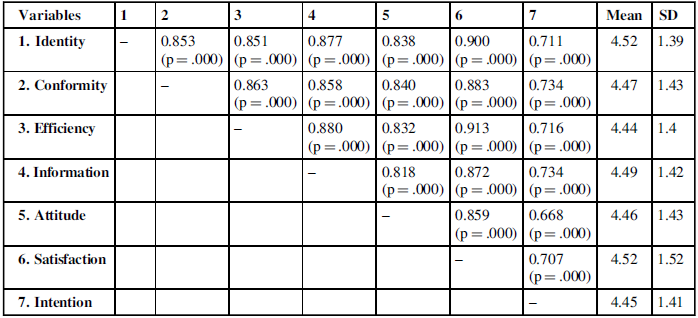
Partial-correlation analyses were used to map which motivational facets were associated with designers’ post-use evaluations. After controlling for gender and AI usage frequency, all four motives displayed strong positive partial correlations with designers’ attitudes (rs = 0.82 – 0.84, ps < 0.001), satisfaction (rs = 0.87– 0.91, ps < 0.001), and continuance intention (rs = 0.71– 0.73, ps < 0.001). The full partial correlation is shown in Table 2. It is notable that in this study, partial correlation reported associations between a given motivation and a post-use evaluation while controlling for the other motivation dimensions. Motivations capture why designers choose to engage with AI, while post-design evaluations reflect how they appraise the outcomes and experience after using AI. Therefore, a high motivational score does not automatically translate into positive evaluations. Designers may be strongly motivated to try or adopt AI but still report neutral or even negative attitudes and satisfaction if the tool’s output quality, controllability, reliability, or fit with their workflow does not meet expectations. Because Table 2 reports partial correlations to test whether and how specific motivations are associated with post-design evaluations after controlling for the other motivation dimensions, rather than assuming a deterministic or self-fulfilling relationship, motivations and evaluations represent two distinct construct domains, and the observed associations indicate patterned relationships in the data. It is not that motivation necessarily leads to positive attitudes, satisfaction, or continuance intention. As for multicollinearity, we examined multicollinearity diagnostics in our regression models. The VIF values ranged from 2.11 to 8.53, which is below the commonly used threshold of 10, suggesting that multicollinearity was present but not at a level that would invalidate the regression results. Therefore, we interpret the regression coefficients as estimates of unique associations conditional on the other motivations.
Partial correlation results among motivations (personal identity, conformity, life efficiency, and information) and post-design AI usage evaluations (attitude, satisfaction, continuance intention)

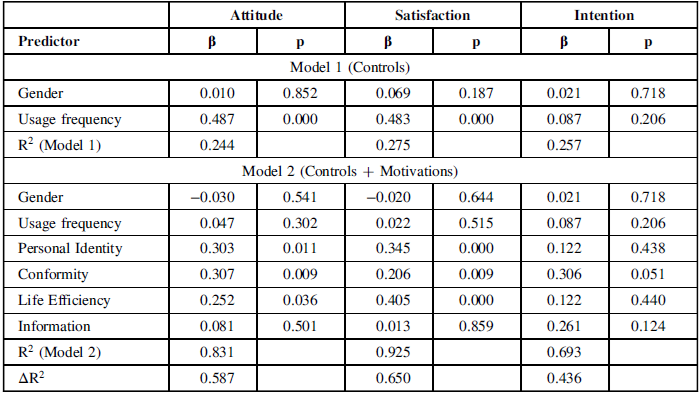
Regression analyses were then used to estimate which motivations remain uniquely associated with attitude, satisfaction, and continuance intention when controlling for participant and usage background. To be specific, hierarchical multiple regression analyses (Table 3) were conducted to detect the relative effects of the four motives (Personal Identity, Conformity, Life Efficiency, and Information) on designers’ post-design AI usage evaluations. Three dependent variables (Attitude, Satisfaction, and Continuance intention) were respectively regressed on the motives, while controlling for gender and AI usage frequency. Multicollinearity was assessed using the variance inflation factor (VIF). VIF values ranged from 1.02 (gender) to 8.53 (information motivation). Although the VIFs for the motivational predictors were relatively high, they remained below the lenient threshold of 10 that was often used to indicate severe multicollinearity (Reference Alauddin and NghiemAlauddin & Nghiem, 2010).
Hierarchical regression analyses predicting post-use evaluations

In each regression, Block 1 included the control variables gender and usage frequency (Model 1), while Block 2 added the four motives (Model 2). For attitude, Model 1 explained 24.4% of the variance, while Model 2 explained 83.1% of the variance, which indicated a substantial increase when motivational variables were entered. In Model 2, Personal Identity (β = 0.30, p = 0.011), Conformity (β = 0.31, p = 0.009), and Life Efficiency (β = 0.25, p = 0.036) were significant and positive predictors of designers’ attitudes toward using Generative AI in AI-assisted design process, while Information motives were not significant (β = 0.08, p = 0.50).
For satisfaction, Model 1 accounted for 27.5% of the variance, while Model 2 explained 92.5%, which showed a large improvement when motivations were added. In Model 2, Personal Identity (β = 0.35, p < 0.001), Conformity (β = 0.21, p = 0.009), and Life Efficiency (β = 0.41, p < 0.001) were significant and positive predictors of satisfaction, while Information motivation was non-significant (β = 0.01, p = 0.86).
For continuance intention, Model 1 explained 25.7% of the variance, a while Model 2 explained 69.3%. In Model 2, none of the motives were significant (Personal Identity: β = 0.12, p = 0.44; Life Efficiency (β = 0.12, p = 0.44; Conformity: β = 0.31, p = 0.051; Information: β = 0.26, p = 0.12), which means these motives were not predictors of continuance intention.
4. Discussion
This study aims to detect how designers’ motivations (personal identity, conformity, life efficiency, and information) for using Generative AI in human–AI co-design processes were related to post-design evaluations of AI (attitudes, satisfaction, and continuance intention) in AI-assisted design. The findings provided converging evidence that designers’ motivations were associated with how positively they evaluated AI after actual use.
4.1. Explanation of results
In this study, designers reported positive motivation across all four motives (M = 4.4 – 4.5). This suggests that designers were motivated to use Generative AI for efficiency, information-seeking, self-presentation, and social context. These results were aligned with previous studies which suggested that designers adopt AI for a mix of expressive, social, and practical reasons (Reference Ho, Liu, Qiu and YangHo et al., 2024; Reference Li, Li, Yan, Yang and DingLi et al., 2024). However, previous research mainly emphasized the dominance of functional or efficiency motivations in technology adoption (Reference Venkatesh and DavisVenkatesh & Davis, 2000), while our study argued that no single motive outweighing the others. This suggested that in design practice, motivations for using Generative AI were evenly distributed, which may reflect the broader integration of AI across all stages of design processes (Reference Saadi and YangSaadi & Yang, 2023).
Designers’ post-design evaluations of AI were positive (M = 4.4 – 4.5), which supported the potential of Generative AI in integrating into design processes. This was consistent with studies which reported a mixture of optimism and caution toward AI (Reference Akverdi and BaykalAkverdi & Baykal, 2024; Reference Mao, Rafner, Wang and ShersonMao et al., 2024). However, the relatively moderate levels observed in this study differ from prior findings in general consumer AI contexts where users report higher satisfaction and stronger continuance intentions (Reference Choi and DrumwrightChoi & Drumwright, 2021). One possible explanation was that designers faced unique concerns about creativity and authorship, which may block positive evaluations even when AI provides meaningful assistance during the design process.
At the bivariate level (controlling for gender and AI usage frequency), the four motives were statistically significant and positively associated with attitudes, satisfaction, and continuance intention of using AI in AI-assisted design processes (rs = 0.71 – 0.91, ps < 0.001). These results indicated that designers who were more motivated to use AI in design tend to evaluate AI more positively and express stronger intentions to keep using it. This finding supported theoretical models, such as SDT, U&G, and TCT, that link motivation to positive affects and sustained engagement (Reference BhattacherjeeBhattacherjee, 2001; Reference Deci and RyanDeci & Ryan, 2000). However, this study also brought new insights. When considering the four motives simultaneously, only personal identity, conformity, and life efficiency can significantly predict attitudes and satisfaction. Although information motives showed a strong bivariate correlation, it did not significantly predict post-design evaluations of using AI. This finding differed from prior research where information-seeking has been considered as a determinant of AI use in other domains (Reference Kang, Choi and KimKang et al., 2024). One possible explanation is that, in design, access to information may already be ubiquitous through other tools, making information less distinctive in shaping designers’ post-use evaluations.
The hierarchical regression analyses showed a more differentiated pattern when the motives were considered together. When gender and AI usage frequency were controlled in Block 1 (Model 1) and the four motives were added in Block 2 (Model 2), personal identity, conformity, and life efficiency emerged as significant and positive predictors of attitude and satisfaction, whereas information motivation did not significantly predict either outcome. For continuance intention, none of the motivational dimensions reached statistical significance (ps > 0.05). This results on continuance intention contrasted with TCT-based studies, which supported a link between motivation and continued use (Reference BhattacherjeeBhattacherjee, 2001). This different result suggested that designers’ decisions to continue using AI may depend more on experience, perceived creative control, or broader cultural and professional background than initial motivations alone. In other words, although motivations strongly influence how designers felt about AI, they may not be sufficient to determine whether designers will commit to AI as a long-term design partner.
In summary, the statistical analyses move the contribution from separated claims about Generative AI use to evidence-based design insights. Firstly, the descriptive and reliability analyses establish that the motivation and evaluation constructs were measured consistently in this sample, which provides a defensible basis for interpreting motivations of using Generative AI in design processes. In addition, the correlation and partial-correlation analyses map which motivational facets co-occur with more positive post-use evaluations, showing that designers’ engagement with Generative AI is not driven by a single reason but by multiple motivational pathways. This advances design practice by indicating that a “one-size-fits-all” tool or workflow is less likely to serve all designers equally. Moreover, the regression analyses estimate unique associations, helping identify which motivational facets remain informative when designers hold multiple motivations simultaneously. Practically, these results translate into actionable guidance for AI-assisted design: identity-oriented users are likely to value controllability, iteration, and support for authorship, while efficiency-oriented users are more likely to prioritise workflow integration, reliability, and reusable productivity features.
4.2. Theoretical implications
Theoretically, this study extended motivation research on AI beyond general technology adoption into the human–AI co-design context. It showed that motivation structures adapted from everyday AI use (Reference Choi and DrumwrightChoi & Drumwright, 2021)(personal identity, conformity, life efficiency, and information) can also be applied to Generative AI in design and was reliable for design-background participants. This further supported the views that designers’ motivations to use AI are multi-dimensional, combining self-related, social, practical, and informational aspects rather than a single factor. Secondly, the findings empirically supported SDT and U&G, where motivations were tightly linked to post-use attitudes and satisfaction. In this study, the results revealed that stronger identity, social, and efficiency motives were associated with more favorable evaluations of AI used in real design contexts. At the same time, the regression results highlighted that different motives may carry different explanatory weight. Identity and efficiency motives were central for how AI is evaluated, instead of information motives. In addition, the differences between strong correlations and the lack of significant prediction for continuance intention suggested to a more complex relationship between motivation and long-term engagement in using Generative AI in design processes. This is consistent with TCT, which emphasises the role of satisfaction and confirmation in bridging initial motivation and continued use. The present findings suggest that, in human–AI co-design, continuance intention may depend on initial motivations, experiences, and concerns about authorship or creativity.
4.3. Practical implications
Practically, the results provide insights for the design of human-centered AI tools and design education. The importance of identity and efficiency motives in predicting attitudes and satisfaction implies that AI systems for designers should go beyond optimising speed and functional performance. Instead, it also needs to support designers’ sense of professional identity and interfaces and workflows that enhance authorship and creative control may motivate designers using AI in design process. In addition, the significant role of conformity motives for satisfaction suggests that social context and communication around AI adoption also important. Creating spaces where designers can share experiences may enhance the perceived legitimacy and emotional reward of using AI tools in design processes. Finally, the weak prediction of motivation for continuance intention indicated that sustaining long-term engagement with AI in AI-assisted design may require more than increasing motivation. Policies and tools that can address concerns about over-reliance, ethical use, and the impact on originality may be necessary to translate initial enthusiasm into stable and sustainable use patterns in design practice.
4.4. Limitations and future research
This study has some limitations. Firstly, the study relied on 100 design-background participants. Although all participants had experience using AI in design processes, the sample size and composition may not fully represent the broader design community, which may limit generalisability. Future work could include larger and more diverse samples or design case studies to further detect how motivations and evaluations of AI evolve over time in design processes. In addition, the measures were based on self-report, which may include individual bias. In future studies, behavioural indicators such as actual AI usage logs, design performance, or peer assessments could be used to detect attitudes and intentions of designers after using AI in design processes. Moreover, the post-design evaluations of AI usage in design were based on positive statement. This questionnaire is adopted from Reference Choi and DrumwrightChoi et al. (2021), which can support the validity of statements in our questionnaire. Also, the questionnaire was based on the 7-point Likert-scale (1 = strongly disagree, 7 = strongly agree), which can reduce the positively worded bias. However, we concede that relying mainly on positively worded agreement statements may risk one-sided operationalisation and may under-capture negative or ambivalent evaluations. In the future more studies can be done to further validate the effect of positively worded bias in this questionnaire. Also, the study recruited participants who have experience in using AI in design processes. This recruitment ignored the designers who reject using AI in design processes and have no experience in using AI in design process, which may bring bias on the findings. In the future the results also need to be validated among designers who reject to use AI in design processes and have no experience in using AI in design processes. It is notable that this study did not collect duration of using AI in a design process as our study is to detect the motivation of using AI in design processes instead of duration. Also, this study did not collect “what tasks/stages of the design process GenAI supports” as this is out of our research aims. These are research questions that are worthy of future research.
5. Conclusions
This study provides a quantitative study to understand designers’ motivations (Personal Identity, Conformity, Life Efficiency, and Information) in the use of Generative AI in human–AI co-design and their relationships with post-design evaluations of AI (Attitude, Satisfaction, Continuance Intention). Based on the study, designers’ personal identity, conformity, and efficiency were motives that associated with their attitudes, satisfaction, and intentions to continue using AI, while information motivations played a less significant role. At the same time, continuance intention was not predicted by motivations, suggesting that long-term engagement with AI in design was influenced by broader perspectives. The findings enhanced the importance of understanding designers’ motivations in using AI when developing Generative AI tools and pointed out the need for human-centered AI systems which can support efficiency, identity, agency, and sustainable creative practice.


 Open access

