


Introduction
Social and sustainable initiatives generally start small, but some of them manage to create an enormous impact when they scale. Research has shown that local initiatives can form the starting point for processes of transformation by bringing in new ideas and generating public support (Doberstein Reference Doberstein2016; Bason Reference Bason2010; Fung Reference Fung2015; Geuijen Reference Geuijen2014; Cloutier et al. Reference Cloutier, Joerin, Dubois, Labarthe, Legay and Viens2015). These initiatives may also have an impact on policies and even transform national and international systems (Seyfang and Smith Reference Seyfang and Smith2007). At the moment, however, our academic knowledge of scaling these initiatives is limited.
There are well-known examples of successful scaling such as the Alzheimer Café and the Instock Restaurant. At the Alzheimer Café, families meet peers, professionals and students in an informal setting. It started in The Dutch city of Leiden in 1997, and at the moment there are 230 Alzheimer Cafés in the Netherlands. The idea has been picked up in other countries as well. The Instock restaurant prepares high-quality meals from wasted ingredients. In 2015, four ambitious employees of a big supermarket in the Netherlands started it, and meanwhile, they have not only increased the number of restaurants, but also put food waste on the political and public agenda. These examples are highly interesting, but an academic understanding of these successful forms of scaling is lacking.
Scaling local initiatives turns out to be rather difficult (Hermans et al. Reference Hermans, Roep and Klerkx2016). How, why and under what conditions initiatives scale are important questions, but academic knowledge is limited and fragmented. In addition, this subject is researched in different academic domains with their own terms and jargon. A systematic review on the literature of the scaling process of social and sustainable initiatives is needed to develop a better and more precise understanding of this process in different areas.
Systematic reviews are based on systematic methods (Tranfiels et al. Reference Tranfield, Denyer and Smart2003) and aim to gather, evaluate and synthesize all studies on a topic (Popay Reference Popay2005). They also identify the gaps in the literature to help further scientific knowledge (Kitchenham Reference Kitchenham2004). Despite their complex and time-consuming nature (Mills et al. (Reference Mills, Montori, Ross, Shea, Wilson and Guyatt2005), systematic reviews are of key importance since they contribute to the academic literature and also be a methodological advance for the field.
The present literature review aims to answer the research question: How and why do social and sustainable initiatives scale? This paper aims to build a framework that synthesizes the state-of-the-art of the fragmented literature in an accessible manner. It provides the basis for research into the scaling mechanisms of initiatives that start bottom-up by presenting the state-of-the-art knowledge on this topic (what do we know and where are the gaps) and by providing the conceptual understanding that is needed to study this topic.
Central Concepts, Search Terms and Definitions
Central Concepts
A literature review of scaling processes of local initiatives is complicated in view of the variety of terms and concepts that are being used to refer to the same or similar processes, in different areas. To get more focus, we distinguished four central concepts—(1) actor characteristics, (2) strategic choices, (3) institutional factors and (4) impact—based on the literature on strategic management (Trau Reference Trau2017; Eshima and Anderson Reference Eshima and Anderson2017; Kraus and Rigtering Reference Kraus and Rigtering2017) and environmental issues (Hossain Reference Hossain2016; Martiskainen Reference Martiskainen2017; Seyfang and Longhurst Reference Seyfang and Longhurst2013a). The four concepts refer to choices to be made by actors or organizations acting in a certain context, with the aim to increase their impact.
Search Terms
The systematic review was an iterative process that we used to specify the central concepts in more detail. At the start of our research, we thoroughly considered what search terms cover our main interest the best. Selecting search terms turned out to be more complicated in view of the variety of terms that are being used to express ‘local initiatives’. An initial exploration of these terms helped to select our search terms for the literature review.
The term ‘bottom-up initiatives’ is often used as an umbrella term to express initiatives that start locally. This umbrella term, however, is not used as much as the underlying, more specific terms. A systematic review of grassroots innovation literature showed that almost all articles were published in journals that focus on the environmental research areas (Hossain Reference Hossain2016). Grassroots innovation would therefore only cover the sustainable initiatives in our review and provide limited information about scaling of social initiatives.
We considered ‘social enterprise’ as search term. However, following the definition of social enterprise in Roy et al. (Reference Roy, Donaldson, Baker and Kerr2014) as ‘business with social objectives whose surplus revenue is reinvested for these purposes’, we would have excluded other forms of social entrepreneurial behaviour, for example by employees or individual citizens. We follow Becker et al. (Reference Becker, Kunze and Vancea2017) who have combined the literature on community energy (grassroots innovation) with that of social entrepreneurship and found this fertile ground for mutual advancement. By including the concept social entrepreneurship, we not only covered the social initiatives, but also enriched the literature on grassroots innovation. In order to check whether we did not omit relevant literature on specific geographical areas or research domains by selecting ‘social entrepreneurship’ as our search term, we compared this term with ‘social enterprise’. In the period which our research covers, we did not find a difference between these two terms, neither geographically nor in research area.
In brief, besides ‘bottom-up’, we include two search terms that represent social and environmental initiatives more specifically: grassroots innovation and social entrepreneurship. We searched on these terms AND ‘scaling’.
Definitions
Grassroots innovation is seen as a bottom-up process that focuses on the creation of public value. Seyfang and Smiths’ (Reference Seyfang and Smith2007) definition of grassroots innovation is widely used in the literature:
(…) networks of activists and organizations generating novel, bottom-up solutions for sustainable development, solutions that respond to the local situation and the interests and values of the communities involved. (Seyfang and Smith Reference Seyfang and Smith2007, p. 585).
Although a clear definition of social entrepreneurship is still missing, they share the dual focus on economic goals and their social challenges (Becker et al. Reference Becker, Kunze and Vancea2017; Zahra et al. Reference Zahra, Gedajlovic, Neubaum and Shulman2009; Santos Reference Santos2012; Smith and Stevens Reference Smith and Stevens2010). Some authors also refer to environmental challenges (Becker et al. Reference Becker, Kunze and Vancea2017).
Scaling is defined as ‘increasing the impact a social (or sustainable)-purpose organization produces’ (Dees 2008, p. 18 in Smith et al. Reference Smith, Kistruck and Cannatelli2016). However, the literature provides many different perspectives on scaling, and it is not clear how social and sustainable impact can be understood. For this reason, we decided to use the literature to develop a conceptual understanding of scaling and impact that could form the basis for further research.
Methodology
Search Strategies for Identification and Selection of Studies
We adopted the systematic literature review (SLR) as our method. SLR was grounded in Medical Science (Cook et al. Reference Cook, Mulrow and Haynes1997) and adopted in the field of management and entrepreneurship (Tranfield et al. Reference Tranfield, Denyer and Smart2003) and in environmental studies (Hossain Reference Hossain2016). This method was used to provide a framework for identifying the gaps in the literature relevant to scaling social and sustainable initiatives and for synthesizing the existing findings. Systematic reviews improve the quality of the review process and outcome by employing a transparent, reproducible procedure (Tranfield et al. Reference Tranfield, Denyer and Smart2003). Following SLR guidelines, the review process consists of three stages: data collection, assessment and clustering for analysis and reporting.
Data Collection
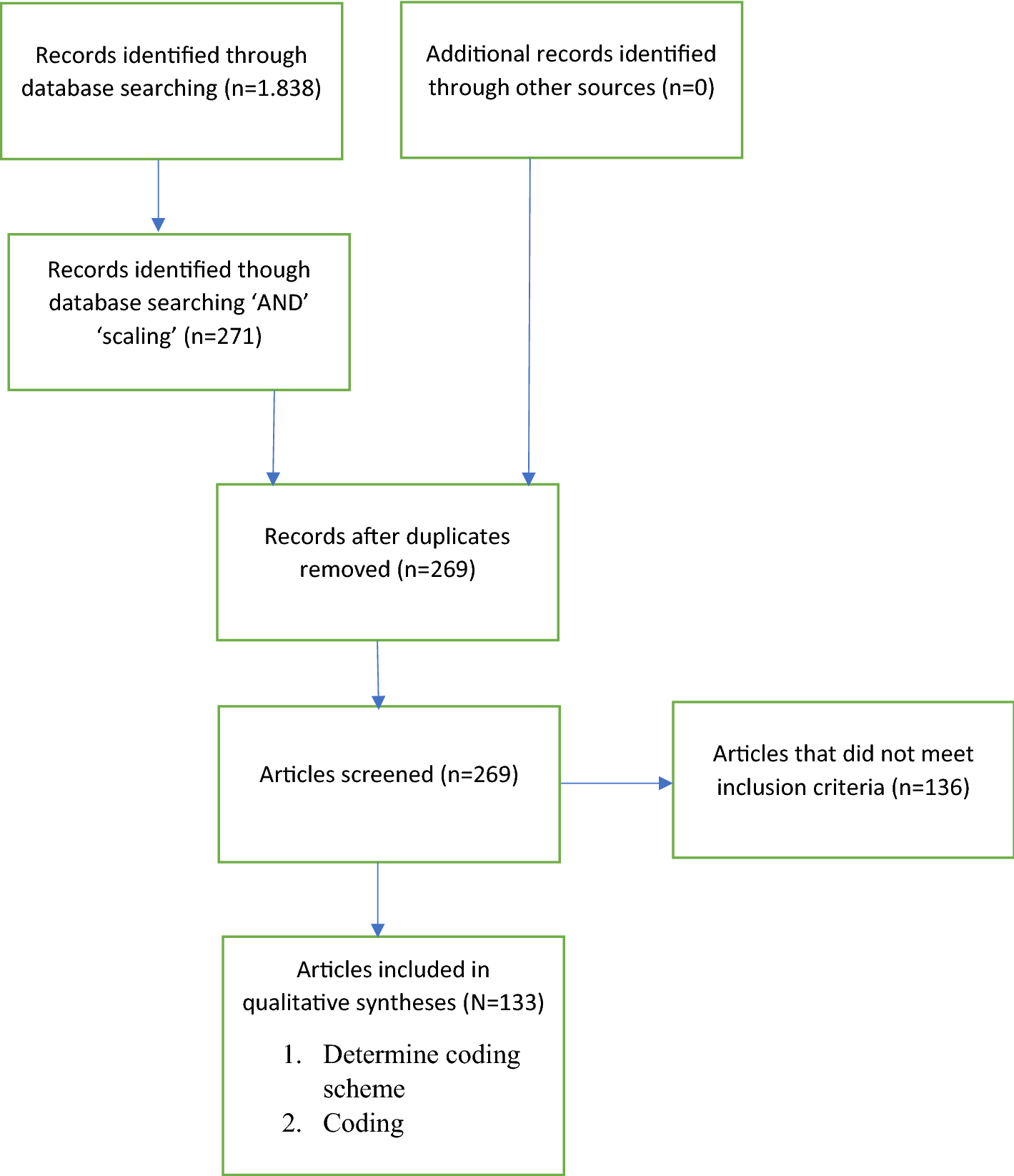
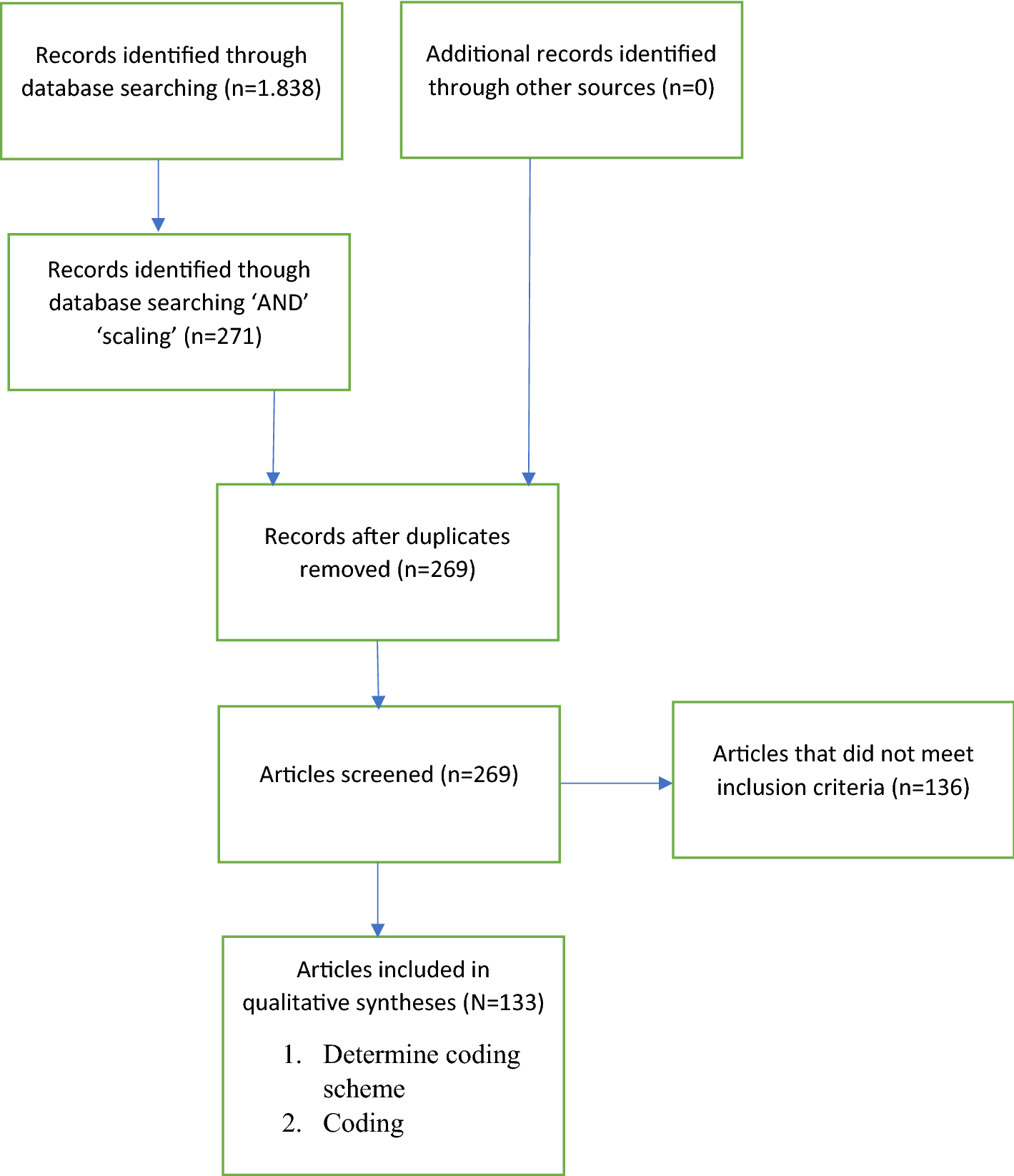
On 5 May 2017, we identified 1.838 studies by searching the Web of Science (SSCI, SCI en A&HCI) database on the topics ‘bottom-up initiatives’ (494), ‘grassroots innovation’ (172) and ‘social entrepreneurship’ (1.172). Only articles were included. Articles not written in English were excluded. To keep our focus on the scaling process and reduce the number of articles, we infused our search with ‘scaling’. This resulted in 271 articles (bottom-up 76; grassroots innovation 26; social entrepreneurship 169).
Inclusion Criteria for Studies to Review
After duplicated were removed, 269 abstracts and (sometimes) content were screened on two inclusion criteria: (1) studies that regarded the broader public domain and (2) studies concerning scaling in the context of growth, distribution or transformation. This resulted in 133 articles (bottom-up 55; grassroots innovation 22; social entrepreneurship 56) (Fig. 1).
Flow diagram of the literature screening process
Assessment Process and Coding
The assessment was done by the first author, a PhD student. Every step was taken in close consultation with the supervisors of the team, being the second and third author. We started our analysis with a rough division of variables taken from the central concepts: ‘strategic scaling choices’, ‘actor characteristics’, ‘institutional factors’ and ‘impact’. We also looked at the year of publication, the research area, whether a study was evidence based or not and the perspective. In order to cluster our data, we had to develop a more detailed code scheme, so we read and re-read the articles in an iterative process. In this way, we double-checked whether all articles matched the criteria. Every step in this process was discussed in the team.
Overall Findings
Our analysis of the selected set of publications showed that the first publications on bottom-up initiatives and scaling date from 1997, those on social entrepreneurship from 2003. Based on a systematic review of grassroots innovation done by Hossain (Reference Hossain2016), we expected a dominant focus of the environmental areas in grassroots literature, but we were surprised that the environmental areas also dominate the literature on bottom-up initiatives. Although environmental areas were found in 28% of the literature on social entrepreneurship as well, business and economics was dominant (67%).
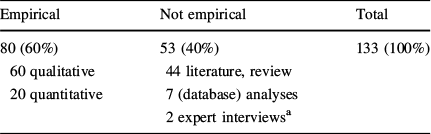
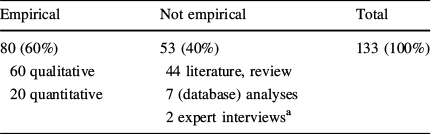
Table 1 shows that 60% of the articles was based on empirical research. In 20 studies, quantitative methods were used. Although the quantitative data did not refer to the variables in the scaling process in which we were interested, it did bring us useful information on the how and why in the scaling process.
Type of research
Empirical |
Not empirical |
Total |
|---|---|---|
80 (60%) |
53 (40%) |
133 (100%) |
60 qualitative 20 quantitative |
44 literature, review 7 (database) analyses 2 expert interviewsa |
aExperts were interviewed for their opinions and normative visions. We therefore classified this study as not empirical
Most empirical studies were based on qualitative research methods (62). Fifty-two out of 62 qualitative studies were case studies. Forty percentage of the studies was based on secondary data, but these data may also represent empirical evidence. Sometimes experts were interviewed about their opinions on how to encourage local initiatives. We classified these interviews as secondary data, but the empirical classification would be defendable as well. All in all, most studies were based on empirical data.
The dominant theme in the literature on bottom-up initiatives was ‘how to involve the public’. Most studies were done from the perspective of the institutional environment (65%). The literature on social entrepreneurship frequently discussed the characteristics and position of the social entrepreneur compared with the traditional entrepreneur. As a result, more studies on social entrepreneurship were done from the perspective of the entrepreneur (49%).
Impact: Volume, Geographical Distribution and System Change
Scaling is not an objective in itself but is seen as a strategy to realize more impact. All 133 articles are on scaling purposes that improve social, welfare, health or physical environmental issues. Impact as success indicator was mentioned in 20 studies. In 17 studies (15 more general studies on bottom-up initiatives and 2 specifically on grassroots initiatives), the impact was considered as some form of prevention (14) or compliance (3) in the environmental of healthcare context (for example, protected cost management, smoking). In the remaining 19 articles (of 56), impact was implicitly defined in terms of ‘better education’, ‘access to energy’, ‘empowerment of women’ and so on, mostly in the context of individual cases.
The types of impact are very diverse and highlight depending on the specific issue at hand. They may also be focused on narrow or broader issues. In more general terms, our analysis highlights that impact refers to social and sustainable impact which can be expressed in (1) volume, (2) geographical distribution and (3) system change. The three dimensions can be used to assess whether scaling has resulted in impact.
Strategy Choices: Pathway and Structure
In the diverse set of academic publications, we found two main strategy choices for scaling which we label as ‘pathway’ and ‘structure’.
Pathway: ‘Scaling Up’ or ‘Scaling Out’
The different perspectives in scaling processes were recognized by Westley et al. (Reference Westley, Antadze, Riddell, Robinson and Geobey2014) and Hermans et al. (Reference Hermans, Roep and Klerkx2016). They labelled all organization’s efforts to affect more people and cover a larger geographic area as ‘scaling out’ and reserved the term ‘scaling up’ for identifying opportunities and barriers within institutional structures to properly embed an innovation and the actions that niche actors employ to achieve that. Among these are creating and fine-tuning technologies, linkage building through intermediation activities, advocacy and lobbying, mobilizing powerful ‘patrons’, and creating alternative visions, framings and discourses. Vertical or political scaling was mentioned as an equivalent of ‘scaling up’ (Kempers et al. Reference Kempers, Ketting, Chandra-Mouli and Raudsepp2015; Radywyl and Biggs Reference Radywyl and Biggs2013; Andre and Pache Reference Andre and Pache2016). The literature highlights that the results (impact) of scaling up and scaling out are measured on different levels (Westley et al. Reference Westley, Antadze, Riddell, Robinson and Geobey2014). Scaling out focuses on increasing numbers, from local to international or from small to big networks. Scaling up focuses on influence on local to international political agendas, public discourses or legislation.
These two perspectives on scaling—scaling up and scaling out—show that we need to study local initiatives’ scaling as two separate but possibly also interrelated processes of making more impact: either by reaching more people and a larger geographical area or by changing institutional structures. The literature suggests that local initiatives may choose one or both forms to strengthen their impact. We explored the strategic choices of local initiatives to enhance our understanding of these two possible routes to more impact.
Pathway is not explicitly discussed in many articles. As initiatives can simultaneously scale up and out, a certain article could cover both. So, 54% covered scaling up and 60% scaling out. The bottom-up literature mainly refers to scaling up in the sense of influencing policy making (64% of 55 articles). Key strategic issues are creating awareness, positive entrepreneurial environment, institutional context and inclusive policy making. In this context, Westley et al. (Reference Westley, Antadze, Riddell, Robinson and Geobey2014) and Quinn et al. (Reference Quinn, Tompkins-Stange and Meyerson2014) introduced institutional entrepreneurship as a concept and condition for scaling up successfully. The literature on social entrepreneurship relatively covered scaling out the most (64% of 56 articles). We found replication, distribution of services, (financial) growth, differentiation, diversification and market development as strategic issues in scaling out. Replication was a dominant way to scale out in bottom-up and grassroots literature.
Little is known about the effects of pathway choices on social and sustainable impact. One study on the scaling process of grassroots innovations in the agricultural area showed that although they had the same challenges, grassroots initiatives all had their own pathways that strongly differ from each other, and it is impossible to draw any conclusions on successful strategies (Hermans et al. Reference Hermans, Roep and Klerkx2016).
Structure: Open or Closed
One important reason for the variance in scaling outcomes is the use of different structures, or organizational modes, of scaling). Structure is defined as the way in which initiatives organize their activities: choosing a more open or a more closed structure. This strategy choice is linked to the concept of organizational scaling (Bocken et al. Reference Bocken, Fil and Prabhu2016) and was implicitly covered by 75% of the articles. Structure is mostly discussed in the literature on social entrepreneurship. Warnecke and Houndonougbo (Reference Warnecke and Houndonougbo2016) distinguished four ways for organizational scaling: expanding the organization, establish strategic networks, affiliation/branching or informal/loose networks just to spread an idea. Smith and Stevens (Reference Smith and Stevens2010) suggested three structure strategies for scaling: dissemination, affiliation and branching. Dissemination would be the most open structure; branching expresses the most control. Franchising sits between branching and affiliation. In the more general literature on bottom-up initiatives as well as in the more specific literature on grassroots initiatives, the collaborative structure dominated. It was also seen as the most successful strategy for scaling environmental issues (Hermans et al. Reference Hermans, Roep and Klerkx2016; Becker et al. Reference Becker, Kunze and Vancea2017; Elbakitze et al. Reference Elbakidze, Angelstam, Sandstrom and Axelsson2010; Andrews et al. Reference Andrews, Tingen, Jarriel, Caleb, Simmons, Brunson, Mueller, Ahluwalia, Newman, Cox, Magwood and Hurman2012; Vergragt and Brown Reference Vergragt and Brown2012; Hatzl et al. Reference Hatzl, Seebauer, Fleiss and Posch2016). However, we also found studies that took a critical view on the success of a collaborative strategy. These argue that collaboration could frustrate the scaling process due to internal conflicts and slow learning (Vergragt and Brown Reference Vergragt and Brown2012; Mair et al. Reference Mair, Wolf and Seelos2016).
The literature on social entrepreneurship was sometimes fully devoted to the relation between strategic choices on structure and impact. In general, social enterprises opt for organizational structures that resemble franchise or network models, implying that multiple bodies coexist, all with some degree of autonomy (Voltan and Fuentes Reference Voltan and De Fuentes2016). We found evidence that open structures like franchising generate more impact in comparison with formal structures (Auvignet and Lloret Reference Auvignet and Lloret2015; Smith and Stevens Reference Smith and Stevens2010; Beckmann and Zeyen Reference Beckmann and Zeyen2014; Krzeminska and Zeyen Reference Krzeminska and Zeyen2017). Open structures also speed up the scaling process (Smith et al. Reference Smith, Kistruck and Cannatelli2016). The relationship between structure and impact is not clear. While some studies find that an open structure implies more and faster impact, other studies contradict this. It seems that actor characteristics interfere. An entrepreneur who desires control would choose a less open structure more often (Smith et al. Reference Smith, Kistruck and Cannatelli2016). This would imply that preferring control would lead to a slower pace of creating impact. However, studies also show that commercial entrepreneurs—who generally desire for control—scale out faster as they are professionally organized and have better access to resources (Hatzl et al. Reference Hatzl, Seebauer, Fleiss and Posch2016). So, the relation between structure and impact seems to be mediated by actor characteristics. We will discuss this more in depth in the next section.
In sum, strategic choices consist of the choice for a pathway and the choice for a structure. The literature provides a fragmented and inconclusive overview of the relation between pathway and social and sustainable impact. An open structure seems to speed up scaling the most, but this might also depend on actor characteristics. For this reason, we explored the literature further to understand how strategic choices and impact are influenced by actor characteristics.
Actor Characteristics: Willingness and Ability to Scale
The characteristics of actors can be organized in many ways. Scheuerle and Schmitz (Reference Scheuerle and Schmitz2016) introduced two specific actor characteristics as conditions for scaling: willingness and ability.Footnote 1 We will apply these concepts below when reporting our findings on actor characteristics.
Willingness to Scale
The first actor characteristic we will discuss is the actor’s willingness to scale. The literature distinguishes three subcategories of the actor’s willingness to scale an initiative: first his or her ambition to scale, second their desire to control, and third which logic would be dominant. Fifty-two percent of the articles covered one or more aspects of this concept willingness.
Scale Ambition
Ambition to scale was covered by 44% of the articles. They indicate that scale ambition differs among initiatives (Becker et al. Reference Becker, Kunze and Vancea2017; Scheuerle and Schmitz Reference Scheuerle and Schmitz2016; Smith et al. Reference Smith, Kistruck and Cannatelli2016; Westley et al. Reference Westley, Antadze, Riddell, Robinson and Geobey2014; Hufen and Koppenjan Reference Hufen and Koppenjan2015; De Bruin Reference De Bruin2016; Gutberlet et al. Reference Gutberlet, Kain, Nyakinya, Ochieng, Odhiambo, Oloko, Omolo, Omondi, Otieno, Zapata and Campos2016). Different types of social entrepreneurs would have different scale ambitions. Zahra et al. (Reference Zahra, Gedajlovic, Neubaum and Shulman2009) distinguish three types of social entrepreneurs. The social bricoleur focuses on the local needs and will hardly touch the existing institutional context. The social constructionist aims to replicate an innovation to different geographical areas, and the social engineer wants to break the (international) social system radically and focuses on the political agenda.
The literature indicates that scale ambition is related to the level of impact. A focus on local needs was seen as a barrier for scaling (Hatzl et al. Reference Hatzl, Seebauer, Fleiss and Posch2016; Kirwan et al. Reference Kirwan, Ilbery, Maye and Carey2013; Nel et al. Reference Nel, Hill and Binns1997; Seyfang and Longhurst Reference Seyfang and Longhurst2013b; Bailey et al. Reference Bailey, Hopkins and Wilson2010; Smith et al. Reference Smith, Fressoli and Thomas2014; Gasperi et al. Reference Gasperi, Pennisi, Rizzati, Magrefi, Bazzocchi, Mezzacapo, Stefani, Sanye-Mengual, Orsini and Gianquinto2016). Whereas social bricoleurs do not want to scale in the first place, the constructionist will scale up and/or out to the regional and national level and the engineer even to the global system. So, scale ambition is related to impact, but literature does not allow to draw conclusions on a relation between scale ambition and pathway or structure choices.
Desire for Control
The second subdivision of the concept concerning the actor’s ‘willingness to scale’ is the actor’s ‘desire for control’. Smith et al. (Reference Smith, Kistruck and Cannatelli2016) found that a scaling process will be delayed if the social entrepreneur has great ambitions, but also feels a strong desire for control. This result was explained by the actor’s preference for an open or formal structure. Smith et al. (Reference Smith, Kistruck and Cannatelli2016) presumed a relationship between the actor’s wish to control, his or her strategic choice for a certain type of structure and the impact created by the initiative. A formal structure would be chosen by entrepreneurs who want to control, while open structures speed up scaling more than formal structures. Smith and Stevens (Reference Smith and Stevens2010) explored this further by correlating structure choice and the threefold categories of Zahra et al. (Reference Zahra, Gedajlovic, Neubaum and Shulman2009). They assumed that the strength of the ties in the network is related to the desire for control: the stronger the network is, the less the actor desires for control. As a result, the local bricoleur will opt for an open structure, whereas the social engineer will opt for branching. Building upon Smith et al.’s (Reference Smith, Kistruck and Cannatelli2016) reasoning, it would paradoxically be expected that the social engineer would be less successful in scaling due to their choice for a less open structure. As we have indicated above, Hatzl et al. (Reference Hatzl, Seebauer, Fleiss and Posch2016) found the same paradox for commercial entrepreneurs. So, the desire for control turns out to be directly related to the choice for a certain structure. It is indirectly related to the impact created.
Logic: Economic and Social
The third subcategory, which is implicated in the actor’s willingness to scale, is whether the economic logic or the social logic prevails in his or her plans and actions. Logic was covered by 20% of all articles, of which 75% was literature on social entrepreneurship. Initiators who could simultaneously act in accordance with both economic and social logics turned out to be more successful in scaling (Morris et al. Reference Morris, Webb and Franklin2011; Fosfuri et al. Reference Fosfuri, Giarratana and Roca2016). They can sustain in their social focus, whereas social entrepreneurs, who do not focus on economic goals at all, would lose their social focus over time due to external pressure (Andre and Pache Reference Andre and Pache2016). As a result, (social) impact decreases.
It turns out that the prevalence of either the economic or the social logic is related to the impact which is created. However, no final conclusions on the relation between logic and pathway and structure can be drawn from the literature.
In sum, we found that scale ambition, desire for control and logic are related to impact. We do not know whether these characteristics are related to pathway: strategic choices for scaling out and/or scaling up. Desire for control seems to be related to structure choice. These findings, however, are mostly based on the literature on social entrepreneurship. We found less studies on the actor’s willingness to scale in grassroots innovation or bottom-up initiatives. We know grassroots innovation focuses on the local community, so we might consider grassroots innovators as social bricoleurs who have low ambition to scale and might have strong tights and therefore choice for an open structure. This might also explain the dominant position of collaborative structures, but we cannot draw hard conclusions on that.
Ability to Scale
Above we indicated that the actor’s characteristics consist of two relevant aspects. We have discussed ‘willingness’ to scale above. The second factor in actor characteristics we discuss is ‘ability’. This aspect was covered by 47% of the articles. Ability to scale represents the way in which initiatives can act upon the institutional context. We distinguished three subcategories of the actor’s ability to scale, being first entrepreneurial skills,Footnote 2 second leadership, and third dependency on money, knowledge and network (resources).
Entrepreneurial Skills
Entrepreneurial skills are crucial for scaling. These are needed to get political or financial support (Westley et al. Reference Westley, Antadze, Riddell, Robinson and Geobey2014; Calvo-Urgarteburu et al. Reference Calvo-Ugarteburu, Raemaekers and Halling2017; Kempers et al. Reference Kempers, Ketting, Chandra-Mouli and Raudsepp2015; Warnecke and Houndonougbo Reference Warnecke and Houndonougbo2016; Radywyl and Biggs Reference Radywyl and Biggs2013; Loosemore Reference Loosemore2015), to build networks, to hire professional staff, to communicate with stakeholders (Smith and McBride Reference Smith and McBride2015; Sofo Reference Sofo2008; Hatzl et al. Reference Hatzl, Seebauer, Fleiss and Posch2016; Osterblom et al. Reference Osterblom, Gardmark, Bergstrom, Muller-Karulis, Folke, Lindegren, Casini, Olsson, Diekmann, Blenckner, Humborg and Mollmann2010; Spiegel et al. Reference Spiegel, Breilh, Beltran, Parra, Solis, Yassi, Rojas, Orrego, Henry, Bowie, Pearce, Gaibor, Velasquez, Concepcion and Parkes2011), to work efficiently, to build a proper business case and to develop marketing strategies (Zahra et al. Reference Zahra, Rawhouser, Bhawe, Neubaum and Hayton2008; Vergragt and Brown Reference Vergragt and Brown2012; Brocken Reference Bocken2015; Reeves et al. Reference Reeves, Lemon and Cook2014; Pless and Appel Reference Pless and Appel2012; Perrini et al. Reference Perrini, Vurro and Costanzo2010; Fosfuri et al. Reference Fosfuri, Giarratana and Roca2016). In the literature, most case studies were presented as successful, meant to learn from. In this context, actors having enough entrepreneurial skills were crucial for success. We therefore may conclude that the more entrepreneurial skills actors have, the more likely the initiative creates impact (on the condition that the actor’s willingness to scale is high). However, we did not find information on how entrepreneurial skills and the two strategic choices, pathway and structure, are related.
Leadership
Next to having entrepreneurial skills, leadership is the second subcategory of the actor’s ability to scale. Leadership refers to both managing the internal organization and (proactively) dealing with the external circumstances (Nel et al. Reference Nel, Hill and Binns1997; Osterblom et al. Reference Osterblom, Gardmark, Bergstrom, Muller-Karulis, Folke, Lindegren, Casini, Olsson, Diekmann, Blenckner, Humborg and Mollmann2010; Sofo Reference Sofo2008; Biggs et al. Reference Biggs, Westley and Carpenter2010; Warnecke and Houndonougbo Reference Warnecke and Houndonougbo2016). We classified leadership apart from entrepreneurial skills as an actor who has high leadership skills and low entrepreneurial skills could still create high impact. This leader might proactively search for the help of others, for example by collaboration in a network or by participating in a franchise structure.
Dependency on Resources
The third and final subcategory indicating the actor’s ability to scale is dependency on money, knowledge or network. This concept was often mentioned when discussing collaboration of grassroots and bottom-up initiatives, especially in environmental issues like coast protection. These issues either require high levels of knowledge and investments or they can only be solved by including a great diversity in stakeholders. In this way, a high dependency on resources requires high entrepreneurial skills and/or it would more often lead to the choice for open structures. Dependency on resources obviously is relevant for structure choice.
To conclude, the literature shows that actor characteristics influence the scaling process towards impact. In the previous section, we discussed the actor’s willingness to scale, and in this section, we discussed the actor’s ability to scale. Two subcategories of the actor’s ability are positively and directly related to impact, being entrepreneurial skills and leadership. However, dependency on resources seems to be only indirectly related to impact, being through structure choice. We did not find evidence for a relation between ability and pathway.
Institutional Factors: Rules and Support
The setting of initiatives consists of the institutions that influence the process of scaling. The general literature on bottom-up initiatives contributed the most to the concept of institutional factors, but it was also substantially covered in more specific articles on grassroots initiatives (59% of 22) and in the literature on social entrepreneurship (41% of 56). The analysis showed that the process of scaling was influenced by the formal and informal rules (mentioned in 49% of all articles), and by support, which is being done through supplying funds, through knowledge and training, or through network relations (covered in 79% of all articles).
Rules
As for rules, governments obviously play a key role in designing and implementing these. However, other actors—e.g. sector organizations—can also influence these rules. Space for experimentation, flexible rules, a favourable business environment and political will are crucial for scaling local initiatives (f.i. Vergragt and Brown Reference Vergragt and Brown2012; Radywyl and Biggs Reference Radywyl and Biggs2013; Biggs et al. Reference Biggs, Westley and Carpenter2010; Jenson Reference Jenson2017; Bailey et al. Reference Bailey, Hopkins and Wilson2010; Awoonor-Williams et al. Reference Awoonor-Williams, Bawah, Nyonator, Asuru, Oduro, Ofosu and Phillips2013; Biehl Reference Biehl2007). Even a lack of rules can be favourable to social entrepreneurs (Gutberlet et al. Reference Gutberlet, Kain, Nyakinya, Ochieng, Odhiambo, Oloko, Omolo, Omondi, Otieno, Zapata and Campos2016; Gluckler and Lenz 2016). Studies done in developing countries showed that fragile regimes might decrease the social and environmental impact (Ault Reference Ault2016). However, stable regimes with strict rules could also frustrate initiatives with their red tape resulting from the bureaucratic system (Kempers et al. Reference Kempers, Ketting, Chandra-Mouli and Raudsepp2015).
Support
Apart from rules, there seemed to be consensus about the facilitating and encouraging role that government could have in supporting local initiatives. Based on case studies, some researchers also came up with ideas how government could fill in this role. For example, by organizing train-the-trainer (Spiegel et al. Reference Spiegel, Breilh, Beltran, Parra, Solis, Yassi, Rojas, Orrego, Henry, Bowie, Pearce, Gaibor, Velasquez, Concepcion and Parkes2011), by connecting local initiatives with standards on higher levels (Riisgaard Reference Riisgaard2011) and EU policy (Osterblom et al. Reference Osterblom, Gardmark, Bergstrom, Muller-Karulis, Folke, Lindegren, Casini, Olsson, Diekmann, Blenckner, Humborg and Mollmann2010) or by co-management (Marin and Berkes Reference Marin and Berkes2010) or workshops (Bremer et al. Reference Bremer, Haque, Haugen and Kaiser2016). Although government is often mentioned as a major actor in the institutional environment, there are other players in the field. Ngo’s are mentioned, and large companies and philanthropy may also stimulate the development of small initiatives by providing knowledge, money and access to networks (f.i. Quinn et al. Reference Quinn, Tompkins-Stange and Meyerson2014; Harvey et al. Reference Harvey, Maclean, Gordon and Shaw2011). Ashoka might be an example of institutional support. This worldwide network stimulates and supports the most innovative entrepreneurial solutions to social and environmental challenges, for instance by training the right skills.
So, what do we know about how institutional factors influence actor characteristics, strategic choices and impact? A favourable business environment will stimulate the start-up activities of grassroots initiatives and social enterprises and the space to experiment will help to scale. For social constructionists and engineers, rules might even be target for system change (Radywyl and Biggs Reference Radywyl and Biggs2013). In this way, rules influence the ambition of the actor. Institutional factors also influence the focus on either the economic or the social logic. For example, some studies done in developing countries show that fragile regimes increase pressure on social entrepreneurs to shift their focus to wealthier clients as they lack the support from government which would allow them to maintain a focus on poorer clients. If they do not shift, they go out of business (Ault Reference Ault2016). As logic is positively related to impact, regime indirectly influences the level of impact too.
Supporting by funds, network and knowledge influence both the actor’s ability to scale and the structure choices that are made. Institutional factors can also influence impact directly by way of adjusting rules, stimulating public debate, or by changing of behaviour inspired by the success of a social entrepreneur. However, a precondition would be the actor’s willing to change (Mahama Reference Mahama2012; Awoonor-Williams et al. Reference Awoonor-Williams, Bawah, Nyonator, Asuru, Oduro, Ofosu and Phillips2013; Biehl Reference Biehl2007).
In sum, the institutional factors can be categorized in rules and support. The institutional environment is important since it influences actor characteristics, strategic choices as well as impact. The institutional setting influences both the actor’s willingness and ability to scale. The institutional environment also affects the strategic choices for a certain type of structure, but we can only assume a relation to pathway. It could also have influence on how much social and environmental impact is created, but the literature in our corpus does not provide clear evidence for this relation.
Framework for Scaling Social and Sustainable Initiatives
The purpose of our review was to combine literature on social entrepreneurship with that of grassroots innovation and bottom-up initiatives to find out why and how social and sustainable initiatives scale. The current academic knowledge about scaling is highly fragmented and anecdotal. In addition, there was much confusion about terms and relevant factors. For that reason, we focused our research on reducing conceptual confusion and building a framework of the different factors and relations in the process of scaling bottom-up initiatives.
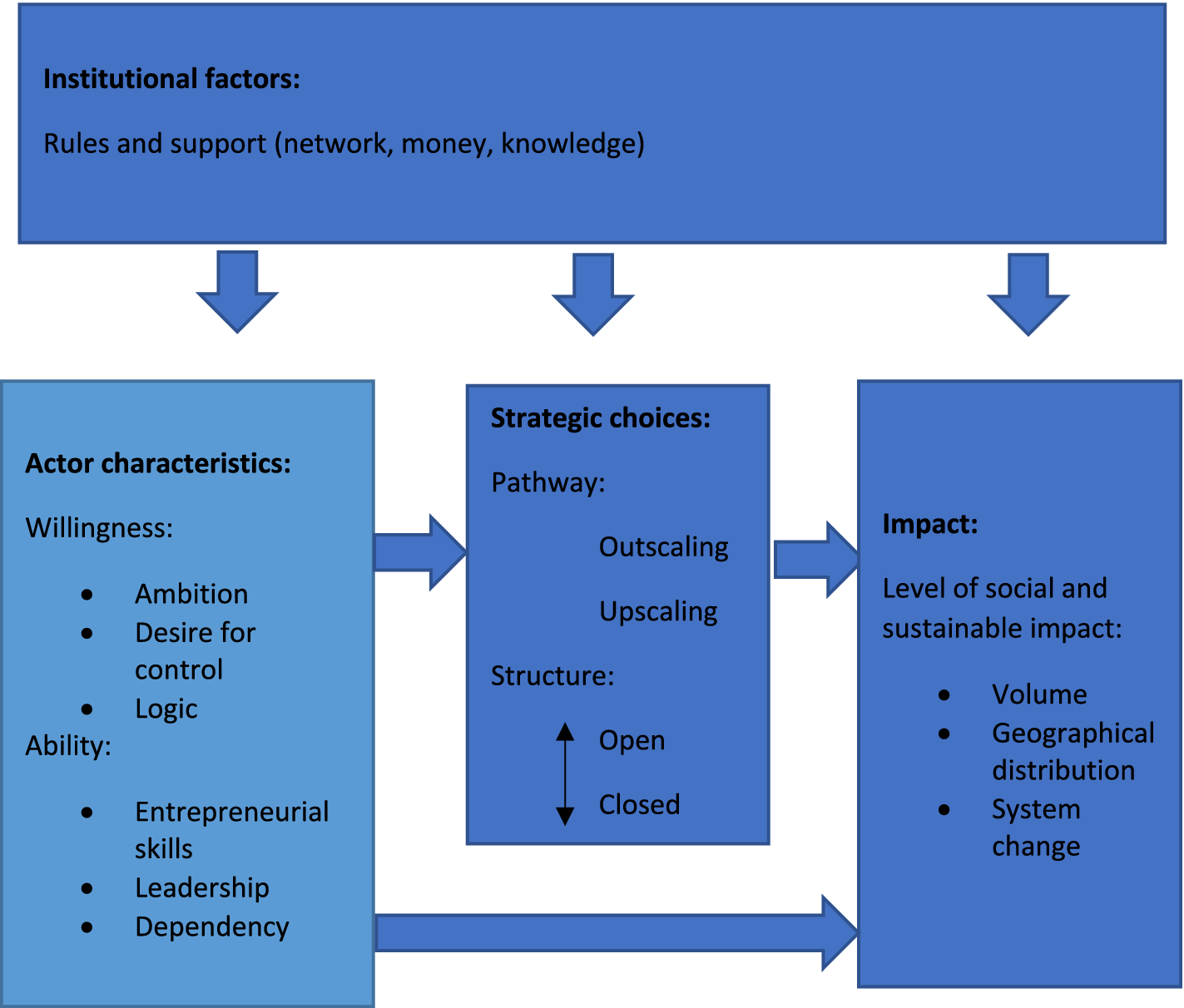
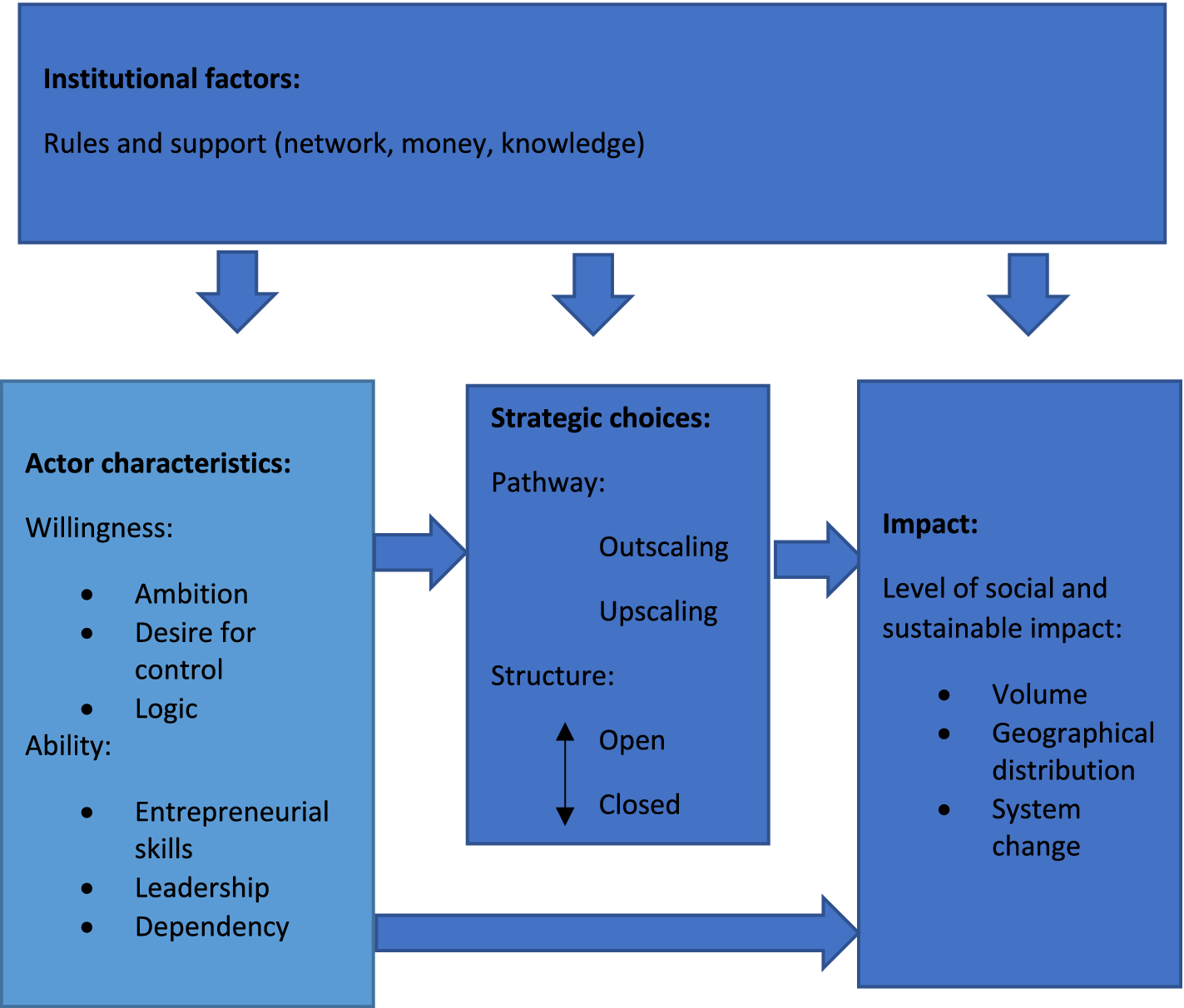
The review of 133 academic articles resulted in a framework (Fig. 2) that reflects the current state of the field. It presents a concise overview of key theoretical concepts in the literature. Based on the literature, we first distinguish two choices in the scaling process: pathway (scaling up and scaling out) and structure (organizational form). Successful scaling implies more social or environmental impact. We chose the perspective of the initiative and categorized the influential factors for scaling in ‘actor characteristics’ (willingness and ability) and ‘institutional factors’ (rules and support).
Framework for ‘scaling social and sustainable initiatives’
The literature review provides important insights into the process of scaling. Our analysis of the literature highlights that:
1. Actor’s scale ambition, hybrid logic and entrepreneurial and leadership skills are positively related to the level of impact realized through scaling;
2. Open structures may generate speed and more social and environmental impact (but we also found some critical views on this relation);
3. A collaborative structure dominates in grassroots literature, and this may be caused by focus on the local community and less desire for control;
4. An institutional environment in which there is room to experiment with different approaches and strategies helps the initiative to scale.
This systematic literature review contributes to the literature on the scaling of local initiatives by combining separate bodies of literature—the literature on grassroots innovation, bottom-up initiatives and social entrepreneurship—and analysing the similarities and differences between these literatures. The review resulted in a compact framework that provides an overview of the key institutional factors, actor characteristics, strategic choices and impact. The framework can form a basis for further research.
The framework highlights that scaling social and sustainable initiatives is complex as there are many variables and the complex interactions between all these variables are not yet well understood. We need a better understanding of the interaction of variables and dynamics in the framework and further explore whether the relations between actor characteristics, strategic choices and impact are linear. Time must be taken into consideration as well, as speed seems to be related to structure choice and we do not know to what extent strategic choices could change over time.
We suggest further exploration of the framework in a specific branch or specific topic, like social initiatives in healthcare or sustainable initiatives in the food industry. This will help to explore the different relations and dynamics in the framework more in detail. Also comparing results across different branches and topics could be potentially fruitful as our literature review showed that combining bodies of literature reduces fragmentation of the academic literature and is of benefit to more than one discipline.
To conclude, this papers highlights that actors need a facilitating context, the willingness and the ability to scale and a strategy that works for them to realize either a better (commercial) dissemination or a stronger impact on policies. There is no evidence for a ‘miracle cure’ as the complex interactions between actors, environments, strategies and impact are dynamic and interactive. Scaling requires ‘contextual work’, and an in-depth empirical analysis of this type of work is needed to further enhance our understanding of these patterns of scaling.
Funding
There was no external funding for this study.
Compliance with Ethical Standards
Conflict of interest
The authors declare that they have no conflict of interest.

 Open access

