




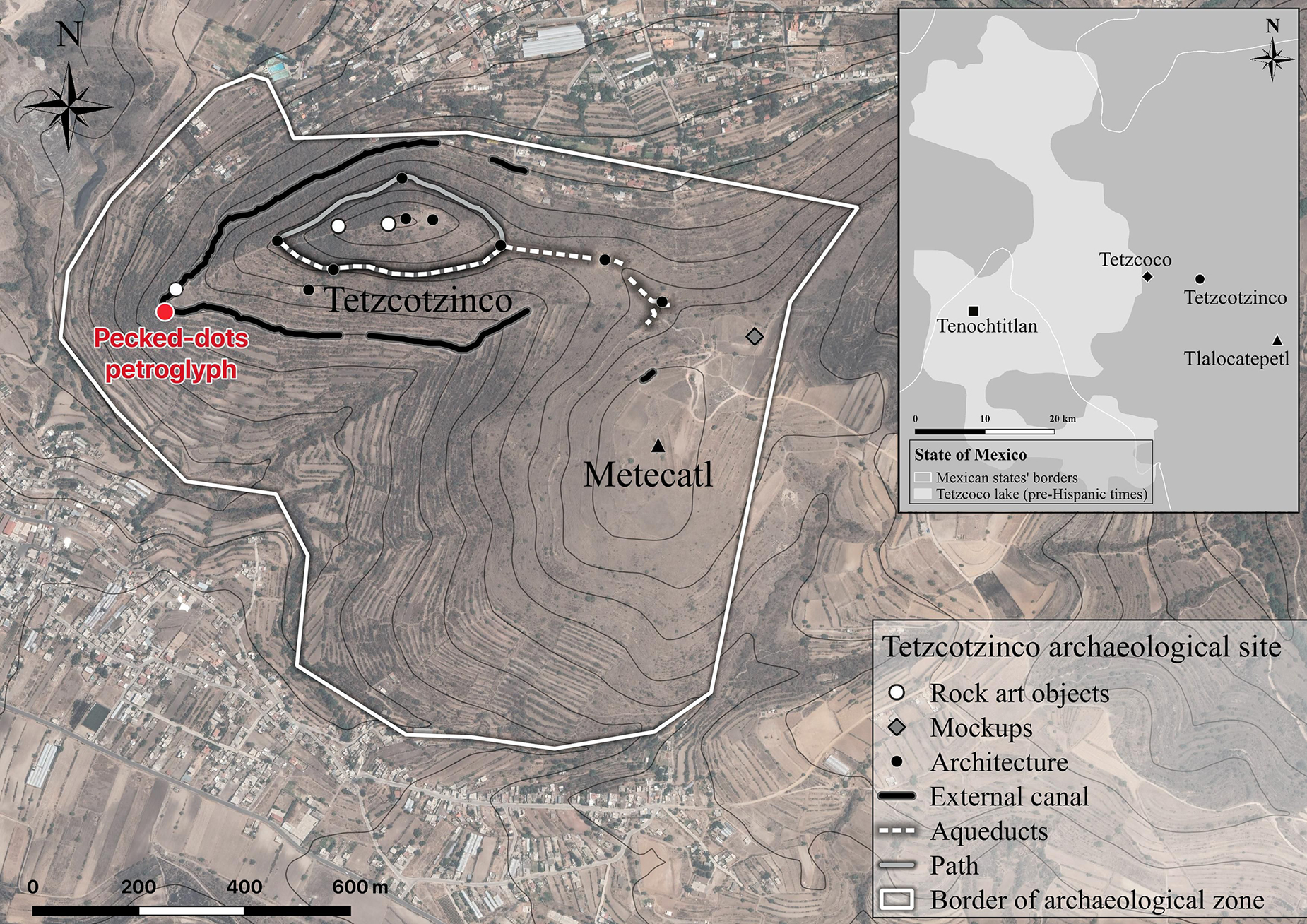
The Tetzcotzinco archaeological site is located in San Nicolás Tlaminca (mun. Texcoco, Mexico; Figure 1) and extends over two hills—Tetzcotzinco and Metecatl—which are part of a small cordillera in the foothills of Mount Tlaloc (known as Tlallocatepetl in pre-Hispanic and early colonial times; see Obregón Reference Obregón2009:16–22), an important ritual center. The archaeological objects preserved there constitute the remains of the former palace-temple complex founded by the tlatoani (Nahuatl: ruler) of Tetzcoco (modern Texcoco), Nezahualcoyotl (Anales de Cuauhtitlan Reference Velázquez1992:52; Lesbre Reference Lesbre2001:324–326). In the Late Postclassic period (a.d. 1200–1521), Tetzcotzinco consisted of numerous residential and temple structures and an exceptional system of canals and aqueducts transporting water from the springs on the south. The complex also included terraces, where various plants were cultivated, forming the so-called gardens of Nezahualcoyotl. This monumental archaeological site has attracted the attention of scholars from at least the nineteenth century, but proper archaeological research has been carried out in Tetzcotzinco only since the 1970s (García García Reference García García2007:136–204; Hernández Reference Hernández1993; Parsons Reference Parsons1971). As a result of numerous studies, it was possible to recognize and recreate the monumental architecture of Tetzcotzinco and better understand its political and religious roles in the Late Postclassic period (Evans Reference Evans2000).
Location of Tetzcotzinco in the pre-Hispanic Basin of Mexico (the map in the top-right corner) and the map of the archaeological site (the main map). Maps by Karolina Juszczyk.
In Tetzcotzinco, archaeologists found several sculptures and stone reliefs with religious representations and a group of rock art objects, such as petroglyphs (graphics carved in stone) and spatial architectural models carved in stone. Among them, the best known and studied are the petroglyphs of the rain god, Tlalloc (also known as Tlaloc, however in this article, I will use the form with double “l” [ll], which seems more correct based on etymological analysis [Contel Reference Contel2008:164; Sullivan Reference Sullivan and Cerulli1972] and was commonly used in early alphabetic sources [e.g., Sahagún Reference Sahagún and Sullivan1997:58-59, 68, 78, 97]), and a group of stone architectural models (Domínguez Nuñez Reference Domínguez Nuñez2007:84–88; Garcia Garcia Reference García García2007:203--204; Prusaczyk Reference Prusaczyk2017:137). The other iconographic representations, especially rock art objects discovered in recent years (Prusaczyk et al. Reference Prusaczyk, Rzeźnik, Kulesza and Juszczyk2023), are still waiting for a deeper analysis.
This article aims to describe and analyze the rock art object (Figure 2) discovered in 2019, which is the only example of rock art on the western slope of Tetzcotzinco hill. This research derives from my broader survey project, which focused on preparing new and precise maps of the site of Tetzcotzinco to better understand its features in the broader geographical context (mainly in the context of water distribution). The project obtained documentation of buildings and other archaeological remains with various techniques, such as photography, 2D photogrammetry, and 3D modeling. These data enabled the elaboration of multiple visualizations of the rock art object in question that have facilitated the analysis of its graphic representation.
The newly discovered rock art object, Tetzcotzinco: (a) pecked cross; and (b) unidentified petroglyph. Photography and drawing by the author.
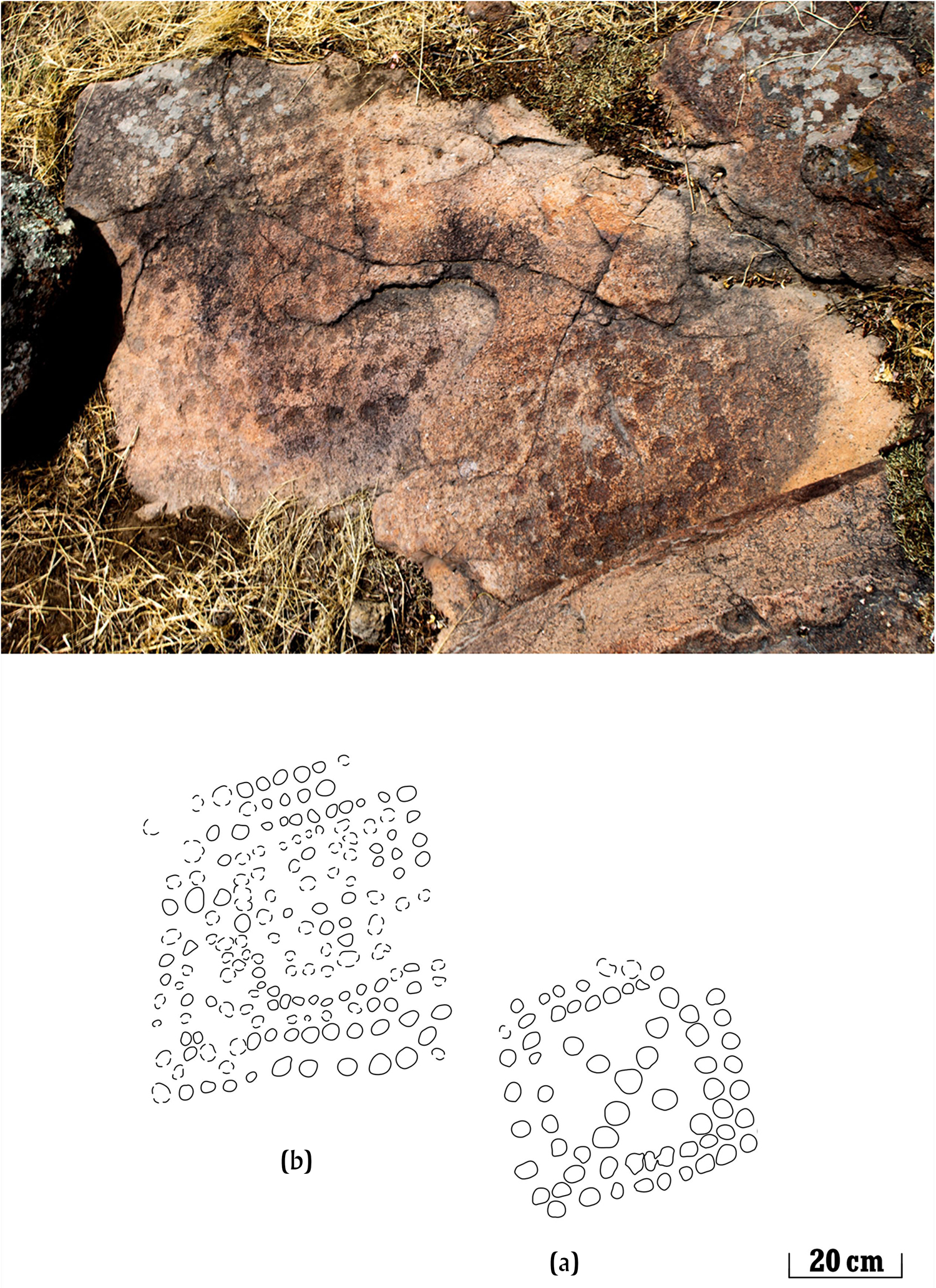
This newly discovered example of rock art is unique for the site: it consists of two petroglyphs in the form of numerous round dots. The first petroglyph (Figure 2a) on this object looks like “pecked-cross” figures that have been discovered in various Mesoamerican sites (e.g., in Teotihuacan, Cocotitlan, or Uaxactun; Iwaniszewski Reference Iwaniszewski and Ruggles2014a:737). The second representation (Figure 2b) has a form that I yet have to recognize. Although the second petroglyph certainly merits attention, and its analysis will add to the understanding of the whole finding, this article is dedicated exclusively to studying Tetzcotzinco's pecked cross. Previous research on other pecked crosses suggested that they encoded calendrical values (Iwaniszewski Reference Iwaniszewski, Wiesheu and Fournier2005). Leaning on data from pre-Hispanic Mesoamerica and colonial and modern heirs of Mesoamerican cultures (Ayöök, Zapotecs, and K'iche’), among whom the use of the 260-day calendar has survived, this analysis follows the lead and consists of the following stages:
(1) Recognition of a pattern of the spatial arrangement of the dots
(2) Contextualization of the registered numbers within Mesoamerican calendrical systems, together with an attempt to decipher the potential meanings and symbolism of these numbers based on studies of indigenous divinatory books
(3) A detailed analysis of the petroglyph's arrangement of dots and the interpretation of its meaning based on studies on the perception of space and time by ancient Mesoamericans and their descendants in today's Mexico
Even though the present study proposes different possibilities of the division of dots within the petroglyph, it has to be stressed that these are not mutually exclusive. As this article will demonstrate, the numbers registered within pecked crosses quite often could simultaneously encode alternative ways of reading.
Pecked-cross petroglyphs in Mesoamerica
Petroglyphs were widespread throughout Mesoamerica, appearing from the early hunter-gatherer period to colonial times. They could represent both simple and complex difficult-to-interpret forms, as well as fully developed figurative scenes. They constituted an essential element of visual communication for people of all Mesoamerican cultures. They could also perform various functions: from ceremonial use, to political propaganda, to astronomical observation (see Murray and Valencia Reference Murray, Valencia, Bahn and Fossati1996). The rich repertoire of signs and symbols of petroglyphs in Mesoamerica includes forms created by groups of small pecked circles or dots—which is why they are called “pecked” elements—but in rock art studies, they are also known as “cup marks” (Iwaniszewski Reference Iwaniszewski and Ruggles2014a:737). This kind of petroglyph appears in archaeological sites from Sonora and Chihuahua in the north to Guatemala in the south, and from Jalisco and Michoacán in the west to Campeche in the east. The greatest accumulation of the pecked-cross figures, however, is in central Mesoamerica, which includes Mexico City and the states of Mexico, Hidalgo, Morelos, and Puebla (Iwaniszewski Reference Iwaniszewski and Ruggles2014a:738; Olvera Hernández Reference Olvera Hernández2022:82–87). The oldest examples of these pecked objects date back to at least the Late Preclassic Period (750–350 b.c.; Aveni et al. Reference Aveni, Hartung and Buckingham1978:273), whereas the largest group of such petroglyphs dates from the Early and Late Classic periods (a.d. 250–900; Aveni Reference Aveni2005:42–43; Iwaniszewski Reference Iwaniszewski and Ruggles1993:289, Reference Iwaniszewski and Ruggles2014a:738). So far, only a few examples of pecked crosses have been dated to the Postclassic period (Olmos Curiel Reference Olmos Curiel2010:116–120; Olvera Hernández Reference Olvera Hernández2022:45; Zimbrón Romero Reference Zimbrón Romero2010).
Despite wide temporal and territorial spread, Mesoamerican pecked petroglyphs tend to form similar motifs. These representations are usually formed by two concentric figures with two intersecting lines, creating an equilateral cross inscribed within another geometrical shape (Hers and Flores Reference Hers and Flores2013:3). So far, the best-recognized form of this sign is the so-called circle-cross figure—a cross within a circle—that appears as petroglyphs and stucco motifs in Teotihuacan (Aveni and Hartung Reference Aveni and Hartung1980:38–39). Other variants of this motif consist of a cross inscribed within quadrangular (the so-called square-cross figures) or pentagonal figures, or within the shape of a Greek cross (Hers and Flores Reference Hers and Flores2013:3). The standard features of all these petroglyphs are the internal cross and the technique of execution—that is, through pecked dots.
Currently, the functions of the pecked-cross petroglyphs are still not fully understood, and scholars have several explanations for such motifs. One of the main research directions is the archaeoastronomical study and analysis of petroglyphs as astronomical markers that—mainly due to the four directions marked by internal crosses (Iwaniszewski Reference Iwaniszewski and Ruggles1993:290–291)—would delineate the directions of sunrises and sunsets, for example, during important Mesoamerican festivals (see e.g., Galindo Reference Galindo Trejo2009; Iwaniszewski Reference Iwaniszewski, Wiesheu and Fournier2005; Nicolau Romero et al. Reference Nicolau Romero, García and García2003). Sometimes they are also linked to the monthly cycle of the moon (Olmos Curiel Reference Olmos Curiel2017:287–292). Some researchers (Hers and Flores Reference Hers and Flores2013) have also tried to interpret pecked crosses as representations of constellations, whereas others (Cruces Cervantes Reference Cruces Cervantes2020) perceived them as gnomons (astronomical tools used to observe the position of the sun based on the shadow cast). An important part of the study of pecked crosses has also been an attempt to contextualize them within the surrounding architecture and urban design, which has given rise to hypotheses about their function as benchmarks for delineation of the grid of streets in Teotihuacan and other sites (Aveni Reference Aveni2005:39), or as landmarks to facilitate orientation within the landscape (Kelley and Abbott Kelley Reference Kelley, Abbott Kelley, Foster and Gorenstein2010). Significant research has also been conducted on the number and arrangement of dots in pecked crosses, leading to new hypotheses about their role as abacuses (Morante López Reference Morante López1997) or board games with ritual-calendar significance, such as patolli (Olmos Curiel Reference Olmos Curiel2020:19; Olvera Hernández Reference Olvera Hernández2022:104–105), or k'uilichi (Olmos Curiel Reference Olmos Curiel2014). In recent decades, the use of Geographic Information Systems (GIS) has enabled the spatial association of some petroglyphs with water bodies and rivers (Carot Reference Carot1989:61–62; Olmos Curiel Reference Olmos Curiel2017; Olvera Hernández Reference Olvera Hernández2022:50–53; Zimbrón Romero Reference Zimbrón Romero2010). Geographical studies also suggested the relationship between the occurrence of pecked crosses in Mesoamerica and the range of turquoise trade routes (Rétiz García and Cárdenas García Reference Rétiz García, Cárdenas García and Galicia2019).
Another interpretation path that has emerged since the beginning of interest in pecked-cross figures, and that seems to be the most accurate direction for the studies on the Tetzcotzinco petroglyph, connects these representations with calendrical cycles. Previous researchers noted that most petroglyphs of this type consist of specific numbers of dots—mainly 260 and 365 dots—that correspond to Mesoamerican calendars (Aveni Reference Aveni2005:42). Consequently, yet another interpretation is that pecked-cross petroglyphs functioned as tallies, used to count agricultural cycles or festivals associated with agrarian deities (Aveni Reference Aveni2005:42; Aveni et al. Reference Aveni, Hartung and Buckingham1978:277; Iwaniszewski Reference Iwaniszewski and Ruggles1993:289). Nevertheless, the critical point is that the arrangements of the dots in the circle-cross and square-cross figures enable the grouping or subdivision of the signs into minor sectors, representing smaller numbers (Aveni Reference Aveni2005:38), possibly corresponding to some minor calendrical subcycles (Iwaniszewski Reference Iwaniszewski, Wiesheu and Fournier2005:98–101).
The grouping of dots may support the hypothesis that pecked crosses expressed different numerical values within one representation. Based on these interpretations, I have observed a close relationship between Tetzcotzinco's pecked cross and some calendrical diagrams from indigenous divinatory books. However, before delving into the detailed analysis of the distribution of dots, let me briefly introduce this petroglyph's archeological context.
Tetzcotzinco's petroglyphs
The pecked cross presented here is part of the only known rock art object with pecked representations in Tetzcotzinco (Figure 2). As mentioned earlier, it has two engravings. One of them—the subject of this article—takes the form of two concentric squares with two crossed lines in the shape of a letter X inside them (“pecked cross”; Figure 2a). The other figure forms irregular rows of dots (unidentified petroglyph; Figure 2b).
Location
Both petroglyphs were carved on a flat, horizontal stone on one of the paths leading from the main site to the western terraces (Figure 1). It is about 240 m southwest of the so-called Queen's Bath (Baño de la Reina), one of the most famous water reservoirs on the site, and near the external canal surrounding the hill.
Material
The stone with the carvings has dimensions of 105 x 112 cm. For legal reasons, I could not analyze this rock's composition, but its form and the region's geology suggest that it is probably andesite. The color of the rock is light brown and gray. The stone is brittle, and natural cracks are visible on its surface. The preliminary analysis did not show any special preparation of the rock surface for carving the petroglyphs (such as surface smoothing); therefore, it can be assumed that it was naturally flat. The stone is highly eroded, which likely blurred some parts of the petroglyph.
Technique
Both petroglyphs consist of more than 220 circular cavities. They have various forms, and their diameter ranges from 2 cm to 5 cm. The depth of the cavities is 1–2 cm. All the dots are irregular in shape, and their interiors are porous and rugged, which may be due to the rock's volcanic nature. The form of the dots suggests that they were made by simply pecking the stone with a hard tool.
Archaeological context and dating
The stone was registered outside the central Tetzcotzinco sector, making it difficult to associate it with Late Postclassic architecture at the site. Moreover, due to the limitations of currently existing methods of physicochemical dating of rock art (Whitley Reference Whitley2018:84–89), and the noninvasive nature of my project, it is not currently possible to undertake chronometric dating of these petroglyphs. Consequently, the most promising method could be relative dating, using archaeological materials found near the stone (Whitley Reference Whitley2018:83). However, no excavations have yet been conducted in this part of the site. The exposure of the stone and the existence of the Postclassic canal in its vicinity may suggest that the petroglyphs were known to the builders of the central part of Tetzcotzinco, but it is impossible to exclude that the representations are older than the monumental architectural complex (especially given that previous research on pecked petroglyphs in Mesoamerica dates them mainly to the Classic period; Aveni Reference Aveni2005:42–43).
Unidentified petroglyph
This representation (Figure 2b) consists of at least 159 dots. Due to erosion and the state of preservation, it is impossible to determine the exact number of pecked dots, but we can assume that, initially, the engravings were more numerous. The whole figure takes the form of relatively parallel rows or concentric squares. They have irregular shapes, and the number of dots in one “row” varies and usually ranges between 10 and 15. In some rows, perhaps due to damage, only three to five circles are visible. In the central part, the representation seems to be the least regular, and the lines formed by the dots are curvier than those forming the external borders of the figure. Although the interpretation of this petroglyph still requires further study, it should be remembered that in many known cases, pecked-cross figures occur in the company of other representations. These may include the second pecked cross, such as in Teotihuacan (Aveni Reference Aveni2005:37) or Yurecuaro (Olvera Hernández Reference Olvera Hernández2022:64; Rétiz García and Cárdenas García Reference Rétiz García, Cárdenas García and Galicia2019:212), or geometric and abstract representations, such as spirals and lines known, among others, from Presa de la Luz (Mota Rodríguez and Esparza López Reference Mota Rodríguez, López, Castilla, Galván, Murray and Anzures2015). Based on previous studies (e.g., Aveni Reference Aveni2005:38; Aveni et al. Reference Aveni, Hartung and Buckingham1978:277), it could be hypothesized that this petroglyph (due to its pecked form) could also serve as tallies, used for counting days or some numbers by adding the dots successively, although the researchers did not explain how exactly a stone object would work this way. Such a system would involve the daily pecking of subsequent dots on the rock surface, which would be extremely laborious and time-consuming. Tally-based day counting would also be ineffective for Mesoamerican communities, for which each day was determined by various calendrical cycles (Nowotny Reference Nowotny1961:216). Moreover, after completing the count of one period, it would be necessary to create a new petroglyph for the following cycle. Thus, it seems that such a function of “pecked crosses” is not very likely. Some researchers (Olvera Hernández Reference Olvera Hernández2022:120; Rétiz García and Cárdenas García Reference Rétiz García, Cárdenas García and Galicia2019:200–202) also suggest a connection between these “accompanying petroglyphs” with water symbolism or their function as representations of astronomical phenomena (Rétiz García and Cárdenas García Reference Rétiz García, Cárdenas García and Galicia2019:204). A promising direction may also be set by the studies of Márquez Lorenzo (Reference Márquez Lorenzo2023), who perceives such petroglyphs as a tool for determining the counting direction of dots in pecked crosses (Márquez Lorenzo Reference Márquez Lorenzo2023:39–40). Currently, however, the unidentified petroglyph from Tetzcotzinco requires more analyses, and future research will hopefully clarify the relationship between the two figures engraved in the Tetzcotzinco rock and add to our understanding of this object.
Pecked cross
This petroglyph (Figure 2a) is more regular in arrangement than the first group of dots. It forms two quadrangles similar to squares, one surrounding the other. The inside of the smaller square encompasses a cross or an X motif made of perpendicular lines connecting the angles of the squares. The entire figure consists of 65 dots. This number is not accidental, and it is undoubtedly related to Mesoamerican calendars and astronomy. The following thorough analysis of the numbers registered on the pecked-cross petroglyph and the arrangement of the dots that compose them will allow for combining them with the specific graphic representation of time units, pointing to the possible symbolism of each of these numbers.
Dots, arrangements, and possible layouts of Tetzcotzinco's pecked-cross petroglyph
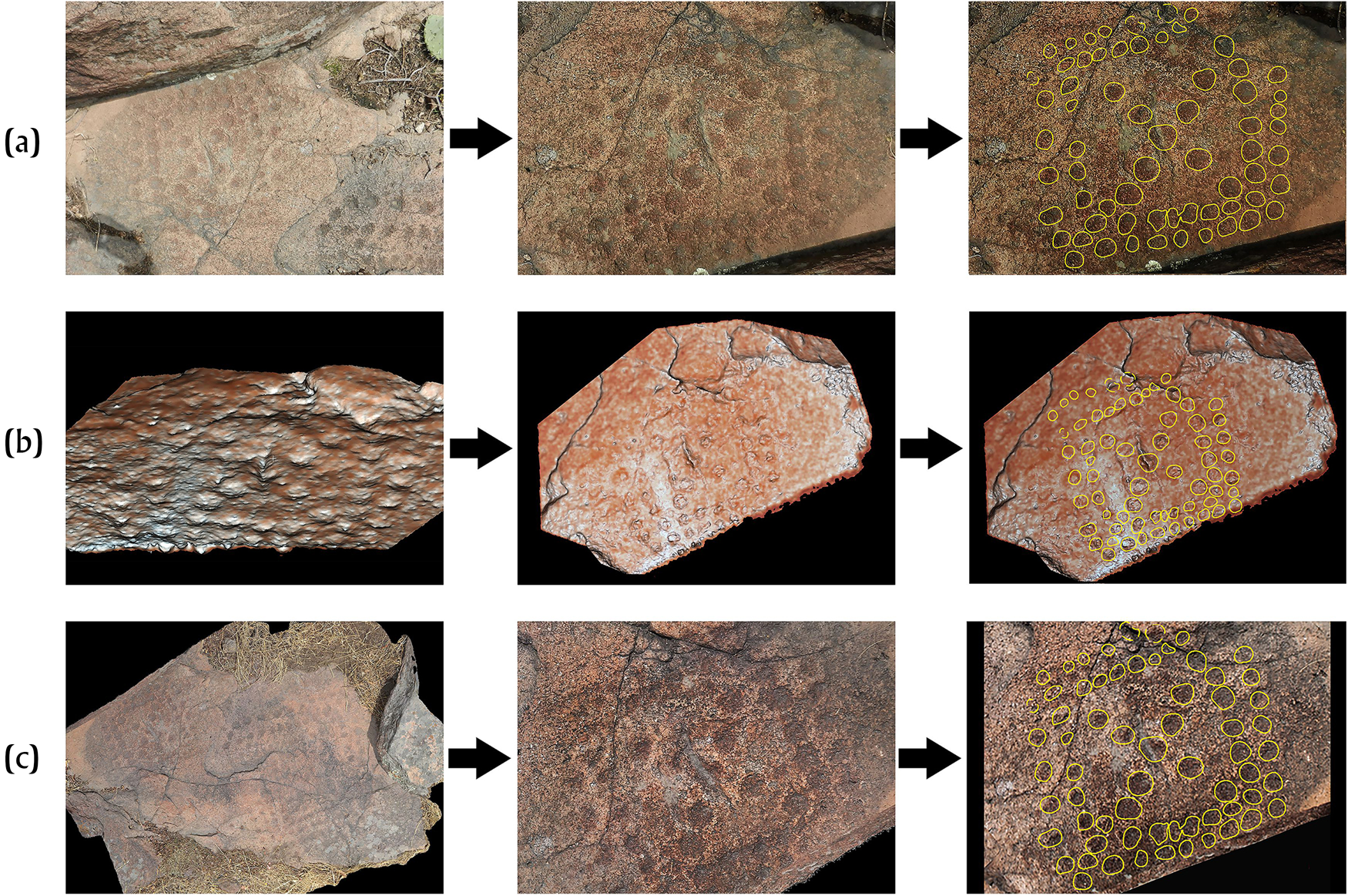
The Tetzcotzinco pecked-cross petroglyph forms a layout that allows the grouping of dots into minor clusters that could potentially correspond to Mesoamerican time units. However, attempting to divide its signs clearly is highly problematic and must rely, at least partially, on the researcher's interpretations. At this point, it is crucial to note the specific nature of rock art studies. The research on such representations requires the translation of petroglyphs made on a natural, uneven, and three-dimensional rock surface into the form of two-dimensional drawings. Therefore, already at the documentation stage, there may be slight deformations in the shape of individual motifs and changes in both the location of signs and the spaces between them. The researcher's task is to convert the petroglyph into a drawing with the best possible faithfulness to the original representation, but the appearance of slight distortions is inevitable. Consequently, various forms of petroglyph visualization should be used simultaneously to minimize any potential errors produced during redrawing.
The presented scheme (Figure 3) shows the stages of the Tetzcotzinco pecked cross redrawing. I made the original sketch (Figure 3a) based on a photo taken in situ, which is a common documentation method. However, after comparing it to the drawings created on the three-dimensional model (Figure 3b)—which maintains the natural structure of the stone—I observed noticeable differences in the location of the dots, especially in its upper rows. As a result, to minimize those differences, I correlated the two original sketches with an orthophotograph (Figure 3c), which is an accurate cartometric projection of the petroglyph. The resulting redrawing then formed the basis for my further studies. Nevertheless, I am aware that the layout of the Tetzcotzinco petroglyph may still raise some doubts. For this reason, the redrawing of the pecked cross offers various possibilities for dot dividing, of which two proposals seem most credible:
(1) The dots can be divided into eight groups of seven dots and an inner cross made of nine dots (Figure 4). The external rectangular shape formed by 28 dots is the clearest. Although the bottom and side rows do not connect to the upper line, they might have been intended to represent a complete square. Each side of the square would then include seven dots, which is particularly clear in the upper “separated” row.
The process of redrawing a pecked cross in digital form: (a) based on photography; (b) based on 3D model; and (c) based on orthophotography.
Pecked-cross petroglyph in Tetzcotzinco with the division of the dots: (a) drawing; and (b) possible layout (7–7–7–7 & 7–7–7–7 & 9[cross]).
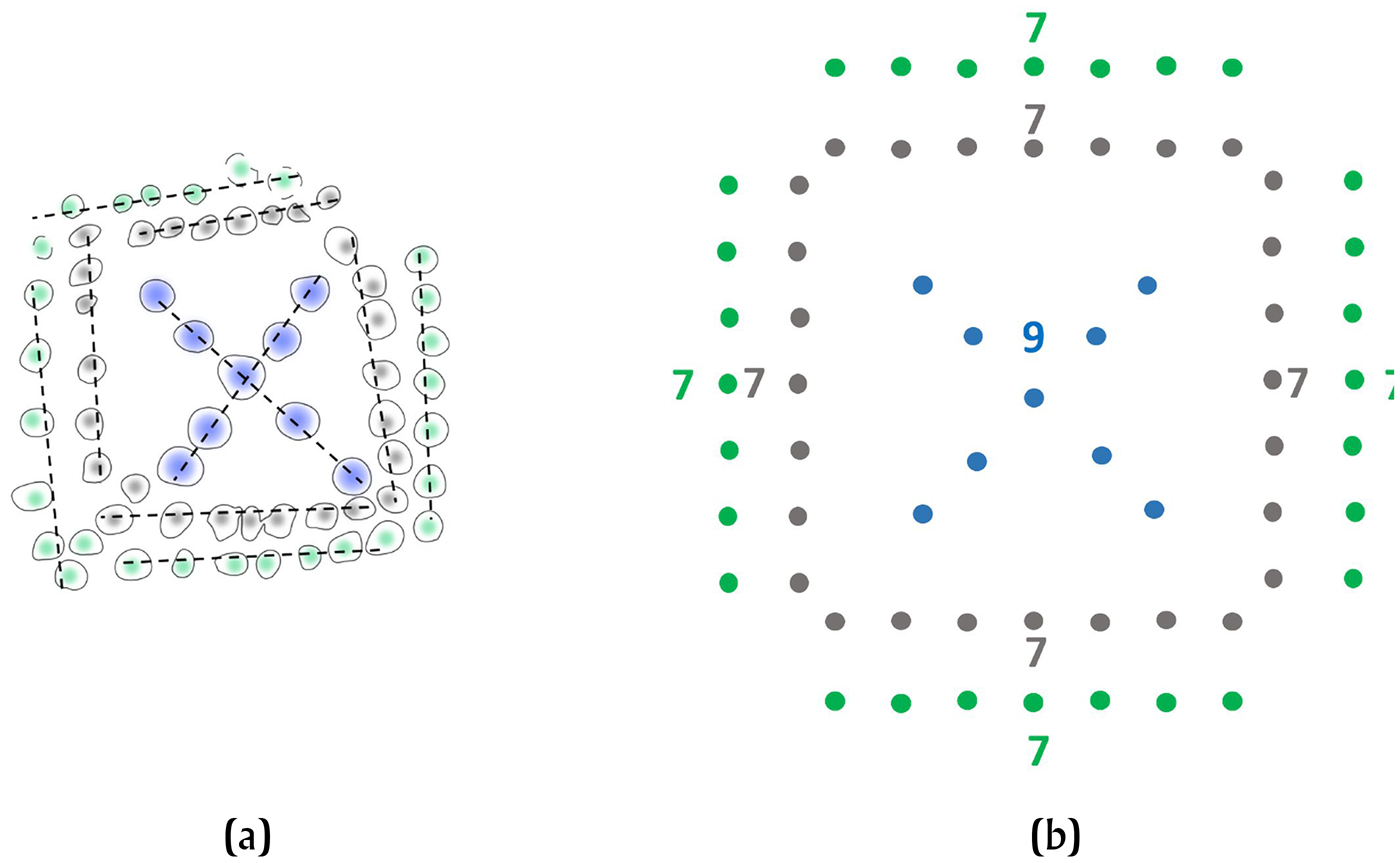
The inner square is slightly more challenging to recognize due to the less distinct and less regular form in addition to the partial “connection” to the central cross. However, if we separate the most central dots of the cross, we are left with a square of 28 dots, each side of which would consist of seven dots. Consequently, the outer and inner squares would each consist of four groups of seven dots (7–7–7–7 & 7–7–7–7, where dash [–] separates numerical values possibly forming a single series of numbers, and ampersand [&] marks the beginning of a separate series). At the same time, the inner cross would consist of nine dots: one central dot and four arms of the cross, of two dots each.
(2) A slightly different arrangement of the dots forming the inner cross is also possible (Figure 5). If the upper side of the inner square consists of six tightly spaced dots, the seventh dot should be seen as separated from the rest and placed on the extension of one arm of the inner cross. A similar possibility appears on the right side of the inner square, where one of the dots seems to be the extension of the inner cross.
Alternate arrangement of the inner square and the cross (6–6 & 13[cross]).
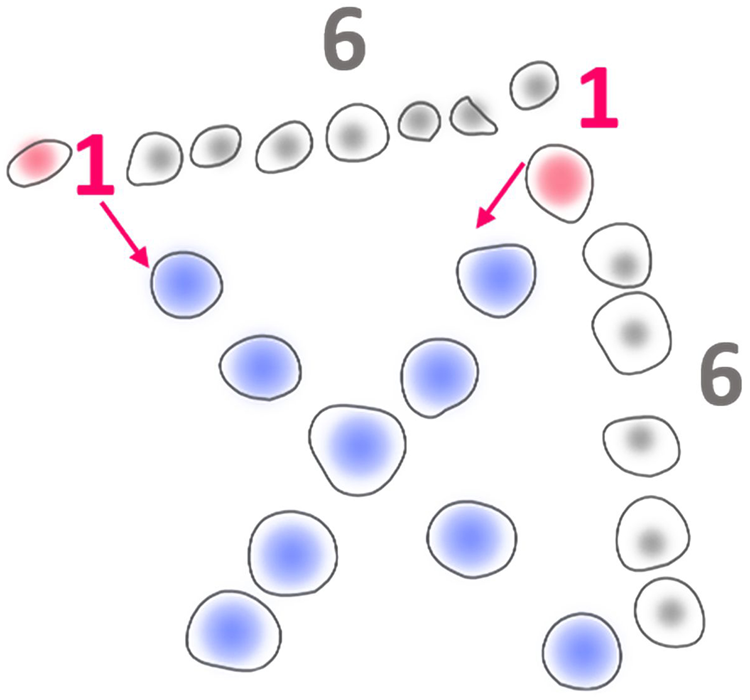
This interpretation suggests that the inner square would have smaller sides, containing six dots each. Consequently, the cross would include four additional outermost dots; therefore, it would ultimately consist of 13 dots (Figure 6). With this arrangement, the parallel sides of the outer and inner square could compose groups of 13 dots (7 outers + 6 inners = 13). The entire representation would therefore consist of five 13-dot groups (four sides of squares and the cross).
Pecked-cross petroglyph in Tetzcotzinco with the division of the dots: (a) drawing; and (b) possible layout (13–13–13–13–13).
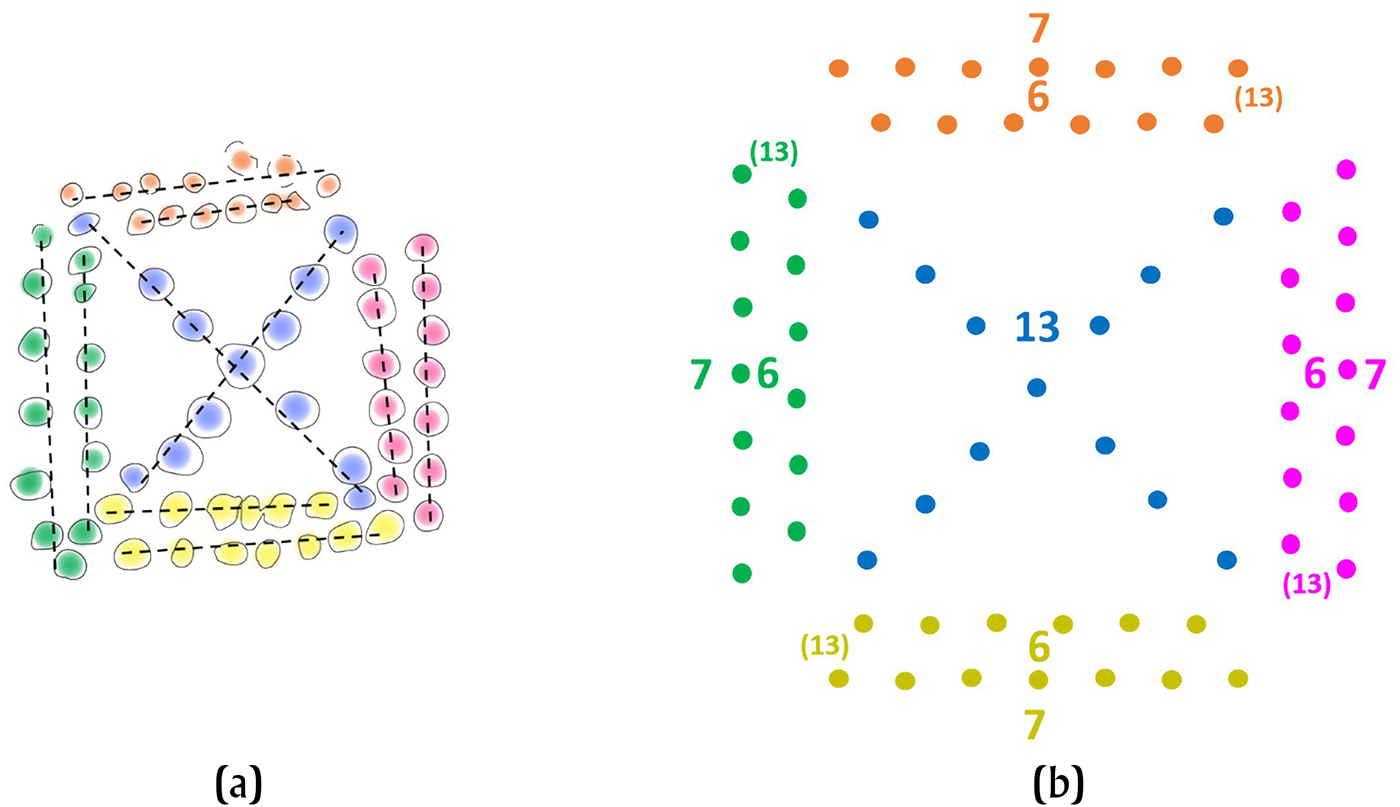
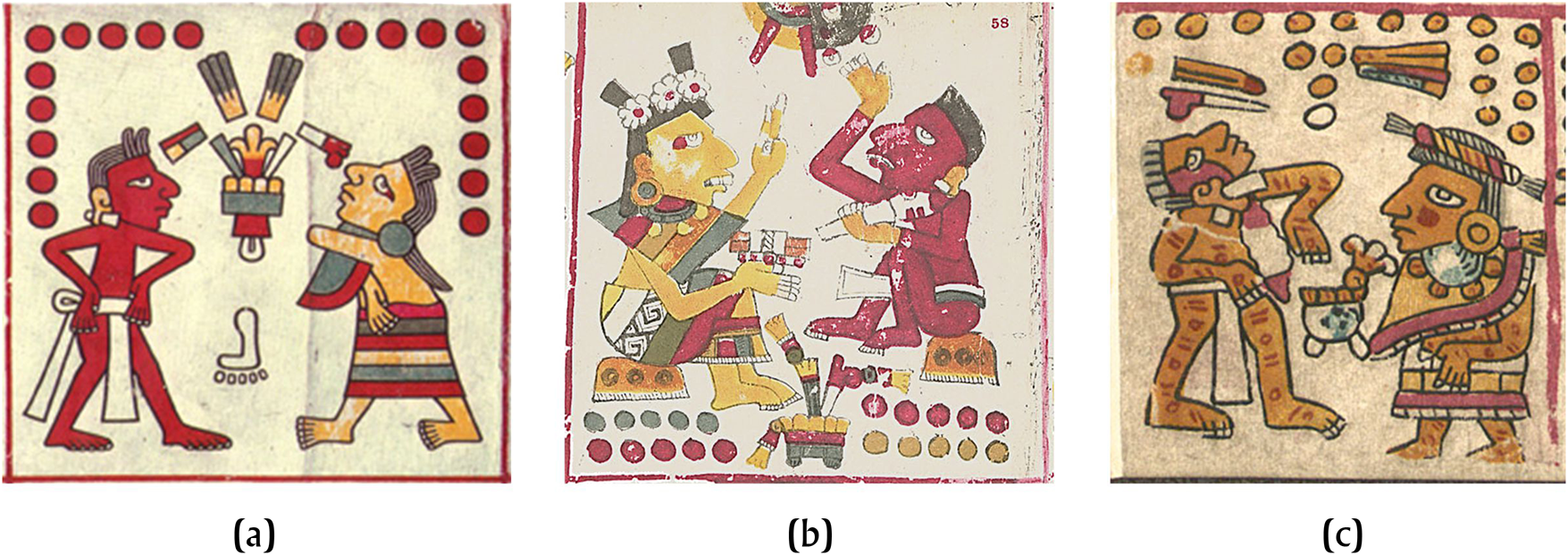
Although this alternate arrangement is not straightforward on each side of the figure, it cannot be ruled out that such a grouping of dots indeed was the original intention of the petroglyph's creators. In the Central Mexican Graphic Communication System (or GCS—a term denoting both glottographic, nonglottographic, and numerical ways of visual communication; see Mikulska Reference Mikulska2015:22), such visual irregularities in the ways of representing numbers is frequent (Nowotny Reference Nowotny1961:218; Boone Reference Boone2006:90–91). In the pre-Hispanic indigenous books (commonly known as “codexes”), the same numbers represented by dots can be arranged visually with a different layout on the graphic surface. For example, let us look at scenes from marriage almanacs in Laud (p. 35), Borgia (p. 58) and Vaticanus B (p. 35) codexes (Figure 7). They are part of a table used to determine the fate that may await the spouses, based on the sums of their numerals (1–13) from the day names (which is why the numbers in the almanac range from 2 to 26; Nowotny Reference Nowotny1961:216). The scenes in Figure 7 include sums of numerals represented with dots, specifically dressed male and female, and additional objects that supplement the mantic information. Although each codex presents the same numerical value (20), each differs in graphic arrangement. In Codex Laud (Burland Reference Burland1966), the 20 dots are depicted symmetrically and regularly, forming two pairs of perpendicular lines (each with five dots). Codex Borgia (Loubat Reference Loubat1898) shows two pairs of parallel lines (also with five dots each), but the arrangement of its dots is no longer so clearly aligned and is only partly symmetrical. The scene from Codex Vaticanus B (Loubat Reference Loubat1900), in contrast, is the most irregular and does not present any form of symmetry or linearity. At the same time, it is the only example where the number has not been visually divided into smaller groups. Therefore, the provided example shows that the regularity of the dot arrangement, as well as the different distances between the signs, did not matter for the representation of a single number.
Ways of representing numbers in the marriage almanacs from (a) Codex Laud, Plate 35 (Burland Reference Burland1966); (b) Codex Borgia, Plate 58 (Loubat Reference Loubat1898); and (c) Codex Vaticanus B, Plate 35 (Loubat Reference Loubat1900).
On the other hand, the scenes from the almanacs, unlike the petroglyph from Tetzcotzinco, constitute the part of a predictable series of prognostications, which certainly facilitates the recognition of the number for the reader. Consequently, this example cannot be an exact analogy for the pecked crosses. Nevertheless, knowing that the Central Mexican GCS allowed for some inaccuracies in the visual representation of the numbers and that the attempt to convert the three-dimensional rock art to the form of a two-dimensional drawing involves some distortions, it is difficult to choose only one possible interpretation of the dot division in the Tetzcotzinco petroglyph. Therefore, in this article, I will consider two alternative hypothetical arrangements of the signs in the pecked cross.
The number 65 and its symbolism
Studies of the Mesoamerican calendars indicate that with astronomy and calendrical counting people developed various ways of representing graphically different time units. The signs served not only to count days but also to express symbolic meanings associated with a particular cycle (e.g., representing a deity related to a specific calendrical period; Boone Reference Boone2007:2; Dehouve Reference Dehouve2001:108; Jansen Reference Jansen2012:87). As demonstrated by various researchers (Aveni et al. Reference Aveni, Hartung and Buckingham1978; Iwaniszewski Reference Iwaniszewski and Ruggles1993:288, Reference Iwaniszewski, Wiesheu and Fournier2005), the Mesoamerican pecked crosses could constitute an example of such a visual correlation between the number and layout of the dots and various calendrical cycles. The layouts of the dots of the Tetzcotzinco petroglyph correlate with several Mesoamerican time counts. I will start the discussion with the largest represented number: 65.
The total count of dots in the Tetzcotzinco petroglyph is 65. This number is highly significant in Mesoamerica and appears in various contexts related to time, calendar, and astronomy. It could refer to the planet Venus and its rising as the Morning Star in 65-year cycles (Rice Reference Rice, Dowd and Milbrath2015:274–275), but Tetzcotzinco has no Venusian associations to support such a reading. This number is also an even multiple in the 260-day tonalpohualli cycle (4 x 65) (Caso Reference Caso, Wauchope and Willey1965:943–944; León-Portilla Reference León-Portilla1963:72; Nowotny Reference Nowotny1968:89), and this interpretive path seems to be much more promising. The tonalpohualli is a set of 260 days (or calendrical “positions”) that was used for calendrical prognostication and ritual purposes, and it has survived to this day in a few locations in Mexico and Guatemala. Currently, there is a debate in the literature about studying tonalpohualli as a calendar (a count of passing days) or a mantic count (a count of 260 positions used for divination and determining mantic values); however in this article, I will consider it as a form of calendrical record, defining a cycle of 260 days (for details on the issues in determining the nature of tonalpohualli, see, e.g., Oudijk [Reference Oudijk and Mikulska2020:232–234], van Doesburg [Reference van Doesburg and Oudijk2021:34–39], and Rojas [Reference Rojas2022:180–184]). The 260-day tonalpohualli calendar thus consists of a set of 20 day signs combined with the numerals from 1 to 13 (20 x 13 = 260), allowing a division into 20 smaller 13-day periods, called trecenas among Mesoamericanists. The 13 numerals and 20 signs go as two separate sets, so when the count of the 13 numerals ends, the count of the day signs continues. The next day sign is now linked with the numeral 1 again. At 7, the count of the signs will end, and another combination will consist of the first day sign and the numeral 8. In this way, the sign and numeral counts follow their order (Figure 8; Seler Reference Seler, Seler and Bowditch1904a:13–15). Therefore, the 260-day calendar, apart from counting time, allowed for the precise determination of individual days, giving them their names by combining a numeral and a sign.
The layout of the functioning of the trecena count. Scheme by the author.

The 260-day tonalpohualli calendar usually appears in divinatory books, or tonalamatl, as extended tables (called tonalpohualli in extenso by Nowotny Reference Nowotny1961:229), showing individual day positions. These charts were created in such a way as to present, apart from the 260-sign system, other numerical values. The 260-day count was the most significant of Mesoamerican calendars, independent of the solar year. It created other astronomical counts, such as the 52-year cycle (Seler Reference Seler, Seler and Bowditch1904a:15) or much smaller units. One of the primary divisions of the 260-day calendar is into four parts. As seen in the divinatory books, the tonalpohualli could be arranged in a chart, divided into four sectors. A trecena occupies one sector, so after four sectors are completed, the fifth trecena appears again in the first part of the chart. Ultimately, after completing the 260-day cycle, each of the sectors of the tonalpohualli contains five nonconsecutive trecenas, thereby creating groups of 65 positions (5 x 13 = 65; Figure 9; Seler Reference Seler, Seler and Bowditch1904b:267).
Graphic arrangement of the tonalpohualli calendar: (a) division of tonalamatl in Codex Borgia into four sectors of 65 positions (scheme by the author); and (b) 65-day subcycle in tonalamatl, Codex Borgia, Plates 7–8 (Loubat Reference Loubat1898).
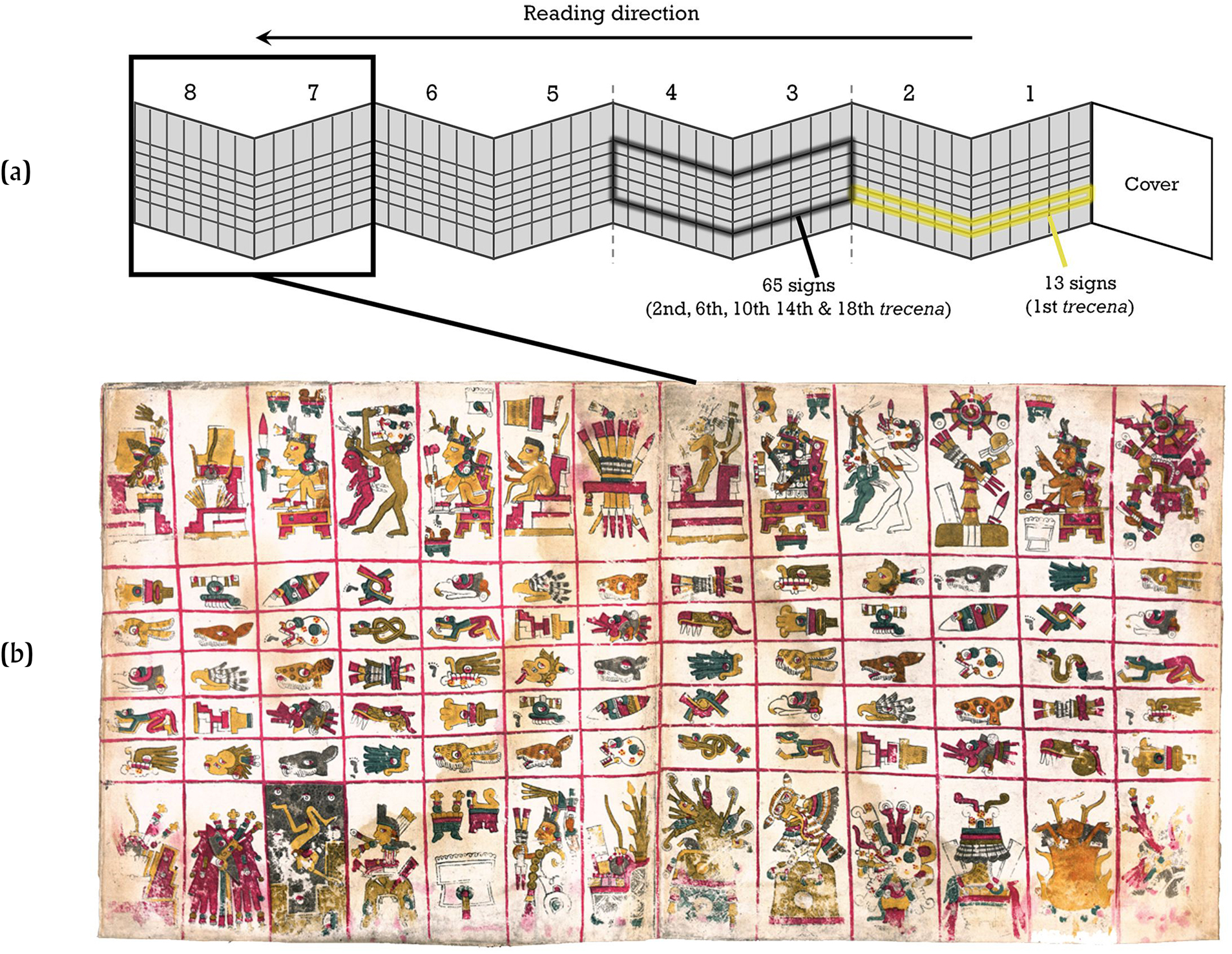
I suggest that one of the essential functions of the Tetzcotzinco petroglyph was to record and count 65 days, each represented by a dot. Alternatively, placing 65 dots may have condensed 260 days, representing the whole tonalpohualli calendar. At the same time, however, the visual representation of 65 dots could have been a way of presenting the symbolism associated with that number and the calendrical subcycle itself.
The 65-day subcycles also appear outside the in extenso tonalpohualli charts. One of the most important contexts in which the number 65 and 65-day intervals appear are the almanacs associated with the rain gods (Anders and Jansen Reference Anders and Jansen1993:297; Seler Reference Seler and Frenk1963:258–265). Such tables can be found, among others, in the Codex Borgia (Loubat Reference Loubat1898) on Plate 27 (Figure 10). The page is divided into five scenes, four arranged in the corners of the plate and one in its center. Each of the depictions shows different manifestations of Tlalloc, the god of rain, with different attributes and in different scenery. The four external scenes also contain signs representing four years (1 Reed, 1 Flint, 1 House, and 1 Rabbit) that divide a 52-year cycle into four parts. Additionally, they have four day signs (1 Cipactli, 1 Death, 1 Monkey, and 1 Vulture), separated by 65 positions in tonalpohualli charts. Consequently, scholars believe that this almanac represents four 13-year cycles and four 65-day subcycles (van Doesburg and Oudijk Reference van Doesburg and Oudijk2022:273–275).
Rain god almanac, Codex Borgia, Plate 27 (Loubat Reference Loubat1898).
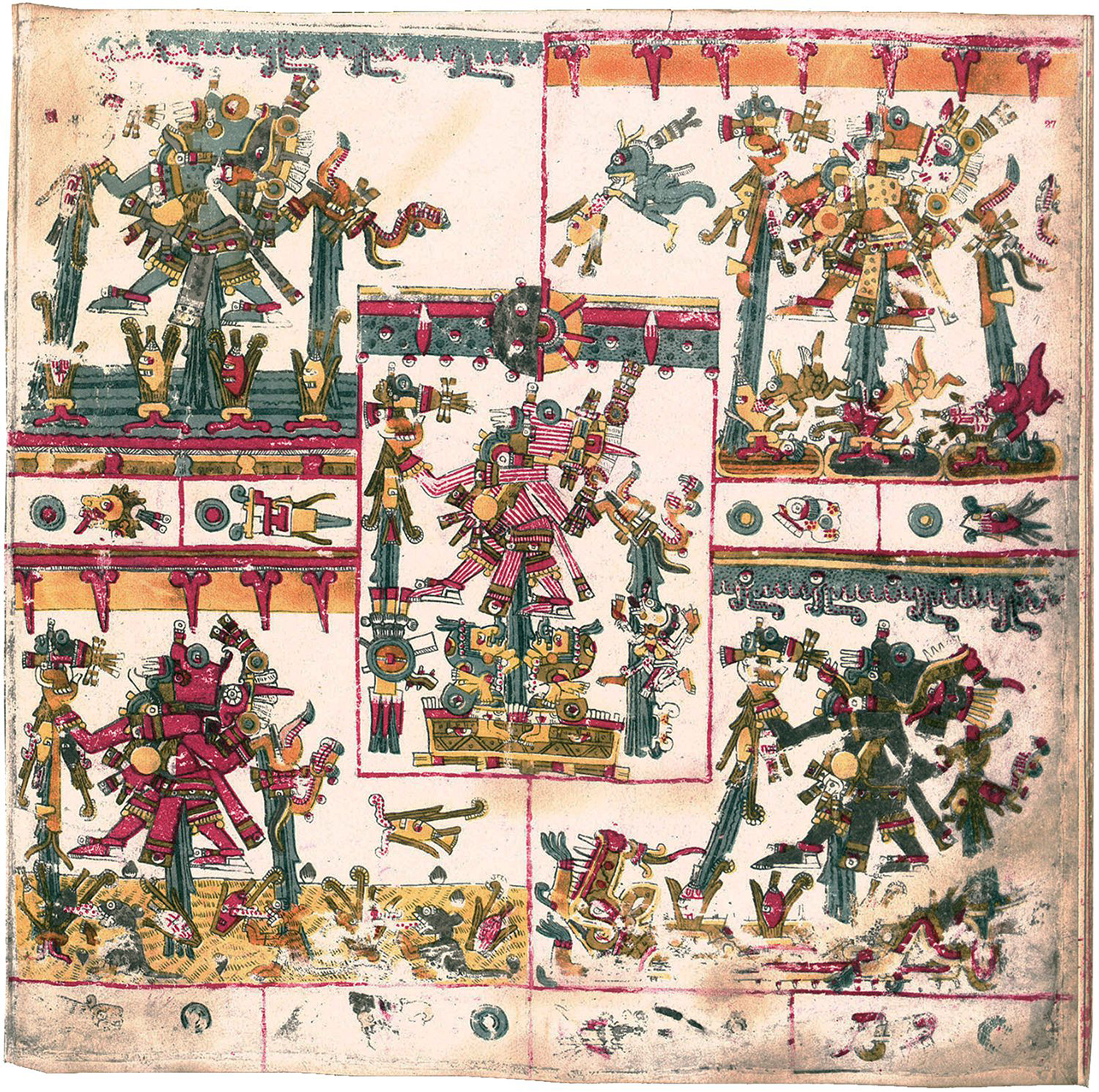
As noted by Boone (Reference Boone2007:145), the rain god almanac's arrangement seems to correspond to the passage from Historia de los mexicanos por sus pinturas (1882) that speaks of Tlalloc and his dwelling (García Icazbalceta Reference García Icazbalceta1888). The story speaks of how Tlalloc lived in four rooms with four bodies of water, which individual Tlalloque (plural of Tlalloc) controlled. Each was responsible for bringing a different type of rain and meteorological phenomena (in Garibay Reference Ángel María1979:26). Plate 27 of the Codex Borgia (Loubat Reference Loubat1898) associates the four cycles with different kinds of rain and weather. The first 65-day period, beginning with 1 Cipactli, is the cycle of the black Tlalloc sending favorable rain that causes maize to grow. The second cycle, 1 Death, is associated with the yellow Tlalloc, who sends harmful rain and a locust that destroys the farmland. The third cycle, 1 Monkey, is the period of the blue Tlalloc, who sends good rain to feed the soil. The last cycle, 1 Vulture, is associated with the red Tlalloc, who releases unfavorable rains on maize devoured by rodents. The fifth, central Tlalloc, has a slightly different form and role. He is painted with stripes (characteristic of sacrificial victims) and sends water with a skeletal figure, a bone, and a shield and arrows (war). In addition, this scene is accompanied by a sign of half sun, half darkness that symbolically connects day and night. The fifth Tlalloc, devoid of calendrical information, would be a symbol of variable fate and rains (Boone Reference Boone2007:147; Seler Reference Seler1903:281) and a thematic summary of the entire representation (van Doesburg and Oudijk Reference van Doesburg and Oudijk2022:274). The almanac and, therefore, the 65-day cycles were graphically related to agriculture, the maize growing cycle, and rainfall.
Heirs of Mesoamerican cultures have also known the 65-day subcycles. Colonial Zapotecs called them Cocijos, which relates them directly to the rain-lightning deity Cocijo (Anders and Jansen Reference Anders and Jansen1993:292; Oudijk, as cited in Justeson and Tavárez Reference Justeson, Tavárez, Ruggles and Urton2007:21). Their primary function is to divide the 260-day calendar (piyé) into four equal periods. This calendar is used primarily for mantic purposes, so the role of the Cocijos cycles is also similar. Based on them, the specialists can designate the offerings for each of the four Cocijos and specify the most effective days for rituals related to rain and agriculture (Jansen and Pérez Jiménez Reference Jansen and Pérez Jiménez2017:459). As previously indicated, groups of 65 days were one of Mesoamerica's essential time units, directly related to “rainy” deities. They allowed people to conduct divination and rituals related to agriculture and to control both propitious and unfavorable weather.
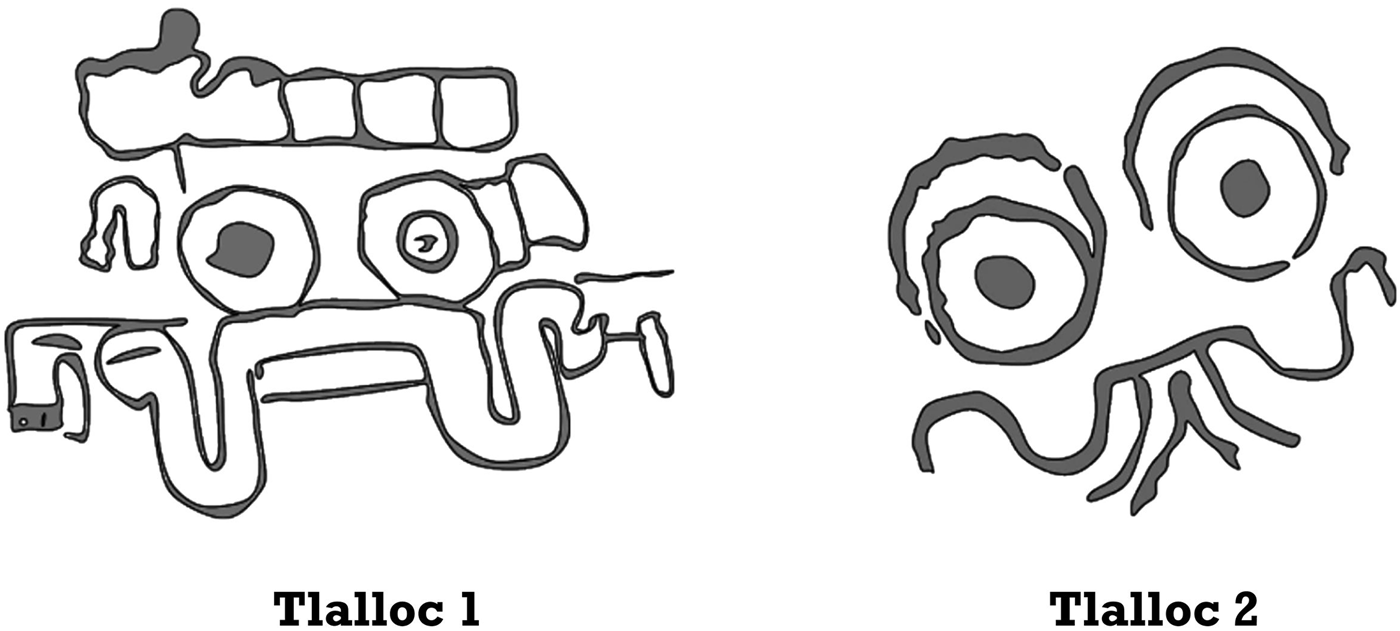
The symbolic relation of the number 65 to agriculture and the rain god correlates with Tetzcotzinco's focus on cultivating plants and worshipping the god Tlalloc (García García Reference García García2000:48). The lower parts of the Tetzcotzinco hill were covered with cultivated terraces, which historical sources describe as the “gardens” of the rulers of Tetzcoco (Evans Reference Evans2000:216–217). The location of the pecked-cross petroglyph on one of the paths leading to the southern terraces can support its agricultural connotations. Moreover, earlier research by Townsend (Reference Townsend, Aveni and Urton1982) showed a connection between this place and the temple on top of Mount Tlaloc, the location of the most important sanctuaries of Tlalloc. From the early stage of the construction of the Tetzcotzinco complex, this place was to become a miniaturized form of Mount Tlaloc, and its hilltop buildings were a response to its temple (Townsend Reference Townsend, Aveni and Urton1982:59–61). Tetzcotzinco's rock art also emphasizes this site's cult of Tlalloc. In the upper complex of Tetzcotzinco, archaeologists discovered the most famous petroglyphs on the site, representing the “masks” of the rain god (Figure 11; García García Reference García García2007:203–204).
Petroglyphs with the “masks” of Tlalloc, Tetzcotzinco. Drawing by the author.
Summing up, besides counting 65 days, it seems that the pecked-cross petroglyph in Tetzcotzinco was associated with agricultural activities. It could have been used as a graphic mark to express Tlalloc's domain, similar to the almanac in the Codex Borgia (Loubat Reference Loubat1898). Divided into four parts, the pecked cross would correspond to the concept of Tlalloc's four manifestations, which were responsible for rains, storms, and other weather phenomena. These, in turn, were indispensable factors supporting (and sometimes hindering) agricultural activity and dividing the cycles of maize cultivation. Through its 65 dots, the petroglyph could also encode ideas directly related to the rituality dedicated to Tlalloc (an essential aspect of the cult held in Tetzcotzinco), especially the ceremonies conducted in 65-day intervals. The whole pecked cross, expressing the number 65, could therefore represent a complete and complex idea, connecting the rain gods, agriculture, rainfall, seasonality, and the passage of time.
Smaller numbers
7–9 and 28
The arrangement of dots in the petroglyph also offers the possibility of considering smaller numbers that may have enabled the encoding of different meanings, possibly unrelated to the 65-day cycle. My first proposal (Figure 4) of the representation division grouped the dots into three clusters: external square (with a group of 28 or 7–7–7–7 dots), internal square (also with 28 or 7–7–7–7 dots), and a cross (consisting of nine dots). Each of these groups could have symbolic implications regarding calendrical cycles and religious beliefs. Significantly, the foci on either of the numbers (including 65) do not have to be mutually exclusive. It is common in the Mesoamerican GCS to combine different numerals and calendrical cycles on a single representation, as exemplified by tonalpohualli charts (Figure 9; see also Seler Reference Seler1903:5–12; Boone Reference Boone2006:73–75).
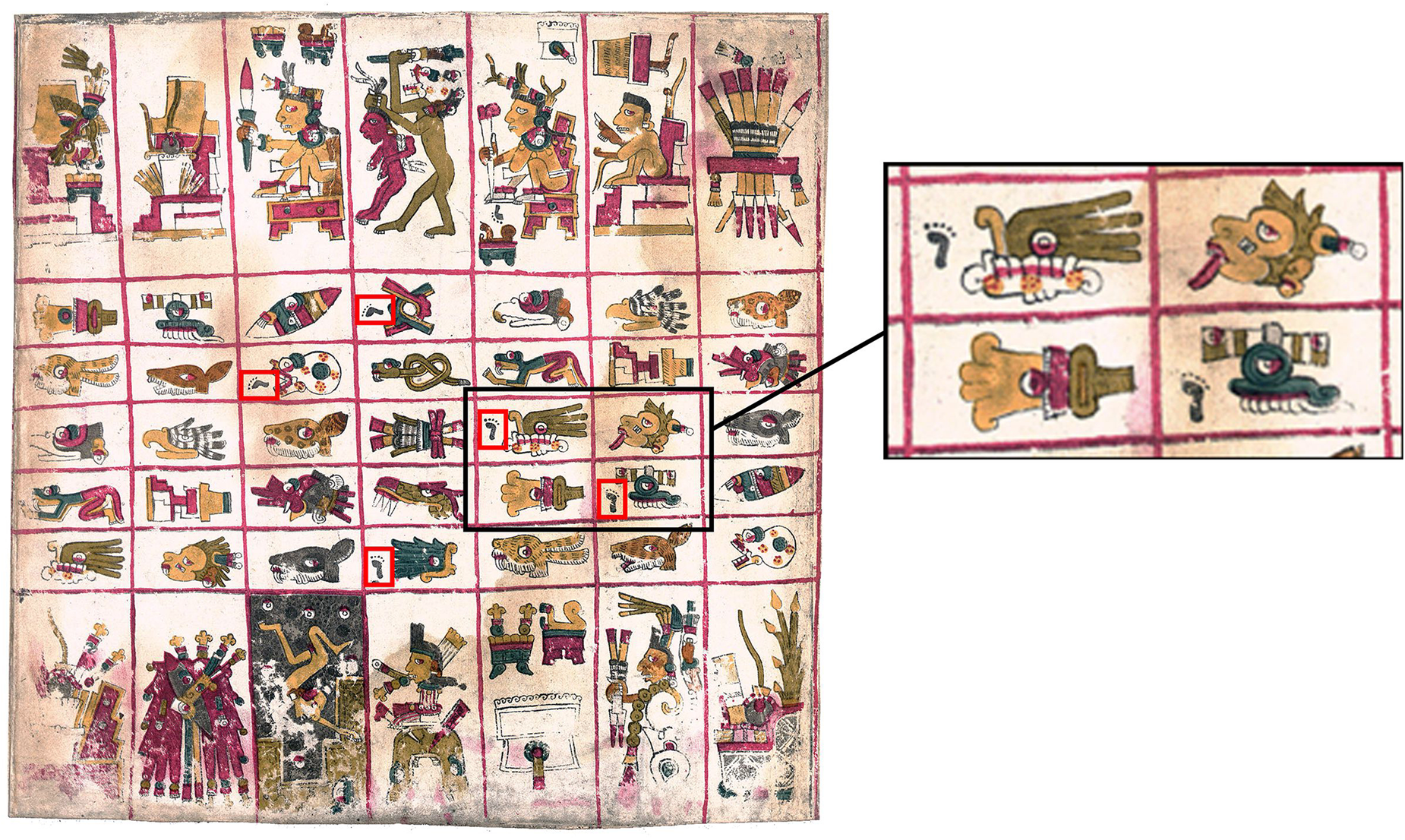
Therefore, in this division, we can distinguish clusters forming the numbers 7 and 9. This petroglyph appears to represent a specific series of values, which would be expressed by eight repeated 7s and a single 9 (8 x 7–9). On the one hand, this series could be rejected, given that such a combination of numbers or time units has not been recorded in any Mesoamerican source. On the other hand, it is possible that this arrangement of dots served only to emphasize the symbolic meaning of the numbers 7 and 9 rather than to express their larger combination. Indeed, the seven- and nine-day subcycles appear in calendrical records and, most importantly, remain in mutual relation. They can be found in various tonalpohualli charts, such as in the Borgia and Cospi codexes (Anders et al. Reference Anders, Jansen and van der Loo1994b:161; Seler Reference Seler1903:5). In these books, the seven- and nine-day subcycle series were coded by foot signs, shown next to the primary day signs (Figure 12). These feet appear in sequences of 7 or 9 positions (Anders et al. Reference Anders, Jansen and van der Loo1994b:161–163). The first foot sign appears on the day 4 Lizard, another nine positions later (13 Reed), another nine positions later (9 Wind), and so on. Repeating foot signs every nine days occurs nine times (9 x 9). After that, the sign appears every seven positions (1 Grass, then 8 Rain, then 2 Death, etc.). This cycle, in turn, repeats seven times (7 x 7). After completing this series, the foot sign reappears once again every nine positions (nine times in total) and again every seven positions (seven times). Consequently, in the tonalpohualli, both series are repeated twice (9 x 9–7 x 7–9 x 9–7 x 7), giving a total of 260 positions (days) (Oudijk Reference Oudijk and Oudijk2021:42–44). Although the above series of nine and seven days and their meaning are not fully understood, it is clear that Mesoamerican people counted such small cycles. Similar seven- and nine-day periods were also observed, among others, in colonial and contemporary calendrical systems used by the Maya K'iche’ (Estrada Peña et al. Reference Estrada Peña, Mikulska, Prusaczyk, Kossowska-Janik and Mikulska2020:190). In the almanacs of the 260-day cycle (not graphically recorded anymore), the mantic value is not only coded by the simple combination of a numeral and day but also depends on other day signs. Therefore, every day is influenced by other numeral days that intertwine within a network expressed by distances from each other. Such a relation includes days separated in the 260-day cycle by seven or nine positions, depending on the period in which these days are located. This means that every given day is under the influence of the forces that appeared seven or nine days earlier. At the same time, this day impacts the future and another day (also distanced by seven or nine positions) (Estrada et al. Reference Estrada Peña, Mikulska, Prusaczyk, Kossowska-Janik and Mikulska2020:191–192). These examples demonstrate additional divisions within the 260-day calendar and seven- and nine-day cycle counts in Mesoamerica, which may support the coding of such numbers in Tetzcotzinco's pecked cross in the form of eightfold series of seven dots (squares) and one series of nine dots (cross).
Feet signs in Codex Borgia, Plate 8 (Loubat Reference Loubat1898).
The arrangement of the petroglyph (the squares made of 7–7–7–7 dots) may also suggest the importance of the number 28. This number would appear twice on the petroglyph: on the external and internal squares, as the sum of the dots that make up each square. Although this number might seem significant, 28 does not appear as a relevant number in Mesoamerican calendars. In this case, the number 28 may constitute a misunderstanding and result from the accidental summation of four 7s (whose importance as calendrical numbers in Mesoamerica is documented; see below). Danièle Dehouve (Reference Dehouve2001) described a similar situation for contemporary Tlapanecas. The researcher noted the custom of offering plants grouped in bundles or chains that appeared to make up large sums (such as 32 or 256) when, in fact, they are supposed to encode multiplied (and thus strengthened) minor numbers (4 and 8) that have a precise symbolic meaning (Dehouve Reference Dehouve2001:103–106).
Consequently, the potential division of the pecked-cross petroglyph into two squares of 28 signs may be wrong. Perhaps the squares actually served to represent smaller numbers or periods, and they also should be divided. This way, it can be more appropriate to think about smaller clusters of signs: groups of seven and nine dots.
6–7 and 13
My second proposal of dividing the pecked-cross petroglyph from Tetzcotzinco into smaller clusters includes groups of dots consisting of four series of 13 external signs (in two rows of seven and six dots) and another internal series of 13 signs, which creates the cross (Figure 6). The entire representation could serve to count five groups of 13 dots, which would correspond to the 13-day or trecenas cycles.
As indicated, indigenous divinatory books often divide the tonalpohualli into four sectors (one for every two plates) with 65 positions. Then, the 65-day cycle could break into five 13-day periods. These 65-day groups correspond with Tetzcotzinco's pecked cross, possibly linking it with 13- and 65-day subcycles; its function would be to record this numerical series (13–13–13–13–13 and 65).
The relationship between the Tetzcotzinco petroglyph and the counting of 13-day subcycles is also noticeable in the visual division of the petroglyph's external squares. The division of the pecked-cross figure shows four groups of thirteen outward signs, divided into two rows of six and seven dots. These subcycles are known in astronomical and calendrical systems of Mesoamerica, and they are called the “half trecenas” (Jansen Reference Jansen1986; van Doesburg and Urcid Reference van Doesburg, Urcid and Oudijk2021:81–83). This combination was recognized, among others, in Codex Tudela (Batalla Rosado Reference Batalla Rosado2002), which presents trecenas on every two pages and separates them into groups of seven and six positions (Jansen Reference Jansen1986:102; van Doesburg Reference van Doesburg and Oudijk2021:51). In the illustrated example (Figure 13a), the reading starts from the left: the first day is 1 Reed (shown in the bottom row), then 2 Jaguar, 3 Eagle, and so on. The top row includes the representations of the “Nine Lords of the Night” (each day correlates to one of the deities). The left page (102v) ends after seven positions (7 Rain), forming the first half trecena. On the next page (103r), the cycle continues, creating the second half of the trecena, consisting of six days: it starts with 8 Flower, then 9 Lizard, and so forth, ending with 13 Snake (Jansen Reference Jansen1986:104).
Half trecena: (a) Codex Tudela, p. 102v–103r (Batalla Rosado Reference Batalla Rosado2002); and (b) Codex Borgia, Plates 75–76 (Loubat Reference Loubat1898).
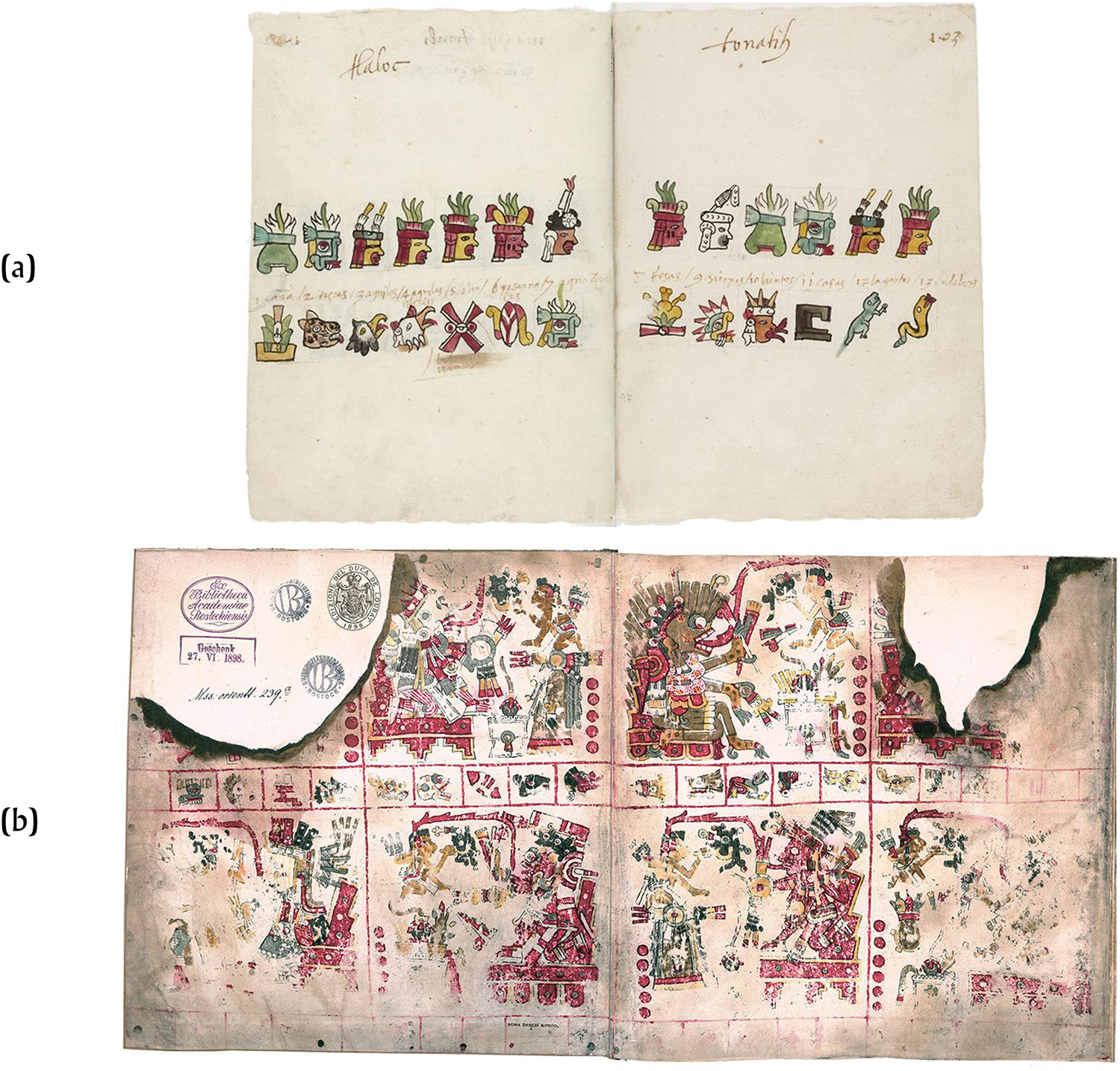
A similar division of a trecena into 6 and 7 is also present in other indigenous divinatory books, such as Codex Borgia (Loubat Reference Loubat1898:Plates 75–76; Figure 13b; Anders et al. Reference Anders, Jansen and García1993:365–372, Reference Anders, Jansen and van der Loo1994b:271–275), which indicates the great importance of six- and seven-day subcycles in Mesoamerica, especially in ritual and divination. In Codex Borgia (Loubat Reference Loubat1898), each half trecena has one patron deity and the assigned mantic signs, which determined the forces in play under the days of each half of the trecena. The count of the periods starts in the lower right part of the table. The first sign of the trecena is below the mantic scene. Then, the spacers (in the form of circles) allow counting the successive six positions (giving the number of seven days). The next position will be the first sign in the left section of the table, followed by five spacers (giving the number of six days). The next part of the table on the left repeats the process. After completing the bottom parts, counting continues in the top row from left to right. In the Codex Borgia (Loubat Reference Loubat1898), the pairs of gods of half trecenas are visible in the “cells” above the rows with day signs (Oudijk Reference Oudijk and Oudijk2021:275–276). Every deity has the form of an enthroned character with a set of offerings in front of them. The pairs of gods identified are Tlalloc and Tonatiuh, Mictlantecuhtli and Tlazolteotl, Centeotl and Tlahuizcalpantecuhtli, and Malinalteotl and Macuiltonalli (Jansen Reference Jansen1986:105–106; van Doesburg and Oudijk Reference van Doesburg and Oudijk2022:270–271).
There is a clear relation between 6-, 7-, and 13-day subcycles in Mesoamerican calendrical systems. Therefore, the division of Tetzcotzinco's petroglyph into clusters of 13 dots and then into smaller groups of 6 and 7 signs may not be accidental. In this petroglyph, representing such units of time in a visual form may have facilitated the count of time and expressed some symbolic content through numbers.
Layout of time and space
The last and most crucial stage of the research is the study of the overall layout of the dots that form the Tetzcotzinco pecked-cross petroglyph. This arrangement also shows a relationship between this object and Mesoamerican ideas about time and the universe. Regardless of which division into smaller clusters we adopt, the whole petroglyph undoubtedly consists of concentric squares with a cross inside them. This arrangement is one of the less common forms of pecked crosses in Mesoamerica. Studies on such representations at Teotihuacan show that these figures typically follow an arrangement of two (or more) concentric circles with two perpendicular lines in the center (Figure 14a). Less common are concentric squares and quadrangles. In square representations, unlike the Tetzcotzinco petroglyph, the inner cross usually intersects the middle of the sides of the squares, not their angles (Figure 14b; Aveni Reference Aveni2005:35). Despite the relatively unusual layout of the Tetzcotzinco petroglyph, it is not unique. Similar forms occasionally appear in various regions of Mesoamerica although they are less common than those mentioned earlier. One of the best-known examples of a pecked cross with a layout resembling that of Tetzcotzinco is a petroglyph found in Tlalancaleca, Puebla (Figure 14c; Olvera Hernández Reference Olvera Hernández2022:58). This motif, along with the petroglyphs accompanying it, is associated with architectural buildings dating to around 500–100 b.c. (Preclassic period; Aveni et al. Reference Aveni, Hartung and Buckingham1978:273), which would make it one of the oldest known pecked crosses in Mesoamerica (Rétiz García and Cárdenas García Reference Rétiz García, Cárdenas García and Galicia2019:215). Despite its nearly identical form to Tetzcotzinco's petroglyph, the cross from Tlalancaleca differs in the number of dots, reaching from 147 to 150. Other examples of petroglyphs with this type of layout include those in Cañón de Bolaños, Jalisco (Figure 14d), and Momax, Zacatecas (Figure 14e). Although both petroglyphs show more elements than the cross from Tetzcotzinco, their general layout appears to be similar. Both pecked crosses are preliminarily dated to the Classic period and the expansion of Teotihuacan's influence (Olvera Hernández Reference Olvera Hernández2022:73; Hers and Flores Reference Hers and Flores2013:8). Hers and Flores (Reference Hers and Flores2013:3) also mentioned the existence of similar crosses at Cerro Chapín (Zacatecas) and Tuitán (Durango). An interesting analogy may also be the pecked-cross figure from San José de Boctó in the northwest of the state of Mexico (Figure 14f); however, this motif is somewhat unique due to its single square with four “extensions” of the arms, pointing counterclockwise. Significantly, researchers have attempted to link the number of dots in this petroglyph to the codification of the series of 13s (Folan et al. Reference Folan, Folan, Pérez and de Jordán1987:437; Granados Saucedo Reference Granados Saucedo, Gómez, Granados Saucedo, Granziera and Medina Márquez2018:97).
Examples of the pecked-cross figures: (a) circle-cross figure TEO-30, Teotihuacan (Aveni Reference Aveni2005:Figure 3); Square-cross figure TEO-34, Teotihuacan (Aveni Reference Aveni2005:Figure 5); (c) square-cross petroglyph, Tlalancaleca, Puebla (Aveni et al. Reference Aveni, Hartung and Buckingham1978:Figure 1i); (d) square-cross petroglyph, Cañón de Bolaños, Jalisco (Olvera Hernández Reference Olvera Hernández2022:Figure 63; photography by Fátima Herrera); (e) square-cross petroglyph, Momax, Zacatecas (Hers and Flores Reference Hers and Flores2013:Figure 4); and (f) square-cross petroglyph, San José de Boctó, Mexico (Folan et al. Reference Folan, Folan, Pérez and de Jordán1987:Figure 20).
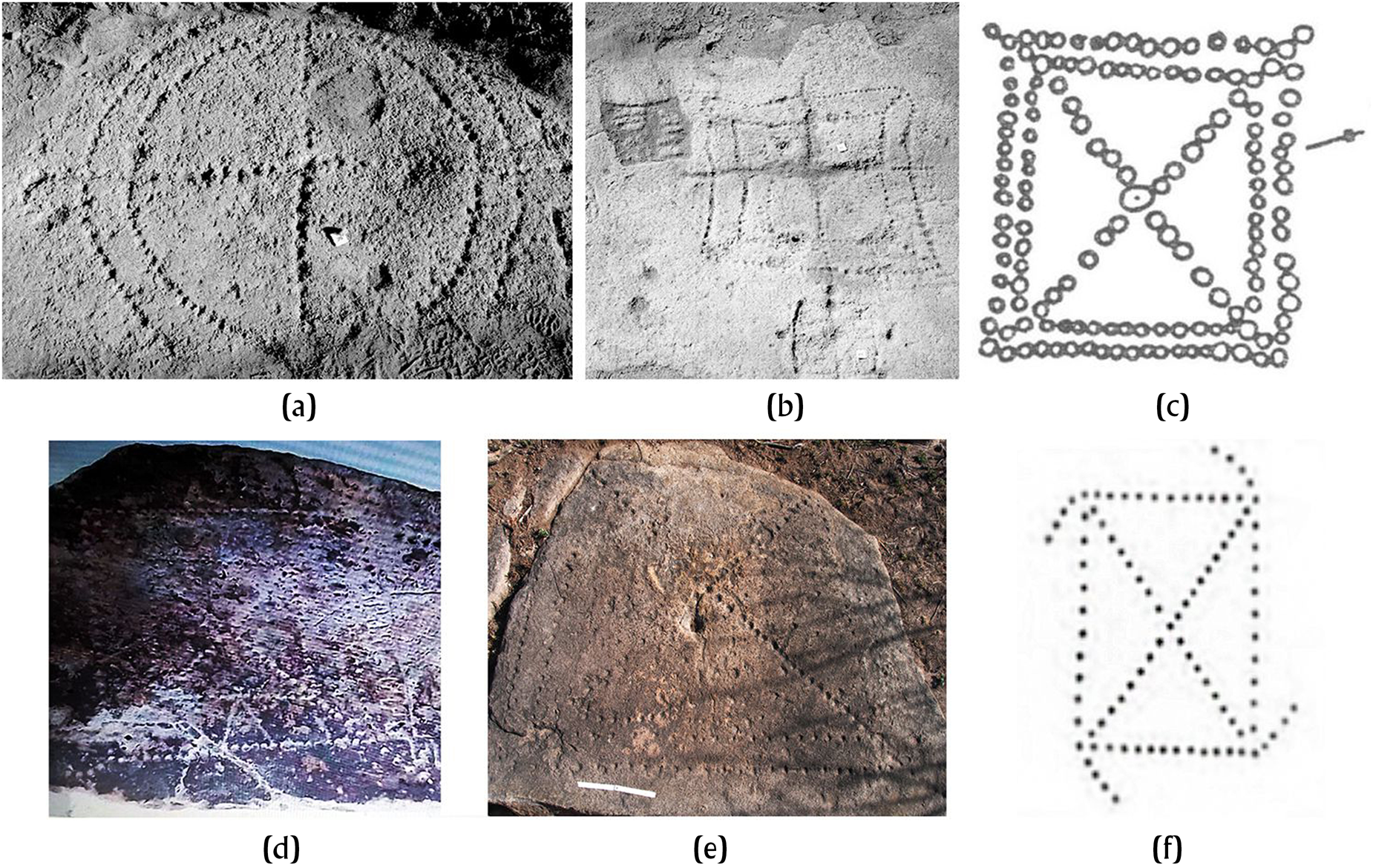
Although there are differences among the various pecked crosses, all the forms of this representation have significant similarities. First of all, one can see that concentric figures are divided into four parts by the arms of the cross in the very center of the representation. Therefore, there is no doubt that these features played an essential role in such pecked figures. Earlier researchers studying pecked-cross figures pointed out this quadruple division (Iwaniszewski Reference Iwaniszewski and Ruggles1993:294). They paid particular attention to the directions marked by internal lines (arms of the crosses) and tried associating them with the cardinal points. Consequently, the scholars mainly focused on the astronomical orientation of such lines and their possible functions as astronomical markers (Hers and Flores Reference Hers and Flores2013:10; Iwaniszewski Reference Iwaniszewski and Ruggles1993:289). The connection of the pecked crosses with the quadruple division of the world seems appropriate, especially on a symbolic level. In Mesoamerica, the division of space into four parts was important, and it was manifested in the GCS, architecture, and everyday life (Iwaniszewski Reference Iwaniszewski and Ruggles2014b:9–11). Indigenous communities viewed the four sides of the universe in a different way than Western ones did. As Dehouve (Reference Dehouve and Mercier2014:116–119) noted, the spaces between the cardinal points played a more significant role in the indigenous worldview than the points themselves. Hence, she proposes to focus on four spaces in the study of Mesoamerica and to use the name “cosmic directions” (rumbos in Spanish; Dehouve Reference Dehouve and Mercier2014:119) rather than “cardinal points.” The petroglyph from Tetzcotzinco (like other pecked-cross figures) could, through its internal crosses, not so much direct the viewer to cardinal points (as earlier scholars suggested) but be a visual representation of the perception of the universe consisting of four spaces.
The quadruple model of the universe is also strongly related to the perception of time in pre-Hispanic sources. The most famous example of a visual representation of the cosmos combined with time units is the first almanac of Codex Fejérváry-Mayer (Figure 15a; Loubat Reference Loubat1901). This almanac represents the entire tonalpohualli cycle. It places the 13-day periods within “bands,” which take the X-shaped or cross-shaped form with four additional “loops”—forming the second letter X. Each of the arms represents one of the cosmic directions. In addition to the day signs (and spacers), the almanac contains other mantic elements, such as birds and trees, adding value to both the cosmic directions and the 13-day series within them. Each arm of the cross includes two deities that, together with the central god Xiuhtecuhtli—who also serves there as “the Lord of the year and time”—form the “Nine Lords of the Night” series (Nowotny Reference Nowotny1961:226–227; Seler Reference Seler1902:5). The almanac perfectly represents the perception of the universe's space, time, and astronomic cycles and is often called “the shape of time” (Aveni Reference Aveni2012:74–75; Coggins Reference Coggins1980:727–729). The graphic arrangement of series of trecenas inscribed within cosmic directions and creating a cross converging toward the center is similar to the layouts of different pecked-cross figures, as already suggested by some scholars (Aveni et al. Reference Aveni, Hartung and Buckingham1978:272; Olvera Hernández Reference Olvera Hernández2022:102–103) for other crosses. Perhaps the arrangements of those petroglyphs were intended to represent not only the quadruple vision of the universe but also to express in its form “the shape of time,” connecting the ideas of time and space.
Comparison of the layouts of (a) Codex Fejérváry-Mayer, Plate 1 (Loubat Reference Loubat1901:2), and (b) Tetzcotzinco's petroglyph.
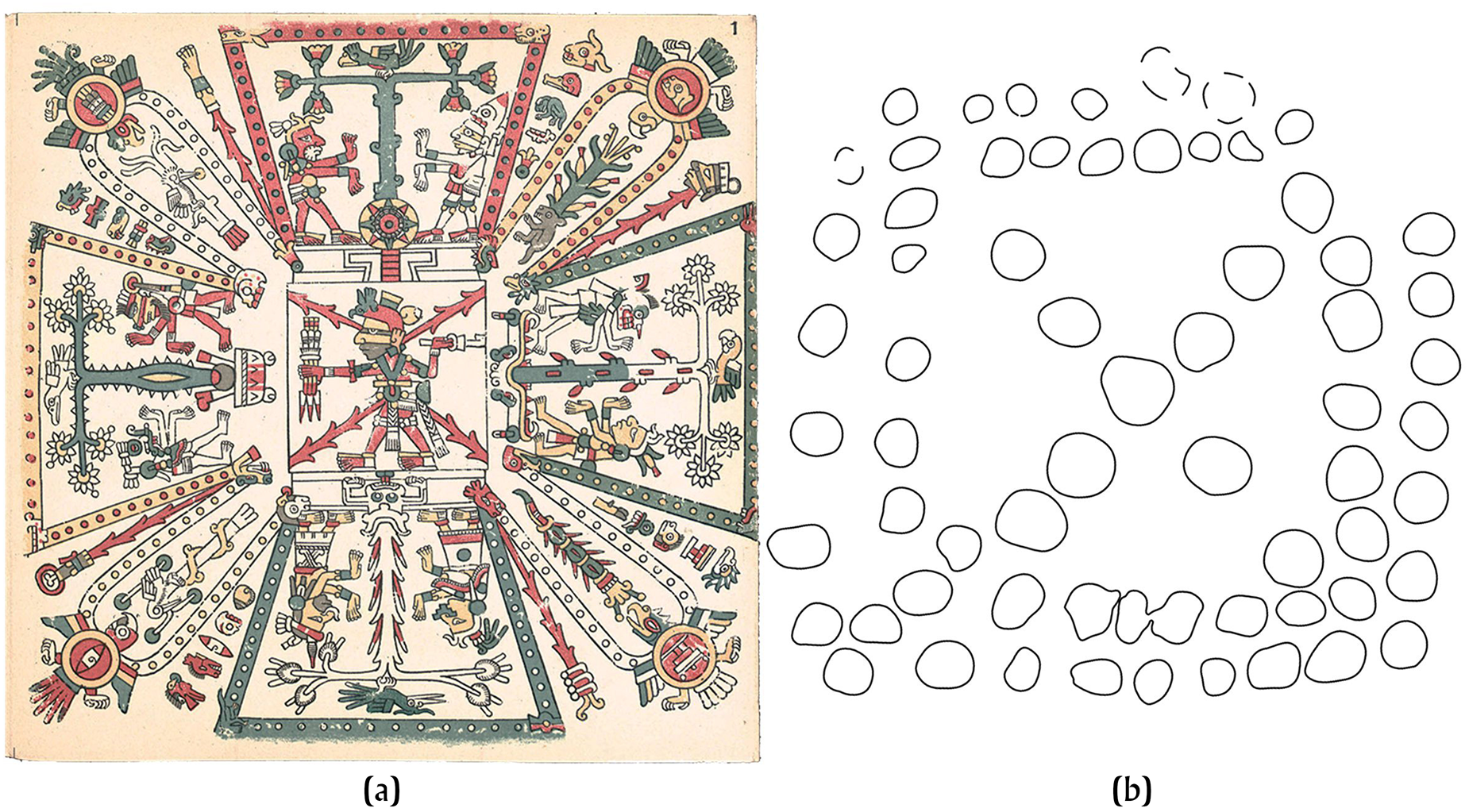
Notably, Codex Fejérváry-Mayer (Loubat Reference Loubat1901) also represents various time units within one diagram, including dividing the 260-day calendar into four 65-day parts. In this composition, each “side of the world” (formed by one arm of the cross and one “loop”) contains 65 signs representing the days (Anders et al. Reference Anders, Jansen and Pérez Jiménez1994a:168; Rojas Reference Rojas2022:185–186; Seler Reference Seler1902:5). Consequently, 65-day cycles form each of the four parts of the universe and reflect the connection between time and space. Similarly, the Tetzcotzinco petroglyph, which could represent one 65-day agrarian cycle divided into smaller units, was carved in the same graphic arrangement. Therefore, it seems possible that the form of the pecked cross from Tetzcotzinco, with its minor cycles, could also represent the ideas related to fourfold time-space.
Moreover, the quadruple division of the universe in the Mesoamerican worldviews did not have to be limited only to the four “traditional” (for Western people) cardinal directions. Contemporary Ayöök people from Oaxaca imagine the universe as consisting of four great bodies of water intersected by two series of four great paths. These paths cut across the world horizontally (creating “cardinal directions”) and vertically. These directions, therefore, run forward and east, upward and north, backward and west, and downward and south. In this way, the great paths simultaneously form two perpendicular X-shaped planes that intersect at the center of the universe (Rojas Reference Rojas2022:185). This image seems to correspond particularly to the pattern of dots in the Tetzcotzinco petroglyph, which could therefore represent X-shaped space in the indigenous vision of the universe. Interestingly, the vision of cosmic space among Ayöök is also inseparably linked to the vision of time. This community imagines the universe as an endless and constantly rotating spiral that would take 52 years to complete a loop, during which time it would touch four sides of the world (Matías Rendon Reference Matías Rendón2021; Rojas Reference Rojas2022:185). Consequently, the visual representation of space (which remains in constant, cyclical motion) also expresses ideas related to time and its counting. Therefore, the representation of the universe is, at the same time, the representation of specific units of time and cycles that are important for Ayöök.
Interestingly, there are other examples of the relationship between the layout of the Tetzcotzinco petroglyph and the representations of the 65-day cycles. The almanac from Plate 27 of Codex Borgia (Loubat Reference Loubat1898; Figure 10), discussed earlier, is also divided visually into four spaces forming an “X” shape, each occupied by one of the Tlalloque and with an additional central scene with a fifth rain god. Moreover, the manifestations of Tlalloque are presented alternately in scenes showing the dry season (a bright sky with clearly marked sun rays) and the rainy season (with a cloudy, dark sky). Combining the two “sunny” Tlalloque and two “rainy” Tlalloque, the shape of the “X” of the whole diagram is even more evident (Figure 16).
Rain god almanac with connections between “sunny” and “rainy” Tlalloque, Codex Borgia, Plate 27 (Loubat Reference Loubat1898). Edited by the author.

A similar arrangement is visible in Tetzcotzinco's petroglyph, where the inner cross not only defines four spaces but can also divide the dots into five subcycles: four external and one central. Consequently, in addition to the 65 dots that compose the petroglyph, its connection to the 65-day cycles can also be seen through the layout (Figure 6), similar to the one visible in Codex Borgia's Plate 27 (Figure 16). Therefore, the representation of the “X” closed in a square could connect the entire petroglyph with the quadruple division of the world (with its four cosmic directions/paths) and the quadruple division of time (which was inseparable from space) into smaller units. This similarity of the Tetzcotzinco petroglyph to the diagram of Plate 27 of Codex Borgia (Loubat Reference Loubat1898) can suggest that the whole arrangement of the former could also express the alternate relationship between the “sunny” and “rainy” Tlalloque, or between the dry and rainy seasons.
Final remarks
This analysis shows that the pecked-cross petroglyph of Tetzcotzinco was created based on two principles that together allowed the building of the set of meanings. First, it involved creating and grouping dots—or “cup marks”—to obtain specific numerical values corresponding to the number of days in particular time units. The second level of coding of meanings was the general layout of the dots, which permitted the expression of further ideas related to space, time, and calendars.
Based on the number of dots, I assume that the petroglyph from Tetzcotzinco coded primarily the number 65. This number allowed the connection of the representation with 65-day time units, which not only divided the full tonalpohualli into four parts but also served as a separate cycle associated with the rain and lightning gods (Tlalloc or Cocijo). As shown by the studies of the sources, the 65-day units not only had a calendrical function, but also carried a set of meanings related to the rain gods, agriculture, seasonality, and rainfall. Consequently, the pecked cross from Tetzcotzinco, containing 65 dots, became a graphic expression for these referents. Moreover, the analysis of the petroglyph's context—the area of agricultural terraces that accompanied the center of the worship of the rain god—also seems to support this idea.
Additionally, due to the specific grouping of dots into smaller clusters, the pecked cross could encode other numerical values that appear as separate calendrical cycles. One possible division of the petroglyph gives a combination of a series of numbers—7 and 9. Although the symbolism of such a combination of numbers in the pre-Hispanic divinatory books has not been fully interpreted, the analysis of modern K'iche’ divinatory systems shows the great importance of alternating seven- and nine-day cycles, which allows the reading of mutual influences between individual days. In turn, the alternative division of Tetzcotzinco's pecked cross shows the encoding of numbers 6 and 7 (which appear in relation to each other) and 13. These numbers allowed the association of the petroglyph with the trecenas and half trecenas, which were the fundamental cycles of the Mesoamerican divination. The graphic representation of the numbers 6–7 and 13 with the dots could have facilitated the mantic count of time and expressed a certain symbolic content through numerical values.
The second level of recording symbolic meanings in the pecked cross depended on a specific layout. The form of the petroglyph, representing a double square with an X motif in the center, was undoubtedly associated with the Mesoamerican vision of the quadruple universe. At the same time, the analysis of sources confirms that in Mesoamerica, visual representations of space and time were directly connected. Therefore, I propose that the pecked cross from Tetzcotzinco was created to express meanings related to time. Consequently, the graphic representation of the time-related ideas was crucial in encoding calendrical cycles. Significantly, the petroglyph's layout could also be related to the 65-day almanacs known from the divinatory books, in which the Tlalloque representations were connected in a chiasmic way, creating an X-shape enclosed in a square. Therefore, this layout could form the shape of the 65-day cycle, and Tetzcotzinco's pecked cross would duplicate its agricultural–Tlalloque symbolism.
Despite the variety of content, the proposed interpretations are not mutually exclusive. The graphic system in which pecked crosses were created assumed multilevel coding of seemingly unrelated values, which as a result, allowed the creation of an extensive network of meanings.
The discovery and analysis of the pecked cross at Tetzcotzinco provide a broader picture of this site. The petroglyph forms part of the symbolism of the previously known rock art in this place, directly related to the cult of the rain god. The interpretation of the pecked cross as a graphic symbol of rainfall, agriculture, and the cult of water and Tlalloc confirms the previously proposed ceremonial and agricultural functions of Tetzcotzinco.
A thorough understanding of the pecked cross from Tetzcotzinco, however, requires further research, especially analyzing its archaeological context and interpreting the second, unidentified petroglyph that appears on the same rock. Future studies in this area of the site may provide further insight into the petroglyph's history and help to place it properly in time and cultural context. The accompanying representation, which could potentially be a different pecked marker itself or serve as an “auxiliary” petroglyph for the pecked cross, may, in turn, help us to fully understand the content encoded by dots and numbers, both at Tetzcotzinco and at other sites.
Acknowledgments
This article is a part of the project funded by the National Science Centre of Poland with the help of the National Institute of Anthropology and History of Mexico (Permit no. 2018–614). I want to thank Katarzyna Mikulska, Araceli Rojas Martínez Gracida, Agnieszka Brylak, Julia Madajczak, and Katarzyna Szoblik for their support and invaluable help. Special thanks to Karolina Juszczyk, Stanisław Rzeźnik, Marcin Kulesza, Dominika Kossowska-Janik, and Javier Ramírez López for their contributions to the project and their support.
Data availability statement
The author confirms that the data resulting from this research are available within the article. Raw data that support the results of this study are available from the author, upon reasonable request.
Funding statement
This article is a part of the project funded by the National Science Centre of Poland (PRELUDIUM 12 Grant no. 2016/23/N/HS3/00819).
Competing interests
The author declares none.


 Open access

