

Introduction
In the second half of the second millennium bce, clay tablets inscribed with cuneiform script were an important means of communication for the major political entities of the ancient Near East, such as Babylonia, Assyria, Mittani, or Hatti, as well as for smaller political formations scattered throughout the Levant. The widespread use of cuneiform writing in the region underlines the interconnectedness of these political centres and reflects their need for reliable and durable means of communication to manage their extensive political, economic and cultural networks. Originally developed in Mesopotamia, this writing system was gradually adapted and used by different cultures and political entities, demonstrating a significant level of cultural and technological exchange throughout the region.
Interestingly, Egyptian rulers and their administration also used cuneiform to communicate with these centres. The proof is the discovery of cuneiform correspondence of Egyptian provenance at sites such as Syrian Ugarit, Hittite Hattusa and Egyptian Tell el-Amarna. The use of cuneiform writing on clay tablets in Egypt raises several intriguing questions: why did the Egyptians adopt cuneiform writing and how did they acquire the necessary knowledge? Who were the scribes responsible for writing these messages, and what training did they receive in cuneiform culture? Furthermore, what technology was used to produce these tablets; how did the scribes prepare their tools and the media necessary for their work, such as the styli and the clay tablets themselves?
While the literature on the motivations behind the use of cuneiform in Egypt is extensive (Cochavi-Rainey Reference Cochavi-Rainey2011; Müller Reference Müller2010), the technology of cuneiform production in Egypt has remained somewhat on the periphery of scholarly interest. This is a significant gap in research, as an understanding of the practicalities of tablet-making is crucial for a full appreciation of the wider context of cuneiform use in Egypt. This includes the sourcing and preparation of the clay, the techniques used to make the tablets and the methods used to inscribe and preserve these means of communication.
Therefore, the discovery of the Amarna tablets in the late 1880s amid the ruins of Tell el-Amarna (ancient Akhetaten) in Middle Egypt is of great importance for understanding the mechanisms that controlled the spread of cuneiform writing in the western peripheries of the cuneiform world during the Late Bronze Age (c. 1550–1200 bce; Rattenborg et al. Reference Rattenborg, Smidt, Johansson, Melin-Kronsell and Nett2023, figs. 1, 3a–b). This corpus, the largest collection of cuneiform documents discovered in Egypt to date, provides direct evidence of the extensive reach of cuneiform culture during this period. At the time of its discovery, however, there was some scepticism about the possible use of cuneiform in Egypt, as illustrated by A.H. Sayce's description:
As it was, they were sent across the Nile to Dêr em-Moez to a small dealer in antiquities, who packed them in bags and carried them on donkey-back to Suhag, where they were again shipped across the Nile and offered for sale to M. Frenay, the superintendent of the French flour mills at Ekhmîm, who also acted as agent of the Louvre. He knew enough about Assyrian antiquities to see that they were inscribed with cuneiform characters, and he rightly considered, therefore, that they were of value. Accordingly, he bought thirteen of them, telling the dealer (Elias) that he would send one of them as a specimen to Paris, and that as soon as he received a report upon it he would negotiate for the purchase of the whole collection. In Paris Professor Oppert, misled by defective sight, hastily pronounced it to be a forgery. It was consequently returned to M. Frenay, who naturally took no further interest in the matter. The unfortunate tablets were again thrown into bags and carried, this time on camel-back, to Luxor, where certain dealers in antiquities, more especially Mohammed Mohassib, purchased them on speculation for a small sum of money. (Sayce Reference Sayce1917, 89‒90)
The episode involving Jules Oppert, a professor at the Collège de France and a respected authority on ancient Near Eastern texts, who cast doubt on the authenticity of the Amarna tablets, underlines the complexity of the study of these artefacts. Oppert's scepticism, likely influenced by the unprecedented discovery of cuneiform tablets in Egypt, highlights the challenges early scholars faced in accepting these finds. Although Oppert's testimony is limited (Oppert Reference Oppert1888), it can be inferred that the unique characteristics of the written record, its Egyptian provenance, and the material used in its production all contributed to his doubts about its authenticity.
This historical episode sets the stage for the broader aim of this study: to explore the materiality and technology involved in the production of cuneiform tablets in ancient Egypt (Balke & Tsouparopoulou Reference Balke and Tsouparopoulou2016; De Martino Reference De Martino, Di Filippo, Milano and Mori2023; Friedrich Reference Friedrich, Betrò, Friedrich and Michel2024; Matthews Reference Matthews, Piquette and Whitehouse2013; Michel Reference Michel and Quenzer2021; Pearce Reference Pearce, Stackert, Porter and Wright2010; Taylor Reference Taylor, Radner and Robson2011; Taylor & Cartwright Reference Taylor and Cartwright2011; Tsouparopoulou Reference Tsouparopoulou, Balke and Tsouparopoulou2016). While Assyriologists and Egyptologists have extensively studied the historical (Albright Reference Albright, Edwards, Gadd, Hammond and Sollberger1975; Campbell Reference Campbell1964; Gestoso Reference Gestoso1992; Kühne Reference Kühne1973), linguistic (Baranowski Reference Baranowski2016; Hess Reference Hess1993; Rainey Reference Rainey1996; Vita Reference Vita2015) and socio-political (Cohen & Westbrook Reference Cohen and Westbrook2002; Pfoh Reference Pfoh2016; Zangani Reference Zangani2022) contexts of these texts (Izre'el Reference Izre'el1997; Knudtzon Reference Knudtzon1915; Liverani Reference Liverani1998–1999; Moran Reference Moran1992; Rainey Reference Rainey1970; Reference Rainey2015), the material aspects of cuneiform tablet production have often been overlooked (with a few exceptions such as Goren et al. Reference Goren, Finkelstein and Na'aman2004; Mynářová Reference Mynářová and Marti2014; Reference Mynářová2024).
This study aims to fill this gap by providing a comprehensive examination of the technological processes and material considerations that underpinned the production of cuneiform tablets in ancient Egypt. Understanding these aspects is crucial for a fuller appreciation of the broader context of cuneiform use in Egypt and its implications for the political, economic and cultural exchanges in the second half of the second millennium bce, thus enriching our understanding of ancient civilizations’ methods of communication and record keeping.
Writing on clay in Egypt
The use of clay as a medium for recording written communication has deep historical roots in ancient Near Eastern cultures, dating back to the late fourth millennium bce, when clay tablets were used to document information in proto-cuneiform script (Englund Reference Englund, Radner and Robson2011; Glassner Reference Glassner2003, 29–47). By the middle of the fourteenth century bce, when the Amarna tablets were written, the clay tablet was a common medium for cuneiform texts throughout the ancient Near East.
In Egypt, clay had been used since early times as a common and easily accessible material for preserving written records. From reused vessel fragments (ostraca) to labels,Footnote 1 tags and finally clay tablets and prisms (Wegner Reference Wegner2021), clay served multiple functions in record-keeping practices. In terms of appearance and content, the closest parallels to the Amarna tablets within the Egyptian realm are the clay tablets discovered at Balat in the Dakhla oasis (Pantalacci Reference Pantalacci, Collombert and Tallet2021, 297; see Figure 1).
Balat tablet No. 3686. (Courtesy of the IFAO.)
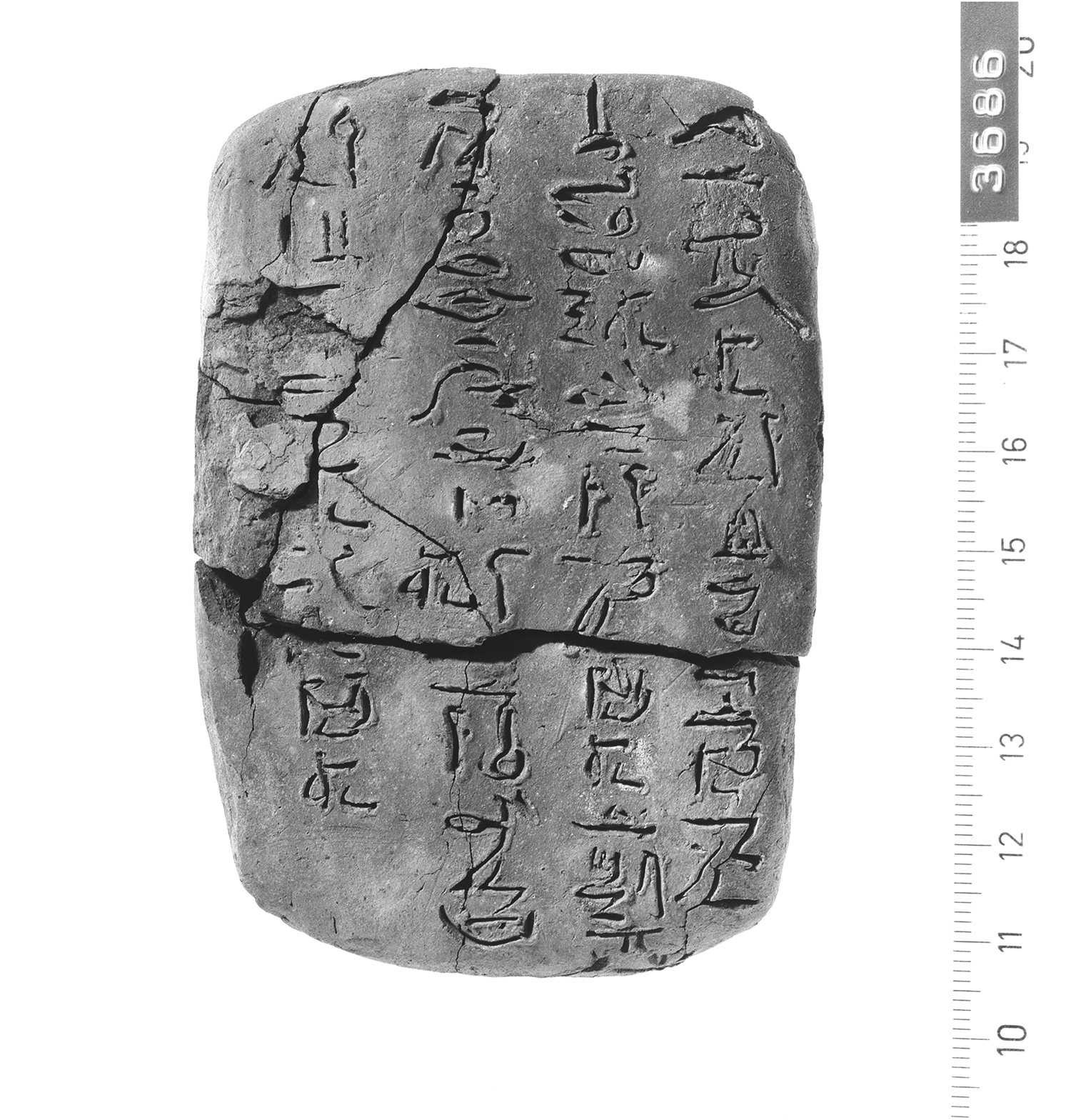
These clay tablets were first discovered at a site near ʿAyn Asil in the late 1970s during excavations by the team of the Institut français d'archéologie orientale du Caire (IFAO) (Posener-Kriéger Reference Posener Kriéger and Lalou1992; Vercoutter Reference Vercoutter1979, 462–5). Although they were found in different parts of the site over time, their presence there is closely linked to the administrative activities in the Governor's residence, where they were probably produced. Temporally, these tablets range from the latter part of the Old Kingdom to the First Intermediate Period (sixth to eleventh dynasties, c. 2305–1940 bce), in the late third millennium bce (Pantalacci Reference Pantalacci and Moreno García2013; Reference Pantalacci, Gülden, van der Moezel and Verhoeven2018, 224). The collection of documents from ʿAyn Asil currently numbers around 525 tablets, many of which are preserved in a fragmentary state, and around 3000 sealings. However, in addition to these two types of objects, jar stoppers and tags are also represented (Pantalacci Reference Pantalacci, Collombert and Tallet2021, 301).
Made from very fine clay, the tablets are predominantly regular in shape, measuring approximately 11–13×8–9 cm and 1.5–2 cm thick (Pantalacci Reference Pantalacci, Gülden, van der Moezel and Verhoeven2018, 218). This allowed for easy handling by scribes, who could hold the tablet in one hand while writing. Most tablets have this seemingly standardized size, although scribes could adjust the size to suit the amount of text to be inscribed if necessary. It appears that the scribes achieved the shape of the tablet solely by manual modelling. The surfaces of the tablets are smooth, possibly indicating the use of a special tool. Pantalacci (Reference Pantalacci, Collombert and Tallet2021, 302) suggests clay or bone spatulas or even pebbles as possible tools to achieve this smoothness. The materials needed to make the tablets, such as suitable clay and sufficient water, are readily available in the surroundings of the Dakhla oasis. However, the texture of the material used varied considerably, as did the the type of clay and the temper used. This diversity seems to reflect both the different places where the tablets were produced and the scribe's own preferences (Henein Reference Henein1997, 21–22; Pantalacci Reference Pantalacci, Collombert and Tallet2021, 302). The text was inscribed into the damp surface of the tablets in a cursive hieratic script. Unlike cuneiform, however, the individual signs were not impressed but deeply engraved (Pantalacci Reference Pantalacci, Collombert and Tallet2021, 303), a technique undoubtedly required to produce smooth strokes not used in cuneiform. The stylus used by the scribes was made of bone, specifically the tibia of hoofed animals (Pantalacci & Lesur Reference Pantalacci and Lesur2012, 299). However, unlike in the cuneiform context, this stylus was not exclusively dedicated to this purpose (Jeuthe Reference Jeuthe2012, 292–3; Pantalacci Reference Pantalacci, Collombert and Tallet2021, 303 fn. 23). Pantalacci (Reference Pantalacci and Moreno García2013, 206) contemplates the possibility of recycling obsolete documents, and it seems that these tablets were not subjected to firing after being inscribed: ‘Although it would have been easy to pour water on the clay, erase the text and reuse the tablets, some documents were definitely discarded; just why is unclear.’
These clay tablets clearly show that the Egyptians were able to use clay as a fully functional writing medium when the need arose—for example, when traditional writing materials were in short supply. However, if we consider clay specifically as a primary writing material (excluding, for example, the reuse of broken vessels), its use is undeniably very limited, particularly for use in administrative records and practices.
Amarna tablets of Egyptian provenance
The Amarna tablets provide valuable insights into the ways in which cuneiform spread to areas with less intensive use of the script. Traditional scholarship has focused primarily on the linguistic content of these artefacts (Böhl Reference Böhl1909; Ebeling Reference Ebeling1910; Izre'el Reference Izre'el, Hasselbach and Pat-El2012; Moran Reference Moran, Huehnergard and Izre'el2003; Rainey Reference Rainey1996; von Dassow Reference von Dassow, Cogan, Koslova, Loesov and Tishchesko2010). However, the studies of Goren, Finkelstein and Na'aman (Goren et al. Reference Goren, Finkelstein and Na'aman2002; Reference Goren, Finkelstein and Na'aman2003a, Reference Goren, Finkelstein and Na'amanb; Reference Goren, Finkelstein and Na'aman2004) have significantly advanced our understanding of the technological aspects of this transmission. Their research marks an important milestone in the increasing focus on the technical aspect of the spread of cuneiform and provides new insights into the basic principles governing its dissemination. Recent advances in analytical methods (Goren et al. Reference Goren, Ben-Yosef, Centola, Catelani and Daponte2019) offer the potential to clarify the composition and origin of these documents, or to improve data obtained through previous petrographic analyses. Nevertheless, the data collected remain reliable and can serve as a basis for further discourse. This article therefore builds on the data and findings presented in these studies, using them as the basis for an in-depth analysis. This approach allows for the exploration of broader, more comprehensive conclusions that go beyond the original scope of the research.
The corpus comprises a total of 382 Amarna texts and fragments,Footnote 2 most of which come from archaeologically uncertain contexts. While the term ‘Amarna Archive’ is commonly used in the literature, it is important to note that not all of the tablets and associated fragments were actually excavated from a single building (Mynářová Reference Mynářová and Marti2014). However, a significant number of these texts probably came from a specific construction known as ‘The House of the Correspondence of Pharaoh, l.p.h.’ (Q42.21), located in the Central City of Tell el-Amarna (Kemp & Garfi Reference Kemp and Garfi1993; Petrie Reference Petrie1894). Within this building both correspondence and texts related to the training of scribes were found, suggesting a dual function as both an archive and a scriptorium.
These texts come from various regions of the ancient Near East, from Mesopotamia to Anatolia, the Levant and Egypt. Although predominantly written in Akkadian, they display a considerable linguistic diversity, largely related to the vast geographical area from which they originate. The study by Goren, Finkelstein and Na'aman drew attention to an intriguing observation—some tablets had been fired during manufacture at temperatures of up to 800–900°C, while others showed no evidence of such treatment. They noted that firing at higher temperatures was particularly common in tablets from regions with a strong cuneiform tradition such as Babylonia, Mittani, Hatti, Arzawa, or Ugarit (Goren et al. Reference Goren, Finkelstein and Na'aman2004, 319). In contrast, tablets from Egypt and the Canaanite region were largely unfired or fired at relatively low temperatures (Goren et al. Reference Goren, Finkelstein and Na'aman2004, 23–30, 226–315). This raises an important question: does this linguistic diversity correspond to variations in the technological processes used to produce these artefacts?
The discovery of tablets of Egyptian provenance at Tell el-Amarna, inscribed on the same site, provides a unique opportunity to study the technological processes used in their production within the specific archaeological and technological context. It is these tablets that can reveal how and from where this cultural tradition was adopted in Egypt.
The Amarna tablets of Egyptian provenance can be divided into two distinct groups according to their genre: correspondence, and educational or scholarly texts aimed at instructing scribes in cuneiform culture. In the case of the correspondence, the clearly Egyptian origin is usually explicitly stated in the heading of the letter, which includes identification of both the sender and the recipient. In the case of instructional texts, however, the origin of the specific tablet is not explicitly stated and further analysis, such as petrological analysis (see below) of the given document, is required to provide evidence.
Materiality and technology of production. The epistolary texts
The collection of epistolary documents of Egyptian origin currently comprises 12 texts (see Table 1), 11 letters and one inventory of gifts (EA 1, EA 5, EA 14, EA 31, EA 99, EA 162, EA 163, EA 190, EA 367, EA 369, EA 370, and EA 380). Eleven of these documents are written in Akkadian and one in Hittite (EA 31). In two cases, the tablets are preserved in a fragmentary state with the individual fragments housed in different museum collections. One fragment of EA 5 is in the Egyptian Museum in Cairo (CG 4744; JE 28179, SR 4/12195/0),Footnote 3 while the other is kept in the British Museum (BM E29787). Similarly, the largest part of the inventory EA 14 is in the Vorderasiatisches Museum in Berlin (VAT 1651 + 2711), while the Ashmolean Museum in Oxford holds one small fragment of the same text (EA 14: col. II, 36–46; Ash. 1893.1-41 (415)).
Epistolary documents of Egyptian provenance
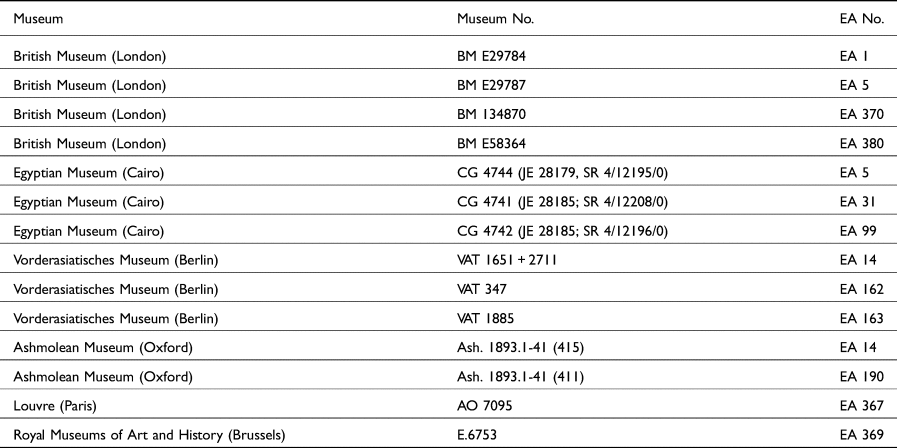
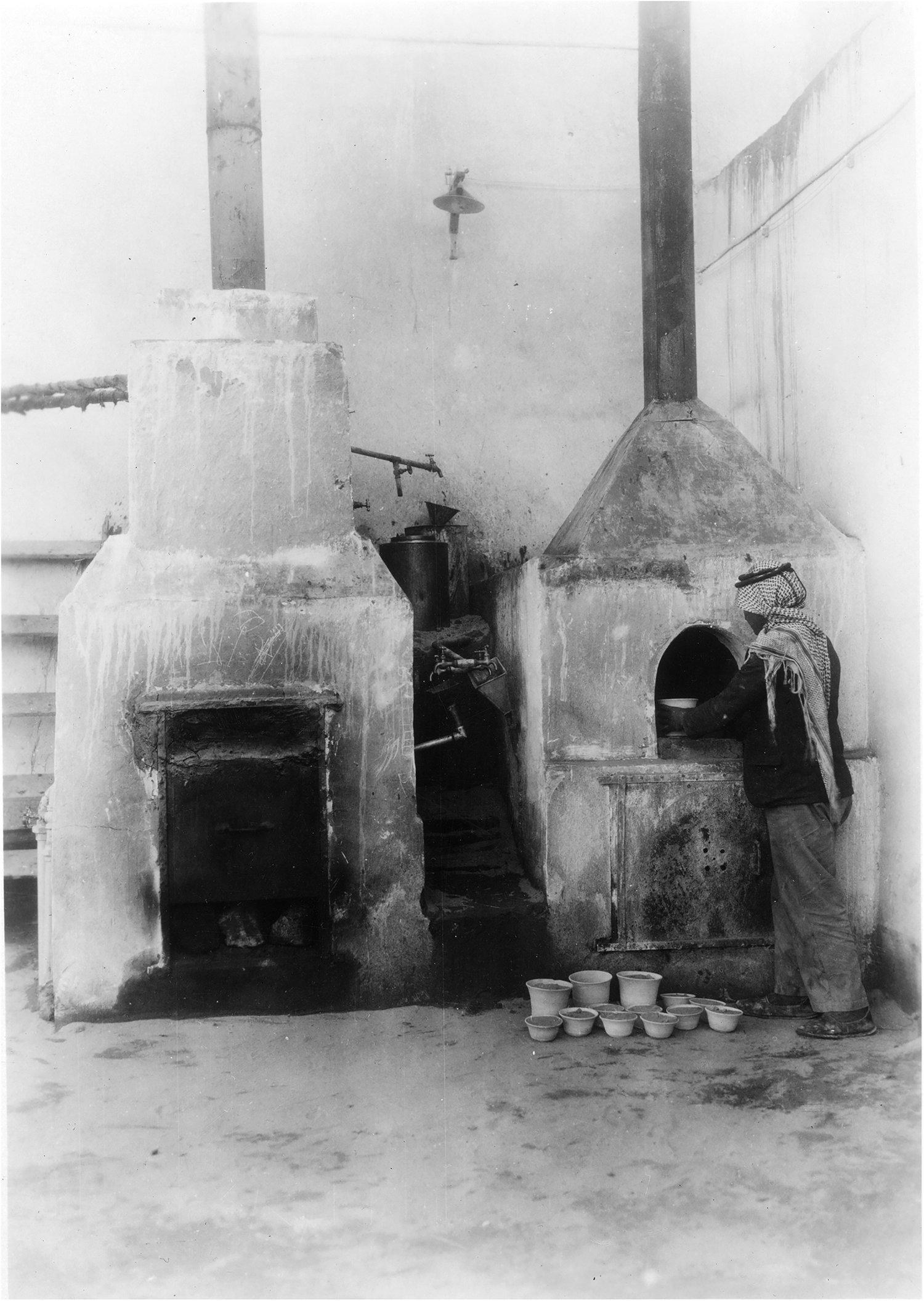
These tablets are held in six different museums, each with its own conservation methods and protocols for handling these artefacts. It is therefore possible that the different treatment of the tablets in the respective collections (or immediately after their discovery: see Figure 2) could affect the data obtained from their analysis, which is especially true in the case of the possible modern firing of the tablets, which may have served to stabilize this material (see Reade Reference Reade2017). In order to avoid possible inaccuracies in the interpretation of the data obtained, it is essential to consider this aspect carefully and to treat each fragment separately.Footnote 4
A kiln (on the right) used for the firing of cuneiform tablets found in the excavations at Tell Asmar, Iraq. A workman is placing a set of tablets in their containers within the kiln chamber. (Courtesy of the Institute for the Study of Ancient Cultures of the University of Chicago.)
Petrological analyses were carried out on a total of eight tablets from four museum collections (see Table 2; EA 1, EA 14 [both fragments], EA 162, EA 163, EA 190, EA 367, EA 370 and EA 380). Petrographically, the Amarna epistolary corpus of Egyptian origin shows considerable homogeneity, with tablets predominantly made from marl clay of the Esna Formation (Goren et al. Reference Goren, Finkelstein and Na'aman2004, 24–8). Nevertheless, in two cases the material used to make these tablets has been identified as Nile silt (Goren et al. Reference Goren, Finkelstein and Na'aman2004, 26–8), a common material easily accessible along the riverbanks. These two small tablet fragments, EA 163 (VAT 1885) and EA 380 (BM E58364), show traces of phrases similar to those found in other letters of Egyptian origin. However, it is possible that these two texts were not intended for actual correspondence, i.e. documents to be delivered to their addressees, but rather were drafts or educational tablets used during the training of Amarna scribes.
An overview of materials used in the production of Amarna epistolary documents
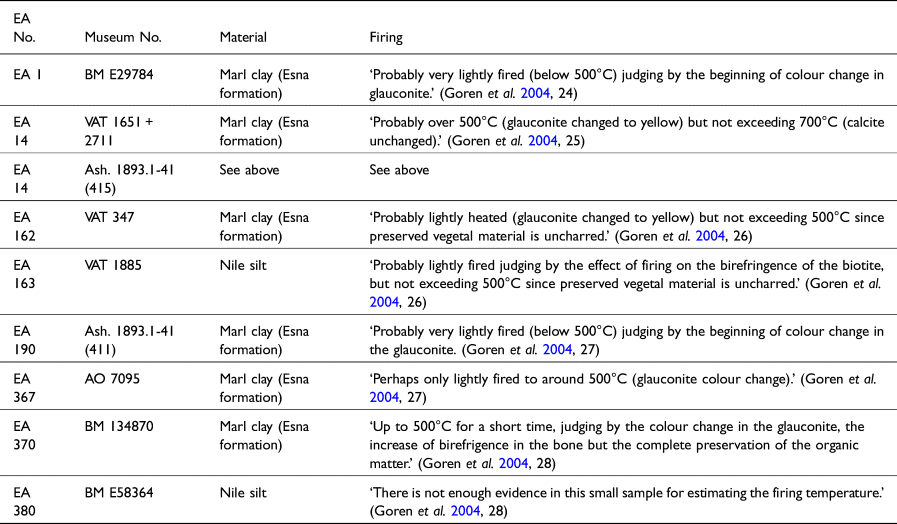
Homogeneity is also evident in the technology used to produce the tablets, particularly with regard to the firing process. In order to estimate the firing temperatures of the tablets, a petrographic microscope was used to examine the optical properties of the minerals within the ceramic material. Different minerals change their physical structure at different temperatures, and these changes affect their optical properties. By observing which minerals had changed and which had not, the firing temperature was estimated as a range between the temperature that affected the altered minerals and the temperature that would have affected the unaltered minerals. This method, commonly used in petrographic studies of pottery, relied on the varied mineral suite within the ceramic material to provide accurate temperature estimates (Goren et al. Reference Goren, Finkelstein and Na'aman2004, 15–16).
All the samples examined showed a consistent pattern: both the letters and the inventory of gifts were lightly fired at temperatures around 500°C, regardless of the museum collection in which the samples were analysed. In the case of EA 380, the results of the analysis were inconclusive due to a lack of precision in determining the firing temperature. Examination of EA 163 indicates that consistent firing temperatures were achieved regardless of the material used, with both the Nile silt and marl clay tablets being processed in a comparable or identical manner. The consistent method of production observed for all of these tablets, regardless of their origin, either from archaeologically uncontrolled excavations where immediate post-discovery handling is uncertain, or from the excavations conducted by Petrie and the EES, suggests that firing was an integral part of the original technological process.
Neither the tablets in the British Museum nor the Vorderasiatisches Museum collections have been shown to have undergone modern secondary firing, so their firing can be considered part of the original technological process (Goren et al. Reference Goren, Finkelstein and Na'aman2004, 15–16; Mynářová Reference Mynářová2024).
Materiality and technology of production. The scholarly tablets
When it comes to the Egyptian origin of the tablets used to educate Amarna scribes in cuneiform writing, the situation is more complicated than that of the correspondence. The specific archaeological site where these tablets were found should indicate that the corpus consists of tablets produced by local scribes. At the same time, however, it is possible that some tablets were transported there by individuals who brought the cuneiform tradition with them. This contention is supported by petrological analysis of the material, which is a valuable method for determining its origin (Goren et al. Reference Goren, Finkelstein and Na'aman2004, 6–87). This analysis confirmed the origin of a total of 16 documents out of 31 individual tablets and fragments, probably used in scribal training. However, not all tablets were examined using this method (see Table 3).
Amarna scholarly tablets (based on Goren et al. Reference Goren, Finkelstein and Na'aman2004)
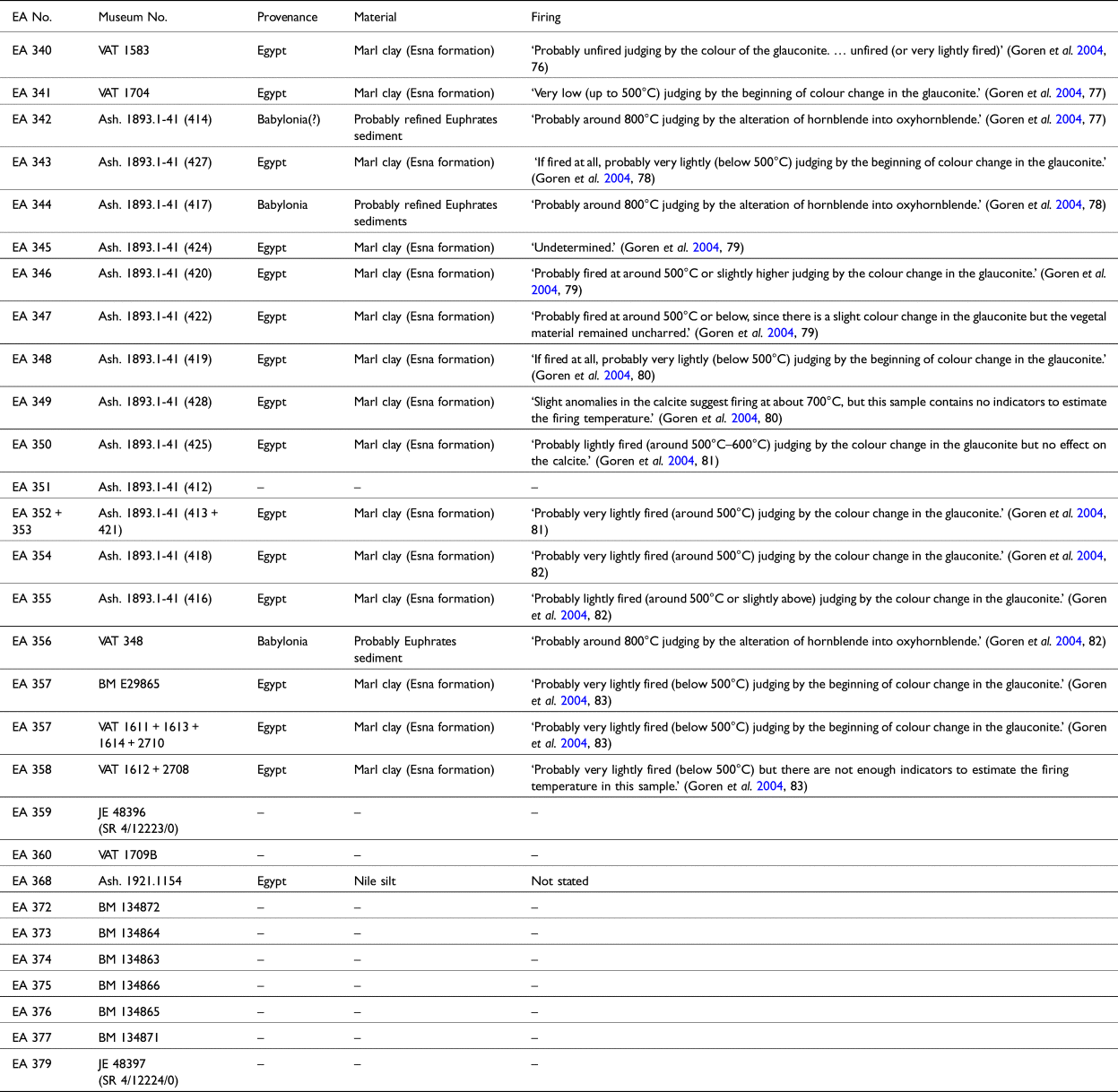
Compared to the letters, our understanding of the excavation context of these texts is much better. This is largely because the scholarly tablets in the collections of the Ashmolean Museum, the Egyptian Museum in Cairo, and the majority of the tablets in the British Museum come from controlled excavations.Footnote 5
Thus, we have the results of analyses of samples from 16 tablets, which show that both Egyptian and Babylonian texts are represented among them. The Egyptian origin of the material has been established for 13 samples, while the remaining three tablets were made from clay associated with Euphrates sediments, and thus of Babylonian origin (Goren et al. Reference Goren, Finkelstein and Na'aman2004, 76–87).
In terms of the materials used and the firing temperature reached, the scholarly tablets of Egyptian origin follow a similar trend to that of the Egyptian letters. It is evident that the scribes at Tell el-Amarna preferred high-quality marl clay for their work, with the sole exception of Nile silt, which is used in the text of EA 368, an Egyptian-Akkadian vocabulary.
Goren et al. (Reference Goren, Finkelstein and Na'aman2004, 84) suggest that EA 368 may have been inscribed by an Assyrian or Mittanian scribe, albeit on Egyptian clay. They explain this by suggesting that the scribe used the most accessible raw material available. This explanation is very likely and is further supported by considering the circumstances of the tablet's discovery, as it is one of the tablets for which we know the actual place of discovery. The mission of the Egypt Exploration Society unearthed this tablet during its 1920–21 season in the area of the Main City, specifically in the rubbish filling Room 8 of Building O49.23, and not in the precincts of the Records Office in the Central City, which was the official institution associated with the activities of the royal scribes (Mynářová Reference Mynářová and Marti2014, 377; Smith & Gadd Reference Smith and Gadd1925). The scribe, therefore, did not have access to the high-quality material of marl clay directly available in the royal scriptorium when compiling this tablet. For his specific task of composing a bilingual Egyptian-Akkadian vocabulary, the more readily available local materials were sufficient.
The issue of firing school tablets is complicated by the fact that in the Mesopotamian area, school exercises were usually recycled so that their material could be reused to make a new tablet or eventually be used for other purposes (Faivre Reference Faivre1995; Ouimet Reference Ouimet and Paulus2023). This practice is also attested in Mesopotamian written sources where, for example, the recently published Neo-Babylonian dedicatory hymn to Ningišzida (U.3018; CDLI P467995) from the Ningal temple in Uru, probably used as a model for school texts, literally states that this tablet was to be crumbled into a tablet container (gunnu): obverse 13–14 ‘in the Egalgaʾaʾaĝsumu he crumbled (them) into the gunnu-container’ (Jiménez Reference Jiménez2024). Firing would have made such treatment of the tablets impossible. Evidence for the recycling or reuse of tablets has also been documented archaeologically, for example in the Old Babylonian House F at Nippur (McMahon Reference McMahon and Paulus2023, 34–7; Robson Reference Robson2001; Taylor & Cartwright Reference Taylor and Cartwright2011) or the House of Ur-Utu at Sippar-Amnanum (Tanret Reference Tanret2002), where recycling bins used in this process have also been identified.
Although the determination of firing temperatures can be challenging in certain cases, as highlighted in the study by Goren, Finkelstein and Na'aman (Reference Goren, Finkelstein and Na'aman2004), the reliability of their analysis for individual samples ranges from satisfactory to high, with some cases being moderate or fair. Even allowing for potential inaccuracies in the analyses, it is clear that the tablets of Egyptian origin, in the case of scholarly documents, show a pattern similar to that of the letters. These tablets were fired at relatively low temperatures, typically around 500°C. This finding is indeed intriguing, especially since in the case of scholarly tablets, which were used for scribal training and not for sending, the purpose of firing the tablet could not have been to increase its durability and prevent damage during transport. Indeed, despite their educational purpose, these tablets were still fired.
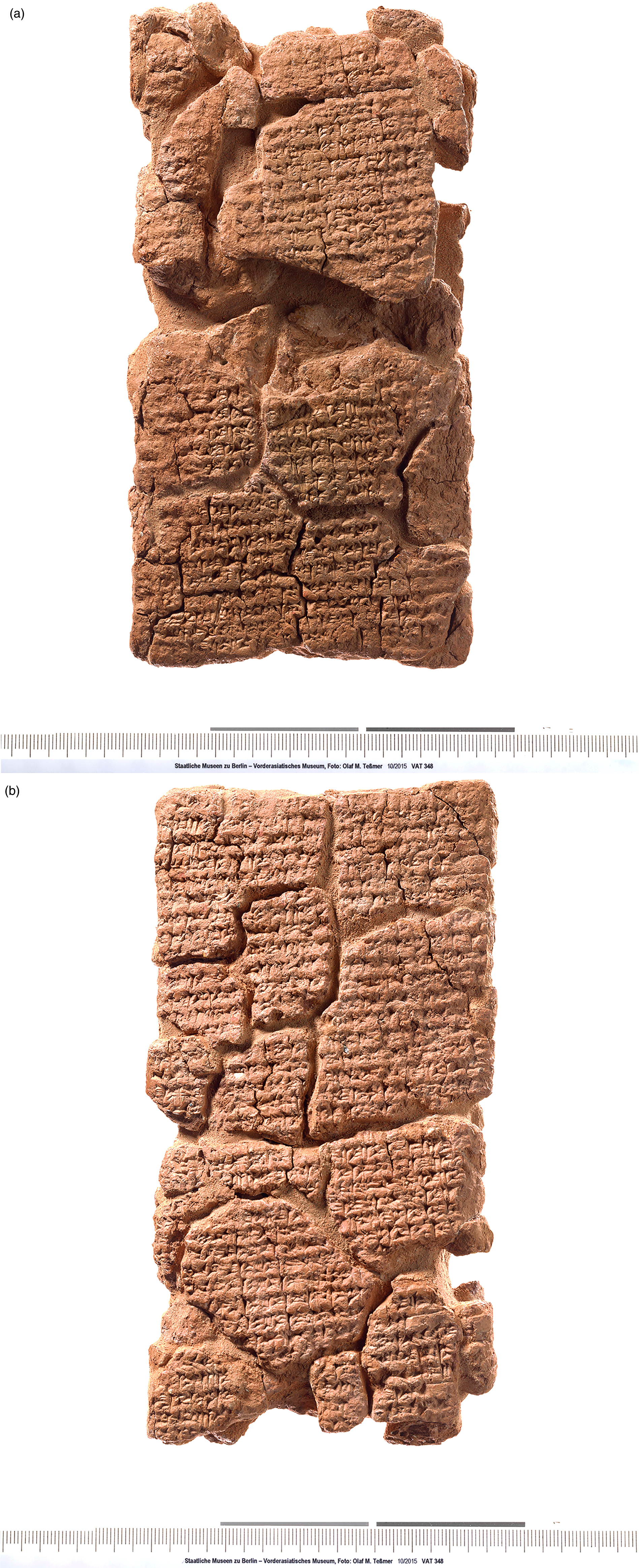
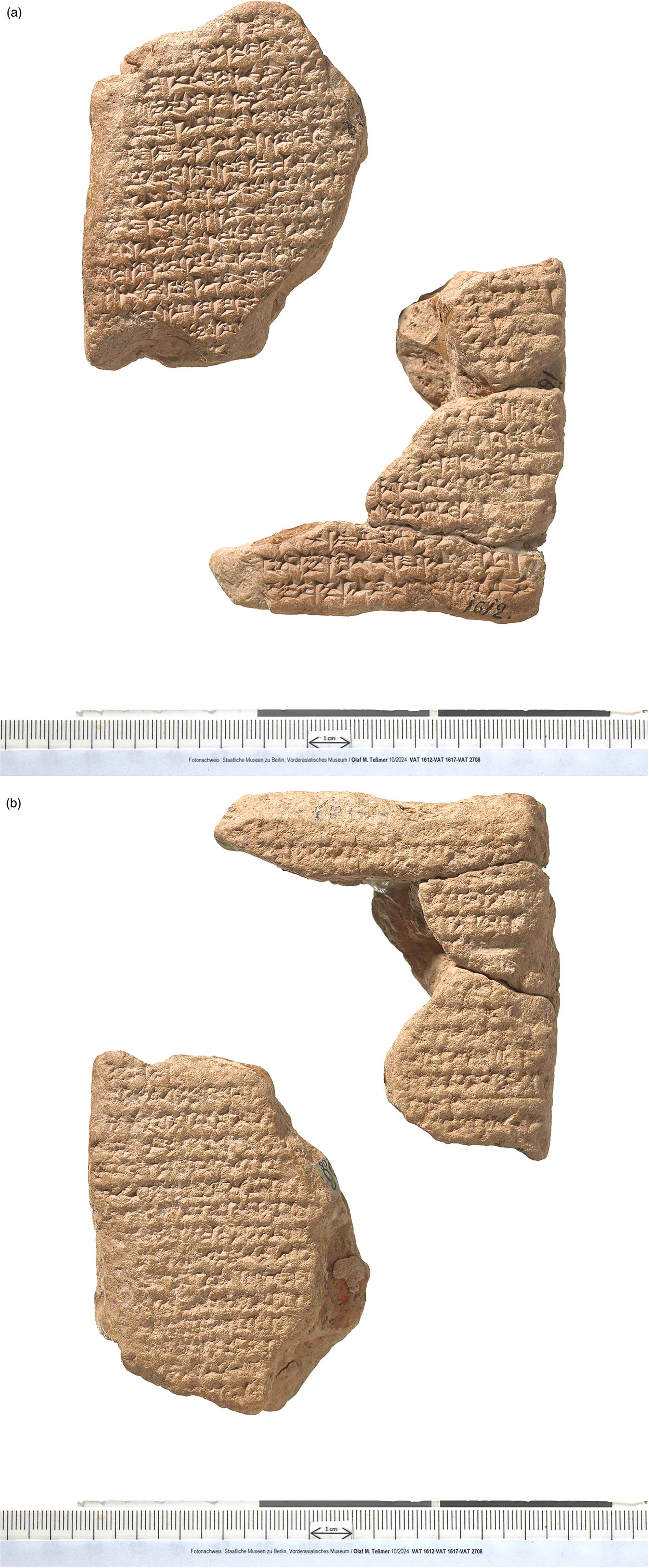
In order to dispel certain reservations about the results of the analyses, it is important to note, particularly in the case of the scholarly tablets, the different interpretations between the petrographic analyses of Goren et al. (2004, 82–7) and the neutron activation analysis of Yellin (Reference Yellin and Izre'el2001; Reference Yellin, Goren, Finkelstein and Na'aman2004). While the former suggest a Babylonian origin for the tablet EA 356 (The myth of Adapa and the South Wind; Figure 3a+b) and an Egyptian origin for EA 357 (The myth of Nergal and Ereškigal) and EA 358 (an undetermined narrative; Figure 4a+b), Yellin argues on the basis of the NAA results that both EA 356 and EA 357 were actually made from the same type of clay and therefore came from the same region. He interprets the different values of each element (Ca, Co, Eu, Fe, La, Sc) in the samples from EA 356 and EA 357 on the basis of their different calcium contents. EA 356 has a significantly lower calcium content, but higher levels of all other monitored elements. In contrast, the high calcium content of EA 357 is considered to be the main reason for the lower content of the other elements. This leads to the interpretation that the increased calcium in EA 357 could possibly be a temper added to improve the properties of the material, in particular to increase its resistance to heat.
a+b. EA 356, The myth of Adapa and the South Wind (VAT 348, obverse, reverse). Staatliche Museen zu Berlin – Vorderasiatisches Museum. (Photographs: Olaf M. Teßmer (CC-BY-SA 4.0 licence).)
a+b. EA 358, an undetermined narrative (VAT 1612 + 2708, obverse, reverse). Staatliche Museen zu Berlin – Vorderasiatisches Museum. (Photographs: Olaf M. Teßmer (CC-BY-SA 4.0 licence).)
On the other hand, Yellin believes that EA 358 is from a different source than the tablets mentioned above. To confirm the results, ICP analysis was carried out on all three tablets by Goren et al. (Reference Goren, Finkelstein and Na'aman2004, 85–7), showing significant material similarities between EA 357 and EA 358, while EA 356 showed significant differences. This analysis convincingly disputes Yellin's suggestion that calcium was added as a tempering agent. At the same time, the available data (Goren et al. Reference Goren, Finkelstein and Na'aman2004, table 4.1) clearly show that EA 356 does not match the composition of other Babylonian or Mittanian tablets, despite its material corresponding to Euphrates sediments. Therefore, the suggestion that it was made at a different Mesopotamian site from the rest of the Babylonian tablets seems highly plausible.
A supporting argument for the Babylonian origin of EA 356 may also lie in the firing temperature of the tablet. Like EA 342 and EA 343, EA 356 was fired at a temperature of approximately 800°C, a temperature also frequently observed in letters of Babylonian origin (Goren et al. Reference Goren, Finkelstein and Na'aman2004, 33–7). Conversely, such high firing temperatures are typically absent from tablets of Egyptian origin. Therefore, a firing temperature of around 800°C for EA 356 could indicate a Mesopotamian origin for this artefact.
An exceptional case of a higher than usual firing temperature for a tablet of Egyptian origin is seen in tablet EA 349 (probably a fragment of a syllabary). In this case, anomalies in the calcium content suggest that its firing temperature may have been as high as 700°C. However, the sample analysed lacks clear indicators that would definitively establish the actual firing temperature (Goren et al. Reference Goren, Finkelstein and Na'aman2004, 80). Consequently, this sample presents challenges in determining the firing temperature and therefore the data do not support the possibility that tablets of Egyptian origin could have been fired at high temperatures.
Unveiling materiality
The results of the petrological analysis of the Amarna tablets of the Egyptian origin clearly show that the scribes preferred the superior quality marl clay from the Esna shales. This marl clay emerged as the designated material for the official work of the royal scriptorium, regardless of whether the tablet contained an official dispatch or an instructional text for scribal training. The use of alternative materials, such as the more easily accessible Nile silt, for certain documents indicates that these tablets did not originate directly from the royal scriptorium.
Similar manufacturing techniques can be seen in the firing processes used, which were a crucial aspect of the technological procedures for producing cuneiform tablets of Egyptian origin. Typically, these processes involved reaching temperatures of around 500°C. This temperature is in marked contrast to the higher temperatures documented in other collections from regions with a longer cuneiform tradition, such as Babylonia, and found at Tell el-Amarna. The presence of tablets of Babylonian origin in the Amarna scholarly repertoire suggests that Egyptian scribes were actively engaged with this particular cuneiform tradition. In the context of the firing of scholarly tablets of Babylonian origin, this practice can be linked to the need to increase the durability of the text for long-distance transport, as in the case of letters. However, the reasons for firing of scholarly tablets of Egyptian origin, which were probably intended to remain in their place of production, are likely to have been different.
Unfortunately, there is a notable lack of written or iconographic records detailing the production process of cuneiform tablets at Amarna. As a result, our understanding relies heavily on the physical characteristics of the artefacts themselves and any insights that can be gleaned from the archaeological context of their discovery. While precise information on the storage locations of the majority of the Amarna tablets remains elusive, it appears that a significant number were stored in the Records Office (Q42.21) located in the Central City. This site served not only as a repository for the tablets, but also as a workshop for their manufacture, producing not only correspondence but also instructional texts for the training of scribes.
The only facilities within the Records Office area that can be associated with the tablet production processes are a pair of ‘ovens’ briefly mentioned by Pendlebury in his excavation report (Pendlebury Reference Pendlebury1951, 114). Although Pendlebury's report does not elaborate on these ‘ovens’, their location within the designated tablet-production area suggests that they may have been used to fire these artefacts (Mynářová Reference Mynářová and Marti2014, 379–80). Drawing parallels with examples at Tell el-Amarna, where similar structures are found in both residential and industrial areas, it is plausible that these were uncovered updraft kilns. Such kilns typically consist of a firebox and a stack, separated by a perforated floor or ‘chequer’ (Nicholson Reference Nicholson, Arnold and Bourriau1993). These installations probably included a chequer designed as a low vault supported by projections along the inner perimeter of the wall, like the kilns documented at Tell el-Amarna (Nicholson Reference Nicholson and Wendrich2010, 2–5). This design allowed for temperatures of up to 1000°C, demonstrating that the Egyptians were able to achieve similar firing conditions to those used for the Babylonian tablets. The marl clay used for the tablet was highly calcareous and could withstand these high temperatures (Bourriau et al. Reference Bourriau, Nicholson, Rose, Nicholson and Shaw2000, 121). Therefore, the lower firing temperature of the Egyptian tablets must be due to factors other than the technological equipment used in their production.
The ductusFootnote 6
The presence of scholarly tablets from Babylonia among the Amarna texts suggests a link between the Amarna scribal school and the southern Mesopotamian region. However, the fact that the scholarly texts of the Egyptian origin were fired challenges the existing understanding of the handling of school texts in Mesopotamia. Furthermore, an analysis of the cuneiform palaeography of Amarna texts of Egyptian origin adds further complexity to this scenario.
As Beckman (Reference Beckman1983) and Wilhelm (Reference Wilhelm1984) demonstrated 40 years ago, these texts show a marked Hittite influence, a phenomenon that is not supported by material evidence, since no tablets of Hittite origin have been identified among the Amarna scholarly tablets. This is a very interesting fact, as there is a striking similarity between the scholarly traditions of Hattuša and Tell el-Amarna. On the technological level, however, all the petrologically analysed epistolary documents of Hittite origin found at Amarna provide evidence that, like the artefacts of Babylonian origin, the technology of firing tablets to temperatures around 800°C can also be recognized in the Hittite context (Goren et al. Reference Goren, Finkelstein and Na'aman2004, 31–2).
However, the tablets of Hittite origin give us a broader perspective on the use of lower-temperature firing of Amarna tablets of Egyptian origin in the mid fourteenth century bce. Brief results of thermogravimetric analysis (TGA), known for its accuracy in determining firing temperature, have recently been published (Goren et al. Reference Goren, Ben-Yosef, Centola, Catelani and Daponte2019, 61–2). This analysis was carried out on both a single tablet of Egyptian provenance from Tell el-Amarna (EA 190) and a set of four letters of Egyptian origin from the Ramesside period (VAT 6161, 6168, 6172, 13067), dating from the reign of Ramesses II (r. c. 1279–1213 bce). These texts, a few decades younger, provide us with a welcome diachronic perspective on the subject. Examination of the materials reveals a shift in the composition of the clay used, with the Amarna marl clay (Esna Formation) being replaced by Marl D in the Ramesside period. In the case of preference for the use of Marl D fabrics (Bourriau Reference Bourriau1981, 14–15) for the production of tablets, its occurrence may play a role, as its sources are mainly located in the Memphis-Fayoum area (Aston Reference Aston1998, 65–6), an area closer to the political centre of Ramesses. In his study, Wilhelm (Reference Wilhelm1984) pointed out that the ductus of cuneiform texts of Egyptian origin changed between the Amarna and Ramesside periods. Thus, it seems that, like the evolution of ductus, there was a further evolution in the technological process of producing cuneiform tablets, both in the choice of materials and in their firing.
In Egypt, the production and firing of clay cuneiform tablets was a major innovation during the Amarna period. Although the earliest evidence for this medium in Egypt dates to the end of the Second Intermediate Period, as evidenced by the discovery of a small fragment of a Late Old Babylonian tablet at Avaris (van Koppen & Radner Reference van Koppen, Radner, Bietak and Forstner-Müller2009), the earliest tablets known to have been produced in Egypt are those of Egyptian origin from Tell el-Amarna. Therefore, this technology was probably quite new to the scribes of Amarna and required considerable knowledge and experience.
As well as adopting the technology of cuneiform writing, they also adopted the methods of production, including the firing of these artefacts. The lower firing temperatures of the tablets seem to have been due to a lack of experience, as there was a fear (probably based on previous experience) that higher temperatures might lead to their destruction. The fact that even scholarly tablets were subjected to firing, a step that might seem excessive giving their function as tablets used for scribal training, probably indicates that firing was seen as another essential technological element that scribes had to navigate. Conversely, in the case of the Babylonian scholarly tablets, firing at high temperatures could be explained by the need to protect them during transport over long distances.
Similar motivations may have influenced the use of lower firing temperatures to produce tablets in the Canaanite region. In this region, too, the technology of manufacturing cuneiform tablets was non-native and relatively new, so the local scribes were cautious about firing to avoid possible damage to the tablets.
On the other hand, in regions where the production of cuneiform tablets had a long tradition, scribes had the knowledge and skills to fire the tablets at higher temperatures if necessary, thereby increasing their durability and resistance. In addition to letters from Hatti or Babylonia, tablets from Mittani, Arzawa, Ugarit, or Nuhašše (Goren et al. Reference Goren, Finkelstein and Na'aman2004, 38–47, 88–92) exhibit high firing temperatures, in contrast to the predominantly unfired or only lightly fired tablets from Cypriot Alašiya (Goren et al. Reference Goren, Finkelstein and Na'aman2004, 48–75) or most of the Levant. The prevalence of high-temperature firing of tablets is thus remarkable in regions where a robust and long-standing cuneiform tradition can be identified.Footnote 7
This theory is further supported by data from the petrographic analysis of the Amarna tablets from sent from the Canaanite site of Hazor (EA 227, EA 228; Goren et al. Reference Goren, Finkelstein and Na'aman2004, 228–9). A high firing temperature of about 800°C was determined for EA 227 (BM E29830). And although the firing temperature for EA 228 (BM E29831) is not explicitly stated, its high firing temperature is noted in conjunction with the partially decarbonated sparitic limestone attested in the sample. At the same time, EA 228 shows the same production technique as other tablets from this site, including those dated to the Middle Bronze Age (cf. especially IAA 1997-3306, IAA 1997-3305), a characteristic that also extends to their high firing temperature (IAA 1997-3303, IAA 75-240: Goren Reference Goren2000). The use of high firing temperatures for the Amarna tablets from Hazor, which is quite exceptional compared to other Canaanite tablets, may thus be related to the long and probably unbroken tradition of their production at this site.
Conclusions
By the fourteenth century bce at the latest, the Egyptians were actively using clay tablets inscribed with cuneiform script as a means of communicating with regions of the ancient Near East. With the adoption of cuneiform writing, they also had to master the technology of tablet-making. A crucial aspect of this technological process was the firing of the tablets in order to improve the properties of the materials used, which was particularly useful for texts that were to be transported over long distances. It is likely that the lower firing temperatures of tablets of Egyptian origin, as opposed to those from regions with a well-established cuneiform tradition, were due to their lack of experience in the firing techniques of such artefacts.
Nevertheless, evidence from fired scholarly tablets suggests that this firing process was an essential part of the scribes’ training. Assyriology typically approaches inscribed material culture with a focus on the content of the text at hand. Tsouparopoulou (Reference Tsouparopoulou, Balke and Tsouparopoulou2016, 257) explicitly mentions the ‘modern dominance of a textualist approach’ to these artefacts. However, it is a balanced approach that considers both the textual and material aspects that can provide a fresh perspective on the material under study and its associated social dimensions.
Acknowledgements
This article was written as part of research funded by the Czech Science Foundation, Project No. 23-05181S, ‘Archaeology of Texts. Tradition, Transmission, and Transformation in the Ancient Near East’. The abbreviations used in this article are listed on the Cuneiform Digital Library Initiative (CDLI) website available at https://cdli.mpiwg-berlin.mpg.de/abbreviations (last accessed 29 March 2024).


 Open access

