

Timeless, graffiti are attested to since the Paleolithic, for every period and probably in every cultural area (Lascaux: Laming [Reference Laming1959]; Pompeii: Garrucci [Reference Garrucci1856]; Gallo-Roman period: Barbet and Fuchs [Reference Barbet and Fuchs2008]; present cultures: Brassaï [2002]; Ganz and Manco [Reference Ganz and Manco2009], etc.). Graffiti are also present all over the Maya area where they mostly consist of naturalistic or abstract drawings incised on the smoothly stuccoed (a mortar of lime and sand) walls and floors of buildings.
These striking Maya productions are often mentioned, but less documented in terms of precise description and illustration in the literature (Mayer Reference Mayer, Lorenzo and Cosme2009). Indeed, even if graffiti are reported for numerous Maya cities and known by every scholar, they are generally considered of little interest at the moment of being reported, recorded, and illustrated in field reports. The Río Bec region provides a huge quantity of examples and information on graffiti. Since its discovery at the turn of the twentieth century, the first explorerers noted the presence of this form of expression. Along with architecture, iconography, and settlement patterns, these graffiti attracted the attention of archaeologists and iconographers (Andrews Reference Andrews1989, Reference Andrews and Andrews1999a; Baudez Reference Baudez1994, Reference Baudez1999, Reference Baudez2002, Reference Baudez2003; Eaton Reference Eaton1972; Gendrop Reference Gendrop and Robertson1980, Reference Gendrop1983, Reference Gendrop1985; Martos López 1989; Merwin Reference Merwin1913; Ruppert and Denison Reference Ruppert and Denison1943; Schele Reference Schele and Houston1998). Exceptional preservation of the still-standing Río Bec buildings, due to the quality of their masonry and of their stucco layers, certainly favored the constitution and preservation of an important corpus, albeit never thoroughly analyzed or documented. Furthermore, in this region famous for its lack of inscriptions (Houston and Stuart Reference Houston and Stuart1992; Stoll Reference Stoll1979), graffiti are probably one of the best emic sources for the understanding of Río Bec society. As graffiti can be found in all types of residences, principal or secondary—from single-room ordinary houses to imposing palaces of 13 rooms—they clearly emerge as the main and most specific form of individual expression of this society. They are thus more widely distributed than façade decorations, which appear restricted, when present, to the main building of each group. Moreover, given their location in the more private and intimate spaces of the residences (walls, benches, floors, doorjambs of the dwelling rooms), graffiti offer a different and complementary source of data, closer to the buildings occupants' conceptions, preoccupations, and way of thought.
After reviewing the available data on Río Bec graffiti, the rich iconographic catalogue—elaborated in the Río Bec micro-region by means of a systematic and rigorous recording method—is explored, while taking into account the accumulation of technical data such as depth of incisions and style of execution, and, above all, the ability to discern graffiti from the confused context of superimposed drawings. The information obtained was combined with chronological data and the resulting catalogue is divided into two main categories: graffiti dating to the building's period of occupation, and those made post-abandonment. Each category is defined by means of a relative dating method that considers the context of the graffiti; that is, their location and height compared with the line of the collapsed debris. This chronological distinction demonstrates significant variations in the drawing style and themes developed according to the period in which they were made. Drawing on all data, it is possible to identify the graffitists and the role graffiti played in their life, as reflecting their concerns and focus of interest or, in other words, crucial data almost inaccessible through other forms of ancient expression.
I also suggest that during building's occupation, every occupant of the residences, adults and children, realized abundant and ubiquitous graffiti. With unequal technical capacities, talents, and aspirations, those graffitists made productions of disparate qualities and styles and of varying themes, even on the same wall, resulting in different individual creations being gathered without pre-defined organization or preliminary reflection. The subject matter of an individual creation is personal and disconnected from others, some illustrating the (plausible) family patriarch, remarkable individuals, warriors, musicians, elite members, or animals living in the surroundings. Some also represent outstanding ceremonial episodes in the framework of complex compositions that can measure up to 2.5 m in length. Incised on the intimate rooms' walls of the houses and only visible by a limited public, these graffiti appear as a personal and private mode of expression I consider as an authentic artistic mode of creation given the numerous visual and aesthetical effects added to the images.
This first category of graffiti is in clear opposition with the second, produced once their original occupants had abandoned all buildings and collapsed materials had filled them. New categories of graffitists, occasional visitors or squatters, intervened on the still accessible portions of plastered walls. They created graffiti with opportunistic, sharp-pointed tools, sitting on the debris. As we shall see, their subject matter regroups human beings and animals as does the former category, but they also develop some exclusive topics like female imagery, fabulous entities, hybrid animals, or grotesque creatures that may have been drawn during some specific ceremonies.
MAYA GRAFFITI AND THE RIO BEC CORPUS
The graffiti at Tikal are certainly the most frequently mentioned and most studied. Maler (Reference Maler1911:Figures 8–17) was the first to report and illustrate their occurence, followed later by Shook (Reference Shook1951:Figures 20 and 21), Berlin (Reference Berlin1951:Figure 7), Walker (Reference Walker1959), and Kampen (Reference Kampen1979). Published in 1983, Trik and Kampen's catalogue represents a compilation of then formerly published and unpublished discoveries. It presents general data, illustrations, and locations of the Tikal graffiti corpus. While the excellent quality of their reproductions is readily appreciated, we regret that many of these remain unusable. In several illustrations, the superposition of many graffiti from a single location or space hampers any study; the overlapping rendering the images illegible (see, for example, Trik and Kampen [Reference Trik and Kampen1983:Figure 84a], where one can potentially identify a human head, but cannot assert its association with a body lost in a jumble of lines; an undulating form is uneasily interpreted as a serpent body). This limitation in the rendering is due to the recording procedures, which mainly consisted of taking rubbings of the incised works (Trik and Kampen Reference Trik and Kampen1983:2). At the time of their publication there was no preliminary study of the quality, style, and depth of each incision—an indispensable procedure utilized to isolate each element in the cases of superimposed graffiti. Nevertheless, this defect, along with the absence of iconographic study does not diminish the importance of the monograph. The accessibility, exhaustiveness, and wide circulation of this catalogue make it a seminal contribution, still much used years after its publication. The Tikal graffiti are regularly mentioned in general Maya research literature (for example, Schele and Mathews Reference Schele and Mathews1998:74–75; Valdés and Fahsen Reference Valdés, Fahsen, Demarest, Rice and Rice2004:143), as well as more focused studies (Gendrop and Schávelzon Reference Gendrop, Schávelzon and Schávelzon1982; Haviland and Haviland Reference Haviland and Haviland1995; Hutson Reference Hutson2011). That Tikal graffiti has received more attention than those from other sites, does not mean that similar incised drawings have not been registered elsewhere. Other Peten sites with standing architecture, such as Nakum (Hermes et al. Reference Hermes, Olko and Zralka2001, Reference Hermes, Olko and Zralka2002), San Clemente (Blom and Lafarge Reference Blom and Lafarge1926) or Uaxactun (Smith Reference Smith1950), also contain graffiti that have been briefly reported, sometimes described, but rarely illustrated and studied. In northern Yucatan, at Chichen Itza specifically, Morris (Morris et al. Reference Morris, Charlot and Morris1931) and Ruppert (Ruppert Reference Ruppert1935, Reference Ruppert1943) mention the presence of many graffiti. More recently a number of fortuitous discoveries have been made, especially at sites such as El Zotz (Houston et al. Reference Houston, Escobedo and Meléndez2008) and Tzibatnah (Kováč et al. Reference Kováč, Hulínek, Szymanski, Arroyo, Aragón, Palma and Arroyave2011). Moreover, the importance of graffiti for the understanding of Maya society has been evaluated during the first workshop organized at Valencia (2008) gathering scholars directly interested in this form of expression (Vidal Lorenzo and Muñoz Cosme Reference Vidal Lorenzo and Cosme2009a).
Reported since the earliest pioneers' work at Río Bec in 1911 (Merwin Reference Merwin1913), graffiti were subsequently mentioned by most scholars who have studied or visited the site. Although Merwin (Reference Merwin1913:80) budgeted little space in his thesis for these “incised designs,” providing only a short description and poor quality photo of a graffito on Group B, Structure 6N1 (Merwin Reference Merwin1913:Plate 6, Figure1), Ruppert and Denison (Reference Ruppert and Denison1943:Figures 37–38) did their best to draw the remarkable drawings that exist in Group V, Structure IV, Room 2. Gendrop (Reference Gendrop and Schávelzon1982) published a short article on graffiti representing architectural elements (houses and one twin-towered building) and Stoll (Reference Stoll1979) wrote his M.A. thesis on the graffiti at Río Bec Temple B, illustrating each graffito found in the aforementioned edifice and developing a more global interpretation of this form of artistic expression. Lastly, in his book on the Río Bec region, Andrews (Reference Andrews and Andrews1999b) dedicated an entire chapter to what he called “architectural graffiti” (all graffiti executed on architectural supports), providing a broad overview of Maya graffiti and repeatedly drawing on examples from Río Bec to illustrate these points.
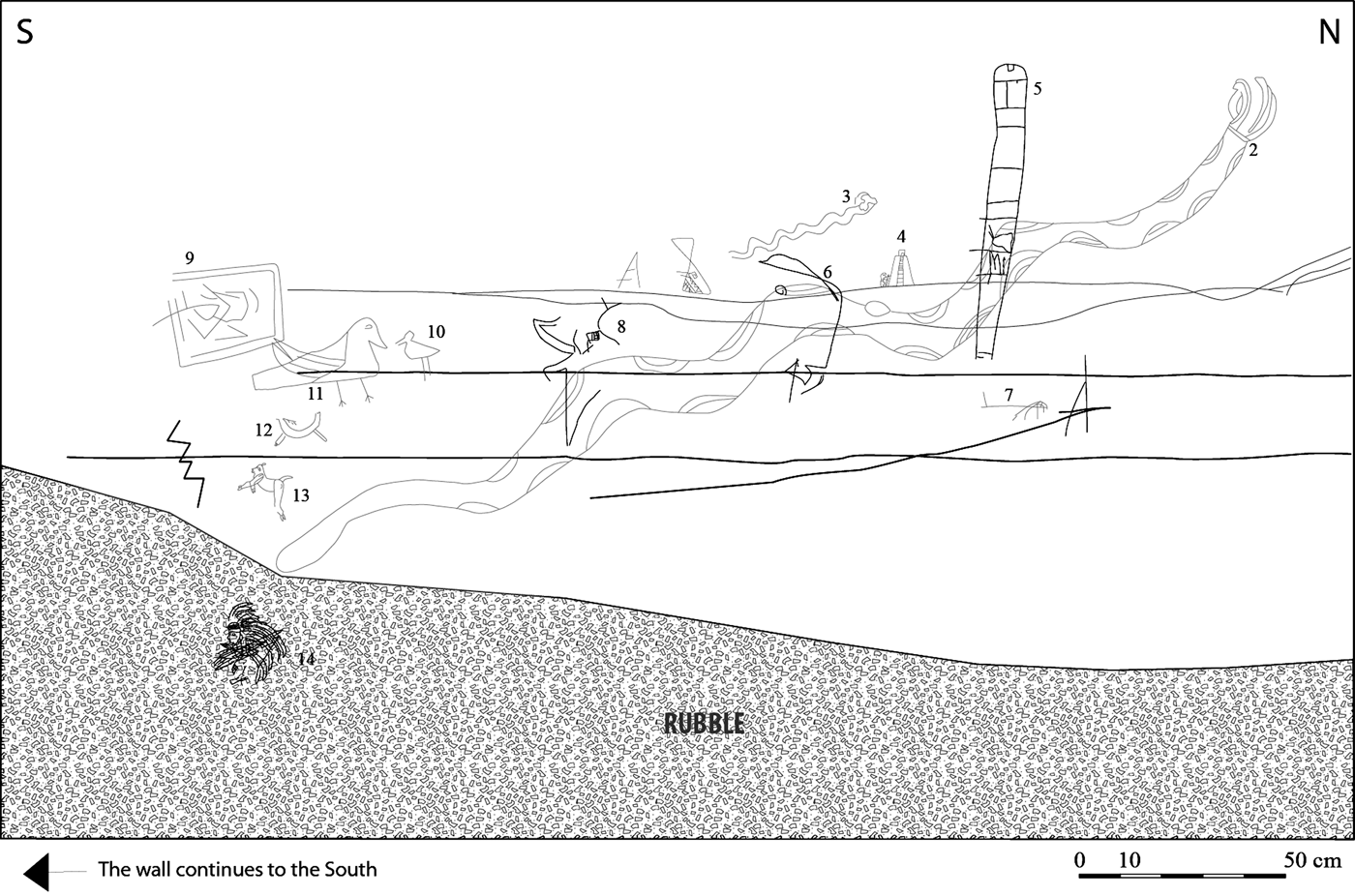
Given the number of direct and indirect mentions of Río Bec graffiti, and despite a recurrent lack of illustrations, this form of expression was of great interest at the start of the Río Bec project (2002–2010). Focusing on the eponymous site, studies of the local architectural and iconographic production were carried out in a study zone of 100 km² (Nondédéo and Patrois Reference Nondédéo, Patrois, Monod-Becquelin, Breton and Ruz2010). In this micro-region, 73 monumental groups were discovered and registered during the survey. Each group includes a few structures, among which one or several buildings show standing architecture and façade decoration (Nondédéo et al. Reference Nondédéo, Arnauld and Michelet2013; Taladoire et al. Reference Taladoire, Dzul, Nondédéo and Forné2013). In 15 of the buildings discovered and/or mapped during survey and excavations, a total of 464 graffiti were systematically registered. The first step for a complete analysis of the Río Bec graffiti was to compile an exhaustive corpus, which includes both the extant records (discussed above) and those discovered during our own research. Once identified in the field, graffiti data were carefully recorded, including aspects of depth and quality of incision (fine, superficial, deep, etc.), with particular attention paid to individualizing each incised line, especially in cases of overlapping drawings. Those details, still available when the graffiti have first been exposed, are ephemeral, since they disappear a few days after contact with the air and sun. Photos were also taken, some with a low-angle light, to distinguish iconographic details invisible or unintelligible in normal daylight. Utilizing this recording method, an exhaustive register that is both synthetic (all the incisions visible are reproduced) and analytical (each line is individualized, each technical detail is indicated, and even superposed graffiti are distinguished) was created (Figure 1). Such a process was carried out in order to recover as much information as possible regarding techniques of execution and incision quality of the drawings, as well as to allow for the most objective identification of the drawings. It is interesting to look at the same instances of graffiti recorded by different people; while the general rendering is usually similar, details frequently differ from one researcher to another (see for instance the famous graffito representing a litter carried by two individuals and recorded by Merwin and Vaillant [Reference Merwin and Vaillant1932:Figure 31], Stoll [1979:Figure 115], Gendrop [1982:Figure 4], and Andrews [1999b:Figure 56]).
Register of graffiti. Example of Group B, Structure 6N1, Room d (western wall), with many post-abandonment graffiti and only one dating to the building's occupation (covered by rubble). In cases of superimposition, late graffiti are in black and earlier ones in grey.

For us, technical data, and the effects they produced, are the principal source of information exploitable by modern scholars who cannot interview ancient graffitists to understand the meaning, function, and importance of their creations. Technical aspects are relevant inasmuch as the word “graffiti” (the plural of “graffito”) is used here in reference to the technique employed, rather than to any supposed function. Indeed, without presuming the meaning given to this term by some Maya scholars—casual inscriptions or drawings on surfaces that were originally unintended for this purpose—I use it in its original meaning based on the Latin root of the word graphium, that is “scratch.” No a priori function is envisaged, only a technical one—the notion of “scratching” (even if, in exceptional cases, Maya graffiti can include drawings made with charcoal as at Payan, Mexico [see Ruppert and Denison 1943]). Moreover, it eliminates the possibility of any amalgam between the Maya ancient graffiti and the illegal, transgressive graffiti currently encountered in our Western culture.
DATING AND EXECUTION OF GRAFFITI
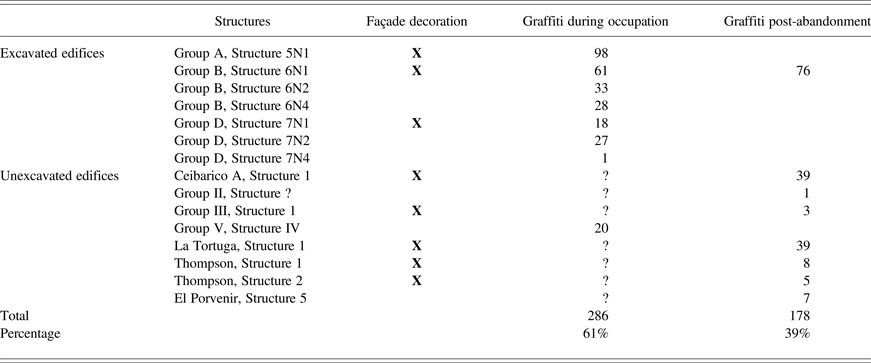
The systematic recording of preserved graffiti drew our attention to the issue of chronology. So far, no scientific method is available for a precise dating of these ancient productions and, in the absence of sealed contexts, archaeology cannot readily provide additional information. As an alternative, I propose an innovative, relative method for dating the graffiti, which allows us to differentiate between those produced during the building's occupation and those created post-abandonment (Patrois and Nondédéo Reference Patrois, Nondédéo, Lorenzo and Cosme2009) (Table 1). This important chronological distinction relies on the respective location of graffiti on the walls in relation to the interior floor and level of accumulated rubble. I argue that graffiti located between the floor and the rubble line, that is, drawings visible only after excavation and debris removal (between 0 and 1.6 m in height) can be dated to the building's occupation (between a.d. 550 and 950). These represent 61% of the corpus (n = 286). In this first set, a complementary distinction is possible when graffiti are realized on superimposed stucco layers (resulting from the traditional Maya practice of regularly replastering walls).
The corpus of Río Bec graffiti
The second class of graffiti (n = 178) includes those located above the rubble level, at a height greater than 2 m (no graffiti have been registered between 1.6 and 2 m), which are considered to be more recent. Most of them clearly follow the rubble line suggesting they were made once the edifices were abandoned and partially collapsed. Furthermore, I differentiate earlier post-abandonment graffiti from others superimposed in later times. This distinction is complex and sometimes difficult to establish, as the composite drawings can become nearly incomprehensible and almost undecipherable. Group B, Structure 6N1 represents the best example of this chronological differentiation, as it contains graffiti dating from both its occupation and post-abandonment phases. Although this is the only case known to date, other edifices still unexcavated may share the same particularities, especially those with visible post-abandonment graffiti (for example, Ceibarico A, Structure 1, or El Porvenir, Structure 5). It is necessary to point out that modern graffiti, also executed post-abandonment, are easily recognizable and distinguishable from pre-Columbian ones in that they mostly consist of Spanish writing and will not be addressed here.
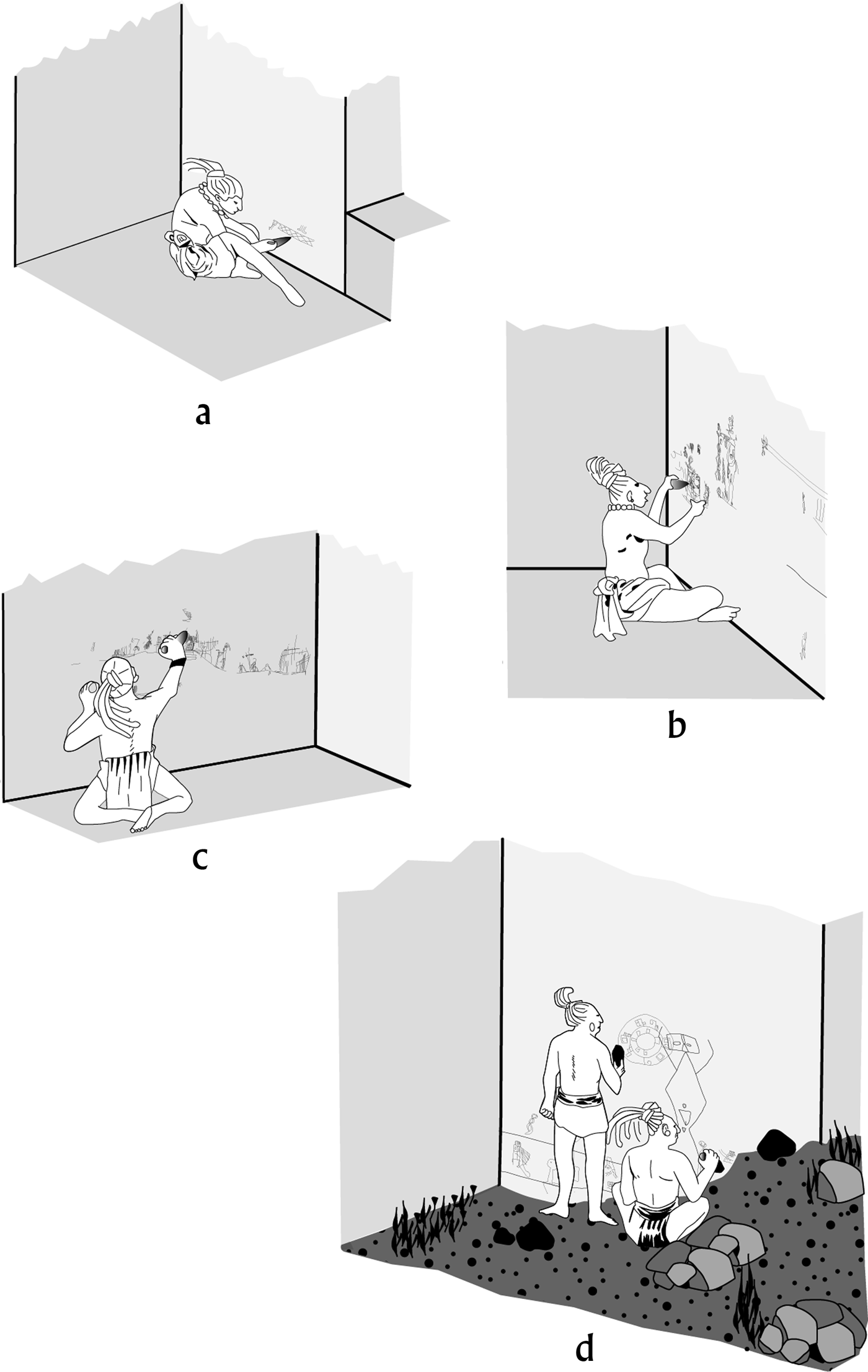
Localization and height of graffiti on walls constitute two main criteria to detect the different positions chosen by the graffitists at the moment of incising (I consider a medium height of 1.5 m for a Maya adult; see Patrois and Nondédéo [2009]). The posture and height of an artist will have an impact on the quality of the graffiti, allowing us to infer the age of the graffitists; children typically drawing at a lower height than adults (see below). Five distinct positions were identified and experiments conducted to test the viability of each (Figure 2). The results are valid both for pre- and post-abandonment incisions, on the assumption that graffitists were standing on the original floor level of the building, or directly on the debris mass. Position 1—between 0 and .3 m—is certainly the most awkward, as graffiti are realized close to the floor or debris level. The drawings recorded at this height are usually crude, superficial, and small in size. Position 2—between .3 and .6 m—is relatively “comfortable;” graffitists are seated, probably cross-legged, with the drawing arm raised at torso level. The resulting graffiti are of all styles of execution; basic or complex, crude or elaborate. Position 3—between .6 and .8 m—is that of graffitists seated cross-legged, with the drawing arm resting at head level. This position is considered perfect for drawing on a vertical support and, in fact, all graffiti created at this level are of relatively good quality, with highly precise incision and complex compositions. Position 4—between .8 and 1.1 m—is the one of graffitists seated, their legs bent at the knee and seated on their heels, with the arm raised just above the head. In this position, most of the graffiti realized are basic drawings, even if some rather precise details are still present. Lastly, Position 5—between 1.1 and 1.4–1.5 m—corresponds to graffitists standing with their drawing arm at torso level. In this natural posture, graffitists only need to slightly incline their head to see clearly what they produce. In this position graffiti appear of a rather good quality. No images were registered above 1.6 m in relation with the floor or the debris level; it seems thus obvious that graffitists never used any kind of pedestal or ladder to incise on the walls higher than their natural size.
Graffitists incising on walls: (a) Group A, Structure 5N2, Room h: Position 1; (b) Group D, Structure 7N1: Position 3; (c) Group A, Structure 5N2, Room e: Position 4; (d) Group B, Structure 6N1, Room d: Positions 5 and 2. Reconstruction by the Author.
GRAFFITI MADE DURING BUILDING OCCUPATION
At Río Bec, the graffiti contemporaneous with the buildings' occupation are widely distributed in most of the excavated residences (Table 1). These residential edifices vary in size and organization, ranging from single-room structures (Group B, Structure 6N4; Group D, Structure 7N2) to 13-room structures such as Group A, Structure 5N2. Therefore, graffiti do not seem to have been restricted to certain categories of buildings, as they are found at all places in the residential hierarchy—from undecorated to decorated ones (for example, Structures 5N2, 6N1, and 7N1). The only prerequisite is the presence of plastered walls, which potentially excludes thatched-roof structures, kitchens, and, perhaps, storage rooms. It is worth noting that Río Bec graffiti were never incised in fresh plaster, but always on dry, sometimes already painted, surfaces.
Within residences, the incised drawings are located exclusively in rooms with benches and, more precisely, on their walls, benches, and/or on doorway jambs. Conversely, no graffiti were found on exterior façades, even when covered with finely plastered coats. These characteristics seem to be specific to Río Bec, since at other Maya sites, especially at Tikal, graffiti are not restricted to residential buildings, but can also be found in temples (Structures 5D-3 or 5C-1, for instance), and are incised on inner or outer plastered walls as well as on benches, floors, and vault soffits (Trik and Kampen Reference Trik and Kampen1983:4).
At Río Bec—on a single wall portion—basic stylized or abstract drawings can be found side by side with elaborate and realistic graffiti. The result appears as the accumulation of various drawings of different styles on a particular part of the wall (produced by different authors), rather than an organized or intentional grouping of diverse designs in order to create a formal image. These disorganized assortments of images on a single support, for example, do not imply the total absence of artistic and aesthetical research. Although graffiti often have nothing to do with conventional, particularly royal, Maya art, I suggest that graffiti are an authentic form of art—defined by Mauss (Reference Mauss1967:67) as “produced and thought of in relation to the pursuit of aesthetic sensation”—rather than simple casual doodles (Patrois Reference Patrois2008). Two main arguments support this consideration.
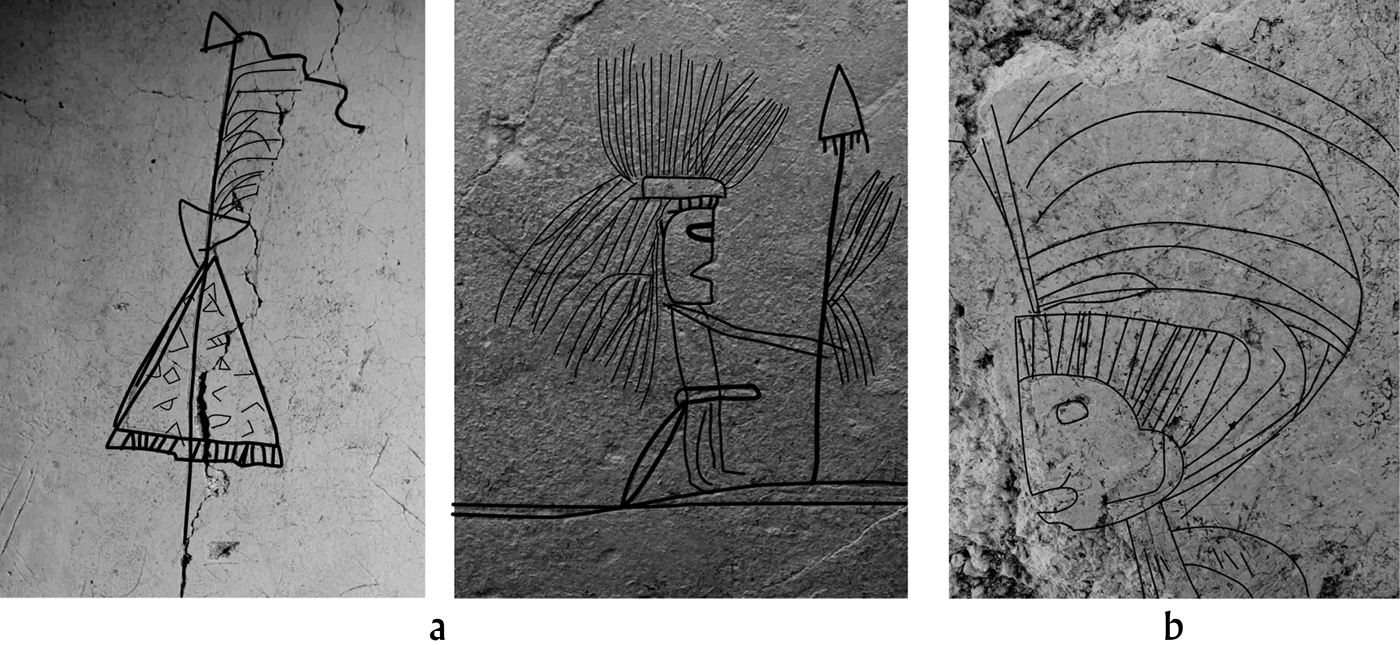
First, a certain aesthetic quality was sought when each incised drawing was made; visual effects often being added to enhance the graphic value of the produced images (Figure 3). Incisions of varied depths were frequently used within a single graffito. For example, in Group V, Structure IV, Room 2, to indicate that a sunshade is either painted or embroidered with small geometric motifs, its general outline is incised fairly deeply while its internal decoration is treated more superficially. The adornment thus stands out against the textile background and gives the impression of physical depth. Using the same technique, and in order to enhance the gaze of a human figure, eyes were incised deeper than the rest of the head. In other instances, to create an impression of lightness, fine and swift incisions were made; a feather headdress, superficially incised and barely visible, appears fluid and diaphanous as if floating in the wind even on a flat surface without any three-dimensional effect. The second argument is that all these images were executed with a great creative liberty, showing diversity and dynamism—artistic characteristics almost totally absent from the repetitive motifs and the standardized canons typical of the Río Bec semi-public art productions (see discussion below).
Visual effects added to enhance the graphic value of the produced images: (a) differing depth of incisions (Group V, Structure IV, Room 2 and Group A, Structure 5N2, Room f); (b) superficial incisions (Group A, Structure 5N2, Room f).
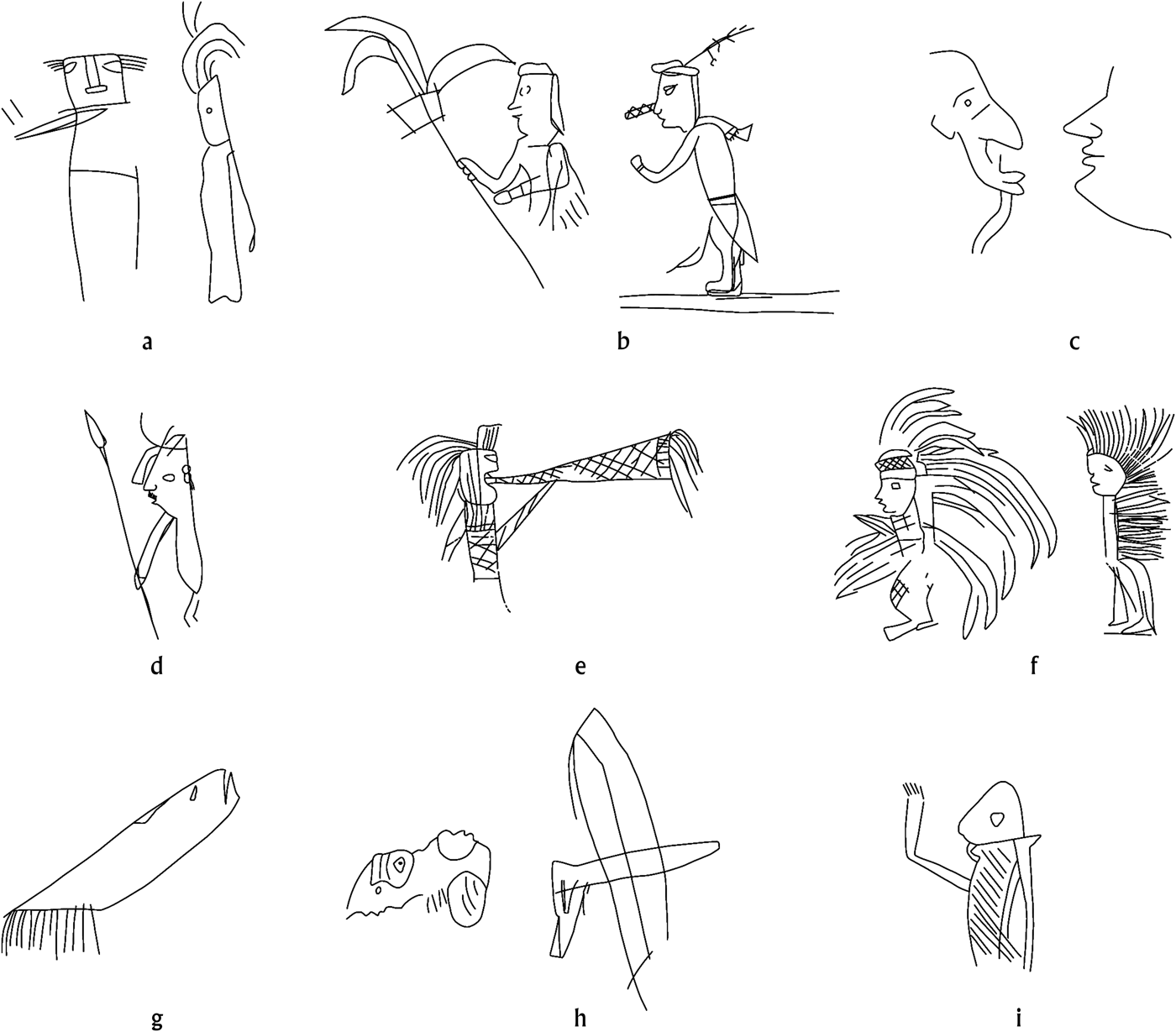
The corpus of Río Bec graffiti is organized into two general categories: one comprising isolated, stand-alone motifs; the other including motifs organized in complex compositions, generally a narrative scene which relates or illustrates an action. Within each category was defined various iconographic topics: anthropomorphic and zoomorphic subjects, architectural, geometric, and sundry motifs. The isolated motifs make up 91% of the corpus (261 of 286 motifs) (Figure 4). Most of them correspond to a more or less faithful reproduction of a certain reality, with 34% almost totally geometric or abstract (including the famous Mesoamerican game of patolli). The anthropomorphic images are the most numerous (45% of the isolated motifs) and show different styles: schematic, stylized, and realistic (Figure 4a-4f). Despite this variation in style, each individual presents unique facial traits, a characteristic that differs strongly from well-known conventional Maya canons that impose certain standardization and rigidity in the heads' representation. Some of the incised facial traits are individualized to the point that the images could even be considered as “portraits.” In fact, Webster (Reference Webster1963:39) went so far as to talk of “self portraits” in the case of some Tikal graffiti. The old man depicted on the northern wall of Room j (Group B, Structure 6N2) exhibits unique facial features, such as an angled forehead, fine eyebrows, small rounded eyes, a large hooked nose, and a prominent mouth with fleshy lips. The individuals represented are generally ordinary persons without any specific garment, gear, or identifiable attributes. Some more remarkable classes of people, however, are also portrayed: warriors with great spears or shields, musicians with trumpets, dancers or members of the elite with feather headdresses and adorned loincloths, for example. In this anthropomorphic corpus, the individuals' dynamism is noteworthy: they are generally figured active and full of life in varying, often very energetic postures—walking, running or dancing. Static and stationary positions are almost absent. This specificity in graffiti style contrasts with the rigidity of Maya royal art (on stelae), or the standardized Río Bec semi-public art style (façade decorations).
Examples of isolated naturalistic designs. Anthropomorphic motifs: (a) stylized individuals (Group A, Structure 5N2 and Group D, Structure 7N2); (b) naturalistic individuals (Group A, Structure 5N2); (c) “portraits” (Group B, Structures 6N2 and 6N1); (d) warrior (Group A, Structure 5N2); (e) trumpeter (Group A, Structure 5N2); (f) richly dressed individuals (Group B, Structure 6N1). Zoomorphic motifs: (g) fish (Group B, Structure 6N4); (h) birds (Group D, Structure 7N2 and Group B, Structure 6N2); (i) batrachians (Group B, Structure 6N4). Drawings by the Author..
Some zoomorphic graffiti also belong to this first category: birds, river fish, and batrachians (amphibians) (Figure 4g-4i). This imagery is clearly reduced to specific species, many of them related to the aquatic element, and the absence of others, such as forest creatures (jaguars, serpents, and so on) is remarkable. Nevertheless, the species represented obviously occupied a relevant place in the residents' life since some of them (fish, frogs, and so on) are also carved in low relief on the north façade medial molding of Group A, Structure 5N2 (see Michelet et al. Reference Michelet, Latsanopoulos and Patrois2004, Reference Michelet, Nondédéo, Patrois, Gillot and González G.2013). The presence of numerous local rivers and aguadas may help to explain this particular interest in aquatic creatures.
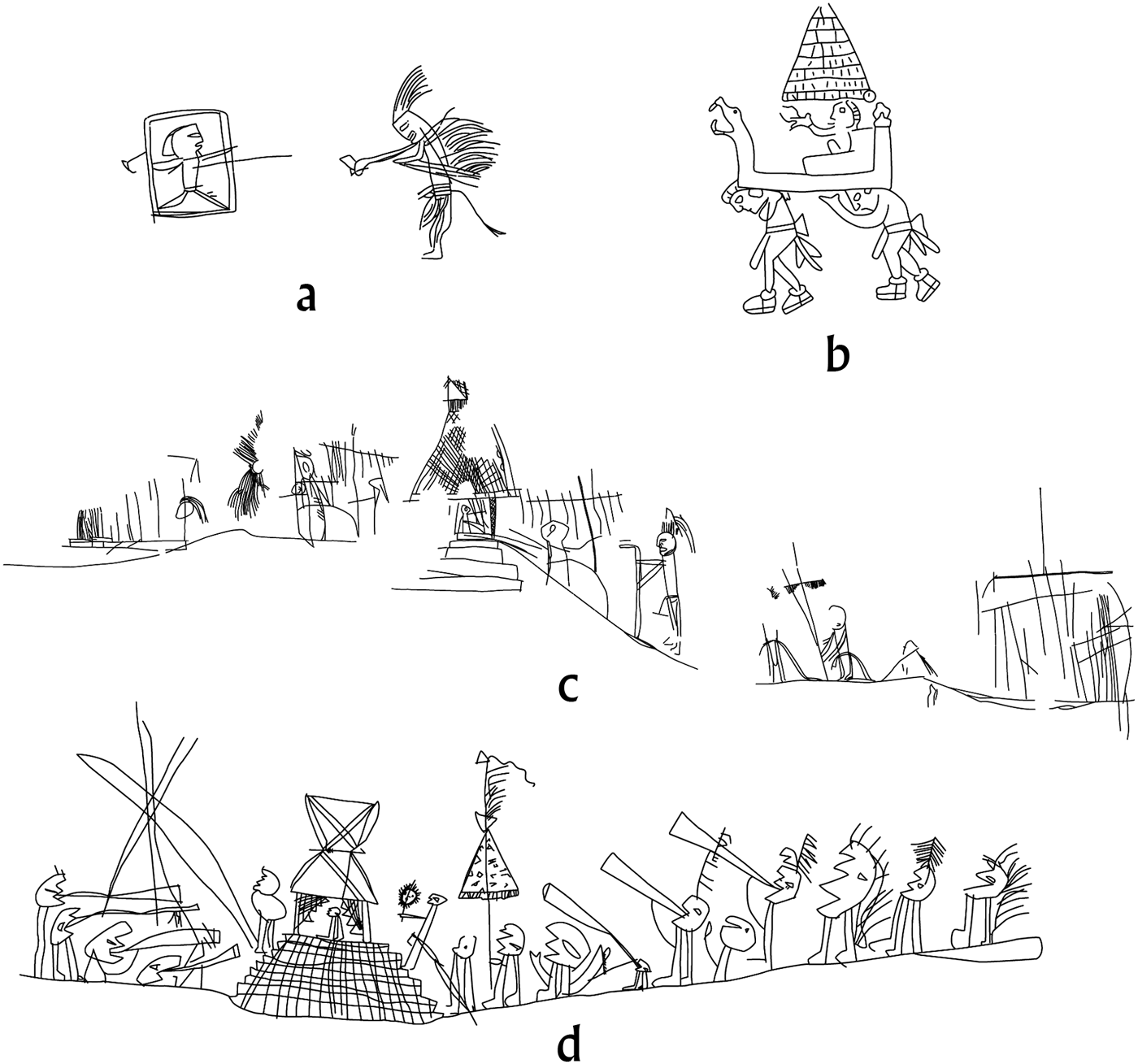
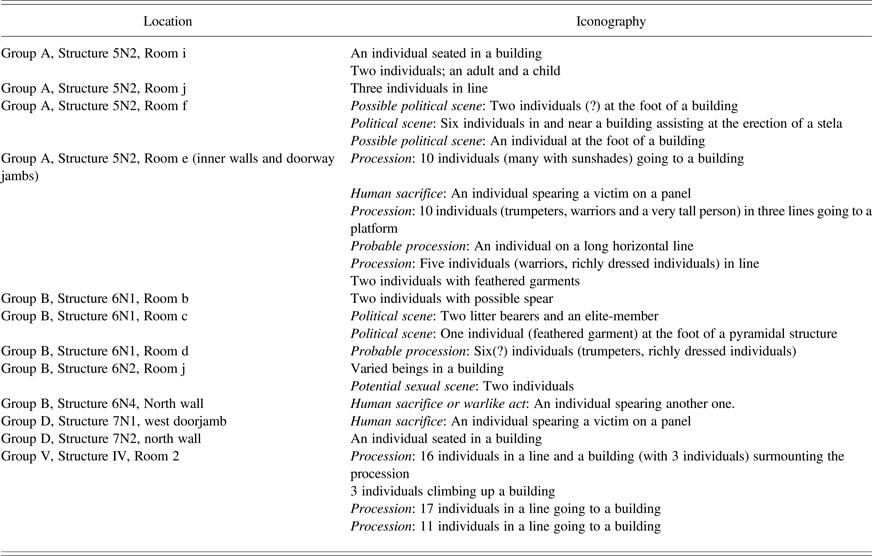
These anthropomorphic and zoomorphic motifs are present in all the buildings with graffiti. They clearly belong to the graffitists' familiar environment or to their private sphere (in the case of some plausible family patriarch portraits), which seem to have been their main source of inspiration. One might expect that the second category of graffiti, the complex scenes (25 occurrences) (see Table 2), would also be linked to the graffitists' daily life activities such as cooking or crop growing. On the contrary, however, the narrative scenes are radically different and mostly show public events of exceptional nature, an observation apparently equally valid for other known Maya graffiti, especially those of Tikal, Nakum, Yaxha, and La Blanca (Hermes et al. Reference Hermes, Olko and Zralka2001, Reference Hermes, Olko and Zralka2002; Trik and Kampen Reference Trik and Kampen1983; Vidal Lorenzo and Muñoz Cosme Reference Vidal Lorenzo, Cosme, Lorenzo and Cosme2009b). These outdoor public manifestations are open to everyone and, de facto, rule out royal indoor ceremonies commonly depicted in elite Maya art (enthronization, ritual, and bloodletting ceremonies). Although there exists some simple scenes with only two or three individuals, several of these images are complex narrative scenes associating many individuals who participate or interact in the same event: feasts with music and dance, sacrificial ceremonies, erection of a stela in front of a residence, or the visit of a high dignitary in a palanquin (Figure 5). These scenes likely correspond to factual events the graffitists had taken part in, or witnessed, at Río Bec or elsewhere—for example, in a large public center like Becan.
Examples of complex scenes: (a) sacrificial rite (Group D, Structure 7N1); (b) visit in a palanquin (Group B, Structure 6N1); (c-d) scenes of procession (Group A, Structure 5N2 and Group V, Structure IV). Drawings by the Author.
List of complex scenes dating from the occupation of the buildings (25 graffiti)
Execution scenes, probably sacrificial rites, belong to these outstanding graffiti; the victim is quartered on a vertical framework while a costumed warrior facing him stabs his body with a spearhead (Figure 5a). These rituals seem to have impressed the residents to the point that they were represented on two different edifices belonging to groups a kilometer apart (Group D, Structure 7N1 and Group A, Structure 5N2). Depictions of human sacrifice are not limited to Río Bec, but also exist at other Maya sites, notably Tikal and Nakum (Trik and Kampen Reference Trik and Kampen1983:Figure 38a; Zralka and Hermes Reference Zralka, Hermes, Lorenzo and Cosme2009:Figure 20). The recurrence of this imagery suggests that this peculiar sacrificial ritual was performed in Maya cities (or at least in every city showing the motif), and that those drawn on the Río Bec walls could have been executed locally. With respect to questions of chronology and geography, it seems improbable that all instances of this imagery illustrate a unique and exceptional event. It is notable that warlike imagery and royal or official religious iconography are absent from Río Bec, whereas they are well-represented at Tikal (for example, “protector figures,” see Lindley [Reference Lindley2012]). In particular, the warlike graffiti have been considered as representative of bellicose times in the aftermath of the city around a.d. 800:
“the continuous bellicose manifestations that affected this region at the end of the eight century were also documented by the graffiti inscribed on the structures' walls, […] reflecting the preoccupation of their occupants with the involvement in these actions, leading them to reproduce drawings of prisoners and the capture of palanquins of enemy rulers.” (Valdés and Fahsen Reference Valdés, Fahsen, Demarest, Rice and Rice2004:143)
Nothing similar has been observed in Río Bec graffiti. In contrast, on Group B, Structure 6N1, a remarkable scene represents the peaceful visit of a dignitary, probably coming from a neighboring group or, perhaps, region farther afield. Unique in the corpus (Figure 5b), it is very small in size (15 cm high) and of elaborate execution: it shows a high-status individual shaded by a parasol and seated in a palanquin that is decorated by a serpent motif which, in fact, forms its frame. The sedan chair is carried by two figures, hands raised above the head. The litter bearers are realistically represented, bending under the weight—walking painstakingly as if the scene was happening before our eyes.
But the most remarkable of these scenes, also the most imposing as they can measure up to 2.5 m in length, illustrate processions (Figure 5c and 5d). The five occurrences in Group V, Structure IV, and Group A, Structure 5N2, are much alike in their composition: in a festive procession, the participants converge with music and dance toward a single edifice. Some are likely elite members, suggested by the fact that they are protected by an adorned sunshade; others are trumpeters, simple participants, or witnesses. A remarkable individual, drawn in a different style than the others, is climbing up the stairs of the building. Probably a priest, he is carrying specific accessories—a fan or staff. Another individual is waiting for the procession directly on the edifice. The latter consists of a pyramidal platform supporting an edifice with a thatched double-sloped roof, a recurrent building type in these scenes, yet never shown as an isolated motif. Representations of the famous twin-towered structures, considered emblematic of the Río Bec architectural style, are not present in the Río Bec corpus of graffiti. The only example known is from the site of Chicanna (Gendrop Reference Gendrop and Schávelzon1982:137). In these scenes, various visual techniques were used, resulting in complex compositions: to show that the individuals are walking (supposedly) on the ground, a horizontal line was drawn under their foot—the indication of a groundline is a well-known graphic process commonly used in artistic imagery. The effect of blowing wind is also added to the scenes to create a certain coherency and dynamic: in Figure 5d, for example, this seems to be clearly indicated by feathered headdresses and ornamentations of the parasol (ribbon and feathers) that all extend outward in the same direction. Another technical example is provided by building imagery. Realistic and well-proportioned in itself, its size relative to close-by human figures is not realistic as building and individuals have the same height, but a miniature individual is located directly inside the superstructure to create a certain visual coherence with the other personages (see Houston Reference Houston and Houston1998).
The iconographic recurrence linking the five procession graffiti is noteworthy since there are no known sakbe or built pathways or avenues, no public plazas in the Río Bec groups to facilitate such grand ceremonies, and not even such edifice as the one represented. It is thus legitimate to wonder about the location in which these events took place. Did they occur at the settlement itself, or elsewhere? Were they possibly at Becan? Do these graffiti reproduce an unknown standardized image presented on other kinds of architectural support, ceramics, paintings, or decorated textiles? Processions are recurrently illustrated on Maya painted ceramics and paintings, but they rarely progress in the direction of a specific building as on the vase from Tikal (Deposit 50) that illustrates the Teotihuacan and Maya encounter at the foot of two temples (Looper Reference Looper2009; Schele and Freidel Reference Schele and Freidel1990:162, Figure 4:26). If so, was this image imported from another site where such events took place? The existence, at other sites, of graffiti roughly illustrating the same event leads us to believe, again, that those processions took place at Río Bec. Although perhaps occuring in the only architectural groups organized around a public plaza following the central lowland pattern; that is, Group V, where several of the procession graffiti are registered, or Group II and Kajtun (Nondédéo and Lacadena Reference Nondédéo and Lacadena2004; Nondédéo et al. Reference Nondédéo, Arnauld and Michelet2013).
DISCUSSION
Profusion and ubiquity are the principal characteristic of these Río Bec productions. While semi-public decorations on façades (for example, addressing outsiders from the coresident group) are limited to the main edifice of each group, graffiti abound in all types of residences. For modern-day people that take particular care of their inner dwelling, walls and floors remaining clean and intact, this intensive “wall marking” (for example, the northern wall of Group B, Structure 6N4, with up to 28 graffiti on a single wall [see Patrois Reference Patrois, Michelet and Taladoire2004]) can be interpreted as a form of defacement, or even as a degradation of the construction. Gendrop gives a good example of this Western viewpoint that cannot envisage the possibility of “touching” the house walls. For him, the unique explanation for this “degradation” is troubled times with no leading authority:
“…una época en que muchos de los principales mecanismos de la autoridad habían desaparecido o se hallaban en avanzado proceso de desintegración, al grado de tolerarse que lugares hasta entonces intocables, no sólo fueron convertidos en meras viviendas, sino que vieran sus paredes cubrirse indiscriminadamente con todo género de inscripciones”. (Gendrop Reference Gendrop and Schávelzon1982:129; translated by Julie Patrois)
[…a time when many of the main mechanisms of authority had disappeared or were disintegrating completely, to the degree of tolerating that places formerly sacred were not only converted into mere dwellings, but had also their walls covered with all sorts of indiscriminate inscriptions.”]
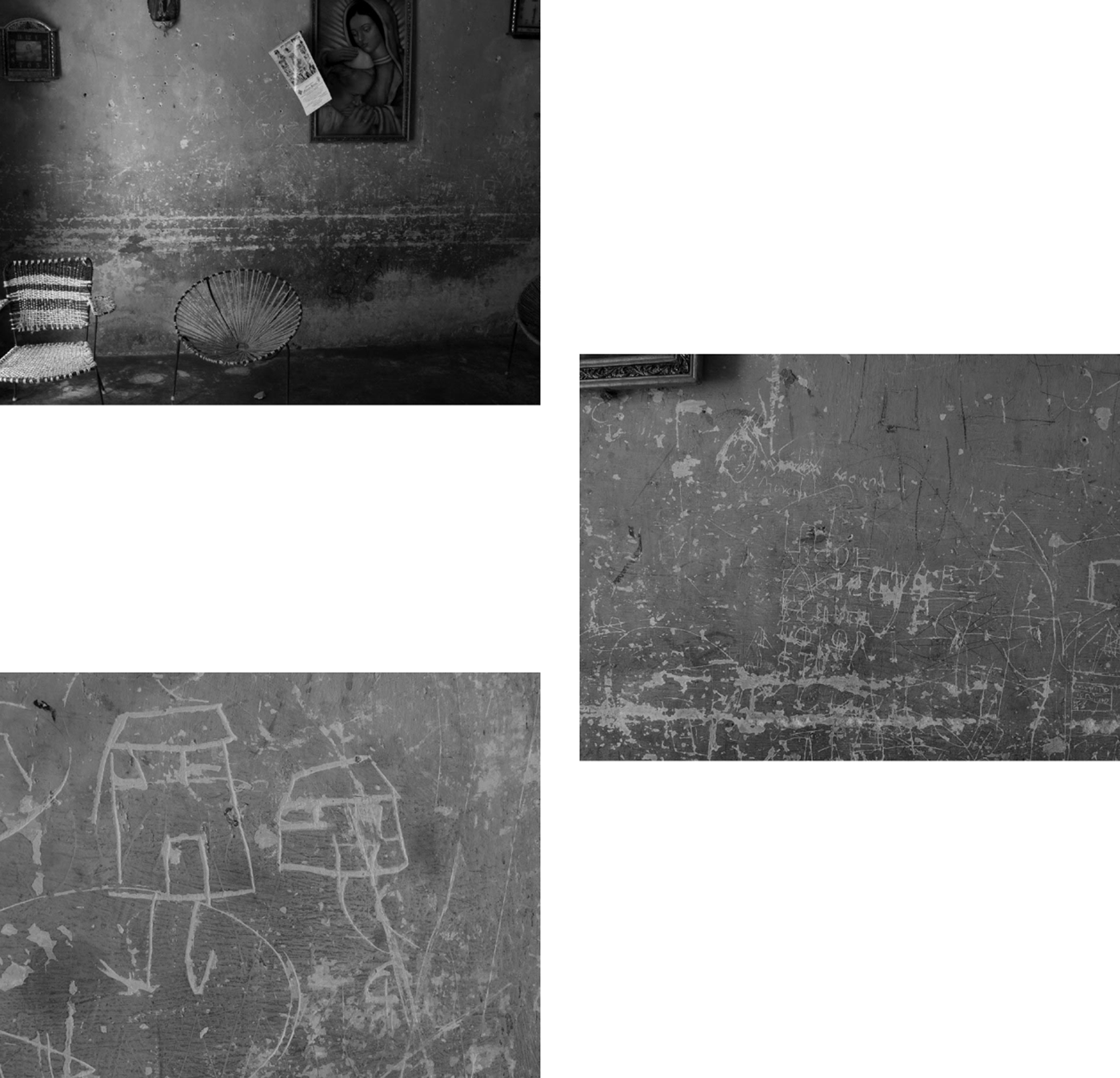
Nevertheless, in contemporary Maya houses, graffiti appear totally integrated with day-to-day domestic life. Nowadays, this practice can still be observed, particularly in northern Yucatan, where the inner walls of traditional houses are covered with numerous graffiti and drawings, as well as inscriptions (Olivier Le Guen, personal communication 2010). They are created by every family member and/or inhabitant, from children incising the image of a schematic house to the grandfather making calculations (Figure 6). Far from the idea of degradation, the young ones are not reprimanded for their action, as the adults do exactly the same; to enforce the banal character of this activity, we must add that it is not exceptional to see graffiti incised on fresh color-painted walls. This detail accentuates the evidence of an act realized during everyday life, which likely finds its roots in pre-Columbian times.
Modern graffiti realized in a traditional house, village of Kopchen, Yucatan, Mexico. Photos courtesy of Olivier Le Guen.
The popularity of such a form of art has certainly been favored due to the ease of execution, as it requires no specific technical skills or training (Patrois Reference Patrois2008). Furthermore, any simple sharp pointed instrument was enough to incise the stucco, even though it seems that flint flakes or projectile points were preferred as better adapted for incising. The technical simplicity of this means of artistic expression increased the number of participants which, in turn, resulted in a range of highly diverse styles and the production of unique works.
Easy execution and localization across many different dwellings invite us to think that graffiti production concerned all the residence's inhabitants. Based on the diversity in styles and different heights of drawings on walls, the corpus analysis strongly suggests that the inhabitants themselves were the graffitists. Maler (Reference Maler1911:56), discussing Tikal graffiti, and without any other argument than his own intuition, also attributed those creations to the buildings occupants: “upon this [finest white stucco] the occupants skilled in writing and drawing made incised drawings….” Andrews (Reference Andrews and Andrews1999b:233) forwarded the same proposition: “… [this] supports my belief that the graffiti were executed by the original occupants of the buildings, both at Tikal and elsewhere.” In the case of the Río Bec houses, this hypothesis is further supported by the fact that the incised drawings were restricted to the most private and intimate spaces within dwellings—rooms with benches or elevated floors, which were generally inaccessible to outsiders and visitors. As mentioned earlier, no graffiti was ever found on building façades, the only constructed plastered sector potentially accessible to visitors or foreigners. To draw in their own house, the graffitists tried to comfortably develop what can be considered as their creative activity, sitting on a bench, on the floor, or standing up (Patrois and Nondédéo Reference Patrois, Nondédéo, Lorenzo and Cosme2009).
It is worth bearing in mind that every resident, without restriction of age—adults and children—could incise graffiti. The lowest graffiti, almost at floor level, an uneasy position for an adult (Position 1), were probably the work of children (see Hutson Reference Hutson2011). This presumption is also based on the command of the gesture and on the physical force necessary for a precise incision that is visibly lacking in the lower graffiti, which is always crudely and superficially incised. Subjectively, and within the limits imposed by our Western vision, the rendering of these lower drawings, mostly anthropomorphic, is generally childish: round heads, oval eyes, the mouth represented by a unique horizontal line, etc. By contrast, drawings located higher on walls are usually more complex and elaborate, with a better quality of incision—the most elaborate certainly being created by experienced graffitists; persons with engraving training, experience, or technical knowledge. The Río Bec walls thus bear the scars of varied graffitists with unequal technical capacities, talents, ages, and aspirations. Here, I disagree with Webster (Reference Webster1963:39) who suggested for Tikal that this extreme variability was due to graffitists of different social status, being either “priests or officials,” or “ordinary citizens.” If we fully accept this proposition, it would mean that individuals of distinct status and occupations potentially incise on the same wall. The restricted access to buildings, the intimate locations, and the fact that graffiti were created during building occupation render this hypothesis rather unconvincing.
Contrary to what can be observed in modern societies where graffiti are exposed on public surfaces (public walls, subways, railroad cars, and so on; see Malland [Reference Malland2007, Reference Malland2010]), Río Bec graffiti were realized exclusively in private rooms. This intimate space par excellence and its walls become the ideal surfaces for projecting personal aspirations. Not surprisingly, specific iconographic themes were developed there, especially the ones that certainly bore a particular significance for the graffitists: eminent human beings (parents or ancestors?), valuable animals, or remarkable collective manifestations. None of them have direct connection with the semi-public imagery exposed on the exterior façades. This is likely due to the audience for which it was intended. As already mentioned, graffiti were only visible/accessible to a limited number of persons: the residence inhabitants or even the sole occupants of the room (apart from the graffiti on doorjambs, which might eventually be seen by visitors). Given such a generally restricted audience, it is logical to infer that this form of art did not have the same concerns as public art. At Río Bec, essentially exposed on exterior façades and roofs of the major residences in each group, semi-public imagery consists of fantastic zoomorphic creatures. I and other scholars interpret them as terrestrial monsters related to the Earth as nourishing land, domain, territory, and sources of power (Baudez Reference Baudez1994, Reference Baudez1999, Reference Baudez2002, Reference Baudez2003; Nondédéo and Patrois Reference Nondédéo, Patrois, Vargas and Benavides2007, Reference Nondédéo, Patrois, Monod-Becquelin, Breton and Ruz2010). This specific Río Bec imagery has little to do with the Late and Terminal Classic royal Maya art expressed mainly on stelae or in the architectural decoration of official buildings (Proskouriakoff Reference Proskouriakoff1950; Sanchez Reference Sanchez2005; Schele and Miller Reference Schele and Miller1986).
Its recurrence across the Río Bec settlement is certainly induced by social and political concerns of a nature different from those normally found in Maya cities, where the image of the almighty ruler was the one most produced and displayed for the eyes of all. The archaeological record shows that the Río Bec micro-region had no centralizing authorities, and that the numerous monumental groups constituting its society formed a complex hierarchy with marked continuity from one rank to the other (Nondédéo et al. Reference Nondédéo, Arnauld and Michelet2013). Their political organization was based, not so much on the centralizing power of a single individual as seen in the central lowlands but, instead, on the competing, perhaps formally shared powers of the “noble” families living in the most decorated residence in their group, and possessing the associated land. I feel that the most powerful families would decorate their residence in a remarkable way for two main reasons: (1) to denote that the territory where the house stands was their domain, in front of neighboring families heading their own group situated a short distance apart (350 m on average; see Nondédéo and Patrois [2010]); and, (2) to display their own social identity by distinguishing themselves from neighboring social groups, and even from coresidents in secondary houses of the same group.
Consequently, semi-public decoration on Río Bec residences provide information on the agrarian, if not more political, worries of people or, more specifically, on relations between neighboring groups as well as within each group. Of a collective nature, these concerns do not have much to say about the dwellers and their personal aspirations. The latter are, nevertheless, accessible by means of private graffiti art. Façade decoration is pre-defined and codified, responding to artistic official canons due to its relatively public function, whereas graffiti, private and intimate, did not impose any restriction or formalism on their creators. To some degree they are the result of spontaneity. Here, I agree with Walker's (Reference Walker1959:194) definition which states that ancient graffiti were “private statements about directly observed events not masked by the formality or conscious effects found in pieces intended for more obvious display.” In their own residences, graffitists felt free to create artwork according to their feelings, moods, and preoccupations of the moment or centers of interest: persons, animals, or even objects or scenes they saw everyday or more occasionally. Young (Reference Young1969:170) has made the same observation about Phrygian graffiti. Thus, in privacy, the theme of the zoomorphic monster, so recurrent, or even compulsory in the Río Bec semi-public imagery, disappears completely. Others replace it, the most frequent being human figures. While rare in Río Bec semi-public art—the only depicted individuals being probably local chiefs—the anthropomorphic motifs are ubiquitous in the graffiti corpus, including individuals of distinct ages and occupations, whether singular or mundane. If diverse life stages are well represented and clearly distinguished, curiously this is not the case with gender. To date, all the individuals registered are exclusively masculine (with perhaps one exception being a potentially naked breast identified on a human-form graffito at Group A, Structure 5N2), identified feminine images occurring subsequent to the buildings' occupation (see below)—data which tend to confirm our relative dating. As both age and gender are determinant in the definition of each individual status within a social group, such exclusion is disconcerting. Also perplexing is the total absence of prosaic themes like vegetation, trees or fruits, the sprouting of seeds, or even rain and/or sun. Thus the presupposed ‘total creative freedom’ and varied source of inspiration actually do not lead to the global everyday life imagery that one might expect but, instead, to privileged and, to a certain point, restricted topics. If not taboo, gender, reproduction, and fertility seem to have been among the latter.
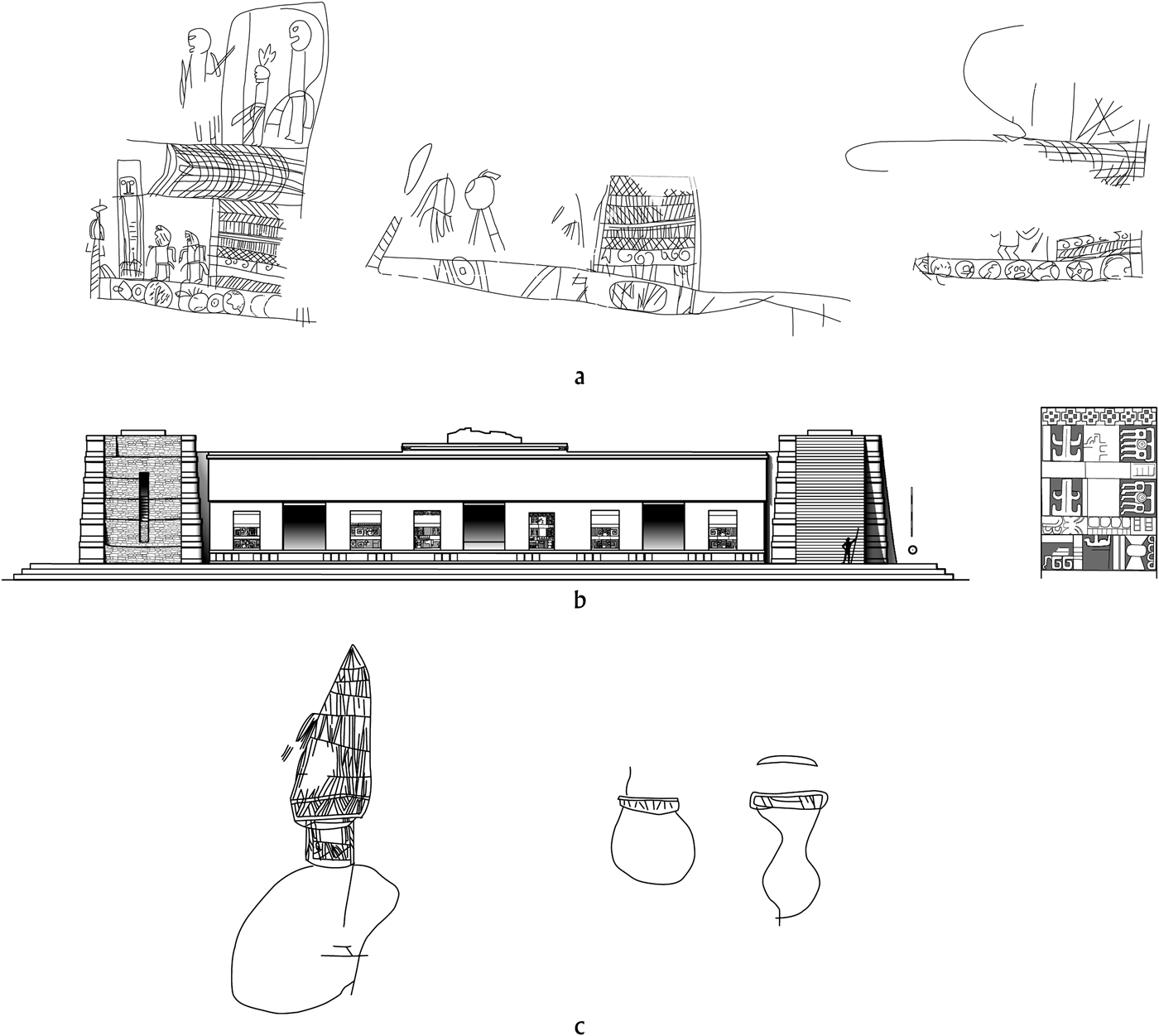
When personages take part in narrative scenes, the events depicted are often collective and probably reflect a certain reality. As previously suggested, the represented processions could have taken place at plaza groups (for example, Groups II, V, or Kajtun). Extending this argument, it is possible to envisage that the individuals living in neighboring groups (the majority without public spaces) witnessed the ceremonies and were strongly impressed by what they saw. Once back in their dwelling, in their private sphere, they reproduced the public event, as a simple homage or with the intent of memorializing it. This strong link between public and private visions is even more obvious when the house identity (marked by a specific decoration) is clearly indicated (Figure 7). Such is the case with the three graffiti (repetitive, but not identical) discovered in Room f of Group A, Structure 5N2 (Figure 7a): these images represent 5N2 itself, as public events take place in front of it (the erection of a stela among others) (Patrois Reference Patrois, Michelet and Arnauld2006). To make the edifice recognizable, the graffitist took the trouble to depict it with its two floors and its singular external decoration (inset panels divided into bands each ornamented with geometric motifs and molding ornamented with various designs, probable pseudo-glyphs) (Figure 7b) suggesting that they were preoccupied with marking their house and social group identity even within this private area. This type of image clearly underscores the emblematic character of the façade decoration as a sort of identity signal applied to the physical house, and also to the house as part of a social grouping. Similarly, in the same structure, Room g offers the motif of a perishable house set on a circular mass (Figure 7c), probably expressing the idea of a bounded land controlled by the House—in other words, the idea of property. The proximity of this drawing to two incised ceramic vessels with decorated lip and cover, most likely of domestic use, emphasizes the residential aspect of the edifice. Both graffiti together may be the only ones in our corpus that we can relate to identity, land, and property, as well as emblematic themes generally expressed in the Río Bec semi-public imagery.
Graffiti; when the identity of the House or of the land and territory is represented: (a) probable representation of Group A, Structure 5N2 with its two floors and its singular external decoration. The first graffiti shows the public erection of a stela, the large quadrangular stone with the effigy of a tall individual: (b) reconstruction of the façade decoration (drawing by Nicolas Latsanopoulos); (c) perishable house and two ceramic recipients (drawing by the Author).
POST-ABANDONMENT GRAFFITI
The second group of graffiti consists of those incised after the buildings' abandonment, as inferred by their location just above the level of debris. These were executed with diverse objectives, under various conditions, and they probably date to several periods.
The majority of these graffiti appear as opportunistic and unpremeditated creations. Incised in partially or totally collapsed buildings that had been abandoned by their inhabitants, these peculiar graffiti must have been the works of occasional visitors or squatters. Probably unrelated with the group occupants, they were probably of Maya origin, and from the pre-Columbian or just post-Conquest period, as indicated by the nature, themes, and the style of the images generated. It is important to add that those post-abandonment creations cannot be considered late copies of ancient motifs, since the rooms were full of debris and the early graffiti totally hidden from plain view. If some thematic recurrences can be observed between occupation and post-abandonment graffiti (anthropomorphic, zoomorphic, or abstract themes), the most recent motifs are unique and restricted to the second, post-abondonment group
Despite the spontaneous nature of these realizations, it is notable that graffitists selected the best-preserved plastered walls of collapsed buildings for incising, and they looked for a convenient rubble slope allowing a correct, even comfortable, sitting position. If the appropriate physical conditions for creation seem to have been essential to them, this was not the case for their tools. The rudimentary character of the incisions, almost excisions, leads one to suppose that the tools were of poor quality, probably opportunistically found on the spot: sharp fragments of stone debris, bone, or any hard material. Those makeshift tools, not really adapted, allowed the execution of deeper, larger (sometimes up to 2 m in length), and objectively cruder images than those created in earlier occupational phases. These technical remarks do not erase the existence of an obvious aesthetic concern. In every post-abandonment graffito, attention to aestheticism is noted in the addition of apparently insignificant details, but which noticeably enrich and embellish the work: eyebrows surmounting schematic eyes or fine scratches at the tips of bird feet, for example.
The post-abandonment graffiti were apparently produced in the same opportunistic conditions as examples observed in other spaces and times, as nowadays tourists leave a trace of their passage on the walls of the monuments as well. In modern circumstances, writing is the most commonly employed medium of communication (mainly names and dating). For the ancient Maya, however, writing was reserved to a minority of the society—more precisely, according to Houston and Stuart (Reference Houston and Stuart1992:591), to a select group including scribes and sculptors. We can thus suppose that the rest of the population who had no access to this knowledge instinctively turned to pictorial representations. This is also valid for the occupation graffiti corpus for which inscriptions are lacking, an absence that correlates with the scarcity of inscriptions on Río Bec public supports (exclusively on rare stelae). There is one interesting exception—the graffito found in Group D Structure 7N2 (see illustration in Arnauld et al. Reference Arnauld, Michelet and Nondédéo2013), as it compares well to the inscriptions painted on the benches of Group B, Structure 6N2, in a private context (Arnauld and Lacadena Reference Arnauld and Lacadena2004). This does not preclude the fact that the Río Bec population was illiterate (Houston and Stuart Reference Houston and Stuart1992:592).
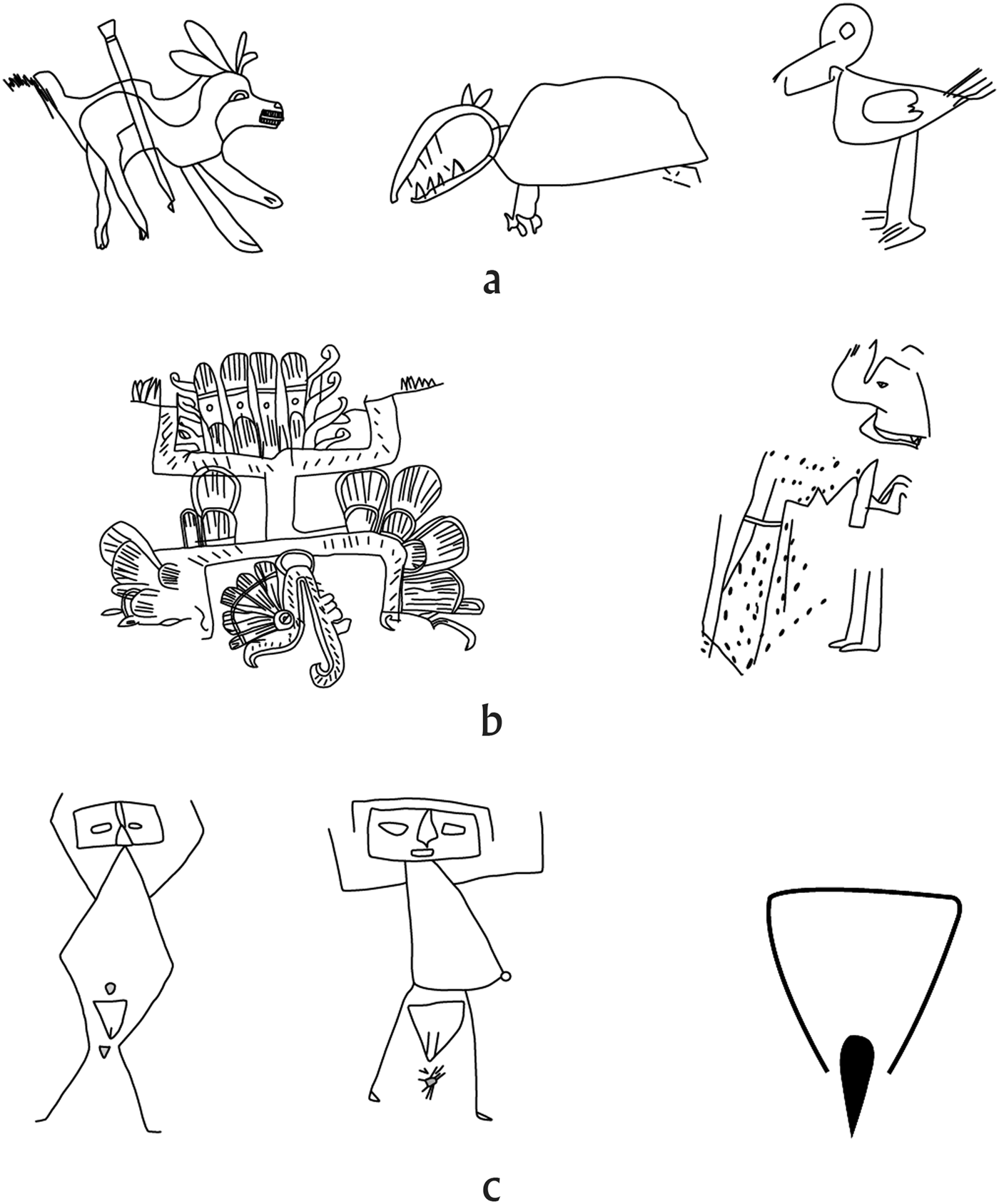
The corpus of post-abandonment graffiti is characterized by a schematic, almost geometric mode—mostly induced by the tools utilized. The resulting stylization does not complicate image identification and every naturalistic design is, without doubt, recognizable. In the case of zoomorphic motifs (17%), each species can be identified quite easily by means of its distinctive features: for example, thin legs and two-colored bushy tail for deer, open jaws of the fierce peccary, or webbed feet of the duck (Figure 8a). These animals lived in the site surroundings, a theme not limited to the Río Bec graffiti, but recurrently observed in other ancient societies as well (notable are the faunal renderings in the Lascaux caves, France [see Bouchud Reference Bouchud1976]). Interestingly, in the specific case of the Río Bec corpus, the zoomorphic images were never associated with anthropomorphic hunting scenes, for example, nor shown in their natural habitats (with the exception of a deer pierced by a spear in front of a luxurious plant). With no contextual clues, it is difficult to understand the motivation behind the choice of such species: spontaneous inspiration of the moment, privilege reserved because of their important role in their staple diet, or fabulous creatures or embodied zoomorphic personages well known in myths, legends, or narratives. The study indicates that the chosen zoomorphic representations were not exclusively linked to the prosaic concerns of the graffitists' daily lives; they also comprised other dimensions that might be considered as spiritual, religious, or magical.
Post-abandonment graffiti: (a) animals: deer (Group B, Structure 6N1), peccary (Group B, Structure 6N1), duck (Group B, Structure 6N1); (b) fantastic creatures (Ceibarico A, Room d); (c) feminine figures: women with an enlarged belly (Group B, Structure 6N1) and vulvas (El Porvenir, Structure 5). Drawings by the Author.
From these post-abandonment graffiti also come fantastic creatures, hybrid animals, anthropomorphic beings with a grotesque head or body, etc. (Figure 8b). Unique and original, they do not pertain to Classic period fantastic imagery seen on other architecture but are, instead, restricted to this specific context. I suggest that they correspond to magic graffiti associated with religious beliefs, meaning that these fantastic images are related to magical actions or ritual performances. Premeditated or not, the images would have been drawn during offerings, as testimonies by visitors or squatters to their reverence for the former residents and the ancient prestige of their house. They have also been considered as substitutes or complements to material offerings. Webster (Reference Webster1963:39) envisaged the possibility of “pictorial offerings to the gods,” considering some graffiti as drawings presented to the gods to express gratitude or solicit some form of special favor.
Also specific to this post-abandonment corpus, and totally absent from the occupation group previously analyzed, are frequently represented feminine figures (Figure 8c). They are clearly identifiable, exhibiting female genitalia; some of them also show an enlarged belly. Deeply incised vulvas are added to this womanly register in all most recently scratched walls. The appearance of women and related images is noteworthy, and are probably linked to the concepts of pregnancy, procreation, and fertility.
In some cases graffiti superimposition can be observed. The result is an almost unreadable palimpsest of two or more drawings. At times it was possible to distinguish and isolate one graffito from another by following each incised line. Once the superimposed graffiti are identified, it appears that the earlier covered images have little to do with the covering ones; they do not present the same themes and do not seem to have inspired the creation of the new ones. A careful study of the incised lines and their execution style shows that distinct graffitists were involved, probably at distinct moments, which would suggest repeated visits—probably related to the enigmatic group of Quejaches that inhabited southern Campeche and Quintana Roo during Postclassic period and early colonial times (Villa Rojas Reference Villa Rojas1962). Such overlapping also calls into question the value formerly assigned to the graffiti—not in an economical but, rather, in an aesthetical sense. Why superimpose drawings? And why do occupation graffiti very scarcely show the same practice of drawing overtop of existing images? Moreover, why superimpose drawings when free, undecorated space was available? Was the objective to hide the older images by deteriorating or abolishing the pre-existing graffiti (perhaps in the framework of the hostility existing between the different groups moving into the ruins)? Evidence of some partially erased drawings, particularly human heads, supports this hypothesis. In such cases, the objective was clearly to remove the facial traits of the individual represented, which would imply, first, the existence of true “portraits,” however stylized and schematized and, second, their intentional defacing. Covering, scratching, or defacing some works are practices attested to in many cultures; in ancient Egypt for example. Many works of art dedicated to Aten, realized under the Pharaoh Akhenaten's reign, were defaced by Horemheb (the Eighteenth Dynasty) in order to erase traces of his governance and to reintegrate the cult of Amen (Darne Reference Darne1999). They are also documented in the Maya lowlands, where numerous stelae show the scars of people having attempted to remove the sacred aura or dehumanize the royal image of a ruler or divine entity (see, for instance, Schele and Freidel Reference Schele and Freidel1990:167). This may have also been the case for post-abandonment Río Bec graffiti, even if the degraded portraits do not seem to be those of sovereigns, as they do not display their specific official attributes (imposing headdresses, rich garments, or manikin scepter). The absence of codified and pre-defined artistic canons in the graffiti art could explain this absence of status characterization.
CONCLUSION
Graffiti production at Río Bec is so abundant and rich that no cursory synthesis can do justice to all the potential information conveyed. It is suggested here that, at least in this particular Maya settlement, graffiti are better understood in relation to the general iconography associated with the local residential architecture. At first glance, only the dominant residences boasted mosaic stone decorations on their façades. Greeting outsiders, they appear on the most important edifice of each residential group, where they could be seen by as many people as possible, including not only members of the local social group, but also by neighboring, or even distant groups. The Terrestrial Monster was the preferred theme, as it represented both elite and commoners' concerns—the origins of power, territoriality, and fertility—enabling the social group to preserve its internal balance while signifying to neighbors and outsiders the grounds and limits within which to frame their relations.
In sharp contrast to these bold public displays, graffiti production was restricted to private contexts and aimed at the occupants themselves, yet was a widely distributed art form in both large and small houses. With no official function or use, the resulting drawings were much more varied and characterized, perhaps, by greater spontaneity. Most of them were essentially inspired by everyday life themes—grown men, old men, birds, fish—but also by the rarest and most sophisticated public ceremonies and celebrations. This form of art thus appears as an important primary source for understanding ancient Maya society.
As an impulsive inspiration, it tells us much about each resident's personal preoccupations, whether child or adult, local chieftain, or mere house member. The scenes represented were, above all, of a festive and collective nature, whereas bellicose episodes are largely lacking in the Río Bec corpus, even if some sacrificial rites are documented that one could directly relate to military actions if the victim were a defeated warrior. The graffiti iconography is rather related to things, persons, actions, or events that the artist witnessed or lived with in their immediate surroundings. The absence of themes such as war and royal or official religious iconography is notable considering its presence in Tikal graffiti, for example. This may suggest that the graffiti is related to the specificity of fragmented Río Bec society, which was organized in numerous noble houses, with little evidence detected for centralized and individualized forms of authority (see Nondédéo et al. Reference Nondédéo, Arnauld and Michelet2013).
Finally, once the buildings had been abandoned, partially or totally collapsed, new graffiti were incised in some of the ruined rooms. They were probably the work of occasional visitors or squatters. In the registered corpus, some incised drawings can be argued to be related to magical and ritual performances or offerings. Others appear as real portraits, as their images were voluntarily erased in order to cancel their aura, their soul, or to dehumanize them. With the final images left of an imagined world, often drawn atop earlier testimonies to a living society, the walls of the great Río Bec houses kept silent until their rediscovery by Western scholars.
RESUMEN
Desde un siglo cuando se descubrió Río Bec, los grafitos de sus edificios llamaron la atención de los investigadores, arquitectos o visitantes, los cuales documentaron estas obras sin dedicarles un verdadero estudio profundizado. En la micro-región de Río Bec (un cuadro de 10 km de lado centrado en el Grupo B), los grafitos que hemos registrado de manera sistemática consisten en imágenes realistas o abstractas directamente incisas en soportes estucados (muros, banquetas, suelos y jambas), localizados en el interior de residencias de todos rangos jerárquicos. Reunidos en un corpus exhaustivo, 464 grafitos fueron documentados por medio de un meticuloso método de registro que nos permitió obtener por una parte, informaciones valiosas que atañen a la profundidad de grabado o al estilo de ejecución y, por otra, aislar y separar cada motivo entre los grafitos superpuestos difícilmente descifrables. Uno de los resultados de esta primera etapa, previa al análisis iconográfico en sí, fue la posibilidad de distinguir dos clases de grafitos según su localización exacta y su altura con respecto a la línea de los escombros que rellenan el interior de los cuartos: los que remontan al periodo de ocupación del edificio y los que fueron grabados después de su abandono y parcial colapso.
Todas esas informaciones fueron combinadas para llevar a cabo una reflexión global sobre los grafitos de Río Bec, su contexto de realización y función, así como la identificación de sus autores y sus preocupaciones. Para la fase de uso de los edificios, llegamos a la conclusión que los grafitos fueron ejecutados por todos los ocupantes de la residencia independientemente de su edad. Sus producciones, verdaderas obras artísticas, reflejan cierta diversidad en cuanto al conocimiento técnico, talento e inspiración de sus distintos autores. A través de ellos, es posible aproximarnos de manera émica a sus autores.
Los grafitos ejecutados durante la ocupación pueden representar individuos o animales considerados como importantes para su autor, o relatar eventos impactantes y públicos (ceremonias, fiestas, etc.) en el marco de escenas complejas que muestran cierta planificación previa al dibujo. Realizados en un contexto privado e íntimo, esos grafitos son claras y directas manifestaciones de las preocupaciones, concepciones y manera de pensar de los residentes. Aparecen como el modo de expresión principal (accesible al arqueólogo) del individuo en la sociedad Río Bec en la que el uso de la escritura parece haber sido anecdótico.
Una vez abandonado y colapsado el edificio cuando se llena de escombros, una nueva categoría de grafistas entra en acción, visitantes ocasionales o “squatters,” que no tienen relación con los antiguos ocupantes. Sentados en los escombros, estos nuevos grafistas dejan, en las porciones de muros estucados todavía a su alcance, imágenes bien distintas de las de la clase anterior, lo que corrobora en sí el método de fechamiento que hemos elaborado. Graban motivos exclusivos como imágenes femeninas y símbolos sexuales inexistentes anteriormente, así como criaturas fabulosas posiblemente ejecutadas en el marco de ceremonias quizás mágicas.
Al lado de la iconografía oficial y repetida en las fachadas de edificios monumentales Río Bec, los grafitos ofrecen un contrastante medio de expresión, una práctica cultural transgeneracional que refleja tal vez las preocupaciones de cierta franja de la población a través de estas obras supuestamente más efímeras, pero más espontáneas.
ACKNOWLEDGMENTS
Since 2002, the Río Bec project has received continuous support from the Instituto Nacional de Antropología e Historia, and from several other Mexican and French institutions, among which I would like to thank particularly the state of Campeche, INAH-Campeche, the French Ministère des Affaires Etrangères et Européennes, the Centre d'Etudes Mexicaines et Centraméricaines (Mexico), Entreprises Françaises au Mexique and Solétanche-CIMESA.
I also want to thank the Directors of the Río Bec Project, Dominique Michelet, M. Charlotte Arnauld, and Philippe Nondédéo (UMR 8096 Archéologie des Amériques, CNRS, Paris) for the opportunity they gave me to write this synthesis on the Río Bec graffiti. Summarizing ten years of fieldwork was a difficult but stimulating task. Special gratitude is expressed to M. Charlotte Arnauld, Eric Taladoire, and Philippe Nondédéo, whose amazing patience and comments encouraged me to complete the manuscript. I am also grateful to Nicolas Latsanopoulos, the project artist who assisted me in the recording of the graffiti. Finally, many thanks to the three anonymous reviewers who greatly helped me improve this contribution.