

Splinters of Daphne and the Open Work
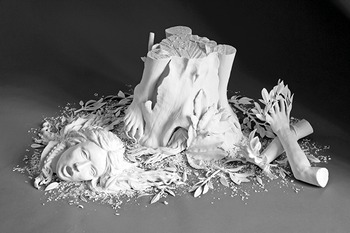
In Daphne by the Oregon-based artist Kate MacDowell (Figure 1.1), the body of Daphne is shattered at the moment she begins transforming into a tree. In the archetypal transformation from the beginning of Ovid’s Metamorphoses, Daphne experiences a similar assault as she is pursued by the god Apollo. Before Daphne’s metamorphosis, Ovid describes how Apollo gazes upon Daphne’s body and the destructive effects of his voyeurism. In what has been called a moment of ‘fetishistic scopophilia’,Footnote 1 Apollo’s gaze effectively reduces Daphne to the individual components or limbs that constitute her body: her hair, eyes, mouth, fingers, hands, and arms. Apollo’s atomization of Daphne’s body prefigures her metamorphosis, which will likewise occur to her individual limbs in turn; as Gianpiero Rosati states, the metamorphosis of Daphne ‘serves to “realize” the widespread metaphors according to which the leaves of a tree are its hair and the branches are its arms’.Footnote 2 In other words, Daphne’s metamorphosis ‘makes flesh of metaphors’.Footnote 3

Figure 1.1 Kate MacDowell, Daphne, 53”×17”×40”, hand-built porcelain, December 2007.
This metaphor also extends to the acts of reading and writing. Daphne is equally enclosed within the liber ‘bark’ and becomes the liber ‘book’; Ovid emphasizes the metapoetic nature of her transformation, as her hair turns into a leafy branch (frons) or, alternatively, the outer end of a book-roll (frons); that is, its ‘beginning’ (Met. 1.550).Footnote 4 The myth makes manifest the potential for selfhood to be obliterated in the face of the other; metamorphosis questions the degree to which our bodies constitute our sense of self and undercuts the illusion of embodied existence, as the body can prevent only temporarily an exterior reality from appropriating its interior structure. To employ the terminology of Deleuze and Guattari, far from Daphne being arborescent, she is rhizomatic.Footnote 5 Both the world described within the Metamorphoses and its relationship with previous literature are, to use the words of Victoria Rimell, ‘not so much a path, tree or ladder as a vital maze of networks, a density of vibrating bodies whose interactions are mutually transformative’.Footnote 6 As Ovid potentially speaks to post-humanist and eco-critical theories, so too his work remains live to deconstructive approaches that are often seen to give false privilege to the text over the world. Metamorphosis marks the defamiliarization of the self and its recognition and experience as being something profoundly other and thoroughly entangled with its environment, and yet arguably we see this most clearly expressed in the structural features of the text and its intertextual dynamics.
Kate MacDowell follows Ovid in uniting the illusive dismantling of selfhood and the artistic object. MacDowell’s Daphne is hand-sculpted from porcelain, which she has also partially hollowed out. The result is a luminous fragility; yet it is also easily mistakable for a plaster cast. MacDowell’s model for Daphne is Bernini’s Apollo and Daphne (1622–1625). She has created the illusion of a plaster cast taken from Bernini’s statue that has subsequently been shattered. It has been carefully crafted so as to appear as if it has been created through the destruction or splintering of another work; yet, as MacDowell makes explicit, her method involves the continual buildup of fine detail.Footnote 7 The Metamorphoses likewise oscillates between an illusion of the text as a fractured and disfigured ‘mosaic of quotations’ and a carefully crafted artefact, its meaning dependent upon its making and unmaking. Ovid and MacDowell allow for competing ideas and interpretations to remain present.
The integration of contrary perspectives and outlooks is also comparable to Bernini’s sculpture, which is itself an exercise in the multiplication of perspectives. Umberto Eco defines Baroque art, of which the sculptures of Bernini are a prime example, in terms we might equally apply to the works of Ovid:
Baroque form is dynamic; it tends to an indeterminacy of effect (in its play of solid and void, light and darkness, with its curvature, its broken surfaces, its widely diversified angles of inclination); it conveys the idea of space being progressively dilated. Its search for kinetic excitement and illusory effect leads to a situation where the plastic mass in the Baroque work of art never allows a privileged, definitive, frontal view; rather, it induces the spectator to shift his position continuously in order to see the work in constantly new aspects, as if it were in a state of perpetual transformation.Footnote 8
Bernini uses the proliferation of angles and viewpoints to achieve what Eco calls a ‘work in movement’, which seeks to represent metamorphic change within fixed stone. Bernini appropriates this kinetic force from the Metamorphoses and its propensity to perpetually transform and alter its appearances. To create a work capable of enacting continual metamorphosis, the reader must be constantly presented with conflicting accounts and perspectives, so that the meaning of the text becomes directly contingent on its ability to remain unfixed and open. In Eco’s concept of the opera aperta, or ‘open work’, the reader is presented with a ‘field’ of possibilities.Footnote 9 This field is not infinite, allowing for shape and form to emerge, while continuing to transform. There is value in returning to the opera aperta and its original goal of offering us ‘a new way of seeing, feeling, understanding, and accepting a universe in which traditional relationships have been shattered and new possibilities of relationship are being laboriously sketched out’.Footnote 10 This book will attempt to sketch Ovid’s relationship with ancient philosophy and especially the works of Plato, while striving to retain a view of Ovid’s works as unfixed and open.
Ovid and Philosophy
Ovid’s engagement with Greek and Roman philosophy has long been recognized. It is also now well established that Latin poetry from its very beginnings responded in various ways to Greek philosophy.Footnote 11 Different texts and philosophical schools have been deemed relevant to understanding Ovid, with much attention given to Lucretius and Empedocles in particular. Little attention, however, has been given to Plato beyond the study of individual passages. Plato’s prominence in the history of ideas hardly needs stating; however, Plato’s teachings were deeply felt in the intellectual culture of Rome across the domains of cosmology, epistemology, ethics, and eschatology. Put simply, Plato stands as a major influence on Cicero and the Stoics and a major opponent for Lucretius and the Epicureans, not to mention the numerous other works of Latin philosophy either wholly lost or only partially extant. The Sceptic afterlife of the Academy represents another important avenue by which Plato’s philosophy entered Rome, especially after its leader Philo Larissa moved to Rome in the first century bc. Ovid belongs to no particular school of thought and this work does not set out to argue that Ovid is a Platonist; rather, it seeks to explore how our understanding of the philosophical dimensions of Ovid’s works comes alive when viewing them as part of a mutually transformative and non-linear system that includes the dialogues of Plato.
Ovid’s responses to Greek and Roman philosophy are multi-layered and dynamic. His works tend to destabilize the notion of ‘discovering’ a singular fixed source or meaning; instead, we are continually asked to simultaneously hold contrastive readings, with the text utilized as a kinetic space for literary experimentation. We might witness in Ovid’s work a foreshadowing of the deconstruction of various binaries associated with the history of Western thought, most relevant for the concerns of this book being the nature/culture and philosophy/poetry divides. To have a text enact or make manifest a world of ongoing flux, an oscillating tension must persist across such binaries so that the deeply philosophical, deeply poetic, and deeply ecological might be seen as one and the same. We are asked to participate in both a text and a world ‘continually making and unmaking itself’.Footnote 12 Ovid’s works might be seen to overturn certain power dynamics through a vision of a divinely inflected ecosystem that is constantly encroaching on the boundaries of the human.
What, then, of Plato for such a reading? There is clear evidence to show that Ovid was aware of and alluded to the dialogues at various points across his literary corpus. It would also seem strange that Ovid would not take aim at arguably the most dominant philosophical figure looming large over Rome’s intelligentsia, especially as Ovid’s philosophical engagement becomes ever more evident. The divisions between Ovid and Plato are of course stark. Ovid has been traditionally viewed as the trickster par excellence, a magpie-poet revelling in the shimmering surface of shifting illusions and arriving at a worldview that is anathema to the perfect realm of eternal and changeless forms. Such divisions are deeply connected with the binaries mentioned above and are ripe for revision. Katharina Volk describes Ovid’s erotodidactic poems as not like philosophy or imitating philosophy but philosophical in their own right, a view which is easily extended to the Metamorphoses and Ovid’s corpus at large.Footnote 13 As Giulia Sissa states, Ovid ‘thinks deeply, although narratively, and writes in a truly philosophical voice’.Footnote 14 That said, there seems to be something reductive or even entrenching in attempting to place Ovid’s work in a particular genre or category, even if on the opposite side of a traditional binary. The Metamorphoses in particular might be seen to dispel the value of asking whether this is poetry and/or philosophy in the first place, especially when the very question plays into structuralist tendencies. We risk establishing a throughline with the now largely sterile critical debate of the distinctions between poetry and natural philosophy that have dominated readings of Lucretius’ De Rerum Natura and to a lesser extent Empedocles.Footnote 15
This work sets out to read Ovid among the philosophers and the philosophers among Ovid without endeavouring to arrive at a definition of natural philosophy in the ancient world or to isolate philosophy from poetry. The Metamorphoses and arguably Ovid’s entire corpus can be considered as open works, in Eco’s sense, that ruthlessly defy fixity in form. Any philological study of such work, however, runs up against the difficulty that no matter how open to multiple interpretations and frames of reference it might be, it tends towards some form of fixity or unifying principle, otherwise it would never congeal into anything that could be placed on a book shelf. The traces of the Platonic dialogues across Ovid’s corpus are, if anything, the unifying framework of this book, which owes much to its origins as a PhD thesis that brushed up against the work of quellenforschung. Following the traces of Plato across Ovid’s work offers ways of seeing anew Ovid’s various representations of the making and unmaking of the world, and the persistent fuzziness therein between the human and non-human and representation and reality. Reading Ovid alongside the Platonic dialogues might also serve to entertain a more playful, dynamic, and polyvalent view of the Platonic corpus than traditionally has been considered.Footnote 16 On the one hand, it will be demonstrated that Ovid’s meaningful interaction with Greek philosophical ideas extends to the works of Plato, while on the other it will be shown that tracing allusions to the dialogues allows Ovid further opportunities to distort and transform our reading expectations. Ovid finds and invents in the Platonic dialogues a model not only for his own sometimes-creationist cosmogony but also a deep obsession with the relationship between language and the formation of the world.
This book owes much to the recent critical shift in Ovidian studies that has demonstrated Ovid’s close engagement with philosophy. Most notable in this context is the volume Ovidius Philosophus, edited by Katharina Volk and Gareth Williams, which comprises a far-ranging study of Ovid’s interaction with philosophy throughout his works, and which does much to dispel the long-held belief that Ovid’s engagement with philosophy is purely superficial, comprising little more than ironic reworkings and parodies of existing discourses. Not only have we gained a greater appreciation of Ovid’s engagement with existing philosophical doctrines (such as those of Pythagoras, Empedocles, and Lucretius) but we also see that Ovid is experimenting with the formation of new ways of creating meaning. Indeed, what has frequently been dismissed as Ovid’s lack of seriousness can equally be read as a manifestation of the philosophical; as Kathryn Morgan observes in relation to Plato, ‘the serious play philosophers engage in is the highest human endeavour’.Footnote 17 This is certainly true for Ovid, where the acts of play and experimentation are frequently used to dispel the possibility of a single dominant discourse capable of encapsulating the full complexity of lived experiences. There can be no ‘theory of everything’. Metamorphosis cuts to the core of our experience of reality as constantly changing and lacking any sense of stable form; on the other hand, as Andrew Feldherr cogently remarks, such a worldview risks devolving into the unintelligible as ‘the multiplication of meanings … can also become a strategy to evade meaning anything at all’.Footnote 18
One of the ways in which Ovid responds to the Academic Sceptics and inheritors of the Academy is to ‘redeem uncertainty’ as a productive category of thought that might match the non-linear or fluid ontologies of the Metamorphoses.Footnote 19 In order to interrogate Ovid’s responses in this regard, this work situates itself as part of the recent philosophical shift in Ovidian studies (outlined earlier), while also integrating aspects of environmental- and ecocritical-centred approaches that have done much to show the entangled and fluid relationships between the human and the natural world in the Metamorphoses. The 2023 volume Ovid’s Metamorphoses and the Environmental Imagination, edited by Giulia Sissa and Francesca Martelli, has shown how metamorphosis unsettles the category of the human within the complex ecologies that make up the world and ‘illustrates a foundational premise of much modern environmental and/or ecological thought in its display of the highly porous relationship between “nature” and “culture”’.Footnote 20
Constructivism may also prove a fruitful way to think about Ovid’s world-making. Duncan Kennedy has successfully applied constructivism, as theorized by Bruno Latour, when analysing Lucretius’ De Rerum Natura in ways that might illuminate the study of Ovid. It can be argued that Ovid presents us with a multiplicity of realities that are invented rather than discovered. There is the danger that readers will take this to mean that ‘reality’ is ‘“ultimately” a social, or a rhetorical, or a historical construct, and to imply that this is its inherent “nature” or “essence”’.Footnote 21 One of the major breaks that Ovid makes with Lucretius and Plato is to show that there is ‘no pre-existing or ready-made reality waiting to be “discovered”’; instead, meaning is arrived at through mediation and in the ongoing process of transformation. The inventive or world-building nature of Ovid’s work is one with us inside it and much of this book is concerned with the cosmopoetic potential of his work.Footnote 22 The beginnings and endings of poems feature prominently in this book, including Ovid’s Metamorphoses, Fasti, and Ars Amatoria, and this interest extends beyond Ovid to Plato’s Timaeus and Phaedrus and Callimachus’ Aetia. It is perhaps unsurprising that it is often at such points of beginning or departure where we see Ovid engaged in the making and unmaking of the world.
Studies of the philosophical in Ovid have largely focused on interactions with Lucretius and Empedocles, especially in the two overtly philosophical passages of the Metamorphoses, the opening cosmogony and the Speech of Pythagoras. There has been little analysis of Ovid’s interaction with the philosophy of Plato, with Robinson’s Reference Robinson1968 article ‘Ovid and the Timaeus’ being one of the more notable exceptions.Footnote 23 There is little question that Ovid had significant familiarity with the dialogues: in addition to the knowledge he gained through his rhetorical education, Ovid travelled to Athens while a student (Tr. 1.2.77) where, like many before him, he had further exposure to Greek philosophy.Footnote 24 The parallels drawn in this book range from the dialogues that are firmly attested in the Latin tradition, through translation, quotation, and adaptation, and which would have been physically available and intellectually appealing. This includes the Phaedo, Phaedrus, Symposium, and Timaeus, as well as those where a greater uncertainty persists concerning their circulation, including the more technical treatises such as the Theaetetus and Philebus, and the Epistles, which are usually considered spurious. It is worth noting that among the Platonists, Neoplatonists, and Pythagoreans active in Rome, Thrasyllus, who Diogenes Laertius credits with arranging the dialogues into the nine tetralogies (D.L.3.61), became Tiberius’ astrologer and confidant after their meeting sometime between 1 bc and 4 ad, and so would have overlapped with Ovid at the height of his career.Footnote 25
Ovid alludes to the dialogues rarely, if ever, in isolation; Plato is frequently played off against other philosophers, including Empedocles, Heraclitus, and Pythagoras, as well as later Greek and Latin literature more generally. Works of Latin philosophy also provide Ovid with additional means of accessing the dialogues, and only a limited amount of attention is given to trying to disentangle the dialogues from their afterlives in the Roman tradition. The uncertainty that persists in our understanding of the exact manner in which Ovid is responding to the dialogues might even contribute to a more open approach. It could be argued that Ovid manipulates the multiple angles of influence to guard against the fixity that results from attempting to crystallize a diachronically inherited tradition.
It has become increasingly apparent that the intertextual approaches that have come to dominate in the study of Latin poetry are beginning to wind their way into the study of Roman philosophical discourses.Footnote 26 Leaving to one side the debates concerning the persistence of intertextuality in the study of Latin literature, there is an unavoidable complexity when we attempt to read and interpret texts and discourses which are self-reflexive and keenly aware of how meaning is generated through an ongoing exchange between readers and writers. That intertextuality as a theoretical discipline found fertile ground in the study of Latin literature is by no means an accident; it is the result of identifying a literature that is already ‘playing’ with these ideas. Intertextuality can also provide a tool for analysing the works of Plato. It can offer insights into Plato’s interaction with Presocratic philosophy and his complex relationship with his own readership. Reading Plato alongside Ovid might also contribute to a more open, playful, and transgressive reading of the dialogues, so that the interaction between Ovid and Plato may be seen as ‘mutually transformative’.Footnote 27
Outline
This book finds itself at a critical juncture, where there is a need to experience a world again outside the text, where post-humanism, eco-criticism, and new materialism can offer fresh alternatives to the language- and imitation-centred worlds of the post-modernists and post-structuralists. Nevertheless, Ovid is often at his most meaningful in a philosophical sense through the world-building being enacted through the text. This work takes up a certain cue from Timothy Morton, who says that the proponents of deconstruction and ecology should talk to one another. Such discourses might be said to be already underway in the works of Ovid.Footnote 28 In the twists and turns of the Metamorphoses, serious philosophical enquiries into the nature of our being and our interrelationship with the environment are often expressed through the seeming frivolity of language games.
As we have seen, Chapter 1, ‘Introduction’, begins by examining the sculpture Daphne by the artist Kate MacDowell, which is a carefully crafted illusion of the destruction of Bernini’s Apollo and Daphne. Umberto Eco’s concept of the ‘open work’ which responds to such Baroque art is discussed as a potential theoretical framework before setting the scene for a discussion of how Ovid responds to the works of Greek and Roman philosophy.
Chapter 2, ‘Chaos and Creation’, considers how chaos in the Metamorphoses is a non-linear state and force that disturbs the structural hierarchies that we tend to associate with the formed world. Beginning with a rereading of the cosmogony from book 1 of the Metamorphoses, we observe Ovid combining a range of different philosophical systems including materialist physics and creationist cosmogony. Ovid introduces a Platonic demiurge, whose role it is to place order onto this chaotic system; however, his introduction is a false dawn as chaos, far from being banished to a primordial past, continually intervenes in the created world, disturbing any sense of a fixed or stable reality. This is matched by the intertextual chaos encountered by the reader, who is left to restitch the cosmos from disparate elements, including conflicting philosophical systems and mythological narratives. The Timaeus provides an important counterweight to Ovid’s cosmogony; on the one hand, the recourse to a more perfect and eternal realm beyond the experience of the physical senses is ripe for deconstruction by Ovid. When read alongside the opening of the Metamorphoses, Plato’s creationist cosmogony appears less fixed and more playful than has been traditionally considered.
Chapter 3, ‘Turbulent Worlds: Phaethon and the Flood’, explores two instances early in the Metamorphoses where chaos exerts itself on the formed world, namely the climate crises triggered by the flood and Phaethon narratives. These narratives frequently occur as a pair in philosophical discourses, where conflagrations and floods are seen as part of a regular cosmic cycle, whereby the world moves between phases of increasing and decreasing entropy, such as in the Stoic theory of the Great Year or in Empedocles’ cosmogony. In such cases, the Phaethon and flood narratives are seen as myths that can be mined for evidence of a ‘true’ scientific doctrine. In the Metamorphoses, however, the narratives of Phaethon and the flood do not indicate a stable cycle but rather are expressions of a world continually veering towards a chaotic collapse. This becomes evident when reading these narratives through the cosmic theories of Empedocles, Plato, and Lucretius.
Chapter 4, ‘Janus and the Many Worlds’, identifies the similarities and differences between the various worldviews generated across Ovid’s works, with particular attention given to the beginning of the Fasti. Here Janus presents an alternative vision of how the world came to be through his evolution from primordial chaos. In encouraging us to explore the correspondences and divergences between his different cosmogonies, Ovid introduces a further level of instability into the world and text alike. Ovid also continues to combine allusions to conflicting cosmogonies, with Empedocles and the myth of the Statesman from Plato’s Politicus operating as important intertexts for Fasti 1. In the Politicus, Plato parodies and subverts Empedocles’ cosmic system so as to question the parameters of natural philosophy and the approaches of the Presocratics. In the Politicus, natural philosophy is seen as largely dependent upon myth to provide an oblique vision of phases in the history of the cosmos that have fallen away from collective human consciousness.
Chapter 5, ‘Archimedes and the Model Universe’, is focused on Ovid’s portrayal of the armillary sphere of Archimedes in book 6 of the Fasti. Ovid, taking a certain cue from Cicero, turns to the armillary sphere of Archimedes to develop an ekphrastic vision of the universe, which on initial glance appears to be divinely designed. The armillary sphere is envisaged as a miniature representation of the cosmos, with its creator operating as foil for a creationist divinity, closely associated with the divine craftsman or demiurge from Plato’s Timaeus. The armillary sphere, however, also presents a series of challenges to both human and divine craftsmanship. It highlights the fallacy of human attempts to create working replicas of the complex movements of the heavenly bodies, while also indicating how the cosmos might be seen as dependent upon such models for its very generation. Despite being fundamentally flawed, models of the cosmos have the capacity to construct the realities they depict, while the multiplicity of such models (and the philosophical systems they are based upon) continues to disturb our sense of a fixed and stable reality.
Chapter 6, ‘Pythagoras: The Early Lives’, shifts focus to the most extensive and contentious passage of natural philosophy in the Ovidian corpus, the Speech of Pythagoras from book 15 of the Metamorphoses. Ovid’s representation of the transmigration of souls has a number of important precedents in Plato’s dialogues, including that from the end of the Timaeus. Recollection forms an important component of the theories of transmigration from the dialogues, with the soul’s access to wisdom being the result of its ability to remember the knowledge it gained when travelling beyond its incarnate existence. For Ovid’s Pythagoras, however, there is no eternal world beyond that of embodied existence, with the ability to remember past lives being as much a form of intertextual recollection as a precise philosophical theory. The Speech of Pythagoras provides a further opportunity for Ovid to underscore the fluid ontologies of the Metamorphoses, while disturbing the notion of metamorphosis as a unifying principle for the text. The illusion of a regular cycle of transmigration governing the lives and afterlives of the soul is disrupted by the inability for such a cycle to ever be fully integrated with the accounts of metamorphoses that precede it.
Chapter 7, ‘The Philosophy of Desire’, explores the interaction between love poetry and philosophy in Ovid and Plato. The philosophical uncertainty that results from Ovid’s visions of fluid ontologies is not restricted to the Metamorphoses but can also be identified in his earlier elegiac work, as love too is subject to constant change. Love and desire are also frequently theorized in ancient philosophy, with Ovid’s didactic Ars Amatoria integrating and distorting elements of this tradition. Its combination of a speculative approach to love with manipulative rhetoric, all with the goal of fostering and pursuing the object of desire, has clear precedents in the philosophical tradition, most notably Plato’s Symposium and Phaedrus. The nature of love, however, remains fundamentally elusive and its definition something of a paradox. The dangers of abduction and sexual assault, however, remain a dark undercurrent in both Ovid’s and Plato’s works. This danger is closely associated with poetry in the Phaedrus, which includes myths of abduction and metamorphosis that internally disrupt the philosophical dimensions of the dialogue. Comparisons are also drawn between passages from the Symposium and Phaedrus and Ovid’s narratives of Narcissus, Phaethon, and Hermaphroditus from the Metamorphoses.
Chapter 8, ‘The Exile of Philosophy’, explores how Ovid in the Tristia and Ex Ponto adopts imagery associated with the eschatological exile of the soul and instead applies it to his own fate at the shores of Tomis so as to give his geographical banishment cosmic significance. Ovid plays upon a longstanding association between philosophy and exile and the notion that the philosopher may be seen as a citizen of the world and so is effectively immune to banishment; Ovid instead views himself as superseding the philosophers and especially Socrates in the hardships he endures in Tomis. The dangers of misreading and the potential destructive dimensions of the text are discussed in relation to Ovid’s Ibis and Plato’s myth of Theuth from the Phaedrus. Connections are also traced with Plato’s Phaedo and the Epistles, as we turn our attention back to ideas of misreading and failures of communication that result from the dislocations of exile.
Chapter 9, ‘The Afterlife of Ovid and Plato’, provides a short epilogue that discusses how the works of Ovid and especially the Metamorphoses were aligned with Platonist and Neoplatonist views of the cosmos in the eleventh and twelfth centuries, before making some concluding remarks.
If we turn our attention back to Kate MacDowell’s Daphne (discussed at the beginning of this chapter), the hierarchy between the plaster cast and the masterwork from which both its image and structure have been extracted is not only disrupted but shattered. MacDowell explains her representation of Daphne as follows:
I created Daphne in part as a response to my experiences as a backpacker and hiker stumbling across clear-cut zones in Oregon and Washington. In this piece, Bernini’s sculpture of Daphne pursued by Apollo is transformed by one additional step from woman to tree, to clear-cut slash pile. The nymph’s distress now reflects a different kind of ‘rape.’ My work invites viewers to think about what is lost with environmental degradation, what sensory delights of texture and form are removed as we allow parts of our body to be cut away.Footnote 29
The contemporary reception of Ovid’s Daphne by artists such as Kate MacDowell can equally enrich our understanding of the Metamorphoses by placing the fracturing of human selfhood, the illusive splintering of the artistic object, and the destruction of the natural world in dialogue with each other. It also reveals how the unsettling theme of rape in Ovid’s work can be reconfigured in its eco-critical reception. While this book does not engage directly with these themes, its focus on the ways in which we construct our realities and represent them to each other is necessarily paired with the contrary state, where worlds and words fail us, where chaos is not a primordial state confined to the primordial past but is an ongoing threat to us and our environment alike. In Chapter 2, we will see how Ovid’s vision of the world-making qualities of the text disturbs the hierarchy between order and chaos.