


1 Introduction
Benjamin Franklin observed that the Declaration of Independence “doesn’t guarantee happiness, only the pursuit of it. You have to catch up to it yourself” (Peck, Reference Peck1996, p. 58). Part of pursuing happiness involves making predictions about which endeavors and events yield the most desired outcomes. Life-altering decisions such as contemplating who to marry or which career to pursue require reasoned predictions regarding long-term emotional benefits. When asked to make affective forecasts, people accurately predict the direction or valence of their emotional reactions but show surprisingly poor ability to predict the intensity and duration of their anticipated feelings (for a review, see Wilson & Gilbert, Reference Wilson, Gilbert and Zanna2003). More specifically, people generally overestimate the emotional impact of future events; a phenomenon termed the impact bias (Wilson, Wheatley, Meyers, Gilbert, & Axsom, Reference Wilson, Wheatley, Meyers, Gilbert and Axsom2000). People expect endless despair in response to romantic breakups and enduring euphoria in response to winning the lottery, whereas reactions tend to be more fleeting than anticipated (Wilson & Gilbert, Reference Wilson, Gilbert and Zanna2003). Although the impact bias tends to be somewhat greater for distressing events, it has been found in predictions for both positive and negative events, including holidays, final course grades, tenure decisions, housing assignments, sports outcomes, meals, prize money, missed train departures, and elections (for reviews see Dunn & Laham, Reference Dunn, Laham and Forgas2006; Wilson & Gilbert, Reference Wilson, Gilbert and Zanna2003). Because people often make decisions based on their predicted emotional reactions, the impact bias leads to frequent errors in decision making (Kermer, Driver-Linn, Wilson, & Gilbert, Reference Kermer, Driver-Linn, Wilson and Gilbert2006; Mellers, Reference Mellers2000; Mellers & McGraw, Reference Mellers and McGraw2001; Mellers, Schwarz, Ho, & Ritov, Reference Mellers, Schwarz, Ho and Ritov1997; Mellers, Schwarz, & Ritov, Reference Mellers, Schwarz and Ritov1999).
Affective forecasting research has highlighted the importance of assessing both predicted and actual emotional reactions, since one type of reaction cannot merely be taken as a proxy for the other. Nonetheless, due to the difficulty of conducting biphasic investigations, researchers have often chosen to examine forecasts only (e.g., Sevdalis & Harvey, Reference Sevdalis and Harvey2009; Wilson et al., 2000, Studies 4 and 5) or to use a between-group design, with predicted and actual reactions to an event measured across different samples (e.g., Fernandez-Duque & Landers, Reference Fernandez-Duque and Landers2008; Wilson et al., Reference Wilson, Wheatley, Meyers, Gilbert and Axsom2000, Studies 1 and 2). In fact, a meta-analysis currently underway (M. Mathieu, & S. Gosling, personal communication, January 27, 2010) indicates that only a small number (n = 14) of the 70+ total forecasting studies have used a solid repeated-measures design in which the same participants provided both predicted and actual reactions to the same event. Only two have focused extensively on non-demographic individual difference variables (Dunn, Brackett, Ashton-James, Schneiderman, & Salovey, Reference Dunn, Brackett, Ashton-James, Schneiderman and Salovey2007; Hoerger, Quirk, Lucas, & Carr, Reference Hoerger, Quirk, Lucas and Carr2009). Although the impact bias has been described by past researchers as a relatively general phenomenon, the study of individual differences in affective forecasting can help reveal the thought processes underlying the impact bias. Past research and theory have implicated working memory capacity and proneness to retrieval interference as important individual difference variables that may influence biased forecasts. In the present investigation, a repeated-measures design was used to determine whether individual differences in cognitive processing influence predicted reactions, actual reactions, or both. Furthermore, we attempted to account for core situational moderators of the impact bias, namely the use of a bias-reduction strategy as well as the perceived importance of the event in question.
1.1 Cognitive processing in predicted reactions
Several affective forecasting studies have implicated the role of attentional focus in shaping predicted emotional reactions. In particular, Wilson et al. (Reference Wilson, Wheatley, Meyers, Gilbert and Axsom2000) hypothesized that exaggerated predictions are largely caused by focalism, the tendency of individuals to view a future target event in isolation, ignoring the relevance of peripheral life events that may also affect one’s thoughts and feelings. In Study 1 of their article, they asked some participants to complete a “diary manipulation”, a questionnaire that asked participants to rate how much time they would spend on a variety of daily activities. On a subsequent affective forecasting task, participants who had completed the diary manipulation made less extreme emotional predictions than control participants, thereby showing reduced impact bias. According to Wilson and colleagues’ theory, the diary manipulation increased contextualization of the focal event, reducing the problem of focalism. Indeed, Ayton, Pott, and Elwakili (Reference Ayton, Pott and Elwakili2007) showed that a “strong” defocusing manipulation (diary) outperformed a “weak” defocusing manipulation (merely thinking about how other people would react). In an effort to advance theory, they suggested that the diary might have influenced predictions by causing people to think about the emotional consequences of alternative events (affective competition hypothesis) or by causing people to think about the likelihood that other events would later provide distraction from the focal event (distraction hypothesis). The results of Wilson et al. (Reference Wilson, Wheatley, Meyers, Gilbert and Axsom2000, Study 4) as well as results from a more targeted follow-up study (Hoerger et al., Reference Hoerger, Quirk, Lucas and Carr2009) failed to support the affective competition hypothesis. As such, the distraction hypothesis curried favor, if only for lack of a better theory.
However, Sevdalis and Harvey (Reference Sevdalis and Harvey2009) recently presented a strong argument against the distraction hypothesis in favor of a new, interference hypothesis. In a surprising series of experiments on retrospective affective forecasting, they showed that a diary manipulation, a mood monitoring task, and a simple anagram task all helped participants to make less extreme emotional forecasts. Sevdalis and Harvey argued that all three tasks depleted working memory resources, interfering with the affective assessment system that customarily produces biased forecasts (interference hypothesis). Working memory involves holding some information in short-term memory, while completing another task. Several researchers have argued that the ability to focus attention on information deemed task-relevant and exclude or inhibit information from other sources is important to the working memory system (Lustig, Hasher, & Zacks, Reference Lustig, Hasher, Zacks, Gorfein and MacLeod2007; Redick, Heitz, & Engle, Reference Redick, Heitz, Engle, Gorfein and MacLeod2007). According to this model, not only should forecasting accuracy increase under cognitive load, but also individuals with low working memory capacity should evince better forecasts than those high on working memory.
Sevdalis and Harvey’s (Reference Sevdalis and Harvey2009) interference theory, however, is not without limitations. Foremost, although results failed to reach statistical significance, their diary manipulation outperformed the other experimental conditions by approximately 37% in reducing bias, replicating similar findings from Ayton and colleagues (2007). Second, in direct contrast to the interference hypothesis, Gilbert, Gill, & Wilson (Reference Gilbert, Gill and Wilson2002) found that placing participants under high cognitive load actually made their forecasts significantly worse. Third, although some have highlighted the relationship between working memory and increased attentional focus (Lustig et al., Reference Lustig, Hasher, Zacks, Gorfein and MacLeod2007; Redick et al., Reference Redick, Heitz, Engle, Gorfein and MacLeod2007; Sevdalis & Harvey, Reference Sevdalis and Harvey2009), others have emphasized that increased working memory capacity is associated with better performance on tasks that require the integration of complex information (Brumback, Low, Gratton, & Fabiani, Reference Brumback, Low, Gratton and Fabiani2005; McElree, Reference McElree2001; Oberauer, Reference Oberauer2002). If accuracy in forecasting requires the integration of information about a target event within the broader context, then increased working memory capacity might actually reduce focalism and the impact bias, or at the very least, avoid making it worse.
In order to fill in the gaps from prior experimental paradigms, we tested the interference hypothesis using an individual differences approach. Two individual difference variables relevant to the present debate are (a) working memory span, the amount of information one can store in short-term memory while completing other cognitive tasks, and (b) susceptibility to retrieval interference, the tendency for irrelevant information to inhibit the processing of task-relevant information. These two attributes are conceptually and empirically distinct and can be measured reliably (Barnes & Underwood, Reference Barnes and Underwood1959; Chandler, Reference Chandler1993; Daneman & Carpenter, Reference Daneman and Carpenter1980; Lustig, Konkel, & Jacoby, Reference Lustig, Konkel and Jacoby2004; Salthouse, Siedlecki, Krueger, Reference Salthouse, Siedlecki and Krueger2006; Turner & Engle, Reference Turner and Engle1989; Watkins, Reference Watkins and Puff1979). In the present investigation, we examined the relative support for conflicting theories of biased forecasts by examining individual differences in working memory span and susceptibility to retrieval interference within the context of a detailed diary study.
1.2 Cognitive processing in actual reactions
A repeated-measures design is vital for determining whether individual cognitive abilities relate primarily to prediction, actual reactions, or both. In addition to influencing predictions, the working memory system may help ameliorate distressing actual emotional reactions, such as through suppressive mechanisms that help allay ruminative or intrusive thoughts (Geraerts, Merckelbach, Jelicic, & Habets, Reference Geraerts, Merckelbach, Jelicic and Habets2007; Verwoerd and Wessel, Reference Verwoerd and Wessel2007). Furthermore, Stawski, Sliwinski, and Smyth (Reference Stawski, Sliwinski and Smyth2006) argued that the relationship between working memory and coping is not driven merely by general mental ability. Thus, working memory (and perhaps by extension, low retrieval interference) can be hypothesized to facilitate quicker recovery from distressing events.
Interestingly, when predicting emotional reactions, people tend to overlook the role their coping mechanisms will play in assuaging negative affect, a phenomena referred to as immune neglect (Gilbert, Pinel, Wilson, Blumberg, & Wheatley, Reference Gilbert, Pinel, Wilson, Blumberg and Wheatley1998; Hoerger et al., Reference Hoerger, Quirk, Lucas and Carr2009). For example, Hoerger et al. (Reference Hoerger, Quirk, Lucas and Carr2009) examined the relationship between forecasting accuracy and individual differences in coping strategies. Those who self-reported greater use of effective coping styles exhibited quicker recovery from a distressing event. Because they failed to consider their available coping resources when making predictions, more effective copers had a greater impact bias. In the present investigation, participants may likewise overlook their coping resources, and if their cognitive capabilities do enhance coping, they could be associated with greater bias.
1.3 Event importance
Past forecasting studies have examined numerous contextual factors that influence the impact bias, including group membership (Mallett, Wilson, & Gilbert, Reference Mallett, Wilson and Gilbert2008), time course of forecasts (Eastwick, Finkel, Krishnamurti, & Loewenstein, Reference Eastwick, Finkel, Krishnamurti and Loewenstein2008; Gilbert et al., 2002), social exclusion (DeWall & Baumeister, Reference DeWall and Baumeister2006), mood orientation (Buehler, McFarland, Spyropoulos, & Lam, Reference Buehler, McFarland, Spyropoulos and Lam2007), and bias-reduction “diary” strategies (Ayton et al., Reference Ayton, Pott and Elwakili2007; Hoerger et al., Reference Hoerger, Quirk, Lucas and Carr2009; Sevdalis & Harvey, Reference Sevdalis and Harvey2009; Wilson et al., Reference Wilson, Wheatley, Meyers, Gilbert and Axsom2000). One contextual factor — the level of importance of the event — has received limited attention in the affective forecasting literature, despite a wealth of evidence tying event importance to affective response (see Tomkins, Reference Tomkins1991). In forecasting studies researchers have focused primarily on high-stakes events and restricted study participation to those likely to find the study event particularly significant, such as tenure-track faculty, registered voters, or sports enthusiasts (Gilbert et al. Reference Gilbert, Pinel, Wilson, Blumberg and Wheatley1998; Wilson et al., Reference Wilson, Wheatley, Meyers, Gilbert and Axsom2000), suggesting that the impact bias may be greatest under the most affectively charged and important circumstances. However, Dunn et al. (2007) found that team identification — a proxy for event importance – was only marginally related to biased forecasts for a basketball game. Keeping in line with our focus on cognitive determinants of the impact bias, the present investigation directly examined how participants’ perceptions of event importance influenced biased forecasts.
In summary, the current study was designed to examine individual differences and situational moderators relevant to the impact bias. In order to study affective forecasting for an event of broad but varying interest, we chose the 2004 U.S. Presidential election. Although an impact bias was expected, it was anticipated to be larger for losers (Kerry supporters) than winners (Bush supporters), given existing data that biased forecasts are more common for negative events, due to the role of immune neglect (Dunn & Laham, Reference Dunn, Laham and Forgas2006; Gilbert et al., Reference Gilbert, Pinel, Wilson, Blumberg and Wheatley1998). Extending upon prior work (Ayton et al., Reference Ayton, Pott and Elwakili2007; Hoerger et al., Reference Hoerger, Quirk, Lucas and Carr2009; Sevdalis & Harvey, Reference Sevdalis and Harvey2009; Wilson et al., Reference Wilson, Wheatley, Meyers, Gilbert and Axsom2000), we also used a diary manipulation to examine support for the focalism theory. To directly compare the distraction hypothesis to the interference hypothesis, we also measured working memory capacity and retrieval interference. If increased working memory capacity (and lower susceptibility to retrieval interference) were associated with more extreme emotional predictions, this would support the interference hypothesis (Lustig et al., Reference Lustig, Hasher, Zacks, Gorfein and MacLeod2007; Redick et al., Reference Redick, Heitz, Engle, Gorfein and MacLeod2007; Sevdalis & Harvey, Reference Sevdalis and Harvey2009). If working memory capacity was unrelated to predications or actually facilitated better predication, however, this would support the distraction hypothesis (Brumback et al., Reference Brumback, Low, Gratton and Fabiani2005; Gilbert et al., Reference Gilbert, Gill and Wilson2002; Hoerger et al., Reference Hoerger, Quirk, Lucas and Carr2009; McElree, Reference McElree2001; Oberauer, Reference Oberauer2002; Wilson et al., Reference Wilson, Wheatley, Meyers, Gilbert and Axsom2000). Additionally, if the distraction hypothesis was found to have merit, participants in the diary condition who were more engaged in defocusing (e.g., reported a greater number of peripheral activities or more time-consuming activities) should have also made better predictions. Irrespective of which of these hypotheses gained support, increased working memory capacity (and perhaps decrease retrieval interference) should be associated with less distressing actual reactions to the election among losers (namely, Kerry supporters). A variety of contextual moderators have been considered in the past, but in the current investigation, we also examined whether participants’ perceptions of the importance of the election played a role in amplifying the impact bias.
2 Method
During the two months prior to the 2004 U.S. Presidential election, participants predicted how they expected to feel two weeks after the election (depending on who won), and they completed various other measures in the lab. Two weeks after the election, participants reported their actual levels of happiness. A similar timeframe had been used in past research because participants have difficulty anticipating how they will feel some time after an event has occurred (Gilbert et al., Reference Gilbert, Pinel, Wilson, Blumberg and Wheatley1998, Study 3).
2.1 Participants
Fifty seven students (68% female, Mean age = 19.5, SD = 1.3) from Michigan State University participated in the study for course credit. Participants signed up for the study through their departmental subject pool and were not required to have an interest in the election or be registered to vote. Of the participants, 37 (65%) indicated support for Kerry, and 20 (35%) supported Bush, with no participants changing political preference or dropping out of the study between stages of the experiment. Participants were informed that the study would primarily involve completing cognitive tasks.
2.2 Measures
2.2.1 Happiness ratings
Participants rated their baseline happiness by answering “How would you rate your current level of happiness compared to how happy you are on average?” Two questions (one each for Bush and Kerry) were used to assess affective forecasting for how participants expected to feel after the election, depending on who won, e.g., “If Bush were to win the election, how would you rate your level of happiness two weeks after the election?” Two weeks after the election, participants again rated their happiness by answering the baseline happiness question once again. All responses were made on a scale ranging from 1 (Below Average Happiness) to 9 (Above Average Happiness). Baseline ratings were subtracted from predicted and actual ratings to yield measures of predicted change in happiness and actual change in happiness.
2.2.2 Working memory
The Operation Span Task (OSPAN; Turner & Engle, Reference Turner and Engle1989) and the Reading Span Task (RSPAN; Daneman & Carpenter, Reference Daneman and Carpenter1980) were used to assess working memory capacity. For the OSPAN, participants tried to memorize a list of unrelated words while solving a series of simple math problems. Participants were shown an equation-word string (e.g., IS (4 x 2) – 1 = 11 ? CAT) on the computer screen. They were asked to read the equation, say whether it was correct, and immediately say the word to the right of the equation. After a series of two to five equation-word strings, participants were asked to write down the sequence of words in that series. For the RSPAN, participants read a number of sentences (e.g., Whenever I drink the newspaper, I always get depressed ? M). They were asked to read the sentence out loud, say if it made semantic sense, and immediately say the letter appearing to the right of the sentence. After a series of two to five sentences, they were asked to write down the sequence of letters in the series. There were 42 items for each task with higher scores reflecting greater working memory capacity. The OSPAN and RSPAN were highly correlated, r = .71, so scores were averaged to form a composite working memory score. Participants knew in advance that their memory would be tested.
2.2.3 Retrieval interference
An interference task was designed specifically for this experiment. Participants were given one minute to memorize a list of 20 unrelated words. They were then given three minutes to recall as many words as possible. Participants were then given a second list, containing 20 new, unrelated words and asked to memorize them within one minute, under the assumption that they would then be asked to recall words from the second list. Subsequently, however, they were then asked to recall words from the first list. Versions of this task have been used for decades to measure interference (e.g., Barnes & Underwood, Reference Barnes and Underwood1959; Chandler, Reference Chandler1993; Watkins, Reference Watkins and Puff1979). Interference scores were obtained by subtracting the number of correct words during the second recall from the number of correctly recalled words during the first recall task. As expected, interference scores were largely independent of working memory, r = -.10, p = .46.
2.2.4 Subjective importance
Two questions were used to assess subjective importance of the election. Participants rated how important they considered politics to be for them personally, compared to other people, and how important they considered this election to be, compared to past Presidential elections. Responses ranged from 1 (Below Average) to 9 (Above Average), and were summed to yield a composite index of subjective importance (Cronbach’s alpha = 0.76).
2.3 Diary manipulation
Half of participants were randomly assigned to complete a defocusing “diary” task regarding their daily activities. Those in the diary condition were instructed to make a list of activities that they do on a typical weekday, such as “brushing my teeth” and “working”. They were given three minutes to make as long a list as possible. After three minutes elapsed, participants were asked to rate each activity they listed along two dimensions: the average amount of time they spend on each activity per day as well as how enjoyable they considered each activity to be, using a scale ranging from –4 (Very Unpleasant) to +4 (Very Pleasant). Post hoc analyses examined whether characteristics of the diary (number of activities listed, valence of activities, or time spent on activities) were related to forecasts.
2.4 Procedures
During the first stage of the experiment, participants attended a lab session held one to eight weeks prior to Election Day. First, participants randomly assigned to the diary condition completed their listing task (control participants went directly to the happiness ratings procedure). For the happiness ratings procedure, participants reported their baseline level of happiness and made affective forecasts. They then supplied demographic information and rated their perceived importance of the election outcome. Participants then completed the working memory tasks and the retrieval interference task, concluding the lab session. Approximately ten days after the election, participants were e-mailed a reminder about the second phase of the study (to decrease dropout). Two weeks after Election Day (range 13–15 days) participants completed a follow-up questionnaire online regarding their current affective state.
3 Results
3.1 Predicted and actual reactions
Bush supporters reported greater levels of baseline happiness, M = 6.35, SD = 1.27, than Kerry supporters, M = 5.65, SD = 1.25, which was a medium effect, d = 0.56, t(55) = 2.01, p = .05. Baseline differences in happiness were controlled for by subtracting baselines happiness scores from predicted and actual ratings. Subsequent analyses examine factors associated with predicted change in happiness (prediction minus baseline) and actual change in happiness (actual minus baseline).
Bush and Kerry supporters, unsurprisingly, differed in terms of their predicted change in happiness for a Bush victory, d = 1.38, t(55) = 4.95, p < .001, with Bush supporters predicting an increase in happiness from baseline, M = 0.85, SD = 1.39, and Kerry supporters predicting a dramatic decline in happiness, M = –1.73, SD = 2.09. Additionally, both groups differed in terms of actual change in happiness two weeks after the election, d = 0.87, t(55) = 3.14, p = .003, with Bush supporters experiencing a slight increase in happiness from baseline, M = 0.60, SD = 1.76, and Kerry supporters experiencing a decrease, M = -0.78, SD = 1.49. Thus, Bush and Kerry supporters correctly predicted the valence of their emotional reactions, positive and negative, respectively.
Bush supporters did not significantly overpredict their emotional reactions, evincing a marginal and nonsignificant impact bias, d = 0.11, t(19) = 0.49, p = .63. However, Kerry supporters did demonstrate the expected bias, modestly overestimating the enduring negative impact of a Bush victory, d = 0.52, t(36) = 2.92, p = .006. Given that the impact bias was relatively weak for Bush supporters, the remaining analyses were conducted separately by candidate supported.
3.2 Individual differences
To examine the relationship between the impact bias and cognitive variables, partial correlations were computed, controlling for the experimental condition. There was a trend for working memory scores to be related to an increased impact bias among Kerry supporters, r = .32, p = .06, but not among Bush supporters, r = –.05, p = .86. For Kerry supporters, working memory scores were related to improved mood following the election, r = .39, p = .02, but not predictions, r = .00, p = .98. Thus, Kerry supporters who were higher on working memory capacity recovered from the loss more easily, an effect that they failed to predict.
Performance on the retrieval interference task was not associated with the impact bias for Kerry supporters, r = .00, p = .99, or Bush supporters, r = .05, p = .83. That is, there was no relationship between difficulty in retrieving information from memory and the tendency to overpredict emotional reactions. Similarly, retrieval interference was unrelated to predicted or actual reactions for either group (p > .10).
Among Kerry supporters, subjective importance of the election correlated well with the impact bias, r = .47, p = .004, and importance was related to the impact bias due to differences in prediction, r = –.59, p < .001, rather than actual emotional reactions, r = –.16, p = .34. Thus, Kerry supporters who considered the election to be more important were also more likely to make extreme predictions, resulting in greater impact bias. Among Bush supporters, event importance was not related to the impact bias, r = –.01, p = .96, though trends were evident for importance to relate to more extreme predictions, r = .36, p = .13, and reactions, r = .30, p = .21.
3.3 Diary task
As hypothesized, Kerry supporters randomly assigned to the diary condition experienced a large reduction in the impact bias relative to control condition participants, d = 0.76,t(35) = 2.23, p = .03. Specifically, those in the control condition greatly overpredicted how unhappy they would be, M predicted = –2.61, SD = 2.0, M actual = –.94, SD = 1.39, d = 0.99, t(17) = 3.59, p = .002. In contrast, the diary tasked effectively extinguished the impact bias, M predicted = -.89, SD = 1.85, M actual = -.63, SD = 1.61, d = 0.15, t(18) = 0.65, p = .52. Thus, Kerry supporters in the diary condition made more conservative predictions which reduced their impact bias.
In a post hoc analysis, the magnitude of the effect of the diary task was examined by correlating the number and type of activities listed with the impact bias for the subsample of Kerry supporters who were in the diary condition (n = 19). There was a trend for the length of the list to be negatively correlated with the impact bias, r = –.40, p = .09, due to differences in predicted, r = .33, p = .16, rather than actual reactions, r = –.05, p = .85. The average duration of the activity listed (in hours) was marginally related to a reduced impact bias, r = –.31, p = .20, due to differences in prediction, r = .23, p = .34, rather than actual emotional experience, r = –.07, p = .79; results were not statistically significant. The average amount of enjoyment participants associated with each item listed was not related to the impact bias, r = .07, p = .77. Although the low power of the subsample failed to permit reliable conclusions, trends were noted for the increased number of activities listed and the increased duration of the activities listed to improve predictions.
Bush supporters did not have a significant impact bias, and this marginal bias was not substantially reduced by the diary task, d = –0.13,t(18) = 0.29, p = .78.
3.4 Unique contributions to forecasts
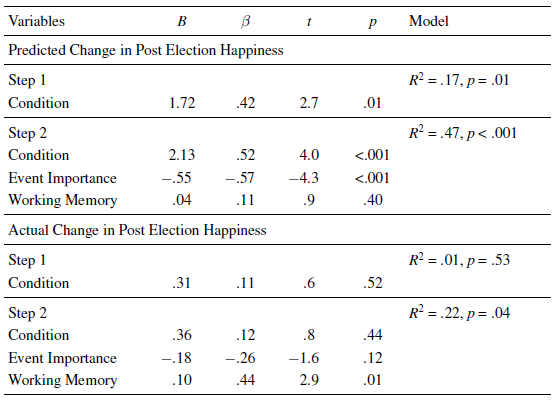
Hierarchical multiple regression was used to determine the relative importance of working memory and subjective importance of the election outcome for Kerry supporters, after accounting for the diary manipulation. Separate analyses were run for predicted and actual change in happiness scores (see Table 1). The upper half of the table shows that experimental condition accounted for 17% of the variance in predictions and individual differences in working memory and event importance accounted for an additional 30% of the variance in prediction. The lower half of the table shows that the experimental condition accounted for only 1% of the variability in post-election changes in mood, which is unremarkable given that the manipulation was designed only to impact prediction. The individual difference variables accounted for an additional 21% of the variance in actual changes in mood following the election loss. In combination, the regression analyses demonstrate that the experimental condition, working memory capacity, and subjective importance of the event all account for important and unique differences in the impact bias. The experimental manipulation and event importance played a role in differential predictions. In contrast, working memory was associated with a greater impact bias due to its facilitatory role in recovery from the loss, which forecasters were unable to account for in their predictions.
4 Discussion
The present investigation fits well within the context of past research on the impact bias but extends on previous findings in three important ways. Foremost, results show that the impact bias is strongly tied to the perceived importance of the event. Secondly, the current study sheds light on the theoretical debate surrounding methods for mitigating the impact bias. Third, working memory was associated with greater bias, not through an influence on predictions, but rather through its ability to facilitate recovery from a distressing event.
In affective forecasting for the 2004 U.S. Presidential election, Kerry supporters in the current study displayed the customary impact bias by overestimating how unhappy they would feel two weeks after the election. A parallel impact bias of overestimated happiness among Bush supporters was only weakly supported in the current data, though this was in line with past research finding the impact bias to be less salient for positive events (for reviews, see Dunn & Laham, Reference Dunn, Laham and Forgas2006; Wilson & Gilbert, Reference Wilson, Gilbert and Zanna2003). The perceived importance of the election was strongly related to predicted affect but only marginally (and nonsignificantly) related to actual affective reactions, leading to a greater impact bias. Given that errors in emotional prediction lead to flawed decision making (Kermer et al., Reference Kermer, Driver-Linn, Wilson and Gilbert2006; Mellers, Reference Mellers2000; Mellers & McGraw, Reference Mellers and McGraw2001; Mellers et al., Reference Mellers, Schwarz, Ho and Ritov1997, Reference Mellers, Schwarz and Ritov1999), it is worrisome that such errors are more likely to occur under the most important circumstances. Awareness of this finding suggests a greater impetus for research on strategies for overcoming forecasting bias.
These results have implications for existing theory on causes of the impact bias and strategies for overcoming it. Specifically, this study extends on the generalizability of past research by showing that a simple diary manipulation designed to increase contextualization of the study event can reduce biased forecasts (Ayton et al., Reference Ayton, Pott and Elwakili2007; Hoerger et al., Reference Hoerger, Quirk, Lucas and Carr2009; Sevdalis & Harvey, Reference Sevdalis and Harvey2009; Wilson et al., Reference Wilson, Wheatley, Meyers, Gilbert and Axsom2000). Contrary to the interference hypothesis, cognitive resources were unrelated to differences in prediction. However, post hoc analyses did provide some tentative support for the distraction hypothesis. On the diary task, number of peripheral events listed and the amount of time they consumed were modestly correlated with improved predictions, though results were merely provisional, as the low power of the subsample failed to permit reliable conclusions. Whereas our results tend to favor the distraction hypothesis, future studies of higher power replicating these post hoc results would be more telling.
Past forecasting researchers have hypothesized the importance of working memory to emotional prediction; however, this study showed that working memory was uniquely related to actual emotional reactions. Several studies have shown that working memory helps to suppress bothersome thoughts that would otherwise contribute to distress (Geraerts et al., Reference Geraerts, Merckelbach, Jelicic and Habets2007; Stawski et al., Reference Stawski, Sliwinski and Smyth2006; Verwoerd & Wessel, Reference Verwoerd and Wessel2007). In our study, Kerry supporters experienced distress in response to Bush’s election victory, but working memory appeared to serve as a protective factor. Interestingly, past studies have shown that participants underestimate or fail to consider available coping resources when making forecasts, producing an impact bias (Gilbert et al., Reference Gilbert, Pinel, Wilson, Blumberg and Wheatley1998; Hoerger et al., Reference Hoerger, Quirk, Lucas and Carr2009). Among Kerry supporters in this study, greater working memory capacity was also related to an increased impact bias. This provides additional evidence that people can improve their affective forecasts by increasing their effort to take into account their personal capacities for coping.
Although this research contributes to the existing forecasting literature, several limitations can also be noted. Foremost, the present investigation examined affective forecasting solely for one event, a U.S. Presidential election, and the generalizability of the working memory findings may vary depending on the type of coping strategies relevant (see Hoerger et al., Reference Hoerger, Quirk, Lucas and Carr2009, p. 94). An additional study limitation involved random assignment. Although participants were randomly assigned to the diary or control condition, they were not randomly assigned to experience the study event as positive or negative, as this was based on their political ideology (Bush or Kerry supporter). A more tightly controlled experimental investigation would help verify that the working memory findings were generalizable to most people coping with distressing events, rather than somehow unique to Kerry supporters. Finally, it should be noted power was low for the post hoc analyses comparing diary response characteristics to the impact bias. Conducting biphasic studies involving time-consuming measures of cognitive abilities can be onerous, but future studies with larger sample sizes would be able to draw more definitive conclusions.
This line of research implicates a number of factors influencing the impact bias and suggests possible avenues for bias reduction. Yet, future investigators will need to grapple with an important practical question: Should we attempt to reduce the impact bias? Some research contends that the impact bias is related to lower emotional intelligence and poorer decision making (Dunn et al., 2007; Kermer et al., Reference Kermer, Driver-Linn, Wilson and Gilbert2006; Mellers, Reference Mellers2000; Mellers & McGraw, Reference Mellers and McGraw2001; Mellers et al., Reference Mellers, Schwarz, Ho and Ritov1997, Reference Mellers, Schwarz and Ritov1999). Yet, this study and others show that the impact bias happens under important circumstances and is linked to positive personal attributes, including working memory capacity, emotional stability, and improved coping (Gilbert et al., Reference Gilbert, Pinel, Wilson, Blumberg and Wheatley1998; Hoerger et al., Reference Hoerger, Quirk, Lucas and Carr2009; Sevdalis, Petrides, & Harvey, Reference Sevdalis, Petrides and Harvey2007). Certainly there is reason for caution in efforts to eradicate the impact bias.
The impact bias may have indeed served an important evolutionary purpose, now worth overriding under strategic circumstances. With few exceptions (Diener, Lucas, & Scollon, Reference Diener, Lucas and Scollon2006), most daily events have little impact on our overall happiness, and forecasting studies tend to cast a bleak light on the human existence. As forecasting researcher Dan Gilbert has pointed out, “Our research simply says that whether it’s the thing that matters or the thing that doesn’t, both of them matter less than you think they will” (Gertner, Reference Gertner2003, p. 47). The impact bias functions to transform the trivial to the consequential. According to Tomkins’ (Reference Tomkins1991) theory of affect, emotional reactions play a fundamental role in amplifying and reinforcing basic drives. The impact bias essentially adds fuel to the fire, increasing the value of existing reinforcers. Research on defensive pessimism, for example, shows that overestimating emotional consequences functions to increase motivation (Norem, Reference Norem2001; Wilson & Gilbert, Reference Wilson, Gilbert and Zanna2003). To the extent that the operant reinforcement system is the product of phylogenetic reinforcement (Catania, Reference Catania2006; Skinner, Reference Skinner1956), so too may the impact bias provide increased motivation for behaviors fundamentally necessary for socialization, survival, and reproduction. Quite logically, our evolutionary history may have favored organisms that overestimate the magnitude of reinforcement to those that underestimate or fail to respond to reinforcement (Catania, Reference Catania2006). Questions remain as to whether the impact bias still serves a functional purpose in modern society and under what circumstances it should be overcome.


 Open access

