


Jerusalem, a city that conjures up a sense of the holy, the historical and the heavenly, it holds a unique attraction for people of several of the world's faiths and religions — especially Jews, Christians and Muslims. When people dream of Jerusalem, they do not see the modern, politically controversial Jerusalem, but rather the holy biblical and religious city. Since 1980, Jerusalem's psychiatrists have encountered an ever-increasing number of tourists who, upon arriving in Jerusalem, suffer psychotic decompensation. In view of the consistently high incidence of this phenomenon, it was decided to channel all such cases to one central facility — the Kfar Shaul Mental Health Centre (Reference Bar-El, Witztum and KalianBar-El et al, 1991a ) — for psychological counselling, psychiatric intervention and, if deemed necessary, admission to hospital. Over the course of 13 years (1980-1993), 1200 tourists with severe, Jerusalem-generated mental problems have been referred to this facility. Of these, 470 were admitted to hospital. On average, 100 such tourists are seen annually, 40 of them requiring admission to hospital.
On the basis of clinical experience, we have identified three main types of patient with Jerusalem syndrome (see Table 1).
The Jerusalem syndrome: classification by type and subtype
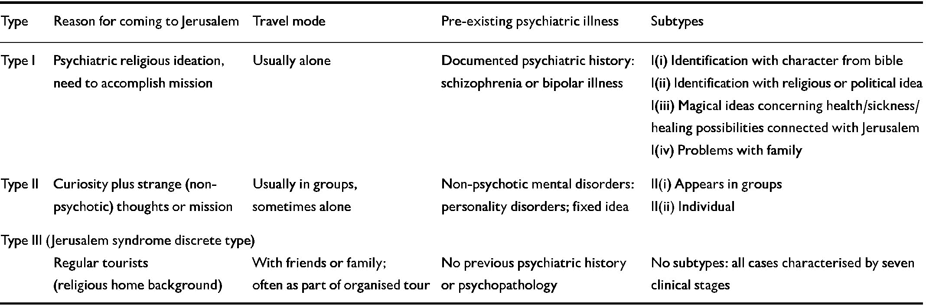
| Type | Reason for coming to Jerusalem | Travel mode | Pre-existing psychiatric illness | Subtypes |
|---|---|---|---|---|
| Type I | Psychiatric religious ideation, need to accomplish mission | Usually alone | Documented psychiatric history: schizophrenia or bipolar illness | I(i) Identification with character from bible |
| I(ii) Identification with religious or political idea | ||||
| I(iii) Magical ideas concerning health/sickness/healing possibilities connected with Jerusalem | ||||
| I(iv) Problems with family | ||||
| Type II | Curiosity plus strange (non-psychotic) thoughts or mission | Usually in groups, sometimes alone | Non-psychotic mental disorders: personality disorders; fixed idea | II(i) Appears in groups |
| II(ii) Individual | ||||
| Type III (Jerusalem syndrome discrete type) | ||||
| Regular tourists (religious home background) | With friends or family; often as part of organised tour | No previous psychiatric history or psychopathology | No subtypes: all cases characterised by seven clinical stages | |
TYPE 1: JERUSALEM SYNDROME SUPERIMPOSED ON PREVIOUS PSYCHOTIC ILLNESS
Type I refers to individuals already diagnosed as having a psychosis before their visit to Israel. Their motivation in coming to Israel is directly related to their mental condition and to the influence of religious ideas, often reaching delusional levels, compelling them to come to Jerusalem and do ‘something’ there. Type I can be divided into the following four subtypes.
Subtype I(i): psychotic identification with biblical characters
Individuals from this subtype strongly identify with characters from the Old or New Testament or are convinced that they themselves are one of these characters. Their conviction reaches psychotic dimensions. Jewish tourists generally identify with characters from the Old Testament, and Christian tourists with characters from the New Testament; in the same vein, men and women generally identify with male and female personalities respectively.
Example
An American tourist aged in his 40s, suffering from paranoid schizophrenia, had been admitted to hospital and treated over the years in the USA. He began working on his body image, by exercising and weightlifting, in the framework of a rehabilitation programme. Over time, he started to identify with the biblical character Samson. Eventually, he was overcome by a compulsion to come to Israel in order to move one of the giant stone blocks forming the Western (Wailing) Wall which, in his opinion, was not in the right place. On arriving at the Western Wall, he attempted to move one of the stones. His actions instigated a terrible commotion, culminating in police intervention and his placement in the hospital of the Kfar Shaul Mental Health Centre.
Contrary to accepted practice, the duty psychiatrist challenged the patient's delusional ideas, telling him that he could not possibly be Samson and that, according to the Bible, Samson had never been in Jerusalem. The patient reacted to this with rage, became aggressive, broke a window, and escaped through it. A team was sent out to look for him, and a student nurse found him standing at a bus stop. Demonstrating commendable wisdom, she told him that he had proved that he possessed qualities similar to Samson's and that he could now return to the hospital, which he did of his own volition. A hospital examination showed him to be in an acute psychotic state: he was convinced that he was Samson and that he had a mission to accomplish. After receiving antipsychotic medication, he calmed down and was able to fly back home, escorted by his father.
Subtype I(ii): psychotic identification with an idea
Individuals from this subtype strongly identify with an idea (usually of a religious nature, sometimes of a political nature) and arrive in Jerusalem to act on this idea.
Example
A Protestant from South America conceived a plan to destroy Islamic holy places in order to replace them with Jewish holy places. The second stage of his plan was then to destroy them in order to start the war of Gog and Magog so that the Anti-Christ would reveal himself, after which Christ would reappear. The patient succeeded in gutting one of the most holy mosques in Jerusalem. Psychiatric examination was ordered by the court, and he was diagnosed as being unable to differentiate between right and wrong, not responsible for his deeds and therefore not fit to stand trial. He was admitted to a local psychiatric institution and later transferred to a mental health institution in his own country.
Subtype I(iii): ‘magical ideas’ concerning connection between health and holy places
This subtype consists of patients with ‘magical ideas’ concerning sickness and health and healing possibilities connected with Jerusalem. Interestingly, the famous Russian writer Gogol, after psychosis had ended his writing, had a revelation suggesting that he would do well to visit Jerusalem and recite special prayers at holy burial sites there in order to recover from his illness and be able to start writing again. Gogol travelled to Israel in 1848, but starved himself to death four years later (Reference NabokovNabokov, 1971).
Subtype I(iv): family problems culminating in psychosis in Jerusalem
This subtype comprises individuals whose mental disturbance is expressed in terms of family problems. This subtype is problematic because, under the influence of the psychosis, it is usually impossible to identify the core meaning of Jerusalem to the patient in association with the psychosis, or the motive for his travelling to Jerusalem. Yet these individuals choose to come repeatedly to Jerusalem, and while there develop florid psychosis.
Example
A South African man, suffering from bipolar affective disorder and with a history of several stays in hospital in his homeland, visited Jerusalem on four occasions, each following a manic episode culminating in admission to hospital. According to this man, he came to Jerusalem in order to kill a man who had raped his daughter. His family always forewarned the Israeli health authorities of his visits and, consequently, he was admitted to hospital immediately upon his arrival in Jerusalem. After receiving treatment, he usually had the capacity to show a degree of insight, and to note that when he became manic, he got upset with his daughter's husband. In remission, he was able to admit to his behaviour being pathological and to admit that he actually admired and respected his son-in-law. Psychologists who treated him have described his disorder as a reversed Oedipus complex which was manifest during manic phases. His connection with Jerusalem is not clear; neither is it clear why he is drawn to Jerusalem in seeking a solution to an imaginary problem created by his distorted pathological thought processes.
TYPE II: JERUSALEM SYNDROME SUPERIMPOSED ON AND COMPLICATED BY IDIOSYNCRATIC IDEATIONS
The Type II subgroup involves people with mental disorders such as personality disorders or an obsession with a fixed idea, but who do not have a clear mental illness; their strange thoughts and ideas fall short of delusional or psychotic dimensions. Type II can be divided into two subtypes: subtype II(i) applies to individuals belonging to a group; subtype II(ii) which is less common, applies to lone individuals.
Type II probably accounts for a relatively large number of Jerusalem syndrome sufferers. In groups, they are highly visible; they stand out in public places, especially holy ones. They are occasionally featured in the media but they do not, on the whole, reach professional psychiatric agencies.
Subtype II(i): individuals belonging to a group
Example
Various Christian groups outside the mainstream of the established churches settle in Jerusalem in order, for instance, to bring about the resurrection of the dead or the reappearance of Jesus Christ. Such groups usually consist of no more than about 20 members. One group, previously located in Jerusalem, is now settled near Jericho, another is located in the Jerusalem Forest, and yet another is based in the centre of Jerusalem. The members of these groups wear distinctive clothing which, according to them, is similar to that worn in the days of Christ.
Various Jewish groups also have unusual ideas and intentions regarding Jerusalem. We know of three groups currently attempting to ‘create’ a red heifer based on writings contained in the Old Testament (Numbers, XIX). In the Bible, the red heifer was to be sacrificed and its ashes used for purification rituals before entering the temple. Today, apparently, simply touching the red heifer will suffice. The problem is that a perfect, unblemished, completely red heifer has yet to be conceived.
The members of these groups do not usually undergo psychiatric examination because they do not evoke problems, endanger others or break the law. Only three individuals from such groups have been examined, as a result of a court order after a violent confrontation with neighbours; all three were diagnosed as suffering from personality disorders.
Subtype II(ii): Lone individuals
Example
A single German male aged 45, working in an academic position, considered healthy, and without any recognisable problems, is obsessed, without being able to explain why, with the need to find the ‘true’ religion. He spent five years studying the various streams of Christianity and further time studying the esoteric religions of ancient Persia, China and Japan, and reached the conclusion that none of them qualified as the ‘true’ religion. He then took leave from work, came to Jerusalem, and started studying Judaism at a university and in a Yeshiva (religious seminary). However, Judaism was also rejected. Finally, this man decided that the only true religion was, in his words, “primitive Christianity — the religion of Jesus before Peter and Paul ruined it”. He now felt it imperative to bring this message to the people of Jerusalem, and set about preaching it at every opportunity. One day, on a visit to the Church of the Holy Sepulchre in the Old City of Jerusalem, he succumbed to an attack of psychomotor agitation and started shouting at the priests, accusing them of being pagans and barbarians and of worshipping graven images. The confrontation developed into a violent struggle; eventually, the subject started to destroy statues and paintings. The court ordered admission to hospital at the Kfar Shaul Mental Health Centre for observation and psychiatric evaluation. However, examination by experienced psychiatrists, including the District Psychiatrist of Jerusalem, revealed no psychopathology, not even the mildest personality disorder, all they could find was obession with the fixed idea described above. Follow-up three years later again failed to indicate mental disorder, and the subject continues to work in his academic position, to believe in the same religion and to spread his message, regretting only that he was unable to do this in Jerusalem.
TYPE III: JERUSALEM SYNDROME — DISCRETE FORM, UNCONFOUNDED BY PREVIOUS PSYCHOPATHOLOGY
The third type of the Jerusalem syndrome is perhaps the most fascinating, in that it describes individuals with no previous history of mental illness, who fall victim to a psychotic episode while in Israel (and especially while in Jerusalem), recover fairly spontaneously, and then, after leaving the country, apparently enjoy normality. Hence, Type III is unconjoined to other psychopathologies, and can be described as the ‘pure’ or ‘unconfounded’ form of the syndrome. Numerically, type III is a relatively small category: between 1980 and 1993 there were 42 cases fitting the three main diagnostic criteria described below.
Main diagnostic criteria for type III
First criterion
Subjects have no previous history of psychiatric illness — no prior psychotic episodes, no significant problems regarding work or family and no drug use. In other words, the subjects can be defined as healthy and devoid of any mental disorder.
Second criterion
Subjects arrive in Jerusalem as regular tourists, with no special mission or specific purpose in mind. They usually arrive with friends or family members, often as part of a larger group on an organised tour of Mediterranean countries.
Third criterion
Subjects have, upon arrival in Jerusalem, an acute psychotic reaction that develops in a consistently characteristic sequence of seven identifiable clinical stages.
The seven clinical stages of type III
-
(a) Anxiety, agitation, nervousness and tension, plus other unspecified reactions.
-
(b) Declaration of the desire to split away from the group or the family and to tour Jerusalem alone. Tourist guides aware of the Jerusalem syndrome and of the significance of such declarations may at this point refer the tourist to our institution for psychiatric evaluation in an attempt to pre-empt the subsequent stages of the syndrome. If unattended, these stages are usually unavoidable.
-
(c) A need to be clean and pure: obsession with taking baths and showers; compulsive fingernail and toenail cutting.
-
(d) Preparation, often with the aid of hotel bed-linen, of a long, ankle-length, togalike gown, which is always white.
-
(e) The need to scream, shout, or sing out loud psalms, verses from the Bible, religious hymns or spirituals. Manifestations of this type serve as a warning to hotel personnel and tourist guides, who should then attempt to have the tourist taken for professional treatment. Failing this, the two last stages will develop.
-
(f) A procession or march to one of Jerusalem's holy places.
-
(g) Delivery of a ‘sermon’ in a holy place. The sermon is usually very confused and based on an unrealistic plea to humankind to adopt a more wholesome, moral, simple way of life.
Treatment and recovery
Type III does not usually involve visual or auditory hallucinations. Patients know who they are and do not claim to be anyone else. If questioned, they identify themselves by their real name. However, they ask not to be disturbed in the completion of their mission. Their condition usually returns to normal within 5-7 days; in other words, a short-lived episode followed by complete recovery. These individuals clearly need treatment, and often receive it, but recovery is quite often spontaneous and not necessarily due to the treatment. Experience has taught us that improvement is facilitated by, or dependent on, physically distancing the patient from Jerusalem and its holy places. On the whole, major medical intervention is not indicated; minor tranquillisers or melatonin (as in cases of jet-lag psychosis) usually suffice. Our main treatment strategy is to facilitate return to the group or the renewal of family ties (including with family overseas), or, if deemed appropriate, access to a priest. Crisis intervention psychotherapy plays an important part in the recovery process.
Upon recovery, patients can usually recall every detail of their aberrant behaviour. They are inevitably ashamed of most of their actions, and feel that they have behaved foolishly or childishly. They sometimes describe their conduct as being akin to that of a ‘clown’ or a ‘drug addict’. However, in most cases, they are reluctant to talk about the episode, and it has therefore been difficult to achieve a deeper understanding of the phenomenon. Those who do talk after the episode often talk about a sense of “something opening up inside them”, their body movements suggesting an outward disposition. After this sensation, they feel an obligation to carry out certain actions or to relay their message.
An example is provided by a Swiss lawyer who arrived in Jerusalem on a group tour of the Middle East which included one week in Greece, one week in Israel, and one week in Egypt. He had been perfectly healthy up to the time of the trip, and spent an enjoyable week in Greece. Onset of type III of the syndrome was indicated on his first night in Jerusalem. The subject fitted the three diagnostic criteria perfectly, and the development of the syndrome followed the seven characteristic stages faithfully. The whole process took seven days, after which the syndrome passed. The subject rejoined the tour, enjoyed his visit to Egypt and returned home in good health. Follow-up indicates that since returning home six years ago, the subject has been completely healthy.
In seeking out distinctive background features of type III patients, we found that, of the 42 cases, 40 were Protestants, one was Catholic, and one was a Jew who had lived as a Protestant while in hiding during the Second World War. All 40 Protestants came from what can be described as ‘ultra-religious families’. The Bible was the most important book to these families, who would read it together at least once a week. The Bible would also serve as a source of answers to seemingly insoluble problems — especially for the father, as head of the family. For fundamentalist believers of this type, Jerusalem assumes the highest significance: such people possess an idealistic subconscious image of Jerusalem, the holy places and the life and death of Jesus. It seems, however, that those who succumb to type III of the Jerusalem syndrome are unable to deal with the concrete reality of Jerusalem today — a gap appears between their subconscious idealistic image of Jerusalem and the city as it appears in reality. One might view their psychotic state and, in particular, the need to preach their universal message as an attempt to bridge the gap between these two representations of Jerusalem.
In an attempt to arrive at a broader empirical base we sent questionnaires to all 42 of our type III patients, but received responses from only four of them — and these merely stated that they were feeling good and thanked us for our treatment, with no further elaboration. None answered the questionnaire. Attempts to obtain information by telephone interview produced the same disappointing result; the expatients insisted that they were feeling well, and that they did not want to talk about their experiences of Jerusalem syndrome.
DISCUSSION
‘Well-known-place’ and travellers syndrome
The first question that arises in discussing the Jerusalem syndrome — and, in particular, type III — is whether it is unique to Jerusalem, or whether other holy places induce similar syndromes. Hysterical or psychotic manifestations related to places — such as those that appear at Mecca, holy places in India, Christian holy places where the Virgin Mary is worshipped, and evangelical rallies — may well resemble our description; however, the Jerusalem syndrome documented here remains a unique phenomenon which deserves thorough appraisal.
Several explanations have been offered to account for psychotic breakdown among travellers. Some of these explanations suggest that the change of routine involved in travel influences mental state to a considerable extent (Reference Bar-El, Kalian and EisenbergBar-El et al, 1991b ). Flinn (Reference Flinn1962) and Singh (Reference Singh1961) list a number of factors such as unfamiliar surroundings, proximity to foreigners or strangers, inactivity, a sense of isolation and culture clash. Factors such as these, compounded by the special significance of Jerusalem to Jews, Christians and Muslims, may serve to trigger an acute psychotic episode. According to Cohen (Reference Cohen1979), the ‘existential’ mode of travelling (one of five modes of tourism; this mode refers to journeys to a spiritual centre) constitutes a modern metamorphosis of the pilgrimage. It is worth noting that Freud (Reference Freud1936) reported having experienced a sense of derealisation while visiting the Acropolis. The possibility that other place-oriented syndromes and the Jerusalem syndrome may share a common denominator even though they appear to be fundamentally different should not be dismissed. For instance, in the case of ‘airport wanderers’ or ‘airport syndrome’ (Reference ShapiroShapiro, 1982), a condition found among tourists who get lost and who experience psychotic episodes in airports, it has been suggested that the airports symbolically highlight pre-existing problems. However, unlike victims of the Jerusalem syndrome, people who develop airport syndrome forget their identity, are unaware of where they have come from or where they are going to and bump into people. Recovery is usually spontaneous after minimal assistance, perhaps a drink and a short rest.
The Stendhal syndrome
The condition most closely resembling the Jerusalem syndrome is the Stendhal syndrome identified by Magherini (Reference Magherini1992), which describes a particular acute psychotic reaction arising among art-loving tourists visiting Florence. The syndrome is named after the French writer Stendhal, who described feelings of déjà vu and disquiet after looking at works of art in Florence. Magherini in her book Sindrome di Stendhal (Reference Magherini1992) presented the statistical, socio-demographical, clinical and travel-related variables of 106 tourists who were admitted to hospital in Florence between 1977 and 1986. She described cases in which a small detail in a famous painting or sculpture evoked an outburst of anxiety, reaching psychotic dimensions. According to her, such reactions are usually associated with a latent mental or psychiatric disturbance that manifests itself as a reaction to paintings of battles or other masterpieces and culminates in the full-blown Florence or Stendhal syndrome.
TOWARDS THE MILLENNIUM
At the time of going to press, we have received reports as the millennium approaches, that various communities and congregations are planning to come to Jerusalem and stay from Easter 1999 until Easter 2000 in anticipation of miraculous events. Type I and type II candidates head for Jerusalem in order to accomplish something there. For such people Jerusalem can be seen as a magnet that attracts them and induces them to carry out certain actions. Type III candidates will fall victim to the syndrome irrespective of their initial motivation for visiting Jerusalem.
Finally, we would like to stress that this analysis is based mainly on phenomenological data consisting of the clinical experience of a multi-disciplinary team. As mentioned above, attempts to anchor the analysis on data obtained by systematic empirical research were thwarted by the reluctance of ex-patients to cooperate. A more detailed investigation would therefore be needed in order to arrive at a better understanding of the Jerusalem syndrome in general, and in particular its most intriguing version, the ‘pure, unconfounded’ type III version.
Clinical Implications and Limitations
CLINICAL IMPLICATIONS
-
▪ The Jerusalem syndrome is a unique psychiatric phenomenon that appears in some tourists who visit Jerusalem.
-
▪ The recognition of religion-related psychiatric disorders associated with proximity to holy places is important because early detection and intervention may halt the progression of such episodes.
-
▪ A comprehensive knowledge of patients' religious background and beliefs is an essential part of the crisis intervention.
LIMITATIONS
-
▪ This work is based on a phenomenological description and is not a research study.
-
▪ The study lacks follow-up information.
-
▪ The study does not taken into account changes in circumstances associated with the expected influx of tourists in the landmark year 2000.




eLetters
No eLetters have been published for this article.