

Introduction
In the field of archaeology, ceramic assemblages play an important role in the identification of cultures, cultural complexities, trade, market economies, subsistence, utensil function and so forth. Countless excavation reports and research articles contain pottery drawings or photographs; the drawings have, however, often been treated as subsidiary and relatively little attention has been paid to the development or technical projection of ceramic drawings in archaeological research. Numerous specialists have developed methods of analysing ceramic assemblages and in South Asia there have been many debates on this topic (e.g. Reference AnsariAnsari 1960, Reference Ansari1961; Reference Dales and KenoyerDales & Kenoyer 1986; Reference SinopoliSinopoli 1991). In contrast, there has been comparatively little creativity or revision in the style of pottery illustrations.
Traditional ceramic drawings
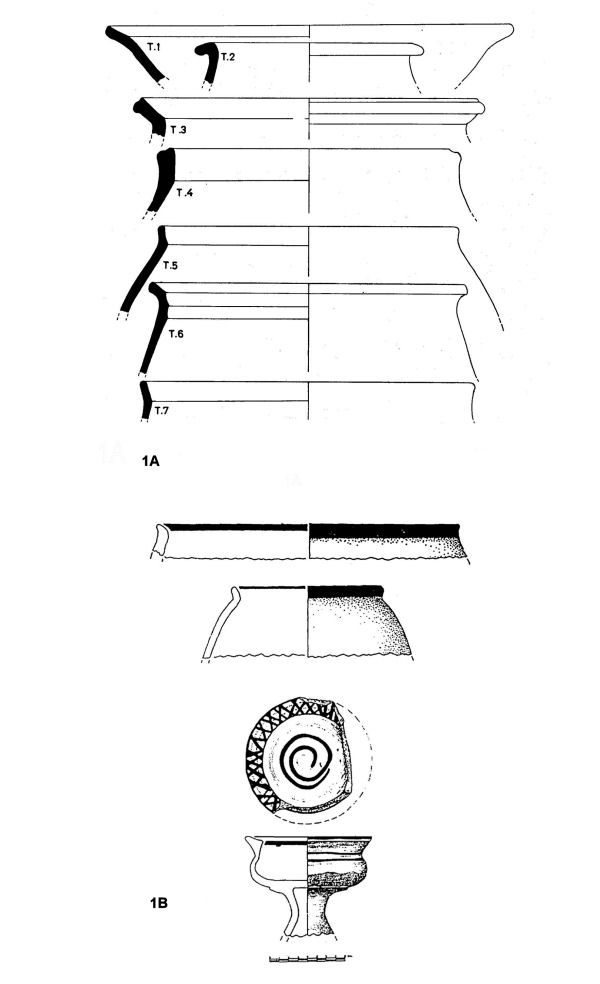
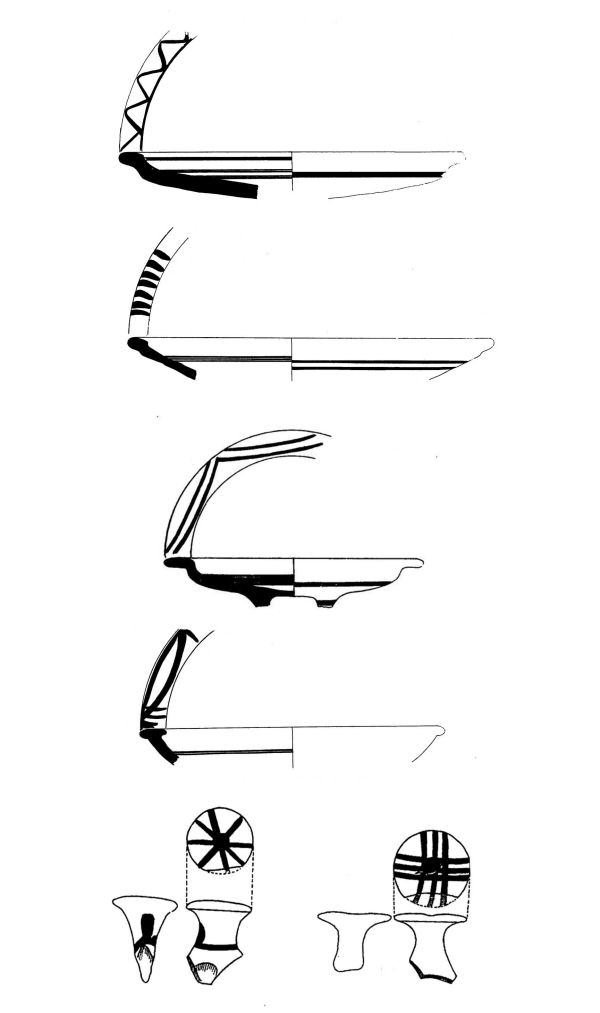
Traditionally pottery drawings show the vessel divided into two parts by a central line. The section of the pot, which provides information about its thickness, is shown on the left-hand side, mostly filled in black (Figure 1A) and sometimes not (Figure 1B). This left half is considered the inner side of the pot whereas the right illustrates its height as well as its exterior surface. If paint is present on the interior of the pot this is shown on the left, while the motifs on the exterior of the pot are on the right. The motifs on the rim portion are shown separately on top of the pot, aligned with its diameter (Figure 2).
A: pottery from Prabhas Patan (after Dhavalikar & Possehl 1992). B: pottery from Harappa (after Dales & Kenoyer 1989).

Pottery from Kuntasi (after Dhavalikar et al. 1996).

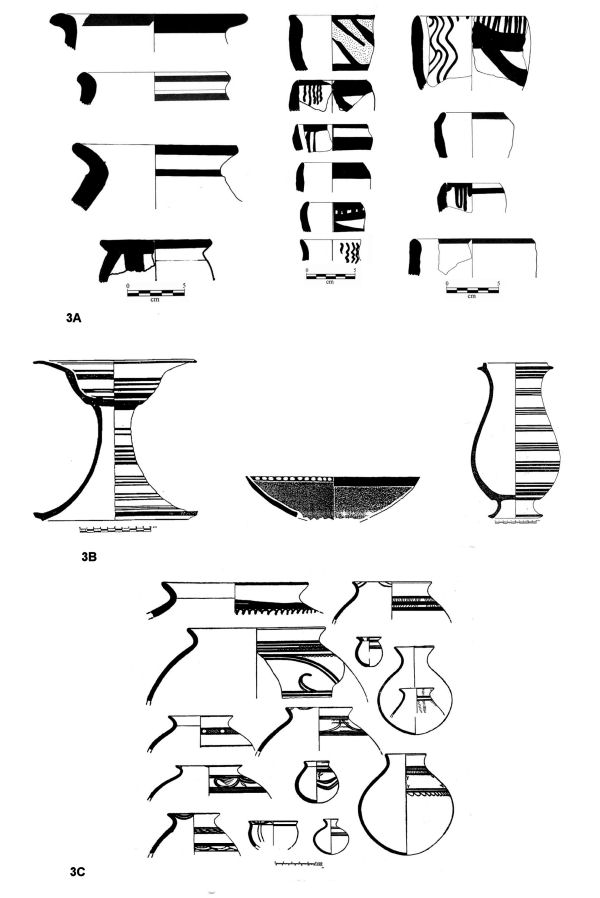
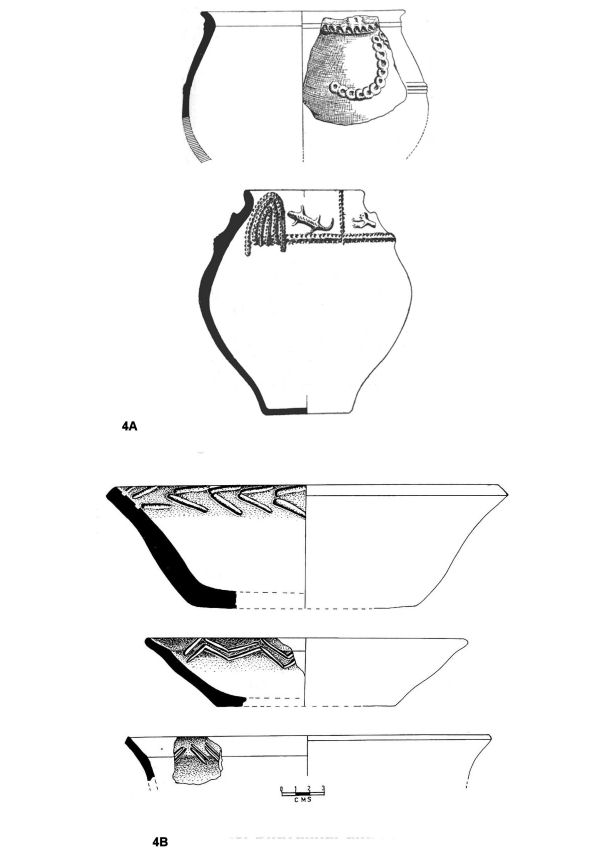
The style of pottery drawing most commonly used is the 'line and shading' format, a form of simple monochrome artwork. The drawings are primarily in black and variations are shown in different shades or different patterns of shading to give an idea of depth, motifs and curvatures. These drawings essentially illustrate the shape of the pot, its cross-section and the motif (if any) in black and white (Figure 3). Other attributes such as the colour of the pot and particularly the colours of the motifs are usually described in the text or presented photographically. Other patterns shown by this method are appliqué (Figure 4A) or incised (Figure 4B) decorations. This conventional method has been followed — after a period when forms of pottery illustrations were more diverse — for many decades and relatively little has been written directly on the method (but see for example, Reference PiggottPiggott 1965: 174–5; Reference Griffiths, Jenner and WilsonGriffiths et al. 1990; Reference CollettCollett 2008). Along with line drawings, authors have often included colour photographs of selected sherds, but these obviously cannot visually and accurately render the complete shapes of the original pots.
A: pottery from Padri (after Shinde & Kar 1992). B: pottery from Harappa (after Dales & Kenoyer 1989). C: pottery from Lothal (after Reference RaoRao 1985).

A: pottery from Navdatoli (after Reference SankaliaSankalia 1963). B: pottery from Prabhas Patan (after Dhavalikar & Possehl 1992).

Limitations of the traditional technique
There are several critical visual and interpretative limitations to the traditional manner of illustrating ancient pottery briefly outlined below:
-
1. The traditional methods struggle to render complexity. Black and white drawings and shading are generally sufficient for simple monochrome pottery with little colour variation, but in cases of multi-colour ceramics, such variation is extremely difficult to portray.
-
2. Readers cannot easily see the variety of colours used. For example, an accompanying text may mention that a pot is creamish-to-pink in colour, with a slight buffish patch on the body and that the painted motifs are black or dark chocolate in colour. This is difficult to visualise, quite apart from the subjectivity inevitable in describing a colour. With black and white illustrations, one has to rely heavily on description, imagine the original pottery or see the actual specimens for verification.
-
3. Generally few photographs, of selected sherds, supplement the pottery drawings in publications, as the cost is often high.
-
4. Finally, traditional drawings tend to uniformity and this can mask diversity when comparing or distinguishing shapes, styles and colours from different sites or regions.
Bearing in mind these problems, we have developed an alternative way of illustrating pottery. We believe it addresses and minimises the problems described above and has the potential to improve visual representation, while retaining parts of the traditional format of pottery drawing, i.e. the cross-section, the left side representing the inner surface of the pot and the right side representing the outer surface.
An alternative method of pottery representation
The new format is essentially a combination of simple, traditional line drawings of pottery outlines and colour photographs of the pottery fragments using computer software.
When the pottery fragment was initially drawn, the rim portion on the right hand side was drawn so as to represent it 'flat' and then motifs on the pot were drawn as per the relative height. We then photographed the ceramic fragments. While photographing, it was crucial to keep the rim sherd on a horizontal plane, as otherwise the curvature of the rim and motifs would become visible. Indeed it is impossible to simply overlap or 'digitally paste' the photograph within the line drawing. To overcome this problem we employed flat photography instead of traditional dimensional photography, where the photographs were taken at 180° (vertical view), thus eliminating attributes of the pot such as thickness and curvature. However, for painted motifs located on the top of the rim, the photograph had to retain perspective to record the precise curvature of the rim and motif. This photograph can then be matched within the boundary of the line drawing and with the diameter of the pot, so that the curvature of the rim is maintained in the angle of photograph. It is also important to include an accurate scale when pottery fragments are photographed, in order to match and adjust it with the scale of the line drawing.
A Nikon D70 SLR model camera with and a 50mm normal lens (Nikon) was used for this work, avoiding distortion which is common in other types of lenses. Photography was carried out in natural light filtered with a thin white cloth which aided in recording the original colours.
The line drawings, which were made in the traditional way, were scanned at a resolution of 300dpi (dots per inch). The digital photographs on the computer hard drive were individually opened in Adobe Photoshop Software version CS2 to combine the line drawings with the colour photographs. The scales of both the line drawings and photographs were matched by using the re-sizing commands in Adobe Photoshop (other appropriate software can also be used).
After this matching stage, the photograph was placed within the appropriate left or right part of the drawing. The photograph is slightly over-imposed on the line drawing and then, using the 'lasso tool' in Adobe Photoshop, the photograph is digitally 'cut'. This is essential, as sherds usually have irregular sides and by digitally 'cutting' the sherd it is possible to obtain the exact shape of the pot. The photographs of the painted motifs on the top of the rims were placed above the line drawing aligning them to the angle which corresponds to the reconstructed pot and diameter of the rim portion.
Finally some minor corrections are necessary to rectify discrepancies such as the colour of the pot or motif. Even if the photographs of the pottery fragments are taken with high-quality equipment, there are always minor variations in the digital colours. While carrying out these corrections of colour it is important to keep the actual specimen in hand: only thus can we modify the 'brightness' or 'contrast' levels with accuracy. If a motif is faded, it can be reproduced using the 'clone stamp tool', but it should be made clear that manipulation has taken place.
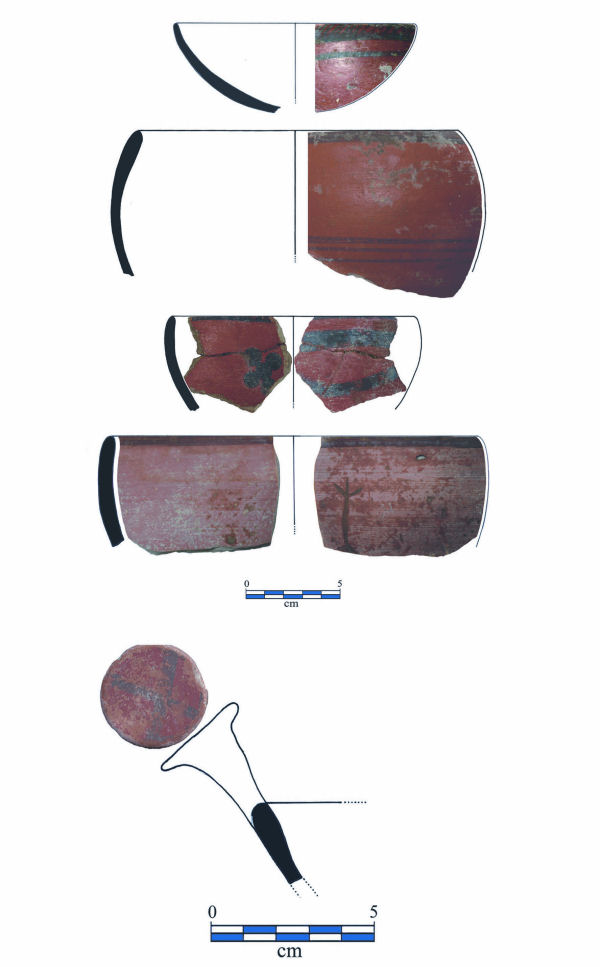
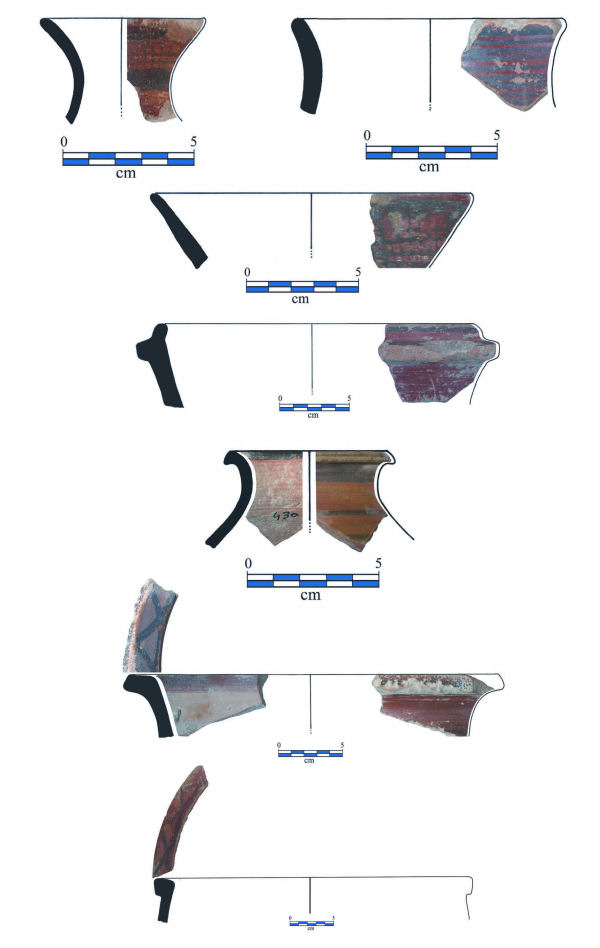
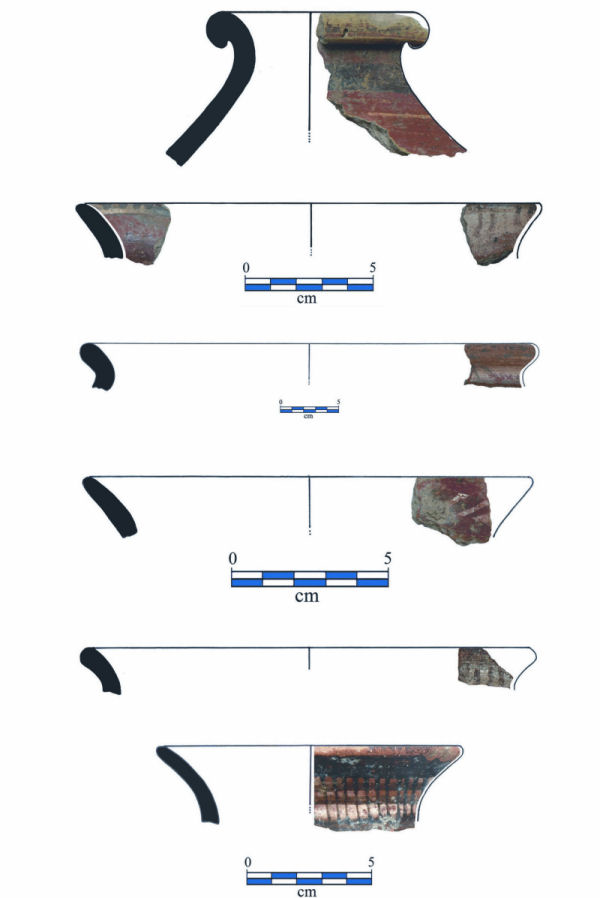
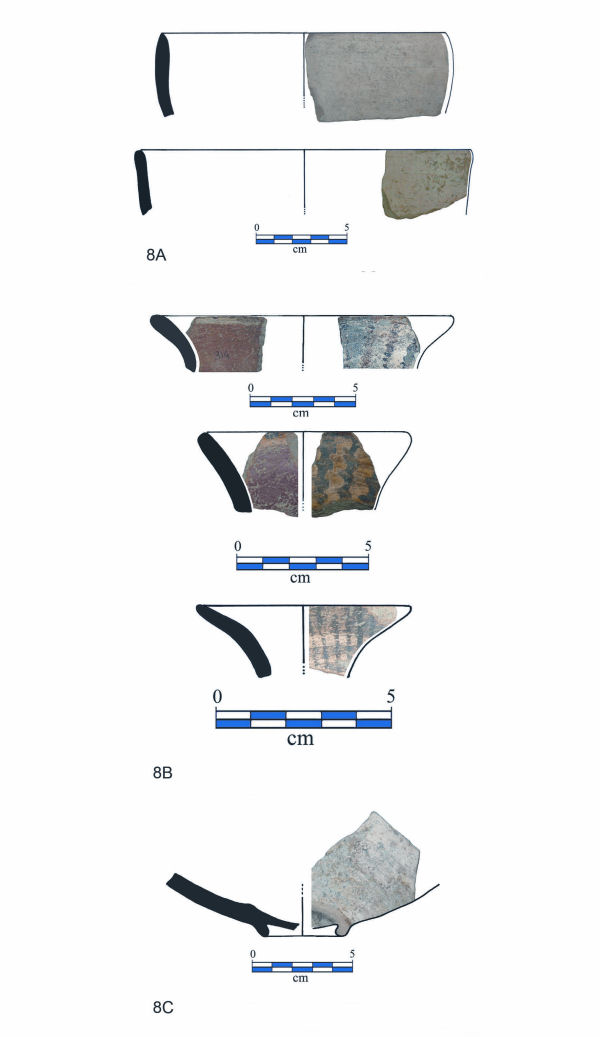
This method was employed on the ceramic assemblage of the Harappan site of Padri (Talaja Taluka, Bhavnagar District, Gujarat, India). The site has a three-fold cultural sequence from Early Harappan, through Mature Harappan to the Early Historic period (Reference ShindeShinde 1992, Reference Shinde, Sharma and Agrawal1995, Reference Shinde1998; Reference Shinde and KarShinde & Kar 1992). The publications show the pottery drawn in the traditional format, but we decided to use the new format for the painted pottery from only the Early Harappan levels at the site. The painted pottery has been divided, on the basis of surface treatment, into various wares and shapes such as black-on-red ware bowls (Figure 5) and globular pots (Figure 6), bichrome globular pots (Figure 7); and finally cream slip ware bowls, globular pots and bases (Figure 8 A–C).
Black-on-red ware bowls from Padri.

Black-on-red ware globular pots from Padri.

Bichrome globular pots from Padri.

Cream slip ware from Padri. A: bowls. B: globular pots. C: base.

Conclusion
We believe our technique offers a number of advantages, summarised here:
-
1. It is possible to visualise the shape and colour of the original pot in a better way than the traditional line drawings.
-
2. By combining line drawings and photographs, there is no requirement to have separate photographic plates of pottery fragments (except to highlight key details as enlarged photographs).
-
3. The actual colours of the motifs are visible in the line drawing so that the colour(s) described in the text can be better understood and subjectivity minimised.
-
4. This simple technique should open new avenues of research, helping researchers in the compilation of databases and accurate comparison.
Although our technique was used for ceramics, it could also be applied to a wide range of archaeological artefacts (especially fragments) which require a combination of line drawing and colour representation.
Acknowledgements
We thank Prof. Vasant Shinde, Joint-Director of the Deccan College Post-Graduate and Research Institute and director of the Padri excavations, for allowing us to use his data. We also thank Dr Parth Chauhan for suggestions on an earlier draft and Mr. Kishore Gaikwad for his assistance in photography.