





1 Introduction
The construction of Eisenstein congruences has a long and consequential history. Interesting in their own right, their significance is amplified by the existence of Galois representations attached to the congruent forms, as the ones attached to Eisenstein series are always reducible, while the ones attached to cusp forms are often irreducible. Using various generalizations of the result known as Ribet’s Lemma, they lead to the construction of non-zero elements in Selmer groups. This direction was first explored by Ribet himself in the context of the group $\operatorname {\mathrm {GL}}_2$
in [Reference Ribet45] and later used by many other authors in a variety of different settings (e.g., [Reference Brown16, Reference Skinner and Urban49, Reference Wiles60]).
$\operatorname {\mathrm {GL}}_2$
in [Reference Ribet45] and later used by many other authors in a variety of different settings (e.g., [Reference Brown16, Reference Skinner and Urban49, Reference Wiles60]).
In a different direction, such congruences can play a crucial role in proving modularity of deformations of reducible residual Galois representations ${\overline {\rho }}$
(see, e.g., [Reference Berger and Klosin6, Reference Berger and Klosin9, Reference Berger and Klosin10, Reference Calegari17, Reference Skinner and Wiles50, Reference Wake54, Reference Wake and Wang-Erickson56]). In [Reference Calegari17] Calegari introduced a method of proving modularity assuming
${\overline {\rho }}$
(see, e.g., [Reference Berger and Klosin6, Reference Berger and Klosin9, Reference Berger and Klosin10, Reference Calegari17, Reference Skinner and Wiles50, Reference Wake54, Reference Wake and Wang-Erickson56]). In [Reference Calegari17] Calegari introduced a method of proving modularity assuming ${\overline {\rho }}$
is unique up to isomorphism, which relies on proving the principality of the ideal of reducibility of the universal deformation ring R of
${\overline {\rho }}$
is unique up to isomorphism, which relies on proving the principality of the ideal of reducibility of the universal deformation ring R of ${\overline {\rho }}$
. This method was developed further by Berger and Klosin [Reference Berger and Klosin5, Reference Berger and Klosin6, Reference Berger and Klosin9] and Wake and Wang-Erickson [Reference Wake and Wang-Erickson56] and successfully applied in many contexts (see also [Reference Akers1, Reference Huang29]). It relies heavily on the ideas of Bellaiche and Chenevier [Reference Bellaïche and Chenevier4] and their study of generalized matrix algebras (GMAs).
${\overline {\rho }}$
. This method was developed further by Berger and Klosin [Reference Berger and Klosin5, Reference Berger and Klosin6, Reference Berger and Klosin9] and Wake and Wang-Erickson [Reference Wake and Wang-Erickson56] and successfully applied in many contexts (see also [Reference Akers1, Reference Huang29]). It relies heavily on the ideas of Bellaiche and Chenevier [Reference Bellaïche and Chenevier4] and their study of generalized matrix algebras (GMAs).
In this article, we pursue both of these directions in the case of Klingen Eisenstein series of level one on the group $\operatorname {\mathrm {Sp}}_4$
. More precisely, let
$\operatorname {\mathrm {Sp}}_4$
. More precisely, let $k\geq 12$
be an even integer and
$k\geq 12$
be an even integer and $\phi $
be a classical weight k Hecke eigenform of level
$\phi $
be a classical weight k Hecke eigenform of level $1$
(i.e., on the group
$1$
(i.e., on the group $\operatorname {\mathrm {GL}}_{2/\mathbf {Q}}$
). Write
$\operatorname {\mathrm {GL}}_{2/\mathbf {Q}}$
). Write $E_{\phi }^{2,1}$
for the (appropriately normalized) Klingen Eisenstein series on
$E_{\phi }^{2,1}$
for the (appropriately normalized) Klingen Eisenstein series on $\operatorname {\mathrm {Sp}}_4$
induced from
$\operatorname {\mathrm {Sp}}_4$
induced from $\phi $
. It is a Siegel modular form of weight k and full level. Congruences between Klingen Eisenstein series and cusp forms have been studied previously by Kurokawa [Reference Kurokawa35, Reference Kurokawa36], Katsurada and Mizumoto [Reference Katsurada and Mizumoto32, Reference Mizumoto39], Takeda [Reference Takeda52], and Urban (unpublished). Katsurada and Mizumoto obtain congruences as an application of the doubling method. In this article, we produce congruences via a much shorter argument using results of Yamauchi [Reference Yamauchi61]. The trade-off is that while our proof is much shorter, we obtain congruences only modulo a prime
$\phi $
. It is a Siegel modular form of weight k and full level. Congruences between Klingen Eisenstein series and cusp forms have been studied previously by Kurokawa [Reference Kurokawa35, Reference Kurokawa36], Katsurada and Mizumoto [Reference Katsurada and Mizumoto32, Reference Mizumoto39], Takeda [Reference Takeda52], and Urban (unpublished). Katsurada and Mizumoto obtain congruences as an application of the doubling method. In this article, we produce congruences via a much shorter argument using results of Yamauchi [Reference Yamauchi61]. The trade-off is that while our proof is much shorter, we obtain congruences only modulo a prime $\ell ,$
whereas Katsurada and Mizumoto obtain congruences modulo powers of
$\ell ,$
whereas Katsurada and Mizumoto obtain congruences modulo powers of $\ell $
. However, the hypotheses required for our result are different and less restrictive than those needed in [Reference Katsurada and Mizumoto32]. We show that under certain conditions
$\ell $
. However, the hypotheses required for our result are different and less restrictive than those needed in [Reference Katsurada and Mizumoto32]. We show that under certain conditions $E_{\phi }^{2,1}$
is congruent to some cusp form f of the same weight and level with irreducible Galois representation (Theorem 3.5). This is the first main result of the article. These congruences are governed by the numerator of the (algebraic part) of the symmetric square L-function
$E_{\phi }^{2,1}$
is congruent to some cusp form f of the same weight and level with irreducible Galois representation (Theorem 3.5). This is the first main result of the article. These congruences are governed by the numerator of the (algebraic part) of the symmetric square L-function $L_{\mathrm {alg}}(2k-2, \mathrm {Sym}^2\phi )$
of
$L_{\mathrm {alg}}(2k-2, \mathrm {Sym}^2\phi )$
of $\phi $
. We also exhibit a concrete example when the assumptions of Theorem 3.5 are satisfied (see Example 3.6).
$\phi $
. We also exhibit a concrete example when the assumptions of Theorem 3.5 are satisfied (see Example 3.6).
We then proceed to show that these congruences give rise (under some assumptions) to non-trivial elements in the Selmer group $H_{2-k}:=H^1_f(\mathbf {Q}, \operatorname {\mathrm {ad}} \rho _{\phi }(2-k)\otimes \mathbf {Q}_{\ell }/\mathbf {Z}_{\ell })$
. Here,
$H_{2-k}:=H^1_f(\mathbf {Q}, \operatorname {\mathrm {ad}} \rho _{\phi }(2-k)\otimes \mathbf {Q}_{\ell }/\mathbf {Z}_{\ell })$
. Here, $\rho _{\phi }$
is the Galois representation attached to
$\rho _{\phi }$
is the Galois representation attached to $\phi $
by Deligne and we use the Fontaine–Laffaille condition at
$\phi $
by Deligne and we use the Fontaine–Laffaille condition at $\ell $
. Assuming the Vandiver Conjecture for
$\ell $
. Assuming the Vandiver Conjecture for $\ell $
we also deduce the non-triviality of the Selmer group
$\ell $
we also deduce the non-triviality of the Selmer group $H^1_f(\mathbf {Q}, \operatorname {\mathrm {ad}}^0 \rho _{\phi }(2-k)\otimes \mathbf {Q}_{\ell }/\mathbf {Z}_{\ell })$
(Corollary 5.7 and Remark 5.8). This is our second main result and gives evidence for new cases of the Bloch–Kato conjecture. This conjecture was studied for other twists of
$H^1_f(\mathbf {Q}, \operatorname {\mathrm {ad}}^0 \rho _{\phi }(2-k)\otimes \mathbf {Q}_{\ell }/\mathbf {Z}_{\ell })$
(Corollary 5.7 and Remark 5.8). This is our second main result and gives evidence for new cases of the Bloch–Kato conjecture. This conjecture was studied for other twists of $\operatorname {\mathrm {ad}} \rho _\phi $
by [Reference Diamond, Flach and Guo20, Reference Klosin34]. In [Reference Urban53] Urban assumed the existence of Klingen Eisenstein congruences to prove a result toward the main conjecture of Iwasawa theory for the adjoint L-function.
$\operatorname {\mathrm {ad}} \rho _\phi $
by [Reference Diamond, Flach and Guo20, Reference Klosin34]. In [Reference Urban53] Urban assumed the existence of Klingen Eisenstein congruences to prove a result toward the main conjecture of Iwasawa theory for the adjoint L-function.
To properly analyze these Selmer groups, we require some results on extensions of Fontaine–Laffaille modules whose proofs appear to be absent in the literature. In Section 4, we carefully study certain aspects of Fontaine–Laffaille theory, in particular, prove the Hom-tensor adjunction formula and give a precise definition of Selmer groups with coefficient rings of finite length.
Given the eigenvalue congruence $E^{2,1}_{\phi }\equiv f$
(mod
$E^{2,1}_{\phi }\equiv f$
(mod $\ell $
), we also study deformations of a non-semi-simple Galois representation
$\ell $
), we also study deformations of a non-semi-simple Galois representation ${\overline {\rho }}: G_{\mathbf {Q}} \to \operatorname {\mathrm {GL}}_4(\overline {\mathbf {F}}_{\ell })$
whose semi-simplification arises from the Klingen Eisenstein series. Such a representation is reducible with two two-dimensional Jordan–Holder blocks and more precisely, one has
${\overline {\rho }}: G_{\mathbf {Q}} \to \operatorname {\mathrm {GL}}_4(\overline {\mathbf {F}}_{\ell })$
whose semi-simplification arises from the Klingen Eisenstein series. Such a representation is reducible with two two-dimensional Jordan–Holder blocks and more precisely, one has
 $$ \begin{align*}{\overline{\rho}} = \left[ \begin{matrix} {\overline{\rho}}_{\phi} & * \\ & {\overline{\rho}}_{\phi}(k-2)\end{matrix} \right].\end{align*} $$
Conjecturally such representations should arise as mod $\ell $
reductions of Galois representations attached to Siegel cusp forms which are congruent to
$\ell $
reductions of Galois representations attached to Siegel cusp forms which are congruent to $E_{\phi }^{2,1}$
mod
$E_{\phi }^{2,1}$
mod $\ell $
. We assume that
$\ell $
. We assume that $\dim H_{2-k}[\ell ]=1$
, where
$\dim H_{2-k}[\ell ]=1$
, where $[\ell ]$
indicates
$[\ell ]$
indicates $\ell $
-torsion. This can be seen as a refinement of the uniqueness assumption of [Reference Skinner and Wiles50] similar to the one in [Reference Berger and Klosin6] and as in [Reference Berger and Klosin6, Reference Calegari17] we prove the principality of the reducibility ideal of the universal deformation. However, this principality cannot be achieved through the method of [Reference Berger and Klosin6] because the representation in question fails to satisfy the strong self-duality property required for the method of [loc.cit.]. Instead we improve on a recent result of Akers [Reference Akers1] which replaces the self-duality condition with a one-dimensionality assumption on the Selmer group
$\ell $
-torsion. This can be seen as a refinement of the uniqueness assumption of [Reference Skinner and Wiles50] similar to the one in [Reference Berger and Klosin6] and as in [Reference Berger and Klosin6, Reference Calegari17] we prove the principality of the reducibility ideal of the universal deformation. However, this principality cannot be achieved through the method of [Reference Berger and Klosin6] because the representation in question fails to satisfy the strong self-duality property required for the method of [loc.cit.]. Instead we improve on a recent result of Akers [Reference Akers1] which replaces the self-duality condition with a one-dimensionality assumption on the Selmer group $H_{k-2}:=H^1_f(\mathbf {Q}, \operatorname {\mathrm {ad}} {\overline {\rho }}_{\phi }(k-2))$
of the “opposite” Tate twist of
$H_{k-2}:=H^1_f(\mathbf {Q}, \operatorname {\mathrm {ad}} {\overline {\rho }}_{\phi }(k-2))$
of the “opposite” Tate twist of $\operatorname {\mathrm {ad}} \rho _{\phi }$
. With these assumptions in place, we are able to show that the universal deformation ring R is a discrete valuation ring and prove a modularity result guaranteeing that the unique deformation of
$\operatorname {\mathrm {ad}} \rho _{\phi }$
. With these assumptions in place, we are able to show that the universal deformation ring R is a discrete valuation ring and prove a modularity result guaranteeing that the unique deformation of ${\overline {\rho }}$
indeed arises from a Siegel cusp form congruent to
${\overline {\rho }}$
indeed arises from a Siegel cusp form congruent to $E_{\phi }^{2,1}$
(Theorem 6.20). This is the third main result of the article.
$E_{\phi }^{2,1}$
(Theorem 6.20). This is the third main result of the article.
We then proceed to formulate conditions for non-cyclicity of the Selmer group $H_{k-2}$
. While many results in the literature give bounds on the orders of Selmer groups (in particular, Corollary 5.7 gives such a lower bound on
$H_{k-2}$
. While many results in the literature give bounds on the orders of Selmer groups (in particular, Corollary 5.7 gives such a lower bound on $H_{2-k}$
), the structure of these groups is notoriously mysterious. In this article, we prove that if the (local) Klingen Eisenstein ideal
$H_{2-k}$
), the structure of these groups is notoriously mysterious. In this article, we prove that if the (local) Klingen Eisenstein ideal $J_{\mathfrak {m}}$
is not principal then
$J_{\mathfrak {m}}$
is not principal then $H_{k-2}$
is not cyclic (Corollary 7.3). We further refine this result by providing a criterion for non-principality in terms of the depth of congruences between cusp forms and
$H_{k-2}$
is not cyclic (Corollary 7.3). We further refine this result by providing a criterion for non-principality in terms of the depth of congruences between cusp forms and $E^{2,1}_{\phi }$
(Corollary 7.5). An intriguing feature of these results is that
$E^{2,1}_{\phi }$
(Corollary 7.5). An intriguing feature of these results is that $H_{k-2}$
is non-critical, i.e., this Selmer group is not controlled by a critical L-value in the sense of Deligne.
$H_{k-2}$
is non-critical, i.e., this Selmer group is not controlled by a critical L-value in the sense of Deligne.
2 Background and notation
Given a field $F,$
we denote by
$F,$
we denote by $G_F$
its absolute Galois group. Fix a rational prime
$G_F$
its absolute Galois group. Fix a rational prime $\ell>2$
. If M is a topological
$\ell>2$
. If M is a topological $\mathbf {Z}_\ell [G_{F}]$
-module, we will write
$\mathbf {Z}_\ell [G_{F}]$
-module, we will write $M(n) = M \otimes \epsilon ^{n}$
for the n-th Tate twist where
$M(n) = M \otimes \epsilon ^{n}$
for the n-th Tate twist where $\epsilon $
denotes the
$\epsilon $
denotes the $\ell $
-adic cyclotomic character.
$\ell $
-adic cyclotomic character.
For each prime p, we fix an embedding $\overline {\mathbf {Q}} \hookrightarrow \overline {\mathbf {Q}}_{p}$
. This is equivalent to choosing a prime
$\overline {\mathbf {Q}} \hookrightarrow \overline {\mathbf {Q}}_{p}$
. This is equivalent to choosing a prime $\overline {p}$
of
$\overline {p}$
of $\overline {\mathbf {Q}}$
lying over p and fixes an isomorphism
$\overline {\mathbf {Q}}$
lying over p and fixes an isomorphism $D_p \cong G_{\mathbf {Q}_p}$
, where
$D_p \cong G_{\mathbf {Q}_p}$
, where $D_p$
is the decomposition group of
$D_p$
is the decomposition group of $\overline {p}$
. We will denote by
$\overline {p}$
. We will denote by $I_p\subset D_p$
the corresponding inertia group. We also fix an isomorphism
$I_p\subset D_p$
the corresponding inertia group. We also fix an isomorphism $\overline {\mathbf {Q}}_{\ell } \cong \mathbf {C}$
.
$\overline {\mathbf {Q}}_{\ell } \cong \mathbf {C}$
.
Let E denote a finite extension of $\mathbf {Q}_{\ell }$
with valuation ring
$\mathbf {Q}_{\ell }$
with valuation ring $\mathcal {O}$
, uniformizer
$\mathcal {O}$
, uniformizer $\lambda ,$
and residue field
$\lambda ,$
and residue field $\mathbf {F}$
. For a continuous homomorphism
$\mathbf {F}$
. For a continuous homomorphism $\rho :G_F \to \operatorname {\mathrm {GL}}_n(\mathcal {O}),$
we write
$\rho :G_F \to \operatorname {\mathrm {GL}}_n(\mathcal {O}),$
we write ${\overline {\rho }}: G_F\to \operatorname {\mathrm {GL}}_n(\mathbf {F})$
for the mod
${\overline {\rho }}: G_F\to \operatorname {\mathrm {GL}}_n(\mathbf {F})$
for the mod $\lambda $
reduction of
$\lambda $
reduction of $\rho $
.
$\rho $
.
For $n\in \mathbf {Z}_+$
, we denote by
$n\in \mathbf {Z}_+$
, we denote by $\operatorname {\mathrm {Mat}}_n$
(resp.,
$\operatorname {\mathrm {Mat}}_n$
(resp., $\operatorname {\mathrm {GL}}_n$
) the affine group scheme over
$\operatorname {\mathrm {GL}}_n$
) the affine group scheme over $\mathbf {Z}$
of
$\mathbf {Z}$
of $n\times n$
(resp., invertible) matrices. Given a matrix
$n\times n$
(resp., invertible) matrices. Given a matrix $\gamma \in \operatorname {\mathrm {Mat}}_{2n}$
, we will write it as
$\gamma \in \operatorname {\mathrm {Mat}}_{2n}$
, we will write it as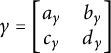 $\gamma = \left [ \begin {matrix} a_{\gamma } & b_{\gamma }\\ c_{\gamma } & d_{\gamma } \end {matrix} \right ]$
, where the blocks are in
$\gamma = \left [ \begin {matrix} a_{\gamma } & b_{\gamma }\\ c_{\gamma } & d_{\gamma } \end {matrix} \right ]$
, where the blocks are in $\operatorname {\mathrm {Mat}}_{n}$
. Set
$\operatorname {\mathrm {Mat}}_{n}$
. Set $\operatorname {\mathrm {GSp}}_{2n} = \left \{g \in \operatorname {\mathrm {GL}}_{2n} : \, ^t\!g J_{n} g = \mu _{n}(g) J_{n} , \mu _{n}(g) \in \operatorname {\mathrm {GL}}_1\right \},$
where
$\operatorname {\mathrm {GSp}}_{2n} = \left \{g \in \operatorname {\mathrm {GL}}_{2n} : \, ^t\!g J_{n} g = \mu _{n}(g) J_{n} , \mu _{n}(g) \in \operatorname {\mathrm {GL}}_1\right \},$
where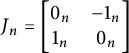 $J_n=\left [ \begin {matrix} 0_n & -1_n \\ 1_n & 0_n \end {matrix} \right ]$
, where
$J_n=\left [ \begin {matrix} 0_n & -1_n \\ 1_n & 0_n \end {matrix} \right ]$
, where $1_{n}$
is the n by n identity matrix, and
$1_{n}$
is the n by n identity matrix, and $\mu _{n}: \operatorname {\mathrm {GL}}_{2n} \rightarrow \operatorname {\mathrm {GL}}_{1}$
is the homomorphism defined via the equation given in the definition. Write
$\mu _{n}: \operatorname {\mathrm {GL}}_{2n} \rightarrow \operatorname {\mathrm {GL}}_{1}$
is the homomorphism defined via the equation given in the definition. Write $\operatorname {\mathrm {GSp}}^{+}_{2n}(\mathbf {R})$
for the subgroup of
$\operatorname {\mathrm {GSp}}^{+}_{2n}(\mathbf {R})$
for the subgroup of $\operatorname {\mathrm {GSp}}_{2n}(\mathbf {R})$
consisting of elements g with
$\operatorname {\mathrm {GSp}}_{2n}(\mathbf {R})$
consisting of elements g with $\mu _{n}(g)> 0$
. We set
$\mu _{n}(g)> 0$
. We set $\operatorname {\mathrm {Sp}}_{2n} = \ker (\mu _{n})$
and
$\operatorname {\mathrm {Sp}}_{2n} = \ker (\mu _{n})$
and
 $$ \begin{align*} \Gamma_n = \operatorname{\mathrm{Sp}}_{2n}(\mathbf{Z}) = \left\{g \in \operatorname{\mathrm{GL}}_{2n}(\mathbf{Z}): \, ^t\!g J_{n} g = J_{n} \right\}. \end{align*} $$
Note that $\operatorname {\mathrm {Sp}}_2 = \operatorname {\mathrm {SL}}_2$
, the subgroup scheme of
$\operatorname {\mathrm {Sp}}_2 = \operatorname {\mathrm {SL}}_2$
, the subgroup scheme of $\operatorname {\mathrm {GL}}_2$
of matrices of determinant one.
$\operatorname {\mathrm {GL}}_2$
of matrices of determinant one.
The Siegel upper half-space is given by
 $$ \begin{align*} \mathfrak{h}_n = \{z=x+iy \in \operatorname{\mathrm{Mat}}_n(\mathbf{C}): x,y\in \operatorname{\mathrm{Mat}}_n(\mathbf{R}), \, ^t\!z=z, y>0\}, \end{align*} $$
where we write $y>0$
to indicate that y is positive definite. The group
$y>0$
to indicate that y is positive definite. The group $\operatorname {\mathrm {GSp}}_{2n}^{+}(\mathbf {R})$
acts on
$\operatorname {\mathrm {GSp}}_{2n}^{+}(\mathbf {R})$
acts on $\mathfrak {h}_{n}$
via
$\mathfrak {h}_{n}$
via $\gamma z = (a_{\gamma }z + b_{\gamma })(c_{\gamma } z + d_{\gamma })^{-1}$
.
$\gamma z = (a_{\gamma }z + b_{\gamma })(c_{\gamma } z + d_{\gamma })^{-1}$
.
For a function $f: \mathfrak {h}_{n} \rightarrow \mathbf {C}$
set
$f: \mathfrak {h}_{n} \rightarrow \mathbf {C}$
set $(f|_{\kappa } \gamma )(z) = \mu _{n}(\gamma )^{nk/2} j(\gamma ,z)^{-k} f(\gamma z)$
for
$(f|_{\kappa } \gamma )(z) = \mu _{n}(\gamma )^{nk/2} j(\gamma ,z)^{-k} f(\gamma z)$
for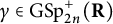 $\gamma \in \operatorname {\mathrm {GSp}}_{2n}^{+}(\mathbf {R})$
and
$\gamma \in \operatorname {\mathrm {GSp}}_{2n}^{+}(\mathbf {R})$
and $z \in \mathfrak {h}_{n}$
, where
$z \in \mathfrak {h}_{n}$
, where $j(\gamma ,z) = \det (c_{\gamma } z+ d_{\gamma })$
. A Siegel modular form of weight k and level
$j(\gamma ,z) = \det (c_{\gamma } z+ d_{\gamma })$
. A Siegel modular form of weight k and level $\Gamma _{n}$
is a holomorphic function
$\Gamma _{n}$
is a holomorphic function $f: \mathfrak {h}_{n} \rightarrow \mathbf {C}$
satisfying
$f: \mathfrak {h}_{n} \rightarrow \mathbf {C}$
satisfying $(f|_{k}\gamma )(z) = f(z)$
for all
$(f|_{k}\gamma )(z) = f(z)$
for all $\gamma \in \Gamma _{n}$
. If
$\gamma \in \Gamma _{n}$
. If $n=1$
, we also require the standard growth condition at the cusp. We denote the
$n=1$
, we also require the standard growth condition at the cusp. We denote the $\mathbf {C}$
-vector space of Siegel modular forms of weight k and level
$\mathbf {C}$
-vector space of Siegel modular forms of weight k and level $\Gamma _n$
as
$\Gamma _n$
as $M_{k}(\Gamma _n)$
. Any
$M_{k}(\Gamma _n)$
. Any $f \in M_{k}(\Gamma _{n})$
has a Fourier expansion of the form
$f \in M_{k}(\Gamma _{n})$
has a Fourier expansion of the form
 $$ \begin{align*} f(z)=\sum_{T\in\Lambda_n} a(T;f) e(\operatorname{\mathrm{Tr}}(Tz)), \end{align*} $$
where $\Lambda _n$
is defined to be the set of n by n half-integral (diagonal entries are in
$\Lambda _n$
is defined to be the set of n by n half-integral (diagonal entries are in $\mathbf {Z}$
, off diagonal are allowed to lie in
$\mathbf {Z}$
, off diagonal are allowed to lie in $\frac {1}{2}\mathbf {Z}$
) positive semi-definite symmetric matrices and
$\frac {1}{2}\mathbf {Z}$
) positive semi-definite symmetric matrices and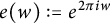 $e(w):=e^{2\pi i w}$
. Given a ring
$e(w):=e^{2\pi i w}$
. Given a ring $A \subset \mathbf {C}$
, we write
$A \subset \mathbf {C}$
, we write $f \in M_{k}(\Gamma _{n};A)$
if
$f \in M_{k}(\Gamma _{n};A)$
if $a(T;f) \in A$
for all
$a(T;f) \in A$
for all $T \in \Lambda _{n}$
. Define the subspace
$T \in \Lambda _{n}$
. Define the subspace $S_k(\Gamma _n)=\ker \Phi \subset M_k(\Gamma _n)$
of cusp forms, where
$S_k(\Gamma _n)=\ker \Phi \subset M_k(\Gamma _n)$
of cusp forms, where $\Phi (f)(z) = \lim _{t \rightarrow \infty } f\left (\left [ \begin {matrix} z & 0 \\ 0 & it \end {matrix} \right ] \right ).$
We will now introduce certain Eisenstein series, which will play a prominent role in this article. For $n \geq 1$
and
$n \geq 1$
and $0 \leq r \leq n$
define the parabolic subgroup
$0 \leq r \leq n$
define the parabolic subgroup
 $$ \begin{align*} P_{n,r} = \left\{\left[ \begin{matrix} a_1 & 0 & b_1 & * \\ * & u & * & * \\ c_1 & 0 & d_1 & * \\ 0 & 0 & 0 & ^t\!u^{-1} \end{matrix} \right] \in \Gamma_{n}: \left[ \begin{matrix} a_1 & b_1 \\ c_1 & d_1 \end{matrix} \right] \in \Gamma_{r}, u \in \operatorname{\mathrm{GL}}_{n-r}(\mathbf{Z}) \right\}. \end{align*} $$
We define projections $\star : \mathfrak {h}_{n} \to \mathfrak {h}_{r}$
,
$\star : \mathfrak {h}_{n} \to \mathfrak {h}_{r}$
,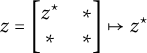 $z = \left [ \begin {matrix} z^{\star } & * \\ * &* \end {matrix} \right ] \mapsto z^{\star }$
and
$z = \left [ \begin {matrix} z^{\star } & * \\ * &* \end {matrix} \right ] \mapsto z^{\star }$
and $\star : P_{n,r} \to \Gamma _{r}$
,
$\star : P_{n,r} \to \Gamma _{r}$
,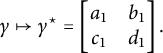 $\gamma \mapsto \gamma ^{\star } = \left [ \begin {matrix} a_1 & b_1 \\ c_1 & d_1 \end {matrix} \right ].$
Let $\phi \in S_{k}(\Gamma _{1})$
. The Klingen Eisenstein series attached to
$\phi \in S_{k}(\Gamma _{1})$
. The Klingen Eisenstein series attached to $\phi $
is the series
$\phi $
is the series
 $$ \begin{align*} E^{2,1}_{\phi}(z) = \sum_{\gamma \in P_{2,1} \backslash \Gamma_{2}} \phi((\gamma z)^{\star}) j(\gamma, z)^{-k}, \end{align*} $$
where $z \in \mathfrak {h}_{2}$
. The Eisenstein series converges for
$z \in \mathfrak {h}_{2}$
. The Eisenstein series converges for $k \geq 12$
(see [Reference Klingen33, Theorem 1, p. 67] for example). Note that [Reference Klingen33, Theorem 1, p. 67] gives
$k \geq 12$
(see [Reference Klingen33, Theorem 1, p. 67] for example). Note that [Reference Klingen33, Theorem 1, p. 67] gives $\Phi (E_{\phi }^{2,1}) = \phi $
.
$\Phi (E_{\phi }^{2,1}) = \phi $
.
Given two Siegel modular forms $f_1, f_2 \in M_{k}(\Gamma _n)$
with at least one a cusp form, set
$f_1, f_2 \in M_{k}(\Gamma _n)$
with at least one a cusp form, set
 $$ \begin{align*} \langle f_1, f_2 \rangle = \int_{\Gamma_{n}\backslash\mathfrak{h}_n}f_1(z)\overline{f_2(z)}(\det y)^{k} d\mu z, \end{align*} $$
where $z=x+iy$
with
$z=x+iy$
with $x = (x_{\alpha , \beta })$
,
$x = (x_{\alpha , \beta })$
, $y = (y_{\alpha , \beta }) \in \operatorname {\mathrm {Mat}}_{n}(\mathbf {R})$
,
$y = (y_{\alpha , \beta }) \in \operatorname {\mathrm {Mat}}_{n}(\mathbf {R})$
, $d\mu z = (\det y)^{-(n+1)} \prod _{\alpha \leq \beta } d x_{\alpha ,\beta } \prod _{\alpha \leq \beta } dy_{\alpha ,\beta }$
with
$d\mu z = (\det y)^{-(n+1)} \prod _{\alpha \leq \beta } d x_{\alpha ,\beta } \prod _{\alpha \leq \beta } dy_{\alpha ,\beta }$
with $dx_{\alpha ,\beta }$
and
$dx_{\alpha ,\beta }$
and $dy_{\alpha ,\beta }$
the usual Lebesgue measure on
$dy_{\alpha ,\beta }$
the usual Lebesgue measure on $\mathbf {R}$
.
$\mathbf {R}$
.
Given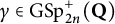 $\gamma \in \operatorname {\mathrm {GSp}}_{2n}^{+}(\mathbf {Q})$
, we write
$\gamma \in \operatorname {\mathrm {GSp}}_{2n}^{+}(\mathbf {Q})$
, we write $T(\gamma )$
to denote the double coset
$T(\gamma )$
to denote the double coset $\Gamma _{n} \gamma \Gamma _{n}$
and set
$\Gamma _{n} \gamma \Gamma _{n}$
and set $T(\gamma ) f = \sum _{i} f|_{k} \gamma _{i}$
, where the
$T(\gamma ) f = \sum _{i} f|_{k} \gamma _{i}$
, where the $\gamma _i$
are given by the finite decomposition
$\gamma _i$
are given by the finite decomposition $\Gamma _{n} \gamma \Gamma _{n} = \coprod _{i} \Gamma _{n} \gamma _{i}$
and
$\Gamma _{n} \gamma \Gamma _{n} = \coprod _{i} \Gamma _{n} \gamma _{i}$
and $f \in M_{k}(\Gamma _n)$
. Let
$f \in M_{k}(\Gamma _n)$
. Let $m>1$
. We define
$m>1$
. We define $T^{(n)}(m)$
via
$T^{(n)}(m)$
via
 $$ \begin{align*} T^{(n)}(m) = \sum_{\substack{d_1e_1 = \cdots = e_n d_n = m\\ d_1 \mid d_2 \mid \cdots \mid d_n \mid e_n \mid e_{n-1} \mid \cdots \mid e_1}} T(\operatorname{\mathrm{diag}}(d_1, \dots, d_n, e_1, \dots, e_n)). \end{align*} $$
In particular, for p a prime, we have
 $$ \begin{align*} T^{(n)}(p) = T(\operatorname{\mathrm{diag}}(1_{n}, p1_{n})). \end{align*} $$
We also define
 $$ \begin{align*} T_{i}^{(n)}(p^2) = T(\operatorname{\mathrm{diag}}(1_{n-i}, p1_{i}, p^2 1_{n-i}, p1_{i})), \quad 1\leq i\leq n. \end{align*} $$
The spaces $M_{k}(\Gamma _{n})$
and
$M_{k}(\Gamma _{n})$
and $S_{k}(\Gamma _{n})$
are both stable under the action of
$S_{k}(\Gamma _{n})$
are both stable under the action of $T^{(n)}(p)$
and
$T^{(n)}(p)$
and $T_{i}^{(n)}(p^2)$
for
$T_{i}^{(n)}(p^2)$
for $1 \leq i \leq n$
and all p. We say a nonzero
$1 \leq i \leq n$
and all p. We say a nonzero $f \in M_{k}(\Gamma _{n})$
is an eigenform if it is an eigenvector of
$f \in M_{k}(\Gamma _{n})$
is an eigenform if it is an eigenvector of $T^{(n)}(p)$
and
$T^{(n)}(p)$
and $T_{i}^{(n)}(p^2)$
for all p and all
$T_{i}^{(n)}(p^2)$
for all p and all $1 \leq i \leq n$
. As we will be focused on the case
$1 \leq i \leq n$
. As we will be focused on the case $n=2$
, we specialize to that case. We let
$n=2$
, we specialize to that case. We let $\mathbf {T}'$
denote the
$\mathbf {T}'$
denote the $\mathbf {Z}$
-subalgebra of
$\mathbf {Z}$
-subalgebra of $\operatorname {\mathrm {End}}_{\mathbf {C}}(S_{k}(\Gamma _{2}))$
generated by the Hecke operators
$\operatorname {\mathrm {End}}_{\mathbf {C}}(S_{k}(\Gamma _{2}))$
generated by the Hecke operators $T^{(2)}(p)$
and
$T^{(2)}(p)$
and $T^{(2)}_1(p^2)$
for all primes p.
$T^{(2)}_1(p^2)$
for all primes p.
Recall that $E/\mathbf {Q}_{\ell }$
denotes a finite extension with valuation ring
$E/\mathbf {Q}_{\ell }$
denotes a finite extension with valuation ring $\mathcal {O}$
and uniformizer
$\mathcal {O}$
and uniformizer $\lambda $
. Given eigenforms
$\lambda $
. Given eigenforms $f_1, f_2 \in M_{k}(\Gamma _n;\mathcal {O})$
, following the notation in [Reference Yamauchi61] we write
$f_1, f_2 \in M_{k}(\Gamma _n;\mathcal {O})$
, following the notation in [Reference Yamauchi61] we write $f_1 \equiv _{\operatorname {\mathrm {ev}}} f_2\ \pmod {\lambda }$
if
$f_1 \equiv _{\operatorname {\mathrm {ev}}} f_2\ \pmod {\lambda }$
if $\lambda _{f_1}(T) \equiv \lambda _{f_2}(T)\ \pmod {\lambda }$
for all
$\lambda _{f_1}(T) \equiv \lambda _{f_2}(T)\ \pmod {\lambda }$
for all $T \in \mathbf {T}'$
, where
$T \in \mathbf {T}'$
, where $Tf_{i} = \lambda _{f_i}(T)f_i$
.
$Tf_{i} = \lambda _{f_i}(T)f_i$
.
For an eigenform $\phi \in S_k(\Gamma _1),$
we set
$\phi \in S_k(\Gamma _1),$
we set
 $$ \begin{align*} \begin{split} L(s,\phi) := &\prod_p(1-\lambda_{\phi}(p)p^{-s}+p^{k-1-2s})^{-1},\\ L(s, {Sym^2} \phi)=&\prod_p \left[(1-\alpha_p^2 p^{-s})(1-\alpha_p \beta_p p^{-s}) (1-\beta_p^2 p^{-s}) \right]^{-1},\end{split} \end{align*} $$
where $\lambda _{\phi }(p)$
is the eigenvalue of
$\lambda _{\phi }(p)$
is the eigenvalue of $T(p):=T^{(1)}(p)$
corresponding to
$T(p):=T^{(1)}(p)$
corresponding to $\phi $
and
$\phi $
and $\alpha _p, \beta _p$
denote the roots of
$\alpha _p, \beta _p$
denote the roots of $X^2-\lambda _{\phi }(p)X+p^{k-1}$
. The symmetric square L-function converges in the right half-plane
$X^2-\lambda _{\phi }(p)X+p^{k-1}$
. The symmetric square L-function converges in the right half-plane $\Re (s)> k$
, satisfies a functional equation, and has analytic continuation to the entire complex plane.
$\Re (s)> k$
, satisfies a functional equation, and has analytic continuation to the entire complex plane.
For an eigenform $f\in S_k(\Gamma _2),$
we define
$f\in S_k(\Gamma _2),$
we define
 $$ \begin{align*} L_{p}(X,f,\operatorname{\mathrm{spin}}) =\ &(1-\lambda_{f}(p)X + (\lambda_f(p)^2 - \lambda_f(p^2) - p^{2k-4})X^2\\ &-\lambda_{f}(p) p^{2k-3}X^3 + p^{4k-6}X^4), \end{align*} $$
where we write $\lambda _f(p)$
is the eigenvalue of
$\lambda _f(p)$
is the eigenvalue of $T^{(2)}(p)$
corresponding to f and
$T^{(2)}(p)$
corresponding to f and $\lambda _{f}(p^2)$
for the eigenvalue
$\lambda _{f}(p^2)$
for the eigenvalue $T^{(2)}(p^2)$
corresponding to f.
$T^{(2)}(p^2)$
corresponding to f.
Theorem 2.1 [Reference Weissauer59, Theorem 1]
Let $f \in S_{k}(\Gamma _2)$
be an eigenform. For a sufficiently large finite extension
$f \in S_{k}(\Gamma _2)$
be an eigenform. For a sufficiently large finite extension $F/\mathbf {Q}_{\ell }$
, one has
$F/\mathbf {Q}_{\ell }$
, one has $L_{p}(X,f, \operatorname {\mathrm {spin}}) \in F[X]$
for all primes
$L_{p}(X,f, \operatorname {\mathrm {spin}}) \in F[X]$
for all primes $p\neq \ell $
and there is a semisimple continuous representation
$p\neq \ell $
and there is a semisimple continuous representation $\rho _{f}: G_{\mathbf {Q}} \rightarrow \operatorname {\mathrm {GL}}_4(F),$
which is unramified outside of
$\rho _{f}: G_{\mathbf {Q}} \rightarrow \operatorname {\mathrm {GL}}_4(F),$
which is unramified outside of $\ell $
so that for
$\ell $
so that for $p \neq \ell ,$
one has
$p \neq \ell ,$
one has $L_p(X,f;\operatorname {\mathrm {spin}}) = \det (1 - \rho _{f}(\operatorname {\mathrm {Frob}}_p)X)$
.
$L_p(X,f;\operatorname {\mathrm {spin}}) = \det (1 - \rho _{f}(\operatorname {\mathrm {Frob}}_p)X)$
.
3 Congruence
We keep the notation of Section 2. Throughout this section, we fix an even weight $k \geq 12$
and an odd prime
$k \geq 12$
and an odd prime $\ell $
and make the following assumption.
$\ell $
and make the following assumption.
Assumption 3.1 Given an even weight $k \geq 12$
and prime
$k \geq 12$
and prime $\ell $
, assume that
$\ell $
, assume that $E/\mathbf {Q}_\ell $
is sufficiently large to contain the fields F from Theorem 2.1 for all forms
$E/\mathbf {Q}_\ell $
is sufficiently large to contain the fields F from Theorem 2.1 for all forms $f \in S_k(\Gamma _2)$
. We also assume that for every eigenform
$f \in S_k(\Gamma _2)$
. We also assume that for every eigenform $\phi \in S_k(\Gamma _1),$
the field E contains all the Hecke eigenvalues of
$\phi \in S_k(\Gamma _1),$
the field E contains all the Hecke eigenvalues of $\phi $
as well as the value
$\phi $
as well as the value $L_{\mathrm {alg}}(2k-2, {\operatorname {Sym}^2}\phi )$
(see (3.1) for the definition). In addition, we suppose that E contains a primitive cube root of unity.
$L_{\mathrm {alg}}(2k-2, {\operatorname {Sym}^2}\phi )$
(see (3.1) for the definition). In addition, we suppose that E contains a primitive cube root of unity.
Recall that we denote the valuation ring of E by $\mathcal {O}$
. Let
$\mathcal {O}$
. Let $\phi \in S_{k}(\Gamma _1)$
be a normalized eigenform and consider the Klingen Eisenstein series
$\phi \in S_{k}(\Gamma _1)$
be a normalized eigenform and consider the Klingen Eisenstein series $E_{\phi }^{2,1}$
. In this section, we show under certain conditions that
$E_{\phi }^{2,1}$
. In this section, we show under certain conditions that $E_{\phi }^{2,1}$
is eigenvalue-congruent to a cuspidal Siegel modular form with irreducible Galois representation.
$E_{\phi }^{2,1}$
is eigenvalue-congruent to a cuspidal Siegel modular form with irreducible Galois representation.
Write
 $$ \begin{align*} E^{2,1}_{\phi}(z) = \sum_{T \in \Lambda_2} a(T;E^{2,1}_{\phi}) e(\operatorname{\mathrm{Tr}}(Tz)). \end{align*} $$
For T that are singular, i.e., $\det T = 0$
, one has T is unimodularly equivalent to
$\det T = 0$
, one has T is unimodularly equivalent to $\left [ \begin {matrix} n & 0 \\ 0 & 0 \end {matrix} \right ]$
for some
$\left [ \begin {matrix} n & 0 \\ 0 & 0 \end {matrix} \right ]$
for some $n \in \mathbf {Z}_{\geq 0}$
. For such T, one has
$n \in \mathbf {Z}_{\geq 0}$
. For such T, one has $a(T;E^{2,1}_{\phi }) = a(n;\phi ),$
where
$a(T;E^{2,1}_{\phi }) = a(n;\phi ),$
where $\phi (z) = \sum _{n> 0} a(n;\phi ) e(nz)$
.
$\phi (z) = \sum _{n> 0} a(n;\phi ) e(nz)$
.
We use the following result to prove our congruence.
Corollary 3.2 [Reference Yamauchi61, Corollary 2.3]
Assume $\ell \geq 7$
. Let g be a Hecke eigenform in
$\ell \geq 7$
. Let g be a Hecke eigenform in $M_{k}(\Gamma _2;\mathcal {O})$
with Fourier expansion
$M_{k}(\Gamma _2;\mathcal {O})$
with Fourier expansion $g(z) = \sum _{T \in \Lambda _2} a(T;g)e(\operatorname {\mathrm {Tr}}(Tz))$
. Assume that
$g(z) = \sum _{T \in \Lambda _2} a(T;g)e(\operatorname {\mathrm {Tr}}(Tz))$
. Assume that $\lambda \mid a(T;g)$
for all T with
$\lambda \mid a(T;g)$
for all T with $\det T =0$
and that there exists at least one
$\det T =0$
and that there exists at least one $T> 0$
with
$T> 0$
with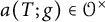 $a(T;g) \in \mathcal {O}^{\times }$
. Then, there exists a Hecke eigenform
$a(T;g) \in \mathcal {O}^{\times }$
. Then, there exists a Hecke eigenform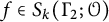 $f \in S_{k}(\Gamma _2;\mathcal {O})$
so that
$f \in S_{k}(\Gamma _2;\mathcal {O})$
so that $g \equiv _{\operatorname {\mathrm {ev}}} f \not \equiv _{\operatorname {\mathrm {ev}}} 0\ \pmod {\lambda } $
.
$g \equiv _{\operatorname {\mathrm {ev}}} f \not \equiv _{\operatorname {\mathrm {ev}}} 0\ \pmod {\lambda } $
.
For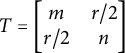 $T = \left [ \begin {matrix} m & r/2 \\ r/2 & n \end {matrix} \right ]$
, we say T is primitive if
$T = \left [ \begin {matrix} m & r/2 \\ r/2 & n \end {matrix} \right ]$
, we say T is primitive if $\gcd (m,n,r) = 1$
. We set
$\gcd (m,n,r) = 1$
. We set $\det (2T) = \Delta (T) \mathfrak {f}^2$
for a positive integer
$\det (2T) = \Delta (T) \mathfrak {f}^2$
for a positive integer $\mathfrak {f}$
and where
$\mathfrak {f}$
and where $-\Delta (T)$
is the discriminant of the quadratic field
$-\Delta (T)$
is the discriminant of the quadratic field $\mathbf {Q}(\sqrt {-\det (2T)})$
. We set
$\mathbf {Q}(\sqrt {-\det (2T)})$
. We set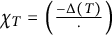 $\chi _{T} = \left (\frac {-\Delta (T)}{\cdot }\right )$
, the quadratic character associated with the field
$\chi _{T} = \left (\frac {-\Delta (T)}{\cdot }\right )$
, the quadratic character associated with the field $\mathbf {Q}(\sqrt {-\det (2T)})$
.
$\mathbf {Q}(\sqrt {-\det (2T)})$
.
Define $ \vartheta _{T}(z) = \sum _{a,b \in \mathbf {Z}^2} e(z(ma^2 + r ab + nb^2)) = \sum _{n \geq 0} b(n;\vartheta _{T}) e(nz). $
Given
$ \vartheta _{T}(z) = \sum _{a,b \in \mathbf {Z}^2} e(z(ma^2 + r ab + nb^2)) = \sum _{n \geq 0} b(n;\vartheta _{T}) e(nz). $
Given $v \in \mathbf {Z}_{\geq 1}$
, set
$v \in \mathbf {Z}_{\geq 1}$
, set
 $$ \begin{align*} \vartheta_{T}^{(v)}(z) = \sum_{n \geq 0} b(v^2 n;\vartheta_{T}) e(nz). \end{align*} $$
One can check that $\vartheta _{T}^{(v)} \in M_1(\Gamma (4\det T)),$
where
$\vartheta _{T}^{(v)} \in M_1(\Gamma (4\det T)),$
where $\Gamma (N) = \ker \left (\operatorname {\mathrm {SL}}_2(\mathbf {Z}) \rightarrow \operatorname {\mathrm {SL}}_2(\mathbf {Z}/N\mathbf {Z})\right )$
and
$\Gamma (N) = \ker \left (\operatorname {\mathrm {SL}}_2(\mathbf {Z}) \rightarrow \operatorname {\mathrm {SL}}_2(\mathbf {Z}/N\mathbf {Z})\right )$
and $M_k(\Gamma (N))$
denotes the modular forms of weight k and level
$M_k(\Gamma (N))$
denotes the modular forms of weight k and level $\Gamma (N)$
. Set
$\Gamma (N)$
. Set
 $$ \begin{align*} D(s,\phi,\vartheta_{T}^{(v)}) = \sum_{n \geq 1} a(n;\phi)b(v^2 n; \vartheta_{T}) n^{-s}. \end{align*} $$
We have that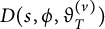 $D(s,\phi ,\vartheta _{T}^{(v)})$
converges in a right half-plane with meromorphic continuation to the entire complex plane [Reference Shimura47]. Set
$D(s,\phi ,\vartheta _{T}^{(v)})$
converges in a right half-plane with meromorphic continuation to the entire complex plane [Reference Shimura47]. Set
 $$ \begin{align} L_{\operatorname{\mathrm{alg}}}(2k-2,{\operatorname{Sym}^2} \phi) := \frac{L(2k-2,{\operatorname{Sym}^2} \phi)}{\pi^{3k-3} \langle \phi, \phi \rangle}, \end{align} $$
 $$ \begin{align*} L_{\operatorname{\mathrm{alg}}}(k-1,\chi_{T}) = \frac{\Delta(T)^{k-3/2} L(k-1,\chi_{T})}{\pi^{k-1}}, \end{align*} $$
and
 $$ \begin{align*} D_{\operatorname{\mathrm{alg}}}(k-1,\phi,\vartheta_{T}^{(v)}) = \frac{D(k-1,\phi,\vartheta_{T}^{(v)})}{\pi^{k-1} \langle \phi, \phi \rangle}. \end{align*} $$
We have each of these terms is algebraic (see [Reference Shimura47, Reference Sturm51, Reference Zagier62]. Moreover, we have via [Reference Zagier62, Equation (22)] that if $\ell> k-1$
, then
$\ell> k-1$
, then $L_{\operatorname {\mathrm {alg}}}(k-1,\chi _{T})$
is
$L_{\operatorname {\mathrm {alg}}}(k-1,\chi _{T})$
is $\ell $
-integral.
$\ell $
-integral.
Theorem 3.3 [Reference Mizumoto38]
Let $\phi \in S_{k}(\Gamma _1)$
be a normalized eigenform with a Fourier expansion as above. Let
$\phi \in S_{k}(\Gamma _1)$
be a normalized eigenform with a Fourier expansion as above. Let $T> 0$
be primitive. We have
$T> 0$
be primitive. We have
 $$ \begin{align*} a(T;E^{2,1}_{\phi}) =\ &(-1)^{k/2} \frac{(k-1)!}{(2k-2)!} 2^{k-1} \frac{L_{\operatorname{\mathrm{alg}}}(k-1,\chi_T)}{L_{\operatorname{\mathrm{alg}}}(2k-2,{\operatorname{Sym}^2} \phi)} \\ &\cdot \sum_{\substack{m \mid \mathfrak{f}\\ m> 0}} M_{T}(\mathfrak{f} m^{-1}) \sum_{\substack{t \mid m \\ t > 0}} \mu(t) D_{\operatorname{\mathrm{alg}}}(k-1, \phi, \vartheta_{T}^{(m/t)}), \end{align*} $$
where
 $$ \begin{align*} M_{T}(a) = \sum_{\substack{d \mid a \\ d>0}} \mu(d) \chi_{T}(d) d^{k-2} \sigma_{2k-3}(a d^{-1}) \text{ and } \sigma_{s}(d) = \sum_{\substack{g \mid d \\ g > 0}} g^{s}. \end{align*} $$
Note that while this theorem is only stated for Fourier coefficients indexed by primitive T, we have that Fourier coefficients indexed by non-primitive T are an integral linear combination of Fourier coefficients indexed by primitive T by [Reference Mizumoto38, Equation (1.3)] so we only need to consider the primitive T to guarantee the hypotheses of Corollary 3.2 are satisfied.
Lemma 3.4 Assume $\ell> 4k-7$
. Let
$\ell> 4k-7$
. Let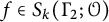 $f \in S_k(\Gamma _2;\mathcal {O})$
be an eigenform. If there exists a normalized eigenform
$f \in S_k(\Gamma _2;\mathcal {O})$
be an eigenform. If there exists a normalized eigenform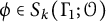 $\phi \in S_k(\Gamma _1;\mathcal {O})$
so that
$\phi \in S_k(\Gamma _1;\mathcal {O})$
so that $f \equiv _{\operatorname {\mathrm {ev}}} E_{\phi }^{2,1}\ \pmod {\lambda }$
and that
$f \equiv _{\operatorname {\mathrm {ev}}} E_{\phi }^{2,1}\ \pmod {\lambda }$
and that ${\overline {\rho }}_\phi $
is irreducible, then
${\overline {\rho }}_\phi $
is irreducible, then $\rho _f$
is irreducible.
$\rho _f$
is irreducible.
Proof We know via [Reference Weissauer59] that if $\rho _{f}$
is reducible, then the automorphic representation associated with f is either CAP or a weak endoscopic lift. Moreover, by [Reference Pitale and Schmidt42, Corollary 4.5] since
$\rho _{f}$
is reducible, then the automorphic representation associated with f is either CAP or a weak endoscopic lift. Moreover, by [Reference Pitale and Schmidt42, Corollary 4.5] since $f \in S_{k}(\Gamma _2)$
and
$f \in S_{k}(\Gamma _2)$
and $k>2$
, the automorphic representation attached to f can be CAP only with respect to the Siegel parabolic, i.e., f is a classical Saito–Kurokawa lift. Suppose that f is a Saito–Kurokawa lift of
$k>2$
, the automorphic representation attached to f can be CAP only with respect to the Siegel parabolic, i.e., f is a classical Saito–Kurokawa lift. Suppose that f is a Saito–Kurokawa lift of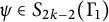 $\psi \in S_{2k-2}(\Gamma _1)$
. Then, we have
$\psi \in S_{2k-2}(\Gamma _1)$
. Then, we have ${\overline {\rho }}_{f}^{\operatorname {\mathrm {ss}}} = {\overline {\rho }}_{\psi } \oplus \overline {\epsilon }^{k-1} \oplus \overline {\epsilon }^{k-2}$
. Using the fact that
${\overline {\rho }}_{f}^{\operatorname {\mathrm {ss}}} = {\overline {\rho }}_{\psi } \oplus \overline {\epsilon }^{k-1} \oplus \overline {\epsilon }^{k-2}$
. Using the fact that $f \equiv _{\operatorname {\mathrm {ev}}} E_{\phi }^{2,1}\ \pmod {\lambda }$
and that the eigenvalues of
$f \equiv _{\operatorname {\mathrm {ev}}} E_{\phi }^{2,1}\ \pmod {\lambda }$
and that the eigenvalues of $E_{\phi }^{2,1}$
are given by
$E_{\phi }^{2,1}$
are given by $\lambda (p;E_{\phi }^{2,1}) = a(p;\phi ) + p^{k-2}a(p;\phi )$
, the Brauer–Nesbitt and Chebotarev Theorems give that
$\lambda (p;E_{\phi }^{2,1}) = a(p;\phi ) + p^{k-2}a(p;\phi )$
, the Brauer–Nesbitt and Chebotarev Theorems give that ${\overline {\rho }}_{f}^{\operatorname {\mathrm {ss}}} = {\overline {\rho }}_{\phi } \oplus {\overline {\rho }}_{\phi }(k-2)$
, where recall that we write
${\overline {\rho }}_{f}^{\operatorname {\mathrm {ss}}} = {\overline {\rho }}_{\phi } \oplus {\overline {\rho }}_{\phi }(k-2)$
, where recall that we write ${\overline {\rho }}_{\phi }(k-2)$
for
${\overline {\rho }}_{\phi }(k-2)$
for ${\overline {\rho }}_{\phi } \otimes \overline {\epsilon }^{k-2}$
. This is a contradiction if
${\overline {\rho }}_{\phi } \otimes \overline {\epsilon }^{k-2}$
. This is a contradiction if ${\overline {\rho }}_{\phi }$
is irreducible. Thus, f cannot be a Saito–Kurokawa lift. It remains to show that the automorphic representation associated with f is not a weak endoscopic lift. The possible decompositions of
${\overline {\rho }}_{\phi }$
is irreducible. Thus, f cannot be a Saito–Kurokawa lift. It remains to show that the automorphic representation associated with f is not a weak endoscopic lift. The possible decompositions of $\rho _{f}$
are given in [Reference Skinner and Urban48, Theorem 3.2.1] under the assumption that
$\rho _{f}$
are given in [Reference Skinner and Urban48, Theorem 3.2.1] under the assumption that $\ell> 4k-7$
. Of these, the only case remaining to check is Case B(v), which states if
$\ell> 4k-7$
. Of these, the only case remaining to check is Case B(v), which states if $\rho _{f} = \sigma \oplus \sigma '$
with
$\rho _{f} = \sigma \oplus \sigma '$
with $\sigma $
and
$\sigma $
and $\sigma '$
both two-dimensional, then
$\sigma '$
both two-dimensional, then $\det (\sigma ) = \det (\sigma ')$
. In our case, this would require
$\det (\sigma ) = \det (\sigma ')$
. In our case, this would require $\det (\rho _{\phi }) = \det (\rho _{\phi }(k-2))$
, i.e.,
$\det (\rho _{\phi }) = \det (\rho _{\phi }(k-2))$
, i.e., $\overline {\epsilon }^{k-1} = \overline {\epsilon }^{2k-3}$
, which is impossible by our assumption that
$\overline {\epsilon }^{k-1} = \overline {\epsilon }^{2k-3}$
, which is impossible by our assumption that $\ell>4k-7$
. Thus,
$\ell>4k-7$
. Thus, $\rho _{f}$
is irreducible.
$\rho _{f}$
is irreducible.
Theorem 3.5 Assume that $\ell> 4k-7$
. Let
$\ell> 4k-7$
. Let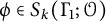 $\phi \in S_{k}(\Gamma _1; \mathcal {O})$
be a normalized eigenform. Suppose that
$\phi \in S_{k}(\Gamma _1; \mathcal {O})$
be a normalized eigenform. Suppose that $\lambda \mid L_{\operatorname {\mathrm {alg}}}(2k-2, {\operatorname {Sym}^2} \phi )$
. Furthermore, assume there exists
$\lambda \mid L_{\operatorname {\mathrm {alg}}}(2k-2, {\operatorname {Sym}^2} \phi )$
. Furthermore, assume there exists $T_0> 0$
so that
$T_0> 0$
so that
 $$ \begin{align*} \operatorname{\mathrm{val}}_{\lambda}\left(L_{\operatorname{\mathrm{alg}}}(2k-2, {\operatorname{Sym}^2} \phi)a(T_0,E^{2,1}_{\phi})\right) \leq 0. \end{align*} $$
Then, there exists an eigenform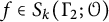 $f \in S_{k}(\Gamma _2; \mathcal {O})$
so that
$f \in S_{k}(\Gamma _2; \mathcal {O})$
so that
 $$ \begin{align*} E^{2,1}_{\phi} \equiv_{\operatorname{\mathrm{ev}}} f \quad\pmod{\lambda}. \end{align*} $$
If in addition ${\overline {\rho }}_{\phi }$
is irreducible, then
${\overline {\rho }}_{\phi }$
is irreducible, then $\rho _{f}$
is irreducible.
$\rho _{f}$
is irreducible.
Proof Set $H_{\phi }^{2,1}(z) = L_{\operatorname {\mathrm {alg}}}(2k-2,{\operatorname {Sym}^2} \phi ) E^{2,1}_{\phi }(z)$
. For
$H_{\phi }^{2,1}(z) = L_{\operatorname {\mathrm {alg}}}(2k-2,{\operatorname {Sym}^2} \phi ) E^{2,1}_{\phi }(z)$
. For $T \geq 0$
, define
$T \geq 0$
, define $c(T) = \operatorname {\mathrm {val}}_{\lambda }(a(T;H_{\phi }^{2,1})). $
Let
$c(T) = \operatorname {\mathrm {val}}_{\lambda }(a(T;H_{\phi }^{2,1})). $
Let $c = \min _{T \geq 0} c(T)$
. Since
$c = \min _{T \geq 0} c(T)$
. Since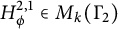 $H_{\phi }^{2,1} \in M_k(\Gamma _2)$
, the Fourier coefficients
$H_{\phi }^{2,1} \in M_k(\Gamma _2)$
, the Fourier coefficients $a(T;H_{\phi }^{2,1})$
have bounded denominators so c is well-defined [Reference Shimura46]. Moreover, our assumption that there is a
$a(T;H_{\phi }^{2,1})$
have bounded denominators so c is well-defined [Reference Shimura46]. Moreover, our assumption that there is a $T_0> 0$
with
$T_0> 0$
with $\operatorname {\mathrm {val}}_{\lambda }(a(T_0;H_{\phi }^{2,1})) = \operatorname {\mathrm {val}}_{\lambda }\left (L_{\operatorname {\mathrm {alg}}}(2k-2, {\operatorname {Sym}^2} \phi )a(T_0,E^{2,1}_{\phi })\right ) \leq 0$
gives that
$\operatorname {\mathrm {val}}_{\lambda }(a(T_0;H_{\phi }^{2,1})) = \operatorname {\mathrm {val}}_{\lambda }\left (L_{\operatorname {\mathrm {alg}}}(2k-2, {\operatorname {Sym}^2} \phi )a(T_0,E^{2,1}_{\phi })\right ) \leq 0$
gives that $c \leq 0$
. Set
$c \leq 0$
. Set
 $$ \begin{align*} G^{2,1}_{\phi}(z) = \lambda^{-c} H_{\phi}^{2,1}(z). \end{align*} $$
We have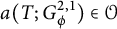 $a(T;G_{\phi }^{2,1}) \in \mathcal {O}$
for all
$a(T;G_{\phi }^{2,1}) \in \mathcal {O}$
for all $T \geq 0$
since
$T \geq 0$
since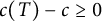 $c(T) - c \geq 0$
for all
$c(T) - c \geq 0$
for all $T \geq 0$
. Observe that for T with
$T \geq 0$
. Observe that for T with $\det T=0$
, we have
$\det T=0$
, we have $a(T;G^{2,1}_{\phi }) = \lambda ^{-c}L_{\operatorname {\mathrm {alg}}}(2k-2,{\operatorname {Sym}^2} \phi ) a(n;\phi )$
for some
$a(T;G^{2,1}_{\phi }) = \lambda ^{-c}L_{\operatorname {\mathrm {alg}}}(2k-2,{\operatorname {Sym}^2} \phi ) a(n;\phi )$
for some $n \in \mathbf {Z}_{\geq 0}$
. Since
$n \in \mathbf {Z}_{\geq 0}$
. Since $a(n;\phi ) \in \mathcal {O}$
by assumption and
$a(n;\phi ) \in \mathcal {O}$
by assumption and $-c\geq 0$
, this gives
$-c\geq 0$
, this gives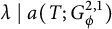 $\lambda \mid a(T;G^{2,1}_{\phi })$
for all T with
$\lambda \mid a(T;G^{2,1}_{\phi })$
for all T with $\det T = 0$
, i.e., all the Fourier coefficients indexed by singular T vanish modulo
$\det T = 0$
, i.e., all the Fourier coefficients indexed by singular T vanish modulo $\lambda $
. Moreover, since
$\lambda $
. Moreover, since $c = c(\widetilde {T})$
for some
$c = c(\widetilde {T})$
for some $\widetilde {T}$
, we have
$\widetilde {T}$
, we have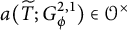 $a(\widetilde {T};G_{\phi }^{2,1}) \in \mathcal {O}^{\times }$
for some
$a(\widetilde {T};G_{\phi }^{2,1}) \in \mathcal {O}^{\times }$
for some $\widetilde {T}$
. Since
$\widetilde {T}$
. Since $c\leq 0$
and
$c\leq 0$
and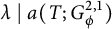 $\lambda \mid a(T;G_{\phi }^{2,1})$
for all singular T, we have
$\lambda \mid a(T;G_{\phi }^{2,1})$
for all singular T, we have $\widetilde {T}>0$
. Thus, Corollary 3.2 and the fact that
$\widetilde {T}>0$
. Thus, Corollary 3.2 and the fact that $G^{2,1}_{\phi }$
and
$G^{2,1}_{\phi }$
and $E^{2,1}_{\phi }$
have the same eigenvalues gives an eigenform
$E^{2,1}_{\phi }$
have the same eigenvalues gives an eigenform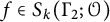 $f \in S_{k}(\Gamma _2;\mathcal {O})$
so that
$f \in S_{k}(\Gamma _2;\mathcal {O})$
so that $ E^{2,1}_{\phi } \equiv _{\operatorname {\mathrm {ev}}} f \not \equiv 0\ \pmod {\lambda }. $
By Lemma 3.4, we get that
$ E^{2,1}_{\phi } \equiv _{\operatorname {\mathrm {ev}}} f \not \equiv 0\ \pmod {\lambda }. $
By Lemma 3.4, we get that $\rho _{f}$
is irreducible.
$\rho _{f}$
is irreducible.
Example 3.6 Consider the space $M_{26}(\Gamma _2)$
. This space has dimension seven and is spanned by
$M_{26}(\Gamma _2)$
. This space has dimension seven and is spanned by $E^{2,0}$
(Siegel Eisenstein series),
$E^{2,0}$
(Siegel Eisenstein series), $E^{2,1}_{\phi }$
(Klingen Eisenstein series), three Saito–Kurokawa lifts, and two non-lift forms
$E^{2,1}_{\phi }$
(Klingen Eisenstein series), three Saito–Kurokawa lifts, and two non-lift forms $\Upsilon _1$
and
$\Upsilon _1$
and $\Upsilon _2$
, where here
$\Upsilon _2$
, where here $\phi \in S_{26}(\Gamma _1)$
is the unique newform given by
$\phi \in S_{26}(\Gamma _1)$
is the unique newform given by
 $$ \begin{align*} \phi(z) = e(z) - 48e(2z) -195804 e(3z) + \cdots. \end{align*} $$
We have via [Reference Dummigan21] that
 $$ \begin{align*} L_{\operatorname{\mathrm{alg}}}&(50, {\operatorname{Sym}^2} \phi)\\ &= \frac{2^{41} \cdot 163\cdot 187273}{3^{26} \cdot 5^{10}\cdot 7^7 \cdot 11^4 \cdot 13^2 \cdot 17^2 \cdot 19 \cdot 23^2 \cdot 29 \cdot 31 \cdot 37 \cdot 41 \cdot 43 \cdot 47 \cdot 657931}. \end{align*} $$
We consider $\ell \in \{163, 187273\}$
and show that both primes produce an example for Theorem 3.5.
$\ell \in \{163, 187273\}$
and show that both primes produce an example for Theorem 3.5.
The Klingen Eisenstein series associated with $\phi $
is given in the beta version of LMFDB. By considering the Fourier coefficients indexed by
$\phi $
is given in the beta version of LMFDB. By considering the Fourier coefficients indexed by $\left [ \begin {matrix} 1 & 0 \\ 0 & 0 \end {matrix} \right ]$
and
$\left [ \begin {matrix} 1 & 0 \\ 0 & 0 \end {matrix} \right ]$
and $\left [ \begin {matrix} 2 & 0 \\ 0 & 0 \end {matrix} \right ]$
, one can see that the Klingen Eisenstein series given there, say
$\left [ \begin {matrix} 2 & 0 \\ 0 & 0 \end {matrix} \right ]$
, one can see that the Klingen Eisenstein series given there, say $E^{\operatorname {\mathrm {LMFDB}}}_{\phi }$
, is given by
$E^{\operatorname {\mathrm {LMFDB}}}_{\phi }$
, is given by
 $$ \begin{align*} E^{2,1}_{\phi}(z) = -\frac{E^{\operatorname{\mathrm{LMFDB}}}_{\phi}(z)}{2^6 \cdot 3^3 \cdot 11 \cdot 19 \cdot 163 \cdot 187273}. \end{align*} $$
We have from LMFDB that
 $$ \begin{align*} a\left(\left[ \begin{matrix} 1 & 1/2 \\ 1/2 & 1 \end{matrix} \right]; E^{2,1}_{\phi}\right) = \frac{2^2\cdot 5 \cdot 43}{ 11 \cdot 19 \cdot 163 \cdot 187273}. \end{align*} $$
Consider $G^{2,1}_{\phi }(z) = L_{\operatorname {\mathrm {alg}}}(50,{\operatorname {Sym}^2} \phi ) E^{2,1}_{\phi }(z)$
. We have for
$G^{2,1}_{\phi }(z) = L_{\operatorname {\mathrm {alg}}}(50,{\operatorname {Sym}^2} \phi ) E^{2,1}_{\phi }(z)$
. We have for $\ell $
as above that
$\ell $
as above that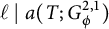 $\ell \mid a(T;G^{2,1}_{\phi })$
for all T with
$\ell \mid a(T;G^{2,1}_{\phi })$
for all T with $\det T= 0$
and
$\det T= 0$
and $a\left (\left [ \begin {matrix} 1 & 1/2 \\ 1/2 & 1 \end {matrix} \right ]; G^{2,1}_{\phi }\right ) \not \equiv 0\ \pmod {\ell }$
. Thus, by Theorem 3.5, there exists a non-trivial Hecke eigenform
$a\left (\left [ \begin {matrix} 1 & 1/2 \\ 1/2 & 1 \end {matrix} \right ]; G^{2,1}_{\phi }\right ) \not \equiv 0\ \pmod {\ell }$
. Thus, by Theorem 3.5, there exists a non-trivial Hecke eigenform $f \in S_{k}(\Gamma _2; \mathbf {Z}_{\ell })$
with
$f \in S_{k}(\Gamma _2; \mathbf {Z}_{\ell })$
with $E^{2,1}_{\phi } \equiv _{\operatorname {\mathrm {ev}}} f\ \pmod {\ell }$
.
$E^{2,1}_{\phi } \equiv _{\operatorname {\mathrm {ev}}} f\ \pmod {\ell }$
.
Consider first the prime $\ell = 163$
and suppose that
$\ell = 163$
and suppose that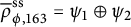 ${\overline {\rho }}^{\mathrm {ss}}_{\phi ,163}=\psi _1 \oplus \psi _2$
for some characters
${\overline {\rho }}^{\mathrm {ss}}_{\phi ,163}=\psi _1 \oplus \psi _2$
for some characters $\psi _1, \psi _2$
. Since
$\psi _1, \psi _2$
. Since ${\overline {\rho }}_\phi $
is unramified for all
${\overline {\rho }}_\phi $
is unramified for all $p \neq \ell ,$
we see that
$p \neq \ell ,$
we see that $\psi _1$
and
$\psi _1$
and $\psi _2$
are each an integer power of
$\psi _2$
are each an integer power of $\overline {\epsilon }$
(see the proof of Lemma 5.3). As
$\overline {\epsilon }$
(see the proof of Lemma 5.3). As $163 \nmid a(163;\phi ),$
we know
$163 \nmid a(163;\phi ),$
we know $\phi $
is ordinary at
$\phi $
is ordinary at $163$
and we get
$163$
and we get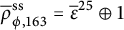 ${\overline {\rho }}^{\mathrm {ss}}_{\phi ,163}=\overline {\epsilon }^{25} \oplus 1$
. By [Reference Ribet45, Proposition 2.1] we can find a lattice such that
${\overline {\rho }}^{\mathrm {ss}}_{\phi ,163}=\overline {\epsilon }^{25} \oplus 1$
. By [Reference Ribet45, Proposition 2.1] we can find a lattice such that
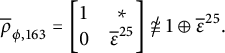 $$ \begin{align*} {\overline{\rho}}_{\phi,163} = \left[ \begin{matrix} 1 & * \\ 0 & \overline{\epsilon}^{25}\end{matrix} \right] \not \cong 1 \oplus \overline{\epsilon}^{25}. \end{align*} $$
One can use ordinarity of $\phi $
to show that
$\phi $
to show that $*$
gives an unramified
$*$
gives an unramified $163$
-extension of
$163$
-extension of $\mathbf {Q}(\zeta _{163})$
(see, e.g., the proof of Theorem 4.28 in [Reference Berger and Klosin10]). By Herbrand’s Theorem, this implies that
$\mathbf {Q}(\zeta _{163})$
(see, e.g., the proof of Theorem 4.28 in [Reference Berger and Klosin10]). By Herbrand’s Theorem, this implies that $163 \mid B_{26}$
. However, one can check this is not true, so we must have that
$163 \mid B_{26}$
. However, one can check this is not true, so we must have that ${\overline {\rho }}_{\phi ,163}$
is irreducible and so
${\overline {\rho }}_{\phi ,163}$
is irreducible and so $E^{2,1}_{\phi }$
must be congruent (modulo 163) to a cusp form f that is not a Saito–Kurokawa lift, i.e.,
$E^{2,1}_{\phi }$
must be congruent (modulo 163) to a cusp form f that is not a Saito–Kurokawa lift, i.e., $\rho _f$
is irreducible by Theorem 3.5. One uses LMFDB to check that
$\rho _f$
is irreducible by Theorem 3.5. One uses LMFDB to check that $f= \Upsilon _2 $
.
$f= \Upsilon _2 $
.
Now consider the case that $\ell = 187273$
. In this case, it is less practical to calculate
$\ell = 187273$
. In this case, it is less practical to calculate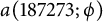 $a(187273; \phi )$
, so we directly eliminate the possibility that
$a(187273; \phi )$
, so we directly eliminate the possibility that $E^{2,1}_{\phi }$
is congruent to a Saito–Kurokawa lift modulo
$E^{2,1}_{\phi }$
is congruent to a Saito–Kurokawa lift modulo $187273$
. The space to consider is
$187273$
. The space to consider is $S_{50}(\Gamma _1)$
. This space has one Galois conjugacy class of newforms consisting of three newforms, call them
$S_{50}(\Gamma _1)$
. This space has one Galois conjugacy class of newforms consisting of three newforms, call them $\psi _1, \psi _2$
, and
$\psi _1, \psi _2$
, and $\psi _3$
. Each newform has a field of definition
$\psi _3$
. Each newform has a field of definition $K_{\psi _{i}}$
generated by a root
$K_{\psi _{i}}$
generated by a root $\alpha _{i}$
of
$\alpha _{i}$
of
 $$ \begin{align*} c(x) = x^3 + 24225168x^2 - 566746931810304x -13634883228742736412672. \end{align*} $$
One has that $\lambda (2, E^{2,1}_{\phi }) = -805306416$
and that
$\lambda (2, E^{2,1}_{\phi }) = -805306416$
and that $\lambda (2,\psi _{i}) = 2^{49}+2^{48} + \alpha _{i}$
. One uses SAGE to check that
$\lambda (2,\psi _{i}) = 2^{49}+2^{48} + \alpha _{i}$
. One uses SAGE to check that $\lambda (2,E^{2,1}_{\phi }) \not \equiv \lambda (2,\psi _{i})\ \pmod {187273}$
, so
$\lambda (2,E^{2,1}_{\phi }) \not \equiv \lambda (2,\psi _{i})\ \pmod {187273}$
, so $E^{2,1}_{\phi }$
must be congruent to a cusp form that is not a Saito–Kurokawa lift. One uses LMFDB to see that
$E^{2,1}_{\phi }$
must be congruent to a cusp form that is not a Saito–Kurokawa lift. One uses LMFDB to see that $E^{2,1}_{\phi }\equiv _{\operatorname {\mathrm {ev}}} \Upsilon _1\ \pmod {187273}$
.
$E^{2,1}_{\phi }\equiv _{\operatorname {\mathrm {ev}}} \Upsilon _1\ \pmod {187273}$
.
4 Extensions of Fontaine–Laffaille modules
In this section, we gather various facts (in particular, Propositions 4.8 and 4.20) about extensions of Fontaine–Laffaille modules, which we use in this article but which to the best of our knowledge have not been published elsewhere.
4.1 Definitions
We keep our assumption that $\ell $
is an odd prime. We fix integers
$\ell $
is an odd prime. We fix integers $a,b$
such that
$a,b$
such that $0 \leq b-a \leq \ell -2$
. In this section, let E be an arbitrary finite extension of
$0 \leq b-a \leq \ell -2$
. In this section, let E be an arbitrary finite extension of $\mathbf {Q}_{\ell }$
with ring of integers
$\mathbf {Q}_{\ell }$
with ring of integers $\mathcal {O}$
, uniformizer
$\mathcal {O}$
, uniformizer $\lambda ,$
and residue field
$\lambda ,$
and residue field $\mathbf {F}$
. Write
$\mathbf {F}$
. Write $\mathrm {LCA}_{\mathcal {O}}$
(respectively,
$\mathrm {LCA}_{\mathcal {O}}$
(respectively, $\mathrm {LCN}_{\mathcal {O}}$
) for the category of local complete Artinian (respectively, Noetherian)
$\mathrm {LCN}_{\mathcal {O}}$
) for the category of local complete Artinian (respectively, Noetherian) $\mathcal {O}$
-algebras with residue field
$\mathcal {O}$
-algebras with residue field $\mathbf {F}$
. For a category
$\mathbf {F}$
. For a category $\mathcal {C,}$
we will write
$\mathcal {C,}$
we will write $X \in \mathcal {C}$
to mean that X is an object of
$X \in \mathcal {C}$
to mean that X is an object of $\mathcal {C}$
.
$\mathcal {C}$
.
Definition 4.1 [Reference Kalloniatis31, Definition 2.3]/[Reference Booher13, Definition 4.1]
-
1. A Fontaine–Laffaille module is a finitely generated $\mathbf {Z}_\ell $
-module M together with a decreasing filtration by
$\mathbf {Z}_\ell $
-module direct summands
$M^i$
for
$i \in \mathbf {Z}$
such that there exists
$k \leq l$
with
$M^i=M$
for
$i \leq k$
and
$M^{i+1}=0$
for
$i \geq l$
, and a collection of
$\mathbf {Z}_\ell $
-linear maps
$\phi ^i_M: M^i \to M$
such that
$\phi ^i_M|_{M^{i+1}}=\ell \phi ^{i+1}_M$
for all i and
$M=\sum _i \phi ^i_M(M^i)$
. The category of all Fontaine–Laffaille modules is denoted
$MF^{f}_{\mathbf {Z}_\ell }$
. Morphisms in this category are
$\mathbf {Z}_\ell $
-linear maps
$f: M \to N$
satisfying
$f(M^i) \subset N^i$
and
$f \circ \phi ^i_M=\phi ^i_N \circ f|_{M^i}$
for all i. We will write
$MF^{f}_{\operatorname {\mathrm {tor}}, \mathbf {Z}_\ell }$
for the full subcategory whose objects are of finite length as
$\mathbf {Z}_\ell $
-modules.
$\mathbf {Z}_\ell $
-module M together with a decreasing filtration by
$\mathbf {Z}_\ell $
-module direct summands
$M^i$
for
$i \in \mathbf {Z}$
such that there exists
$k \leq l$
with
$M^i=M$
for
$i \leq k$
and
$M^{i+1}=0$
for
$i \geq l$
, and a collection of
$\mathbf {Z}_\ell $
-linear maps
$\phi ^i_M: M^i \to M$
such that
$\phi ^i_M|_{M^{i+1}}=\ell \phi ^{i+1}_M$
for all i and
$M=\sum _i \phi ^i_M(M^i)$
. The category of all Fontaine–Laffaille modules is denoted
$MF^{f}_{\mathbf {Z}_\ell }$
. Morphisms in this category are
$\mathbf {Z}_\ell $
-linear maps
$f: M \to N$
satisfying
$f(M^i) \subset N^i$
and
$f \circ \phi ^i_M=\phi ^i_N \circ f|_{M^i}$
for all i. We will write
$MF^{f}_{\operatorname {\mathrm {tor}}, \mathbf {Z}_\ell }$
for the full subcategory whose objects are of finite length as
$\mathbf {Z}_\ell $
-modules. -
2. For a fixed interval
$[k,l],$
we denote the full subcategory of
$MF^{f}_{?,\mathbf {Z}_\ell }$
whose objects M have a filtration satisfying
$M^k=M$
and
$M^{l+1}=0$
by
$MF^{f, [k,l]}_{?,\mathbf {Z}_\ell }$
for
$?\in \{\emptyset , \text {tor}\}$
. -
3. For any
$A \in \mathrm {LCA}_{\mathcal {O}}$
, a Fontaine–Laffaille module over A consists of an object
$M \in MF^{f, [a,b]}_{\operatorname {\mathrm {tor}}, \mathbf {Z}_\ell }$
together with a map
$\theta : A \to \mathrm {End}_{MF^{f, [a,b]}_{\operatorname {\mathrm {tor}}, \mathbf {Z}_\ell }}(M)$
that makes M into a free finitely generated module over A in such a way that
$M^i$
is an A-direct summand of M for each i. A morphism between two such objects is required to additionally preserve the A-structure. We will denote this category of Fontaine–Laffaille modules over A as
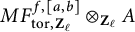
$MF^{f, [a,b]}_{\operatorname {\mathrm {tor}}, \mathbf {Z}_\ell } \otimes _{\mathbf {Z}_\ell } A$
. -
4. For
$M \in MF^{f, [a,b]}_{\operatorname {\mathrm {tor}}, \mathbf {Z}_\ell } \otimes _{\mathbf {Z}_\ell } A,$
any integer i for which
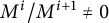
$M^i/M^{i+1} \neq 0$
is called a Fontaine–Laffaille weight for M. The set of Fontaine–Laffaille weights for M will be denoted by
$\mathrm {FL}(M)$
.


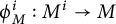




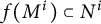



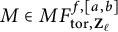




Remark 4.2 We impose the stronger restriction on the length of the filtration as in [Reference Bloch and Kato12, Section 4] and [Reference Clozel, Harris and Taylor18, Section 2.4.1] compared to that in Section 1.1.2 of [Reference Diamond, Flach and Guo20] or [Reference Kalloniatis31, Definition 2.3] (which allow the length to be $\ell -1$
).
$\ell -1$
).
Definition 4.3 We introduce the following examples of Fontaine–Laffaille modules:
-
1. If
$0 \in [a,b],$
we write
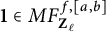
$\textbf {1} \in MF^{f, [a,b]}_{\mathbf {Z}_\ell }$
for the Fontaine–Laffaille module defined by
$\textbf {1}^i=\mathbf {Z}_\ell $
for
$i \leq 0$
and
$\textbf {1}^i=0$
for
$i>0$
. We set
$\phi ^i: \textbf {1}^i \to \textbf {1}$
to be given by
$x \mapsto \ell ^{-i} x$
for
$i \leq 0$
. -
2. For any
$A \in \mathrm {LCA}_{\mathcal {O}}$
, we define
$M_{n, A} \in MF^{f, [a,b]}_{\operatorname {\mathrm {tor}}, \mathbf {Z}_\ell } \otimes _{\mathbf {Z}_\ell } A$
to be the free rank one A-module equipped with the filtration
$M_{n, A}^i=A$
for
$i \leq n$
,
$M_{n, A}^{n+1}=0$
and
$\phi ^i: M_{n, A}^i \to M_{n, A}$
given by
$x \mapsto \ell ^{n-i} x$
for
$i \leq n$
. We put
$\mathbf {1}_A=M_{0, A}$
.









Definition 4.4 [Reference Booher13, Definition 4.9]
For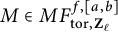 $M \in MF^{f, [a,b]}_{\operatorname {\mathrm {tor}}, \mathbf {Z}_\ell }$
and
$M \in MF^{f, [a,b]}_{\operatorname {\mathrm {tor}}, \mathbf {Z}_\ell }$
and $s \in \mathbf {Z}$
define
$s \in \mathbf {Z}$
define $M(s)$
to be the same underlying
$M(s)$
to be the same underlying $\mathbf {Z}_{\ell }$
-module, but change the filtration to
$\mathbf {Z}_{\ell }$
-module, but change the filtration to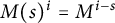 $M(s)^i=M^{i-s}$
for any
$M(s)^i=M^{i-s}$
for any $i \in \mathbf {Z}$
. This means that
$i \in \mathbf {Z}$
. This means that $M(s) \in MF^{f, [a+s,b+s]}_{\operatorname {\mathrm {tor}}, \mathbf {Z}_\ell }$
.
$M(s) \in MF^{f, [a+s,b+s]}_{\operatorname {\mathrm {tor}}, \mathbf {Z}_\ell }$
.
4.2 Extensions
To ease notation in the rest of this section, we put $\mathcal {C}_A^I=MF_{\operatorname {\mathrm {tor}}, \mathbf {Z}_\ell }^{f, I} \otimes _{\mathbf {Z}_\ell } A$
for
$\mathcal {C}_A^I=MF_{\operatorname {\mathrm {tor}}, \mathbf {Z}_\ell }^{f, I} \otimes _{\mathbf {Z}_\ell } A$
for $A \in \mathrm {LCA}_{\mathcal {O}}$
. Here,
$A \in \mathrm {LCA}_{\mathcal {O}}$
. Here, $I=[a,b]$
.
$I=[a,b]$
.
Definition 4.5 (Definition/Lemma)
Given $M, N \in \mathcal {C}_A^I$
define a filtration on the A-module
$M, N \in \mathcal {C}_A^I$
define a filtration on the A-module $\operatorname {\mathrm {Hom}}_{A}(M,N)$
by
$\operatorname {\mathrm {Hom}}_{A}(M,N)$
by
 $$ \begin{align*}\operatorname{\mathrm{Hom}}_{A}(M,N)^i=\{f\in\operatorname{\mathrm{Hom}}_{A}(M,N)\mid f(M^j)\subset N^{j+i} \text{ for all } j \in \mathbf{Z}\}\end{align*} $$
and $\mathbf {Z}_\ell $
-linear maps
$\mathbf {Z}_\ell $
-linear maps $\phi ^i: \operatorname {\mathrm {Hom}}_{A}(M,N)^i \to \operatorname {\mathrm {Hom}}_{A}(M,N)$
by
$\phi ^i: \operatorname {\mathrm {Hom}}_{A}(M,N)^i \to \operatorname {\mathrm {Hom}}_{A}(M,N)$
by
 $$ \begin{align*}\phi^i(f)(\phi^j_M(m))=\phi^{i+j}_N(f(m))\end{align*} $$
(note that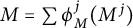 $M=\sum \phi _M^j(M^j)$
) for
$M=\sum \phi _M^j(M^j)$
) for $ f \in \operatorname {\mathrm {Hom}}_{A}(M,N)^i$
and all
$ f \in \operatorname {\mathrm {Hom}}_{A}(M,N)^i$
and all $m \in M^j$
and
$m \in M^j$
and $j \in \mathbf {Z}$
. We claim this defines a Fontaine–Laffaille structure and that
$j \in \mathbf {Z}$
. We claim this defines a Fontaine–Laffaille structure and that $\operatorname {\mathrm {Hom}}_{A}(M,N)\in MF_{\operatorname {\mathrm {tor}}, \mathbf {Z}_\ell }^{f, [a-b, b-a]} \otimes _{\mathbf {Z}_\ell } A.$
Proof First note that there exists a canonical A-module homomorphism $\psi : M^\vee \otimes _A N \to \operatorname {\mathrm {Hom}}_{A}(M,N)$
, where
$\psi : M^\vee \otimes _A N \to \operatorname {\mathrm {Hom}}_{A}(M,N)$
, where $M^\vee =\operatorname {\mathrm {Hom}}_A(M,A)$
. Definition 4.19 in [Reference Booher13] defines a Fontaine–Laffaille structure on
$M^\vee =\operatorname {\mathrm {Hom}}_A(M,A)$
. Definition 4.19 in [Reference Booher13] defines a Fontaine–Laffaille structure on $M^\vee $
(and Lemmas 4.20 and 4.21 prove that this structure is well-defined and so we get an object in
$M^\vee $
(and Lemmas 4.20 and 4.21 prove that this structure is well-defined and so we get an object in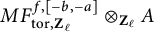 $MF_{\operatorname {\mathrm {tor}}, \mathbf {Z}_\ell }^{f, [-b, -a]} \otimes _{\mathbf {Z}_\ell } A$
). Definition 4.17 in [Reference Booher13] then gives us the Fontaine–Laffaille structure on
$MF_{\operatorname {\mathrm {tor}}, \mathbf {Z}_\ell }^{f, [-b, -a]} \otimes _{\mathbf {Z}_\ell } A$
). Definition 4.17 in [Reference Booher13] then gives us the Fontaine–Laffaille structure on $M^\vee \otimes _A N$
.
$M^\vee \otimes _A N$
.
We claim that transferring this structure on $M^\vee \otimes _A N$
via
$M^\vee \otimes _A N$
via $\psi $
to
$\psi $
to $\operatorname {\mathrm {Hom}}_{A}(M,N)$
matches our definition. Recall from [Reference Booher13] that
$\operatorname {\mathrm {Hom}}_{A}(M,N)$
matches our definition. Recall from [Reference Booher13] that $(M^\vee )^i=\{f\in \operatorname {\mathrm {Hom}}_{A}(M,A)| f(M^k) \subset \mathbf {1}_A^{i+k} \text { for all } k \in \mathbf {Z}\}$
and
$(M^\vee )^i=\{f\in \operatorname {\mathrm {Hom}}_{A}(M,A)| f(M^k) \subset \mathbf {1}_A^{i+k} \text { for all } k \in \mathbf {Z}\}$
and $(M^\vee \otimes N)^n=\sum _{i+j=n} (M^\vee )^i \otimes _A N^j.$
We will first show that
$(M^\vee \otimes N)^n=\sum _{i+j=n} (M^\vee )^i \otimes _A N^j.$
We will first show that $\psi ((M^\vee \otimes N)^n) \subset \operatorname {\mathrm {Hom}}_{A}(M,N)^n$
. Let
$\psi ((M^\vee \otimes N)^n) \subset \operatorname {\mathrm {Hom}}_{A}(M,N)^n$
. Let $f_i \otimes n_j \in (M^\vee )^i \otimes _A N^j$
. Then,
$f_i \otimes n_j \in (M^\vee )^i \otimes _A N^j$
. Then, $\psi (f_i \otimes n_j): m \in M^k \mapsto f_i(m)n_j \in N^j$
. In fact, the image lies in
$\psi (f_i \otimes n_j): m \in M^k \mapsto f_i(m)n_j \in N^j$
. In fact, the image lies in $N^{n+k}$
. This is clear for
$N^{n+k}$
. This is clear for $j \geq n+k$
. If
$j \geq n+k$
. If $j<n+k$
(and hence
$j<n+k$
(and hence $0<i+k$
) it follows since
$0<i+k$
) it follows since $f_i(m) \in \mathbf {1}_A^{i+k}=0$
. To show the reverse inclusion
$f_i(m) \in \mathbf {1}_A^{i+k}=0$
. To show the reverse inclusion $\psi ((M^\vee \otimes N)^n) \supset \operatorname {\mathrm {Hom}}_{A}(M,N)^n$
consider
$\psi ((M^\vee \otimes N)^n) \supset \operatorname {\mathrm {Hom}}_{A}(M,N)^n$
consider $f \in \operatorname {\mathrm {Hom}}_{A}(M,N)^n$
and let j be maximal among integers l such that
$f \in \operatorname {\mathrm {Hom}}_{A}(M,N)^n$
and let j be maximal among integers l such that $f(M) \subset N^l$
. To satisfy
$f(M) \subset N^l$
. To satisfy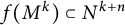 $f(M^k) \subset N^{k+n}$
for all integers
$f(M^k) \subset N^{k+n}$
for all integers $k,$
we need
$k,$
we need $f(M^k)=0$
for
$f(M^k)=0$
for $k+n>j$
by maximality of j. This means that we need f to factor through
$k+n>j$
by maximality of j. This means that we need f to factor through $M/M^{1-i}$
for
$M/M^{1-i}$
for $i:=n-j$
. By [Reference Booher13, Lemma 4.20] we have
$i:=n-j$
. By [Reference Booher13, Lemma 4.20] we have $(M^\vee )^i=\operatorname {\mathrm {Hom}}_A(M/M^{1-i}, A)$
so we get
$(M^\vee )^i=\operatorname {\mathrm {Hom}}_A(M/M^{1-i}, A)$
so we get
 $$ \begin{align*}(M^\vee)^i \otimes N^j=\operatorname{\mathrm{Hom}}_A(M/M^{1-i}, A) \otimes N^j\overset{\psi}{\cong}\operatorname{\mathrm{Hom}}_A(M/M^{1-i}, N^j).\end{align*} $$
We conclude that $f \in \psi ^{-1}((M^\vee )^i \otimes N^j) \subset \psi ^{-1}((M^\vee \otimes N)^n)$
.
$f \in \psi ^{-1}((M^\vee )^i \otimes N^j) \subset \psi ^{-1}((M^\vee \otimes N)^n)$
.
Now, we check the $\mathbf {Z}_\ell $
-linear maps: Recall from [Reference Booher13] that for
$\mathbf {Z}_\ell $
-linear maps: Recall from [Reference Booher13] that for $f \in M^\vee $
, we have
$f \in M^\vee $
, we have $\phi ^i_{M^\vee }(f)(\phi ^j_M(m))=\phi ^{i+j}(f(m))$
for all
$\phi ^i_{M^\vee }(f)(\phi ^j_M(m))=\phi ^{i+j}(f(m))$
for all $m \in M^j$
and
$m \in M^j$
and $j \in \mathbf {Z}$
. We also have
$j \in \mathbf {Z}$
. We also have $\phi ^n_{M^\vee \otimes _A N}=\sum _{i+j=n} \phi ^i_{M^\vee } \otimes \phi ^j_N.$
We claim that
$\phi ^n_{M^\vee \otimes _A N}=\sum _{i+j=n} \phi ^i_{M^\vee } \otimes \phi ^j_N.$
We claim that $\phi ^n_{\operatorname {\mathrm {Hom}}_A(M,N)} \circ \psi =\psi \circ \phi ^n_{M^\vee \otimes _A N}: (M^\vee \otimes N)^n \to \operatorname {\mathrm {Hom}}_A(M,N).$
For this, one calculates that both sides map
$\phi ^n_{\operatorname {\mathrm {Hom}}_A(M,N)} \circ \psi =\psi \circ \phi ^n_{M^\vee \otimes _A N}: (M^\vee \otimes N)^n \to \operatorname {\mathrm {Hom}}_A(M,N).$
For this, one calculates that both sides map $f \otimes n \in (M^\vee )^i \otimes N^{n-i}$
to the homomorphism, for which
$f \otimes n \in (M^\vee )^i \otimes N^{n-i}$
to the homomorphism, for which
 $$ \begin{align*}\phi^k_M(m) \mapsto \begin{cases} 0& \text{ if } i+k \geq 0\\ \phi^{n+k}_N(f(m)x)& \text{ if } i+k \leq 0 \end{cases}\end{align*} $$
for any $m \in M^k$
(for
$m \in M^k$
(for $\psi \circ \phi ^n_{M^\vee \otimes _A N}$
this uses
$\psi \circ \phi ^n_{M^\vee \otimes _A N}$
this uses $\phi ^{n+k}_N|_{N^{n-i}}=\ell ^{k+i} \phi ^{n-i}_N$
for
$\phi ^{n+k}_N|_{N^{n-i}}=\ell ^{k+i} \phi ^{n-i}_N$
for $i+k \leq 0$
). This claim, combined with the results in [Reference Booher13] shows that the definition of
$i+k \leq 0$
). This claim, combined with the results in [Reference Booher13] shows that the definition of $\phi ^n_{\operatorname {\mathrm {Hom}}_A(M,N)}$
is well-defined and satisfies the requirements for
$\phi ^n_{\operatorname {\mathrm {Hom}}_A(M,N)}$
is well-defined and satisfies the requirements for $\operatorname {\mathrm {Hom}}_A(M,N)$
to be a Fontaine–Laffaille module in
$\operatorname {\mathrm {Hom}}_A(M,N)$
to be a Fontaine–Laffaille module in $ MF_{\operatorname {\mathrm {tor}}, \mathbf {Z}_\ell }^{f, [a-b, b-a]} \otimes _{\mathbf {Z}_\ell } A$
.
$ MF_{\operatorname {\mathrm {tor}}, \mathbf {Z}_\ell }^{f, [a-b, b-a]} \otimes _{\mathbf {Z}_\ell } A$
.
For $M, N\in \mathcal {C}_A^I$
consider the map
$M, N\in \mathcal {C}_A^I$
consider the map $\phi -1: \operatorname {\mathrm {Hom}}_{A}(M,N)^0 \to \operatorname {\mathrm {Hom}}_{A}(M,N),$
which takes f to the homomorphism that sends
$\phi -1: \operatorname {\mathrm {Hom}}_{A}(M,N)^0 \to \operatorname {\mathrm {Hom}}_{A}(M,N),$
which takes f to the homomorphism that sends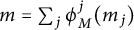 $m=\sum _j \phi ^j_{M}(m_j)$
to
$m=\sum _j \phi ^j_{M}(m_j)$
to
 $$ \begin{align*}\sum_j\phi^j_{N}(f(m_j))-f(m)=\sum_j \left(\phi^j_{N}(f(m_j))-f(\phi^j_{M}(m_{j}))\right).\end{align*} $$
Note that $\ker (\phi -1)=\operatorname {\mathrm {Hom}}_{\mathcal {C}_A^I}(M,N).$
Proposition 4.6 [Reference Clozel, Harris and Taylor18, Lemma 2.4.2] and [Reference Kalloniatis31, Proposition 2.17]
Given $M,N \in \mathcal {C}_A^I$
, we have an exact sequence of A-modules (note that
$M,N \in \mathcal {C}_A^I$
, we have an exact sequence of A-modules (note that $\operatorname {\mathrm {Hom}}_{\operatorname {\mathrm {Fil}}, A}(M,N)$
in [Reference Kalloniatis31] equals
$\operatorname {\mathrm {Hom}}_{\operatorname {\mathrm {Fil}}, A}(M,N)$
in [Reference Kalloniatis31] equals $\operatorname {\mathrm {Hom}}_{A}(M,N)^0$
)
$\operatorname {\mathrm {Hom}}_{A}(M,N)^0$
)
 $$ \begin{align*}0 \to \operatorname{\mathrm{Hom}}_{\mathcal{C}_A^I}(M,N) \to \operatorname{\mathrm{Hom}}_{A}(M,N)^0 \overset{\phi-1}{\to} \operatorname{\mathrm{Hom}}_{A}(M,N) \to \operatorname{\mathrm{Ext}}^1_{\mathcal{C}_A^I}(M,N) \to 0.\end{align*} $$
Given $M,N \in \mathcal {C}_A^I$
, we write
$M,N \in \mathcal {C}_A^I$
, we write $\mathrm {FL}(M)>\mathrm {FL}(N)$
if there is an integer j such that all elements of
$\mathrm {FL}(M)>\mathrm {FL}(N)$
if there is an integer j such that all elements of $\mathrm {FL}(M)$
are greater than or equal to j, and all elements of
$\mathrm {FL}(M)$
are greater than or equal to j, and all elements of $\mathrm {FL}(N)$
are strictly less than j.
$\mathrm {FL}(N)$
are strictly less than j.
Proposition 4.7 The extension group $\operatorname {\mathrm {Ext}}^1_{\mathcal {C}_A^I}(M,N)$
is a finitely generated A-module. Furthermore, one has:
$\operatorname {\mathrm {Ext}}^1_{\mathcal {C}_A^I}(M,N)$
is a finitely generated A-module. Furthermore, one has:
-
1. If
$\mathrm {FL}(M)>\mathrm {FL}(N)$
then
$\operatorname {\mathrm {Ext}}^1_{\mathcal {C}_A^I}(M,N) \cong \operatorname {\mathrm {Hom}}_A(M,N)$
, in particular, it is a free A-module and
$\mathrm {rk}_A(\operatorname {\mathrm {Ext}}^1_{\mathcal {C}_A^I}(M,N))=\mathrm {rk}_A(M) \mathrm {rk}_A(N)$
. -
2. If
$\mathrm {FL}(M)<\mathrm {FL}(N)$
then
$\operatorname {\mathrm {Ext}}^1_{\mathcal {C}_A^I}(M,N)=0$
.




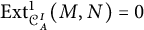
Proof This follows from Proposition 4.6. In particular,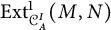 $\operatorname {\mathrm {Ext}}^1_{\mathcal {C}_A^I}(M,N)$
is a quotient of the finitely generated A-module
$\operatorname {\mathrm {Ext}}^1_{\mathcal {C}_A^I}(M,N)$
is a quotient of the finitely generated A-module $\operatorname {\mathrm {Hom}}_A(M,N)$
. The calculation on [Reference Kalloniatis31, p. 238] (“two notable cases”) is carried out for
$\operatorname {\mathrm {Hom}}_A(M,N)$
. The calculation on [Reference Kalloniatis31, p. 238] (“two notable cases”) is carried out for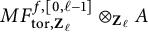 $MF^{f, [0,\ell -1]}_{\operatorname {\mathrm {tor}}, \mathbf {Z}_\ell } \otimes _{\mathbf {Z}_\ell } A$
, but applies verbatim to
$MF^{f, [0,\ell -1]}_{\operatorname {\mathrm {tor}}, \mathbf {Z}_\ell } \otimes _{\mathbf {Z}_\ell } A$
, but applies verbatim to $\mathcal {C}_A^I$
. If
$\mathcal {C}_A^I$
. If $\mathrm {FL}(M)>\mathrm {FL}(N)$
then this calculation shows that
$\mathrm {FL}(M)>\mathrm {FL}(N)$
then this calculation shows that $\operatorname {\mathrm {Hom}}_A(M,N)^0=0$
, while if
$\operatorname {\mathrm {Hom}}_A(M,N)^0=0$
, while if $\mathrm {FL}(M)<\mathrm {FL}(N)$
then one gets
$\mathrm {FL}(M)<\mathrm {FL}(N)$
then one gets $\operatorname {\mathrm {Hom}}_A(M,N)^0=\operatorname {\mathrm {Hom}}_A(M,N)$
.
$\operatorname {\mathrm {Hom}}_A(M,N)^0=\operatorname {\mathrm {Hom}}_A(M,N)$
.
Proposition 4.8 (Hom-tensor adjunction)
Let $M, N \in \mathcal {C}_A^I$
. Assume that
$M, N \in \mathcal {C}_A^I$
. Assume that $\operatorname {\mathrm {Hom}}_{A}(M,N)$
equipped with the filtration as in Definition 4.5 is an object in
$\operatorname {\mathrm {Hom}}_{A}(M,N)$
equipped with the filtration as in Definition 4.5 is an object in $\mathcal {C}_A^I$
and that
$\mathcal {C}_A^I$
and that $0 \in I$
. Then, there exists a canonical isomorphism of A-modules:
$0 \in I$
. Then, there exists a canonical isomorphism of A-modules:
 $$ \begin{align*}\operatorname{\mathrm{Ext}}^1_{\mathcal{C}_A^I}(M,N)\cong \operatorname{\mathrm{Ext}}^1_{\mathcal{C}_A^I}(\mathbf{1}_A, \operatorname{\mathrm{Hom}}_{A}(M,N)).\end{align*} $$
Proof The statement follows from the existence of the following commutative diagram with exact columns:

The exactness of both columns follows from Proposition 4.6. The second horizontal arrow is the usual isomorphism $\psi $
of A-modules given by
$\psi $
of A-modules given by $f\mapsto (a\mapsto af)$
(recall that the underlying module of the object
$f\mapsto (a\mapsto af)$
(recall that the underlying module of the object $\mathbf {1}_A$
is A) with the inverse map sending g to
$\mathbf {1}_A$
is A) with the inverse map sending g to $g(1)$
, where
$g(1)$
, where $1$
is the multiplicative identity of A. The map
$1$
is the multiplicative identity of A. The map $\tilde \psi $
is defined by lifting an element of
$\tilde \psi $
is defined by lifting an element of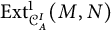 $ \operatorname {\mathrm {Ext}}^1_{\mathcal {C}_A^I}(M,N)$
to
$ \operatorname {\mathrm {Ext}}^1_{\mathcal {C}_A^I}(M,N)$
to $\operatorname {\mathrm {Hom}}_{A}(M,N)$
and using
$\operatorname {\mathrm {Hom}}_{A}(M,N)$
and using $\psi $
. The exactness of the first column ensures that such a map is well-defined.
$\psi $
. The exactness of the first column ensures that such a map is well-defined.
The first horizontal arrow is the restriction $\psi '$
of
$\psi '$
of $\psi $
to
$\psi $
to $\operatorname {\mathrm {Hom}}_{A}(M,N)^0$
(note that
$\operatorname {\mathrm {Hom}}_{A}(M,N)^0$
(note that $\operatorname {\mathrm {Hom}}_{A}(M,N)^0$
is a subgroup of
$\operatorname {\mathrm {Hom}}_{A}(M,N)^0$
is a subgroup of $\operatorname {\mathrm {Hom}}_{A}(M,N)$
even though
$\operatorname {\mathrm {Hom}}_{A}(M,N)$
even though $\phi -1$
is not necessarily injective). We need to check that
$\phi -1$
is not necessarily injective). We need to check that $\psi '$
lands in
$\psi '$
lands in $\operatorname {\mathrm {Hom}}_{ A}(\mathbf {1}_A, \operatorname {\mathrm {Hom}}_{A}(M,N))^0$
. By its definition, we need to check if
$\operatorname {\mathrm {Hom}}_{ A}(\mathbf {1}_A, \operatorname {\mathrm {Hom}}_{A}(M,N))^0$
. By its definition, we need to check if $f(\mathbf {1}_A^j) \subset \operatorname {\mathrm {Hom}}_{A}(M,N)^j$
. If
$f(\mathbf {1}_A^j) \subset \operatorname {\mathrm {Hom}}_{A}(M,N)^j$
. If $j>0$
there is nothing to check as then
$j>0$
there is nothing to check as then $\mathbf {1}_A^j=0$
, so assume that
$\mathbf {1}_A^j=0$
, so assume that $j\leq 0$
. Then,
$j\leq 0$
. Then, $\mathbf {1}_A^j=A$
and
$\mathbf {1}_A^j=A$
and $\operatorname {\mathrm {Hom}}_{A}(M,N)^j\supset \operatorname {\mathrm {Hom}}_{A}(M,N)^0$
. So, it is enough to show that if
$\operatorname {\mathrm {Hom}}_{A}(M,N)^j\supset \operatorname {\mathrm {Hom}}_{A}(M,N)^0$
. So, it is enough to show that if $f\in \operatorname {\mathrm {Hom}}_{A}(M,N)^0$
then
$f\in \operatorname {\mathrm {Hom}}_{A}(M,N)^0$
then $\psi '(f)(A)\subset \operatorname {\mathrm {Hom}}_{A}(M,N)^0$
. Let
$\psi '(f)(A)\subset \operatorname {\mathrm {Hom}}_{A}(M,N)^0$
. Let $a\in A$
. Then,
$a\in A$
. Then, $\psi '(f)(a)=af,$
which clearly lies in
$\psi '(f)(a)=af,$
which clearly lies in $\operatorname {\mathrm {Hom}}_{A}(M,N)^0$
as
$\operatorname {\mathrm {Hom}}_{A}(M,N)^0$
as $\operatorname {\mathrm {Hom}}_{A}(M,N)^0$
is an A-module.
$\operatorname {\mathrm {Hom}}_{A}(M,N)^0$
is an A-module.
Now, let $g\in \operatorname {\mathrm {Hom}}_{ A}(\mathbf {1}_A, \operatorname {\mathrm {Hom}}_{A}(M,N))^0$
. We need to show that
$g\in \operatorname {\mathrm {Hom}}_{ A}(\mathbf {1}_A, \operatorname {\mathrm {Hom}}_{A}(M,N))^0$
. We need to show that $\psi ^{-1}(g)$
lands in
$\psi ^{-1}(g)$
lands in $\operatorname {\mathrm {Hom}}_{A}(M,N)^0$
. Again we need to consider
$\operatorname {\mathrm {Hom}}_{A}(M,N)^0$
. Again we need to consider $\psi ^{-1}(g)(\mathbf {1}_A^j)$
. If
$\psi ^{-1}(g)(\mathbf {1}_A^j)$
. If $j>0$
, then
$j>0$
, then $g=0$
, hence we are done. Assume that
$g=0$
, hence we are done. Assume that $j\leq 0$
. Then,
$j\leq 0$
. Then, $\mathbf {1}_A^j=A$
and
$\mathbf {1}_A^j=A$
and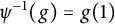 $\psi ^{-1}(g)=g(1)$
. As
$\psi ^{-1}(g)=g(1)$
. As $1\in \mathbf {1}_A^0$
and
$1\in \mathbf {1}_A^0$
and $g \in \operatorname {\mathrm {Hom}}_{ A}(\mathbf {1}_A, \operatorname {\mathrm {Hom}}_{A}(M,N))^0$
we must have that
$g \in \operatorname {\mathrm {Hom}}_{ A}(\mathbf {1}_A, \operatorname {\mathrm {Hom}}_{A}(M,N))^0$
we must have that $g(1)\in \operatorname {\mathrm {Hom}}_{A}(M,N)^0$
. So, we are done again.
$g(1)\in \operatorname {\mathrm {Hom}}_{A}(M,N)^0$
. So, we are done again.
This shows that $\psi '$
is a bijection, hence an isomorphism. Hence, by the second Four Lemma,
$\psi '$
is a bijection, hence an isomorphism. Hence, by the second Four Lemma, $\tilde \psi $
is injective, and since it is clearly surjective, it is an isomorphism.
$\tilde \psi $
is injective, and since it is clearly surjective, it is an isomorphism.
4.3 Fontaine–Laffaille Galois representations
Fix an interval $I=[a,b]$
with
$I=[a,b]$
with $a, b \in \mathbf {Z}$
and
$a, b \in \mathbf {Z}$
and $b-a \leq \ell -2$
. In this section, we introduce certain categories of
$b-a \leq \ell -2$
. In this section, we introduce certain categories of $G_{\mathbf {Q}_\ell }$
-representations and define a covariant version
$G_{\mathbf {Q}_\ell }$
-representations and define a covariant version $V_I$
of the functor in [Reference Fontaine and Laffaille25] from the categories of Fontaine–Laffaille modules defined in Section 4.1 to these categories of Galois representations.
$V_I$
of the functor in [Reference Fontaine and Laffaille25] from the categories of Fontaine–Laffaille modules defined in Section 4.1 to these categories of Galois representations.
Let $A_{\operatorname {\mathrm {cris}}}$
and
$A_{\operatorname {\mathrm {cris}}}$
and $B_{\operatorname {\mathrm {cris}}}$
denote the usual Fontaine’s
$B_{\operatorname {\mathrm {cris}}}$
denote the usual Fontaine’s $\ell $
-adic period rings (see Definitions 7.3 and 7.7 in [Reference Fontaine and Ouyang26] and [Reference Fontaine24]). We recall that a
$\ell $
-adic period rings (see Definitions 7.3 and 7.7 in [Reference Fontaine and Ouyang26] and [Reference Fontaine24]). We recall that a $\mathbf {Q}_\ell [G_{\mathbf {Q}_\ell }]$
-module V is called crystalline if
$\mathbf {Q}_\ell [G_{\mathbf {Q}_\ell }]$
-module V is called crystalline if $\dim _{\mathbf {Q}_{\ell }}V = \dim _{\mathbf {Q}_{\ell }} H^0(\mathbf {Q}_{\ell }, V \otimes _{\mathbf {Q}_{\ell }} B_{\operatorname {\mathrm {cris}}})$
. Our convention is that the Hodge–Tate weight of the cyclotomic character is
$\dim _{\mathbf {Q}_{\ell }}V = \dim _{\mathbf {Q}_{\ell }} H^0(\mathbf {Q}_{\ell }, V \otimes _{\mathbf {Q}_{\ell }} B_{\operatorname {\mathrm {cris}}})$
. Our convention is that the Hodge–Tate weight of the cyclotomic character is $+1$
.
$+1$
.
Definition 4.9 Let $A\in \mathrm {LCA}_{\mathcal {O}}$
. We introduce the following categories:
$A\in \mathrm {LCA}_{\mathcal {O}}$
. We introduce the following categories:
-
(i)
$\mathrm {Rep}_{\mathbf {Z}_\ell }^{f}(G_{\mathbf {Q}_{\ell }})$
, the category of
$\mathbf {Z}_\ell [G_{\mathbf {Q}_{\ell }}]$
-modules that are finitely generated as
$\mathbf {Z}_\ell $
-modules. -
(ii)
$\mathrm {Rep}_{\operatorname {\mathrm {tor}}, \mathbf {Z}_\ell }^{f}(G_{\mathbf {Q}_{\ell }})$
, the full subcategory of
$\mathrm {Rep}_{\mathbf {Z}_\ell }^{f}(G_{\mathbf {Q}_{\ell }})$
whose objects are required to be of finite length as
$\mathbf {Z}_\ell [G_{\mathbf {Q}_{\ell }}]$
-modules. -
(iii)
$\mathrm {Rep}_{\mathbf {Z}_\ell }^{\mathrm {cris}, I}(G_{\mathbf {Q}_\ell })$
, the full subcategory of
$\mathrm {Rep}_{\mathbf {Z}_\ell }^{f}(G_{\mathbf {Q}_{\ell }})$
whose objects are isomorphic to
$T/T'$
, where T and
$T'$
are
$G_{\mathbf {Q}_{\ell }}$
-stable finitely generated submodules of a crystalline
$\mathbf {Q}_\ell $
-representation with Hodge–Tate weights in I. -
(iv)
$\mathrm {Rep}_{\operatorname {\mathrm {tor}}, \mathbf {Z}_\ell }^{\mathrm {cris}, I}(G_{\mathbf {Q}_\ell })$
, the full subcategory of
$\mathrm {Rep}_{\operatorname {\mathrm {tor}}, \mathbf {Z}_\ell }^{f}(G_{\mathbf {Q}_{\ell }})$
whose objects are isomorphic to
$T/T'$
, where T and
$T'$
are
$G_{\mathbf {Q}_{\ell }}$
-stable lattices in a crystalline
$\mathbf {Q}_\ell $
-representation with Hodge–Tate weights in I. -
(v)
$\mathrm {Rep}_{\mathrm {free}, A}^{\mathrm {cris}, I}(G_{\mathbf {Q}_\ell })$
, the category of free finite rank A-modules M with an A-linear
$G_{\mathbf {Q}_\ell }$
-action, for which there exists a crystalline representation of
$G_{\mathbf {Q}_\ell }$
defined over E with Hodge–Tate weights in I containing
$G_{\mathbf {Q}_\ell }$
-stable
$\mathcal {O}$
-lattices
$T' \subset T$
, and an
$\mathcal {O}$
-algebra map
$A \to \mathrm {End}_{\mathcal {O}}(T/T')$
such that M is isomorphic as an
$A[G_{\mathbf {Q}_\ell }]$
-module to
$T/T'$
. We will call objects of this category Fontaine–Laffaille A-representations (with weights in I).
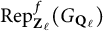


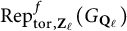
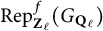

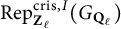
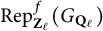


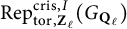
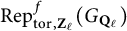


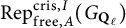





Remark 4.10 Definition 4.9(v) matches Definition 2.1 in [Reference Kalloniatis31] .
Definition 4.11 [Reference Bloch and Kato12, p. 363] and [Reference Booher13, Definitions 4.7 and 4.9]
Similar to [Reference Booher13] we define the following two functors:
-
1. A covariant functor
$T_{\mathrm {cris}}: MF^{f, [2-\ell ,0]}_{\mathbf {Z}_\ell } \to \mathrm {Rep}_{\mathbf {Z}_\ell }^{f}(G_{\mathbf {Q}_\ell })$
defined via
$$ \begin{align*}T_{\mathrm{cris}}(M):=\ker\left(1-\phi^0_{A_{\mathrm{cris}} \otimes_{\mathbf{Z}_\ell} M}: \mathrm{Fil}^0(A_{\mathrm{cris}} \otimes_{\mathbf{Z}_\ell} M) \to A_{\mathrm{cris}} \otimes_{\mathbf{Z}_\ell} M \right).\end{align*} $$
-
2. A covariant functor
$V_I: MF^{f, [a,b]}_{\mathbf {Z}_\ell } \to \mathrm {Rep}_{\mathbf {Z}_\ell }^{f}(G_{\mathbf {Q}_\ell }),$
defined via (4.2)
$$ \begin{align} V_I(M)=T_{\mathrm{cris}}(M(-b))(- b).\end{align} $$
Recall that
$M(-b)$
was defined in Definition 4.4, while
$(-b)$
on the outside denotes the Tate twist as defined in Section 2.





Remark 4.12 We note that for $?\in \{\emptyset , \operatorname {\mathrm {tor}}\},$
the category
$?\in \{\emptyset , \operatorname {\mathrm {tor}}\},$
the category $MF_{?, \mathbf {Z}_{\ell }}^{f,[a,b]}$
is a full subcategory of
$MF_{?, \mathbf {Z}_{\ell }}^{f,[a,b]}$
is a full subcategory of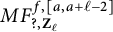 $MF_{?, \mathbf {Z}_{\ell }}^{f,[a,a+\ell -2]}$
, since they are both full subcategories of
$MF_{?, \mathbf {Z}_{\ell }}^{f,[a,a+\ell -2]}$
, since they are both full subcategories of $MF_{?, \mathbf {Z}_{\ell }}^{f}$
(cf. Definition 4.1), so in particular (4.2) makes sense.
$MF_{?, \mathbf {Z}_{\ell }}^{f}$
(cf. Definition 4.1), so in particular (4.2) makes sense.
Remark 4.13 Note that $V_I$
extends
$V_I$
extends $T_{\mathrm {cris}}$
to general I (in particular,
$T_{\mathrm {cris}}$
to general I (in particular, $V_{[2-\ell ,0]}=T_{\mathrm {cris}}$
). Also observe that for
$V_{[2-\ell ,0]}=T_{\mathrm {cris}}$
). Also observe that for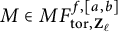 $M \in MF^{f, [a,b]}_{\operatorname {\mathrm {tor}}, \mathbf {Z}_\ell }$
, we have
$M \in MF^{f, [a,b]}_{\operatorname {\mathrm {tor}}, \mathbf {Z}_\ell }$
, we have $M(-b) \in MF^{f, [2-\ell , 0]}_{\operatorname {\mathrm {tor}}, \mathbf {Z}_\ell }$
since
$M(-b) \in MF^{f, [2-\ell , 0]}_{\operatorname {\mathrm {tor}}, \mathbf {Z}_\ell }$
since $M(-b)^{1}=M^{b+1}=0$
and
$M(-b)^{1}=M^{b+1}=0$
and $M(-b)^{2-\ell }=M^{2-\ell +b}=M$
as
$M(-b)^{2-\ell }=M^{2-\ell +b}=M$
as $b+2-\ell \leq a$
. In particular, the definition of
$b+2-\ell \leq a$
. In particular, the definition of $V_I$
makes sense.
$V_I$
makes sense.
Compared to [Reference Booher13] we work with the more restrictive interval $[2-\ell ,0]$
for
$[2-\ell ,0]$
for $T_{\mathrm {cris}}$
and correct a sign error in the Galois twist in [Reference Booher13, Definition 4.9]
$T_{\mathrm {cris}}$
and correct a sign error in the Galois twist in [Reference Booher13, Definition 4.9]
Theorem 4.14 [Reference Bloch and Kato12, Theorem 4.3] [Reference Niziol41, Section 2] [Reference Diamond, Flach and Guo20, Section 1.1.2] [Reference Hattori27, Section 2.2] [Reference Booher13, Fact 4.10] and [Reference Kalloniatis31, Theorem 2.10]
We have:
-
(i) The covariant functor
$V_{[a,b]}:MF^{f, [a,b]}_{\mathbf {Z}_\ell } \to \mathrm {Rep}^f_{\mathbf {Z}_\ell }(G_{\mathbf {Q}_\ell })$
is well-defined, exact, and fully faithful. -
(ii) For
$M \in MF^{f, [a,b]}_{\mathbf {Z}_\ell }$
, one has
$V_{[a,b]}(M)=\mathop {\varprojlim }\limits _n V_{[a,b]}(M/\ell ^n)$
. -
(iii) The essential image of
$V_{[a,b]}$
is closed under formation of sub-objects, quotients, and finite direct sums. It is given by the subcategory
$\mathrm {Rep}_{\mathbf {Z}_\ell }^{\mathrm {cris}, [-b,-a]}(G_{\mathbf {Q}_\ell })$
. For
$M \in MF^{f, [a,b]}_{\operatorname {\mathrm {tor}}, \mathbf {Z}_\ell }$
, the lengths of M and
$V_I(M)$
as
$\mathbf {Z}_\ell $
-modules agree; in particular, the essential image of
$ MF^{f, [a,b]}_{\operatorname {\mathrm {tor}}, \mathbf {Z}_\ell }$
under
$V_{[a,b]}$
is
$\mathrm {Rep}_{\operatorname {\mathrm {tor}}, \mathbf {Z}_\ell }^{\mathrm {cris}, [-b,-a]}(G_{\mathbf {Q}_\ell })$
. -
(iv) For
$A \in \mathrm {LCA}_{\mathcal {O}}$
, the functor
$V_{[a,b]}$
induces a functor from
$MF^{f, [a,b]}_{\operatorname {\mathrm {tor}}, \mathbf {Z}_\ell } \otimes _{\mathbf {Z}_\ell } A$
to the category of free finite rank A-modules with an A-linear
$G_{\mathbf {Q}_\ell }$
-action, which we will also denote by
$V_{[a,b]}$
. Its essential image is given by
$\mathrm {Rep}^{\mathrm {cris}, [-b,-a]}_{\mathrm {free}, A}(G_{\mathbf {Q}_\ell })$
. In fact,
$V_{[a,b]}$
gives an equivalence of categories between
$ MF^{f, [a,b]}_{\operatorname {\mathrm {tor}}, \mathbf {Z}_\ell } \otimes _{\mathbf {Z}_\ell } A $
and
$\mathrm {Rep}^{\mathrm {cris}, [-b,-a]}_{\mathrm {free}, A}(G_{\mathbf {Q}_\ell })$
.

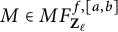



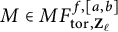





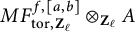




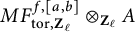

Remark 4.15
-
(1) Note that for
$M \in MF^{f, [a,b]}_{\operatorname {\mathrm {tor}}, \mathbf {Z}_\ell }$
, we have
$V_{[a+s,b+s]}(M(s))=V_{[a,b]}(M)(-s)$
. -
(2) For
$I=[a,b]=[0, \ell -2],$
the functor
$V_I$
agrees with that of the functor
$\mathbb {V}$
in [Reference Diamond, Flach and Guo20, p. 670] by [Reference Breuil14, Proposition 3.2.1.7] -
(3) For
$M \in MF^{f, [a,b]}_{\operatorname {\mathrm {tor}}, \mathbf {Z}_\ell } \otimes _{\mathbf {Z}_\ell } A$
, the Hodge–Tate weights of
$V_I(M)$
(in the sense of Definition 4.9(3)) equal the negatives of the Fontaine–Laffaille weights of M, defined in Definition 4.1(3), due to our convention that the Hodge–Tate weight of the cyclotomic character is
$+1$
.
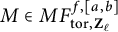







As an immediate consequence of the equivalence of categories in Theorem 4.14(iv), we obtain the following corollary.
Corollary 4.16 For any $M, N \in MF_{\operatorname {\mathrm {tor}}, \mathbf {Z}_\ell }^{f, I} \otimes _{\mathbf {Z}_\ell } A,$
there is an isomorphism of A-modules
$M, N \in MF_{\operatorname {\mathrm {tor}}, \mathbf {Z}_\ell }^{f, I} \otimes _{\mathbf {Z}_\ell } A,$
there is an isomorphism of A-modules
 $$ \begin{align} \mathrm{Ext}^1_{MF_{\operatorname{\mathrm{tor}}, \mathbf{Z}_\ell}^{f, I} \otimes_{\mathbf{Z}_\ell} A}(M,N)\cong\mathrm{Ext}^1_{ \mathrm{Rep}_{A}^{\mathrm{cris}, -I}(G_{\mathbf{Q}_{\ell}})}(V_I(M),V_I(N)).\end{align} $$
4.4 Local Selmer groups
Let $I=[a,b]$
be an interval as in the previous section (so
$I=[a,b]$
be an interval as in the previous section (so $0\leq b-a\leq \ell -2$
) but we now also require that
$0\leq b-a\leq \ell -2$
) but we now also require that $0 \in I$
(so that
$0 \in I$
(so that $\mathbf {1} \in MF^{f, I}_{\mathbf {Z}_\ell }$
, see Definition 4.3).
$\mathbf {1} \in MF^{f, I}_{\mathbf {Z}_\ell }$
, see Definition 4.3).
For an extension between two objects $M,N$
in
$M,N$
in $\mathrm {Rep}_{A}(G_{\mathbf {Q}_\ell }) 0 \to M \to E \to N \to 0,$
we define the n-th Tate twist of the extension to be the extension
$\mathrm {Rep}_{A}(G_{\mathbf {Q}_\ell }) 0 \to M \to E \to N \to 0,$
we define the n-th Tate twist of the extension to be the extension $0 \to M(n) \to E(n) \to N(n) \to 0.$
For a subgroup G of
$0 \to M(n) \to E(n) \to N(n) \to 0.$
For a subgroup G of $\mathrm {Ext}^1_{\mathrm {Rep}_{A}(G_{\mathbf {Q}_{\ell }})}(M,N),$
we define
$\mathrm {Ext}^1_{\mathrm {Rep}_{A}(G_{\mathbf {Q}_{\ell }})}(M,N),$
we define $G(n)$
to consist of extensions which are the n-th Tate twists of the elements of G.
$G(n)$
to consist of extensions which are the n-th Tate twists of the elements of G.
Given an extension $\mathcal {E} \in \mathrm {Ext}^1_{MF^{f, I}_{\operatorname {\mathrm {tor}}, \mathbf {Z}_\ell } \otimes _{\mathbf {Z}_\ell } A}(M_3,M_1)$
represented by an exact sequence
$\mathcal {E} \in \mathrm {Ext}^1_{MF^{f, I}_{\operatorname {\mathrm {tor}}, \mathbf {Z}_\ell } \otimes _{\mathbf {Z}_\ell } A}(M_3,M_1)$
represented by an exact sequence
 $$ \begin{align*}0 \to M_1 \to M_2 \to M_3 \to 0\end{align*} $$
we will write $V_I(\mathcal {E})$
for the extension in
$V_I(\mathcal {E})$
for the extension in $\mathrm {Ext}^1_{\mathrm {Rep}^{\mathrm {cris}, -I}_{\mathrm {free}, A}(G_{\mathbf {Q}_{\ell }})} (V_I(M_3),V_I(M_1))$
represented by
$\mathrm {Ext}^1_{\mathrm {Rep}^{\mathrm {cris}, -I}_{\mathrm {free}, A}(G_{\mathbf {Q}_{\ell }})} (V_I(M_3),V_I(M_1))$
represented by
 $$ \begin{align*}0 \to V_I(M_1) \to V_I(M_2) \to V_I(M_3) \to 0.\end{align*} $$
This uses the exactness of the functor $V_I$
(cf. Theorem 4.14(i)). Since we defined
$V_I$
(cf. Theorem 4.14(i)). Since we defined $V_I(M)=T_{\mathrm {cris}}(M(-b))(-b)$
(see Equation (4.2)), we conclude the following lemma.
$V_I(M)=T_{\mathrm {cris}}(M(-b))(-b)$
(see Equation (4.2)), we conclude the following lemma.
Lemma 4.17 For $A \in \mathrm {LCA}_{\mathcal {O}}$
and
$A \in \mathrm {LCA}_{\mathcal {O}}$
and $M \in MF^{f, I}_{\operatorname {\mathrm {tor}}, \mathbf {Z}_\ell } \otimes _{\mathbf {Z}_\ell } A,$
we have
$M \in MF^{f, I}_{\operatorname {\mathrm {tor}}, \mathbf {Z}_\ell } \otimes _{\mathbf {Z}_\ell } A,$
we have
 $$ \begin{align*} V_I(\mathrm{Ext}^1_{MF^{f, I}_{\operatorname{\mathrm{tor}}, \mathbf{Z}_\ell} \otimes_{\mathbf{Z}_\ell} A}(\mathbf{1}_A,M))&=\mathrm{Ext}^1_{\mathrm{Rep}^{\mathrm{cris}, -I}_{\mathrm{free}, A}(G_{\mathbf{Q}_\ell})}(T_{\mathrm{cris}}(M_{-b, A})(-b),T_{\mathrm{cris}}(M(-b))(-b))\\ &\cong \mathrm{Ext}^1_{\mathrm{Rep}^{\mathrm{cris}, [0,\ell-2]}_{\mathrm{free}, A}(G_{\mathbf{Q}_\ell})}(A(b), T_{\mathrm{cris}}(M(-b)))(- b). \end{align*} $$
Note that the latter is naturally isomorphic to $\mathrm {Ext}^1_{\mathrm {Rep}^{\mathrm {cris}, [0,\ell -2]}_{\mathrm {free}, A}(G_{\mathbf {Q}_{\ell }})}(A(b), T_{\mathrm {cris}}(M(-b)))$
and they give rise to the same subgroup of
$\mathrm {Ext}^1_{\mathrm {Rep}^{\mathrm {cris}, [0,\ell -2]}_{\mathrm {free}, A}(G_{\mathbf {Q}_{\ell }})}(A(b), T_{\mathrm {cris}}(M(-b)))$
and they give rise to the same subgroup of $H^1(\mathbf {Q}_\ell , V_I(M))$
, see Definition 4.18.
$H^1(\mathbf {Q}_\ell , V_I(M))$
, see Definition 4.18.
Definition 4.18 For $M \in MF^{f, I}_{\operatorname {\mathrm {tor}}, \mathbf {Z}_\ell } \otimes _{\mathbf {Z}_\ell } A,$
let
$M \in MF^{f, I}_{\operatorname {\mathrm {tor}}, \mathbf {Z}_\ell } \otimes _{\mathbf {Z}_\ell } A,$
let $H^1_{f, I}(\mathbf {Q}_\ell , V_I(M))=V_I(\mathrm {Ext}^1_{MF^{f, I}_{\operatorname {\mathrm {tor}}, \mathbf {Z}_\ell }\otimes _{\mathbf {Z}_\ell } A}(\mathbf {1}_A,M)) \subset H^1(\mathbf {Q}_\ell , V_I(M))$
.
$H^1_{f, I}(\mathbf {Q}_\ell , V_I(M))=V_I(\mathrm {Ext}^1_{MF^{f, I}_{\operatorname {\mathrm {tor}}, \mathbf {Z}_\ell }\otimes _{\mathbf {Z}_\ell } A}(\mathbf {1}_A,M)) \subset H^1(\mathbf {Q}_\ell , V_I(M))$
.
Remark 4.19 This is a more precise version of the definition made in [Reference Berger and Klosin6, Section 5.2.1] (where the prime $\ell $
was denoted by p). In [Reference Berger and Klosin6] we worked (implicitly) with
$\ell $
was denoted by p). In [Reference Berger and Klosin6] we worked (implicitly) with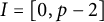 $I=[0,p-2]$
, but the results in [Reference Berger and Klosin6, Section 5] (in particular, Corollary 5.4 and Proposition 5.8 restated below) carry over to
$I=[0,p-2]$
, but the results in [Reference Berger and Klosin6, Section 5] (in particular, Corollary 5.4 and Proposition 5.8 restated below) carry over to $H^1_{f, I}$
defined here for general I.
$H^1_{f, I}$
defined here for general I.
T.B. and K.K. would like to clarify how certain definitions and results in some of our papers fit in with this more precise description of the groups $H^1_{f, I}$
: In [Reference Berger and Klosin8] the relevant interval I is
$H^1_{f, I}$
: In [Reference Berger and Klosin8] the relevant interval I is $I=[1-k, k-1]$
for Section 5, and p should satisfy
$I=[1-k, k-1]$
for Section 5, and p should satisfy $p-1>2k-2$
. The examples in Section 6 of [loc. cit] satisfy this stronger condition. Similarly, in [Reference Berger and Klosin9] one has
$p-1>2k-2$
. The examples in Section 6 of [loc. cit] satisfy this stronger condition. Similarly, in [Reference Berger and Klosin9] one has $I=[3-2k, 2k-3]$
(
$I=[3-2k, 2k-3]$
( $p-1>4k-6$
). In [Reference Berger and Klosin6, Section 6] the suitable interval I is such that
$p-1>4k-6$
). In [Reference Berger and Klosin6, Section 6] the suitable interval I is such that $\operatorname {\mathrm {Hom}}_{\mathcal {O}}(\tilde \rho _2, \tilde \rho _1)$
has Hodge–Tate weights in I. For
$\operatorname {\mathrm {Hom}}_{\mathcal {O}}(\tilde \rho _2, \tilde \rho _1)$
has Hodge–Tate weights in I. For $i, j \in \{1, 2\},$
the local condition at
$i, j \in \{1, 2\},$
the local condition at $v \mid p$
for the Selmer groups
$v \mid p$
for the Selmer groups $H^1_\Sigma (F, \operatorname {\mathrm {Hom}}_{\mathbf {F}}(\rho _i, \rho _j))$
is
$H^1_\Sigma (F, \operatorname {\mathrm {Hom}}_{\mathbf {F}}(\rho _i, \rho _j))$
is $H^1_{f, I}(F_v, \operatorname {\mathrm {Hom}}_{\mathbf {F}}(\tilde \rho _i, \tilde \rho _j))$
. In [loc.cit.] Section 9, one has
$H^1_{f, I}(F_v, \operatorname {\mathrm {Hom}}_{\mathbf {F}}(\tilde \rho _i, \tilde \rho _j))$
. In [loc.cit.] Section 9, one has $I=[-1,1]$
(
$I=[-1,1]$
( $p-1>2$
), in Section 10,
$p-1>2$
), in Section 10, $I=[1-k,k-1]$
(
$I=[1-k,k-1]$
( $p-1>2k-2$
). In [Reference Berger and Klosin7, Sections 7 and 8] the same comment applies as for [Reference Berger and Klosin6, Section 9]
$p-1>2k-2$
). In [Reference Berger and Klosin7, Sections 7 and 8] the same comment applies as for [Reference Berger and Klosin6, Section 9]
In J.B.’s paper [Reference Brown16] the argument in Sections 8 and 9 to show the splitting at $\ell $
of
$\ell $
of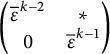 $\begin {pmatrix} \overline {\epsilon }^{k-2}&*\\0&\overline {\epsilon }^{k-1} \end {pmatrix}$
by relating it to
$\begin {pmatrix} \overline {\epsilon }^{k-2}&*\\0&\overline {\epsilon }^{k-1} \end {pmatrix}$
by relating it to $H^1_f(\mathbf {Q}_\ell , \mathbf {F}(-1))=0$
requires an interval I containing
$H^1_f(\mathbf {Q}_\ell , \mathbf {F}(-1))=0$
requires an interval I containing $-1$
and
$-1$
and $2k-3$
, so would need
$2k-3$
, so would need $p-1>2k-2$
. However, one could instead not twist and invoke Proposition 4.7.
$p-1>2k-2$
. However, one could instead not twist and invoke Proposition 4.7.
Similar comments apply to other results in the literature, e.g., in [Reference Diamond, Flach and Guo20, Corollary 2.3] the expression $H^1_f(\mathbf {Q}_\ell , \mathrm {ad}^0_{\kappa } \overline {L})$
is only indirectly defined by
$H^1_f(\mathbf {Q}_\ell , \mathrm {ad}^0_{\kappa } \overline {L})$
is only indirectly defined by $H^1_f(\mathbf {Q}_\ell , \mathrm {ad}_{\kappa } \overline {L})=H^1_f(\mathbf {Q}_\ell , \mathrm {ad}^0_{\kappa } \overline {L}) \oplus H^1_f(\mathbf {Q}_\ell , \kappa )$
. To define the Selmer group for the trace zero endomorphisms and prove this identity requires
$H^1_f(\mathbf {Q}_\ell , \mathrm {ad}_{\kappa } \overline {L})=H^1_f(\mathbf {Q}_\ell , \mathrm {ad}^0_{\kappa } \overline {L}) \oplus H^1_f(\mathbf {Q}_\ell , \kappa )$
. To define the Selmer group for the trace zero endomorphisms and prove this identity requires $\mathrm {ad}^0_{\kappa }$
to lie in the essential image of the Fontaine–Laffaille functor, and therefore
$\mathrm {ad}^0_{\kappa }$
to lie in the essential image of the Fontaine–Laffaille functor, and therefore $I=[1-k, k-1]$
should be specified, rather than
$I=[1-k, k-1]$
should be specified, rather than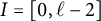 $I=[0, \ell -2]$
as in [Reference Diamond, Flach and Guo20, Section 1.1.2]
$I=[0, \ell -2]$
as in [Reference Diamond, Flach and Guo20, Section 1.1.2]
If $M,N \in \mathrm {Rep}_{\mathrm {free}, A}^{\mathrm {cris}, I}(G_{\mathbf {Q}_{\ell }})$
, then
$M,N \in \mathrm {Rep}_{\mathrm {free}, A}^{\mathrm {cris}, I}(G_{\mathbf {Q}_{\ell }})$
, then $M\oplus N\in \mathrm {Rep}_{\mathrm {free}, A}^{\mathrm {cris}, I}(G_{\mathbf {Q}_{\ell }})$
and it is clear that
$M\oplus N\in \mathrm {Rep}_{\mathrm {free}, A}^{\mathrm {cris}, I}(G_{\mathbf {Q}_{\ell }})$
and it is clear that
 $$ \begin{align} H^1_{f,I}(\mathbf{Q}_{\ell}, M\oplus N)=H^1_{f, I}(\mathbf{Q}_{\ell}, M)\oplus H^1_{f,I}(\mathbf{Q}_{\ell}, N)\end{align} $$
because the extension groups as well as the functor $V_I$
commute with direct sums.
$V_I$
commute with direct sums.
Proposition 4.20 For any $n \in [2-\ell , \ell -2]$
such that
$n \in [2-\ell , \ell -2]$
such that $0, -n \in I,$
the group
$0, -n \in I,$
the group $H^1_{f, I}(\mathbf {Q}_\ell , V_I(M_{-n, \mathbf {F}}))$
is independent of I. In fact, we have
$H^1_{f, I}(\mathbf {Q}_\ell , V_I(M_{-n, \mathbf {F}}))$
is independent of I. In fact, we have
 $$ \begin{align*}H^1_{f, I}(\mathbf{Q}_\ell, \mathbf{F}(n))=\begin{cases} 0 & n<0\\ H^1_{\operatorname{\mathrm{un}}}(\mathbf{Q}_\ell, \mathbf{F}) & n=0\\ H^1_{\mathrm{fl}}(\mathbf{Q}_\ell, \mu_\ell)& n=1\\ H^1(\mathbf{Q}_\ell, \mathbf{F}(n))& n>1,\end{cases}\end{align*} $$
where
 $$ \begin{align*}H^1_{\operatorname{\mathrm{un}}}(\mathbf{Q}_\ell, \mathbf{F}):=\ker(H^1(\mathbf{Q}_\ell, \mathbf{F}) \to H^1(I_\ell, \mathbf{F})) \cong \operatorname{\mathrm{Hom}}(G_{\mathbf{Q}_\ell}/I_\ell, \mathbf{F})\end{align*} $$
and $H^1_{\mathrm {fl}}(\mathbf {Q}_\ell , \mu _\ell )$
denotes the peu ramifiée classes, namely, those classes corresponding to
$H^1_{\mathrm {fl}}(\mathbf {Q}_\ell , \mu _\ell )$
denotes the peu ramifiée classes, namely, those classes corresponding to $\mathbf {Z}_\ell ^\times /(\mathbf {Z}_\ell ^\times )^\ell \subset \mathbf {Q}_\ell ^\times /(\mathbf {Q}_\ell ^\times )^\ell \cong H^1(\mathbf {Q}_\ell , \mathbf {F}(1))$
. For
$\mathbf {Z}_\ell ^\times /(\mathbf {Z}_\ell ^\times )^\ell \subset \mathbf {Q}_\ell ^\times /(\mathbf {Q}_\ell ^\times )^\ell \cong H^1(\mathbf {Q}_\ell , \mathbf {F}(1))$
. For $n \geq 0,$
we note that
$n \geq 0,$
we note that $\dim _{\mathbf {F}} H^1_{f, I}(\mathbf {Q}_\ell , \mathbf {F}(n)) =1$
.
$\dim _{\mathbf {F}} H^1_{f, I}(\mathbf {Q}_\ell , \mathbf {F}(n)) =1$
.
Remark 4.21
-
(1) Proposition 4.20 justifies writing
$H^1_{\Sigma }(\mathbf {Q}_\ell , V_I(M_n))$
as we did in [Reference Berger and Klosin8], without specifying the interval I, as long as I contains
$-n$
. Under the conditions of Proposition 4.23 (see comment after Proposition 5.1), once we have fixed a suitable interval
$I,$
we will also drop the subscript I in this article. -
(2) Note that the definition of
$H^1_{f, I}(\mathbf {Q}_\ell , V_I(M_n))$
depends on
$n \in \mathbf {Z}$
, even though the coefficients
$V_I(M_n)=\mathbf {F}(n)$
only depend on
$n\ \mod {\ell -1}$
. -
(3) [Reference Niziol41, Section 9.3] states a version of this result for the local crystalline cohomology of unramified extensions of
$\mathbf {Q}_\ell $
and with
$\mathbf {Z}_\ell /\ell ^m(n)$
coefficients for
$m \in \mathbf {Z}_{>0}$
.








Proof We first note that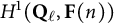 $H^1(\mathbf {Q}_\ell , \mathbf {F}(n))$
is one-dimensional for
$H^1(\mathbf {Q}_\ell , \mathbf {F}(n))$
is one-dimensional for $n \neq 0,1$
, which follows from local Tate duality and the Euler characteristic formula (see, e.g., [Reference Washington58, Theorem 1 and Proposition 3]
$n \neq 0,1$
, which follows from local Tate duality and the Euler characteristic formula (see, e.g., [Reference Washington58, Theorem 1 and Proposition 3]
For $n=0,$
we refer the reader to [Reference Clozel, Harris and Taylor18, Corollary 2.4.4] for identifying
$n=0,$
we refer the reader to [Reference Clozel, Harris and Taylor18, Corollary 2.4.4] for identifying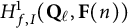 $H^1_{f, I}(\mathbf {Q}_\ell , \mathbf {F}(n))$
with
$H^1_{f, I}(\mathbf {Q}_\ell , \mathbf {F}(n))$
with $H^1_{\operatorname {\mathrm {un}}}(\mathbf {Q}_\ell , \mathbf {F})$
. That
$H^1_{\operatorname {\mathrm {un}}}(\mathbf {Q}_\ell , \mathbf {F})$
. That $H^1_{\operatorname {\mathrm {un}}}(\mathbf {Q}_\ell , \mathbf {F})$
is one-dimensional follows since
$H^1_{\operatorname {\mathrm {un}}}(\mathbf {Q}_\ell , \mathbf {F})$
is one-dimensional follows since $\#H^1(G_{\mathbf {Q}_\ell }/I_\ell , \mathbf {F})=\#H^0(\mathbf {Q}_\ell , \mathbf {F})$
. Recall that
$\#H^1(G_{\mathbf {Q}_\ell }/I_\ell , \mathbf {F})=\#H^0(\mathbf {Q}_\ell , \mathbf {F})$
. Recall that
 $$ \begin{align*}H^1_{f, I}(\mathbf{Q}_\ell, \mathbf{F}(n))=H^1_{f, I}(\mathbf{Q}_\ell, V_I(M_{-n, \mathbf{F}}))=V_I(\mathrm{Ext}^1_{MF^{f, I}_{\operatorname{\mathrm{tor}}, \mathbf{Z}_\ell} \otimes_{\mathbf{Z}_\ell} \mathbf{F}}(M_{0, \mathbf{F}},M_{-n, \mathbf{F}})).\end{align*} $$
If $n<0$
then by Proposition 4.7(ii)
$n<0$
then by Proposition 4.7(ii) $\mathrm {Ext}^1_{MF^{f, I}_{\operatorname {\mathrm {tor}}, \mathbf {Z}_\ell }\otimes _{\mathbf {Z}_\ell } \mathbf {F}}(M_{0, \mathbf {F}},M_{-n,\mathbf {F}})=0$
since the Fontaine–Laffaille weights satisfy the inequality
$\mathrm {Ext}^1_{MF^{f, I}_{\operatorname {\mathrm {tor}}, \mathbf {Z}_\ell }\otimes _{\mathbf {Z}_\ell } \mathbf {F}}(M_{0, \mathbf {F}},M_{-n,\mathbf {F}})=0$
since the Fontaine–Laffaille weights satisfy the inequality $-n>0$
.
$-n>0$
.
On the other hand, if $n> 0$
then
$n> 0$
then $H^1_{f, I}(\mathbf {Q}_\ell , V_I(M_{-n}))$
is one-dimensional by Proposition 4.7(i). For
$H^1_{f, I}(\mathbf {Q}_\ell , V_I(M_{-n}))$
is one-dimensional by Proposition 4.7(i). For $n>1,$
this equals
$n>1,$
this equals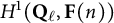 $H^1(\mathbf {Q}_\ell , \mathbf {F}(n))$
by our observation at the start of the proof.
$H^1(\mathbf {Q}_\ell , \mathbf {F}(n))$
by our observation at the start of the proof.
For $n=1,$
we have
$n=1,$
we have $H^1(\mathbf {Q}_\ell , \mathbf {F}(1)) \cong \mathbf {Q}_\ell ^\times /(\mathbf {Q}_\ell ^\times )^\ell $
is two-dimensional, and one can identify the Fontaine–Laffaille extensions with the peu ramifiée classes (see, e.g., [Reference Breuil15, Lemma 8.1.3]
$H^1(\mathbf {Q}_\ell , \mathbf {F}(1)) \cong \mathbf {Q}_\ell ^\times /(\mathbf {Q}_\ell ^\times )^\ell $
is two-dimensional, and one can identify the Fontaine–Laffaille extensions with the peu ramifiée classes (see, e.g., [Reference Breuil15, Lemma 8.1.3]
Remark 4.22 Note that $[2-\ell , 0]$
contains both
$[2-\ell , 0]$
contains both $0$
and
$0$
and $2-\ell $
(and is the only interval of this length that contains both). Then, since
$2-\ell $
(and is the only interval of this length that contains both). Then, since $\mathbf {F}(-1)=\mathbf {F}(\ell -2)=V_{[2-\ell , 0]}(M_{2-\ell }),$
we get
$\mathbf {F}(-1)=\mathbf {F}(\ell -2)=V_{[2-\ell , 0]}(M_{2-\ell }),$
we get
 $$ \begin{align*} H^1_{f, [2-\ell, 0]}(\mathbf{Q}_\ell, \mathbf{F}(-1))&=H^1_{f, [2-\ell, 0]}(\mathbf{Q}_\ell, \mathbf{F}(\ell-2))\\ &=H^1_{f, [2-\ell, 0]}(\mathbf{Q}_\ell, V_{[2-\ell, 0]}(M_{2-\ell, \mathbf{F}}))\\ &\neq 0, \end{align*} $$
corresponding to the crystalline non-split extension $\begin {pmatrix} \overline {\epsilon }^{\ell -2}&*\\0&1 \end {pmatrix}$
. Note that
$\begin {pmatrix} \overline {\epsilon }^{\ell -2}&*\\0&1 \end {pmatrix}$
. Note that $1 \notin [2-\ell , 0]$
.
$1 \notin [2-\ell , 0]$
.
However, for all other intervals $I \subset [2-\ell , \ell -2]$
of length
$I \subset [2-\ell , \ell -2]$
of length $\ell -2,$
we have
$\ell -2,$
we have $1 \in I$
and so
$1 \in I$
and so
 $$ \begin{align*} H^1_{f, I}(\mathbf{Q}_\ell, \mathbf{F}(-1))&=V_I(\mathrm{Ext}^1_{ MF^{f, [a,b]}_{\operatorname{\mathrm{tor}}, \mathbf{Z}_\ell}}(M_{0, \mathbf{F}},M_{1, \mathbf{F}}))\\ &=T_{\mathrm{cris}}(\mathrm{Ext}^1_{MF^{f, [2-\ell,0]}_{\operatorname{\mathrm{tor}}, \mathbf{Z}_\ell}}(M_{-b, \mathbf{F}},M_{1-b, \mathbf{F}}))(-b)\\ &=0 \end{align*} $$
by Proposition 4.20. This demonstrates that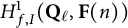 $H^1_{f, I}(\mathbf {Q}_\ell , \mathbf {F}(n))$
is only independent of I for I containing
$H^1_{f, I}(\mathbf {Q}_\ell , \mathbf {F}(n))$
is only independent of I for I containing $-n$
.
$-n$
.
Following [Reference Bloch and Kato12] for a $\mathbf {Q}_\ell [G_{\mathbf {Q}_\ell }]$
-module V define
$\mathbf {Q}_\ell [G_{\mathbf {Q}_\ell }]$
-module V define $H_{f}^1(\mathbf {Q}_\ell ,V)= \ker \left (H^1(\mathbf {Q}_\ell ,V) \rightarrow H^1(\mathbf {Q}_\ell , V \otimes _{\mathbf {Q}_{\ell }} B_{\operatorname {\mathrm {cris}}})\right ).$
Let V be a finite-dimensional E-vector space and
$H_{f}^1(\mathbf {Q}_\ell ,V)= \ker \left (H^1(\mathbf {Q}_\ell ,V) \rightarrow H^1(\mathbf {Q}_\ell , V \otimes _{\mathbf {Q}_{\ell }} B_{\operatorname {\mathrm {cris}}})\right ).$
Let V be a finite-dimensional E-vector space and $T \subset V$
be a
$T \subset V$
be a $G_{\mathbf {Q}_\ell }$
-stable
$G_{\mathbf {Q}_\ell }$
-stable $\mathcal {O}$
-lattice, i.e., T is a free
$\mathcal {O}$
-lattice, i.e., T is a free $\mathcal {O}$
-submodule of V that spans V as a vector space over E. We set
$\mathcal {O}$
-submodule of V that spans V as a vector space over E. We set $W = V/T$
and
$W = V/T$
and $W[\lambda ^{m}] = \{w \in W: \lambda ^{m}w = 0\} \cong T/\lambda ^{m} T$
for any
$W[\lambda ^{m}] = \{w \in W: \lambda ^{m}w = 0\} \cong T/\lambda ^{m} T$
for any $m \in \mathbf {Z}_{>0}$
. Note that
$m \in \mathbf {Z}_{>0}$
. Note that $W[\lambda ^{m}]$
lies in
$W[\lambda ^{m}]$
lies in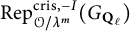 $\mathrm {Rep}^{\mathrm {cris}, -I}_{\mathcal {O}/\lambda ^m}(G_{\mathbf {Q}_\ell })$
if V is crystalline with Hodge–Tate weights in
$\mathrm {Rep}^{\mathrm {cris}, -I}_{\mathcal {O}/\lambda ^m}(G_{\mathbf {Q}_\ell })$
if V is crystalline with Hodge–Tate weights in $-I$
. We let
$-I$
. We let $H^1_{f}(\mathbf {Q}_\ell ,W)$
be the image of
$H^1_{f}(\mathbf {Q}_\ell ,W)$
be the image of $H^1_{f}(\mathbf {Q}_\ell ,V)$
under the natural map
$H^1_{f}(\mathbf {Q}_\ell ,V)$
under the natural map $H^1(\mathbf {Q}_\ell ,V) \rightarrow H^1(\mathbf {Q}_\ell ,W)$
.
$H^1(\mathbf {Q}_\ell ,V) \rightarrow H^1(\mathbf {Q}_\ell ,W)$
.
Proposition 4.23 [Reference Diamond, Flach and Guo20, Proposition 2.2]
Assume V is a crystalline $E[G_{\mathbf {Q}_\ell }]$
-module as above with Hodge–Tate weights in
$E[G_{\mathbf {Q}_\ell }]$
-module as above with Hodge–Tate weights in $-I=[-b,-a]$
(and
$-I=[-b,-a]$
(and $0 \in I$
). For
$0 \in I$
). For $T \subset V$
and
$T \subset V$
and $W=V/T$
as above, we then have
$W=V/T$
as above, we then have $H^1_{f}(\mathbf {Q}_\ell , W)= \mathop {\varinjlim }\limits _m H^1_{f,I}(\mathbf {Q}_\ell , W[\lambda ^m])$
.
$H^1_{f}(\mathbf {Q}_\ell , W)= \mathop {\varinjlim }\limits _m H^1_{f,I}(\mathbf {Q}_\ell , W[\lambda ^m])$
.
Proof We note that the proof of [Reference Diamond, Flach and Guo20, Proposition 2.2] carries over from $[0, \ell -2]$
to general I (in particular, one has Proposition 4.6) and apply the argument with (in their notation)
$[0, \ell -2]$
to general I (in particular, one has Proposition 4.6) and apply the argument with (in their notation) $V_1$
the trivial
$V_1$
the trivial $G_{\mathbf {Q}_\ell }$
-representation and
$G_{\mathbf {Q}_\ell }$
-representation and $V_2=V$
.
$V_2=V$
.
Corollary 4.24 [Reference Diamond, Flach and Guo20, (33)] and [Reference Berger and Klosin6, Corollary 5.4]
For every $m \in \mathbf {Z}_{>0}$
, we have an exact sequence of
$m \in \mathbf {Z}_{>0}$
, we have an exact sequence of $\mathcal {O}$
-modules
$\mathcal {O}$
-modules
 $$ \begin{align*}0 \to H^0(\mathbf{Q}_\ell, W)/\lambda^m \to H^1_{f, I}(\mathbf{Q}_\ell, W[\lambda^m]) \to H^1_f(\mathbf{Q}_\ell, W)[\lambda^m] \to 0.\end{align*} $$
Corollary 4.25 For $n \in \mathbf {Z}$
with
$n \in \mathbf {Z}$
with $0, n \in I \subset [2-\ell , \ell -2]$
and
$0, n \in I \subset [2-\ell , \ell -2]$
and $n \neq 0,$
we have
$n \neq 0,$
we have
 $$ \begin{align*}H^1_{f, I}(\mathbf{Q}_\ell, V_I(M_{-n, \mathbf{F}}))= H^1_f(\mathbf{Q}_\ell, E/\mathcal{O}(n))[\lambda].\end{align*} $$
Proof Note that $H^0(\mathbf {Q}_\ell , E/\mathcal {O}(n)[\lambda ])=0$
since
$H^0(\mathbf {Q}_\ell , E/\mathcal {O}(n)[\lambda ])=0$
since $n \not \equiv 0\ \mod {\ell -1}$
. This implies
$n \not \equiv 0\ \mod {\ell -1}$
. This implies $H^0(\mathbf {Q}_\ell , E/\mathcal {O}(n))=0$
, hence, we are done by Corollary 4.24.
$H^0(\mathbf {Q}_\ell , E/\mathcal {O}(n))=0$
, hence, we are done by Corollary 4.24.
5 Selmer groups
5.1 Definitions
For M a topological $\mathbf {Z}_\ell [G_{\mathbf {Q}}]$
-module set
$\mathbf {Z}_\ell [G_{\mathbf {Q}}]$
-module set
 $$ \begin{align*} H^1_{\operatorname{\mathrm{un}}}(\mathbf{Q}_{p},M):= \ker\left(H^1(\mathbf{Q}_{p},M) \rightarrow H^1(I_{p},M)\right) \end{align*} $$
for every prime p. Let $E/\mathbf {Q}_{\ell }$
be a finite extension with valuation ring
$E/\mathbf {Q}_{\ell }$
be a finite extension with valuation ring $\mathcal {O}$
, uniformizer
$\mathcal {O}$
, uniformizer $\lambda $
, and residue field
$\lambda $
, and residue field $\mathbf {F}$
. Let V be a finite-dimensional E-vector space on which one has a continuous E-linear
$\mathbf {F}$
. Let V be a finite-dimensional E-vector space on which one has a continuous E-linear $G_{\mathbf {Q}}$
action. For finite primes p with
$G_{\mathbf {Q}}$
action. For finite primes p with $p \neq \ell $
, we set
$p \neq \ell $
, we set
 $$ \begin{align*} H^1_{f}(\mathbf{Q}_p,V) = H^1_{\operatorname{\mathrm{un}}}(\mathbf{Q}_p,V). \end{align*} $$
For $p=\ell $
, we recall from Section 4 that
$p=\ell $
, we recall from Section 4 that
 $$ \begin{align*} H_{f}^1(\mathbf{Q}_\ell,V)= \ker\left(H^1(\mathbf{Q}_\ell,V) \rightarrow H^1(\mathbf{Q}_\ell, V \otimes_{\mathbf{Q}_{\ell}} B_{\operatorname{\mathrm{cris}}})\right). \end{align*} $$
Let $T \subset V$
be a
$T \subset V$
be a $G_{\mathbf {Q}}$
-stable
$G_{\mathbf {Q}}$
-stable $\mathcal {O}$
-lattice. We set
$\mathcal {O}$
-lattice. We set $W = V/T$
and
$W = V/T$
and $W[\lambda ^{n}] = \{w \in W: \lambda ^{n}w = 0\} \cong T/\lambda ^{n} T$
. For every
$W[\lambda ^{n}] = \{w \in W: \lambda ^{n}w = 0\} \cong T/\lambda ^{n} T$
. For every $p,$
we let
$p,$
we let $H^1_{f}(\mathbf {Q}_p,W)$
be the image of
$H^1_{f}(\mathbf {Q}_p,W)$
be the image of $H^1_{f}(\mathbf {Q}_p,V)$
under the natural map
$H^1_{f}(\mathbf {Q}_p,V)$
under the natural map $H^1(\mathbf {Q}_p,V) \rightarrow H^1(\mathbf {Q}_p,W)$
. We have
$H^1(\mathbf {Q}_p,V) \rightarrow H^1(\mathbf {Q}_p,W)$
. We have $H^1_{f}(\mathbf {Q}_p,W) = H^1_{\operatorname {\mathrm {un}}}(\mathbf {Q}_p, W)$
for all
$H^1_{f}(\mathbf {Q}_p,W) = H^1_{\operatorname {\mathrm {un}}}(\mathbf {Q}_p, W)$
for all $p \neq \ell $
, as long as V is unramified at p, which for us will always be the case.
$p \neq \ell $
, as long as V is unramified at p, which for us will always be the case.
We define the global Selmer group of W as
 $$ \begin{align*} H^1_{f}(\mathbf{Q},W) = \ker \left\{H^1(\mathbf{Q},W) \rightarrow \bigoplus_{p} \frac{H^1(\mathbf{Q}_{p},W)}{H^1_{f}(\mathbf{Q}_{p}, W)}\right\}. \end{align*} $$
We note that as $H^1_{f}(\mathbf {Q}_\ell , W)$
commutes with direct sums and so clearly does
$H^1_{f}(\mathbf {Q}_\ell , W)$
commutes with direct sums and so clearly does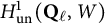 $H^1_{\operatorname {\mathrm {un}}}(\mathbf {Q}_\ell , W)$
, we get that
$H^1_{\operatorname {\mathrm {un}}}(\mathbf {Q}_\ell , W)$
, we get that $H^1_f(\mathbf {Q}, W)$
does as well.
$H^1_f(\mathbf {Q}, W)$
does as well.
Let $I=[a,b]$
with
$I=[a,b]$
with $a, b \in \mathbf {Z}$
and
$a, b \in \mathbf {Z}$
and $b-a \leq \ell -2$
and assume that
$b-a \leq \ell -2$
and assume that $0 \in I$
. If V is crystalline with Hodge–Tate weights in
$0 \in I$
. If V is crystalline with Hodge–Tate weights in $-I,$
we define
$-I,$
we define
 $$ \begin{align*} H^1_{f, I}&(\mathbf{Q},W[\lambda^n])\\ &= \ker \left\{H^1(\mathbf{Q},W[\lambda^n]) \rightarrow \bigoplus_{p \neq \ell} \frac{H^1(\mathbf{Q}_{p},W[\lambda^n])}{H^1_{\mathrm{un}}(\mathbf{Q}_{p}, W[\lambda^n])}\oplus \frac{H^1(\mathbf{Q}_{\ell},W[\lambda^n])}{H^1_{f, I}(\mathbf{Q}_{\ell}, W[\lambda^n])}\right\}. \end{align*} $$
As noted in (4.4),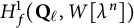 $H^1_{f}(\mathbf {Q}_\ell , W[\lambda ^n])$
also commutes with direct sums and so we get that
$H^1_{f}(\mathbf {Q}_\ell , W[\lambda ^n])$
also commutes with direct sums and so we get that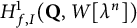 $H^1_{f, I}(\mathbf {Q}, W[\lambda ^n])$
does as well.
$H^1_{f, I}(\mathbf {Q}, W[\lambda ^n])$
does as well.
Proposition 5.1 Assume that the interval $I=[a,b]$
contains
$I=[a,b]$
contains $0$
and V is
$0$
and V is $E[G_{\mathbf {Q}}]$
-module, which is finite-dimensional as an E-vector space and a crystalline
$E[G_{\mathbf {Q}}]$
-module, which is finite-dimensional as an E-vector space and a crystalline $G_{\mathbf {Q}_{\ell }}$
-module with Hodge–Tate weights in
$G_{\mathbf {Q}_{\ell }}$
-module with Hodge–Tate weights in $-I$
. If
$-I$
. If $H^0(\mathbf {Q}, W[\lambda ])=0$
then we have
$H^0(\mathbf {Q}, W[\lambda ])=0$
then we have
 $$ \begin{align*}H^1_f(\mathbf{Q}, W)[\lambda^n] \cong H^1_{f,I}(\mathbf{Q}, W[\lambda^n]).\end{align*} $$
Proof [Reference Berger and Klosin6, Proposition 5.8] proves the claim under the assumption $H^0(\mathbf {Q}, W)=0$
.
$H^0(\mathbf {Q}, W)=0$
.
Suppose we have $\alpha \in H^0(\mathbf {Q}, W)$
. We know every element of W is annihilated by some power of
$\alpha \in H^0(\mathbf {Q}, W)$
. We know every element of W is annihilated by some power of $\lambda $
, so if
$\lambda $
, so if $\alpha \neq 0$
there is an integer m so that
$\alpha \neq 0$
there is an integer m so that $\lambda ^{m} \alpha =0$
but
$\lambda ^{m} \alpha =0$
but $\lambda ^{n} \alpha \neq 0$
for all
$\lambda ^{n} \alpha \neq 0$
for all $0 < n < m$
. However, this gives
$0 < n < m$
. However, this gives $\lambda ^{m-1} \alpha \in H^0(\mathbf {Q}, W[\lambda ]) =0$
, so it must be that
$\lambda ^{m-1} \alpha \in H^0(\mathbf {Q}, W[\lambda ]) =0$
, so it must be that $\alpha = 0$
. Thus,
$\alpha = 0$
. Thus, $H^0(\mathbf {Q}, W) = 0$
as desired.
$H^0(\mathbf {Q}, W) = 0$
as desired.
After a suitable interval, I has been fixed, we will therefore also drop the subscript I and write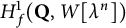 $H^1_{f}(\mathbf {Q}, W[\lambda ^n])$
.
$H^1_{f}(\mathbf {Q}, W[\lambda ^n])$
.
Let G be a group, R a commutative ring with identity, and $M_{i}$
finitely generated free R-modules with R-linear action given by
$M_{i}$
finitely generated free R-modules with R-linear action given by $\rho _{i}: G \rightarrow \operatorname {\mathrm {GL}}_R(M_i)$
for
$\rho _{i}: G \rightarrow \operatorname {\mathrm {GL}}_R(M_i)$
for $i=1,2$
. The action of G on
$i=1,2$
. The action of G on $\operatorname {\mathrm {Hom}}_{R}(\rho _2,\rho _1)$
is given by
$\operatorname {\mathrm {Hom}}_{R}(\rho _2,\rho _1)$
is given by $(g\cdot \varphi )(v) = \rho _1(v) \varphi (\rho _2(g^{-1})v).$
In particular, if
$(g\cdot \varphi )(v) = \rho _1(v) \varphi (\rho _2(g^{-1})v).$
In particular, if $\rho _1 = \rho _2 = \rho $
, we define the adjoint representation of
$\rho _1 = \rho _2 = \rho $
, we define the adjoint representation of $\rho $
to be the
$\rho $
to be the $R[G]$
-module
$R[G]$
-module $\operatorname {\mathrm {ad}} \rho = \operatorname {\mathrm {Hom}}_R(\rho ,\rho )$
. We write
$\operatorname {\mathrm {ad}} \rho = \operatorname {\mathrm {Hom}}_R(\rho ,\rho )$
. We write $\operatorname {\mathrm {ad}}^0\rho $
for the
$\operatorname {\mathrm {ad}}^0\rho $
for the $R[G]$
-submodule of
$R[G]$
-submodule of $\operatorname {\mathrm {ad}}\rho $
consisting of endomorphisms of trace zero.
$\operatorname {\mathrm {ad}}\rho $
consisting of endomorphisms of trace zero.
If $\rho $
is of rank n and
$\rho $
is of rank n and $2n \in R^\times $
then we have an isomorphism of
$2n \in R^\times $
then we have an isomorphism of $R[G]$
-modules
$R[G]$
-modules
 $$ \begin{align} \operatorname{\mathrm{ad}} \rho \cong\operatorname{\mathrm{ad}}^0 \rho \oplus R. \end{align} $$
5.2 Non-vanishing of a Selmer group
In this section, we explain how the congruence of a Siegel cusp form to the Klingen Eisenstein series in Section 3 leads to a non-zero element of $H^1_f(\mathbf {Q}, \mathrm {ad}^0(\rho _{\phi , \lambda })(2-k) \otimes E/\mathcal {O})$
.
$H^1_f(\mathbf {Q}, \mathrm {ad}^0(\rho _{\phi , \lambda })(2-k) \otimes E/\mathcal {O})$
.
From now on, we fix the weight $k \geq 12$
even and the prime
$k \geq 12$
even and the prime $\ell $
satisfying
$\ell $
satisfying $\ell>4k-5$
and impose Assumption 3.1 on the field
$\ell>4k-5$
and impose Assumption 3.1 on the field $E/\mathbf {Q}_\ell $
. Let
$E/\mathbf {Q}_\ell $
. Let $\phi \in S_{k}(\Gamma _1)$
be a normalized eigenform. Let
$\phi \in S_{k}(\Gamma _1)$
be a normalized eigenform. Let $\rho _{\phi }$
be the
$\rho _{\phi }$
be the $\lambda $
-adic Galois representation associated with
$\lambda $
-adic Galois representation associated with $\phi $
and assume
$\phi $
and assume ${\overline {\rho }}_{\phi }$
is irreducible. Let
${\overline {\rho }}_{\phi }$
is irreducible. Let $f \in S_{k}(\Gamma _2)$
be an eigenform with irreducible Galois representation
$f \in S_{k}(\Gamma _2)$
be an eigenform with irreducible Galois representation $\rho _{f}$
so that f is eigenvalue congruent to
$\rho _{f}$
so that f is eigenvalue congruent to $E_{\phi }^{2,1}$
modulo
$E_{\phi }^{2,1}$
modulo $\lambda $
.
$\lambda $
.
The following result shows we can choose a lattice so that the residual Galois representation gives rise to a non-split extension.
Lemma 5.2 There exists a $G_{\mathbf {Q}}$
-stable lattice in the space of
$G_{\mathbf {Q}}$
-stable lattice in the space of $\rho _f$
such that with respect to this lattice
$\rho _f$
such that with respect to this lattice
 $$ \begin{align*}{\overline{\rho}}_{f} = \left[ \begin{matrix} {\overline{\rho}}_{\phi} &* \\ &{\overline{\rho}}_{\phi}(k-2)\end{matrix} \right]\not\cong {\overline{\rho}}_{\phi}\oplus{\overline{\rho}}_{\phi}(k-2).\end{align*} $$
Proof Using the compactness of $G_{\mathbf {Q}}$
, one can show that there exists a
$G_{\mathbf {Q}}$
, one can show that there exists a $G_{\mathbf {Q}}$
-stable lattice
$G_{\mathbf {Q}}$
-stable lattice $\Lambda '$
in the space of
$\Lambda '$
in the space of $\rho _f$
. One uses Brauer–Nesbitt Theorem together with the Chebotarev Density Theorem to conclude that
$\rho _f$
. One uses Brauer–Nesbitt Theorem together with the Chebotarev Density Theorem to conclude that ${\overline {\rho }}_{f, \Lambda '}^{\mathrm {ss}}={\overline {\rho }}_{\phi }\oplus {\overline {\rho }}_{\phi }(k-2)$
. Now, the existence of the desired lattice which gives the non-split extension follows from Theorem 4.1 in [Reference Berger and Klosin9].
${\overline {\rho }}_{f, \Lambda '}^{\mathrm {ss}}={\overline {\rho }}_{\phi }\oplus {\overline {\rho }}_{\phi }(k-2)$
. Now, the existence of the desired lattice which gives the non-split extension follows from Theorem 4.1 in [Reference Berger and Klosin9].
From now on, whenever we write $\rho _f$
, we assume we have made a choice of lattice as in Lemma 5.2, so we consider
$\rho _f$
, we assume we have made a choice of lattice as in Lemma 5.2, so we consider $\rho _f$
as a map from
$\rho _f$
as a map from $G_{\mathbf {Q}}$
to
$G_{\mathbf {Q}}$
to $\operatorname {\mathrm {GL}}_4(\mathcal {O})$
.
$\operatorname {\mathrm {GL}}_4(\mathcal {O})$
.
We now choose the interval $I=[3-2k,2k-3]$
so that it contains all the Hodge–Tate weights of
$I=[3-2k,2k-3]$
so that it contains all the Hodge–Tate weights of $\rho _f$
,
$\rho _f$
, $\rho _\phi $
,
$\rho _\phi $
, $\rho _\phi (k-2)$
,
$\rho _\phi (k-2)$
,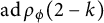 $\operatorname {\mathrm {ad}} \rho _\phi (2-k)$
, and
$\operatorname {\mathrm {ad}} \rho _\phi (2-k)$
, and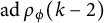 $\operatorname {\mathrm {ad}} \rho _\phi (k-2)$
. Note that
$\operatorname {\mathrm {ad}} \rho _\phi (k-2)$
. Note that $-I=I$
. We assume that
$-I=I$
. We assume that $\ell -2\geq 4k-6$
. When we write
$\ell -2\geq 4k-6$
. When we write $H^1_f$
from now on, this refers to
$H^1_f$
from now on, this refers to $H^1_{f, I}$
as defined in Section 5.1.
$H^1_{f, I}$
as defined in Section 5.1.
Let $\rho $
be any of the representations above and write V for the representation space of
$\rho $
be any of the representations above and write V for the representation space of $\rho $
. We choose a
$\rho $
. We choose a $G_{\mathbf {Q}}$
-stable lattice
$G_{\mathbf {Q}}$
-stable lattice $T\subset V$
and recall that the isomorphism class of the semi-simplification of the
$T\subset V$
and recall that the isomorphism class of the semi-simplification of the $\mathbf {F}[G_{\mathbf {Q}}]$
-representation
$\mathbf {F}[G_{\mathbf {Q}}]$
-representation $T/\lambda T$
is independent of the choice of T. It is well-known that if
$T/\lambda T$
is independent of the choice of T. It is well-known that if $T/\lambda T$
is irreducible then the
$T/\lambda T$
is irreducible then the $\mathcal {O}$
-length of
$\mathcal {O}$
-length of $H^1_f(\mathbf {Q}, W)$
is independent of T, where as before
$H^1_f(\mathbf {Q}, W)$
is independent of T, where as before $W=V/T$
. By Proposition 5.1, we then conclude that also the
$W=V/T$
. By Proposition 5.1, we then conclude that also the $\mathcal {O}$
-length of
$\mathcal {O}$
-length of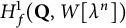 $H^1_f(\mathbf {Q},W[\lambda ^n])$
is independent of the choice of T as long as
$H^1_f(\mathbf {Q},W[\lambda ^n])$
is independent of the choice of T as long as $H^0(\mathbf {Q},W)=0$
.
$H^0(\mathbf {Q},W)=0$
.
Lemma 5.3 Under our assumptions (in particular, ${\overline {\rho }}_{\phi }$
irreducible and
${\overline {\rho }}_{\phi }$
irreducible and $\ell>4k-5$
), the modulo
$\ell>4k-5$
), the modulo $\lambda $
reduction of
$\lambda $
reduction of $\operatorname {\mathrm {ad}}^0\rho _{\phi }$
is irreducible.
$\operatorname {\mathrm {ad}}^0\rho _{\phi }$
is irreducible.
Proof Assume the three-dimensional representation $\operatorname {\mathrm {ad}}^0{\overline {\rho }}_{\phi }$
is reducible. Then, it either has a one-dimensional
$\operatorname {\mathrm {ad}}^0{\overline {\rho }}_{\phi }$
is reducible. Then, it either has a one-dimensional $G_{\mathbf {Q}}$
-stable subspace or quotient. Since
$G_{\mathbf {Q}}$
-stable subspace or quotient. Since $\operatorname {\mathrm {ad}}\rho _{\phi }$
and
$\operatorname {\mathrm {ad}}\rho _{\phi }$
and $\mathbf {1}$
are self-dual, so is
$\mathbf {1}$
are self-dual, so is $\operatorname {\mathrm {ad}}^0 {\overline {\rho }}_{\phi }$
. Hence, we can assume without loss of generality that
$\operatorname {\mathrm {ad}}^0 {\overline {\rho }}_{\phi }$
. Hence, we can assume without loss of generality that $\operatorname {\mathrm {ad}}^0{\overline {\rho }}_{\phi }$
has a
$\operatorname {\mathrm {ad}}^0{\overline {\rho }}_{\phi }$
has a $G_{\mathbf {Q}}$
-stable line. Write
$G_{\mathbf {Q}}$
-stable line. Write $\psi $
for the character by which
$\psi $
for the character by which $G_{\mathbf {Q}}$
acts on the line.
$G_{\mathbf {Q}}$
acts on the line.
As ${\overline {\rho }}_{\phi }$
is unramified away from
${\overline {\rho }}_{\phi }$
is unramified away from $\ell $
and the order of
$\ell $
and the order of $\psi $
is prime to
$\psi $
is prime to $\ell $
, we have
$\ell $
, we have $\psi =\overline {\epsilon }^a$
for some integer
$\psi =\overline {\epsilon }^a$
for some integer $a \in I$
. This would require
$a \in I$
. This would require $H^0(\mathbf {Q}, \operatorname {\mathrm {ad}}^0 {\overline {\rho }}_{\phi }(-a)) \neq 0$
. Note that
$H^0(\mathbf {Q}, \operatorname {\mathrm {ad}}^0 {\overline {\rho }}_{\phi }(-a)) \neq 0$
. Note that $H^0(\mathbf {Q}, \operatorname {\mathrm {ad}} {\overline {\rho }}_{\phi }(-a))=\operatorname {\mathrm {Hom}}_{G_{\mathbf {Q}}}({\overline {\rho }}_\phi (a), {\overline {\rho }}_\phi ).$
If
$H^0(\mathbf {Q}, \operatorname {\mathrm {ad}} {\overline {\rho }}_{\phi }(-a))=\operatorname {\mathrm {Hom}}_{G_{\mathbf {Q}}}({\overline {\rho }}_\phi (a), {\overline {\rho }}_\phi ).$
If $a\equiv 0$
(mod (
$a\equiv 0$
(mod ( $\ell -1$
)), then this space is one-dimensional by Schur’s Lemma since
$\ell -1$
)), then this space is one-dimensional by Schur’s Lemma since ${\overline {\rho }}_{\phi }$
is irreducible. So,
${\overline {\rho }}_{\phi }$
is irreducible. So, $H^0(\mathbf {Q}, \operatorname {\mathrm {ad}}^0{\overline {\rho }}_{\phi })=0$
, contradiction.
$H^0(\mathbf {Q}, \operatorname {\mathrm {ad}}^0{\overline {\rho }}_{\phi })=0$
, contradiction.
If $a\not \equiv 0$
(mod (
$a\not \equiv 0$
(mod ( $\ell -1$
)), then
$\ell -1$
)), then $H^0(\mathbf {Q}, \operatorname {\mathrm {ad}} {\overline {\rho }}_{\phi }(-a))=H^0(\mathbf {Q}, \operatorname {\mathrm {ad}}^0 {\overline {\rho }}_{\phi }(-a))\neq 0.$
This means that
$H^0(\mathbf {Q}, \operatorname {\mathrm {ad}} {\overline {\rho }}_{\phi }(-a))=H^0(\mathbf {Q}, \operatorname {\mathrm {ad}}^0 {\overline {\rho }}_{\phi }(-a))\neq 0.$
This means that ${\overline {\rho }}_{\phi }$
is isomorphic to
${\overline {\rho }}_{\phi }$
is isomorphic to ${\overline {\rho }}_{\phi }(a)$
. Considering the determinant,
${\overline {\rho }}_{\phi }(a)$
. Considering the determinant, $\overline {\epsilon }^a$
must be the trivial character or the quadratic character
$\overline {\epsilon }^a$
must be the trivial character or the quadratic character $\overline {\epsilon }^{(\ell -1)/2}$
. Both are ruled out since
$\overline {\epsilon }^{(\ell -1)/2}$
. Both are ruled out since $a \in I=[3-2k, 2k-3]$
by our assumption that
$a \in I=[3-2k, 2k-3]$
by our assumption that $\ell>4k-5$
.
$\ell>4k-5$
.
Remark 5.4 From Lemma 5.3, we conclude that when $\rho \in \{\rho _{\phi }, \rho _{\phi }(k-2), \operatorname {\mathrm {ad}}^0\rho _{\phi }(2-k), \operatorname {\mathrm {ad}}^0\rho _{\phi }(k-2)\}$
, the
$\rho \in \{\rho _{\phi }, \rho _{\phi }(k-2), \operatorname {\mathrm {ad}}^0\rho _{\phi }(2-k), \operatorname {\mathrm {ad}}^0\rho _{\phi }(k-2)\}$
, the $\mathcal {O}$
-lengths of
$\mathcal {O}$
-lengths of $H^1_f(\mathbf {Q}, W)$
and
$H^1_f(\mathbf {Q}, W)$
and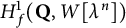 $H^1_f(\mathbf {Q}, W[\lambda ^n])$
are independent of the choice of T. As we will ever only be interested in the order of these groups, the choice of T is immaterial and we will simply assume that such a choice was made. So, for example, we will use the notation
$H^1_f(\mathbf {Q}, W[\lambda ^n])$
are independent of the choice of T. As we will ever only be interested in the order of these groups, the choice of T is immaterial and we will simply assume that such a choice was made. So, for example, we will use the notation $H^1_f(\mathbf {Q}, \operatorname {\mathrm {ad}}^0\rho _{\phi , \lambda }(k-2)\otimes E/\mathcal {O})$
, thus assuming that when we write
$H^1_f(\mathbf {Q}, \operatorname {\mathrm {ad}}^0\rho _{\phi , \lambda }(k-2)\otimes E/\mathcal {O})$
, thus assuming that when we write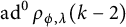 $\operatorname {\mathrm {ad}}^0\rho _{\phi , \lambda }(k-2)$
, we have made a choice of a lattice for this representation. Likewise any one-dimensional representation
$\operatorname {\mathrm {ad}}^0\rho _{\phi , \lambda }(k-2)$
, we have made a choice of a lattice for this representation. Likewise any one-dimensional representation $\rho $
is irreducible, so the
$\rho $
is irreducible, so the $\mathcal {O}$
-length of
$\mathcal {O}$
-length of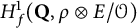 $H^1_f(\mathbf {Q}, \rho \otimes E/\mathcal {O})$
is independent of the choice of T.
$H^1_f(\mathbf {Q}, \rho \otimes E/\mathcal {O})$
is independent of the choice of T.
For the representation $\operatorname {\mathrm {ad}}\rho (m)$
,
$\operatorname {\mathrm {ad}}\rho (m)$
, $m\in \{k-2, 2-k\}$
(which is reducible), we choose a lattice which is a direct sum of a lattice inside
$m\in \{k-2, 2-k\}$
(which is reducible), we choose a lattice which is a direct sum of a lattice inside $\operatorname {\mathrm {ad}}^0\rho (m)$
and a lattice inside
$\operatorname {\mathrm {ad}}^0\rho (m)$
and a lattice inside $E(m)$
. So, from now on, whenever we write
$E(m)$
. So, from now on, whenever we write $\operatorname {\mathrm {ad}}\rho (m)$
we mean such a lattice. Since the formation of Selmer groups commutes with direct sums, we then get
$\operatorname {\mathrm {ad}}\rho (m)$
we mean such a lattice. Since the formation of Selmer groups commutes with direct sums, we then get
 $$ \begin{align} H^1_f(\mathbf{Q}, \operatorname{\mathrm{ad}}\rho_{\phi}(m)\otimes E/\mathcal{O})= H^1_f(\mathbf{Q}, \operatorname{\mathrm{ad}}^0\rho_{\phi}(m)\otimes E/\mathcal{O})\oplus H^1_f(\mathbf{Q}, E/\mathcal{O}(m))\end{align} $$
for $m\in \{k-2,2-k\}$
. Note that the
$m\in \{k-2,2-k\}$
. Note that the $\mathcal {O}$
-length (and in particular, the non-triviality) of
$\mathcal {O}$
-length (and in particular, the non-triviality) of $H^1_f(\mathbf {Q}, \operatorname {\mathrm {ad}} \rho (m)\otimes E/\mathcal {O})$
is independent of the choice of a lattice inside
$H^1_f(\mathbf {Q}, \operatorname {\mathrm {ad}} \rho (m)\otimes E/\mathcal {O})$
is independent of the choice of a lattice inside $\operatorname {\mathrm {ad}}\rho _{\phi }(m)$
as long as it is the direct sum of lattices in
$\operatorname {\mathrm {ad}}\rho _{\phi }(m)$
as long as it is the direct sum of lattices in $\operatorname {\mathrm {ad}}^0\rho _{\phi }(m)$
and
$\operatorname {\mathrm {ad}}^0\rho _{\phi }(m)$
and $E(m)$
.
$E(m)$
.
Theorem 5.5 With the set-up as above, we have $H^1_f(\mathbf {Q}, \operatorname {\mathrm {ad}}\rho _{\phi }(2-k)\otimes E/\mathcal {O})\neq 0$
.
$H^1_f(\mathbf {Q}, \operatorname {\mathrm {ad}}\rho _{\phi }(2-k)\otimes E/\mathcal {O})\neq 0$
.
Proof We have via Lemma 5.2 that there is a lattice $T_{f} \subset V_{f}$
so that the residual representation
$T_{f} \subset V_{f}$
so that the residual representation ${\overline {\rho }}_{f}: G_{\mathbf {Q}} \rightarrow \operatorname {\mathrm {GL}}_4(\mathbf {F})$
has the form
${\overline {\rho }}_{f}: G_{\mathbf {Q}} \rightarrow \operatorname {\mathrm {GL}}_4(\mathbf {F})$
has the form
 $$ \begin{align} {\overline{\rho}}_{f} = \left[ \begin{matrix} {\overline{\rho}}_\phi & \psi \\ 0 & {\overline{\rho}}_\phi(k-2) \end{matrix} \right] \end{align} $$
and is not semisimple. The fact that $\psi $
as in (5.3) gives a non-trivial class
$\psi $
as in (5.3) gives a non-trivial class $[\psi ]$
in
$[\psi ]$
in $H^1(\mathbf {Q},\operatorname {\mathrm {Hom}}_{\mathbf {F}}({\overline {\rho }}_2, {\overline {\rho }}_1))= H^1(\mathbf {Q}, \operatorname {\mathrm {ad}}\rho _{\phi }(2-k)\otimes E/\mathcal {O}[\lambda ])$
is clear. We need to show that
$H^1(\mathbf {Q},\operatorname {\mathrm {Hom}}_{\mathbf {F}}({\overline {\rho }}_2, {\overline {\rho }}_1))= H^1(\mathbf {Q}, \operatorname {\mathrm {ad}}\rho _{\phi }(2-k)\otimes E/\mathcal {O}[\lambda ])$
is clear. We need to show that $[\psi ]$
lies in
$[\psi ]$
lies in $H^1_f(\mathbf {Q}, \operatorname {\mathrm {ad}}\rho _{\phi }(2-k)\otimes E/\mathcal {O}[\lambda ])$
and that the latter group injects into
$H^1_f(\mathbf {Q}, \operatorname {\mathrm {ad}}\rho _{\phi }(2-k)\otimes E/\mathcal {O}[\lambda ])$
and that the latter group injects into $H_f^1(\mathbf {Q}, \operatorname {\mathrm {ad}}\rho _{\phi }(2-k)\otimes E/\mathcal {O})$
.
$H_f^1(\mathbf {Q}, \operatorname {\mathrm {ad}}\rho _{\phi }(2-k)\otimes E/\mathcal {O})$
.
We first show that $[\psi ]$
satisfies the conditions to be in
$[\psi ]$
satisfies the conditions to be in $H^1_{f}(\mathbf {Q}, \operatorname {\mathrm {ad}}\rho _{\phi }(2-k)\otimes E/\mathcal {O}[\lambda ])$
. We have that
$H^1_{f}(\mathbf {Q}, \operatorname {\mathrm {ad}}\rho _{\phi }(2-k)\otimes E/\mathcal {O}[\lambda ])$
. We have that ${\rho }_f$
is unramified at all primes
${\rho }_f$
is unramified at all primes $p \neq \ell $
, so the local conditions are satisfied for all primes
$p \neq \ell $
, so the local conditions are satisfied for all primes $p \neq \ell $
.
$p \neq \ell $
.
Since f has level one and weight k, $\rho _{f}|_{D_{\ell }}$
is crystalline with Hodge–Tate weights in
$\rho _{f}|_{D_{\ell }}$
is crystalline with Hodge–Tate weights in $[0, 2k-3] \subset I=-I$
. Hence,
$[0, 2k-3] \subset I=-I$
. Hence, ${\overline {\rho }}_f$
(considered as a
${\overline {\rho }}_f$
(considered as a $G_{\mathbf {Q}_{\ell }}$
-module) belongs to
$G_{\mathbf {Q}_{\ell }}$
-module) belongs to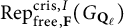 $\mathrm {Rep}_{\mathrm {free}, \mathbf {F}}^{\mathrm {cris}, I}(G_{\mathbf {Q}_{\ell }})$
and gives rise to an element of
$\mathrm {Rep}_{\mathrm {free}, \mathbf {F}}^{\mathrm {cris}, I}(G_{\mathbf {Q}_{\ell }})$
and gives rise to an element of $\mathrm {Ext}^1_{ {\mathrm {Rep}_{\mathrm {free}, \mathbf {F}}^{\mathrm {cris}, I}(G_{\mathbf {Q}_{\ell }})}}({\overline {\rho }}_\phi (k-2),{\overline {\rho }}_\phi )\subset \operatorname {\mathrm {Ext}}^1_{\mathbf {F}[G_{\mathbf {Q}_{\ell }}]}(\rho _\phi (k-2) \otimes E/\mathcal {O}[\lambda ], \rho _\phi \otimes E/\mathcal {O}[\lambda ]).$
By our choice of
$\mathrm {Ext}^1_{ {\mathrm {Rep}_{\mathrm {free}, \mathbf {F}}^{\mathrm {cris}, I}(G_{\mathbf {Q}_{\ell }})}}({\overline {\rho }}_\phi (k-2),{\overline {\rho }}_\phi )\subset \operatorname {\mathrm {Ext}}^1_{\mathbf {F}[G_{\mathbf {Q}_{\ell }}]}(\rho _\phi (k-2) \otimes E/\mathcal {O}[\lambda ], \rho _\phi \otimes E/\mathcal {O}[\lambda ]).$
By our choice of $I,$
we can use (4.3) and Proposition 4.8 to get a non-zero element in
$I,$
we can use (4.3) and Proposition 4.8 to get a non-zero element in
 $$ \begin{align*}\mathrm{Ext}^1_{ {\mathrm{Rep}_{\mathrm{free}, \mathbf{F}}^{\mathrm{cris}, I}(G_{\mathbf{Q}_{\ell}})}}(\mathbf{F}, \operatorname{\mathrm{ad}}\rho_{\phi}(2-k)\otimes E/\mathcal{O}[\lambda])\subset \operatorname{\mathrm{Ext}}^1_{\mathbf{F}[G_{\mathbf{Q}_{\ell}}]}(\mathbf{F}, \operatorname{\mathrm{ad}}\rho_{\phi}(2-k)\otimes E/\mathcal{O}[\lambda]).\end{align*} $$
As this extension maps to $[\psi |_{G_{\mathbf {Q}_\ell }}]$
in
$[\psi |_{G_{\mathbf {Q}_\ell }}]$
in $H^1(\mathbf {Q}_{\ell }, \operatorname {\mathrm {ad}}\rho _{\phi }(2-k)\otimes E/\mathcal {O}[\lambda ])$
under the canonical isomorphism
$H^1(\mathbf {Q}_{\ell }, \operatorname {\mathrm {ad}}\rho _{\phi }(2-k)\otimes E/\mathcal {O}[\lambda ])$
under the canonical isomorphism $\operatorname {\mathrm {Ext}}^1_{\mathbf {F}[G_{\mathbf {Q}_{\ell }}]}(\mathbf {F}, \operatorname {\mathrm {ad}}\rho _{\phi }(2-k)\otimes E/\mathcal {O}[\lambda ])\cong H^1(\mathbf {Q}_{\ell }, \operatorname {\mathrm {ad}}\rho _{\phi }(2-k)\otimes E/\mathcal {O}[\lambda ])$
, we conclude that
$\operatorname {\mathrm {Ext}}^1_{\mathbf {F}[G_{\mathbf {Q}_{\ell }}]}(\mathbf {F}, \operatorname {\mathrm {ad}}\rho _{\phi }(2-k)\otimes E/\mathcal {O}[\lambda ])\cong H^1(\mathbf {Q}_{\ell }, \operatorname {\mathrm {ad}}\rho _{\phi }(2-k)\otimes E/\mathcal {O}[\lambda ])$
, we conclude that
 $$ \begin{align*}[\psi|_{G_{\mathbf{Q}_\ell}}] \in H^1_{f}(\mathbf{Q}_{\ell}, \operatorname{\mathrm{ad}}\rho_{\phi}(2-k)\otimes E/\mathcal{O}[\lambda])\subset H^1(\mathbf{Q}_{\ell}, \operatorname{\mathrm{ad}}\rho_{\phi}(2-k)\otimes E/\mathcal{O}[\lambda]).\end{align*} $$
Therefore, we have established that $[\psi ] \in H^1_{f}(\mathbf {Q}, \operatorname {\mathrm {ad}}\rho _{\phi }(2-k)\otimes E/\mathcal {O}[\lambda ]).$
By Proposition 5.1, this group is isomorphic to
$[\psi ] \in H^1_{f}(\mathbf {Q}, \operatorname {\mathrm {ad}}\rho _{\phi }(2-k)\otimes E/\mathcal {O}[\lambda ]).$
By Proposition 5.1, this group is isomorphic to $H^1_{f}(\mathbf {Q}, \operatorname {\mathrm {ad}}\rho _{\phi }(2-k)\otimes E/\mathcal {O})[\lambda ]$
if
$H^1_{f}(\mathbf {Q}, \operatorname {\mathrm {ad}}\rho _{\phi }(2-k)\otimes E/\mathcal {O})[\lambda ]$
if $H^0(\mathbf {Q}, \operatorname {\mathrm {ad}}\rho _{\phi }(2-k)\otimes E/\mathcal {O}[\lambda ])=0$
. The latter holds since
$H^0(\mathbf {Q}, \operatorname {\mathrm {ad}}\rho _{\phi }(2-k)\otimes E/\mathcal {O}[\lambda ])=0$
. The latter holds since
 $$ \begin{align} \operatorname{\mathrm{ad}}\rho_{\phi}(2-k)\otimes E/\mathcal{O}[\lambda]^{G_{\mathbf{Q}}}=\operatorname{\mathrm{Hom}}_{G_{\mathbf{Q}}}({\overline{\rho}}_\phi(k-2), {\overline{\rho}}_\phi)=0\end{align} $$
as ${\overline {\rho }}_\phi $
and
${\overline {\rho }}_\phi $
and ${\overline {\rho }}_\phi (k-2)$
are absolutely irreducible (by assumption) and non-isomorphic since
${\overline {\rho }}_\phi (k-2)$
are absolutely irreducible (by assumption) and non-isomorphic since $k-2 \not \equiv 0, \frac {\ell -1}{2}\ \pmod {\ell -1}$
as
$k-2 \not \equiv 0, \frac {\ell -1}{2}\ \pmod {\ell -1}$
as $\ell>4k-5$
and
$\ell>4k-5$
and $k \neq 2$
(cf. the proof of Lemma 5.3).
$k \neq 2$
(cf. the proof of Lemma 5.3).
Lemma 5.6 Let n be an even integer satisfying $3-2k<n \leq 0$
. Assuming
$3-2k<n \leq 0$
. Assuming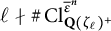 $\ell \nmid \#\operatorname {\mathrm {Cl}}_{\mathbf {Q}(\zeta _{\ell })^{+}}^{\overline {\epsilon }^{n}}$
, one has
$\ell \nmid \#\operatorname {\mathrm {Cl}}_{\mathbf {Q}(\zeta _{\ell })^{+}}^{\overline {\epsilon }^{n}}$
, one has $H^1_f(\mathbf {Q}, \mathbf {F}(n))=0$
and, if additionally
$H^1_f(\mathbf {Q}, \mathbf {F}(n))=0$
and, if additionally $n \neq 0$
,
$n \neq 0$
, $H^1_f(\mathbf {Q}, E/\mathcal {O}(n))=0$
.
$H^1_f(\mathbf {Q}, E/\mathcal {O}(n))=0$
.
Proof We see from Proposition 4.20 that any cohomology class in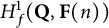 $H^1_f(\mathbf {Q}, \mathbf {F}(n))$
must vanish when restricted to
$H^1_f(\mathbf {Q}, \mathbf {F}(n))$
must vanish when restricted to $I_{\ell }$
. As all classes in
$I_{\ell }$
. As all classes in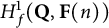 $H^1_f(\mathbf {Q}, \mathbf {F}(n))$
are unramified away from
$H^1_f(\mathbf {Q}, \mathbf {F}(n))$
are unramified away from $\ell $
, we get that they are unramified everywhere. Using inflation-restriction sequence where
$\ell $
, we get that they are unramified everywhere. Using inflation-restriction sequence where $H=\operatorname {\mathrm {Gal}}(\mathbf {Q}(\zeta _{\ell })^{+}/\mathbf {Q}),$
we see that
$H=\operatorname {\mathrm {Gal}}(\mathbf {Q}(\zeta _{\ell })^{+}/\mathbf {Q}),$
we see that
 $$ \begin{align*}H^1(\mathbf{Q}, \mathbf{F}(n))\cong H^1(\mathbf{Q}(\zeta_{\ell})^{+}, \mathbf{F}(n))^H=\operatorname{\mathrm{Hom}}_H(G_{\mathbf{Q}(\zeta_{\ell})^{+}}, \mathbf{F}(n)).\end{align*} $$
Note that everywhere unramified classes map to homomorphisms that kill all the inertia groups. Hence, the image of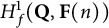 $H^1_f(\mathbf {Q}, \mathbf {F}(n))$
lands inside
$H^1_f(\mathbf {Q}, \mathbf {F}(n))$
lands inside $\operatorname {\mathrm {Hom}}\left (\operatorname {\mathrm {Cl}}_{\mathbf {Q}(\zeta _{\ell })^{+}}^{\overline {\epsilon }^{n}}, \mathbf {F}\right )=0$
.
$\operatorname {\mathrm {Hom}}\left (\operatorname {\mathrm {Cl}}_{\mathbf {Q}(\zeta _{\ell })^{+}}^{\overline {\epsilon }^{n}}, \mathbf {F}\right )=0$
.
Note that a torsion $\mathcal {O}$
-module M is zero if and only if
$\mathcal {O}$
-module M is zero if and only if $M[\lambda ]=0$
. Therefore, the vanishing of
$M[\lambda ]=0$
. Therefore, the vanishing of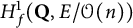 $H^1_f(\mathbf {Q}, E/\mathcal {O}(n))$
follows from Proposition 5.1, which tells us that
$H^1_f(\mathbf {Q}, E/\mathcal {O}(n))$
follows from Proposition 5.1, which tells us that $H^1_f(\mathbf {Q}, E/\mathcal {O}(n))[\lambda ]=H^1_f(\mathbf {Q}, \mathbf {F}(n))$
if
$H^1_f(\mathbf {Q}, E/\mathcal {O}(n))[\lambda ]=H^1_f(\mathbf {Q}, \mathbf {F}(n))$
if $H^0(\mathbf {Q},E/\mathcal {O}(n))=0$
. We know that
$H^0(\mathbf {Q},E/\mathcal {O}(n))=0$
. We know that $H^0(\mathbf {Q}_\ell ,E/\mathcal {O}(n)[\lambda ])=H^0(\mathbf {Q},\mathbf {F}(n))=0$
for
$H^0(\mathbf {Q}_\ell ,E/\mathcal {O}(n)[\lambda ])=H^0(\mathbf {Q},\mathbf {F}(n))=0$
for $n \neq 0$
since
$n \neq 0$
since $n \not \equiv 0\ \pmod {\ell -1}$
under our assumption
$n \not \equiv 0\ \pmod {\ell -1}$
under our assumption $\ell>4k-5$
.
$\ell>4k-5$
.
Corollary 5.7 Let $\phi \in S_{k}(\Gamma _1)$
be as in Theorem 3.5 and assume the hypotheses of Theorem 3.5 are satisfied. Assuming
$\phi \in S_{k}(\Gamma _1)$
be as in Theorem 3.5 and assume the hypotheses of Theorem 3.5 are satisfied. Assuming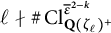 $\ell \nmid \#\operatorname {\mathrm {Cl}}_{\mathbf {Q}(\zeta _{\ell })^{+}}^{\overline {\epsilon }^{2-k}}$
, one has
$\ell \nmid \#\operatorname {\mathrm {Cl}}_{\mathbf {Q}(\zeta _{\ell })^{+}}^{\overline {\epsilon }^{2-k}}$
, one has $H^1_f(\mathbf {Q}, \operatorname {\mathrm {ad}}^0\rho _{\phi }(2-k)\otimes E/\mathcal {O})\neq 0$
.
$H^1_f(\mathbf {Q}, \operatorname {\mathrm {ad}}^0\rho _{\phi }(2-k)\otimes E/\mathcal {O})\neq 0$
.
Remark 5.8 If we assume Vandiver’s conjecture for the prime $\ell $
, this gives that
$\ell $
, this gives that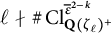 $\ell \nmid \#\operatorname {\mathrm {Cl}}_{\mathbf {Q}(\zeta _{\ell })^{+}}^{\overline {\epsilon }^{2-k}}$
.
$\ell \nmid \#\operatorname {\mathrm {Cl}}_{\mathbf {Q}(\zeta _{\ell })^{+}}^{\overline {\epsilon }^{2-k}}$
.
6 Modularity
We begin with the following commutative algebra result that will be useful in this section.
Lemma 6.1 If J is an ideal of $\mathbf {F}[[X_1,\dots , X_n]]$
that is strictly contained in the maximal ideal, then
$\mathbf {F}[[X_1,\dots , X_n]]$
that is strictly contained in the maximal ideal, then $\mathbf {F}[[X_1,\dots , X_n]]/J$
admits an
$\mathbf {F}[[X_1,\dots , X_n]]/J$
admits an $\mathbf {F}$
-algebra surjection to
$\mathbf {F}$
-algebra surjection to $\mathbf {F}[T]/T^2$
.
$\mathbf {F}[T]/T^2$
.
Proof For a positive integer $k,$
let
$k,$
let $I_k$
be the ideal of
$I_k$
be the ideal of $\mathbf {F}[[X_1,\dots , X_k]]$
generated by all the monomials of degree at least 2. Set
$\mathbf {F}[[X_1,\dots , X_k]]$
generated by all the monomials of degree at least 2. Set $S_k:=\mathbf {F}[[X_1,\dots , X_k]]/I_k$
and write
$S_k:=\mathbf {F}[[X_1,\dots , X_k]]/I_k$
and write $\phi _k: \mathbf {F}[[X_1,\dots , X_k]]\to S_k$
for the canonical
$\phi _k: \mathbf {F}[[X_1,\dots , X_k]]\to S_k$
for the canonical $\mathbf {F}$
-algebra surjection. If
$\mathbf {F}$
-algebra surjection. If $\phi _n(J)=0$
, then composing
$\phi _n(J)=0$
, then composing $\phi _n$
with the map
$\phi _n$
with the map $S_n\to \mathbf {F}[[T]]/T^2$
sending
$S_n\to \mathbf {F}[[T]]/T^2$
sending $X_1$
to T and
$X_1$
to T and $X_i$
for
$X_i$
for $i>1$
to zero gives the desired surjection.
$i>1$
to zero gives the desired surjection.
Now suppose $\phi _n(J)\neq 0$
. Without loss of generality (renumbering the variables if necessary), we may assume then that J contains an element of the form
$\phi _n(J)\neq 0$
. Without loss of generality (renumbering the variables if necessary), we may assume then that J contains an element of the form $u:=X_n+f(X_1,\dots , X_{n-1})+g(X_1,\dots , X_n)$
, where f is homogeneous of degree one and all the terms in g have degree at least 2. Note that we can assume without loss of generality that some power of
$u:=X_n+f(X_1,\dots , X_{n-1})+g(X_1,\dots , X_n)$
, where f is homogeneous of degree one and all the terms in g have degree at least 2. Note that we can assume without loss of generality that some power of $X_n$
appears in g. (Indeed, if g contains no
$X_n$
appears in g. (Indeed, if g contains no $X_n$
then we replace u by
$X_n$
then we replace u by $u+u^2 \in J$
.) By Theorem 7.16(a) in [Reference Eisenbud23] there is a unique
$u+u^2 \in J$
.) By Theorem 7.16(a) in [Reference Eisenbud23] there is a unique $\mathbf {F}$
-algebra map from
$\mathbf {F}$
-algebra map from $\mathbf {F}[[X_1,\dots , X_n]]$
to itself sending
$\mathbf {F}[[X_1,\dots , X_n]]$
to itself sending $X_n$
to
$X_n$
to $-f-g$
and
$-f-g$
and $X_i$
to itself for
$X_i$
to itself for $i<n$
. In other words, for any power series
$i<n$
. In other words, for any power series $h(X_1,\dots , X_n)$
, the element
$h(X_1,\dots , X_n)$
, the element $h(X_1,\dots , X_{n-1}, -f-g)$
also lives in
$h(X_1,\dots , X_{n-1}, -f-g)$
also lives in $\mathbf {F}[[X_1, \dots , X_n]]$
and we denote it by
$\mathbf {F}[[X_1, \dots , X_n]]$
and we denote it by $h'(X_1, \dots , X_n)$
. Clearly,
$h'(X_1, \dots , X_n)$
. Clearly, $h-h'\in J$
.
$h-h'\in J$
.
Thus, for any power series $h,$
where the smallest total degree of any term containing
$h,$
where the smallest total degree of any term containing $X_n$
is
$X_n$
is $s,$
we have
$s,$
we have
 $$ \begin{align*}h\equiv h' \quad\pmod{J}\end{align*} $$
for some power series $h'$
with the smallest total degree of any term containing
$h'$
with the smallest total degree of any term containing $X_n$
equal to
$X_n$
equal to $s'>s$
. By the same process, we get an
$s'>s$
. By the same process, we get an $h"$
such that
$h"$
such that $h' \equiv h"\ \mod {J}$
and the smallest total degree of any term
$h' \equiv h"\ \mod {J}$
and the smallest total degree of any term $X_n$
in
$X_n$
in $h"$
is strictly greater than
$h"$
is strictly greater than $s'$
. This way, we can construct a sequence of power series
$s'$
. This way, we can construct a sequence of power series $h_s$
where for every
$h_s$
where for every $s,$
we have the smallest total degree of any term containing
$s,$
we have the smallest total degree of any term containing $X_n$
being greater than or equal to s and such that
$X_n$
being greater than or equal to s and such that $h- h_s\in J$
for every s. We note that
$h- h_s\in J$
for every s. We note that $h_s$
is a Cauchy sequence with respect to the
$h_s$
is a Cauchy sequence with respect to the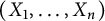 $(X_1,\dots ,X_n)$
-adic topology (indeed, for
$(X_1,\dots ,X_n)$
-adic topology (indeed, for $t,u>s,$
we see that
$t,u>s,$
we see that $h_t-h_u$
lies in
$h_t-h_u$
lies in $(X_1,\dots ,X_n)^s$
). Set
$(X_1,\dots ,X_n)^s$
). Set $h_0=\lim _{s\to \infty }h_s$
. As J is a closed ideal, we get that
$h_0=\lim _{s\to \infty }h_s$
. As J is a closed ideal, we get that $h_0-h\in J$
. For every
$h_0-h\in J$
. For every $s,$
we have
$s,$
we have
 $$ \begin{align*}h_0 \equiv h_s \equiv w_s \quad\mod{X_n^s},\end{align*} $$
for some $w_s \in \mathbf {F}[[X_1, \dots , X_{n-1}]]$
. Note that the
$w_s \in \mathbf {F}[[X_1, \dots , X_{n-1}]]$
. Note that the $w_s$
also form a Cauchy sequence since
$w_s$
also form a Cauchy sequence since $h_s$
does. Set
$h_s$
does. Set $w:= \lim _{s \to \infty } w_s \in \mathbf {F}[[X_1, \dots , X_{n-1}]]$
. Thus,
$w:= \lim _{s \to \infty } w_s \in \mathbf {F}[[X_1, \dots , X_{n-1}]]$
. Thus, $h_0 \equiv w$
modulo
$h_0 \equiv w$
modulo $\bigcap _s (X_n^s) \subset \bigcap _s (X_1, \ldots , X_n)^s=0$
, so
$\bigcap _s (X_n^s) \subset \bigcap _s (X_1, \ldots , X_n)^s=0$
, so $h_0 \in \mathbf {F}[[X_1, \dots , X_{n-1}]]$
.
$h_0 \in \mathbf {F}[[X_1, \dots , X_{n-1}]]$
.
Hence, the natural $\mathbf {F}$
-algebra map
$\mathbf {F}$
-algebra map $\psi _{n-1}:\mathbf {F}[[X_1,\dots , X_{n-1}]]\to \mathbf {F}[[X_1, \dots , X_n]]/J$
given by
$\psi _{n-1}:\mathbf {F}[[X_1,\dots , X_{n-1}]]\to \mathbf {F}[[X_1, \dots , X_n]]/J$
given by $h_0 \mapsto h_0+J$
is surjective. Thus, we get an
$h_0 \mapsto h_0+J$
is surjective. Thus, we get an $\mathbf {F}$
-algebra isomorphism
$\mathbf {F}$
-algebra isomorphism $\mathbf {F}[[X_1,\dots , X_n]]/J \to \mathbf {F}[[X_1, \dots , X_{n-1}]]/J_{n-1}$
, where
$\mathbf {F}[[X_1,\dots , X_n]]/J \to \mathbf {F}[[X_1, \dots , X_{n-1}]]/J_{n-1}$
, where $J_{n-1}=\ker \psi _{n-1}$
.
$J_{n-1}=\ker \psi _{n-1}$
.
If $\phi _{n-1}(J_{n-1})\neq 0$
, continue this way obtaining a sequence of ideals
$\phi _{n-1}(J_{n-1})\neq 0$
, continue this way obtaining a sequence of ideals $J_{n-2},J_{n-3},\ldots $
. If at any stage (
$J_{n-2},J_{n-3},\ldots $
. If at any stage ( $1\leq r\leq n-2$
), we get
$1\leq r\leq n-2$
), we get $\phi _{n-r}(J_{n-r})=0$
, then we are done. Otherwise, we can eliminate all but one variable and get
$\phi _{n-r}(J_{n-r})=0$
, then we are done. Otherwise, we can eliminate all but one variable and get $\mathbf {F}[[X_1,\dots , X_n]]/J\cong \mathbf {F}[[X_1]]/J_1$
and now we must have
$\mathbf {F}[[X_1,\dots , X_n]]/J\cong \mathbf {F}[[X_1]]/J_1$
and now we must have $\phi _1(J_1)=0$
as otherwise
$\phi _1(J_1)=0$
as otherwise $J_1$
and hence J is maximal.
$J_1$
and hence J is maximal.
Recall that in the earlier sections we fixed the weight $k \geq 12$
even and prime
$k \geq 12$
even and prime $\ell> 4k-5$
and imposed Assumption 3.1 on the field
$\ell> 4k-5$
and imposed Assumption 3.1 on the field $E/\mathbf {Q}_\ell $
. We also fixed the Fontaine–Laffaille interval
$E/\mathbf {Q}_\ell $
. We also fixed the Fontaine–Laffaille interval $I=[3-2k, 2k-3]$
. Let
$I=[3-2k, 2k-3]$
. Let $\phi \in S_k(\Gamma _1)$
be a newform such that
$\phi \in S_k(\Gamma _1)$
be a newform such that ${\overline {\rho }}_{\phi }$
is irreducible. The goal of this section is to prove a modularity theorem under the following assumption.
${\overline {\rho }}_{\phi }$
is irreducible. The goal of this section is to prove a modularity theorem under the following assumption.
Assumption 6.2 For k and $\phi $
as above, we assume that:
$\phi $
as above, we assume that:
-
(i) there exists
$f \in S_k(\Gamma _2)$
such that
$f\equiv _{\mathrm {ev}}E^{2,1}_{\phi }$
(mod
$\lambda $
), and -
(ii)
$\#H^1_f(\mathbf {Q}, \mathrm {ad}^0\rho _{\phi }(2-k)\otimes _{\mathcal {O}}E/\mathcal {O})=\#\mathcal {O}/\lambda $
(recall that the left-hand side is independent of the choice of lattice, see Remark 5.4), and -
(iii)
$H^1_f(\mathbf {Q}, \operatorname {\mathrm {ad}}^0{\overline {\rho }}_{\phi })=0.$




Remark 6.3 Assumption 6.2 (i) is satisfied under the assumptions of Theorem 3.5, and so is one inequality in Assumption 6.2 (ii) under the assumptions of Corollary 5.7.
We impose Assumption 6.2 and fix f as in Assumption 6.2 in what follows. We will write $G_{\{\ell \}}$
for the Galois group of the maximal Galois extension of
$G_{\{\ell \}}$
for the Galois group of the maximal Galois extension of $\mathbf {Q}$
unramified away from
$\mathbf {Q}$
unramified away from $\ell $
. Let
$\ell $
. Let $\rho _f: G_{\{\ell \}}\to \operatorname {\mathrm {GL}}_4(E)$
be as in Theorem 2.1. Lemma 3.4 gives that
$\rho _f: G_{\{\ell \}}\to \operatorname {\mathrm {GL}}_4(E)$
be as in Theorem 2.1. Lemma 3.4 gives that $\rho _{f}$
is irreducible. We will use Mazur’s deformation theory and refer the reader to standard references, such as [Reference Cornell, Silverman and Stevens19, Reference Ramakrishna43] for the definitions and basic properties.
$\rho _{f}$
is irreducible. We will use Mazur’s deformation theory and refer the reader to standard references, such as [Reference Cornell, Silverman and Stevens19, Reference Ramakrishna43] for the definitions and basic properties.
Definition 6.4 For $B \in \mathrm {LCN}_{\mathcal {O}}$
, we say that a representation
$B \in \mathrm {LCN}_{\mathcal {O}}$
, we say that a representation $\rho :G_{\mathbf {Q}_\ell } \to \operatorname {\mathrm {GL}}_n(B)$
is Fontaine–Laffaille (with Hodge–Tate weights in
$\rho :G_{\mathbf {Q}_\ell } \to \operatorname {\mathrm {GL}}_n(B)$
is Fontaine–Laffaille (with Hodge–Tate weights in $-I$
) if
$-I$
) if $\rho \otimes _B A$
lies in
$\rho \otimes _B A$
lies in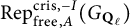 $\mathrm {Rep}_{\mathrm {free}, A}^{\mathrm {cris}, -I}(G_{\mathbf {Q}_\ell })$
(see Definition 4.9(v)) for every Artinian quotient A of B. By Theorem 4.14(iv), this is equivalent to requiring
$\mathrm {Rep}_{\mathrm {free}, A}^{\mathrm {cris}, -I}(G_{\mathbf {Q}_\ell })$
(see Definition 4.9(v)) for every Artinian quotient A of B. By Theorem 4.14(iv), this is equivalent to requiring $\rho \otimes _B A$
to lie in the essential image of the Fontaine–Laffaille functor.
$\rho \otimes _B A$
to lie in the essential image of the Fontaine–Laffaille functor.
Remark 6.5 We know that any choice of $\mathcal {O}$
-lattice
$\mathcal {O}$
-lattice $\rho _L$
in
$\rho _L$
in $\rho _\phi $
or
$\rho _\phi $
or $\rho _f$
is Fontaine–Laffaille in this sense, since their restrictions to
$\rho _f$
is Fontaine–Laffaille in this sense, since their restrictions to $G_{\mathbf {Q}_\ell }$
lie in
$G_{\mathbf {Q}_\ell }$
lie in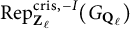 $\mathrm { Rep}_{\mathbf {Z}_\ell }^{\mathrm {cris}, -I}(G_{\mathbf {Q}_{\ell }})$
and therefore in the essential image of the Fontaine–Laffaille functor by Theorem 4.14(iii). Since they are also free
$\mathrm { Rep}_{\mathbf {Z}_\ell }^{\mathrm {cris}, -I}(G_{\mathbf {Q}_{\ell }})$
and therefore in the essential image of the Fontaine–Laffaille functor by Theorem 4.14(iii). Since they are also free $\mathcal {O}$
-modules this implies by Theorem 4.14 (iii) and (iv) that
$\mathcal {O}$
-modules this implies by Theorem 4.14 (iii) and (iv) that $\rho _L \otimes B$
lies in
$\rho _L \otimes B$
lies in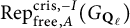 $\mathrm {Rep}_{\mathrm {free}, A}^{\mathrm {cris}, -I}(G_{\mathbf {Q}_\ell })$
for every Artinian quotient B of
$\mathrm {Rep}_{\mathrm {free}, A}^{\mathrm {cris}, -I}(G_{\mathbf {Q}_\ell })$
for every Artinian quotient B of $\mathcal {O}$
.
$\mathcal {O}$
.
For any local complete Noetherian $\mathcal {O}$
-algebra A with residue field
$\mathcal {O}$
-algebra A with residue field $\mathbf {F}$
by a deformation of a residual Galois representation
$\mathbf {F}$
by a deformation of a residual Galois representation $\tau : G_{\{\ell \}} \to \operatorname {\mathrm {GL}}_n(\mathbf {F}),$
we will mean a strict equivalence class of lifts
$\tau : G_{\{\ell \}} \to \operatorname {\mathrm {GL}}_n(\mathbf {F}),$
we will mean a strict equivalence class of lifts $\tilde {\tau }:G_{\{\ell \}}\to \operatorname {\mathrm {GL}}_n(A)$
of
$\tilde {\tau }:G_{\{\ell \}}\to \operatorname {\mathrm {GL}}_n(A)$
of $\tau $
that are Fontaine–Laffaille at
$\tau $
that are Fontaine–Laffaille at $\ell $
. This deformation condition is introduced in [Reference Berger and Klosin6, Section 5.3] and [Reference Clozel, Harris and Taylor18, p. 35]
$\ell $
. This deformation condition is introduced in [Reference Berger and Klosin6, Section 5.3] and [Reference Clozel, Harris and Taylor18, p. 35]
As is customary, we will denote a strict equivalence class of deformations by any of its members. If $\tau $
has scalar centralizer then this deformation problem is representable by a local complete Noetherian
$\tau $
has scalar centralizer then this deformation problem is representable by a local complete Noetherian $\mathcal {O}$
-algebra which we will denote by
$\mathcal {O}$
-algebra which we will denote by $R_{\tau }$
[Reference Ramakrishna44]. In particular, the identity map in
$R_{\tau }$
[Reference Ramakrishna44]. In particular, the identity map in $\operatorname {\mathrm {Hom}}_{\mathcal {O}-\mathrm {alg}}(R_{\tau },R_{\tau })$
furnishes what is called the universal deformation
$\operatorname {\mathrm {Hom}}_{\mathcal {O}-\mathrm {alg}}(R_{\tau },R_{\tau })$
furnishes what is called the universal deformation $\tau ^{\mathrm {univ}}: G_{\{\ell \}}\to \operatorname {\mathrm {GL}}_n(R_{\tau })$
.
$\tau ^{\mathrm {univ}}: G_{\{\ell \}}\to \operatorname {\mathrm {GL}}_n(R_{\tau })$
.
Lemma 6.6 One has $R_{{\overline {\rho }}_{\phi }}\cong R_{{\overline {\rho }}_{\phi }(k-2)}\cong \mathcal {O}$
. Furthermore,
$R_{{\overline {\rho }}_{\phi }}\cong R_{{\overline {\rho }}_{\phi }(k-2)}\cong \mathcal {O}$
. Furthermore, $\rho _{\phi }$
(resp.,
$\rho _{\phi }$
(resp., $\rho _{\phi }(k-2)$
) is the unique deformation of
$\rho _{\phi }(k-2)$
) is the unique deformation of ${\overline {\rho }}_{\phi }$
(resp.,
${\overline {\rho }}_{\phi }$
(resp., ${\overline {\rho }}_{\phi }(k-2)$
) to
${\overline {\rho }}_{\phi }(k-2)$
) to $\operatorname {\mathrm {GL}}_2(\mathcal {O})$
.
$\operatorname {\mathrm {GL}}_2(\mathcal {O})$
.
Proof We have
 $$ \begin{align} \#\operatorname{\mathrm{Hom}}_{\mathcal{O}-\mathrm{alg}}(R_{{\overline{\rho}}_{\phi}}, \mathbf{F}[X]/X^2)=\#H^1_f(\mathbf{Q}, \operatorname{\mathrm{ad}}{\overline{\rho}}_{\phi})=0,\end{align} $$
where the first equality follows from the fact that our deformation condition is the property of being Fontaine–Laffaille (see, e.g., [Reference Clozel, Harris and Taylor18, Section 2.4.1]), and the second one holds since we have $H^1_f(\mathbf {Q}, \operatorname {\mathrm {ad}}{\overline {\rho }}_{\phi })=H^1_f(\mathbf {Q}, \operatorname {\mathrm {ad}}^0{\overline {\rho }}_{\phi }) \oplus H^1_f(\mathbf {Q}, \mathbf {F})=0$
and
$H^1_f(\mathbf {Q}, \operatorname {\mathrm {ad}}{\overline {\rho }}_{\phi })=H^1_f(\mathbf {Q}, \operatorname {\mathrm {ad}}^0{\overline {\rho }}_{\phi }) \oplus H^1_f(\mathbf {Q}, \mathbf {F})=0$
and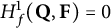 $H^1_f(\mathbf {Q}, \mathbf {F})=0$
by Lemma 5.6 as we have imposed Assumption 6.2(iii).
$H^1_f(\mathbf {Q}, \mathbf {F})=0$
by Lemma 5.6 as we have imposed Assumption 6.2(iii).
By Theorem 7.16 in [Reference Eisenbud23] we know that any local complete Noetherian $\mathcal {O}$
-algebra with residue field
$\mathcal {O}$
-algebra with residue field $\mathbf {F}$
is a quotient of
$\mathbf {F}$
is a quotient of $\mathcal {O}[[X_1, \dots , X_n]]$
for some positive integer n. Hence,
$\mathcal {O}[[X_1, \dots , X_n]]$
for some positive integer n. Hence, $S:=R_{{\overline {\rho }}_{\phi }}/(\lambda R_{{\overline {\rho }}_{\phi }})\cong \mathbf {F}[[X_1, \dots , X_n]]/J$
for some ideal J. Suppose first that J is not maximal. Then, by Lemma 6.1, we know that S admits a surjection
$S:=R_{{\overline {\rho }}_{\phi }}/(\lambda R_{{\overline {\rho }}_{\phi }})\cong \mathbf {F}[[X_1, \dots , X_n]]/J$
for some ideal J. Suppose first that J is not maximal. Then, by Lemma 6.1, we know that S admits a surjection $\varphi $
to
$\varphi $
to $\mathbf {F}[T]/T^2$
. This contradicts (6.1), hence
$\mathbf {F}[T]/T^2$
. This contradicts (6.1), hence $S=\mathbf {F}$
. We now use the complete version of Nakayama’s Lemma to conclude that the structure map
$S=\mathbf {F}$
. We now use the complete version of Nakayama’s Lemma to conclude that the structure map $\mathcal {O}\to R_{{\overline {\rho }}_{\phi }}$
is surjective (cf. [Reference Eisenbud23, Exercise 7.2] or [Reference Matsumura37, Theorem 8.4]). Let us briefly explain why this version applies here. As
$\mathcal {O}\to R_{{\overline {\rho }}_{\phi }}$
is surjective (cf. [Reference Eisenbud23, Exercise 7.2] or [Reference Matsumura37, Theorem 8.4]). Let us briefly explain why this version applies here. As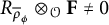 $R_{{\overline {\rho }}_{\phi }}\otimes _{\mathcal {O}}\mathbf {F}\neq 0$
, we see that
$R_{{\overline {\rho }}_{\phi }}\otimes _{\mathcal {O}}\mathbf {F}\neq 0$
, we see that $\lambda \in \mathfrak {m}$
, where
$\lambda \in \mathfrak {m}$
, where $\mathfrak {m}$
is the maximal ideal of
$\mathfrak {m}$
is the maximal ideal of $R_{{\overline {\rho }}_{\phi }}$
. Hence,
$R_{{\overline {\rho }}_{\phi }}$
. Hence,
 $$ \begin{align} \bigcap_n \lambda^n R_{{\overline{\rho}}_{\phi}} \subset \bigcap_n\mathfrak{m}^n.\end{align} $$
The latter intersection is zero, since $R_{{\overline {\rho }}_{\phi }}$
is complete, so separated with respect to
$R_{{\overline {\rho }}_{\phi }}$
is complete, so separated with respect to $\mathfrak {m}$
. Hence, (6.2) implies that
$\mathfrak {m}$
. Hence, (6.2) implies that $R_{{\overline {\rho }}_{\phi }}$
is separated with respect to
$R_{{\overline {\rho }}_{\phi }}$
is separated with respect to $\lambda R_{{\overline {\rho }}_{\phi }}$
allowing for the application of the complete version of Nakayama’s Lemma.
$\lambda R_{{\overline {\rho }}_{\phi }}$
allowing for the application of the complete version of Nakayama’s Lemma.
As $\rho _{\phi }$
is a deformation to
$\rho _{\phi }$
is a deformation to $\mathcal {O}$
, we conclude that
$\mathcal {O}$
, we conclude that $R_{{\overline {\rho }}_{\phi }}=\mathcal {O}$
. This implies that if
$R_{{\overline {\rho }}_{\phi }}=\mathcal {O}$
. This implies that if $\rho : G_{\{\ell \}}\to \operatorname {\mathrm {GL}}_2(\mathcal {O})$
is any deformation of
$\rho : G_{\{\ell \}}\to \operatorname {\mathrm {GL}}_2(\mathcal {O})$
is any deformation of ${\overline {\rho }}_\phi $
, one has
${\overline {\rho }}_\phi $
, one has $\rho \cong \rho _{\phi }$
. Similarly, if
$\rho \cong \rho _{\phi }$
. Similarly, if $\rho : G_{\{\ell \}} \to \operatorname {\mathrm {GL}}_2(\mathcal {O})$
is a deformation of
$\rho : G_{\{\ell \}} \to \operatorname {\mathrm {GL}}_2(\mathcal {O})$
is a deformation of ${\overline {\rho }}_{\phi }(k-2)$
then
${\overline {\rho }}_{\phi }(k-2)$
then $\rho (2-k)$
is a deformation of
$\rho (2-k)$
is a deformation of ${\overline {\rho }}_{\phi }$
. Note that our choice of
${\overline {\rho }}_{\phi }$
. Note that our choice of $I=[3-2k, 2k-3]$
means that this twisting stays inside our category of Fontaine–Laffaille representations. Hence, we get that
$I=[3-2k, 2k-3]$
means that this twisting stays inside our category of Fontaine–Laffaille representations. Hence, we get that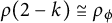 $\rho (2-k)\cong \rho _{\phi }$
, and so we are done.
$\rho (2-k)\cong \rho _{\phi }$
, and so we are done.
Remark 6.7 Note that the determinant of our deformations is automatically fixed as $H^1_f(\mathbf {Q}, \operatorname {\mathrm {ad}}{\overline {\rho }}_{\phi })=H^1_f(\mathbf {Q}, \operatorname {\mathrm {ad}}^0{\overline {\rho }}_{\phi })$
under our assumptions. This means that all deformations
$H^1_f(\mathbf {Q}, \operatorname {\mathrm {ad}}{\overline {\rho }}_{\phi })=H^1_f(\mathbf {Q}, \operatorname {\mathrm {ad}}^0{\overline {\rho }}_{\phi })$
under our assumptions. This means that all deformations $\rho $
of
$\rho $
of ${\overline {\rho }}_{\phi }$
(respectively,
${\overline {\rho }}_{\phi }$
(respectively, ${\overline {\rho }}_{\phi }(k-2)$
) satisfy
${\overline {\rho }}_{\phi }(k-2)$
) satisfy $\det \rho =\epsilon ^{k-1}$
(respectively,
$\det \rho =\epsilon ^{k-1}$
(respectively,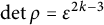 $\det \rho =\epsilon ^{2k-3}$
).
$\det \rho =\epsilon ^{2k-3}$
).
Remark 6.8 Regarding Assumption 6.2(iii), we note that if one additionally assumes that ${\overline {\rho }}_\phi $
is absolutely irreducible when restricted to
${\overline {\rho }}_\phi $
is absolutely irreducible when restricted to $\operatorname {\mathrm {Gal}}(\overline {\mathbf {Q}}/\mathbf {Q}(\sqrt {(-1)^{(\ell -1)/2}\ell })$
then [Reference Diamond, Flach and Guo20, Theorem 3.7] (see also [Reference Hida28, Theorem 5.20] relates
$\operatorname {\mathrm {Gal}}(\overline {\mathbf {Q}}/\mathbf {Q}(\sqrt {(-1)^{(\ell -1)/2}\ell })$
then [Reference Diamond, Flach and Guo20, Theorem 3.7] (see also [Reference Hida28, Theorem 5.20] relates $H^1_f(\mathbf {Q}, \mathrm {ad}^0 \rho _\phi \otimes E/\mathcal {O})$
(via an
$H^1_f(\mathbf {Q}, \mathrm {ad}^0 \rho _\phi \otimes E/\mathcal {O})$
(via an $R_{{\overline {\rho }}_{\phi }}=\mathbf {T}$
theorem) to a congruence ideal
$R_{{\overline {\rho }}_{\phi }}=\mathbf {T}$
theorem) to a congruence ideal $\eta _\phi ^\emptyset $
. One can use Proposition 5.1 to see that
$\eta _\phi ^\emptyset $
. One can use Proposition 5.1 to see that $H^1_f(\mathbf {Q}, \operatorname {\mathrm {ad}}^0{\overline {\rho }}_{\phi })=H^1_f(\mathbf {Q}, \mathrm {ad}^0 \rho _\phi \otimes E/\mathcal {O})[\lambda ]=0$
if
$H^1_f(\mathbf {Q}, \operatorname {\mathrm {ad}}^0{\overline {\rho }}_{\phi })=H^1_f(\mathbf {Q}, \mathrm {ad}^0 \rho _\phi \otimes E/\mathcal {O})[\lambda ]=0$
if $\eta _\phi ^\emptyset $
is coprime to
$\eta _\phi ^\emptyset $
is coprime to $\ell $
.
$\ell $
.
Lemma 6.9 Let G be a group and F be a field. For $i\in \{1,2\}$
, let
$i\in \{1,2\}$
, let $n_i \in \mathbf {Z}_+$
and
$n_i \in \mathbf {Z}_+$
and $\rho _i: G \to \operatorname {\mathrm {GL}}_{n_i}(F)$
be an irreducible representation with
$\rho _i: G \to \operatorname {\mathrm {GL}}_{n_i}(F)$
be an irreducible representation with $\rho _1\not \cong \rho _2$
. Let
$\rho _1\not \cong \rho _2$
. Let $\rho : G \to \operatorname {\mathrm {GL}}_{n_1+n_2}(F)$
be a representation such that
$\rho : G \to \operatorname {\mathrm {GL}}_{n_1+n_2}(F)$
be a representation such that
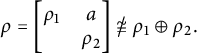 $$ \begin{align*}\rho = \left[ \begin{matrix} \rho_1 & a \\ & \rho_2 \end{matrix} \right]\not\cong \rho_1 \oplus \rho_2.\end{align*} $$
Then, $\rho $
has scalar centralizer.
$\rho $
has scalar centralizer.
Proof This is a simple consequence of Schur’s Lemma and the fact that $\tilde {a}: g \to \rho _2(g)^{-1}a(g)$
defines a cocycle from G to
$\tilde {a}: g \to \rho _2(g)^{-1}a(g)$
defines a cocycle from G to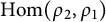 $\operatorname {\mathrm {Hom}}(\rho _2, \rho _1)$
which is not a coboundary.
$\operatorname {\mathrm {Hom}}(\rho _2, \rho _1)$
which is not a coboundary.
Fix a lattice in the space of $\rho _f$
as in Lemma 5.2, i.e., such that
$\rho _f$
as in Lemma 5.2, i.e., such that ${\overline {\rho }}_{f}=\left [ \begin {matrix} {\overline {\rho }}_{\phi } &* \\ &{\overline {\rho }}_{\phi }(k-2)\end {matrix} \right ]: G_{\{\ell \}}\to \operatorname {\mathrm {GL}}_4(\mathbf {F})$
is non-semisimple. For simplicity, we will write R for the universal deformation ring
${\overline {\rho }}_{f}=\left [ \begin {matrix} {\overline {\rho }}_{\phi } &* \\ &{\overline {\rho }}_{\phi }(k-2)\end {matrix} \right ]: G_{\{\ell \}}\to \operatorname {\mathrm {GL}}_4(\mathbf {F})$
is non-semisimple. For simplicity, we will write R for the universal deformation ring $R_{{\overline {\rho }}_{f}}$
of
$R_{{\overline {\rho }}_{f}}$
of ${\overline {\rho }}_{f}$
and
${\overline {\rho }}_{f}$
and $\rho ^{\mathrm {univ}}: G_{\{\ell \}}\to \operatorname {\mathrm {GL}}_4(R)$
for the universal deformation. Note that the deformation problem is representable because
$\rho ^{\mathrm {univ}}: G_{\{\ell \}}\to \operatorname {\mathrm {GL}}_4(R)$
for the universal deformation. Note that the deformation problem is representable because ${\overline {\rho }}_{f}$
is non-semisimple with irreducible, mutually non-isomorphic Jordan–Holder factors, hence by Lemma 6.9, the centralizer of
${\overline {\rho }}_{f}$
is non-semisimple with irreducible, mutually non-isomorphic Jordan–Holder factors, hence by Lemma 6.9, the centralizer of ${\overline {\rho }}_f$
consists of only scalar matrices. We say that a deformation
${\overline {\rho }}_f$
consists of only scalar matrices. We say that a deformation $\tilde \rho $
is upper-triangular if
$\tilde \rho $
is upper-triangular if $\tilde \rho $
is strictly equivalent to a deformation of
$\tilde \rho $
is strictly equivalent to a deformation of ${\overline {\rho }}_{f}$
of the form
${\overline {\rho }}_{f}$
of the form $\left [ \begin {matrix} *&*\\ 0&*\end {matrix} \right ]$
with the stars representing
$\left [ \begin {matrix} *&*\\ 0&*\end {matrix} \right ]$
with the stars representing $2\times 2$
blocks.
$2\times 2$
blocks.
Lemma 6.10 There do not exist any non-trivial deformations of ${\overline {\rho }}_{f}$
into
${\overline {\rho }}_{f}$
into $\operatorname {\mathrm {GL}}_4(\mathbf {F}[X]/X^2)$
that are upper-triangular.
$\operatorname {\mathrm {GL}}_4(\mathbf {F}[X]/X^2)$
that are upper-triangular.
Proof We use Proposition 7.2 in [Reference Berger and Klosin6] noting that Assumption 6.1(i) in [loc.cit.] is satisfied because we impose the current Assumption 6.2(ii). On the other hand, Assumption 6.1(ii) in [loc.cit.] is satisfied because of Lemma 6.6.
Definition 6.11 The smallest ideal I of R such that $\text {tr}\hspace {2pt} \rho ^{\mathrm {univ}}$
is the sum of two pseudocharacters mod I will be called the reducibility ideal of R. We will denote this ideal by
$\text {tr}\hspace {2pt} \rho ^{\mathrm {univ}}$
is the sum of two pseudocharacters mod I will be called the reducibility ideal of R. We will denote this ideal by $I_{\mathrm {re}}$
.
$I_{\mathrm {re}}$
.
Proposition 6.12 Let $I\subset R$
be an ideal such that
$I\subset R$
be an ideal such that $R/I$
is an Artin ring. Then,
$R/I$
is an Artin ring. Then, $I\supset I_{\mathrm {re}}$
if and only if
$I\supset I_{\mathrm {re}}$
if and only if $\rho ^{\mathrm {univ}}$
(mod I) is upper-triangular.
$\rho ^{\mathrm {univ}}$
(mod I) is upper-triangular.
Proof This is proved as Corollary 7.8 in [Reference Berger and Klosin6].
Corollary 6.13 The structure map $\mathcal {O}\to R/I_{\mathrm {re}}$
is surjective and descends to an isomorphism
$\mathcal {O}\to R/I_{\mathrm {re}}$
is surjective and descends to an isomorphism $\mathcal {O}/\lambda ^s \to R/I_{\mathrm {re}}$
for some
$\mathcal {O}/\lambda ^s \to R/I_{\mathrm {re}}$
for some $s\in \mathbf {Z}_{\geq 0}\cup \{\infty \}$
. In fact, one has
$s\in \mathbf {Z}_{\geq 0}\cup \{\infty \}$
. In fact, one has
 $$ \begin{align*}R/I_{\mathrm{re}} \cong\mathcal{O}/\lambda.\end{align*} $$
Proof By Theorem 7.16 in [Reference Eisenbud23] we know that any local complete Noetherian $\mathcal {O}$
-algebra with residue field
$\mathcal {O}$
-algebra with residue field $\mathbf {F}$
is a quotient of
$\mathbf {F}$
is a quotient of $\mathcal {O}[[X_1, \dots , X_n]]$
for some positive integer n. Hence,
$\mathcal {O}[[X_1, \dots , X_n]]$
for some positive integer n. Hence, $S:=R/(I_{\mathrm {re}}+\lambda R)\cong \mathbf {F}[[X_1, \dots , X_n]]/J$
for some ideal J. Suppose first that J is not maximal. Then, by Lemma 6.1, we know that S admits a surjection
$S:=R/(I_{\mathrm {re}}+\lambda R)\cong \mathbf {F}[[X_1, \dots , X_n]]/J$
for some ideal J. Suppose first that J is not maximal. Then, by Lemma 6.1, we know that S admits a surjection $\varphi $
to
$\varphi $
to $\mathbf {F}[T]/T^2$
. This means that there exists a non-trivial (because the image of
$\mathbf {F}[T]/T^2$
. This means that there exists a non-trivial (because the image of $\varphi $
is not contained in
$\varphi $
is not contained in $\mathbf {F}$
) deformation of
$\mathbf {F}$
) deformation of $\rho $
to
$\rho $
to $\mathbf {F}[T]/T^2$
which is upper-triangular (by Proposition 6.12), which contradicts Lemma 6.10. Thus, indeed,
$\mathbf {F}[T]/T^2$
which is upper-triangular (by Proposition 6.12), which contradicts Lemma 6.10. Thus, indeed, $S=\mathbf {F}$
.
$S=\mathbf {F}$
.
Hence, the structure map $\mathcal {O}\to R/I_{\mathrm {re}}$
is surjective by the complete version of Nakayama’s Lemma (see the proof of Lemma 6.6). So,
$\mathcal {O}\to R/I_{\mathrm {re}}$
is surjective by the complete version of Nakayama’s Lemma (see the proof of Lemma 6.6). So,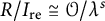 $R/I_{\mathrm {re}}\cong \mathcal {O}/\lambda ^s$
for some
$R/I_{\mathrm {re}}\cong \mathcal {O}/\lambda ^s$
for some $s\in \mathbf {Z}_{\geq 0}\cup \{\infty \}$
.
$s\in \mathbf {Z}_{\geq 0}\cup \{\infty \}$
.
The composition of $\rho ^{\mathrm {univ}}$
with the map
$\rho ^{\mathrm {univ}}$
with the map $R\to R/I_{\mathrm {re}}$
gives rise to a deformation
$R\to R/I_{\mathrm {re}}$
gives rise to a deformation $\rho _{\mathrm {re}}: G_{\{\ell \}}\to \operatorname {\mathrm {GL}}_4(R/I_{\mathrm {re}})=\operatorname {\mathrm {GL}}_4(\mathcal {O}/\lambda ^s)$
. By Proposition 6.12, this deformation is upper triangular, i.e., one has
$\rho _{\mathrm {re}}: G_{\{\ell \}}\to \operatorname {\mathrm {GL}}_4(R/I_{\mathrm {re}})=\operatorname {\mathrm {GL}}_4(\mathcal {O}/\lambda ^s)$
. By Proposition 6.12, this deformation is upper triangular, i.e., one has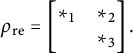 $\rho _{\mathrm {re}}=\left [ \begin {matrix} *_1&*_2\\ &*_3\end {matrix} \right ].$
As the property of being Fontaine–Laffaille is preserved by subobjects and quotients, we see that
$\rho _{\mathrm {re}}=\left [ \begin {matrix} *_1&*_2\\ &*_3\end {matrix} \right ].$
As the property of being Fontaine–Laffaille is preserved by subobjects and quotients, we see that $*_1$
and
$*_1$
and $*_3$
are Fontaine–Laffaille representations with values in
$*_3$
are Fontaine–Laffaille representations with values in $\operatorname {\mathrm {GL}}_2(R/I_{\mathrm { re}})=\operatorname {\mathrm {GL}}_2(\mathcal {O}/\lambda ^s)$
. Thus, by Lemma 6.6, we can conclude that
$\operatorname {\mathrm {GL}}_2(R/I_{\mathrm { re}})=\operatorname {\mathrm {GL}}_2(\mathcal {O}/\lambda ^s)$
. Thus, by Lemma 6.6, we can conclude that $*_1=\rho _{\phi }$
,
$*_1=\rho _{\phi }$
, $*_3=\rho _{\phi }(k-2)$
mod
$*_3=\rho _{\phi }(k-2)$
mod $\lambda ^s$
. Hence, by (5.4) and Proposition 5.1,
$\lambda ^s$
. Hence, by (5.4) and Proposition 5.1, $*_2$
gives rise to a class in
$*_2$
gives rise to a class in $H_f^1(\mathbf {Q},\mathrm {ad}^0\rho _{\phi }(2-k)\otimes _{\mathcal {O}}E/\mathcal {O})$
as
$H_f^1(\mathbf {Q},\mathrm {ad}^0\rho _{\phi }(2-k)\otimes _{\mathcal {O}}E/\mathcal {O})$
as $\rho _{\mathrm {re}}$
is Fontaine–Laffaille. As
$\rho _{\mathrm {re}}$
is Fontaine–Laffaille. As $\rho $
is non-semi-simple, we conclude that
$\rho $
is non-semi-simple, we conclude that $*_2$
is not annihilated by
$*_2$
is not annihilated by $\lambda ^{s-1}$
, i.e., the class of
$\lambda ^{s-1}$
, i.e., the class of $*_2$
gives rise to a subgroup of
$*_2$
gives rise to a subgroup of $H^1_f(\mathbf {Q},\mathrm { ad}^0\rho _{\phi }(2-k)\otimes _{\mathcal {O}}E/\mathcal {O})$
isomorphic to
$H^1_f(\mathbf {Q},\mathrm { ad}^0\rho _{\phi }(2-k)\otimes _{\mathcal {O}}E/\mathcal {O})$
isomorphic to $\mathcal {O}/\lambda ^s$
. Thus,
$\mathcal {O}/\lambda ^s$
. Thus, $s\leq 1$
as
$s\leq 1$
as $\#H^1_f(\mathbf {Q}, \mathrm { ad}^0\rho _{\phi }(2-k)\otimes _{\mathcal {O}}E/\mathcal {O})\leq \#\mathcal {O}/\lambda $
by Assumption 6.2(ii). Finally,
$\#H^1_f(\mathbf {Q}, \mathrm { ad}^0\rho _{\phi }(2-k)\otimes _{\mathcal {O}}E/\mathcal {O})\leq \#\mathcal {O}/\lambda $
by Assumption 6.2(ii). Finally, $s>0$
as
$s>0$
as ${\overline {\rho }}_{f}$
itself is reducible. This concludes the proof.
${\overline {\rho }}_{f}$
itself is reducible. This concludes the proof.
The following proposition does not use Assumption 6.2(ii).
Proposition 6.14 Assume that $\dim H^1_f(\mathbf {Q}, \operatorname {\mathrm {ad}}{\overline {\rho }}_{\phi }(k-2))\leq 1$
. Then, the ideal
$\dim H^1_f(\mathbf {Q}, \operatorname {\mathrm {ad}}{\overline {\rho }}_{\phi }(k-2))\leq 1$
. Then, the ideal $I_{\mathrm {re}}$
is a principal ideal.
$I_{\mathrm {re}}$
is a principal ideal.
Proof Since $\rho ^{\mathrm {univ}}$
is a trace representation in the sense of Section 1.3.3 of [Reference Bellaïche and Chenevier4] Lemma 1.3.7 in [loc.cit.] tells us that we can conjugate
$\rho ^{\mathrm {univ}}$
is a trace representation in the sense of Section 1.3.3 of [Reference Bellaïche and Chenevier4] Lemma 1.3.7 in [loc.cit.] tells us that we can conjugate $\rho ^{\mathrm {univ}}$
by a matrix
$\rho ^{\mathrm {univ}}$
by a matrix $P \in \operatorname {\mathrm {GL}}_2(R)$
(here we use that every finite type projective R-module is free since R is local) to get
$P \in \operatorname {\mathrm {GL}}_2(R)$
(here we use that every finite type projective R-module is free since R is local) to get $\rho ^{\mathrm {univ}}$
adapted to a data of GMA idempotents for
$\rho ^{\mathrm {univ}}$
adapted to a data of GMA idempotents for $R[G_{\{\ell \}}]/\ker \rho ^{\mathrm {univ}}$
. By [Reference Bellaïche and Chenevier4, Lemma 1.3.8] we then get an isomorphism of R-modules
$R[G_{\{\ell \}}]/\ker \rho ^{\mathrm {univ}}$
. By [Reference Bellaïche and Chenevier4, Lemma 1.3.8] we then get an isomorphism of R-modules
 $$ \begin{align*}R[G_{\{\ell\}}]/\ker \rho^{\mathrm{univ}}\cong\left[ \begin{matrix} \operatorname{\mathrm{Mat}}_2(R)&\operatorname{\mathrm{Mat}}_2(B)\\ \operatorname{\mathrm{Mat}}_2(C)&\operatorname{\mathrm{Mat}}_2(R) \end{matrix} \right]\end{align*} $$
for ideals $B, C \subset R$
. By [Reference Bellaïche and Chenevier4, Proposition 1.5.1] we further know that
$B, C \subset R$
. By [Reference Bellaïche and Chenevier4, Proposition 1.5.1] we further know that $I_{\mathrm {re}}=BC$
.
$I_{\mathrm {re}}=BC$
.
[Reference Bellaïche and Chenevier4, Theorem 1.5.5] proves that there are injections $\operatorname {\mathrm {Hom}}_R(B, \mathbf {F}) \hookrightarrow H^1(G_{\{\ell \}}, \operatorname {\mathrm {ad}}{\overline {\rho }}_{\phi }(2-k))$
and
$\operatorname {\mathrm {Hom}}_R(B, \mathbf {F}) \hookrightarrow H^1(G_{\{\ell \}}, \operatorname {\mathrm {ad}}{\overline {\rho }}_{\phi }(2-k))$
and $\operatorname {\mathrm {Hom}}_R(C, \mathbf {F}) \hookrightarrow H^1(G_{\{\ell \}}, \operatorname {\mathrm {ad}}{\overline {\rho }}_{\phi }(k-2)).$
Arguing as in [Reference Akers1, Proposition 4.2] (see also [Reference Wake and Wang-Erickson55, Theorem 4.3.5 and Remark 4.3.6] one sees that the images are contained in the Selmer groups
$\operatorname {\mathrm {Hom}}_R(C, \mathbf {F}) \hookrightarrow H^1(G_{\{\ell \}}, \operatorname {\mathrm {ad}}{\overline {\rho }}_{\phi }(k-2)).$
Arguing as in [Reference Akers1, Proposition 4.2] (see also [Reference Wake and Wang-Erickson55, Theorem 4.3.5 and Remark 4.3.6] one sees that the images are contained in the Selmer groups $H^1_f(\mathbf {Q}, \operatorname {\mathrm {ad}}{\overline {\rho }}_{\phi }(2-k))$
and
$H^1_f(\mathbf {Q}, \operatorname {\mathrm {ad}}{\overline {\rho }}_{\phi }(2-k))$
and $H^1_f(\mathbf {Q}, \operatorname {\mathrm {ad}}{\overline {\rho }}_{\phi }(k-2))$
, respectively. From Assumption 6.2 (ii) and Proposition 5.1, we see that
$H^1_f(\mathbf {Q}, \operatorname {\mathrm {ad}}{\overline {\rho }}_{\phi }(k-2))$
, respectively. From Assumption 6.2 (ii) and Proposition 5.1, we see that $H^1(\mathbf {Q}, \operatorname {\mathrm {ad}}{\overline {\rho }}_{\phi }(2-k)) \cong \mathbf {F}$
. Together with the assumption
$H^1(\mathbf {Q}, \operatorname {\mathrm {ad}}{\overline {\rho }}_{\phi }(2-k)) \cong \mathbf {F}$
. Together with the assumption $\dim H^1_f(\mathbf {Q}, \operatorname {\mathrm {ad}}{\overline {\rho }}_{\phi }(k-2))\leq 1,$
we deduce by Nakayama’s Lemma that both B and C, and therefore also
$\dim H^1_f(\mathbf {Q}, \operatorname {\mathrm {ad}}{\overline {\rho }}_{\phi }(k-2))\leq 1,$
we deduce by Nakayama’s Lemma that both B and C, and therefore also $I_{\mathrm {re}}$
are principal ideals of R. Note that Nakayama’s Lemma applies since B and C are ideals in R, which is Noetherian, hence they are finitely generated over R.
$I_{\mathrm {re}}$
are principal ideals of R. Note that Nakayama’s Lemma applies since B and C are ideals in R, which is Noetherian, hence they are finitely generated over R.
Remark 6.15 [Reference Akers1, Proposition 3.10] proves the principality of the reducibility ideal of the reduced Fontaine–Laffaille deformation ring $R^{\mathrm {red}}$
for any residual representations with two Jordan-Hölder factors. Our argument (while relying on [Reference Akers1, Proposition 4.2] is slightly more general as it allows us to treat the case of non-reduced deformation rings.
$R^{\mathrm {red}}$
for any residual representations with two Jordan-Hölder factors. Our argument (while relying on [Reference Akers1, Proposition 4.2] is slightly more general as it allows us to treat the case of non-reduced deformation rings.
Remark 6.16 By (5.2), we have
 $$ \begin{align*}H^1_f(\mathbf{Q}, \operatorname{\mathrm{ad}}{\overline{\rho}}_{\phi}(k-2))=H^1_f(\mathbf{Q}, \operatorname{\mathrm{ad}}^0{\overline{\rho}}_{\phi}(k-2))\oplus H^1_f(\mathbf{Q}, \mathbf{F}(k-2)).\end{align*} $$
However, as opposed to the case of the $(2-k)$
-twist of the trivial representation (cf. proof of Lemma 5.6), there is no simple relation between
$(2-k)$
-twist of the trivial representation (cf. proof of Lemma 5.6), there is no simple relation between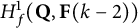 $H^1_f(\mathbf {Q}, \mathbf {F}(k-2))$
and part of a class group except for the case
$H^1_f(\mathbf {Q}, \mathbf {F}(k-2))$
and part of a class group except for the case $k=2$
by Proposition 4.20. By the same proposition for
$k=2$
by Proposition 4.20. By the same proposition for $2<k\leq \ell ,$
the group
$2<k\leq \ell ,$
the group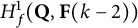 $H^1_f(\mathbf {Q}, \mathbf {F}(k-2))$
requires no ramification condition at
$H^1_f(\mathbf {Q}, \mathbf {F}(k-2))$
requires no ramification condition at $\ell $
, so equals
$\ell $
, so equals $H^1(G_{\{\ell \}}, \mathbf {F}(k-2))$
.
$H^1(G_{\{\ell \}}, \mathbf {F}(k-2))$
.
We have the following results about $H^1(G_{\{\ell \}}, \mathbf {F}(n))$
for
$H^1(G_{\{\ell \}}, \mathbf {F}(n))$
for $n>0$
.
$n>0$
.
Proposition 6.17 [Reference Berger and Klosin8, Proposition 6.5]
Suppose $n \in \mathbf {Z}_{>0}$
and
$n \in \mathbf {Z}_{>0}$
and $n \not \equiv 1\ \mod {\ell -1}$
. Assume that
$n \not \equiv 1\ \mod {\ell -1}$
. Assume that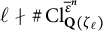 $\ell \nmid \#\operatorname {\mathrm {Cl}}_{\mathbf {Q}(\zeta _{\ell })}^{\overline {\epsilon }^{n}}$
. Then,
$\ell \nmid \#\operatorname {\mathrm {Cl}}_{\mathbf {Q}(\zeta _{\ell })}^{\overline {\epsilon }^{n}}$
. Then, $\dim H^1(G_{\{\ell \}}, \mathbf {F}(n)) \leq 1$
.
$\dim H^1(G_{\{\ell \}}, \mathbf {F}(n)) \leq 1$
.
Proposition 6.18 Let $n>0$
be an even integer. Assume
$n>0$
be an even integer. Assume $\ell \nmid B_n$
(the n-th Bernoulli number) and
$\ell \nmid B_n$
(the n-th Bernoulli number) and $n \not \equiv 0\ \mod {\ell -1}$
. Then,
$n \not \equiv 0\ \mod {\ell -1}$
. Then, $H^1(G_{\{\ell \}}, \mathbf {F}(n))=0$
.
$H^1(G_{\{\ell \}}, \mathbf {F}(n))=0$
.
Proof Since n is even and $H^0(G_{\{\ell \}}, \mathbf {F}(n))=0$
as
$H^0(G_{\{\ell \}}, \mathbf {F}(n))=0$
as $n \not \equiv 0\ \mod {\ell -1}$
we know
$n \not \equiv 0\ \mod {\ell -1}$
we know $\dim _{\mathbf {F}} H^1(G_{\{\ell \}}, \mathbf {F}(n))=\dim _{\mathbf {F}} H^2(G_{\{\ell \}}, \mathbf {F}(n))$
by [Reference Neukirch, Schmidt and Wingberg40, Corollary 8.7.5] (Euler Poincare characteristic). [Reference Assim3, Proposition 1.3] (condition
$\dim _{\mathbf {F}} H^1(G_{\{\ell \}}, \mathbf {F}(n))=\dim _{\mathbf {F}} H^2(G_{\{\ell \}}, \mathbf {F}(n))$
by [Reference Neukirch, Schmidt and Wingberg40, Corollary 8.7.5] (Euler Poincare characteristic). [Reference Assim3, Proposition 1.3] (condition $(ii, \beta )$
) proves that
$(ii, \beta )$
) proves that $H^2(G_{\{\ell \}}, \mathbf {F}(n))=0$
if
$H^2(G_{\{\ell \}}, \mathbf {F}(n))=0$
if $n \not \equiv 1 \ \mod {\ell -1}$
(which is automatically satisfied for even n) and
$n \not \equiv 1 \ \mod {\ell -1}$
(which is automatically satisfied for even n) and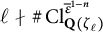 $\ell \nmid \#\operatorname {\mathrm {Cl}}_{\mathbf {Q}(\zeta _{\ell })}^{\overline {\epsilon }^{1-n}}$
. By Herbrand’s Theorem (see, e.g., [Reference Washington57, Theorem 6.17] the latter follows from our assumption that
$\ell \nmid \#\operatorname {\mathrm {Cl}}_{\mathbf {Q}(\zeta _{\ell })}^{\overline {\epsilon }^{1-n}}$
. By Herbrand’s Theorem (see, e.g., [Reference Washington57, Theorem 6.17] the latter follows from our assumption that $\ell \nmid B_n$
(here we use again
$\ell \nmid B_n$
(here we use again $n \not \equiv 0\ \mod {\ell -1}$
).
$n \not \equiv 0\ \mod {\ell -1}$
).
Remark 6.19 Note that the assumption $\ell \nmid B_{n}$
is stronger than
$\ell \nmid B_{n}$
is stronger than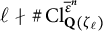 $\ell \nmid \#\operatorname {\mathrm {Cl}}_{\mathbf {Q}(\zeta _{\ell })}^{\overline {\epsilon }^{n}}$
in [Reference Berger and Klosin8, Proposition 6.5] As noted in the proof of Proposition 6.18,
$\ell \nmid \#\operatorname {\mathrm {Cl}}_{\mathbf {Q}(\zeta _{\ell })}^{\overline {\epsilon }^{n}}$
in [Reference Berger and Klosin8, Proposition 6.5] As noted in the proof of Proposition 6.18, $\ell \nmid B_{n}$
implies
$\ell \nmid B_{n}$
implies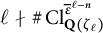 $\ell \nmid \#\operatorname {\mathrm {Cl}}_{\mathbf {Q}(\zeta _{\ell })}^{\overline {\epsilon }^{\ell -n}}$
by Herbrand’s Theorem. By the “reflection theorem” [Reference Washington57, Theorem 10.9] this means that also
$\ell \nmid \#\operatorname {\mathrm {Cl}}_{\mathbf {Q}(\zeta _{\ell })}^{\overline {\epsilon }^{\ell -n}}$
by Herbrand’s Theorem. By the “reflection theorem” [Reference Washington57, Theorem 10.9] this means that also $\ell \nmid \operatorname {\mathrm {Cl}}_{\mathbf {Q}(\zeta _{\ell })}^{\overline {\epsilon }^{n}}$
.
$\ell \nmid \operatorname {\mathrm {Cl}}_{\mathbf {Q}(\zeta _{\ell })}^{\overline {\epsilon }^{n}}$
.
This allows us to prove the following modularity theorem.
Theorem 6.20 Recall that we impose Assumptions 3.1 and 6.2. Furthermore, assume that $\dim H^1_f(\mathbf {Q}, \mathrm { ad}{\overline {\rho }}_{\phi }(k-2))\leq 1$
. Then, the structure map
$\dim H^1_f(\mathbf {Q}, \mathrm { ad}{\overline {\rho }}_{\phi }(k-2))\leq 1$
. Then, the structure map $\iota :\mathcal {O}\to R$
is an isomorphism. In particular, if
$\iota :\mathcal {O}\to R$
is an isomorphism. In particular, if $\tau :G_{\mathbf {Q}}\to \operatorname {\mathrm {GL}}_4(E)$
is any continuous irreducible homomorphism unramified outside
$\tau :G_{\mathbf {Q}}\to \operatorname {\mathrm {GL}}_4(E)$
is any continuous irreducible homomorphism unramified outside $\ell $
, crystalline at
$\ell $
, crystalline at $\ell $
with Hodge–Tate weights in
$\ell $
with Hodge–Tate weights in $[3-2k,2k-3]$
and such that
$[3-2k,2k-3]$
and such that
 $$ \begin{align*}\overline{\tau}^{\mathrm{ss}}={\overline{\rho}}_{\phi} \oplus {\overline{\rho}}_{\phi}(k-2),\end{align*} $$
then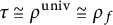 $\tau \cong \rho ^{\mathrm {univ}}\cong \rho _f$
, i.e., in particular,
$\tau \cong \rho ^{\mathrm {univ}}\cong \rho _f$
, i.e., in particular, $\tau $
is modular.
$\tau $
is modular.
Proof It follows from Corollary 6.13 that $I_{\mathrm {re}}$
is a maximal ideal of R. As the deformation
$I_{\mathrm {re}}$
is a maximal ideal of R. As the deformation $\rho _f$
induces a surjective map
$\rho _f$
induces a surjective map $j: R\to \mathcal {O}$
, we get the following commutative diagram of
$j: R\to \mathcal {O}$
, we get the following commutative diagram of $\mathcal {O}$
-algebra maps:
$\mathcal {O}$
-algebra maps:

As $\overline {\iota }$
is an isomorphism, we get that so is
$\overline {\iota }$
is an isomorphism, we get that so is $\overline {j}$
. So, using the fact that
$\overline {j}$
. So, using the fact that $I_{\mathrm {re}}$
is principal (Proposition 6.14), we can now apply Theorem 6.9 in [Reference Berger and Klosin5] to the right square to conclude that j is an isomorphism.
$I_{\mathrm {re}}$
is principal (Proposition 6.14), we can now apply Theorem 6.9 in [Reference Berger and Klosin5] to the right square to conclude that j is an isomorphism.
Now, let $\tau $
be as in the statement of the theorem. Then,
$\tau $
be as in the statement of the theorem. Then, $\tau $
factors through a representation of
$\tau $
factors through a representation of $G_{\{\ell \}}$
. Using that
$G_{\{\ell \}}$
. Using that $\tau $
is irreducible, Theorem 4.1 in [Reference Berger and Klosin9] allows us to find a lattice in the space of
$\tau $
is irreducible, Theorem 4.1 in [Reference Berger and Klosin9] allows us to find a lattice in the space of $\tau $
such that with respect to that lattice, one has
$\tau $
such that with respect to that lattice, one has
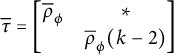 $$ \begin{align*}\overline{\tau}=\left[ \begin{matrix} {\overline{\rho}}_{\phi} & * \\ & {\overline{\rho}}_{\phi}(k-2)\end{matrix} \right]\end{align*} $$
that is non-semi-simple. Using Remark 6.5, we see that this lattice is Fontaine–Laffaille, so the star gives rise to a non-zero element in $H^1_f(\mathbf {Q}, \mathrm {ad}^0\rho _{\phi \textbf {}}(2-k)\otimes _{\mathcal {O}}E/\mathcal {O})$
. As the latter group has order
$H^1_f(\mathbf {Q}, \mathrm {ad}^0\rho _{\phi \textbf {}}(2-k)\otimes _{\mathcal {O}}E/\mathcal {O})$
. As the latter group has order $\#\mathcal {O}/\lambda $
by Assumption 6.2(ii), we conclude that
$\#\mathcal {O}/\lambda $
by Assumption 6.2(ii), we conclude that $\overline {\tau }\cong \rho $
. In particular,
$\overline {\tau }\cong \rho $
. In particular, $\tau $
is a deformation of
$\tau $
is a deformation of $\rho $
. Hence,
$\rho $
. Hence, $\tau $
gives rise to an
$\tau $
gives rise to an $\mathcal {O}$
-algebra map
$\mathcal {O}$
-algebra map $R\to \mathcal {O}$
, which must equal j by the first part of the theorem.
$R\to \mathcal {O}$
, which must equal j by the first part of the theorem.
Remark 6.21 We return to Example 3.6 and note that Assumption 6.2 (i) holds, as discussed earlier. Since $\ell =163$
or
$\ell =163$
or $187273$
do not divide
$187273$
do not divide $(2k-1)(2k-3)k!$
for
$(2k-1)(2k-3)k!$
for $k=26$
and
$k=26$
and ${\overline {\rho }}_\phi $
is irreducible, [Reference Diamond, Flach and Guo20, Lemma 2.5] proves that
${\overline {\rho }}_\phi $
is irreducible, [Reference Diamond, Flach and Guo20, Lemma 2.5] proves that ${\overline {\rho }}_\phi $
stays irreducible when restricted to
${\overline {\rho }}_\phi $
stays irreducible when restricted to $\operatorname {\mathrm {Gal}}(\overline {\mathbf {Q}}/\mathbf {Q}(\sqrt {(-1)^{(\ell -1)/2}\ell }))$
. Via Remark 6.8, we can therefore check that
$\operatorname {\mathrm {Gal}}(\overline {\mathbf {Q}}/\mathbf {Q}(\sqrt {(-1)^{(\ell -1)/2}\ell }))$
. Via Remark 6.8, we can therefore check that $H^1_f(\mathbf {Q}, \operatorname {\mathrm {ad}}^0{\overline {\rho }}_{\phi })=0$
as
$H^1_f(\mathbf {Q}, \operatorname {\mathrm {ad}}^0{\overline {\rho }}_{\phi })=0$
as $\phi $
is the only cusp form of weight 26 and level 1, so in particular,
$\phi $
is the only cusp form of weight 26 and level 1, so in particular, $\phi $
is not congruent mod
$\phi $
is not congruent mod $\ell $
to other forms. Since, in addition,
$\ell $
to other forms. Since, in addition, $L_{\mathrm {alg}}(50, \mathrm {Sym}^2 \phi )$
has
$L_{\mathrm {alg}}(50, \mathrm {Sym}^2 \phi )$
has $\ell $
-valuation 1 for both
$\ell $
-valuation 1 for both $\ell =163$
and
$\ell =163$
and $187273,$
the Bloch–Kato conjecture for
$187273,$
the Bloch–Kato conjecture for $\#H^1_f(\mathbf {Q}, \mathrm {ad}^0 \rho _\phi (2-k) \otimes E/\mathcal {O})=\#\mathcal {O}/\lambda $
(see [Reference Dummigan22, Conjecture (5.2) and (5)] would imply that Assumption (ii) holds.
$\#H^1_f(\mathbf {Q}, \mathrm {ad}^0 \rho _\phi (2-k) \otimes E/\mathcal {O})=\#\mathcal {O}/\lambda $
(see [Reference Dummigan22, Conjecture (5.2) and (5)] would imply that Assumption (ii) holds.
We do not know how to check $\dim H^1_f(\mathbf {Q}, \mathrm {ad}{\overline {\rho }}_{\phi }(k-2))\leq 1$
, as the corresponding divisible Selmer group is not critical (in the sense of Deligne). Note that
$\dim H^1_f(\mathbf {Q}, \mathrm {ad}{\overline {\rho }}_{\phi }(k-2))\leq 1$
, as the corresponding divisible Selmer group is not critical (in the sense of Deligne). Note that $\dim H^1_f(\mathbf {Q}, \mathrm {ad}{\overline {\rho }}_{\phi }(k-2))=\dim H^1_f(\mathbf {Q}, \mathrm {ad}^0{\overline {\rho }}_{\phi }(k-2))$
by Proposition 6.18, since neither prime
$\dim H^1_f(\mathbf {Q}, \mathrm {ad}{\overline {\rho }}_{\phi }(k-2))=\dim H^1_f(\mathbf {Q}, \mathrm {ad}^0{\overline {\rho }}_{\phi }(k-2))$
by Proposition 6.18, since neither prime $\ell $
divides
$\ell $
divides $B_{24}$
.
$B_{24}$
.
7 (Non-)principality of Eisenstein ideals
In this section, we formulate conditions when the Eisenstein ideal of the local Hecke algebra acting on $S_k(\Gamma _2)$
is non-principal and
$S_k(\Gamma _2)$
is non-principal and $\dim _{\mathbf {F}}H^1_f(\mathbf {Q}, \operatorname {\mathrm {ad}}^0{\overline {\rho }}_{\phi }(k-2))>1.$
In particular, in that case,
$\dim _{\mathbf {F}}H^1_f(\mathbf {Q}, \operatorname {\mathrm {ad}}^0{\overline {\rho }}_{\phi }(k-2))>1.$
In particular, in that case, $R\not \cong \mathcal {O}$
.
$R\not \cong \mathcal {O}$
.
Let $\mathbf {T}'$
be as in Section 2. Let
$\mathbf {T}'$
be as in Section 2. Let $\mathbf {T}$
denote the
$\mathbf {T}$
denote the $\mathcal {O}$
-subalgebra of
$\mathcal {O}$
-subalgebra of $\mathbf {T}'\otimes _{\mathbf {Z}}\mathcal {O}$
generated by the operators
$\mathbf {T}'\otimes _{\mathbf {Z}}\mathcal {O}$
generated by the operators $T^{(2)}(p)$
and
$T^{(2)}(p)$
and $T_1^{(2)}(p^2)$
for all primes
$T_1^{(2)}(p^2)$
for all primes $p\nmid \ell $
. Since strong multiplicity, one holds in the level one case, we can choose an orthogonal basis
$p\nmid \ell $
. Since strong multiplicity, one holds in the level one case, we can choose an orthogonal basis $\mathcal {N}'$
of
$\mathcal {N}'$
of $S_{k}(\Gamma _{2})$
consisting of eigenforms for all the operators in
$S_{k}(\Gamma _{2})$
consisting of eigenforms for all the operators in $\mathbf {T}$
.
$\mathbf {T}$
.
Each $g\in \mathcal {N}'$
gives rise to
$g\in \mathcal {N}'$
gives rise to $\psi _g\in \operatorname {\mathrm {Hom}}_{\mathcal {O}-\mathrm {alg}}(\mathbf {T}, \mathcal {O}),$
where
$\psi _g\in \operatorname {\mathrm {Hom}}_{\mathcal {O}-\mathrm {alg}}(\mathbf {T}, \mathcal {O}),$
where $\psi _g(T)=\lambda _g(T)$
, with
$\psi _g(T)=\lambda _g(T)$
, with $\lambda _g(T)$
the eigenvalue of the operator T corresponding to g. Thus, we get a map
$\lambda _g(T)$
the eigenvalue of the operator T corresponding to g. Thus, we get a map $\Psi : \mathcal {N}'\to \operatorname {\mathrm {Hom}}_{\mathcal {O}-\mathrm {alg}}(\mathbf {T}, \mathcal {O})$
given by
$\Psi : \mathcal {N}'\to \operatorname {\mathrm {Hom}}_{\mathcal {O}-\mathrm {alg}}(\mathbf {T}, \mathcal {O})$
given by $g\mapsto \lambda _g$
, which by strong multiplicity, one is an injection.
$g\mapsto \lambda _g$
, which by strong multiplicity, one is an injection.
Lemma 7.1 The natural $\mathcal {O}$
-algebra map
$\mathcal {O}$
-algebra map
 $$ \begin{align} \mathbf{T}\to \prod_{g\in \mathcal{N}'}\mathcal{O} \quad \text{given by} \quad T\mapsto (\psi_g(T))_{g}\end{align} $$
is injective and has finite cokernel, i.e., $\mathbf {T}$
can be viewed as a lattice in
$\mathbf {T}$
can be viewed as a lattice in $\prod _{g\in \mathcal {N}'}\mathcal {O}$
.
$\prod _{g\in \mathcal {N}'}\mathcal {O}$
.
Proof The injectivity follows from the fact that the elements of $\mathcal {N}'$
form a basis.
$\mathcal {N}'$
form a basis.
We will now show that the map has finite cokernel. Note that the (set) map $\Psi \otimes \overline {\mathbf {Q}}_\ell : \mathcal {N}'\to \operatorname {\mathrm {Hom}}_{\overline {\mathbf {Q}}_{\ell }-\mathrm {alg}}(\mathbf {T}\otimes \overline {\mathbf {Q}}_{\ell },\overline {\mathbf {Q}}_{\ell })\hookrightarrow \operatorname {\mathrm {Hom}}_{\overline {\mathbf {Q}}_{\ell }}(\mathbf {T}\otimes \overline {\mathbf {Q}}_{\ell }, \overline {\mathbf {Q}}_{\ell })$
given by
$\Psi \otimes \overline {\mathbf {Q}}_\ell : \mathcal {N}'\to \operatorname {\mathrm {Hom}}_{\overline {\mathbf {Q}}_{\ell }-\mathrm {alg}}(\mathbf {T}\otimes \overline {\mathbf {Q}}_{\ell },\overline {\mathbf {Q}}_{\ell })\hookrightarrow \operatorname {\mathrm {Hom}}_{\overline {\mathbf {Q}}_{\ell }}(\mathbf {T}\otimes \overline {\mathbf {Q}}_{\ell }, \overline {\mathbf {Q}}_{\ell })$
given by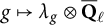 $g \mapsto \lambda _g \otimes \overline {\mathbf {Q}}_\ell $
is injective (because
$g \mapsto \lambda _g \otimes \overline {\mathbf {Q}}_\ell $
is injective (because $\Psi $
is injective), and strong multiplicity one implies that no non-trivial linear relation
$\Psi $
is injective), and strong multiplicity one implies that no non-trivial linear relation $\sum _{g\in \mathcal {N}'} c_g \lambda _{g}=0$
can hold. Thus, the set
$\sum _{g\in \mathcal {N}'} c_g \lambda _{g}=0$
can hold. Thus, the set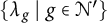 $\{\lambda _g\mid g\in \mathcal {N}'\}$
is a linearly independent subset of
$\{\lambda _g\mid g\in \mathcal {N}'\}$
is a linearly independent subset of $\operatorname {\mathrm {Hom}}_{\overline {\mathbf {Q}}_{\ell }}(\mathbf {T}\otimes \overline {\mathbf {Q}}_{\ell }, \overline {\mathbf {Q}}_{\ell })$
. Hence,
$\operatorname {\mathrm {Hom}}_{\overline {\mathbf {Q}}_{\ell }}(\mathbf {T}\otimes \overline {\mathbf {Q}}_{\ell }, \overline {\mathbf {Q}}_{\ell })$
. Hence,
 $$ \begin{align} \dim_{\overline{\mathbf{Q}}_{\ell}}\mathbf{T}\otimes \overline{\mathbf{Q}}_{\ell}=\dim_{\overline{\mathbf{Q}}_{\ell}}\operatorname{\mathrm{Hom}}_{\overline{\mathbf{Q}}_{\ell}}(\mathbf{T}\otimes \overline{\mathbf{Q}}_{\ell}, \overline{\mathbf{Q}}_{\ell})\geq \# \mathcal{N}'.\end{align} $$
Tensoring the map (7.1) with $\overline {\mathbf {Q}}_{\ell }$
we get a corresponding map
$\overline {\mathbf {Q}}_{\ell }$
we get a corresponding map $\mathbf {T}\otimes \overline {\mathbf {Q}}_{\ell }\to \prod _{g\in \mathcal {N}'}\overline {\mathbf {Q}}_{\ell }$
, which is injective as (7.1) is. Thus, it must be surjective by (7.2). Hence, the map (7.1) has finite cokernel.
$\mathbf {T}\otimes \overline {\mathbf {Q}}_{\ell }\to \prod _{g\in \mathcal {N}'}\overline {\mathbf {Q}}_{\ell }$
, which is injective as (7.1) is. Thus, it must be surjective by (7.2). Hence, the map (7.1) has finite cokernel.
We now identify $\mathbf {T}$
with the image of the map (7.1) and note that
$\mathbf {T}$
with the image of the map (7.1) and note that $\mathbf {T}=\prod _{\mathfrak {m} \in \mathrm {MaxSpec}\mathbf {T}}\mathbf {T}_{\mathfrak {m}},$
where
$\mathbf {T}=\prod _{\mathfrak {m} \in \mathrm {MaxSpec}\mathbf {T}}\mathbf {T}_{\mathfrak {m}},$
where $\mathbf {T}_{\mathfrak {m}}$
is the localization of
$\mathbf {T}_{\mathfrak {m}}$
is the localization of $\mathbf {T}$
at the maximal ideal
$\mathbf {T}$
at the maximal ideal $\mathfrak {m}$
. Let
$\mathfrak {m}$
. Let $\mathcal {N}$
be the subset of
$\mathcal {N}$
be the subset of $\mathcal {N}'$
consisting of all the
$\mathcal {N}'$
consisting of all the $g\in \mathcal {N}'$
which satisfy
$g\in \mathcal {N}'$
which satisfy
 $$ \begin{align*}\psi_g(T)\equiv \lambda_{E_{\phi}^{1,2}}(T) \quad\pmod{\lambda}\quad \text{for all }T\in \mathbf{T}.\end{align*} $$
We write $\mathfrak {m}$
for the corresponding maximal ideal. Set
$\mathfrak {m}$
for the corresponding maximal ideal. Set $J\subset \mathbf {T}$
to be the Eisenstein ideal, i.e., J is the ideal of
$J\subset \mathbf {T}$
to be the Eisenstein ideal, i.e., J is the ideal of $\mathbf {T}$
generated by the set
$\mathbf {T}$
generated by the set $\{T^{(2)}(p)-(\text {tr}\hspace {2pt} \rho _{\phi }(\operatorname {\mathrm {Frob}}_p)+\text {tr}\hspace {2pt}\rho _{\phi }(k-2)(\operatorname {\mathrm {Frob}}_p))\mid p\neq \ell \}.$
Write
$\{T^{(2)}(p)-(\text {tr}\hspace {2pt} \rho _{\phi }(\operatorname {\mathrm {Frob}}_p)+\text {tr}\hspace {2pt}\rho _{\phi }(k-2)(\operatorname {\mathrm {Frob}}_p))\mid p\neq \ell \}.$
Write $J_{\mathfrak {m}}$
to be the image of J under the canonical map
$J_{\mathfrak {m}}$
to be the image of J under the canonical map $\mathbf {T}\to \mathbf {T}_{\mathfrak {m}}$
.
$\mathbf {T}\to \mathbf {T}_{\mathfrak {m}}$
.
Recall that we fixed in Section 5.2 the weight $k \geq 12$
even and prime
$k \geq 12$
even and prime $\ell> 4k-5$
and imposed Assumption 3.1 on the field
$\ell> 4k-5$
and imposed Assumption 3.1 on the field $E/\mathbf {Q}_\ell $
. We also fixed the Fontaine–Laffaille interval
$E/\mathbf {Q}_\ell $
. We also fixed the Fontaine–Laffaille interval $I=[3-2k, 2k-3]$
. Let
$I=[3-2k, 2k-3]$
. Let $\phi \in S_k(\Gamma _1)$
be a newform such that
$\phi \in S_k(\Gamma _1)$
be a newform such that ${\overline {\rho }}_{\phi }$
is irreducible.
${\overline {\rho }}_{\phi }$
is irreducible.
For the rest of this section, we also impose Assumption 6.2 and fix the corresponding $f \in S_k(\Gamma _2)$
. Then,
$f \in S_k(\Gamma _2)$
. Then, $f\in \mathcal {N}$
, i.e.,
$f\in \mathcal {N}$
, i.e., $\mathbf {T}_{\mathfrak {m}}/J_{\mathfrak {m}}\neq 0$
. Let
$\mathbf {T}_{\mathfrak {m}}/J_{\mathfrak {m}}\neq 0$
. Let $R=R_{{\overline {\rho }}_f}$
be the universal deformation ring defined in Section 6.
$R=R_{{\overline {\rho }}_f}$
be the universal deformation ring defined in Section 6.
Theorem 7.2 Recall that we impose Assumptions 3.1 and 6.2. Then, there exists a surjective $\mathcal {O}$
-algebra map
$\mathcal {O}$
-algebra map $\varphi : R\to \mathbf {T}_{\mathfrak {m}}$
such that
$\varphi : R\to \mathbf {T}_{\mathfrak {m}}$
such that $\varphi (I_{\mathrm {re}})=J_{\mathfrak {m}}$
and
$\varphi (I_{\mathrm {re}})=J_{\mathfrak {m}}$
and $J_{\mathfrak {m}}$
is a maximal ideal of
$J_{\mathfrak {m}}$
is a maximal ideal of $\mathbf {T}_{\mathfrak {m}}$
. If, in addition,
$\mathbf {T}_{\mathfrak {m}}$
. If, in addition, $\dim _{\mathbf {F}} H^1_f(\mathbf {Q}, \mathrm {ad}{\overline {\rho }}_{\phi }(k-2))\leq 1$
, then all of the following are true:
$\dim _{\mathbf {F}} H^1_f(\mathbf {Q}, \mathrm {ad}{\overline {\rho }}_{\phi }(k-2))\leq 1$
, then all of the following are true:
-
• the map
$\varphi $
is an isomorphism; -
• the Hecke ring
$\mathbf {T}_{\mathfrak {m}}$
is isomorphic to
$\mathcal {O}$
; -
• the Eisenstein ideal
$J_{\mathfrak {m}}$
is principal.


Proof Let $g\in \mathcal {N}$
. Then, by Lemma 5.2, there exists a
$g\in \mathcal {N}$
. Then, by Lemma 5.2, there exists a $G_{\mathbf {Q}}$
-stable lattice with respect to which one has
$G_{\mathbf {Q}}$
-stable lattice with respect to which one has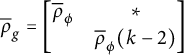 ${\overline {\rho }}_{g}=\left [ \begin {matrix} {\overline {\rho }}_{\phi }&* \\ & {\overline {\rho }}_{\phi }(k-2)\end {matrix} \right ]$
and is not semi-simple. Hence, the
${\overline {\rho }}_{g}=\left [ \begin {matrix} {\overline {\rho }}_{\phi }&* \\ & {\overline {\rho }}_{\phi }(k-2)\end {matrix} \right ]$
and is not semi-simple. Hence, the $*$
gives rise to an element in
$*$
gives rise to an element in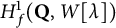 $H^1_f(\mathbf {Q}, W[\lambda ])$
, where
$H^1_f(\mathbf {Q}, W[\lambda ])$
, where $W=\mathrm {ad}^0\rho _{\phi }(2-k)\otimes _{\mathcal {O}}E/\mathcal {O}$
.
$W=\mathrm {ad}^0\rho _{\phi }(2-k)\otimes _{\mathcal {O}}E/\mathcal {O}$
.
By (5.4) and Proposition 5.1, we get $H^1_f(\mathbf {Q}, W[\lambda ])=H^1_f(\mathbf {Q}, W)[\lambda ]$
. The latter group is cyclic by Assumption 6.2 (ii), so we must have that
$H^1_f(\mathbf {Q}, W[\lambda ])=H^1_f(\mathbf {Q}, W)[\lambda ]$
. The latter group is cyclic by Assumption 6.2 (ii), so we must have that ${\overline {\rho }}_{g}\cong {\overline {\rho }}_f$
, and so after adjusting the basis, if necessary, we get that
${\overline {\rho }}_{g}\cong {\overline {\rho }}_f$
, and so after adjusting the basis, if necessary, we get that $\rho _{g}$
is a deformation of
$\rho _{g}$
is a deformation of ${\overline {\rho }}_f$
.
${\overline {\rho }}_f$
.
This implies that for every $g\in \mathcal {N,}$
we get an
$g\in \mathcal {N,}$
we get an $\mathcal {O}$
-algebra (hence continuous) map
$\mathcal {O}$
-algebra (hence continuous) map $\varphi _{g}:R\to \mathcal {O}$
with the property that
$\varphi _{g}:R\to \mathcal {O}$
with the property that $\text {tr}\hspace {2pt}\rho ^{\mathrm { univ}}(\operatorname {\mathrm {Frob}}_p) \mapsto \lambda _{g}(T^{(2)}(p))$
. This property completely determines
$\text {tr}\hspace {2pt}\rho ^{\mathrm { univ}}(\operatorname {\mathrm {Frob}}_p) \mapsto \lambda _{g}(T^{(2)}(p))$
. This property completely determines $\varphi _{g}$
because R is topologically generated by the set
$\varphi _{g}$
because R is topologically generated by the set $\{\text {tr}\hspace {2pt}\rho ^{\mathrm { univ}}(\operatorname {\mathrm {Frob}}_p)\mid p\neq \ell \}$
by Proposition 7.13 in [Reference Berger and Klosin6]. Putting these maps together we get an
$\{\text {tr}\hspace {2pt}\rho ^{\mathrm { univ}}(\operatorname {\mathrm {Frob}}_p)\mid p\neq \ell \}$
by Proposition 7.13 in [Reference Berger and Klosin6]. Putting these maps together we get an $\mathcal {O}$
-algebra map
$\mathcal {O}$
-algebra map $\varphi : R\to \prod _{g\in \mathcal {N}}\mathcal {O}$
whose image is an
$\varphi : R\to \prod _{g\in \mathcal {N}}\mathcal {O}$
whose image is an $\mathcal {O}$
-subalgebra of
$\mathcal {O}$
-subalgebra of $\prod _{g\in \mathcal {N}}\mathcal {O}$
generated by
$\prod _{g\in \mathcal {N}}\mathcal {O}$
generated by $\{T^{(2)}(p)\mid p\neq \ell \}$
. Note that
$\{T^{(2)}(p)\mid p\neq \ell \}$
. Note that $\varphi (R)\subset \mathbf {T}_{\mathfrak {m}}$
. To see the opposite inclusion consider the characteristic polynomial
$\varphi (R)\subset \mathbf {T}_{\mathfrak {m}}$
. To see the opposite inclusion consider the characteristic polynomial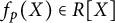 $f_p(X)\in R[X]$
of
$f_p(X)\in R[X]$
of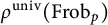 $\rho ^{\mathrm {univ}}(\operatorname {\mathrm {Frob}}_p)$
for
$\rho ^{\mathrm {univ}}(\operatorname {\mathrm {Frob}}_p)$
for $p\neq \ell $
. Combining Theorem 2.1 with the definition of
$p\neq \ell $
. Combining Theorem 2.1 with the definition of $L_p(X, f; \mathrm {spin}),$
we see that the coefficient at
$L_p(X, f; \mathrm {spin}),$
we see that the coefficient at $X^2$
is mapped by
$X^2$
is mapped by $\varphi $
to
$\varphi $
to $T^{(2)}(p)^2-T^{(2)}(p^2)-p^{2k-4}\in \prod _{g\in \mathcal {N}}\mathcal {O}$
. As
$T^{(2)}(p)^2-T^{(2)}(p^2)-p^{2k-4}\in \prod _{g\in \mathcal {N}}\mathcal {O}$
. As $T^{(2)}(p)$
and
$T^{(2)}(p)$
and $p^{2k-4}$
both belong to
$p^{2k-4}$
both belong to $\varphi (R)$
, so therefore must
$\varphi (R)$
, so therefore must $T^{(2)}(p^2)$
. We now use the fact [Reference Andrianov2, 3.3.38] and [Reference Johnson-Leung and Roberts30, p. 547] that
$T^{(2)}(p^2)$
. We now use the fact [Reference Andrianov2, 3.3.38] and [Reference Johnson-Leung and Roberts30, p. 547] that
 $$ \begin{align*} p T_1^{(2)}(p^2) = T^{(2)}(p)^2 - T^{(2)}(p^2) - p(p^2+p+1) T(\operatorname{\mathrm{diag}}(p,p,p,p)) \end{align*} $$
to conclude that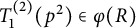 $T_1^{(2)}(p^2) \in \varphi (R)$
. Hence,
$T_1^{(2)}(p^2) \in \varphi (R)$
. Hence, $\varphi (R)$
contains all the Hecke operators away from
$\varphi (R)$
contains all the Hecke operators away from $\ell $
, i.e.,
$\ell $
, i.e., $\varphi (R)=\mathbf {T}_{\mathfrak {m}}$
. We denote the resulting
$\varphi (R)=\mathbf {T}_{\mathfrak {m}}$
. We denote the resulting $\mathcal {O}$
-algebra epimorphism
$\mathcal {O}$
-algebra epimorphism $R\to \mathbf {T}_{\mathfrak {m}}$
again by
$R\to \mathbf {T}_{\mathfrak {m}}$
again by $\varphi $
. We claim that
$\varphi $
. We claim that $\varphi (I_{\mathrm {re}})\subset J_{\mathfrak {m}}$
.
$\varphi (I_{\mathrm {re}})\subset J_{\mathfrak {m}}$
.
Indeed, using the Chebotarev Density Theorem, one sees that
 $$ \begin{align*}\text{tr}\hspace{2pt} \rho^{\mathrm{univ}}\equiv \text{tr}\hspace{2pt} \rho_{\phi}+\text{tr}\hspace{2pt} \rho_{\phi}(k-2)\quad\pmod{\varphi^{-1}(J_{\mathfrak{m}})},\end{align*} $$
so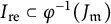 $I_{\mathrm {re}}\subset \varphi ^{-1}(J_{\mathfrak {m}})$
. As
$I_{\mathrm {re}}\subset \varphi ^{-1}(J_{\mathfrak {m}})$
. As $\varphi $
is a surjection, this implies that
$\varphi $
is a surjection, this implies that $\varphi (I_{\mathrm {re}})\subset J_{\mathfrak {m}}$
. Hence,
$\varphi (I_{\mathrm {re}})\subset J_{\mathfrak {m}}$
. Hence, $\varphi $
gives rise to a sequence of
$\varphi $
gives rise to a sequence of $\mathcal {O}$
-algebra surjections
$\mathcal {O}$
-algebra surjections $R/I_{\mathrm {re}}\to \mathbf {T}_{\mathfrak {m}}/\varphi (I_{\mathrm {re}})\to \mathbf {T}_{\mathfrak {m}}/J_{\mathfrak {m}}$
. As
$R/I_{\mathrm {re}}\to \mathbf {T}_{\mathfrak {m}}/\varphi (I_{\mathrm {re}})\to \mathbf {T}_{\mathfrak {m}}/J_{\mathfrak {m}}$
. As $R/I_{\mathrm {re}}=\mathbf {F}$
by Corollary 6.13 we conclude that all these surjections are isomorphisms (note that
$R/I_{\mathrm {re}}=\mathbf {F}$
by Corollary 6.13 we conclude that all these surjections are isomorphisms (note that $\mathbf {T}_{\mathfrak {m}}/J_{\mathfrak {m}}\neq 0$
), hence
$\mathbf {T}_{\mathfrak {m}}/J_{\mathfrak {m}}\neq 0$
), hence $\varphi (I_{\mathrm {re}})=J_{\mathfrak {m}}$
and
$\varphi (I_{\mathrm {re}})=J_{\mathfrak {m}}$
and $J_{\mathfrak {m}}$
is maximal. This proves the first claim.
$J_{\mathfrak {m}}$
is maximal. This proves the first claim.
Now assume in addition that $\dim H^1_f(\mathbf {Q}, \mathrm {ad}{\overline {\rho }}_{\phi }(k-2))\leq 1$
. Then, Theorem 6.20 gives us that
$\dim H^1_f(\mathbf {Q}, \mathrm {ad}{\overline {\rho }}_{\phi }(k-2))\leq 1$
. Then, Theorem 6.20 gives us that $R=\mathcal {O}$
, so we get that
$R=\mathcal {O}$
, so we get that $\varphi $
is an isomorphism, and so
$\varphi $
is an isomorphism, and so $R\cong \mathbf {T}_{\mathfrak {m}}\cong \mathcal {O}$
. Hence,
$R\cong \mathbf {T}_{\mathfrak {m}}\cong \mathcal {O}$
. Hence, $J_{\mathfrak {m}}$
is a principal ideal.
$J_{\mathfrak {m}}$
is a principal ideal.
Corollary 7.3 If $J_{\mathfrak {m}}$
is not principal, then
$J_{\mathfrak {m}}$
is not principal, then $\dim _{\mathbf {F}}H^1_f(\mathbf {Q}, \operatorname {\mathrm {ad}}{\overline {\rho }}_{\phi }(k-2))>1.$
If in addition
$\dim _{\mathbf {F}}H^1_f(\mathbf {Q}, \operatorname {\mathrm {ad}}{\overline {\rho }}_{\phi }(k-2))>1.$
If in addition $\ell \nmid B_{k-2}$
then
$\ell \nmid B_{k-2}$
then $\dim _{\mathbf {F}}H^1_f(\mathbf {Q}, \operatorname {\mathrm {ad}}^0{\overline {\rho }}_{\phi }(k-2))>1.$
Proof The first inequality is just a restatement of one of the claims of Theorem 7.2. The second follows from the first one and Proposition 6.18.
Proposition 7.4 For each $g\in \mathcal {N,}$
write
$g\in \mathcal {N,}$
write $m_{g}$
for the largest positive integer m such that
$m_{g}$
for the largest positive integer m such that $g\equiv E_{2,1}^{\phi }$
mod
$g\equiv E_{2,1}^{\phi }$
mod $\lambda ^{m}$
. If
$\lambda ^{m}$
. If
 $$ \begin{align} \operatorname{\mathrm{val}}_{\ell}(\# \mathbf{T}_{\mathfrak{m}}/J_{\mathfrak{m}})<[\mathbf{F}:\mathbf{F}_{\ell}] \cdot \sum_{g\in \mathcal{N}}m_{g}\end{align} $$
then $J_{\mathfrak {m}}$
is not principal.
$J_{\mathfrak {m}}$
is not principal.
Proof Set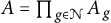 $A = \prod _{g\in \mathcal {N}}A_{g}$
, where
$A = \prod _{g\in \mathcal {N}}A_{g}$
, where $A_{g}=\mathcal {O}$
for all
$A_{g}=\mathcal {O}$
for all $g\in \mathcal {N}$
. Let
$g\in \mathcal {N}$
. Let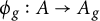 $\phi _{g} : A \to A_{g}$
be the canonical projection. Since, by Lemma 7.1,
$\phi _{g} : A \to A_{g}$
be the canonical projection. Since, by Lemma 7.1, $\mathbf {T}$
is a full rank
$\mathbf {T}$
is a full rank $\mathcal {O}$
-submodule of
$\mathcal {O}$
-submodule of $\prod _{g \in \mathcal {N}'} \mathcal {O,}$
we conclude that the local complete
$\prod _{g \in \mathcal {N}'} \mathcal {O,}$
we conclude that the local complete $\mathcal {O}$
-subalgebra
$\mathcal {O}$
-subalgebra $\mathbf {T}_{\mathfrak {m}} \subset A$
is of full rank as an
$\mathbf {T}_{\mathfrak {m}} \subset A$
is of full rank as an $\mathcal {O}$
-submodule and
$\mathcal {O}$
-submodule and $J_{\mathfrak {m}} \subset \mathbf {T}_{\mathfrak {m}}$
is an ideal of finite index. Set
$J_{\mathfrak {m}} \subset \mathbf {T}_{\mathfrak {m}}$
is an ideal of finite index. Set $T_{g} = \phi _{g}(\mathbf {T}_{\mathfrak {m}})=A_{g}=\mathcal {O}$
and
$T_{g} = \phi _{g}(\mathbf {T}_{\mathfrak {m}})=A_{g}=\mathcal {O}$
and $J_{g} = \phi _{g}(J_{\mathfrak {m}})=\lambda ^{m_{g}}\mathcal {O}$
. Hence, we are in the setup of Section 2 of [Reference Berger, Klosin and Kramer11]. Assume
$J_{g} = \phi _{g}(J_{\mathfrak {m}})=\lambda ^{m_{g}}\mathcal {O}$
. Hence, we are in the setup of Section 2 of [Reference Berger, Klosin and Kramer11]. Assume $J_{\mathfrak {m}}$
is principal. Then, Proposition 2.3 in [Reference Berger, Klosin and Kramer11] gives us that
$J_{\mathfrak {m}}$
is principal. Then, Proposition 2.3 in [Reference Berger, Klosin and Kramer11] gives us that
 $$ \begin{align} \#\mathbf{T}_{\mathfrak{m}}/J_{\mathfrak{m}}=\prod_{g\in \mathcal{N}} \#T_{g}/J_{g}.\end{align} $$
Note that one has
 $$ \begin{align} \operatorname{\mathrm{val}}_{\ell}\left(\prod_{g\in \mathcal{N}} \#T_{g}/J_{g}\right)= [\mathbf{F}:\mathbf{F}_{\ell}] \cdot \sum_{g\in \mathcal{N}}m_{g}.\end{align} $$
This equality, together with (7.4), contradicts the inequality (7.3).
Corollary 7.5 Let $m_{g}$
be defined as in Proposition 7.4. If
$m_{g}$
be defined as in Proposition 7.4. If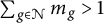 $ \sum _{g\in \mathcal {N}}m_{g}>1$
then
$ \sum _{g\in \mathcal {N}}m_{g}>1$
then $J_{\mathfrak {m}}$
is not principal and
$J_{\mathfrak {m}}$
is not principal and $\dim _{\mathbf {F}}H^1_f(\mathbf {Q}, \operatorname {\mathrm {ad}}{\overline {\rho }}_{\phi }(k-2))>1.$
If in addition
$\dim _{\mathbf {F}}H^1_f(\mathbf {Q}, \operatorname {\mathrm {ad}}{\overline {\rho }}_{\phi }(k-2))>1.$
If in addition $\ell \nmid B_{k-2}$
then
$\ell \nmid B_{k-2}$
then $\dim _{\mathbf {F}}H^1_f(\mathbf {Q}, \operatorname {\mathrm {ad}}^0{\overline {\rho }}_{\phi }(k-2))>1.$
Proof Note that from the proof of Theorem 7.2, we get that $\mathbf {T}_{\mathfrak {m}}/J_{\mathfrak {m}}=\mathbf {F}$
, even without assuming
$\mathbf {T}_{\mathfrak {m}}/J_{\mathfrak {m}}=\mathbf {F}$
, even without assuming $\dim _{\mathbf {F}}H^1_f(\mathbf {Q}, \operatorname {\mathrm {ad}}{\overline {\rho }}_{\phi }(k-2))\leq 1$
. Assume that
$\dim _{\mathbf {F}}H^1_f(\mathbf {Q}, \operatorname {\mathrm {ad}}{\overline {\rho }}_{\phi }(k-2))\leq 1$
. Assume that $J_{\mathfrak {m}}$
is principal. Then, from (7.4) and (7.5), we conclude that
$J_{\mathfrak {m}}$
is principal. Then, from (7.4) and (7.5), we conclude that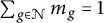 $\sum _{g\in \mathcal {N}}m_{g}=1$
, which contradicts our assumption. Hence,
$\sum _{g\in \mathcal {N}}m_{g}=1$
, which contradicts our assumption. Hence, $J_{\mathfrak {m}}$
is not principal. The Selmer group inequalities now follow from Corollary 7.3.
$J_{\mathfrak {m}}$
is not principal. The Selmer group inequalities now follow from Corollary 7.3.
Remark 7.6 Corollary 7.3 directly ties the cyclicity of the non-critical Selmer group $H^1_f(\mathbf {Q}, \operatorname {\mathrm {ad}}{\overline {\rho }}_{\phi }(k-2))$
with the principality of the Eisenstein ideal
$H^1_f(\mathbf {Q}, \operatorname {\mathrm {ad}}{\overline {\rho }}_{\phi }(k-2))$
with the principality of the Eisenstein ideal $J_{\mathfrak {m}}$
. We note that Assumption 6.2(ii) implies the equality
$J_{\mathfrak {m}}$
. We note that Assumption 6.2(ii) implies the equality $\mathbf {T}_{\mathfrak {m}}/J_{\mathfrak {m}}=\mathbf {F}$
. Contrary to what one might think, the existence of several forms
$\mathbf {T}_{\mathfrak {m}}/J_{\mathfrak {m}}=\mathbf {F}$
. Contrary to what one might think, the existence of several forms $g\equiv E_{2,1}^{\phi }$
mod
$g\equiv E_{2,1}^{\phi }$
mod $\lambda $
does not preclude this equality. For example, if there are exactly two linearly independent eigenforms
$\lambda $
does not preclude this equality. For example, if there are exactly two linearly independent eigenforms $g_1, g_2 \in \mathcal {N}$
with
$g_1, g_2 \in \mathcal {N}$
with $m_{g_1}=m_{g_2}=1$
such that
$m_{g_1}=m_{g_2}=1$
such that $g_1 \not \equiv g_2\ \mod {\lambda ^2}$
then
$g_1 \not \equiv g_2\ \mod {\lambda ^2}$
then $\mathbf {T}_{\mathfrak {m}} \cong \mathcal {O} \times _{\mathbf {F}} \mathcal {O}=\{(a,b) \in \mathcal {O} \times \mathcal {O} \mid a \equiv b\ \mod {\lambda }\}$
and in this case,
$\mathbf {T}_{\mathfrak {m}} \cong \mathcal {O} \times _{\mathbf {F}} \mathcal {O}=\{(a,b) \in \mathcal {O} \times \mathcal {O} \mid a \equiv b\ \mod {\lambda }\}$
and in this case, $J_{\mathfrak {m}}$
is the maximal ideal, i.e.,
$J_{\mathfrak {m}}$
is the maximal ideal, i.e., $\mathbf {T}_{\mathfrak {m}}/J_{\mathfrak {m}}=\mathbf {F}$
, so Corollary 7.5 applies and
$\mathbf {T}_{\mathfrak {m}}/J_{\mathfrak {m}}=\mathbf {F}$
, so Corollary 7.5 applies and $\dim _{\mathbf {F}}H^1_f(\mathbf {Q}, \operatorname {\mathrm {ad}}{\overline {\rho }}_{\phi }(k-2))>1$
.
$\dim _{\mathbf {F}}H^1_f(\mathbf {Q}, \operatorname {\mathrm {ad}}{\overline {\rho }}_{\phi }(k-2))>1$
.
Acknowledgements
The authors would like to thank Jeremy Booher and Neil Dummigan for helpful discussions.


 Open access

