




Impact statement
Seabirds are indicators of ecosystem health, serving as the messengers of plastics pollution in the world’s oceans. Reports of plastic ingestion in seabirds have thus informed policy responses and helped track the impacts of such policies. Yet, seabirds are the most threatened group of birds globally. Therefore, policy priorities for addressing plastics pollution using seabirds as indicators must also balance with conservation priorities to ensure we protect the messengers of ocean health.
Introduction
Plastics pollution is ubiquitous in marine and freshwater ecosystems and projected to increase dramatically if measures are not taken to reduce production and improve waste management (Law, Reference Law2017; Borrelle et al., Reference Borrelle, Ringma, Law, Monnahan, Lebreton, McGivern, Murphy, Jambeck, Leonard, Hilleary, Eriksen, Possingham, De Frond, Gerber, Polidoro, Tahir, Bernard, Mallos, Barnes and Rochman2020). Marine animals from the smallest plankton to the largest whales ingest plastic, become entangled, and are impacted by plastic associated chemicals (Bucci et al., Reference Bucci, Tulio and Rochman2020). Seabird plastic ingestion studies have played a critical role in the development of regional and global policy responses to marine plastics pollution by demonstrating the biological impact on marine wildlife (van Franeker et al., Reference van Franeker, Blaize, Danielsen, Fairclough, Gollan, Guse, Hansen, Heubeck, Jensen, Le Guillou, Olsen, Olsen, Pedersen, Stienen and Turner2011). Increasingly, monitoring of nest debris and plastic-associated chemical contamination in seabirds is informing national and international policy responses (e.g., Bond et al., Reference Bond, Montevecchi, Guse, Regular, Garthe and Rail2012; Provencher et al., Reference Provencher, Malaisé, Mallory, Braune, Pirie-Dominix and Lu2022). Thus, seabirds have served as the messengers of marine plastics pollution (we use the plural of plastic here to describe both the physical and chemical components of plastic materials) since the late 1950s, not long after plastics began to be commercially manufactured (Provencher et al., Reference Provencher, Ammendolia, Rochman and Mallory2019).
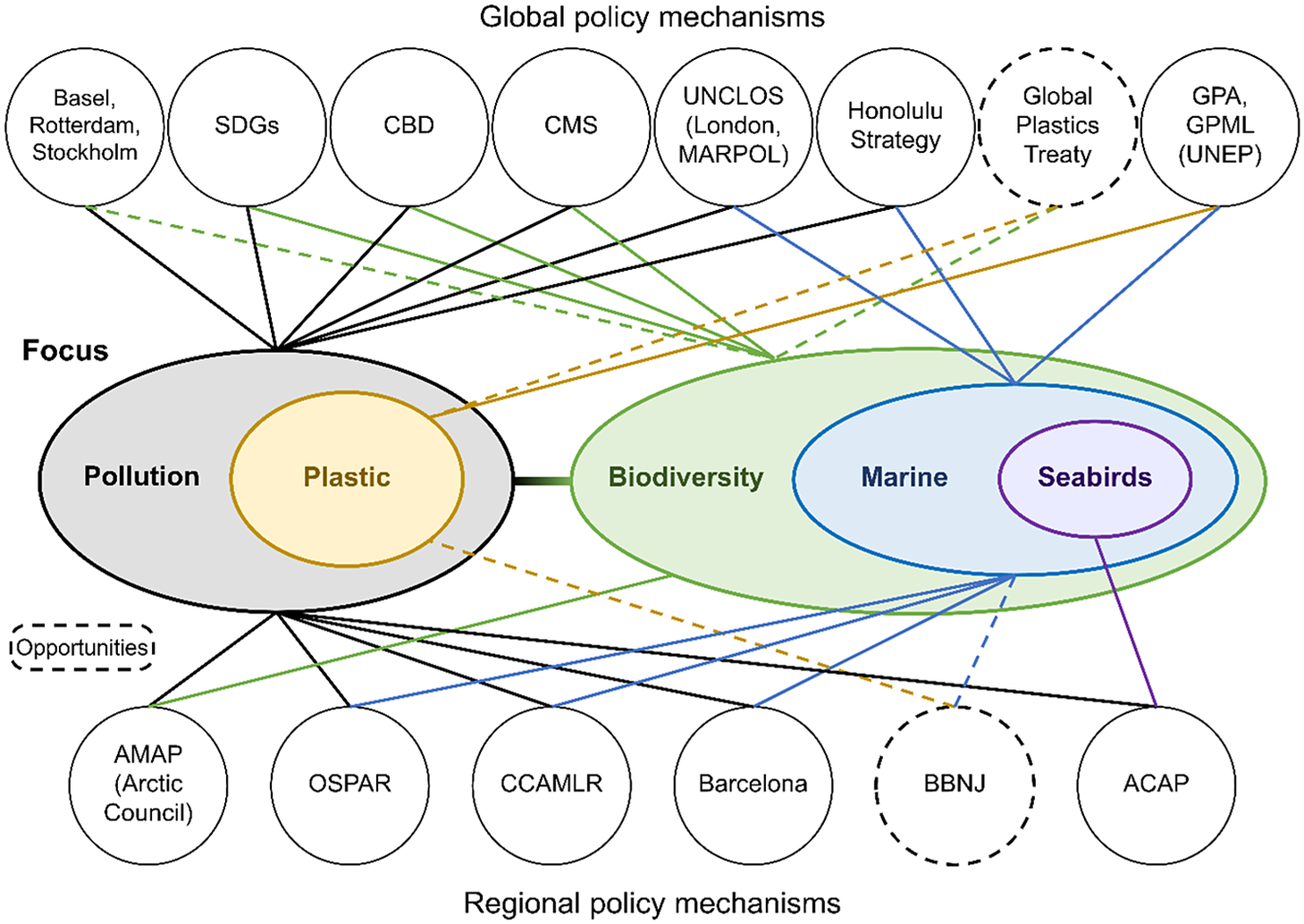
There are many existing regional and international agreements (legally binding and nonbinding) related to the protection of marine ecosystems and biodiversity or addressing the problems of plastics pollution, many of which have been informed by seabird research (Table 1). For example, the impacts of plastics on biological diversity, notably seabirds, were officially recognized in the Convention on Biological Diversity (CBD) in 2005 by the Subsidiary Body on Scientific, Technical and Technological Advice (CBD, 2005). Other policy mechanisms have identified seabirds as important messengers of anthropogenic activity. For example, the Stockholm Convention has identified seabirds (and other transient species) as long-range transport mechanisms for persistent contaminants (Idowu et al., Reference Idowu, Capaldi, Zu and Gupta2013). All of these policy mechanisms have different aims, geographic remits, and links to plastics pollution or seabirds (Figure 1), and to add further complexity, different sets of countries have signed each agreement (Linnebjerg et al., Reference Linnebjerg, Baak, Barry, Gavrilo, Mallory, Merkel, Price, Strand, Walker and Provencher2021).
Table describing international policy agreements on pollution, biodiversity, or conservation; the monitoring requirements for each international policy as it relates to seabirds; and opportunities within each policy to bridge conservation and monitoring efforts moving forward

Note: Gray boxes indicate international policies that are currently under international negotiations.
* Agreed, yet to be ratified.
Multilateral policy mechanisms are outlined in Table 1 according to their scale (global or regional) and focus (nested, e.g., a focus on pollution including plastics, or only plastics). Dashed lines indicate policy mechanisms that are still under negotiation or yet to be ratified, but represent opportunities for the inclusion of seabirds or plastics within monitoring and conservation provisions. ACAP, the Agreement on the Conservation of Albatrosses and Petrels; BBNJ, Biological Diversity of Areas Beyond National Jurisdiction; CBD, Convention on Biological Diversity; CCAMLR, Commission for the Conservation of Antarctic Marine Living Resources; CMS, Convention on the Conservation of Migratory Species of Wild Animals; GPA, Global Programme of Action for the Protection of the Marine Environment from Land-Based Activities; GPML, Global Partnership on Marine Litter; OSPAR, Convention for the Protection of the Marine Environment of the North-East Atlantic; SDG, Sustainable Development Goals; UNCLOS, United Nations Convention on the Law of the Sea; UNEP, United National Environment Programme.

A prominent example of seabird plastic ingestion influencing policy is the Northern Fulmar (Fulmarus glacialis), which is specified as a monitoring tool for the 1992 OSPAR Convention, replacing the Oslo and Paris Conventions, for the protection of the marine environment of the northeast Atlantic. As an indicator of environmental quality, OSPAR has monitored the amount of plastic in the stomachs of Northern Fulmars in the North Sea since 1996 (Box 1; van Franeker et al., Reference van Franeker, Blaize, Danielsen, Fairclough, Gollan, Guse, Hansen, Heubeck, Jensen, Le Guillou, Olsen, Olsen, Pedersen, Stienen and Turner2011; van Franeker and Law, Reference van Franeker and Law2015). It is important to note that this target had no substantiated evidence of relating to individual or population health. Rather, it represented an arbitrary target considered to reflect “acceptable ecological quality” as used in policy documents (Provencher et al., Reference Provencher, Bond, Avery-Gomm, Borrelle, Bravo Rebolledo, Hammer, Kühn, Lavers, Mallory, Trevail and van Franeker2017).
OSPAR
OSPAR is “the mechanism by which 15 governments and the European Union cooperate to protect the marine environment of the North-East Atlantic,” which includes maritime and land-based sources of marine pollution. Initially, working groups of the International Council for the Exploration of the Sea (ICES) and OSPAR worded a preliminary target definition of the proposed Ecological Quality Objective (EcoQO) as plastics in stomachs of seabirds as “the proportion of birds having 10 or more pieces of plastic in the stomach should be below 2%.”
As evidence grew, ICES and OSPAR agreed that the target definition would be more ecologically meaningful in terms of plastic if mass was used instead of number of particles. This was informed by Dutch studies which indicated that in terms of mass of plastics in Northern Fulmar stomachs, the critical level of 10 particles is equal to about 0.1 g of plastic (Van Franeker and Meijboom, Reference van Franeker and Meijboom2002). These studies also showed that nearly every Northern Fulmar in the southern part of North Sea had plastics in the proventriculus–averaging a mass of 0.6 g per bird (about 0.1% of the species’ average body mass) between 1996 and 2000. Consequently, the policy aim of <2% of Northern Fulmars exceeding 0.1 g of plastic became unrealistic for the foreseeable future. Advice was followed to redefine the less strict target to <10% of beached Northern Fulmars exceeding 0.1 g of plastic in the stomach, which still lacked ecologically relevant evidence. This proportion of 10% of birds was taken from the definition for the EcoQO on oil pollution, which used Common Murre (Uria aalge) as an indicator species with an EcoQO target of <10% of beached guillemots having oil in their feathers (OSPAR, 2010). In 2019, 56% of stranded fulmars collected from beaches around the North Sea exceeded the 0.1 g of plastic in their stomachs (https://www.ospar.org/work-areas/eiha/marine-litter/assessment-of-marine-litter/plastic-particles-in-fulmars).
Seabirds can also inform harmonized monitoring of plastics within geographic areas that could ultimately lead to policy responses on a national level. A notable example of this is the Litter and Microplastics Monitoring Guidelines published by the Arctic Monitoring and Assessment Program (AMAP), which lists seabirds as a priority monitoring species (AMAP, 2021). AMAP is one of six Working Groups of the Arctic Council with directives from the Ministers of the Arctic Council and supports international processes that address regional and global efforts to combat climate change and contaminants (Box 2; AMAP, 2021).
AMAP
In 2017, the AMAP released an assessment of chemicals of emerging Arctic concern, which classified plastics pollution as a contaminant of concern in the Arctic. In 2019, the Arctic Council’s working group, Protection of the Arctic Marine Environment (PAME), conducted a desktop study on marine litter including microplastics in the Arctic – the first Arctic-wide evaluation of the occurrence and impacts of plastics pollution across the circumpolar North (PAME, 2019). PAME’s desktop study highlighted the need to create a regional action plan on marine litter in the Arctic. AMAP’s Expert Group on Litter and Microplastics (LMEG) was formed in 2019 with the aim to: (a) design a monitoring program of plastics pollution in the Arctic environment; (b) develop necessary guidelines for this monitoring program; and (c) create recommendation frameworks and identify areas of future research priorities.
AMAP-LMEG has since released the Litter and Microplastics Monitoring Plan, which provides recommendations that will lead to a coordinated, ecosystem-scale pan-Arctic monitoring program that will collect information for future assessments. This monitoring program includes monitoring levels of plastic ingestion in seabirds over time. Following this, LMEG also released the Litter and Microplastics Monitoring Guidelines, a technical document that reviews litter and microplastics protocols and research techniques paired with technical recommendations for harmonized monitoring efforts across the Arctic.
Plastics pollution and its complex suite of chemicals
Plastics are inherently complex, ranging in morphology, polymer composition, and chemical mixture (Rochman et al., Reference Rochman, Brookson, Bikker, Djuric, Earn, Bucci, Athey, Huntington, McIlwraith, Munno, De Frond, Kolomijeca, Erdle, Grbic, Bayoumi, Borrelle, Wu, Santoro, Werbowski, Zhu, Giles, Hamilton, Thaysen, Kaura, Klasios, Ead, Kim, Sherlock, Ho and Hung2019). Therefore, moving beyond ingestion studies of macro-plastics (plastic particles >5 mm following the descriptions in Rochman et al., Reference Rochman, Brookson, Bikker, Djuric, Earn, Bucci, Athey, Huntington, McIlwraith, Munno, De Frond, Kolomijeca, Erdle, Grbic, Bayoumi, Borrelle, Wu, Santoro, Werbowski, Zhu, Giles, Hamilton, Thaysen, Kaura, Klasios, Ead, Kim, Sherlock, Ho and Hung2019), research efforts to inform policy are increasingly being directed toward understanding the fate, transport, and toxicity of plastics through seabird research (Provencher et al., Reference Provencher, Liboiron, Borrelle, Bond, Rochman, Lavers, Avery-Gomm, Yamashita, Ryan, Lusher, Hammer, Bradshaw, Khan and Mallory2020). This is because seabirds play an important role at the interface of the aquatic and terrestrial environment by transporting nutrients and pollutants (Jones et al., Reference Jones, Borrelle and Rankin2022). For over two decades, seabirds have been identified as long-range transport mechanisms for contaminants (Blais, Reference Blais, Kimpe, McMahon, Keatley, Mallory, Douglas and Smol2005; Idowu et al., Reference Idowu, Capaldi, Zu and Gupta2013) and thereby serve as important indicators for both the fate and transport of emerging contaminants of concern including plastics (e.g., Mallory and Braune, Reference Mallory and Braune2012; Provencher et al., Reference Provencher, Vermaire, Avery-Gomm, Braune and Mallory2018; Bourdages et al., Reference Bourdages, Provencher, Baak, Mallory and Vermaire2020). Plastic-associated chemicals have been identified in seabirds (e.g., Neumann et al., Reference Neumann, Harju, Herzke, Anker-Nilssen, Christensen-Dalsgaard, Langset and Gabrielsen2021; Provencher et al., Reference Provencher, Malaisé, Mallory, Braune, Pirie-Dominix and Lu2022), but understanding the biological and ecological impacts of more than 10,000 chemicals that have been associated with plastics pollution (Wiesinger et al., Reference Wiesinger, Wang and Hellweg2021), and then translating this information into meaningful policy responses is no easy task.
Plastic additives are complex and do not fit into a single category or class of chemicals. Not only do these compounds range in function (e.g., plasticizers, flame retardants, surfactants) and chemical structure, but they also range in their affiliation with plastic polymers, and their ecological impacts (Hamilton et al., Reference Hamilton, Baak, Vorkamp, Hammer, Granberg, Herzke and Provencher2022). Understanding the role plastics have in transporting these chemicals depends on a variety of physio-chemical factors and evaluating the fate and effects of plastic additives in the environment and wildlife is in its infancy. Seabirds are already providing important insights on the fate and effects of plastic-associated chemicals including additives. For example, Neumann et al. (Reference Neumann, Harju, Herzke, Anker-Nilssen, Christensen-Dalsgaard, Langset and Gabrielsen2021) identified decabromodiphenyl ether (BDE-209; an unregulated flame retardant) in liver tissues of Northern Fulmars that had plastics in their gastrointestinal tract, while BDE-209 was absent in individuals with plastic-free stomachs suggesting chemical transfer via plastic ingestion (Neumann et al., Reference Neumann, Harju, Herzke, Anker-Nilssen, Christensen-Dalsgaard, Langset and Gabrielsen2021). Conversely, in a recent study conducted by Collard et al. (Reference Collard, Leconte, Danielsen, Halsband, Herzke, Harju, Tulatz, Gabrielsen and Tarroux2022), plastic ingestion was observed in 95% of sampled Northern Fulmar chicks. Polybrominated diphenyl ethers (PBDEs) and dechloranes were detected in the livers of all sampled birds; however, there was no relationship found between ingested plastic and chemical burden within the liver (Collard et al., Reference Collard, Leconte, Danielsen, Halsband, Herzke, Harju, Tulatz, Gabrielsen and Tarroux2022). While PBDEs and dechloranes are used in plastics, they have a wide variety of uses; thus, understanding the relationship between plastics and associated chemical contaminants in wildlife is complex (Hamilton et al., Reference Hamilton, Baak, Vorkamp, Hammer, Granberg, Herzke and Provencher2022).
Specimen banks have been regarded as critically important tools in monitoring contaminants over time, specifically in seabirds (Mallory and Braune, Reference Mallory and Braune2012) and have been successfully used to retrospectively evaluate historical trends of additives in the environment (Provencher et al., Reference Provencher, Malaisé, Mallory, Braune, Pirie-Dominix and Lu2022). Additionally, several studies have explored the use of plastic additive concentrations in tissues like preen oil to investigate plastic ingestion levels (e.g., Hardesty et al., Reference Hardesty, Good and Wilcox2015; Yamashita et al., Reference Yamashita, Hiki, Kashiwada, Takada, Mizukawa, Hardesty and Watanuki2021). However, it is important to note that not all seabirds are equally susceptible to plastics pollution nor are all seabirds tolerant of handling for nonlethal sampling (e.g., lavage, blood sampling). Such studies of chemical contaminants in seabirds inform policy interventions such as the Basel Convention, Stockholm Convention, and the Rotterdam Convention, which together provide legally binding mechanisms for the control of the transboundary movement, and safe disposal and management of hazardous substances. Decisions by UN member states in 2019 added plastic-related additives to the Stockholm Convention and the Rotterdam Convention, which provided greater legal power to countries to control the import of harmful plastics and their additives (BRS, 2019). Additionally, in 2021, the Stockholm Convention considered UV-stabilizer 328, opening the door to plastic additive regulations (Stockholm Convention, 2021). However, this also underscores the need to better understand the fate, transport, and ecological effects of thousands of different plastic additives. We recommend the use of standardized methodology, specimen banks, nonlethal sampling in seabird research, and the addition of plastic additives to inform policy mechanisms targeting chemical contaminants.
The plastic monitoring-seabird nexus
Plastics ingestion monitoring protocols for seabirds, such as those developed through OSPAR, or new protocols based on chemical contamination trends are an important tool for measuring the impact of policy responses to address plastics pollution (Provencher et al., Reference Provencher, Liboiron, Borrelle, Bond, Rochman, Lavers, Avery-Gomm, Yamashita, Ryan, Lusher, Hammer, Bradshaw, Khan and Mallory2020). They can serve as a standardized approach to monitoring plastics contamination (including plastics-associated chemicals) in other ocean basins to form a cohesive global picture of the issue and how it changes over time in response to policy implementation. However, monitoring programs such as the OSPAR EcoQO target of <10% of Northern Fulmars with <0.1 g of plastic in their stomachs, or similar targets that are developed for other species are an arbitrary value that provides little to no information about the impact to individuals or populations (Box 1) to inform a species-specific conservation response to meet the obligations of biodiversity focused international agreements and goals (e.g., Table 1).
Scientific and policy needs (e.g., monitoring) must also balance with conservation priorities (Mallory et al., Reference Mallory, Robinson, Hebert and Forbes2010; Avery-Gomm et al., Reference Avery-Gomm, Borrelle and Provencher2018). Seabirds are the most threatened group of birds globally (Dias et al., Reference Dias, Martin, Pearmain, Burfield, Small, Phillips, Yates, Lascelles, Borboroglu and Croxall2019). While only 25 of the 369 seabird species have “garbage and solid waste” listed as a threat (Birdlife International, 2022), many more species are impacted by plastic debris. Of the groups of seabirds, Procellariiformes (albatrosses, petrels, and shearwaters) are the most sensitive to plastic ingestion (Provencher et al., Reference Provencher, Bond, Avery-Gomm, Borrelle, Bravo Rebolledo, Hammer, Kühn, Lavers, Mallory, Trevail and van Franeker2017). Seabirds are found in every ocean, but are not evenly distributed (Jenkins and Van Houtan, Reference Jenkins and Van Houtan2016), and can travel vast distances, crossing international boundaries during foraging trips and migratory journeys (Beal et al., Reference Beal, Dias, Phillips, Oppel, Hazin, Pearmain, Adams, Anderson, Antolos, Arata, Arcos, Arnould, Awkerman, Bell, Bell, Carey, Carle, Clay, Cleeland, Colodro, Conners, Cruz-Flores, Cuthbert, Delord, Deppe, Dilley, Dinis, Elliott, De Felipe, Felis, Forero, Freeman, Fukuda, González-Solís, Granadeiro, Hedd, Hodum, Igual, Jaeger, Landers, Le Corre, Makhado, Metzger, Militão, Montevecchi, Morera-Pujol, Navarro-Herrero, Nel, Nicholls, Oro, Ouni, Ozaki, Quintana, Ramos, Reid, Reyes-González, Robertson, Robertson, Romdhane, Ryan, Sagar, Sato, Schoombie, Scofield, Shaffer, Shah, Stevens, Surman, Suryan, Takahashi, Tatayah, Taylor, Thompson, Torres, Walker, Wanless, Waugh, Weimerskirch, Yamamoto, Zajkova, Zango and Catry2021). Likewise, marine plastics are found worldwide and distributed unevenly, with some regions accumulating much more plastic than others, such as mid-ocean gyres and some coastal areas (Eriksen et al., Reference Eriksen, Lebreton, Carson, Thiel, Moore, Borerro, Galgani, Ryan and Reisser2014; van Sebille et al., Reference Van Sebille, Wilcox, Lebreton, Maximenko, Hardesty, Van Franeker, Eriksen, Siegel, Galgani and Law2015). Plastics can remain close to the source but can also be transported large distances in ocean currents such that the highly polluted areas are not necessarily sources (Maximenko et al., Reference Maximenko, Hafner and Niiler2012). For example, remote islands such as Midway Atoll, Hawai’i are not near sources of plastic, but the breeding seabirds including the Laysan Albatross (Phoebastria immutabilis) and Bonin Petrel (Pterodroma hypoleuca) from Midway Atoll ingest debris that collects in the Northeast Pacific gyre (Lavers and Bond, Reference Lavers and Bond2016). Tracking data shows that many seabird species spend large amounts of time on the high seas (Beal et al., Reference Beal, Dias, Phillips, Oppel, Hazin, Pearmain, Adams, Anderson, Antolos, Arata, Arcos, Arnould, Awkerman, Bell, Bell, Carey, Carle, Clay, Cleeland, Colodro, Conners, Cruz-Flores, Cuthbert, Delord, Deppe, Dilley, Dinis, Elliott, De Felipe, Felis, Forero, Freeman, Fukuda, González-Solís, Granadeiro, Hedd, Hodum, Igual, Jaeger, Landers, Le Corre, Makhado, Metzger, Militão, Montevecchi, Morera-Pujol, Navarro-Herrero, Nel, Nicholls, Oro, Ouni, Ozaki, Quintana, Ramos, Reid, Reyes-González, Robertson, Robertson, Romdhane, Ryan, Sagar, Sato, Schoombie, Scofield, Shaffer, Shah, Stevens, Surman, Suryan, Takahashi, Tatayah, Taylor, Thompson, Torres, Walker, Wanless, Waugh, Weimerskirch, Yamamoto, Zajkova, Zango and Catry2021), where plastic can accumulate in mid-ocean gyres (van Sebille et al., Reference Van Sebille, Wilcox, Lebreton, Maximenko, Hardesty, Van Franeker, Eriksen, Siegel, Galgani and Law2015), especially seabirds that migrate long distances.
Many seabirds that are vulnerable to plastics ingestion are also migratory and threatened, potentially qualifying them to be listed in the appendices of the Convention on the Conservation of Migratory Species of Wild Animals Convention (CMS). This presents an opportunity to address both plastic ingestion and conservation of migratory seabirds through monitoring and policy mechanisms. While migratory seabirds have been widely studied, both from a plastics and migratory perspective, the current published tracking data does not include many threatened species that are expected to use areas containing high densities of floating plastic (Bernard et al., Reference Bernard, Rodrigues, Cazalis and Grémillet2021). While there has been assessment of seabird maps overlaid with plastic ingestion, for example, Wilcox et al. (Reference Wilcox, Van Sebille and Hardesty2015), there remains a data gap in bridging seabird movement and plastics ingestion data. By integrating tracking and plastic ingestion data, we could better pinpoint the locations where seabirds, especially threatened species, are ingesting plastic (Table 1). Thereby providing a key opportunity for increasing protection through international and regional mechanisms, such as site-based protections. In this way, species that are valuable in their own right but also as indicators for plastics pollution and environmental change can be protected.
Ultimately, monitoring programs that inform contaminant and conservation priorities, independently, are in place at national and regional levels. Moving forward there are opportunities to better integrate conservation of seabirds (and other marine wildlife) into policy mechanisms aiming to address plastics pollution (Linnebjerg et al., Reference Linnebjerg, Baak, Barry, Gavrilo, Mallory, Merkel, Price, Strand, Walker and Provencher2021), both as indicators of progress and recipients of conservation protection on a local and regional level.
Opportunities
A 2020 Horizon Scan of 115 experts found across all respondents and geographic regions (29 countries) that one of the top-five ranked priorities (by urgency) for informing policy development to address plastics pollution was implementing the “best standardized approaches for sampling and reporting of ingested plastics” (Provencher et al., Reference Provencher, Liboiron, Borrelle, Bond, Rochman, Lavers, Avery-Gomm, Yamashita, Ryan, Lusher, Hammer, Bradshaw, Khan and Mallory2020). These standardized approaches already exist (Provencher et al., Reference Provencher, Bond, Avery-Gomm, Borrelle, Bravo Rebolledo, Hammer, Kühn, Lavers, Mallory, Trevail and van Franeker2017) and can be deployed for monitoring progress on existing mechanisms and embedded in proposed mechanisms, such as the legally binding instrument on plastics pollution (UNEP, 2022), hereafter referred to as the Plastics Treaty (Table 1 and Figure 1). However, ingestion and chemical monitoring protocols are not always feasible, logistically, and financially over the long term, particularly for the remote breeding sites of seabirds. Therefore, alternative approaches to monitoring the impacts of plastics on seabirds, and temporal trends of environmental contamination are emerging.
Some seabird species, including gannets, boobies, cormorants, and gulls, gather plastic material to make nests, which can lead to injury and death through entanglement (Votier et al., Reference Votier, Archibald, Morgan and Morgan2011). Evidence of spatial variance in the amount of plastic in nests is growing, and consequently, plastic debris in seabird nests can serve as an indicator for plastics in the environment (e.g., Lavers et al., Reference Lavers, Bond and Hutton2014; Ryan, Reference Ryan2020). Nest monitoring can be quicker, easier, cheaper and cause less disturbance to birds than diet sampling, because observations can be made at a distance and nests can be physically sampled after the end of the breeding season (Bond et al., Reference Bond, Montevecchi, Guse, Regular, Garthe and Rail2012; Luna-Jorquera et al., Reference Luna-Jorquera, Thiel, Portflitt-Toro and Dewitte2019; Ryan, Reference Ryan2020). The quality and reliability of remote sensing data from satellites continue to improve dramatically, to the extent that population censuses of ground-nesting birds are possible using community scientists to identify nests (e.g., penguinwatch.org). Here, community science offers an opportunity to fill gaps as photos can be taken by nonexperts and can show debris missed by visual observations (Ryan, Reference Ryan2020, birdsanddebris.com) making it a suitable and accessible tool for community-based science. However, work is needed to standardize monitoring methodology and reporting practices so that this information can be used to assess progress of regional and international policies. Suitable widespread indicator species have been identified, that is, northern gannets in the North Atlantic (O’Hanlon et al., Reference O’Hanlon, Bond, Lavers, Masden and James2019) and brown boobies in the Pacific and Atlantic oceans (Tavares et al., Reference Tavares, da Costa, Rangel, de Moura, Zalmon and Siciliano2016). Nest debris surveys would be complementary but not directly comparable with results from ingestion studies for informing seabird conservation and measuring plastic in marine areas surrounding nest sites. Although not yet integrated into policy frameworks that we are aware of, there are opportunities to use this growing body of evidence to inform policy alongside ingestion (Table 1).
International agreements can be used to coordinate efforts to monitor levels and distribution of marine plastics pollution and track its impact on marine species. Using standardized protocols, that have already been developed for regional monitoring programs (e.g., OSPAR), agreements can provide the framework for conducting research, collecting data, and sharing information (Table 1). This information can be used to measure plastics pollution contamination and develop and implement effective conservation and management strategies for marine species and their habitats (Avery-Gomm et al., Reference Avery-Gomm, Borrelle and Provencher2018). For example, the Biodiversity Beyond National Jurisdiction (BBNJ) Agreement is currently being negotiated by the international community, and monitoring is considered in the draft text of Article 13 of the BBNJ Treaty. Here lies an opportunity to establish a network of environmental indicator species to assess the impacts of plastics pollution on biodiversity at the ocean basin scale, while simultaneously informing conservation practitioners of at-risk species to prioritize land-based actions to offset population-level impacts (Table 1; Avery-Gomm et al., Reference Avery-Gomm, Borrelle and Provencher2018). Likewise, a negotiating committee has been established to develop an international Plastics Treaty. This is another opportunity to establish a network of environmental indicator species, such as seabirds, to assess the impacts of policy actions aimed at reducing plastics pollution at the ocean basin scale (Table 1). A coordinated and standardized monitoring approach to assessing the impacts of plastics on marine species, and changes in plastics pollution contamination in response to international policy action serves to reduce redundancy in scientific knowledge generation that informs policy and conserves vulnerable wildlife (Linnebjerg et al., Reference Linnebjerg, Baak, Barry, Gavrilo, Mallory, Merkel, Price, Strand, Walker and Provencher2021).
Monitoring seabirds for plastic ingestion and associated chemical contaminants can inform future research priorities, which in turn inform robust management policies and regulations on a local, regional, and international level. While international and regional agreements provide a framework for addressing the issue of plastics pollution, they also need to integrate conservation measures for indicator species. Opportunities already exist through regional and international policy mechanisms that could foster a holistic practice in monitoring for conservation, such as coordinated, multi-state monitoring programs currently in existence, like OSPAR. These mechanisms can embed actions, such as invasive species management, and strengthening fisheries bycatch mitigation measures (Avery-Gomm et al., Reference Avery-Gomm, Borrelle and Provencher2018) to ensure the persistence of seabird populations that we rely on to inform us of plastics pollution in the marine environment. Such actions will be of benefit to the most vulnerable of seabirds, as well as keeping common species common.
Open peer review
To view the open peer review materials for this article, please visit http://doi.org/10.1017/plc.2023.2.
Author contribution
S.B.B., B.M.H., and B.C. contributed to the conception and design of the review and wrote sections of the manuscript. All authors contributed to the manuscript revision, and read and approved the submitted version.
Financial support
This research received no specific grant from any funding agency, commercial, or not-for-profit sectors.
Competing interest
The authors declare none.


 Open access


Comments
Dear Dr Tiller,
I am pleased to submit a Review Article for consideration in Cambridge Prisms: Plastics, titled “Monitoring to conservation: The science-policy nexus of plastics and seabirds”. Thank you for the invitation to submit an article for the launch of the journal in May. We apologise for the delay in finalising the manuscript, but hope that it meets your expectations and look forward to hearing feedback from reviewers and editors.
As suggested, in this review my co-authors and I review the science-policy interface of plastics and seabirds. We discuss the existing policies that have been informed by research on plastic ingestion in seabirds, the disconnect between monitoring and conservation, and finally opportunities to ensure that scientific and policy needs are balanced with conservation in these policies and also in proposed international and regional mechanisms moving forward.
We look forward to hearing from you,
Dr Stephanie Borrelle, on behalf of my co-authors