

It is now generally recognized by scholars and practitioners alike that the recent global financial crisis was chiefly the result of widespread regulatory failure.Footnote 2 An extended period of light-touch financial regulation, neo-liberal ideological dominance, and processes of ‘financialization’ had significantly weakened the structures of both national and international financial governance. Importantly, financial industry actors have been greatly implicated in this process. Not only were banks, securities markets actors, and insurance providers the main beneficiaries of regulatory failure, but these same actors are often credited with helping to significantly weaken financial regulation.Footnote 3 Indeed, regulatory failure is routinely traced back to the lobbying efforts and undue influence of these market actors.Footnote 4 The millions of dollars spent by the likes of Ameriquest Mortgage on political donations and campaign contributions as well as AIG's strategies to avoid rigorous regulatory oversight prior to the financial crisis are just two of the more prominent examples.Footnote 5 The effects of bank lobbying on financial regulation are even more conspicuous, however, at the international level. The Basel Committee on Banking Supervision (BCBS), the chief international regulatory agency setting standards and regulations for banks worldwide, has long been considered to be in the pocket of large, international banks, with the regulations issued by the BCBS serving as evidence of excessive bank influence and even so-called regulatory capture.Footnote 6 Footnote 7 That the BCBS's various Accords have come to serve as common regulation for the majority of commercial and investment banks around the globe makes such speculation particularly troubling. Even more troubling is that Basel III, the BCBS's central regulatory response to the financial crisis, suggests nothing more than ‘business as usual,’ with the lobbying efforts of banks effectively taking the teeth out of the new regulation.Footnote 8
This article examines bank lobbying in the BCBS. There is already considerable research addressing this issue. For instance, scholars have examined the role and influence of banks in the creation of Basel I, Basel II, and, most recently, Basel III.Footnote 9 Additionally, scholars have variously assessed how and why financial industry actors managed to obtain their rule-making role in global regulatory politics; how the lobbying strategies of financial industry actors have changed in light of the recent financial crisis; and the impact of lobbying strategies on financial regulatory outcomes and so-called regulatory capture.Footnote 10 Nevertheless, and despite a renewed interest in financial industry actors’ lobbying efforts since the financial crisis, recent scholarly research is relatively quiet on one fundamental question: Namely, when do banks lobby? More specifically: What factors explain when and why banks mobilize to lobby the BCBS in order to shape regulatory outcomes in their favor and, perhaps, even weaken global banking regulations?Footnote 11 Further, how can we explain why only some banks lobby at the international level and others do not? Answering these questions not only addresses a fundamental gap in existing scholarship but also speaks to larger issues of the role and influence of banks in BCBS decision-making processes as well as how bank lobbying leads to regulatory failure and weakened global financial regulation in the banking sector.
This article examines these questions using a unique dataset on bank lobbying in the BCBS for the period 2010–2014 during which the Basel III Accord was negotiated. Basel III sought a complete overhaul of the existing permissive regulatory environment in the global financial system, thus providing an important incentive for banks to lobby at the international level. Advancing a novel theoretical framework, I explain the decision to lobby the BCBS as a function of two factors: bank organizational characteristics and domestic banking regulations. First, organizational characteristics, like financial resources and international banking activity, reflect a bank's capacity to overcome collective action problems and lobby at the international level. Second, domestic banking regulations, like strict capital adequacy requirements, impact the decision to lobby in two ways. First, they work to effectively ‘push’ banks to seek opportunities at the international level, especially in terms of leveling the regulatory playing field with international competitors. Second, banks seek to limit the adjustment costs between existing domestic regulations and proposed international regulations. As such, banks facing greater adjustment costs are also more likely to lobby the BCBS.
Controlling for a series of alternative explanations, I test my argument using an econometric analysis of over 33,000 banks worldwide. Results provide considerable evidence supporting several of my main arguments. First, I find that banks’ financial resources and international scope are critical factors in the decision to lobby. Only a very select few of the world's wealthiest and most international banks tend to lobby the BCBS, thus confirming a pronounced bias in bank mobilization patterns in the BCBS. Second, I find that banks facing tougher regulations at home tend to be more likely to lobby the BCBS. At the same time, however, I find little evidence that the decision to lobby is linked to the adjustment costs. In other words, banks are not lobbying in order to support or secure more permissive international rules. Taken together, these results suggest that international bank lobbying follows patterns of regulatory ‘trading up’ (see Vogel, Reference Vogel1995) or a race-to-the-top. In an effort to level the playing field with international competitors, banks lobby the BCBS to ensure that the same strict rules they face at home are applied at the international level.
1 The Determinants of Bank Lobbying
At the international level, the main locus for banking regulation is the BSBC. Emerging in 1974 in response to the collapse of Bankhaus Herstatt in Germany, the BSBC seeks to bring greater stability to global finance, especially in light of a steady increase in, and risks associated with, cross-border banking, international banking competition, and trends in foreign entry.Footnote 12 While composed entirely of unelected officials (mainly central bankers and national bank supervisors from the world's richest countries) and lacking a formal legal personality, the BCBS's standards and regulations nevertheless have surprising power and reach in global financial governance. Starting as a G10 body, the Basel Committee now has representatives from twenty-eight jurisdictions around the world. Basel rules have also quickly spread to governments not formally represented on the Committee. Non-member governments use Basel because they typically face “strong incentives […] to emulate the standards it generates.”Footnote 13 Part of this pressure comes from the fact that various international organizations, in particular the International Monetary Fund and World Bank, now use Basel to evaluate financial soundness in emerging and developing markets (Barth, Caprio, and Levine (Reference Barth, Caprio and Levine2006), 65). It is therefore perhaps little wonder then that Basel is routinely characterized as perhaps the most prominent example of international regulatory harmonization to date (Singer, Reference Singer2007).
The central importance of the BCBS in global financial regulation goes some distance in explaining why banks would spend time and resources lobbying to influence the agency's core regulatory outputs. The fact that the BCBS has no formal legal personality and its rules are examples of ‘soft law’ has little bearing on the importance of the Committee as a target for lobbying. In fact, the informal nature of the BCBS seems to nurture lobbying efforts. The unelected character of BCBS officials only seems to exacerbate a ‘revolving door’ problem that sees a tight web of influence linking industry actors and regulators.Footnote 14 The so-called ‘Olympian detachment’ that separates the BCBS from state governments and which is meant to ensure that the Committee acts as a guardian of the public interest has transformed decision-making in the BCBS into a form of “business corporatism.”Footnote 15 What is more, both BCBS regulators and powerful industry actors are commonly implicated in propagating a ‘cult of finance’ that advocates light touch regulation and liberal regulatory strategies.Footnote 16 Taken together these insights have led to a general consensus in the scholarly literature that BCBS regulations are largely shaped by the preferences of powerful banks and that the Basel Accords are prime examples of so-called regulatory capture, a situation where regulation is excessively influenced by the regulated industry itself.Footnote 17
Despite such a consensus amongst scholars, we still know little about the more fundamental question of why banks decide to lobby the BCBS in the first place. What factors, in other words, explain a bank's decision to mobilize? Further, why do some banks lobby the BCBS while others do not?
1.1 Organizational Characteristics
A prominent explanation for bank lobbying in the BCBS is related to banks’ resources. Scholarly and popular accounts commonly stress the extent to which excessive concentrations of wealth can translate into considerable political lobbying power for banks.Footnote 18 On one level, superior resources are crucial for funding campaign contributions, obtaining media coverage, and otherwise financing expensive lobbying strategies.Footnote 19 However, when it comes to influencing banking regulations, material resources are perhaps most important to the extent that they relate to informational advantages for industry actors.Footnote 20 Technical, policy-relevant information is the currency of influence for global financial governance.Footnote 21 As Griffith-Jones and Persaud explain, resources help banks “pay for studies from outside experts that better inform their positions […] through superior expertise and information” which, in turn, are central for regulators to “become persuaded of the banker's position.”Footnote 22 In addition to having access to the type of technical information most in demand by regulators, superior wealth and other material resources are key to a bank's ability to mobilize at the international level. From Stigler's Reference Stigler1971 seminal work, we know that private sector actors with considerable resources have an easier time overcoming collective action problems that otherwise limit their ability to mobilize on certain issues.Footnote 23 On balance, groups with greater resources are able to expand the scope and sophistication of their lobbying efforts and develop new strategies to lobby at both the state and international levels.
H1:
Banks with greater financial resources will be more likely to lobby the BCBS.
A second feature related to organizational characteristics is banks’ international scope, or specifically the extent to which banks are internationally active. In one sense, banks with greater international scope have more at stake when it comes to the international banking rules set out by the BCBS. After all, the various Basel Accords are, strictly speaking, intended to target international banks. In fact, recent empirical research suggests that these same international banks are the most active and influential when it comes to lobbying in the BCBS. Goldbach (Reference Goldbach2015a) shows that while internationally-oriented banks are more likely to lobby at the international level, nationally-oriented banks tend to use established national channels and bank associations. Several studies also find that the Basel II and Basel III Accords reflected the interests of internationally active banks, regardless of their national origin (and finances).Footnote 24 International scope also reflects a bank's lobbying power. In particular, banks that are internationally active are better able to provide the technical expertise required by BCBS regulators, especially as it pertains to issues of international banking, like regulatory arbitrage and the risks associated with cross-border banking.
H2:
Banks with greater international scope will be more likely to lobby the BCBS.
1.2 Domestic Banking Regulations
Banks’ organizational characteristics go some distance in explaining bank mobilization patterns at the level of the BCBS. However, they are limited in the sense that they can only tell us about the capacity of banks to lobby, and not their motivation for doing so. A central argument advanced in this analysis is that a more complete explanation of bank lobbying requires a consideration of both factors. To this end, I propose coupling an organizational, characteristics-based explanation of bank lobbying with more explicit theorizing regarding the institutional push and pull factors motivating banks to lobby the BCBS: In particular, the nature and stringency of the domestic regulatory context that banks face at home. Insights from the existing literature provide a point of departure for this approach.
Banks, as well as interest organizations more broadly speaking, are regularly constrained in achieving their political aims and objectives by the institutional context in which they operate.Footnote 25 Strict rules at home tend to ‘push’ these actors to seek more favorable rules elsewhere. This might entail international venue shopping or multi-level lobbying as well as a strategic shift in lobbying focus from the domestic to the international level.Footnote 26 For banks, stringent domestic banking regulations, like high capital adequacy requirements and strict regulatory oversight mechanisms, impose high financial costs on banks in domestic markets. Internationally, however, more stringent domestic regulations lead to concerns about bank competitiveness. According to Singer (Reference Singer2007) domestic regulators are often faced with the difficult dilemma of increasing banking regulations while maintaining banks’ sectoral competitiveness. More stringent regulations at home have the potential to make banks less competitive in world markets. Oatley and Nabor (Reference Oatley and Nabors1998) provides compelling evidence that banks also make strategic decisions about the link between domestic regulations and international competitiveness. Indeed, the authors explain how Basel I rules resulted from the U.S. government seeking to satisfy powerful domestic banking interests. Basel I was less about addressing an international regulatory problem and more about implementing rules that would ensure that Japanese banks were playing by the same (strict) rules as their American (and European) counterparts.Footnote 27 In this sense, banks are pushed to lobby at the international level by their interest in leveling the playing field with other banks. These insights lead to a third hypothesis.
H3:
Banks facing stricter domestic banking regulations will be more likely to lobby the BCBS.
Finally, proponents of a ‘realist’ explanation of international banking regulations provide a somewhat different argument regarding the impact of domestic banking regulations. For instance, Simmons (Reference Simmons2001), (Wood Reference Wood2005), and Drezner (Reference Drezner2007) variously explain how states seek to limit the adjustment costs of new international regulations by working to ensure that international arrangements correspond as closely as possible to their pre-existing, national regulatory frameworks. The same logic can impact a bank's decision to lobby.Footnote 28 The underlying implication is that banks facing greater adjustment costs (greater differences between existing domestic rules and international rules) would be more inclined to take their lobbying efforts to the BCBS than banks facing fewer adjustment costs. Given banks’ preferences for more permissive regulatory environments, this effect should be most salient for banks located in countries where banking regulations are less stringent than the new international standards. These banks enjoying permissive regulations at home have more to lose by adopting the new, more stringent international rules, and would therefore be more inclined to lobby at the level of the BCBS to change these rules.
H4:
Banks facing higher adjustment costs associated with adopting more stringent regulations will be more likely to lobby the BCBS.
2 Research Design
In this section I discuss the operationalization of the variables considered in this analysis. In order to isolate the effects of these variables, I will also consider a number of control variables.
2.1 Bank Mobilization Patterns
I examine bank mobilization patterns using data derived from BCBS official stakeholder consultation documents. Since the early 1990s, the BCBS has routinely consulted with relevant (financial industry) stakeholders before drawing up new regulations.Footnote 29 These open consultations provide an opportunity for a broad array of actors (ranging from NGOs to individual financial industry actors) to weigh in on and, ultimately influence, BCBS decisions. The documents or letters submitted by stakeholders through the consultation mechanism typically communicate valuable technical information regarding highly complex regulatory processes and, as such, are potentially of great value to BCBS regulators. Further, banks face a strong inventive to provide feedback insofar as the consultation process affords banks with a unique opportunity to influence and shape new regulations. Of course, consultations are not the only avenue for banks seeking influence: There are also several alternative formal and informal points of access through which banks can lobby.Footnote 30 However, using consultation documents to examine mobilization patterns and lobbying influence has become common practice in scholarly research.Footnote 31 This is likely due to the fact that consultation data are commonly readily available online and easy to access. In the case of the BCBS there is also good reason to believe that consultation data provides an important insight into recent bank lobbying efforts and gives us a good picture of which banks are indeed concerned about influencing BCBS regulatory outcomes. Specifically, the 2008 global financial crisis has shone a spotlight on the role of financial industry actors in national and international regulatory processes.Footnote 32 As a result, industry actors and regulators are now subject to greater public scrutiny. One significant outcome is related to how financial industry actors have adapted their lobbying strategies in the post-crisis period (Young, Reference Young2013). Namely, rather than seeking to simply veto new regulations at the earliest stages of the policy making process, banks are now relegated to negotiating the finer details of regulations that are already on the table. This means that lobbying practices have been increasingly brought into the light of day, forcing industry actors to weigh-in on regulatory decision-making processes through more formal channels of communication, like stakeholder consultations.
This analysis focuses on the mobilization of banks at the level of the BCBS over a four-year period: 2010–2014.Footnote 33 This period corresponds to the BCBS's negotiation of the Basel III Accord. Basel III is significant because it marks the BCBS's main response to the frailties of global financial governance as they were exposed through the financial crisis. Indeed, Basel III marked a significant overhaul of existing international banking regulations (most importantly, the Basel II Accord), setting out an ambitious range of new regulatory standards, redefining capital, increasing Tier 1 capital requirements, introducing higher minimum capital and liquidity ratios, and implementing a capital surcharge on systemically important institutions (BCBS, 2009). All of these changes pose significant costs for banks, giving them considerable incentive to lobby the BCBS during the four-year period examined here.
Data collection for this analysis proceeded over a number of steps. First, I gathered information on all consultations held during the 2010–2014 period. This amounted to 1494 individual contributions from a wide variety of different types of non-state actors. Second, and as detailed in Table 1, I coded each contributing actor using a modified version of the International Standard Industrial Classification scheme (ISIC rev. 4), a United Nations’ system for classifying diverse economic sector activities.Footnote 34 This approach to coding is consistent with other recent empirical efforts (Chalmers, Reference Chalmers2015; Pagliari and Young, Reference Pagliari and Young2014).
Distribution of actor type in BCBS consultations (2010–2014)

In a second step, I isolated banking sector actors by excluding all other actor-types from the dataset. Banking sector actors were identified by the ISIC scheme as the category of actors engaging in ‘all financial service activities’ (i.e., monetary intermediation, the activities of holding companies, trusts, funds, financial leasing, and credit granting). Finally, in a third step, I used data derived from the BankScope database provided by Bureau van Dijk and Fitch Ratings to code each banking sector actor by their specific banking activity.Footnote 35 The result, presented in Table 2, was a total of 531 contributions from 143 unique banking sector actors lobbying the BCBS at least once during 2010–2014 time period.Footnote 36
Distribution of Banking Industry Actors Lobbying the BCBS (2010–2014)
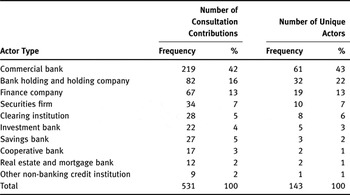
The focus of this analysis is individual bank lobbying in the BCBS. I therefore exclude national and transnational financial associations (e.g., the British Bankers Association (BBA) and the Institute of International Finance (IIF)) that work to represent the interests of multiple financial industry firms.Footnote 37 These associations constitute a sizeable percentage of BCBS lobbying in the four years under study in this article. As presented in Table 1, nearly 40 percent of the dataset comprises transnational financial associations, like the IIF. Such associations clearly play a central role in lobbying at the level of the BCBS.Footnote 38 Nevertheless, their inclusion in this study would raise several methodological issues. Foremost, my hypotheses predict lobbying patterns based partly on the characteristics of individual banks. Disaggregating banks from their associations distorts mechanisms explaining a bank's decision to lobby. Large associations, after all, can represent dozens or more individual banks, many of which may not be involved in the decision to lobby and can even free-ride on the association's lobbying efforts (lobbying via an association lowers the costs of lobbying). It is also not entirely clear if associations (adequately) represent the specific interests of all of their members. Disaggregating associations such that all individual members are included in this study would give an exaggerated account of individual bank lobbying—after all, the presence of the IIF, for instance, does not necessarily mean that all of its members have lobbied on an issue.
2.2 Organizational Characteristics
I operationalize organizational characteristics in two ways: first, in terms of a bank's financial resources, and second in terms of a bank's international scope.
-
1. First, collecting data on banks' financial resources required linking the 143 unique banking-sector actors identified above to data derived from the BankScope database. This database includes comprehensive information on banks’ assets and activities for over 33,000 individual banks around the globe over a sixteen-year period. All 143 individual banks identified in the consultation data were found in the BankScope database. Individual bank's financial resources are measured as a bank's total assets per year and averaged over the four-year period of this analysis. Total assets are recorded in millions of USD and are log-transformed to normalize distribution.
-
2. Second, and to operationalize H2, I measure individual bank's international scope. To this end I use BankScope data on the total number of international subsidiaries owned by a bank averaged over the four years of this study.
2.3 Domestic Banking Regulations
In order to operationalize H3 I measured domestic banking regulations using data from Barth, Caprio, and Levine's Bank Regulation and Supervision database.Footnote 39 These data provide a comprehensive and comparative overview of banking regulations in 125 countries around the globe based on information derived from national banking authorities, supervisors, and regulators. I use four primary measures to gauge variation in the stringency of domestic banking regulations. Country-level values for each indicator are then linked to individual banks using BankScope data on a bank's ‘main domestic country’ (assessed in terms of each bank's ownership structure).
-
1. Overall restrictions on banks’ activities refer to a bank's ability to engage in securities, insurance, and real estate activities according to existing domestic regulations. For each activity, responses are recorded on a scale ranging from 1 = unrestricted (“a full range of activities can be conducted directly by banks”); 2 = permitted (“a full range of activities are offered, but all or some of these activities must be conducted in subsidiaries, or in another part of a common holding company or parent); 3 = restricted (“less than the full range of activities can be conducted in banks”); 4 = prohibited (“none of these activities can be done in either banks or subsidiaries, or in another part of a common holding company or parent”). Higher scores correspond to more stringent regulations.
-
2. Official supervisory powers measure the extent to which official supervisory authorities have the authority to take specific actions to prevent and correct problems in the banking sector. This indicator is comprised of two questions: 1. Can the supervisory authority force a bank to change its internal organizational structure (yes = 1)?; Is a formal consultation process with the industry and the public required prior to the introduction of new regulations (yes = 1)? The sum of the two indicators forms a single indicator where higher values correspond to more stringent regulations.
-
3. Independence of supervisory authority measures the degree to which the supervisory authority is independent from government and legally protected from the banking industry. The indicator is comprised of three main questions: 1. Are the supervisory bodies responsible or accountable to a) Prime Minister, b) the Finance Minister or other cabinet level official, c) a legislative body, such as parliament or congress (yes = 1)?; 2. Are the supervisors legally liable for their actions (i.e., if a supervisor takes actions against a bank, the supervisor cannot be sued) (no = 1)?; 3. Does the head of the supervisory agency (and other directors) have a fixed term and how long (= 1 if term is > = 4 years)?Footnote 40 The sum for all responses form a single indicator where higher values correspond to greater regulatory and supervisory independence and, therefore, more stringent regulations.
-
4. Capital adequacy regulations is an index comprised of three indicators regarding national regulations on the amount of capital a bank should hold relative to its total assets: 1. What was the actual risk based capital ratio of the banking system as of the end of 2010? This question asks for the capital adequacy ratios (Tier I, Tier II and Tier III) of all banks in that country; 2. What was the minimum required risk-based regulatory capital ratio as of the end of 2010? This question refers to “the minimum capital adequacy ratios required on the basis of Basel I and Basel II”Footnote 41 ; 3. What was the actual Tier I capital ratio of the banking system as of end of 2010? This question asks about “the ratio between Tier I capital—Tier I includes paid up share capital, share premiums (positive difference between selling price of the new shares, over the nominal value), retained earnings and disclosed reserves.”Footnote 42 Higher scores on this index correspond to more stringent regulations.
H4 testing the adjustment costs argument is operationalized as a binary indicator for whether or not banks were using Basel II rules as of 2010 (use of Basel II = 1). Banks that were not using these rules face greater adjustment costs than banks that were. Data are derived from Barth, Caprio, and Levine's Bank Regulation and Supervision survey.
2.4 Control Variables
In order to isolate the effects of the variables listed above, I also include a number of control variables in the regression analyses. As with coding for domestic banking regulations, country values for each control variable are linked to individual banks using BankScope data on each bank's “main domestic country.”
First, I include two control variables for the size of domestic financial markets. For many scholars, the size of financial markets plays a critical role in “conditioning financial power on the global stage.”Footnote 43 Indeed, realist scholars expect that the BCBS, like many international organizations, is simply a reflection of state power.Footnote 44 In particular, BCBS regulations likely correspond to the interests of governments (and banks) from states with the largest financial markets. What is more, larger financial markets also correspond to a larger banking sector and hence a greater number of banks that can possibly mobilize at the level of the BCBS. Finally, banks from larger (and commonly more developed) markets have more at stake with regard to changes in international banking regulations. I measure this variable using two indicators. (1) Gross domestic product (GDP) per capita provides a general and commonly used measure of market size at the individual country level. Data are averaged over the four-year period of this analysis, are in current U.S. dollars, and derived from World Bank Development Indicators. (2) Second, I also include a measure for the number of banks active in each country as of 2010. Data include all bank types and are derived from the BankScope database.
Second, I include a control variable for BCBS membership. Existing scholarship has suggested that banks “domiciled in the countries represented on the Committee” tend to also be more likely to lobby the BCBS.Footnote 45 BCBS membership, however, has expanded over the years, from the original G10+ member countries in 1974 to twenty-seven member countries from both developed and emerging economies in 2010. Banks from the original BCBS members have a longer history of engagement with the BCBS that may affect lobby patterns. As such, to control for BCBS membership I created a binary variable for all banks from countries that have been official members of the BCBS since 1974. This includes: Belgium, Canada, France, Germany, Italy, Japan, Luxembourg, the Netherlands, Sweden, Switzerland, the United Kingdom, and the United States. Descriptive statistics for all variables used in this analysis can be found in the online appendix.
3 Analysis
The task of the present analysis is to explain the determinants of when and why banks lobby the BCBS. In order to avoid selection bias resulting from examining only those banks that have lobbied the BCBS, it is imperative to also include data for (the full universe of) banks that have not. Data derived from BCBS consultations provide a generally accurate picture of bank lobbying. However, there is unfortunately no master list of banks that have decided not to lobby the BCBS. The solution proposed here is to use the full list of banks included in the BankScope dataset as a substitute for the universe of banks. This dataset includes over 33,000 banks from 179 countries around the world. Importantly, the BankScope database has been subjected to several studies examining its validity and coverage.Footnote 46 On balance, these studies find that the data is generally representative for most countries and in terms of bank size (both large and small banks) and international orientation (both nationally-oriented and internationally-oriented banks). One important point of criticism, however, is that the data for banks in emerging market countries might be somewhat skewed toward larger, “top tier” banks.Footnote 47 Whether this criticism is still valid for the updated database is difficult to ascertain. Nevertheless, I have included a further control variable accounting for banks located in emerging markets countries (those in China, Brazil, India, Russia, and South Africa = 1).
Combining consultation data with the universe of banks in the BankScope data reveals that instances of lobbying the BCBS only account for approximately 0.45 percent of the entire dataset. As such, the decision to lobby can be considered a “rare event,” a binary dependent variable with “dozens to thousands of times” more zeros than ones.Footnote 48 While not unusual in political science research (e.g., events like wars), such rare events data pose unique challenges for maximum likelihood regression estimation methods. Specially, a standard approach to examining a binary dependent variable, logit estimations, tends to radically underestimate the possibility of such rare events.Footnote 49 In order to mitigate this bias I have implemented King and Zeng's (Reference King and Zeng2001) bias correction method for rare events logit (using the authors’ relogit statistical package). While this approach has become commonplace in political science research, there is concern that this correction procedure may “overcorrect” for bias in maximum likelihood estimates.Footnote 50 As such, I also check the robustness of my results using a further correction procedure for rare events data, namely Firth's (Reference Firth1993) Penalized Maximum Likelihood Estimation method (using Joseph Coveny's firthlogit program).Footnote 51 The results for these robustness checks are available in the online appendix.
To test the relative explanatory power of my hypothesis, I estimate a series of models with separate error components clustered at the level of ‘country’. Table 3 presents regression results for five separate models: models 1–4 individually test my four hypotheses and a fifth complete model tests all indicators together. A test for multicollinearity (using the collin command in Stata) revealed no significant problems with the key regressors.
Determinants of bank lobbying in the BCBS using rare events logistic regression

t statistics in parentheses
* p < 0.05, ** p < 0.01, *** p < 0.001
Regression results provide considerable support for H1 and H2 regarding the impact of banks’ organizational characteristics on the decision to lobby. First, bank resources appear to be an important determinant of the decision to lobby at the level of the BCBS. Indeed, models 1 and 5 suggest a strong positive correlation between bank resources and lobbying. In both models, an increase in the logarithm for bank resources corresponds to an approximate .8 increase in the predicted log odds for lobbying the BCBS. Figure 1 puts these findings in context, plotting marginal effects of bank resources on BCBS lobbying using results from model 5. We can see that the first instance of the decision to lobby the BCBS corresponds to a value between ten and twenty on the logarithm for bank resources. What this amounts to in real terms is approximately 200 to 500 million USD. Importantly, this level of bank assets represents only the wealthiest 10 percent of all banks in the full dataset of over 33,000 banks. A similar effect is found for banks’ international scope. Model 2 (testing hypothesis 2 alone), finds that for each additional one thousand international subsidiaries we see a corresponding 2.37 increase in the predicted log odds for lobbying the BCBS. Marginal effects are plotted in Figure 2 and show that the decision to lobby corresponds to banks’ possessing approximately one thousand international subsidiaries. Again, this applies to only a very concentrated group of the most internationally active banks, namely the top 1 percent of the total dataset of more than 33,000 banks.
Lobbying the BCBS and Bank Assets

Lobbying the BCBS and International Scope

Support for hypotheses 1 and 2 give further purchase to existing scholarship predicting a strong correlation between bank wealth and BCBS lobbying.Footnote 52 In fact, this analysis provides evidence of excessive and concentrated lobbying efforts to impact Basel III regulations on the part of an extremely select few of only the world's wealthiest banks. Hence, the results support Lall's (Reference Lall2012) case study of lobbying on Basel III, which clearly shows how “large international banks […] managed to seize control of the regulatory process, closing the window of opportunity for substantive reform.”Footnote 53 The results also speak to Claessens et al.’s (Reference Claessens, Underhill and Zhang2008) study on how bank lobbying in the BCBS tends to “advance the interests of powerful market players with less regard for smaller, less sophisticated banks.”Footnote 54 Taken together, the results give a strong indication of regulatory capture for Basel III. Nevertheless, the link between the decision to lobby and lobbying influence remains tenuous and would require further research. What is clear, however, is that small banks and domestically oriented banks do seem to be excluded from BCBS lobbying, thereby painting a picture of privileged access to the BCBS that favors the largest and wealthiest banks.
Regression results provide some support for H3, predicting a positive correlation between more stringent domestic banking regulations and BCBS lobbying. First, model 3 (testing H3) suggests that banks facing greater overall restrictions on activities also tend to be more likely to lobby the BCBS. An increase in the stringency of these restrictions corresponds to a 0.5 increase in the predicted log odds for lobbying the BCBS. Second, model 5 shows a strong positive correlation between capital adequacy regulations and a bank's decision to lobby the BCBS. Specifically, an increase in the stringency of domestic capital adequacy regulations (demanding that banks retain a greater percentage of capital relative to their total assets) corresponds to a 2.8 increase in the predicted log odds for lobbying the BCBS. Robustness checks using Firthlogit show similar results (see online appendix).
How can we explain these mixed results? Why, in particular, do more stringent overall restrictions on banks’ activities and higher capital adequacy requirements drive banks to lobby the BCBS while the official supervisory powers of bank regulators and the independence of the supervisory authority do not? One explanation for this finding is related to the central role and saliency of certain banking regulations. First, restrictions on banks’ activities, in particular the freedom of banks to engage in securities, insurance, real estate, and other such activities have largely been linked to the financial crisis. Regulators routinely point to the erosion of barriers separating commercial and investment banking and the repackaging of mortgage-related debt as structured finance as key determinants of the crisis.Footnote 55 Further, fierce lobbying campaigns in the post-crisis period have seen banks scrambling to roll-back regulations limiting these same activities.Footnote 56 Clearly, banks facing stricter regulations on securities and insurance related activities are highly motivated to lobby the BCBS in an effort to level the international playing field. Second, the issue of capital adequacy regulations has been similarly central to global banking regulations in the post-crisis period. Indeed, capital adequacy stands at the very center of most debates about bank regulations. As Singer (Reference Singer2007) puts it, capital adequacy regulations “go to the heart of a financial institution's operations and can affect profitability, foreign competitiveness, corporate strategy, and even survivability. Negotiations over capital adequacy […] are therefore invariably contentious.”Footnote 57 What is more, introducing more stringent capital adequacy standards was a central component of the Basel III negotiations.Footnote 58 While oversight mechanisms are part of the larger narrative on the role of banks in helping to weaken the global financial regulatory architecture, capital adequacy regulations and restrictions on banks’ financial activities have been the central focus of domestic and international regulators following the crisis. It was therefore primarily the prospect of the BCBS ratcheting up these restrictions that pushed banks to seek a more level international playing field via the BCBS and its new Accord.
Results for H4 provide little evidence that banks facing greater adjustment costs are more likely to take their lobbying efforts to the international level. More specifically, banks not already using Basel II are no more inclined to lobby the BCBS than those using Basel II. Taken together with the results for H3, these findings suggest that patterns of bank lobbying in the BCBS are more about bank competitiveness than adjustment costs. It might be the case that banks facing greater adjustment costs (using Basel I or some other, less stringent set of regulations) are simply not part of the active community of banks seeking influence at the BCBS. They either stand outside the sphere of influence of the BCBS (as indicated by the fact that they have not yet implemented Basel II) or are marginalized by larger, more powerful banks that have already sought to influence Basel II. As we have seen, banks that do mobilize to lobby the BCBS tend to be wealthy and have considerable international scope. It stands to reason that their main concern is leveling the regulatory playing field with their international competitors. What is more, the goal of lobbying the BCBS is not limited to ensuring less stringent regulations, but rather ensuring that all banks play by the same rules. As such, lobbying patterns on Basel III suggest regulatory “trading up,” with banks seeking to ensure that stringent regulations are applied at the international level and therefore equally affect banks’ direct international competitors.Footnote 59 Of course, our ability to say anything definitive about these trends is limited to the fact that this analysis does not consider banks’ lobbying preferences as expressed in their consultation contributions. Nevertheless, the trends outlined in this analysis (especially a comparison of the results for H3 and H4) give some sense that lobbying is not aimed at securing less stringent regulations in a “race to the bottom,” and more about a “race to the top” for more stringent international rules.
Finally, for the control variables, there is mixed support for the idea that a banks’ decision to lobby is a function of the size of domestic financial markets. Country-level indicators for the size of domestic financial markets measured as GDP show few significant differences in the five models. Size of domestic markets measured as the number of banks per country, however, tells a different story. For all of the models, the more commercial banks per country, the less likely an individual bank from that country will decide to lobby the BCBS. This unexpected result can be explained in terms of crowding in the BCBS lobbying community. Individual banks from countries with a larger overall banking population will have less of an incentive to lobby simply because other banks may already be representing their interests at the BCBS. There are few additional selective incentives for such banks to lobby and hence larger collective action problems. A further control variable, BCBS membership, does not appear to have any bearing on a bank's decision to lobby, showing no significant differences across any of the models. Banks from BCBS member countries are no more likely to lobby the Committee than banks from non-member states. Taken together with the results for H2, it appears that banks lobby regardless of their national origin, and second, that international banks are most likely to seek influence over BCBS regulatory outputs.Footnote 60 Finally, banks located in emerging markets show no significant differences in any of the models.
4 Conclusions
This article examines the determinants of bank lobbying in the BCBS. Despite increased scholarly interest in bank lobbying activities following the recent financial crisis as well as speculation about the undue lobbying influence of banks over domestic and global financial regulation, little research had addressed the fundamental question of when and why banks decide to lobby the BCBS. Further, what factors explain why some banks mobilize in an effort influence BCBS regulations while others do not? The scant work that does exist proposes several explanations for BCBS lobbying but does not bring them together in a single, comprehensive analysis. This article addresses this shortcoming by testing several hypotheses for bank lobbying in the BCBS and employing a large-n quantitative analysis of over 33,000 banks worldwide.
This article marks both a theoretical and empirical advance on existing research. First, it complements an explanation of bank lobbying based on organizational characteristics with an institutional explanation related to domestic banking regulations. Together, these explanations provide insight into both the capacity of banks to lobby as well as their motivation for doing so. A second advance is related to the empirical approach of this analysis. This article is the first to examine bank lobbying in the BCBS against a large population of banks that have not lobbied the BCBS. This approach has the benefit of addressing issues of selection bias that would otherwise result from examining only those banks that have lobbied the BCBS.
The central findings presented in this analysis speak to larger debates related to financial industry lobbying as well as regulatory politics more broadly speaking. First, and confirming hypotheses 1 and 2, I find that banks with greater resources as well as those that are more internationally active are more likely to lobby the BCBS. These findings give support to existing studies suggesting that Basel III regulations were ‘captured’ by banks as well as broader studies about the impact of financial industry lobbying on financial regulation.Footnote 61 However, whereas existing research stresses the central role of large, international banks, the empirical picture painted here shows just how concentrated bank lobbying really is. Only a very select few of the world's wealthiest banks (the top 10 percent in terms of wealth and the top 1 percent in terms of international scope) lobbied the BCBS and enjoyed privileged access to Basel III negotiations.
Second, I find that banks facing more stringent domestic banking regulations are also more likely to lobby the BCBS than banks facing less stringent domestic regulations. Coupled with findings regarding adjustments costs (hypothesis 4), these results suggest an instance of “trading up” of international regulations.Footnote 62 Banks do not appear to make the decision to lobby based on the potential shift from less stringent domestic regulations to more stringent international regulations. Instead, bank lobbying is concerned with leveling the playing field with direct international competitors. This clearly supports similar findings for Basel I, where the problem of jurisdictional competition did not lead to a deregulatory spiral but rather a “race to the top.”Footnote 63 As such, this study provides further support to the idea that international regulations rarely result in a “race to the bottom.”Footnote 64 Financial regulation, as with environmental, consumer, and labor regulations, sees dynamics of competition translated into more stringent, rather than less stringent, regulations.Footnote 65 Financial actors are similar to their business counterparts insofar as they establish more stringent regulatory regimes in an effort to shape and protect markets, as well as to level the playing field with industry competitors.Footnote 66
There are several ways for future research to build on this study. First, the results presented here are only valid for the period 2010–2014 during the period of Basel III negotiations. Expanding the dataset to include earlier consultations over a range of different regulatory issues would help to increase the generalizability of my empirical claims. Doing this, however, would require a careful consideration of consultation-specific factors, like the salience and scope of the proposed regulation.Footnote 67 Importantly, the patterns of bank lobbying revealed in this analysis do suggest the systematic exclusion of small and nationally-oriented banks from BCBS lobbying as well as privileged access for large, internationally active banks. However, given the rarity of bank lobbying revealed in this analysis, my results give purchase to recent research suggesting the rather circumscribed nature of bank lobbying influence.Footnote 68 Future research could therefore go further in examining the causal mechanisms linking the explanatory variables used in this analysis and banks’ influence over BCBS decisions.Footnote 69 One central limitation of this study is that it does not examine the lobbying positions of each individual bank with regard to each policy proposal. As such, we do not know the extent to which banks were lobbying in favor of more or less stringent regulation. Coding the lobbying positions of banks as expressed in their consultation contributions, which is now common practice in the larger literature on interest group politics would therefore also be a fruitful avenue for future research.Footnote 70 Finally, future research could also examine in greater detail the differences revealed in this analysis between the various dimensions of domestic banking regulations and bank lobbying. While capital adequacy regulations and restrictions on banking activities may be important and contentious aspects of domestic regulations, why are banks less motivated by more stringent oversight and supervisory mechanisms of banking regulations? Are these other dimensions of domestic banking regulations perceived as less of a burden on banks’ international competitiveness? Investigation into these questions will certainly help us flesh out our understanding of banks’ decision to take their lobbying efforts to the BCBS.
Acknowledgements
Thanks are due to Juliet Johnson and Kevin Young for their helpful comments on earlier drafts of this article. I would also like to thank Susanna Mocker for her invaluable research assistance on this project.
Supplementary material and methods
To view supplementary material for this article, please visit https://doi.org/10.1017/S1469356916000070.



