


Introduction
Importance and inherent characteristics of marriage
Marriage is a fundamental social institution recognised across cultures, crucial in organising societies, allocating social roles, and creating familial structures. Scholars examine marriage from various perspectives, including structural-functionalism, symbolic interactionism, feminism, postmodernism, and critical theory.
From a structural-functional standpoint, marriage provides societal stability and cohesion by regularising sexual behaviour, providing economic support, and establishing frameworks for child-rearing (Durkheim, Reference Durkheim1897). Conversely, symbolic interactionists view marriage as a dynamic social process shaped by individual experiences and interpretations, rejecting the notion of a singular social order (Blumer, Reference Blumer1969). Feminist analyses critique marriage as an institution that reinforces women’s subordination by perpetuating traditional gender roles (Tong, Reference Tong2009). Postmodernist perspectives highlight the fluidity of marriage as a social construct influenced by contemporary complexities (Giddens, Reference Giddens1992). Additionally, critical theory examines how marriage reflects and reproduces social inequalities related to race, class, sexual orientation, and nationality, as Hooks (Reference Hooks2000) notes (Hooks, Reference Hooks2000).
Marriage continues to evolve in tandem with societal changes, reflecting broader socio-cultural transformations. Anthropologists have identified core characteristics of marriage, such as the merging of families (Leach, Reference Leach and Leach1955) and the determination of social status (Fortes and Evans-Pritchard, Reference Fortes and Evans-Pritchard1940). Goody (Reference Goody and Goody1973) emphasises the economic relations established through bridewealth and dowry. In societies practising dowry, it reflects cultural attitudes towards women and their familial economic status (Esho et al., Reference Esho, Enzlin, Van Wolputte and Van Wolputte2013). The diverse marriage practices across cultures illustrate broader societal values, gender norms, and familial obligations (Hirsch and Wardlow, Reference Hirsch and Wardlow2006). Marriage ceremonies uphold societal values and continuity in communities with strong communal ties, as seen in elaborate African marriage celebrations (Bourguignon, Reference Bourguignon, Needham and Needham1980).
Child marriage and religious affiliations: a scholarly exploration
The Islamic Civil Code presents its rationale regarding the legal age of marriage, influenced by various interpretations of foundational texts like the Quran and Hadith. Bukhari (Reference Bukhari1987) notes that while the Quran does not explicitly endorse child marriage, aspects of the Prophet Muhammad’s life are often cited to support early marriages, particularly the example of his young wife, Aisha (Bukhari, Reference Bukhari1987). However, some jurists strictly prohibit child marriage, arguing that the Quran’s emphasis on consent and reaching ‘the age of marriage’ implies a prohibition against underage unions. A study in Malaysia (SIS & ARROW, 2018) shows that specific interpretations of Islamic texts are used to justify child marriage, particularly concerning premarital sex and pregnancies, often overriding concerns about the adverse health and social impacts on girls. Ullah et al. (Reference Ullah, Abd Aziz and Idrees2021) note that most jurists permit marriages contracted by a guardian before puberty, with consummation permitted only after the marriage has been contracted. Ultimately, there is no singular stance within Islamic jurisprudence regarding child marriage, indicating the necessity for further scholarly discourse on the topic.
Perceiving child marriage in Hinduism
While Hindu scriptures, such as the Manusmriti, provide varying accounts of marriage customs, specific interpretations have historically placed a strong emphasis on early marriage for girls. Mandal (Reference Mandal2024) posits that the Manusmriti is ambiguous regarding child marriage since some interpret Manu as suggesting marriage before puberty, ideally around eight years old, to ensure chastity and prevent potential problems. Others argue that Manusmriti’s emphasis on a girl’s maturity and qualifications before marriage suggests that child marriage was not obligatory, with the preference for a later marriage age (post-puberty) and the option for a girl to choose her husband after waiting three years post-puberty (Mandal, Reference Mandal2024).
Legal aspects of child marriage in the Indian context
In India, child marriage was first legislated through the ‘Child Marriage Restraint Act’ in 1929, setting the minimum marriage age at 14 for females and 18 for males (Whitehead, Reference Whitehead1995). However, the Muslim community followed the ‘Muslim Personal Law (Shariat) Application Act of 1937’, permitting marriage upon reaching puberty, presumed at 15 years (Carroll, Reference Carroll1982; Puspita and Octariza, Reference Puspita and Octariza2022). Subsequent amendments to this law occurred in 1949, 1978, and finally in 2006, with the ‘Prohibition of Child Marriage Act’ defining child marriage as a marriage involving at least one party under the age of 18 for females and 21 for males (Meena, Reference Meena2022).
The Act applies universally to all Indians except in Jammu and Kashmir (J&K) and the renunciants of Puducherry, defining ‘child’ based on gender. Nonetheless, the applicability of child marriage among Muslims under the 1937 Act and the Indian Constitution adopted in 1950 remains contentious. This controversy has been the subject of numerous Supreme Court cases and rulings, raising complex questions about legal standards and cultural practices.
The multifaceted scourge of child marriage: a global analysis
The studies by Kamal et al. (Reference Kamal, Hassan, Alam and Ying2015) and Akter et al. (Reference Akter, Williams, Talukder, Islam, Escallon, Sultana, Kapil and Sarker2021) reveal that in many societies, early marriage is seen as a protective measure against perceived risks such as sexual violence against girls and the increased burden of poverty (Kamal et al., Reference Kamal, Hassan, Alam and Ying2015; Akter et al., Reference Akter, Williams, Talukder, Islam, Escallon, Sultana, Kapil and Sarker2021). In less developed nations, where traditional values often prevail over objective considerations, these two factors play a crucial role, as discussed by Krafft et al. (Reference Krafft, Arango, Rubin and Kelly2022). The authors show that such factors help child marriage to flourish alarmingly in some areas of sub-Saharan Africa and South Asia. In rural India, socioeconomic factors such as poverty and limited educational opportunities also drive early marriages. Families often view daughters as economic burdens, leading to early marriage as a strategy to alleviate financial pressures, as revealed by Shukla et al. (Reference Shukla, Upadhyay and Tiwari2024). Seta (Reference Seta2023) finds that in Muslim communities, to preserve family honour related to a daughter’s chastity and ensure social stability, early marriage is frequently justified (Seta, Reference Seta2023).
Religious traditions and indigenous beliefs further contribute to the global prevalence of child marriage. The African Union reports that many countries with high child marriage rates have strong traditional practices that hinder the enforcement of laws against the practice (African Union, Reference Union2015). In Egypt, Jordan, Lebanon, Morocco, Sudan, and Yemen, child marriage reinforces gendered social roles. It serves functions such as securing inheritance and promoting social cohesion, while political instability can exacerbate the issue (UNICEF, 2017; DiGiuseppe and Haer, Reference DiGiuseppe and Haer2023).
Socioeconomic issues are deeply intertwined with child marriage. In India, families often view girls as financial burdens, leading to early marriages to avoid costs associated with education and dowries (Lal, Reference Lal2015). This trend persists across less educated and economically disadvantaged populations despite legal measures to abolish child marriage (NFHS-5, 2019–2021). Similarly, in Bangladesh, high rates of child marriage correlate with increased risks of stillbirths and unintended pregnancies (Kamal et al., Reference Kamal, Hassan, Alam and Ying2015), linked to lower education levels in comparable countries like Nepal and Pakistan (Miedema et al., Reference Miedema, Koster, Pouw, Meyer and Sotirova2020). In Indonesia, child marriage can respond to unplanned pregnancies and social pressures, underscoring the need for context-specific interventions (Horii, Reference Horii2020).
In sub-Saharan African countries such as Ghana, Burkina Faso, and Senegal, concepts of shame and honour significantly influence early marriage decisions (Miedema et al., Reference Miedema, Koster, Pouw, Meyer and Sotirova2020). Elengemoke and Susuman (Reference Elengemoke and Susuman2021) reveal that low education, poverty, and rural residence are key determinants in these nations (Elengemoke and Susuman, Reference Elengemoke and Susuman2021). The study of Abdurahman et al. (Reference Abdurahman, Assefa and Berhane2023) in Eastern Ethiopia highlights that social norms have a significant impact on early marriage intention (Abdurahman et al., Reference Abdurahman, Assefa and Berhane2023).
Highlighting the importance of laws and policies, Muriaas et al. (Reference Muriaas, Tønnessen and Wang2018) maintain that it is essential to understand the dynamics of law and power in counter-mobilisation efforts against child marriage in Sudan and Zambia (Muriaas et al., Reference Muriaas, Tønnessen and Wang2018). Yüksel-Kaptanoğlu and Ergöçmen (Reference Yüksel-Kaptanoğlu and Ergöçmen2014) find that the reach and implementation of proactive measures to eradicate child marriage may not be equal across all regions in a country due to several factors. The authors provide an example from Turkey, noting that regional disparities persist while early marriage rates decline in Turkey due to urbanisation and improved female education (Yüksel-Kaptanoğlu and Ergöçmen, Reference Yüksel-Kaptanoğlu and Ergöçmen2014). Chakravarty (Reference Chakravarty2018) and Ghosh (Reference Ghosh2011) maintain that gender disparity in employment attainment and the differential impact of cultural traditions on women restrict the reduction of child marriage intensity in West Bengal (Ghosh, Reference Ghosh2011; Chakravarty, Reference Chakravarty2018). A macro-level study across 35 Asian countries reveals a strong correlation between female education and lower rates of child marriage, as well as its associated health consequences (Torabi, Reference Torabi2023). In conclusion, child marriage exists ontologically as both an objective reality with profound real-world consequences and a subjective social construct deeply rooted in cultural, religious, and socioeconomic contexts, requiring a balanced perspective that avoids the extremes of pure nominalism or strict realism. This nuanced ontology necessitates an epistemological framework that integrates positivist approaches, focused on measurable data, with interpretive methodologies to fully capture the interplay between objective impacts and subjective influences.
The rationale of the study
A host of scholarly studies have established that factors such as cultural norms, religious beliefs, socioeconomic conditions, and gender inequalities are the driving forces leading to child marriage. Religion influences both Hindus and Muslims in familial and social life. Thus, focusing on religious affiliation allows for a targeted analysis of how specific beliefs among Hindus and Muslims interact with poverty, education, and societal norms to influence child marriage rates. Despite substantial research on child marriage in India, comparative studies using large-scale quantitative data, such as the 2011 Census and NFHS-5, are limited. This research addresses this gap and aims to provide robust statistical findings on the association between religious affiliation and child marriage prevalence.
The primary objectives of this study are to
i.
Examine the extent and historical trends of child marriage in India, with a particular focus on variations between Hindu and Muslim communities (using Christians as a comparator where relevant), based on data from the Census of India 2011.
ii.
Investigate the degree to which the prevalence of child marriage varies by religious affiliation – particularly comparing Hindus and Muslims – while controlling for key intersecting sociodemographic factors such as education, wealth, caste/social group, place of residence, media exposure, and geographic region, using data from the National Family Health Survey-5 (NFHS-5, 2019–2021).
iii.
Contextualise these empirical findings through a scholarly review of cultural norms, religious interpretations, and socioeconomic drivers of child marriage in contexts dominated by Hindu and Muslim communities.
Sources of data and methodology used
The magnitude of child marriage in India
In India, a child is defined as a person below the age of 14; however, marriage occurring under 18 years of age is considered child marriage. Because 14 years of age is defined as a child, and as puberty in girls generally occurs around this age, and since traditionally puberty is seen as the sign of the onset of reproductive capability, there is a likelihood that parents may indulge in marriage of their daughters after puberty, irrespective of their attainment of a legal marriageable age. Based on this logic, the census of India data on child marriage has been classified into two categories: i) Marriage under 14 years of age, and ii) Marriage under 18 years of age. Furthermore, several studies and research also reveal the presence of prepubescent marriage in the name of traditions and religious faith across the globe.
The Indian census records the age of marriage for all ever-married females, categorising marriage duration into seven groups: 0–5 years, 6–9 years, 10–19 years, 20–29 years, 30–39 years, 40 and above, and those without specified duration. These classifications help track trends in child marriage over the decades.
The paper argues that the incidence of child marriage (both under 14 and under 18) varies significantly depending on religious affiliation. This two-group classification was used to analyse the data from the Census of India (2011) only. While Census data were analysed through percentage distributions, NFHS-5 data were analysed using advanced statistical methods, as described below.
To assess child marriage prevalence in India’s socio-demographic context, a bivariate analysis based on the Chi-square test was performed. Subsequently, a multivariate logistic regression analysis was conducted to explore the relationship between socio-demographic characteristics and child marriage, encompassing various demographic and socioeconomic covariates, to estimate the likelihood of the outcome based on multiple explanatory variables. The logistic regression model for individual-level analysis is mathematically defined as follows:
 $${\rm{logit}}\left( p \right) = \log \left( {{p}\over{{1 - p}}} \right) = {\beta _{0{\rm{\;}}}} + {\beta _{1{\rm{\;}}}}{\rm{*}}{x_1} \ldots \ldots . + {\beta _{k{\rm{\;}}}}{\rm{*}}\,{x_k} + \varepsilon {\rm{\;\;}}$$
here, ${\beta _{0{\rm{\;}}}}$
is the intercept, β
1… β
k
is the regression coefficient indicating the relative effect of a particular explanatory variable on the outcome, and
${\beta _{0{\rm{\;}}}}$
is the intercept, β
1… β
k
is the regression coefficient indicating the relative effect of a particular explanatory variable on the outcome, and ${\rm{\varepsilon }}$
is the error term. In this model, child marriage was the outcome variable, coded as 0 = ‘Child Marriage – No’ and 1 = ‘Child Marriage – Yes’. Key explanatory variables included religion, social group, education, wealth index, place of residence, media exposure, and geographic region.
${\rm{\varepsilon }}$
is the error term. In this model, child marriage was the outcome variable, coded as 0 = ‘Child Marriage – No’ and 1 = ‘Child Marriage – Yes’. Key explanatory variables included religion, social group, education, wealth index, place of residence, media exposure, and geographic region.
Bivariate Local Moran’s I statistics, Local Indicators of Spatial Association (LISA) cluster maps, and scatter plots were used to investigate the spatial clustering of child marriage and the socio-demographic factors contributing to it. Moran’s I, a spatial autocorrelation metric akin to Pearson’s correlation coefficient, was used to assess spatial dependencies among districts. A queen contiguity-based spatial weight matrix was constructed to define spatial relationships, encapsulating district-to-district geographical interdependencies. This method was chosen for its robustness in accounting for shared borders. The Moran’s I formula used is:
 $${\text{Bivariate Local Moran's I }} (I_{ij})= {{{\left( {{x_i} - {\rm{\;}}\bar x} \right){\rm{\;}}\left( {\sum _{j = 1}^n{w_{ij{\rm{\;}}}}{\rm{\;}}\left( {{y_i} - {\rm{\;}}\bar y} \right)} \right)}}\over{{\sqrt {\sum _{j = 1}^n{{({x_j} - {\rm{\;}}\bar x)}^2}\sum _{j = 1}^n{{({y_j} - {\rm{\;}}\bar y{\rm{\;}})}^2}}} }}$$
Here ${x_i}$
is the percentage of child marriage in district i,
${x_i}$
is the percentage of child marriage in district i, $\bar x$
: is the mean percentage of child marriage across districts.,
$\bar x$
: is the mean percentage of child marriage across districts., ${y_i}$
: is the percentage of predictor variable in district j,
${y_i}$
: is the percentage of predictor variable in district j, $\bar y$
: is the mean of the predictor variable across all districts,
$\bar y$
: is the mean of the predictor variable across all districts, ${w_{ij\;}}$
: is the spatial weight between districts i and j, and the sums are over all districts j in the dataset. The Moran’s I value ranges from −1, indicating perfect dispersion, to +1, indicating perfect correlation. A value of zero suggests a random spatial pattern. Negative values signify negative spatial autocorrelation, indicating dissimilarity among points that are closely associated. In contrast, positive values indicate positive spatial autocorrelation, signifying the clustering of points with similar attribute values in close proximity. LISA cluster maps classified districts into four groups based on child marriage prevalence: high-high: districts with consistently high prevalence surrounded by similar neighbours. Low-low: districts with low prevalence surrounded by similar neighbours. Low-high: low-prevalence districts surrounded by high-prevalence neighbours. High-low: high-prevalence districts surrounded by low-prevalence neighbours.
${w_{ij\;}}$
: is the spatial weight between districts i and j, and the sums are over all districts j in the dataset. The Moran’s I value ranges from −1, indicating perfect dispersion, to +1, indicating perfect correlation. A value of zero suggests a random spatial pattern. Negative values signify negative spatial autocorrelation, indicating dissimilarity among points that are closely associated. In contrast, positive values indicate positive spatial autocorrelation, signifying the clustering of points with similar attribute values in close proximity. LISA cluster maps classified districts into four groups based on child marriage prevalence: high-high: districts with consistently high prevalence surrounded by similar neighbours. Low-low: districts with low prevalence surrounded by similar neighbours. Low-high: low-prevalence districts surrounded by high-prevalence neighbours. High-low: high-prevalence districts surrounded by low-prevalence neighbours.
To examine variables associated with child marriage, the analysis began with spatial Ordinary Least Squares (OLS) regression to test for spatial autocorrelation in the error term. As the OLS regression confirmed spatial autocorrelation in its error term with respect to the outcome variable, the study further estimated the spatial lag model (SLM) and the Spatial Error Model (SEM). The underlying assumption of the SLM posits that neighbouring areas influence observations of the dependent variables. In contrast, the spatial error model incorporates the effects of variables not included in the regression model but that impact the outcome variable. The primary difference between the two models lies in the use of spatial dependence in the error term, as the SLM does not account for spatial dependence. Subsequently, based on the Akaike Information Criterion (AIC) values, the spatial error model seems to be the best-fitting model for this study. A typical SLMl can be written as follows:
 $${\rm{}}{Y_i} = \delta \sum\nolimits_{j \ne 1} {{W_{ij}}{\rm{}}{Y_j} + } {\rm{\beta }}{{\rm{X}}_j}{\rm{}} + {\rm{}}{{\rm{\varepsilon }}_j}$$
Here ${Y_i}:$
denotes the prevalence of child marriage in the
${Y_i}:$
denotes the prevalence of child marriage in the ${i^{th}}$
District,
${i^{th}}$
District, ${\rm{\delta }}$
: is the spatial autoregressive coefficient,
${\rm{\delta }}$
: is the spatial autoregressive coefficient, ${W_{ij}}:$
denotes the spatial weight of proximity between district
${W_{ij}}:$
denotes the spatial weight of proximity between district $i$
and
$i$
and $j$
,
$j$
, $\;{Y_j}:$
is the prevalence of child marriage in the
$\;{Y_j}:$
is the prevalence of child marriage in the ${j^{th}}$
District,
${j^{th}}$
District, ${\rm{\beta }}:\;$
denotes the coefficient,
${\rm{\beta }}:\;$
denotes the coefficient, ${{\rm{X}}_j}:\;$
is the predictor variable, and
${{\rm{X}}_j}:\;$
is the predictor variable, and ${{\rm{\varepsilon }}_j}:$
is the residual.
${{\rm{\varepsilon }}_j}:$
is the residual.
The Spatial Error Model accounts for the impact of omitted variables that are not directly incorporated into the model but could substantially influence the analysis. Formally, a Spatial Error Model (SEM) can be articulated as follows:
 $${Y_i} = \beta {{\rm{X}}_j} + \lambda \sum\nolimits_{j \ne 1} {{W_{ij}}{Y_j}{\varepsilon _j} + } {\rm{ }}{\varepsilon _j}$$
Here ${Y_i}:$
denotes the prevalence of child marriage in the
${Y_i}:$
denotes the prevalence of child marriage in the ${i^{th}}$
District,
${i^{th}}$
District, ${\rm{\lambda }}$
: is the spatial autoregressive coefficient,
${\rm{\lambda }}$
: is the spatial autoregressive coefficient, ${W_{ij}}:$
denotes the spatial weight of proximity between district
${W_{ij}}:$
denotes the spatial weight of proximity between district $i$
and
$i$
and $j$
,
$j$
, $\;{Y_j}:$
is the prevalence of child marriage in the
$\;{Y_j}:$
is the prevalence of child marriage in the ${j^{th}}$
District,
${j^{th}}$
District, ${\rm{\beta }}:\;$
denotes the coefficient,
${\rm{\beta }}:\;$
denotes the coefficient, ${{\rm{X}}_j}:\;$
is the predictor variable, and
${{\rm{X}}_j}:\;$
is the predictor variable, and ${{\rm{\varepsilon }}_j}:$
is the residual. All statistical analyses were conducted using Stata SE 16 and GeoDa 1.22 software. GeoDa 1.22 was explicitly used to generate LISA Cluster maps and scatter plots. Additionally, QGIS 3.18.1 was employed to create maps for visualisation.
${{\rm{\varepsilon }}_j}:$
is the residual. All statistical analyses were conducted using Stata SE 16 and GeoDa 1.22 software. GeoDa 1.22 was explicitly used to generate LISA Cluster maps and scatter plots. Additionally, QGIS 3.18.1 was employed to create maps for visualisation.
Results
Derivatives from census of India data
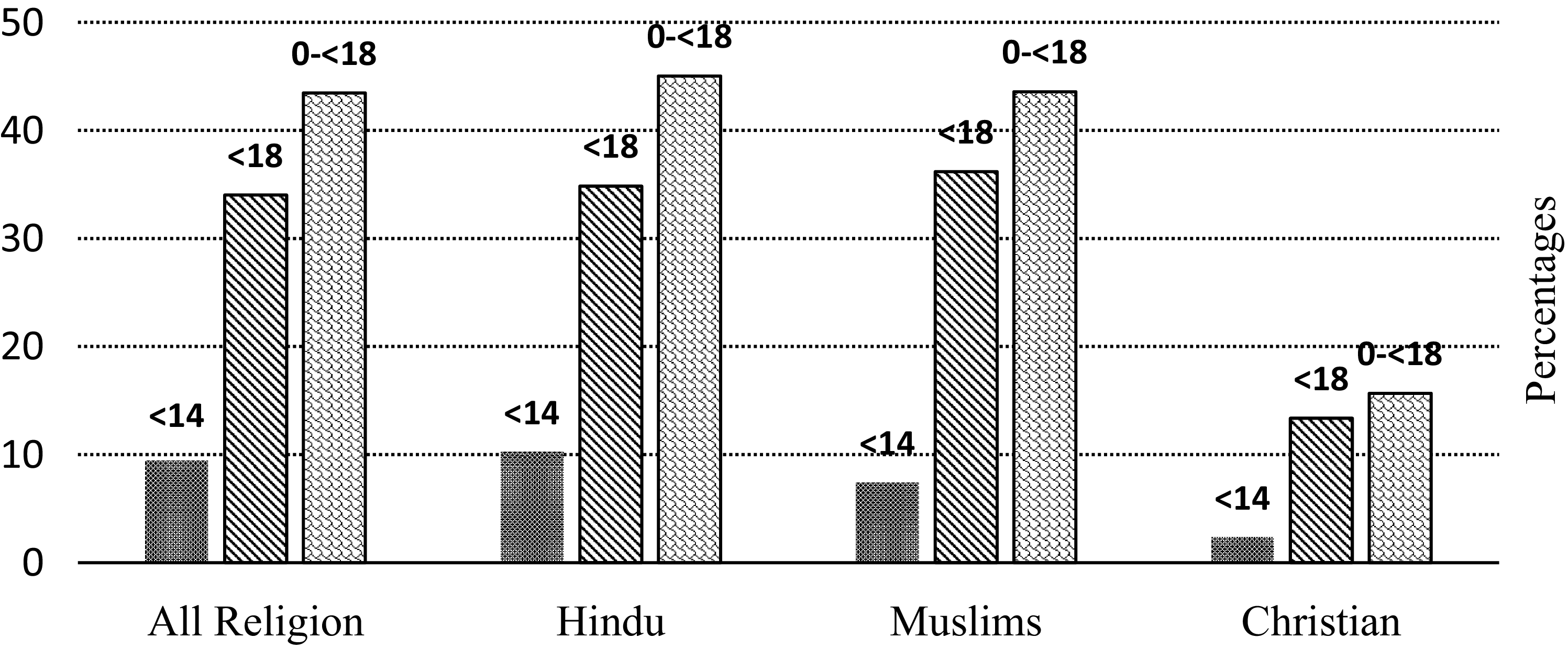
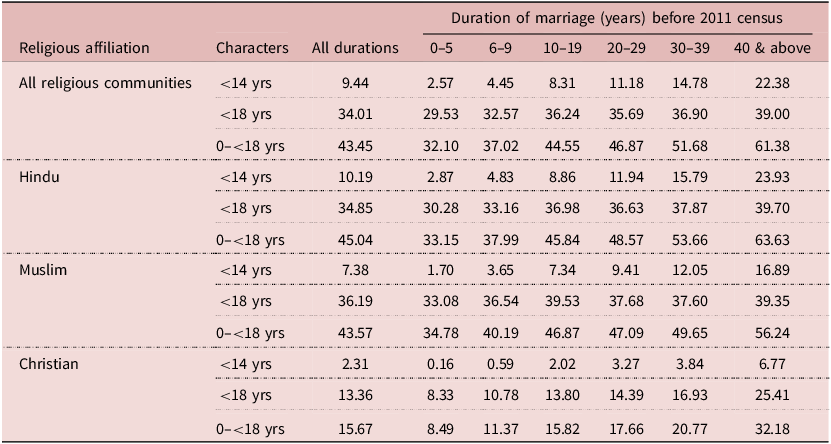
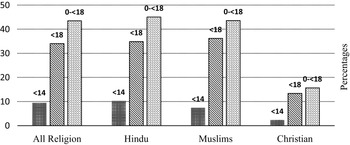
Table 1 contains the incidence of under-14 marriages and under-18 marriages among females in India among all religious communities, and a specific mention of child marriage among Hindus, Muslims, and Christians. The counts have been classified as <14 years, <18 years, and the sum of <14 and <18 marriage incidences. Table 1 and Figure 1 indicate that <14 marriage is nearly 1% higher among Hindus than the average of all religious communities. Compared to Hindus (10.19%), the incidence of <14 marriages are 2.81% less among Muslims. The extent of <14 marriages is only 2.31% among Christians. The incidence of <18 marriages is slightly higher among Muslims (36.19%) as compared to the Hindu communities (34.85). Importantly, for all these categories of marriages, the Christian community presents a far lesser incidence compared to all religious communities. The data indicates that while there is marked disparity among religious groups on <14 marriage, for <18 marriage, the difference is not remarkable between Hindus and Muslims, barring Christians.
Percentage distribution of child and underage marriage in India among some religious communities
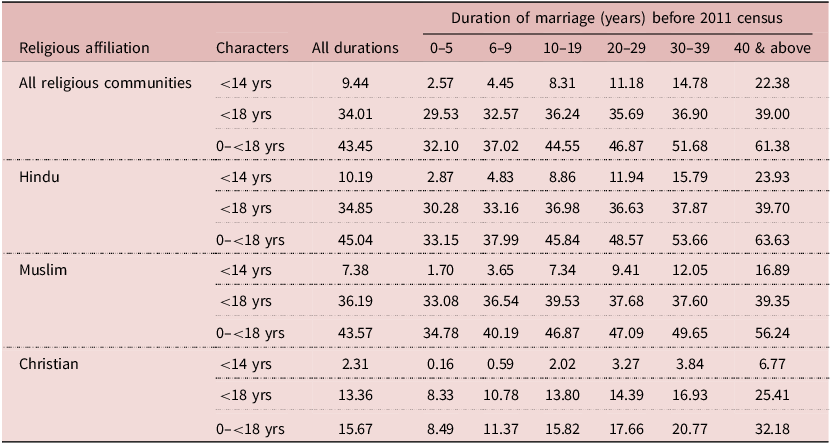
Source: Census of India, 2011, Table C-5: Ever Married and Currently Married Population by Age at Marriage, Duration of Marriage and Religious Community – 2011
Percentage distribution of child marriage (<14, <18, and 0-<18) among different religious communities in India.
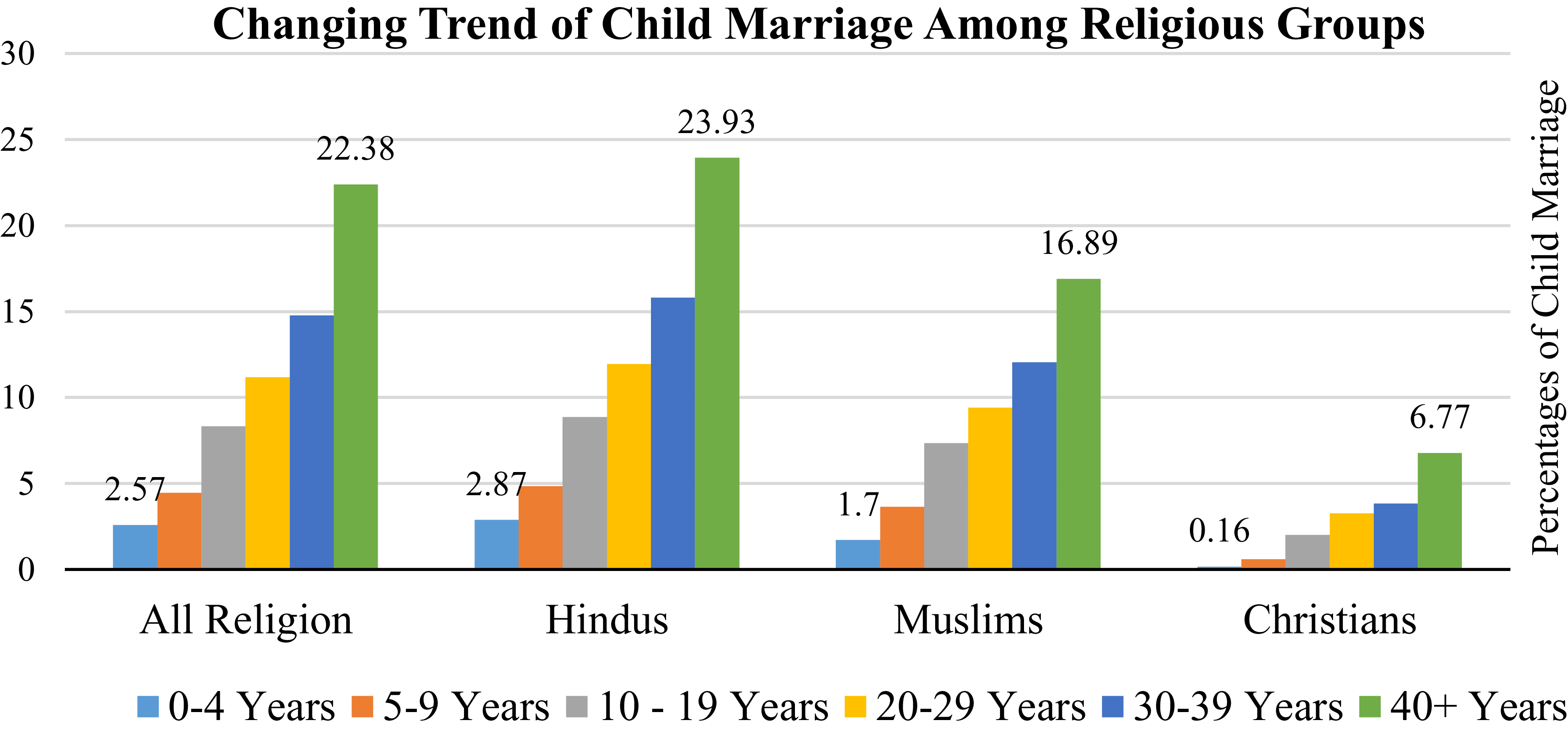
While examining the extent of child marriage and its trend over the decades, Table 1 and Figure 2 indicate that there is a decreasing trend in the extent of child marriage over the decades across religious communities. For all the religious communities under scrutiny, 40 years before 2011, the percentage of women married at <14 years of age was 22.38%. When compared among the religious communities, Hindus had the highest percentage of women married at <14 years of age, at 23.93%, exceeding the national average of all religious communities by nearly 1.5%, as well as the averages for Muslims (7%) and Christians (17%). Child marriage was more frequent in earlier decades, with a gradual decline observed toward the 2011 census year. The percentage decline in child marriage between the marriage duration of 40+ years and 2011 varies across all religious groups, with a difference of 19.81%. Among Hindus, the decline is 21.06%, among Muslims, it is 15.19%, and among Christians, it is 6.61%.
Changing trend of the extent of child marriage (<14 years) among religious groups over past decades (base year, 2011).
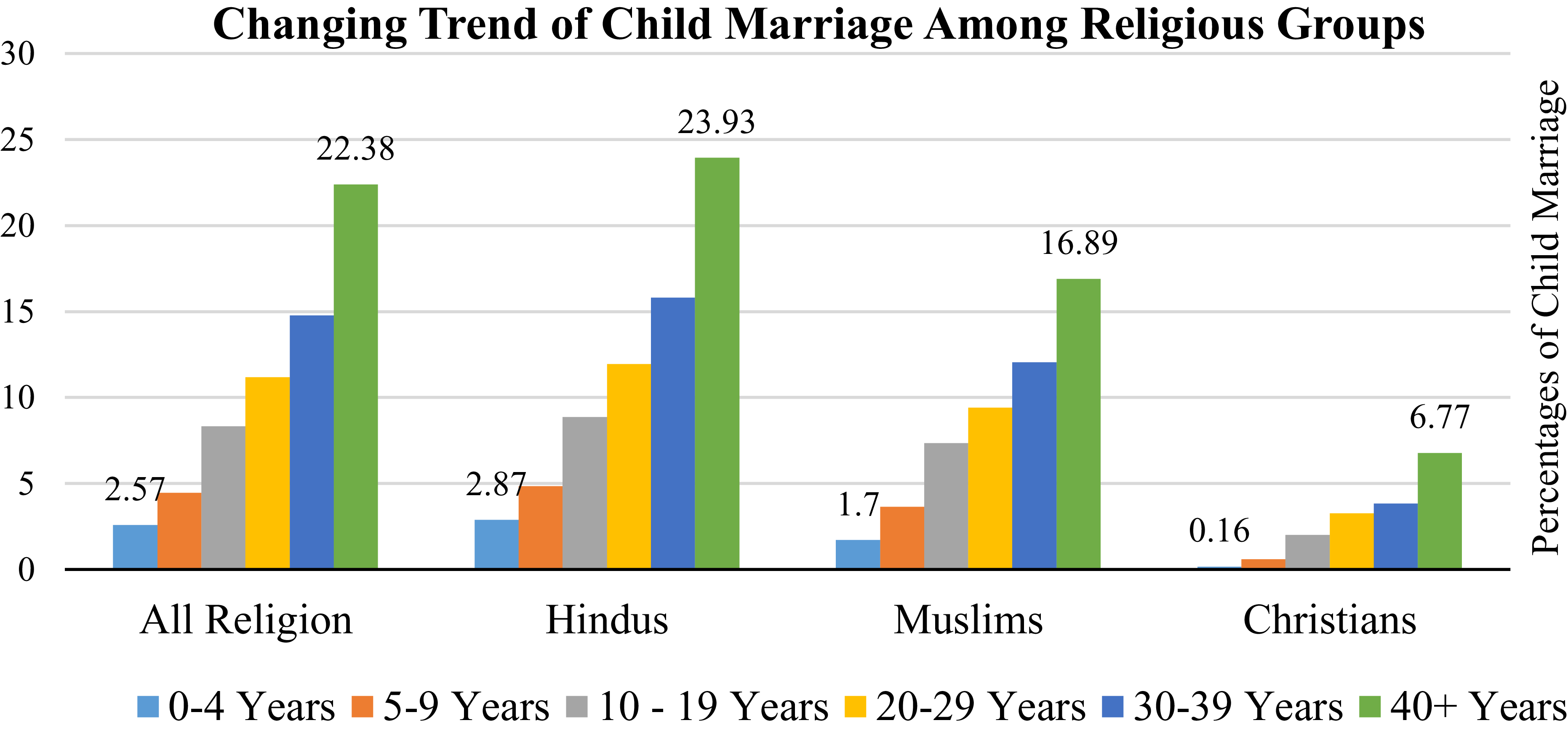
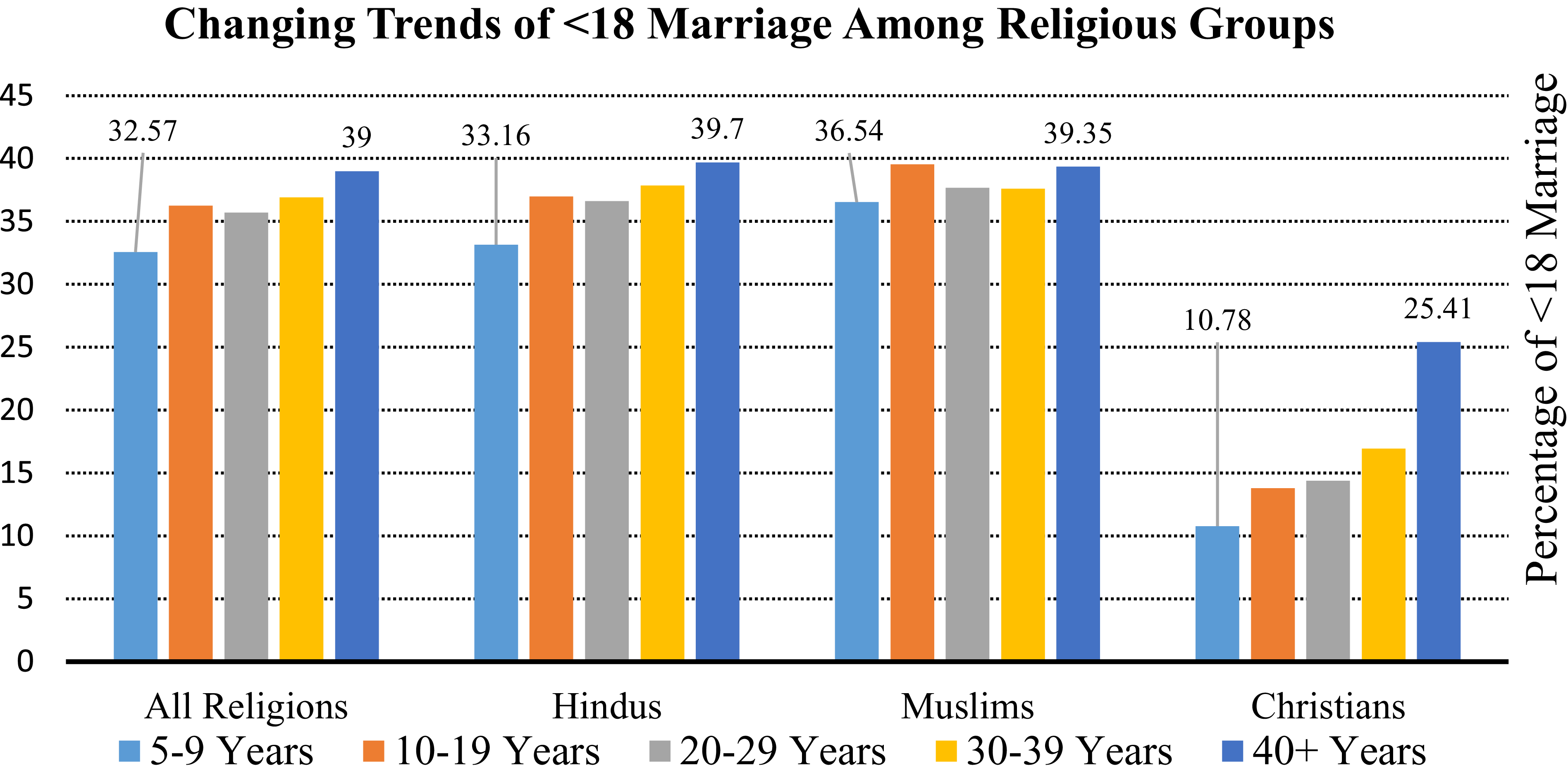
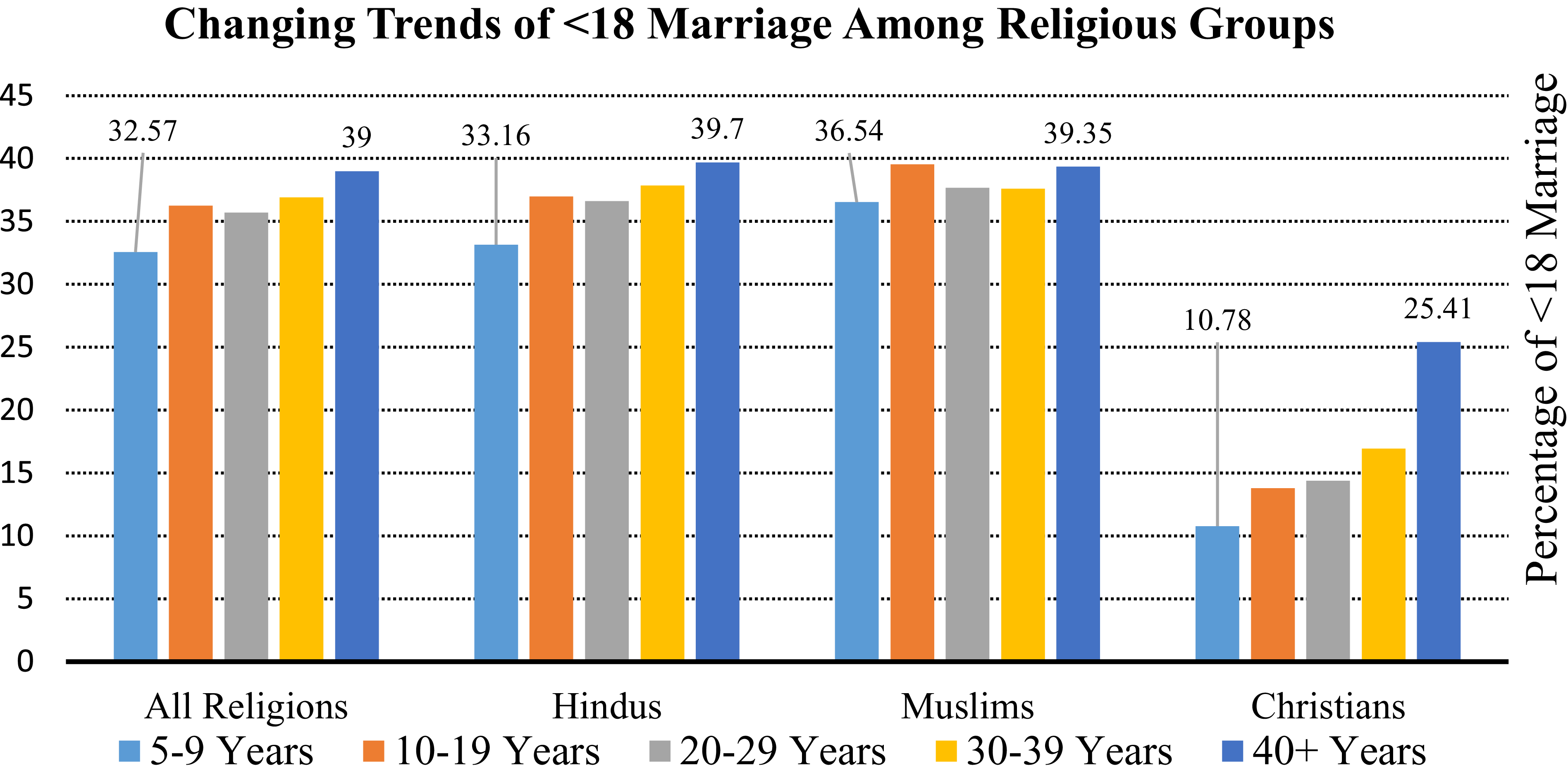
Figure 3 presents a trend of <18 marriages among the religious communities over the decades. It shows that 40 years from 2011, the average percentage of <18 marriages among all religious groups was 39%. Hindus and Muslims had an almost equal incidence of <18 marriage. However, among Christians, the extent of <18 marriage was far less compared to other communities, 13.59% lesser than the average percentage of all religions. A sharp decline in marriages below 18 years is not observed, in contrast to the noticeable decline in marriages below 14 years over the decades. The decline is 6.43% across all religions, 6.54% among Hindus, 2.81% among Muslims, and 14.63% among Christians.
Changing trends of <18 marriage among religious communities in India.
Three Indian states, namely J&K, Assam and Uttar Pradesh (UP), were selected to compare <14 and <18 marriages among the Hindu and Muslim communities. The first state was selected since it has the second-highest Muslim population (68.31%), followed by Assam (34.22%). UP was selected since the majority of the population is influenced by the core Hindu ideology as the centre of this tradition, while Muslims constitute 19.26% of the state population. Furthermore, the Muslim population of J&K is identified as a relatively older and indigenous population. In contrast, a significant chunk of the Muslims in Assam is believed to have migrated from present-day Bangladesh. Considering these contexts, it was assumed that the religious communities in these three states would show diverse trends in child marriages.
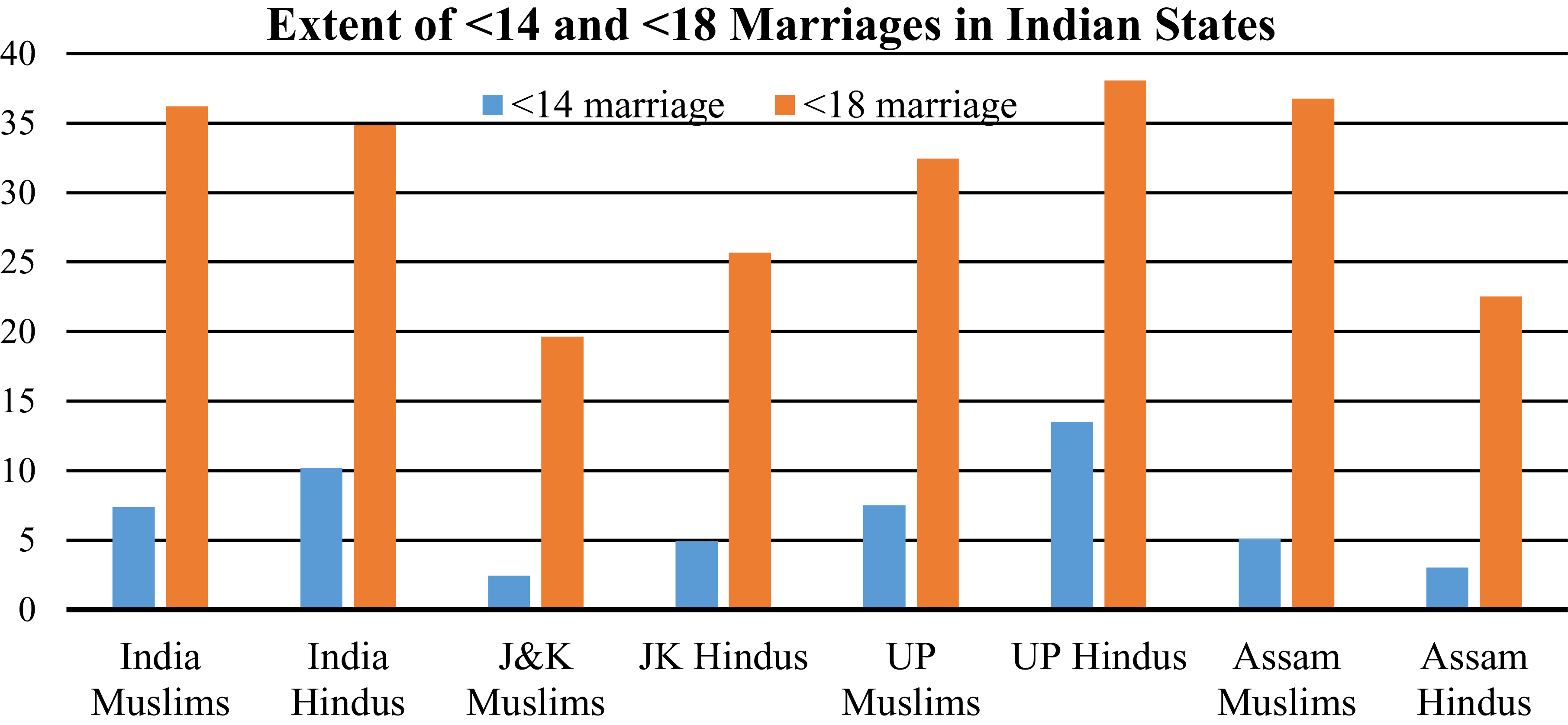
Figure 4 shows that the prevalence of child marriage (<14) and <18 marriage is quite prevalent in India, and its extent varies across religious groups in different states in India. At the national level, child marriages are found more common among Hindus than among Muslims. A similar trend exists in J&K and UP. However, in Assam, child marriage is more significant among Muslims. In the case of <18 marriages, the national average is slightly less among Hindus than among Muslims. However, in J&K and UP, <18 marriages are more than Muslims. However, in Assam, fewer <18 marriages are found among Hindus than among Muslims.
Comparative analysis of <14 and <18 marriages in Indian States.
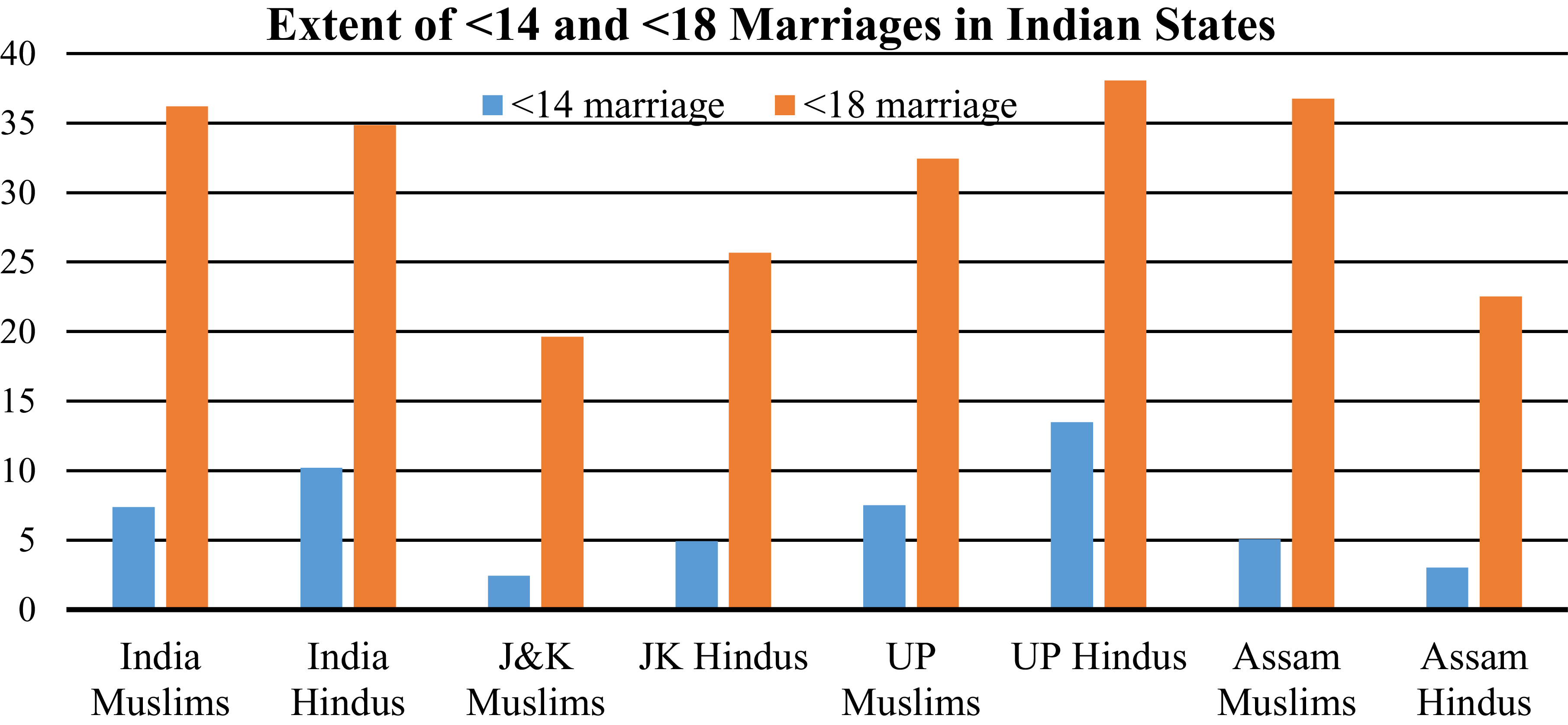
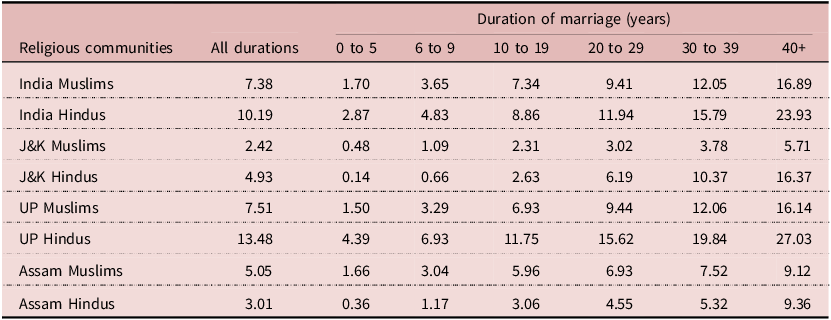
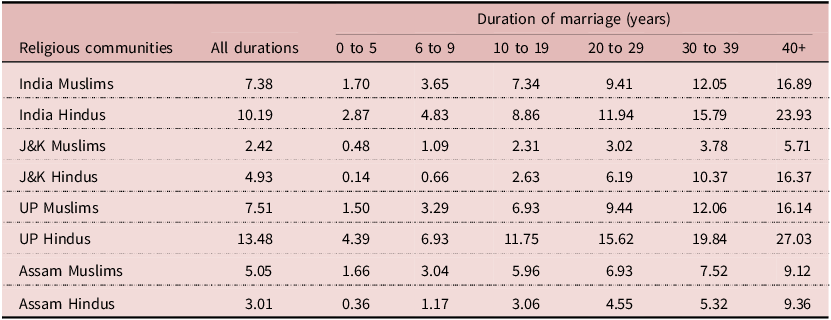
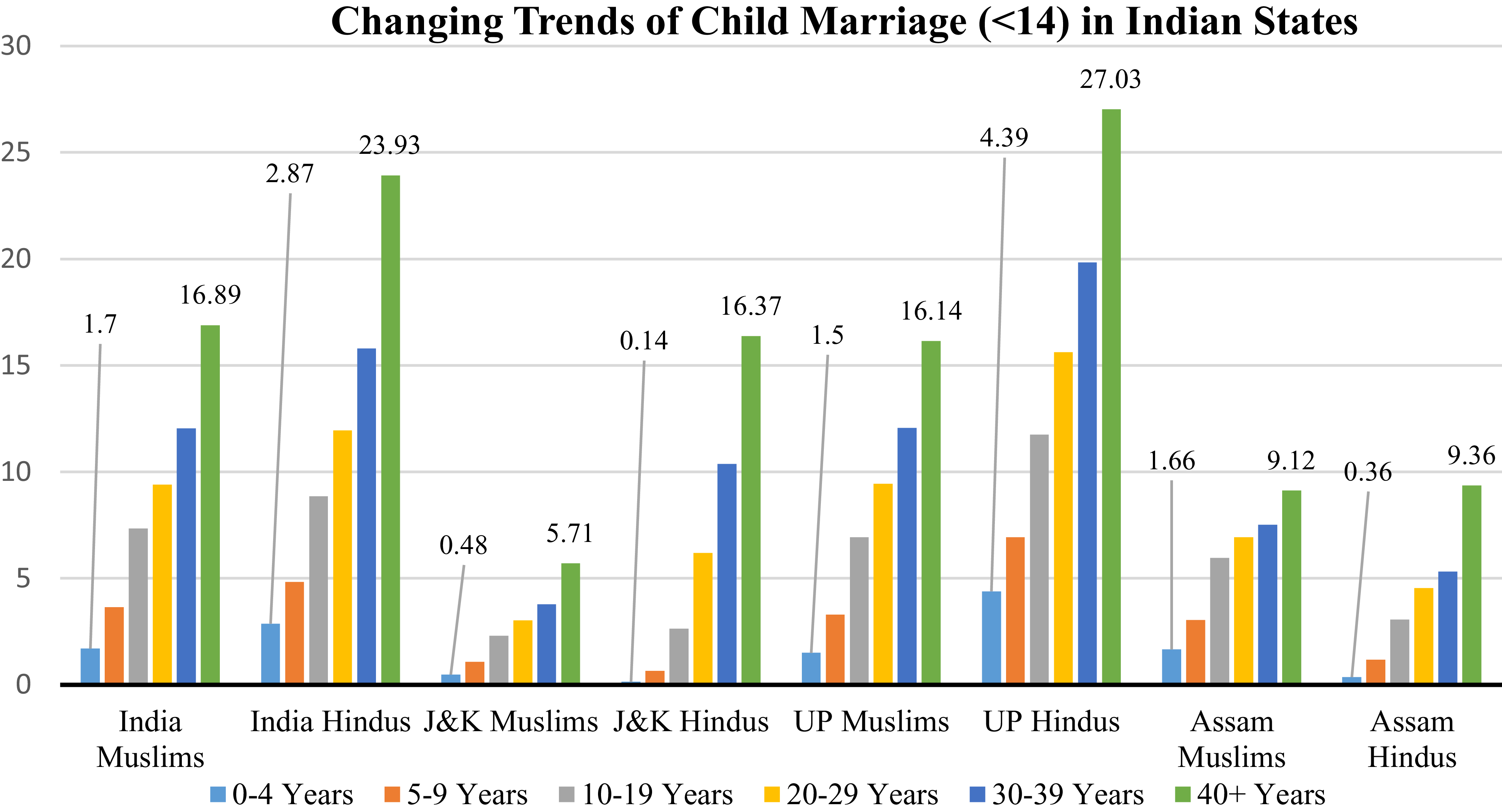
Table 2 presents the percentage distribution of women classified by their age at first marriage (<14) and the duration of their marriage. This table records the all-India average percentages for Hindu and Muslim religious groups, along with similar records for three Indian states: J&K, UP, and Assam. Based on Table 2, Figure 5 has been prepared.
Percentage distribution and changing trends of child marriage (<14) among Hindus and Muslims
Changing trends of child marriage (<14) in Indian States.
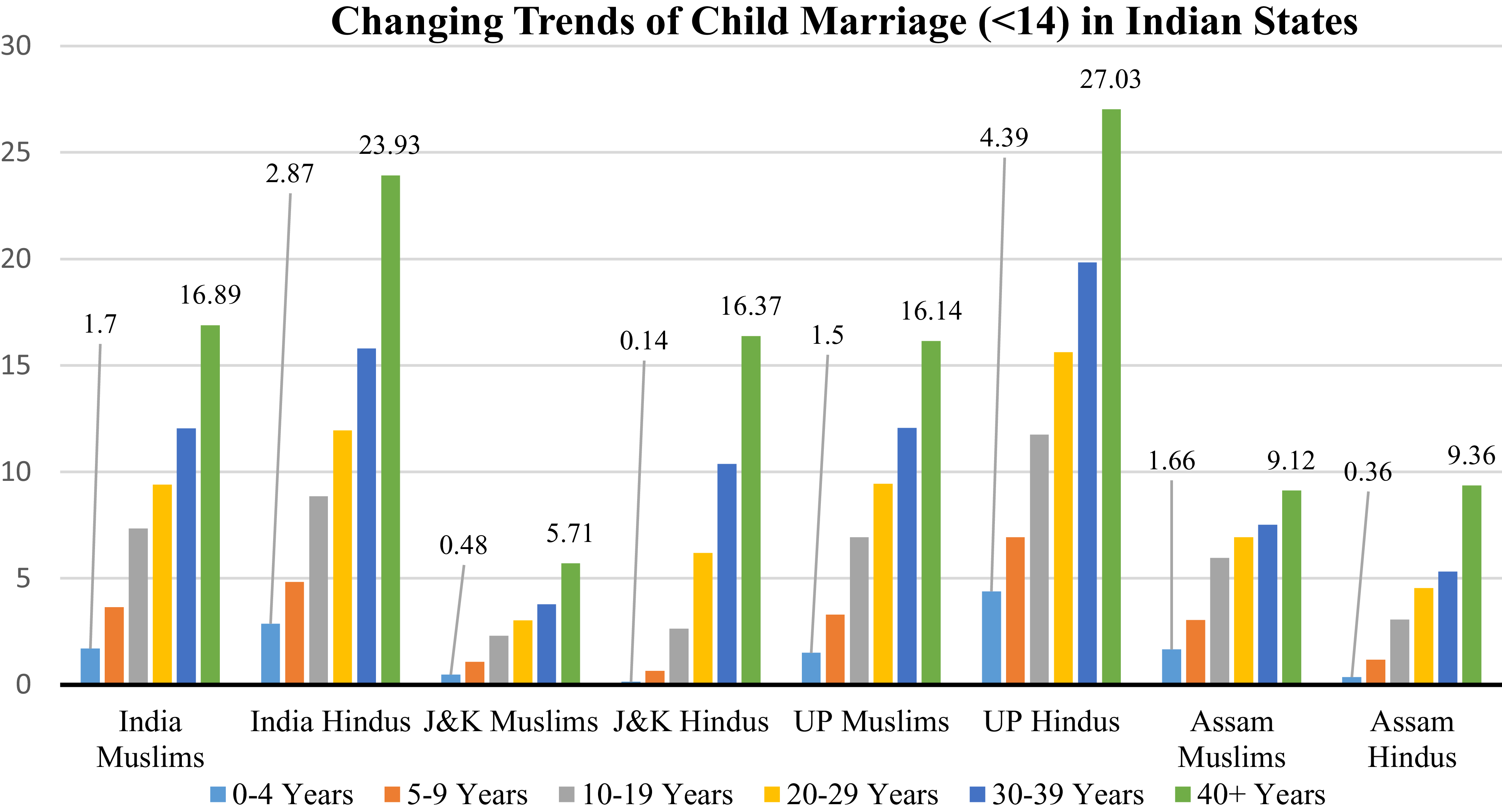
Figure 5 shows that 40 years before the census year 2011, as many as 23.93% of Hindu women in India married before they attained 14 years of age, compared to 16.89% of Muslim women who married at this age. A sharp decline in the practice is observed in the 0–5 years preceding the 2011 census, with only 1.7% of Muslim women and 2.87% of Hindu women married before the age of 14. A gradual decline in child marriage is evident across decades among religious groups; however, the practice persists and remains more prevalent among Hindus. State-level figures further indicate that in Muslim-majority states such as J&K, child marriage was less prevalent among Muslims than among Hindus. The figure shows that while 16.37% of Hindu women were married at <14 years of age before 40 years from the census year 2011, only 5.71% of Muslim women were married at that age. However, the decline in the practice is relatively sharper among the Hindus.
In UP, where the Hindu ideology is more potent, 40 years before the census year 2011, a remarkably high proportion of women married during their childhood (27.3%) compared to 16.14% of Muslim women in that age category. The figure also indicates that, although there is a sharp decline, the practice persists, retaining relative prominence among Hindus. In Assam, the record of past decades reveals that the extent of child marriage practice was almost equal among the Hindus and Muslims here. Furthermore, the practice was significantly less prevalent than the extent seen in the case of UP, for both Hindus and Muslims, as well as among Hindus in J&K.
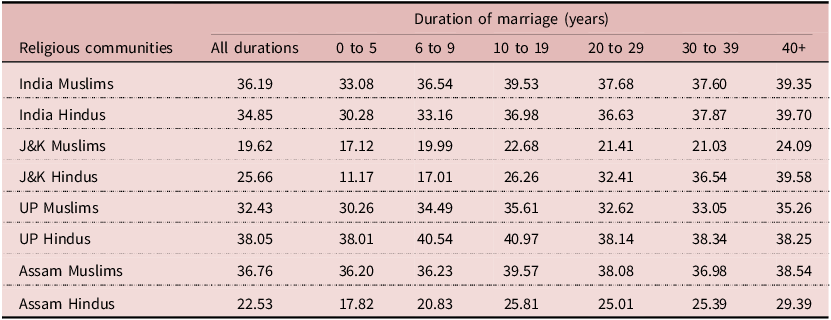
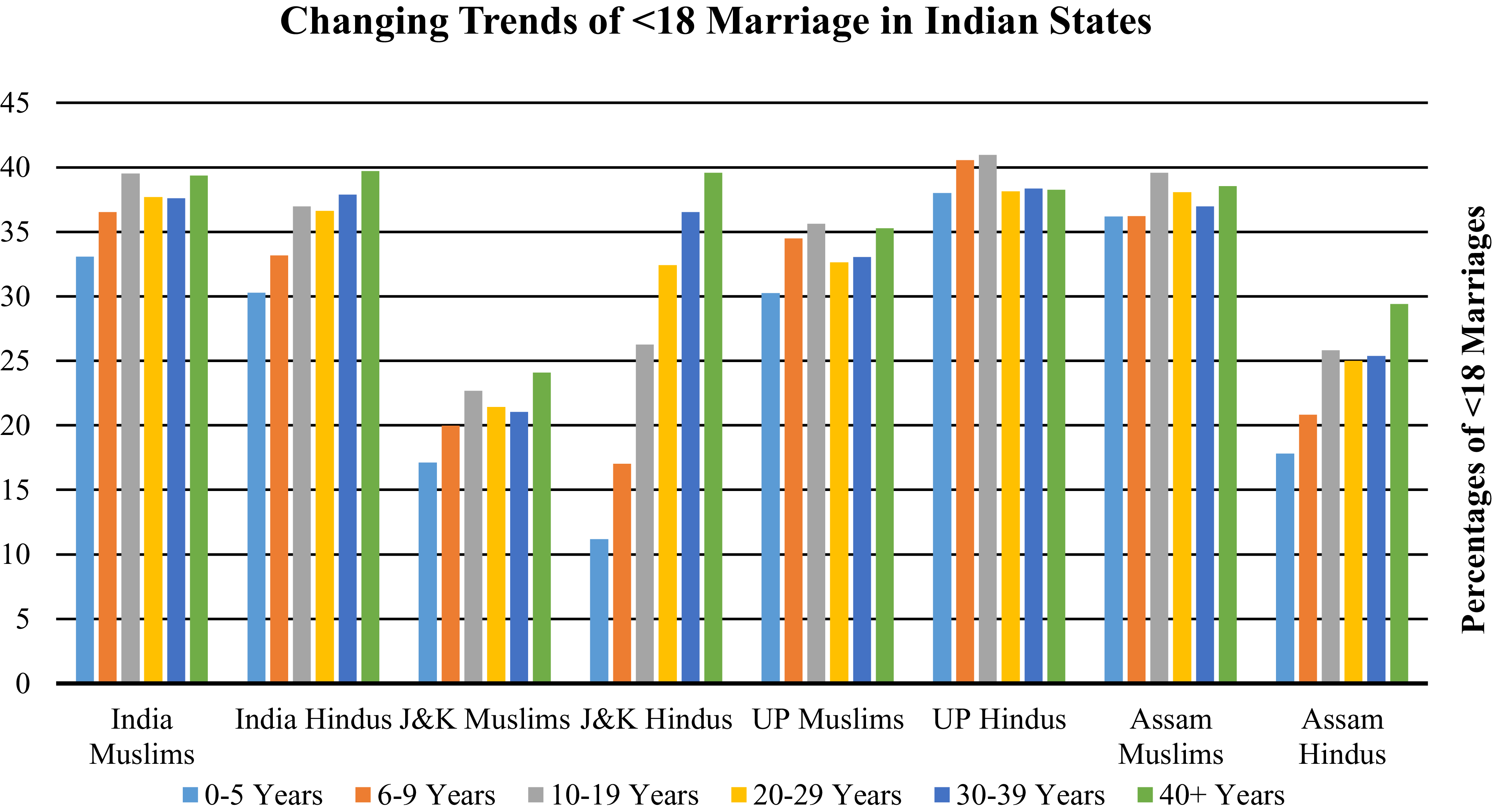
Table 3 records the percentage of women in various religious groups who married before the age of 18, as reported in the 2011 census. The records include the average percentage of <18 marriages for all Hindus and all Muslims in the country. Furthermore, the table also records the duration of marriages under 18 years up to 2011. Figure 6 has been generated based on the data presented in Table 3. The figure shows that the extent of <18 marriages among women in past decades was almost similar among Hindus and Muslims nationally. However, the decline in child marriage practice is sharper in the case of Hindus (9.42%) than in Muslims (6.27%), when observed for the past few decades. The percentage of <18 marriage is 1.34% lower among Hindus compared to Muslims, as per the 2011 census.
Percentage distribution and changing trends of child marriage (<18) among Hindus and Muslims
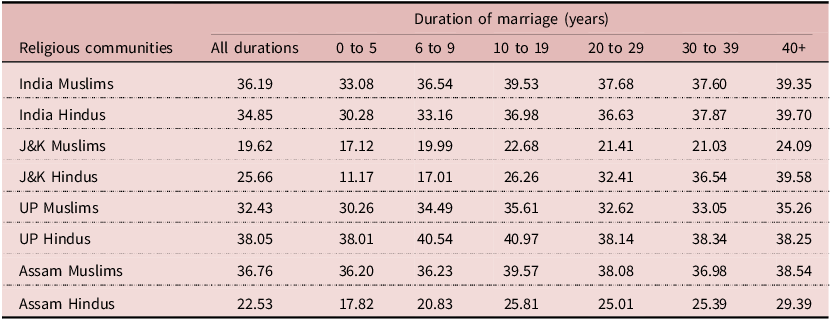
Source: Census of India, 2011, Table C-5: Ever Married and Currently Married Population by Age at Marriage, Duration of Marriage and Religious Community – 2011.
Changing trends of <18 marriages in Indian States.

State-level comparisons indicate that in J&K and Uttar Pradesh, the proportion of women who married before the age of 18 more than 40 years prior to the 2011 census was higher among Hindus than among Muslims, with the difference being more pronounced in J&K. Moreover, the declining trend in <18 marriages are not uniform and sharp, unlike in the case of <14 marriages. Notably, in Assam, <18 marriages are significantly higher among Muslims than among Hindus over the decades. Among Muslims in Assam, there is a nearly consistent equal percentage of <18 marriages among Muslims over the decades before 2011, while among the Hindus, there is a sharp though uneven declining trend. A comparison of Figures 5 and 6 indicates that marriages below the age of 14 were less prevalent among Muslims, whereas marriages below the age of 18 remained consistently high among Muslims.
Analysis of NFHS-5 data on child marriage
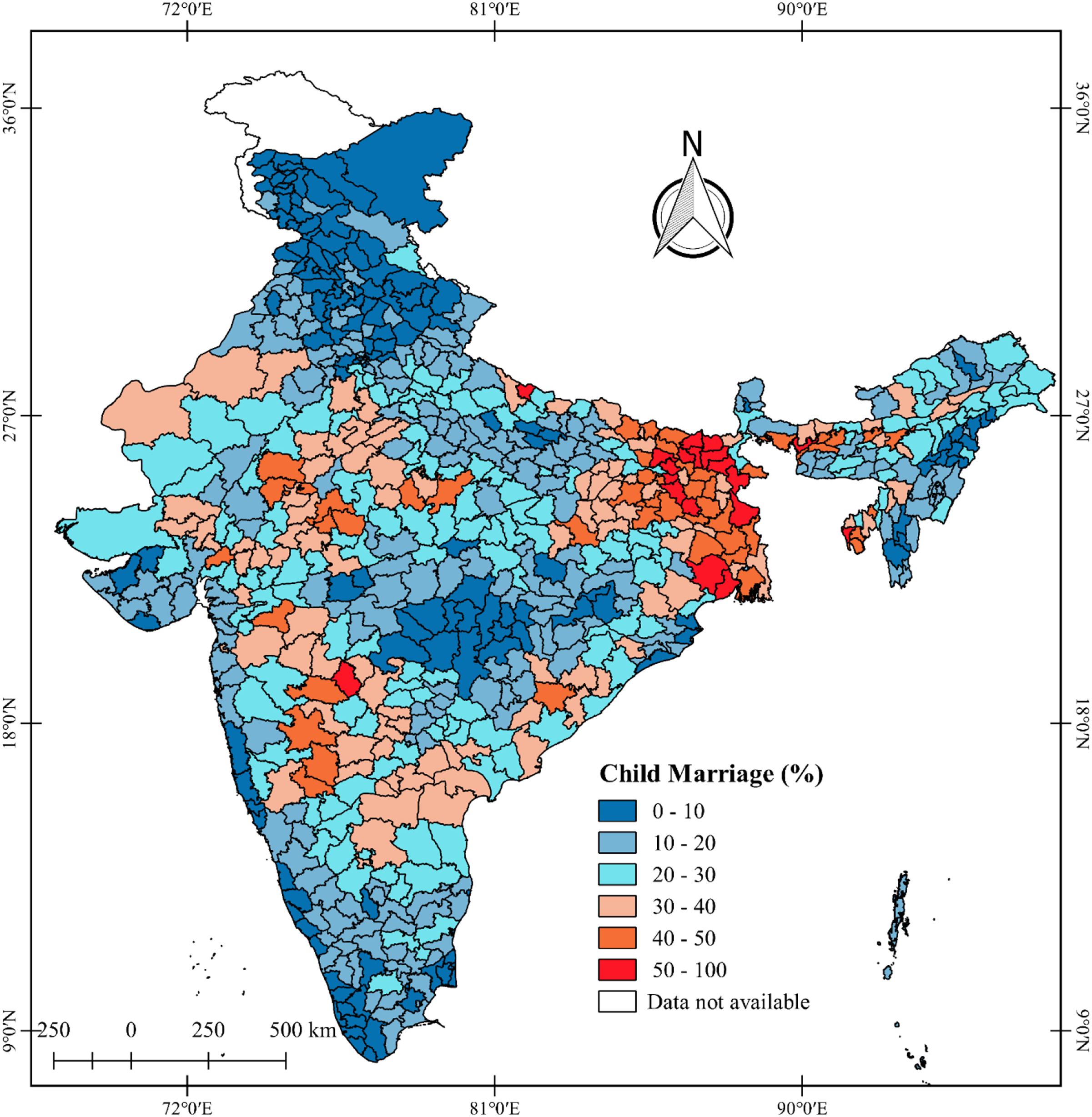
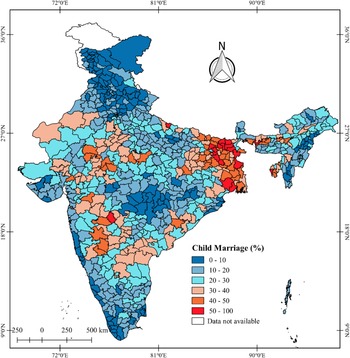
Figure 7 illustrates the district-wise prevalence of child marriage across India, revealing significant geographical disparities. A large proportion of districts in eastern India, particularly in the states of West Bengal, Bihar, and Jharkhand, exhibit a prevalence of child marriage exceeding 40%. In the Northeastern region, the majority of districts in Assam and Tripura also report a prevalence of more than 40%, highlighting the persistence of child marriage in this region. Certain districts in Rajasthan, Madhya Pradesh, Maharashtra, and Andhra Pradesh show child marriage prevalence levels around the 40% threshold, indicating localised hotspots within these states.
District-wise magnitude of child marriage in India.
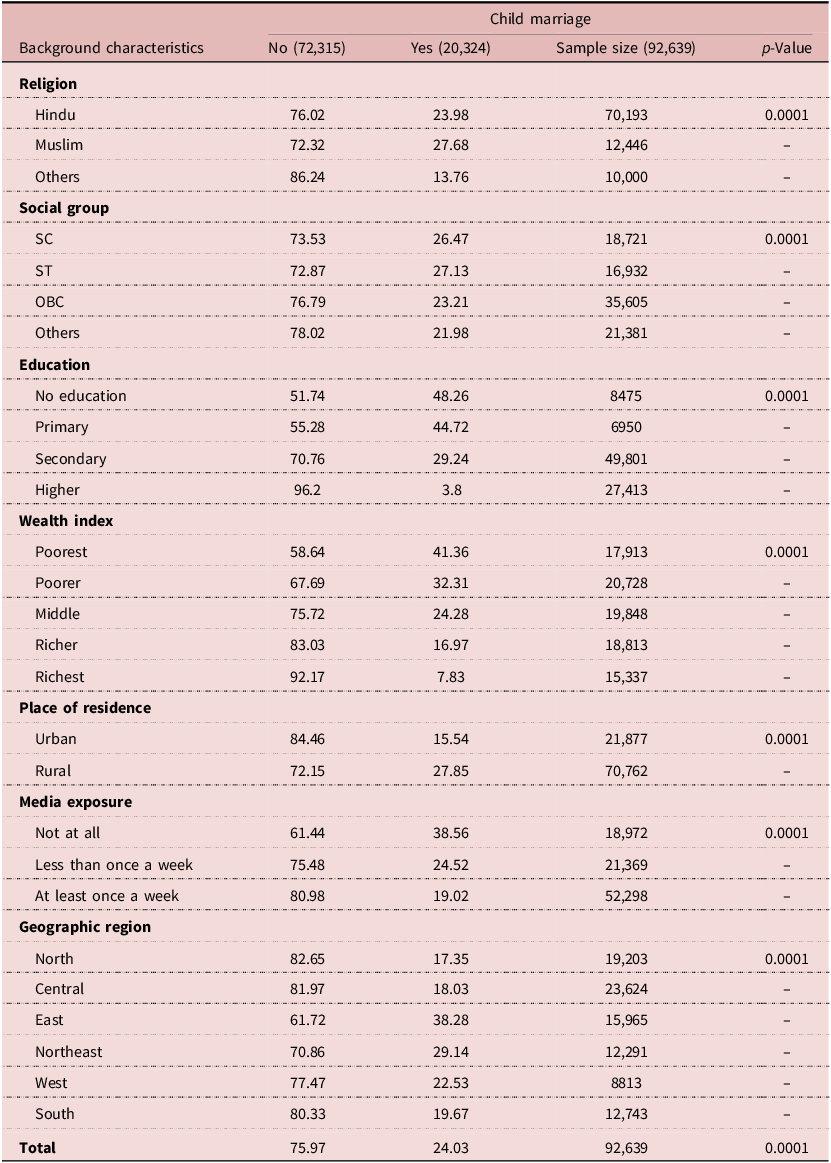
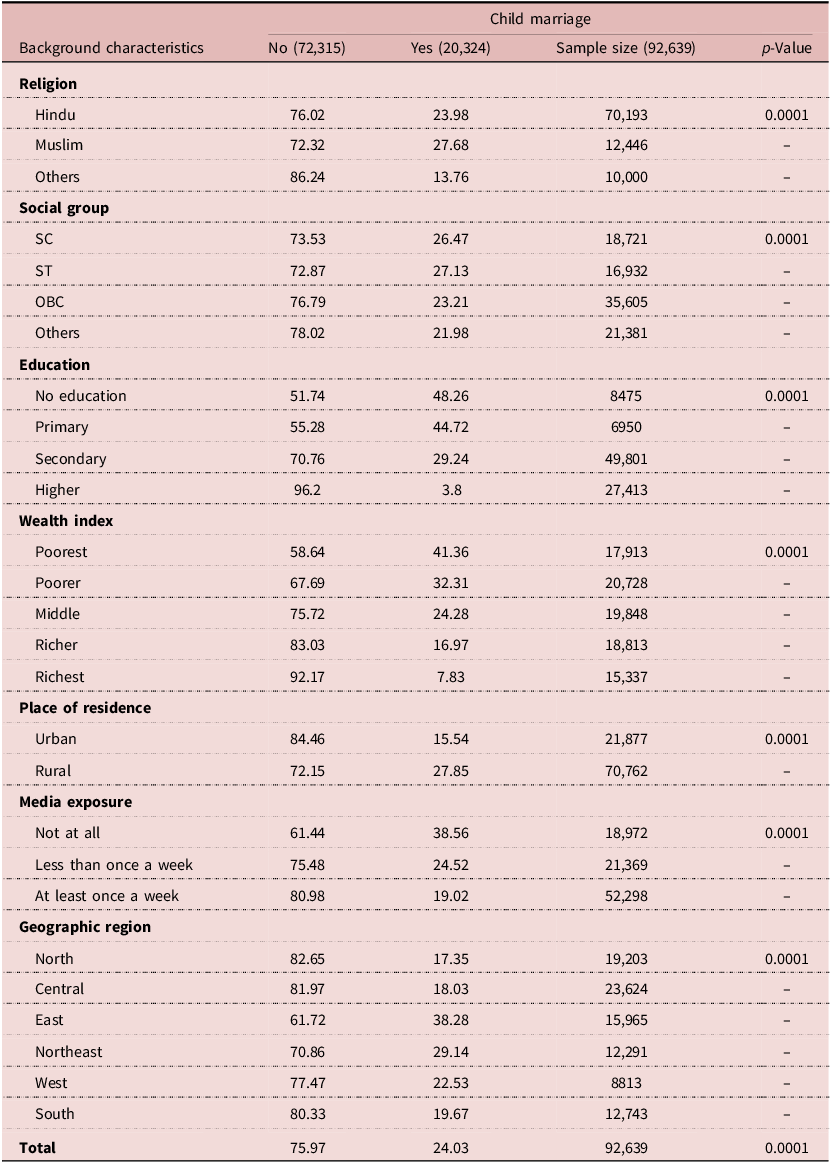
The bivariate analysis in Table 4 highlights the association between sociodemographic characteristics and child marriage in India. Overall, 24.03% of women in the sample experienced child marriage, with significant variation across sociodemographic groups. Among religious groups, the prevalence of child marriage was highest among Muslims (27.68%) and lowest among those from ‘Other’ religions (13.76%). Social group differences reveal that Scheduled Tribes (27.13%) and Scheduled Castes (26.47%) reported the highest prevalence, while the ‘Others’ group had the lowest (21.98%). Education emerged as a strong determinant, with the prevalence drastically declining from 48.26% among women with no education to just 3.8% among those with higher education. The wealth index also showed a clear gradient, with the prevalence highest among the poorest (41.36%) and lowest among the richest (7.83%). Rural women (27.85%) were more likely to experience child marriage than their urban counterparts (15.54%). Media exposure appeared protective, as women with no exposure reported the highest prevalence (38.56%), compared to 19.02% among those exposed at least once a week. Regionally, the East (38.28%) and Northeast (29.14%) had the highest rates of child marriage, while the North (17.35%) and Central (18.03%) regions reported the lowest. All associations were statistically significant (p < 0.0001).
Bivariate table showing the association between sociodemographic characteristics and child marriage in India
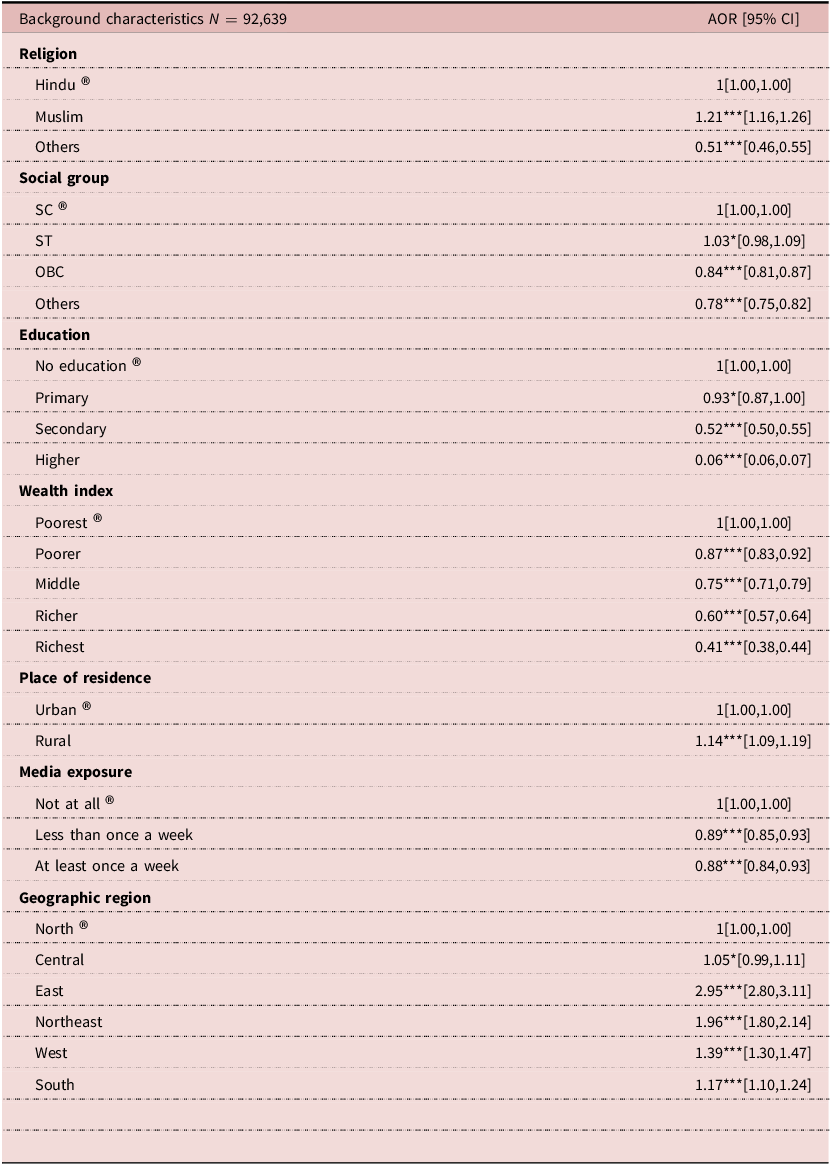
The results from the logistic regression analysis (Table 5) show that the likelihood of child marriage in India varies significantly across different socioeconomic and demographic factors. Women who identify as Muslim are 21% more likely to experience child marriage compared to Hindu women, while women from other religions are 49% less likely. Compared to Scheduled Caste women, Scheduled Tribe women are 3% more likely, while Other Backward Classes women and those from other social groups are 16% and 22% less likely, respectively. Education plays a critical role: women with primary education are 7% less likely to experience child marriage than those with no education, while secondary and higher education reduce the likelihood by 48% and 94%, respectively. Economic status also shows a strong correlation: women from poorer households are 13% less likely to experience child marriage compared to the poorest, with middle, more affluent, and wealthiest households further reducing the likelihood by 25%, 40%, and 59%, respectively. Rural women are 14% more likely to experience child marriage than urban women. Media exposure acts as a protective factor; women exposed to media less than once a week and at least once a week are 11% and 12% less likely to experience child marriage, respectively. Regional differences are pronounced: women in the East are nearly three times more likely (195%) to experience child marriage compared to those in the North, with women in the Northeast, West, and South being 96%, 39%, and 17% more likely, respectively. These findings underscore the importance of addressing socioeconomic inequalities and regional disparities in the effort to reduce child marriage in India.
Odds-ratio estimate of the association between background characteristics and child marriage in India
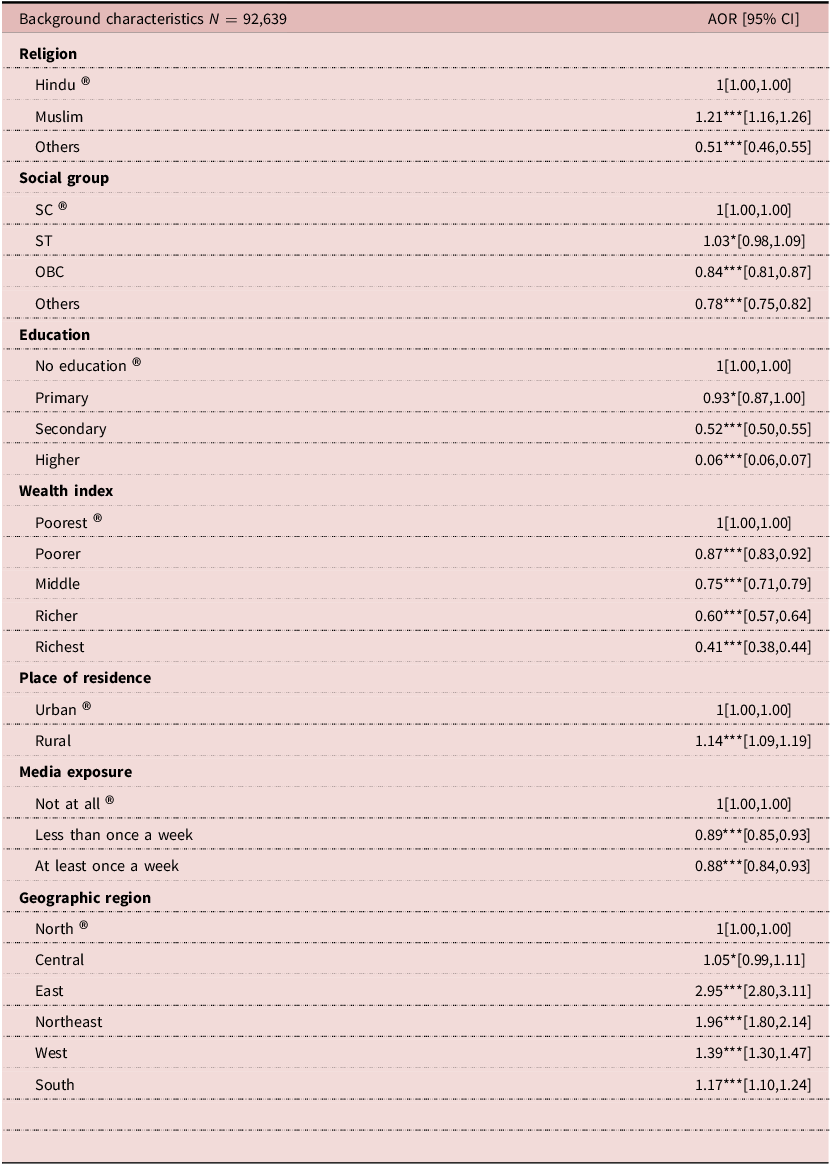
Note : CI: Confidence Interval; AOR- Adjusted Odds-Ratio; ®- Reference Category; *** Significant at 0.1%, ** Significant at 1%, Significant at 5%.
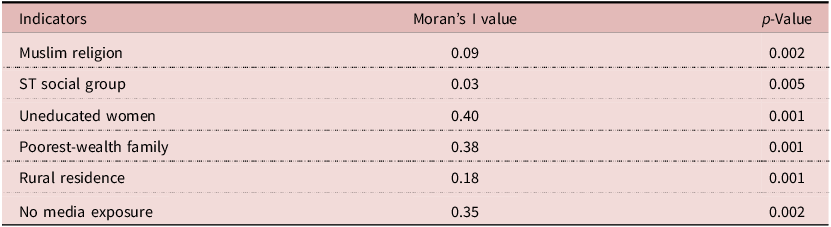
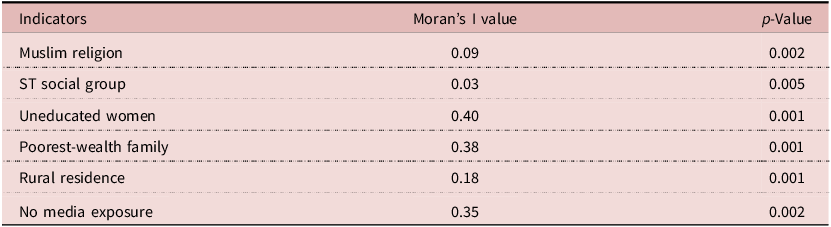
The Moran’s I statistics (Table 6) reveal significant spatial dependence for child marriage and its correlates across India, indicating that these factors are not randomly distributed but show patterns of geographic clustering. The presence of spatial autocorrelation is evident for various socioeconomic indicators. The Muslim religion has a Moran’s I value of 0.09 (p = 0.002), reflecting weak but significant spatial clustering. Similarly, the Scheduled Tribe social group shows a weak spatial dependence with a Moran’s I value of 0.03 (p = 0.005). In contrast, the proportion of uneducated women exhibits a strong spatial clustering, with a Moran’s I value of 0.40 (p = 0.001), indicating that areas with higher concentrations of uneducated women tend to be geographically proximate. The poorest-wealth families also demonstrate strong spatial dependence, with a Moran’s I value of 0.38 (p = 0.001), suggesting economic disparities are concentrated in specific regions. The rural residence has a moderate Moran’s I value of 0.18 (p = 0.001), indicating spatial clustering of rural populations. Furthermore, regions with limited media exposure are also clustered, as indicated by a Moran’s I value of 0.35 (p = 0.002).
Moran’s I statistics show the spatial dependence for child marriage and its correlates in India
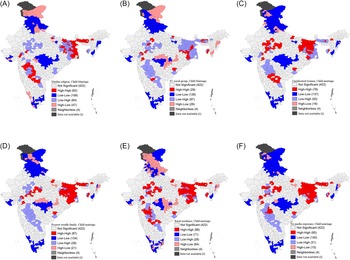
The LISA cluster maps (Figure 8) illustrate the significant geographic influence on child marriage in India. The maps reveal that various factors contribute to child marriage differently across regions, categorising areas into four associations: high-high, high-low, low-low, and low-high. ‘High-high’ signifies areas with both high levels of a given factor and high child marriage rates, while ‘low-low’ indicates the opposite. In northeastern districts, a ‘high-high’ association exists between child marriage and factors such as Muslim population, poverty, rural residence, and limited media exposure. This suggests that Muslim women there face more significant vulnerabilities due to lower education and socioeconomic status. Conversely, in West Bengal and Bihar, factors differ. West Bengal shows a ‘high-high’ association between child marriage and the Muslim population, reflecting similar socioeconomic challenges as in the northeast. In Bihar, the uneducated female population demonstrates a ‘high-high’ association with child marriage, indicating that lack of education is critical. Additionally, women in Bihar often belong to poorer families and have limited media exposure. In Jharkhand and Odisha, Scheduled Tribe populations show a ‘high-high’ association with child marriage, indicating these women face economic disadvantages and limited access to education and media, raising their risk of early marriage. These patterns indicate that the determinants of child marriage vary regionally across India, with the Muslim population significant in the northeast and West Bengal, while education is a primary factor in Bihar, and Scheduled Tribes are most affected in Jharkhand and Odisha.
Bivariate LISA cluster maps and scatter plots showing the geographic clustering of (A) Muslim population and child marriage, (B) Scheduled Tribe population and child marriage, (C) uneducated women and child marriage, (D) poorest wealth households and child marriage, (E) rural residence and child marriage, and (F) no media exposure and child marriage in India.
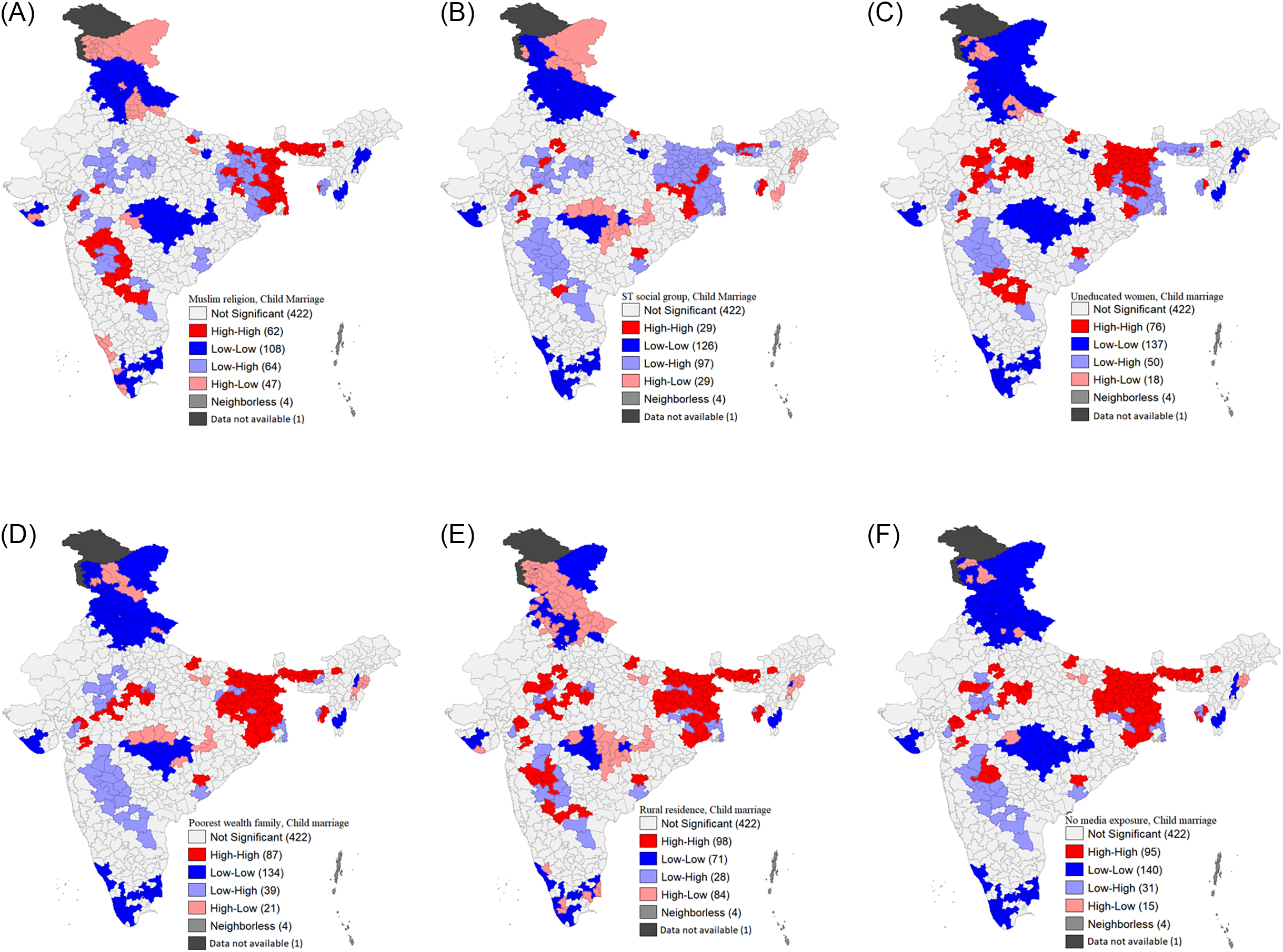
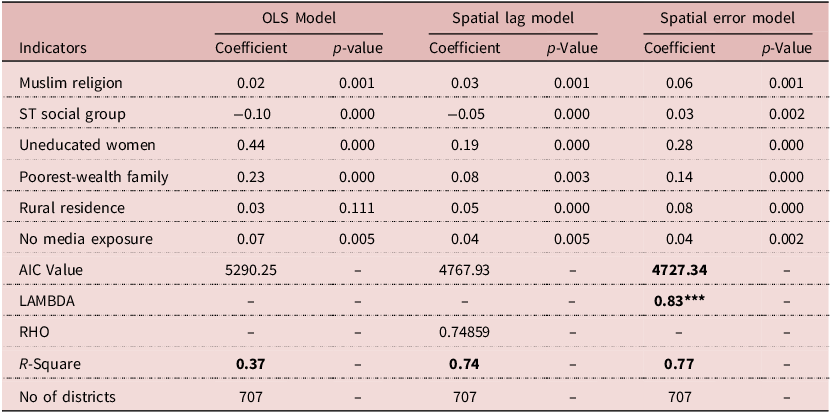
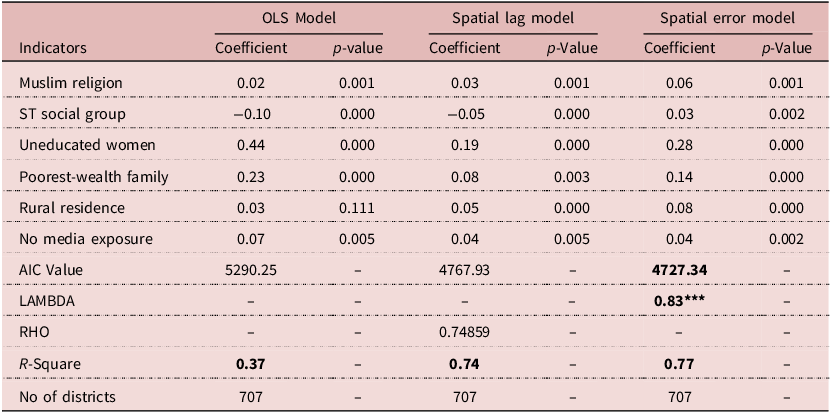
Table 7 presents the OLS, SLM, and SEM used to assess the association between child marriage and its correlates in India. The SEM emerges as the best-fitting model for assessing the association between child marriage and its correlates in India, based on its lowest AIC value (4727.34) and highest R-squared value (0.77) compared to the OLS model and SLM. The SEM accounts for spatial autocorrelation in error terms, suggesting that unobserved factors related to geography play a significant role in explaining the patterns of child marriage across districts. The Lambda value in the SEM was 0.83, which is highly significant (p < 0.001), indicating positive spatial autocorrelation of regions with a high prevalence of child marriage. The coefficient of uneducated women was the highest (β = 0.28), followed by poorest-wealth families (β = 0.14), rural residence (β = 0.08), and Muslim religion (β = 0.06). The coefficient estimates for uneducated women confirmed that a 10-point increase in the proportion of uneducated women was associated with a 2.8-point increase in child marriage. Similarly, a 10-point increase in the proportion of poorest-wealth families was associated with a 1.4-point increase in child marriage. These findings highlight the critical influence of education, poverty, and rural demographics on child marriage rates across India.
OLS, spatial lag, and spatial error model to assess the association between child marriage and its correlates in India
Discussion
According to the 2011 Census of India, the prevalence of child marriage below 14 years was higher among Hindus by 1.03 percentage points, whereas marriages below 18 years were higher among Muslims by a margin of 0.33 percentage points. However, historical data indicate that approximately four decades prior to the 2011 census, the proportion of child marriage was substantially higher among Muslims compared with Hindus. The rate of decline has been more significant than that of Hindus over the years. The Census of India data and the NFHS-5 data do not deal with the subjective factors responsible for the prevalence of child marriage. However, background characteristics like religious affiliation, education, social categories, wealth index, and media exposure are recorded and examined to establish a relationship with child marriage. However, the literature discussed in the foregoing part reveals several such subjective and objective aspects directly and indirectly related to child marriage in India and globally as well. The minimal difference in the incidence of child marriage among Muslims and Hindus indicates that the inherent factors responsible for child marriage might be similar and exist to the same extent.
The impact of similar religious references
Let us first discuss the role of religious references in the tradition of child marriage. Child marriage is a complex issue that intertwines with religious customs and interpretations within both Hindu and Islamic traditions. Both religions exhibit ambiguity in their textual interpretations concerning the marriage age. In Islam, although the Quran does not explicitly advocate for child marriage, certain practices from the life of the Prophet Muhammad, such as his marriage to Aisha at a young age, have been interpreted to allow early marriages (Bukhari, Reference Bukhari1987). Conversely, Hindu scriptures like the Manusmriti offer varied views. Some interpretations suggest marriage before puberty, ideally around eight years old (Mandal, Reference Mandal2024), while others argue for a later marriage age based on a girl’s maturity.
Cultural justifications are prevalent in both traditions. In Islam, specific interpretations of texts are used to legitimise early marriages, particularly in contexts involving premarital sex or unexpected pregnancies (SIS & ARROW, 2018). Similarly, Hindu customs have historically relied on the Manusmriti to validate early marriages, thereby reinforcing the notion of protecting chastity. Guardianship plays a crucial role in both religious contexts. Many Islamic scholars permit marriages to be contracted by a guardian before puberty, with consummation expected post-puberty. This mirrors Hindu practices where the father or guardian’s authority in marriage decisions is emphasised, often driven by social and economic considerations. Lastly, both traditions acknowledge the adverse health and social impacts of child marriage, despite these concerns often being overshadowed by cultural imperatives. Islamic discussions highlight potential consequences for young girls, while similar concerns are present in Hindu discourse. As evident in the census data, these similarities may have played a crucial role in maintaining child marriage rates at nearly equal levels over time.
The impact of socio-cultural traditions
Many socio-cultural beliefs and practices have religious ingredients. The African Union’s report (2015) indicates that strong religious practices can hinder the enforcement of legal prohibitions against child marriage. In countries like Egypt, Jordan, and Morocco, child marriage serves several social purposes, reinforcing gender roles and promoting social cohesion (UNICEF, 2017). Almost a similar sort of beliefs and d practices regarding child marriage exist in both Hindu and Muslim societies. For instance, many communities view early marriage as a protective measure against sexual violence and poverty (Kamal et al., Reference Kamal, Hassan, Alam and Ying2015; Akter et al., Reference Akter, Williams, Talukder, Islam, Escallon, Sultana, Kapil and Sarker2021). This is particularly prevalent in less developed nations, leading to high rates of child marriage, both in Muslim and Hindu-dominant countries (Krafft et al., Reference Krafft, Arango, Rubin and Kelly2022).
In less developed countries, poverty, limited educational opportunities and ruralness are the inherent characteristics that create a congenial situation, causing child marriage. A recent study by Shukla et al. (Reference Shukla, Upadhyay and Tiwari2024) reveals that within Hindu communities in rural India, early marriage is driven by socioeconomic factors. While explaining the inherent link between the economic condition of the family and child marriage, a recent study by Jailobaeva et al. (Reference Jailobaeva, Kraft, Barrett, Niyonkuru, Lim, Marin and Cossa2024) reveals that such families perceive their daughters as economic burdens and attempt to marry them off early to alleviate financial pressures. In both Hindu and Muslim traditions, people link the daughter’s chastity to family honour, which intensifies pressure for early marriages, particularly in patriarchal settings (Miedema et al., Reference Miedema, Koster, Pouw, Meyer and Sotirova2020; Seta, Reference Seta2023)
Explaining the findings of NFHS-5 data
Findings from the analysis of NFHS-5 data indicate that a high prevalence of child marriage is concentrated in specific regions, particularly when examined in conjunction with selected socio-demographic background characteristics. Religion alone as a factor is not significantly related to the great extent of child marriage. It is evident in states/UTs like Lakshadweep, J&K, and Kerala, where high Muslim concentration is associated with low child marriage incidents. However, the greatest extent of child marriage is prevalent among Muslim populations who are laden with other demographic factors like lesser education, poor economic conditions, and lesser social media exposure, as seen in West Bengal and parts of Assam in the Northeastern region of India. The literature review and the subsequent discussions reveal that poor economic conditions have been one of the most influential factors that determine child marriage across religious communities worldwide. This has been reflected well in the Bivariate LISA cluster maps. The prevalence of specific social categories in a particular geographical region is also a driving factor. The eastern regions, particularly Jharkhand and Odisha, have a higher concentration of tribal populations, which are often associated with stronger adherence to traditional practices, limited access to education, and higher levels of poverty. These socioeconomic and cultural factors may partly explain the persistence of child marriage in these areas.
Explaining the declining trend in child marriage
There has been a remarkable decline in <14 marriages across the religious groups in India. However, the declining rate is far lower in <18 marriages. Data shows that such a decline is influenced by several factors, notably education, wealth, and policies. Policies against child marriage have been a crucial strategy. The Prohibition of Child Marriage Act (2006) of India criminalises the practice and imposes penalties for violations, marking a significant step towards its elimination (Meena, Reference Meena2022). The United Nations’ Sustainable Development Goals (SDGs), at the international level, aim for the eradication of child marriage by 2030, framing it as a critical human rights violation (United Nations, 2015).
Malhotra et al. (Reference Malhotra, Warner, McGonagle and Lee-Rife2011) highlight the vital role of non-governmental organisations (NGOs) in raising awareness about the harmful effects of child marriage (Malhotra et al., Reference Malhotra, Warner, McGonagle and Lee-Rife2011). There is evidence that many NGOs work closely with communities to promote girls’ education and empowerment through awareness programmes on the benefits of delaying marriage. Improved access to education significantly reduces child marriage rates by enabling girls to resist early marriage (Rasmussen et al., Reference Rasmussen, Maharaj, Karan, Symons, Selvaraj, Kumar and Kumnick2021; Torabi, Reference Torabi2023).
Similarly, researchers such as Chakravarty (Reference Chakravarty2018) and Elengemoke and Susuman (Reference Elengemoke and Susuman2021) have proved that financial independence fosters greater autonomy for girls and enhanced economic opportunities reduce girls’ vulnerability to early marriage (Chakravarty, Reference Chakravarty2018; Elengemoke and Susuman, Reference Elengemoke and Susuman2021). Community involvement in addressing deeply rooted social norms is crucial for shifting attitudes towards marriage (Amzat, Reference Amzat2020; Miedema et al., Reference Miedema, Koster, Pouw, Meyer and Sotirova2020; Muriaas et al., Reference Muriaas, Tønnessen and Wang2018). Worldwide, grassroots movements on eradicating child marriage led by women and youth are also making significant impacts, particularly in Muslim-majority countries (Malhotra and Elnakib, Reference Malhotra and Elnakib2021). However, despite these advances, some regions still face persistent child marriage due to entrenched cultural practices (Naved et al., Reference Naved, Kalra, Talukder, Laterra, Nunna, Parvin and Al Mamun2022).
Conclusion
This study demonstrates that the extent of child marriage in India varies modestly by religious affiliation but is predominantly driven by intersecting socioeconomic factors. Analysis of Census 2011 data reveals minimal differences between Hindu and Muslim communities: marriages below age 14 were only 1.03% higher among Hindus, while those below age 18 were 0.33% higher among Muslims, with both showing marked historical declines – sharper for <14 marriages overall. NFHS-5 (2019–2021) data confirm a national prevalence of 24.03%, with Muslims 21% more likely to experience child marriage than Hindus after adjustments, yet education (higher education reducing odds by 94%), wealth (richest quintile by 59%), and rural residence emerge as far stronger predictors. Spatial analyses highlight clustering in eastern and northeastern districts, where poverty, low education, rurality, and limited media exposure amplify risks, often intersecting with religious or tribal demographics.
In essence, child marriage transcends religious boundaries, rooted in broader structural inequalities. Recent national trends indicate continued progress, with prevalence declining to approximately 23.3% by NFHS-5, though regional hotspots persist.
To accelerate elimination by the 2030 SDG target, policymakers should prioritise:
Targeted investments in girls’ education : Expand secondary and higher education access in high-prevalence districts (e.g., Bihar, West Bengal, Jharkhand), as it yields the highest protective effect; integrate life skills and gender equality curricula.
Economic empowerment programmes: Scale conditional cash transfers (e.g., enhancements to existing schemes like Sukanya Samriddhi or Kanyashree) linked to school retention and delayed marriage, particularly for the poorest households and the Scheduled Tribes.
Region-specific interventions: Strengthen enforcement and awareness in clustered hotspots via community engagement, appointing dedicated child marriage prevention officers, and leveraging grassroots NGOs for norm-changing campaigns.
Multisectoral coordination: Align legal enforcement under the Prohibition of Child Marriage Act (2006) with health, media exposure, and rural development initiatives to address omitted spatial factors.
Future research should incorporate qualitative insights into lived experiences and evaluate the long-term impacts of empowerment programmes. Sustained, multidimensional efforts combining education, economic support, and community mobilisation are essential to eradicate this human rights violation and unlock girls’ full potential.
Funding statement
This research did not receive any specific grant from funding agencies in the public, commercial, or not-for-profit sectors.
Competing interests
There are no known conflicts of interest/competing interests to declare.
Ethical standard
This study is based entirely on secondary data from the National Family Health Survey and the Census of India, both of which are publicly available sources (NFHS: &The DHS Program - login_main and Census: Home | Government of India). As no primary data collection or human subject involvement was required, ethical approval was not necessary.

 Open access

